
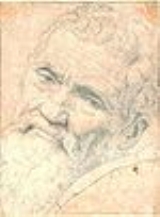
Michelangelo di Lodovico Buonarroti Simoni (6 March 1475 – 18 February 1564), commonly known as
Michelangelo, was an
ItalianThe Italian people are an ethnic group that share a common Italian culture, ancestry and speak the Italian language as a mother tongue. Within Italy, Italians are defined by citizenship, regardless of ancestry or country of residence , and are distinguished from people...
RenaissanceThe Italian Renaissance began the opening phase of the Renaissance, a period of great cultural change and achievement in Europe that spanned the period from the end of the 13th century to about 1600, marking the transition between Medieval and Early Modern Europe...
painter, sculptor, architect, poet, and engineer who exerted an unparalleled influence on the development of Western art. Despite making few forays beyond the arts, his versatility in the disciplines he took up was of such a high order that he is often considered a contender for the title of the archetypal
Renaissance manA polymath is a person whose expertise spans a significant number of different subject areas. In less formal terms, a polymath may simply be someone who is very knowledgeable...
, along with fellow Italian
Leonardo da VinciLeonardo di ser Piero da Vinci was an Italian Renaissance polymath: painter, sculptor, architect, musician, scientist, mathematician, engineer, inventor, anatomist, geologist, cartographer, botanist and writer whose genius, perhaps more than that of any other figure, epitomized the Renaissance...
.
Michelangelo was considered the greatest living artist in his lifetime, and ever since then he has been held to be one of the greatest artists of all time. A number of his works in painting, sculpture, and architecture rank among the most famous in existence. His output in every field during his long life was prodigious; when the sheer volume of correspondence, sketches, and reminiscences that survive is also taken into account, he is the best-documented artist of the 16th century. Two of his best-known works, the
PietàThe Pietà is a masterpiece of Renaissance sculpture by Michelangelo Buonarroti, housed in St. Peter's Basilica in Vatican City. It is the first of a number of works of the same theme by the artist. The statue was commissioned for the French cardinal Jean de Billheres, who was a representative in...
and
DavidDavid is a masterpiece of Renaissance sculpture created between 1501 and 1504, by the Italian artist Michelangelo. It is a marble statue of a standing male nude. The statue represents the Biblical hero David, a favoured subject in the art of Florence...
, were sculpted before he turned thirty. Despite his low opinion of painting, Michelangelo also created two of the most influential works in
frescoFresco is any of several related mural painting types, executed on plaster on walls or ceilings. The word fresco comes from the Greek word affresca which derives from the Latin word for "fresh". Frescoes first developed in the ancient world and continued to be popular through the Renaissance...
in the history of Western art: the scenes from Genesis on the
ceilingThe Sistine Chapel ceiling, painted by Michelangelo between 1508 and 1512, at the commission of Pope Julius II, is a cornerstone work of High Renaissance art. The ceiling is that of the large Papal Chapel built within the Vatican between 1477 and 1480 by Pope Sixtus IV after whom it is named...
and
The Last JudgmentThe Last Judgment is a canonical fresco by the Italian Renaissance master Michelangelo executed on the altar wall of the Sistine Chapel in Vatican City...
on the altar wall of the
Sistine ChapelSistine Chapel is the best-known chapel in the Apostolic Palace, the official residence of the Pope in Vatican City. It is famous for its architecture and its decoration that was frescoed throughout by Renaissance artists including Michelangelo, Sandro Botticelli, Pietro Perugino, Pinturicchio...
in Rome. As an architect, Michelangelo pioneered the
ManneristMannerism is a period of European art that emerged from the later years of the Italian High Renaissance around 1520. It lasted until about 1580 in Italy, when a more Baroque style began to replace it, but Northern Mannerism continued into the early 17th century throughout much of Europe...
style at the
Laurentian LibraryThe Laurentian Library is a historical library in Florence, Italy, containing a repository of more than 11,000 manuscripts and 4,500 early printed books...
. At 74 he succeeded
Antonio da Sangallo the Youngerthumb|250px|The church of Santa Maria di Loreto near the [[Trajan's Market]] in [[Rome]], considered Sangallo's masterwork.thumb|250px|View of St. Patrick's Well in [[Orvieto]]....
as the architect of
St. Peter's BasilicaThe Papal Basilica of Saint Peter , officially known in Italian as ' and commonly known as Saint Peter's Basilica, is a Late Renaissance church located within the Vatican City. Saint Peter's Basilica has the largest interior of any Christian church in the world...
. Michelangelo transformed the plan, the western end being finished to Michelangelo's design, the dome being completed after his death with some modification.
In a demonstration of Michelangelo's unique standing, he was the first Western artist whose biography was published while he was alive. Two biographies were published of him during his lifetime; one of them, by
Giorgio VasariGiorgio Vasari was an Italian painter, writer, historian, and architect, who is famous today for his biographies of Italian artists, considered the ideological foundation of art-historical writing.-Biography:...
, proposed that he was the pinnacle of all artistic achievement since the beginning of the
RenaissanceThe Renaissance was a cultural movement that spanned roughly the 14th to the 17th century, beginning in Italy in the Late Middle Ages and later spreading to the rest of Europe. The term is also used more loosely to refer to the historical era, but since the changes of the Renaissance were not...
, a viewpoint that continued to have currency in art history for centuries. In his lifetime he was also often called
Il Divino ("the divine one"). One of the qualities most admired by his contemporaries was his
terribilità, a sense of awe-inspiring grandeur, and it was the attempts of subsequent artists to imitate Michelangelo's impassioned and highly personal style that resulted in
MannerismMannerism is a period of European art that emerged from the later years of the Italian High Renaissance around 1520. It lasted until about 1580 in Italy, when a more Baroque style began to replace it, but Northern Mannerism continued into the early 17th century throughout much of Europe...
, the next major movement in Western art after the
High RenaissanceThe expression High Renaissance, in art history, is a periodizing convention used to denote the apogee of the visual arts in the Italian Renaissance...
.
Early life
Michelangelo was born on 6 March 1475 in
CapreseCaprese Michelangelo is a village and comune in the province of Arezzo, Tuscany, Italy. It is the birthplace of the renowned Renaissance artist Michelangelo. The village is roughly 100 km east of Florence....
near
ArezzoArezzo is a city and comune in Central Italy, capital of the province of the same name, located in Tuscany. Arezzo is about 80 km southeast of Florence, at an elevation of 296 m above sea level. In 2011 the population was about 100,000....
,
TuscanyTuscany is a region in Italy. It has an area of about 23,000 square kilometres and a population of about 3.75 million inhabitants. The regional capital is Florence ....
. (Today, Caprese is known as Caprese Michelangelo). For several generations, his family had been small-scale bankers in Florence, but his father, Ludovico di Leonardo di Buonarotto Simoni, failed to maintain the bank's financial status, and held occasional government positions. At the time of Michelangelo's birth, his father was the
Judicial administratorA magistrate is an officer of the state; in modern usage the term usually refers to a judge or prosecutor. This was not always the case; in ancient Rome, a magistratus was one of the highest government officers and possessed both judicial and executive powers. Today, in common law systems, a...
of the small town of Caprese and
local administratorPodestà is the name given to certain high officials in many Italian cities, since the later Middle Ages, mainly as Chief magistrate of a city state , but also as a local administrator, the representative of the Emperor.The term derives from the Latin word potestas, meaning power...
of
ChiusiChiusi is a town and comune in province of Siena, Tuscany, Italy.-History:It was one of the more powerful among the Etruscan 12‑city confederation...
. Michelangelo's mother was Francesca di Neri del Miniato di Siena. The Buonarrotis claimed to descend from the Countess Mathilde of Canossa; this claim remains unproven, but Michelangelo himself believed it. Several months after Michelangelo's birth, the family returned to Florence, where Michelangelo was raised. At later times, during the prolonged illness and after the death of his mother in 1481 when he was just six years old, Michelangelo lived with a stonecutter and his wife and family in the town of
SettignanoSettignano is a picturesque frazione ranged on a hillside northeast of Florence, Italy, with spectacular views that have attracted American expatriates for generations...
, where his father owned a marble quarry and a small farm.
Giorgio VasariGiorgio Vasari was an Italian painter, writer, historian, and architect, who is famous today for his biographies of Italian artists, considered the ideological foundation of art-historical writing.-Biography:...
quotes Michelangelo as saying, "If there is some good in me, it is because I was born in the subtle atmosphere of your country of Arezzo. Along with the milk of my nurse I received the knack of handling chisel and hammer, with which I make my figures."
Michelangelo's father sent him to study
grammarIn linguistics, grammar is the set of structural rules that govern the composition of clauses, phrases, and words in any given natural language. The term refers also to the study of such rules, and this field includes morphology, syntax, and phonology, often complemented by phonetics, semantics,...
with the
HumanistHumanism is an approach in study, philosophy, world view or practice that focuses on human values and concerns. In philosophy and social science, humanism is a perspective which affirms some notion of human nature, and is contrasted with anti-humanism....
Francesco da Urbino in Florence as a young boy. The young artist, however, showed no interest in his schooling, preferring to copy paintings from churches and seek the company of painters. At thirteen, Michelangelo was apprenticed to the painter
Domenico GhirlandaioDomenico Ghirlandaio was an Italian Renaissance painter from Florence. Among his many apprentices was Michelangelo.-Early years:Ghirlandaio's full name is given as Domenico di Tommaso di Currado di Doffo Bigordi...
. When Michelangelo was only fourteen, his father persuaded Ghirlandaio to pay his apprentice as an artist, which was highly unusual at the time. When in 1489
Lorenzo de' MediciLorenzo de' Medici was an Italian statesman and de facto ruler of the Florentine Republic during the Italian Renaissance. Known as Lorenzo the Magnificent by contemporary Florentines, he was a diplomat, politician and patron of scholars, artists and poets...
, de facto ruler of Florence, asked Ghirlandaio for his two best pupils, Ghirlandaio sent Michelangelo and
Francesco GranacciFrancesco Granacci was an Italian painter of the Renaissance.Born at Villamagna di Volterra, he trained in Florence in the studio of Domenico Ghirlandaio, and was employed painting frescoes for San Marco on commission of Lorenzo de'Medici...
. From 1490 to 1492, Michelangelo attended the
HumanistHumanism is an approach in study, philosophy, world view or practice that focuses on human values and concerns. In philosophy and social science, humanism is a perspective which affirms some notion of human nature, and is contrasted with anti-humanism....
academy which the Medici had founded along
Neo PlatonicPlatonism is the philosophy of Plato or the name of other philosophical systems considered closely derived from it. In a narrower sense the term might indicate the doctrine of Platonic realism...
lines. Michelangelo studied sculpture under
Bertoldo di GiovanniBertoldo di Giovanni was an Italian sculptor and medallist.Born in Florence, he was a pupil of Donatello and for a long time worked in his master's workshop, carrying out his unfinished works after his death in 1466, for example the bronze pulpit reliefs from the life of Christ in the Basilica di...
. At the academy, both Michelangelo's outlook and his art were subject to the influence of many of the most prominent philosophers and writers of the day including
Marsilio FicinoMarsilio Ficino was one of the most influential humanist philosophers of the early Italian Renaissance, an astrologer, a reviver of Neoplatonism who was in touch with every major academic thinker and writer of his day, and the first translator of Plato's complete extant works into Latin...
, Pico della Mirandola and
PolizianoAngelo Ambrogini, commonly known by his nickname, anglicized as Politian, Italian Poliziano, Latin Politianus was an Italian Renaissance classical scholar and poet, one of the revivers of Humanist Latin...
. At this time, Michelangelo sculpted the reliefs
Madonna of the StepsMadonna of the stairs is a relief by Italian Renaissance master Michelangelo, created around 1491.-History:The first citation that Madonna of the stairs was a Michelangelo sculpture was in Giorgio Vasari's Lives in the 1568 edition.-External links:* - From the Official Site of Casa Buonarroti...
(1490–1492) and
Battle of the CentaursBattle of the Centaurs is a relief by Italian Renaissance artist Michelangelo, created around 1492. It was the last work Michelangelo created while under the patronage of Lorenzo de' Medici, who died shortly after its completion...
(1491–1492). The latter was based on a theme suggested by Poliziano and was commissioned by Lorenzo de
MediciThe House of Medici or Famiglia de' Medici was a political dynasty, banking family and later royal house that first began to gather prominence under Cosimo de' Medici in the Republic of Florence during the late 14th century. The family originated in the Mugello region of the Tuscan countryside,...
.
While both were apprenticed to Bertoldo di Giovanni,
Pietro TorrigianoPietro Torrigiano was an Italian sculptor of the Florentine school. According to Giorgio Vasari, he was one of the group of talented youths who studied art under the patronage of Lorenzo de' Medici in Florence....
struck the 17-year-old on the nose, and thus caused that disfigurement which is so conspicuous in all the portraits of Michelangelo.
Early adulthood
Lorenzo de' Medici's death on 8 April 1492 brought a reversal of Michelangelo's circumstances. Michelangelo left the security of the Medici court and returned to his father's house. In the following months he carved a
wooden crucifixTwo different crucifixes, or strictly wooden corpus figures for crucifixes, are attributed to the High Renaissance master Michelangelo, although neither is universally accepted as his...
(1493), as a gift to the prior of the Florentine church of
Santo SpiritoThe Basilica of Santa Maria del Santo Spirito is a church in Florence, Italy. Usually referred to simply as Santo Spirito, it is located in the Oltrarno quarter, facing the square with the same name...
, who had permitted him some studies of
anatomyAnatomy is a branch of biology and medicine that is the consideration of the structure of living things. It is a general term that includes human anatomy, animal anatomy , and plant anatomy...
on the corpses of the church's hospital. Between 1493 and 1494 he bought a block of marble for a larger than life statue of
HerculesHercules is the Roman name for Greek demigod Heracles, son of Zeus , and the mortal Alcmene...
, which was sent to France and subsequently disappeared sometime circa 18th century. On 20 January 1494, after heavy snowfalls, Lorenzo's heir,
Piero de MediciPiero de' Medici , called Piero the Unfortunate, was the Gran maestro of Florence from 1492 until his exile in 1494.-Life and death:...
commissioned a snow statue, and Michelangelo again entered the court of the Medici.
In the same year, the Medici were expelled from Florence as the result of the rise of Savonarola. Michelangelo left the city before the end of the political upheaval, moving to
VeniceVenice is a city in northern Italy which is renowned for the beauty of its setting, its architecture and its artworks. It is the capital of the Veneto region...
and then to
BolognaBologna is the capital city of Emilia-Romagna, in the Po Valley of Northern Italy. The city lies between the Po River and the Apennine Mountains, more specifically, between the Reno River and the Savena River. Bologna is a lively and cosmopolitan Italian college city, with spectacular history,...
. In Bologna, he was commissioned to finish the carving of the last small figures of the
Shrine of St. DominicThe Arca di San Domenico is a monument containing the remains of Saint Dominic. It is located in Dominic’s Chapel in the Basilica of San Domenico in Bologna, Italy.- History :...
, in the church dedicated to that saint. Towards the end of 1494, the political situation in Florence was calmer. The city, previously under threat from the French, was no longer in danger as
Charles VIIICharles VIII, called the Affable, , was King of France from 1483 to his death in 1498. Charles was a member of the House of Valois...
had suffered defeats. Michelangelo returned to Florence but received no commissions from the new city government under Savonarola. He returned to the employment of the Medici. During the half year he spent in Florence he worked on two small statues, a child
St. John the Baptist and a sleeping
CupidMichelangelo created two sculptures of Cupid, the first of which was a forgery designed to look like an antique sculpture, through which he first came to the attention of patrons in Rome. Both works are now lost.-Sleeping Cupid:...
. According to Condivi,
Lorenzo di Pierfrancesco de' MediciLorenzo di Pierfrancesco de' Medici , nicknamed the Popolano, was an Italian banker and politician, the brother of Giovanni de' Medici il Popolano....
, for whom Michelangelo had sculpted
St. John the Baptist, asked that Michelangelo "fix it so that it looked as if it had been buried" so he could "send it to Rome...pass [it off as] an ancient work and...sell it much better." Both Lorenzo and Michelangelo were unwittingly cheated out of the real value of the piece by a middleman. Cardinal
Raffaele RiarioRaffaele Sansoni Galeoti Riario was an Italian Cardinal of the Renaissance, mainly known as the constructor of the Palazzo della Cancelleria and the one who invited Michelangelo to Rome. He was a patron of the arts...
, to whom Lorenzo had sold it, discovered that it was a fraud, but was so impressed by the quality of the sculpture that he invited the artist to Rome. This apparent success in selling his sculpture abroad as well as the conservative Florentine situation may have encouraged Michelangelo to accept the prelate's invitation.
Rome
Michelangelo arrived in Rome 25 June 1496 at the age of 21. On 4 July of the same year, he began work on a commission for Cardinal
Raffaele RiarioRaffaele Sansoni Galeoti Riario was an Italian Cardinal of the Renaissance, mainly known as the constructor of the Palazzo della Cancelleria and the one who invited Michelangelo to Rome. He was a patron of the arts...
, an over-life-size statue of the Roman wine god,
BacchusBacchus is a marble sculpture by the Italian High Renaissance sculptor, painter, architect and poet Michelangelo. The statue is somewhat over life-size and depicts Bacchus, the Roman god of wine, in a revolutionary inebriated state...
. However, upon completion, the work was rejected by the cardinal, and subsequently entered the collection of the banker Jacopo Galli, for his garden.
In November of 1497, the French ambassador in the Holy See commissioned one of his most famous works, the
PietàThe Pietà is a masterpiece of Renaissance sculpture by Michelangelo Buonarroti, housed in St. Peter's Basilica in Vatican City. It is the first of a number of works of the same theme by the artist. The statue was commissioned for the French cardinal Jean de Billheres, who was a representative in...
and the contract was agreed upon in August of the following year. The contemporary opinion about this work – "a revelation of all the potentialities and force of the art of sculpture" – was summarized by Vasari: "It is certainly a miracle that a formless block of stone could ever have been reduced to a perfection that nature is scarcely able to create in the flesh."
In Rome, Michelangelo lived near the church of
Santa Maria di LoretoSanta Maria di Loreto is a 16th century church in Rome, central Italy, located just across the street from the Trajan's Column, near the giant Monument of Vittorio Emanuele II....
. Here, according to the legend, he fell in love with
Vittoria ColonnaVittoria Colonna , marchioness of Pescara, was an Italian noblewoman and poet.-Biography:The daughter of Fabrizio Colonna, grand constable of the kingdom of Naples, and of Agnese da Montefeltro, Vittoria Colonna was born at Marinoa fief of the Colonna family in the Alban Hills near Rome.Betrothed...
, marchioness of
PescaraPescara is the capital city of the Province of Pescara, in the Abruzzo region of Italy. As of January 1, 2007 it was the most populated city within Abruzzo at 123,059 residents, 400,000 with the surrounding metropolitan area...
and a poet. His house was demolished in 1874, and the remaining architectural elements saved by the new proprietors were destroyed in 1930. Today a modern reconstruction of Michelangelo's house can be seen on the
JaniculumThe Janiculum is a hill in western Rome, Italy. Although the second-tallest hill in the contemporary city of Rome, the Janiculum does not figure among the proverbial Seven Hills of Rome, being west of the Tiber and outside the boundaries of the ancient city.-Sights:The Janiculum is one of the...
hill. It is also during this period that skeptics allege Michelangelo executed the sculpture
Laocoön and His SonsThe statue of Laocoön and His Sons , also called the Laocoön Group, is a monumental sculpture in marble now in the Vatican Museums, Rome. The statue is attributed by the Roman author Pliny the Elder to three sculptors from the island of Rhodes: Agesander, Athenodoros and Polydorus...
which resides in the
VaticanThe Vatican Museums , in Viale Vaticano in Rome, inside the Vatican City, are among the greatest museums in the world, since they display works from the immense collection built up by the Roman Catholic Church throughout the centuries, including some of the most renowned classical sculptures and...
.
Statue of David
Michelangelo returned to Florence in 1499–1501. Things were changing in the
republicThe Republic of Florence , or the Florentine Republic, was a city-state that was centered on the city of Florence, located in modern Tuscany, Italy. The republic was founded in 1115, when the Florentine people rebelled against the Margraviate of Tuscany upon Margravine Matilda's death. The...
after the fall of anti-Renaissance Priest and leader of Florence,
Girolamo SavonarolaGirolamo Savonarola was an Italian Dominican friar, Scholastic, and an influential contributor to the politics of Florence from 1494 until his execution in 1498. He was known for his book burning, destruction of what he considered immoral art, and what he thought the Renaissance—which began in his...
(executed in 1498) and the rise of the
gonfaloniere Piero SoderiniPiero di Tommaso Soderini also known as Pier Soderini, was an Italian statesman of the Republic of Florence.-Biography:...
. He was asked by the consuls of the Guild of Wool to complete an unfinished project begun 40 years earlier by
Agostino di DuccioAgostino di Duccio was an Italian early Renaissance sculptor.Born in Florence, he worked in Prato with Donatello and Michelozzo, who influenced him greatly. In 1441, he was accused of stealing precious materials from a monastery in Florence and was banished from his native city as a result...
: a colossal statue portraying David as a symbol of Florentine freedom, to be placed in the Piazza della Signoria, in front of the
Palazzo VecchioThe Palazzo Vecchio is the town hall of Florence, Italy. This massive, Romanesque, crenellated fortress-palace is among the most impressive town halls of Tuscany...
. Michelangelo responded by completing his most famous work, the
Statue of DavidDavid is a masterpiece of Renaissance sculpture created between 1501 and 1504, by the Italian artist Michelangelo. It is a marble statue of a standing male nude. The statue represents the Biblical hero David, a favoured subject in the art of Florence...
in 1504. This masterwork, created out of a marble block from the quarries at
CarraraCarrara is a city and comune in the province of Massa-Carrara , notable for the white or blue-grey marble quarried there. It is on the Carrione River, some west-northwest of Florence....
that had already been worked on by an earlier hand, definitively established his prominence as a sculptor of extraordinary technical skill and strength of symbolic imagination.
Also during this period, Michelangelo painted the
Holy Family and St John, also known as the
Doni TondoThe Doni Tondo or Doni Madonna, sometimes called The Holy Family, is the earliest of only three surviving panel paintings by the adult Italian Renaissance master Michelangelo Buonarroti, and the only one to be finished...
or the
Holy Family of the Tribune: it was commissioned for the marriage of Angelo Doni and Maddalena Strozzi and in the 17th century hung in the room known as the Tribune in the
UffiziThe Uffizi Gallery , is a museum in Florence, Italy. It is one of the oldest and most famous art museums of the Western world.-History:...
. He also may have painted the Madonna and Child with
John the BaptistJohn the Baptist was an itinerant preacher and a major religious figure mentioned in the Canonical gospels. He is described in the Gospel of Luke as a relative of Jesus, who led a movement of baptism at the Jordan River...
, known as the
Manchester MadonnaThe Madonna and Child with St John and Angels , also known as The Manchester Madonna, is an unfinished painting by Michelangelo in the National Gallery, London. It is one of the four panel paintings by the artist, dating to Michelangelo's first period in Rome...
and now in the
National GalleryThe National Gallery is an art gallery on Trafalgar Square, London, United Kingdom.National Gallery may also refer to:*Armenia: National Gallery of Armenia, Yerevan*Australia:**National Gallery of Australia, Canberra...
, London.
Sistine Chapel ceiling
In 1505 Michelangelo was invited back to Rome by the newly elected
Pope Julius IIPope Julius II , nicknamed "The Fearsome Pope" and "The Warrior Pope" , born Giuliano della Rovere, was Pope from 1503 to 1513...
. He was commissioned to build the Pope's tomb. Under the patronage of the Pope, Michelangelo had to constantly stop work on the tomb in order to accomplish numerous other tasks. Because of these interruptions, Michelangelo worked on the tomb for 40 years. The tomb, of which the central feature is Michelangelo's
statue of MosesThe Moses is a sculpture by the Italian High Renaissance artist Michelangelo Buonarroti, housed in the church of San Pietro in Vincoli in Rome...
, was never finished to Michelangelo's satisfaction. It is located in the
Church of S. Pietro in VincoliSan Pietro in Vincoli is a Roman Catholic titular church and minor basilica in Rome, Italy, best known for being the home of Michelangelo's statue of Moses, part of the tomb of Pope Julius II.-History:...
in Rome.
During the same period, Michelangelo took the commission to paint the ceiling of the Sistine Chapel, which took approximately four years to complete (1508–1512). According to Michelangelo's account, Bramante and
RaphaelRaffaello Sanzio da Urbino , better known simply as Raphael, was an Italian painter and architect of the High Renaissance. His work is admired for its clarity of form and ease of composition and for its visual achievement of the Neoplatonic ideal of human grandeur...
convinced the Pope to commission Michelangelo in a medium not familiar to the artist. This was done in order that he, Michelangelo, would suffer unfavorable comparisons with his rival Raphael, who at the time was at the peak of his own artistry as the primo fresco painter. However, this story is discounted by modern historians on the grounds of contemporary evidence, and may merely have been a reflection of the artist's own perspective.
Michelangelo was originally commissioned to paint the 12 Apostles against a starry sky, but lobbied for a different and more complex scheme, representing creation, the Downfall of Man and the Promise of Salvation through the prophets and Genealogy of Christ. The work is part of a larger scheme of decoration within the chapel which represents much of the doctrine of the Catholic Church.
The composition eventually contained over 300 figures and had at its center nine episodes from the Book of Genesis, divided into three groups: God's Creation of the Earth; God's Creation of Humankind and their fall from God's grace; and lastly, the state of Humanity as represented by
NoahNoah was, according to the Hebrew Bible, the tenth and last of the antediluvian Patriarchs. The biblical story of Noah is contained in chapters 6–9 of the book of Genesis, where he saves his family and representatives of all animals from the flood by constructing an ark...
and his family. On the pendentives supporting the ceiling are painted twelve men and women who prophesied the coming of the Jesus. They are seven
prophetIn religion, a prophet, from the Greek word προφήτης profitis meaning "foreteller", is an individual who is claimed to have been contacted by the supernatural or the divine, and serves as an intermediary with humanity, delivering this newfound knowledge from the supernatural entity to other people...
s of Israel and five
SibylThe word Sibyl comes from the Greek word σίβυλλα sibylla, meaning prophetess. The earliest oracular seeresses known as the sibyls of antiquity, "who admittedly are known only through legend" prophesied at certain holy sites, under the divine influence of a deity, originally— at Delphi and...
s, prophetic women of the Classical world.
Among the most famous paintings on the ceiling are
The Creation of AdamThe Creation of Adam is a section of Michelangelo's fresco Sistine Chapel ceiling painted circa 1511. It illustrates the Biblical story from the Book of Genesis in which God the Father breathes life into Adam, the first man...
,
Adam and EveAdam and Eve were, according to the Genesis creation narratives, the first human couple to inhabit Earth, created by YHWH, the God of the ancient Hebrews...
in the
Garden of EdenThe Garden of Eden is in the Bible's Book of Genesis as being the place where the first man, Adam, and his wife, Eve, lived after they were created by God. Literally, the Bible speaks about a garden in Eden...
, the Great Flood, the Prophet
IsaiahIsaiah ; Greek: ', Ēsaïās ; "Yahu is salvation") was a prophet in the 8th-century BC Kingdom of Judah.Jews and Christians consider the Book of Isaiah a part of their Biblical canon; he is the first listed of the neviim akharonim, the later prophets. Many of the New Testament teachings of Jesus...
and the
Cumaean SibylThe ageless Cumaean Sibyl was the priestess presiding over the Apollonian oracle at Cumae, a Greek colony located near Naples, Italy.The word sibyl comes from the ancient Greek word sibylla, meaning prophetess. There were many Sibyls in different locations throughout the ancient world...
. Around the windows are painted the ancestors of Christ.
Under Medici popes in Florence
In 1513 Pope Julius II died and his successor
Pope Leo XPope Leo X , born Giovanni di Lorenzo de' Medici, was the Pope from 1513 to his death in 1521. He was the last non-priest to be elected Pope. He is known for granting indulgences for those who donated to reconstruct St. Peter's Basilica and his challenging of Martin Luther's 95 Theses...
, of the
MediciThe House of Medici or Famiglia de' Medici was a political dynasty, banking family and later royal house that first began to gather prominence under Cosimo de' Medici in the Republic of Florence during the late 14th century. The family originated in the Mugello region of the Tuscan countryside,...
family, commissioned Michelangelo to reconstruct the façade of the Basilica of San Lorenzo in Florence and to adorn it with sculptures. Michelangelo agreed reluctantly. The three years Michelangelo spent in creating drawings and models for the façade, as well as attempting to open a new marble quarry at Pietrasanta specifically for the project, were among the most frustrating in his career, as work was abruptly canceled by his financially strapped patrons before any real progress had been made. The basilica lacks a façade to this day.
Apparently not the least embarrassed by this turnabout, the Medici later came back to Michelangelo with another grand proposal, this time for a family funerary chapel in the Basilica of San Lorenzo. Fortunately for posterity, this project, occupying the artist for much of the 1520s and 1530s, was more fully realized.
In 1527, the Florentine citizens, encouraged by the
sack of RomeThe Sack of Rome on 6 May 1527 was a military event carried out by the mutinous troops of Charles V, Holy Roman Emperor in Rome, then part of the Papal States...
, threw out the Medici and restored the republic. A siege of the city ensued, and Michelangelo went to the aid of his beloved Florence by working on the city's fortifications from 1528 to 1529. The city fell in 1530 and the Medici were restored to power. Completely out of sympathy with the repressive reign of the ducal Medici, Michelangelo left Florence for good in the mid-1530s, leaving assistants to complete the Medici chapel.
Last works in Rome
The
frescoFresco is any of several related mural painting types, executed on plaster on walls or ceilings. The word fresco comes from the Greek word affresca which derives from the Latin word for "fresh". Frescoes first developed in the ancient world and continued to be popular through the Renaissance...
of
The Last JudgmentThe Last Judgment is a canonical fresco by the Italian Renaissance master Michelangelo executed on the altar wall of the Sistine Chapel in Vatican City...
on the altar wall of the Sistine Chapel was commissioned by
Pope Clement VIIClement VII , born Giulio di Giuliano de' Medici, was a cardinal from 1513 to 1523 and was Pope from 1523 to 1534.-Early life:...
, who died shortly after assigning the commission. Paul III was instrumental in seeing that Michelangelo began and completed the project. Michelangelo labored on the project from 1534 to October 1541. The work is massive and spans the entire wall behind the altar of the Sistine Chapel.
The Last Judgment is a depiction of the second coming of Christ and the apocalypse; where the souls of humanity rise and are assigned to their various fates, as judged by Christ, surrounded by the Saints. In that work, the position of the figure of Christ appears to pay tribute to that of Melozzo's Christ in the
Ascension of our Lord, once in the
Santi ApostoliThe Church of the Twelve Holy Apostles is a 6th century Roman Catholic parish and titular church and minor basilica in Rome, Italy, dedicated originally to St. James and St. Philip and later to all Apostles...
, now in the
Quirinal PalaceThe Quirinal Palace is a historical building in Rome, Italy, the current official residence of the President of the Italian Republic. It is located on the Quirinal Hill, the tallest of the seven hills of Rome...
.
Once completed, the depiction of Christ and the Virgin Mary naked was considered sacrilegious, and
Cardinal CarafaPope Paul IV, C.R. , né Giovanni Pietro Carafa, was Pope from 23 May 1555 until his death.-Early life:Giovanni Pietro Carafa was born in Capriglia Irpina, near Avellino, into a prominent noble family of Naples...
and Monsignor Sernini (
Mantua'sMantua is a city and comune in Lombardy, Italy and capital of the province of the same name. Mantua's historic power and influence under the Gonzaga family, made it one of the main artistic, cultural and notably musical hubs of Northern Italy and the country as a whole...
ambassador) campaigned to have the fresco removed or censored, but the Pope resisted. After Michelangelo's death, it was decided to obscure the genitals (
"Pictura in Cappella Ap.ca coopriantur"). So
Daniele da VolterraDaniele Ricciarelli , better known as Daniele da Volterra, was an Italian mannerist painter and sculptor.He is best remembered for his association, for better or worse, with the late Michelangelo. Several of Daniele's most important works were based on designs made for that purpose by Michelangelo...
, an apprentice of Michelangelo, was commissioned to cover with perizomas (briefs) the genitals, leaving unaltered the complex of bodies. When the work was restored in 1993, the conservators chose not to remove all the perizomas of Daniele, leaving some of them as a historical document, and because some of Michelangelo’s work was previously scraped away by the touch-up artist's application of “decency” to the masterpiece. A faithful uncensored copy of the original, by
Marcello VenustiMarcello Venusti was an Italian Mannnerist painter active in Rome in mid 16th century.Native to Mazzo di Valtellina near Como, he was reputed to have been a pupil of Perino del Vaga. He is known for a scaled copy of the Michelangelo's Last Judgement, commissioned by Cardinal Alessandro Farnese,...
, can be seen at the
Capodimonte MuseumThe National Museum of Capodimonte is located in the Palace of Capodimonte, a grand Bourbon palazzo in Naples, Italy. The museum is the prime repository of Neapolitan painting and decorative art, with several important works from other Italian schools of painting, and some important Ancient Roman...
of
NaplesNaples is a city in Southern Italy, situated on the country's west coast by the Gulf of Naples. Lying between two notable volcanic regions, Mount Vesuvius and the Phlegraean Fields, it is the capital of the region of Campania and of the province of Naples...
.
Censorship always followed Michelangelo, once described as "inventor delle porcherie" ("inventor of obscenities", in the original Italian language referring to "pork things"). The infamous "fig-leaf campaign" of the
Counter-ReformationThe Counter-Reformation was the period of Catholic revival beginning with the Council of Trent and ending at the close of the Thirty Years' War, 1648 as a response to the Protestant Reformation.The Counter-Reformation was a comprehensive effort, composed of four major elements:#Ecclesiastical or...
, aiming to cover all representations of human genitals in paintings and sculptures, started with Michelangelo's works. To give two examples, the marble statue of
Cristo della MinervaThe Cristo della Minerva, also known as Christ the Redeemer or Christ Carrying the Cross, is a marble sculpture by the Italian High Renaissance master Michelangelo Buonarroti, finished in 1521...
(church of
Santa Maria sopra MinervaThe Basilica of Saint Mary Above Minerva is a titular minor basilica and one of the most important churches of the Roman Catholic Dominican order in Rome, Italy. The church, located in the Piazza della Minerva in the Campus Martius region, is considered the only Gothic church in Rome. It houses...
, Rome) was covered by added drapery, as it remains today, and the statue of the naked child Jesus in
Madonna of BrugesThe Madonna of Bruges is a marble sculpture by Michelangelo, of Mary with the infant Jesus.Michelangelo's depiction of the Madonna and Child differs significantly from earlier representations of the same subject, which tended to feature a pious Virgin smiling down on an infant held in her arms...
(The
Church of Our LadyThe Church of Our Lady in Bruges, Belgium, dates mainly from the 13th, 14th and 15th centuries.Its tower, at 122.3 meters in height, remains the tallest structure in the city and the second tallest brickwork tower in the world The Church of Our Lady in Bruges, Belgium, dates mainly from the 13th,...
in
BrugesBruges is the capital and largest city of the province of West Flanders in the Flemish Region of Belgium. It is located in the northwest of the country....
, Belgium) remained covered for several decades. Also, the plaster copy of the David in the
Cast Courts (Victoria and Albert Museum)The Cast Courts of the Victoria and Albert Museum in London, England, comprise two large halls. Unusually for a museum, the Cast Courts house a collection not of originals, but copies. Here are to be found reproductions of some of the most famous sculptures in the world...
in London, has a fig leaf in a box at the back of the statue. It was there to be placed over the statue's genitals so that they would not upset visiting female royalty.
In 1546, Michelangelo was appointed architect of
St. Peter's BasilicaThe Papal Basilica of Saint Peter , officially known in Italian as ' and commonly known as Saint Peter's Basilica, is a Late Renaissance church located within the Vatican City. Saint Peter's Basilica has the largest interior of any Christian church in the world...
in the Vatican, and designed its dome. As St. Peter's was progressing there was concern that Michelangelo would pass away before the dome was finished. However, once building commenced on the lower part of the dome, the supporting ring, the completion of the design was inevitable. Michelangelo died in Rome at the age of 88 (three weeks before his 89th birthday). His body was brought back from Rome for interment at the Basilica of Santa Croce, fulfilling the maestro's last request to be buried in his beloved
TuscanyTuscany is a region in Italy. It has an area of about 23,000 square kilometres and a population of about 3.75 million inhabitants. The regional capital is Florence ....
.
Last sketch found
On 7 December 2007, Michelangelo's red chalk sketch for the dome of St Peter's Basilica, his last before his death in 1564, was discovered in the Vatican archives. It is extremely rare, since he destroyed his designs later in life. The sketch is a partial plan for one of the radial columns of the cupola drum of Saint Peter's.
Disputed works
A number of works attributed to Michelangelo are disputed. These include the
Palestrina PietàPalestrina Pietà is a marble sculpture by the Italian High Renaissance, dating from c. 1555 and housed in the Academy of Fine Arts, Florence, Italy. It was formerly attributed to Michelangelo, but now it is mostly considered to have been completed by someone else. The sculpture depicts three...
and the paintings, The
Manchester Madonna and
The Torment of Saint Anthony, newly acquired by the
Kimbell Art MuseumThe Kimbell Art Museum in Fort Worth, Texas, hosts a small but excellent art collection as well as traveling art exhibitions, educational programs and an extensive research library. Its initial artwork came from the private collection of Kay and Velma Kimbell, who also provided funds for a new...
, USA (previously attributed to "Workshop of Domenico Ghirlandaio", and having had two previously unsuccessful attempts at attribution to the hand of Michelangelo). In addition, the
Cupid sculpture "rediscovered" in the French Embassy in New York in 1996 (now on loan to the Metropolitan Museum of Art) has also been inconclusively attributed to Michelangelo.
Architectural work
Michelangelo worked on many projects that had been started by other men, most notably in his work at St Peter's Basilica, Rome. The Campidoglio, designed by Michelangelo during the same period, rationalized the structures and spaces of Rome's
Capitoline HillThe Capitoline Hill , between the Forum and the Campus Martius, is one of the seven hills of Rome. It was the citadel of the earliest Romans. By the 16th century, Capitolinus had become Capitolino in Italian, with the alternative Campidoglio stemming from Capitolium. The English word capitol...
. Its shape, more a rhomboid than a square, was intended to counteract the effects of perspective. The major Florentine architectural projects by Michelangelo are the unexecuted façade for the
Basilica of San Lorenzo, FlorenceThe Basilica di San Lorenzo is one of the largest churches of Florence, Italy, situated at the centre of the city’s main market district, and the burial place of all the principal members of the Medici family from Cosimo il Vecchio to Cosimo III...
and the Medici Chapel (
Capella Medicea) and
Laurentian LibraryThe Laurentian Library is a historical library in Florence, Italy, containing a repository of more than 11,000 manuscripts and 4,500 early printed books...
there, and the fortifications of Florence. The major Roman projects are St. Peter's, Palazzo Farnese,
San Giovanni dei FiorentiniSan Giovanni dei Fiorentini, St John of the Florentines, is a church in the Ponte rione or district of Rome. Dedicated to St John the Baptist, the protector of Florence, the new church for the Florentine community in Rome was started in the 16th century and completed in early eighteenth and is the...
, the Sforza Chapel (
Capella Sforza) in the
Basilica di Santa Maria MaggioreThe Papal Basilica of Saint Mary Major , known also by other names, is the largest Roman Catholic Marian church in Rome, Italy.There are other churches in Rome dedicated to Mary, such as Santa Maria in Trastevere, Santa Maria in Aracoeli, Santa Maria sopra Minerva, but the greater size of the...
,
Porta PiaPorta Pia is a gate in the Aurelian Walls of Rome, Italy. One of Pope Pius IV's civic improvements to the city, it is named after him. Situated at the end of a new street, the Via Pia, it was designed by Michelangelo in replacement for the Porta Nomentana situated several hundred meters...
and
Santa Maria degli AngeliThe Basilica of St. Mary of the Angels and the Martyrs is a titular basilica church in Rome, built inside the frigidarium of the Baths of Diocletian. The Cardinal priest of the is William Henry Keeler.- The basilica :...
.
Laurentian Library
Around 1530 Michelangelo designed the
Laurentian LibraryThe Laurentian Library is a historical library in Florence, Italy, containing a repository of more than 11,000 manuscripts and 4,500 early printed books...
in Florence, attached to the church of San Lorenzo. He produced new styles such as pilasters tapering thinner at the bottom, and a staircase with contrasting rectangular and curving forms.
Medici Chapel
Michelangelo designed the
Medici ChapelThe Medici Chapels is a structure in the Basilica of San Lorenzo, Florence, Italy. It comprises two structures added to Brunelleschi's original design, each intended to celebrate the power of the Medici as Grand Dukes of Tuscany. One is the Sagrestia Nuova, the "New Sacristy", designed by...
and in fact used his own discretion to create its composition. The Medici Chapel has monuments in it dedicated to certain members of the Medici family. Michelangelo never finished the project, so his pupils later completed it. Lorenzo the Magnificent was buried at the entrance wall of the Medici Chapel. Sculptures of the "Madonna and Child" and the Medici patron saints Cosmas and Damian were set over his burial. The "Madonna and child" was Michelangelo's own work. The concealed corridor with wall drawings of Michelangelo under the New Sacristy discovered in 1976.
Personal life
In his personal life, Michelangelo was abstemious. He told his apprentice,
Ascanio CondiviAscanio Condivi was an Italian painter and writer. Generally regarded as a mediocre artist, he is primarily remembered as the biographer of Michelangelo.-Biography:...
: "However rich I may have been, I have always lived like a poor man." Condivi said he was indifferent to food and drink, eating "more out of necessity than of pleasure" and that he "often slept in his clothes and ... boots." These habits may have made him unpopular. His biographer
Paolo Gioviothumb|Paolo Giovio.thumb|Monument to Paolo Giovo by [[Francesco da Sangallo]], in [[San Lorenzo di Firenze|San Lorenzo]] Basilica, [[Florence]].Paolo Giovio was an Italian physician, historian and biographer, and prelate.He is chiefly known as the author of a celebrated work of...
says, "His nature was so rough and uncouth that his domestic habits were incredibly squalid, and deprived posterity of any pupils who might have followed him." He may not have minded, since he was by nature a solitary and melancholy person. He had a reputation for being
bizzarro e fantastico because he "withdrew himself from the company of men."
Sexuality
While clearly having a keen appreciation for the nude form resurgent in the Renaissance, fundamental to Michelangelo's art is his love of male beauty which seems to have particularly attracted him both aesthetically and emotionally. In part, this was an expression of the Renaissance idealization of masculinity. But in Michelangelo's art there is clearly a sensual response to this aesthetic.
The sculptor's expressions of love have been characterized as both Neoplatonic and openly homoerotic. Recent scholarship seeks an interpretation which respects both readings, yet is wary of drawing absolute conclusions. One example of the conundrum is
Cecchino dei BracciCecchino Bracci was an acquaintance of Michelangelo. He died at the age of fifteen at Rome on the 8th of January 1542 and is buried in the Church of Araceli.-Legacy:...
, whose death, only a year after their meeting in 1543, inspired the writing of forty eight funeral epigrams, which by some accounts allude to a relationship that was not only romantic but physical as well:
La carne terra, e qui l'ossa mia, prive
de' lor begli occhi, e del leggiadro aspetto
fan fede a quel ch'i' fu grazia nel letto,
che abbracciava, e' n che l'anima vive. |
The flesh now earth, and here my bones,
Bereft of handsome eyes, and jaunty air,
Still loyal are to him I joyed in bed,
Whom I embraced, in whom my soul now lives. |
According to others, they represent an emotionless and elegant re-imagining of Platonic dialogue, whereby erotic poetry was seen as an expression of refined sensibilities (indeed, it must be remembered that professions of love in 16th century Italy were given a far wider application than now). Some young men were street wise and took advantage of the sculptor.
Febo di PoggioFebo di Poggio was an Italian model, with whom the artist Michelangelo had a relationship. Michelangelo called Febo "that little blackmailer." Febo adopted him as his "honorary father" and sought money, clothes and gifts...
, in 1532, peddled his charms—in answer to Michelangelo's love poem he asks for money. Earlier,
Gherardo PeriniGherardo Perini was a model for Michelangelo and came to work for him around 1520. Their love intensified around 1522-1525 and lasted until the mid-1530s....
, in 1522, had stolen from him shamelessly. Michelangelo defended his privacy above all. When an employee of his friend Niccolò Quaratesi offered his son as apprentice suggesting that he would be good even in bed, Michelangelo refused indignantly, suggesting Quaratesi fire the man.
The greatest written expression of his love was given to
Tommaso dei CavalieriTommaso Dei Cavalieri was the object of the greatest expression of Michelangelo's love. Cavalieri was 23 years old when Michelangelo met him in 1532, at the age of 57. Cavalieri was open to the older man's affection: I swear to return your love...
(c. 1509–1587), who was 23 years old when Michelangelo met him in 1532, at the age of 57. Cavalieri was open to the older man's affection:
I swear to return your love. Never have I loved a man more than I love you, never have I wished for a friendship more than I wish for yours. Cavalieri remained devoted to Michelangelo until his death.
Michelangelo dedicated to him over three hundred sonnets and madrigals, constituting the largest sequence of poems that he composed. Some modern commentators assert that the relationship was merely a Platonic affection, even suggesting that Michelangelo was seeking a surrogate son. However, their homoerotic nature was recognized in his own time, so that a decorous veil was drawn across them by his grand nephew, Michelangelo the Younger, who published an edition of the poetry in 1623 with the gender of pronouns changed.
John Addington SymondsJohn Addington Symonds was an English poet and literary critic. Although he married and had a family, he was an early advocate of male love , which he believed could include pederastic as well as egalitarian relationships. He referred to it as l'amour de l'impossible...
, the early British homosexual activist, undid this change by translating the original sonnets into English and writing a two-volume biography, published in 1893.
The sonnets are the first large sequence of poems in any modern tongue addressed by one man to another, predating Shakespeare's
sonnetsShakespeare's sonnets are 154 poems in sonnet form written by William Shakespeare, dealing with themes such as the passage of time, love, beauty and mortality. All but two of the poems were first published in a 1609 quarto entitled SHAKE-SPEARES SONNETS.: Never before imprinted. Sonnets 138 and 144...
to the fair youth by fifty years.
- I feel as lit by fire a cold countenance
- That burns me from afar and keeps itself ice-chill;
- A strength I feel two shapely arms to fill
- Which without motion moves every balance.
- — (Michael Sullivan, translation)
|
Late in life he nurtured a great love for the poet and noble widow
Vittoria ColonnaVittoria Colonna , marchioness of Pescara, was an Italian noblewoman and poet.-Biography:The daughter of Fabrizio Colonna, grand constable of the kingdom of Naples, and of Agnese da Montefeltro, Vittoria Colonna was born at Marinoa fief of the Colonna family in the Alban Hills near Rome.Betrothed...
, whom he met in Rome in 1536 or 1538 and who was in her late forties at the time. They wrote sonnets for each other and were in regular contact until she died.
It is impossible to know for certain whether Michelangelo had physical relationships (
CondiviAscanio Condivi was an Italian painter and writer. Generally regarded as a mediocre artist, he is primarily remembered as the biographer of Michelangelo.-Biography:...
ascribed to him a "monk-like chastity"), but through his poetry and visual art we may at least glimpse the arc of his imagination.
See also
- Michelangelo and the Medici
- Beginnings with the Medici :Michelangelo's father sent him to study grammar with the Humanist Francesco da Urbino in Florence as a young boy. The young artist, however, showed no interest in his schooling, preferring to copy paintings from churches and seek the company of painters. At thirteen,...
- Michelangelo phenomenon
The Michelangelo phenomenon is a phenomenon observed by psychologists in which interdependent individuals influence and "sculpt" each other. Over time, the Michelangelo effect causes individuals to develop toward what they themselves consider as their "ideal selves."For example, in a close...
- Renaissance art
- Restoration of the Sistine Chapel frescoes
The restoration of the frescoes of the Sistine Chapel was one of the most significant art restorations of the 20th century.The Sistine Chapel was built by Pope Sixtus IV within the Vatican immediately to the north of St. Peter's Basilica and completed in about 1481...
- 3001 Michelangelo
3001 Michelangelo is a small main belt asteroid, which was discovered by Edward L. G. Bowell in 1982. It is named after Michelangelo Buonarotti, the Italian renaissance artist.Michelangelo's closest approaches to Mars are just over 0.6 AU.-References:...
asteroid
- The Agony and the Ecstasy (film)
The Agony and the Ecstasy is a 1965 film directed by Carol Reed, starring Charlton Heston as Michelangelo and Rex Harrison as Pope Julius II. The film was partly based on Irving Stone's biographical novel of the same name. This film deals with the conflicts of Michelangelo and Pope Julius II...
Footnotes
- a. Michelangelo's father marks the date as 6 March 1474 in the Florentine manner ab Incarnatione. However, in the Roman manner, ab Nativitate, it is 1475.
- b. Sources disagree as to how old Michelangelo was when he departed for school. De Tolnay writes that it was at ten years old while Sedgwick notes in her translation of Condivi that Michelangelo was seven.
- c. The Strozzi family acquired the sculpture Hercules. Filippo Strozzi
thumb|250px|A view of [[Palazzo Strozzi]] in Florence.Filippo Strozzi the Younger was an Italian condottiero and banker, the most famous member of the Florentine Strozzi family in the Renaissance.-Biography:...
sold it to Francis IFrancis I was King of France from 1515 until his death. During his reign, huge cultural changes took place in France and he has been called France's original Renaissance monarch...
in 1529. In 1594, Henry IVHenry IV , Henri-Quatre, was King of France from 1589 to 1610 and King of Navarre from 1572 to 1610. He was the first monarch of the Bourbon branch of the Capetian dynasty in France....
installed it in the Jardin d'Estang at FontainebleauFontainebleau is a commune in the metropolitan area of Paris, France. It is located south-southeast of the centre of Paris. Fontainebleau is a sub-prefecture of the Seine-et-Marne department, and it is the seat of the arrondissement of Fontainebleau...
where it disappeared in 1713 when the Jardin d'Estange was destroyed.
- d. Vasari makes no mention of this episode and Paolo Giovio
thumb|Paolo Giovio.thumb|Monument to Paolo Giovo by [[Francesco da Sangallo]], in [[San Lorenzo di Firenze|San Lorenzo]] Basilica, [[Florence]].Paolo Giovio was an Italian physician, historian and biographer, and prelate.He is chiefly known as the author of a celebrated work of...
's Life of Michelangelo indicates that Michelangelo tried to pass the statue off as an antique himself.
Further reading
- Einem, Herbert von (1973). Michelangelo. Trans. Ronald Taylor. London: Methuen.
- Gilbert, Creighton (1994). Michelangelo On and Off the Sistine Ceiling. New York: George Braziller.
- Hibbard, Howard (1974). Michelangelo. New York: Harper & Row.
- Hirst, Michael and Jill Dunkerton. (1994) The Young Michelangelo: The Artist in Rome 1496–1501. London: National Gallery Publications.
- Pietrangeli, Carlo, et al. (1994). The Sistine Chapel: A Glorious Restoration. New York: Harry N. Abrams
- Saslow, James M. (1991). The Poetry of Michelangelo: An Annotated Translation. New Haven and London: Yale University Press.
- Seymour, Charles, Jr. (1972). Michelangelo: The Sistine Chapel Ceiling. New York: W. W. Norton.
- Summers, David (1981). Michelangelo and the Language of Art. Princeton University Press.
- Tolnay, Charles de. (1964). The Art and Thought of Michelangelo. 5 vols. New York: Pantheon Books.
- Wilde, Johannes (1978). Michelangelo: Six Lectures. Oxford: Clarendon Press.
External links