

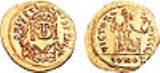
Justin II

Encyclopedia
Justin II was Byzantine Emperor from 565 to 578. He was the husband of Sophia
, nephew of Justinian I
and the late Empress Theodora
, and was therefore a member of the Justinian Dynasty
. His reign is marked by war with Persia
and the loss of the greater part of Italy
. He presented the Cross of Justin II
to Saint Peter's, Rome.
and Dulcidio (or Dulcissimus), respectively the sister and brother-in-law of Justinian. His siblings included Marcellus
and Praejecta
. There are brief mentions of a nephew called Marcianus
and a niece called Helena
. Which sibling of Justin was their parent is unknown.
, seems to have been the only witness to his dying moments, and later claimed that Justinian had designated "Justin, Vigilantia's son" as his heir in a deathbed decision. The disambiguation was needed because there was another nephew and candidate for the throne, Justin
, son of Germanus. Modern historians suspect Callinicus may have fabricated the last words of Justinian to secure the succession for his political ally. As Robert Browning
observed: "Did Justinian really bring himself in the end to make a choice, or did Callinicus make it for him? Only Callinicus knew."
 In any case, Callinicus started alerting those most interested in the succession, originally various members of the Byzantine Senate
. Then they jointly informed Justin and Vigilantia, offering the throne. Justin accepted after the traditional token show of reluctance, and with his wife Sophia, he was escorted to the Great Palace of Constantinople
. The Excubitors
blocked the palace entrances during the night, and early in the morning, John Scholasticus
, Patriarch of Constantinople, crowned the new Augustus
. Only then was the death of Justinian and the succession of Justin publicly announced in the Hippodrome of Constantinople
.
Both the Patriarch and Tiberius
, commander of the Excubitors, had been recently appointed, with Justin having played a part in their respective appointments, in his role as Justinian's curopalates
. Their willingness to elevate their patron and ally to the throne was hardly surprising.
In the first few days of his reign Justin paid his uncle's debts, administered justice in person, and proclaimed universal religious toleration. Contrary to his uncle, Justin relied completely on the support of the aristocratic party.
, ending a truce that had existed since 558. After the Avars and the neighbouring tribe of the Lombards
had combined to destroy the Gepids, from whom Justin had obtained the Danube fortress of Sirmium
, Avar pressure caused the Lombards to migrate West, and in 568
they invaded Italy
under their king Alboin
. They quickly overran the Po valley, and within a few years they had made themselves masters of nearly the entire country. The Avars themselves crossed the Danube in 573 or 574, when the Empire's attention was distracted by troubles on the Persian frontier. They were only placated by the payment of a subsidy of 60,000 silver
pieces by Justin's successor Tiberius.
The North and East frontiers were the main focus of Justin's attention. In 572 his refusal to pay tribute to the Persians in combination with overtures to the Turks led to a war with the Sassanid Empire. After two disastrous campaigns, in which the Persians overran Syria
and captured the strategically important fortress of Dara (Mesopotamia)
, Justin reportedly lost his mind. The temporary fits of insanity into which he fell warned him to name a colleague. Passing over his own relatives, he raised, on the advice of Sophia, the general Tiberius
to be Caesar in December 574 and withdrew into retirement. In 574, Sophia paid 45,000 solidi to Chosroes in return for a year's truce. Sophia and Tiberius ruled together as joint regents for four years, while Justin sank into growing insanity
. When Justin died in 578, Tiberius succeeded him as Tiberius II Constantine
.
, as Justin II slipped into the unbridled madness of his final days he was pulled through the palace on a wheeled throne, biting attendants as he passed. He reportedly ordered organ music to be played constantly throughout the palace in an attempt to soothe his frenzied mind, and it was rumoured that his taste for attendants extended as far as "devouring" a number of them during his reign.
The tardy knowledge of his own impotence determined him to lay down the weight of the diadem; he showed some symptoms of a discerning and even magnanimous spirit when he addressed his assembly,
In silence and in tears, the assembly applauded the counsels, and sympathized with the repentance of their prince. Tiberius received the diadem on his knees; and Justin, who in his abdication appeared most worthy to reign, addressed the new monarch in the following words: "If you consent, I live; if you command, I die: may the God of heaven and earth infuse into your heart whatever I have neglected or forgotten." The four last years of the emperor Justin were passed in tranquil obscurity: his conscience was no longer tormented by the remembrance of those duties which he was incapable of discharging; and his choice was justified by the filial reverence and gratitude of Tiberius.
Sophia (empress)
Aelia Sophia was the Empress consort of Justin II of the Byzantine Empire from 565 to 578. She was specifically interested in economic matters and was involved in financial matters during Justin's reign...
, nephew of Justinian I
Justinian I
Justinian I ; , ; 483– 13 or 14 November 565), commonly known as Justinian the Great, was Byzantine Emperor from 527 to 565. During his reign, Justinian sought to revive the Empire's greatness and reconquer the lost western half of the classical Roman Empire.One of the most important figures of...
and the late Empress Theodora
Theodora (6th century)
Theodora , was empress of the Roman Empire and the wife of Emperor Justinian I. Like her husband, she is a saint in the Orthodox Church, commemorated on November 14...
, and was therefore a member of the Justinian Dynasty
Justinian Dynasty
The Justinian Dynasty is a family who ruled over the Byzantine Empire from 518 to 602. It originated with Justin I and ended with Maurice. Patriarch Germanus I of Constantinople , whose father was named Justinian, might have been a descendant of the dynasty...
. His reign is marked by war with Persia
Sassanid Empire
The Sassanid Empire , known to its inhabitants as Ērānshahr and Ērān in Middle Persian and resulting in the New Persian terms Iranshahr and Iran , was the last pre-Islamic Persian Empire, ruled by the Sasanian Dynasty from 224 to 651...
and the loss of the greater part of Italy
Italy
Italy , officially the Italian Republic languages]] under the European Charter for Regional or Minority Languages. In each of these, Italy's official name is as follows:;;;;;;;;), is a unitary parliamentary republic in South-Central Europe. To the north it borders France, Switzerland, Austria and...
. He presented the Cross of Justin II
Cross of Justin II
The Cross of Justin II or in the Treasury of Saint Peter's in St Peter's Basilica, is a processional cross and also a reliquary of the True Cross, one of the oldest surviving, if not the oldest...
to Saint Peter's, Rome.
Family
He was a son of VigilantiaVigilantia
Vigilantia was a sister of Byzantine emperor Justinian I , and mother to his successor Justin II .- Name :The name "Vigilantia" is Latin for "alertness, wakefulness". Itself deriving from "vigilia" and "vigil"...
and Dulcidio (or Dulcissimus), respectively the sister and brother-in-law of Justinian. His siblings included Marcellus
Marcellus (brother of Justin II)
Marcellus was a brother of Byzantine emperor Justin II and general under his uncle, Justinian I .Marcellus was the son of Vigilantia, the sister of Justinian, and Dulcidio , and thus the brother of Justin II and Praejecta...
and Praejecta
Praejecta
Praejecta or Praiecta was a niece to Byzantine emperor Justinian I by blood and of his empress Theodora by marriage.She was a daughter of Vigilantia and Dulcidio , respectively the sister and brother-in-law of Justinian. She was also a sister of later emperor Justin II Praejecta or Praiecta was a...
. There are brief mentions of a nephew called Marcianus
Marcianus (nephew of Justin II)
Marcianus was a Byzantine general, recorded to be a kinsman of Emperor Justin II.Theophanes the Confessor records him as a nephew of Justin II, commander of an army fighting the Moors in the Praetorian prefecture of Africa. Bibliotheca by Photios I of Constantinople records him as a mere cousin....
and a niece called Helena
Helena (niece of Justin II)
Helena was a niece of Byzantine Emperor Justin II . Georgios Kedrenos mentions a statue of her in the Milion, alongside statues of Sophia and Arabia, Respectively the wife and daughter of Justin II....
. Which sibling of Justin was their parent is unknown.
Accession
Justinian I died on the night of 14 to 15 November 565. Callinicus, the praepositus sacri cubiculiPraepositus sacri cubiculi
The praepositus sacri cubiculi was one of the senior palace offices in the late Roman Empire. Its holder was usually a eunuch, and acted as the grand chamberlain of the palace, wielding considerable authority and influence. In the 7th or 8th century, the title was also given to an order of rank...
, seems to have been the only witness to his dying moments, and later claimed that Justinian had designated "Justin, Vigilantia's son" as his heir in a deathbed decision. The disambiguation was needed because there was another nephew and candidate for the throne, Justin
Justin (consul 540)
Flavius Mar Petrus Theodorus Valentinus Rusticius Boraides Germanus Iustinus, commonly simply Iustinus was an East Roman aristocrat and general, who was appointed as one of the last Roman consuls in 540....
, son of Germanus. Modern historians suspect Callinicus may have fabricated the last words of Justinian to secure the succession for his political ally. As Robert Browning
Robert Browning (Byzantinist)
Robert Browning was a Scottish Byzantinist and university professor.-Early career:Browning was born in Glasgow in 1914. He attended Kelvinside Academy in that city. He entered the Humanities department of Glasgow University in 1931, graduating in 1935...
observed: "Did Justinian really bring himself in the end to make a choice, or did Callinicus make it for him? Only Callinicus knew."
Byzantine Senate
The Byzantine Senate or Eastern Roman Senate was the continuation of the Roman Senate, established in the 4th century by Constantine I. It survived for centuries but was increasingly irrelevant until its eventual disappearance in the 13th century....
. Then they jointly informed Justin and Vigilantia, offering the throne. Justin accepted after the traditional token show of reluctance, and with his wife Sophia, he was escorted to the Great Palace of Constantinople
Great Palace of Constantinople
The Great Palace of Constantinople — also known as the Sacred Palace — was the large Imperial Byzantine palace complex located in the south-eastern end of the peninsula now known as "Old Istanbul", modern Turkey...
. The Excubitors
Excubitors
The Excubitors were founded in circa 460 AD as the imperial guards of the early Byzantine emperors. Their commanders soon acquired great influence and provided a series of emperors in the 6th century...
blocked the palace entrances during the night, and early in the morning, John Scholasticus
John Scholasticus
John Scholasticus was the 32nd patriarch of Constantinople from April 12, 565 until his death in 577. He is also regarded as a saint of the Eastern Orthodox Church....
, Patriarch of Constantinople, crowned the new Augustus
Augustus (honorific)
Augustus , Latin for "majestic," "the increaser," or "venerable", was an Ancient Roman title, which was first held by Gaius Julius Caesar Augustus , and subsequently came to be considered one of the titles of what are now known as the Roman Emperors...
. Only then was the death of Justinian and the succession of Justin publicly announced in the Hippodrome of Constantinople
Hippodrome of Constantinople
The Hippodrome of Constantinople was a circus that was the sporting and social centre of Constantinople, capital of the Byzantine Empire. Today it is a square named Sultanahmet Meydanı in the Turkish city of Istanbul, with only a few fragments of the original structure surviving...
.
Both the Patriarch and Tiberius
Tiberius II Constantine
Tiberius II Constantine was Byzantine Emperor from 574 to 582.During his reign, Tiberius II Constantine gave away 7,200 pounds of gold each year for four years....
, commander of the Excubitors, had been recently appointed, with Justin having played a part in their respective appointments, in his role as Justinian's curopalates
Curopalates
Kouropalatēs, Latinized as curopalates or curopalata and Anglicized as curopalate, was a Byzantine court title, one of the highest from the time of Emperor Justinian I to that of the Komnenoi in the 12th century...
. Their willingness to elevate their patron and ally to the throne was hardly surprising.
In the first few days of his reign Justin paid his uncle's debts, administered justice in person, and proclaimed universal religious toleration. Contrary to his uncle, Justin relied completely on the support of the aristocratic party.
Foreign policy
Proud of character, and faced with an empty treasury, he discontinued Justinian's practice of buying off potential enemies. Immediately after his accession, Justin halted the payment of subsidies to the AvarsEurasian Avars
The Eurasian Avars or Ancient Avars were a highly organized nomadic confederacy of mixed origins. They were ruled by a khagan, who was surrounded by a tight-knit entourage of nomad warriors, an organization characteristic of Turko-Mongol groups...
, ending a truce that had existed since 558. After the Avars and the neighbouring tribe of the Lombards
Lombards
The Lombards , also referred to as Longobards, were a Germanic tribe of Scandinavian origin, who from 568 to 774 ruled a Kingdom in Italy...
had combined to destroy the Gepids, from whom Justin had obtained the Danube fortress of Sirmium
Sirmium
Sirmium was a city in ancient Roman Pannonia. Firstly mentioned in the 4th century BC and originally inhabited by the Illyrians and Celts, it was conquered by the Romans in the 1st century BC and subsequently became the capital of the Roman province of Lower Pannonia. In 294 AD, Sirmium was...
, Avar pressure caused the Lombards to migrate West, and in 568
568
Year 568 was a leap year starting on Sunday of the Julian calendar. The denomination 568 for this year has been used since the early medieval period, when the Anno Domini calendar era became the prevalent method in Europe for naming years.- Europe :* April 1 – King Alboin leads the Lombards...
they invaded Italy
Italy
Italy , officially the Italian Republic languages]] under the European Charter for Regional or Minority Languages. In each of these, Italy's official name is as follows:;;;;;;;;), is a unitary parliamentary republic in South-Central Europe. To the north it borders France, Switzerland, Austria and...
under their king Alboin
Alboin
Alboin was king of the Lombards from about 560 until 572. During his reign the Lombards ended their migrations by settling in Italy, the northern part of which Alboin conquered between 569 and 572...
. They quickly overran the Po valley, and within a few years they had made themselves masters of nearly the entire country. The Avars themselves crossed the Danube in 573 or 574, when the Empire's attention was distracted by troubles on the Persian frontier. They were only placated by the payment of a subsidy of 60,000 silver
Silver
Silver is a metallic chemical element with the chemical symbol Ag and atomic number 47. A soft, white, lustrous transition metal, it has the highest electrical conductivity of any element and the highest thermal conductivity of any metal...
pieces by Justin's successor Tiberius.
The North and East frontiers were the main focus of Justin's attention. In 572 his refusal to pay tribute to the Persians in combination with overtures to the Turks led to a war with the Sassanid Empire. After two disastrous campaigns, in which the Persians overran Syria
Syria
Syria , officially the Syrian Arab Republic , is a country in Western Asia, bordering Lebanon and the Mediterranean Sea to the West, Turkey to the north, Iraq to the east, Jordan to the south, and Israel to the southwest....
and captured the strategically important fortress of Dara (Mesopotamia)
Dara (Mesopotamia)
Dara or Daras was an important East Roman fortress city in northern Mesopotamia on the border with the Sassanid Empire. Because of its great strategic importance, it featured prominently in the Roman-Persian conflicts of the 6th century, with the famous Battle of Dara taking place before its walls...
, Justin reportedly lost his mind. The temporary fits of insanity into which he fell warned him to name a colleague. Passing over his own relatives, he raised, on the advice of Sophia, the general Tiberius
Tiberius II Constantine
Tiberius II Constantine was Byzantine Emperor from 574 to 582.During his reign, Tiberius II Constantine gave away 7,200 pounds of gold each year for four years....
to be Caesar in December 574 and withdrew into retirement. In 574, Sophia paid 45,000 solidi to Chosroes in return for a year's truce. Sophia and Tiberius ruled together as joint regents for four years, while Justin sank into growing insanity
Insanity
Insanity, craziness or madness is a spectrum of behaviors characterized by certain abnormal mental or behavioral patterns. Insanity may manifest as violations of societal norms, including becoming a danger to themselves and others, though not all such acts are considered insanity...
. When Justin died in 578, Tiberius succeeded him as Tiberius II Constantine
Tiberius II Constantine
Tiberius II Constantine was Byzantine Emperor from 574 to 582.During his reign, Tiberius II Constantine gave away 7,200 pounds of gold each year for four years....
.
Personal traits
The historian Previte-Orton describes Justin as "a rigid man, dazzled by his predecessor's glories, to whom fell the task of guiding an exhausted, ill-defended Empire through a crisis of the first magnitude and a new movement of peoples". Previte-Orton continues,Speech at abdication
According to John of EphesusJohn of Ephesus
John of Ephesus was a leader of the non-Chalcedonian Syriac-speaking Church in the sixth century, and one of the earliest and most important of historians who wrote in Syriac.-Life:...
, as Justin II slipped into the unbridled madness of his final days he was pulled through the palace on a wheeled throne, biting attendants as he passed. He reportedly ordered organ music to be played constantly throughout the palace in an attempt to soothe his frenzied mind, and it was rumoured that his taste for attendants extended as far as "devouring" a number of them during his reign.
The tardy knowledge of his own impotence determined him to lay down the weight of the diadem; he showed some symptoms of a discerning and even magnanimous spirit when he addressed his assembly,
In silence and in tears, the assembly applauded the counsels, and sympathized with the repentance of their prince. Tiberius received the diadem on his knees; and Justin, who in his abdication appeared most worthy to reign, addressed the new monarch in the following words: "If you consent, I live; if you command, I die: may the God of heaven and earth infuse into your heart whatever I have neglected or forgotten." The four last years of the emperor Justin were passed in tranquil obscurity: his conscience was no longer tormented by the remembrance of those duties which he was incapable of discharging; and his choice was justified by the filial reverence and gratitude of Tiberius.
Primary sources
- Edward WalfordEdward WalfordEdward Walford was a British magazine editor and a compiler of educational, biographical, genealogical and touristic works, perhaps best known for his Old and New London 6 volumes , 1878....
, translator (1846) The Ecclesiastical History of Evagrius: A History of the Church from AD 431 to AD 594, Reprinted 2008. Evolution Publishing, ISBN 978-1-889758-88-6. http://www.evolpub.com/CRE/CREseries.html#CRE5