

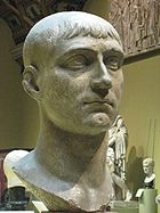
Maxentius

Encyclopedia
- For the saint of the same name see Saint MaxentiusSaint MaxentiusSaint Maxentius was born in Agde, France, and originally had the name Adjutor. He was trained by Saint Severus and became a monk in his abbey.Butler's Lives of the Saints offers the following remarks:...
Maxentius was a Roman Emperor
Roman Emperor
The Roman emperor was the ruler of the Roman State during the imperial period . The Romans had no single term for the office although at any given time, a given title was associated with the emperor...
from 306 to 312. He was the son of former Emperor Maximian
Maximian
Maximian was Roman Emperor from 286 to 305. He was Caesar from 285 to 286, then Augustus from 286 to 305. He shared the latter title with his co-emperor and superior, Diocletian, whose political brain complemented Maximian's military brawn. Maximian established his residence at Trier but spent...
, and the son-in-law of Emperor Galerius
Galerius
Galerius , was Roman Emperor from 305 to 311. During his reign he campaigned, aided by Diocletian, against the Sassanid Empire, sacking their capital Ctesiphon in 299. He also campaigned across the Danube against the Carpi, defeating them in 297 and 300...
.
Birth and early life
Maxentius' exact date of birth is unknown; it was probably around 278. He was the son of the Emperor MaximianMaximian
Maximian was Roman Emperor from 286 to 305. He was Caesar from 285 to 286, then Augustus from 286 to 305. He shared the latter title with his co-emperor and superior, Diocletian, whose political brain complemented Maximian's military brawn. Maximian established his residence at Trier but spent...
and his wife Eutropia.
As his father became emperor in 285, he was regarded as crown prince who would eventually follow his father on the throne. He seems not to have served in any important military or administrative position during Diocletian
Diocletian
Diocletian |latinized]] upon his accession to Diocletian . c. 22 December 244 – 3 December 311), was a Roman Emperor from 284 to 305....
's and his father's reign, though. Early (the exact date is unknown) he married Valeria Maximilla
Valeria Maximilla
Valeria Maximilla was the Empress of Rome and wife of Emperor Maxentius.She was the daughter of Emperor Galerius and his first wife, whose name is unknown. She married Maxentius around 293 and bore him two sons. The eldest, Valerius Romulus, was born c. 294, the other son's name is not recorded,...
, the daughter of Galerius
Galerius
Galerius , was Roman Emperor from 305 to 311. During his reign he campaigned, aided by Diocletian, against the Sassanid Empire, sacking their capital Ctesiphon in 299. He also campaigned across the Danube against the Carpi, defeating them in 297 and 300...
. He had two sons, Valerius Romulus
Valerius Romulus
Valerius Romulus, also Marcus Aurelius Romulus was the son of the Caesar and later usurper Maxentius and of Valeria Maximilla, daughter of Emperor Galerius....
(ca. 295 – 309) and an unknown one.
In 305, Diocletian and Maximian resigned, and the former caesares
Caesar (title)
Caesar is a title of imperial character. It derives from the cognomen of Julius Caesar, the Roman dictator...
Constantius and Galerius
Galerius
Galerius , was Roman Emperor from 305 to 311. During his reign he campaigned, aided by Diocletian, against the Sassanid Empire, sacking their capital Ctesiphon in 299. He also campaigned across the Danube against the Carpi, defeating them in 297 and 300...
became Augusti
Augustus (honorific)
Augustus , Latin for "majestic," "the increaser," or "venerable", was an Ancient Roman title, which was first held by Gaius Julius Caesar Augustus , and subsequently came to be considered one of the titles of what are now known as the Roman Emperors...
. Although with Constantine and Maxentius two sons of emperors were available, they were left out from the new tetrarchy
Tetrarchy
The term Tetrarchy describes any system of government where power is divided among four individuals, but usually refers to the tetrarchy instituted by Roman Emperor Diocletian in 293, marking the end of the Crisis of the Third Century and the recovery of the Roman Empire...
, and Severus
Flavius Valerius Severus
Severus , sometimes known as Severus II, was a Western Roman Emperor from 306 to 307.- Officer in the Roman army :Severus was of humble birth, born in the Illyrian provinces around the middle of the third century AD...
and Maximinus Daia
Maximinus
Maximinus II , also known as Maximinus Daia or Maximinus Daza, was Roman Emperor from 308 to 313. He was born of Dacian peasant stock to the half sister of the emperor Galerius near their family lands around Felix Romuliana; a rural area then in the Danubian region of Moesia, now Eastern Serbia.He...
were appointed Caesars. Some sources (Lactantius
Lactantius
Lucius Caecilius Firmianus Lactantius was an early Christian author who became an advisor to the first Christian Roman emperor, Constantine I, guiding his religious policy as it developed, and tutor to his son.-Biography:...
, Epitome) state that Galerius hated Maxentius and used his influence on Diocletian that Maxentius be ignored in the succession; maybe Diocletianus also thought that he was not qualified for the military duties of the imperial office. Maxentius retired to an estate some miles from Rome
Rome
Rome is the capital of Italy and the country's largest and most populated city and comune, with over 2.7 million residents in . The city is located in the central-western portion of the Italian Peninsula, on the Tiber River within the Lazio region of Italy.Rome's history spans two and a half...
.
When Constantius died in 306, his son Constantine was crowned emperor on July 25 and subsequently accepted by Galerius into the tetrarchy
Tetrarchy
The term Tetrarchy describes any system of government where power is divided among four individuals, but usually refers to the tetrarchy instituted by Roman Emperor Diocletian in 293, marking the end of the Crisis of the Third Century and the recovery of the Roman Empire...
as Caesar. This set the precedent for Maxentius' accession later in the same year.
Accession
Praetorian Guard
The Praetorian Guard was a force of bodyguards used by Roman Emperors. The title was already used during the Roman Republic for the guards of Roman generals, at least since the rise to prominence of the Scipio family around 275 BC...
which were still stationed at Rome, riots broke out. A group of officers of the city's garrisons (Zosimus
Zosimus
Zosimus was a Byzantine historian, who lived in Constantinople during the reign of the Byzantine Emperor Anastasius I . According to Photius, he was a comes, and held the office of "advocate" of the imperial treasury.- Historia Nova :...
calls them Marcellianus, Marcellus and Lucianus) turned to Maxentius to accept the imperial purple, probably judging that the official recognition which was granted to Constantine would not be withheld from Maxentius, son of an emperor as well. Maxentius accepted the honour, promised donations to the city's troops, and was publicly acclaimed emperor on October 28, 306. The usurpation obviously went largely without bloodshed (Zosimus names only one victim); the prefect of Rome went over to Maxentius and retained his office. Apparently the conspirators turned to Maximian as well, who had retired to a palace in Lucania
Lucania
Lucania was an ancient district of southern Italy, extending from the Tyrrhenian Sea to the Gulf of Taranto. To the north it adjoined Campania, Samnium and Apulia, and to the south it was separated by a narrow isthmus from the district of Bruttium...
, but he declined to resume power for the time being.
Maxentius managed to be recognized as emperor in central and southern Italy, the islands of Corsica
Corsica
Corsica is an island in the Mediterranean Sea. It is located west of Italy, southeast of the French mainland, and north of the island of Sardinia....
, Sardinia
Sardinia
Sardinia is the second-largest island in the Mediterranean Sea . It is an autonomous region of Italy, and the nearest land masses are the French island of Corsica, the Italian Peninsula, Sicily, Tunisia and the Spanish Balearic Islands.The name Sardinia is from the pre-Roman noun *sard[],...
and Sicily
Sicily
Sicily is a region of Italy, and is the largest island in the Mediterranean Sea. Along with the surrounding minor islands, it constitutes an autonomous region of Italy, the Regione Autonoma Siciliana Sicily has a rich and unique culture, especially with regard to the arts, music, literature,...
, and the Africa
Africa
Africa is the world's second largest and second most populous continent, after Asia. At about 30.2 million km² including adjacent islands, it covers 6% of the Earth's total surface area and 20.4% of the total land area...
n provinces. Northern Italy remained under the control of the western Augustus Severus
Flavius Valerius Severus
Severus , sometimes known as Severus II, was a Western Roman Emperor from 306 to 307.- Officer in the Roman army :Severus was of humble birth, born in the Illyrian provinces around the middle of the third century AD...
, who resided in Milan
Milan
Milan is the second-largest city in Italy and the capital city of the region of Lombardy and of the province of Milan. The city proper has a population of about 1.3 million, while its urban area, roughly coinciding with its administrative province and the bordering Province of Monza and Brianza ,...
.
Maxentius refrained from using the titles Augustus or Caesar at first and styled himself princeps invictus (Undefeated Prince), in the hope of obtaining recognition of his reign by the senior emperor Galerius. However, the latter refused to do so. Apart from his alleged antipathy towards Maxentius, Galerius probably wanted to deter others from following the examples of Constantine and Maxentius and declaring themselves emperors. Constantine firmly controlled his father's army and territories, and Galerius could pretend that his accession was part of the regular succession in the tetrarchy
Tetrarchy
The term Tetrarchy describes any system of government where power is divided among four individuals, but usually refers to the tetrarchy instituted by Roman Emperor Diocletian in 293, marking the end of the Crisis of the Third Century and the recovery of the Roman Empire...
, but neither was the case with Maxentius: he would be the fifth emperor, and he had only few troops at his command. Galerius reckoned that it would be not too difficult to quell the usurpation, and early in 307, the Augustus Severus marched on Rome with a large army.
The majority of this army consisted of soldiers who had fought under Maxentius' father Maximian
Maximian
Maximian was Roman Emperor from 286 to 305. He was Caesar from 285 to 286, then Augustus from 286 to 305. He shared the latter title with his co-emperor and superior, Diocletian, whose political brain complemented Maximian's military brawn. Maximian established his residence at Trier but spent...
for years, and as Severus reached Rome, the majority of his army went over to Maxentius, rightful heir of their former commander, who dealt out a large amount of money. When Maximian himself finally left his retreat and returned to Rome to assume the imperial office once again and support his son, Severus with the rest of his army retreated to Ravenna
Ravenna
Ravenna is the capital city of the Province of Ravenna in the Emilia-Romagna region of Italy and the second largest comune in Italy by land area, although, at , it is little more than half the size of the largest comune, Rome...
. Shortly after he surrendered to Maximian, who promised that his life be spared.
After the defeat of Severus, Maxentius took possession of northern Italy up to the Alps
Alps
The Alps is one of the great mountain range systems of Europe, stretching from Austria and Slovenia in the east through Italy, Switzerland, Liechtenstein and Germany to France in the west....
and the Istria
Istria
Istria , formerly Histria , is the largest peninsula in the Adriatic Sea. The peninsula is located at the head of the Adriatic between the Gulf of Trieste and the Bay of Kvarner...
n peninsula to the east, and assumed the title of Augustus, which (in his eyes) had become vacant with the surrender of Severus.
Emperor
Roman Gaul
Roman Gaul consisted of an area of provincial rule in the Roman Empire, in modern day France, Belgium, Luxembourg, and western Germany. Roman control of the area lasted for less than 500 years....
, where Constantine married his daughter Fausta
Fausta
Fausta Flavia Maxima was a Roman Empress, daughter of the Roman Emperor Maximianus. To seal the alliance between them for control of the Tetrarchy, in 307 Maximianus married her to Constantine I, who set aside his wife Minervina in her favour. Constantine and Fausta had been betrothed since...
and was in turn appointed Augustus by the senior emperor. However, Constantine tried to avoid breaking with Galerius, and did not openly support Maxentius during the invasion.
In 308, probably April, Maximian tried to depose his son in an assembly of soldiers in Rome; surprisingly to him, the present troops remained faithful to his son, and he had to flee to Constantine.
In the conference of Carnuntum
Carnuntum
Carnuntum was a Roman army camp on the Danube in the Noricum province and after the 1st century the capital of the Upper Pannonia province...
in the autumn of 308, Maxentius was once again denied recognition as legitimate emperor, and Licinius
Licinius
Licinius I , was Roman Emperor from 308 to 324. Co-author of the Edict of Milan that granted official toleration to Christians in the Roman Empire, for the majority of his reign he was the rival of Constantine I...
was appointed Augustus with the task of regaining the usurper's domain.
Late in 308, Domitius Alexander
Domitius Alexander
Lucius Domitius Alexander , probably born in Phrygia, was vicarius of Africa when Emperor Maxentius ordered him to send his son as hostage to Rome. Alexander refused and proclaimed himself emperor in 308....
was acclaimed emperor in Carthage
Carthage
Carthage , implying it was a 'new Tyre') is a major urban centre that has existed for nearly 3,000 years on the Gulf of Tunis, developing from a Phoenician colony of the 1st millennium BC...
, and the African provinces seceded from Maxentian rule. This produced a dangerous situation for Maxentius, as Africa was critical to Rome's food supply. Under the command of his praetorian prefect
Praetorian prefect
Praetorian prefect was the title of a high office in the Roman Empire. Originating as the commander of the Praetorian Guard, the office gradually acquired extensive legal and administrative functions, with its holders becoming the Emperor's chief aides...
Rufius Volusianus, he sent a small army to Africa which defeated and executed Alexander in 310 or 311; Maxentius used the opportunity to seize the wealth of Alexander's supporters, and to bring large amounts of grain to Rome. Also in 310, he lost Istria
Istria
Istria , formerly Histria , is the largest peninsula in the Adriatic Sea. The peninsula is located at the head of the Adriatic between the Gulf of Trieste and the Bay of Kvarner...
to Licinius, who could not continue the campaign, however, as Galerius fell mortally ill and died the next year.
Maxentius' eldest son Valerius Romulus
Valerius Romulus
Valerius Romulus, also Marcus Aurelius Romulus was the son of the Caesar and later usurper Maxentius and of Valeria Maximilla, daughter of Emperor Galerius....
died in 309, at the age of about 14, was consecrated
Apotheosis
Apotheosis is the glorification of a subject to divine level. The term has meanings in theology, where it refers to a belief, and in art, where it refers to a genre.In theology, the term apotheosis refers to the idea that an individual has been raised to godlike stature...
and buried in a mausoleum in the Villa of Maxentius at the Via Appia. Near the villa, Maxentius also constructed the Circus of Maxentius
Circus of Maxentius
The Circus of Maxentius is an ancient structure in Rome, Italy; it is part of a complex of buildings erected by emperor Maxentius on the Via Appia between AD 306 and 312...
.
After the death of Maximian in 309 or 310, relations with Constantine rapidly deteriorated, and Maxentius allied with Maximinus
Maximinus
Maximinus II , also known as Maximinus Daia or Maximinus Daza, was Roman Emperor from 308 to 313. He was born of Dacian peasant stock to the half sister of the emperor Galerius near their family lands around Felix Romuliana; a rural area then in the Danubian region of Moesia, now Eastern Serbia.He...
to counter an alliance between Constantine and Licinius. He allegedly tried to secure the province of Raetia
Raetia
Raetia was a province of the Roman Empire, named after the Rhaetian people. It was bounded on the west by the country of the Helvetii, on the east by Noricum, on the north by Vindelicia, on the west by Cisalpine Gaul and on south by Venetia et Histria...
north of the Alps, thereby dividing the realms of Constantine and Licinius (reported by Zosimus); the plan was not carried out, as Constantine acted first.
By the middle of 310 Galerius had become too ill to involve himself in imperial politics. He died soon after April 30, 311. Galerius' death destabilized what remained of the Tetrarchic system. On hearing the news, Maximinus mobilized against Licinius, and seized Asia Minor before meeting Licinius on the Bosphorus to arrange terms for peace. Maxentius fortified northern Italy against potential invasions. He also strengthened his support among the Christians of Italy by allowing them to elect a new Bishop of Rome, Eusebius
Pope Eusebius
Pope Saint Eusebius was pope in the year 309 or 310....
.
Maxentius was far from secure, however. His early support was dissolving into open protest; by 312, he was a man barely tolerated, not one actively supported. Without the revenues of the empire, Maxentius was forced to resume taxation in Italy to support his army and his building projects in Rome. The election of a bishop did not aid much, either, as Diocletian's persecution had split the Italian church into competing factions over the issue of apostasy. The Christians of Italy could easily see that Constantine was more sympathetic to their plight than Maxentius. In the summer of 311, Maxentius mobilized against Constantine while Licinius was occupied with affairs in the East. He declared war on Constantine, vowing to avenge his father's "murder". Constantine, in an attempt to prevent Maxentius from forming a hostile alliance with Licinius, forged his own alliance with the man over the winter of 311–12 by offering to him his sister Constantia in marriage. Maximin considered Constantine's arrangement with Licinius an affront to his authority. In response, he sent ambassadors to Rome, offering political recognition to Maxentius in exchange for military support. Two alliances, Maximin and Maxentius, Constantine and Licinius, lined up against one another. The emperors prepared for war.
War against Constantine
Maxentius expected an attack along his eastern flank from Licinius, and stationed an army in Verona. Constantine had smaller forces than his opponent: with his forces withdrawn from Africa, with the praetorian and Imperial Horse Guard, and with the troops he had taken from Severus, Maxentius had an army equal to approximately 100,000 soldiers to use against his opponents in the north. Many of these he used to garrison fortified towns across the region, keeping most stationed with him in Verona. Against this, Constantine could only bring a force of between twenty-five and forty thousand men. The bulk of his troops simply could not be withdrawn from the Rhine frontiers without negative consequences. It was against the recommendations of his advisers and generals, against popular expectation, that Constantine anticipated Maxentius, and struck first.As early as weather permitted, late in the spring of 312, Constantine crossed the Alps with a quarter of his total army, a force equivalent to something less than forty thousand men. Having crossed the Cottian Alps
Cottian Alps
The Cottian Alps are a mountain range in the southwestern part of the Alps. They form the border between France and Italy...
at the Mont Cenis
Mont Cenis
Mont Cenis is a massif and pass in Savoie in France which forms the limit between the Cottian and Graian Alps.A road over the pass was built between 1803 and 1810 by Napoleon...
pass, he first came to Segusium (Susa, Italy
Italy
Italy , officially the Italian Republic languages]] under the European Charter for Regional or Minority Languages. In each of these, Italy's official name is as follows:;;;;;;;;), is a unitary parliamentary republic in South-Central Europe. To the north it borders France, Switzerland, Austria and...
), a heavily fortified town containing a military garrison, which shut its gates to him. Constantine ordered his forces to set its gates on fire and scale its walls, and took the town quickly. Constantine forbade the plunder of the town, and advanced into northern Italy. At the approach to the west of the important city of Augusta Taurinorum (Turin
Turin
Turin is a city and major business and cultural centre in northern Italy, capital of the Piedmont region, located mainly on the left bank of the Po River and surrounded by the Alpine arch. The population of the city proper is 909,193 while the population of the urban area is estimated by Eurostat...
, Italy), Constantine encountered a large force of heavily armed Maxentian cavalry, labeled clibanarii
Clibanarii
The Clibanarii or Klibanophoroi were a Sassanid Persian, late Roman and Byzantine military unit of heavy armored horsemen. Similar to the cataphracti, the horsemen themselves and their horses were fully armoured...
or cataphract
Cataphract
A cataphract was a form of armored heavy cavalry utilised in ancient warfare by a number of peoples in Western Eurasia and the Eurasian Steppe....
i in the ancient sources. In the ensuing battle
Battle of Turin (312)
The Battle of Turin was fought in 312 between Roman emperor Constantine and the troops of his rival augustus, Maxentius. Constantine won the battle, giving an impressive display of the tactical skill which was to characterise his whole military career...
Constantine spread his forces into a line, allowing Maxentius' cavalry to ride into the middle of his forces. As his forces broadly encircled the enemy cavalry, Constantine's own cavalry charged at the sides of the Maxentian cataphracts, beating them with iron-tipped clubs. Many Maxentian cavalrymen were dismounted, while most others were variously incapacitated by the blows. Constantine then commanded his foot soldiers to advance against the surviving Maxentian infantry, cutting them down as they fled. Victory, the panegyrist who speaks of the events declares, came easily. Turin refused to give refuge to the retreating forces of Maxentius. It opened its gates to Constantine instead. Other cities of the north Italian plain, recognizing Constantine's quick and clement victories, sent him embassies of congratulation for his victory. He moved on to Milan, where he was met with open gates and jubilant rejoicing. He resided there until the middle of the summer of 312 before moving on.
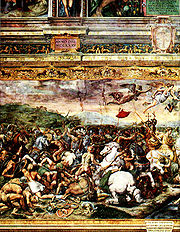
Battle of Milvian Bridge
The Battle of the Milvian Bridge took place between the Roman Emperors Constantine I and Maxentius on 28 October 312. It takes its name from the Milvian Bridge, an important route over the Tiber. Constantine won the battle and started on the path that led him to end the Tetrarchy and become the...
on October 28, 312. Ancient sources usually attribute this action to superstition or (if pro-Constantinian) divine providence. Maxentius of course had consulted soothsayers before battle, as was customary practice, and it can be assumed that they reported favourable omen
Omen
An omen is a phenomenon that is believed to foretell the future, often signifying the advent of change...
s, especially as the day of battle would be his dies imperii, the day of his accession to the throne (which was October 28, 306). What else may have motivated him, is open to speculation.
The armies of Maxentius and Constantine met north of the city, some distance outside the walls, beyond the Tiber
Tiber
The Tiber is the third-longest river in Italy, rising in the Apennine Mountains in Emilia-Romagna and flowing through Umbria and Lazio to the Tyrrhenian Sea. It drains a basin estimated at...
river on the Via Flaminia
Via Flaminia
The Via Flaminia was an ancient Roman road leading from Rome over the Apennine Mountains to Ariminum on the coast of the Adriatic Sea, and due to the ruggedness of the mountains was the major option the Romans had for travel between Etruria, Latium and Campania and the Po Valley...
. Christian tradition, especially Lactantius
Lactantius
Lucius Caecilius Firmianus Lactantius was an early Christian author who became an advisor to the first Christian Roman emperor, Constantine I, guiding his religious policy as it developed, and tutor to his son.-Biography:...
and Eusebius of Caesarea
Eusebius of Caesarea
Eusebius of Caesarea also called Eusebius Pamphili, was a Roman historian, exegete and Christian polemicist. He became the Bishop of Caesarea in Palestine about the year 314. Together with Pamphilus, he was a scholar of the Biblical canon...
, claims that Constantine fought under the labarum
Labarum
The labarum was a vexillum that displayed the "Chi-Rho" symbol ☧, formed from the first two Greek letters of the word "Christ" — Chi and Rho . It was used by the Roman emperor Constantine I...
in that battle, revealed to him in a dream. Of the battle itself, not much is known – Constantine's forces defeated Maxentius's troops, who retreated to the Tiber, and in the chaos of the fleeing army trying to cross the river, Maxentius fell into the water and drowned. His body was found the next day and paraded through the city, and later sent to Africa, as a sign that he had surely perished.
Oddly enough, he died on October 28 – the sixth anniversary of the day that he assumed the Empire.
Overview and legacy
After Constantine's victory, Maxentius was systematically vilified and presented as a cruel, bloodthirsty and incompetent tyrant. While he was not counted under the persecutors of the Christians by early sources like LactantiusLactantius
Lucius Caecilius Firmianus Lactantius was an early Christian author who became an advisor to the first Christian Roman emperor, Constantine I, guiding his religious policy as it developed, and tutor to his son.-Biography:...
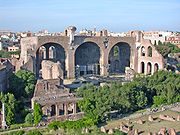
, under the influence of the official propaganda later Christian tradition framed Maxentius as hostile to Christianity as well. This image has left its traces in all of our sources and has dominated the view of Maxentius well into the 20th century, when a more extensive use and analysis of non-literary sources like coins and inscriptions have led to a more balanced image. Maxentius was a prolific builder, whose achievements were overshadowed by Constantine's issue of a damnatio memoriae against him. Many buildings in Rome that are commonly associated with Constantine, such as the great basilica in the forum Romanum, were in fact built by Maxentius.
Discovery of Imperial insignia
In December 2006, Italian archeologists announced that an excavation under a shrine near the Palatine HillPalatine Hill
The Palatine Hill is the centermost of the Seven Hills of Rome and is one of the most ancient parts of the city...
had unearthed several items in wooden boxes, which they identified as the imperial regalia
Regalia
Regalia is Latin plurale tantum for the privileges and the insignia characteristic of a Sovereign.The word stems from the Latin substantivation of the adjective regalis, 'regal', itself from Rex, 'king'...
, possibly belonging to Maxentius. The items in these boxes, which were wrapped in linen and what appears to be silk, include 3 complete lances, 4 javelins, what appears to be a base for standards, and three glass and chalcedony
Chalcedony
Chalcedony is a cryptocrystalline form of silica, composed of very fine intergrowths of the minerals quartz and moganite. These are both silica minerals, but they differ in that quartz has a trigonal crystal structure, while moganite is monoclinic...
spheres. The most important find was a scepter of a flower holding a blue-green globe, which is believed to have belonged to the Emperor himself because of its intricate workmanship, and has been dated to his rule.
These are the only known imperial insignia so far recovered, which hitherto had only been known from coins and wall paintings. Clementina Panella, the archaeologist who made the discovery states that "These artifacts clearly belonged to the emperor, especially the scepter, which is very elaborated, it's not an item you would let someone else have." Panella notes that the insignia were likely hidden by Maxentius' supporters in an attempt to preserve the emperor's memory after he was defeated at the Battle of Milvian Bridge
Battle of Milvian Bridge
The Battle of the Milvian Bridge took place between the Roman Emperors Constantine I and Maxentius on 28 October 312. It takes its name from the Milvian Bridge, an important route over the Tiber. Constantine won the battle and started on the path that led him to end the Tetrarchy and become the...
by Constantine. The items have been restored and are on temporary display at the Museo Nazionale Romano at the Palazzo Massimo alle Terme.
In popular culture
In the upcoming 2011 film Katherine of Alexandria, Maxentius will be played by Will HoustonWill Houston
Will Houston , often credited as William Houston, is a British actor. Born in Sussex, he grew up in Northern Ireland....
.
External links
- De imperatoribus Romanis on Maxentius
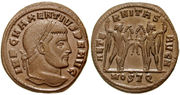
- Coins of Maxentius A brief history of Maxentius illustrated with some coins