

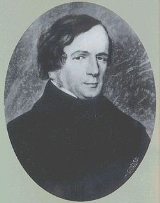
Vincenzo Gioberti

Encyclopedia

Italy
Italy , officially the Italian Republic languages]] under the European Charter for Regional or Minority Languages. In each of these, Italy's official name is as follows:;;;;;;;;), is a unitary parliamentary republic in South-Central Europe. To the north it borders France, Switzerland, Austria and...
philosopher, publicist
Publicist
A publicist is a person whose job is to generate and manage publicity for a public figure, especially a celebrity, a business, or for a work such as a book, film or album...
and politician
Politician
A politician, political leader, or political figure is an individual who is involved in influencing public policy and decision making...
.
Biography
Gioberti was born in TurinTurin
Turin is a city and major business and cultural centre in northern Italy, capital of the Piedmont region, located mainly on the left bank of the Po River and surrounded by the Alpine arch. The population of the city proper is 909,193 while the population of the urban area is estimated by Eurostat...
.
He was educated by the fathers of the Oratory with a view to the priesthood and ordained in 1825. Partly under the influence of Mazzini
Giuseppe Mazzini
Giuseppe Mazzini , nicknamed Soul of Italy, was an Italian politician, journalist and activist for the unification of Italy. His efforts helped bring about the independent and unified Italy in place of the several separate states, many dominated by foreign powers, that existed until the 19th century...
, the freedom of Italy became his ruling motive in life, its emancipation, not only from foreign masters, but from modes of thought alien to its genius, and detrimental to, its European authority. This authority was in his mind connected with papal supremacy, though in a way quite intellectual rather than political. This leitmotif informs nearly all his writings, and also his political position with respect to the ruling clerical party—the Jesuits—and the court of Piedmont after the accession of Charles Albert in 1831.
Gioberti was now noticed by the king and made one of his chaplains. His popularity and private influence, however, were reasons enough for the court party to mark him for exile; he was not one of them, and could not be depended on. Knowing this, he resigned his office in 1833, but was suddenly arrested on a charge of conspiracy, and, after an imprisonment of four months, was banished without a trial. Gioberti first went to Paris
Paris
Paris is the capital and largest city in France, situated on the river Seine, in northern France, at the heart of the Île-de-France region...
, and, a year later, to Brussels
Brussels
Brussels , officially the Brussels Region or Brussels-Capital Region , is the capital of Belgium and the de facto capital of the European Union...
, where he remained till 1845, teaching philosophy, and assisting a friend in the work of a private school. He nevertheless found time to write many works of philosophical importance, with special reference to his country and its position.
An amnesty having been declared by Charles Albert in 1846, Gioberti (who was again in Paris) was at liberty to return to Italy, but refused to do so till the end of 1847. On his entrance into Turin on April 29, 1848 he was received with the greatest enthusiasm. He refused the dignity of senator offered him by Charles Albert, preferring to represent his native town in the Chamber of Deputies, of which he was soon elected president. At the close of the same year, a new ministry was formed, headed by Gioberti; but with the accession of Victor Emmanuel
Victor Emmanuel II of Italy
Victor Emanuel II was king of Sardinia from 1849 and, on 17 March 1861, he assumed the title King of Italy to become the first king of a united Italy since the 6th century, a title he held until his death in 1878...
in March 1849, his active life came to an end. For a short time indeed be held a seat in the cabinet, though without a portfolio; but an irreconcilable disagreement soon followed, and his removal from Turin was accomplished by his appointment on a mission to Paris, whence he never returned. There, refusing the pension which had been offered him and all ecclesiastical preferment, he lived frugally, and spent his days and nights as at Brussels in literary labour. He died suddenly, of apoplexy
Apoplexy
Apoplexy is a medical term, which can be used to describe 'bleeding' in a stroke . Without further specification, it is rather outdated in use. Today it is used only for specific conditions, such as pituitary apoplexy and ovarian apoplexy. In common speech, it is used non-medically to mean a state...
, on the 26th of October 1852.
Works and Philosophy
Gioberti's writings are more important than his political career. In the general history of European philosophy they stand apart. As the speculations of Rosmini-SerbatiAntonio Rosmini-Serbati
Blessed Antonio Rosmini-Serbati was an Italian Roman Catholic priest and philosopher. He founded the Rosminians, officially the Institute of Charity or Societas a charitate nuncupata.-Biography:...
, against which he wrote, have been called the last link added to medieval thought, so the system of Gioberti, known as Ontologism
Ontologism
Ontologism is a philosophical system most associated with Nicholas Malebranche which maintains that God and divine ideas are the first object of our intelligence and the intuition of God the first act of our intellectual knowledge.-Bibliography:...
, more especially in his greater and earlier works, is unrelated to other modern schools of thought. It shows a harmony with the Roman Catholic faith which caused Cousin
Victor Cousin
Victor Cousin was a French philosopher. He was a proponent of Scottish Common Sense Realism and had an important influence on French educational policy.-Early life:...
to declare that Italian philosophy was still in the bonds of theology
Theology
Theology is the systematic and rational study of religion and its influences and of the nature of religious truths, or the learned profession acquired by completing specialized training in religious studies, usually at a university or school of divinity or seminary.-Definition:Augustine of Hippo...
, and that Gioberti was no philosopher.
Method is with him a synthetic, subjective and psychological instrument. He reconstructs, as he declares, ontology, and begins with the ideal formula, the "Ens" creates ex nihilo the existent. God
God
God is the English name given to a singular being in theistic and deistic religions who is either the sole deity in monotheism, or a single deity in polytheism....
is the only being (Ens); all other things are merely existences. God is the origin of all human knowledge (called lidea, thought), which is one and so to say identical with God himself. It is directly beheld (intuited) by reason, but in order to be of use it has to be reflected on, and this by means of language. A knowledge of being and existences (concrete, not abstract) and their mutual relations, is necessary as the beginning of philosophy.
Gioberti is in some respects a Plato
Plato
Plato , was a Classical Greek philosopher, mathematician, student of Socrates, writer of philosophical dialogues, and founder of the Academy in Athens, the first institution of higher learning in the Western world. Along with his mentor, Socrates, and his student, Aristotle, Plato helped to lay the...
nist. He identifies religion with civilization, and in his treatise Del primato morale e civile degli italiani arrives at the conclusion that the church is the axis on which the well-being of human life revolves. In it he affirms the idea of the supremacy of Italy, brought about by the restoration of the papacy as a moral dominion, founded on religion and public opinion. In his later works, the Rinnovamento and the Protologia, he is thought by some to have shifted his ground under the influence of events.
His first work, written when he was thirty-seven, had a personal reason for its existence. A young fellow-exile and friend, Paolo Pallia, having many doubts and misgivings as to the reality of revelation and a future life, Gioberti at once set to work with La Teorica del sovrannaturale, which was his first publication (1838). After this, philosophical treatises followed in rapid succession. The Teorica was followed by Introduzione allo studio della filosofia in three volumes (1839–1840). In this work he states his reasons for requiring a new method and new terminology. Here he brings out the doctrine that religion is the direct expression of the idea in this life, and is one with true civilization in history. Civilization
Civilization
Civilization is a sometimes controversial term that has been used in several related ways. Primarily, the term has been used to refer to the material and instrumental side of human cultures that are complex in terms of technology, science, and division of labor. Such civilizations are generally...
is a conditioned mediate tendency to perfection, to which religion is the final completion if carried out; it is the end of the second cycle expressed by the second formula, the Ens redeems existences.
Essays (not published till 1846) on the lighter and more popular subjects, Del bello and Del buono, followed the Introduzione. Del primato morale e civile degli Italiani and the Prolegomeni to the same, and soon afterwards his triumphant exposure of the Jesuits, Il Gesuita moderno, no doubt hastened the transfer of rule from clerical to civil hands. It was the popularity of these semi-political works, increased by other occasional political articles, and his Rinnovamento civile d'Italia, that caused Gioberti to be welcomed with such enthusiasm on his return to his native country. All these works were perfectly orthodox, and aided in drawing the liberal clergy into the movement which has resulted since his time in the unification of Italy. The Jesuits, however, closed round the pope more firmly after his return to Rome, and in the end Gioberti's writings were placed on the Index. The remainder of his works, especially La Filosofia della Rivelazione and the Prolologia, give his mature views on many points.