


Great Fire of Rome

Encyclopedia
Fire
Fire is the rapid oxidation of a material in the chemical process of combustion, releasing heat, light, and various reaction products. Slower oxidative processes like rusting or digestion are not included by this definition....
that occurred beginning July 19, AD 64.
Background
According to TacitusTacitus
Publius Cornelius Tacitus was a senator and a historian of the Roman Empire. The surviving portions of his two major works—the Annals and the Histories—examine the reigns of the Roman Emperors Tiberius, Claudius, Nero and those who reigned in the Year of the Four Emperors...
, the fire spread quickly and burned for six days. Only four of the fourteen districts of Rome
Rome
Rome is the capital of Italy and the country's largest and most populated city and comune, with over 2.7 million residents in . The city is located in the central-western portion of the Italian Peninsula, on the Tiber River within the Lazio region of Italy.Rome's history spans two and a half...
escaped the fire; three districts were completely destroyed and the other seven suffered serious damage. The only other contemporaneous historian to mention the fire was Pliny the Elder
Pliny the Elder
Gaius Plinius Secundus , better known as Pliny the Elder, was a Roman author, naturalist, and natural philosopher, as well as naval and army commander of the early Roman Empire, and personal friend of the emperor Vespasian...
, who wrote about it in passing. Other historians who lived through the period (including Dio Chrysostom
Dio Chrysostom
Dio Chrysostom , Dion of Prusa or Dio Cocceianus was a Greek orator, writer, philosopher and historian of the Roman Empire in the 1st century. Eighty of his Discourses are extant, as well as a few Letters and a funny mock essay In Praise of Hair, as well as a few other fragments...
, Plutarch
Plutarch
Plutarch then named, on his becoming a Roman citizen, Lucius Mestrius Plutarchus , c. 46 – 120 AD, was a Greek historian, biographer, essayist, and Middle Platonist known primarily for his Parallel Lives and Moralia...
and Epictetus
Epictetus
Epictetus was a Greek sage and Stoic philosopher. He was born a slave at Hierapolis, Phrygia , and lived in Rome until banishment when he went to Nicopolis in northwestern Greece where he lived the rest of his life. His teachings were noted down and published by his pupil Arrian in his Discourses...
) make no mention of it. The only other account on the size of fire is an interpolation in a forged Christian letter from Seneca
Seneca the Younger
Lucius Annaeus Seneca was a Roman Stoic philosopher, statesman, dramatist, and in one work humorist, of the Silver Age of Latin literature. He was tutor and later advisor to emperor Nero...
to Paul
Paul of Tarsus
Paul the Apostle , also known as Saul of Tarsus, is described in the Christian New Testament as one of the most influential early Christian missionaries, with the writings ascribed to him by the church forming a considerable portion of the New Testament...
: "A hundred and thirty-two houses and four blocks (insulae
Insulae
In Roman architecture, an insula was a kind of apartment building that housed most of the urban citizen population of ancient Rome, including ordinary people of lower- or middle-class status and all but the wealthiest from the upper-middle class...
) have been burnt in six days; the seventh brought a pause". This account implies less than a tenth of the city was burnt. Rome contained about 1,700 private houses
Domus
In ancient Rome, the domus was the type of house occupied by the upper classes and some wealthy freedmen during the Republican and Imperial eras. They could be found in almost all the major cities throughout the Roman territories...
and 47,000 insulae or tenement blocks.
It was said by Cassius Dio that Nero, the emperor at the time, sang the "Sack of Ilium" in stage costume as the city burned. However, Tacitus' account has Nero in Antium
Anzio
Anzio is a city and comune on the coast of the Lazio region of Italy, about south of Rome.Well known for its seaside harbour setting, it is a fishing port and a departure point for ferries and hydroplanes to the Pontine Islands of Ponza, Palmarola and Ventotene...
at the time of the fire. Tacitus said that Nero's playing his lyre
Lyre
The lyre is a stringed musical instrument known for its use in Greek classical antiquity and later. The word comes from the Greek "λύρα" and the earliest reference to the word is the Mycenaean Greek ru-ra-ta-e, meaning "lyrists", written in Linear B syllabic script...
and singing while the city burned was only a rumor.
According to Tacitus, upon hearing news of the fire, Nero rushed back to Rome to organize a relief effort, which he paid for from his own funds. After the fire, Nero opened his palaces to provide shelter for the homeless, and arranged for food supplies to be delivered in order to prevent starvation among the survivors. In the wake of the fire, he made a new urban development plan. Houses after the fire were spaced out, built in brick, and faced by porticos on wide roads. Nero also built a new palace complex known as the Domus Aurea
Domus Aurea
The Domus Aurea was a large landscaped portico villa, designed to take advantage of artificially created landscapes built in the heart of Ancient Rome by the Emperor Nero after the Great Fire of Rome had cleared away the aristocratic dwellings on the slopes of the Palatine...
in an area cleared by the fire. The size of this complex is debated (from 100 to 300 acre or 40.5 to 121.4 ha). To find the necessary funds for the reconstruction, tributes were imposed on the provinces of the empire.
Rumors of arson and the persecution of Christians
It is uncertain who or what actually caused the fire — whether accident or arsonArson
Arson is the crime of intentionally or maliciously setting fire to structures or wildland areas. It may be distinguished from other causes such as spontaneous combustion and natural wildfires...
. According to Tacitus, some in the population held Nero responsible. To diffuse blame, Nero targeted the Christian
Christian
A Christian is a person who adheres to Christianity, an Abrahamic, monotheistic religion based on the life and teachings of Jesus of Nazareth as recorded in the Canonical gospels and the letters of the New Testament...
s. There were Christians who confessed to the crime, but it became known that Christians were forced to confess by means of torture, and the passage is unclear as to what the Christians confessed to — being arsonists or Christians. Suetonius and Cassius Dio favor Nero as the arsonist with an insane desire to destroy the city as his motive, or to rebuild Rome in a new style more to his liking. However, major accidental fires were common in ancient Rome. In fact, Rome burned again under Vitellius
Vitellius
Vitellius , was Roman Emperor for eight months, from 16 April to 22 December 69. Vitellius was acclaimed Emperor following the quick succession of the previous emperors Galba and Otho, in a year of civil war known as the Year of the Four Emperors...
in 69 and under Titus in 80.
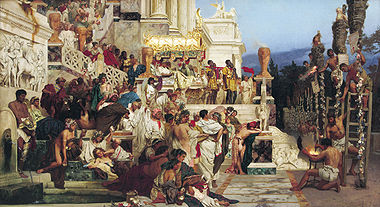
According to Tacitus, Nero ordered Christians to be thrown to dogs, while others were crucified or burned to serve as lights.
He describes the event as follows:
Historical accounts
The varying historical accounts of the event come from three secondary sources — Cassius Dio, SuetoniusSuetonius
Gaius Suetonius Tranquillus, commonly known as Suetonius , was a Roman historian belonging to the equestrian order in the early Imperial era....
and Tacitus
Tacitus
Publius Cornelius Tacitus was a senator and a historian of the Roman Empire. The surviving portions of his two major works—the Annals and the Histories—examine the reigns of the Roman Emperors Tiberius, Claudius, Nero and those who reigned in the Year of the Four Emperors...
. The primary accounts, which possibly included histories written by Fabius Rusticus
Fabius Rusticus
Fabius Rusticus was a Roman historian who was quoted on several occasions by Tacitus. Tacitus couples his name with that of Livy and describes him as "the most graphic among ancient and modern historians." Tacitus also said that he embellished matters with his eloquence...
, Cluvius Rufus
Cluvius Rufus
Marcus Cluvius Rufus was a Roman consul, senator, governor, and historian who was mentioned on several occasions by Tacitus, Suetonius, Cassius Dio, Josephus and Plutarch.-Career:...
and Pliny the Elder
Pliny the Elder
Gaius Plinius Secundus , better known as Pliny the Elder, was a Roman author, naturalist, and natural philosopher, as well as naval and army commander of the early Roman Empire, and personal friend of the emperor Vespasian...
, did not survive. These primary accounts are described as contradictory and gross exaggerations. At least five separate stories circulated regarding Nero and the fire:
- Motivated by a desire to destroy the city, Nero secretly sent out men pretending to be drunk to set fire to the city. Nero watched from his palace on the Palatine Hill singing and playing the lyre.
- Motivated by an insane whim, Nero quite openly sent out men to set fire to the city. Nero watched from the Tower of Maecenas on the Esquiline Hill singing and playing the lyre.
- Nero sent out men to set fire to the city. Nero sang and played his lyre from a private stage.
- The fire was an accident. Nero was in Antium.
- The fire was caused by Christians.
Modern scholarship
Modern scholars tend to agree with Tacitus and believe that Nero probably did not cause the fire. It is postulated that the fire had been intentionally started to create room for Nero's Domus AureaDomus Aurea
The Domus Aurea was a large landscaped portico villa, designed to take advantage of artificially created landscapes built in the heart of Ancient Rome by the Emperor Nero after the Great Fire of Rome had cleared away the aristocratic dwellings on the slopes of the Palatine...
, but the fire started 1 kilometre (0.621372736649807 mi) away from the site where this palace would later be built, on the other side of the Palatine Hill
Palatine Hill
The Palatine Hill is the centermost of the Seven Hills of Rome and is one of the most ancient parts of the city...
. Moreover, the fire destroyed parts of Nero's own palace, the Domus Transitoria
Domus Transitoria
The Domus Transitoria was Roman Emperor Nero's palace on Palatine Hill destroyed by the Great Fire of Rome in 64 AD. Marble and other parts salvaged from the ruins later became part of the Domus Aurea, the Roman Emperor's official residence...
. It seems unlikely that Nero wanted to destroy this palace since he actually salvaged some of the marble decoration and integrated it into the new Domus Aurea
Domus Aurea
The Domus Aurea was a large landscaped portico villa, designed to take advantage of artificially created landscapes built in the heart of Ancient Rome by the Emperor Nero after the Great Fire of Rome had cleared away the aristocratic dwellings on the slopes of the Palatine...
. Even the paintings and wall decorations of the new palace were similar to the ones that had been burned. Last, the fire started just two days after a full moon, a time that, it is presumed, would not have been chosen by arsonists who would not have wished to be observed.
External links
- "Secrets of the dead": PBS series investigates clues that Nero circumvented the SenateRoman SenateThe Senate of the Roman Republic was a political institution in the ancient Roman Republic, however, it was not an elected body, but one whose members were appointed by the consuls, and later by the censors. After a magistrate served his term in office, it usually was followed with automatic...
by burning Rome - Tacitus describes the great Fire: (in English)