
All Topics  
Etruscan mythology

 
Etruscan Mythology

   Email Print
   Bookmark   Link


Etruscan mythology


The Etruscan
Etruscan civilization

Etruscan civilization is the modern English name given to the culture and way of life of a people of ancient Italy and Corsica whom the ancient Romans called Etrusci or Tusci....
s were a people of unknown origin living in Northern Italy
Italy

Italy , officially the Italian Republic , is a country located on the Italian Peninsula in Southern Europe and on the two largest islands in the Mediterranean Sea, Sicily and Sardinia....
, who were eventually integrated into Roman culture and politically became part of the Roman Republic
Roman Republic

The Roman Republic was the phase of the Ancient Rome characterized by a republican form of government; a period which began with the overthrow of the Roman Roman Kingdom, c....
. The Etruscans had both a religion
Religion

A religion is an organized approach to human spirituality which usually encompasses a set of myth, symbols, beliefs and practices, often with a supernatural or transcendence quality, that give meaning to the practitioner's experiences of life through reference to a higher power or truth....
 and a supporting mythology
Mythology

The word mythology refers to a body of folklore/myths/legends that a particular culture believes to be true and that often use the supernatural to interpret natural events and to explain the nature of the universe and humanity....
. Many Etruscan beliefs, customs and divinities became part of Roman culture, including the Roman pantheon
Roman mythology

Roman mythology, or more appropriately, Latin mythology, refers to the mythology beliefs of the Italic people inhabiting the region of Latium and its main city, Rome....
.


Discussion
Ask a question about 'Etruscan mythology'
Start a new discussion about 'Etruscan mythology'
Answer questions from other users
Full Discussion Forum


Encyclopedia


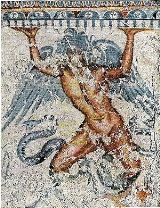
Etruscan Mural Typhon2
The Etruscan
Etruscan civilization

Etruscan civilization is the modern English name given to the culture and way of life of a people of ancient Italy and Corsica whom the ancient Romans called Etrusci or Tusci....
s were a people of unknown origin living in Northern Italy
Italy

Italy , officially the Italian Republic , is a country located on the Italian Peninsula in Southern Europe and on the two largest islands in the Mediterranean Sea, Sicily and Sardinia....
, who were eventually integrated into Roman culture and politically became part of the Roman Republic
Roman Republic

The Roman Republic was the phase of the Ancient Rome characterized by a republican form of government; a period which began with the overthrow of the Roman Roman Kingdom, c....
. The Etruscans had both a religion
Religion

A religion is an organized approach to human spirituality which usually encompasses a set of myth, symbols, beliefs and practices, often with a supernatural or transcendence quality, that give meaning to the practitioner's experiences of life through reference to a higher power or truth....
 and a supporting mythology
Mythology

The word mythology refers to a body of folklore/myths/legends that a particular culture believes to be true and that often use the supernatural to interpret natural events and to explain the nature of the universe and humanity....
. Many Etruscan beliefs, customs and divinities became part of Roman culture, including the Roman pantheon
Roman mythology

Roman mythology, or more appropriately, Latin mythology, refers to the mythology beliefs of the Italic people inhabiting the region of Latium and its main city, Rome....
. The Etruscans believed that their religion had been revealed to them in early days by seers.

Polytheistic belief system

The Etruscan system of belief was an immanent polytheism
Polytheism

Polytheism is the belief in or worship of multiple deities, such as gods and goddesses. These are usually assembled into a Pantheon , along with their own mythology and rituals....
; that is, all visible phenomena were considered to be a manifestation of divine
Divinity

Divinity and divine are broadly applied but loosely defined terms, used variously within different faiths and belief systems ? and even by different individuals within a given faith ? to refer to some transcendent or transcendental power, or its attributes or manifestations in the world....
 power and that power was subsided into deities
Deity

A deity is a postulated preternatural or supernatural immortal being, who may be thought of as holy, divinity, or sacred, held in high regard, and respected by human beings....
 that acted continually on the world of man and could be dissuaded or persuaded in favor of human affairs. Three layers are evident in the extensive Etruscan art motifs. One appears to be divinities of an indigenous nature: Catha
Catha

Catha may refer to:*the shrub Khat*the Etruscan mythology Cautha...
 and Usil, the sun, Tivr, the moon, Selvans
Selvans

In Etruscan mythology, Selvans was god of the woodlands, cognate with Roman mythology Silvanus . His name is mentioned on the Piacenza Liver, a bronze model of a sheep's liver used for divination rites....
, a civil god, Turan
Turan (mythology)

Turan was the Etruscan mythology goddess of love and vitality and patroness of the city of Volci. In art, she was usually depicted as a young winged girl ....
, the goddess of love, Laran
Laran

In Etruscan mythology, Laran was the god of war. In art, he was portrayed as a nudity young man with a helmet and a spear. Laran's consort was Turan ....
, the god of war, Leinth
Leinth

In Etruscan mythology, Leinth is the goddess of death, whose name means "Old Age" or "Old Woman". In art, she was portrayed with the face veiled....
, the goddess of death, Maris
Maris

Maris was the Etruscan civilisation god of agriculture and fertility later borrowed by the Romans as a war/agricultual god Mars and equated with Greek mythology Ares by interpretatio romana....
, Thalna
Thalna

In Etruscan mythology, Thalna was the goddess of childbirth and wife of Tinia. She was depicted in art as a youthful woman.Early Roman Mythology focused on the interlocking and complex interrelations between gods and humans....
, Turms
Turms

In Etruscan mythology, Turms was the equivalent of Greek Hermes, god oftrade and the messenger god between people and gods.Turms is also a character in a book by Mika Waltari The_Etruscan which takes...
 and the ever-popular Fufluns
Fufluns

In Etruscan mythology, Fufluns was a god of plant life, happiness and health and growth in all things. He is the son of Semla_%28mythology%29 ....
, whose name is related in some unknown way to the city of Populonia
Populonia

Populonia is a frazione of the commune of Piombino . It is especially noteworthy for its Etruscan civilization remains, including one of the main necropolis in Italy, discovered by Isidoro Falchi....
 and the populus Romanus. Perhaps he was the god of the people.

Ruling over this pantheon of lesser deities were higher ones that seem to reflect the Indo-European system: Tin or Tinia
Tinia

The Etruscan bright sky god Tinia was the highest god in Etruscan mythology, the Etruscan equivalent of the Roman mythology Jupiter and the Greek mythology Zeus....
, the sky, Uni his wife (Juno
Juno (mythology)

File:Juno sospita pushkin.jpgJuno was an Roman religion, the protector and special counselor of the state. She is a daughter of Saturn and sister of the chief god Jupiter and the mother of Juventas, Mars , and Vulcan ....
), and Cel, the earth goddess. In addition the Greek gods were taken into the Etruscan system: Aritimi (Artemis
Artemis

In Greek mythology, Artemis was the daughter of Zeus and Leto, and the twin sister of Apollo. She was the Hellenic goddess of forests and hills, child birth/virginity/fertility, the hunt and was often depicted as a huntress carrying a bow and arrows.....
), Menrva
Menrva

Menrva was an Etruscan mythology of war, art, wisdom and health. She contributed a lot of her character to Roman mythology Minerva.Though she was seen by Hellenized Etruscans as their counterpart to Greek mythology Athena, Menrva has some unique traits that makes it clear that she wasn't an import from Greece....
 (Minerva
Minerva

Minerva was the Roman mythology name of Greek goddess Athena. She was considered to be the virgin goddess of warriors, poetry, medicine, wisdom, commerce, weaving,crafts, and the inventor of music....
;Latin name for Athena
Athena

In Greek mythology, Athena is the shrewd companion of Hero and the goddess of Hero endeavour. She is the virgin patron of Athens, which built the Parthenon to worship her....
), and Pacha (Bacchus
Dionysus

In classical mythology, Dionysus or Dionysos , is the God of wine, the inspirer of ritual madness and ecstasy, and a major figure of Greek mythology, and one of the twelve Olympians, among whom Greek mythology treated Dionysus as a late arrival....
;Latin name for Dionysus
Dionysus

In classical mythology, Dionysus or Dionysos , is the God of wine, the inspirer of ritual madness and ecstasy, and a major figure of Greek mythology, and one of the twelve Olympians, among whom Greek mythology treated Dionysus as a late arrival....
). The heroes taken from Homer
Homer

Homer is traditionally held to be the author of the ancient Greek language epic poems the Iliad and the Odyssey, as well as of the Homeric Hymns....
 also appear extensively in art motifs.

Religious practices

Etruscan Temple Orvieto
The Etruscans believed in intimate contact with divinity. They did nothing without proper consultation with the gods and signs from them. These practices were taken over in total by the Romans. A god was called an ais (later eis) which in the plural is aisar. Where they were was a fanu or luth, a sacred place, such as a favi, a grave or temple. There one would need to make a fler (plural flerchva) "offering".

Around the mun or muni, the tombs, were the man or mani (Latin Manes), the souls of the ancestors. A deceased person travels to the underworld called Aita "Hades
Hades

Hades refers both to the ancient Greek underworld, the abode of Hades, and to the god of the underworld. Hades in Homer referred just to the god; the genitive case , Haidou, was an elision to denote locality: "[the house/dominion] of Hades"....
" and thus may be referred to as a hinthial (literally "(one who is) underneath"). A special magistrate, the cechase, looked after the cecha, or rath, sacred things. Every man, however, had his religious responsibilities, which were expressed in an alumnathe or slecaches, a sacred society. No public event was conducted without the netsvis, the haruspex, or his female equivalent, the nethsra. They read the bumps on the liver of a properly sacrificed sheep. We have a model of a liver made of bronze, whose religious significance is still a matter of heated debate, marked into sections which perhaps are meant to explain what the bump in that region should mean. Divination through haruspicy is a tradition originating from the Fertile Crescent
Fertile Crescent

The Fertile Crescent is a region in the Near East, incorporating the Levant and Mesopotamia, and often extended to Lower Egypt. Mesopotamia is considered the Cradle of civilization and saw the development of the earliest human civilizations and is the History_of_writing#Bronze_Age_writing and Wheel#History....
.

Beliefs of the hereafter

Like the Egyptian
Ancient Egypt

Ancient Egypt was an Ancient history civilization in eastern North Africa, concentrated along the lower reaches of the Nile in what is now the modern nation of Egypt....
s, the Etruscans believed in eternal life, but prosperity there was linked to funeral prosperity here. The tombs in many cases imitated domestic structures and were characterized by spacious chambers, wall paintings and grave furniture. Most Etruscan tombs have been plundered. In the tomb, especially on the sarcophagus (examples shown below), was a representation of the dead person in his or her prime, probably as they wanted to be in the hereafter. Some of the statuary is the finest and most realistic of any. We have no problem visualizing the appearance of the Etruscans. They wanted us to see them smiling and intimate with their kith and kin around them, as we do.

Mythology

The mythology is attested by a number of sources.

Mythological systems

The primary trinity included Tinia
Tinia

The Etruscan bright sky god Tinia was the highest god in Etruscan mythology, the Etruscan equivalent of the Roman mythology Jupiter and the Greek mythology Zeus....
, Uni
Uni (mythology)

Uni was the supreme goddess of the Etruscan mythology wiktionary:pantheon and the patron goddess of Perugia. Uni was identified by the Etruscans as their equivalent of Juno in Roman mythology and Hera in Greek mythology....
 and Menrva
Menrva

Menrva was an Etruscan mythology of war, art, wisdom and health. She contributed a lot of her character to Roman mythology Minerva.Though she was seen by Hellenized Etruscans as their counterpart to Greek mythology Athena, Menrva has some unique traits that makes it clear that she wasn't an import from Greece....
.

List of Etruscan mythological figures

The names below were taken mainly from Etruscan "picture bilinguals", which are Etruscan call-outs on art depicting mythological scenes or motifs. Several different media provide names. Variants of the names are given, reflecting differences in language in different localities and times.

Many of the names are Etruscan spellings (and pronunciations) of Greek names. The themes may or may not be entirely Greek. Etruscans frequently added their own themes to Greek myths. The same may be said of native Italic names rendered into Etruscan. Some names are entirely Etruscan. Which is which is often a topic of debate in the international forum of scholarship.

Apulu, Aplu: The Etruscan equivalent of the Greek god, Apollo
Apollo

In Greek mythology and Roman mythology, Apollo , is one of the most important and many-sided of the Twelve Olympians. The ideal of the kouros , Apollo has been variously recognized as a god of light and the sun; truth and prophecy; archery; medicine and healing; music, poetry, and the arts; and more....
.

Aritimi, Artumes: The goddess Artemis
Artemis

In Greek mythology, Artemis was the daughter of Zeus and Leto, and the twin sister of Apollo. She was the Hellenic goddess of forests and hills, child birth/virginity/fertility, the hunt and was often depicted as a huntress carrying a bow and arrows.....
.

Fufluns
Fufluns

In Etruscan mythology, Fufluns was a god of plant life, happiness and health and growth in all things. He is the son of Semla_%28mythology%29 ....
: Etruscan god of wine, identified with Dionysus
Dionysus

In classical mythology, Dionysus or Dionysos , is the God of wine, the inspirer of ritual madness and ecstasy, and a major figure of Greek mythology, and one of the twelve Olympians, among whom Greek mythology treated Dionysus as a late arrival....
. The name is used in the expressions Fufluns Pacha (Bacchus
Dionysus

In classical mythology, Dionysus or Dionysos , is the God of wine, the inspirer of ritual madness and ecstasy, and a major figure of Greek mythology, and one of the twelve Olympians, among whom Greek mythology treated Dionysus as a late arrival....
) and Fufluns Pachie. Puplona (Populonia
Populonia

Populonia is a frazione of the commune of Piombino . It is especially noteworthy for its Etruscan civilization remains, including one of the main necropolis in Italy, discovered by Isidoro Falchi....
) was named from Fufluns.

Hercle: With Perseus
Perseus

Perseus , the legendary founder of Mycenae and of the Mycenae there, was the first of the mythic heroes of Greek mythology whose exploits in defeating various archaic monsters provided the founding myths in the cult of the Twelve Olympians....
, the main Etruscan hero, the adopted son of Uni
Uni

:For the numerical prefix...
/Juno, who suckled the adult Hercle. His image appears more often than any other on Etruscan carved hardstones. His name appears on the bronze Piacenza Liver, used for divination (hepatoscopy), a major element of Etruscan religious practice. His Etruscan epithet, sometimes substituted for his name, is Calanice, "beautiful victory", derived from Greek Kallinikos

Laran
Laran

In Etruscan mythology, Laran was the god of war. In art, he was portrayed as a nudity young man with a helmet and a spear. Laran's consort was Turan ....
: Etruscan God of war.

Lasa
Lares

Lares were ancient Roman Empire deity protecting the house and the family, they were a form of household deity.Lares were presumed sons of Mercury and Lara , and deeply venerated by ancient Romans through small statues, usually put in higher places of the house, far from the floor, or even on the roof ....
: One of a class of deities, plural Lasas, mainly female, but sometimes male, from which the Roman Lares
Lares

Lares were ancient Roman Empire deity protecting the house and the family, they were a form of household deity.Lares were presumed sons of Mercury and Lara , and deeply venerated by ancient Romans through small statues, usually put in higher places of the house, far from the floor, or even on the roof ....
 came. Where the latter were the guardians of the dead, the Etruscan originals formed the court of Turan. Lasa often precedes an epithet referring to a particular deity: Lasa Sitmica, Lasa Achununa, Lasa Racuneta, Lasa Thimrae, Lasa Vecuvia.

Man, Mani: Etruscan class of spirits representing "the dead" and yet not the same as a hinthial, "ghost." From the Mani came the Latin Manes
Manes

In Roman mythology, the Manes were the souls of deceased loved ones. As minor spirits, they were similar to the Lares, Genius and Di Penates. They were honored during the Parentalia and Feralia in February....
, which are both "the good" and the deified spirits of the dead.

Menerva, Menrva
Menrva

Menrva was an Etruscan mythology of war, art, wisdom and health. She contributed a lot of her character to Roman mythology Minerva.Though she was seen by Hellenized Etruscans as their counterpart to Greek mythology Athena, Menrva has some unique traits that makes it clear that she wasn't an import from Greece....
: The Etruscan original to the Roman Minerva
Minerva

Minerva was the Roman mythology name of Greek goddess Athena. She was considered to be the virgin goddess of warriors, poetry, medicine, wisdom, commerce, weaving,crafts, and the inventor of music....
, made into Greek Athena
Athena

In Greek mythology, Athena is the shrewd companion of Hero and the goddess of Hero endeavour. She is the virgin patron of Athens, which built the Parthenon to worship her....
.

Nethuns
Nethuns

In Etruscan mythology, Nethuns was the god of water wells, later expanded to all water, including the sea. The Etruscan conception of the deity affected Roman mythology Neptune ....
: Italic divinity, probably Umbrian, of springs and water, identified with Greek Poseidon
Poseidon

In Greek mythology, Poseidon was the god of the sea and, as "Earth-Shaker," of earthquakes. The name of the god Nethuns in Etruscan mythology was adopted in Latin for Neptune in Roman mythology: both were sea gods analogous to Poseidon....
 and Roman Neptune
NEPTUNE

=Overview=The project, along with sister project, VENUS, offers a unique approach to ocean science. Traditionally, ocean scientists have relied on infrequent ship cruises or space-based satellites to carry out their research....
, from which the name comes. It occurs in the expression flere Nethuns, "the divinity of Nethuns."

Selvans: God who appears in the expression Selvansl Tularias, "Selvans of the boundaries", which identifies him as a god of boundaries. The name is borrowed from the Roman god, Silvanus
Silvanus

Silvanus may refer to:*Silvanus , a Roman tutelary spirit of woods, apparently inherited from the Etruscan deity Selvan*Silvanus, also called Silas, an early Christian and companion of Paul...
.

Tarchon
Tarchon

In Etruscan mythology, Tarchon and his brother, Tyrrhenus, were culture heroes who founded the Etruscan civilization Federation of twelve cities, the Dodecapoli:...
: An Etruscan culture hero
Culture hero

A culture hero is a mythological hero specific to some group who changes the world through invention or discovery . A typical culture hero might be credited as the discoverer of fire, or agriculture, folk music, tradition and religion, and is usually the most important legendary figure of a people, sometimes as the founder of its ruling dyna...
 who, with his brother, Tyrrhenus, founded the Etruscan Federation of twelve cities.

Tinia
Tinia

The Etruscan bright sky god Tinia was the highest god in Etruscan mythology, the Etruscan equivalent of the Roman mythology Jupiter and the Greek mythology Zeus....
, Tina, Tin: Chief Etruscan god, the ruler of the skies, husband of Uni, and father of Hercle, identified with the Greek Zeus
Zeus

Zeus in Greek mythology is the king of the gods, the ruler of Mount Olympus and the god of the sky father and List of thunder gods. His symbols are the thunderbolt, eagle, bull , and oak....
 and Roman Jupiter
Jupiter (mythology)

In Roman mythology, Jupiter or Jove was the king of the gods,and the god of sky and thunder. He is the equivalent of Zeus in the Greek pantheon....
 well within the Etruscan window of ascendance, as the Etruscan kings built the first temple of Jupiter at Rome. Called apa, "father" in inscriptions (parallel to the -piter in Ju-piter), he has most of the attributes of his Indo-European counterpart, with whom some have postulated a more remote linguistic connection. The name means "day" in Etruscan. He is the god of boundaries and justice. He is depicted as a young, bearded male, seated or standing at the center of the scene, grasping a stock of thunderbolts. According to Latin literature, the bolts are of three types: for warning, good or bad interventions, and drastic catastrophes. Unlike Zeus, Tin needs the permission of the Dii Consentes (consultant gods) and Dii Involuti (hidden gods) to wield the last two categories. A further epithet, Calusna (of Calu), hints at a connection to wolves or dogs and the underworld. In post-classical Tuscan folklore he became an evil spirit, Tigna, who causes lightning strikes, hail, rain, whirlwinds and mildew.

Turan
Turan (mythology)

Turan was the Etruscan mythology goddess of love and vitality and patroness of the city of Volci. In art, she was usually depicted as a young winged girl ....
: Etruscan goddess identified with Greek Aphrodite
Aphrodite

Aphrodite is the classical Greek mythology goddess of love, sex, and beauty. According to Greek oral poet Hesiod, she was born when Uranus was castrated by his son Cronus....
 and Roman Venus
Venus (mythology)

Venus was a major Roman mythology goddess principally associated with love, beauty and sexual reproduction, the equivalent of the Greek mythology Aphrodite....
. She appears in the expression, Turan ati, "Mother Turan", equivalent to Venus Genetrix. Her name is a noun meaning "the act of giving" in Etruscan, based on the verb stem tur- 'to give.'

Turms
Turms

In Etruscan mythology, Turms was the equivalent of Greek Hermes, god oftrade and the messenger god between people and gods.Turms is also a character in a book by Mika Waltari The_Etruscan which takes...
, Turms: Etruscan god identified with Greek Hermes
Hermes

Hermes is the messenger of the gods in Greek mythology. An Twelve Olympians, he is also the patron of boundaries and of the travelers who cross them, of shepherds and cowherds, of thieves and road travelers, of orators and wit, of literature and poets, of athletics, of weights and measures, of invention, of general commerce, and of the cunni...
 and Roman Mercurius
Mercury (mythology)

In Roman mythology, Mercury was a messenger, and a god of trade, profit and commerce, the son of Maia Maiestas, also known as Ops, the Roman version of Cronus, and Jupiter ....
. In his capacity as guide to the ghost of Tiresias, who has been summoned by Odysseus, he is Turms Aitas, "Turms Hades."

Uni
Uni (mythology)

Uni was the supreme goddess of the Etruscan mythology wiktionary:pantheon and the patron goddess of Perugia. Uni was identified by the Etruscans as their equivalent of Juno in Roman mythology and Hera in Greek mythology....
: Supreme goddess of the Etruscan pantheon, wife of Tinia, mother of Hercle, and patroness of Perugia
Perugia

Perugia is the capital city of the region of Umbria in central Italy, near the Tiber river, and the capital of the province of Perugia. The city symbol is the griffin, which can be seen in the form of plaques and statues on buildings around the city....
. With Tinia and Menrva, she was a member of the ruling triad
Capitoline Triad

The Capitoline Triad was a group of three supreme deities in Roman religion who were worshipped in an elaborate temple on Rome's Capitoline Hill, the Capitolium....
 of Etruscan deities. Uni was the equivalent of the Roman Juno
Juno (mythology)

File:Juno sospita pushkin.jpgJuno was an Roman religion, the protector and special counselor of the state. She is a daughter of Saturn and sister of the chief god Jupiter and the mother of Juventas, Mars , and Vulcan ....
 (Iuno), whose name Uni may be derived from, and the Greek Hera
Hera

In the Twelve Olympians of classical Greek Mythology, Hera or Here was the wife and older sister of Zeus. Her chief function was as goddess of women and marriage....
.

Vanth
Vanth

Vanth is a chthonic figure in Etruscan mythology shown in a variety of forms of funerary art, such as in tomb paintings and on sarcophagi. Vanth is a female demon in the Etruscan underworld that is often accompanied either by additional Vanth figures or by another demon, Charun ....
: Etruscan winged demon of the underworld often depicted in the company of Charun
Charun

In Etruscan mythology, Charun was the psychopomp of the underworld, not to be confused with the lord of the underworld, known to the Etruscans as Aita ....
. She could be present at the moment of death, and frequently acted as a guide of the deceased to the underworld.

Bibliography

Available for preview on Google Books. Google Books Translated by Wendy Doniger, Gerald Honigsblum. Preview Google Books. Preview available on Google Books.
  • Available in the Gazeteer of Bill Thayer's Website at
  • Preview shown on Google Books.* Downloadable Google Books, online at .
  • Preview Google Books.*
Preview available on Google Books. Preview Google Books. A German-language book, downloadable from Google Books.

See also

  • Greek deities and their Roman and Etruscan counterparts


External links