

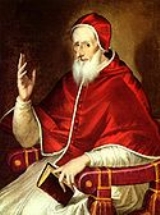
Pope Pius V

Encyclopedia
Pope Saint Pius V born Antonio Ghislieri (from 1518 called Michele Ghislieri, O.P.
), was Pope
from 1566 to 1572 and is a saint
of the Catholic Church. He is chiefly notable for his role in the Council of Trent
, the Counter-Reformation
, and the standardization of the Roman liturgy
within the Latin Church
. Pius V declared saint Thomas Aquinas
a Doctor of the Church
and patronized prominent sacred music composer Giovanni Pierluigi da Palestrina
.
As Cardinal Ghislieri he gained a reputation for putting orthodoxy before personalities, prosecuting eight French Bishops for heresy. He also stood firm against nepotism
, rebuking his predecessor Pope Pius IV
to his face when he wanted to make a 13-year old member of his family a cardinal and subsidise a nephew from the Papal treasury.
In affairs of state, Pius V excommunicated Elizabeth I of England
for schism
and persecutions of English Catholics during her reign. He also arranged the formation of the Holy League, an alliance of Catholic states. Although outnumbered, the Holy League famously defeated the Ottomans
, who had threatened to overrun Europe, at the Battle of Lepanto
. This victory Pius V attributed to the intercession of the Blessed Virgin Mary and instituted the feast, Our Lady of Victory.
(now Bosco Marengo
in the province of Alessandria
, Piedmont
), Italy
. At the age of fourteen he entered the Dominican Order
, taking the name Michele, passing from the monastery of Voghera
to that of Vigevano
, and thence to Bologna
. Ordained priest at Genoa
in 1528, he was sent by his order to Pavia
, where he lectured for sixteen years. At Parma he advanced thirty propositions in support of the papal chair and against the heresies of the time. As prior of more than one Dominican priory during a time of great moral laxity, he insisted on discipline, and, in accordance with his own wishes, he was appointed inquisitor
at Como
. As his reformist zeal provoked resentment, he was compelled to return to Rome
in 1550, where, after having been employed in several inquisitorial missions, he was elected to the commissariat
of the Holy Office. Pope Paul IV
(1555–59), who, as Cardinal Carafa, had shown him special favor, conferred upon him the bishopric of Sutri and Nepi, the cardinalate with the title of Alessandrino, and the unique honor of the supreme inquisitorship. Under Pope Pius IV
(1559–65) he became bishop of Mondovi in Piedmont, but his opposition to that pontiff procured his dismissal from the palace and the abridgment of his authority as inquisitor.
and decrees of the Council of Trent
had precedence over other considerations.
. Pope Pius V made this Missal mandatory throughout the Latin rite of the Catholic Church, except where a Mass liturgy dating from before 1370 AD was in use. This form of the Mass remained essentially unchanged for 400 years until Pope Paul VI's revision of the Roman Missal
in 1969–70, after which it has become widely known as the Tridentine Mass
; use of the last pre-1969 edition of the Missal, that by Pope John XXIII
in 1962, is permitted without limitation for private celebration of the Mass
and, since July 2007, is allowed also, under certain conditions, for public use, as laid down in the motu proprio Summorum Pontificum
of Pope Benedict XVI
. Some continue to use even earlier editions, but without authorisation.
, where his influence was stronger, he took several measures to oppose the Protestant Huguenots. He directed the dismissal of Cardinal Odet de Coligny
and seven bishops, nullified the royal edict tolerating the extramural services of the Reformers, introduced the Roman catechism
, restored papal discipline, and strenuously opposed all compromise with the Huguenot nobility.
issued by him the famous bull "In Coena Domini
" (1568) takes a leading place; but amongst others throwing light on Pope Pius V's character and policy there may be mentioned his prohibition of quaestuary
(February 1567 and January 1570); the condemnation of Michael Baius
, the heretical Professor of Leuven
(1567); the reform of the breviary
(July 1568); the denunciation of the "dirum nefas" (August 1568); the banishment of the Jews from the ecclesiastical dominions
except Rome and Ancona
(1569); the injunction of the use of the reformed missal
(July 1570); the confirmation of the privileges of the Society of Crusaders for the protection of the Inquisition (October 1570); the dogmatic certainty of the Immaculate Conception
of the Virgin Mary (November 1570); the suppression of the Fratres Humiliati
for profligacy (February 1571); the approbation of the new office of the Blessed Virgin (March 1571); the enforcement of the daily recitation of the Canonical Hours
(September 1571); and the purchase of assistance against the Turks
by offers of plenary pardon (March 1572).
Katherine Rinne says in the book Waters of Rome Pius V also ordered public constructions to improve water supply and sewer of Rome.
assuming governance of the Church of England
included support of the imprisoned Mary, Queen of Scots, and her supporters in their attempts to take over England
"ex turpissima muliebris libidinis servitute". A brief English Catholic uprising, the Rising of the North
, had just failed. Pius then issued a bull, Regnans in Excelsis
, dated April 27, 1570, that declared Elizabeth I a heretic and released her subjects from their allegiance to her. In response, Elizabeth, who had thus far tolerated Catholic worship in private, now actively started persecuting them.
ic Turks, as the result of which the Battle of Lepanto
(7 October 1571) was won by the combined fleet under Don John of Austria. It is attested in his canonisation that he miraculously knew when the battle was over, himself being in Rome at the time. Three national synod
s were held during his pontificate at Naples
under Alfonso Cardinal Caraffa (whose family had, after inquiry, been reinstated by Pius V), at Milan
under Saint Charles Borromeo
, and at Machim.
habit
with the red commonly worn by Popes and Cardinals at the time.
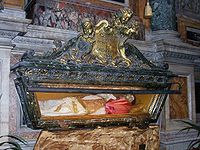 Pius V died on 1 May 1572. He was succeeded by Pope Gregory XIII
(1572–85). In 1696, the process of Pius's canonisation was started through the efforts of the Master of the Order of Preachers, Antonin Cloche. He also immediately commissioned a representative tomb from the sculptor Pierre Le Gros the Younger
to be erected in the Sistine Chapel of the Basilica di Santa Maria Maggiore
. The pope's body was placed in it in 1698. St Pius V was beatified by Pope Clement X
in the year 1672, and was later canonized by Pope Clement XI
(1700–21) on 24 May 1712.
In the following year, 1713, his feast day was inserted in the General Roman Calendar, for celebration on 5 May, with the rank of "Double", the equivalent of "Third-Class Feast" in the General Roman Calendar of 1962
, and of its present rank of "Memorial". In 1969 the celebration was moved to 30 April, the day before the anniversary of his death (1 May).
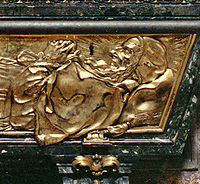 The front of his tomb has a lid of gilded bronze which shows a likeness of the dead pope. Most of the time this is left open to allow the veneration of the saint's remains.
Pope St Pius V also helped financially in the construction of the city of Valletta
, Malta
's capital city by sending his military engineer Francesco Laparelli to design the fortification walls.
Dominican Order
The Order of Preachers , after the 15th century more commonly known as the Dominican Order or Dominicans, is a Catholic religious order founded by Saint Dominic and approved by Pope Honorius III on 22 December 1216 in France...
), was Pope
Pope
The Pope is the Bishop of Rome, a position that makes him the leader of the worldwide Catholic Church . In the Catholic Church, the Pope is regarded as the successor of Saint Peter, the Apostle...
from 1566 to 1572 and is a saint
Saint
A saint is a holy person. In various religions, saints are people who are believed to have exceptional holiness.In Christian usage, "saint" refers to any believer who is "in Christ", and in whom Christ dwells, whether in heaven or in earth...
of the Catholic Church. He is chiefly notable for his role in the Council of Trent
Council of Trent
The Council of Trent was the 16th-century Ecumenical Council of the Roman Catholic Church. It is considered to be one of the Church's most important councils. It convened in Trent between December 13, 1545, and December 4, 1563 in twenty-five sessions for three periods...
, the Counter-Reformation
Counter-Reformation
The Counter-Reformation was the period of Catholic revival beginning with the Council of Trent and ending at the close of the Thirty Years' War, 1648 as a response to the Protestant Reformation.The Counter-Reformation was a comprehensive effort, composed of four major elements:#Ecclesiastical or...
, and the standardization of the Roman liturgy
Roman Rite
The Roman Rite is the liturgical rite used in the Diocese of Rome in the Catholic Church. It is by far the most widespread of the Latin liturgical rites used within the Western or Latin autonomous particular Church, the particular Church that itself is also called the Latin Rite, and that is one of...
within the Latin Church
Latin Church
The Latin Church is the largest particular church within the Catholic Church. It is a particular church not on the level of the local particular churches known as dioceses or eparchies, but on the level of autonomous ritual churches, of which there are 23, the remaining 22 of which are Eastern...
. Pius V declared saint Thomas Aquinas
Thomas Aquinas
Thomas Aquinas, O.P. , also Thomas of Aquin or Aquino, was an Italian Dominican priest of the Catholic Church, and an immensely influential philosopher and theologian in the tradition of scholasticism, known as Doctor Angelicus, Doctor Communis, or Doctor Universalis...
a Doctor of the Church
Doctor of the Church
Doctor of the Church is a title given by a variety of Christian churches to individuals whom they recognize as having been of particular importance, particularly regarding their contribution to theology or doctrine.-Catholic Church:In the Catholic Church, this name is given to a saint from whose...
and patronized prominent sacred music composer Giovanni Pierluigi da Palestrina
Giovanni Pierluigi da Palestrina
Giovanni Pierluigi da Palestrina was an Italian Renaissance composer of sacred music and the best-known 16th-century representative of the Roman School of musical composition...
.
As Cardinal Ghislieri he gained a reputation for putting orthodoxy before personalities, prosecuting eight French Bishops for heresy. He also stood firm against nepotism
Nepotism
Nepotism is favoritism granted to relatives regardless of merit. The word nepotism is from the Latin word nepos, nepotis , from which modern Romanian nepot and Italian nipote, "nephew" or "grandchild" are also descended....
, rebuking his predecessor Pope Pius IV
Pope Pius IV
Pope Pius IV , born Giovanni Angelo Medici, was Pope from 1559 to 1565. He is notable for presiding over the culmination of the Council of Trent.-Biography:...
to his face when he wanted to make a 13-year old member of his family a cardinal and subsidise a nephew from the Papal treasury.
In affairs of state, Pius V excommunicated Elizabeth I of England
Elizabeth I of England
Elizabeth I was queen regnant of England and Ireland from 17 November 1558 until her death. Sometimes called The Virgin Queen, Gloriana, or Good Queen Bess, Elizabeth was the fifth and last monarch of the Tudor dynasty...
for schism
Schism (religion)
A schism , from Greek σχίσμα, skhísma , is a division between people, usually belonging to an organization or movement religious denomination. The word is most frequently applied to a break of communion between two sections of Christianity that were previously a single body, or to a division within...
and persecutions of English Catholics during her reign. He also arranged the formation of the Holy League, an alliance of Catholic states. Although outnumbered, the Holy League famously defeated the Ottomans
Ottoman Empire
The Ottoman EmpireIt was usually referred to as the "Ottoman Empire", the "Turkish Empire", the "Ottoman Caliphate" or more commonly "Turkey" by its contemporaries...
, who had threatened to overrun Europe, at the Battle of Lepanto
Battle of Lepanto (1571)
The Battle of Lepanto took place on 7 October 1571 when a fleet of the Holy League, a coalition of Catholic maritime states, decisively defeated the main fleet of the Ottoman Empire in five hours of fighting on the northern edge of the Gulf of Patras, off western Greece...
. This victory Pius V attributed to the intercession of the Blessed Virgin Mary and instituted the feast, Our Lady of Victory.
Earlier Life
Antonio Ghislieri was born at Bosco in the Duchy of MilanDuchy of Milan
The Duchy of Milan , was created on the 1st of may 1395, when Gian Galeazzo Visconti, Lord of Milan, purchased a diploma for 100,000 Florins from King Wenceslaus. It was this diploma that installed, Gian Galeazzo as Duke of Milan and Count of Pavia...
(now Bosco Marengo
Bosco Marengo
Bosco Marengo is a town and comune in the Province of Alessandria in the Italian region Piedmont, located about 80 km southeast of Turin and about 12 km southeast of Alessandria....
in the province of Alessandria
Province of Alessandria
The Province of Alessandria is an Italian province, with a population of some 430,000, which forms the southeastern part of the region of Piedmont. The provincial capital is the city of Alessandria....
, Piedmont
Piedmont
Piedmont is one of the 20 regions of Italy. It has an area of 25,402 square kilometres and a population of about 4.4 million. The capital of Piedmont is Turin. The main local language is Piedmontese. Occitan is also spoken by a minority in the Occitan Valleys situated in the Provinces of...
), Italy
Italy
Italy , officially the Italian Republic languages]] under the European Charter for Regional or Minority Languages. In each of these, Italy's official name is as follows:;;;;;;;;), is a unitary parliamentary republic in South-Central Europe. To the north it borders France, Switzerland, Austria and...
. At the age of fourteen he entered the Dominican Order
Dominican Order
The Order of Preachers , after the 15th century more commonly known as the Dominican Order or Dominicans, is a Catholic religious order founded by Saint Dominic and approved by Pope Honorius III on 22 December 1216 in France...
, taking the name Michele, passing from the monastery of Voghera
Voghera
thumb|250px|The Castle of Voghera in a 19th century etching.Voghera is a town and comune of Lombardy, Italy, in the province of Pavia...
to that of Vigevano
Vigevano
Vigevano is a town and comune in the province of Pavia, Lombardy, northern Italy, which possesses many artistic treasures and runs a huge industrial business. It is at the center of a district called Lomellina, a great rice-growing agricultural centre...
, and thence to Bologna
Bologna
Bologna is the capital city of Emilia-Romagna, in the Po Valley of Northern Italy. The city lies between the Po River and the Apennine Mountains, more specifically, between the Reno River and the Savena River. Bologna is a lively and cosmopolitan Italian college city, with spectacular history,...
. Ordained priest at Genoa
Genoa
Genoa |Ligurian]] Zena ; Latin and, archaically, English Genua) is a city and an important seaport in northern Italy, the capital of the Province of Genoa and of the region of Liguria....
in 1528, he was sent by his order to Pavia
Pavia
Pavia , the ancient Ticinum, is a town and comune of south-western Lombardy, northern Italy, 35 km south of Milan on the lower Ticino river near its confluence with the Po. It is the capital of the province of Pavia. It has a population of c. 71,000...
, where he lectured for sixteen years. At Parma he advanced thirty propositions in support of the papal chair and against the heresies of the time. As prior of more than one Dominican priory during a time of great moral laxity, he insisted on discipline, and, in accordance with his own wishes, he was appointed inquisitor
Inquisitor
An inquisitor was an official in an Inquisition, an organisation or program intended to eliminate heresy and other things frowned on by the Roman Catholic Church...
at Como
Como
Como is a city and comune in Lombardy, Italy.It is the administrative capital of the Province of Como....
. As his reformist zeal provoked resentment, he was compelled to return to Rome
Rome
Rome is the capital of Italy and the country's largest and most populated city and comune, with over 2.7 million residents in . The city is located in the central-western portion of the Italian Peninsula, on the Tiber River within the Lazio region of Italy.Rome's history spans two and a half...
in 1550, where, after having been employed in several inquisitorial missions, he was elected to the commissariat
Commissariat
A commissariat is the department of an army charged with the provision of supplies, both food and forage, for the troops. The supply of military stores such as ammunition is not included in the duties of a commissariat. In almost every army the duties of transport and supply are performed by the...
of the Holy Office. Pope Paul IV
Pope Paul IV
Pope Paul IV, C.R. , né Giovanni Pietro Carafa, was Pope from 23 May 1555 until his death.-Early life:Giovanni Pietro Carafa was born in Capriglia Irpina, near Avellino, into a prominent noble family of Naples...
(1555–59), who, as Cardinal Carafa, had shown him special favor, conferred upon him the bishopric of Sutri and Nepi, the cardinalate with the title of Alessandrino, and the unique honor of the supreme inquisitorship. Under Pope Pius IV
Pope Pius IV
Pope Pius IV , born Giovanni Angelo Medici, was Pope from 1559 to 1565. He is notable for presiding over the culmination of the Council of Trent.-Biography:...
(1559–65) he became bishop of Mondovi in Piedmont, but his opposition to that pontiff procured his dismissal from the palace and the abridgment of his authority as inquisitor.
Election
Before Michele Ghislieri could return to his episcopate, Pope Pius IV died. On 7 January 1566, Ghislieri was elected to the Papal chair as Pope Pius V. He was crowned ten days later, on his 62nd birthday.Church discipline
Aware of the necessity of restoring discipline and morality at Rome to ensure success without, he at once proceeded to reduce the cost of the papal court after the manner of the Dominican Order to which he belonged, compel residence among the clergy, regulate inns, expel prostitutes, and assert the importance of the ceremonial in general and the liturgy of the Mass in particular. In his wider policy, which was characterised throughout by an effective stringency, the maintenance and increase of the efficacy of the Inquisition and the enforcement of the canonsCanon law
Canon law is the body of laws & regulations made or adopted by ecclesiastical authority, for the government of the Christian organization and its members. It is the internal ecclesiastical law governing the Catholic Church , the Eastern and Oriental Orthodox churches, and the Anglican Communion of...
and decrees of the Council of Trent
Council of Trent
The Council of Trent was the 16th-century Ecumenical Council of the Roman Catholic Church. It is considered to be one of the Church's most important councils. It convened in Trent between December 13, 1545, and December 4, 1563 in twenty-five sessions for three periods...
had precedence over other considerations.
Liturgy
Accordingly, in order to implement a decision of that council, he standardised the Holy Mass by promulgating the 1570 edition of the Roman MissalTridentine Mass
The Tridentine Mass is the form of the Roman Rite Mass contained in the typical editions of the Roman Missal that were published from 1570 to 1962. It was the most widely celebrated Mass liturgy in the world until the introduction of the Mass of Paul VI in December 1969...
. Pope Pius V made this Missal mandatory throughout the Latin rite of the Catholic Church, except where a Mass liturgy dating from before 1370 AD was in use. This form of the Mass remained essentially unchanged for 400 years until Pope Paul VI's revision of the Roman Missal
Mass of Paul VI
The Mass of Pope Paul VI is the liturgy of the Catholic Mass of the Roman Rite promulgated by Paul VI in 1969, after the Second Vatican Council...
in 1969–70, after which it has become widely known as the Tridentine Mass
Tridentine Mass
The Tridentine Mass is the form of the Roman Rite Mass contained in the typical editions of the Roman Missal that were published from 1570 to 1962. It was the most widely celebrated Mass liturgy in the world until the introduction of the Mass of Paul VI in December 1969...
; use of the last pre-1969 edition of the Missal, that by Pope John XXIII
Pope John XXIII
-Papal election:Following the death of Pope Pius XII in 1958, Roncalli was elected Pope, to his great surprise. He had even arrived in the Vatican with a return train ticket to Venice. Many had considered Giovanni Battista Montini, Archbishop of Milan, a possible candidate, but, although archbishop...
in 1962, is permitted without limitation for private celebration of the Mass
Mass (liturgy)
"Mass" is one of the names by which the sacrament of the Eucharist is called in the Roman Catholic Church: others are "Eucharist", the "Lord's Supper", the "Breaking of Bread", the "Eucharistic assembly ", the "memorial of the Lord's Passion and Resurrection", the "Holy Sacrifice", the "Holy and...
and, since July 2007, is allowed also, under certain conditions, for public use, as laid down in the motu proprio Summorum Pontificum
Summorum Pontificum
Summorum Pontificum is an Apostolic Letter of Pope Benedict XVI, issued "motu proprio" . The document specified the rules, for the Latin Rite of the Catholic Church, for celebrating Mass according to the "Missal promulgated by John XXIII in 1962" , and for administering most of the sacraments in...
of Pope Benedict XVI
Pope Benedict XVI
Benedict XVI is the 265th and current Pope, by virtue of his office of Bishop of Rome, the Sovereign of the Vatican City State and the leader of the Catholic Church as well as the other 22 sui iuris Eastern Catholic Churches in full communion with the Holy See...
. Some continue to use even earlier editions, but without authorisation.
Huguenots
St Pius V recognized attacks on papal supremacy in the Catholic Church and was desirous of limiting their advancement. In FranceFrance
The French Republic , The French Republic , The French Republic , (commonly known as France , is a unitary semi-presidential republic in Western Europe with several overseas territories and islands located on other continents and in the Indian, Pacific, and Atlantic oceans. Metropolitan France...
, where his influence was stronger, he took several measures to oppose the Protestant Huguenots. He directed the dismissal of Cardinal Odet de Coligny
Odet de Coligny
Odet de Coligny was a French cardinal of Châtillon, bishop of Beauvais, son of Gaspard I de Coligny and Louise de Montmorency, and brother of Gaspard and François, Seigneur d'Andelot.-Birth:...
and seven bishops, nullified the royal edict tolerating the extramural services of the Reformers, introduced the Roman catechism
Catechism
A catechism , i.e. to indoctrinate) is a summary or exposition of doctrine, traditionally used in Christian religious teaching from New Testament times to the present...
, restored papal discipline, and strenuously opposed all compromise with the Huguenot nobility.
Character and policy
In the list of more important bullsPapal bull
A Papal bull is a particular type of letters patent or charter issued by a Pope of the Catholic Church. It is named after the bulla that was appended to the end in order to authenticate it....
issued by him the famous bull "In Coena Domini
In Coena Domini
In Coena Domini was a recurrent papal bull between 1363 and 1770, so called from its opening words , formerly issued annually on Holy Thursday , or later on Easter Monday.Its first publication was in 1363 under Pope Urban V...
" (1568) takes a leading place; but amongst others throwing light on Pope Pius V's character and policy there may be mentioned his prohibition of quaestuary
Profit (economics)
In economics, the term profit has two related but distinct meanings. Normal profit represents the total opportunity costs of a venture to an entrepreneur or investor, whilst economic profit In economics, the term profit has two related but distinct meanings. Normal profit represents the total...
(February 1567 and January 1570); the condemnation of Michael Baius
Michael Baius
Michael Baius was a Belgian theologian. He came up with the school of thought Baianism.He was born at Meslin L'Eveque near Ath in Hainaut as Michel De Bay. Educated at the Catholic University of Leuven, he studied philosophy and theology with distinguished success, and was rewarded by a series of...
, the heretical Professor of Leuven
Leuven
Leuven is the capital of the province of Flemish Brabant in the Flemish Region, Belgium...
(1567); the reform of the breviary
Breviary
A breviary is a liturgical book of the Latin liturgical rites of the Catholic Church containing the public or canonical prayers, hymns, the Psalms, readings, and notations for everyday use, especially by bishops, priests, and deacons in the Divine Office...
(July 1568); the denunciation of the "dirum nefas" (August 1568); the banishment of the Jews from the ecclesiastical dominions
Papal States
The Papal State, State of the Church, or Pontifical States were among the major historical states of Italy from roughly the 6th century until the Italian peninsula was unified in 1861 by the Kingdom of Piedmont-Sardinia .The Papal States comprised territories under...
except Rome and Ancona
Ancona
Ancona is a city and a seaport in the Marche region, in central Italy, with a population of 101,909 . Ancona is the capital of the province of Ancona and of the region....
(1569); the injunction of the use of the reformed missal
Missal
A missal is a liturgical book containing all instructions and texts necessary for the celebration of Mass throughout the year.-History:Before the compilation of such books, several books were used when celebrating Mass...
(July 1570); the confirmation of the privileges of the Society of Crusaders for the protection of the Inquisition (October 1570); the dogmatic certainty of the Immaculate Conception
Immaculate Conception
The Immaculate Conception of Mary is a dogma of the Roman Catholic Church, according to which the Virgin Mary was conceived without any stain of original sin. It is one of the four dogmata in Roman Catholic Mariology...
of the Virgin Mary (November 1570); the suppression of the Fratres Humiliati
Humiliati
The Humiliati were an Italian religious order of men formed probably in the 12th century. It was suppressed by a Papal bull in 1571 though an associated order of women continued into the 20th century.-Origin:Its origin is obscure...
for profligacy (February 1571); the approbation of the new office of the Blessed Virgin (March 1571); the enforcement of the daily recitation of the Canonical Hours
Canonical hours
Canonical hours are divisions of time which serve as increments between the prescribed prayers of the daily round. A Book of Hours contains such a set of prayers....
(September 1571); and the purchase of assistance against the Turks
Ottoman Empire
The Ottoman EmpireIt was usually referred to as the "Ottoman Empire", the "Turkish Empire", the "Ottoman Caliphate" or more commonly "Turkey" by its contemporaries...
by offers of plenary pardon (March 1572).
Katherine Rinne says in the book Waters of Rome Pius V also ordered public constructions to improve water supply and sewer of Rome.
Elizabeth I
His response to the Queen Elizabeth I of EnglandElizabeth I of England
Elizabeth I was queen regnant of England and Ireland from 17 November 1558 until her death. Sometimes called The Virgin Queen, Gloriana, or Good Queen Bess, Elizabeth was the fifth and last monarch of the Tudor dynasty...
assuming governance of the Church of England
Church of England
The Church of England is the officially established Christian church in England and the Mother Church of the worldwide Anglican Communion. The church considers itself within the tradition of Western Christianity and dates its formal establishment principally to the mission to England by St...
included support of the imprisoned Mary, Queen of Scots, and her supporters in their attempts to take over England
England
England is a country that is part of the United Kingdom. It shares land borders with Scotland to the north and Wales to the west; the Irish Sea is to the north west, the Celtic Sea to the south west, with the North Sea to the east and the English Channel to the south separating it from continental...
"ex turpissima muliebris libidinis servitute". A brief English Catholic uprising, the Rising of the North
Rising of the North
The Rising of the North of 1569, also called the Revolt of the Northern Earls or Northern Rebellion, was an unsuccessful attempt by Catholic nobles from Northern England to depose Queen Elizabeth I of England and replace her with Mary, Queen of Scots.-Background:When Elizabeth I succeeded her...
, had just failed. Pius then issued a bull, Regnans in Excelsis
Regnans in Excelsis
Regnans in Excelsis was a papal bull issued on 25 February 1570 by Pope Pius V declaring "Elizabeth, the pretended Queen of England and the servant of crime" to be a heretic and releasing all her subjects from any allegiance to her and excommunicating any that obeyed her orders.The bull, written in...
, dated April 27, 1570, that declared Elizabeth I a heretic and released her subjects from their allegiance to her. In response, Elizabeth, who had thus far tolerated Catholic worship in private, now actively started persecuting them.
Holy League
Saint Pius V arranged the forming of the Holy League against the IslamIslam
Islam . The most common are and . : Arabic pronunciation varies regionally. The first vowel ranges from ~~. The second vowel ranges from ~~~...
ic Turks, as the result of which the Battle of Lepanto
Battle of Lepanto (1571)
The Battle of Lepanto took place on 7 October 1571 when a fleet of the Holy League, a coalition of Catholic maritime states, decisively defeated the main fleet of the Ottoman Empire in five hours of fighting on the northern edge of the Gulf of Patras, off western Greece...
(7 October 1571) was won by the combined fleet under Don John of Austria. It is attested in his canonisation that he miraculously knew when the battle was over, himself being in Rome at the time. Three national synod
Synod
A synod historically is a council of a church, usually convened to decide an issue of doctrine, administration or application. In modern usage, the word often refers to the governing body of a particular church, whether its members are meeting or not...
s were held during his pontificate at Naples
Naples
Naples is a city in Southern Italy, situated on the country's west coast by the Gulf of Naples. Lying between two notable volcanic regions, Mount Vesuvius and the Phlegraean Fields, it is the capital of the region of Campania and of the province of Naples...
under Alfonso Cardinal Caraffa (whose family had, after inquiry, been reinstated by Pius V), at Milan
Milan
Milan is the second-largest city in Italy and the capital city of the region of Lombardy and of the province of Milan. The city proper has a population of about 1.3 million, while its urban area, roughly coinciding with its administrative province and the bordering Province of Monza and Brianza ,...
under Saint Charles Borromeo
Charles Borromeo
Charles Borromeo was the cardinal archbishop of the Catholic Archdiocese of Milan from 1564 to 1584. He was a leading figure during the Counter-Reformation and was responsible for significant reforms in the Catholic Church, including the founding of seminaries for the education of priests...
, and at Machim.
Papal garments
Pius V is also often credited with the origin of the Pope's white garments, which supposedly originated because after this election Pius refused to replace his white DominicanDominican Order
The Order of Preachers , after the 15th century more commonly known as the Dominican Order or Dominicans, is a Catholic religious order founded by Saint Dominic and approved by Pope Honorius III on 22 December 1216 in France...
habit
Religious habit
A religious habit is a distinctive set of garments worn by members of a religious order. Traditionally some plain garb recognisable as a religious habit has also been worn by those leading the religious eremitic and anachoritic life, although in their case without conformity to a particular uniform...
with the red commonly worn by Popes and Cardinals at the time.
Death and canonisation
Pope Gregory XIII
Pope Gregory XIII , born Ugo Boncompagni, was Pope from 1572 to 1585. He is best known for commissioning and being the namesake for the Gregorian calendar, which remains the internationally-accepted civil calendar to this date.-Youth:He was born the son of Cristoforo Boncompagni and wife Angela...
(1572–85). In 1696, the process of Pius's canonisation was started through the efforts of the Master of the Order of Preachers, Antonin Cloche. He also immediately commissioned a representative tomb from the sculptor Pierre Le Gros the Younger
Pierre Le Gros the Younger
Pierre Le Gros was a French sculptor, active almost exclusively in Baroque Rome. Nowadays, his name is commonly written Legros, while he himself always signed as Le Gros; he is frequently referred to either as 'the Younger' or 'Pierre II' to distinguish him from his father, Pierre Le Gros the...
to be erected in the Sistine Chapel of the Basilica di Santa Maria Maggiore
Basilica di Santa Maria Maggiore
The Papal Basilica of Saint Mary Major , known also by other names, is the largest Roman Catholic Marian church in Rome, Italy.There are other churches in Rome dedicated to Mary, such as Santa Maria in Trastevere, Santa Maria in Aracoeli, Santa Maria sopra Minerva, but the greater size of the...
. The pope's body was placed in it in 1698. St Pius V was beatified by Pope Clement X
Pope Clement X
Pope Clement X , born Emilio Bonaventura Altieri, was Pope from 29 April 1670 to 22 July 1676.-Early life:Emilio Altieri was born in Rome, the son of Lorenzo Altieri and Victoria Delphini, a Venetian lady...
in the year 1672, and was later canonized by Pope Clement XI
Pope Clement XI
Pope Clement XI , born Giovanni Francesco Albani, was Pope from 1700 until his death in 1721.-Early life:...
(1700–21) on 24 May 1712.
In the following year, 1713, his feast day was inserted in the General Roman Calendar, for celebration on 5 May, with the rank of "Double", the equivalent of "Third-Class Feast" in the General Roman Calendar of 1962
General Roman Calendar of 1962
This article lists the feast days of the General Roman Calendar as it was in 1962, following the reforms that Pope John XXIII introduced with his motu proprio Rubricarum instructum of 23 July 1960...
, and of its present rank of "Memorial". In 1969 the celebration was moved to 30 April, the day before the anniversary of his death (1 May).
Pope St Pius V also helped financially in the construction of the city of Valletta
Valletta
Valletta is the capital of Malta, colloquially known as Il-Belt in Maltese. It is located in the central-eastern portion of the island of Malta, and the historical city has a population of 6,098. The name "Valletta" is traditionally reserved for the historic walled citadel that serves as Malta's...
, Malta
Malta
Malta , officially known as the Republic of Malta , is a Southern European country consisting of an archipelago situated in the centre of the Mediterranean, south of Sicily, east of Tunisia and north of Libya, with Gibraltar to the west and Alexandria to the east.Malta covers just over in...
's capital city by sending his military engineer Francesco Laparelli to design the fortification walls.
Further reading
- St Pius V, by Robin Anderson, TAN Books and Publishers, Inc, 1973/78. ISBN 0-89555-354-6