


Landsknecht

Encyclopedia
Germany
Germany , officially the Federal Republic of Germany , is a federal parliamentary republic in Europe. The country consists of 16 states while the capital and largest city is Berlin. Germany covers an area of 357,021 km2 and has a largely temperate seasonal climate...
mercenary
Mercenary
A mercenary, is a person who takes part in an armed conflict based on the promise of material compensation rather than having a direct interest in, or a legal obligation to, the conflict itself. A non-conscript professional member of a regular army is not considered to be a mercenary although he...
pikemen
Pike (weapon)
A pike is a pole weapon, a very long thrusting spear used extensively by infantry both for attacks on enemy foot soldiers and as a counter-measure against cavalry assaults. Unlike many similar weapons, the pike is not intended to be thrown. Pikes were used regularly in European warfare from the...
and supporting foot soldier
Infantry
Infantrymen are soldiers who are specifically trained for the role of fighting on foot to engage the enemy face to face and have historically borne the brunt of the casualties of combat in wars. As the oldest branch of combat arms, they are the backbone of armies...
s from the late 15th to the late 16th century, and achieved the reputation for being the universal mercenary of Early modern Europe
Early modern Europe
Early modern Europe is the term used by historians to refer to a period in the history of Europe which spanned the centuries between the end of the Middle Ages and the beginning of the Industrial Revolution, roughly the late 15th century to the late 18th century...
.
Etymology
The term is from GermanGerman language
German is a West Germanic language, related to and classified alongside English and Dutch. With an estimated 90 – 98 million native speakers, German is one of the world's major languages and is the most widely-spoken first language in the European Union....
, Land "land, country" + Knecht "servant", recorded from ca. 1480. It was originally coined by Peter von Hagenbach
Peter von Hagenbach
Peter von Hagenbach was a Bourguignon knight from Alsace and Germanic military and civil commander....
and intended to indicate soldiers of the lowlands
Swabia
Swabia is a cultural, historic and linguistic region in southwestern Germany.-Geography:Like many cultural regions of Europe, Swabia's borders are not clearly defined...
of the Holy Roman Empire
Holy Roman Empire
The Holy Roman Empire was a realm that existed from 962 to 1806 in Central Europe.It was ruled by the Holy Roman Emperor. Its character changed during the Middle Ages and the Early Modern period, when the power of the emperor gradually weakened in favour of the princes...
as opposed to the Swiss mercenaries
Swiss mercenaries
Swiss mercenaries were notable for their service in foreign armies, especially the armies of the Kings of France, throughout the Early Modern period of European history, from the Later Middle Ages into the Age of the European Enlightenment...
. As early as 1500 the misleading spelling of Lanzknecht became common because of the association with Lanze "lance
Lance
A Lance is a pole weapon or spear designed to be used by a mounted warrior. The lance is longer, stout and heavier than an infantry spear, and unsuited for throwing, or for rapid thrusting. Lances did not have tips designed to intentionally break off or bend, unlike many throwing weapons of the...
".
The term "Landser
Landser
Landser may refer to:*A colloquial term for a Landsknecht*A German colloquial term for a soldier derived from the above, equivalent to the English term "squaddie"...
" is directly based on Landsknecht, as is the name of the French
France
The French Republic , The French Republic , The French Republic , (commonly known as France , is a unitary semi-presidential republic in Western Europe with several overseas territories and islands located on other continents and in the Indian, Pacific, and Atlantic oceans. Metropolitan France...
card game.
History
Maximilian I, Holy Roman EmperorMaximilian I, Holy Roman Emperor
Maximilian I , the son of Frederick III, Holy Roman Emperor and Eleanor of Portugal, was King of the Romans from 1486 and Holy Roman Emperor from 1493 until his death, though he was never in fact crowned by the Pope, the journey to Rome always being too risky...
from 1493 to 1519, formed the first mercenary Landsknecht regiment
Regiment
A regiment is a major tactical military unit, composed of variable numbers of batteries, squadrons or battalions, commanded by a colonel or lieutenant colonel...
s in 1487. He called upon Georg von Frundsberg
Georg von Frundsberg
Georg von Frundsberg was a South German knight and Landsknecht leader in the service of the Imperial Habsburg dynasty of the Holy Roman Empire....
(1473–1528), known by many as the Father of the Landsknechts, to assist him in their organization. Landsknechts later went on to fight in almost every 16th-century military campaign
Military campaign
In the military sciences, the term military campaign applies to large scale, long duration, significant military strategy plan incorporating a series of inter-related military operations or battles forming a distinct part of a larger conflict often called a war...
, sometimes on both sides of the engagement.
The Landsknechte, formed in conscious imitation of the Swiss mercenaries
Swiss mercenaries
Swiss mercenaries were notable for their service in foreign armies, especially the armies of the Kings of France, throughout the Early Modern period of European history, from the Later Middle Ages into the Age of the European Enlightenment...
(and, initially, using Swiss instructors), eventually contributed to the defeat of the redoubtable Swiss, whose battle formations - overly-dependent on hand-to-hand fighting - became vulnerable to the increased fire power of arquebus
Arquebus
The arquebus , or "hook tube", is an early muzzle-loaded firearm used in the 15th to 17th centuries. The word was originally modeled on the German hakenbüchse; this produced haquebute...
and artillery
Artillery
Originally applied to any group of infantry primarily armed with projectile weapons, artillery has over time become limited in meaning to refer only to those engines of war that operate by projection of munitions far beyond the range of effect of personal weapons...
. French artillery or Spanish firepower dealt serious blows to the Swiss formations, and the Landsknecht pike blocks were there to fight off the depleted Swiss attack columns once this had occurred.
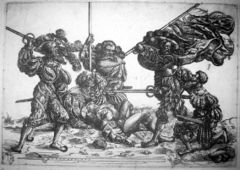
Landsknechte typically came from Swabia
Swabia
Swabia is a cultural, historic and linguistic region in southwestern Germany.-Geography:Like many cultural regions of Europe, Swabia's borders are not clearly defined...
, Alsace
Alsace
Alsace is the fifth-smallest of the 27 regions of France in land area , and the smallest in metropolitan France. It is also the seventh-most densely populated region in France and third most densely populated region in metropolitan France, with ca. 220 inhabitants per km²...
, Flanders
Flanders
Flanders is the community of the Flemings but also one of the institutions in Belgium, and a geographical region located in parts of present-day Belgium, France and the Netherlands. "Flanders" can also refer to the northern part of Belgium that contains Brussels, Bruges, Ghent and Antwerp...
, and the Rhineland
Rhineland
Historically, the Rhinelands refers to a loosely-defined region embracing the land on either bank of the River Rhine in central Europe....
, but ultimately the regiments were made up of men from all parts of Europe.
Their battlefield behavior was highly variable. Sometimes, such as at the Battle of Pavia
Battle of Pavia
The Battle of Pavia, fought on the morning of 24 February 1525, was the decisive engagement of the Italian War of 1521–26.A Spanish-Imperial army under the nominal command of Charles de Lannoy attacked the French army under the personal command of Francis I of France in the great hunting preserve...
(1525), they performed exceptionally well, fighting to the death on both sides of the conflict, even after their allies fled the field, as was the case for the French employed Landsknechts. The Imperial Landsknechte were instrumental to the Emperor's victory. However, on many other occasions, (such as in the later Italian Wars
Italian Wars
The Italian Wars, often referred to as the Great Italian Wars or the Great Wars of Italy and sometimes as the Habsburg–Valois Wars, were a series of conflicts from 1494 to 1559 that involved, at various times, most of the city-states of Italy, the Papal States, most of the major states of Western...
, French Wars of Religion
French Wars of Religion
The French Wars of Religion is the name given to a period of civil infighting and military operations, primarily fought between French Catholics and Protestants . The conflict involved the factional disputes between the aristocratic houses of France, such as the House of Bourbon and House of Guise...
and the Eighty Years War) their bravery and discipline came under severe criticism, and the Spanish elements of the Imperial army regularly deprecated the battlefield usefulness of the Landsknechts—it was said that the Duke of Alba hired them only to deny the Dutch enemy of their service, and put them on display to swell his numbers, not intending to fight with them. The Huguenots scorned their Landsknecht mercenaries after these were immediately routed by the battered Swiss mercenary pike-block they had been sent to finish off at the Battle of Dreux
Battle of Dreux
The Battle of Dreux was fought on 19 December 1562 between Catholics and Huguenots. The Catholics were led by Anne de Montmorency while Louis I, Prince of Condé led the Huguenots....
(1562).
Organization
Black Band (landsknechts)
The Black Band was a formation of 16th century mercenaries, largely pikemen, probably serving as Landsknechts. They fought in the French army for ten years, seeing service in several notable engagements, including the Battle of Marignano and the Battle of Pavia.- Origin :Some uncertainty exists...
, generally considered to have been a regiment of landsknechts, were 17,000 strong when raised by the French in 1515. It was this flexibility which allowed them to be used in various battle conditions. Oberste (colonel
Colonel
Colonel , abbreviated Col or COL, is a military rank of a senior commissioned officer. It or a corresponding rank exists in most armies and in many air forces; the naval equivalent rank is generally "Captain". It is also used in some police forces and other paramilitary rank structures...
s) were given recruiting commissions by the Emperor to form regiments, with a lieutenant-colonel and various regimental staff, and units divided into Fähnlein
Fähnlein
The Fähnlein was a military unit approximately equivalent to the company or battalion which was used in parts of Europe during the Middle Ages. The Fähnlein, meaning "small banner", consisted of foot soldiers that were organized under a single banner, hence the unit's name...
s (companies
Company (military unit)
A company is a military unit, typically consisting of 80–225 soldiers and usually commanded by a Captain, Major or Commandant. Most companies are formed of three to five platoons although the exact number may vary by country, unit type, and structure...
) with a Hauptmann
Hauptmann
Hauptmann is a German word usually translated as captain when it is used as an officer's rank in the German, Austrian and Swiss armies. While "haupt" in contemporary German means "main", it also has the dated meaning of "head", i.e...
(captain) in charge, as well as lieutenant
Lieutenant
A lieutenant is a junior commissioned officer in many nations' armed forces. Typically, the rank of lieutenant in naval usage, while still a junior officer rank, is senior to the army rank...
s and Fähnrich
Fähnrich
Fähnrich is a German and Austrian military rank in armed forces which translates as "Ensign" in English. The rank also exists in a few other European military organizations, often with historical ties to the German system. Examples are Sweden, Norway and Finland . The French Army has a similar...
e (ensign
Ensign (rank)
Ensign is a junior rank of a commissioned officer in the armed forces of some countries, normally in the infantry or navy. As the junior officer in an infantry regiment was traditionally the carrier of the ensign flag, the rank itself acquired the name....
s). Other ranks included majors of the court-martial
Court-martial
A court-martial is a military court. A court-martial is empowered to determine the guilt of members of the armed forces subject to military law, and, if the defendant is found guilty, to decide upon punishment.Most militaries maintain a court-martial system to try cases in which a breach of...
and officers in charge of camp follower
Camp follower
Camp-follower is a term used to identify civilians and their children who follow armies. There are two common types of camp followers; first, the wives and children of soldiers, who follow their spouse or parent's army from place to place; the second type of camp followers have historically been...
s.
The Tross
Tross
The Tross was the camp follower contingent of the Landsknecht mercenary regiments which originated at the end of the fifteenth century and were the dominant form of infantry mercenary force throughout the sixteenth century. Each Landsknecht unit traveled with a Tross contingent, which followed...
were the camp followers or "baggage train" who traveled with each Landsknecht unit, carrying the military necessities, the food and the belongings of each soldier and his family. Members of the Tross were made up of women, children and some craftsmen.
Weapons
Landsknechte were trained in the use of the famous long pikePike (weapon)
A pike is a pole weapon, a very long thrusting spear used extensively by infantry both for attacks on enemy foot soldiers and as a counter-measure against cavalry assaults. Unlike many similar weapons, the pike is not intended to be thrown. Pikes were used regularly in European warfare from the...
s and used the pike square
Pike square
The pike square was a military tactic developed by the Swiss Confederacy during the 15th century for use by its infantry.- History :The pike square was used to devastating effect at the Battle of Nancy against Charles the Bold of Burgundy in 1477, when the Swiss defeated a smaller but more...
formations developed by the Swiss. The majority of Landsknechte would use pikes, but others, meant to provide tactical assistance to the pikemen, accordingly used different weapons. For example, men armed with an early matchlock firearm called an "arquebus" would lay ranged fire support by the flanks of the pike square. For another example an experienced Landsknecht could be designated a Doppelsöldner
Doppelsöldner
Doppelsöldner were Landsknechts in 16th-century Germany who were prepared to fight in the front line, taking an extra risk, in exchange for double payment. The stated ratio was that one Landsknecht in four would be a Doppelsöldner...
, an armoured soldier who served as the backbone for the formation and in addition to the pike as more recent recruits, they could also be Alternatively employed wielding a 6 to 8 ft (1.8 to 2.4 m) halberd
Halberd
A halberd is a two-handed pole weapon that came to prominent use during the 14th and 15th centuries. Possibly the word halberd comes from the German words Halm , and Barte - in modern-day German, the weapon is called Hellebarde. The halberd consists of an axe blade topped with a spike mounted on...
or partisan
Partisan (weapon)
A partisan is a type of polearm that was used in Europe during the middle ages. It consisted of a spearhead mounted on a long shaft with protrusions on the sides which aided the user in parrying sword thrusts...
, or, more famously, a Zweihänder (literally: "Two-hander"), a two-handed sword
Two-handed sword
A two-handed sword, used as a general term, is any large sword designed to be used primarily with two hands:* the European longsword, popular in the Late Middle Ages and Renaissance....
as long as 180 cm (6 ft), although it was generally called at the time a Bidenhänder (literally: "both-hander") rather than a Zweihänder. These great war swords could be used to hack off the heads of enemy pikes; or more likely to knock the pikes aside, creating disorder among the tightly arranged enemy pikemen in order to break through their lines.
Arquebus
The arquebus , or "hook tube", is an early muzzle-loaded firearm used in the 15th to 17th centuries. The word was originally modeled on the German hakenbüchse; this produced haquebute...
, the precursor to the musket
Musket
A musket is a muzzle-loaded, smooth bore long gun, fired from the shoulder. Muskets were designed for use by infantry. A soldier armed with a musket had the designation musketman or musketeer....
. When the Landsknechts were first formed, arquebusiers composed up to an eighth of the total number of soldiers, but the number gradually grew to be about a quarter.
The universal Landsknecht weapon was a short sword called a Katzbalger
Katzbalger
A Katzbalger is a short Renaissance arming sword, notable for its sturdy build and a distinctive s-shaped or figure-8 shaped guard. Measuring 75–85 cm long and weighing 1–2 kg, it was the signature blade of the Landsknecht...
, carried in addition to the Landsknecht's main weapon. Indeed, the Katzbalger was seen as the very symbol of the Landsknecht, Swiss illustrators being careful to depict it to indicate that a mercenary was a Landsknecht rather than a Reisläufer
Swiss mercenaries
Swiss mercenaries were notable for their service in foreign armies, especially the armies of the Kings of France, throughout the Early Modern period of European history, from the Later Middle Ages into the Age of the European Enlightenment...
.
Landsknechte were a very powerful force due to powerful weaponry. Landsknecht Paul Dolstein wrote of the siege of Älfsborg
Älvsborg Fortress
Älvsborg, also Elfsborg Fortress, is a sea fortress located in today's Gothenburg , Sweden. Situated on the mouth of the Göta Älv river, it served to protect Sweden's access to the Atlantic Ocean and the nearby settlement of today's Gothenburg and its four predecessors. The fortress was relocated...
in July 1502, fighting for the King of Denmark: "We were 1800 Germans, and we were attacked by 15000 Swedish farmers ... we struck most of them dead".
Clothes
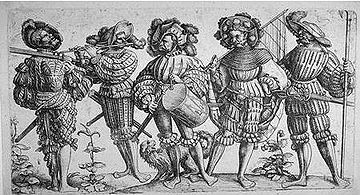
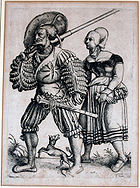
What made the landsknechte so conspicuous was their elaborate dress, which they adopted from the Swiss, but later took to even more dramatic excess. Maximilian I exempted them from the prevalent sumptuary laws as an acknowledgement of their "...short and brutish" lives.Doublet
Doublet (clothing)
A doublet is a man's snug-fitting buttoned jacket that is fitted and shaped to the man's body which was worn in Western Europe from the Middle Ages through to the mid-17th century. The doublet was hip length or waist length and worn over the shirt or drawers. Until the end of the 15th century the...
s (or Wams), deliberately slashed at the front, back and sleeves with shirts and other wear pulled through to form puffs of different-colored fabric, so-called puffed and slashed; parti-colored hose (or Gesses); jerkin
Jerkin (garment)
A jerkin is a man's short close-fitting jacket, made usually of light-colored leather, and often without sleeves, worn over the doublet in the sixteenth and seventeenth centuries...
s (or Lederwams); ever-broader flat beret
Beret
A beret is a soft, round, flat-crowned hat, designated a "cap", usually of woven, hand-knitted wool, crocheted cotton, or wool felt, or acrylic fiber....
-type hat
Hat
A hat is a head covering. It can be worn for protection against the elements, for ceremonial or religious reasons, for safety, or as a fashion accessory. In the past, hats were an indicator of social status...
s (or Tellerbarrets) with tall feathers; and broad flat shoe
Shoe
A shoe is an item of footwear intended to protect and comfort the human foot while doing various activities. Shoes are also used as an item of decoration. The design of shoes has varied enormously through time and from culture to culture, with appearance originally being tied to function...
s, made them bodies of men that could not be mistaken.
Camp
Landsknechte adopted the HussiteHussite
The Hussites were a Christian movement following the teachings of Czech reformer Jan Hus , who became one of the forerunners of the Protestant Reformation...
tactic of creating a ring of limbers and wagons, surrounded by cannon, with the encampment in the middle. While in strong positions like this, many Landsknechts lived in tents; however, in more makeshift situations, they would often build crude huts made of straw and mud supported by Pike
Pike (weapon)
A pike is a pole weapon, a very long thrusting spear used extensively by infantry both for attacks on enemy foot soldiers and as a counter-measure against cavalry assaults. Unlike many similar weapons, the pike is not intended to be thrown. Pikes were used regularly in European warfare from the...
s and Halberd
Halberd
A halberd is a two-handed pole weapon that came to prominent use during the 14th and 15th centuries. Possibly the word halberd comes from the German words Halm , and Barte - in modern-day German, the weapon is called Hellebarde. The halberd consists of an axe blade topped with a spike mounted on...
s. Commissioned officers would always sleep in tents on campaign. Quarrels and disease would go about the camp, and if the landsknechte had been defeated in the battle the camp followers had little time to escape before rape and plunder took place. However, it was usually secure from the enemy.
Modern image
There are Landsknecht associations in various European countriesEurope
Europe is, by convention, one of the world's seven continents. Comprising the westernmost peninsula of Eurasia, Europe is generally 'divided' from Asia to its east by the watershed divides of the Ural and Caucasus Mountains, the Ural River, the Caspian and Black Seas, and the waterways connecting...
, as well as in the United States
United States
The United States of America is a federal constitutional republic comprising fifty states and a federal district...
, which promote interest in the Renaissance
Renaissance
The Renaissance was a cultural movement that spanned roughly the 14th to the 17th century, beginning in Italy in the Late Middle Ages and later spreading to the rest of Europe. The term is also used more loosely to refer to the historical era, but since the changes of the Renaissance were not...
tradition of the landsknechts and who often stage revivals and festivals. The action film Flesh & Blood
Flesh & Blood (film)
Flesh & Blood is a 1985 film directed by Paul Verhoeven. It is set in the year 1501 in Italy, and follows a group of mercenaries as they loot, rape and kill....
portrays a group of Landsknecht and their fictional adventures in Italy. In the games Age of Empires 3, Europa Universalis 3 and Medieval 2: Total War
Medieval 2: Total War
Medieval II: Total War, the indirect sequel to 2002's Medieval: Total War and the fourth game in the Total War series from The Creative Assembly, is a game of turn-based strategic rounds and real-time tactically-oriented battles. The game is set between the years 1080 and 1530...
, Landsknechts can be hired to fight for one's own use. In Civilization IV
Civilization IV
Sid Meier's Civilization IV is a turn-based strategy, 4X computer game released in 2005 and developed by lead designer Soren Johnson under the direction of Sid Meier and Meier's studio Firaxis Games. It is the fourth installment of the Civilization series...
, Landsknechts act as the unique unit for the Holy Roman civilization. In Civilization V
Civilization V
Sid Meier's Civilization V is a turn-based strategy, 4X computer game developed by Firaxis, released on Microsoft Windows in September 2010 and on Mac OS X on November 23, 2010...
and Rise of Nations
Rise of Nations
Rise of Nations is a real-time strategy computer game, developed by Big Huge Games and published by Microsoft on May 20, 2003. The development of the game was led by veteran Brian Reynolds, of Civilization II and Sid Meier's Alpha Centauri. Concepts taken from turn-based strategy games have been...
Landsknechts are the unique unit of Germany, replacing pikemen. In the For the Glory
For the Glory
For the Glory is a grand strategy wargame that is based on Europa Universalis II and its Europa Engine. It was developed by , a studio composed of members of the Europe Universalis II modification "Alternative Grand Campaign / Event Exchange Project" team, and published by Paradox Interactive. It...
, the 1st level unit sprite of German nations is landsknecht with zweihander . In the Etrian Odyssey
Etrian Odyssey
Media Create/Famitsū reported that Etrian Odyssey had sold 119,584 copies in Japan as of July 1, 2007. Atlus' own July 2007 investors report listed US sales of the title at around 30,000 units, roughly 2 months after release....
series, Landsknecht is a playable class. The Warhammer Fantasy Battles Imperial Greatswords have been modelled after Landsknechts. They also feature in the game Bladestorm: The Hundred Years' War
Bladestorm: The Hundred Years' War
Bladestorm: The Hundred Years' War is a historical fantasy video game for the PlayStation 3 and Xbox 360 platforms. It was published by Koei and developed by Omega Force....
. The Original Renaissance Pleasure Faire in Irwindale, California, also has a group of landsknecht. There is also a unit of landsknecht re-enactors known as Das Geld Fahnlein at the Connecticut Renaissance Faire.
External links
- Landsknecht.org, International Landsknecht enthusiast society.
- Das Todesengel Faehnlein, St. Maximilian Landsknecht Re-enactment Guild in Northern California.
- Das Heiligesturm Fahnlein, Website of Das Heiligesturm Fahnlein in Southern California.
- No Money No Landsknecht, Website of Wolfgang von Orlok, Landsknecht of the Bristol Renaissance Faire On the Illinois/Wisconsin Border.
- Landsknecht clothing