
| |
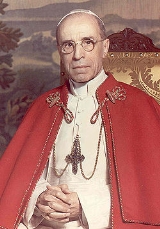
Pope Pius XII, born Eugenio Maria Giuseppe Giovanni Pacelli, reigned as the 260th pope, the human head of the Roman Catholic Church and sovereign of Vatican City, from March 2, 1939 until his death in 1958.
Before election to the papacy, Pacelli served as secretary of the Department of Extraordinary Ecclesiastical Affairs, papal nuncio and Cardinal Secretary of State, in which he worked to conclude treaties with European and Latin-American nations, most notably the Reichskonkordat with Germany. His leadership of the Catholic Church during World War II remains the subject of continued historical controversy.
After the war, Pius XII contributed to the rebuilding of Europe, and advocated peace and reconciliation, including lenient policies toward vanquished nations and the unification of Europe.

Discussion
Ask a question about 'Pope Pius XII'
Start a new discussion about 'Pope Pius XII'
Answer questions from other users
|
Timeline
Quotations
What the Vatican did will be indelibly and eternally engraved in our hearts. Priests and even high prelates did things that will forever be an honor to Catholicism.
Israel Zolli, former Chief Rabbi of Rome, 1948.
If the pope had spoken out, Hitler would probably have massacred more than six million Jews and perhaps ten times ten million Catholics, if he had the power to do so.
Rabbi Marcus Melchior, Holocaust survivor and Chief Rabbi of Denmark, 1950.
With special gratitude we remember all he has done for the persecuted Jews during one of the darkest periods in their entire history.
Nahum Goldmann, president of the World Jewish Congress, message of condolence to the Vatican, sent 1958.
The Catholic Church, under the pontificate of Pope Pius XII was instrumental in saving at least 700,000, but probably as many as 860,000, Jews from certain death at Nazi hands.
Pinchas E. Lapide, Three Popes and the Jews (1967).
Hitler distrusted the Holy See because it hid Jews. The Germans considered the Pope as an enemy.
Jewish historian Richard Breitman, professor at American University in Washington, D.C. Statement made in Italian newspaper "Corriere della Sera" on June 29 2000.
No rebuke has come to Nazism from Pope Pius XI and his successor, Pope Pius XII.
- Rabbi Louis Finkelstein, chancellor, Jewish Theological Seminary of America in the New York Times, March, 1940.

Encyclopedia
Pope Pius XII, born Eugenio Maria Giuseppe Giovanni Pacelli, reigned as the 260th pope, the human head of the Roman Catholic Church and sovereign of Vatican City, from March 2, 1939 until his death in 1958.
Before election to the papacy, Pacelli served as secretary of the Department of Extraordinary Ecclesiastical Affairs, papal nuncio and Cardinal Secretary of State, in which he worked to conclude treaties with European and Latin-American nations, most notably the Reichskonkordat with Germany. His leadership of the Catholic Church during World War II remains the subject of continued historical controversy.
After the war, Pius XII contributed to the rebuilding of Europe, and advocated peace and reconciliation, including lenient policies toward vanquished nations and the unification of Europe. The Church, flourishing in the West, experienced severe persecution and mass deportations of Catholic clergy in the East. In light of his protests, and his involvement in the Italian elections of 1948, he became known as a staunch but pragmatic opponent of Communism. He signed thirty concordats and diplomatic treaties.
Pius XII is one of only two popes (along with Pope Pius IX) to have invoked ex cathedra papal infallibility by defining the dogma of the Assumption of Mary, as proclaimed in the Apostolic constitution Munificentissimus Deus. The magisterium includes almost 1,000 addresses and radio broadcasts. His forty-one encyclicals, include Mystici Corporis, the Church as the Body of Christ; Mediator Dei on liturgy reform; Humani Generis on the Church's position on theology and evolution. He eliminated the Italian majority in the College of Cardinals with the Grand Consistory in 1946. His ongoing canonisation process progressed to the Venerable stage on September 2, 2000, under Pope John Paul II.
Early life Pacelli was born in Rome on March 2, 1876, into a well-off aristocratic family with a history of ties to the papacy (the "Black Nobility"). His grandfather, Marcantonio Pacelli, was Under-Secretary in the Papal Ministry of Finances and then Secretary of the Interior under Pope Pius IX from 1851 to 1870 and founded the Vatican's newspaper, L'Osservatore Romano in 1861; his cousin, Ernesto Pacelli, was a key financial advisor to Pope Leo XIII; his father, Filippo Pacelli, was the dean of the Sacra Rota Romana; and his brother, Francesco Pacelli, became a lay canon lawyer, credited for his role in negotiating the Lateran Treaty in 1929, bringing an end to the Roman Question. At the age of twelve, Eugenio announced his intentions to enter the priesthood instead of becoming a lawyer.
After completing state primary schools, Pacelli received his secondary, classical education at the Visconti Institute. In 1894, at the age of eighteen, he entered the Almo Capranica Seminary to begin study for the priesthood and enrolled at the Pontifical Gregorian University and the Appolinare Institute of Lateran University. From 1895–1896, he studied philosophy at University of Rome La Sapienza. In 1899, he received degrees in theology and in utroque iure|civil]] and canon law). At the seminary, he received a special dispensation to live at home for health reasons.
Church careerPriest and MonsignorHe was ordained a priest on Easter Sunday, April 2 1899 by Bishop Francesco di Paola Cassetta — the vice-regent of Rome and a family friend — and received his first assignment as a curate at Chiesa Nuova, where he had served as an altar boy. In 1901, he entered the Congregation for Extraordinary Ecclesiastical Affairs, a sub-office of the Vatican Secretariat of State, where he became a minutante, at the recommendation of Cardinal Vannutelli, another family friend.
In 1904, Pacelli became a papal chamberlain and in 1905 a domestic prelate. From 1904 until 1916, Father Pacelli assisted Cardinal Pietro Gasparri in his codification of canon law with the Department of Extraordinary Ecclesiastical Affairs. He was also chosen by Pope Leo XIII to deliver condolences on behalf of the Vatican to Edward VII of the United Kingdom after the death of Queen Victoria. In 1908, he served as a Vatican representative on the International Eucharistic Congress in London, where he met Winston Churchill. In 1911, he represented the Holy See at the coronation of King George V.
In 1908 and 1911, Pacelli turned down professorships in canon law at a Roman university and The Catholic University of America, respectively. Pacelli became the under-secretary in 1911, adjunct-secretary in 1912 (a position he received under Pope Pius X and retained under Pope Benedict XV) and secretary of the Department of Extraordinary Ecclesiastical Affairs in 1914 — succeeding Gasparri, who was promoted to Cardinal Secretary of State. As secretary, Pacelli concluded a concordat with Serbia four days before Archduke Franz Ferdinand of Austria was assassinated in Sarajevo. During World War I, Pacelli maintained the Vatican's registry of prisoners of war. In 1915, he travelled to Vienna to assist Monsignor Scapinelli — the apostolic nuncio to Vienna — in his negotiations with Franz Joseph I of Austria regarding Italy.
Archbishop and Papal Nuncio Pope Benedict XV appointed Pacelli as papal nuncio to Bavaria on April 23, 1917, consecrating him as titular Bishop of Sardis and immediately elevating him to archbishop in the Sistine Chapel on May 13, 1917, the very day, Our Lady of Fatima is believed to have first appeared to three shepherd children in Fatima, Portugal. After his consecration, Eugenio Pacelli left for Bavaria. The Vatican Peace Initiative As there was no nuncio to Prussia or Germany at the time, Pacelli was, for all practical purposes, the nuncio to all of the German Empire. Once in Munich, he conveyed the papal initiative to end the War to German authorities. He met with King Ludwig III on May 29, and later with Kaiser Wilhelm II. and Chancellor Bethmann-Hollweg, who replied positively to the Papal initiative. Pacelli saw “for the first time a real prospect for peace”. However, Bethmann-Hollweg was forced to resign and the German High Command, hoping for a military victory, delayed the German reply until September 20. Pacelli was “extraordinarily disappointed and depressed”, since the German note did not include the concessions promised earlier. For the remainder of the war, he concentrated on Benedict’s humanitarian efforts.
After the war, during the short-lived Bavarian Soviet Republic in 1919 Pacelli was one of the few foreign diplomats to remain in Munich. According to Pascalina Lehnert, who was personally there at the time, Pacelli calmly faced down a small group of Spartacist revolutionaries, who had entered the nunciature by force in order to take his car. Pacelli told them to leave the extraterritorial building, to which they responded, "only with your car". Pacelli, who had previously ordered to disconnect the starter, permitted the car to be towed away, after he was informed that the Bavarian government had promised to return the vehicle at once. Several versions of this incident and alleged later incidents are much more colorful, but, according to the relator in the beatification process in the Vatican, "mostly based on imagination" The popular view may also overlook his cordial relations with socialist politicians like Friedrich Ebert and Philipp Scheidemann, and his prolonged secret negotiations with the Soviet Union (see below). “Pacelli is simply too intelligent to be irritated by something like this” opined the Bavarian representative at the Vatican.
On the night of Adolf Hitler's Beer Hall Putsch, Franz Matt, the only member of the Bavarian cabinet not present at the Bürgerbräu Keller, was having dinner with Pacelli and Michael Cardinal von Faulhaber. The American diplomat Robert Murphy, then in Munich, writes that "all the foreign representatives at Munich, including Nuncio Pacelli, were convinced that Hitler's political career had ended ignominiously in 1924. When I ventured to remind His Holiness of this bit of history (in 1945), he laughed and said: 'I know what you mean - papal infallibility, Don't forget, I was only a monsignor then'."
The First Nuncio in Berlin Several years after he was appointed Nuncio to Germany, and after completion of a concordat with Bavaria, the nunciature was moved to Berlin. June 23 1920 and 1925 respectively. Many of Pacelli's Munich staff would stay with him for the rest of his life, including his advisor Robert Leiber and Sister Pascalina Lehnert — housekeeper, friend, and adviser to Pacelli for 41 years.
In Berlin, Pacelli was doyen or Dean of the Diplomatic Corps and active in diplomatic and many social activities. There he met notables like Albert Einstein, Adolf von Harnack, Gustav Stresemann, Clemens August Graf von Galen, and Konrad Cardinal von Preysing, the later two he elevated to cardinal in 1946. He worked with the German priest Ludwig Kaas, who was known for his expertise in Church-state relations and was politically active in the Centre Party.. While in Germany, he enjoyed working as a pastor. He traveled to all regions, attended Katholikentag (national gatherings of the faithful), and delivered some 50 sermons and speeches to the German people.
Negotiations with the Soviet Union (1925-1927) In post-war Germany, Pacelli worked mainly on clarifying the relations between Church and State (see below). But in the absence of a papal nuncio in Moscow, Pacelli worked also on diplomatic arrangements between the Vatican and the Soviet Union. He negotiated food shipments for Russia, where the Church was persecuted. He met with Soviet representatives including Foreign Minister Georgi Chicherin, who rejected any kind of religious education, the ordination of priests and bishops, but offered agreements without the points vital to the Vatican. “An enormously sophisticated conversation between two highly intelligent men like Pacelli and Chicherin, who seemed not to dislike each other.” wrote one participant. Despite Vatican pessimism and a lack of visible progress, Pacelli continued the secret negotiations, until Pope Pius XI ordered them to be discontinued in 1927.
Pacelli and the Weimar Republic
Pacelli supported the Weimar Coalition with Social Democrats and liberal parties. Although he had cordial relations with representatives of the Centre Party such as Marx and Kaas, he did not involve the Centre in his dealings with the German government. Pacelli supported German diplomatic activity aimed at rejection of punitive measures from victorious former enemies. He blocked French attempts for an ecclesiastical separation of the Saar region, supported the appointment of a papal administrator for Danzig and aided the reintegration of priests expelled from Poland.. Pacelli was critical of German policy regarding financial reparations, which he considered unimaginative and lacking a sense of reality. He regretted the return of William, German Crown Prince from exile as destabilizing. After repeated German acts of sabotage against the French occupation forces in the Ruhr valley in 1923, German media reported a conflict between Pacelli and the German authorities. The Vatican denounced these acts against the French in the Ruhr.
When he returned to Rome in 1929, praise was heaped by Catholics and Protestants alike on Pacelli, who by now had become more popular than any German cardinal or bishop, which he had largely excluded from his negotiations and dealings with the German government.
Cardinal Secretary of State and CamerlengoPacelli was made a cardinal on 16 December, 1929 by Pope Pius XI, and within a few months, on 7 February 1930, Pius XI appointed him Cardinal Secretary of State. In 1935, Cardinal Pacelli was named Camerlengo of the Roman Church.
As Cardinal Secretary of State, Pacelli signed concordats with a number of countries and states, including Baden (1932), Austria (1933), Germany (1933), Yugoslavia (1935) and Portugal (1940). The Lateran treaties with Italy (1929) were concluded before Pacelli became secretary of state. Such concordats allowed the Catholic Church to organize youth groups, make ecclesiastical appointments, run schools, hospitals, and charities, or even conduct religious services. They also ensured that canon law would be recognized within some spheres (e.g. church decrees of nullity in the area of marriage).
He made many diplomatic visits throughout Europe and the Americas, including an extensive visit to the United States in 1936 where he met with Charles Coughlin and Franklin D. Roosevelt, who appointed a personal envoy — who did not require Senate confirmation — to the Holy See in December 1939, re-establishing a diplomatic tradition that had been broken since 1870 when the pope lost temporal power.
Pacelli presided as Papal Legate over the International Eucharistic Congress in Buenos Aires, Argentina on October 10–14, 1934, and in Budapest on May 25–30, 1938.
Some historians have argued that Pacelli, as Cardinal Secretary of State, dissuaded Pope Pius XI — who was nearing death at the time — from condemning Kristallnacht in November 1938, when he was informed of it by the papal nuncio in Berlin. Likewise the prepared encyclical Humani Generis Unitas ("On the Unity of Human Society"), which was ready in September 1938 but, according to the two publishers of the encyclical and other sources, not forwarded to the Vatican by the Jesuit General Wlodimir Ledochowski. It contained an open and clear condemnation of colonialism, racism and antisemitism but also strong accusations against Jews and elements of anti-Judaism. Some historians have argued that Pacelli learned about its existence only after the death of Pius XI did not promulgate it as pope. He did however use parts of it in his inaugural encyclical Summi Pontificatus, which he titled "On the Unity of Human Society."
His various positions on Church and policy issues during his tenure as Cardinal Secretary of State were made public by the Vatican in 1939. Most noteworthy among the fifty speeches is his review of church and state issues in Budapest 1938.
Reichskonkordat The Reichskonkordat was an integral part of four concordats Pacelli concluded on behalf of the Vatican with German States. The state concordats were necessary, because the German federalist Weimar constitution gave the states authority in the area of education and culture, which were of main concern to Vatican policy. As Bavarian Nuncio, Pacelli negotiated successfully with the Bavarian authorities in 1925. He expected the concordat with Catholic Bavaria to be the model for the rest of Germany. Prussia showed interest in negotiations only after the Bavarian concordat. However, Pacelli obtained less favorable conditions for the Church in the Prussian concordat of 1929, which excluded educational issues. A concordat with the German state of Baden was completed by Pacelli in 1932, after he had moved to Rome. There he also negotiated a concordat with Austria in 1933. A total of 16 concordats and treaties with European states had been concluded in the ten year period 1922-1932.
The Reichskonkordat, signed on July 20, 1933, between Germany and the Holy See, while thus a part of an overall Vatican policy, was controversial from its beginning. It remains the most important of Pacelli's concordats. It is debated, not because of its content, which is still valid today, but because of its timing. A national concordat with Germany was one of Pacelli's main objectives as secretary of state, because he had hoped to strengthen the legal position of the Church. Pacelli, who knew German conditions well, emphasized (1) protection for Catholic associations (§31), (2) freedom for education and Catholic schools, and, (3) freedom for publications.
As nuncio during the 1920s, he had made unsuccessful attempts to obtain German agreement for such a treaty, and between 1930 and 1933 he attempted to initiate negotiations with representatives of successive German governments, but the opposition of Protestant and Socialist parties, the instability of national governments and the care of the individual states to guard their autonomy thwarted this aim. In particular, the questions of denominational schools and pastoral work in the armed forces prevented any agreement on the national level, despite talks in the winter of 1932.
Adolf Hitler was appointed Chancellor on 30 January 1933 and sought to gain international respectability and to remove internal opposition by representatives of the Church and the Catholic Centre Party. He sent his vice chancellor Franz von Papen, a Catholic nobleman and former member of the Centre Party, to Rome to offer negotiations about a Reichskonkordat. On behalf of Cardinal Pacelli, Prelate Ludwig Kaas, the outgoing chairman of the Centre Party, negotiated first drafts of the terms with Papen. The concordat was finally signed, by Pacelli for the Vatican and von Papen for Germany, on 20 July and ratified on September 10, 1933.
Between 1933 and 1939, Pacelli issued 55 protests of violations of the Reichskonkordat. Most notably, early in 1937, Pacelli asked several German cardinals, including Michael Cardinal von Faulhaber to help him write a protest of Nazi violations of the Reichskonkordat; this was to become Pius XI's encyclical Mit Brennender Sorge. The encyclical, condemning the view that "exalts race, or the people, or the State, or a particular form of State ... above their standard value and divinizes them to an idolatrous level", was written in German instead of Latin and read in German churches on Palm Sunday 1937. On June 10 1941 he commented on the problems of the Reichskonkordat in a letter to the Bishop of Passau, Bavaria: "The history of the Reichskonkordat shows, that the other side lacked the most basic prerequisites to accept minimal freedoms and rights of the Church, without which the Church simply cannot live and operate, formal agreements notwithstanding".
PapacyElection and coronationPope Pius XI died on February 10, 1939. Several historians have interpreted the conclave to choose his successor as facing a choice between a diplomatic or a spiritual candidate, and they view Pacelli's diplomatic experience, especially with Germany, as one of the deciding factors in his election on March 2, 1939, his 63rd birthday, after only one day of deliberation and three ballots. He was the first cardinal secretary of state to be elected Pope since Clement IX in 1667. He was also one of only two men known to have served as Camerlengo immediately prior to being elected as pope (the other being Pope Leo XIII). His coronation took place March 12, 1939.
Pacelli took the same papal name as his predecessor, a title used exclusively by . He was quoted as saying, "I call myself Pius; my whole life was under Popes with this name, but especially as a sign of gratitude towards Pius XI." On December 15 1937, during his last consistory, Pius XI strongly hinted to the cardinals that he expected Pacelli to be his successor, saying "He is in your midst." He had previously been quoted as saying: "When today the Pope dies, you’ll get another one tomorrow, because the Church continues. It would be a much bigger tragedy, if Cardinal Pacelli dies, because there is only one. I pray every day, God may send another one into one of our seminaries, but as of today, there is only one in this world."
After his election, Pius XII listed three objectives as pontiff.
- A new translation of the psalms, daily recited by the religious and priests, in order for the clergy to better appreciate the beauty and richness of the Old Testament. This translation was completed in 1945
- A definition of the of Dogma of the Assumption. This necessitated numerous studies into Church history and consultations with the episcopate worldwide. The dogma was proclaimed in November 1950.
- Increased archaeological excavations under St Peter's Basilica in Rome, to determine, whether St. Peter was actually buried there, or whether the Church subjected itself for more than 1500 years to a pious hoax. This was a controversial point, because of the real possibility of a major embarrassment and technical concerns, to conduct excavations under the main altar, close to the Bernini columns of the papal altar and the main support of the Michelangelo’s cupola. The first results regarding the tomb of St. Peter were published in 1950.
AppointmentsAfter his election, he appointed Luigi Cardinal Maglione to be his successor as Secretary of State. Maglione, a seasoned Vatican diplomat, had reestablished diplomatic relations with Switzerland and was for many years nuncio in Paris, France. Yet, Maglione did not exercise the influence of his predecessor Pacelli, who as Pope continued his close relation with Monsignors Montini (later Pope Paul VI) and Domenico Tardini. After the death of Maglione in 1944, Pius left the position open and named Tardini head of its foreign section and Montini head of the internal section. Tardini and Montini continued serving there until 1953, when Pius XII decided to appoint them cardinals, an honor which both turned down. They were then later appointed to be Pro-Secretary with the privilege to wear Episcopal Insignia. Tardini continued to be a close co-worker of the Pope until the death of Pius XII, while Montini became archbishop of Milan, after the death of Alfredo Ildefonso Schuster.
Pius XII slowly eroded the Italian monopoly on the Roman Curia; he employed German and Dutch Jesuit advisors, Robert Leiber, Augustin Bea, and Sebastian Tromp. He also supported the elevation of Americans such as Francis Spellman from a minor to a major role in the Church. After World War II, Pius XII appointed more non-Italians than any Pope before him. Americans included Joseph P Hurley as regent of the nunciature in Belgrade, Gerald P. O'Hara Nuncio to Rumania and Monsignor Aloisius Joseph Muench as nuncio to Germany. For the first time, numerous young European, Asian and "Americans were trained in various congregations and secretariats within the Vatican for eventual service throughout the world."
ConsistoriesOnly twice in his pontificate did Pius XII hold a consistory to create new cardinals, in contrast to Pius XI, who had done so seventeen times in seventeen years. Pius XII chose not to name new cardinals during World War II, and the number of cardinals shrank to 38, with Cardinal Denis Dougherty being the only living U.S. cardinal. The first occasion on February 18 1946 — which has become known as the "Grand Consistory" — yielded the elevation of a record thirty-two new cardinals, almost 50% of the College of Cardinals and reaching the canonical limit of seventy cardinals. In the 1946 consistory Pius XII, while maintaining the maximum size of the College of Cardinals at 70, named cardinals from China, India, the Middle East and increased the number of Cardinals from the Americas, proportionally lessening the Italian influence
In his second consistory on January 12, 1953, it was expected that his closest co-workers, Monsignore Domenico Tardini and Monsignore Montini would be elevated& Pius XII informed the assembled cardinals that two persons were originally on the top of his list, but they had turned down the offer, and were rewarded instead with other promotions. The two consistories of 1946 and 1953 brought an end to over five hundred years of Italians constituting a majority of the College of Cardinals. With few exceptions, Italian prelates accepted the changes positively; there was no protest movement or open opposition to the internationalization efforts.
Earlier, in 1945, Pius XII had dispensed with the complicated papal conclave procedures which attempted to ensure secrecy while preventing Cardinals from voting for themselves, compensating for this change by raising the requisite majority from two-thirds to two thirds plus one.
Church ReformsLiturgy reformsIn his encyclical Mediator Dei, Pius XII links liturgy with the last will of Christ.
- "But it is His will, that the worship He instituted and practiced during His life on earth shall continue ever afterwards without intermission. For he has not left mankind an orphan. He still offers us the support of His powerful, unfailing intercession, acting as our "advocate with the Father." He aids us likewise through His Church, where He is present indefectibly as the ages run their course: through the Church which He constituted "the pillar of truth" and dispenser of grace, and which by His sacrifice on the cross, He founded, consecrated and confirmed forever. "
The Church has, therefore, according to Pius XII, a common aim with Christ himself, teaching all men the truth, and, offering to God a pleasing and acceptable sacrifice. This way, the Church re-establishes the unity between the Creator and His creatures. The sacrifice of the altar, being Christ's own actions, convey and dispense divine grace from Christ to the members of the Mystical Body.
Liturgy requires participation of the faithful. Pius XII rejects as sterile the widespread Catholic practices of private and interior devotions by individuals during Holy Mass. They separate the faithful "from the sacrifice of the altar, and from the stream of vital energy that flows from Head to members." Catholic worship offers to God a joint profession of Catholic faith and a continuous exercise of hope and charity.
The numerous Liturgy reforms of Pius XII show two characteristics. Renewal and the rediscovery of old liturgical traditions, such as the reintroduction of the Easter Vigil, and, a more structured atmosphere within the Church buildings. The use of vernacular language, favoured by Pius XII, was hotly debated at his time. He increased non-Latin services, especially in countries with expanding Catholic mission activities. The location of the Blessed Sacrament within the Church was to be always at the main altar in the centre of the Church. The Church should display religious objects, but not be overloaded with secondary objects or even Kitsch. Modern sacred art should be reverential and reflect the spirit of our time. Priests are permitted to officiate marriages without Holy Mass. They also may also officiate confirmations in certain instances.
Canon Law ReformsDecentralized authority and increased the independence of the United Churches were aimed at in the Canon Law/Corpis Iuris Canonici (CIC) reform. In its new constitutions, Eastern Patriarchs were made almost independent from Rome (CIC Orientalis, 1957) Eastern marriage law (CIC Orientalis, 1949), civil law (CIC Orientalis, 1950), laws governing religious associations (CIC Orientalis, 1952) property law (CIC Orientalis ,1952) and other laws. These reforms and writings of Pius XII were intended to establish Eastern Orientals as equal parts of the mystical body of Christ, as explained in the encyclical Mystici Corporis.
Priests and ReligiousWith the Apostolic constitution Sedis Sapientiae, Pius XII added social sciences, sociology, psychology and social psychology, to the pastoral training of future priests. Pius XII emphasised the need to systematically analyze the psychological condition of candidates to the priesthood to ensure that they are capable of a life of virginity and service. Pius XII added one year to the theological formation of future priests. He also included a "pastoral year", an introduction into the practice of Parish work.
The call to constant interior reform and Christian heroism is a central part of the message of Pius XII to all Religious. This means to be above average, to be a living example of Christian virtue. As the secular world has fallen back into Hedonism, the Catholic alternative is the sanctification especially of Priests and Religious. The strict norms governing their lives are meant to make them models of Christian perfection for lay people, he writes in Menti Nostrae. Bishops are encouraged to look at model saints like Boniface, and Pope Pius X. Priests were encouraged to be living examples of the love of Christ and his sacrifice.
TheologyPius XII explained the Catholic faith in 41 encyclicals and almost 1000 messages and speeches during his long pontificate. Mediator Dei clarified membership and participation in the Church. The encyclical Divino Afflante Spiritu opened the doors for biblical research. But his magisterium was far larger and is difficult to summarize. In numerous speeches Catholic teaching is related to various aspects of life, education, medicine, politics, war and peace, the life of saints, Mary, the mother of God, things eternal and contemporary. Theologically, Pius XII specified the nature of the teaching authority of the Church. He also gave a new freedom to engage in theological in |