

Tiber

Encyclopedia
River
A river is a natural watercourse, usually freshwater, flowing towards an ocean, a lake, a sea, or another river. In a few cases, a river simply flows into the ground or dries up completely before reaching another body of water. Small rivers may also be called by several other names, including...
in Italy
Italy
Italy , officially the Italian Republic languages]] under the European Charter for Regional or Minority Languages. In each of these, Italy's official name is as follows:;;;;;;;;), is a unitary parliamentary republic in South-Central Europe. To the north it borders France, Switzerland, Austria and...
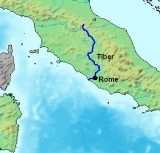
, rising in the Apennine Mountains
Apennine mountains
The Apennines or Apennine Mountains or Greek oros but just as often used alone as a noun. The ancient Greeks and Romans typically but not always used "mountain" in the singular to mean one or a range; thus, "the Apennine mountain" refers to the entire chain and is translated "the Apennine...
in Emilia-Romagna
Emilia-Romagna
Emilia–Romagna is an administrative region of Northern Italy comprising the two historic regions of Emilia and Romagna. The capital is Bologna; it has an area of and about 4.4 million inhabitants....
and flowing 406 kilometres (252 mi) through Umbria
Umbria
Umbria is a region of modern central Italy. It is one of the smallest Italian regions and the only peninsular region that is landlocked.Its capital is Perugia.Assisi and Norcia are historical towns associated with St. Francis of Assisi, and St...
and Lazio to the Tyrrhenian Sea
Tyrrhenian Sea
The Tyrrhenian Sea is part of the Mediterranean Sea off the western coast of Italy.-Geography:The sea is bounded by Corsica and Sardinia , Tuscany, Lazio, Campania, Basilicata and Calabria and Sicily ....
. It drains a basin estimated at 17375 square kilometres (6,709 sq mi). The river has achieved lasting fame as the main watercourse of the city of Rome
Rome
Rome is the capital of Italy and the country's largest and most populated city and comune, with over 2.7 million residents in . The city is located in the central-western portion of the Italian Peninsula, on the Tiber River within the Lazio region of Italy.Rome's history spans two and a half...
, founded on its eastern banks.
The river rises at Mount Fumaiolo
Mount Fumaiolo
Mount Fumaiolo is a mountain of the northern Apennines range of Italy located in the southern-most corner of the Emilia-Romagna region, c. 70 km from the town of Cesena. It is at the border Emilia-Romagna and Tuscany...
in central Italy and flows in a generally southerly direction past Perugia
Perugia
Perugia is the capital city of the region of Umbria in central Italy, near the River Tiber, and the capital of the province of Perugia. The city is located about north of Rome. It covers a high hilltop and part of the valleys around the area....
and Rome to meet the sea at Ostia. Popularly called flavus ("the blond"), in reference to the yellowish colour of its water, the Tiber has heavily advanced at the mouth by about 3 km since Roman times, leaving the ancient port of Ostia Antica 6 km inland. However, it does not form a proportional delta
River delta
A delta is a landform that is formed at the mouth of a river where that river flows into an ocean, sea, estuary, lake, reservoir, flat arid area, or another river. Deltas are formed from the deposition of the sediment carried by the river as the flow leaves the mouth of the river...
, owing to a strong north-flowing sea current close to the shore, to the steep shelving of the coast, and to slow tectonic subsidence
Tectonic subsidence
Tectonic subsidence is the sinking of the Earth's crust relative to neighboring crust or other point of reference. Components of plate movement create several environments in which subsidence occurs including, passive margins, aulacogens, fore-arc basins, foreland basins, intercontinental basins,...
.
Source of the Tiber
The sourceSource (river or stream)
The source or headwaters of a river or stream is the place from which the water in the river or stream originates.-Definition:There is no universally agreed upon definition for determining a stream's source...
of the Tiber consists of two springs
Spring (hydrosphere)
A spring—also known as a rising or resurgence—is a component of the hydrosphere. Specifically, it is any natural situation where water flows to the surface of the earth from underground...
10 metres (32.8 ft) away from each other on Mount Fumaiolo
Mount Fumaiolo
Mount Fumaiolo is a mountain of the northern Apennines range of Italy located in the southern-most corner of the Emilia-Romagna region, c. 70 km from the town of Cesena. It is at the border Emilia-Romagna and Tuscany...
. These springs are called "Le Vene." The springs are in a beech
Beech
Beech is a genus of ten species of deciduous trees in the family Fagaceae, native to temperate Europe, Asia and North America.-Habit:...
forest 1268 metres (4,160.1 ft) above sea level
Sea level
Mean sea level is a measure of the average height of the ocean's surface ; used as a standard in reckoning land elevation...
. During the 1930s, Benito Mussolini
Benito Mussolini
Benito Amilcare Andrea Mussolini was an Italian politician who led the National Fascist Party and is credited with being one of the key figures in the creation of Fascism....
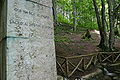
placed an antique marble
Marble
Marble is a metamorphic rock composed of recrystallized carbonate minerals, most commonly calcite or dolomite.Geologists use the term "marble" to refer to metamorphosed limestone; however stonemasons use the term more broadly to encompass unmetamorphosed limestone.Marble is commonly used for...
Roman column
Column
A column or pillar in architecture and structural engineering is a vertical structural element that transmits, through compression, the weight of the structure above to other structural elements below. For the purpose of wind or earthquake engineering, columns may be designed to resist lateral forces...
at the point where the river arises, inscribed QUI NASCE IL FIUME SACRO AI DESTINI DI ROMA ("Here is born the river / sacred to the destinies of Rome"). There is an eagle
Eagle
Eagles are members of the bird family Accipitridae, and belong to several genera which are not necessarily closely related to each other. Most of the more than 60 species occur in Eurasia and Africa. Outside this area, just two species can be found in the United States and Canada, nine more in...
on the top of this column. The first miles of the Tiber run through Valtiberina before entering Umbria
Umbria
Umbria is a region of modern central Italy. It is one of the smallest Italian regions and the only peninsular region that is landlocked.Its capital is Perugia.Assisi and Norcia are historical towns associated with St. Francis of Assisi, and St...
.
Name
It is probable that the name Tiber is pre-Latin, like the Roman name of Tibur (modern TivoliTivoli, Italy
Tivoli , the classical Tibur, is an ancient Italian town in Lazio, about 30 km east-north-east of Rome, at the falls of the Aniene river where it issues from the Sabine hills...
). It may be Etruscan
Etruscan language
The Etruscan language was spoken and written by the Etruscan civilization, in what is present-day Italy, in the ancient region of Etruria and in parts of Lombardy, Veneto, and Emilia-Romagna...
or Italic
Italic languages
The Italic subfamily is a member of the Indo-European language family. It includes the Romance languages derived from Latin , and a number of extinct languages of the Italian Peninsula, including Umbrian, Oscan, Faliscan, and Latin.In the past various definitions of "Italic" have prevailed...
in origin, possibly akin to the Celtic root-word dubr, "water". The same root is believed to be the source of the Latin praenomen
Praenomen
The praenomen was a personal name chosen by the parents of a Roman child. It was first bestowed on the dies lustricus , the eighth day after the birth of a girl, or the ninth day after the birth of a boy...
Tiberius
Tiberius (praenomen)
Tiberius is a Latin praenomen, or personal name, which was used throughout Roman history. Although not especially common, it was used by both patrician and plebeian families. The feminine form is Tiberia. The name is usually abbreviated Ti., but occasionally Tib.For most of Roman history, Tiberius...
, and its Etruscan cognate, Thefarie.
The legendary king Tiberinus Silvius, or Thebris, ninth in the king-list of Alba Longa
Alba Longa
Alba Longa – in Italian sources occasionally written Albalonga – was an ancient city of Latium in central Italy southeast of Rome in the Alban Hills. Founder and head of the Latin League, it was destroyed by Rome around the middle of the 7th century BC. In legend, Romulus and Remus, founders of...
, was said to have drowned in the Albula River, which was subsequently renamed in his honour. The myth may have explained a memory of an earlier, perhaps pre-Indo-European
Proto-Indo-European language
The Proto-Indo-European language is the reconstructed common ancestor of the Indo-European languages, spoken by the Proto-Indo-Europeans...
name for the river, "white" (alba) with sediment. According to the legend, Jupiter
Jupiter (mythology)
In ancient Roman religion and myth, Jupiter or Jove is the king of the gods, and the god of the sky and thunder. He is the equivalent of Zeus in the Greek pantheon....
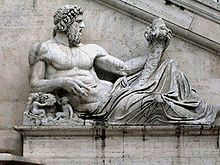
made him a god and guardian spirit of the river (also called Volturnus, "rolling water"). This gave rise to the standard Roman depiction of the river as a powerfully built reclining river god
River God
River God is a novel by author Wilbur Smith. It tells the story of the talented eunuch slave Taita, his life in Egypt, the flight of Taita along with the Egyptian populace from the Hyksos invasion, and their eventual return. The novel can be grouped together with Wilbur Smith's other books on...
, also named Tiberinus
Tiberinus (god)
Tiberinus is a figure in Roman mythology. He was added to the 3,000 rivers , as the genius of the river Tiber.According to Virgil's epic Aeneid, he helped Aeneas in his travel from Troy, suggesting to him that he land in Latium and gave him much other precious advice...
, with streams of water flowing from his hair and beard.
The River Tiber was also believed to be the river into which Romulus and Remus
Romulus and Remus
Romulus and Remus are Rome's twin founders in its traditional foundation myth, although the former is sometimes said to be the sole founder...
(the former founded Rome) were thrown as infants.
History
Ostia Antica
Ostia Antica is a large archeological site, close to the modern suburb of Ostia , that was the location of the harbour city of ancient Rome, which is approximately 30 km to the northeast. "Ostia" in Latin means "mouth". At the mouth of the River Tiber, Ostia was Rome's seaport, but, due to...
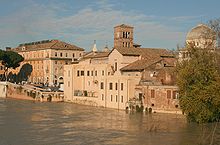
. The island Isola Tiberina
Tiber Island
The Tiber Island , is a boat-shaped island which has long been associated with healing. It is an ait, and is one of the two islands in the Tiber river, which runs through Rome; the other one, much larger, is near the mouth. The island is located in the southern bend of the Tiber. It is...
in the center of Rome, between Trastevere
Trastevere
Trastevere is rione XIII of Rome, on the west bank of the Tiber, south of Vatican City. Its name comes from the Latin trans Tiberim, meaning literally "beyond the Tiber". The correct pronunciation is "tras-TEH-ve-ray", with the accent on the second syllable. Its logo is a golden head of a lion on a...
and the ancient center, was the site of an important ancient ford and was later bridged. Legend says Rome's founders, the twin brothers Romulus and Remus
Romulus and Remus
Romulus and Remus are Rome's twin founders in its traditional foundation myth, although the former is sometimes said to be the sole founder...
, were abandoned on its waters, where they were rescued by a she-wolf.
The river marked the boundary between the lands of the Etruscans to the west, the Sabines to the east and the Latins
Latins
"Latins" refers to different groups of people and the meaning of the word changes for where and when it is used.The original Latins were an Italian tribe inhabiting central and south-central Italy. Through conquest by their most populous city-state, Rome, the original Latins culturally "Romanized"...
to the south. Benito Mussolini, born in Romagna
Romagna
Romagna is an Italian historical region that approximately corresponds to the south-eastern portion of present-day Emilia-Romagna. Traditionally, it is limited by the Apennines to the south-west, the Adriatic to the east, and the rivers Reno and Sillaro to the north and west...
, adjusted the boundary between Tuscany
Tuscany
Tuscany is a region in Italy. It has an area of about 23,000 square kilometres and a population of about 3.75 million inhabitants. The regional capital is Florence ....
and Emilia-Romagna
Emilia-Romagna
Emilia–Romagna is an administrative region of Northern Italy comprising the two historic regions of Emilia and Romagna. The capital is Bologna; it has an area of and about 4.4 million inhabitants....
, so that the springs of the Tiber would lie in Romagna.
The Tiber was critically important to Roman trade and commerce, as ships could reach as far as 100 kilometres (62.1 mi) upriver; there is evidence that it was used to ship grain from the Val Teverina as long ago as the 5th century BC. It was later used to ship stone, timber and foodstuffs to Rome.
During the Punic Wars
Punic Wars
The Punic Wars were a series of three wars fought between Rome and Carthage from 264 B.C.E. to 146 B.C.E. At the time, they were probably the largest wars that had ever taken place...
of the 3rd century BC, the harbour at Ostia became a key naval base. It later became Rome's most important port, where wheat
Wheat
Wheat is a cereal grain, originally from the Levant region of the Near East, but now cultivated worldwide. In 2007 world production of wheat was 607 million tons, making it the third most-produced cereal after maize and rice...
, olive oil
Olive oil
Olive oil is an oil obtained from the olive , a traditional tree crop of the Mediterranean Basin. It is commonly used in cooking, cosmetics, pharmaceuticals, and soaps and as a fuel for traditional oil lamps...
, and wine
Wine
Wine is an alcoholic beverage, made of fermented fruit juice, usually from grapes. The natural chemical balance of grapes lets them ferment without the addition of sugars, acids, enzymes, or other nutrients. Grape wine is produced by fermenting crushed grapes using various types of yeast. Yeast...
were imported from Rome's colonies around the Mediterranean. Wharves were also built along the riverside in Rome itself, lining the riverbanks around the Campus Martius
Campus Martius
The Campus Martius , was a publicly owned area of ancient Rome about in extent. In the Middle Ages, it was the most populous area of Rome...
area. The Romans connected the river with a sewer system (the Cloaca Maxima
Cloaca Maxima
The Cloaca Maxima is one of the world's earliest sewage systems. Constructed in Ancient Rome in order to drain local marshes and remove the waste of one of the world's most populous cities, it carried an effluent to the River Tiber, which ran beside the city....
) and with an underground network of tunnels and other channels, to bring its water into the middle of the city.
Wealthy Romans had garden-parks or "horti" on the banks of the river in Rome up through the first century BC. These may have been sold and developed about a century later.
The heavy sedimentation of the river made it difficult to maintain Ostia, prompting the emperors Claudius
Claudius
Claudius , was Roman Emperor from 41 to 54. A member of the Julio-Claudian dynasty, he was the son of Drusus and Antonia Minor. He was born at Lugdunum in Gaul and was the first Roman Emperor to be born outside Italy...
and Trajan
Trajan
Trajan , was Roman Emperor from 98 to 117 AD. Born into a non-patrician family in the province of Hispania Baetica, in Spain Trajan rose to prominence during the reign of emperor Domitian. Serving as a legatus legionis in Hispania Tarraconensis, in Spain, in 89 Trajan supported the emperor against...
to establish a new port on the Fiumicino in the 1st century AD. They built a new road, the via Portuensis
Via Portuensis
Via Portuensis was an ancient Roman road, leading to the Portus constructed by Claudius on the right bank of the Tiber, at its mouth. It started from the Pons Aemilius, and the first part of its course is identical with that of the Via Campana...
, to connect Rome with Fiumicino, leaving the city by Porta Portese ('the port gate'). Both ports were eventually abandoned due to silting.
Several pope
Pope
The Pope is the Bishop of Rome, a position that makes him the leader of the worldwide Catholic Church . In the Catholic Church, the Pope is regarded as the successor of Saint Peter, the Apostle...
s attempted to improve navigation on the Tiber in the 17th and 18th century, with extensive dredging continuing into the 19th century. Trade was boosted for a while but by the 20th century silting had resulted in the river only being navigable as far as Rome itself.
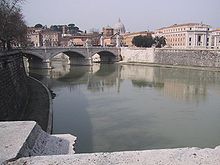
The Tiber was once known for its floods — the Campus Martius is a flood plain and would regularly flood to a depth of 2 metres (6.6 ft). The river is now confined between high stone embankments which were begun in 1876. Within the city, the riverbanks are lined by boulevards known as lungoteveri, streets "along the Tiber."
Because the river is identified with Rome, the term "swimming the Tiber" has come to be the Protestant shorthand term for converting to Roman Catholicism. This is most common if the person who converts had been Anglican
Anglicanism
Anglicanism is a tradition within Christianity comprising churches with historical connections to the Church of England or similar beliefs, worship and church structures. The word Anglican originates in ecclesia anglicana, a medieval Latin phrase dating to at least 1246 that means the English...
, the reverse of which is referred to as "Swimming the Thames
River Thames
The River Thames flows through southern England. It is the longest river entirely in England and the second longest in the United Kingdom. While it is best known because its lower reaches flow through central London, the river flows alongside several other towns and cities, including Oxford,...
."
In ancient Rome, executed
Capital punishment
Capital punishment, the death penalty, or execution is the sentence of death upon a person by the state as a punishment for an offence. Crimes that can result in a death penalty are known as capital crimes or capital offences. The term capital originates from the Latin capitalis, literally...
criminals were thrown into the Tiber. People executed at the Gemonian stairs
Gemonian stairs
The Gemonian Stairs were a flight of steps located in the ancient city of Rome. Nicknamed the Stairs of Mourning, the stairs are infamous in Roman history as a place of execution.- Location :...
were thrown in the Tiber during the latter part of the reign of the emperor Tiberius
Tiberius
Tiberius , was Roman Emperor from 14 AD to 37 AD. Tiberius was by birth a Claudian, son of Tiberius Claudius Nero and Livia Drusilla. His mother divorced Nero and married Augustus in 39 BC, making him a step-son of Octavian...
. This practice continued over the centuries. For example, the corpse of Pope Formosus
Pope Formosus
Pope Formosus was Pope of the Catholic Church from 891 to 896. His brief reign as Pope was troubled, and his remains were exhumed and put on trial in the notorious Cadaver Synod.-Biography:...
was thrown into the Tiber after the infamous Cadaver Synod
Cadaver Synod
The Cadaver Synod is the name commonly given to the posthumous ecclesiastical trial of Catholic Pope Formosus, held in the Basilica of St...
held in 897
897
Year 897 was a common year starting on Saturday of the Julian calendar.- Asia :* Emperor Uda of Japan is succeeded by Emperor Daigo....
.
Bridges over the Tiber
In addition to numerous modern bridgeBridge
A bridge is a structure built to span physical obstacles such as a body of water, valley, or road, for the purpose of providing passage over the obstacle...
s over the Tiber in Rome, there remain several ancient
Ancient Rome
Ancient Rome was a thriving civilization that grew on the Italian Peninsula as early as the 8th century BC. Located along the Mediterranean Sea and centered on the city of Rome, it expanded to one of the largest empires in the ancient world....
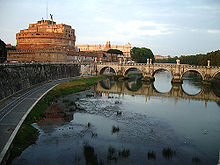
bridges (now mostly pedestrian-only) that have survived in part (e.g., the Milvian Bridge and the Ponte Sant'Angelo
Ponte Sant'Angelo
Ponte Sant'Angelo, once the Aelian Bridge or Pons Aelius, meaning the Bridge of Hadrian, is a Roman bridge in Rome, Italy, completed in 134 AD by Roman Emperor Hadrian, to span the Tiber, from the city center to his newly constructed mausoleum, now the towering Castel Sant'Angelo...
) or in whole (Fabricius' Bridge).