

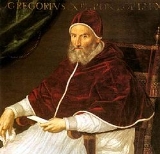
Pope Gregory XIII

Encyclopedia
Pope Gregory XIII born Ugo Boncompagni, was Pope
from 1572 to 1585. He is best known for commissioning and being the namesake for the Gregorian calendar
, which remains the internationally-accepted civil calendar to this date.
. He had an illegitimate son before he took holy orders.
(1534–1549), under whom he held successive appointments as first judge of the capital, abbreviator
, and vice-chancellor of the Campagna
; by Pope Paul IV
(1555–1559) he was attached as datarius to the suite of Cardinal Carlo Carafa
; and by Pope Pius IV
(1559–1565) he was created Cardinal-Priest of San Sisto Vecchio
and sent to the Council of Trent
.
He also served as a legate to Philip II of Spain
(1556–1598), being sent by the Pope to investigate the Cardinal of Toledo
. It was here that he formed a lasting and close relationship with the Spanish King, which was to become very important during his foreign policy as Pope.
chose Cardinal Boncompagni, who assumed the name of Gregory XIII, in homage to the great reforming Pope, Gregory I
(590–604), surnamed the Great. It was a very brief conclave, lasting less than 24 hours, presumed by many historians to have been due to the influence and backing of the Spanish King. His character seemed to be perfect for the needs of the church at the time. Unlike some of his predecessors, Gregory XIII was to lead a faultless personal life, becoming a model for his simplicity of life. Additionally, his legal brilliance and management abilities meant that he was able to respond and deal with the major problems quickly and decisively, although not always successfully.
. He allowed no exceptions for cardinals to the rule that bishops must take up residence in their see
s, and designated a committee to update the Index of Forbidden Books. A new and greatly improved edition of the Corpus juris canonici was also due to his concerned patronage. In a time of considerable centralisation of power, Gregory XIII abolished the Cardinals Consistories, replacing them with Colleges, and appointing specific tasks for these colleges to work on. He was renowned for having a fierce independence; with the few confidants noting there were interventions that were not always welcomed nor advice sought for. The power of the papacy increased under him, whereas the influence and power of the cardinals substantially decreased.
throughout Europe
, for which he founded many new colleges. The Roman College, of the Jesuits, grew substantially under his patronage, and became the most important centre of learning in Europe for a time, a University of the Nations. It is now named the Pontifical Gregorian University
. Pope Gregory XIII also founded numerous seminaries for training priests, beginning with the German College at Rome
, and put them in the charge of the Jesuits
.
In 1575 he gave official status to the Congregation of the Oratory, a community of priests without vows, dedicated to prayer and preaching (founded by Saint Filippo Neri). In 1580 he commissioned artists, including Ignazio Danti
, to complete works to decorate the Vatican
and commissioned The Gallery of Maps
.
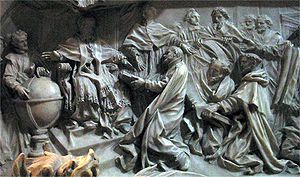 Pope Gregory XIII is best known for his reformation of the calendar, producing the Gregorian calendar
with the aid of Jesuit priest/astronomer Christopher Clavius
, who is credited as the calendar's chief architect. The reason for the reform was that the average length of the year in the Julian calendar
was too long - it treated each year as 365 days, 6 hours in length; whereas calculations showed that the actual mean length of a year was closer to 365 days, 5 hours and 49 minutes in length. As such, the date of the actual vernal equinox had slowly (over the course of 13 centuries) slipped to 10 March, whereas the computus
(calculation) of the date of Easter still followed the traditional date of 21 March.
This was rectified by following the observations of Clavius, and the calendar was changed when Gregory decreed that the day after Thursday, 4 October 1582 would be not Friday, 5 October, but Friday, 15 October 1582. He issued the papal bull
Inter gravissimas
to promulgate the new calendar on 24 February 1582. On 15 October 1582, this calendar replaced the Julian calendar
, in use since 45 BC, and has become used universally today. Because of his decree, the reform of the Julian calendar came to be known as the Gregorian calendar.
The switchover was bitterly opposed by much of the populace, who feared it was an attempt by landlords to cheat them out of a week and a half's rent. However, the Catholic countries of Spain, Portugal, Poland, and Italy complied. France, some states of the Dutch Republic
and various Catholic states in Germany
and Switzerland
(both countries were religiously split) followed suit within a year or two, and Hungary
followed in 1587.
However, more than a century would pass before Protestant Europe would accept the new calendar. Denmark, the remaining states of the Dutch Republic, and the Protestant states of the Holy Roman Empire
and Switzerland adopted the Gregorian reform in 1700-01. By this time, the calendar trailed the seasons by 11 days. Great Britain and its American colonies reformed in 1752, where Wednesday, 2 September 1752 was immediately followed by Thursday, 14 September 1752; they were joined by the last Protestant holdout, Sweden
, on 1 March 1753.
The Gregorian calendar was not accepted in eastern christendom for several hundred years, and then only as the civil calendar. England and its colonies adopted the calendar in 1752. The Gregorian Calendar was instituted in Russia
by the Bolshevik
s in 1917, Romania
accepted it in 1919 under king Ferdinand of Romania (1 November 1919 became 14 November 1919), Turkey
in 1923 under Ataturk, and the last Orthodox country to accept the calendar was Greece
also in 1923.
While some Eastern Orthodox national churches have accepted the Gregorian calendar dates for feast days that occur on the same date every year, the dates of all movable feasts (such as Easter
) are still calculated in the Eastern Orthodox churches by reference to the Julian calendar.
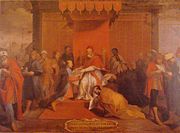 Though he expressed the conventional fears of the danger from the Turks
, Gregory XIII's attentions were more consistently directed to the dangers from the Protestants. He also encouraged the plans of Phillip II to dethrone Elizabeth I of England
(reigned from 1558–1603), thus helping to develop an atmosphere of subversion and imminent danger among English Protestants, who looked on any Roman Catholic as a potential traitor.
In 1578, to further the plans of exiled English and Irish Catholics such as Nicholas Sanders
, William Allen, and James Fitzmaurice Fitzgerald
, Gregory outfitted adventurer Thomas Stukeley with a ship and an army of 800 men to land in Ireland
to aid in the hope for overthrow of Elizabeth's rule through the Catholic leader and former leader of the first Desmond rebellion, Fitzmaurice. To his dismay, Stukeley joined his forces with those of King Sebastian of Portugal
against Emperor Abdul Malik of Morocco
instead.
Another papal expedition sailed to Ireland in 1579 with a mere 50 soldiers under the command of Fitzmaurice, accompanied by Sanders as papal legate
. The resulting Second Desmond Rebellion
was equally unsuccessful. Gregory's greatest success came in his patronage of colleges and seminaries which he founded on the Continent for the Irish and English, among others.
In 1580 he was persuaded by English Jesuits to moderate or suspend the Bull Regnans in Excelsis
(1570) which had excommunicated Queen Elizabeth I of England. Catholics were advised to obey the queen outwardly in all civil matters, until such time as a suitable opportunity presented itself for her overthrow.
Pope Gregory XIII had no connection with the plot of Henry, Duke of Guise, and his brother, Charles, Duke of Mayenne
, to assassinate Elizabeth I in 1582.
After the St. Bartholomew's Day Massacre
s of Huguenot
s in France in 1572, Pope Gregory celebrated a Te Deum mass. However, some hold that he was ignorant of the nature of the plot at the time, having been told the Huguenots had tried to take over the government but failed. Three frescoes in the Sala Regia Palace of the Vatican depicting the events were painted by Giorgio Vasari
, and a commemorative medal was issued with Gregory's portrait and on the obverse a chastising angel, sword in hand and the legend UGONOTTORUM STRAGES ("Massacre of the Huguenots").
in 1580. He also turned the Baths of Diocletian
into a granary in 1575.
He appointed his illegitimate son Giacomo
, born to his mistress at Bologna
before his papacy, castellan
of Sant'Angelo
and Gonfalonier of the Church
; Venice, anxious to please, enrolled him among its nobles. Philip II of Spain appointed him general in his army. Gregory also helped his son to become a powerful feudatary through the acquisition of the Duchy of Sora
, on the border between the Papal States
and the Kingdom of Naples
.
In order to raise funds for these and similar objects, he confiscated a large proportion of the houses and properties throughout the states of the Church. This measure enriched his treasury for a time, but alienated a great body of the nobility and gentry, revived old factions, and created new ones. Gregory XIII died on 10 April 1585.
Pope
The Pope is the Bishop of Rome, a position that makes him the leader of the worldwide Catholic Church . In the Catholic Church, the Pope is regarded as the successor of Saint Peter, the Apostle...
from 1572 to 1585. He is best known for commissioning and being the namesake for the Gregorian calendar
Gregorian calendar
The Gregorian calendar, also known as the Western calendar, or Christian calendar, is the internationally accepted civil calendar. It was introduced by Pope Gregory XIII, after whom the calendar was named, by a decree signed on 24 February 1582, a papal bull known by its opening words Inter...
, which remains the internationally-accepted civil calendar to this date.
Youth
He was born the son of Cristoforo Boncompagni (10 July 1470 – 1546) and wife Angela Marescalchi and paternal grandson of Giacomo Boncompagni and wife Camilla Piattesi, where he studied law and graduated in 1530. Afterwards, he taught jurisprudence for some years; his students included notable figures such as Cardinals Alexander Farnese, Reginald Pole and Charles BorromeoCharles Borromeo
Charles Borromeo was the cardinal archbishop of the Catholic Archdiocese of Milan from 1564 to 1584. He was a leading figure during the Counter-Reformation and was responsible for significant reforms in the Catholic Church, including the founding of seminaries for the education of priests...
. He had an illegitimate son before he took holy orders.
Career before papacy
At the age of thirty-six he was summoned to Rome by Pope Paul IIIPope Paul III
Pope Paul III , born Alessandro Farnese, was Pope of the Roman Catholic Church from 1534 to his death in 1549. He came to the papal throne in an era following the sack of Rome in 1527 and rife with uncertainties in the Catholic Church following the Protestant Reformation...
(1534–1549), under whom he held successive appointments as first judge of the capital, abbreviator
Abbreviator
Abbreviator, plural Abbreviators in English or Abbreviatores in Latin, also called Breviators, were a body of writers in the papal chancery, whose business was to sketch out and prepare in due form the pope's bulls, briefs and consistorial decrees before these are written out in extenso by the...
, and vice-chancellor of the Campagna
Campagna
Campagna is a small town and comune of the province of Salerno, in the Campania region of Southern Italy.-History:The town, located in a mountainous district, gradually lost importance in the 20th century...
; by Pope Paul IV
Pope Paul IV
Pope Paul IV, C.R. , né Giovanni Pietro Carafa, was Pope from 23 May 1555 until his death.-Early life:Giovanni Pietro Carafa was born in Capriglia Irpina, near Avellino, into a prominent noble family of Naples...
(1555–1559) he was attached as datarius to the suite of Cardinal Carlo Carafa
Carlo Carafa
Carlo Carafa of a distinguished family of Naples, vicious and talented was successively condottiero in the service of France and of Spain, vying for their protectorates in Italy until 1555, when he was made a cardinal, to 1559 the all-powerful favourite and Cardinal Nephew of Pope Paul IV Carafa,...
; and by Pope Pius IV
Pope Pius IV
Pope Pius IV , born Giovanni Angelo Medici, was Pope from 1559 to 1565. He is notable for presiding over the culmination of the Council of Trent.-Biography:...
(1559–1565) he was created Cardinal-Priest of San Sisto Vecchio
San Sisto Vecchio
San Sisto Vecchio is a church in Rome, devoted to St. Pope Sixtus II. It was built in the 4th century, and is recorded as the Titulus Crescentianae, thus relating the church to some Crescentia, possibly a Roman woman who founded the church. According to tradition, the church was established by Pope...
and sent to the Council of Trent
Council of Trent
The Council of Trent was the 16th-century Ecumenical Council of the Roman Catholic Church. It is considered to be one of the Church's most important councils. It convened in Trent between December 13, 1545, and December 4, 1563 in twenty-five sessions for three periods...
.
He also served as a legate to Philip II of Spain
Philip II of Spain
Philip II was King of Spain, Portugal, Naples, Sicily, and, while married to Mary I, King of England and Ireland. He was lord of the Seventeen Provinces from 1556 until 1581, holding various titles for the individual territories such as duke or count....
(1556–1598), being sent by the Pope to investigate the Cardinal of Toledo
Toledo, Spain
Toledo's Alcázar became renowned in the 19th and 20th centuries as a military academy. At the outbreak of the Spanish Civil War in 1936 its garrison was famously besieged by Republican forces.-Economy:...
. It was here that he formed a lasting and close relationship with the Spanish King, which was to become very important during his foreign policy as Pope.
Election as Pope
Upon the death of Pope Pius V (1566–1572), the conclavePapal conclave, 1572
The Papal conclave, May 12 – May 13, 1572 – papal conclave convoked after the death of Pius V, elected Cardinal Ugo Boncompagni, who under the name of Gregory XIII became the 226th pope of the Catholic Church.- List of participants :...
chose Cardinal Boncompagni, who assumed the name of Gregory XIII, in homage to the great reforming Pope, Gregory I
Pope Gregory I
Pope Gregory I , better known in English as Gregory the Great, was pope from 3 September 590 until his death...
(590–604), surnamed the Great. It was a very brief conclave, lasting less than 24 hours, presumed by many historians to have been due to the influence and backing of the Spanish King. His character seemed to be perfect for the needs of the church at the time. Unlike some of his predecessors, Gregory XIII was to lead a faultless personal life, becoming a model for his simplicity of life. Additionally, his legal brilliance and management abilities meant that he was able to respond and deal with the major problems quickly and decisively, although not always successfully.
Pontificate
Reform of the Church
Once in the chair of Saint Peter, Gregory XIII's rather worldly concerns became secondary and he dedicated himself to reform of the Catholic Church. He committed himself to putting into practice the recommendations of the Council of TrentCouncil of Trent
The Council of Trent was the 16th-century Ecumenical Council of the Roman Catholic Church. It is considered to be one of the Church's most important councils. It convened in Trent between December 13, 1545, and December 4, 1563 in twenty-five sessions for three periods...
. He allowed no exceptions for cardinals to the rule that bishops must take up residence in their see
Episcopal See
An episcopal see is, in the original sense, the official seat of a bishop. This seat, which is also referred to as the bishop's cathedra, is placed in the bishop's principal church, which is therefore called the bishop's cathedral...
s, and designated a committee to update the Index of Forbidden Books. A new and greatly improved edition of the Corpus juris canonici was also due to his concerned patronage. In a time of considerable centralisation of power, Gregory XIII abolished the Cardinals Consistories, replacing them with Colleges, and appointing specific tasks for these colleges to work on. He was renowned for having a fierce independence; with the few confidants noting there were interventions that were not always welcomed nor advice sought for. The power of the papacy increased under him, whereas the influence and power of the cardinals substantially decreased.
Formation of clergy and promotion of the arts and sciences
A central part of the strategy of Gregory XIII's reform was to apply the recommendations of Trent. He was a liberal patron of the recently formed Society of JesusSociety of Jesus
The Society of Jesus is a Catholic male religious order that follows the teachings of the Catholic Church. The members are called Jesuits, and are also known colloquially as "God's Army" and as "The Company," these being references to founder Ignatius of Loyola's military background and a...
throughout Europe
Europe
Europe is, by convention, one of the world's seven continents. Comprising the westernmost peninsula of Eurasia, Europe is generally 'divided' from Asia to its east by the watershed divides of the Ural and Caucasus Mountains, the Ural River, the Caspian and Black Seas, and the waterways connecting...
, for which he founded many new colleges. The Roman College, of the Jesuits, grew substantially under his patronage, and became the most important centre of learning in Europe for a time, a University of the Nations. It is now named the Pontifical Gregorian University
Pontifical Gregorian University
The Pontifical Gregorian University is a pontifical university located in Rome, Italy.Heir of the Roman College founded by Saint Ignatius of Loyola over 460 years ago, the Gregorian University was the first university founded by the Jesuits...
. Pope Gregory XIII also founded numerous seminaries for training priests, beginning with the German College at Rome
Rome
Rome is the capital of Italy and the country's largest and most populated city and comune, with over 2.7 million residents in . The city is located in the central-western portion of the Italian Peninsula, on the Tiber River within the Lazio region of Italy.Rome's history spans two and a half...
, and put them in the charge of the Jesuits
Society of Jesus
The Society of Jesus is a Catholic male religious order that follows the teachings of the Catholic Church. The members are called Jesuits, and are also known colloquially as "God's Army" and as "The Company," these being references to founder Ignatius of Loyola's military background and a...
.
In 1575 he gave official status to the Congregation of the Oratory, a community of priests without vows, dedicated to prayer and preaching (founded by Saint Filippo Neri). In 1580 he commissioned artists, including Ignazio Danti
Ignazio Danti
Ignazio Danti , born Pellegrino Rainaldi Danti, was an Italian priest, mathematician, astronomer, and cosmographer.-Biography:Danti was born in Perugia to a family rich in artists and scientists...
, to complete works to decorate the Vatican
Apostolic Palace
The Apostolic Palace is the official residence of the Pope, which is located in Vatican City. It is also known as the Sacred Palace, the Papal Palace and the Palace of the Vatican...
and commissioned The Gallery of Maps
The Gallery of Maps
The Gallery of Maps is a gallery located on the west side of the Belvedere Courtyard in the Vatican containing a series of painted topographical maps of Italy based on drawings by friar and geographer Ignazio Danti.The galley was commissioned in 1580 by Pope Gregory XIII as part of other artistic...
.
The Gregorian calendar
Gregorian calendar
The Gregorian calendar, also known as the Western calendar, or Christian calendar, is the internationally accepted civil calendar. It was introduced by Pope Gregory XIII, after whom the calendar was named, by a decree signed on 24 February 1582, a papal bull known by its opening words Inter...
with the aid of Jesuit priest/astronomer Christopher Clavius
Christopher Clavius
Christopher Clavius was a German Jesuit mathematician and astronomer who was the main architect of the modern Gregorian calendar...
, who is credited as the calendar's chief architect. The reason for the reform was that the average length of the year in the Julian calendar
Julian calendar
The Julian calendar began in 45 BC as a reform of the Roman calendar by Julius Caesar. It was chosen after consultation with the astronomer Sosigenes of Alexandria and was probably designed to approximate the tropical year .The Julian calendar has a regular year of 365 days divided into 12 months...
was too long - it treated each year as 365 days, 6 hours in length; whereas calculations showed that the actual mean length of a year was closer to 365 days, 5 hours and 49 minutes in length. As such, the date of the actual vernal equinox had slowly (over the course of 13 centuries) slipped to 10 March, whereas the computus
Computus
Computus is the calculation of the date of Easter in the Christian calendar. The name has been used for this procedure since the early Middle Ages, as it was one of the most important computations of the age....
(calculation) of the date of Easter still followed the traditional date of 21 March.
This was rectified by following the observations of Clavius, and the calendar was changed when Gregory decreed that the day after Thursday, 4 October 1582 would be not Friday, 5 October, but Friday, 15 October 1582. He issued the papal bull
Papal bull
A Papal bull is a particular type of letters patent or charter issued by a Pope of the Catholic Church. It is named after the bulla that was appended to the end in order to authenticate it....
Inter gravissimas
Inter gravissimas
Inter gravissimas was a papal bull issued by Pope Gregory XIII on February 24, 1582. The document reformed the Julian calendar and created a new calendar which came to be called the Gregorian calendar, which is used in most countries today.-Description:...
to promulgate the new calendar on 24 February 1582. On 15 October 1582, this calendar replaced the Julian calendar
Julian calendar
The Julian calendar began in 45 BC as a reform of the Roman calendar by Julius Caesar. It was chosen after consultation with the astronomer Sosigenes of Alexandria and was probably designed to approximate the tropical year .The Julian calendar has a regular year of 365 days divided into 12 months...
, in use since 45 BC, and has become used universally today. Because of his decree, the reform of the Julian calendar came to be known as the Gregorian calendar.
The switchover was bitterly opposed by much of the populace, who feared it was an attempt by landlords to cheat them out of a week and a half's rent. However, the Catholic countries of Spain, Portugal, Poland, and Italy complied. France, some states of the Dutch Republic
Dutch Republic
The Dutch Republic — officially known as the Republic of the Seven United Netherlands , the Republic of the United Netherlands, or the Republic of the Seven United Provinces — was a republic in Europe existing from 1581 to 1795, preceding the Batavian Republic and ultimately...
and various Catholic states in Germany
Germany
Germany , officially the Federal Republic of Germany , is a federal parliamentary republic in Europe. The country consists of 16 states while the capital and largest city is Berlin. Germany covers an area of 357,021 km2 and has a largely temperate seasonal climate...
and Switzerland
Switzerland
Switzerland name of one of the Swiss cantons. ; ; ; or ), in its full name the Swiss Confederation , is a federal republic consisting of 26 cantons, with Bern as the seat of the federal authorities. The country is situated in Western Europe,Or Central Europe depending on the definition....
(both countries were religiously split) followed suit within a year or two, and Hungary
Hungary
Hungary , officially the Republic of Hungary , is a landlocked country in Central Europe. It is situated in the Carpathian Basin and is bordered by Slovakia to the north, Ukraine and Romania to the east, Serbia and Croatia to the south, Slovenia to the southwest and Austria to the west. The...
followed in 1587.
However, more than a century would pass before Protestant Europe would accept the new calendar. Denmark, the remaining states of the Dutch Republic, and the Protestant states of the Holy Roman Empire
Holy Roman Empire
The Holy Roman Empire was a realm that existed from 962 to 1806 in Central Europe.It was ruled by the Holy Roman Emperor. Its character changed during the Middle Ages and the Early Modern period, when the power of the emperor gradually weakened in favour of the princes...
and Switzerland adopted the Gregorian reform in 1700-01. By this time, the calendar trailed the seasons by 11 days. Great Britain and its American colonies reformed in 1752, where Wednesday, 2 September 1752 was immediately followed by Thursday, 14 September 1752; they were joined by the last Protestant holdout, Sweden
Sweden
Sweden , officially the Kingdom of Sweden , is a Nordic country on the Scandinavian Peninsula in Northern Europe. Sweden borders with Norway and Finland and is connected to Denmark by a bridge-tunnel across the Öresund....
, on 1 March 1753.
The Gregorian calendar was not accepted in eastern christendom for several hundred years, and then only as the civil calendar. England and its colonies adopted the calendar in 1752. The Gregorian Calendar was instituted in Russia
Russia
Russia or , officially known as both Russia and the Russian Federation , is a country in northern Eurasia. It is a federal semi-presidential republic, comprising 83 federal subjects...
by the Bolshevik
Bolshevik
The Bolsheviks, originally also Bolshevists , derived from bol'shinstvo, "majority") were a faction of the Marxist Russian Social Democratic Labour Party which split apart from the Menshevik faction at the Second Party Congress in 1903....
s in 1917, Romania
Romania
Romania is a country located at the crossroads of Central and Southeastern Europe, on the Lower Danube, within and outside the Carpathian arch, bordering on the Black Sea...
accepted it in 1919 under king Ferdinand of Romania (1 November 1919 became 14 November 1919), Turkey
Turkey
Turkey , known officially as the Republic of Turkey , is a Eurasian country located in Western Asia and in East Thrace in Southeastern Europe...
in 1923 under Ataturk, and the last Orthodox country to accept the calendar was Greece
Greece
Greece , officially the Hellenic Republic , and historically Hellas or the Republic of Greece in English, is a country in southeastern Europe....
also in 1923.
While some Eastern Orthodox national churches have accepted the Gregorian calendar dates for feast days that occur on the same date every year, the dates of all movable feasts (such as Easter
Easter
Easter is the central feast in the Christian liturgical year. According to the Canonical gospels, Jesus rose from the dead on the third day after his crucifixion. His resurrection is celebrated on Easter Day or Easter Sunday...
) are still calculated in the Eastern Orthodox churches by reference to the Julian calendar.
Foreign policy
Ottoman Empire
The Ottoman EmpireIt was usually referred to as the "Ottoman Empire", the "Turkish Empire", the "Ottoman Caliphate" or more commonly "Turkey" by its contemporaries...
, Gregory XIII's attentions were more consistently directed to the dangers from the Protestants. He also encouraged the plans of Phillip II to dethrone Elizabeth I of England
Elizabeth I of England
Elizabeth I was queen regnant of England and Ireland from 17 November 1558 until her death. Sometimes called The Virgin Queen, Gloriana, or Good Queen Bess, Elizabeth was the fifth and last monarch of the Tudor dynasty...
(reigned from 1558–1603), thus helping to develop an atmosphere of subversion and imminent danger among English Protestants, who looked on any Roman Catholic as a potential traitor.
In 1578, to further the plans of exiled English and Irish Catholics such as Nicholas Sanders
Nicholas Sanders
Nicholas Sanders was an English Roman Catholic priest and polemicist.-Early life:Sanders was born at Chariwood , Surrey, the son of William Sanders, once sheriff of Surrey, who was descended from the Sanders of Sanderstead...
, William Allen, and James Fitzmaurice Fitzgerald
James FitzMaurice FitzGerald
James Fitzmaurice Fitzgerald was a member of the 16th century ruling Geraldine dynasty in the province of Munster in Ireland. He rebelled against the crown authority of Queen Elizabeth I of England in response to the onset of the Tudor conquest of Ireland and was deemed an archtraitor...
, Gregory outfitted adventurer Thomas Stukeley with a ship and an army of 800 men to land in Ireland
Ireland
Ireland is an island to the northwest of continental Europe. It is the third-largest island in Europe and the twentieth-largest island on Earth...
to aid in the hope for overthrow of Elizabeth's rule through the Catholic leader and former leader of the first Desmond rebellion, Fitzmaurice. To his dismay, Stukeley joined his forces with those of King Sebastian of Portugal
Sebastian of Portugal
Sebastian "the Desired" was the 16th king of Portugal and the Algarves. He was the son of Prince John of Portugal and his wife, Joan of Spain...
against Emperor Abdul Malik of Morocco
Abu Marwan Abd al-Malik I Saadi
Abu Marwan Abd al-Malik I , often simply Abd al-Malik or Mulay Abdelmalek, was the Saadi Sultan of Morocco from 1576 until his death right after the Battle of Ksar El Kebir against Portugal in 1578.-Saadi Prince:...
instead.
Another papal expedition sailed to Ireland in 1579 with a mere 50 soldiers under the command of Fitzmaurice, accompanied by Sanders as papal legate
Papal legate
A papal legate – from the Latin, authentic Roman title Legatus – is a personal representative of the pope to foreign nations, or to some part of the Catholic Church. He is empowered on matters of Catholic Faith and for the settlement of ecclesiastical matters....
. The resulting Second Desmond Rebellion
Second Desmond Rebellion
The Second Desmond rebellion was the more widespread and bloody of the two Desmond Rebellions launched by the FitzGerald dynasty of Desmond in Munster, Ireland, against English rule in Ireland...
was equally unsuccessful. Gregory's greatest success came in his patronage of colleges and seminaries which he founded on the Continent for the Irish and English, among others.
In 1580 he was persuaded by English Jesuits to moderate or suspend the Bull Regnans in Excelsis
Regnans in Excelsis
Regnans in Excelsis was a papal bull issued on 25 February 1570 by Pope Pius V declaring "Elizabeth, the pretended Queen of England and the servant of crime" to be a heretic and releasing all her subjects from any allegiance to her and excommunicating any that obeyed her orders.The bull, written in...
(1570) which had excommunicated Queen Elizabeth I of England. Catholics were advised to obey the queen outwardly in all civil matters, until such time as a suitable opportunity presented itself for her overthrow.
Pope Gregory XIII had no connection with the plot of Henry, Duke of Guise, and his brother, Charles, Duke of Mayenne
Charles of Lorraine, Duke of Mayenne
Charles of Lorraine, Duke of Mayenne , or Charles de Guise, was a French nobleman of the house of Guise and a military leader of the Catholic League, which he headed during the French Wars of Religion, following the assassination of his brothers at Blois in 1588...
, to assassinate Elizabeth I in 1582.
After the St. Bartholomew's Day Massacre
St. Bartholomew's Day massacre
The St. Bartholomew's Day massacre in 1572 was a targeted group of assassinations, followed by a wave of Roman Catholic mob violence, both directed against the Huguenots , during the French Wars of Religion...
s of Huguenot
Huguenot
The Huguenots were members of the Protestant Reformed Church of France during the 16th and 17th centuries. Since the 17th century, people who formerly would have been called Huguenots have instead simply been called French Protestants, a title suggested by their German co-religionists, the...
s in France in 1572, Pope Gregory celebrated a Te Deum mass. However, some hold that he was ignorant of the nature of the plot at the time, having been told the Huguenots had tried to take over the government but failed. Three frescoes in the Sala Regia Palace of the Vatican depicting the events were painted by Giorgio Vasari
Giorgio Vasari
Giorgio Vasari was an Italian painter, writer, historian, and architect, who is famous today for his biographies of Italian artists, considered the ideological foundation of art-historical writing.-Biography:...
, and a commemorative medal was issued with Gregory's portrait and on the obverse a chastising angel, sword in hand and the legend UGONOTTORUM STRAGES ("Massacre of the Huguenots").
Cultural patronage
In Rome Gregory XIII built the magnificent Gregorian chapel in the Basilica of St. Peter, and extended the Quirinal PalaceQuirinal Palace
The Quirinal Palace is a historical building in Rome, Italy, the current official residence of the President of the Italian Republic. It is located on the Quirinal Hill, the tallest of the seven hills of Rome...
in 1580. He also turned the Baths of Diocletian
Baths of Diocletian
The Baths of Diocletian in Rome were the grandest of the public baths, or thermae built by successive emperors. Diocletian's Baths, dedicated in 306, were the largest and most sumptuous of the imperial baths. The baths were built between the years 298 AD and 306 AD...
into a granary in 1575.
He appointed his illegitimate son Giacomo
Giacomo Boncompagni
Giacomo Boncompagni was an Italian feudal lord of the 16th century, the illegitimate son of Pope Gregory XIII . He was also Duke of Sora, Aquino, Arce and Arpino, and Marquess of Vignola.A member of the Boncompagni family, he was a patron of arts and culture...
, born to his mistress at Bologna
Bologna
Bologna is the capital city of Emilia-Romagna, in the Po Valley of Northern Italy. The city lies between the Po River and the Apennine Mountains, more specifically, between the Reno River and the Savena River. Bologna is a lively and cosmopolitan Italian college city, with spectacular history,...
before his papacy, castellan
Castellan
A castellan was the governor or captain of a castle. The word stems from the Latin Castellanus, derived from castellum "castle". Also known as a constable.-Duties:...
of Sant'Angelo
Castel Sant'Angelo
The Mausoleum of Hadrian, usually known as the Castel Sant'Angelo, is a towering cylindrical building in Parco Adriano, Rome, Italy. It was initially commissioned by the Roman Emperor Hadrian as a mausoleum for himself and his family...
and Gonfalonier of the Church
Gonfalonier of the Church
The Gonfalonier of the Church or Papal Gonfalonier was a military and political office of the Papal States. Originating from the use of the Papal banner during combat, the office later became largely ceremonial and political...
; Venice, anxious to please, enrolled him among its nobles. Philip II of Spain appointed him general in his army. Gregory also helped his son to become a powerful feudatary through the acquisition of the Duchy of Sora
Duchy of Sora
The Duchy of Sora was a semi-independent state in Italy, created in 1443 by King Alfonso I of Naples and dissolved in 1796. It occupied the south-eastern part of what is today Lazio, bordering what is now Abruzzo...
, on the border between the Papal States
Papal States
The Papal State, State of the Church, or Pontifical States were among the major historical states of Italy from roughly the 6th century until the Italian peninsula was unified in 1861 by the Kingdom of Piedmont-Sardinia .The Papal States comprised territories under...
and the Kingdom of Naples
Kingdom of Naples
The Kingdom of Naples, comprising the southern part of the Italian peninsula, was the remainder of the old Kingdom of Sicily after secession of the island of Sicily as a result of the Sicilian Vespers rebellion of 1282. Known to contemporaries as the Kingdom of Sicily, it is dubbed Kingdom of...
.
In order to raise funds for these and similar objects, he confiscated a large proportion of the houses and properties throughout the states of the Church. This measure enriched his treasury for a time, but alienated a great body of the nobility and gentry, revived old factions, and created new ones. Gregory XIII died on 10 April 1585.
External links
- "Papal Library" website: Gregory XIII
- Monument to Gregory XIII