

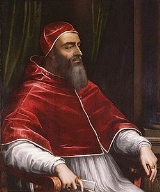
Pope Clement VII

Encyclopedia
Clement VII born Giulio di Giuliano de' Medici, was a cardinal
from 1513 to 1523 and was Pope
from 1523 to 1534.
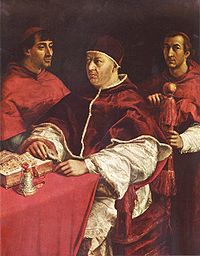 He was born in Florence
one month after his father's death. His father, Giuliano de' Medici, had been assassinated. Although his parents had not had a formal marriage, a canon law
loophole allowing for the parents to have been betrothed meant that Giulio was considered legitimate. He was thus the nephew of Lorenzo the Magnificent, who educated him in his youth. Clement's mother, Fioretta Gorini, also died leaving him an orphan.
Giulio was made a Knight of Rhodes and Grand Prior of Capua
, and, upon the election of his cousin Giovanni de' Medici to the pontificate as Leo X (1513–21), he soon became a powerful figure in Rome. Upon his cousin's accession to the papacy, Giulio became his principal minister and confidant, especially in the maintenance of the Medici
interest at Florence
as archbishop of that city. On 23 September 1513, he was made cardinal
and he was consecrated on 29 September. He had the credit of being the main director of papal policy during the whole of Leo X's pontificate, especially as cardinal protector of England
. He was also the titular Bishop of Worcester
in the county of Worcestershire in England as Administrator or the See
of Worcester.
in the protracted conclave. Although unable to gain the Papacy for himself or his ally Alessandro Farnese
(both preferred candidates of Emperor Charles V
(1519–56)), he took a leading part in determining the unexpected election of the short-lived Pope Adrian VI
(1522–23), with whom he also wielded formidable influence. Following Adrian VI's death on 14 September 1523, Medici finally succeeded in being elected Pope Clement VII in the next conclave
(19 November 1523).
He brought to the papal throne a high reputation for political ability and possessed in fact all the accomplishments of a wily diplomat. However, he was considered worldly and indifferent to the perceived dangers of the Protestant Reformation
by the people of the papacy.
, Spain
, and England
, in order to bring the war then raging in Europe to a peace. But his attempt failed.
's conquest of Milan
in 1524 prompted the Pope to quit the Imperial
–Spanish side and to ally himself with other Italian princes, including the Republic of Venice
, and France in the January of 1525. This treaty granted the definitive acquisition of Parma
and Piacenza
for the Papal States
, the rule of Medici over Florence and the free passage of the French troops to Naples
. This policy in itself was sound and patriotic, but Clement VII's zeal soon cooled; by his want of foresight and unseasonable economy, he laid himself open to an attack from the turbulent Roman barons, which obliged him to invoke the mediation of the emperor. One month later, however, Francis I was crushed and imprisoned in the Battle of Pavia
, and Clement VII veered back to his former engagements with Charles V, signing an alliance with the viceroy of Naples
.
But he was to change sides again when Francis I was freed after the Treaty of Madrid (1526): the Pope entered into the League of Cognac together with France, Venice
, and Francesco Sforza of Milan
. Clement VII issued an invective against Charles V, who in reply defined him a "wolf" instead of a "shepherd", menacing the summoning of a council about the Lutheran question.
: Cardinal Pompeo Colonna
's soldiers pillaged Vatican Hill
and gained control of the whole of Rome in his name. The humiliated Pope promised therefore to bring the Papal States to the Imperial side again. But soon after, Colonna left the siege and went to Naples, not keeping his promises and dismissing the Cardinal from his charge. From this point on, Clement VII could do nothing but follow the fate of the French party to the end.
Soon he found himself alone in Italy too, as the duke of Ferrara had sided with the Imperial army, allowing the horde of Landsknecht
s led by Charles III, Duke of Bourbon
and Georg von Frundsberg
to reach Rome without harm.
Charles of Bourbon died while mounting a ladder during the short siege and his starving troops, unpaid and left without a guide, felt free to ravage Rome from 6 May 1527. The many incidents of murder, rape, and vandalism that followed ended the splendours of Renaissance Rome
forever. Clement VII, who had displayed no more resolution in his military than in his political conduct, was shortly afterwards (June 6) obliged to surrender himself together with the castle of Sant'Angelo
, where he had taken refuge. He agreed to pay a ransom of 400,000 ducati in exchange for his life; conditions included the cession of Parma
, Piacenza
, Civitavecchia
, and Modena
to the Holy Roman Empire. (Only the last could be occupied in fact.) At the same time, Venice took advantage of his situation to capture Cervia
and Ravenna
while Sigismondo Malatesta
returned in Rimini
.
Clement was kept as a prisoner in Castel Sant'Angelo for six months. After having bought off some Imperial officers, he escaped disguised as a peddler and took shelter in Orvieto
and then in Viterbo
. He came back to a depopulated and devastated Rome only in October 1528.
Meanwhile, in Florence, Republican enemies of the Medici took advantage of the chaos to again expel the Pope's family from the city.
In June of the next year the warring parties signed the Peace of Barcelona. The Papal States regained some cities, and Charles V agreed to restore the Medici to power in Florence. In 1530, after an eleven-month siege, the Tuscan city capitulated, and Clement VII installed his illegitimate son Alessandro as duke. Subsequently the Pope followed a policy of subservience to the emperor, endeavouring on the one hand to induce him to act with severity against the Lutherans in Germany and on the other to avoid his demands for a general council.
annulled
. The royal couple had not produced a male heir who survived into adulthood, and Henry wanted a son to secure the Tudor dynasty
. Henry claimed that this lack of a male heir was because his marriage was "blighted in the eyes of God". Catherine had been his late brother
's wife, and it was therefore against Biblical teachings for Henry to have married her. Indeed, a special dispensation from Pope Julius II
had been needed to allow the wedding in the first place. Henry argued that this had been wrong and that his marriage had never been valid. In 1527 Henry asked Pope Clement to annul the marriage, but the Pope refused. According to canon law, the Pope cannot annul a marriage on the basis of a canonical impediment
previously dispensed
. Clement also feared the wrath of Catherine's nephew, Charles V, whose own troops were responsible for the episode earlier that year that included the sack of Rome. In the matter of the annulment, no progress seemed possible: the Pope seemed more afraid of Emperor Charles V than of Henry. Many people close to Henry VIII wished simply to ignore the Pope; but in October 1530 a meeting of clergy and lawyers advised that the English Parliament could not empower the Archbishop of Canterbury
to act against the Pope's prohibition. In Parliament, Bishop John Fisher
was the Pope's champion.
Henry was married to Anne Boleyn
at some debated point between the end of 1532 and the beginning of 1533. One 16th century chronicler put the wedding service on the feast of Saint Erkenwald in Dover Castle
, around November 14, whilst others have suggested a second or perhaps sole Nuptial Mass at the Palace of Whitehall
in Westminster
on January 25, 1533. The name of the celebrant is unknown, although various sources suggest it was Father Rowland Lee
, future Bishop of Lichfield
, or Prior George Browne
, future Archbishop of Dublin
. The marriage was made easier by the death of Archbishop William Warham
, a stalwart friend of the Pope, after which Henry persuaded Clement to appoint Father Thomas Cranmer
, a friend of the Boleyn family, as his successor as Archbishop of Canterbury. The Pope granted the papal bull
s necessary for Cranmer’s promotion to Canterbury, as Henry had personally financed them. Cranmer was prepared to grant the annulment of the marriage to Catherine as Henry required. Anne gave birth to a daughter, Princess Elizabeth, three months after her public coronation as queen in Westminster Abbey
. The Pope responded to the marriage by excommunicating both Henry and Cranmer from the Catholic Church. For some time, the news was kept from the new queen, for fear it would bring about a miscarriage.
Consequently in England, in the same year, the Act of First Fruits and Tenths transferred the taxes on ecclesiastical income from the Pope to the English Crown. The Peter's Pence Act
outlawed the annual payment by landowners of one penny
to the Pope. This act also reiterated that England had "no superior under God, but only your Grace
" and that Henry's "imperial crown" had been diminished by "the unreasonable and uncharitable usurpations and exactions" of the Pope. Ultimately Henry led the English Parliament to pass the Act of Supremacy (1534) that established the independent Church of England
and breaking from the Catholic Church.
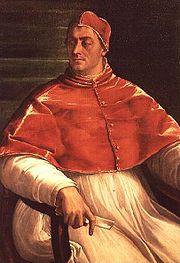 During his half-year imprisonment in 1527, Clement VII grew a full beard as a sign of mourning for the sack of Rome
. This was a violation of Catholic canon law, which required priests to be clean-shaven; however, it had the precedent of the beard which Pope Julius II
had worn for nine months in 1511–12 as a similar sign of mourning for the loss of the papal city of Bologna
.
Unlike Julius II, however, Clement VII kept his beard until his death in 1534. His example in wearing a beard was followed by his successor, Paul III, and indeed by twenty-four popes who followed him, down to Innocent XII, who died in 1700. Clement VII was thus the unintentional originator of a fashion that lasted well over a century.
to the Pope and two cardinals. The Pope was so pleased that he gave Widmanstetter a valuable gift.
Towards the end of his life, Clement VII once more gave indications of a leaning towards a French alliance, which was averted by his death in September 1534 in Rome after consuming the death cap
mushroom. He was buried in Santa Maria sopra Minerva
.
As for the arts, Clement VII is remembered for having ordered, just a few days before his death, Michelangelo
's painting of The Last Judgment
in the Sistine Chapel
.
Cardinal (Catholicism)
A cardinal is a senior ecclesiastical official, usually an ordained bishop, and ecclesiastical prince of the Catholic Church. They are collectively known as the College of Cardinals, which as a body elects a new pope. The duties of the cardinals include attending the meetings of the College and...
from 1513 to 1523 and was Pope
Pope
The Pope is the Bishop of Rome, a position that makes him the leader of the worldwide Catholic Church . In the Catholic Church, the Pope is regarded as the successor of Saint Peter, the Apostle...
from 1523 to 1534.
Early life
Florence
Florence is the capital city of the Italian region of Tuscany and of the province of Florence. It is the most populous city in Tuscany, with approximately 370,000 inhabitants, expanding to over 1.5 million in the metropolitan area....
one month after his father's death. His father, Giuliano de' Medici, had been assassinated. Although his parents had not had a formal marriage, a canon law
Canon law (Catholic Church)
The canon law of the Catholic Church, is a fully developed legal system, with all the necessary elements: courts, lawyers, judges, a fully articulated legal code and principles of legal interpretation. It lacks the necessary binding force present in most modern day legal systems. The academic...
loophole allowing for the parents to have been betrothed meant that Giulio was considered legitimate. He was thus the nephew of Lorenzo the Magnificent, who educated him in his youth. Clement's mother, Fioretta Gorini, also died leaving him an orphan.
Giulio was made a Knight of Rhodes and Grand Prior of Capua
Capua
Capua is a city and comune in the province of Caserta, Campania, southern Italy, situated 25 km north of Naples, on the northeastern edge of the Campanian plain. Ancient Capua was situated where Santa Maria Capua Vetere is now...
, and, upon the election of his cousin Giovanni de' Medici to the pontificate as Leo X (1513–21), he soon became a powerful figure in Rome. Upon his cousin's accession to the papacy, Giulio became his principal minister and confidant, especially in the maintenance of the Medici
Medici
The House of Medici or Famiglia de' Medici was a political dynasty, banking family and later royal house that first began to gather prominence under Cosimo de' Medici in the Republic of Florence during the late 14th century. The family originated in the Mugello region of the Tuscan countryside,...
interest at Florence
Roman Catholic Archdiocese of Florence
The Archdiocese of Florence is a metropolitan see of the Catholic Church in Italy. Traditionally founded in the 1st century, it was elevated to the dignity of an archdiocese on May 10, 1419, by Pope Martin V. Its mother church is the Basilica di Santa Maria del Fiore, which has as its pastor the...
as archbishop of that city. On 23 September 1513, he was made cardinal
Cardinal (Catholicism)
A cardinal is a senior ecclesiastical official, usually an ordained bishop, and ecclesiastical prince of the Catholic Church. They are collectively known as the College of Cardinals, which as a body elects a new pope. The duties of the cardinals include attending the meetings of the College and...
and he was consecrated on 29 September. He had the credit of being the main director of papal policy during the whole of Leo X's pontificate, especially as cardinal protector of England
Cardinal protector of England
The Cardinal protector of England was an appointed crown-cardinal of England from 1492 until 1539. A cardinal protector is the representative of a Roman Catholic nation or organization within the College of Cardinals, appointed by the pope...
. He was also the titular Bishop of Worcester
Bishop of Worcester
The Bishop of Worcester is the Ordinary of the Church of England Diocese of Worcester in the Province of Canterbury, England. He is the head of the Diocese of Worcester in the Province of Canterbury...
in the county of Worcestershire in England as Administrator or the See
Episcopal See
An episcopal see is, in the original sense, the official seat of a bishop. This seat, which is also referred to as the bishop's cathedra, is placed in the bishop's principal church, which is therefore called the bishop's cathedral...
of Worcester.
Election
At Leo X's death in 1521, Cardinal Medici was considered especially papabilePapabile
Papabile is an unofficial Italian term first coined by Vaticanologists and now used internationally in many languages to describe a cardinal of whom it is thought likely or possible that he will be elected pope. A literal English translation would be "popeable" or "one who might become pope".In...
in the protracted conclave. Although unable to gain the Papacy for himself or his ally Alessandro Farnese
Pope Paul III
Pope Paul III , born Alessandro Farnese, was Pope of the Roman Catholic Church from 1534 to his death in 1549. He came to the papal throne in an era following the sack of Rome in 1527 and rife with uncertainties in the Catholic Church following the Protestant Reformation...
(both preferred candidates of Emperor Charles V
Charles V, Holy Roman Emperor
Charles V was ruler of the Holy Roman Empire from 1519 and, as Charles I, of the Spanish Empire from 1516 until his voluntary retirement and abdication in favor of his younger brother Ferdinand I and his son Philip II in 1556.As...
(1519–56)), he took a leading part in determining the unexpected election of the short-lived Pope Adrian VI
Pope Adrian VI
Pope Adrian VI , born Adriaan Florenszoon Boeyens, served as Pope from 9 January 1522 until his death some 18 months later...
(1522–23), with whom he also wielded formidable influence. Following Adrian VI's death on 14 September 1523, Medici finally succeeded in being elected Pope Clement VII in the next conclave
Papal conclave
A papal conclave is a meeting of the College of Cardinals convened to elect a Bishop of Rome, who then becomes the Pope during a period of vacancy in the papal office. The Pope is considered by Roman Catholics to be the apostolic successor of Saint Peter and earthly head of the Roman Catholic Church...
(19 November 1523).
He brought to the papal throne a high reputation for political ability and possessed in fact all the accomplishments of a wily diplomat. However, he was considered worldly and indifferent to the perceived dangers of the Protestant Reformation
Protestant Reformation
The Protestant Reformation was a 16th-century split within Western Christianity initiated by Martin Luther, John Calvin and other early Protestants. The efforts of the self-described "reformers", who objected to the doctrines, rituals and ecclesiastical structure of the Roman Catholic Church, led...
by the people of the papacy.
Papacy
At his accession, Clement VII sent the Archbishop of Capua, Nikolaus von Schönberg, to the Kings of FranceEarly Modern France
Kingdom of France is the early modern period of French history from the end of the 15th century to the end of the 18th century...
, Spain
Spain
Spain , officially the Kingdom of Spain languages]] under the European Charter for Regional or Minority Languages. In each of these, Spain's official name is as follows:;;;;;;), is a country and member state of the European Union located in southwestern Europe on the Iberian Peninsula...
, and England
Kingdom of England
The Kingdom of England was, from 927 to 1707, a sovereign state to the northwest of continental Europe. At its height, the Kingdom of England spanned the southern two-thirds of the island of Great Britain and several smaller outlying islands; what today comprises the legal jurisdiction of England...
, in order to bring the war then raging in Europe to a peace. But his attempt failed.
Continental and Medici politics
Francis I of FranceFrancis I of France
Francis I was King of France from 1515 until his death. During his reign, huge cultural changes took place in France and he has been called France's original Renaissance monarch...
's conquest of Milan
Italian campaign of 1524–1525
The Italian campaign of 1524–25 was the final significant action of the Italian War of 1521–26.- Prelude :The French, in possession of Lombardy at the start of the Italian War of 1521, had been forced to abandon it after their defeat at the Battle of Bicocca in 1522...
in 1524 prompted the Pope to quit the Imperial
Holy Roman Empire
The Holy Roman Empire was a realm that existed from 962 to 1806 in Central Europe.It was ruled by the Holy Roman Emperor. Its character changed during the Middle Ages and the Early Modern period, when the power of the emperor gradually weakened in favour of the princes...
–Spanish side and to ally himself with other Italian princes, including the Republic of Venice
Republic of Venice
The Republic of Venice or Venetian Republic was a state originating from the city of Venice in Northeastern Italy. It existed for over a millennium, from the late 7th century until 1797. It was formally known as the Most Serene Republic of Venice and is often referred to as La Serenissima, in...
, and France in the January of 1525. This treaty granted the definitive acquisition of Parma
Parma
Parma is a city in the Italian region of Emilia-Romagna famous for its ham, its cheese, its architecture and the fine countryside around it. This is the home of the University of Parma, one of the oldest universities in the world....
and Piacenza
Piacenza
Piacenza is a city and comune in the Emilia-Romagna region of northern Italy. It is the capital of the province of Piacenza...
for the Papal States
Papal States
The Papal State, State of the Church, or Pontifical States were among the major historical states of Italy from roughly the 6th century until the Italian peninsula was unified in 1861 by the Kingdom of Piedmont-Sardinia .The Papal States comprised territories under...
, the rule of Medici over Florence and the free passage of the French troops to Naples
Naples
Naples is a city in Southern Italy, situated on the country's west coast by the Gulf of Naples. Lying between two notable volcanic regions, Mount Vesuvius and the Phlegraean Fields, it is the capital of the region of Campania and of the province of Naples...
. This policy in itself was sound and patriotic, but Clement VII's zeal soon cooled; by his want of foresight and unseasonable economy, he laid himself open to an attack from the turbulent Roman barons, which obliged him to invoke the mediation of the emperor. One month later, however, Francis I was crushed and imprisoned in the Battle of Pavia
Battle of Pavia
The Battle of Pavia, fought on the morning of 24 February 1525, was the decisive engagement of the Italian War of 1521–26.A Spanish-Imperial army under the nominal command of Charles de Lannoy attacked the French army under the personal command of Francis I of France in the great hunting preserve...
, and Clement VII veered back to his former engagements with Charles V, signing an alliance with the viceroy of Naples
Charles de Lannoy
Charles de Lannoy was a soldier and statesman from the Low Countries in service of the Habsburg Emperors Maximilian I and Charles V of Spain....
.
But he was to change sides again when Francis I was freed after the Treaty of Madrid (1526): the Pope entered into the League of Cognac together with France, Venice
Republic of Venice
The Republic of Venice or Venetian Republic was a state originating from the city of Venice in Northeastern Italy. It existed for over a millennium, from the late 7th century until 1797. It was formally known as the Most Serene Republic of Venice and is often referred to as La Serenissima, in...
, and Francesco Sforza of Milan
Duchy of Milan
The Duchy of Milan , was created on the 1st of may 1395, when Gian Galeazzo Visconti, Lord of Milan, purchased a diploma for 100,000 Florins from King Wenceslaus. It was this diploma that installed, Gian Galeazzo as Duke of Milan and Count of Pavia...
. Clement VII issued an invective against Charles V, who in reply defined him a "wolf" instead of a "shepherd", menacing the summoning of a council about the Lutheran question.
Evangelization
In his bull "Intra Arcana" he advocated a militaristic means of evangelizing "by force and arms, if needful" which contrasts with the more peaceful admonitions of his successor Paul III in his bull "Sublimus Dei".Sack of Rome
The Pope's wavering politics also caused the rise of the Imperial party inside the CuriaRoman Curia
The Roman Curia is the administrative apparatus of the Holy See and the central governing body of the entire Catholic Church, together with the Pope...
: Cardinal Pompeo Colonna
Pompeo Colonna
Pompeo Colonna was an Italian Cardinal, politician and condottiero.Born in Rome, he fought very early against the traditional family enemies, the Orsini....
's soldiers pillaged Vatican Hill
Vatican Hill
Vatican Hill is the name given, long before the founding of Christianity, to one of the hills on the side of the Tiber opposite the traditional seven hills of Rome...
and gained control of the whole of Rome in his name. The humiliated Pope promised therefore to bring the Papal States to the Imperial side again. But soon after, Colonna left the siege and went to Naples, not keeping his promises and dismissing the Cardinal from his charge. From this point on, Clement VII could do nothing but follow the fate of the French party to the end.
Soon he found himself alone in Italy too, as the duke of Ferrara had sided with the Imperial army, allowing the horde of Landsknecht
Landsknecht
Landsknechte were European, predominantly German mercenary pikemen and supporting foot soldiers from the late 15th to the late 16th century, and achieved the reputation for being the universal mercenary of Early modern Europe.-Etymology:The term is from German, Land "land, country" + Knecht...
s led by Charles III, Duke of Bourbon
Charles III, Duke of Bourbon
Charles III, Duke of Bourbon was a French military leader, the Count of Montpensier and Dauphin of Auvergne. He commanded the Imperial troops of Holy Roman Emperor Charles V in what became known as the Sack of Rome in 1527, where he was killed.-Biography:Charles was born at Montpensier...
and Georg von Frundsberg
Georg von Frundsberg
Georg von Frundsberg was a South German knight and Landsknecht leader in the service of the Imperial Habsburg dynasty of the Holy Roman Empire....
to reach Rome without harm.
Charles of Bourbon died while mounting a ladder during the short siege and his starving troops, unpaid and left without a guide, felt free to ravage Rome from 6 May 1527. The many incidents of murder, rape, and vandalism that followed ended the splendours of Renaissance Rome
Italian Renaissance
The Italian Renaissance began the opening phase of the Renaissance, a period of great cultural change and achievement in Europe that spanned the period from the end of the 13th century to about 1600, marking the transition between Medieval and Early Modern Europe...
forever. Clement VII, who had displayed no more resolution in his military than in his political conduct, was shortly afterwards (June 6) obliged to surrender himself together with the castle of Sant'Angelo
Castel Sant'Angelo
The Mausoleum of Hadrian, usually known as the Castel Sant'Angelo, is a towering cylindrical building in Parco Adriano, Rome, Italy. It was initially commissioned by the Roman Emperor Hadrian as a mausoleum for himself and his family...
, where he had taken refuge. He agreed to pay a ransom of 400,000 ducati in exchange for his life; conditions included the cession of Parma
Parma
Parma is a city in the Italian region of Emilia-Romagna famous for its ham, its cheese, its architecture and the fine countryside around it. This is the home of the University of Parma, one of the oldest universities in the world....
, Piacenza
Piacenza
Piacenza is a city and comune in the Emilia-Romagna region of northern Italy. It is the capital of the province of Piacenza...
, Civitavecchia
Civitavecchia
Civitavecchia is a town and comune of the province of Rome in the central Italian region of Lazio. A sea port on the Tyrrhenian Sea, it is located 80 kilometers west-north-west of Rome, across the Mignone river. The harbor is formed by two piers and a breakwater, on which is a lighthouse...
, and Modena
Modena
Modena is a city and comune on the south side of the Po Valley, in the Province of Modena in the Emilia-Romagna region of Italy....
to the Holy Roman Empire. (Only the last could be occupied in fact.) At the same time, Venice took advantage of his situation to capture Cervia
Cervia
Cervia is a town and comune in the province of Ravenna , central Italy.-History:Originally called Ficocle, it was probably of Greek origin and was located midway from current Cervia and Ravenna...
and Ravenna
Ravenna
Ravenna is the capital city of the Province of Ravenna in the Emilia-Romagna region of Italy and the second largest comune in Italy by land area, although, at , it is little more than half the size of the largest comune, Rome...
while Sigismondo Malatesta
Sigismondo Malatesta
Sigismondo Pandolfo Malatesta , popularly known as the Wolf of Rimini, was an Italian condottiero and nobleman, a member of the House of Malatesta and lord of Rimini, Fano, and Cesena from 1432...
returned in Rimini
Rimini
Rimini is a medium-sized city of 142,579 inhabitants in the Emilia-Romagna region of Italy, and capital city of the Province of Rimini. It is located on the Adriatic Sea, on the coast between the rivers Marecchia and Ausa...
.
Clement was kept as a prisoner in Castel Sant'Angelo for six months. After having bought off some Imperial officers, he escaped disguised as a peddler and took shelter in Orvieto
Orvieto
Orvieto is a city and comune in Province of Terni, southwestern Umbria, Italy situated on the flat summit of a large butte of volcanic tuff...
and then in Viterbo
Viterbo
See also Viterbo, Texas and Viterbo UniversityViterbo is an ancient city and comune in the Lazio region of central Italy, the capital of the province of Viterbo. It is approximately 80 driving / 80 walking kilometers north of GRA on the Via Cassia, and it is surrounded by the Monti Cimini and...
. He came back to a depopulated and devastated Rome only in October 1528.
Meanwhile, in Florence, Republican enemies of the Medici took advantage of the chaos to again expel the Pope's family from the city.
In June of the next year the warring parties signed the Peace of Barcelona. The Papal States regained some cities, and Charles V agreed to restore the Medici to power in Florence. In 1530, after an eleven-month siege, the Tuscan city capitulated, and Clement VII installed his illegitimate son Alessandro as duke. Subsequently the Pope followed a policy of subservience to the emperor, endeavouring on the one hand to induce him to act with severity against the Lutherans in Germany and on the other to avoid his demands for a general council.
English Reformation
Clement's dependence on Charles V led indirectly to the break between the Kingdom of England and the Catholic Church. By the late 1520s, King Henry VIII wanted to have his marriage to Catherine of AragonCatherine of Aragon
Catherine of Aragon , also known as Katherine or Katharine, was Queen consort of England as the first wife of King Henry VIII of England and Princess of Wales as the wife to Arthur, Prince of Wales...
annulled
Annulment (Catholic Church)
In the Roman Catholic Church an annulment is the procedure, governed by the Church's Canon Law and the Catechism, whereby an ecclesial tribunal determines the sacrament of marriage was invalidly entered into. An annulment determines the Catholic marriage to be void at its inception...
. The royal couple had not produced a male heir who survived into adulthood, and Henry wanted a son to secure the Tudor dynasty
Tudor dynasty
The Tudor dynasty or House of Tudor was a European royal house of Welsh origin that ruled the Kingdom of England and its realms, including the Lordship of Ireland, later the Kingdom of Ireland, from 1485 until 1603. Its first monarch was Henry Tudor, a descendant through his mother of a legitimised...
. Henry claimed that this lack of a male heir was because his marriage was "blighted in the eyes of God". Catherine had been his late brother
Arthur, Prince of Wales
Arthur Tudor, Prince of Wales was the first son of King Henry VII of England and Elizabeth of York, and therefore, heir to the throne of England. As he predeceased his father, Arthur never became king...
's wife, and it was therefore against Biblical teachings for Henry to have married her. Indeed, a special dispensation from Pope Julius II
Pope Julius II
Pope Julius II , nicknamed "The Fearsome Pope" and "The Warrior Pope" , born Giuliano della Rovere, was Pope from 1503 to 1513...
had been needed to allow the wedding in the first place. Henry argued that this had been wrong and that his marriage had never been valid. In 1527 Henry asked Pope Clement to annul the marriage, but the Pope refused. According to canon law, the Pope cannot annul a marriage on the basis of a canonical impediment
Canonical impediment
In the Canon Law of the Catholic Church, a canonical impediment is a legal obstacle that prevents a sacrament from being performed validly and/or licitly. The term is used most frequently in relationship to the sacraments of Marriage and Holy Orders...
previously dispensed
Dispensation (Catholic Church)
In the canon law of the Roman Catholic Church, a dispensation is the suspension by competent authority of general rules of law in particular cases...
. Clement also feared the wrath of Catherine's nephew, Charles V, whose own troops were responsible for the episode earlier that year that included the sack of Rome. In the matter of the annulment, no progress seemed possible: the Pope seemed more afraid of Emperor Charles V than of Henry. Many people close to Henry VIII wished simply to ignore the Pope; but in October 1530 a meeting of clergy and lawyers advised that the English Parliament could not empower the Archbishop of Canterbury
Archbishop of Canterbury
The Archbishop of Canterbury is the senior bishop and principal leader of the Church of England, the symbolic head of the worldwide Anglican Communion, and the diocesan bishop of the Diocese of Canterbury. In his role as head of the Anglican Communion, the archbishop leads the third largest group...
to act against the Pope's prohibition. In Parliament, Bishop John Fisher
John Fisher
Saint John Fisher was an English Roman Catholic scholastic, bishop, cardinal and martyr. He shares his feast day with Saint Thomas More on 22 June in the Roman Catholic calendar of saints and 6 July on the Church of England calendar of saints...
was the Pope's champion.
Henry was married to Anne Boleyn
Anne Boleyn
Anne Boleyn ;c.1501/1507 – 19 May 1536) was Queen of England from 1533 to 1536 as the second wife of Henry VIII of England and Marquess of Pembroke in her own right. Henry's marriage to Anne, and her subsequent execution, made her a key figure in the political and religious upheaval that was the...
at some debated point between the end of 1532 and the beginning of 1533. One 16th century chronicler put the wedding service on the feast of Saint Erkenwald in Dover Castle
Dover Castle
Dover Castle is a medieval castle in the town of the same name in the English county of Kent. It was founded in the 12th century and has been described as the "Key to England" due to its defensive significance throughout history...
, around November 14, whilst others have suggested a second or perhaps sole Nuptial Mass at the Palace of Whitehall
Palace of Whitehall
The Palace of Whitehall was the main residence of the English monarchs in London from 1530 until 1698 when all except Inigo Jones's 1622 Banqueting House was destroyed by fire...
in Westminster
City of Westminster
The City of Westminster is a London borough occupying much of the central area of London, England, including most of the West End. It is located to the west of and adjoining the ancient City of London, directly to the east of the Royal Borough of Kensington and Chelsea, and its southern boundary...
on January 25, 1533. The name of the celebrant is unknown, although various sources suggest it was Father Rowland Lee
Rowland Lee
Bishop Rowland Lee was an English administrator and bishop of Coventry and Lichfield.He belonged to a Northumberland family and was educated at Cambridge. Having entered the Church he obtained several livings owing to the favour of Cardinal Wolsey; after Wolsey's fall he rose high in the esteem of...
, future Bishop of Lichfield
Bishop of Lichfield
The Bishop of Lichfield is the ordinary of the Church of England Diocese of Lichfield in the Province of Canterbury.The diocese covers 4,516 km² of the counties of Staffordshire, Shropshire, Warwickshire and West Midlands. The bishop's seat is located in the Cathedral Church of the Blessed...
, or Prior George Browne
George Browne (archbishop of Dublin)
George Browne D.D. was an English Augustinian who was appointed by Henry VIII of England to the vacant Episcopal see of Dublin. He became the king's main instrument in his desire to establish the state church in the Kingdom of Ireland.-Life:...
, future Archbishop of Dublin
Archbishop of Dublin
The Archbishop of Dublin may refer to:* Archbishop of Dublin – an article which lists of pre- and post-Reformation archbishops.* Archbishop of Dublin – the title of the senior cleric who presides over the Roman Catholic Archdiocese of Dublin....
. The marriage was made easier by the death of Archbishop William Warham
William Warham
William Warham , Archbishop of Canterbury, belonged to a Hampshire family, and was educated at Winchester and New College, Oxford, afterwards practising and teaching law both in London and Oxford....
, a stalwart friend of the Pope, after which Henry persuaded Clement to appoint Father Thomas Cranmer
Thomas Cranmer
Thomas Cranmer was a leader of the English Reformation and Archbishop of Canterbury during the reigns of Henry VIII, Edward VI and, for a short time, Mary I. He helped build a favourable case for Henry's divorce from Catherine of Aragon which resulted in the separation of the English Church from...
, a friend of the Boleyn family, as his successor as Archbishop of Canterbury. The Pope granted the papal bull
Papal bull
A Papal bull is a particular type of letters patent or charter issued by a Pope of the Catholic Church. It is named after the bulla that was appended to the end in order to authenticate it....
s necessary for Cranmer’s promotion to Canterbury, as Henry had personally financed them. Cranmer was prepared to grant the annulment of the marriage to Catherine as Henry required. Anne gave birth to a daughter, Princess Elizabeth, three months after her public coronation as queen in Westminster Abbey
Westminster Abbey
The Collegiate Church of St Peter at Westminster, popularly known as Westminster Abbey, is a large, mainly Gothic church, in the City of Westminster, London, United Kingdom, located just to the west of the Palace of Westminster. It is the traditional place of coronation and burial site for English,...
. The Pope responded to the marriage by excommunicating both Henry and Cranmer from the Catholic Church. For some time, the news was kept from the new queen, for fear it would bring about a miscarriage.
Consequently in England, in the same year, the Act of First Fruits and Tenths transferred the taxes on ecclesiastical income from the Pope to the English Crown. The Peter's Pence Act
Act Concerning Peter's Pence and Dispensations
The Act Concerning Peter's Pence and Dispensations – short title Ecclesiastical Licences Act 1533 – was passed by the English Reformation Parliament in the early part of 1534 and outlawed the payment of Peter's Pence and other payments to Rome.-Description:Peter's Pence was originally an annual...
outlawed the annual payment by landowners of one penny
Peter's Pence
Peter's Pence is payment made more or less voluntarily to the Roman Catholic Church. It began under the Saxons in England and is seen in other countries. Though formally discontinued in England at the time of the Reformation, a post-Reformation payment of uncertain characteristics is seen in some...
to the Pope. This act also reiterated that England had "no superior under God, but only your Grace
Grace (style)
His Grace or Her Grace is a style used for various high ranking personages. It was the style used to address the King or Queen of Scotland up to the Act of Union of 1707, which merged the Kingdom of England and the Kingdom of Scotland, and to address monarchs of England prior to Henry VIII...
" and that Henry's "imperial crown" had been diminished by "the unreasonable and uncharitable usurpations and exactions" of the Pope. Ultimately Henry led the English Parliament to pass the Act of Supremacy (1534) that established the independent Church of England
Church of England
The Church of England is the officially established Christian church in England and the Mother Church of the worldwide Anglican Communion. The church considers itself within the tradition of Western Christianity and dates its formal establishment principally to the mission to England by St...
and breaking from the Catholic Church.
Appearance
Sack of Rome (1527)
The Sack of Rome on 6 May 1527 was a military event carried out by the mutinous troops of Charles V, Holy Roman Emperor in Rome, then part of the Papal States...
. This was a violation of Catholic canon law, which required priests to be clean-shaven; however, it had the precedent of the beard which Pope Julius II
Pope Julius II
Pope Julius II , nicknamed "The Fearsome Pope" and "The Warrior Pope" , born Giuliano della Rovere, was Pope from 1503 to 1513...
had worn for nine months in 1511–12 as a similar sign of mourning for the loss of the papal city of Bologna
Bologna
Bologna is the capital city of Emilia-Romagna, in the Po Valley of Northern Italy. The city lies between the Po River and the Apennine Mountains, more specifically, between the Reno River and the Savena River. Bologna is a lively and cosmopolitan Italian college city, with spectacular history,...
.
Unlike Julius II, however, Clement VII kept his beard until his death in 1534. His example in wearing a beard was followed by his successor, Paul III, and indeed by twenty-four popes who followed him, down to Innocent XII, who died in 1700. Clement VII was thus the unintentional originator of a fashion that lasted well over a century.
Death and character
In 1533, Johann Widmanstetter (alternately spelled John Widmanstad), a secretary of Pope Clement VII, explained the Copernican systemCopernican heliocentrism
Copernican heliocentrism is the name given to the astronomical model developed by Nicolaus Copernicus and published in 1543. It positioned the Sun near the center of the Universe, motionless, with Earth and the other planets rotating around it in circular paths modified by epicycles and at uniform...
to the Pope and two cardinals. The Pope was so pleased that he gave Widmanstetter a valuable gift.
Towards the end of his life, Clement VII once more gave indications of a leaning towards a French alliance, which was averted by his death in September 1534 in Rome after consuming the death cap
Death cap
Amanita phalloides , commonly known as the death cap, is a deadly poisonous basidiomycete fungus, one of many in the genus Amanita. Widely distributed across Europe, A. phalloides forms ectomycorrhizas with various broadleaved trees. In some cases, death cap has been introduced to new regions with...
mushroom. He was buried in Santa Maria sopra Minerva
Santa Maria sopra Minerva
The Basilica of Saint Mary Above Minerva is a titular minor basilica and one of the most important churches of the Roman Catholic Dominican order in Rome, Italy. The church, located in the Piazza della Minerva in the Campus Martius region, is considered the only Gothic church in Rome. It houses...
.
As for the arts, Clement VII is remembered for having ordered, just a few days before his death, Michelangelo
Michelangelo
Michelangelo di Lodovico Buonarroti Simoni , commonly known as Michelangelo, was an Italian Renaissance painter, sculptor, architect, poet, and engineer who exerted an unparalleled influence on the development of Western art...
's painting of The Last Judgment
The Last Judgment (Michelangelo)
The Last Judgment is a canonical fresco by the Italian Renaissance master Michelangelo executed on the altar wall of the Sistine Chapel in Vatican City...
in the Sistine Chapel
Sistine Chapel
Sistine Chapel is the best-known chapel in the Apostolic Palace, the official residence of the Pope in Vatican City. It is famous for its architecture and its decoration that was frescoed throughout by Renaissance artists including Michelangelo, Sandro Botticelli, Pietro Perugino, Pinturicchio...
.
See also
- Republic of FlorenceRepublic of FlorenceThe Republic of Florence , or the Florentine Republic, was a city-state that was centered on the city of Florence, located in modern Tuscany, Italy. The republic was founded in 1115, when the Florentine people rebelled against the Margraviate of Tuscany upon Margravine Matilda's death. The...
- Sack of Rome (1527)Sack of Rome (1527)The Sack of Rome on 6 May 1527 was a military event carried out by the mutinous troops of Charles V, Holy Roman Emperor in Rome, then part of the Papal States...
- Italian WarsItalian WarsThe Italian Wars, often referred to as the Great Italian Wars or the Great Wars of Italy and sometimes as the Habsburg–Valois Wars, were a series of conflicts from 1494 to 1559 that involved, at various times, most of the city-states of Italy, the Papal States, most of the major states of Western...
- Medici family
- List of popes from the Medici family