

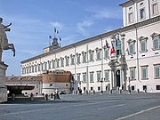
Quirinal Palace

Encyclopedia
The Quirinal Palace is a historical building in Rome
, Italy
, the current official residence
of the President of the Italian Republic
. It is located on the Quirinal Hill
, the tallest of the seven hills of Rome
. It housed thirty popes, four kings and eleven presidents of the Italian Republic.
to Quirinus
, after whom the hill was named. During the reign of Constantine
the last complex of Roman baths
was built here, as the statues of the twins Castor and Pollux
taming the horses decorating the fountain in the square testify. The Quirinal, being the highest hill in Rome, was very sought after and became a popular spot for the Roman patricians, who built their luxurious villas. An example of those are the remains of a villa in the Quirinal gardens, where a mosaic, part of the old floor has been found.
as a papal summer residence. The pope wanted to find a location which would have been far away from the humidity and stench coming from the river Tiber
and the unhealthy conditions of the Lateran Palace
, therefore the Quirinal hill was one of the most suitable places in Rome. On the site there was already a small villa owned by the Carafa
family and rented to Luigi d'Este
. The pope commissioned to the architect Ottaviano Mascherino the building of a palace with porticoed parallel wings and an internal court. The project was not fully executed, due to the death of the pope in 1585 but it's still recognisable in the north part of the court, especially in the double loggia facade, topped by the panoramic Torre dei venti (tower of the winds) or Torrino. To the latter a bell tower was added according to a project by Carlo Maderno
and Francesco Borromini
.
was the one who commissioned the completion of the works on the main building of the palace.
It was also used as the location for papal conclaves
in 1823
, 1829
, 1831, and 1846
. It served as a papal residence and housed the central offices responsible for the civil government of the Papal States
until 1870. In September 1870, what was left of the Papal States
was overthrown. About five months later, in 1871, Rome became the capital of the new Kingdom of Italy
. The palace became the official royal residence of the Kings of Italy, though some monarchs, notably King Victor Emmanuel III
(reigned 1900–1946) actually lived in a private residence elsewhere, the Quirinale being used simply as an office and for state functions. The monarchy was abolished in 1946 and the Palace became the official residence
and workplace for the Presidents of the Italian Republic
. Some, still, declined the Colle residence and kept their usual Roman residence: for example, Sandro Pertini preferred his old flat near the Trevi fountain
.
The façade
was designed by Domenico Fontana
. Its Great Chapel was designed by Carlo Maderno
. It contains frescos by Guido Reni
, but the most famous fresco is the Blessing Christ by Melozzo da Forlì
, placed over the stairs. Its grounds include a famous set of gardens laid out in the eighteenth century.
Rome
Rome is the capital of Italy and the country's largest and most populated city and comune, with over 2.7 million residents in . The city is located in the central-western portion of the Italian Peninsula, on the Tiber River within the Lazio region of Italy.Rome's history spans two and a half...
, Italy
Italy
Italy , officially the Italian Republic languages]] under the European Charter for Regional or Minority Languages. In each of these, Italy's official name is as follows:;;;;;;;;), is a unitary parliamentary republic in South-Central Europe. To the north it borders France, Switzerland, Austria and...
, the current official residence
Official residence
An official residence is the residence at which heads of state, heads of government, gubernatorial or other senior figures officially reside...
of the President of the Italian Republic
President of the Italian Republic
The President of the Italian Republic is the head of state of Italy and, as such, is intended to represent national unity and guarantee that Italian politics comply with the Constitution. The president's term of office lasts for seven years....
. It is located on the Quirinal Hill
Quirinal Hill
The Quirinal Hill is one of the Seven Hills of Rome, at the north-east of the city center. It is the location of the official residence of the Italian Head of State, who resides in the Quirinal Palace; by metonymy "the Quirinal" has come to stand for the Italian President.- History :It was...
, the tallest of the seven hills of Rome
Seven hills of Rome
The Seven Hills of Rome east of the river Tiber form the geographical heart of Rome, within the walls of the ancient city.The seven hills are:* Aventine Hill * Caelian Hill...
. It housed thirty popes, four kings and eleven presidents of the Italian Republic.
Origins
The current site of the palace has been in use since Roman times, as excavations in the gardens testify. On this hill the Romans built temples to several deities, from the FloraFlora (mythology)
In Roman mythology, Flora was a goddess of flowers and the season of spring. While she was otherwise a relatively minor figure in Roman mythology, being one among several fertility goddesses, her association with the spring gave her particular importance at the coming of springtime...
to Quirinus
Quirinus
In Roman mythology, Quirinus was an early god of the Roman state. In Augustan Rome, Quirinus was also an epithet of Janus, as Janus Quirinus. His name is derived from Quiris meaning "spear."-History:...
, after whom the hill was named. During the reign of Constantine
Constantine I
Constantine the Great , also known as Constantine I or Saint Constantine, was Roman Emperor from 306 to 337. Well known for being the first Roman emperor to convert to Christianity, Constantine and co-Emperor Licinius issued the Edict of Milan in 313, which proclaimed religious tolerance of all...
the last complex of Roman baths
Roman Baths
The Roman Baths complex is a site of historical interest in the English city of Bath. The house is a well-preserved Roman site for public bathing....
was built here, as the statues of the twins Castor and Pollux
Castor and Pollux
In Greek and Roman mythology, Castor and Pollux or Polydeuces were twin brothers, together known as the Dioscuri . Their mother was Leda, but Castor was the mortal son of Tyndareus, king of Sparta, and Pollux the divine son of Zeus, who visited Leda in the guise of a swan...
taming the horses decorating the fountain in the square testify. The Quirinal, being the highest hill in Rome, was very sought after and became a popular spot for the Roman patricians, who built their luxurious villas. An example of those are the remains of a villa in the Quirinal gardens, where a mosaic, part of the old floor has been found.
Foundation of the current palace
The palace, located on the Via del Quirinale and facing onto the Piazza del Quirinale, was built in 1583 by Pope Gregory XIIIPope Gregory XIII
Pope Gregory XIII , born Ugo Boncompagni, was Pope from 1572 to 1585. He is best known for commissioning and being the namesake for the Gregorian calendar, which remains the internationally-accepted civil calendar to this date.-Youth:He was born the son of Cristoforo Boncompagni and wife Angela...
as a papal summer residence. The pope wanted to find a location which would have been far away from the humidity and stench coming from the river Tiber
Tiber
The Tiber is the third-longest river in Italy, rising in the Apennine Mountains in Emilia-Romagna and flowing through Umbria and Lazio to the Tyrrhenian Sea. It drains a basin estimated at...
and the unhealthy conditions of the Lateran Palace
Lateran Palace
The Lateran Palace , formally the Apostolic Palace of the Lateran , is an ancient palace of the Roman Empire and later the main Papal residence....
, therefore the Quirinal hill was one of the most suitable places in Rome. On the site there was already a small villa owned by the Carafa
Carafa
Carafa is the name of a noble Neapolitan family of Italian nobles, clergy, and men of arts.* Cardinal Oliviero Carafa, , uncle of Paul IV...
family and rented to Luigi d'Este
Luigi d'Este
Luigi d'Este was an Italian Catholic cardinal, the second of the five children of Ercole II d'Este, Duke of Modena and Ferrara, and Renée, daughter of Louis XII of France.-Biography:...
. The pope commissioned to the architect Ottaviano Mascherino the building of a palace with porticoed parallel wings and an internal court. The project was not fully executed, due to the death of the pope in 1585 but it's still recognisable in the north part of the court, especially in the double loggia facade, topped by the panoramic Torre dei venti (tower of the winds) or Torrino. To the latter a bell tower was added according to a project by Carlo Maderno
Carlo Maderno
Carlo Maderno was a Swiss-Italian architect, born in Ticino, who is remembered as one of the fathers of Baroque architecture. His façades of Santa Susanna, St. Peter's Basilica and Sant'Andrea della Valle were of key importance in the evolution of the Italian Baroque...
and Francesco Borromini
Francesco Borromini
Francesco Borromini, byname of Francesco Castelli was an architect from Ticino who, with his contemporaries, Gian Lorenzo Bernini and Pietro da Cortona, was a leading figure in the emergence of Roman Baroque architecture.A keen student of the architecture of Michelangelo and the ruins of...
.
From the 17th century to the taking of Rome
Pope Paul VPope Paul V
-Theology:Paul met with Galileo Galilei in 1616 after Cardinal Bellarmine had, on his orders, warned Galileo not to hold or defend the heliocentric ideas of Copernicus. Whether there was also an order not to teach those ideas in any way has been a matter for controversy...
was the one who commissioned the completion of the works on the main building of the palace.
It was also used as the location for papal conclaves
Papal conclave
A papal conclave is a meeting of the College of Cardinals convened to elect a Bishop of Rome, who then becomes the Pope during a period of vacancy in the papal office. The Pope is considered by Roman Catholics to be the apostolic successor of Saint Peter and earthly head of the Roman Catholic Church...
in 1823
Papal conclave, 1823
Following the death of Pope Pius VII on August 20, 1823, a papal conclave was held to determine his successor.Pius VII had reigned as Pope for what was then considered a very long pontificate...
, 1829
Papal conclave, 1829
The papal conclave held after the death of Pope Leo XII on February 10, 1829 to elect his successor began on February 24, 1829.It took a long time to make a decision because of conflict between secular governments about who should be elected...
, 1831, and 1846
Papal conclave, 1846
The death of Pope Gregory XVI on 1 June 1846 triggered the Papal conclave of 1846. Fifty of the 62 members of the College of Cardinals assembled in the Quirinal Palace, one of the papal palaces in Rome and the seat of two earlier 19th century conclaves...
. It served as a papal residence and housed the central offices responsible for the civil government of the Papal States
Papal States
The Papal State, State of the Church, or Pontifical States were among the major historical states of Italy from roughly the 6th century until the Italian peninsula was unified in 1861 by the Kingdom of Piedmont-Sardinia .The Papal States comprised territories under...
until 1870. In September 1870, what was left of the Papal States
Papal States
The Papal State, State of the Church, or Pontifical States were among the major historical states of Italy from roughly the 6th century until the Italian peninsula was unified in 1861 by the Kingdom of Piedmont-Sardinia .The Papal States comprised territories under...
was overthrown. About five months later, in 1871, Rome became the capital of the new Kingdom of Italy
Italy
Italy , officially the Italian Republic languages]] under the European Charter for Regional or Minority Languages. In each of these, Italy's official name is as follows:;;;;;;;;), is a unitary parliamentary republic in South-Central Europe. To the north it borders France, Switzerland, Austria and...
. The palace became the official royal residence of the Kings of Italy, though some monarchs, notably King Victor Emmanuel III
Victor Emmanuel III of Italy
Victor Emmanuel III was a member of the House of Savoy and King of Italy . In addition, he claimed the crowns of Ethiopia and Albania and claimed the titles Emperor of Ethiopia and King of Albania , which were unrecognised by the Great Powers...
(reigned 1900–1946) actually lived in a private residence elsewhere, the Quirinale being used simply as an office and for state functions. The monarchy was abolished in 1946 and the Palace became the official residence
Presidential Palace
A Presidential Palace is the official residence of the president in some countries. However, some countries do not call the official residence of a head of state a presidential palace...
and workplace for the Presidents of the Italian Republic
President of the Italian Republic
The President of the Italian Republic is the head of state of Italy and, as such, is intended to represent national unity and guarantee that Italian politics comply with the Constitution. The president's term of office lasts for seven years....
. Some, still, declined the Colle residence and kept their usual Roman residence: for example, Sandro Pertini preferred his old flat near the Trevi fountain
Trevi Fountain
The Trevi Fountain is a fountain in the Trevi rione in Rome, Italy. Standing 26 metres high and 20 metres wide, it is the largest Baroque fountain in the city and one of the most famous fountains in the world....
.
The façade
Facade
A facade or façade is generally one exterior side of a building, usually, but not always, the front. The word comes from the French language, literally meaning "frontage" or "face"....
was designed by Domenico Fontana
Domenico Fontana
Domenico Fontana was a Swiss-born Italian architect of the late Renaissance.-Biography:200px|thumb|Fountain of Moses in Rome....
. Its Great Chapel was designed by Carlo Maderno
Carlo Maderno
Carlo Maderno was a Swiss-Italian architect, born in Ticino, who is remembered as one of the fathers of Baroque architecture. His façades of Santa Susanna, St. Peter's Basilica and Sant'Andrea della Valle were of key importance in the evolution of the Italian Baroque...
. It contains frescos by Guido Reni
Guido Reni
Guido Reni was an Italian painter of high-Baroque style.-Biography:Born in Bologna into a family of musicians, Guido Reni was the son of Daniele Reni and Ginevra de’ Pozzi. As a child of nine, he was apprenticed under the Bolognese studio of Denis Calvaert. Soon after, he was joined in that...
, but the most famous fresco is the Blessing Christ by Melozzo da Forlì
Melozzo da Forlì
Melozzo da Forlì was an Italian Renaissance painter and architect. His fresco paintings are notable for the use of foreshortening. He was the most important member of the Forlì painting school.- Biography :...
, placed over the stairs. Its grounds include a famous set of gardens laid out in the eighteenth century.
See also
- Palazzo MadamaPalazzo MadamaPalazzo Madama is a palace in Rome that is currently the home of the Senate of the Italian Republic.It was built atop the ruins of the ancient baths of Nero, next to Piazza Navona...
, seat of the Italian SenateItalian SenateThe Senate of the Republic is the upper house of the Italian Parliament. It was established in its current form on 8 May 1948, but previously existed during the Kingdom of Italy as Senato del Regno , itself a continuation of the Senato Subalpino of Sardinia-Piedmont established on 8 May 1848... - Palazzo MontecitorioPalazzo MontecitorioThe Palazzo Montecitorio is a palace in Rome and the seat of the Italian Chamber of Deputies.- History :The building was originally designed by Gian Lorenzo Bernini for the young Cardinal Ludovico Ludovisi, nephew of Pope Gregory XV...
, seat of the Italian Chamber of DeputiesItalian Chamber of DeputiesThe Italian Chamber of Deputies is the lower house of the Parliament of Italy. It has 630 seats, a plurality of which is controlled presently by liberal-conservative party People of Freedom. Twelve deputies represent Italian citizens outside of Italy. Deputies meet in the Palazzo Montecitorio. A... - Palazzo ChigiPalazzo ChigiThe Palazzo Chigi is a palace or noble residence in Rome, overlooking the Piazza Colonna and the Via del Corso. It was begun in 1562 by Giacomo della Porta and completed by Carlo Maderno in 1580 for the Aldobrandini family. In 1659 it was purchased by the Chigi family. It was then remodelled by...
, seat of the Italian GovernmentCouncil of Ministers of ItalyThe Cabinet of Italy is a principal organ of the Government of Italy... - Palazzo della ConsultaPalazzo della ConsultaThe Palazzo della Consulta is a late Baroque palace in central Rome, Italy, that now houses the Constitutional Court of the Italian Republic...
, seat of the Constitutional Court of ItalyConstitutional Court of ItalyThe Constitutional Court of Italy is a supreme court of Italy, the other being the Court of Cassation. Sometimes the name Consulta is used as a metonym for it, because its sessions are held in Palazzo della Consulta in Rome....
External links
- Official site of the Presidency of Italy (Virtual tour of Quirinal Palace)
- Satellite image of the palace and its garden Note: One block north east of the Gardens is the Palazzo BarberiniPalazzo BarberiniPalazzo Barberini is a palace in Rome, facing the piazza of the same name in Rione Trevi and is home to the Galleria Nazionale d'Arte Antica.-History:...
. Midway along the long southeast wing flanking the garden, across the street, is the small dome of Bernini's Sant'Andrea al QuirinaleSant'Andrea al QuirinaleThe Church of Saint Andrew's at the Quirinal is a Roman Catholic titular church in Rome, built for of the Jesuit seminary on the Quirinal Hill....
. At the next corner north is the inconspicuous church by Borromini, San Carlo alle Quattro FontaneSan Carlo alle Quattro FontaneThe Church of Saint Charles at the Four Fountains is a Roman Catholic church in Rome, Italy. Designed by the architect Francesco Borromini, it was his first independent commission. It is an iconic masterpiece of Baroque architecture, built as part of a complex of monastic buildings on the Quirinal...
. Diagonal and to the west of the facade, amid a warren of small streets is the turquoise tub-like polygon of the Trevi FountainTrevi FountainThe Trevi Fountain is a fountain in the Trevi rione in Rome, Italy. Standing 26 metres high and 20 metres wide, it is the largest Baroque fountain in the city and one of the most famous fountains in the world....
.