

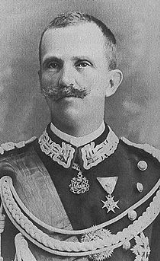
Victor Emmanuel III of Italy

Encyclopedia
Victor Emmanuel III was a member of the House of Savoy
and King of
Italy
(29 July 1900 – 9 May 1946). In addition, he claimed the crowns of Ethiopia
and Albania
and claimed the titles Emperor of Ethiopia
(1936–41) and King of Albania
(1939–43), which were unrecognised by the Great Powers. During his long reign (46 years), the Kingdom of Italy became involved in two World Wars. His reign also encompassed the birth, rise and fall of Italian Fascism
.
, Italy
. He was the only child of Umberto I
, King of Italy
, and his consort, Princess Margherita of Savoy
. Margherita was the daughter of the duke of Genoa
.
Unlike his paternal first cousin's son, the 1.98 m (6 foot 6") tall Amedeo, 3rd Duke of Aosta
, Victor Emmanuel was short of stature even by 19th-century standards, to the point that today he would appear diminutive. He was just 1.53 m tall (just over 5 feet). From birth, Victor Emmanuel was known by the title of Prince of Naples.
On 24 October 1896, Prince Victor Emmanuel married Princess Elena
of Montenegro
.
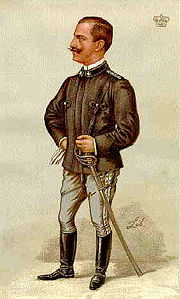 On 29 July 1900, at the age of 30, Victor Emmanuel ascended the throne upon his father's assassination
. The only advice that his father Umberto ever gave his heir was "Remember: to be a king, all you need to know is how to sign your name, read a newspaper, and mount a horse". His early years showed evidence that, by the standards of the Savoy monarchy, he was a man committed to constitutional government. Indeed, even though his father was killed by an anarchist
, the new King showed a commitment to constitutional freedoms.
Though Italy was a parliamentary democracy, under the Statuto Albertino
, or constitution, the monarchy possessed considerable residual powers, including the right to appoint the Prime Minister
, even if the individual in question did not command majority support in the Chamber of Deputies
. A shy and somewhat withdrawn individual, the King hated the day-to-day stresses of Italian politics, though the country's chronic political instability forced him to intervene no less than ten times between 1900 and 1922 to solve parliamentary crises.
When World War I
began, Italy remained neutral at first, despite being part of the Triple Alliance
(albeit it was signed on defensive terms and Italy objected that the Sarajevo assassination did not qualify as aggression). However, in 1915, Italy signed several secret treaties committing to enter the war on the side of the Triple Entente
. Most of the people opposed war, however, and the Italian Chamber of Deputies
forced Prime Minister
Antonio Salandra
to resign. Victor Emmanuel, however, declined Salandra's resignation and made the decision himself for Italy to enter the war. He legally had the right to make this decision under the Statuto Albertino
, popular opposition to the war notwithstanding. However, the corrupt and disorganised war effort, the stunning loss of life suffered by the Italian army, especially at the great defeat of Caporetto
, and the economic depression that followed the war turned the King against what he perceived as an inefficient political bourgeoisie. Nevertheless, the King visited the various areas of northern Italy suffering repeated strikes and mortar hits from elements of the Austro-Hungarian
/Italian fighting there, where he demonstrated considerable courage and care in personally visiting many people, with his wife the queen taking turns with nurses in caring for Italy's wounded. It was at this time, the period of World War I, that the King enjoyed genuine affection from the majority of his people.
gave rise to much extremism among the sorely-tried working classes of Italy. This caused the country as a whole to become politically unstable. Benito Mussolini
, soon to be Italy's Fascist
dictator
, took advantage of this instability for his rise to power.
 In 1922, Mussolini led a force of his Fascist supporters on a March on Rome
. Prime Minister
Luigi Facta
and his cabinet drafted a decree of martial law
. After some hesitation the King refused to sign it, citing doubts about the ability of the Army to contain the uprising.
Fascist violence had been growing in intensity throughout the summer and autumn of 1922, climaxing with the rumours of a possible coup. General Pietro Badoglio
told the King that the military would be able to rout the rebels, who numbered no more than 10,000 men, without any difficulty.
The troops were totally loyal to the King. Even Cesare Maria De Vecchi
, commander of the Blackshirts, and one of the organisers of the March on Rome, told Mussolini that he would not act against the wishes of the monarch. It was at this point that the Fascist leader considered leaving Italy altogether. But then, in the minute before midnight, he received a telegram from the King inviting him to Rome. By midday on 30 October, he had been appointed Prime Minister, at the age of 39, with no previous experience of office, and with only 35 Fascist deputies in the Chamber.
The King failed to move against the Mussolini regime's abuses of power (including, as early as 1924, the assassination of Giacomo Matteotti
and other opposition MPs) and remained silent during the winter of 1925-26 when Mussolini dropped all pretense of democracy. Later that year, Mussolini passed a law declaring that he was responsible to the King, not Parliament. Although under the Statuto Albertino Italian governments were responsible only to the monarch, it had been a strong constitutional convention
since at least the 1860s that they were actually responsible to Parliament. By 1928, practically the only check on Mussolini's power was the King's right to dismiss him from office—though that right could only be exercised on the advice of the Fascist Grand Council, a body that could only be convened by Mussolini.
Though the King claimed in his memoirs that it was the fear of a civil war that motivated his actions, it would seem that he received some 'alternative' advice, possibly from the archconservative Salandra as well as General Armando Diaz
, that it would be better to do a deal with Mussolini.
Whatever the circumstances, Victor Emmanuel showed weakness in a position of strength, with dire future consequences for Italy and for the monarchy itself. Fascism offered opposition to left-wing radicalism. This appealed to many people in Italy at the time, and certainly to the King. In many ways, the events from 1922 to 1943 demonstrated that the monarchy and the moneyed class, for different reasons, felt Mussolini and his regime offered an option that, after years of political chaos, was more appealing than what they perceived as the alternative: socialism
and anarchism
. Both the spectre of the Russian Revolution
and the tragedies of World War I
played large roles in these political decisions. At the same time, though, the crown became so closely identified with Fascism that by the time Victor Emmanuel was able to shake himself loose from it, it was too late to save the monarchy.
and the Holy See
. On 7 June 1929, the Lateran Treaty was ratified and the "Roman Question
" was settled.
images of King Victor Emmanuel and Queen Elena, born Princess Elena of Montenegro
, evoked applause, sometimes cheering, when played in cinemas, in contrast to the hostile silence shown toward images of Fascist leaders.
On 30 March 1938, the Italian Parliament established the rank of First Marshal of the Empire
for Victor Emmanuel and Mussolini. This new rank was the highest rank in the Italian military.
As popular as Victor Emmanuel was, several of his decisions proved fatal to the monarchy. Among these decisions were his assumption of the crown of Ethiopia
, his public silence when Mussolini's Fascist government issued its notorious racial purity laws, and his assumption of the crown of Albania
.
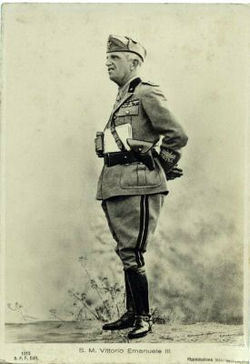 In 1936, Victor Emmanuel assumed the crown of the Emperor of Ethiopia
. His decision to do this was not universally accepted. Victor Emmanuel was only able to assume the crown after the Italian Royal Army invaded Ethiopia (Abyssinia) and had overthrown Emperor Haile Selassie during the Second Italo-Abyssinian War
. The model for the Italian King thus becoming a King-Emperor
was evidently the British monarchs who since 1877 were King-Emperor (or Queen-Empress) with a double throne, of Britain and India respectively.
The League of Nations
decried Italy's participation in this war and the Italian claim on Ethiopia's conquest was disputed by some members of the international community (namely the United States
and the Soviet Union
) but accepted by Great Britain
and France
in 1938. It was undone in 1941 by the Ethiopian restoration after five years of Italian Empire
.
The term of the last acting Italian Viceroy
of East Africa, including Eritrea
and Somalia
, ended 27 November 1941 upon surrender to the allies. King Victor Emmanuel III renounced his claimed titles of Emperor of Ethiopia in November 1943, recognizing the previous holders of those titles as legitimate.
, issued racial purity laws. These laws left his Jewish subjects open to persecution.
and caused King Zog I to flee. The Italian invasion of Albania
was generally seen as the act of a stronger nation taking unfair advantage of a weaker neighbour.
In 1941, while in Tirana
, the monarch escaped an assassination attempt by the 19-year-old Albanian patriot Vasil Laçi
. Later, the author's act was considered by Communist Albania to be sign of the overall discontent of the oppressed Albanian population. A second attempt by Dimitri Mikhaliov in Albania lead the Italians to cast heavy doubts on the event by pointing to a possible Greek
link following the monarch's green light to the Greco-Italian War
.
on the side of Nazi Germany
. Almost from the beginning, disaster followed disaster. In 1940 Italian armies in North Africa
and in Greece suffered humiliating defeats. In late 1941, Italian East Africa
was lost. In 1942, Italian Libya
was lost. Early in 1943, the ten divisions of the "Italian Army in Russia
" (Armata Italiana in Russia, or ARMIR) were crushed as an aside to the Battle of Stalingrad
. Before the end of 1943, the last Italian forces in Tunisia
had surrendered and Sicily
had been taken by the Allies. Confronted by a lack of fuel as well as several serious defeats, the Royal Navy
(Regia Marina
) spent most of the war confined to port as a fleet in being
. The Mediterranean Sea
was hardly "Italy's Sea" (Mare Nostrum). The Royal Air Force
(Regia Aeronautica
), while generally doing better than the Army and the Navy, was chronically short of modern aircraft (its primary aircraft was a biplane
in an age when jet engines were already being developed) and even it was politely uninvited to participate in the Battle of Britain
.
As Italy's fortunes worsened, the popularity of the King suffered. One coffee house ditty went as follows:
On 19 July 1943, Rome
was bombed for the first time
in the war, further cementing the Italian people's disillusionment with their once-popular King.
and the Grand Council of Fascism
voted overwhelmingly to ask Victor Emmanuel to resume his full constitutional powers—in effect, a motion of no confidence
in Benito Mussolini
. The next afternoon, the King — who had been planning to get rid of the dictator himself for some time — summoned Mussolini to the palace and dismissed him as Prime Minister in favour of Marshal
Pietro Badoglio
. He then ordered Mussolini arrested and renounced the usurped Ethiopian and Albanian crowns in favor of the legitimate monarchs of those states.
Publicly, Victor Emmanuel and Badoglio claimed that Italy would continue the war as a member of the Axis
. Privately, they both began negotiating with the Allies
for an armistice. Court circles had already been putting out feelers to the Allies before Mussolini's ousting.
, as well as in Italy itself. Many of those units that did not surrender joined forces with the Germans against the Allies.
Fearing a German advance on Rome, Victor Emmanuel and his government fled south to Brindisi
. This choice may have been necessary to protect his safety; indeed, Hitler had planned to arrest him shortly after Mussolini's overthrow. Nonetheless, it still came as a surprise to many observers inside and outside Italy. They drew contrasts to King George VI
and Queen Elizabeth
, who refused to leave London during the Blitz
, and of Pope Pius XII
, who mixed with Rome's crowds and prayed with them after the working class Roman neighborhood of Quartiere San Lorenzo
was bombed and destroyed.
Ultimately, the Badoglio government in southern Italy raised the Italian Co-Belligerent Army
(Esercito Cobelligerante del Sud), the Italian Co-Belligerent Air Force
(Aviazione Cobelligerante Italiana), and the Italian Co-Belligerent Navy
(Marina Cobelligerante del Sud). All three forces were loyal to the King.
On 12 September, the Germans launched Operation Eiche and rescued Mussolini from captivity. In short time, he established a new Fascist state in northern Italy. Mussolini's Italian Social Republic
(Repubblica Sociale Italiana) was never more than a German-dominated puppet state
, but it did compete for the allegiance of the Italian people with Badoglio's government in the south.
Realizing that he was too tainted by his earlier support of the Fascist regime, Victor Emmanuel transferred most of his powers to his son, Crown Prince Umberto
, in April 1944. By doing this, Victor Emmanuel relinquished his remaining power while retaining the royal title. This status was formalized shortly after Rome was liberated on 4 June, when he appointed Umberto Lieutenant General of the Realm
.
or becoming a republic
. On 9 May 1946, in hopes of influencing the vote, Victor Emmanuel formally abdicated, succeeded by his son Umberto II. It did not work. Fifty-four percent of the voters favored declaring a republic in the referendum held less than a month later. Widespread irregularities in the vote were alleged, but never proven, and the Savoy family was required to leave the country. The Kingdom of Italy was no more.
Taking refuge in Egypt
, Victor Emmanuel died in Alexandria
in 1947 and was buried there, behind the altar of St Catherine's Cathedral
. In 1948, Time
magazine included an article about "The Little King".
and Princess Maria José
as the de facto
king and queen of Italy since 1944. The 'May' King and Queen, Umberto and Maria José, in their brief, month-long reign, were unable to shift the burden of recent history and opinion. (Some present-day historians have speculated that, had Victor Emmanuel abdicated in favour of Umberto shortly after the Allied invasion of Sicily in 1943, Umberto's relative popularity might have saved the monarchy).
:
Victor Emmanuel III, by the Grace of God
and the Will of the Nation, King of Italy
, King of Sardinia, Cyprus
, Jerusalem
, Armenia
, Duke of Savoy, count
of Maurienne
, Marquis (of the Holy Roman Empire
) in Italy; prince of Piedmont
, Carignano
, Oneglia
, Poirino
, Trino
; Prince and Perpetual vicar of the Holy Roman Empire; prince of Carmagnola
, Montmellian with Arbin and Francin, prince bailliff
of the Duchy of Aosta
, Prince
of Chieri
, Dronero
, Crescentino
, Riva di Chieri
and Banna, Busca
, Bene
, Brà, Duke of Genoa
, Monferrat
, Aosta
, Duke of Chablais
, Genevois
, Duke of Piacenza
, Marquis
of Saluzzo
(Saluces), Ivrea
, Susa, of Maro, Oristano
, Cesana
, Savona
, Tarantasia
, Borgomanero
and Cureggio
, Caselle
, Rivoli, Pianezza
, Govone
, Salussola
, Racconigi
with Tegerone, Migliabruna and Motturone, Cavallermaggiore
, Marene
, Modane
and Lanslebourg, Livorno Ferraris
, Santhià
Agliè
, Centallo
and Demonte
, Desana
, Ghemme
, Vigone
, Count of Barge, Villafranca
, Ginevra
, Nizza
, Tenda
, Romont
, Asti
, Alessandria
, del Goceano, Novara
, Tortona
, Bobbio
, Soissons
, Sant'Antioco
, Pollenzo, Roccabruna
, Tricerro
, Bairo
, Ozegna
, of Apertole, Baron
of Vaud
and of Faucigni
, Lord
of Vercelli
, Pinerolo
, of Lomellina
, of Valle Sesia
, of Ceva
Marquisate, Overlord of Monaco
, Roccabruna
and 11/12th of Menton
, Noble patrician of Venice
, patrician of Ferrara
.
, King of Montenegro
. Their issue included:
House of Savoy
The House of Savoy was formed in the early 11th century in the historical Savoy region. Through gradual expansion, it grew from ruling a small county in that region to eventually rule the Kingdom of Italy from 1861 until the end of World War II, king of Croatia and King of Armenia...
and King of
King of Italy
King of Italy is a title adopted by many rulers of the Italian peninsula after the fall of the Roman Empire...
Italy
Kingdom of Italy (1861–1946)
The Kingdom of Italy was a state forged in 1861 by the unification of Italy under the influence of the Kingdom of Sardinia, which was its legal predecessor state...
(29 July 1900 – 9 May 1946). In addition, he claimed the crowns of Ethiopia
Ethiopia
Ethiopia , officially known as the Federal Democratic Republic of Ethiopia, is a country located in the Horn of Africa. It is the second-most populous nation in Africa, with over 82 million inhabitants, and the tenth-largest by area, occupying 1,100,000 km2...
and Albania
Albania
Albania , officially known as the Republic of Albania , is a country in Southeastern Europe, in the Balkans region. It is bordered by Montenegro to the northwest, Kosovo to the northeast, the Republic of Macedonia to the east and Greece to the south and southeast. It has a coast on the Adriatic Sea...
and claimed the titles Emperor of Ethiopia
Emperor of Ethiopia
The Emperor of Ethiopia was the hereditary ruler of Ethiopia until the abolition of the monarchy in 1974. The Emperor was the head of state and head of government, with ultimate executive, judicial and legislative power in that country...
(1936–41) and King of Albania
King of Albania
While the medieval Angevin Kingdom of Albania was a monarchy, it did not encompass the entirety of the modern state of Albania. The latter has been a kingdom on two occasions. The first time was after it was declared independent in 1912...
(1939–43), which were unrecognised by the Great Powers. During his long reign (46 years), the Kingdom of Italy became involved in two World Wars. His reign also encompassed the birth, rise and fall of Italian Fascism
Italian Fascism
Italian Fascism also known as Fascism with a capital "F" refers to the original fascist ideology in Italy. This ideology is associated with the National Fascist Party which under Benito Mussolini ruled the Kingdom of Italy from 1922 until 1943, the Republican Fascist Party which ruled the Italian...
.
Early years
Victor Emmanuel was born in NaplesNaples
Naples is a city in Southern Italy, situated on the country's west coast by the Gulf of Naples. Lying between two notable volcanic regions, Mount Vesuvius and the Phlegraean Fields, it is the capital of the region of Campania and of the province of Naples...
, Italy
Kingdom of Italy (1861–1946)
The Kingdom of Italy was a state forged in 1861 by the unification of Italy under the influence of the Kingdom of Sardinia, which was its legal predecessor state...
. He was the only child of Umberto I
Umberto I of Italy
Umberto I or Humbert I , nicknamed the Good , was the King of Italy from 9 January 1878 until his death. He was deeply loathed in far-left circles, especially among anarchists, because of his conservatism and support of the Bava-Beccaris massacre in Milan...
, King of Italy
King of Italy
King of Italy is a title adopted by many rulers of the Italian peninsula after the fall of the Roman Empire...
, and his consort, Princess Margherita of Savoy
Margherita of Savoy
Margherita of Savoy , was the Queen consort of the Kingdom of Italy during the reign of her husband, Umberto I.-Family:...
. Margherita was the daughter of the duke of Genoa
Duke of Genoa
The Royal Dukedom of Genoa was a subsidiary title of the King of Sardinia. It was first awarded in 1831 to Prince Ferdinando of Savoy, second son of King Charles Albert of Sardinia. The title became extinct on the death of Prince Eugenio, grandson of King Charles Albert in 1996.-External links:...
.
Unlike his paternal first cousin's son, the 1.98 m (6 foot 6") tall Amedeo, 3rd Duke of Aosta
Amedeo, 3rd Duke of Aosta
Prince Amedeo of Savoy-Aosta was the third Duke of Aosta and a first cousin, once removed of the King of Italy, Victor Emmanuel III. His baptismal name was Amedeo Umberto Isabella Luigi Filippo Maria Giuseppe Giovanni di Savoia-Aosta...
, Victor Emmanuel was short of stature even by 19th-century standards, to the point that today he would appear diminutive. He was just 1.53 m tall (just over 5 feet). From birth, Victor Emmanuel was known by the title of Prince of Naples.
On 24 October 1896, Prince Victor Emmanuel married Princess Elena
Elena of Montenegro
Elena of Montenegro was the daughter of King Nikola I Petrović-Njegoš of Montenegro and his wife, Milena Vukotić...
of Montenegro
Kingdom of Montenegro
The Kingdom of Montenegro was a monarchy in southeastern Europe during the tumultuous years on the Balkan Peninsula leading up to and during World War I. Legally it was a constitutional monarchy, but absolutist in practice...
.
Ascension to the throne
Assassination
To carry out an assassination is "to murder by a sudden and/or secret attack, often for political reasons." Alternatively, assassination may be defined as "the act of deliberately killing someone, especially a public figure, usually for hire or for political reasons."An assassination may be...
. The only advice that his father Umberto ever gave his heir was "Remember: to be a king, all you need to know is how to sign your name, read a newspaper, and mount a horse". His early years showed evidence that, by the standards of the Savoy monarchy, he was a man committed to constitutional government. Indeed, even though his father was killed by an anarchist
Anarchism
Anarchism is generally defined as the political philosophy which holds the state to be undesirable, unnecessary, and harmful, or alternatively as opposing authority in the conduct of human relations...
, the new King showed a commitment to constitutional freedoms.
Though Italy was a parliamentary democracy, under the Statuto Albertino
Statuto Albertino
The Statuto Albertino or Albertine Statute was the constitution that King Charles Albert conceded to the Kingdom of Piedmont-Sardinia in Italy on 4 March 1848...
, or constitution, the monarchy possessed considerable residual powers, including the right to appoint the Prime Minister
Prime minister of Italy
The Prime Minister of Italy is the head of government of the Italian Republic...
, even if the individual in question did not command majority support in the Chamber of Deputies
Italian Chamber of Deputies
The Italian Chamber of Deputies is the lower house of the Parliament of Italy. It has 630 seats, a plurality of which is controlled presently by liberal-conservative party People of Freedom. Twelve deputies represent Italian citizens outside of Italy. Deputies meet in the Palazzo Montecitorio. A...
. A shy and somewhat withdrawn individual, the King hated the day-to-day stresses of Italian politics, though the country's chronic political instability forced him to intervene no less than ten times between 1900 and 1922 to solve parliamentary crises.
When World War I
World War I
World War I , which was predominantly called the World War or the Great War from its occurrence until 1939, and the First World War or World War I thereafter, was a major war centred in Europe that began on 28 July 1914 and lasted until 11 November 1918...
began, Italy remained neutral at first, despite being part of the Triple Alliance
Triple Alliance (1882)
The Triple Alliance was the military alliance between Germany, Austria–Hungary, and Italy, , that lasted from 1882 until the start of World War I in 1914...
(albeit it was signed on defensive terms and Italy objected that the Sarajevo assassination did not qualify as aggression). However, in 1915, Italy signed several secret treaties committing to enter the war on the side of the Triple Entente
Triple Entente
The Triple Entente was the name given to the alliance among Britain, France and Russia after the signing of the Anglo-Russian Entente in 1907....
. Most of the people opposed war, however, and the Italian Chamber of Deputies
Italian Chamber of Deputies
The Italian Chamber of Deputies is the lower house of the Parliament of Italy. It has 630 seats, a plurality of which is controlled presently by liberal-conservative party People of Freedom. Twelve deputies represent Italian citizens outside of Italy. Deputies meet in the Palazzo Montecitorio. A...
forced Prime Minister
Prime minister of Italy
The Prime Minister of Italy is the head of government of the Italian Republic...
Antonio Salandra
Antonio Salandra
Antonio Salandra was a conservative Italian politician who served as the 33rd Prime Minister of Italy between 1914 and 1916...
to resign. Victor Emmanuel, however, declined Salandra's resignation and made the decision himself for Italy to enter the war. He legally had the right to make this decision under the Statuto Albertino
Statuto Albertino
The Statuto Albertino or Albertine Statute was the constitution that King Charles Albert conceded to the Kingdom of Piedmont-Sardinia in Italy on 4 March 1848...
, popular opposition to the war notwithstanding. However, the corrupt and disorganised war effort, the stunning loss of life suffered by the Italian army, especially at the great defeat of Caporetto
Battle of Caporetto
The Battle of Caporetto , took place from 24 October to 19 November 1917, near the town of Kobarid , on the Austro-Italian front of World War I...
, and the economic depression that followed the war turned the King against what he perceived as an inefficient political bourgeoisie. Nevertheless, the King visited the various areas of northern Italy suffering repeated strikes and mortar hits from elements of the Austro-Hungarian
Austria-Hungary
Austria-Hungary , more formally known as the Kingdoms and Lands Represented in the Imperial Council and the Lands of the Holy Hungarian Crown of Saint Stephen, was a constitutional monarchic union between the crowns of the Austrian Empire and the Kingdom of Hungary in...
/Italian fighting there, where he demonstrated considerable courage and care in personally visiting many people, with his wife the queen taking turns with nurses in caring for Italy's wounded. It was at this time, the period of World War I, that the King enjoyed genuine affection from the majority of his people.
Support to Mussolini
The economic depression which followed World War IWorld War I
World War I , which was predominantly called the World War or the Great War from its occurrence until 1939, and the First World War or World War I thereafter, was a major war centred in Europe that began on 28 July 1914 and lasted until 11 November 1918...
gave rise to much extremism among the sorely-tried working classes of Italy. This caused the country as a whole to become politically unstable. Benito Mussolini
Benito Mussolini
Benito Amilcare Andrea Mussolini was an Italian politician who led the National Fascist Party and is credited with being one of the key figures in the creation of Fascism....
, soon to be Italy's Fascist
Italian Fascism
Italian Fascism also known as Fascism with a capital "F" refers to the original fascist ideology in Italy. This ideology is associated with the National Fascist Party which under Benito Mussolini ruled the Kingdom of Italy from 1922 until 1943, the Republican Fascist Party which ruled the Italian...
dictator
Dictator
A dictator is a ruler who assumes sole and absolute power but without hereditary ascension such as an absolute monarch. When other states call the head of state of a particular state a dictator, that state is called a dictatorship...
, took advantage of this instability for his rise to power.
March on Rome
March on Rome
The March on Rome was a march by which Italian dictator Benito Mussolini's National Fascist Party came to power in the Kingdom of Italy...
. Prime Minister
Prime minister of Italy
The Prime Minister of Italy is the head of government of the Italian Republic...
Luigi Facta
Luigi Facta
Luigi Facta was an Italian politician, journalist and last Prime Minister of Italy before the leadership of Benito Mussolini....
and his cabinet drafted a decree of martial law
Martial law
Martial law is the imposition of military rule by military authorities over designated regions on an emergency basis— only temporary—when the civilian government or civilian authorities fail to function effectively , when there are extensive riots and protests, or when the disobedience of the law...
. After some hesitation the King refused to sign it, citing doubts about the ability of the Army to contain the uprising.
Fascist violence had been growing in intensity throughout the summer and autumn of 1922, climaxing with the rumours of a possible coup. General Pietro Badoglio
Pietro Badoglio
Pietro Badoglio, 1st Duke of Addis Abeba, 1st Marquess of Sabotino was an Italian soldier and politician...
told the King that the military would be able to rout the rebels, who numbered no more than 10,000 men, without any difficulty.
The troops were totally loyal to the King. Even Cesare Maria De Vecchi
Cesare Maria De Vecchi
Cesare Maria De Vecchi, 1st Conte di Val Cismon was an Italian soldier, colonial administrator and Fascist politician.-Biography:...
, commander of the Blackshirts, and one of the organisers of the March on Rome, told Mussolini that he would not act against the wishes of the monarch. It was at this point that the Fascist leader considered leaving Italy altogether. But then, in the minute before midnight, he received a telegram from the King inviting him to Rome. By midday on 30 October, he had been appointed Prime Minister, at the age of 39, with no previous experience of office, and with only 35 Fascist deputies in the Chamber.
The King failed to move against the Mussolini regime's abuses of power (including, as early as 1924, the assassination of Giacomo Matteotti
Giacomo Matteotti
Giacomo Matteotti was an Italian socialist politician. On 30 May 1924, he openly spoke in the Italian Parliament alleging the Fascists committed fraud in the recently held elections, and denounced the violence they used to gain votes...
and other opposition MPs) and remained silent during the winter of 1925-26 when Mussolini dropped all pretense of democracy. Later that year, Mussolini passed a law declaring that he was responsible to the King, not Parliament. Although under the Statuto Albertino Italian governments were responsible only to the monarch, it had been a strong constitutional convention
Constitutional convention (political custom)
A constitutional convention is an informal and uncodified procedural agreement that is followed by the institutions of a state. In some states, notably those Commonwealth of Nations states that follow the Westminster system and whose political systems derive from British constitutional law, most...
since at least the 1860s that they were actually responsible to Parliament. By 1928, practically the only check on Mussolini's power was the King's right to dismiss him from office—though that right could only be exercised on the advice of the Fascist Grand Council, a body that could only be convened by Mussolini.
Though the King claimed in his memoirs that it was the fear of a civil war that motivated his actions, it would seem that he received some 'alternative' advice, possibly from the archconservative Salandra as well as General Armando Diaz
Armando Diaz
Armando Diaz, 1st Duca della Vittoria was an Italian general and a Marshal of Italy.Born in Naples, Diaz began his military career as a student at the Military Academy of Turin, where he became an artillery officer. He was a colonel commanding the 93rd infantry during the Italo-Turkish War, and...
, that it would be better to do a deal with Mussolini.
Whatever the circumstances, Victor Emmanuel showed weakness in a position of strength, with dire future consequences for Italy and for the monarchy itself. Fascism offered opposition to left-wing radicalism. This appealed to many people in Italy at the time, and certainly to the King. In many ways, the events from 1922 to 1943 demonstrated that the monarchy and the moneyed class, for different reasons, felt Mussolini and his regime offered an option that, after years of political chaos, was more appealing than what they perceived as the alternative: socialism
Socialism
Socialism is an economic system characterized by social ownership of the means of production and cooperative management of the economy; or a political philosophy advocating such a system. "Social ownership" may refer to any one of, or a combination of, the following: cooperative enterprises,...
and anarchism
Anarchism
Anarchism is generally defined as the political philosophy which holds the state to be undesirable, unnecessary, and harmful, or alternatively as opposing authority in the conduct of human relations...
. Both the spectre of the Russian Revolution
Russian Revolution of 1917
The Russian Revolution is the collective term for a series of revolutions in Russia in 1917, which destroyed the Tsarist autocracy and led to the creation of the Soviet Union. The Tsar was deposed and replaced by a provisional government in the first revolution of February 1917...
and the tragedies of World War I
World War I
World War I , which was predominantly called the World War or the Great War from its occurrence until 1939, and the First World War or World War I thereafter, was a major war centred in Europe that began on 28 July 1914 and lasted until 11 November 1918...
played large roles in these political decisions. At the same time, though, the crown became so closely identified with Fascism that by the time Victor Emmanuel was able to shake himself loose from it, it was too late to save the monarchy.
Lateran Treaty
In 1929, Mussolini, on behalf of the king, signed the Lateran Treaty. The treaty was one of the three agreements made that year between the Kingdom of ItalyKingdom of Italy (1861–1946)
The Kingdom of Italy was a state forged in 1861 by the unification of Italy under the influence of the Kingdom of Sardinia, which was its legal predecessor state...
and the Holy See
Holy See
The Holy See is the episcopal jurisdiction of the Catholic Church in Rome, in which its Bishop is commonly known as the Pope. It is the preeminent episcopal see of the Catholic Church, forming the central government of the Church. As such, diplomatically, and in other spheres the Holy See acts and...
. On 7 June 1929, the Lateran Treaty was ratified and the "Roman Question
Roman Question
thumb|300px|The breach of [[Porta Pia]], on the right, in a contemporaneous photograph.The Roman Question was a political dispute between the Italian Government and the Papacy from 1861 to 1929....
" was settled.
Loss of popular support
The Italian monarchy enjoyed popular support for decades. Foreigners noted how even as late as the 1940s newsreelNewsreel
A newsreel was a form of short documentary film prevalent in the first half of the 20th century, regularly released in a public presentation place and containing filmed news stories and items of topical interest. It was a source of news, current affairs and entertainment for millions of moviegoers...
images of King Victor Emmanuel and Queen Elena, born Princess Elena of Montenegro
Elena of Montenegro
Elena of Montenegro was the daughter of King Nikola I Petrović-Njegoš of Montenegro and his wife, Milena Vukotić...
, evoked applause, sometimes cheering, when played in cinemas, in contrast to the hostile silence shown toward images of Fascist leaders.
On 30 March 1938, the Italian Parliament established the rank of First Marshal of the Empire
First Marshal of the Empire
First marshal of the empire was a military rank established by the Italian Parliament on March 30, 1938. The highest rank in the Italian Military, it was only granted to Benito Mussolini and King Victor Emmanuel III...
for Victor Emmanuel and Mussolini. This new rank was the highest rank in the Italian military.
As popular as Victor Emmanuel was, several of his decisions proved fatal to the monarchy. Among these decisions were his assumption of the crown of Ethiopia
Ethiopia
Ethiopia , officially known as the Federal Democratic Republic of Ethiopia, is a country located in the Horn of Africa. It is the second-most populous nation in Africa, with over 82 million inhabitants, and the tenth-largest by area, occupying 1,100,000 km2...
, his public silence when Mussolini's Fascist government issued its notorious racial purity laws, and his assumption of the crown of Albania
Albania
Albania , officially known as the Republic of Albania , is a country in Southeastern Europe, in the Balkans region. It is bordered by Montenegro to the northwest, Kosovo to the northeast, the Republic of Macedonia to the east and Greece to the south and southeast. It has a coast on the Adriatic Sea...
.
Emperor of Ethiopia
Emperor of Ethiopia
The Emperor of Ethiopia was the hereditary ruler of Ethiopia until the abolition of the monarchy in 1974. The Emperor was the head of state and head of government, with ultimate executive, judicial and legislative power in that country...
. His decision to do this was not universally accepted. Victor Emmanuel was only able to assume the crown after the Italian Royal Army invaded Ethiopia (Abyssinia) and had overthrown Emperor Haile Selassie during the Second Italo-Abyssinian War
Second Italo-Abyssinian War
The Second Italo–Abyssinian War was a colonial war that started in October 1935 and ended in May 1936. The war was fought between the armed forces of the Kingdom of Italy and the armed forces of the Ethiopian Empire...
. The model for the Italian King thus becoming a King-Emperor
King-Emperor
A king-emperor, the female equivalent being queen-empress, is a sovereign ruler who is simultaneously a king of one territory and emperor of another...
was evidently the British monarchs who since 1877 were King-Emperor (or Queen-Empress) with a double throne, of Britain and India respectively.
The League of Nations
League of Nations
The League of Nations was an intergovernmental organization founded as a result of the Paris Peace Conference that ended the First World War. It was the first permanent international organization whose principal mission was to maintain world peace...
decried Italy's participation in this war and the Italian claim on Ethiopia's conquest was disputed by some members of the international community (namely the United States
United States
The United States of America is a federal constitutional republic comprising fifty states and a federal district...
and the Soviet Union
Soviet Union
The Soviet Union , officially the Union of Soviet Socialist Republics , was a constitutionally socialist state that existed in Eurasia between 1922 and 1991....
) but accepted by Great Britain
Great Britain
Great Britain or Britain is an island situated to the northwest of Continental Europe. It is the ninth largest island in the world, and the largest European island, as well as the largest of the British Isles...
and France
France
The French Republic , The French Republic , The French Republic , (commonly known as France , is a unitary semi-presidential republic in Western Europe with several overseas territories and islands located on other continents and in the Indian, Pacific, and Atlantic oceans. Metropolitan France...
in 1938. It was undone in 1941 by the Ethiopian restoration after five years of Italian Empire
Italian Empire
The Italian Empire was created after the Kingdom of Italy joined other European powers in establishing colonies overseas during the "scramble for Africa". Modern Italy as a unified state only existed from 1861. By this time France, Spain, Portugal, Britain, and the Netherlands, had already carved...
.
The term of the last acting Italian Viceroy
Viceroy
A viceroy is a royal official who runs a country, colony, or province in the name of and as representative of the monarch. The term derives from the Latin prefix vice-, meaning "in the place of" and the French word roi, meaning king. A viceroy's province or larger territory is called a viceroyalty...
of East Africa, including Eritrea
Eritrea
Eritrea , officially the State of Eritrea, is a country in the Horn of Africa. Eritrea derives it's name from the Greek word Erethria, meaning 'red land'. The capital is Asmara. It is bordered by Sudan in the west, Ethiopia in the south, and Djibouti in the southeast...
and Somalia
Somalia
Somalia , officially the Somali Republic and formerly known as the Somali Democratic Republic under Socialist rule, is a country located in the Horn of Africa. Since the outbreak of the Somali Civil War in 1991 there has been no central government control over most of the country's territory...
, ended 27 November 1941 upon surrender to the allies. King Victor Emmanuel III renounced his claimed titles of Emperor of Ethiopia in November 1943, recognizing the previous holders of those titles as legitimate.
Public silence concerning racial purity laws
In 1938, Victor Emmanuel kept a public silence when the Fascist government, under pressure from Nazi GermanyNazi Germany
Nazi Germany , also known as the Third Reich , but officially called German Reich from 1933 to 1943 and Greater German Reich from 26 June 1943 onward, is the name commonly used to refer to the state of Germany from 1933 to 1945, when it was a totalitarian dictatorship ruled by...
, issued racial purity laws. These laws left his Jewish subjects open to persecution.
King of the Albanians
In 1939, Victor Emmanuel assumed the crown of the King of the Albanians. Italian forces invaded the nearly defenseless monarchy across the Adriatic SeaAdriatic Sea
The Adriatic Sea is a body of water separating the Italian Peninsula from the Balkan peninsula, and the system of the Apennine Mountains from that of the Dinaric Alps and adjacent ranges...
and caused King Zog I to flee. The Italian invasion of Albania
Italian invasion of Albania
The Italian invasion of Albania was a brief military campaign by the Kingdom of Italy against the Albanian Kingdom. The conflict was a result of the imperialist policies of Italian dictator Benito Mussolini...
was generally seen as the act of a stronger nation taking unfair advantage of a weaker neighbour.
In 1941, while in Tirana
Tirana
Tirana is the capital and the largest city of Albania. Modern Tirana was founded as an Ottoman town in 1614 by Sulejman Bargjini, a local ruler from Mullet, although the area has been continuously inhabited since antiquity. Tirana became Albania's capital city in 1920 and has a population of over...
, the monarch escaped an assassination attempt by the 19-year-old Albanian patriot Vasil Laçi
Vasil Laçi
Vasil Laçi , was an Albanian patriot and monarchist who attempted to kill Victor Emmanuel III, King of Italy and Shefqet Bej Vërlaci, Prime Minister of Albania after the occupation of Albania by fascist Italy.-Youth:...
. Later, the author's act was considered by Communist Albania to be sign of the overall discontent of the oppressed Albanian population. A second attempt by Dimitri Mikhaliov in Albania lead the Italians to cast heavy doubts on the event by pointing to a possible Greek
Greece
Greece , officially the Hellenic Republic , and historically Hellas or the Republic of Greece in English, is a country in southeastern Europe....
link following the monarch's green light to the Greco-Italian War
Greco-Italian War
The Greco-Italian War was a conflict between Italy and Greece which lasted from 28 October 1940 to 23 April 1941. It marked the beginning of the Balkans Campaign of World War II...
.
Final efforts to save crown
On 10 June 1940, ignoring advice that the country was unprepared for war, Mussolini made the fatal decision to have Italy enter World War IIWorld War II
World War II, or the Second World War , was a global conflict lasting from 1939 to 1945, involving most of the world's nations—including all of the great powers—eventually forming two opposing military alliances: the Allies and the Axis...
on the side of Nazi Germany
Nazi Germany
Nazi Germany , also known as the Third Reich , but officially called German Reich from 1933 to 1943 and Greater German Reich from 26 June 1943 onward, is the name commonly used to refer to the state of Germany from 1933 to 1945, when it was a totalitarian dictatorship ruled by...
. Almost from the beginning, disaster followed disaster. In 1940 Italian armies in North Africa
North Africa
North Africa or Northern Africa is the northernmost region of the African continent, linked by the Sahara to Sub-Saharan Africa. Geopolitically, the United Nations definition of Northern Africa includes eight countries or territories; Algeria, Egypt, Libya, Morocco, South Sudan, Sudan, Tunisia, and...
and in Greece suffered humiliating defeats. In late 1941, Italian East Africa
Italian East Africa
Italian East Africa was an Italian colonial administrative subdivision established in 1936, resulting from the merger of the Ethiopian Empire with the old colonies of Italian Somaliland and Italian Eritrea. In August 1940, British Somaliland was conquered and annexed to Italian East Africa...
was lost. In 1942, Italian Libya
Italian Libya
Italian Libya was a unified colony of Italian North Africa established in 1934 in what represents present-day Libya...
was lost. Early in 1943, the ten divisions of the "Italian Army in Russia
Italian Army in Russia
The Italian Army in Russia was an army-sized unit of the Italian Royal Army which fought on the Eastern Front during World War II...
" (Armata Italiana in Russia, or ARMIR) were crushed as an aside to the Battle of Stalingrad
Battle of Stalingrad
The Battle of Stalingrad was a major battle of World War II in which Nazi Germany and its allies fought the Soviet Union for control of the city of Stalingrad in southwestern Russia. The battle took place between 23 August 1942 and 2 February 1943...
. Before the end of 1943, the last Italian forces in Tunisia
Tunisia
Tunisia , officially the Tunisian RepublicThe long name of Tunisia in other languages used in the country is: , is the northernmost country in Africa. It is a Maghreb country and is bordered by Algeria to the west, Libya to the southeast, and the Mediterranean Sea to the north and east. Its area...
had surrendered and Sicily
Sicily
Sicily is a region of Italy, and is the largest island in the Mediterranean Sea. Along with the surrounding minor islands, it constitutes an autonomous region of Italy, the Regione Autonoma Siciliana Sicily has a rich and unique culture, especially with regard to the arts, music, literature,...
had been taken by the Allies. Confronted by a lack of fuel as well as several serious defeats, the Royal Navy
Regia Marina
The Regia Marina dates from the proclamation of the Kingdom of Italy in 1861 after Italian unification...
(Regia Marina
Regia Marina
The Regia Marina dates from the proclamation of the Kingdom of Italy in 1861 after Italian unification...
) spent most of the war confined to port as a fleet in being
Fleet in being
In naval warfare, a fleet in being is a naval force that extends a controlling influence without ever leaving port. Were the fleet to leave port and face the enemy, it might lose in battle and no longer influence the enemy's actions, but while it remains safely in port the enemy is forced to...
. The Mediterranean Sea
Mediterranean Sea
The Mediterranean Sea is a sea connected to the Atlantic Ocean surrounded by the Mediterranean region and almost completely enclosed by land: on the north by Anatolia and Europe, on the south by North Africa, and on the east by the Levant...
was hardly "Italy's Sea" (Mare Nostrum). The Royal Air Force
Regia Aeronautica
The Italian Royal Air Force was the name of the air force of the Kingdom of Italy. It was established as a service independent of the Royal Italian Army from 1923 until 1946...
(Regia Aeronautica
Regia Aeronautica
The Italian Royal Air Force was the name of the air force of the Kingdom of Italy. It was established as a service independent of the Royal Italian Army from 1923 until 1946...
), while generally doing better than the Army and the Navy, was chronically short of modern aircraft (its primary aircraft was a biplane
Biplane
A biplane is a fixed-wing aircraft with two superimposed main wings. The Wright brothers' Wright Flyer used a biplane design, as did most aircraft in the early years of aviation. While a biplane wing structure has a structural advantage, it produces more drag than a similar monoplane wing...
in an age when jet engines were already being developed) and even it was politely uninvited to participate in the Battle of Britain
Battle of Britain
The Battle of Britain is the name given to the World War II air campaign waged by the German Air Force against the United Kingdom during the summer and autumn of 1940...
.
As Italy's fortunes worsened, the popularity of the King suffered. One coffee house ditty went as follows:
- Quando Vittorio era soltanto re
- Si bevea del buon caffè.
- Poi divenne Imperatore
- Se ne sentì solo l’odore.
- Oggi che è anche Re d’Albania
- Anche l’odore l’ han portato via.
- E se avremo un’altra vittoria
- Ci mancherà anche la cicoria.
- "When our Vittorio was plain King,
- Coffee was a common thing.
- When an Emperor he was made,
- Coffee to a smell did fade.
- Since he got Albania's throne,
- Coffee's very smell has flown.
- And if we have another victory
- We're also going to lose our chicoryChicoryCommon chicory, Cichorium intybus, is a somewhat woody, perennial herbaceous plant usually with bright blue flowers, rarely white or pink. Various varieties are cultivated for salad leaves, chicons , or for roots , which are baked, ground, and used as a coffee substitute and additive. It is also...
."
On 19 July 1943, Rome
Rome
Rome is the capital of Italy and the country's largest and most populated city and comune, with over 2.7 million residents in . The city is located in the central-western portion of the Italian Peninsula, on the Tiber River within the Lazio region of Italy.Rome's history spans two and a half...
was bombed for the first time
Bombing of Rome in World War II
The bombing of Rome in World War II took place on several occasions in 1943 and 1944, primarily by Allied and to a smaller degree by Axis aircraft, before the city was freed from Axis occupation by the Allies on June 4, 1944...
in the war, further cementing the Italian people's disillusionment with their once-popular King.
Coup d'état against Mussolini
On 24 July 1943, Count Dino GrandiDino Grandi
Dino Grandi , Conte di Mordano, was an Italian Fascist politician, minister of justice, minister of foreign affairs and president of parliament.- Early life :...
and the Grand Council of Fascism
Grand Council of Fascism
The Grand Council of Fascism was the main body of Mussolini's Fascist government in Italy. A body which held and applied great power to control the institutions of government, it was created as a party body in 1923 and became a state body on 9 December 1928....
voted overwhelmingly to ask Victor Emmanuel to resume his full constitutional powers—in effect, a motion of no confidence
Motion of no confidence
A motion of no confidence is a parliamentary motion whose passing would demonstrate to the head of state that the elected parliament no longer has confidence in the appointed government.-Overview:Typically, when a parliament passes a vote of no...
in Benito Mussolini
Benito Mussolini
Benito Amilcare Andrea Mussolini was an Italian politician who led the National Fascist Party and is credited with being one of the key figures in the creation of Fascism....
. The next afternoon, the King — who had been planning to get rid of the dictator himself for some time — summoned Mussolini to the palace and dismissed him as Prime Minister in favour of Marshal
Marshal
Marshal , is a word used in several official titles of various branches of society. The word is an ancient loan word from Old French, cf...
Pietro Badoglio
Pietro Badoglio
Pietro Badoglio, 1st Duke of Addis Abeba, 1st Marquess of Sabotino was an Italian soldier and politician...
. He then ordered Mussolini arrested and renounced the usurped Ethiopian and Albanian crowns in favor of the legitimate monarchs of those states.
Publicly, Victor Emmanuel and Badoglio claimed that Italy would continue the war as a member of the Axis
Axis Powers
The Axis powers , also known as the Axis alliance, Axis nations, Axis countries, or just the Axis, was an alignment of great powers during the mid-20th century that fought World War II against the Allies. It began in 1936 with treaties of friendship between Germany and Italy and between Germany and...
. Privately, they both began negotiating with the Allies
Allies of World War II
The Allies of World War II were the countries that opposed the Axis powers during the Second World War . Former Axis states contributing to the Allied victory are not considered Allied states...
for an armistice. Court circles had already been putting out feelers to the Allies before Mussolini's ousting.
Armistice with the Allies
On 8 September 1943, Victor Emmanuel publicly announced an armistice with the Allies without first notifying the armed forces. Confusion reigned as Italian troops were left without orders, and the Germans, who had been expecting this move for some time, quickly disarmed and interned Italian forces and took control in the occupied Balkans, France, and the DodecaneseDodecanese
The Dodecanese are a group of 12 larger plus 150 smaller Greek islands in the Aegean Sea, of which 26 are inhabited. Τhis island group generally defines the eastern limit of the Sea of Crete. They belong to the Southern Sporades island group...
, as well as in Italy itself. Many of those units that did not surrender joined forces with the Germans against the Allies.
Fearing a German advance on Rome, Victor Emmanuel and his government fled south to Brindisi
Brindisi
Brindisi is a city in the Apulia region of Italy, the capital of the province of Brindisi, off the coast of the Adriatic Sea.Historically, the city has played an important role in commerce and culture, due to its position on the Italian Peninsula and its natural port on the Adriatic Sea. The city...
. This choice may have been necessary to protect his safety; indeed, Hitler had planned to arrest him shortly after Mussolini's overthrow. Nonetheless, it still came as a surprise to many observers inside and outside Italy. They drew contrasts to King George VI
George VI of the United Kingdom
George VI was King of the United Kingdom and the Dominions of the British Commonwealth from 11 December 1936 until his death...
and Queen Elizabeth
Elizabeth Bowes-Lyon
Elizabeth Angela Marguerite Bowes-Lyon was the queen consort of King George VI from 1936 until her husband's death in 1952, after which she was known as Queen Elizabeth The Queen Mother, to avoid confusion with her daughter, Queen Elizabeth II...
, who refused to leave London during the Blitz
The Blitz
The Blitz was the sustained strategic bombing of Britain by Nazi Germany between 7 September 1940 and 10 May 1941, during the Second World War. The city of London was bombed by the Luftwaffe for 76 consecutive nights and many towns and cities across the country followed...
, and of Pope Pius XII
Pope Pius XII
The Venerable Pope Pius XII , born Eugenio Maria Giuseppe Giovanni Pacelli , reigned as Pope, head of the Catholic Church and sovereign of Vatican City State, from 2 March 1939 until his death in 1958....
, who mixed with Rome's crowds and prayed with them after the working class Roman neighborhood of Quartiere San Lorenzo
Quartiere San Lorenzo
San Lorenzo is a district in Rome, Italy.It occupies roughly the two sides of the early stretch of Via Tiburtina, starting from Termini railway station and ending at the Verano area...
was bombed and destroyed.
Ultimately, the Badoglio government in southern Italy raised the Italian Co-Belligerent Army
Italian Co-Belligerent Army
The Italian Co-Belligerent Army , or the Army of the South , was the army of the Italian Royalist forces fighting on the side of the Allies during World War II....
(Esercito Cobelligerante del Sud), the Italian Co-Belligerent Air Force
Italian Co-Belligerent Air Force
The Italian Co-Belligerent Air Force , or Air Force of the South , was the air force of the Royalist "Badoglio government" in southern Italy during the last years of World War II. The ACI was formed in southern Italy in October 1943 after the Italian Armistice in September...
(Aviazione Cobelligerante Italiana), and the Italian Co-Belligerent Navy
Italian Co-Belligerent Navy
The Italian Co-Belligerent Navy , or Navy of the South or Royal Navy , was the navy of the Italian royalist forces fighting on the side of the Allies in southern Italy after the Allied armistice with Italy in September 1943...
(Marina Cobelligerante del Sud). All three forces were loyal to the King.
On 12 September, the Germans launched Operation Eiche and rescued Mussolini from captivity. In short time, he established a new Fascist state in northern Italy. Mussolini's Italian Social Republic
Italian Social Republic
The Italian Social Republic was a puppet state of Nazi Germany led by the "Duce of the Nation" and "Minister of Foreign Affairs" Benito Mussolini and his Republican Fascist Party. The RSI exercised nominal sovereignty in northern Italy but was largely dependent on the Wehrmacht to maintain control...
(Repubblica Sociale Italiana) was never more than a German-dominated puppet state
Puppet state
A puppet state is a nominal sovereign of a state who is de facto controlled by a foreign power. The term refers to a government controlled by the government of another country like a puppeteer controls the strings of a marionette...
, but it did compete for the allegiance of the Italian people with Badoglio's government in the south.
Realizing that he was too tainted by his earlier support of the Fascist regime, Victor Emmanuel transferred most of his powers to his son, Crown Prince Umberto
Umberto II of Italy
Umberto II, occasionally anglicized as Humbert II was the last King of Italy for slightly over a month, from 9 May 1946 to 12 June 1946. He was nicknamed the King of May -Biography:...
, in April 1944. By doing this, Victor Emmanuel relinquished his remaining power while retaining the royal title. This status was formalized shortly after Rome was liberated on 4 June, when he appointed Umberto Lieutenant General of the Realm
Luogotenente
The Italian word luogotenente , plural luogotenenti, is an etymological parallel to lieutenant, deriving from the Latin locum tenens "holding a place", i.e...
.
1946 plebiscite
Within a year, public opinion forced a plebiscite to decide between retaining the monarchyMonarchy
A monarchy is a form of government in which the office of head of state is usually held until death or abdication and is often hereditary and includes a royal house. In some cases, the monarch is elected...
or becoming a republic
Republic
A republic is a form of government in which the people, or some significant portion of them, have supreme control over the government and where offices of state are elected or chosen by elected people. In modern times, a common simplified definition of a republic is a government where the head of...
. On 9 May 1946, in hopes of influencing the vote, Victor Emmanuel formally abdicated, succeeded by his son Umberto II. It did not work. Fifty-four percent of the voters favored declaring a republic in the referendum held less than a month later. Widespread irregularities in the vote were alleged, but never proven, and the Savoy family was required to leave the country. The Kingdom of Italy was no more.
Taking refuge in Egypt
Egypt
Egypt , officially the Arab Republic of Egypt, Arabic: , is a country mainly in North Africa, with the Sinai Peninsula forming a land bridge in Southwest Asia. Egypt is thus a transcontinental country, and a major power in Africa, the Mediterranean Basin, the Middle East and the Muslim world...
, Victor Emmanuel died in Alexandria
Alexandria
Alexandria is the second-largest city of Egypt, with a population of 4.1 million, extending about along the coast of the Mediterranean Sea in the north central part of the country; it is also the largest city lying directly on the Mediterranean coast. It is Egypt's largest seaport, serving...
in 1947 and was buried there, behind the altar of St Catherine's Cathedral
St. Catherine's Cathedral
St. Catherine's Cathedral, Utrecht, is a Roman Catholic church dedicated to Saint Catherine of Alexandria situated in Utrecht in the Netherlands....
. In 1948, Time
Time (magazine)
Time is an American news magazine. A European edition is published from London. Time Europe covers the Middle East, Africa and, since 2003, Latin America. An Asian edition is based in Hong Kong...
magazine included an article about "The Little King".
Legacy
At worst, his abdication prior to the referendum reminded undecided voters of the role the monarchy and the King's own actions (or inactions) had played during the Fascist period, at precisely the moment when monarchists were hoping that voters would focus on the positive impression created by Crown Prince UmbertoUmberto II of Italy
Umberto II, occasionally anglicized as Humbert II was the last King of Italy for slightly over a month, from 9 May 1946 to 12 June 1946. He was nicknamed the King of May -Biography:...
and Princess Maria José
Marie-José of Belgium
Marie José of Belgium was the last Queen of Italy...
as the de facto
De facto
De facto is a Latin expression that means "concerning fact." In law, it often means "in practice but not necessarily ordained by law" or "in practice or actuality, but not officially established." It is commonly used in contrast to de jure when referring to matters of law, governance, or...
king and queen of Italy since 1944. The 'May' King and Queen, Umberto and Maria José, in their brief, month-long reign, were unable to shift the burden of recent history and opinion. (Some present-day historians have speculated that, had Victor Emmanuel abdicated in favour of Umberto shortly after the Allied invasion of Sicily in 1943, Umberto's relative popularity might have saved the monarchy).
Titles of the Crown of Italy
From 1860 to 1946, the following titles were used by the King of ItalyKing of Italy
King of Italy is a title adopted by many rulers of the Italian peninsula after the fall of the Roman Empire...
:
Victor Emmanuel III, by the Grace of God
By the Grace of God
By the Grace of God is an introductory part of the full styles of a monarch taken to be ruling by divine right, not a title in its own right....
and the Will of the Nation, King of Italy
King of Italy
King of Italy is a title adopted by many rulers of the Italian peninsula after the fall of the Roman Empire...
, King of Sardinia, Cyprus
Kingdom of Cyprus
The Kingdom of Cyprus was a Crusader kingdom on the island of Cyprus in the high and late Middle Ages, between 1192 and 1489. It was ruled by the French House of Lusignan.-History:...
, Jerusalem
Kings of Jerusalem
This is a list of kings of Jerusalem, from 1099 to 1291, as well as claimants to the title up to the present day.-Kings of Jerusalem :...
, Armenia
Armenian Kingdom of Cilicia
The Armenian Kingdom of Cilicia , also known as the Cilician Armenia, Kingdom of Cilician Armenia or New Armenia, was an independent principality formed during the High Middle Ages by Armenian refugees fleeing the Seljuk invasion of Armenia...
, Duke of Savoy, count
Count
A count or countess is an aristocratic nobleman in European countries. The word count came into English from the French comte, itself from Latin comes—in its accusative comitem—meaning "companion", and later "companion of the emperor, delegate of the emperor". The adjective form of the word is...
of Maurienne
Maurienne
Maurienne is one of the provinces of Savoy, corresponding to the arrondissement of Saint-Jean-de-Maurienne in France. It is also the original name of the capital of the province, now Saint-Jean-de-Maurienne.-Location:...
, Marquis (of the Holy Roman Empire
Holy Roman Empire
The Holy Roman Empire was a realm that existed from 962 to 1806 in Central Europe.It was ruled by the Holy Roman Emperor. Its character changed during the Middle Ages and the Early Modern period, when the power of the emperor gradually weakened in favour of the princes...
) in Italy; prince of Piedmont
Piedmont
Piedmont is one of the 20 regions of Italy. It has an area of 25,402 square kilometres and a population of about 4.4 million. The capital of Piedmont is Turin. The main local language is Piedmontese. Occitan is also spoken by a minority in the Occitan Valleys situated in the Provinces of...
, Carignano
Carignano
Carignano is a comune in the Province of Turin in the Italian region Piedmont, located about 20 km south of Turin. As of 31 December 2004, it had a population of 8,777 and an area of 50.2 km².-Geography:...
, Oneglia
Oneglia
Oneglia was a town in northern Italy on the Ligurian coast that was joined to Porto Maurizio to form the Comune of Imperia in 1923....
, Poirino
Poirino
Poirino is a comune in the Province of Turin in the Italian region Piedmont, located about 20 km southeast of Turin.Poirino borders the following municipalities: Chieri, Riva presso Chieri, Villanova d'Asti, Santena, Villastellone, Isolabella, Cellarengo, Pralormo, Ceresole Alba, and...
, Trino
Trino
Trino is a comune in the Province of Vercelli in the Italian region Piedmont, located about 50 km northeast of Turin and about 15 km southwest of Vercelli, at the foot of the Montferrat hills....
; Prince and Perpetual vicar of the Holy Roman Empire; prince of Carmagnola
Carmagnola
Carmagnola is a comune in the Province of Turin in the Italian region Piedmont, located 29 km south of Turin. As of July 11, 2007, it had a population of 27,043 and an area of 96.4 km²....
, Montmellian with Arbin and Francin, prince bailliff
Bailiff
A bailiff is a governor or custodian ; a legal officer to whom some degree of authority, care or jurisdiction is committed...
of the Duchy of Aosta
Aosta
Aosta is the principal city of the bilingual Aosta Valley in the Italian Alps, north-northwest of Turin. It is situated near the Italian entrance of the Mont Blanc Tunnel, at the confluence of the Buthier and the Dora Baltea, and at the junction of the Great and Little St. Bernard routes...
, Prince
Prince
Prince is a general term for a ruler, monarch or member of a monarch's or former monarch's family, and is a hereditary title in the nobility of some European states. The feminine equivalent is a princess...
of Chieri
Chieri
Chieri is a town and comune in the province of Turin, Piedmont , located about 11 km southeast of Turin...
, Dronero
Dronero
Dronero is a comune in the Province of Cuneo in the Italian region Piedmont, located about 70 km southwest of Turin and about 15 km northwest of Cuneo at the entrance of the Valle Maira.-Main sights:...
, Crescentino
Crescentino
Crescentino is a comune in the Province of Vercelli in the Italian region Piedmont, located about 35 km northeast of Turin and about 30 km southwest of Vercelli...
, Riva di Chieri
Riva presso Chieri
Riva presso Chieri is a comune in the Province of Turin in the Italian region Piedmont, located about 15 km southeast of Turin.-Natives of Riva presso Chieri:*Domenico Savio , canonized by Pope Pius XII in 1954....
and Banna, Busca
Busca
Busca is a comune in the Province of Cuneo in the Italian region Piedmont, located about 60 km southwest of Turin and about 15 km northwest of Cuneo...
, Bene
Bene Vagienna
Bene Vagienna is a comune in the Province of Cuneo in the Italian region Piedmont, located about 60 km south of Turin and about 30 km northeast of Cuneo....
, Brà, Duke of Genoa
Duke of Genoa
The Royal Dukedom of Genoa was a subsidiary title of the King of Sardinia. It was first awarded in 1831 to Prince Ferdinando of Savoy, second son of King Charles Albert of Sardinia. The title became extinct on the death of Prince Eugenio, grandson of King Charles Albert in 1996.-External links:...
, Monferrat
Rulers of Montferrat
The Marquises and Dukes of Montferrat were the rulers of a territory in Piedmont south of the Po and east of Turin called Montferrat. The March of Montferrat was created by Berengar II of Italy in 950 during a redistribution of power in the northwest of his kingdom. It was originally named after...
, Aosta
Aosta
Aosta is the principal city of the bilingual Aosta Valley in the Italian Alps, north-northwest of Turin. It is situated near the Italian entrance of the Mont Blanc Tunnel, at the confluence of the Buthier and the Dora Baltea, and at the junction of the Great and Little St. Bernard routes...
, Duke of Chablais
Chablais
Chablais was a province of the Duchy of Savoy. Its capital was Thonon-les-Bains.This region is currently divided into three territories, the Chablais savoyard, the Chablais valaisan, and the Chablais vaudois, and is now split across two countries: France and Switzerland...
, Genevois
Genevois (province)
The Genevois is a former province of the Duchy of Savoy. Its capital is Annecy and other centres include Faverges, Thônes, and La Clusaz. It was bordered by the provinces of Carouge to the north-west, Faucigny to the north-east, and Savoy proper to the south-east and south-west.Although the...
, Duke of Piacenza
Piacenza
Piacenza is a city and comune in the Emilia-Romagna region of northern Italy. It is the capital of the province of Piacenza...
, Marquis
Marquis
Marquis is a French and Scottish title of nobility. The English equivalent is Marquess, while in German, it is Markgraf.It may also refer to:Persons:...
of Saluzzo
Saluzzo
Saluzzo is a town and former principality in the province of Cuneo, Piedmont region, Italy.The city of Saluzzo is built on a hill overlooking a vast, well-cultivated plain. Iron, lead, silver, marble, slate etc...
(Saluces), Ivrea
Ivrea
Ivrea is a town and comune of the province of Turin in the Piedmont region of northwestern Italy. Situated on the road leading to the Aosta Valley , it straddles the Dora Baltea and is regarded as the centre of the Canavese area. Ivrea lies in a basin that, in prehistoric times, formed a great lake...
, Susa, of Maro, Oristano
Oristano
Oristano is a town and comune, capital of the Province of Oristano, on the island of Sardinia, Italy. It has approximately 32,500 inhabitants.Its economy is mainly based on fishing, agriculture and, to a certain extent, tourism.-History:...
, Cesana
Cesana Torinese
Cesana Torinese is a comune in the Province of Turin in the Italian region Piedmont, located about 70 km west of Turin, on the border with France.-External links:*...
, Savona
Savona
Savona is a seaport and comune in the northern Italian region of Liguria, capital of the Province of Savona, in the Riviera di Ponente on the Mediterranean Sea....
, Tarantasia
Tarentaise
Tarentaise can refer to the following:Places* Moûtiers, historically known as Tarentaise, in Savoy* Tarentaise Valley* Tarentaise, LoirePeople* Peter of TarentaiseOther*Tarentaise cattle...
, Borgomanero
Borgomanero
Borgomanero is a comune in the Province of Novara in the Italian region Piedmont, located about 90 km northeast of Turin and about 30 km northwest of Novara....
and Cureggio
Cureggio
Cureggio is a comune in the Province of Novara in the Italian region of Piedmont, located about 90 km northeast of Turin and about 30 km northwest of Novara...
, Caselle
Caselle Torinese
Caselle Torinese is a comune in the Province of Turin in the Italian region Piedmont, located about 14 km northwest of Turin, on the left bank of the Stura di Lanzo.-External links:*...
, Rivoli, Pianezza
Pianezza
Pianezza is a comune in the Province of Turin in the Italian region Piedmont, located about 12 km northwest of Turin.-External links:*...
, Govone
Govone
Govone is a comune in the Province of Cuneo in the Italian region Piedmont, located about 45 km southeast of Turin and about 60 km northeast of Cuneo...
, Salussola
Salussola
Salussola is a comune in the Province of Biella in the Italian region Piedmont, located about 50 km northeast of Turin and about 14 km southeast of Biella....
, Racconigi
Racconigi
Racconigi is a town and comune in Piedmont, Italy. It is located in the province of Cuneo, south of Turin, and north of Cuneo by rail.The economy is mostly based on agriculture, production of milk and meat, and industrial working of metal sheets....
with Tegerone, Migliabruna and Motturone, Cavallermaggiore
Cavallermaggiore
Cavallermaggiore is a comune in the Province of Cuneo in the Italian region Piedmont, located about 40 km south of Turin and about 40 km northeast of Cuneo...
, Marene
Marene
Marene is a comune in the Province of Cuneo in the Italian region Piedmont, located about 45 km south of Turin and about 35 km northeast of Cuneo. As of 31 December 2004, it had a population of 2,803 and an area of 29.0 km²....
, Modane
Modane
Modane is a commune in the Savoie department in the Rhône-Alpes region in southeastern France.It was part of the Kingdom of Sardinia until 1860.-Transportation:...
and Lanslebourg, Livorno Ferraris
Livorno Ferraris
Livorno Ferraris is a comune in the Province of Vercelli in the Italian region Piedmont, located about 40 km northeast of Turin and about 25 km west of Vercelli....
, Santhià
Santhià
Santhià is a comune in the province of Vercelli in the Italian region Piedmont, located about 50 km northeast of Turin and about 20 km northwest of Vercelli....
Agliè
Agliè
Agliè is a comune in the province of Turin in the Italian region Piedmont, located about 35 km north of Turin.Agliè borders the following municipalities: San Martino Canavese, Torre Canavese, Bairo, Vialfrè, Cuceglio, San Giorgio Canavese, and Ozegna.-Main sights:Agliè's main attraction is...
, Centallo
Centallo
Centallo is a comune in the Province of Cuneo in the Italian region Piedmont, located about 60 km south of Turin and about 13 km north of Cuneo...
and Demonte
Demonte
Demonte is a comune in the Province of Cuneo in the Italian region Piedmont, located about 90 km southwest of Turin and about 20 km southwest of Cuneo, in the Valle Stura di Demonte....
, Desana
Desana
Desana is a comune in the Province of Vercelli in the Italian region Piedmont, located about 60 km northeast of Turin and about 8 km southwest of Vercelli...
, Ghemme
Ghemme
Ghemme is a comune in the Province of Novara in the Italian region Piedmont, located on the river Sesia about 80 km northeast of Turin and about 25 km northwest of Novara....
, Vigone
Vigone
Vigone is a comune in the Province of Turin in the Italian region Piedmont, located about 30 km southwest of Turin. As of 31 December 2004, it had a population of 5,157 and an area of 41.1 km²....
, Count of Barge, Villafranca
Villafranca Piemonte
Villafranca Piemonte is a comune in the Province of Turin in the Italian region Piedmont, located about 35 km southwest of Turin....
, Ginevra
Geneva
Geneva In the national languages of Switzerland the city is known as Genf , Ginevra and Genevra is the second-most-populous city in Switzerland and is the most populous city of Romandie, the French-speaking part of Switzerland...
, Nizza
Nice
Nice is the fifth most populous city in France, after Paris, Marseille, Lyon and Toulouse, with a population of 348,721 within its administrative limits on a land area of . The urban area of Nice extends beyond the administrative city limits with a population of more than 955,000 on an area of...
, Tenda
Tende
Tende is a commune in the Alpes-Maritimes department in southeastern France.-Geography:Tende is located within Mercantour National Park in the French Alps. The mountainous commune is bordered by Italy to the north, with the boundary determined by the watershed line between the two countries...
, Romont
Romont
Romont may refer to:*Romont, Fribourg, Switzerland*Romont, Berne, Switzerland...
, Asti
Asti
Asti is a city and comune of about 75,000 inhabitants located in the Piedmont region of northwestern Italy, about 55 kilometres east of Turin in the plain of the Tanaro River...
, Alessandria
Alessandria
-Monuments:* The Citadel * The church of Santa Maria di Castello * The church of Santa Maria del Carmine * Palazzo Ghilini * Università del Piemonte Orientale-Museums:* The Marengo Battle Museum...
, del Goceano, Novara
Novara
Novara is the capital city of the province of Novara in the Piedmont region in northwest Italy, to the west of Milan. With c. 105,000 inhabitants, it is the second most populous city in Piedmont after Turin. It is an important crossroads for commercial traffic along the routes from Milan to Turin...
, Tortona
Tortona
Tortona is a comune of Piemonte, in the Province of Alessandria, Italy. Tortona is sited on the right bank of the Scrivia between the plain of Marengo and the foothills of the Ligurian Apennines.-History:...
, Bobbio
Bobbio
Bobbio is a small town and commune in the province of Piacenza in Emilia-Romagna, northern Italy. It is located in the Trebbia River valley southwest of the town Piacenza. There is also an abbey and a diocese of the same name...
, Soissons
Soissons
Soissons is a commune in the Aisne department in Picardy in northern France, located on the Aisne River, about northeast of Paris. It is one of the most ancient towns of France, and is probably the ancient capital of the Suessiones...
, Sant'Antioco
Sant'Antioco
Sant'Antioco is the name of both an island and a municipality in southwestern Sardinia, in the Province of Carbonia-Iglesias, in Sulcis zone. With a population of 11,730, the municipality of Sant'Antioco it is the island's largest community...
, Pollenzo, Roccabruna
Roccabruna
Roccabruna is a comune in the Province of Cuneo in the Italian region Piedmont, located about 70 km southwest of Turin and about 20 km northwest of Cuneo...
, Tricerro
Tricerro
Tricerro is a comune in the Province of Vercelli in the Italian region Piedmont, located about 50 km northeast of Turin and about 11 km southwest of Vercelli. As of 31 December 2004, it had a population of 627 and an area of 12.2 km².Tricerro borders the following municipalities:...
, Bairo
Bairo
Bairo is a comune in the Province of Turin in the Italian region of Piedmont, located about 35 km north of Turin.Bairo borders the following municipalities: Castellamonte, Torre Canavese, Agliè, and Ozegna....
, Ozegna
Ozegna
Ozegna is a comune in the Province of Turin in the Italian region Piedmont, located about 30 km north of Turin....
, of Apertole, Baron
Baron
Baron is a title of nobility. The word baron comes from Old French baron, itself from Old High German and Latin baro meaning " man, warrior"; it merged with cognate Old English beorn meaning "nobleman"...
of Vaud
Vaud
Vaud is one of the 26 cantons of Switzerland and is located in Romandy, the French-speaking southwestern part of the country. The capital is Lausanne. The name of the Canton in Switzerland's other languages are Vaud in Italian , Waadt in German , and Vad in Romansh.-History:Along the lakes,...
and of Faucigni
Faucigny
Faucigny is a commune in the Haute-Savoie department in the Rhône-Alpes region in south-eastern France.Historically, Faucigny was a region in Savoy which included the area of the modern département of Haute Savoie and the municipalities of Chamonix, Argentière, and Les Houches.-Geography:In the...
, Lord
Lord
Lord is a title with various meanings. It can denote a prince or a feudal superior . The title today is mostly used in connection with the peerage of the United Kingdom or its predecessor countries, although some users of the title do not themselves hold peerages, and use it 'by courtesy'...
of Vercelli
Vercelli
Vercelli is a city and comune of about 47,000 inhabitants in the Province of Vercelli, Piedmont, northern Italy. One of the oldest urban sites in northern Italy, it was founded, according to most historians, around the year 600 BC.The city is situated on the river Sesia in the plain of the river...
, Pinerolo
Pinerolo
Pinerolo is a town and comune in north-western Italy, 40 kilometres southwest of Turin on the river Chisone.-History:In the Middle Ages, the town of Pinerolo was one of the main crossroads in Italy, and was therefore one of the principal fortresses of the dukes of Savoy. Its military importance...
, of Lomellina
Lomellina
The Lomellina is a geographical and historical area in the Pianura Padana of northern Italy, located in south-western Lombardy between the Sesia, Po and Ticino rivers....
, of Valle Sesia
Valsesia
Valsesia is a group of valleys in north-east of Piedmont in the Province of Vercelli, Italy; the principal valley is that of the river Sesia.The major cities are Varallo Sesia, Borgosesia, Serravalle Sesia; important touristic villages include Alagna Valsesia, Rima, Carcoforo, Scopello.-External...
, of Ceva
Ceva
Ceva, the ancient Ceba, is a small Italian town in the province of Cuneo, region of Piedmont, 49 km east of Cuneo. It lies on the right bank of the Tanaro on a wedge of land between that river and the Cevetta stream.-History:...
Marquisate, Overlord of Monaco
Monaco
Monaco , officially the Principality of Monaco , is a sovereign city state on the French Riviera. It is bordered on three sides by its neighbour, France, and its centre is about from Italy. Its area is with a population of 35,986 as of 2011 and is the most densely populated country in the...
, Roccabruna
Roquebrune-Cap-Martin
Roquebrune-Cap-Martin is a commune in the Alpes-Maritimes department in southeastern France between Monaco and Menton. The name was changed from Roquebrune to differentiate the town from Roquebrune-sur-Argens in the neighboring Var Department.-History:In pre-Roman times the area was settled by the...
and 11/12th of Menton
Menton
Menton is a commune in the Alpes-Maritimes department in the Provence-Alpes-Côte d'Azur region in southeastern France.Situated on the French Riviera, along the Franco-Italian border, it is nicknamed la perle de la France ....
, Noble patrician of Venice
Venice
Venice is a city in northern Italy which is renowned for the beauty of its setting, its architecture and its artworks. It is the capital of the Veneto region...
, patrician of Ferrara
Ferrara
Ferrara is a city and comune in Emilia-Romagna, northern Italy, capital city of the Province of Ferrara. It is situated 50 km north-northeast of Bologna, on the Po di Volano, a branch channel of the main stream of the Po River, located 5 km north...
.
Ancestors
Family
In 1896 he married princess Elena of Montenegro (1873–1952), daughter of Nicholas INicholas I of Montenegro
Nikola I Mirkov Petrović-Njegoš was the only king of Montenegro, reigning as king from 1910 to 1918 and as prince from 1860 to 1910. He was also a poet, notably penning "Onamo, 'namo!", a popular song from Montenegro.-Early life:Nikola was born in the village of Njeguši, the ancient home of the...
, King of Montenegro
Montenegro
Montenegro Montenegrin: Crna Gora Црна Гора , meaning "Black Mountain") is a country located in Southeastern Europe. It has a coast on the Adriatic Sea to the south-west and is bordered by Croatia to the west, Bosnia and Herzegovina to the northwest, Serbia to the northeast and Albania to the...
. Their issue included:
- Yolanda Margherita Milena Elisabetta Romana Maria (1901–1986), married to Giorgio Carlo Calvi, Count of BergoloBergolo- External links :*...
, (1887–1977); - Mafalda Maria Elisabetta Anna Romana (1902–44), married to Prince Philipp of Hesse (1896–1980) with issue; she died in the NaziNazismNazism, the common short form name of National Socialism was the ideology and practice of the Nazi Party and of Nazi Germany...
concentration camp at Buchenwald; - Umberto Nicola Tommaso Giovanni MariaUmberto II of ItalyUmberto II, occasionally anglicized as Humbert II was the last King of Italy for slightly over a month, from 9 May 1946 to 12 June 1946. He was nicknamed the King of May -Biography:...
, later Umberto II, King of Italy (1904–1983) married to Princess Marie José of Belgium (1906–2001), with issue. - Giovanna Elisabetta Antonia Romana MariaGiovanna of ItalyJoanna of Italy was the last Tsaritsa of Bulgaria.-Childhood:Giovanna was born in Rome, the third daughter and fourth child of King Victor Emmanuel III of Italy and Queen Elena, former Princess of Montenegro...
(1907–2000), married to Boris IIIBoris III of BulgariaBoris III the Unifier, Tsar of Bulgaria , originally Boris Klemens Robert Maria Pius Ludwig Stanislaus Xaver , son of Ferdinand I, came to the throne in 1918 upon the abdication of his father, following the defeat of the Kingdom of Bulgaria during World War I...
, King of BulgariaBulgariaBulgaria , officially the Republic of Bulgaria , is a parliamentary democracy within a unitary constitutional republic in Southeast Europe. The country borders Romania to the north, Serbia and Macedonia to the west, Greece and Turkey to the south, as well as the Black Sea to the east...
, and mother of Simeon II, King and later Prime Minister of Bulgaria. - Maria Francesca Anna RomanaPrincess Maria Francesca of SavoyMaria Francesca of Savoy was the youngest daughter of Victor Emmanuel III of Italy and Elena of Montenegro...
(1914–2001), who married Prince Luigi of Bourbon–Parma (1899–1967), with issue.
Italian
- Grand Master of the Order of the Most Holy AnnunciationOrder of the Most Holy AnnunciationThe Supreme Order of the Most Holy Annunciation is an order of chivalry, or knighthood, originating in mediæval Italy. It eventually was the pinnacle of the honours system in the Kingdom of Italy, which ceased to be a national order when the kingdom became a republic in 1946...
- Grand Master of the Military Order of SavoyOld Military Order of SavoyThe Military Order of Savoy was a military honorary order of the Kingdom of Sardinia first, and of the Kingdom of Italy later.-History:The origin of the Military Order of Savoy is be traced back to the first honorary degrees granted by Victor Amadeus III of Sardinia to its soldiers, later this...
- Grand Master of the Order of Saints Maurice and LazarusOrder of Saints Maurice and LazarusThe Order of Saints Maurice and Lazarus is an order of chivalry awarded by the House of Savoy, the heads of which were formerly Kings of Italy...
- Grand Master of the Order of the Crown of ItalyOrder of the Crown of ItalyThe Order of the Crown of Italy was founded as a national order in 1868 by King Vittorio Emanuele II, to commemorate the unification of Italy in 1861...
- Grand Master of the Civil Order of SavoyCivil Order of SavoyThe Civil Order of Savoy was founded as an order of knighthood in 1831 by the King of Sardinia, Charles Albert, Duke of Savoy. The intention was to reward those virtues not belonging to the existing Military Order of Savoy, founded by Vittorio Emanuele I in 1815. The order has one degree, that of...
- Grand Master of the Colonial Order of the Star of ItalyColonial Order of the Star of ItalyThe Colonial Order of the Star of Italy was founded as a colonial order of knighthood on 18 June 1914 by King Victor Emmanuel III, to reward soldiers deployed to the colony of Libya. The order had fallen into abeyance by 1943, when Allied forces re-took the colonies of Italian North Africa.The...
- Grand Master of the Order of SkanderbegOrder of SkanderbegThe Order of Skanderbeg was instituted in 1925 as an Order of Merit of the Republic of Albania. It was abolished the Communist government in 1945 and replaced by a newaward of the same name. Skanderbeg is the national hero of the Albanian people....
(Albania) - Grand Master of the Order of Besa (Albania)
- Grand Master of the civil and military Order of the Roman EagleOrder of the Roman EagleThe Fascist Order of the Roman Eagle founded in 1942 with civil and military divisions, was abolished in Italy in 1944; although it continued to be awarded by Benito Mussolini in the short-lived Italian Social Republic until 1945. An organisation of the same name was founded by Romano Mussolini in...
(Kingdom of Italy) - Mauritian MedalMaurician medalThe Maurician medal is an honorary degree granted to a soldier, after 50 years of service in the Italian army...
for military merit of 10 decades - War Merit CrossWar Merit Cross (Italy)The Italian War Merit Cross was instituted by King Victor Emanuel III on 19 January 1918.From its institution till 30 May 1927, 1,034,924 Crosses were issued.-Eligibility:...
- Medal commemorating the war between Italy and Austria from 1915 to 18 (four years' campaign)
- Medal commemorating the unification of Italy
- Commemorative medal of the Italian victory
Foreign
- Knight of the Order of Saint Peter of CetinjeOrder of Saint Peter of CetinjeThe Order of Saint Peter of Cetinje is the first dynastic of the Royal House of Petrović-Njegoš. The Order was introduced by King Nikola I of Montenegro in 1869....
- Knight Grand Cross of the Order of LāčplēsisOrder of LacplesisThe Order of Lāčplēsis, the first and the highest Latvian military award, was established in 1919 on the initiative of the Commander of Latvian Army, during the Latvian War of Independence, Jānis Balodis. The Lāčplēsis Order is awarded in the first, second and third class. Initially, a holder of...
- Knight of the Order of the Black EagleOrder of the Black EagleThe Order of the Black Eagle was the highest order of chivalry in the Kingdom of Prussia. The order was founded on 17 January 1701 by Elector Friedrich III of Brandenburg . In his Dutch exile after WWI, deposed Emperor Wilhelm II continued to award the order to his family...
- Knight of the Order of the GarterOrder of the GarterThe Most Noble Order of the Garter, founded in 1348, is the highest order of chivalry, or knighthood, existing in England. The order is dedicated to the image and arms of St...
, (United Kingdom, expelled in 1941) - Knight of the Order of the Golden FleeceOrder of the Golden FleeceThe Order of the Golden Fleece is an order of chivalry founded in Bruges by Philip III, Duke of Burgundy in 1430, to celebrate his marriage to the Portuguese princess Infanta Isabella of Portugal, daughter of King John I of Portugal. It evolved as one of the most prestigious orders in Europe...
(Spain) - Knight of the Order of Saints Cyril and MethodiusOrder of Saints Cyril and MethodiusThe Order of Saints Cyril and Methodius is an award conferred by the Republic of Bulgaria. It has three incarnations; first on 18 May 1909 by the Kingdom of Bulgaria, second on 13 December 1950 by the People's Republic of Bulgaria and finally by the current republic on 29 May 2003....
- Knight Grand Cross of the Order of the Tower and SwordOrder of the Tower and SwordThe Military Order of the Tower and of the Sword, of Valour, Loyalty and Merit is a Portuguese order of knighthood and the pinnacle of the Portuguese honours system. It was created by King Afonso V in 1459....
(Portugal) - Knight of the Order of the White Eagle, 1st Class (Poland)
- Knight Grand Cross of the Virtuti MilitariVirtuti MilitariThe Order Wojenny Virtuti Militari is Poland's highest military decoration for heroism and courage in the face of the enemy at war...
(Poland) - Bailiff Grand Cross of Honour and Devotion of the Sovereign Military Hospitaller Order of Malta
See also
- Kingdom of Italy (1861-1946)
- Italian EmpireItalian EmpireThe Italian Empire was created after the Kingdom of Italy joined other European powers in establishing colonies overseas during the "scramble for Africa". Modern Italy as a unified state only existed from 1861. By this time France, Spain, Portugal, Britain, and the Netherlands, had already carved...
- Amedeo, 3rd Duke of AostaAmedeo, 3rd Duke of AostaPrince Amedeo of Savoy-Aosta was the third Duke of Aosta and a first cousin, once removed of the King of Italy, Victor Emmanuel III. His baptismal name was Amedeo Umberto Isabella Luigi Filippo Maria Giuseppe Giovanni di Savoia-Aosta...
, ViceroyViceroyA viceroy is a royal official who runs a country, colony, or province in the name of and as representative of the monarch. The term derives from the Latin prefix vice-, meaning "in the place of" and the French word roi, meaning king. A viceroy's province or larger territory is called a viceroyalty...
and Governor-GeneralGovernor-GeneralA Governor-General, is a vice-regal person of a monarch in an independent realm or a major colonial circonscription. Depending on the political arrangement of the territory, a Governor General can be a governor of high rank, or a principal governor ranking above "ordinary" governors.- Current uses...
of Italian East AfricaItalian East AfricaItalian East Africa was an Italian colonial administrative subdivision established in 1936, resulting from the merger of the Ethiopian Empire with the old colonies of Italian Somaliland and Italian Eritrea. In August 1940, British Somaliland was conquered and annexed to Italian East Africa... - Aimone, 4th Duke of Aosta, titular king Tomislav II of Croatia
- History of Italy as a monarchy and in the World WarsHistory of Italy as a monarchy and in the World WarsThis articles covers the history of Italy as a monarchy and in the World Wars.-Italian unification :Modern Italy became a nation-state during the Risorgimento on March 17, 1861 when most of the states of the Italian Peninsula and the Kingdom of the Two Sicilies were united under king Victor...