
All Topics  
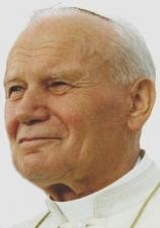
Pope John Paul II

 
Pope John Paul II

   Email Print
   Bookmark   Link


Pope John Paul II


Pope John Paul II (Latin
Latin

Latin is an Italic language, historically spoken in Latium and Ancient Rome. Through the Military history of the Roman Empire, Latin spread throughout the Mediterranean and a large part of Europe....
: Ioannes Paulus PP. II, , born ; (18 May 1920 – 2 April 2005) reigned as Pope
Pope

The Pope is the Bishop of Rome, the leader of the Roman Catholic Church and head of state of Vatican City. The current pope is Pope Benedict XVI, who was elected April 19, 2005 in Papal conclave, 2005....
 and Sovereign of the State of the Vatican City
Vatican City

Vatican City , officially the State of the Vatican City , is a Landlocked country sovereignty city-state whose territory consists of a walled enclave within the city of Rome, the Capital of Italy....
 from 16 October 1978 until his death almost 27 years later. His was the second-longest pontificate. He has been the only Polish
Poles

The Polish people, or Poles , are a West Slavs ethnic group of Central Europe, living predominantly in Poland. Poles are sometimes defined as people who share a common Polish culture and are of Polish descent....
 pope, and was the first non-Italian since the Dutch pontiff Adrian VI
Pope Adrian VI

Pope Adrian VI , born Adriaan Florenszoon Boeyens, served as Bishop of Rome from 9 January 1522 until his death some 18 months later. He was the last non-Italian pope until John Paul II, 456 years later....
 in the 1520s.

John Paul II is widely acclaimed as one of the most influential leaders of the twentieth century.


Discussion
Ask a question about 'Pope John Paul II'
Start a new discussion about 'Pope John Paul II'
Answer questions from other users
Full Discussion Forum


Timeline

1920   Born

1967   Pope Paul VI ordains 276 new cardinals (one of them Karol Wojtyla).

1978   Cardinal Karol Wojtyla becomes Pope John Paul II.

1979   Pope John Paul II visits his native Poland, becoming the first Pope to visit a Communist country.

1980   Yugoslav president Tito dies. The funeral ceremony later becomes the world's biggest diplomatic meeting and media event ever, with more than 140 state delegations in Belgrade from all over the world (only the funeral of Pope John Paul II in 2005 will have more news coverage and a higher number of delegations).

1981   Pope John Paul II is shot at and nearly killed by Mehmet Ali Agca, a Turkish gunman, as he entered St. Peter's Square in Rome to address a general audience (Two days after Christmas in 1983, Pope John Paul goes to the prison to meet and forgive his would-be assassin).

1982   Spanish priest Juan Hernandes tries to stab Pope John Paul II with a bayonet during the latter's pilgrimage to the Fatima shrine.

1983   Pope John Paul II visits his would-be assassin Mehmet Ali Agca in prison to forgive him.

1992   Pope John Paul II issues an apology, and lifts the edict of the Inquisition against Galileo Galilei.

2000   Pope John Paul II begins the first official visit by a Roman Catholic pontiff to Israel.


Quotations


Never again war. Never again hatred and intolerance.

Where: Bosnian capital, Sarajevo. (1997-04-12)

Amen.

Where: In his Papal apartment, Vatican City (2005-04-02), This word is the final word before his death

You applaud, even though you don't understand me.

Quipped by the pope during a mass in Central Park, New York City after he recited a prayer in Polish to the applauding English-speaking crowd (October, 1995)

The exploration of both the micro and the macro cosmos, is a song to Gods glory, which is reflected in everything in the universe.

Jubilee Address to Men and Women from the World of Learning Rome (2000-05-25)

The twentieth century was the great century of Christian martyrs, and this is true both in the Catholic Church and in other Churches and ecclesial communities.

From his book 'Memory & Identity' -Weidenfeld & Nicolson, 2005, p.44.

I have looked for you. Now you have come to me. And I thank you.

Where: In his Papal apartment, Vatican City (2005-04-02), Among the Holy Father's last words in Polish


Encyclopedia


Pope John Paul II (Latin
Latin

Latin is an Italic language, historically spoken in Latium and Ancient Rome. Through the Military history of the Roman Empire, Latin spread throughout the Mediterranean and a large part of Europe....
: Ioannes Paulus PP. II, , born ; (18 May 1920 – 2 April 2005) reigned as Pope
Pope

The Pope is the Bishop of Rome, the leader of the Roman Catholic Church and head of state of Vatican City. The current pope is Pope Benedict XVI, who was elected April 19, 2005 in Papal conclave, 2005....
 and Sovereign of the State of the Vatican City
Vatican City

Vatican City , officially the State of the Vatican City , is a Landlocked country sovereignty city-state whose territory consists of a walled enclave within the city of Rome, the Capital of Italy....
 from 16 October 1978 until his death almost 27 years later. His was the second-longest pontificate. He has been the only Polish
Poles

The Polish people, or Poles , are a West Slavs ethnic group of Central Europe, living predominantly in Poland. Poles are sometimes defined as people who share a common Polish culture and are of Polish descent....
 pope, and was the first non-Italian since the Dutch pontiff Adrian VI
Pope Adrian VI

Pope Adrian VI , born Adriaan Florenszoon Boeyens, served as Bishop of Rome from 9 January 1522 until his death some 18 months later. He was the last non-Italian pope until John Paul II, 456 years later....
 in the 1520s.

John Paul II is widely acclaimed as one of the most influential leaders of the twentieth century. He has been credited with being instrumental
Pope John Paul II

Pope John Paul II John Paul II is widely acclaimed as one of the most influential leaders of the twentieth century. He has been Pope_John_Paul_II#Role_in_the_fall_of_Communism in bringing down communism in Eastern Europe, as well as significantly improving the Roman Catholic Church's relations with Judaism, the Eastern Orthodox Church, and A...
 in bringing down communism
Communism

Communism is a socioeconomic structure and political ideology that promotes the establishment of an egalitarianism, classlessness, stateless society based on common ownership and control of the means of production and property in general....
 in Eastern Europe
Eastern Europe

Eastern Europe is a term that applies to the geopolitical region encompassing the easternmost part of the Europe. Throughout history and to a lesser extent today, parts of Eastern Europe has been distinguishable from Western Europe and other regions due to cultural, religious, economic, and historical reasons, even though there i...
, as well as significantly improving the Roman Catholic Church
Roman Catholic Church

The Roman Catholic Church, officially known as the Catholic Church is the world's largest Christianity Ecclesia , representing over half of all Christians and one-sixth of the world population....
's relations with Judaism
Judaism

Judaism is a set of beliefs and practices originating in the Hebrew Bible , as later further explored and explained in the Talmud and other texts....
, the Eastern Orthodox Church
Eastern Orthodox Church

The Eastern Orthodox Church is the second largest single Christian communion in the world with an estimated 225 million members worldwide. It is considered by its adherents to be the Four Marks of the Church established by Jesus Christ and his Apostles nearly 2000 years ago....
, and Anglican
Anglicanism

Anglicanism is a tradition of Christianity faith. Churches in this tradition either have historical connections to the Church of England or have similar beliefs, worship and church structures....
 Churches. While many criticised him
Pope John Paul II

Pope John Paul II John Paul II is widely acclaimed as one of the most influential leaders of the twentieth century. He has been Pope_John_Paul_II#Role_in_the_fall_of_Communism in bringing down communism in Eastern Europe, as well as significantly improving the Roman Catholic Church's relations with Judaism, the Eastern Orthodox Church, and A...
 for his views in such areas as ordination of women
Ordination of women

In general religious use, ordination is the process by which a person is Consecration . The ordination of women is a controversial issue in religions where either the rite of ordination, or the role that an ordained person fulfills, has traditionally been restricted to men because of cultural or theological prohibitions....
 and contraception
Birth control

Birth control, sometimes synonymous with contraception, is a regimen of one or more actions, devices, or medications followed in order to deliberately prevent or reduce the likelihood of pregnancy or childbirth....
, his support for Vatican II
Second Vatican Council

The Second Ecumenical Council of the Vatican, or Vatican II, was the twenty-first Ecumenical Council of the Roman Catholic Church. It opened under Pope John XXIII in 1962 and closed under Pope Paul VI in 1965....
 and its effect on the Liturgy
Mass (liturgy)

The Mass is the Eucharistic celebration in the Latin liturgical rites of the Roman Catholic Church. The term is used also of similar celebrations in Old Catholic Churches, in the Anglo-Catholic tradition of Anglicanism, and in some largely High Church Lutheranism Lutheranism regions, including the Scandinavian and Baltic states countries....
, and his stance on the sanctity of marriage
Marriage

Marriage is a social, spirituality, or law union of individuals. This union may also be called matrimony, while the ceremony that marks its beginning is usually called a wedding and the married status created is sometimes called wedlock....
, many others praised him for his orthodox Catholic stances in these areas.

He was one of the most-travelled world leaders in history, visiting 129 countries during his pontificate. He was fluent in many languages: his native Polish
Polish language

Polish , an official language of Poland, has the largest number of speakers of any West Slavic languages. Polish-speakers use the language in a uniform manner through most of Poland, and it has a regular orthography....
 as well as Italian
Italian language

Italian is a Romance languages spoken by about 63 million people as a first language, primarily in Italy. In Switzerland, Italian is one of four Linguistic geography of Switzerlands....
, French
French language

French is a Romance language spoken around the world by around 80 million people as first language, by 190 million as second language, and by about another 200 million people as an acquired tongue, with significant speakers in 54 countries....
, German
German language

German is a West Germanic languages, thus related to and classified alongside English language and Dutch language. It is one of the world's world language and the most widely spoken mother tongue in the European Union....
, English
English language

English is a West Germanic language that originated in Anglo-Saxon England and has lingua franca status in many parts of the world as a result of the military, economic, scientific, political and cultural influence of the British Empire in the 18th, 19th and early 20th centuries and that of the United States from the mid 20th century onwa...
, Spanish
Spanish language

Spanish or Castilian is a Romance languages that originated in northern Spain, and gradually spread in the Kingdom of Castile and evolved into the principal language of government and trade....
, Portuguese
Portuguese language

Portuguese is a Romance language that originated in what is now Galicia and Portugal. It is derived from the Latin language spoken by the Romanization Pre-Roman peoples of the Iberian Peninsula around 2000 years ago....
, Ancient Greek
Ancient Greek

Ancient Greek is the historical stage in the development of the Greek language spanning across the Archaic Greece , Classical Greece , and Hellenistic civilization periods of ancient Greece and the classical antiquity....
 and Latin
Latin

Latin is an Italic language, historically spoken in Latium and Ancient Rome. Through the Military history of the Roman Empire, Latin spread throughout the Mediterranean and a large part of Europe....
. As part of his special emphasis on the universal call to holiness
Universal call to holiness

Universal Call to Holiness and Apostolate is a teaching of the Roman Catholic Church that all people are called to be sacred. This Church teaching states that all within the church should live holy lives and spread holiness to others....
, he beatified
Beatification

Beatification is a recognition accorded by the Catholic church of a dead person's accession to Heaven and capacity to intercede on behalf of individuals who pray in his or her name ....
 1,340 people
List of people beatified by Pope John Paul II

Pope John Paul II beatified 1,340 people, more than any previous pope. The names listed below are from the Vatican website and are listed by year, then date....
 and canonised
Canonization

Canonization is the act by which a particular Christian church declares a deceased person to be a saint and is included in the canon, or list, of recognized saints....
 483 saints, more than the combined tally of his predecessors during the last five centuries. In any case, he would have been expected to beatify and canonize more people than his predecessors because of the increase in the number of living humans
World population

The world population is the total number of living humans on Earth at a given time. As of March 2009, the world's population is estimated to be about 6.76 1,000,000,000 ....
.

Biography


Early life

Geb Haus Papst
Karol Józef Wojtyla was born on 18 May 1920 in the Polish town of Wadowice
Wadowice

Wadowice [] is a town in southern Poland, 50km from Krak?w with 19,200 inhabitants , situated on the Skawa river, confluence of Vistula, in the eastern part of Silesian Plateau ....
 and was the youngest of three children of Karol Wojtyla, an ethnic Pole
Poles

The Polish people, or Poles , are a West Slavs ethnic group of Central Europe, living predominantly in Poland. Poles are sometimes defined as people who share a common Polish culture and are of Polish descent....
, and Emilia Kaczorowska, who was of Lithuanian ancestry. His mother died on 13 April 1929, when he was just eight years old. Karol's elder sister, Olga, had died in infancy before his birth, thus, Karol grew close to his brother Edmund, who was 14 years his senior, and whom he nicknamed ‘Mundek’. However, Edmund's work as a physician
Physician

A physician, medical practitioner, doctor of medicine, or medical doctor practices medicine, and is concerned with maintaining or restoring human health through the study, diagnosis, and treatment of disease and injury....
 led to his contraction and death of scarlet fever
Scarlet fever

Scarlet fever is a disease caused by an exotoxin released by Streptococcus pyogenes. The term Scarlatina may be used interchangeably with Scarlet Fever, though it is commonly used to indicate the less acute form of Scarlet Fever that is often seen since the beginning of the twentieth century....
, profoundly affecting Karol.

As a youth, Wojtyla was an athlete and often played football (soccer) as a goalkeeper; he was also a supporter of Polish club
Football team

A football team or a football club is the collective name given to a number of players who play together in a football game, be it Association football, American football, Australian rules football, Canadian football, Gaelic football, Rugby league, Rugby union, or other version of football....
 Cracovia Kraków
Cracovia Kraków

Cracovia Krak?w, Recently, the club has announced plans to build a new 15,000 seat stadium designed by a Spain architectural firm Estudio Lamela....
. His formative years were influenced by numerous contacts with the vibrant and prospering Jewish community of Wadowice. School football games were often organised between teams of Jews and Catholics, and Wojtyla would voluntarily offer himself as a substitute goalkeeper
Goalkeeper

In many team sports, a goalkeeper is a designated player that is charged with directly preventing the opposite team from scoring by defending the goal ....
 on the Jewish side if they were short of players.

In the summer of 1938, Karol Wojtyla and his father left Wadowice and moved to Kraków
Kraków

Krak?w , in English also spelled Krakow or Cracow , is one of the largest and oldest cities in Poland, with a population of 756,336 in 2007 ....
, where he enrolled at the Jagiellonian University
Jagiellonian University

The Jagiellonian University is located in Krak?w, Poland. Originally founded as Akademia Krakowska in 1364 by Casimir III of Poland, it is the second oldest university in Central Europe after the Charles University in Prague, and one of the List of oldest universities in continuous operation....
. While studying such topics as philology
Philology

Philology, derived from the Greek language considers both morphology and Meaning in linguistic expression, combining linguistics and literary studies....
 and various languages at the University, he worked as a volunteer librarian and did compulsory military training in the Academic Legion, but refused to hold or fire a weapon. He also performed with various theatrical groups and worked as a playwright. During this time, his talent for language blossomed and he learned as many as 12 foreign languages, nine of which he later used extensively as Pope.

In 1939, Nazi German
Nazi Germany

Nazi Germany and the Third Reich are the colloquial English names for Germany under the regime of Adolf Hitler and the Nazi Party , which established a Totalitarianism dictatorship that existed from 1933 to 1945....
 occupation forces closed the Jagiellonian University
Jagiellonian University

The Jagiellonian University is located in Krak?w, Poland. Originally founded as Akademia Krakowska in 1364 by Casimir III of Poland, it is the second oldest university in Central Europe after the Charles University in Prague, and one of the List of oldest universities in continuous operation....
. All able-bodied males were required to work, and, from 1940 to 1944, Wojtyla variously worked as a messenger for a restaurant, a manual labourer in a limestone quarry, and as a salesman for the Solvay
Solvay (company)

Solvay is a Belgium chemical and pharmaceutical company. It was founded in 1863 by Ernest Solvay to produce sodium carbonate by the solvay process....
 chemical factory to avoid being deported to Germany. His father, a non-commissioned army officer, died of a heart attack in 1941, leaving Karol the sole surviving member of his immediate family. “I was not at my mother's death, I was not at my brother's death, I was not at my father's death,” he said, reflecting on these times of his life, nearly forty years later, “At twenty, I had already lost all the people I loved.”
Karol Wojtyla At 12
He later stated that he began thinking seriously about the priesthood after his father's death, and that his vocation gradually became ‘an inner fact of unquestionable and absolute clarity.’ In October 1942, increasingly aware of his calling to the priesthood, he knocked on the door of the Archbishops Palace in Kraków
Kraków

Krak?w , in English also spelled Krakow or Cracow , is one of the largest and oldest cities in Poland, with a population of 756,336 in 2007 ....
, and declared that he wanted to study for the priesthood. Soon after, he began courses in the clandestine underground seminary
Education in Poland during World War II

This article covers the topic of underground education in Poland during World War II. Secret learning prepared new cadres for the post-war reconstruction of Poland and countered the Polish culture during World War II....
 run by the Archbishop of Kraków
Kraków

Krak?w , in English also spelled Krakow or Cracow , is one of the largest and oldest cities in Poland, with a population of 756,336 in 2007 ....
, Adam Stefan, Cardinal Sapieha
Adam Stefan Sapieha

Prince Adam Stefan Stanislaw Bonfatiusz J?zef Cardinal Sapieha was a Poland prelate of the Roman Catholic Church. Between 1922 ? 1923 he was a senator of the Second Rzeczpospolita....
.

On 29 February 1944, Wojtyla was knocked down by a German
Nazi Germany

Nazi Germany and the Third Reich are the colloquial English names for Germany under the regime of Adolf Hitler and the Nazi Party , which established a Totalitarianism dictatorship that existed from 1933 to 1945....
 truck. Unexpectedly, the German Wehrmacht
Wehrmacht

Wehrmacht was the name of the unified armed forces of Germany from 1935 to 1945. It consisted of the Heer , the Kriegsmarine and the Luftwaffe ....
 officers tended to him and sent him to hospital. He spent two weeks there recovering from a severe concussion and a shoulder injury. This accident and his survival seemed to Wojtyla a confirmation of his priest
Priest

A priest or priestess is a person having the authority or power to administer religious rites; in particular, rites of sacrifice to, and propitiation of, a deity or deities....
ly vocation. On 6 August 1944, ‘Black Sunday’, the Gestapo
Gestapo

The was the official secret police of Nazi Germany. Under the overall administration of the Schutzstaffel , it was administered by the Reichssicherheitshauptamt and was considered a dual organization of the Sicherheitsdienst and also a suboffice of the Sicherheitspolizei ....
 rounded up young men in Kraków
Kraków

Krak?w , in English also spelled Krakow or Cracow , is one of the largest and oldest cities in Poland, with a population of 756,336 in 2007 ....
 to avoid an uprising similar
Krakow Uprising (1944)

The Krakow Uprising was a planned but never realized uprising of the Polish Resistance against the German occupation of Poland in the city of Krak?w during World War II....
 to the previous uprising in Warsaw
Warsaw Uprising

The Warsaw Uprising was a struggle by the Armia Krajowa to liberate Warsaw from Nazi Germany occupation during World War II. The Uprising began on 1 August 1944, as part of a nationwide rebellion, Operation Tempest....
. Wojtyla escaped by hiding in the basement of his uncle's home at 10 Tyniets Street, while German troops searched upstairs. More than eight thousand men and boys were taken into custody that day, but Karol escaped to the Archbishop's Palace, where he remained in hiding until after the Germans left.

On the night of 17 January 1945, the Germans fled the city, and the students reclaimed the ruined seminary
Seminary

A seminary, theological college, or divinity school is a specialized and often live-in higher education institution for the purpose of instructing students in philosophy, theology, spirituality and the religious life, usually in order to prepare them to become members of the clergy....
. Wojtyla and another seminarian volunteered for the unenviable task of clearing away piles of frozen excrement from the lavatories. That month, Wojtyla personally aided a 14-year-old Jewish refugee girl named Edith Zierer who had run away from a Nazi labour camp in Czestochowa
Czestochowa

Czestochowa is a city in south Poland on the Warta with 248,894 inhabitants . It has been situated in the Silesian Voivodeship since 1999, and was previously the capital of Czestochowa Voivodeship ....
. After her collapse on a railway platform, Wojtyla personally carried her to a train and accompanied her safely to Kraków. Zierer credits Wojtyla with saving her life that day. B'nai B'rith
B'nai B'rith

The Independent Order of B'nai B'rith is the oldest continually-operating Jewish service organization in the world. It was founded in New York City by Henry Jones and 11 others on October 13, 1843....
 and other authorities have said that Wojtyla helped protect many other Polish Jews from the Nazis
Nazism

Nazism, officially National Socialism , refers to the ideology and practices of the National Socialist German Workers? Party under Adolf Hitler, and the policies adopted by the dictatorial government of Nazi Germany from 1933 to 1945....
.

Priesthood


On completion of his studies at the seminary
Seminary

A seminary, theological college, or divinity school is a specialized and often live-in higher education institution for the purpose of instructing students in philosophy, theology, spirituality and the religious life, usually in order to prepare them to become members of the clergy....
 in Kraków, Karol Wojtyla was ordained
Ordination

In general religious use, ordination is the process by which individuals are Consecration, that is, set apart as clergy to perform various religious rites and ceremonies....
 as a priest
Priest

A priest or priestess is a person having the authority or power to administer religious rites; in particular, rites of sacrifice to, and propitiation of, a deity or deities....
 on All Saints' Day
All Saints

All Saints' Day , often shortened to All Saints, is a feast celebrated on November 1 in Western Christianity, and on the first Sunday after Pentecost in Eastern Christianity in honour of all the saints, known and unknown....
, 1 November 1946, by the Archbishop of Kraków
Kraków

Krak?w , in English also spelled Krakow or Cracow , is one of the largest and oldest cities in Poland, with a population of 756,336 in 2007 ....
, Cardinal Sapieha
Adam Stefan Sapieha

Prince Adam Stefan Stanislaw Bonfatiusz J?zef Cardinal Sapieha was a Poland prelate of the Roman Catholic Church. Between 1922 ? 1923 he was a senator of the Second Rzeczpospolita....
. He was then sent to study theology
Theology

Theology is the study of the existence or attributes of a deity or gods, or more generally the study of religion or spirituality. It is sometimes contrasted with religious studies: theology is understood as the study of religion from an internal perspective , and religious studies as the study of religion from an external perspective....
 in Rome
Rome

Rome is the capital city of Italy and Lazio, and is Italy's largest and most populous city, with 2,724,347 residents in an urban area of some ....
, at the Pontifical International Athenaeum Angelicum, where he earned a licentiate
Licentiate of Sacred Theology

Licentiate of Sacred Theology is the title of an intermediate graduate degree with canon law effects in the Roman Catholic Church offered by pontifical university and ecclesiastical Faculty of theology....
 and later a doctorate in sacred theology
Doctor of Sacred Theology

"S.T.D." redirects here. For other uses, see STD.The Doctor of Sacred Theology is the final theological degree in the pontifical university system of the Catholic Church....
. This doctorate, the first of two, was based on the Latin dissertation The Doctrine of Faith According to Saint John of the Cross.

He returned to Poland in the summer of 1948 with his first pastoral
Pastoral

Pastoral, as an adjective, refers to the lifestyle of shepherds and pastoralists, moving livestock around larger areas of land according to seasons and availability of water and food....
 assignment in the village of Niegowic
Niegowic

Niegowic is a village in the administrative district of Gmina Gd?w, within Wieliczka County, Lesser Poland Voivodeship, in southern Poland. It lies approximately south-east of Wieliczka and south-east of the regional capital Krak?w....
, fifteen miles from Kraków. Arriving at Niegowic during harvest time, his first action was to kneel down and kiss the ground. This gesture would become one of his ‘trademarks’ during his Papacy, but it was not his own, since he acknowledged that he had adopted it from a 19th-century French
French people

French people can refer to:* The legal residents and citizens of France, regardless of ancestry. For a legal discussion, see French nationality law....
 saint, Jean Marie Baptiste Vianney
Jean Vianney

Saint Jean Marie Baptiste Vianney was a French parish priest who became a Catholic saint and the patron saint of parish priests. He is often referred to, even in English, as the "Cur? d'Ars" ....
 the ‘Curé d'Ars’
Jean Vianney

Saint Jean Marie Baptiste Vianney was a French parish priest who became a Catholic saint and the patron saint of parish priests. He is often referred to, even in English, as the "Cur? d'Ars" ....
. In March 1949, he was transferred to Saint Florian
Saint Florian

Saint Florian is a Christian saint, and the patron saint of Poland; Linz, Austria; chimney sweeps; and firefighting. His feast day is May 4. St....
 parish in Kraków. He taught ethics
Ethics

Ethics is a word for a philosophy that encompasses proper conduct and good living. It is significantly broader than the common conception of ethics as the analyzing of right and wrong....
 at the Jagiellonian University
Jagiellonian University

The Jagiellonian University is located in Krak?w, Poland. Originally founded as Akademia Krakowska in 1364 by Casimir III of Poland, it is the second oldest university in Central Europe after the Charles University in Prague, and one of the List of oldest universities in continuous operation....
 there and subsequently at the Catholic University of Lublin
John Paul II Catholic University of Lublin

John Paul II Catholic University of Lublin is located in Lublin, Poland. Presently it has an enrollment of over 19,000 students. It has eight...
. While teaching, Wojtyla gathered a group of about 20 young people, who began to call themselves Rodzinka, the "little family". They met for prayer, philosophical
Philosophy

Philosophy is the study of general problems concerning matters such as existence, knowledge, truth, beauty, justice, validity, mind, and language....
 discussion, and helping the blind and sick. The group eventually grew to approximately 200 participants, and their activities expanded to include annual skiing
Skiing

Snow skiing is a group of sports using skis as primary equipment. Skis are used in conjunction with ski boots that connect to the ski with use of a ski bindings....
 and kayak
Kayak

A kayak is a small human-powered boat. It typically has a covered deck, and a cockpit covered by a spraydeck. The kayak was used by the native Ainu people, Aleuts and Eskimo hunters in sub-Arctic regions of northeastern Asia, North America and Greenland....
ing trips.

In 1954 he earned a second doctorate, in philosophy, evaluating the feasibility of a Catholic ethic based on the ethical system of phenomenologist Max Scheler
Max Scheler

Max Scheler was a Germany philosopher known for his work in Phenomenology , ethics, and philosophical anthropology.Scheler developed further the philosophical method of the founder of phenomenology, Edmund Husserl, and was called by Jos? Ortega y Gasset "the first man of the philosophical paradise." After his demise in 1928, Heidegger aff...
. However, the Communist
Communism

Communism is a socioeconomic structure and political ideology that promotes the establishment of an egalitarianism, classlessness, stateless society based on common ownership and control of the means of production and property in general....
 authorities' intervention prevented his receiving the degree until 1957.

During this period, Wojtyla wrote a series of articles in Kraków's Catholic newspaper
Newspaper

A newspaper is a publication containing news, information and advertising, usually printed on low-cost paper called newsprint. General-interest newspapers often feature articles on Politics, crime, business, art/entertainment, society and sports....
 Tygodnik Powszechny
Tygodnik Powszechny

Tygodnik Powszechny , is a Roman Catholic weekly magazine, focusing on social and cultural issues. It is published in Poland in Polish. It was established by Cardinal Adam Stefan Sapieha in 1945....
 ("Universal Weekly") dealing with contemporary church issues. He also focused on creating original literary work during his first dozen years as a priest. War
World War II

World War II, or the Second World War , was a global military conflict which involved a Participants in World War II, including all of the great powers, organised into two opposing military alliances: the Allies of World War II and the Axis powers....
, life under communism
Communism

Communism is a socioeconomic structure and political ideology that promotes the establishment of an egalitarianism, classlessness, stateless society based on common ownership and control of the means of production and property in general....
, and his pastoral responsibilities all fed his poetry
Poetry

Poetry is a form of literature art in which language is used for its aesthetics and evocative qualities in addition to, or in lieu of, its apparent meaning ....
 and plays. However, he published his work under two pseudonym
Pseudonym

A pseudonym, , is a fictitious alternative to a person's legal name. In some cases, pseudonyms are adopted because it is part of a cultural or organizational tradition, as in the case of Religious names used by members of some religious orders and "cadre names" used by Communist party leaders such as Leon Trotsky and Joseph Stalin....
s – Andrzej Jawien and Stanislaw Andrzej Gruda – to distinguish his literary from his religious writings (which were published under his own name) and also so that his literary works would be considered on their own merits. In 1960, Wojtyla published the influential theological book Love and Responsibility, a defence of the traditional Church teachings on marriage from a new philosophical standpoint.

Bishop and cardinal

On 4 July 1958, while Wojtyla was on a kayaking vacation in the lakes region of northern Poland, he was nominated for the position of auxiliary bishop of Kraków. He then travelled to Warsaw
Warsaw

Warsaw is the Capital and World's largest cities of Poland. It is located on the Vistula River roughly from both the Baltic Sea coast and the Carpathian Mountains....
 to meet the Primate
Primate (religion)

Primate is a title or rank bestowed on some bishops in certain Christianity churches. Depending on the particular tradition, it can denote either jurisdictional authority or ceremonial precedence ....
 of Poland, Stefan, Cardinal Wyszynski. He agreed to serve as auxiliary to Archbishop
Archbishop

In Christianity, an archbishop is an elevated bishop. In the Roman Catholic Church, the Anglican Communion and others, this means that they lead a diocese of particular importance called an archdiocese, or in the Anglican Communion an Ecclesiastical Province, but this is not always the case....
 Eugeniusz Baziak
Eugeniusz Baziak

Eugeniusz Baziak was Archbishop of Roman Catholic Archdiocese of Lviv of the Latins and Apostolic Administrator of Krak?w. Baziak was rector of the Clerical Seminarium in Lw?w....
, and he was ordained to the Episcopate on 28 September 1958. At the age of 38, he was the youngest bishop in Poland. Baziak died in June 1962 and on 16 July Karol Wojtyla was elected as Vicar Capitular, or temporary administrator, of the Archdiocese until an Archbishop could be appointed.

Beginning in October 1962, Bishop Wojtyla took part in the Second Vatican Council
Second Vatican Council

The Second Ecumenical Council of the Vatican, or Vatican II, was the twenty-first Ecumenical Council of the Roman Catholic Church. It opened under Pope John XXIII in 1962 and closed under Pope Paul VI in 1965....
 (1962–1965), where he made contributions to two of the most historic and influential products of the council, the Decree on Religious Freedom (in Latin, Dignitatis Humanae
Dignitatis Humanae

Dignitatis Human? is the Second Vatican Council Declaration on Freedom of Religion. The full text in English is available from the The passage of this measure by a vote of 2,308 to 70 by the assembled bishops of the Catholic Church is considered by many one of the most significant events of the Council....
) and the Pastoral Constitution on the Church in the Modern World (Gaudium et Spes
Gaudium et Spes

Gaudium et Spes, the Pastoral Constitution on the Church in the Modern World, was one of the chief accomplishments of the Second Vatican Council....
).

Bishop Wojtyla also participated in all of the assemblies of the Synod of Bishops. In December 1963 Pope Paul VI
Pope Paul VI

Pope Paul VI , born Giovanni Battista Enrico Antonio Maria Montini , reigned as Pope of the Roman Catholic Church and monarch of Vatican City from 1963 to 1978....
 appointed him Archbishop of Kraków
Kraków

Krak?w , in English also spelled Krakow or Cracow , is one of the largest and oldest cities in Poland, with a population of 756,336 in 2007 ....
. On 26 June 1967, Paul VI announced Archbishop Wojtyla's promotion to the Sacred College of Cardinals
College of Cardinals

The Sacred College of Cardinals is the body of all Cardinal of the Roman Catholic Church. The College plays two roles in the church:*participating in Papal conclave when the Holy See is vacant, and...
.

In 1967, he was instrumental in formulating the encyclical
Encyclical

An encyclical was originally a Flyer letter sent to all the churches of a particular area in the ancient Christian church. At that time, the word could be used for a letter sent out by any bishop....
 Humanae Vitae
Humanae Vitae

Humanae Vitae is an encyclical written by Pope Paul VI and promulgated on July 25, 1968. Subtitled "On the Regulation of Birth", it re-affirms the traditional teaching of the Roman Catholic Church regarding abortion, contraception, and other issues pertaining to human life....
, which deals with those same issues and forbids abortion and artificial birth control.

Papacy


Election

In August 1978 following the death of Pope Paul VI
Pope Paul VI

Pope Paul VI , born Giovanni Battista Enrico Antonio Maria Montini , reigned as Pope of the Roman Catholic Church and monarch of Vatican City from 1963 to 1978....
 , Cardinal Wojtyla voted in the Papal conclave
Papal conclave

A papal conclave is a meeting of the College of Cardinals to elect the pope, or Bishop of Rome, who is considered by Catholics to be the Apostolic Succession of Saint Peter and earthly head of the Catholic Church....
 that elected Pope John Paul I
Pope John Paul I

Pope John Paul I , born Albino Luciani, , reigned as Pope of the Roman Catholic Church and as Monarch of Vatican City from 26 August 1978 until his death 33 days later....
, who at 65 was considered young by papal standards. However, John Paul I died after only 33 days as Pope, thereby precipitating another conclave.

Ten days after the funeral of Pope John Paul I
Pope John Paul I

Pope John Paul I , born Albino Luciani, , reigned as Pope of the Roman Catholic Church and as Monarch of Vatican City from 26 August 1978 until his death 33 days later....
, on 14 October, the doors of the Sistine Chapel
Sistine Chapel

Sistine Chapel is the best-known chapel in the Apostolic Palace, the official residence of the Pope in Vatican City. Its fame rests on its architecture, evocative of Solomon's Temple of the Old Testament and on its decoration which has been frescoed throughout by the greatest Renaissance artists including Michelangelo, Raphael, Bernini, and...
 were sealed and the conclave commenced. It was divided between two particularly strong candidates
Papabile

Papabile is an unofficial Italian language term first coined by Vaticanologists and now used internationally in many languages to describe a Cardinal of whom it is thought likely or possible that he will be Papal conclave pope....
 for the papacy
Pope

The Pope is the Bishop of Rome, the leader of the Roman Catholic Church and head of state of Vatican City. The current pope is Pope Benedict XVI, who was elected April 19, 2005 in Papal conclave, 2005....
: Cardinal Giuseppe Siri, the conservative
Conservatism

Conservatism is a political and social term whose meaning has changed in different countries and time periods, but which usually indicates support for the status quo or the status quo ante....
 Archbishop of Genoa
Roman Catholic Archdiocese of Genoa

The Archdiocese of Genoa is a metropolitan see of the Catholic Church in Italy.Erected in the third century, it was elevated to an archdiocese on 20 March 1133....
, and the liberal
Liberalism

Liberalism is a broad class of political philosophy that considers individualism liberty and equality to be the most important political goals....
 Cardinal Giovanni Benelli, the Archbishop of Florence
Roman Catholic Archdiocese of Florence

The Archdiocese of Florence is a metropolitan see of the Catholic Church in Italy. Traditionally founded in the 1st century, it was elevated to the dignity of an archdiocese on May 10, 1419, by Pope Martin V....
 and a close associate of John Paul I.

Supporters of Benelli were confident that he would be elected, and in early ballots, Benelli came within nine votes of election. However, the scale of opposition to both men meant that neither was likely to receive the votes needed for election, and Franz, Cardinal König
Franz König

Franz Cardinal K?nig was an Austrian prelate of the Roman Catholic Church. He served as Archbishop of Vienna from 1956 to 1985, and was elevated to the Cardinal in 1958....
, Archbishop of Vienna
Archbishop of Vienna

The Archbishop of Vienna is the prelate of the Roman Catholic Archdiocese of Vienna who is concurrently the metropolitan bishop of its ecclesiastical province which includes the dioceses of Roman Catholic Diocese of Eisenstadt, Roman Catholic Diocese of Linz and Roman Catholic Diocese St....
, individually suggested to his fellow electors a compromise candidate: the Polish Cardinal, Karol Józef Wojtyla. Wojtyla ultimately won the election on the eighth ballot on the second day with, according to the Italian press, 99 votes from the 111 participating electors. He subsequently chose the name John Paul II and the traditional white smoke informed the crowd gathered in St Peter's Square that a pope had been chosen. He accepted his election with these words: ‘With obedience in faith to Christ, my Lord, and with trust in the Mother of Christ and the Church, in spite of great difficulties, I accept.’ When the new pontiff himself appeared on the balcony, he broke tradition by addressing the gathered crowd:

Cardinal Wojtyla became the 264th Pope according to the chronological List of popes
List of popes

There is no official list of popes, but the Annuario Pontificio, published every year by the Roman Curia, contains a list that is generally considered to be the most authoritative....
. At only 58 years of age, he was the youngest pope elected since Pope Pius IX
Pope Pius IX

Blessed Pope Pius IX , born Giovanni Maria Mastai-Ferretti, was Pope from June 16, 1846 until his death. His was the longest reign in Church history, lasting 32 years....
 in 1846, who was 54. Like his immediate predecessor, Pope John Paul II dispensed with the traditional Papal coronation
Papal Coronation

The Papal Coronation is the ceremony in which a new pope is crowned as earthly head of the Roman Catholic Church, sovereignty of Vatican City, and Monarch of the Holy See....
 and instead received ecclesiastical investiture
Investiture

Investiture, from the Latin is a rather general term for the formal installation of an incumbent in public office, especially by taking possession of its insignia....
 with the simplified Papal inauguration
Papal Inauguration

The Papal Inauguration Mass is a liturgy of the Catholic Church for the ecclesiastical investiture of the Pope. It no longer includes the millennium-old Papal Coronation ceremony....
 on 22 October 1978. During his inauguration, when the cardinals were to kneel before him to take their vows and kiss his ring, he stood up as the Polish prelate Stefan, Cardinal Wyszynski knelt down, stopped him from kissing the ring, and hugged him.

Life's work


Teachings


As pope, one of John Paul II's most important roles was to teach people about Christianity
Christianity

Christianity is a Monotheistic religion #Christian view religion centered on the life and teachings of Jesus as New Testament view on Jesus' life....
. He wrote 14 papal encyclical
Encyclical

An encyclical was originally a Flyer letter sent to all the churches of a particular area in the ancient Christian church. At that time, the word could be used for a letter sent out by any bishop....
s (List of Encyclicals of Pope John Paul II
List of Encyclicals of Pope John Paul II

This article contains a list of Encyclicals of Pope John Paul II. Pope John Paul II issued 14 Papal Encyclicals during his reign as Pope of the Roman Catholic Church for over 26 years, from his election on 16 October 1978 until his death on 2 April 2005....
).

In his Apostolic Letter At the beginning of the third millennium (Novo Millennio Inuente), he emphasised the importance of "starting afresh from Christ
Christ

Christ is the English language term for the Greek meaning "the anointing", which is a title given to the Reigning Messiah in the given age of the Zodiac....
": "No, we shall not be saved by a formula but by a Person."

In The Splendour of the Truth (Veritatis Splendor
Veritatis Splendor

Veritatis Splendor is an encyclical by Pope John Paul II. It expresses the position of the Catholicism regarding fundamentals of the Church's role in moral teaching....
) he emphasised the dependence of man on God and His Law ("Without the Creator, the creature disappears") and the "dependence of freedom on the truth". He warned that man "giving himself over to relativism
Relativism

Relativism is the idea that some elements or aspects of experience or culture are relative to, i.e., dependent on, other elements or aspects.Common statements that might be considered relativistic include...
 and skepticism
Skepticism

In ordinary usage, skepticism or scepticism refers to:* an attitude of doubt or a disposition to incredulity either in general or toward a particular object;...
, goes off in search of an illusory freedom apart from truth itself".

In Fides et Ratio
Fides et Ratio

Fides et Ratio is an encyclical promulgated by Pope John Paul II on 14 September 1998. It deals primarily with the relationship between faith and reason....
 (On the Relationship between Faith and Reason) John Paul promoted a renewed interest in philosophy and an autonomous pursuit for Truth in theological matters. Drawing on many different sources (such as Thomism), he described the mutually supporting relationship between faith and reason, and emphasized why it is important that theologians should focus on that relationship.

John Paul II also wrote extensively about workers and the social doctrine
Catholic social teaching

Catholic social teaching encompasses aspects of Roman Catholic Church doctrine relating to matters dealing with the collective welfare of humanity....
 of the Church, which he discussed in three encyclicals. Through his encyclicals and many Apostolic Letters and Exhortations, John Paul also talked about the dignity
Dignity

Dignity is a term used in moral, ethical, and political discussions to signify that a being has an innate right to respect and ethical treatment....
 of women and the importance of the family
Family

Family denotes a group of people affiliated by a common ancestry, affinity or co-residence. Although the concept of consanguinity originally referred to relations by "blood," some cultural anthropology have argued that one must understand the idea of "blood" metaphorically, and that many societies understand 'family' through other concepts r...
 for the future of mankind, .

Other encyclical
Encyclical

An encyclical was originally a Flyer letter sent to all the churches of a particular area in the ancient Christian church. At that time, the word could be used for a letter sent out by any bishop....
s include The Gospel of Life (Evangelium Vitae
Evangelium Vitae

Evangelium Vit? is the name of the encyclical written by Pope John Paul II which expresses the position of the Catholicism regarding the value and inviolability of human life....
) and Orientale Lumen (Light of the East). In spite of critics who accused him of inflexibility, he explicitly re-asserted Catholic moral teachings against murder, euthanasia and abortion that have remained unchanging for two thousand years. Like all statements on faith and morals asserted in official papal capacity, these statements are infallible according to Roman Catholic doctrine, and are so defined by the Congregation for the Doctrine of the Faith
Congregation for the Doctrine of the Faith

The Congregation for the Doctrine of the Faith , previously known as the Supreme Sacred Congregation of the Universal Inquisition, and sometimes simply called the Holy Office is the oldest of the nine congregation of the Roman Curia....
.

Pastoral trips

John Paul Ii Polish Parliament 1999 5
John Paul Ii George W
During his pontificate, Pope John Paul II made trips to 129 countries, and logged more than 1.1 million km (725,000 miles). He consistently attracted large crowds on his travels, some amongst the largest ever assembled in human history. The cost of all these travels were paid by the countries that he visited and not by the Vatican.

One of John Paul II's earliest official visits was to Poland, in June 1979, where he was constantly surrounded by ecstatic crowds. This first trip to Poland uplifted the whole nations spirit and sparked the formation of the Solidarity
Solidarity

Solidarity is a Poland trade union federation founded in September 1980 at the Gdansk Shipyard, and originally led by Lech Walesa.Solidarity was the first non-communist trade union in a communist country....
 movement in 1980, which brought freedom and human rights to his troubled country. On later trips to Poland, he gave tacit support to the organisation. Successive trips reinforced this message and Poland began the process that would finally defeat the domination of the Soviet Union
Soviet Union

The Union of Soviet Socialist Republics was a Constitution of the Soviet Union socialist state that existed in Eurasia from 1922 to 1991.The name is a translation of the , romanization of Russian Soyuz Sovetskikh Sotsialisticheskikh Respublik, abbreviated ????, SSSR....
 in Eastern Europe in 1989.

While some of his trips (such as to the United States
United States

The United States of America is a Federal government constitutional republic comprising U.S. state and a federal district. The country is situated mostly in central North America, where its Contiguous United States and Washington, D.C., the Capital districts and territories, lie between the Pacific Ocean and Atlantic Oceans, Borders of the U...
 and the Holy Land
Holy Land

The Holy Land , generally refers to the geographical region of the Levant called Land of Canaan or Land of Israel in the Bible, and constitutes the Promised land....
) were to places previously visited by Pope Paul VI
Pope Paul VI

Pope Paul VI , born Giovanni Battista Enrico Antonio Maria Montini , reigned as Pope of the Roman Catholic Church and monarch of Vatican City from 1963 to 1978....
, many others were to places that no pope had ever visited before. He was the first pope to visit Mexico
Mexico

The United Mexican States , commonly known as Mexico , is a federalism constitutionalism republic in North America. It is bordered on the north by the United States; on the south and west by the Pacific Ocean; on the southeast by Guatemala, Belize, and the Caribbean Sea; and on the east by the Gulf of Mexico....
 in January 1979, before his initial trip to Poland as Pope, as well as to Ireland
Ireland

Ireland is the List of islands by area in Europe, and the twentieth-largest island in the world. It lies to the north-west of continental Europe and is surrounded by hundreds of islands and islet....
 later that year. He was the first reigning pope to travel to the United Kingdom, in 1982, where he met Queen Elizabeth II
Elizabeth II of the United Kingdom

Elizabeth II is the queen regnant of sixteen independent states known as the Commonwealth realms: Monarchy of the United Kingdom, Monarchy of Canada, Monarchy of Australia, Monarchy of New Zealand, Monarchy of Jamaica, Monarchy of Barbados, the Bahamas, Grenada, Papua New Guinea, the Monarchy of the Solomon Islands, Tuvalu, Saint Lucia, Sain...
, the Supreme Governor
Supreme Governor of the Church of England

The Supreme Governor of the Church of England is a title held by the British Monarch which signifies their titular leadership over the Church of England....
 of the Church of England
Church of England

The Church of England is the State religion Christianity Ecclesia in England, the Mother Church of the worldwide Anglican Communion and the oldest among the communion's thirty-eight independent national and regional churches....
. In 2000, he was the first modern pope to visit Egypt
Egypt

Egypt is a country mainly in North Africa, with the Sinai Peninsula forming a land bridge in Western Asia. Covering an area of about , Egypt borders the Mediterranean Sea to the north, the Gaza Strip and Israel to the northeast, the Red Sea to the east, Sudan to the south and Libya to the west....
, where he met with the Coptic pope, Pope Shenuda III and the Greek Orthodox Patriarch of Alexandria. He was the first Catholic pope to visit and pray in an Islam
Islam

Islam is a Monotheism, Abrahamic religion originating with the teachings of the Prophets of Islam Muhammad, a 7th century Arab religious and political figure....
ic mosque
Mosque

A mosque is a place of worship for followers of Islam. Muslims often refer to the mosque by its Arabic name, masjid, ? . The word "mosque" in English refers to all types of buildings dedicated for Islamic worship, although there is a distinction in Arabic between the smaller, privately owned mosque and the larger, "collective" mosque ,...
, in Damascus
Damascus

Damascus is the capital and largest city of Syria. It is List of oldest continuously inhabited cities and its current population is estimated at about 4,000,000....
, Syria
Syria

Syria , officially the Syrian Arab Republic , is an Arab-majority country in Southwest Asia, bordering Lebanon and the Mediterranean Sea to the west, Israel to the southwest, Jordan to the south, Iraq to the east, and Turkey to the north....
 in 2001. He visited the Umayyad Mosque, a former Christian church where John the Baptist
John the Baptist

John the Baptist was a mission preacher and a major religious figure who led a movement of baptism at the Jordan River in expectation of a divine apocalypse that would restore occupied Israel....
 is believed to be interred, where he made a speech calling for Muslims, Christians and Jews to work together.

On 15 January, 1995, during the X World Youth Day
World Youth Day 1995

World Youth Day 1995 was a Roman Catholic youth festival that took place from January 10–January 15, 1995 in Manila, Philippines. It was the first time for an Asian country to host the event....
, he offered Mass to an estimated crowd of between five and seven million in Luneta Park
Rizal Park

Rizal Park is situated in the heart of the city of Manila, Philippines. It is at the northern end of Roxas Boulevard, overlooking Manila Bay....
, Manila
Manila

The 'City of Manila' , or simply 'Manila', is the Capital of the Philippines and one of the 17 cities and municipalities that make up Metro Manila....
, Philippines
Philippines

The Philippines, officially known as the Republic of the Philippines, is a country in Southeast Asia with Manila as its capital city. It comprises 7,107 islands in the western Pacific Ocean....
, which was considered to be the largest single gathering in Christian history. In March 2000, John Paul became the first pope in history to visit Jerusalem
Jerusalem

Jerusalem is the capital of Israel and its List of Israeli cities in both population and area, with a population of 747,600 residents over an area of if Positions on Jerusalem East Jerusalem is included....
 and pray at the Western Wall
Western Wall

The Western Wall , sometimes referred to as the Wailing Wall or simply the Kotel , and as al-Buraq Wall by Muslims, is an important Jewish religious site located in the Old City ....
. In September 2001, amidst post-September 11 concerns, he travelled to Kazakhstan
Kazakhstan

Kazakhstan, also Kazakstan , officially the Republic of Kazakhstan, is a large Eurasian country in Central Asia and Eastern Europe. Ranked as the List of countries by area as well as the world's largest landlocked country, it has a territory of 2,727,300 km? ....
, with an audience largely consisting of Muslims, and to Armenia
Armenia

Armenia , officially the Republic of Armenia , is a landlocked mountainous country in South Caucasus between the Black Sea and the Caspian Sea....
, to participate in the celebration of the 1,700 years of Christianity
Christianity

Christianity is a Monotheistic religion #Christian view religion centered on the life and teachings of Jesus as New Testament view on Jesus' life....
 in that nation.

- | style="width:20%" | | style="width:21%; vertical-align: top; text-align:justify; padding-left: 10px;" |