


Cumae

Encyclopedia
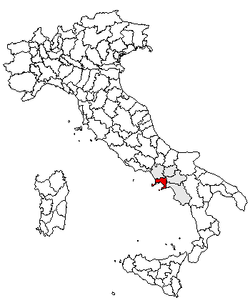
Cumae is an ancient Greek settlement lying to the northwest of Naples
Naples
Naples is a city in Southern Italy, situated on the country's west coast by the Gulf of Naples. Lying between two notable volcanic regions, Mount Vesuvius and the Phlegraean Fields, it is the capital of the region of Campania and of the province of Naples...
in the Italian region of Campania
Campania
Campania is a region in southern Italy. The region has a population of around 5.8 million people, making it the second-most-populous region of Italy; its total area of 13,590 km² makes it the most densely populated region in the country...
. Cumae was the first Greek colony on the mainland of Italy (Magna Graecia
Magna Graecia
Magna Græcia is the name of the coastal areas of Southern Italy on the Tarentine Gulf that were extensively colonized by Greek settlers; particularly the Achaean colonies of Tarentum, Crotone, and Sybaris, but also, more loosely, the cities of Cumae and Neapolis to the north...
), and the seat of the Cumaean Sibyl
Cumaean Sibyl
The ageless Cumaean Sibyl was the priestess presiding over the Apollonian oracle at Cumae, a Greek colony located near Naples, Italy.The word sibyl comes from the ancient Greek word sibylla, meaning prophetess. There were many Sibyls in different locations throughout the ancient world...
. It was the Cumaean alphabet that was adopted in Italy, first by the Etruscans (800 - 100 B.C.E.) and then by the Romans
Ancient Rome
Ancient Rome was a thriving civilization that grew on the Italian Peninsula as early as the 8th century BC. Located along the Mediterranean Sea and centered on the city of Rome, it expanded to one of the largest empires in the ancient world....
(300 - 100 B.C.E.), thus becoming the Latin alphabet
Latin alphabet
The Latin alphabet, also called the Roman alphabet, is the most recognized alphabet used in the world today. It evolved from a western variety of the Greek alphabet called the Cumaean alphabet, which was adopted and modified by the Etruscans who ruled early Rome...
, the world's most widely used phonemic script. The Cumaean alphabet was also used throughout the Greek island of Euboea
Euboea
Euboea is the second largest Greek island in area and population, after Crete. The narrow Euripus Strait separates it from Boeotia in mainland Greece. In general outline it is a long and narrow, seahorse-shaped island; it is about long, and varies in breadth from to...
.
Today Cuma - Fusaro is a frazione
Frazione
A frazione , in Italy, is the name given in administrative law to a type of territorial subdivision of a comune; for other administrative divisions, see municipio, circoscrizione, quartiere...
of the comune
Comune
In Italy, the comune is the basic administrative division, and may be properly approximated in casual speech by the English word township or municipality.-Importance and function:...
of Bacoli
Bacoli
Bacoli is a comune in the Province of Naples in the Italian region Campania, located about 15 km west of Naples. As of 31 December 2004, it had a population of 27,402 and an area of 13.3 km².-History:...
.
Early history
The settlement, in a location that was already occupied, is believed to have been founded in the 8th century BC by Euboean Greeks, originally from the cities of EretriaEretria
Erétria was a polis in Ancient Greece, located on the western coast of the island of Euboea, south of Chalcis, facing the coast of Attica across the narrow Euboean Gulf. Eretria was an important Greek polis in the 6th/5th century BC. However, it lost its importance already in antiquity...
and Chalcis
Chalcis
Chalcis or Chalkida , the chief town of the island of Euboea in Greece, is situated on the strait of the Evripos at its narrowest point. The name is preserved from antiquity and is derived from the Greek χαλκός , though there is no trace of any mines in the area...
in Euboea
Euboea
Euboea is the second largest Greek island in area and population, after Crete. The narrow Euripus Strait separates it from Boeotia in mainland Greece. In general outline it is a long and narrow, seahorse-shaped island; it is about long, and varies in breadth from to...
, who were already established at Pithecusae (modern Ischia
Ischia
Ischia is a volcanic island in the Tyrrhenian Sea. It lies at the northern end of the Gulf of Naples, about 30 km from the city of Naples. It is the largest of the Phlegrean Islands. Roughly trapezoidal in shape, it measures around 10 km east to west and 7 km north to south and has...
); they were led by the paired oecists (colonizers) Megasthenes of Chalcis and Hippocles of Cyme
Kymi, Greece
Kymi is a coastal town and a former municipality in the island of Euboea, Greece, named after an ancient Greek place of the same name. Since the 2011 local government reform it is part of the municipality Kymi-Aliveri, of which it is a municipal unit...
.
The Greeks were planted upon the earlier dwellings of indigenous, Iron-Age peoples whom they supplanted; a memory of them was preserved as cave-dwellers named Cimmerians
Cimmerians
The Cimmerians or Kimmerians were ancient equestrian nomads of Indo-European origin.According to the Greek historian Herodotus, of the 5th century BC, the Cimmerians inhabited the region north of the Caucasus and the Black Sea during the 8th and 7th centuries BC, in what is now Ukraine and Russia...
, among whom there was already an oracular tradition. Its name refers to the peninsula of Cyme in Euboea. The colony was also the entry point in the Italian peninsula
Peninsula
A peninsula is a piece of land that is bordered by water on three sides but connected to mainland. In many Germanic and Celtic languages and also in Baltic, Slavic and Hungarian, peninsulas are called "half-islands"....
for the Euboean alphabet, the local variant of the Greek alphabet used by its colonists, a variant of which was adapted by the Romans
Ancient Rome
Ancient Rome was a thriving civilization that grew on the Italian Peninsula as early as the 8th century BC. Located along the Mediterranean Sea and centered on the city of Rome, it expanded to one of the largest empires in the ancient world....
and became the Latin alphabet
Latin alphabet
The Latin alphabet, also called the Roman alphabet, is the most recognized alphabet used in the world today. It evolved from a western variety of the Greek alphabet called the Cumaean alphabet, which was adopted and modified by the Etruscans who ruled early Rome...
still used worldwide today.
Cumae was a direct offshoot of an earlier colony on the nearby island of Ischia
Ischia
Ischia is a volcanic island in the Tyrrhenian Sea. It lies at the northern end of the Gulf of Naples, about 30 km from the city of Naples. It is the largest of the Phlegrean Islands. Roughly trapezoidal in shape, it measures around 10 km east to west and 7 km north to south and has...
, Pithecusae, founded by colonists from the Euboean cities of Eretria
Eretria
Erétria was a polis in Ancient Greece, located on the western coast of the island of Euboea, south of Chalcis, facing the coast of Attica across the narrow Euboean Gulf. Eretria was an important Greek polis in the 6th/5th century BC. However, it lost its importance already in antiquity...
and of Chalcis
Chalcis
Chalcis or Chalkida , the chief town of the island of Euboea in Greece, is situated on the strait of the Evripos at its narrowest point. The name is preserved from antiquity and is derived from the Greek χαλκός , though there is no trace of any mines in the area...
(Χαλκίς), which was accounted its mother-city by agreement among the first settlers.
The colony thrived. By the eighth century it was strong enough to send Perieres and a group with him, who were among the founders of Zancle in Sicily
Sicily
Sicily is a region of Italy, and is the largest island in the Mediterranean Sea. Along with the surrounding minor islands, it constitutes an autonomous region of Italy, the Regione Autonoma Siciliana Sicily has a rich and unique culture, especially with regard to the arts, music, literature,...
, and another band had returned to found Triteia in Achaea, Pausanias was told. It spread its influence throughout the area over the seventh and sixth centuries BC, gaining sway over Puteoli and Misenum and, thereafter, founding Neapolis
Naples
Naples is a city in Southern Italy, situated on the country's west coast by the Gulf of Naples. Lying between two notable volcanic regions, Mount Vesuvius and the Phlegraean Fields, it is the capital of the region of Campania and of the province of Naples...
in 470 BC
470 BC
Year 470 BC was a year of the pre-Julian Roman calendar. At the time, it was known as the Year of the Consulship of Potitus and Mamercus...
. All these facts were recalled long afterwards; Cumae's first brief contemporary mention in written history is in Thucydides
Thucydides
Thucydides was a Greek historian and author from Alimos. His History of the Peloponnesian War recounts the 5th century BC war between Sparta and Athens to the year 411 BC...
.
The growing power of the Cumaean Greeks led many indigenous tribes of the region to organize against them, notably the Dauni and Aurunci
Aurunci
The Aurunci were an Italic population which lived in southern Italy from around the 1st millennium BC. Of Indo-European origin, their language belonged to the Oscan group...
with the leadership of the Capua
Capua
Capua is a city and comune in the province of Caserta, Campania, southern Italy, situated 25 km north of Naples, on the northeastern edge of the Campanian plain. Ancient Capua was situated where Santa Maria Capua Vetere is now...
n Etruscans. This coalition was defeated by the Cumaeans in 524 BC under the direction of Aristodemus, called Malacus
Aristodemus of Cumae
Aristodemus, born in 550 BC also nicknamed Malakos, meaning voluptuous to touch), was a tyrant of Cumae.As a strategos, he defeated the Etruscan armies in 524 BC and 506 BC in the Battle of Aricia....
, a successful man of the people who overthrew the aristocratic faction, became a tyrant himself, and was assassinated.
Contact between the Romans and the Cumaeans is recorded during the reign of Aristodemus. Livy
Livy
Titus Livius — known as Livy in English — was a Roman historian who wrote a monumental history of Rome and the Roman people. Ab Urbe Condita Libri, "Chapters from the Foundation of the City," covering the period from the earliest legends of Rome well before the traditional foundation in 753 BC...
states that immediately prior to the war between Rome and Clusium, the Roman senate
Roman Senate
The Senate of the Roman Republic was a political institution in the ancient Roman Republic, however, it was not an elected body, but one whose members were appointed by the consuls, and later by the censors. After a magistrate served his term in office, it usually was followed with automatic...
sent agents to Cumae to purchase grain in anticipation of a siege of Rome. Also Lucius Tarquinius Superbus
Lucius Tarquinius Superbus
Lucius Tarquinius Superbus was the legendary seventh and final King of Rome, reigning from 535 BC until the popular uprising in 509 BC that led to the establishment of the Roman Republic. He is more commonly known by his cognomen Tarquinius Superbus and was a member of the so-called Etruscan...
, the last legendary King of Rome
King of Rome
The King of Rome was the chief magistrate of the Roman Kingdom. According to legend, the first king of Rome was Romulus, who founded the city in 753 BC upon the Palatine Hill. Seven legendary kings are said to have ruled Rome until 509 BC, when the last king was overthrown. These kings ruled for...
, lived his life in exile with Aristodemus at Cumae after the establishment of the Roman Republic
Roman Republic
The Roman Republic was the period of the ancient Roman civilization where the government operated as a republic. It began with the overthrow of the Roman monarchy, traditionally dated around 508 BC, and its replacement by a government headed by two consuls, elected annually by the citizens and...
.
Also during the reign of Aristodemus, the Cumaean army assisted the Latin
Latin league
The Latin League was a confederation of about 30 villages and tribes in the region of Latium near ancient Rome, organized for mutual defense...
city of Aricia
Aricia
Aricia can refer to:*Aricia, a genus of gossamer-winged butterflies usually included in Aricia *Aricia , historical figure in ancient Britain*Aricia , minor figure in Greek mythology*Aricia, Italy...
to defeat
War between Clusium and Aricia
The war between Clusium and Aricia was a military conflict in central Italy in around 508 BC.Lars Porsena was king of Clusium, at that time reputed to be one of the most powerful cities of Etruria. At the behest of the exiled king of Rome, Lucius Tarquinius Superbus, Porsena had waged war against...
the Etruscan forces of Clusium
Clusium
Clusium was an ancient city in Italy, one of several found at the site. The current municipality of Chiusi partly overlaps this Roman walled city. The Roman city remodeled an earlier Etruscan city, Clevsin, found in the territory of a prehistoric culture, possibly also Etruscan or proto-Etruscan...
.
The combined fleets of Cumae and Syracuse
Syracuse, Italy
Syracuse is a historic city in Sicily, the capital of the province of Syracuse. The city is notable for its rich Greek history, culture, amphitheatres, architecture, and as the birthplace of the preeminent mathematician and engineer Archimedes. This 2,700-year-old city played a key role in...
defeated the Etruscans at the Battle of Cumae
Battle of Cumae
The Battle of Cumae was a naval battle in 474 BC between the combined navies of Syracuse and Cumae and the Etruscans.Hiero I of Syracuse allied with Aristodemus, the tyrant of Cumae, to defend against Etruscan expansion into southern Italy. In 474 they met and defeated the Etruscan fleet at Cumae...
in 474 BC
474 BC
Year 474 BC was a year of the pre-Julian Roman calendar. At the time, it was known as the Year of the Consulship of Medullinus and Vulso...
.
Oscan and Roman Cumae
Capua
Capua is a city and comune in the province of Caserta, Campania, southern Italy, situated 25 km north of Naples, on the northeastern edge of the Campanian plain. Ancient Capua was situated where Santa Maria Capua Vetere is now...
and in 338 was granted partial citizenship, a civitas sine suffragio
Civitas
In the history of Rome, the Latin term civitas , according to Cicero in the time of the late Roman Republic, was the social body of the cives, or citizens, united by law . It is the law that binds them together, giving them responsibilities on the one hand and rights of citizenship on the other...
. In the Second Punic War
Second Punic War
The Second Punic War, also referred to as The Hannibalic War and The War Against Hannibal, lasted from 218 to 201 BC and involved combatants in the western and eastern Mediterranean. This was the second major war between Carthage and the Roman Republic, with the participation of the Berbers on...
, in spite of temptations, Cumae withstood Hannibal's siege, under the leadership of Tib. Sempronius Gracchus
Tiberius Sempronius Gracchus (consul 215 and 213 BC)
Tiberius Sempronius Tib. f. Tib. n. Gracchus was a Roman Republican consul in the Second Punic War. He was son of Tiberius Sempronius Tib. f...
.
Under Roman rule "quiet Cumae" slumbered until the disasters of the Gothic Wars, when it was repeatedly attacked, as the only fortified city in Campania aside from Neapolis: Belisarius
Belisarius
Flavius Belisarius was a general of the Byzantine Empire. He was instrumental to Emperor Justinian's ambitious project of reconquering much of the Mediterranean territory of the former Western Roman Empire, which had been lost less than a century previously....
took it in 536, Totila
Totila
Totila, original name Baduila was King of the Ostrogoths from 541 to 552 AD. A skilled military and political leader, Totila reversed the tide of Gothic War, recovering by 543 almost all the territories in Italy that the Eastern Roman Empire had captured from his Kingdom in 540.A relative of...
held it, and when Narses
Narses
Narses was, with Belisarius, one of the great generals in the service of the Byzantine Emperor Justinian I during the "Reconquest" that took place during Justinian's reign....
gained possession of Cumae, he found he had won the whole treasury of the Goths. In 1207, forces from Naples, acting for the boy-King of Sicily, destroyed the city and its walls, as the stronghold of a nest of bandits.
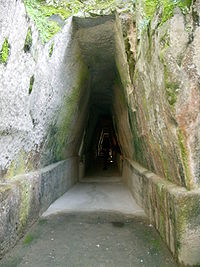
The Sibyl of Cumae
Cumae is perhaps most famous as the seat of the Cumaean Sibyl. Her sanctuary is now open to the public.In Roman mythology
Roman mythology
Roman mythology is the body of traditional stories pertaining to ancient Rome's legendary origins and religious system, as represented in the literature and visual arts of the Romans...
, there is an entrance to the underworld
Hades
Hades , Hadēs, originally , Haidēs or , Aidēs , meaning "the unseen") was the ancient Greek god of the underworld. The genitive , Haidou, was an elision to denote locality: "[the house/dominion] of Hades". Eventually, the nominative came to designate the abode of the dead.In Greek mythology, Hades...
located at Avernus
Avernus
Avernus was an ancient name for a crater near Cumae , Italy, in the Region of Campania west of Naples. It is approximately in circumference. Within the crater is Lake Avernus .-Role in ancient Roman society:...
, a crater lake near Cumae, and was the route Aeneas
Aeneas
Aeneas , in Greco-Roman mythology, was a Trojan hero, the son of the prince Anchises and the goddess Aphrodite. His father was the second cousin of King Priam of Troy, making Aeneas Priam's second cousin, once removed. The journey of Aeneas from Troy , which led to the founding a hamlet south of...
used to descend to the Underworld.
The Temple of Zeus at Cumae was transformed into a Christian basilica at the end of the fourth century. At Cumae was set a widely influential Christian work of the second century, The Shepherd of Hermas
The Shepherd of Hermas
The Shepherd of Hermas is a Christian literary work of the 1st or 2nd century, considered a valuable book by many Christians, and considered canonical scripture by some of the early Church fathers such as Irenaeus. The Shepherd had great authority in the 2nd and 3rd centuries...
said by its author to have been inspired by way of visions.
The colony was built on a large rise, the seaward side of which was used as a bunker
Bunker
A military bunker is a hardened shelter, often buried partly or fully underground, designed to protect the inhabitants from falling bombs or other attacks...
and gun emplacement by the Germans
Germany
Germany , officially the Federal Republic of Germany , is a federal parliamentary republic in Europe. The country consists of 16 states while the capital and largest city is Berlin. Germany covers an area of 357,021 km2 and has a largely temperate seasonal climate...
during World War II
World War II
World War II, or the Second World War , was a global conflict lasting from 1939 to 1945, involving most of the world's nations—including all of the great powers—eventually forming two opposing military alliances: the Allies and the Axis...
.
See also
- Aristodemus of CumaeAristodemus of CumaeAristodemus, born in 550 BC also nicknamed Malakos, meaning voluptuous to touch), was a tyrant of Cumae.As a strategos, he defeated the Etruscan armies in 524 BC and 506 BC in the Battle of Aricia....
- Battle of CumaeBattle of CumaeThe Battle of Cumae was a naval battle in 474 BC between the combined navies of Syracuse and Cumae and the Etruscans.Hiero I of Syracuse allied with Aristodemus, the tyrant of Cumae, to defend against Etruscan expansion into southern Italy. In 474 they met and defeated the Etruscan fleet at Cumae...
- Cumaean SibylCumaean SibylThe ageless Cumaean Sibyl was the priestess presiding over the Apollonian oracle at Cumae, a Greek colony located near Naples, Italy.The word sibyl comes from the ancient Greek word sibylla, meaning prophetess. There were many Sibyls in different locations throughout the ancient world...
- Grotta di CocceioGrotta di CocceioGrotta di Cocceio, also known as the Cocceius Tunnel, is a straight-line subterranean gallery nearly a kilometre in length connecting Lake Avernus with Cumae north of Naples, Italy. It was burrowed clean through the tuff stone of Monte Grillo from 38-36 BCE...
External links
- YouTube video of Cuma from Napoli Underground.
- "Cuma" in Around Naples Encyclopedia.
- Blog of Cumae.