
All Topics  
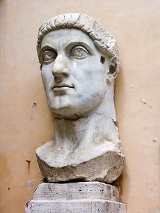
Constantine I

 
Constantine I

   Email Print
   Bookmark   Link


Constantine I


Flavius Valerius Aurelius Constantinus (27 February c. 272 – 22 May 337), commonly known in English
English language

English is a West Germanic language that originated in Anglo-Saxon England and has lingua franca status in many parts of the world as a result of the military, economic, scientific, political and cultural influence of the British Empire in the 18th, 19th and early 20th centuries and that of the United States from the mid 20th century onwa...
 as Constantine I, Constantine the Great, or (among Eastern Orthodox
Eastern Orthodox Church

The Eastern Orthodox Church is the second largest single Christian communion in the world with an estimated 225 million members worldwide. It is considered by its adherents to be the Four Marks of the Church established by Jesus Christ and his Apostles nearly 2000 years ago....
, Oriental Orthodox and Byzantine Catholic Christians) Saint Constantine (/'k?nst?nta?n/), was Roman emperor
Roman Emperor

The Roman Emperor was the ruler of the Roman Empire during the imperial period . The Romans had no single term for the office: Latin language titles such as imperator , Augustus , Caesar and princeps were all associated with it....
 from 306, and the undisputed holder of that office from 324 until his death in 337. Best known for being the first Christian
Christianity

Christianity is a Monotheistic religion #Christian view religion centered on the life and teachings of Jesus as New Testament view on Jesus' life....
 Roman emperor, Constantine reversed the persecutions of his predecessor, Diocletian
Diocletian

Gaius Aurelius Valerius Diocletianus , born Diocles and commonly known as Diocletian , was Roman Emperor from November 20, 284 to May 1, 305....
, and issued (with his co-emperor Licinius
Licinius

Valerius Licinianus Licinius was Roman emperor from 308 to 324.Of Dacian peasant origin, born in Moesia Superior, Licinius accompanied his close childhood friend, the Emperor Galerius, on the Persian expedition in 297....
) the Edict of Milan
Edict of Milan

The Edict of Milan was a letter signed by emperors Constantine I and Licinius that proclaimed religious toleration in the Roman Empire. The letter was issued in 313 AD, shortly after the conclusion of the Diocletian Persecution....
 in 313, which proclaimed religious toleration
Religious toleration

Religious toleration is the condition of accepting or permitting others' religion beliefs and practices which disagree with one's own.In a country with a state religion, toleration means that the government permits religious practices of other sects besides the state religion, and does not persecute believers in other faiths....
 throughout the empire.

The Byzantine
Byzantine Rite

The Byzantine Rite, sometimes called the Rite of Constantinople or Constantinopolitan Rite, is the liturgy used currently by all the Eastern Orthodox Churches and by the Greek-Catholic Churches ....
 liturgical calendar, observed by the Eastern Orthodox Church
Eastern Orthodox Church

The Eastern Orthodox Church is the second largest single Christian communion in the world with an estimated 225 million members worldwide. It is considered by its adherents to be the Four Marks of the Church established by Jesus Christ and his Apostles nearly 2000 years ago....
 and Eastern Catholic Churches of Byzantine rite, lists both Constantine and his mother Helena
Helena of Constantinople

Saint Helena also known as Saint Helen, Helena Augusta or Helena of Constantinople was the consort of Roman Emperor Constantius Chlorus, and the mother of Emperor Constantine I....
 as saints.


Discussion
Ask a question about 'Constantine I'
Start a new discussion about 'Constantine I'
Answer questions from other users
Full Discussion Forum


Recent Posts


Encyclopedia


Flavius Valerius Aurelius Constantinus (27 February c. 272 – 22 May 337), commonly known in English
English language

English is a West Germanic language that originated in Anglo-Saxon England and has lingua franca status in many parts of the world as a result of the military, economic, scientific, political and cultural influence of the British Empire in the 18th, 19th and early 20th centuries and that of the United States from the mid 20th century onwa...
 as Constantine I, Constantine the Great, or (among Eastern Orthodox
Eastern Orthodox Church

The Eastern Orthodox Church is the second largest single Christian communion in the world with an estimated 225 million members worldwide. It is considered by its adherents to be the Four Marks of the Church established by Jesus Christ and his Apostles nearly 2000 years ago....
, Oriental Orthodox and Byzantine Catholic Christians) Saint Constantine (/'k?nst?nta?n/), was Roman emperor
Roman Emperor

The Roman Emperor was the ruler of the Roman Empire during the imperial period . The Romans had no single term for the office: Latin language titles such as imperator , Augustus , Caesar and princeps were all associated with it....
 from 306, and the undisputed holder of that office from 324 until his death in 337. Best known for being the first Christian
Christianity

Christianity is a Monotheistic religion #Christian view religion centered on the life and teachings of Jesus as New Testament view on Jesus' life....
 Roman emperor, Constantine reversed the persecutions of his predecessor, Diocletian
Diocletian

Gaius Aurelius Valerius Diocletianus , born Diocles and commonly known as Diocletian , was Roman Emperor from November 20, 284 to May 1, 305....
, and issued (with his co-emperor Licinius
Licinius

Valerius Licinianus Licinius was Roman emperor from 308 to 324.Of Dacian peasant origin, born in Moesia Superior, Licinius accompanied his close childhood friend, the Emperor Galerius, on the Persian expedition in 297....
) the Edict of Milan
Edict of Milan

The Edict of Milan was a letter signed by emperors Constantine I and Licinius that proclaimed religious toleration in the Roman Empire. The letter was issued in 313 AD, shortly after the conclusion of the Diocletian Persecution....
 in 313, which proclaimed religious toleration
Religious toleration

Religious toleration is the condition of accepting or permitting others' religion beliefs and practices which disagree with one's own.In a country with a state religion, toleration means that the government permits religious practices of other sects besides the state religion, and does not persecute believers in other faiths....
 throughout the empire.

The Byzantine
Byzantine Rite

The Byzantine Rite, sometimes called the Rite of Constantinople or Constantinopolitan Rite, is the liturgy used currently by all the Eastern Orthodox Churches and by the Greek-Catholic Churches ....
 liturgical calendar, observed by the Eastern Orthodox Church
Eastern Orthodox Church

The Eastern Orthodox Church is the second largest single Christian communion in the world with an estimated 225 million members worldwide. It is considered by its adherents to be the Four Marks of the Church established by Jesus Christ and his Apostles nearly 2000 years ago....
 and Eastern Catholic Churches of Byzantine rite, lists both Constantine and his mother Helena
Helena of Constantinople

Saint Helena also known as Saint Helen, Helena Augusta or Helena of Constantinople was the consort of Roman Emperor Constantius Chlorus, and the mother of Emperor Constantine I....
 as saints. Although he is not included in the Latin Church's
Latin Rite

The Latin Rite is one of the 23 sui iuris particular Churches within the Catholic Church. This particular Church developed in western Europe and north Africa, where, from classical antiquity to the Renaissance, Latin was the principal language of education and culture, and so also of the liturgy....
 list of saints, which does recognize several other Constantines as saints, he is revered under the title "The Great" for his contributions to Christianity
Christianity

Christianity is a Monotheistic religion #Christian view religion centered on the life and teachings of Jesus as New Testament view on Jesus' life....
.

Constantine also transformed the ancient Greek colony of Byzantium
Byzantium

Byzantium was an Ancient Greece city, which was founded by Greeks colonists from Megara in 667 BC and named after their king Byzas or Byzantas ....
 into a new imperial residence, Constantinople
Constantinople

Constantinople was the empire capital of the Roman Empire , the Byzantine Empire , the Latin Empire , and the Ottoman Empire . Strategically located between the Golden Horn and the Sea of Marmara at the point where Europe meets Asia, Byzantine Constantinople had been the capital of a Christendom empire, successor to ancient ancient Greece...
, which would remain the capital of the Byzantine Empire
Byzantine Empire

Byzantine Empire and Eastern Roman Empire are conventional names used to describe the Roman Empire during the Middle Ages, centered on its capital of Constantinople....
 for over a thousand years.

Sources

As the emperor who empowered Christianity
Christianity

Christianity is a Monotheistic religion #Christian view religion centered on the life and teachings of Jesus as New Testament view on Jesus' life....
 throughout the Roman Empire
Roman Empire

The Roman Empire was the Roman Republic phase of the Ancient Rome, characterised by an autocracy form of government and large territorial holdings in Europe and around the Mediterranean....
 and moved the Roman capital to the banks of the Bosphorus, Constantine was a ruler of major historical importance, but he has always been a controversial figure. The fluctuations in Constantine's reputation reflect the nature of the ancient sources for his reign. These are abundant and detailed, but have been strongly influenced by the official propaganda of the period, and are often one-sided. There are no surviving histories or biographies dealing with Constantine's life and rule. The nearest replacement is Eusebius of Caesarea
Eusebius of Caesarea

Eusebius of Caesarea became the bishop of Caesarea Maritima c 314. He is often referred to as the Father of Church History because of his work in recording the history of the early Christianity church, especially Chronicon and Church_History_....
's Vita Constantini, a work that is a mixture of eulogy
Eulogy

A eulogy is a Speech or writing in praise of a person or thing, especially one recently deceased or retired. The word is derived from the Greek word e?????a , meaning praise ....
 and hagiography
Hagiography

Hagiography is the study of saints. A hagiography, from Greek ' and ' , refers literally to writings on the subject of such holy people, and specifically the biography of ecclesiastical and secular leaders....
. Written between 335 and circa 339, the Vita extols Constantine's moral and religious virtues. The Vita creates a contentiously positive image of Constantine, and modern historians have frequently challenged its reliability. The fullest secular life of Constantine is the anonymous Origo Constantini. A work of uncertain date, the Origo focuses on military and political events, to the neglect of cultural and religious matters.

Lactantius
Lactantius

Lucius Caelius Firmianus Lactantius was an early Christian author ....
' De Mortibus Persecutorum, a polemical Christian pamphlet on the reigns of Diocletian
Diocletian

Gaius Aurelius Valerius Diocletianus , born Diocles and commonly known as Diocletian , was Roman Emperor from November 20, 284 to May 1, 305....
 and the Tetrarchy
Tetrarchy

Tetrarchy can be applied to any system of government where power is divided between four individuals. The term is usually used to refer to the tetrarchy instituted by Roman Emperor Diocletian in 293 which lasted until c. 313....
, provides valuable but tendentious detail on Constantine's predecessors and early life. The ecclesiastical histories of Socrates, Sozomen
Sozomen

Salminius Hermias Sozomenus was a historian of the Christianity church....
, and Theodoret
Theodoret

Saint Theodoret, known as Theodoret of Cyrus or Cyrrhus, was an influential author, theologian, and Christianity bishop of Cyrrhus%2C_Syria ....
 describe the ecclesiastic disputes of Constantine's later reign. Written during the reign of Theodosius II
Theodosius II

Flavius Theodosius , called the Calligrapher, known in English as Theodosius II, was an Eastern Roman Empire , mostly known for the law code bearing his name, the Codex Theodosianus, and the Walls of Constantinople#The Theodosian Walls of Constantinople built during his reign....
 (408–50), a century after Constantine's reign, these ecclesiastic historians obscure the events and theologies of the Constantinian period through misdirection, misrepresentation and deliberate obscurity. The contemporary writings of the Orthodox Christian Athanasius and the ecclesiastical history of the Arian Philostorgius
Philostorgius

Philostorgius was a so-called Anomoeanism Church historian of the 4th and 5th centuries. Very little information about his life is available; he was born in Borissus, Cappadocia to Eulampia and Carterius, and later lived in Constantinople....
 also survive, though their biases are no less firm.

The epitome
Epitome

An epitome is a summary or miniature form; an instance that represents a larger reality, also used as a synonym for embodiment.Many documents from the Ancient Greek and Ancient Rome worlds survive now only "in epitome," referring to the practice of some later authors who wrote distilled versions of larger works now lost....
s of Aurelius Victor
Aurelius Victor

Sextus Aurelius Victor was an historian and politician of the Roman Empire.Aurelius Victor was the author of a History of Rome from Augustus to Julian the Apostate , published ca....
 (De Caesaribus), Eutropius
Eutropius

IntroductionNot much is known about the early life of Eutropius because there are no written texts that document his life. Eutropius should not be confused with Eutropius of Valencia or Saint Eutropius....
 (Breviarium), Festus
Festus

Festus can be several things:* Festus, Missouri, a town in the United States*Festus, a poem by the English poet Philip James Bailey*Drew Hankinson, the ring name of professional wrestler Drew Hankinson and one half of the tag team Jesse and Festus...
 (Breviarium), and the anonymous author of the Epitome de Caesaribus
Epitome de Caesaribus

The Epitome de Caesaribus is the name for a Latin historical work, written at the end of the 4th century.It is a brief account of the reigns of the emperors from Augustus to Theodosius the Great....
 offer compressed secular political and military histories of the period. Although pagan, the epitomes paint a favorable image of Constantine, but omit reference to Constantine's religious policies. The Panegyrici Latini
Panegyrici Latini

The Panegyrici Latini or Latin Panegyrics is a collection of twelve Ancient Rome panegyric orations. The authors of most of the speeches in the collection are anonymous, but appear to have been Gallic in origin....
, a collection of panegyric
Panegyric

A panegyric is a formal public speech , or written verse, delivered in high praise of a person or object , a generally highly studied and discriminating eulogy, not expected to be critical....
s from the late third and early fourth centuries, provide valuable information on the politics and ideology of the tetrarchic period and the early life of Constantine. Contemporary architecture, like the Arch of Constantine
Arch of Constantine

The Arch of Constantine is a triumphal arch in Rome, situated between the Colosseum and the Palatine Hill. It was erected to commemorate Constantine I's victory over Maxentius at the Battle of Milvian Bridge on October 28, 312....
 in Rome and palaces in Gamzigrad
Gamzigrad

Gamzigrad is a spa resort in Serbia, located south of the Danube, near Zajecar....
 and Córdoba
Córdoba, Spain

viktor chucchuc he sucsuck my dick||-||-|File:Cordoba Water Wheel.jpg|}Cordova is a city in Andalusia, southern Spain, and the capital of the C?rdoba ....
, epigraphic
Epigraphy

Epigraphy is the study of wikt:inscriptions or wikt:epigraphs engraved into stone or other durable materials, or cast in metal, the science of classifying them as to cultural context and date, elucidating them and assessing what conclusions can be deduced from them....
 remains, and the coin
Coin

A coin is a piece of hard material, usually metal or a metallic material, usually in the shape of a Disk , and most often issued by a government....
age of the era complement the literary sources.

Early life

".]]

Constantine, named Flavius Valerius Constantinus, was born in the Moesia
Moesia

Moesia was an ancient region and Roman province situated in the areas of modern Serbia, Bulgaria and Romania along the south bank of the Danube River....
n military city of Naissus (Niš
Niš

Ni? is a city in Ni?ava District, Serbia situated at 43.3? N 21.9? E, on the Ni?ava River. With more than 250,000 inhabitants it is the largest city of South Serbia and third-largest city in the country, after Belgrade and Novi Sad....
, Serbia
Serbia

Serbia , officially the Republic of Serbia , is a country in Central Europe and Balkans Europe, covering the southern part of the Pannonian Plain and the central part of the Balkans....
) on the 27th of February of an uncertain year, probably near 272. His father was Flavius Constantius
Constantius Chlorus

Flavius Valerius Constantius , also Constantius I, was an Roman emperor of the Western Roman Empire . He was commonly called Chlorus an epithet given to him by Byzantine Empire historians....
, a native of Moesia Superior
Moesia

Moesia was an ancient region and Roman province situated in the areas of modern Serbia, Bulgaria and Romania along the south bank of the Danube River....
 (later Dacia Ripensis
Dacia ripensis

Dacia ripensis was the name of a Roman province first established by Aurelian after he withdrew from Dacia north of the Danube River. Ratiaria was established as the capital of Dacia ripensis ....
). Constantius was a tolerant and politically skilled man. Constantine probably spent little time with his father. Constantius was an officer in the Roman army in 272, part of the Emperor Aurelian
Aurelian

Lucius Domitius Aurelianus , known in English as Aurelian, Roman Emperor , was the second of several highly successful "soldier-emperors" who helped the Roman Empire regain its power during the latter part of the third century and the beginning of the fourth....
's imperial bodyguard. Constantius advanced through the ranks, earning the governorship
Roman governor

A Roman governor was an official either elected or appointed to be the chief administrator of Roman law throughout one or more of the many Roman province constituting the Roman Empire....
 of Dalmatia
Dalmatia (Roman province)

Dalmatia was an ancient Roman province. Its name is probably derived from the name of an Illyrians called the Dalmatae which lived in the area of the eastern Adriatic coast in the 1st millennium BC....
 from Emperor Diocletian
Diocletian

Gaius Aurelius Valerius Diocletianus , born Diocles and commonly known as Diocletian , was Roman Emperor from November 20, 284 to May 1, 305....
, another of Aurelian's Illyrian companions, in 284 or 285. Constantine's mother was Helena
Helena of Constantinople

Saint Helena also known as Saint Helen, Helena Augusta or Helena of Constantinople was the consort of Roman Emperor Constantius Chlorus, and the mother of Emperor Constantine I....
, a Bithynia
Bithynia

Bithynia was an ancient region, kingdom and Roman province in the northwest of Asia Minor, adjoining the Propontis, the Thrace Bosporus and the Euxine ....
n Greek
Byzantine Greeks

Byzantine Greeks or Byzantines or Romaioi, is a conventional term used by modern historians to refer to the medieval Greeks or Hellenization citizens of the Byzantine Empire, centered mainly in Constantinople, the southern Balkans, the Greek islands, Asia Minor and the large urban centres of the Near East and Northern Egypt....
 of humble origin. It is uncertain whether she was legally married to Constantius or merely his concubine.

In July 285, Diocletian declared Maximian
Maximian

Marcus Aurelius Valerius Maximianus Herculius , commonly referred to as Maximian, was Caesar from July 285 and Augustus from April 1, 286 to May 1, 305....
, another colleague from Illyricum
Illyricum

Illyricum can refer to:* Illyricum * Diocese of Illyricum* Praetorian prefecture of Illyricum...
, his co-emperor. Each emperor would have his own court, his own military and administrative faculties, and each would rule with a separate praetorian prefect
Praetorian prefect

Praetorian prefect was the constant title of a high office in the Roman Empire state that changed fundamentally in nature.The praetorian prefect was commander of the Praetorian Guard until Constantine I abolished the guard in 314....
 as chief lieutenant. Maximian ruled in the West, from his capitals at Mediolanum
Mediolanum

Mediolanum, the ancient Milan, was an important Celts and then Ancient Rome centre of northern Italy. This article charts the history of the city from its settlement by the Insubres around 600 BC, through its conquest by the Ancient Rome and its development into a key centre of Western Christianity and capital of the Western Roman Empire, un...
 (Milan
Milan

Milan is the second largest city of Italy, located in the plains of Lombardy. It is the capital in the Province of Milan, as well as the Regions of Italy capital of Lombardy....
, Italy
Italy

Italy , officially the Italian Republic , is a country located on the Italian Peninsula in Southern Europe and on the two largest islands in the Mediterranean Sea, Sicily and Sardinia....
) or Augusta Treverorum (Trier
Trier

Trier is a city in Germany on the banks of the Moselle River. It is the oldest city in Germany, founded in or before 16 BC. Trier is not the only city claiming to be Germany's oldest, but it is the only one that bases this assertion on having the longest history as a city, as opposed to a mere settlement or army camp....
, Germany
Germany

Germany , officially the Federal Republic of Germany , is a country in Central Europe. It is bordered to the north by the North Sea, Denmark, and the Baltic Sea; to the east by Poland and the Czech Republic; to the south by Austria and Switzerland; and to the west by France, Luxembourg, Belgium, and the Netherlands....
), while Diocletian ruled in the East, from Nicomedia
Nicomedia

Nicomedia was founded by Nicomedes I of Bithynia at the head of the Gulf of Astacus which opens to the Propontis. In earlier antiquity, the city was called Astacus or Olbia ....
 (Izmit
Izmit

Izmit is a city in Turkey, administrative center of Kocaeli Province as well as the Kocaeli Metropolitan municipality. It is located at the Gulf of Izmit in the Sea of Marmara, about east of Istanbul, on the northwestern part of Anatolia....
, Turkey
Turkey

Turkey , known officially as the Republic of Turkey , is a Eurasian country that stretches across the Anatolian peninsula in southwest Asia and Thrace in the Balkans region of Southern Europe....
). The division was merely pragmatic: the Empire was called "indivisible" in official panegyric, and both emperors could move freely throughout the Empire. In 288, Maximian appointed Constantius to serve as his praetorian prefect in Gaul
Roman Gaul

Roman Gaul consisted of an area of provincial rule in the Roman Empire, in modern day France, Belgium, Luxembourg, and western Germany. Roman control of the area lasted for 600 years....
. Constantius left Helena to marry Maximian's stepdaughter Theodora
Flavia Maximiana Theodora

File:Bronze-Flavia Maximiana Theodora-trier RIC 65.jpgFlavia Maximiana Theodora was the stepdaughter of Maximian. Her parents were Flavius Afranius Hannibalianus and wife, divorced before 283, Eutropia, later wife of Maximian....
 in 288 or 289.

Diocletian divided the Empire again in 293, appointing two Caesar
Caesar (title)

Caesar , Latin: Caesar , is a title of emperor character. It derives from the Roman naming convention#Cognomen of Julius Caesar, the Roman dictator....
s (junior emperors) to rule over further subdivisions of East and West. Each would be subordinate to their respective Augustus (senior emperor) but would act with supreme authority in his assigned lands. This system would later be called the Tetrarchy
Tetrarchy

Tetrarchy can be applied to any system of government where power is divided between four individuals. The term is usually used to refer to the tetrarchy instituted by Roman Emperor Diocletian in 293 which lasted until c. 313....
. Diocletian's first appointee for the office of Caesar was Constantius; his second was Galerius
Galerius

Galerius Maximianus , formally Gaius Galerius Valerius Maximianus was Roman Emperor from 305 to 311....
, a native of Felix Romuliana (Gamzigrad
Gamzigrad

Gamzigrad is a spa resort in Serbia, located south of the Danube, near Zajecar....
, Serbia
Serbia

Serbia , officially the Republic of Serbia , is a country in Central Europe and Balkans Europe, covering the southern part of the Pannonian Plain and the central part of the Balkans....
). According to Lactantius, Galerius was a brutal, animalistic man. Although he shared the paganism of Rome's aristocracy, he seemed to them an alien figure, a semi-barbarian. On 1 March, Constantius was promoted to the office of Caesar, and dispatched to Gaul to fight the rebels Carausius
Carausius

Marcus Aurelius Mausaeus Carausius was a military commander of the Roman Empire in the 3rd century. He was a Menapii, born in the western part of Betuwe, who Roman usurper power in 286, declaring himself emperor of Roman Britain and northern Gaul....
 and Allectus
Allectus

Allectus was a Roman Empire Roman usurper-Roman emperors in Roman Britain and northern Gaul from 293 to 296....
. In spite of meritocratic overtones, the Tetrarchy retained vestiges of hereditary privilege, and Constantine became the prime candidate for future appointment as Caesar as soon as his father took the position. Constantine left the Balkans for the court of Diocletian, where he lived as his father's heir presumptive.

In the East

Constantine received a formidable education at Diocletian's court, where he learned Latin literature, Greek, and philosophy. The cultural environment in Nicomedia was open, fluid and socially mobile, and Constantine could mix with intellectuals both pagan and Christian. He may have attended the lectures of Lactantius, a Christian scholar of Latin in the city. Because Diocletian did not completely trust Constantius—none of the Tetrarchs fully trusted their colleagues—Constantine was held as something of a hostage, a tool to ensure Constantius' best behaviour. Constantine was nonetheless a prominent member of the court: he fought for Diocletian and Galerius in Asia, and served in a variety of tribunates
Tribune

Tribune was a title shared by 10 elected officials in the Roman Republic. Tribunes had the power to convene the Plebeian Council and to act as its president, which also gave them the exclusive right to propose legislation before it....
; he campaigned against barbarians on the Danube in 296, and fought the Persians under Diocletian in Syria (297) and under Galerius in Mesopotamia (298–99). By late 305, he had become a tribune of the first order, a tribunus ordinis primi.

, Augustus of the East]]

Constantine had returned to Nicomedia from the eastern front by the spring of 303, in time to witness the beginnings of Diocletian's "Great Persecution", the most severe persecution of Christians
Persecution of early Christians in the Roman Empire

In its first three centuries, the Early Christianity endured periods of persecution at the hands of Roman Empire authorities. Christians were persecuted by local authorities on an intermittent and ad-hoc basis....
 in Roman history. In late 302, Diocletian and Galerius sent a messenger to the oracle
Oracle

An oracle is a person or agency considered to be a source of wise counsel or prophecy opinion; an infallible authority, usually Spirituality in nature....
 of Apollo
Apollo

In Greek mythology and Roman mythology, Apollo , is one of the most important and many-sided of the Twelve Olympians. The ideal of the kouros , Apollo has been variously recognized as a god of light and the sun; truth and prophecy; archery; medicine and healing; music, poetry, and the arts; and more....
 at Didyma
Didyma

Didyma was an ancient Ionian sanctuary, the modern Didim, Turkey, containing a Temple and oracle of Apollo, the Didymaion. In Greek didyma means "twin", but the Greeks who sought a "twin" at Didyma ignored the Carian origin of the name....
 with an inquiry about Christians. Constantine could recall his presence at the palace when the messenger returned, when Diocletian accepted his court's demands for universal persecution. On 23 February 303, Diocletian ordered the destruction of Nicomedia's new church, condemned its scriptures to the flame, and had its treasures seized. In the months that followed, churches and scriptures were destroyed, Christians were deprived of official ranks, and priests were imprisoned.

It is unlikely that Constantine played any role in the persecution. In his later writings he would attempt to present himself as an opponent of Diocletian's "sanguinary edicts" against the "worshipers of God", but nothing indicates that he opposed it effectively at the time. Although no contemporary Christian challenged Constantine for his inaction during the persecutions, it remained a political liability throughout his life.

On 1 May 305, Diocletian, as a result of a debilitating sickness taken in the winter of 304–5, announced his resignation. In a parallel ceremony in Milan, Maximian did the same. Lactantius states that Galerius manipulated the weakened Diocletian into resigning, and forced him to accept Galerius' allies in the imperial succession. According to Lactantius, the crowd listening to Diocletian's resignation speech believed, until the very last moment, that Diocletian would choose Constantine and Maxentius
Maxentius

Marcus Aurelius Valerius Maxentius was Western Roman Emperor from 306 to 312. He was the son of former emperor Maximian, and the son-in-law of Galerius, also an emperor....
 (Maximian's son) as his successors. It was not to be: Severus
Flavius Valerius Severus

Flavius Valerius Severus was a Western Roman Emperor from 306 to 307.Severus was of humble birth, born in the Illyrian provinces around the middle of the third century AD....
 and Maximin
Maximinus

title = Roman Emperor of the Roman Empire|name=Maximinus Daia|full name =Gaius Valerius Galerius Maximinus Daia| image =...
 were appointed, while Constantine and Maxentius were ignored.

Some of the ancient sources detail plots that Galerius made on Constantine's life in the months following Diocletian's abdication. They assert that Galerius assigned Constantine to lead an advance unit in a cavalry charge through a swamp on the middle Danube
Danube

The Danube is the longest river in the European Union and Europe's second longest river after the Volga.The river originates in the Black Forest in Germany as the much smaller Brigach and Breg River rivers which join at the eponymously named German town Donaueschingen, after which it is known as the Danube and flows eastwards for a distance...
, made him enter into single combat with a lion, and attempted to kill him in hunts and wars. Constantine always emerged victorious: the lion emerged from the contest in a poorer condition than Constantine; Constantine returned to Nicomedia from the Danube with a Sarmatian captive to drop at Galerius' feet. It is uncertain how much these tales can be trusted.

In the West

Constantine recognized the implicit danger in remaining at Galerius' court, where he was held as a virtual hostage. His career depended on being rescued by his father in the west. Constantius was quick to intervene. In the late spring or early summer of 305, Constantius requested leave for his son, to help him campaign in Britain. After a long evening of drinking, Galerius granted the request. Constantine's later propaganda describes how Constantine fled the court in the night, before Galerius could change his mind. He rode from post-house
Cursus publicus

Cursus publicus was the courier service of the Roman Empire. It was created by Emperor Augustus to transport messages, officials, and tax revenues from one province to another....
 to post-house at high speed, mutilating
Hamstringing

Hamstringing is a method of crippling a person so he or she cannot walk properly, by cutting the two large tendons at the back of the knees. A victim of this cannot stand properly, walk or run once the hamstring tendons have been cut....
 every horse in his wake. By the time Galerius awoke the following morning, Constantine had fled too far to be caught. Constantine joined his father in Gaul
Roman Gaul

Roman Gaul consisted of an area of provincial rule in the Roman Empire, in modern day France, Belgium, Luxembourg, and western Germany. Roman control of the area lasted for 600 years....
, at Bononia (Boulogne
Boulogne-sur-Mer

Boulogne-sur-Mer is a city in northern France. It is a Subprefectures in France of the Departments of France of Pas-de-Calais.The population of the city was 44,859 in the 1999 census, whereas that of the whole metropolitan area was 135,116....
) before the summer of 305.

, England
England

native_name =|conventional_long_name = England|common_name = England|image_flag = Flag of England.svg|image_coat = England COA.svg|symbol_type = Royal Coat of Arms...
, near the spot where he was proclaimed Augustus in 306]] From Bononia they crossed the Channel
English Channel

The English Channel is an Arm of the Atlantic Ocean that separates England from northern France, and joins the North Sea to the Atlantic. It is about long and varies in width from at its widest, to only in the Strait of Dover....
 to Britain and made their way to Eboracum
Eboracum

Eboracum was a castra and city in Roman Britain. Today it is known as York, located in North Yorkshire, England....
 (York
York

York is a walled city, sited at the confluence of the rivers River Ouse, Yorkshire and River Foss in North Yorkshire, England. The city status in the United Kingdom is noted for its rich heritage and it has played an important role throughout much of its almost 2,000 year existence....
), capital of the province of Britannia Secunda
Britannia Secunda

Britannia Secunda was one of the provinces of Roman Britain in existence by c. 312 AD and probably created as part of the administrative reforms of the Roman Emperor Diocletian after the defeat of the usurper Allectus by Constantius Chlorus in 296 AD....
 and home to a large military base. Constantine was able to spend a year in northern Britain at his father's side, campaigning against the Picts
Picts

The Picts were a confederation of tribes in what was later to become eastern and northern Scotland from Roman Empire times until the 10th century....
 beyond Hadrian's Wall
Hadrian's Wall

Hadrian's Wall is a Rock and Sod fortification built by the Roman Empire across the width of what is now northern England. Begun in AD 122, during the rule of emperor Hadrian, it was the middle of three such fortifications built across Great Britain, the first being from the River Clyde to the River Forth under Agricola and the last the Ant...
 in the summer and autumn. Constantius's campaign, like that of Septimius Severus
Septimius Severus

Lucius Septimius Severus was a Roman Empire general, and Roman Emperor from April 14 193 to 211. He was born in what is now the Libyan part of Rome's historic Africa Province, making him the first emperor to be born in the Roman province of Africa Province....
 before it, probably advanced far into the north without achieving great success. Constantius had become severely sick over the course of his reign, and died on 25 July 306 in Eboracum
Eboracum

Eboracum was a castra and city in Roman Britain. Today it is known as York, located in North Yorkshire, England....
 (York
York

York is a walled city, sited at the confluence of the rivers River Ouse, Yorkshire and River Foss in North Yorkshire, England. The city status in the United Kingdom is noted for its rich heritage and it has played an important role throughout much of its almost 2,000 year existence....
). Before dying, he declared his support for raising Constantine to the rank of full Augustus. The Alamanni
Alamanni

The Alamanni, Allemanni, or Alemanni were originally an alliance of Germanic languagess located around the upper Main river . One of the earliest references to them is the cognomen Alamannicus assumed by Caracalla, who ruled the Roman Empire from 211?17 and claimed thereby to be their defeater....
c king Chrocus
Chrocus

Chrocus or Crocus, also Croc, Krokus,Crochus or Croscus was a leader of the Alamanni in the late 3rd century. In 260, he led an uprising of the Alamanni against the Roman Empire, traversing the Upper Germanic Limes and advancing as far as Clermont, and possibly as far as Ravenna, and he was possibly present at the Alamannic conquest of...
, a barbarian taken into service under Constantius, then proclaimed Constantine as Augustus. The troops loyal to Constantius' memory followed him in acclamation. Gaul and Britain quickly accepted his rule; Iberia, which had been in his father's domain for less than a year, rejected it.

Constantine sent Galerius an official notice of Constantius's death and his own acclamation. Along with the notice, he included a portrait of himself in the robes of an Augustus. The portrait was wreathed in bay
Bay Laurel

The Bay Laurel , also known as True Laurel, Sweet Bay, Grecian Laurel, Laurel, or Bay Tree, is an aromatic evergreen tree or large shrub reaching 10?18 m tall, native to the Mediterranean region....
. He requested recognition as heir to his father's throne, and passed off responsibility for his unlawful ascension on his army, claiming they had "forced it upon him". Galerius was put into a fury by the message; he almost set the portrait on fire. His advisers calmed him, and argued that outright denial of Constantine's claims would mean certain war. Galerius was compelled to compromise: he granted Constantine the title "Caesar" rather than "Augustus" (The latter office went to Severus instead). Wishing to make it clear that he alone gave Constantine legitimacy, Galerius personally sent Constantine the emperor's traditional purple robes
Tyrian purple

Tyrian purple , also known as royal purple, imperial purple or imperial dye, is a purple-red dye which was first produced by the ancient Phoenicians in the city of Tyre, Lebanon....
. Constantine accepted the decision, knowing that it would remove doubts as to his legitimacy.

Early rule

Constantine's share of the Empire consisted of Britain, Gaul, and Spain. He therefore commanded one of the largest Roman armies, stationed along the important Rhine
Rhine

File:Swiss Grand Canyon.jpgThe Rhine is one of the longest and most important rivers in Europe, at , with an average discharge of more than ....
 frontier. After his promotion to emperor, Constantine remained in Britain, and secured his control in the northwestern diocese
Roman diocese

A Roman or civil diocese was one of the administrative divisions of the later Roman Empire, starting with the Tetrarchy. It formed the intermediate level of government, grouping several Roman provinces and being in turn subordinated to a praetorian prefecture....
s. He completed the reconstruction of military bases begun under his father's rule, and ordered the repair of the region's roadways. He soon left for Augusta Treverorum (Trier
Trier

Trier is a city in Germany on the banks of the Moselle River. It is the oldest city in Germany, founded in or before 16 BC. Trier is not the only city claiming to be Germany's oldest, but it is the only one that bases this assertion on having the longest history as a city, as opposed to a mere settlement or army camp....
) in Gaul, the Tetrarchic capital of the northwestern Roman Empire. The Franks
Franks

The Franks or Frankish people were a West Germanic ethnic group first identified in the 3rd century as living north and east of the Lower Rhine River....
, after learning of Constantine's acclamation, invaded Gaul across the lower Rhine over the winter of 306–7. Constantine drove them back beyond the Rhine and captured two of their kings, Ascaric and Merogaisus. The kings and their soldiers were fed to the beasts of Trier's amphitheater in the adventus
Adventus (ceremony)

The adventus was a ceremony in ancient Rome, in which an Roman emperor was formally welcomed into a city either during a progress or after a military campaign, often Rome....
 (arrival) celebrations that followed.

(thermae
Thermae

The terms balnea or thermae were the words the Ancient Rome used for the buildings housing their public baths.Most Roman cities had at least one, if not many, such buildings, which were centers of public bathing and socialization....
) built in Trier by Constantine. More than wide by long, and capable of serving several thousands at a time, the baths were built to rival those of Rome.]] Constantine began a major expansion of Trier. He strengthened the circuit wall around the city with military towers and fortified gates, and began building a palace complex in the northeastern part of the city. To the south of his palace, he ordered the construction of a large formal audience hall, and a massive imperial bathhouse. Constantine sponsored many building projects across Gaul during his tenure as emperor of the West, especially in Augustodunum (Autun
Autun

Autun is a Communes of France in the Sa?ne-et-Loire Departments of France in Bourgogne in eastern France.The history of Autun dates back to Ancient Rome times....
) and Arelate (Arles
Arles

Arles is a city in the south of France, in the Bouches-du-Rh?ne Departments of France, of which it is a Subprefectures in France, in the former Provinces of France of Provence....
). According to Lactantius, Constantine followed his father in following a tolerant policy towards Christianity. Although not yet a Christian, he probably judged it a more sensible policy than open persecution, and a way to distinguish himself from the "great persecutor", Galerius. Constantine decreed a formal end to persecution, and returned to Christians all they had lost during the persecutions.

Because Constantine was still largely untried and had a hint of illegitimacy about him, he relied on his father's reputation in his early propaganda: the earliest panegyrics to Constantine give as much coverage to his father's deeds as to those of Constantine himself. Constantine's military skill and building projects soon gave the panegyrist the opportunity to comment favorably on the similarities between father and son, and Eusebius remarked that Constantine was a "renewal, as it were, in his own person, of his father's life and reign". Constantinian coinage, sculpture and oratory also shows a new tendency for disdain towards the "barbarians" beyond the frontiers. After Constantine's victory over the Alemanni, he minted a coin issue depicting weeping and begging Alemannic tribesmen—"The Alemanni conquered"—beneath the phrase "Romans' rejoicing". There was little sympathy for these enemies. As his panegyrist declared: "It is a stupid clemency that spares the conquered foe."

Maxentius' rebellion

Following Galerius' recognition of Constantine as emperor, Constantine's portrait was brought to Rome, as was customary. Maxentius mocked the portrait's subject as the son of a harlot, and lamented his own powerlessness. Maxentius, jealous of Constantine's authority, seized the title of emperor on 28 October 306. Galerius refused to recognize him, but failed to unseat him. Galerius sent Severus
Severus

Severus is Latin cognomen, most often used for Septimius Severus, Alexander Severus and other members of the Severan dynasty.Severus can also refer to:...
 against Maxentius, but during the campaign, Severus' armies, previously under command of Maxentius's father Maximian, defected, and Severus was seized and imprisoned. Maximian, brought out of retirement by his son's rebellion, left for Gaul to confer with Constantine in late 307. He offered to marry his daughter Fausta
Fausta

Fausta Flavia Maxima, Roman Empress, She was the daughter of the Roman Emperor Maximianus . To seal the alliance between them for control of the Tetrarchy, Maximianus married her to Constantine I in 307....
 to Constantine, and elevate him to Augustan rank. In return, Constantine would reaffirm the old family alliance between Maximian and Constantius, and offer support to Maxentius' cause in Italy. Constantine accepted, and married Fausta in Trier in late summer 307. Constantine now gave Maxentius his meager support, offering Maxentius political recognition.

Constantine remained aloof from the Italian conflict, however. Over the spring and summer of 307, he had left Gaul for Britain to avoid any involvement in the Italian turmoil; now, instead of giving Maxentius military aid, he sent his troops against Germanic tribes along the Rhine. In 308, he raided the territory of the Bructeri
Bructeri

The Bructeri were a Germanic tribe located in northwestern Germany , between the Lippe River and Ems rivers south of the Teutoburg Forest, in present-day North Rhine-Westphalia around 100 BC through 350....
, and made a bridge across the Rhine at Colonia Agrippinensium (Cologne
Cologne

Cologne is Germany's fourth-largest city , and is the largest city both in the German Federal State of North Rhine-Westphalia and within the Rhine-Ruhr, one of the major European metropolitan areas with more than ten million inhabitants....
). In 310, he marched to the northern Rhine and fought the Franks. When not campaigning, he toured his lands advertising his benevolence, and supporting the economy and the arts. His refusal to participate in the war increased his popularity among his people, and strengthened his power base in the West. Maximian returned to Rome in the winter of 307–8, but soon fell out with his son. In early 309, after a failed attempt to usurp Maxentius' title, Maximian returned to Constantine's court.

On 11 November 308, Galerius called a general council at the military city of Carnuntum
Carnuntum

Carnuntum was an important Roman Empire army camp in what is now Austria. It belonged originally to Noricum province, but after the 1st century was part of Pannonia....
 (Petronell-Carnuntum
Petronell-Carnuntum

Petronell-Carnuntum is a community of Bruck an der Leitha in Austria. Petronell-Carnuntum takes up about 25,36 square kilometers and 1,158 inhabitants ....
, Austria
Austria

Austria , officially the Republic of Austria , is a landlocked country in Central Europe. It borders both Germany and the Czech Republic to the north, Slovakia and Hungary to the east, Slovenia and Italy to the south, and Switzerland and Liechtenstein to the west....
) to resolve the instability in the western provinces. In attendance were Diocletian, briefly returned from retirement, Galerius, and Maximian. Maximian was forced to abdicate again and Constantine was again demoted to Caesar. Licinius
Licinius

Valerius Licinianus Licinius was Roman emperor from 308 to 324.Of Dacian peasant origin, born in Moesia Superior, Licinius accompanied his close childhood friend, the Emperor Galerius, on the Persian expedition in 297....
, one of Galerius' old military companions, was appointed Augustus of the west. The new system did not last long: Constantine refused to accept the demotion, and continued to style himself as Augustus on his coinage, even as other members of the Tetrarchy referred to him as a Caesar on theirs. Maximin was frustrated that he had been turned over for promotion while the newcomer Licinius had been raised to the office of Augustus, and demanded that Galerius promote him. Galerius offered to call both Maximin and Constantine "sons of the Augusti", but neither accepted the new title. By the spring of 310, Galerius was referring to both men as Augusti.

Maximian's rebellion

and the arts; and to Christians, who found solar monotheism less objectionable than the traditional pagan pantheon.]] In 310, a dispossessed and power-hungry Maximian rebelled against Constantine while Constantine was away campaigning against the Franks. Maximian had been sent south to Arles with a contingent of Constantine's army, in preparation for any attacks by Maxentius in southern Gaul. He announced that Constantine was dead, and took up the imperial purple. In spite of a large donative pledge to any who would support him as emperor, most of Constantine's army remained loyal to their emperor, and Maximian was soon compelled to leave. Constantine soon heard of the rebellion, abandoned his campaign against the Franks, and marched his army up the Rhine. At Cabillunum (Chalon-sur-Saône
Chalon-sur-Saône

Chalon-sur-Sa?ne is a town and communes of France in central France, in the Sa?ne-et-Loire departments of France, of which it is a Subprefectures in France....
), he moved his troops onto waiting boats to row down the slow waters of the Saône
Saône

The Sa?ne is a river of eastern France. It is a right tributary of the River Rh?ne River . Rising at Viom?nil in the Vosges department, it joins the Rh?ne in Lyon ....
 to the quicker waters of the Rhone
Rhône

Rh?ne can refer to:* Rhone, one of the major rivers of Europe, running through Switzerland and France* Rh?ne Glacier, the source of the Rhone River and one of the primary contributors to Lake Geneva in the far eastern end of the canton of Valais in Switzerland...
. He disembarked at Lugdunum
Lugdunum

Colonia Copia Claudia Augusta Lugdunum was an important Ancient Rome city in Gaul. The city was founded in 43 BC by Lucius Munatius Plancus. It served as the capital of the Roman province Gallia Lugdunensis....
 (Lyon
Lyon

||-||}Lyon, also known as Lyons in English, is a city in east-central France. Its name is pronounced in French language and Franco-Proven?al language, and or in English language....
). Maximian fled to Massilia (Marseille
Marseille

"Marseille" is the second-largest city of France and forms the third-largest aire urbaine, after those of Paris and Lyon, with a population recorded to be 1,516,340 at the 1999 census and estimated to be 1,605,000 in 2007....
), a town better able to withstand a long siege than Arles. It made little difference, however, as loyal citizens opened the rear gates to Constantine. Maximian was captured and reproved for his crimes. Constantine granted some clemency, but strongly encouraged his suicide. In July 310, Maximian hanged himself.

In spite of the earlier rupture in their relations, Maxentius was eager to present himself as his father's devoted son after his death. He began minting coins with his father's deified image, proclaiming his desire to avenge Maximian's death. Constantine initially presented the suicide as an unfortunate family tragedy. By 311, however, he was spreading another version. According to this, after Constantine had pardoned him, Maximian planned to murder Constantine in his sleep. Fausta learned of the plot and warned Constantine, who put a eunuch
Eunuch

A eunuch is a castrated man, in particular one castrated early enough to have major hormonal consequences; the term usually refers to those castrated in order to perform a specific social function, as was common in many societies of the past....
 in his own place in bed. Maximian was apprehended when he killed the eunuch and was offered suicide, which he accepted. In addition to the propaganda, Constantine instituted a damnatio memoriae
Damnatio memoriae

Damnatio memoriae is the Latin language literally meaning "damnation of memory", in the sense of removed from the remembrance. It was a form of dishonor that could be passed by the Roman Senate upon treachery or others who brought discredit to the Roman State....
 on Maximian, destroying all inscriptions referring to him and eliminating any public work bearing his image.

The death of Maximian necessitated a shift in Constantine's public image. He could no longer rely on his connection to the elder emperor Maximian, and needed a new source of legitimacy. In a speech delivered in Gaul on 25 July 310, the orator reveals a previously unknown dynastic connection to Claudius II
Claudius II

Marcus Aurelius Claudius , often referred to as Claudius Gothicus or Claudius II, was a Roman Emperor. He ruled the Roman Empire for less than two years , but during that brief time he managed to obtain some successes....
, a third-century emperor famed for defeating the Goths and restoring order to the empire. Breaking away from tetrarchic models, the speech emphasizes Constantine's ancestral prerogative to rule, rather than principles of imperial equality. The new ideology expressed in the speech made Galerius and Maximian irrelevant to Constantine's right to rule. Indeed, the orator emphasizes ancestry to the exclusion of all other factors: "No chance agreement of men, nor some unexpected consequence of favor, made you emperor," the orator declares to Constantine.

The oration also moves away from the religious ideology of the Tetrarchy, with its focus on twin dynasties of Jupiter
Jupiter (mythology)

In Roman mythology, Jupiter or Jove was the king of the gods,and the god of sky and thunder. He is the equivalent of Zeus in the Greek pantheon....
 and Hercules
Hercules

Hercules is the Ancient Rome name for the mythical Ancient Greece hero Heracles, son of Zeus and the mortal Alcmene. Early Roman sources suggest that the imported Greek hero supplanted a mythic Italian shepherd called "Recaranus" or "Garanus", famous for his strength....
. Instead, the orator proclaims that Constantine experienced a divine vision of Apollo
Apollo

In Greek mythology and Roman mythology, Apollo , is one of the most important and many-sided of the Twelve Olympians. The ideal of the kouros , Apollo has been variously recognized as a god of light and the sun; truth and prophecy; archery; medicine and healing; music, poetry, and the arts; and more....
 and Victory
Victoria (mythology)

In Roman mythology, Victoria was the personification/Goddess of victory. She is the Roman version of the Greek mythology Nike , and was associated with Bellona ....
 granting him laurel wreath
Laurel wreath

A laurel wreath is a circular wreath made of interlocking branches and leaves of the Bay Laurel , an aromatic broadleaf evergreen. In Greek mythology, Apollo is represented wearing a laurel wreath on his head....
s of health and a long reign. In the likeness of Apollo Constantine recognized himself as the saving figure to whom would be granted "rule of the whole world", as the poet Virgil had once foretold. The oration's religious shift is paralleled by a similar shift in Constantine's coinage. In his early reign, the coinage of Constantine advertised Mars
Mars (mythology)

Mars was the Roman mythology warrior God , the son of Juno and Jupiter , husband of Bellona , and the lover of Venus . He was the most prominent of the military gods that were worshipped by the Roman legions....
 as his patron. From 310 on, Mars was replaced by Sol Invictus
Sol Invictus

Sol Invictus was the Roman official religion sun god created by the emperor Aurelian in 274 and continued, overshadowing other Eastern cults in importance, until the abolition of paganism under Theodosius I....
, a god conventionally identified with Apollo. There is little reason to believe that either the dynastic connection or the divine vision are anything other than fiction, but their proclamation strengthened Constantine's claims to legitimacy and increased his popularity among the citizens of Gaul.

Civil wars


War against Maxentius


By the middle of 310 Galerius had become too ill to involve himself in imperial politics. As his last political act, Galerius decided to rescind his failed policies of persecution. In a letter to his provincials posted in Nicomedia on 30 April 311, Galerius proclaimed an end to the persecutions, and a resumption of official religious toleration. He died soon after. Galerius' death destabilized what remained of the tetrarchic system. Maximinus mobilized against Licinius, and seized Asia Minor. Licinius and Maximinus arranged a temporary peace on the Bosphorus soon thereafter. While Constantine toured Britain and Gaul, Maxentius prepared for war. He fortified northern Italy, and strengthened his support in the Christian community by allowing it to elect a new Bishop of Rome
Bishop of Rome

The Bishop of Rome is the Bishop of the Holy See, more often referred to in the Catholic Church tradition as the Pope. The first Bishop of Rome to bear the title of "Pope" was Pope Boniface III in 607, the first to assume the title of "Universal Bishop" by decree of Phocas....
, Eusebius
Pope Eusebius

Pope Saint Eusebius was pope in the year 309 or 310.His pontificate lasted only from April 18 to August 17, after which, in consequence of disturbances within the Church which led to acts of violence, he was banished by the emperor Maxentius, who had been the ruler of Rome since 306, and had at first shown himself friendly to the Christian...
.

Maxentius' rule was nevertheless insecure. His early support dissolved in the wake of heightened tax rates and depressed trade; riots broke out in Rome and Carthage; and Domitius Alexander
Domitius Alexander

Lucius Domitius Alexander , probably born in Phrygia, was vicarius of Africa Province when Roman Emperor Maxentius ordered him to send his son as hostage to Rome....
 was able to briefly usurp his authority in Africa. By 312, he was a man barely tolerated, not one actively supported, even among Christian Italians. In the summer of 311, Maxentius mobilized against Constantine while Licinius was occupied with affairs in the East. He declared war on Constantine, vowing to avenge his father's "murder". To prevent Maxentius from forming an alliance against him with Licinius, Constantine forged his own alliance with Licinius over the winter of 311–12, and offered him his sister Constantia in marriage. Maximin considered Constantine's arrangement with Licinius an affront to his authority. In response, he sent ambassadors to Rome, offering political recognition to Maxentius in exchange for a military support. Maxentius accepted. According to Eusebius, inter-regional travel became impossible, and there was military buildup everywhere. There was "not a place where people were not expecting the onset of hostilities every day".

Constantine's advisers and generals cautioned against preemptive attack on Maxentius; even his soothsayers recommended against it, stating that the sacrifices had produced unfavorable omens. Constantine, with a spirit that left a deep impression on his followers, inspiring some to believe that he had some form of supernatural guidance, ignored all these cautions. Early in the spring of 312, Constantine crossed the Cottian Alps
Cottian Alps

The Cottian Alps are a mountain range in the south-western part of the Alps. They form the border between France and Italy . The Maddalena Pass separates them from the Maritime Alps; the Col du Mont Cenis separates them from the Graian Alps; the Col du Galibier separates them from the Dauphin? Alps....
 with a quarter of his army, a force numbering about 40,000. The first town his army encountered was Segusium (Susa, Italy
Italy

Italy , officially the Italian Republic , is a country located on the Italian Peninsula in Southern Europe and on the two largest islands in the Mediterranean Sea, Sicily and Sardinia....
), a heavily fortified town that shut its gates to him. Constantine ordered his men to set fire to its gates and scale its walls. He took the town quickly. Constantine ordered his troops not to loot the town, and advanced with them into northern Italy.

At the approach to the west of the important city of Augusta Taurinorum (Turin
Turín

Tur?n is a municipality in the Ahuachap?n Department Departments of El Salvador of El Salvador....
, Italy), Constantine encountered a large force of heavily armed Maxentian cavalry. In the ensuing battle
Battle of Turin (312)

The Battle of Turin was fought in 312 between Roman emperor Constantine I and the troops of his rival augustus, Maxentius. Constantine won the battle, giving an impressive display of the tactical skill which was to characterise his whole military career....
 Constantine's army encircled Maxentius' cavalry, flanked them with his own cavalry, and dismounted them with blows from his soldiers' iron-tipped clubs. Constantine's armies emerged victorious. Turin refused to give refuge to Maxentius' retreating forces, opening its gates to Constantine instead. Other cities of the north Italian plain sent Constantine embassies of congratulation for his victory. He moved on to Milan, where he was met with open gates and jubilant rejoicing. Constantine rested his army in Milan until mid-summer 312, when he moved on to Brixia
Brixia

Brixia is the Latin name of the modern city of Brescia in Northern Italy.Its location was first settled in the 7th century BC by a tribe of Gauls , which were the inhabitants of this part of Italy before the Ancient Rome conquest ....
 (Brescia
Brescia

Brescia is a city in the region of Lombardy in northern Italy. It is situated at the foot of the Alps, between the Mella and the Naviglio, with a population of around 190,000....
).

Brescia's army was easily dispersed, and Constantine quickly advanced to Verona
Verona

Verona is a city in Veneto, northern Italy, one of the seven provincial capitals in the region. It is one of the main tourist destinations in north-eastern Italy, thanks to its artistic heritage, several annual fairs, shows and operas, such as the lyrical season in the Arena, the ancient amphitheatre built by the Romans....
, where a large Maxentian force was camped. Ruricius Pompeianus, general of the Veronese forces and Maxentius' praetorian prefect, was in a strong defensive position, since the town was surrounded on three sides by the Adige
Adige

The Adige is a river with its source in the Alpine region of Trentino-Alto Adige/S?dtirol near the Italy border with Austria and Switzerland. At in length, 220 located in the province of Bolzano, it is the second longest river in Italy, after the Po River with ....
. Constantine sent a small force north of the town in an attempt to cross the river unnoticed. Ruricius sent a large detachment to counter Constantine's expeditionary force, but was defeated. Constantine's forces successfully surrounded the town and laid siege. Ruricius gave Constantine the slip and returned with a larger force to oppose Constantine. Constantine refused to let up on the siege, and sent only a small force to oppose him. In the desperately-fought encounter
Battle of Verona (312)

The Battle of Verona was fought in 312 between the forces of the Roman emperors Constantine I and Maxentius. Maxentius' forces were defeated, and Ruricius Pompeianus, the most senior Maxentian commander, was killed in the fighting....
 that followed, Ruricius was killed and his army destroyed. Verona surrendered soon afterwards, followed by Aquileia
Aquileia

Aquileia is an ancient history Roman Republic city in what is now Italy, at the head of the Adriatic Sea at the edge of the lagoons, about 10 km from the sea, on the river Natiso , the course of which has changed somewhat since Roman times....
, Mutina (Modena
Modena

Modena is a city and a comune on the south side of the Padan Plain, in the Province of Modena in the Emilia-Romagna region of Italy.An ancient town, it is the seat of an archbishop, but is now best known as "the capital of engines", since the factories of the famous Italian sports car makers Ferrari, De Tomaso, Lamborghini, Pagani and...
), and Ravenna
Ravenna

Ravenna is a city and comune in the Emilia-Romagna region of Italy. The city is inland, but is connected to the Adriatic Sea by a canal. Ravenna once served as the seat of the Western Roman Empire and later the Ostrogoths and the Exarchate of Ravenna....
. The road to Rome was now wide open to Constantine.

) over the Tiber, north of Rome, where Constantine and Maxentius fought in the Battle of the Milvian Bridge]] Maxentius prepared for the same type of war he had waged against Severus and Galerius: he sat in Rome and prepared for a siege. He still controlled Rome's praetorian guards, was well-stocked with African grain, and was surrounded on all sides by the seemingly-impregnable Aurelian Walls
Aurelian Walls

The Aurelian Walls were city walls built between 271 and 275 in Rome during the reign of the Roman Emperors Aurelian and Probus. They enclosed all seven hills of Rome plus the Campus Martius and, on the right bank of the Tiber, the Trastevere district....
. He ordered all bridges across the Tiber
Tiber

The Tiber is the third-longest river in Italy, rising in the Apennine mountains in Emilia-Romagna and flowing 406 kilometres through Umbria and Lazio to the Tyrrhenian Sea....
 cut, reportedly on the counsel of the gods, and left the rest of central Italy undefended; Constantine secured that region's support without challenge. Constantine progressed slowly along the Via Flaminia
Via Flaminia

The Via Flaminia was a Roman road leading from Rome to Ariminum , and was the most important route to the north....
, allowing the weakness of Maxentius to draw his regime further into turmoil. Maxentius' support continued to weaken: at chariot races on 27 October, the crowd openly taunted Maxentius, shouting that Constantine was invincible. Maxentius, no longer certain that he would emerge from a siege victorious, built a temporary boat bridge across the Tiber in preparation for a field battle against Constantine. On 28 October 312, the sixth anniversary of his reign, he approached the keepers of the Sibylline Books
Sibylline Books

The Sibylline Books or Libri Sibyllini were a collection of oracle utterances, set out in Ancient Greece hexameters, purchased from a sibyl by the last king of Ancient Rome, Tarquinius Superbus, and consulted at momentous crises through the history of the Roman Republic and the Roman Empire....
 for guidance. The keepers found in them a prophecy stating that, on that very day, "the enemy of the Romans" would die. Maxentius advanced north to meet Constantine in battle.

Maxentius organized his forces—still twice the size of Constantine's—in long lines facing the battle plain, with their backs to the river. Constantine's army arrived at the field bearing unfamiliar symbols on either its standards or its soldiers' shields. According to Lactantius, Constantine was visited by a dream the night before the battle, wherein he was advised "to mark the heavenly sign of God on the shields of his soldiers...by means of a slanted letter X with the top of its head bent round, he marked Christ on their shields.". The Christian polemicist Eusebius describes another version, where, while marching at midday, he saw with his own eyes in the heavens a trophy of the cross arising from the light of the sun, carrying the message, "Conquer By This"; in Eusebius's account, Constantine had a dream the following night, in which Christ appeared with the same heavenly sign, and told him to make a standard, the labarum
Labarum

For the article about the "PX" symbol see Chi RhoThe Labarum was a typographic ligature formed from Chi and Rho , which had particular symbolic significance to the Roman Empires, Ancient Greece, and to the Christianity of Late Antiquity in general....
, for his army in that form.. Although Eusebius is vague about when and where this event took place, it enters his narrative before the war against Maxentius begins. Eusebius describes the sign as Chi
Chi (letter)

Chi is the 22nd letter of the Greek alphabet, pronounced as [kai] in English. Its value in Ancient Greek was an aspirated voiceless velar plosive ....
traversed by Rho
Rho (letter)

Rho is the 17th letter of the Greek alphabet. In the system of Greek numerals it has a value of 100. It is derived from Proto-Canaanite alphabet R? "head" ....
, or ?.. The Eusebian description of the vision has been explained as an example of the meteorological phenomenon known as the "solar halo
Halo (optical phenomenon)

A halo is an optical phenomenon that appears near or around the Sun or Moon, and sometimes near other strong light sources such as street lights....
", which can produce similar effects.. However, the earliest independent evidence for Constantine's use of the labarum (ie. bearing the Chi-Rho), dates from 317 - 5 years after the wars against Maxentius had ended.

by Giulio Romano
Giulio Romano

Giulio Romano was an Italy Painting and Architecture. A prominent pupil of Raffaello Santi, his stylistic deviations from high Renaissance classicism help define the 16th-century style known as Mannerism....
]] Constantine deployed his own forces along the whole length of Maxentius' line. He ordered his cavalry to charge, and they broke Maxentius' cavalry. He then sent his infantry against Maxentius' infantry, pushing many into the Tiber where they were slaughtered and drowned. The battle was brief: Maxentius' troops were broken before the first charge. Maxentius' horse guards and praetorians initially held their position, but broke under the force of a Constantinian cavalry charge; they also broke ranks and fled to the river. Maxentius rode with them, and attempted to cross the bridge of boats, but he was pushed by the mass of his fleeing soldiers into the Tiber, and drowned.

In Rome

Constantine entered Rome on 29 October. He staged a grand
adventus
Adventus (ceremony)

The adventus was a ceremony in ancient Rome, in which an Roman emperor was formally welcomed into a city either during a progress or after a military campaign, often Rome....
in the city, and was met with popular jubilation. Maxentius' body was fished out of the Tiber and decapitated. His head was paraded through the streets for all to see. After the ceremonies, Maxentius' disembodied head was sent to Carthage
Carthage

Carthage refers both to an ancient city in present-day Tunisia, and a modern-day suburb of Tunis. The civilization that developed within the city's sphere of influence is referred to as Punic or Carthaginian....
, after which Africa gave no further resistance. He entered as a Christian: unlike his predecessors, he neglected to make the trip to the Capitoline Hill
Capitoline Hill

The Capitoline Hill , between the Roman Forum and the Campus Martius, is one of the seven hills of Rome of Rome. By the 16th century, Capitolinus had become Campidoglio in the Romanesco....
 and perform customary sacrifices at the Temple of Jupiter. He did, however, choose to honor the Senatorial
Roman Senate

The Senate of the Roman Republic was a political institution in the ancient Roman Republic. According to the Greek historian Polybius, our principal source on the Constitution of the Roman Republic, the Roman Senate was the predominant branch of government....
 Curia
Curia Julia

File:Forum of Roma before Caesar.svgThe Curia Hostilia, was the original Senate House of the Roman Republic. It is believed to have been constructed during the reign of Tullus Hostilius , in the 7th century BC, and rebuilt a number of times....
 with a visit, where he promised to restore its ancestral privileges and give it a secure role in his reformed government: there would be no revenge against Maxentius' supporters. In response, the Senate decreed him "title of the first name", which meant his name would be listed first in all official documents, and acclaimed him as "the greatest Augustus". He issued decrees returning property lost under Maxentius, recalling political exiles, and releasing Maxentius' imprisoned opponents.

An extensive propaganda campaign followed, during which Maxentius' image was systematically purged from all public places. Maxentius was written up as a "tyrant
Tyrant

This article is about the political ruler. For other uses see Tyrant and Tyranny In modern usage, a tyrant is a single ruler holding absolute political power over a state or within an organization....
", and set against an idealized image of the "liberator", Constantine. Eusebius, in his later works, is the best representative of this strand of Constantinian propaganda. Maxentius' rescripts were declared null and void, and the honors Maxentius had granted to leaders of the Senate were invalidated. Constantine also attempted to remove Maxentius' influence on Rome's urban landscape. All structures built by Maxentius were re-dedicated to Constantine, including the Temple of Romulus
Santi Cosma e Damiano

The basilica of 'Santi Cosma e Damiano' is one of the ancient Churches of Rome#Ancient churches called Titulus , of which cardinals are patrons as deacons: the Cardinal Deacon of the Titulus Ss....
 and the Basilica of Maxentius
Basilica of Maxentius

The Basilica of Maxentius and Constantine was the largest building in the Roman Forum....
. At the focal point of the basilica, a stone statue of Constantine holding the Christian
labarum in its hand was erected. Its inscription bore the message the statue had already made clear: By this sign Constantine had freed Rome from the yoke of the tyrant.

Where he did not overwrite Maxentius' achievements, Constantine upstaged them: the Circus Maximus
Circus Maximus

The Circus Maximus is an ancient hippodrome and mass entertainment venue located in Rome. Situated in the valley between the Aventine Hill and Palatine Hill hills, it was the first and largest circus in ancient Rome....
 was redeveloped so that its total seating capacity was twenty-five times larger than that of Maxentius' racing complex on the Via Appia. Maxentius' strongest supporters in the military were neutralized when the Praetorian Guard
Praetorian Guard

The Praetorian Guard was a special force of guards used by Roman empire List of Roman Emperorss. Before being appropriated for the use of the Emperors' personal guards, the title was used for the guards of Roman generals, at least since the rise to prominence of the Scipio family around 275 BC....
 and Imperial Horse Guard (
equites singulares) were disbanded. Their tombstones were ground up and put to use in a basilica on the Via Labicana
Via Labicana

The Via Labicana was an ancient Roman road of Italy, leading east southeast from Rome. It seems possible that the road at first led to Tusculum, that it was then extended to Labici, and later still became a road for through traffic; it may even have superseded the Via Latina as a route to the southeast, for, while the distance from Rome to...
. Early in Constantine's reign, the former base of the Imperial Horse Guard was chosen for redevelopment into the Lateran Basilica
Basilica of St. John Lateran

The Basilica of St. John Lateran is the cathedral of the Diocese of Rome and the official ecclesiastical seat of the Bishop of Rome, who is the Pope....
. Art historian Richard Krautheimer
Richard Krautheimer

Richard Krautheimer was a 20th century art historian, architectural historian, Baroque scholar, and Byzantine Art.He was born in Germany in 1897, the son of Nathan Krautheimer and Martha Landman ....
 has dated the event to 9 November 312—barely two weeks after Constantine captured the city. The Legio II Parthica
Legio II Parthica

Legio secunda Parthica was a Roman legion levied by Emperor Septimius Severus in 197, for his campaign against the Parthian Empire, hence the cognomen Parthica....
 was removed from Alba (Albano Laziale
Albano Laziale

Albano Laziale is a commune in the province of Rome, on the Alban Hills, in Lazio . It is also a suburb of Rome, which is 25 km distant....
), and the remainder of Maxentius' armies were sent to do frontier duty on the Rhine.

Wars against Licinius

In the following years, Constantine gradually consolidated his military superiority over his rivals in the crumbling Tetrarchy. In 313, he met Licinius
Licinius

Valerius Licinianus Licinius was Roman emperor from 308 to 324.Of Dacian peasant origin, born in Moesia Superior, Licinius accompanied his close childhood friend, the Emperor Galerius, on the Persian expedition in 297....
 in Milan
Milan

Milan is the second largest city of Italy, located in the plains of Lombardy. It is the capital in the Province of Milan, as well as the Regions of Italy capital of Lombardy....
 to secure their alliance by the marriage of Licinius and Constantine's half-sister Constantia
Flavia Julia Constantia

Flavia Julia Constantia, , was the daughter of the Roman Emperor Constantius Chlorus and his second wife, Flavia Maximiana Theodora.In 313, Emperor Constantine I, who was half-brother of Constantia, gave her in marriage to his co-emperor Licinius, on occasion of their meeting in Milan....
. During this meeting, the emperors agreed on the so-called Edict of Milan
Edict of Milan

The Edict of Milan was a letter signed by emperors Constantine I and Licinius that proclaimed religious toleration in the Roman Empire. The letter was issued in 313 AD, shortly after the conclusion of the Diocletian Persecution....
 (which, in its surviving forms, was neither an edict nor issued in Milan), officially granting full tolerance to all religions in the Empire. The document had special benefits for Christians, legalizing their religion and granting them restoration for all property seized during Diocletian's persecution. It repudiates past methods of religious coercion, accepting religious plurality and using only general terms to refer to the gods—"Divinity" and "Supreme Divinity",
summa divinitas. The conference was cut short, however, when news reached Licinius that his rival Maximinus Daia
Maximinus

title = Roman Emperor of the Roman Empire|name=Maximinus Daia|full name =Gaius Valerius Galerius Maximinus Daia| image =...
 had crossed the Bosporus
Bosporus

The Bosporus or Bosphorus , also known as the Istanbul Strait , is a strait that forms the boundary between the European part of Turkey and its Asian part ....
 and invaded Licinian territory. Licinius departed and eventually defeated Maximinus, gaining control over the entire eastern half of the Roman Empire. Relations between the two remaining emperors deteriorated, though, and either in 314 or 316, Constantine and Licinius fought against one another in the war of Cibalae
Battle of Cibalae

The Battle of Cibalae was fought on October 8, 314 , between the two Roman emperors Constantine I and Licinius. The site of the battle was approximately 350 kilometers within the territory of Licinius....
, with Constantine being victorious. They clashed again in the Battle of Campus Ardiensis
Battle of Mardia

The Battle of Mardia, also known as Battle of Campus Mardiensis or Battle of Campus Ardiensis, was fought, probably at modern Harmanli in Thrace, in late 316/early 317 between the forces of Roman Emperors Constantine I and Licinius....
 in 317, and agreed to a settlement in which Constantine's sons Crispus
Crispus

Flavius Julius Crispus, also known as Flavius Claudius Crispus and Flavius Valerius Crispus was a Caesar of the Roman Empire. He was the first-born son of Constantine I and Minervina....
 and Constantine II
Constantine II (emperor)

Flavius Claudius Constantinus, known in English as Constantine II, was List of Roman Emperors from 337 to 340. The eldest son of Constantine the Great and Fausta, he was born at Arles, and was raised as a Christian....
, and Licinius' son Licinianus were made
caesars
Caesar (title)

Caesar , Latin: Caesar , is a title of emperor character. It derives from the Roman naming convention#Cognomen of Julius Caesar, the Roman dictator....
.

In the year 320, Licinius
Licinius

Valerius Licinianus Licinius was Roman emperor from 308 to 324.Of Dacian peasant origin, born in Moesia Superior, Licinius accompanied his close childhood friend, the Emperor Galerius, on the Persian expedition in 297....
 reneged on the religious freedom promised by the Edict of Milan
Edict of Milan

The Edict of Milan was a letter signed by emperors Constantine I and Licinius that proclaimed religious toleration in the Roman Empire. The letter was issued in 313 AD, shortly after the conclusion of the Diocletian Persecution....
 in 313 and began another persecution
Persecution

Persecution is the systematic mistreatment of an individual or group by another group. The most common forms are religious persecution, ethnic persecution, and political persecution, though there is naturally some overlap between these terms....
 of the Christians. It became a challenge to Constantine in the west, climaxing in the great civil war of 324. Licinius, aided by Goth
Goths

The Goths were East Germanic tribes who, in the 3rd and 4th centuries, invasion the Roman Empire and later adopted Arian Christianity. In the 5th and 6th centuries, divided as the Visigoths and the Ostrogoths, they established powerful successor-states of the Roman Empire in the Iberian peninsula and Italy....
 mercenaries
Mercenary

A mercenary is a person who takes part in an armed conflict, who is not a national or a party to the conflict, and is "motivated to take part in the hostilities essentially by the desire for private gain and, in fact, is promised, by or on behalf of a party to the conflict, material compensation substantially in excess of that promised or p...
, represented the past and the ancient Pagan
Paganism

Paganism is the blanket term given to describe religions and spiritual practices of pre-Christian Europe, and by extension a term for polytheistic?traditions or folk religion?worldwide seen from a Western or Christian viewpoint....
 faiths. Constantine and his Franks
Franks

The Franks or Frankish people were a West Germanic ethnic group first identified in the 3rd century as living north and east of the Lower Rhine River....
 marched under the standard of the
labarum
Labarum

For the article about the "PX" symbol see Chi RhoThe Labarum was a typographic ligature formed from Chi and Rho , which had particular symbolic significance to the Roman Empires, Ancient Greece, and to the Christianity of Late Antiquity in general....
, and both sides saw the battle in religious terms. Supposedly outnumbered, but fired by their zeal, Constantine's army emerged victorious in the Battle of Adrianople
Battle of Adrianople (324)

The Battle of Adrianople was fought on July 3, 324 during a Roman civil war, the second to be waged between the two Roman emperor Constantine I and Licinius; Licinius suffered a heavy defeat....
. Licinius fled across the Bosphorus and appointed Martius Martinianus, the commander of his bodyguard, as Caesar, but Constantine next won the Battle of the Hellespont
Battle of the Hellespont

The Battle of the Hellespont, consisting of two separate naval clashes, was fought in 324 between a Constantinian fleet, led by the eldest son of Constantine I, Crispus; and a larger fleet under Licinius' admiral, Abantus ....
, and finally the Battle of Chrysopolis
Battle of Chrysopolis

The Battle of Chrysopolis was fought on 18 September 324 in Chrysopolis , near Chalcedon , between the two Roman emperors Constantine I and Licinius....
 on 18 September 324. Licinius and Martinianus surrendered to Constantine at Nicomedia on the promise their lives would be spared: they were sent to live as private citizens in Thessalonica and Cappadocia respectively, but in 325 Constantine accused Licinius of plotting against him and had them both arrested and hanged; Licinius's son (the son of Constantine's half-sister) was also eradicated. Thus Constantine became the sole emperor of the Roman Empire.

Later rule


Foundation of Constantinople

Licinius' defeat represented the passing of old Rome, and the beginning of the role of the Eastern Roman Empire as a center of learning, prosperity, and cultural preservation. Constantine rebuilt the city of Byzantium, which was renamed
Constantinopolis ("Constantine's City" or Constantinople
Constantinople

Constantinople was the empire capital of the Roman Empire , the Byzantine Empire , the Latin Empire , and the Ottoman Empire . Strategically located between the Golden Horn and the Sea of Marmara at the point where Europe meets Asia, Byzantine Constantinople had been the capital of a Christendom empire, successor to ancient ancient Greece...
 in English), and issued special commemorative coins in 330 to honor the event. He provided the "Second Rome" with a Senate
Byzantine Senate

The Byzantine Senate or Eastern Roman Senate was the continuation of the Roman Senate, established in the 4th century by Constantine I....
 and civic offices similar to those of Rome. The new city was protected by the alleged True Cross
True Cross

The True Cross is the name for physical remnants which, by a Christianity tradition, are believed to be from the actual cross upon which Jesus was crucified....
, the Rod of Moses
Moses

Moses is a Hebrew Bible Hebrews religious leader, lawgiver, prophet, to whom the Mosaic authorship of the Torah is traditionally attributed. Also called Moshe Rabbeinu in Hebrew , he is the most important prophet in Judaism, and also an important prophet of Christianity, Islam, the Bah?'? Faith, Rastafari movement, Chrislam and many ot...
 and other holy relic
Relic

A relic is an object or a personal item of Religion significance, carefully preserved with an air of veneration as a tangible memorial. Relics are an important aspect of some forms of Buddhism, Christianity, Hinduism, shamanism, and many other religions....
s, though a cameo now at the Hermitage Museum
Hermitage Museum

The State Hermitage Museum in Saint Petersburg, Russia is one of the largest museums in the world, with 3 million works of art , and one of the oldest art gallery and museums of human history and culture in the world....
 also represented Constantine crowned by the tyche
Tyche

In Ancient Greek religion, Tyche was the presiding tutelary deity that governed the fortune and prosperity of a city, its destiny. Increasingly during the Hellenistic period, cities had their own specific iconic version of Tyche, wearing a mural crown ....
 of the new city. The figures of old gods were either replaced or assimilated into a framework of Christian symbolism
Christian symbolism

Christian symbolism invests objects or actions with an inner meaning expressing Christian ideas. Christianity has borrowed from the common stock of significant symbols known to most periods and to all regions of the world....
. Constantine built the new Church of the Holy Apostles
Church of the Holy Apostles

The Church of the Holy Apostles , also known as the Imperial Polyandreion, was a Christian basilica built in Constantinople in 550. It was second only to the Hagia Sophia among the great churches of the Eastern Empire....
 on the site of a temple to Aphrodite
Aphrodite

Aphrodite is the classical Greek mythology goddess of love, sex, and beauty. According to Greek oral poet Hesiod, she was born when Uranus was castrated by his son Cronus....
. Generations later there was the story that a Divine vision
Vision (religion)

In spirituality including religion, visions comprise inspirational renderings, generally of a future state and/or of a mythologyical being, and are believed to come from a deity, sometimes directly or indirectly via prophets, and serve to inspire or prod believers as part of a revelation or an Epiphany ....
 led Constantine to this spot, and an angel
Ángel

?ngel is the third single from Belinda Peregr?n's debut album: Belinda. It was a massive hit in Mexico and an international hit for Belinda....
 no one else could see, led him on a circuit of the new walls. The capital would often be compared to the 'old' Rome as
Nova Roma Constantinopolitana, the "New Rome of Constantinople".

Religious policy

, c. 1000]]

Constantine is perhaps best known for being claimed by later Christians as the first Christian Roman emperor; his reign was certainly a turning point for the Christian Church. In 313 Constantine announced toleration of Christianity in the Edict of Milan
Edict of Milan

The Edict of Milan was a letter signed by emperors Constantine I and Licinius that proclaimed religious toleration in the Roman Empire. The letter was issued in 313 AD, shortly after the conclusion of the Diocletian Persecution....
, which removed penalties for professing Christianity (under which many had been martyred in previous persecutions of Christians
Persecution of Christians

The persecution of Christians refers to the religious persecution of Christians, both historically and in the current era....
) and returned confiscated Church property. Though a similar edict had been issued in 311 by Galerius
Galerius

Galerius Maximianus , formally Gaius Galerius Valerius Maximianus was Roman Emperor from 305 to 311....
, then senior emperor of the Tetrarchy
Tetrarchy

Tetrarchy can be applied to any system of government where power is divided between four individuals. The term is usually used to refer to the tetrarchy instituted by Roman Emperor Diocletian in 293 which lasted until c. 313....
, Galerius' edict granted Christians the right to practice their religion but did not restore any property to them.

Scholars debate whether Constantine adopted his mother St. Helena
Helena of Constantinople

Saint Helena also known as Saint Helen, Helena Augusta or Helena of Constantinople was the consort of Roman Emperor Constantius Chlorus, and the mother of Emperor Constantine I....
's Christianity, and whether, if he did adopt it, it was during his youth rather than gradually over the course of his life.. Constantine however maintained the title of
Pontifex Maximus
Pontifex Maximus

The Pontifex Maximus was the high priest of the Ancient Rome College of Pontiffs. This was the most important position in the Ancient Roman religion, open only to patricians until 254 BC, when a plebeian first occupied this post....
until his death; emperors bore the title as heads of the pagan priesthood. According to Christian writers, Constantine was over 40 when he finally declared himself a Christian, by writing to Christians to make clear that he believed he owed his successes to the protection of the Christian High God alone Throughout his rule, Constantine supported the Church financially, built various basilicas, granted privileges (e.g. exemption from certain taxes) to clergy, promoted Christians to high ranking offices, and returned property confiscated during the Great Persecution of Diocletian
Diocletian

Gaius Aurelius Valerius Diocletianus , born Diocles and commonly known as Diocletian , was Roman Emperor from November 20, 284 to May 1, 305....
. His most famous building projects include the Church of the Holy Sepulchre
Church of the Holy Sepulchre

The Church of the Holy Sepulchre , also called the Church of the Resurrection, by Eastern Christianitys, is a Christianity Church within the walled Old City of Jerusalem....
, and Old Saint Peter's Basilica
Old Saint Peter's Basilica

Old Saint Peter's Basilica was the building that once stood on the spot where the Basilica of Saint Peter stands today in Rome. The name Old Saint Peter's Basilica has been used since the construction of the current basilica to distinguish the two buildings....
.

Constantine didn't give his favouritism exclusively to Christianity. After gaining victory in the Battle of the Milvian Bridge, a triumphal arch - the Arch of Constantine
Arch of Constantine

The Arch of Constantine is a triumphal arch in Rome, situated between the Colosseum and the Palatine Hill. It was erected to commemorate Constantine I's victory over Maxentius at the Battle of Milvian Bridge on October 28, 312....
 - was built to celebrate; the arch is decorated with images of Jupiter
Jupiter

Jupiter is the fifth planet from the Sun and the Solar system by size planet within the Solar System. It is two and a half times as massive as all of the other planets in our Solar System combined....
, Mars
MARS

In cryptography, MARS is a block cipher that was IBM's submission to the Advanced Encryption Standard process. MARS was selected as an AES finalist in August 1999, after the AES2 conference in March 1999, where it was voted as the fifth and last finalist algorithm....
, and Hercules
Hercules

Hercules is the Ancient Rome name for the mythical Ancient Greece hero Heracles, son of Zeus and the mortal Alcmene. Early Roman sources suggest that the imported Greek hero supplanted a mythic Italian shepherd called "Recaranus" or "Garanus", famous for his strength....
, but contains no Christian symbolism. The rebuilt Milvian Bridge
Ponte Milvio

The Milvian Bridge in northern Rome, is one of the most important bridges over the Tiber....
 itself was dedicated in homage to Mithras, and was covered in associated imagery, but nothing Christian. In 321 Constantine instructed that Christians and non-Christians should be united in observing the
venerable day of the sun, referencing the esoteric eastern sun-worship
Sol Invictus

Sol Invictus was the Roman official religion sun god created by the emperor Aurelian in 274 and continued, overshadowing other Eastern cults in importance, until the abolition of paganism under Theodosius I....
 which Aurelian
Aurelian

Lucius Domitius Aurelianus , known in English as Aurelian, Roman Emperor , was the second of several highly successful "soldier-emperors" who helped the Roman Empire regain its power during the latter part of the third century and the beginning of the fourth....
 had helped introduce, and his coinage still carried the symbols of the sun-cult until 324. Even when he dedicated the new capital of Constantinople, which became the seat of Byzantine Christianity for a millenium, he did so wearing the Apollo
Apollo

In Greek mythology and Roman mythology, Apollo , is one of the most important and many-sided of the Twelve Olympians. The ideal of the kouros , Apollo has been variously recognized as a god of light and the sun; truth and prophecy; archery; medicine and healing; music, poetry, and the arts; and more....
nian sun-rayed Diadem
Diadem

Diadem may refer to:*Diadem , a type of crownMilitary*HMS Diadem was the lead ship of the Diadem-class of protected cruiser in the Royal Navy launched in 1896...
.

The reign of Constantine established a precedent for the position of the emperor in the Christian Church. Constantine himself is widely perceived by historians to have disliked the risks, to societal stability, that religious disputes and controversies brought with them, preferring where possible to establish an orthodoxy. In 316, Constantine acted as a judge in a North African dispute concerning the validity of Donatism; after making a decision against the Donatists, Constantine led an army of Christians against the Donatist Christians. After 300 years of pacifism, this was the first intra-Christian persecution. More significantly, in 325 he summoned the Council of Nicaea
First Council of Nicaea

The First Council of Nicea was convened in Nicaea in Bithynia by the Roman Emperors Constantine I in 325 CE. The Council was historically significant as the first effort to attain consensus decision-making in the church through an legislature representing all of Christendom....
, effectively the first Ecumenical Council
Ecumenical council

An ecumenical council is a conference of the bishops of the whole Christian Church convened to discuss and settle matters of Church doctrine and practice....
 (unless the Council of Jerusalem
Council of Jerusalem

The Council of Jerusalem is a name applied subsequently to a meeting described in Acts of the Apostles chapter and probably referred to in Paul of Tarsus's Epistle to the Galatians chapter ....
 is so classified, Pre Ecumenical councils include the Council of Rome 155 AD, Second Council of Rome 193 AD, Council of Ephesus
Council of Ephesus

The First Council of Ephesus was held in 431 at the Church of Mary in Ephesus, Asia Minor. The council was called due to the contentious teachings of Nestorius, bishop of Constantinople....
 193 AD, Council of Carthage 251 AD, Council of Iconium
Konya

Konya is a city in Turkey, on the central plateau of Anatolia. It has a population of 1,412,343 ....
 258 AD, Councils of Antioch
Synods of Antioch

Beginning with three synods convened between 264 and 269 in the matter of Paul of Samosata, more than thirty councils were held in Antioch in ancient times....
, 264 AD, Council of Elvira 306 AD, Council of Carthage 311 AD, Council of Ancyra 314 AD, Council of Arles 314 AD and the Council of Neo-Caesarea
Synod of Neo-Caesarea

Synod of Neo-Caesarea, a synod held shortly after Synod of Ancyra, probably about 314 or 315 .Its principal work was the adoption of fifteen disciplinary canons, which were subsequently accepted as ecumenical by the Council of Chalcedon, 451, and of which the most important are the following:...
 315 AD), Nicaea was to deal mostly with the heresy of Arianism
Arianism

Arianism is the theological teaching of Arius , a Christian priest, who was first ruled a heresy at the First Council of Nicea, later exonerated and then pronounced a heretic again after his death....
. Constantine also enforced the prohibition of the First Council of Nicaea
First Council of Nicaea

The First Council of Nicea was convened in Nicaea in Bithynia by the Roman Emperors Constantine I in 325 CE. The Council was historically significant as the first effort to attain consensus decision-making in the church through an legislature representing all of Christendom....
 against celebrating Easter on the day before the Jewish Passover
Passover

Passover is a Jewish and Samaritan holy day and festival commemorating God sparing the Israelites when He killed the first born of Egypt, and is followed by the seven day Feast of the Unleavened Bread commemorating the Exodus from Ancient Egypt and the liberation of the Israelites from Judaism and slavery....
 (14
Nisan
Nisan

Nisan is the seventh month of the civil year and the first month of the ecclesiastical year on the Hebrew calendar. The name of the month is Babylonian; in the Torah it is called the month of the Aviv, referring to a stage in the ripening of barley which occurs during the month....
) (see Quartodecimanism
Quartodecimanism

Quartodecimanism refers to the custom of some early Christians celebrating Passover or Easter beginning with the eve of the 14th day of Nisan , which at dusk is Biblically the "'s passover"....
 and Easter controversy
Easter controversy

The Easter controversy is a series of controversies about the proper date to celebrate the Christianity festival of Easter. To date, there are four distinct phases of the dispute....
).

Constantine made new laws regarding the Jews. They were forbidden to own Christian slaves or to circumcise
Brit milah

Brit milah , also berit milah , bris milah or bris is a religious ceremony within Judaism to welcome infant Jewish boys into a covenant between Names of God in Judaism and the Children of Israel through ritual circumcision performed by a mohel , on the eighth day of the child's life unless health reasons or certain spe...
 their slaves. Jews were forbidden to proselytize or accept converts to Judaism
Judaism

Judaism is a set of beliefs and practices originating in the Hebrew Bible , as later further explored and explained in the Talmud and other texts....
. Any Jew found converting a Christian to Judaism by force would be burned alive. Jewish clergy were given the same exemptions as Christian clergy. Congregations for religious services were restricted, but Jews were allowed to enter Jerusalem
Jerusalem

Jerusalem is the capital of Israel and its List of Israeli cities in both population and area, with a population of 747,600 residents over an area of if Positions on Jerusalem East Jerusalem is included....
 on one day each year. Constantine also supported conversion efforts in Judaea. He raised Josephus of Tiberias (a Jewish convert to Christianity) the rank of
comes
Comes

Comes is the Latin word for companion, either individually or as a member of a collective known as comitatus , especially the suite of a magnate, in some cases large and/or formal enough to have a specific name, such as a cohors amicorum. The word comes derives from com- "with" + ire "go."...
and gave him the money to build churches in the largely Jewish towns of Galilee
Galilee

Galilee , is a large region in northern Israel which overlaps with much of the administrative North District of the country. Traditionally divided into Upper Galilee , Lower Galilee , and Western Galilee , extending from Dan to the north, at the base of Mount Hermon, along Mount Lebanon to the ridges of Mount Carmel and Mount Gilboa t...
.

Executions of Crispus and Fausta

On some date between 15 May and 17 June 326, Constantine had his eldest son Crispus
Crispus

Flavius Julius Crispus, also known as Flavius Claudius Crispus and Flavius Valerius Crispus was a Caesar of the Roman Empire. He was the first-born son of Constantine I and Minervina....
, by Minervina, seized and put to death by "cold poison" at Pola (Pula
Pula

Pula is the largest city in Istria County, Croatia, situated at the southern tip of the Istria peninsula, with a population of 62,080 .Like the rest of the region, it is known for its mild climate, tame sea, and unspoiled nature....
, Croatia
Croatia

Croatia , officially the Republic of Croatia , is a Central European country at the crossroads of Pannonian Plain, Balkans, and the Mediterranean Sea....
). In July, Constantine had his wife, the Empress Fausta
Fausta

Fausta Flavia Maxima, Roman Empress, She was the daughter of the Roman Emperor Maximianus . To seal the alliance between them for control of the Tetrarchy, Maximianus married her to Constantine I in 307....
, killed at the behest of his mother, Helena. Fausta was left to die in an over-heated bath. Their names were wiped from the face of many inscriptions, references to their lives in the literary record were erased, and the memory of both was condemned. Eusebius, for example, edited praise of Crispus out of later copies of his
Historia Ecclesiastica
Church History (Eusebius)

The Church History of Eusebius of Caesarea was a fourth-century pioneer work giving a chronological account of the development of Christianity from the first century....
, and his Vita Constantini contains no mention of Fausta or Crispus at all. Few ancient sources are willing to discuss possible motives for the events; those few that do offer unconvincing rationales, are of later provenance, and are generally unreliable. At the time of the executions, it was commonly believed that the Empress Fausta was either in an illicit relationship with Crispus, or was spreading rumors to that effect. A popular myth arose, modified to allude to Hippolytus
Hippolytus (mythology)

In Greek mythology, Hippolytus was a son of Theseus and either Antiope or Hippolyte. He was identified with the Roman mythology forest god Virbius....
Phaedra
Phaedra (mythology)

In Greek mythology, Phaedra is the daughter of Minos, wife of Theseus and the mother of Demophon and Acamas.Though married to Theseus, Phaedra fell in love with Hippolytus , Theseus' son born by Antiope, queen of the Amazons....
 legend, with the suggestion that Constantine killed Crispus and Fausta for their immoralities. One source, the largely fictional
Passion of Artemius, probably penned in the eighth century by John of Damascus
John of Damascus

John of Damascus was a monk and Priesthood from Damascus. He was born and raised in that city, and died at his monastery Mar Saba.He was a polymath whose fields of interest and contribution included law, theology, philosophy, and music....
, makes the legendary connection explicit. As an interpretation of the executions, the myth rests on only "the slimmest of evidence": sources that allude to the relationship between Crispus and Fausta are late and unreliable, and the modern suggestion that Constantine's "godly" edicts of 326 and the irregularities of Crispus are somehow connected rests on no evidence at all.

An additional story, propagated by the historian Charles Matson Odahl, goes that Fausta wanted to kill Crispus to ensure that her own children would receive the Imperial throne. Therefore she told Constantine that Crispus had attempted to rape her, and bribed several senators to corroborate the story. Constantine was obligated by Roman law to execute his son, as these charges were as serious as treason in Roman times. Hence, Constantine reluctantly, and sadly, executed his son. Later, his mother Helena heard of what had taken place, and investigated the event. She discovered that Fausta had bribed the senators, and told Constantine. Fausta was locked in a bath and left to die (this method would have caused her to pass out before expiring, making the procedure painless). After this entire event Constantine was so depressed that he never returned to the western half of the empire in his lifetime. The earliest authority to support the charges in Odahl's account is Zosimus, and the wording of Zosimus's account could also suggest that Fausta made advances on Crispus. To use such a late source, one reviewer remarked, seems uncouth. It is plausible that "the further away from the events people were writing, the more fanciful the stories became".

Later campaigns

Constantine considered Constantinople as his capital and permanent residence. He lived there for a good portion of his later life. He rebuilt Trajan's bridge across the Danube, in hopes of reconquering Dacia
Roman Dacia

The Roman province of Dacia on the Balkans included the modern Romanian regions of Transylvania, Banat and Oltenia, and temporarily Muntenia and southern Moldova, but not the nearby regions of Moesia....
, a province that had been abandoned under Aurelian. In the late winter of 332, Constantine campaigned with the Sarmatians against the Goths. The weather and a lack of food did the Goths in; nearly one hundred thousand died before they submitted to Roman lordship. In 334, after Sarmatian commoners had overthrown their leaders, Constantine led a campaign against the tribe. He won a victory in the war and extended his control over the region, as remains of camps and fortifications in the region indicate. Constantine resettled some Sarmatian exiles as farmers in the Balkans and Italy, and conscripted the rest into the army. Constantine took the title
Dacius maximus in 336.

In the last years of his life Constantine made plans for a campaign against Persia. In a letter written to the king of Persia, Shapur, Constantine had asserted his patronage over Persia's Christian subjects and urged Shapur to treat them well. The letter is undatable. In response to border raids, Constantine sent Constantius to guard the eastern frontier in 335. In 336, prince Narseh invaded Armenia (a Christian kingdom since 314) and installed a Persian client on the throne. Constantine then resolved to campaign against Persia himself. He treated the war as a Christian crusade, calling for bishops to accompany the army and commissioning a tent in the shape of a church to follow him everywhere. Constantine planned to be baptized in the Jordan River
Jordan River

The Jordan River is a river in Southwest Asia which flows into the Dead Sea. It is considered to be one of the world's most sacred rivers. It is 251 kilometers long....
 before crossing into Persia. Persian diplomats came to Constantinople over the winter of 336–7, seeking peace, but Constantine turned them away. The campaign was called off however, when Constantine fell sick in the Spring of 337.

Sickness and death

Constantine had known death would soon come. Within the Church of the Holy Apostles, Constantine had secretly prepared a final resting-place for himself. It came sooner than he had expected. Soon after the Feast of Easter 337, Constantine fell seriously ill. He left Constantinople for the hot baths near his mother's city of Helenopolis (Altinova), on the southern shores of the Gulf of Izmit. There, in a church his mother built in honor of Lucian the Apostle, he prayed, and there he realized that he was dying. Seeking purification, he became a catechumen
Catechumen

In ecclesiology, a catechumen is one receiving instruction from a catechist in the principles of the Christianity with a view to baptism. The title and practice is most often used by Orthodox Christians and by Roman Catholics....
, and attempted a return to Constantinople, making it only as far as a suburb of Nicomedia. He summoned the bishops, and told them of his hope to be baptized in the River Jordan, where Christ was written to have been baptized. He requested the baptism right away, promising to live a more Christian life should he live through his illness. The bishops, Eusebius records, "performed the sacred ceremonies according to custom". He chose the Arianizing bishop Eusebius of Nicomedia
Eusebius of Nicomedia

Eusebius of Nicomedia was a bishop of Berytus in Phoenicia, then of Nicomedia where the imperial court resided in Bithynia, and finally of Constantinople from 338 up to his death....
, bishop of the city
Nicomedia

Nicomedia was founded by Nicomedes I of Bithynia at the head of the Gulf of Astacus which opens to the Propontis. In earlier antiquity, the city was called Astacus or Olbia ....
 where he lay dying, as his baptizer. In postponing his baptism, he followed one custom at the time which postponed baptism until old age or death. It was thought Constantine put off baptism as long as he did so as to be absolved from as much of his sin as possible. Constantine died soon after at a suburban villa called Achyron, on the last day of the fifty-day festival of Pentecost directly following Easter, on 22 May 337.

, as imagined by students of Raphael
Raphael

Raphael Sanzio, usually known by his first name alone was an Italy Painting and architect of the High Renaissance, celebrated for the perfection and grace of his paintings and drawings....
]] Although Constantine's death follows the conclusion of the Persian campaign in Eusebius's account, most other sources report his death as occurring in its middle. Emperor Julian
Julian the Apostate

Flavius Claudius Julianus, known also as Julian or Julian the Apostate , was Roman Emperor of the Constantinian dynasty. He was the last non-Christian Roman Emperor, and expended much energy during his reign attempting to supplant the growing power of Christianity within the empire with officially revived Religion in ancient Rom...
, writing in the mid-350s, observes that the Sassanian
Sassanid Empire

The Sassanid Empire or Sassanian Dynasty is the name of the last pre-Islamic Iranian empire. It was one of the two main powers in Western Asia for a period of more than 400 years....
s escaped punishment for their ill-deeds, because Constantine died "in the middle of his preparations for war". Similar accounts are given in the Origo Constantini, an anonymous document composed while Constantine was still living, and which has Constantine dying in Nicomedia; the Historiae abbreviatae of Sextus Aurelius Victor, written in 361, which has Constantine dying at an estate near Nicomedia called Achyrona while marching against the Persians; and the Breviarium of Eutropius, a handbook compiled in 369 for the Emperor Valens
Valens

Flamin Julius Valens was Roman Emperor , after he was given the Eastern part of the empire by his brother Valentinian I. Valens, sometimes known as the Last of the Romans, was defeated and killed in the Battle of Adrianople, which marked the beginning of the fall of the Western Roman Empire....
, which has Constantine dying in a nameless state villa in Nicomedia. From these and other accounts, some have concluded that Eusebius's Vita was edited to defend Constantine's reputation against what Eusebius saw as a less congenial version of the campaign.

down to Gratian
Gratian

Flavius Gratianus , known usually by the anglicised name Gratian, was a Western Roman Emperor from 375 to 383.He favoured the Christian religion against Roman polytheism, refusing the traditional polytheistic attributes of the emperors and removing the Altar of Victory from the Roman Senate....
 (r. 367–383)]] Following his death, his body was transferred to Constantinople and buried in the Church of the Holy Apostles
Church of the Holy Apostles

The Church of the Holy Apostles , also known as the Imperial Polyandreion, was a Christian basilica built in Constantinople in 550. It was second only to the Hagia Sophia among the great churches of the Eastern Empire....
 there. He was succeeded by his three sons born of Fausta, Constantine II
Constantine II (emperor)

Flavius Claudius Constantinus, known in English as Constantine II, was List of Roman Emperors from 337 to 340. The eldest son of Constantine the Great and Fausta, he was born at Arles, and was raised as a Christian....
, Constantius II
Constantius II

Flavius Iulius Constantius, known in English as Constantius II was a Roman Emperor of the Constantinian dynasty....
 and Constans
Constans

Flavius Julius Constans , was a Roman Emperor who ruled from 337 to 350. Constans was the third and youngest son of Constantine the Great and Fausta, Constantine's second wife....
. A number of relatives were killed by followers of Constantius, notably Constantine's nephews Dalmatius
Dalmatius

Flavius Dalmatius , also known as Dalmatius Caesar, was a Caesar of the Roman Empire, and member of the Constantinian dynasty.Dalmatius was son of another Flavius Dalmatius, Censor , and nephew of Constantine I....
 (who held the rank of Caesar) and Hannibalianus
Hannibalianus

Flavius Hannibalianus was a member of the Constantinian dynasty, which ruled over the Roman Empire in the 4th century.Hannibalianus was the son of Flavius Dalmatius, and thus nephew of Constantine I....
, presumably to eliminate possible contenders to an already complicated succession. He also had two daughters, Constantina
Constantina

Constantina was the eldest daughter of Roman Emperor Constantine the Great and his second wife Fausta, daughter of Emperor Maximian. Constantina received the title of Augusta by her father, and is venerated as saint....
 and Helena
Helena, wife of Julian

Helena was the wife of Julian the Apostate, List of Roman Emperors. She was briefly his Empress consort when Julian was proclaimed Augustus by his troops in 360....
, wife of Emperor Julian
Julian the Apostate

Flavius Claudius Julianus, known also as Julian or Julian the Apostate , was Roman Emperor of the Constantinian dynasty. He was the last non-Christian Roman Emperor, and expended much energy during his reign attempting to supplant the growing power of Christianity within the empire with officially revived Religion in ancient Rom...
.

Legacy


Although he earned his honorific of "The Great" ("???a?") from Christian historians long after he had died, he could have claimed the title on his military achievements and victories alone. In addition to reuniting the Empire under one emperor, Constantine won major victories over the Franks
Franks

The Franks or Frankish people were a West Germanic ethnic group first identified in the 3rd century as living north and east of the Lower Rhine River....
 and Alamanni
Alamanni

The Alamanni, Allemanni, or Alemanni were originally an alliance of Germanic languagess located around the upper Main river . One of the earliest references to them is the cognomen Alamannicus assumed by Caracalla, who ruled the Roman Empire from 211?17 and claimed thereby to be their defeater....
 in 306–8, the Franks again in 313–14, the Visigoths in 332 and the Sarmatians
Sarmatians

The Sarmatians, Sarmat? or Sauromat? were a people of Ancient Iranian peoples origin. Mentioned by Classics authors, they migrated from Central Asia to the Ural Mountains around fifth century B.C....
 in 334. In fact, by 336, Constantine had actually reoccupied most of the long-lost province of Dacia
Dacia

In ancient geography, Dacia was the land of the Dacians. It was named by the ancient Greeks "Getae". Dacia was a large district of East-Central Europe, bounded on the north by the Carpathian Mountains, on the south by the Danube, on the west by the Tisia or Tisza, on the east by the Tyras or Dniester, now in eastern Moldova....
, which Aurelian
Aurelian

Lucius Domitius Aurelianus , known in English as Aurelian, Roman Emperor , was the second of several highly successful "soldier-emperors" who helped the Roman Empire regain its power during the latter part of the third century and the beginning of the fourth....
 had been forced to abandon in 271. At the time of his death, he was planning a great expedition to put an end to raids on the eastern provinces from the Persian Empire
Persian Empire

The 'Persian Empire' was a series of successive Iranian or Persianization empires that ruled over the Iranian plateau, the original Persian homeland, and beyond in Southwest Asia, South Asia, Central Asia and the Caucasus....
.

The Byzantine Empire considered Constantine its founder and the Holy Roman Empire
Holy Roman Empire

The Holy Roman Empire was a union of territories in Central Europe during the Middle Ages and the Early modern Europe under a Holy Roman Emperor....
 reckoned him among the venerable figures of its tradition. In the later Byzantine state, it had become a great honor for an emperor to be hailed as a "new Constantine". Ten emperors, including the last emperor of Byzantium, carried the name. Monumental Constantinian forms were used at the court of Charlemagne
Charlemagne

Charlemagne was List of Frankish kings from 768 to his death. He expanded the Franks kingdoms into a Carolingian Empire that incorporated much of Western Europe and Central Europe....
 to suggest that he was Constantine's successor and equal. Constantine acquired a mythic role as a warrior against "heathens". The motif of the Romanesque equestrian, the mounted figure in the posture of a triumphant Roman emperor, came to be used as a visual metaphor in statuary in praise of local benefactors. The name "Constantine" itself enjoyed renewed popularity in western France in the eleventh and twelfth centuries. Most Eastern Christian churches consider Constantine a saint (????? ???sta?t????, Saint Constantine). In the Byzantine Church he was called isapostolos (?sap?st???? ???sta?t????)—an equal of the Apostles
Equal-to-apostles

An equal-to-the-apostles is a special title given to some canonization Saints in Eastern Orthodoxy. It is also used by Eastern Rite Catholic Churches that are in full communion with Holy see....
.

During his life and those of his sons, Constantine's was presented as a paragon of virtue. Even pagans like Praxagoras of Athens
Praxagoras of Athens

Praxagoras of Athens was a pagan historian in the early 4th century AD.He was born in Athens and wrote three historical works, which are all lost: a history of the Kings of Athens, a history of Alexander the Great, and a panegyric biography of the emperor Constantine the Great....
 and Libanius
Libanius

Libanius was a Greek-speaking teacher of rhetoric of the later Roman Empire, an educated Pagan of the Sophist school in an Empire that was turning Christian....
 showered him with praise. When the last of his sons died in 361, however, his nephew Julian the Apostate
Julian the Apostate

Flavius Claudius Julianus, known also as Julian or Julian the Apostate , was Roman Emperor of the Constantinian dynasty. He was the last non-Christian Roman Emperor, and expended much energy during his reign attempting to supplant the growing power of Christianity within the empire with officially revived Religion in ancient Rom...
 wrote the satire Symposium, or the Saturnalia, which denigrated Constantine. It called him inferior to the great pagan emperors, and given over to luxury and greed. Following Julian, Eunapius
Eunapius

Eunapius was a Greece sophist and historian of the 4th century....
 of Sardis began a historiographic tradition that blamed Constantine for weakening the Empire through his indulgence to the Christians. In medieval times, when the Roman Catholic Church
Roman Catholic Church

The Roman Catholic Church, officially known as the Catholic Church is the world's largest Christianity Ecclesia , representing over half of all Christians and one-sixth of the world population....
 was dominant, Catholic historians presented Constantine as an ideal ruler, the standard against which any king or emperor could be measured. The Renaissance
Renaissance

The Renaissance was a cultural movement that spanned roughly the 14th to the 17th century, beginning in Italy in the late Middle Ages and later spreading to the rest of Europe....
 rediscovery of anti-Constantinian sources prompted a re-evaluation of Constantine's career. The German humanist Johann Löwenklau, discoverer of Zosimus' writings, published a Latin translation thereof in 1576. In its preface, he argued that Zosimus' picture of Constantine was superior to that offered by Eusebius and the Church historians, and damned Constantine as a tyrant. Cardinal Caesar Baronius
Caesar Baronius

Venerable Cesare Baronio was an Italy Cardinal and ecclesiastical historian.Baronio was born at Sora, Italy, and was educated at Veroli and Naples....
, a man of the Counter-Reformation
Counter-Reformation

The Counter-Reformation denotes the period of Roman Catholic Church revival from the pontificate of Pope Pius IV in 1560 to the close of the Thirty Years' War, 1648....
, criticized Zosimus, favoring Eusebius' account of the Constantinian era. Baronius' Life of Constantine (1588) presents Constantine as the model of a Christian prince. Edward Gibbon
Edward Gibbon

Edward Gibbon was an English historian and Member of Parliament. His most important work, The History of the Decline and Fall of the Roman Empire, was published in six volumes between 1776 and 1788....
, aiming to unite the two extremes of Constantinian scholarship, offered a portrait of Constantine built on the contrasted narratives of Eusebius and Zosimus.

Modern interpretations of Constantine's rule begin with Jacob Burckhardt
Jacob Burckhardt

Carl Jacob Christoph Burckhardt was a Switzerland historian of art history and cultural history, and an influential figure in the historiography of each field....
's The Age of Constantine the Great (1853). Burckhardt's Constantine is a scheming secularist, a politician who manipulates all parties in a quest to secure his own power. Henri Grégoire
Henri Grégoire (historian)

Henri Gr?goire was an eminent scholar of the Byzantine Empire, virtually the founder of Byzantine studies in Belgium.Gr?goire spent most of his teaching career at the Universit? Libre de Bruxelles....
, writing in the 1930s, followed Burckhardt's evaluation of Constantine. For Grégoire, Constantine only developed an interest in Christianity after witnessing its political usefulness. Grégoire was skeptical of the authenticity of Eusebius' Vita, and postulated a pseudo-Eusebius to assume responsibility for the vision and conversion narratives of that work. Otto Seeck
Otto Seeck

Otto Seeck was a Germany classical historian. He was born in Riga.Received his teaching credentials in Berlin in 1877, and with the support of Theodor Mommsen was appointed to a position with the University of Greifswald, where he met Karl Julius Beloch who had quarrelled with Mommsen....
, in Geschichte des Untergangs der antiken Welt (1920–23), and André Piganiol, in L'empereur Constantin (1932), wrote against this historiographic tradition. Seeck presented Constantine as a sincere war hero, whose ambiguities were the product of his own naïve inconsistency. Piganiol's Constantine is a philosophical monotheist, a child of his era's religious syncretism. Related histories by A.H.M. Jones
Arnold Hugh Martin Jones

Arnold Hugh Martin Jones was a prominent 20th century British historian of classical antiquity, particularly of the later Roman Empire....
 (Constantine and the Conversion of Europe (1949)) and Ramsay MacMullen
Ramsay MacMullen

Ramsay MacMullen is an Emeritus Professor of history at Yale University, where he taught from 1967 to his retirement in 1993 as Dunham Professor of History and Classics....
 (Constantine (1969)) gave portraits of a less visionary, and more impulsive, Constantine.

These later accounts were more willing to present Constantine as a genuine convert to Christianity. Beginning with Norman H. Baynes
Norman H. Baynes

Professor Norman Hepburn Baynes was a noted 20th century British historian of the Byzantine Empire....
' Constantine the Great and the Christian Church (1929) and reinforced by Andreas Alföldi
Andreas Alföldi

Andreas Alf?ldi was a Hungarian historian, epigraphist, numismatist and archaeologist. He was one of the most productive 20th-century scholars of the ancient world and is considered one of the leading researchers of his time....
's The Conversion of Constantine and Pagan Rome (1948), a historiographic tradition developed which presented Constantine as a committed Christian. T. D. Barnes
Timothy Barnes

Timothy David Barnes is a United Kingdom Classics.Timothy David Barnes was born in Yorkshire in 1942. He was educated at Queen Elizabeth Grammar School, Wakefield until 1960, going up to Balliol College, Oxford, where he read Literae Humaniores, taking his Bachelor of Arts in 1964 and Master of Arts in 1967....
's seminal Constantine and Eusebius (1981) represents the culmination of this trend. Barnes' Constantine experienced a radical conversion, which drove him on a personal crusade to convert his empire. Charles Matson Odahl's recent Constantine and the Christian Empire (2004) takes much the same tack. In spite of Barnes' work, arguments over the strength and depth of Constantine's religious conversion continue. Certain themes in this school reached new extremes in T.G. Elliott's The Christianity of Constantine the Great (1996), which presented Constantine as a committed Christian from early childhood.

Niš airoport
Niš Constantine the Great Airport

Ni? Constantine the Great Airport , serves southern Serbia and the city of Ni?. It is located four kilometers from the Ni? city centre and is Serbia's second international airport....
 is named Constantine the Great in honor of his birth in Naissus.

Donation of Constantine

Latin Rite
Latin Rite

The Latin Rite is one of the 23 sui iuris particular Churches within the Catholic Church. This particular Church developed in western Europe and north Africa, where, from classical antiquity to the Renaissance, Latin was the principal language of education and culture, and so also of the liturgy....
 Catholics
Roman Catholic Church

The Roman Catholic Church, officially known as the Catholic Church is the world's largest Christianity Ecclesia , representing over half of all Christians and one-sixth of the world population....
 considered it inappropriate that Constantine was baptized only on his death-bed and by a bishop of questionable orthodoxy, viewing it as a snub to the authority of the Papacy. Hence, by the early fourth century, a legend had emerged that Pope Sylvester I (314–35) had cured the pagan emperor from leprosy
Leprosy

Leprosy , or Hansen's disease , is a Chronic disease caused by the bacteria Mycobacterium leprae and Mycobacterium lepromatosis. Leprosy is primarily a granulomatous disease of the Peripheral nervous system and Mucous membrane of the upper respiratory tract; skin lesions are the primary external symptom....
. According to this legend, Constantine was soon baptized, and began the construction of a church in the Lateran Palace
Lateran Palace

The Lateran Palace, formally the Apostolic Palace of the Lateran , is an ancient palace of the Roman Empire and later a Papal Palace. Adjacent to the Basilica di San Giovanni in Laterano, the cathedral Church of Rome, Italy....
. In the eighth century, most likely during the pontificate of Stephen II
Pope Stephen II

Pope Stephen II was a pope of the Roman Catholic Church .The Lombards to the north of Rome had captured Ravenna, former capital of the Byzantine Empire exarchate, in 751, and began to put pressure on Rome....
 (752–7), a document called the Donation of Constantine
Donation of Constantine

The Donation of Constantine is a forged Roman Empire decree in which the emperor Constantine transfers authority over Rome and the western part of the Roman Empire to the pope....
 first appeared, in which the freshly converted Constantine hands the temporal rule over "the city of Rome
Rome

Rome is the capital city of Italy and Lazio, and is Italy's largest and most populous city, with 2,724,347 residents in an urban area of some ....
 and all the provinces, districts, and cities of Italy
Italy

Italy , officially the Italian Republic , is a country located on the Italian Peninsula in Southern Europe and on the two largest islands in the Mediterranean Sea, Sicily and Sardinia....
 and the Western regions" to Stephen and his successors. In the High Middle Ages
High Middle Ages

The High Middle Ages was the periodization of history of Europe in the 11th, 12th, and 13th centuries . The High Middle Ages were preceded by the Early Middle Ages and followed by the Late Middle Ages, which by convention end around 1500....
, this document was used and accepted as the basis for the Pope's temporal power
Temporal power

The temporal power of the Popes is the political and governmental activity of the Popes of the Roman Catholic Church, as distinguished from their spiritual and pastoral activity, which is also called eternal power, to contrast it with the Church's secular power....
, though it was denounced as a forgery by Emperor Otto III
Otto III, Holy Roman Emperor

Otto III was the fourth ruler of the Saxon or Ottonian dynasty of the Holy Roman Empire. He was elected king of Germany in 983 on the death of his father Otto II, Holy Roman Emperor....
 and lamented as the root of papal worldliness by the poet Dante Alighieri
Dante Alighieri

Durante degli Alighieri , commonly known as Dante Alighieri, was a Florence poet of the Middle Ages. His Magnum opus, the Divine Comedy , is often considered the greatest literary work composed in the Italian language and a masterpiece of world literature....
. The 15th century philologist Lorenzo Valla
Lorenzo Valla

Lorenzo Valla was an Italy Renaissance humanism, rhetorician, and education. His family was from Piacenza; his father, Luca della Valla, was a lawyer....
 proved the document was indeed a forgery.

Geoffrey of Monmouth's Historia

Because of his fame and his being proclaimed Emperor on the territory of Great Britain
Great Britain

Great Britain is an island lying to the northwest of Continental Europe. It is the List of islands by area, and the largest in Europe. With a population of 58.9 million people it is List of islands by population....
, Constantine was later also considered a British King. In the 11th century, the Welsh
Wales

native_name = Cymru|conventional_long_name = Wales|common_name = Wales|image_flag = Flag of Wales 2.svg|national_motto = ...
 writer Geoffrey of Monmouth
Geoffrey of Monmouth

Geoffrey of Monmouth was a clergyman and one of the major figures in the English historians in the Middle Ages and the popularity of tales of King Arthur....
 published a fictional work called Historia Regum Britanniae
Historia Regum Britanniae

The Historia Regum Britanniae is a pseudohistory account of Great Britain history, written c.1136 by Geoffrey of Monmouth. It chronicles the lives of the List of legendary kings of Britain in a chronological narrative spanning a time of two thousand years, beginning with the Troy of Homer's Iliad founding the Brython nation and conti...
, in which he narrates the supposed history of the Britons and their kings from the Trojan War
Trojan War

In Greek mythology, the Trojan War was waged against the city of Troy by the Achaeans after Paris of Troy stole Helen from her husband Menelaus, the king of Sparta....
, King Arthur
King Arthur

King Arthur is a legendary Britons leader who, according to medieval histories and Romance , led the defence of Britain against the Saxon invaders in the early 6th century....
 and the Anglo-Saxon conquest
Anglo-Saxons

Anglo-Saxons is the term usually used to describe the invading tribes in the south and east of Great Britain starting from the early 5th century AD, and their creation of the English nation, lasting until the Norman conquest of England of 1066....
. In this work, Geoffrey claimed that Constantine's mother Helena was actually the daughter of King Cole
Old King Cole

This is an article about the nursery rhyme. A legendary king of Celtic Roman Britain, about all that can be said about Old King Cole with any certainty is that:...
, the mythical King of the Britons
British people

The British are citizenship of the United Kingdom, of the Isle of Man, one of the Channel Islands, or of one of the British overseas territories, and their descendants....
 and eponymous founder of Colchester
Camulodunum

Camulodunum is the Ancient Rome name for the ancient settlement which is today's Colchester, a town in Essex, England. Camulodunum is the Oldest town in Britain in England as recorded by the Romans, existing as a Celtic settlement before the Ancient Rome conquest, when it became the first Roman town, and eventually a settlement of discharged...
. A daughter for King Cole
Old King Cole

This is an article about the nursery rhyme. A legendary king of Celtic Roman Britain, about all that can be said about Old King Cole with any certainty is that:...
 had not previously figured in the lore, at least not as it has survived in writing, and this pedigree is likely to reflect Geoffrey's desire to create a continuous line of regal descent. It was indecorous, Geoffrey considered, that a king might have less-than-noble ancestors. Geoffrey also said that Constantine was proclaimed King of the Britons
List of legendary kings of Britain

The following list of legendary kings of Britain derives predominantly from Geoffrey of Monmouth's circa 1136 work Historia Regum Britanniae ....
 at York, rather than Roman emperor
Roman Emperor

The Roman Emperor was the ruler of the Roman Empire during the imperial period . The Romans had no single term for the office: Latin language titles such as imperator , Augustus , Caesar and princeps were all associated with it....
.

See also

  • Colossus of Constantine
    Colossus of Constantine

    The Colossus of Constantine was a colossal acrolithic statue of Constantine the Great that once occupied the west apse of the Basilica of Maxentius in the Forum Romanum in Rome....
  • Constantinian shift
    Constantinian shift

    Constantinian shift is a term used by Anabaptist and Post-Christendom theologians to describe the political and theological aspects of the 4th century process of Constantine I and Christianity....


Primary sources

  • Athanasius, Apologia conta Arianos (Defence against the Arians) ca. 349.
  • Athanasius, Epistola de Decretis Nicaenae Synodi (Letter on the Decrees of the Council of Nicaea) ca. 352.
  • Athanasius, Historia Arianorum (History of the Arians) ca. 357.
  • Sextus Aurelius Victor
    Aurelius Victor

    Sextus Aurelius Victor was an historian and politician of the Roman Empire.Aurelius Victor was the author of a History of Rome from Augustus to Julian the Apostate , published ca....
    , Liber de Caesaribus (Book on the Caesars) ca. 361.
  • Epitome de Caesaribus
    Epitome de Caesaribus

    The Epitome de Caesaribus is the name for a Latin historical work, written at the end of the 4th century.It is a brief account of the reigns of the emperors from Augustus to Theodosius the Great....
     (Epitome on the Caesars) ca. 395.
  • Eunapius
    Eunapius

    Eunapius was a Greece sophist and historian of the 4th century....
    , History from Dexippus first edition ca. 390, second edition ca. 415.
  • Eusebius of Caesarea
    Eusebius of Caesarea

    Eusebius of Caesarea became the bishop of Caesarea Maritima c 314. He is often referred to as the Father of Church History because of his work in recording the history of the early Christianity church, especially Chronicon and Church_History_....
    , Historia Ecclesiastica (Church History) first seven books ca. 300, eighth and ninth book ca. 313, tenth book ca. 315, epilogue ca. 325.
  • Eusebius of Caesarea, Oratio de Laudibus Constantini (Oration in Praise of Constantine) 336.
  • Eusebius of Caesarea, Vita Constantini (The Life of the Blessed Emperor Constantine) ca. 336–39.
  • Eutropius
    Eutropius

    IntroductionNot much is known about the early life of Eutropius because there are no written texts that document his life. Eutropius should not be confused with Eutropius of Valencia or Saint Eutropius....
    , Breviarium ab Urbe Condita (Abbreviated History from the City's Founding) ca. 369.
  • Ruffus Festus
    Festus (historian)

    Festus was a late Roman historian whose epitome was commissioned by the emperor Valens in preparation for Valens#Conflict with the Sassanids....
    , Breviarium Festi (The Abbreviated History of Festus) ca. 370.
  • Jerome
    Jerome

    Saint Jerome was a Christian priest and Christian apologetics best known for translating the Vulgate. He is recognized by the Catholic Church as a canonized saint and Doctor of the Church, and his version of the Bible is still an important text in Catholicism....
    , Chronicon
    Chronicon (Jerome)

    The Chronicle was a universal chronicle, one of Jerome's earliest attempts in the department of history. It was composed circa 380 in Constantinople; this is a translation into Latin of the chronological tables which compose the second part of the Chronicon of Eusebius, with a supplement covering the period from 325 to 379....
     (Chronicle) ca. 380.
  • Jordanes
    Jordanes

    Jordanes , was a 6th century Roman bureaucrat , who turned his hand to history later in life.Though he also wrote Romana , a book about the history of Rome, his most known work is his Getica, written in Constantinople about AD 551 ....
    , De origine actibusque Getarum
    Getica (Jordanes)

    De origine actibusque Getarum , or the Getica, written by Jordanes in 551, is a summary of a voluminous account by Cassiodorus of the origin and history of the Goths, the now lost Libri XII De Rebus Gestis Gothorum....
     (The Origin and Deeds of the Goths) ca. 551.
  • Lactantius
    Lactantius

    Lucius Caelius Firmianus Lactantius was an early Christian author ....
    , Liber De Mortibus Persecutorum (Book on the Deaths of the Persecutors) ca. 313–15.
  • Libanius
    Libanius

    Libanius was a Greek-speaking teacher of rhetoric of the later Roman Empire, an educated Pagan of the Sophist school in an Empire that was turning Christian....
    , Oratio (Orations) ca. 362–65.
  • Optatus
    Saint Optatus

    Saint Optatus, sometimes anglicized as St. Optate, was Bishop of Milevis, in Numidia, in the fourth century, remembered for his writings against Donatism....
    , Libri VII de Schismate Donatistarum (Seven Books on the Schism of the Donatists) first edition ca. 365–67, second edition ca. 385.
  • Origo Constantini Imperiatoris (The Lineage of the Emperor Constantine) ca. 340–90.
  • Orosius
    Orosius

    Paulus Orosius was a Christianity historian, theology and disciple of Augustine of Hippo who came from Gallaecia , probably from the capital city Bracara Augusta....
    , Historiarum Adversum Paganos Libri VII (Seven Books of History Against the Pagans) ca. 417.
  • XII Panegyrici Latini
    Panegyrici Latini

    The Panegyrici Latini or Latin Panegyrics is a collection of twelve Ancient Rome panegyric orations. The authors of most of the speeches in the collection are anonymous, but appear to have been Gallic in origin....
     (Twelve Latin Panegyircs) relevant panegyrics dated 289, 291, 297, 298, 307, 310, 311, 313 and 321.
  • Philostorgius
    Philostorgius

    Philostorgius was a so-called Anomoeanism Church historian of the 4th and 5th centuries. Very little information about his life is available; he was born in Borissus, Cappadocia to Eulampia and Carterius, and later lived in Constantinople....
    , Historia Ecclesiastica (Church History) ca. 433.
  • Praxagoras of Athens
    Praxagoras of Athens

    Praxagoras of Athens was a pagan historian in the early 4th century AD.He was born in Athens and wrote three historical works, which are all lost: a history of the Kings of Athens, a history of Alexander the Great, and a panegyric biography of the emperor Constantine the Great....
    , Historia (History of Constantine the Great) ca. 337.
  • Socrates of Constantinople (Socrates Scholasticus), Historia Ecclesiastica (Church History) ca. 443.
  • Sozomen
    Sozomen

    Salminius Hermias Sozomenus was a historian of the Christianity church....
    , Historia Ecclesiastica (Church History) ca. 445.
  • Theodoret
    Theodoret

    Saint Theodoret, known as Theodoret of Cyrus or Cyrrhus, was an influential author, theologian, and Christianity bishop of Cyrrhus%2C_Syria ....
    , Historia Ecclesiastica (Church History) ca. 448.
  • Codex Theodosianus
    Codex Theodosianus

    The Codex Theodosianus was a compilation of the Roman law of the Roman Empire under the Christian emperors since 312. A commission was established by Theodosius II in 429 and the compilation was published in the eastern half of the Roman Empire in 438....
     (Theodosian Code) 439.
  • Zosimus
    Zosimus

    Zosimus was a Byzantine Empire historian, who lived in Constantinople during the reign of the Byzantine Emperor Anastasius I . According to Photios I of Constantinople, he was a comes, and held the office of "advocate" of the imperial treasury....
    , Historia Nova (New History) ca. 500.


Secondary sources

  • Alföldi, Andrew. The Conversion of Constantine and Pagan Rome. Translated by Harold Mattingly. Oxford: Clarendon Press, 1948.
  • Arjava, Antii. Women and Law in Late Antiquity. Oxford: Oxford University Press, 1996. ISBN 0-19-815233-7
  • Armstrong, Gregory T. "Church and State Relations: The Changes Wrought by Constantine." Journal of Bible and Religion 32 (1964): 1–7.
  • Armstrong, Gregory T. "Constantine's Churches: Symbol and Structure." The Journal of the Society of Architectural Historians 33 (1974): 5–16.
  • Barnes, Timothy D.
    Timothy Barnes

    Timothy David Barnes is a United Kingdom Classics.Timothy David Barnes was born in Yorkshire in 1942. He was educated at Queen Elizabeth Grammar School, Wakefield until 1960, going up to Balliol College, Oxford, where he read Literae Humaniores, taking his Bachelor of Arts in 1964 and Master of Arts in 1967....
     "Lactantius and Constantine." The Journal of Roman Studies 63 (1973): 29–46.
  • Barnes, Timothy D. Constantine and Eusebius (CE in citations). Cambridge, MA: Harvard University Press, 1981. ISBN 978-0674165311
  • Barnes, Timothy D. The New Empire of Diocletian and Constantine. Cambridge, MA: Harvard University Press, 1982. ISBN 0783722214
  • Barnes, Timothy D. "Constantine and the Christians of Persia." The Journal of Roman Studies 75 (1985): 126–136.
  • Bowman, Alan K. "Diocletian and the First Tetrarchy." In The Cambridge Ancient History, Volume XII: The Crisis of Empire, edited by Alan Bowman, Averil Cameron, and Peter Garnsey, 67–89. Cambridge University Press, 2005. ISBN 0-521-30199-8
  • Cameron, Averil
    Averil Cameron

    Dame Averil Millicent Cameron, Order of the British Empire, Fellow_of_the_British_Academy is Warden of Keble College, Oxford, Professor of Late Antiquity and Byzantine History in the University of Oxford, and Pro-Vice-Chancellor of the University of Oxford....
    . "The Reign of Constantine, A.D. 306–337." In The Cambridge Ancient History, Volume XII: The Crisis of Empire, edited by Alan Bowman, Averil Cameron, and Peter Garnsey, 90–109. Cambridge University Press, 2005. ISBN 0-521-30199-8
  • Cameron, Averil and Stuart G. Hall. Life of Constantine. Oxford: Clarendon Press, 1999. Hardcover ISBN 0-19-814917-4 Paperback ISBN 0-19-814924-7
  • Corcoran, Simon
    Simon Corcoran

    Simon Corcoran is an Ancient history and senior research fellow at University College, London. He received his D.Phil from St. John's College, Oxford in 1992....
    . The Empire of the Tetrarchs: Imperial Pronouncements and Government, AD 284–324. Oxford: Clarendon Press, 1996. ISBN 019815304X
  • Curran, John. Pagan City and Christian Capital. Oxford: Clarendon Press, 2000. Hardcover ISBN 0-19-815278-8 Paperback ISBN 0-19-925420-6
  • Digeser, Elizabeth DePalma. The Making of A Christian Empire: Lactantius and Rome. London: Cornell University Press, 2000. ISBN 0801435943
  • Downey, Glanville. "Education in the Christian Roman Empire: Christian and Pagan Theories under Constantine and His Successors." Speculum 32 (1957): 48–61.
  • Drake, H. A. "What Eusebius Knew: The Genesis of the "Vita Constantini"." Classical Philology 83 (1988): 20–38.
  • Drake, H. A. "Constantine and Consensus." Church History 64 (1995): 1–15.
  • Drake, H. A. "Lambs into Lions: Explaining Early Christian Intolerance." Past & Present 153 (1996): 3–36.
  • Drake, H. A. Constantine and the Bishops: The Politics of Intolerance. Baltimore: Johns Hopkins University Press, 2000. ISBN 0-8018-6218-3
  • Elliott, T. G. "Constantine's Conversion: Do We Really Need It?" Phoenix 41 (1987): 420–438.
  • Elliott, T. G. "Eusebian Frauds in the "Vita Constantini"." Phoenix 45 (1991): 162–171.
  • Elliott, T. G. The Christianity of Constantine the Great . Scranton, PA: University of Scranton Press, 1996. ISBN 0-940866-59-5
  • Fowden, Garth. "Between Pagans and Christians." The Journal of Roman Studies 78 (1988): 173–182.
  • Fowden, Garth. "The Last Days of Constantine: Oppositional Versions and Their Influence." The Journal of Roman Studies 84 (1994): 146–170.
  • Fubini, Riccardo. "Humanism and Truth: Valla Writes against the Donation of Constantine." Journal of the History of Ideas 57:1 (1996): 79–86.
  • Grant, Robert M. "Religion and Politics at the Council at Nicaea." The Journal of Religion 55 (1975): 1–12.
  • Guthrie, Patrick. "The Execution of Crispus." Phoenix 20: 4 (1966): 325–331.
  • Harries, Jill. Law and Empire in Late Antiquity. Cambridge, UK: Cambridge University Press, 2004. Hardcover ISBN 0-521-41087-8 Paperback ISBN 0-521-42273-6
  • Hartley, Elizabeth. Constantine the Great: York's Roman Emperor. York: Lund Humphries, 2004. ISBN 978-0853319283.
  • Heather, Peter J. "Foedera and Foederati of the Fourth Century." In From Roman Provinces to Medieval Kingdoms, edited by Thomas F.X. Noble, 292–308. New York: Routledge, 2006. Hardcover ISBN 0-415-32741-5 Paperback ISBN 0-415-32742-3
  • Helgeland, John. "Christians and the Roman Army A.D. 173-337." Church History 43 (June 1974): 149–163.
  • Jones, A.H.M.
    Arnold Hugh Martin Jones

    Arnold Hugh Martin Jones was a prominent 20th century British historian of classical antiquity, particularly of the later Roman Empire....
     Constantine and the Conversion of Europe. Buffalo: University of Toronto Press, 1978 [1948].
  • Jordan, David P. "Gibbon's "Age of Constantine" and the Fall of Rome" History and Theory 8:1 (1969), 71–96.
  • Lenski, Noel, ed. The Cambridge Companion to the Age of Constantine. New York: Cambridge University Press, 2006. Hardcover ISBN 0-521-81838-9 Paperback ISBN 0-521-52157-2
  • Lieu, Samuel N.C. and Dominic Montserrat. From Constantine to Julian: Pagan and Byzantine Views; A Source History. New York: Routledge, 1996.
  • Mackay, Christopher S. "Lactantius and the Succession to Diocletian." Classical Philology 94:2 (1999): 198–209.
  • MacMullen, Ramsay
    Ramsay MacMullen

    Ramsay MacMullen is an Emeritus Professor of history at Yale University, where he taught from 1967 to his retirement in 1993 as Dunham Professor of History and Classics....
    . Constantine. New York: Dial Press, 1969. ISBN 0709946856
  • MacMullen, Ramsay. Christianizing the Roman Empire A.D. 100–400. New Heaven, CT; London: Yale University Press, 1984. ISBN 978-0300036428
  • MacMullen, Ramsay. Christianity and Paganism in the Fourth to Eighth Centuries. New Haven: Yale University Press, 1997. ISBN 0-300-07148-5
  • Mattingly, David
    David Mattingly (author)

    Dr. David Mattingly is an archaeologist and historian of the Ancient Rome world, who is currently a professor at the University of Leicester....
    . An Imperial Possession: Britain in the Roman Empire. London: Penguin, 2007. ISBN 978-0-140-14822-0
  • Nicholson, Oliver. "Constantine's Vision of the Cross." Vigiliae Christianae 54:3 (2000): 309–323.
  • Odahl, Charles Matson. Constantine and the Christian Empire. New York: Routledge, 2004. Hardcover ISBN 0-415-17485-6 Paperback ISBN 0-415-38655-1
  • Pears, Edwin. "The Campaign against Paganism A.D. 324." The English Historical Review 24:93 (1909): 1–17.
  • Pohlsander, Hans. "Crispus: Brilliant Career and Tragic End". Historia 33 (1984): 79–106.
  • Pohlsander, Hans. The Emperor Constantine. London & New York: Routledge, 2004a. Hardcover ISBN 0-415-31937-4 Paperback ISBN 0-415-31938-2
  • Pohlsander, Hans. "." De Imperatoribus Romanis (2004b). Accessed December 16, 2007.
  • Potter, David S. The Roman Empire at Bay: AD 180–395. New York: Routledge, 2005. Hardcover ISBN 0-415-10057-7 Paperback ISBN 0-415-10058-5
  • Rees, Roger. Layers of Loyalty in Latin Panegyric: AD 289–307. New York: Oxford University Press, 2002. ISBN 0-19-924918-0
  • Rodgers, Barbara Saylor. "The Metamorphosis of Constantine." The Classical Quarterly 39 (1989): 233–246.
  • Seidel, Lisa. "Constantine 'and' Charlemagne." Gesta 15 (1976): 237–239.
  • Southern, Pat. The Roman Empire from Severus to Constantine. New York: Routledge, 2001. ISBN 0-415-23944-3
  • Storch, Rudolph H. "The "Eusebian Constantine"." Church History 40 (1971): 1–15.
  • Treadgold, Warren. A History of the Byzantine State and Society. Stanford: Stanford University Press, 1997. ISBN 0-8047-2630-2
  • Warmington, Brian. "Some Constantinian References in Ammianus." In The Late Roman World and its Historian: Interpreting Ammianus Marcellinus, edited by Jan Willem Drijvers and David Hunt, 166–177. London: Routledge, 1999. ISBN 0-415-20271-X
  • Weiss, Peter. "The Vision of Constantine." Translated by A.R. Birley in Journal of Roman Archaeology 16 (2003): 237–59.
  • Wiemer, Hans-Ulrich. "Libanius on Constantine." The Classical Quarterly 44 (1994): 511–524.
  • Williams, Stephen. Diocletian and the Roman Recovery. New York: Routledge, 1997. ISBN 0-415-91827-8
  • Woods, David. "On the Death of the Empress Fausta." Greece & Rome 45 (1988): 70–86.
  • Woods, David. "Where Did Constantine I Die?" Journal of Theological Studies 48:2 (1997): 531–535.
  • Wright, David H. "The True Face of Constantine the Great." Dumbarton Oaks Papers 41 (1987): 493–507


External links

  • Letters of Constantine: , , &
  • by Lars Brownworth
    Lars Brownworth

    Lars Brownworth, an author and former United States history and political science teacher at the Stony Brook School, is the creator of the top 50 podcast, ....
     of Stony Brook School (grades 7-12). 40 minute audio lecture on Constantine.
  • in the 1911 Encyclopædia Britannica
    Encyclopædia Britannica

    The Encyclop?dia Britannica is a general English language encyclopedia published by Encyclop?dia Britannica, Inc., a privately held company....
  • A site about Constantine the Great and his brass coins emphasizing history using coins, with many resources including reverse types issued and reverse translations.
  • Illustrations and descriptions of coins of Constantine the Great and his relatives.
  • This shows laws passed by Constantine I relating to Christianity.