
All Topics  
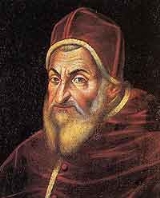
Pope Sixtus V

 
Pope Sixtus V

   Email Print
   Bookmark   Link


Pope Sixtus V


Pope Sixtus V (December 13, 1521 – August 27, 1590), born Felice Peretti di Montalto, was Pope
Pope

The Pope is the Bishop of Rome, the leader of the Roman Catholic Church and head of state of Vatican City. The current pope is Pope Benedict XVI, who was elected April 19, 2005 in Papal conclave, 2005....
 from 1585 to 1590.

Biography
Felice Peretti was born at Grottammare
Grottammare

Grottammare is a town and commune on Italy's Adriatic coast, in the province of Ascoli Piceno, Marche region. It receives over 500,000 tourists a year....
, in the Marche, son of Piergentile di Giacomo, nicknamed "Peretto", and Marianna da Frontillo. He took the surname "Peretti" in 1551 and was more generally known as "di Montalto". He was reared in poverty; born in a shanty so ill-thatched that the sun shone through the roof, he later jested that he was "nato di casa illustre" — born of an illustrious house.


Discussion
Ask a question about 'Pope Sixtus V'
Start a new discussion about 'Pope Sixtus V'
Answer questions from other users
Full Discussion Forum


Quotations


What a valiant woman! It is a pity that Elizabeth and I cannot marry. Our children would have ruled the world!


Encyclopedia


Pope Sixtus V (December 13, 1521 – August 27, 1590), born Felice Peretti di Montalto, was Pope
Pope

The Pope is the Bishop of Rome, the leader of the Roman Catholic Church and head of state of Vatican City. The current pope is Pope Benedict XVI, who was elected April 19, 2005 in Papal conclave, 2005....
 from 1585 to 1590.

Biography


Felice Peretti was born at Grottammare
Grottammare

Grottammare is a town and commune on Italy's Adriatic coast, in the province of Ascoli Piceno, Marche region. It receives over 500,000 tourists a year....
, in the Marche, son of Piergentile di Giacomo, nicknamed "Peretto", and Marianna da Frontillo. He took the surname "Peretti" in 1551 and was more generally known as "di Montalto". He was reared in poverty; born in a shanty so ill-thatched that the sun shone through the roof, he later jested that he was "nato di casa illustre" — born of an illustrious house. His father was a gardener and it is said of Felice that, when a boy, he was a swineherd
Swineherd

A swineherd is a person who looks after domestic pig. The term has fallen out of popular use in favour of pig farmer.Pig farming today is still carried out in a manner that can be compared to that practiced in Roman times....
.

According to Andrija Zmajevic
Andrija Zmajevic

Andrija Zmajevic was a distinguished Serbian language Baroque poet and contributor to the Roman Catholic Church from the Bay of Kotor. He was also a prominent theologian and the Archbishop of Bar, Montenegro and "Primate of the Serbian Kingdom"....
's chronicle, his father originated from the Bay of Kotor
Bay of Kotor

The Bay of Kotor in south-western Montenegro and south-eastern Croatia, is a winding Headlands and bays on the Adriatic Sea. The bay, sometimes called Europe's southernmost fjord, is in fact a submerged river canyon of the disintegrated Bokelj River which used to run from the high mountain plateaus of Mount Orjen....
 (modern-day Montenegro
Montenegro

Montenegro , Montenegrin language/Serbian language: ???? ????, Crna Gora , ) is a country located in Balkans. It has a coast on the Adriatic Sea to the south and is bordered by Croatia to the west, Bosnia and Herzegovina to the northwest, Serbia to the north, Kosovo to the east and Albania to the south....
) and was born in Bjelske Kruševice, a village near Bijela
Bijela

Bijela is a coastal town within the Municipality of Herceg Novi, Montenegro. It is located north of Herceg Novi, near Verige strait of Bay of Kotor....
, into the Šišic family, possibly called Slavjan. The theory that he comes from the Svilanovic family is unfounded. As a child, he served in a Catholic monastery in Kotor
Kotor

Kotor is a coastal town in Montenegro. It is located in a most secluded part of Gulf of Kotor. The town has a population of 13,510, and is the administrative center of the Kotor municipality....
, where he converted from Serbian Orthodoxy
Serbian Orthodox Church

The Serbian Orthodox Church or the Church of Serbia is one of the autocephalyEastern Orthodox Church organization, ranking sixth in order of seniority after Orthodox Church of Constantinople, Greek Church of Alexandria, Church of Antioch, Orthodox Church of Jerusalem, and Russian Orthodox Church....
 to Roman Catholicism and was subsequently taken to Italy
Italy

Italy , officially the Italian Republic , is a country located on the Italian Peninsula in Southern Europe and on the two largest islands in the Mediterranean Sea, Sicily and Sardinia....
 by an Italian friar. He settled in Ancona
Ancona

Ancona is a city and a seaport in the Marche, a region of central Italy, population 101,909 . Ancona is situated on the Adriatic Sea and is the center of the province of Ancona and the capital of the region....
, where he married and had Felice Peretti (Srecko Peric in modern Croat). Not much else is recorded about Peretti's father, but when Felice eventually became Pope Sixtus V, he rebuilt the church of Saint Jerome
Saint Jerome

Saint Jerome is a Christian church father, best known for translating the Bible into Latin.Saint Jerome may also refer to:* Saint Jerome Emiliani , Italian humanitarian, founder of the Somaschi Fathers...
 in Rome
Rome

Rome is the capital city of Italy and Lazio, and is Italy's largest and most populous city, with 2,724,347 residents in an urban area of some ....
 (finished in 1589), to be used specifically for the people who spoke the Illyria
Illyria

'Illyria' was in Classical antiquity a region in the western part of today's Balkan Peninsula, inhabited by tribes of Illyrians, an ancient people who spoke the Illyrian languages....
n language
. He also established a college of eleven Slavonic
Slavic peoples

The Slavic Peoples are a linguistic branch of Indo-European peoples, living mainly in eastern Europe. From the early 6th century they spread from their original homeland to inhabit most of eastern Central Europe, Eastern Europe and the Balkans....
 clerics in his papal bull
Papal bull

A Papal bull is a particular type of letters patent or charter issued by a pope. It is named after the bulla that was appended to the end to authenticate it....
 Sapientiam Sanctorum of August 1, 1589. This was later transformed into the Pontifical Croatian College of St. Jerome
Pontifical Croatian College of St. Jerome

The Pontifical Croatian College of St. Jerome, lin Italian the Pontificio Collegio Croato Di San Girolamo a Roma, is a Roman Catholic college, church and a society in the city of Rome intended for the schooling of Croatian clerics....
.

At an early age he entered a Franciscan
Franciscan

The term Franciscan is commonly used to refer to members of Catholic religious orders that follow a body of regulations known as "The rule of St....
 monastery at Montalto delle Marche and was known as Felice di Montalto. He soon gave evidence of rare ability as a preacher
Preacher

Preacher is a term the for someone who preaches sermons or gives homilies.Some believe a preacher is distinct from a theologian by focusing on the communication rather than the development of doctrine....
 and a dialectician
Dialectician

A dialectician is a philosopher who views the world in terms of complementary opposites and the interactions thereof. In popular usage, the central feature of dialectic is the concept of "thesis, antithesis, synthesis" - when an idea or phenomenon arises, it carries within itself the seed of its opposite , and the interplay of these polariti...
. About 1552 he was noticed by Cardinal Rodolfo Pio da Carpi
Cardinal Rodolfo Pio da Carpi

Rodolfo Pio da Carpi was an Italy Cardinal , humanist and patron of the arts. He formed a great library and was at the center of humanist studies in 16th-century Rome, though serving on the Congregation for the Doctrine of the Faith....
 (1500–64), protector of his order, Ghislieri (later Pope Pius V
Pope Pius V

Pope Saint Pius V , born Antonio Ghislieri was Pope from 1566 to 1572 and is a saint of the Roman Catholic Church. He is chiefly notable for his role in the implementation of the Council of Trent, the Counterreformation and the standardisation of the liturgy....
) and Caraffa (later Pope Paul IV
Pope Paul IV

Pope Paul IV , n? Giovanni Pietro Carafa, was Pope from May 23, 1555 until his death.Giovanni Pietro Carafa was born in Capriglia Irpina, near Avellino, into a prominent noble family of Naples....
), and from that time his advancement was assured. He was sent to Venice
Venice

Venice is a city in northern Italy, the capital city of the Italian regions Veneto, a population of 271,251 . Together with Padua, Italy, the city is included in the Padua-Venice Metropolitan Area ....
 as inquisitor general
Inquisition

The term Inquisition can refer to any one of several institutions charged with trying and convicting Christian heresy within the Roman Catholic Church....
, but was so severe and carried matters with such a high hand that he became embroiled in quarrels. The government asked for his recall in 1560.

After a brief term as procurator
Procurator

Procurator may refer to:In historical uses:*Promagistrate, an appointed position in the Roman Republic by the Senate, acting in place of a curator...
 of his order, he was attached to the Spanish legation headed by Ugo Boncampagni (later Pope Gregory XIII
Pope Gregory XIII

Pope Gregory XIII , born Ugo Boncompagni, was Pope from 1572 to 1585....
) in 1565, which was sent to investigate a charge of heresy
Heresy

Heresy is an introduced change to some system of belief, especially a religion, that conflicts with the previously established canon of that belief....
 levelled against Archbishop Bartolome Carranza of Toledo. The violent dislike he conceived for Boncampagni exerted a marked influence upon his subsequent actions. He hurried back to Rome
Rome

Rome is the capital city of Italy and Lazio, and is Italy's largest and most populous city, with 2,724,347 residents in an urban area of some ....
 upon the accession of Pius V (1566–72), who made him apostolic vicar of his order, and, later (1570), cardinal
Cardinal (Catholicism)

A cardinal is a senior Ecclesiology official, usually a Bishop , of the Catholic Church. They are collectively known as the College of Cardinals, which as a body elects a new pope....
.

During the pontificate of his political enemy Gregory XIII (1572–85) the Cardinal Montalto, as he was generally called, lived in enforced retirement, occupied with the care of his property, the Villa Montalto, erected by Domenico Fontana
Domenico Fontana

Domenico Fontana was a Switzerland-born Italy architect of the late Renaissance.He was born at Melide, Switzerland on the Lake Lugano and died at Naples....
 close to his beloved church on the Esquiline Hill
Esquiline Hill

The Esquiline Hill is one of the celebrated seven hills of Rome of Rome. Its southern-most cusp is the Oppius ....
, overlooking the Baths of Diocletian
Baths of Diocletian

The Baths of Diocletian in Ancient Rome were the grandest of the public baths, or thermae built by successive emperors. Diocletian's Baths, dedicated in 306, were the largest and most sumptuous of the imperial baths and remained in use until the aqueducts that fed them were cut by the Goths in 537....
. The first phase (1576–80) was enlarged after Peretti became pope and could clear buildings to open four new streets in 1585–6. The villa contained two residences, the Palazzo Sistino or "di Termini" ("of the Baths") and the casino, called the Palazzetto Montalto e Felice. Displaced Romans were furious. The decision to build the central pontifical railroad station (begun in 1869) in the area of the Villa marked the beginning of its destruction.

The Cardinal Montalto's other concern was with his studies, one of the fruits of which was an edition of the works of Ambrose
Ambrose

Saint Ambrose was a Roman Catholic Archdiocese of Milan who became one of the most influential ecclesiastical figures of the fourth century. He is counted as one of the four original doctors of the Church....
. As pope he personally supervised the printing of an improved edition of Jerome's Vulgate
Vulgate

The Vulgate is an early Fifth Century version of the Bible in Latin, and largely the result of the labors of Jerome, who was commissioned by Pope Damasus I in 382 to make a revision of Vetus Latina....
 -- said to be "as splendid a translation of the Bible into Latin as the King James version is into English."

Though not neglecting to follow the course of affairs, Sixtus V carefully avoided every occasion of offence. This discretion contributed not a little to his election to the papacy on April 24, 1585; but the story of his having feigned decrepitude in the conclave, in order to win votes, is a pure invention. One of the things that commended his candidacy to certain Cardinals was his physical vigour, which seemed to promise a long pontificate.

Sixtusv
The terrible condition in which Pope Gregory XIII had left the ecclesiastical states called for prompt and stern measures. Against the prevailing lawlessness Sixtus V proceeded with an almost ferocious severity, which only extreme necessity could justify. Thousands of brigands were brought to justice: within a short time the country was again quiet and safe. Next Sixtus V set to work to repair the finances. By the sale of offices, the establishment of new "Monti" and by levying new taxes, he accumulated a vast surplus, which he stored up against certain specified emergencies, such as a crusade or the defence of the Holy See
Holy See

The Holy See is the episcopal jurisdiction of the Bishop of Rome, commonly known as the Pope, and is the preeminent episcopal see of the Roman Catholic Church, forming the central government of the Church....
. Sixtus V prided himself upon his hoard, but the method by which it had been amassed was financially unsound: some of the taxes proved ruinous, and the withdrawal of so much money from circulation could not fail to cause distress.

Immense sums, however, were spent upon public works, in carrying through the comprehensive planning that had come to fruition during his retirement, bringing water to the waterless hills in the Acqua Felice
Acqua Felice

The Acqua Felice is one of the List of Roman aqueducts by date, completed in 1586 by Pope Sixtus V, whose birth name, which he never fully abandoned, was Felice Peretti....
,feeding twenty-seven new fountains; laying out new arteries in Rome, which connected the great basilicas, even setting his engineer-architect Domenico Fontana to replan the Colosseum
Colosseum

The Colosseum or Roman Coliseum, originally the Flavian Amphitheatre , is an elliptical amphitheatre in the center of the city of Rome, Italy, the largest ever built in the Roman Empire....
 as a silk-spinning factory housing its workers. The Pope set no limit to his plans; and what he achieved in his short pontificate, carried through always at top speed, is almost incredible; the completion of the dome of St. Peter's
St. Peter's Basilica

The Basilica of Saint Peter , officially known in Italian language as the Basilica di San Pietro in Vaticano and commonly known as St. Peter's Basilica, is located within the Vatican City....
; the loggia
Loggia

Loggia is the name given to an architectural feature, originally of Italy design, which is often a gallery or corridor generally on the ground level, or sometimes higher, on the facade of a building and open to the air on one side, where it is supported by columns or pierced openings in the wall....
 of Sixtus in the Basilica di San Giovanni in Laterano; the chapel of the Praesepe in Santa Maria Maggiore; additions or repairs to the Quirinal, Lateran
Lateran

Lateran and Laterano are the shared names of several architectural projects throughout Rome. The properties were once owned by the Lateranus family of the former Roman Empire....
 and Vatican
Vatican City

Vatican City , officially the State of the Vatican City , is a Landlocked country sovereignty city-state whose territory consists of a walled enclave within the city of Rome, the Capital of Italy....
 palaces; the erection of four obelisk
Obelisk

An obelisk An Obelisks is a tall, narrow, four-sided, tapering monument which ends in a pyramid like shape at the top. Ancient obelisks were made of a single piece of stone, a monolith; however, most modern obelisks are made of individual stones, and can even have interior spaces....
s, including that in St Peter's Square; the opening of six streets; the restoration of the aqueduct
Aqueduct

File:Tomar December 2008-4.jpgAn aqueduct is a water supply or navigable canal constructed to convey water. In modern engineering, the term is used for any system of pipes, ditches, canals, tunnels, and other structures used for this purpose....
 of Septimius Severus
Septimius Severus

Lucius Septimius Severus was a Roman Empire general, and Roman Emperor from April 14 193 to 211. He was born in what is now the Libyan part of Rome's historic Africa Province, making him the first emperor to be born in the Roman province of Africa Province....
 ("Acqua Felice"); the integration of the Leonine City
Leonine City

The Leonine City is that part of the city of Rome around which Pope Leo IV commissioned the construction of the Leonine Wall. It is on the opposite side of the Tiber from the seven hills of Rome....
 in Rome as XIV rione
Rione

Rione is the name given to a ward in several Italian cities, the best-known of which is rioni of Rome. Unlike a quartiere, a rione is usually an official administrative subdivision....
 (Borgo
Borgo (rione of Rome)

Borgo , is the 14th historic district of Rome. It lies on the west bank of the Tiber, and has a trapezoidal shape. Its Coat of Arms shows a lion , lying in front of three mounts and a star....
); besides numerous roads and bridges, he sweetened the city air by financing the Pontine Marshes
Pontine Marshes

The Pontine Marshes is a former marsh area in the Lazio Region of Central Italy, southeast of Rome, that today forms a low tract of land, the Agro Pontino, varying in breadth between the Volscian Mountains and the sea from 15 to 30 km, and extending northwest to southeast from Velletri to Terracina by the Tyrrhenian Sea, from which the...
. Good progress was made with more than reclaimed and opened to agriculture and manufacture; the project was abandoned upon his death.

But Sixtus V had no appreciation of antiquities, which were employed as raw material to serve his urbanistic and Christianising programs: Trajan's Column
Trajan's Column

Trajan's Column is a monument in Rome raised in honour of the Roman Empire emperor Trajan and constructed by the architect Apollodorus of Damascus at the order of the Roman Senate....
 and the Column of Marcus Aurelius
Column of Marcus Aurelius

File:column.of.marcus.aurelius.complete.arp.jpgFile:detail.from.column.of.marcus.aurelius.arp.jpgThe Column of Marcus Aurelius, , is a Doric column, with a spiral relief, built in honour of Roman emperor Marcus Aurelius and modeled on Trajan's Column....
 (at the time misidentified as the Column of Antoninus Pius
Column of Antoninus Pius

The Column of Antoninus Pius is an honorific column in Rome, devoted in 161 to the Roman emperor Antoninus Pius, in the Campus Martius, on the edge of the hill now known as Monte Citorio, and set up by his successors, the co-emperors Marcus Aurelius and Lucius Verus....
) were made to serve as pedestals for the statues of SS Peter and Paul; the Minerva
Minerva

Minerva was the Roman mythology name of Greek goddess Athena. She was considered to be the virgin goddess of warriors, poetry, medicine, wisdom, commerce, weaving,crafts, and the inventor of music....
 of the Capitol
Capitoline Hill

The Capitoline Hill , between the Roman Forum and the Campus Martius, is one of the seven hills of Rome of Rome. By the 16th century, Capitolinus had become Campidoglio in the Romanesco....
 was converted into an emblem of Christian Rome; the Septizonium of Septimius Severus
Septimius Severus

Lucius Septimius Severus was a Roman Empire general, and Roman Emperor from April 14 193 to 211. He was born in what is now the Libyan part of Rome's historic Africa Province, making him the first emperor to be born in the Roman province of Africa Province....
 was demolished for its building materials.

Nostradamus incident

Nostradamus
Nostradamus

Michel de Nostredame , usually Latinized to Nostradamus, was a France apothecary and reputed Prophet who published collections of prophecy that have since become famous worldwide....
 enthusiasts claim that one day, as a simple priest, Sixtus met the Salon prophet. Nostradamus is said to have recognized the future pope right away and kissed his hand. Note that Peretti became pope after Nostradamus's death.

Church administration

The subsequent administrative system of the Church owed much to Sixtus V. He limited the College of Cardinals
College of Cardinals

The Sacred College of Cardinals is the body of all Cardinal of the Roman Catholic Church. The College plays two roles in the church:*participating in Papal conclave when the Holy See is vacant, and...
 to seventy; and doubled the number of the congregations, and enlarged their functions, assigning to them the principal role in the transaction of business (1588). He regarded the Jesuits with disfavour and suspicion. He meditated radical changes in their constitution, but death prevented the execution of his purpose. In 1589 was begun a revision of the Vulgate
Vulgate

The Vulgate is an early Fifth Century version of the Bible in Latin, and largely the result of the labors of Jerome, who was commissioned by Pope Damasus I in 382 to make a revision of Vetus Latina....
, the so-called Editio Sixtina.

Foreign relations

In his larger political relations, however, Sixtus V showed himself visionary and vacillating. He entertained fantastic ambitions, such as the annihilation of the Turks
Ottoman Empire

The Ottoman Empire , also known by its contemporaries as the Turkish Empire or Turkey , was an empire that lasted from 1299?1923. It was Treaty of Lausanne by the Republic of Turkey, which was officially proclaimed on October 29, 1923....
, the conquest of Egypt
Egypt

Egypt is a country mainly in North Africa, with the Sinai Peninsula forming a land bridge in Western Asia. Covering an area of about , Egypt borders the Mediterranean Sea to the north, the Gaza Strip and Israel to the northeast, the Red Sea to the east, Sudan to the south and Libya to the west....
, the transporting of the Holy Sepulchre to Italy, and the accession of his nephew to the throne of France
France

France , officially the French Republic , is a country whose Metropolitan France is located in Western Europe and that also comprises various Overseas departments and territories of France....
. The situation in which he found himself was embarrassing: he could not countenance the designs of heretical princes, and yet he mistrusted Philip II of Spain
Philip II of Spain

Philip II was King of Spain from 1556 until 1598, List of monarchs of Naples from 1554 until 1598, king consort of England, as husband of Mary I of England, from 1554 to 1558, lord of the Seventeen Provinces from 1556 until 1581, holding various titles for the individual territories, such as Duke or Count; and King of Portugal as Philip I...
 (1556–98) and viewed with apprehension any extension of his power.

Sixtus V agreed to renew the excommunication
Excommunication

Excommunication is a religious censure used to deprive or suspend membership in a religious community. The word literally means putting [someone] out of full communion....
 of Queen Elizabeth I of England
Elizabeth I of England

Elizabeth I was List of English monarchs and Queen of Ireland from 17 November 1558 until her death. Sometimes called The Virgin Queen, Gloriana, or Good Queen Bess, Elizabeth was the fifth and last monarch of the House of Tudor....
 (1558–1603), and to grant a large subsidy to the Armada
Armada

Armada may refer to:...
 of King Philip II, but, knowing the slowness of Spain, would give nothing till the expedition should actually land in England
England

native_name =|conventional_long_name = England|common_name = England|image_flag = Flag of England.svg|image_coat = England COA.svg|symbol_type = Royal Coat of Arms...
. In this way he was saved his crown millions, and spared the reproach of having taken futile proceedings against what Roman Catholics viewed as the heretic Queen. This excommunication which Catholics of the day considered richly deserved, and there is extant a proclamation to justify it, which was to have been published in England if the invasion had been successful. It was signed by Cardinal Allen, and is entitled "An Admonition to the Nobility and Laity of England". It was intended to comprise all that could be said against Queen Elizabeth I, and the indictment is therefore fuller and more forcible than any other put forward by the religious exiles, who were generally very reticent in their complaints. Allen also carefully consigned his publication to the fire, and we only know of it through one of Elizabeth's ubiquitous spies, who had previously stolen a copy.

Sixtus V excommunicated Henry of Navarre (future Henry IV of France), and contributed to the Catholic League
Catholic League (French)

The Catholic League of France, sometimes referred to by contemporary Roman Catholics as the Holy League, was formed by Duke Henry of Guise in 1576....
, but he chafed under his forced alliance with Philip II, and looked for escape. The victories of Henry and the prospect of his conversion to Catholicism
Roman Catholic Church

The Roman Catholic Church, officially known as the Catholic Church is the world's largest Christianity Ecclesia , representing over half of all Christians and one-sixth of the world population....
 raised Sixtus V's hopes, and in corresponding degree determined Philip II to tighten his grip upon his wavering ally. The Pope's negotiations with Henry's representative evoked a bitter and menacing protest and a categorical demand for the performance of promises. Sixtus V took refuge in evasion, and temporized until death relieved him of the necessity of coming to a decision (August 27, 1590).

Summation

On his death bed his subjects loathed Sixtus V, but history has recognized him as one of the great figures of the Counter Reformation. On the negative he could be impulsive, obstinate, severe, and autocratic. On the positive he was open to large ideas and threw himself into his undertakings with a lot of energy as well as determination. This often led to success. His reign saw great enterprises and large achievements. He slept little and worked hard. He had inherited a bankrupt treasury, administered his funds with competence and care, and left five million crowns in the Vatican coffers at his death. Though not the greatest man, he was by far the greatest statesman who has ever sat on the papal throne.

The changes wrought by Sixtus V on the streetscape of Rome were documented in the film, "Rome: Impact of an Idea", featuring Edmund N. Bacon and based on sections of his book Design of Cities
Design of Cities

Design of Cities, published in 1976, is an illustrated account of the development of urban form, written by Edmund Bacon , who was the Executive Director of the Philadelphia City Planning Commission from 1949 to 1970....
.


External links