
All Topics  
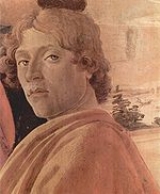
Sandro Botticelli

 
Sandro Botticelli

   Email Print
   Bookmark   Link


Sandro Botticelli


Alessandro di Mariano di Vanni Filipepi, better known as Sandro Botticelli or Il Botticello ("The Little Barrel"; March 1, 1445 – May 17, 1510) was an Italian
Italy

Italy , officially the Italian Republic , is a country located on the Italian Peninsula in Southern Europe and on the two largest islands in the Mediterranean Sea, Sicily and Sardinia....
 painter
Painting

Painting is the practice of applying paint, pigment, color or other medium to a surface . In art, the term describes both the act and the result, which is called a painting....
 of the Florentine school during the Early Renaissance
Renaissance

The Renaissance was a cultural movement that spanned roughly the 14th to the 17th century, beginning in Italy in the late Middle Ages and later spreading to the rest of Europe....
 (Quattrocento
Quattrocento

The cultural and artistic events of 15th century Italy are collectively referred to as the Quattrocento . Quattrocento encompasses the artistic styles of the late Middle Ages and the early Renaissance....
). Less than a hundred years later, this movement, under the patronage of Lorenzo de' Medici
Lorenzo de' Medici

Lorenzo de' Medici was an Italy statesman and de facto ruler of the Florentine Republic during the Italian Renaissance. Known as Lorenzo the Magnificent by contemporary Florentines, he was a diplomat, politician and patron of scholars, artists, and poets....
, was characterized by Giorgio Vasari
Giorgio Vasari

Giorgio Vasari was an Italy Painting and architect, who is today famous for his biography of Italian artists, considered the ideological foundation of art history writing....
 as a "golden age
Golden age

The term Golden age in ancient Greece mythology and legend but can also be found in other ancient cultures . It refers either to the highest age in the Greek spectrum of Iron, Bronze, Silver and Golden ages, or to a time in the beginnings of Humanity which was perceived as an ideal state, or utopia, when mankind was pure and immortal....
", a thought, suitably enough, he expressed at the head of his Vita of Botticelli.


Discussion
Ask a question about 'Sandro Botticelli'
Start a new discussion about 'Sandro Botticelli'
Answer questions from other users
Full Discussion Forum


Recent Posts


Encyclopedia


Alessandro di Mariano di Vanni Filipepi, better known as Sandro Botticelli or Il Botticello ("The Little Barrel"; March 1, 1445 – May 17, 1510) was an Italian
Italy

Italy , officially the Italian Republic , is a country located on the Italian Peninsula in Southern Europe and on the two largest islands in the Mediterranean Sea, Sicily and Sardinia....
 painter
Painting

Painting is the practice of applying paint, pigment, color or other medium to a surface . In art, the term describes both the act and the result, which is called a painting....
 of the Florentine school during the Early Renaissance
Renaissance

The Renaissance was a cultural movement that spanned roughly the 14th to the 17th century, beginning in Italy in the late Middle Ages and later spreading to the rest of Europe....
 (Quattrocento
Quattrocento

The cultural and artistic events of 15th century Italy are collectively referred to as the Quattrocento . Quattrocento encompasses the artistic styles of the late Middle Ages and the early Renaissance....
). Less than a hundred years later, this movement, under the patronage of Lorenzo de' Medici
Lorenzo de' Medici

Lorenzo de' Medici was an Italy statesman and de facto ruler of the Florentine Republic during the Italian Renaissance. Known as Lorenzo the Magnificent by contemporary Florentines, he was a diplomat, politician and patron of scholars, artists, and poets....
, was characterized by Giorgio Vasari
Giorgio Vasari

Giorgio Vasari was an Italy Painting and architect, who is today famous for his biography of Italian artists, considered the ideological foundation of art history writing....
 as a "golden age
Golden age

The term Golden age in ancient Greece mythology and legend but can also be found in other ancient cultures . It refers either to the highest age in the Greek spectrum of Iron, Bronze, Silver and Golden ages, or to a time in the beginnings of Humanity which was perceived as an ideal state, or utopia, when mankind was pure and immortal....
", a thought, suitably enough, he expressed at the head of his Vita of Botticelli. His posthumous reputation suffered until the late 19th century; since then his work has been seen to represent the linear grace of Early Renaissance painting, and The Birth of Venus
The Birth of Venus (Botticelli)

The Birth of Venus is a painting by Sandro Botticelli. It depicts Venus , having emerged from the sea as a full grown woman, arriving at the sea-shore ....
 and Primavera rank now among the most familiar masterpieces of Florentine art.

Youth

Details of Botticelli's life are sparse, but we know that he became an apprentice when he was about fourteen years old, which was typical for a Renaissance artist. Vasari reported that he was initially trained as a goldsmith by his brother Antonio. Probably by 1462 he was apprenticed to Fra Filippo Lippi; many of his early works have been attributed to the elder master, and attributions continue to be uncertain. Influenced also by the monumentality of Masaccio
Masaccio

Masaccio , was the first great Painting of the Quattrocento period of the Italian Renaissance. His frescoes are the earliest monuments of Humanism, and introduce a plasticity previously unseen in figure painting....
's painting, it was from Lippi that Botticelli learned a more intimate and detailed manner. As recently discovered, during this time, Botticelli could have traveled to Hungary
Hungary

Hungary , officially in English the Republic of Hungary , is a landlocked country in the Carpathian Basin of Central Europe, bordered by Austria, Slovakia, Ukraine, Romania, Serbia, Croatia, and Slovenia....
, participating in the creation of a fresco in Esztergom
Esztergom

Esztergom is a city in northern Hungary, about 50 km north-west of the Capital Budapest. It lies in Kom?rom-Esztergom county, on the right bank of the river Danube, which forms the border with Slovakia there....
, ordered in the workshop of Fra Filippo Lippi by Vitéz János, then archbishop
Archbishop

In Christianity, an archbishop is an elevated bishop. In the Roman Catholic Church, the Anglican Communion and others, this means that they lead a diocese of particular importance called an archdiocese, or in the Anglican Communion an Ecclesiastical Province, but this is not always the case....
 of Hungary.

By 1470 Botticelli had his own workshop. Even at this early date his work was characterized by a conception of the figure as if seen in low relief, drawn with clear contours, and minimizing strong contrasts of light and shadow which would indicate fully modeled forms.

Masterworks

The masterworks Primavera (c. 1478) and The Birth of Venus (c. 1485) were both seen by Vasari at the villa of Lorenzo di Pierfrancesco de' Medici at Castello in the mid-16th century, and until recently, it was assumed that both works were painted specifically for the villa. Recent scholarship suggests otherwise: the Primavera was painted for Lorenzo's (not to be confused with Lorenzo de' Medici
Lorenzo de' Medici

Lorenzo de' Medici was an Italy statesman and de facto ruler of the Florentine Republic during the Italian Renaissance. Known as Lorenzo the Magnificent by contemporary Florentines, he was a diplomat, politician and patron of scholars, artists, and poets....
, a cousin) townhouse in Florence, and The Birth of Venus was commissioned by someone else for a different site. By 1499, both had been installed at Castello.

In these works, the influence of Gothic
Gothic art

Gothic art was a Medieval art art movement that lasted about 200 years. It began in France out of the Romanesque art period in the mid-12th century, concurrent with Gothic architecture found in Cathedrals....
 realism is tempered by Botticelli's study of the antique. But if the painterly means may be understood, the subjects themselves remain fascinating for their ambiguity. The complex meanings of these paintings continue to receive widespread scholarly attention, mainly focusing on the poetry and philosophy of humanists who were the artist's contemporaries. The works do not illustrate particular texts; rather, each relies upon several texts for its significance. Of their beauty, characterized by Vasari as exemplifying "grace" and by John Ruskin
John Ruskin

John Ruskin was a British art critic and social thought, also remembered as an author, poet and artist. His essays on art and architecture were extremely influential in the Victorian era and Edwardian period eras....
 as possessing linear rhythm, there can be no doubt.

Maturity and later life

Sandro Botticelli 038
The Adoration of the Magi for Santa Maria Novella (c. 1475-1476, now at the Uffizi) contains the portraits of Cosimo de' Medici
Cosimo de' Medici

C?simo di Giovanni degli M?dici , was the first of the Medici political dynasty, de facto rulers of Florence during most of the Italian Renaissance; also known as "Cosimo 'the Elder'" and "Cosimo Pater Patriae."...
 ("the finest of all that are now extant for its life and vigour"), his grandson Giuliano de' Medici
Giuliano di Piero de' Medici

Giuliano de' Medici was the second son of Piero di Cosimo de' Medici and Lucrezia Tornabuoni. As co-ruler of Florence, with his brother Lorenzo de' Medici, he complemented his brother's image as the "patron of the arts" with his own image as the handsome, sporting, "golden boy."...
, and Cosimo's son Giovanni
Giovanni di Cosimo de' Medici

Giovanni de' Medici was an Italy banker and patron of arts....
. The quality of the scene was hailed by Vasari as one of Botticelli's pinnacles.

In 1481, Pope Sixtus IV
Pope Sixtus IV

Pope Sixtus IV , born Francesco della Rovere, was Pope from 1471 to 1484. He founded the Sistine Chapel where the team of artists he brought together introduced the Early Renaissance to Rome with the first masterpiece of the city's new artistic age....
 summoned Botticelli and other prominent Florentine and Umbrian artists to fresco the walls of the Sistine Chapel
Sistine Chapel

Sistine Chapel is the best-known chapel in the Apostolic Palace, the official residence of the Pope in Vatican City. Its fame rests on its architecture, evocative of Solomon's Temple of the Old Testament and on its decoration which has been frescoed throughout by the greatest Renaissance artists including Michelangelo, Raphael, Bernini, and...
. The iconological program was the supremacy of the Papacy. Sandro's contribution was moderately successful. He returned to Florence, and "being of a sophistical turn of mind, he there wrote a commentary on a portion of Dante
Dante Alighieri

Durante degli Alighieri , commonly known as Dante Alighieri, was a Florence poet of the Middle Ages. His Magnum opus, the Divine Comedy , is often considered the greatest literary work composed in the Italian language and a masterpiece of world literature....
 and illustrated the Inferno
The Divine Comedy

The Divine Comedy , written by Dante Alighieri between 1308 and his death in 1321, is widely considered the central epic poem of Italian literature, and is seen as one of the greatest works of world literature....
 which he printed, spending much time over it, and this abstention from work led to serious disorders in his living." Thus Vasari characterized the first printed Dante
Dante Alighieri

Durante degli Alighieri , commonly known as Dante Alighieri, was a Florence poet of the Middle Ages. His Magnum opus, the Divine Comedy , is often considered the greatest literary work composed in the Italian language and a masterpiece of world literature....
 (1481) with Botticelli's decorations; he could not imagine that the new art of printing
Printing

Printing is a process for reproducing text and image, typically with ink on paper using a printing press. It is often carried out as a large-scale industrial process, and is an essential part of publishing and transaction printing....
 might occupy an artist.

In the mid-1480s Botticelli worked on a major fresco cycle with Perugino, Ghirlandaio, and Filippino Lippi
Filippino Lippi

Filippino Lippi was a well-known painter working during the High Renaissance in Florence, Italy....
, for Lorenzo the Magnificent's villa near Volterra
Volterra

file:Volterra san francesco 003.JPGVolterra is a town in the Tuscany region of Italy....
; in addition he painted many frescoes in Florentine churches.

In 1491 Botticelli served on a committee to decide upon a facade for the Florence Duomo
Duomo

Duomo is a generic Italian language term for a cathedral church. The formal word for a church that is presently a cathedral is cattedrale; a Duomo may be either a present or a former cathedral ....
. In 1502 he was accused of sodomy, though charges were later dropped. In 1504 he was a member of the committee appointed to decide where Michelangelo
Michelangelo

Michelangelo di Lodovico Buonarroti Simoni , commonly known as Michelangelo, was an Italian Renaissance Painting, sculptor, architect, poet, and engineer....
's David
David (Michelangelo)

David is a masterpiece of Renaissance sculpture sculpted by Michelangelo from 1501 to 1504. The 5.17 meter marble statue portrays the Bible David in the depictions of nudity....
 would be placed. His later work, especially as seen in a series on the life of St. Zenobius, witnessed a diminution of scale, expressively distorted figures, and a non-naturalistic use of colour reminiscent of the work of Fra Angelico
Fra Angelico

Fra Angelico , born Guido di Pietro, was an Early Italian Renaissance painter, referred to in Vasari's Lives of the Artists as having "a rare and perfect talent"....
 nearly a century earlier.

Religion

Venus and Mars
In later life, Botticelli was one of Savonarola's followers, though the full extent of Savonarola's influence is uncertain. The story that he burnt his own paintings on pagan themes in the notorious "Bonfire of the Vanities
Bonfire of the Vanities

Bonfire of the Vanities refers to the burning of objects that are deemed to be Occasion of sin. The most famous one took place on 7 February 1497, when supporters of the Dominican Order priest Girolamo Savonarola collected and publicly burned thousands of objects like cosmetics, art, and books in Florence, Italy, on the Shrove Tuesday fest...
" is not told by Vasari, who asserts that of the sect of Savonarola "he was so ardent a partisan that he was thereby induced to desert his painting, and, having no income to live on, fell into very great distress. For this reason, persisting in his attachement to that party, and becoming a Piagnone he abandoned his work.". Botticelli biographer Ernst Steinman searched for the artist's psychological development through his Madonnas. In the "deepening of insight and expression in the rendering of Mary's physiognomy", Steinman discerns proof of Savonarola's influence over Botticelli. This means that the biographer needed to alter the dates of a number of Madonnas to substantiate his theory; specifically, they are dated ten years later than before. Steinman disagrees with Vasari's assertion that Botticelli produced nothing after coming under the influence of Girolamo Savonarola. Steinman believes the spiritual and emotional Virgins rendered by Sandro follow directly from the teachings of the Dominican monk.

Earlier, Botticelli had painted an Assumption of the Virgin for Matteo Palmieri in a chapel at San Pietro Maggiore in which, it was rumored, both the patron who dictated the iconic scheme and the painter who painted it, were guilty of unidentified heresy
Heresy

Heresy is an introduced change to some system of belief, especially a religion, that conflicts with the previously established canon of that belief....
, a delicate requirement in such a subject. The heretical notions seem to be gnostic
Gnosticism

Gnosticism refers to diverse, syncretistic religious movements in antiquity consisting of various belief systems generally united in the teaching that humans are divine souls trapped in a Nature created by an imperfect god, the demiurge; this being is frequently identified with the Abrahamic God, and is contrasted with a superior entity, ref...
 in character:
By the side door of San Piero Maggiore he did a panel for Matteo Palmieri, with a large number of figures representing the Assumption of Our Lady with zones of patriarchs, prophets, apostles, evangelists, martyrs, confessors, doctors, virgins, and the orders of angels, the whole from a design given to him by Matteo, who was a worthy and educated man. He executed this work with the greatest mastery and diligence, introducing the portraits of Matteo and his wife on their knees. But although the great beauty of this work could find no other fault with it, said that Matteo and Sandro were guilty of grave heresy. Whether this be true or not, I cannot say. (Giorgio Vasari)


This is a common misconception based on an error by Vasari. The painting referred to here, now in the National Gallery
National Gallery, London

The National Gallery in London, founded in 1824, houses a rich collection of over 2,300 paintings dating from the mid-13th century to 1900 in its home on Trafalgar Square....
 in London
London

London is the capital of both England and the United Kingdom, and the most populous municipality in the European Union. An important settlement for two millennia, History of London goes back to its founding by the Roman Empire....
, is by the artist Botticini. Vasari confused their similar sounding names.

Private life

Botticelli never, and expressed a strong aversion to the idea of marriage, a prospect he claimed gave him nightmares. A summary of a charge has been found in the Florentine Archives for November 16, 1502 which reads simply, "Botticelli keeps a boy". The painter was then fifty-eight. Jacques Mesnil who discovered the document in 1938 dismissed it as a customary slander by which the partisans and adversaries of Savanarola abused each other; however, it should be noted that Savonarolla was executed in 1498 so this was after the period where he had an influence on day to day Florentine life and Politics. Opinion remains divided. Some historians have agreed with Mesnil's view; while others have cautioned against hasty dismissal of the charge. However, while dismissing the charge, speculating on the subject of his paintings, Mesnil nevertheless concluded "woman was not the only object of his love".

Posthumous eclipse

Botticelli was already little employed in 1502; after his death his reputation was eclipsed longer and more thoroughly than that of any other major European artist. His paintings remained in the churches and villas for which they had been created, his frescoes in the Sistine Chapel
Sistine Chapel

Sistine Chapel is the best-known chapel in the Apostolic Palace, the official residence of the Pope in Vatican City. Its fame rests on its architecture, evocative of Solomon's Temple of the Old Testament and on its decoration which has been frescoed throughout by the greatest Renaissance artists including Michelangelo, Raphael, Bernini, and...
 upstaged by Michelangelo's. The first nineteenth century art historian to have looked with satisfaction at Botticelli's Sistine frescoes was Alexis-François Rio
Alexis-François Rio

Alexis-Fran?ois Rio was a French writer on art. Without any strict method or criticism, he expressed preference for the art of the fifteenth century....
. Through Rio Mrs Jameson
Anna Brownell Jameson

Anna Brownell Jameson , Kingdom of Great Britain writer, was born in Dublin.Her father, Denis Brownell Murphy , was a Portrait miniature and Vitreous enamel Painting....
 and Sir Charles Eastlake
Charles Eastlake

Charles Locke Eastlake was a United Kingdom architect and furniture designer. Trained by the architect Philip Hardwick , he popularised William Morris's notions of decorative arts in the Arts and Crafts movement, becoming one of the principal exponents of the revived "Early English" or "Gothic revival" popular in Victorian architecture....
 were alerted to Botticelli, but, while works by his hand began to appear in German collections, both the Nazarenes and the Pre-Raphaelite Brotherhood
Pre-Raphaelite Brotherhood

The Pre-Raphaelite Brotherhood was a group of England Paintings, poets, and critics, founded in 1848 by Dante Gabriel Rossetti, William Michael Rossetti, James Collinson, John Everett Millais, Frederic George Stephens, Thomas Woolner and William Holman Hunt....
 ignored him. Walter Pater
Walter Pater

Walter Horatio Pater was an England essayist and critic of art criticism and literary criticism....
 created a literary picture of Botticelli, who was then taken up by the Aesthetic movement. The first monograph on the artist was published in 1893; then, between 1900 and 1920 more books were written on Botticelli than any other painter.

Recent discovery

Recently, one of four female figures on a fresco in the ruins of the Archbishop
Archbishop

In Christianity, an archbishop is an elevated bishop. In the Roman Catholic Church, the Anglican Communion and others, this means that they lead a diocese of particular importance called an archdiocese, or in the Anglican Communion an Ecclesiastical Province, but this is not always the case....
's studiolo in the castle of Esztergom
Esztergom

Esztergom is a city in northern Hungary, about 50 km north-west of the Capital Budapest. It lies in Kom?rom-Esztergom county, on the right bank of the river Danube, which forms the border with Slovakia there....
, Hungary
Hungary

Hungary , officially in English the Republic of Hungary , is a landlocked country in the Carpathian Basin of Central Europe, bordered by Austria, Slovakia, Ukraine, Romania, Serbia, Croatia, and Slovenia....
, was recognized (by Zsuzsanna Wierdl and Maria Prokopp) as possibly the first independent creation by Botticelli. The figures representing four cardinal virtues were ordered from the workshop of Fra Filippo Lippi by Vitéz János
János Vitéz (archbishop)

J?nos Vit?z was the Archdiocese of Esztergom and a prominent Renaissance humanism, diplomat, Latinist, mathematician, astrologist and astronomer....
, then Archbishop of Hungary. The figure attributed to Botticelli — the temperance — has many traits of his later works. Some eminent scholars in the field such as Miklos Boskovits and Louis Waldman reject the frescoes' attribution to Botticelli.

Anthology of works


See also

  • History of painting
    History of painting

    The history of painting reaches back in time to artifacts from pre-historic humans, and spans all cultures, that represents a continuous, though disrupted, tradition from Antiquity....
  • Italian Renaissance
    Italian Renaissance

    The Italian Renaissance began the opening phase of the Renaissance, a period of great cultural change and achievement in Europe that spanned the period from the end of the 13th century to about 1600, marking the transition between Medieval and Early Modern Europe....
  • List of painters
  • List of Italian painters
    List of Italian painters

    Famous Italy Paintings :*Francesco Albani *Mariotto Albertinelli *Fra Angelico *Pietro Annigoni *Antonello da Messina *Fra Bartolomeo *Gentile Bellini ...
  • List of famous Italians
  • Renaissance painting
  • Western painting
    Western painting

    The history of Western painting represents a continuous, though disrupted, tradition from classical antiquity. Until the mid 19th century it was primarily concerned with Representational art and Classical antiquity modes of production, after which time more Modern art, Abstract art and Conceptual art forms gained favor....


External links

  • Botticelli's Dante illustrations and interactive version of Chart of Hell