

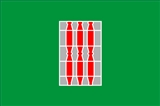
Umbria

Encyclopedia
Umbria (ˈumbrja) is a region
of modern central Italy
. It is one of the smallest Italian regions and the only peninsular region that is landlocked.
Its capital is Perugia
.
Assisi
and Norcia
are historical towns associated with St. Francis of Assisi, and St. Benedict.
The official language, as in the rest of Italy, is Italian
.
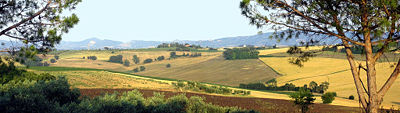 Umbria is bordered by Tuscany
to the west, the Marche
to the east and Lazio to the south. Mostly hilly or mountainous, its topography is dominated by the Apennines
, with the highest point in the region at Monte Vettore
on the border of the Marche, at 2476 m (8,123 ft), and the Tiber
valley basin, with the lowest point at Attigliano
, 96 m (315 ft). It is the only Italian region having neither coastline nor common border with other countries.
The Tiber river forms the approximate border with Lazio, although its source is just over the Tuscan border. The Tiber's three principal tributaries flow southward through Umbria. The Chiascio basin is relatively uninhabited as far as Bastia Umbra
. About 10 km (6 mi) further it joins the Tiber at Torgiano
. The Topino, cleaving the Apennines with passes that the Via Flaminia
and successor roads follow, makes a sharp turn at Foligno
to flow NW for a few kilometres before joining the Chiascio below Bettona
. The third river is the Nera, flowing into the Tiber further south, at Terni
; its valley is called the Valnerina. The upper Nera cuts ravines in the mountains; the lower in the Chiascio-Topino basin is in a fairly large floodplain.
In antiquity, the plain was covered by a pair of shallow, interlocking lakes, the Lacus Clitorius and the Lacus Umber. They were drained by the Romans
over several hundred years, but an earthquake in the 4th century and the political collapse of the Roman Empire resulted in the reflooding of the basin. It was drained a second time, almost a thousand years later, during a five-hundred-year period: Benedictine
monks started the process in the 13th century, and the draining was completed by an engineer from Foligno in the 18th century.
In literature, one sometimes sees Umbria called il cuor verde d'Italia (the green heart of Italy). The phrase is taken from a poem by Giosuè Carducci
— the subject of which is not Umbria but rather a specific place in it, the source of the Clitunno river
.
tribe, one of those who were absorbed by the expansion of the Romans. Pliny the Elder
recounts a fanciful derivation for the tribal name from the Greek ὄμβρος "a shower", which had led to the confused idea that they had survived the Deluge familiar from Greek mythology, giving them the claim to be the most ancient race in Italy. In fact they belonged to a broader family of neighbouring tribes with similar roots. Their language was Umbrian
, one of the Italic languages
, related to Latin
and Oscan
.
The Umbri probably sprang, like neighbouring tribes, from the creators of the Terramara, and Villanovan culture
in northern and central Italy, who entered north-eastern Italy at the beginning of the Bronze Age
.
The Etruscans were the chief enemies of the Umbri, and the Etruscan invasion went from the western seaboard towards the north and east (lasting from about 700 to 500 BC), eventually driving the Umbrians towards the Apenninic uplands and capturing 300 Umbrian towns. Nevertheless, the Umbrian population does not seem to have been eradicated in the conquered districts.
After the downfall of the Etruscans, Umbrians attempted to aid the Samnite
s in their struggle
against Rome
(308 BC); but communications with Samnium
were impeded by the Roman fortress of Narni
(founded 298 BC). At the great battle of Sentinum
(295 BC), which was fought in their own territory, the Umbrians did not substantially help the Samnites.
The Roman victory at Sentinum started a period of integration under the Roman rulers, who established some colonies (e.g., Spoletium) and built the via Flaminia
(220 BC), which became a principal vector for Roman development in Umbria. During Hannibal
's invasion in the second Punic war
, the battle of Lake Trasimene
was fought in Umbria, but the Umbrians did not aid him.
During the Roman civil war between Mark Antony
and Octavian (40 BC), the city of Perugia supported Antony and was almost completely destroyed by the latter.
In Pliny
's time, 49 independent communities still existed in Umbria, and the abundance of inscriptions and the high proportion of recruits in the imperial army
attest to its population.
The modern region of Umbria, however, is essentially different from the Umbria of Roman times (see Roman Umbria
), which extended through most of what is now the northern Marche, to Ravenna
, but excluded the west bank of the Tiber. Thus Perugia
was in Etruria
, and the area around Norcia
was in the Sabine
territory.
After the collapse of the Roman empire
, Ostrogoths and Byzantines
struggled for the supremacy in the region; the Lombards
founded the duchy of Spoleto
, covering much of today's Umbria. When Charlemagne
conquered most of the Lombard kingdoms, some Umbrian territories were given to the Pope
, who established temporal power over them. Some cities acquired a form of autonomy (the comuni
); they were often at war with each other in the context of the more general conflict between the papacy and the Holy Roman Empire
or between the Guelphs and the Ghibellines.
In the 14th century, the signorie
arose, but were subsumed into the Papal States
, which ruled the region until the end of the 18th century.
After the French Revolution
and the French conquest of Italy, Umbria was part of the ephemeral Roman Republic
(1798–1799) and of the Napoleonic Empire (1809–1814).
After Napoleon's defeat, the Pope regained Umbria until 1860.
After the Risorgimento, the expansion of the Piedmontese, and Italian unification
, in 1861 Umbria was incorporated in the Kingdom of Italy
.
The borders of Umbria were fixed in 1927, with the creation of the province of Terni
and the separation of the province of Rieti
, which was incorporated in Lazio.
In 1946 Umbria became part of the Italian Republic.
Umbrian agriculture is noted for its tobacco, its olive oil
and its vineyards, which produce excellent wines. Regional varietals include the white Orvieto
, which draws agri-tourists to the vineyards in the area surrounding the medieval town of the same name. Other noted wines produced in Umbria are Torgiano
and Rosso di Montefalco
. Another typical Umbrian product is the black truffle found in Valnerina, an area that produces 45% of this product in Italy.
The food industry in Umbria produces processed pork-meats, confectionery, pasta and the traditional products of Valnerina in preserved form (truffles, lentils, cheese). The other main industries are textiles, clothing, sportswear, iron and steel, chemicals and ornamental ceramics.
forming with Tuscany
, Emilia-Romagna
and Marche
the famous Italian political "Red Quadrilateral". Nowadays Umbria is a stronghold of the center-left and of the Democratic Party
. At the April 2008 elections
, Umbria gave more than 47% of its votes to Walter Veltroni
.
:
Regions of Italy
The regions of Italy are the first-level administrative divisions of the state, constituting its first NUTS administrative level. There are twenty regions, of which five are constitutionally given a broader amount of autonomy granted by special statutes....
of modern central Italy
Central Italy
Central Italy is one of the five official statistical regions of Italy used by the National Institute of Statistics , a first level NUTS region and a European Parliament constituency...
. It is one of the smallest Italian regions and the only peninsular region that is landlocked.
Its capital is Perugia
Perugia
Perugia is the capital city of the region of Umbria in central Italy, near the River Tiber, and the capital of the province of Perugia. The city is located about north of Rome. It covers a high hilltop and part of the valleys around the area....
.
Assisi
Assisi
- Churches :* The Basilica of San Francesco d'Assisi is a World Heritage Site. The Franciscan monastery, il Sacro Convento, and the lower and upper church of St Francis were begun immediately after his canonization in 1228, and completed in 1253...
and Norcia
Norcia
Norcia is a town and comune in the province of Perugia in southeastern Umbria, located in a wide plain abutting the Monti Sibillini, a subrange of the Apennines with some of its highest peaks, near the Sordo River, a small stream that eventually flows into the Nera...
are historical towns associated with St. Francis of Assisi, and St. Benedict.
The official language, as in the rest of Italy, is Italian
Italian language
Italian is a Romance language spoken mainly in Europe: Italy, Switzerland, San Marino, Vatican City, by minorities in Malta, Monaco, Croatia, Slovenia, France, Libya, Eritrea, and Somalia, and by immigrant communities in the Americas and Australia...
.
Geography
Tuscany
Tuscany is a region in Italy. It has an area of about 23,000 square kilometres and a population of about 3.75 million inhabitants. The regional capital is Florence ....
to the west, the Marche
Marche
The population density in the region is below the national average. In 2008, it was 161.5 inhabitants per km2, compared to the national figure of 198.8. It is highest in the province of Ancona , and lowest in the province of Macerata...
to the east and Lazio to the south. Mostly hilly or mountainous, its topography is dominated by the Apennines
Apennine mountains
The Apennines or Apennine Mountains or Greek oros but just as often used alone as a noun. The ancient Greeks and Romans typically but not always used "mountain" in the singular to mean one or a range; thus, "the Apennine mountain" refers to the entire chain and is translated "the Apennine...
, with the highest point in the region at Monte Vettore
Monte Vettore
Monte Vettore is a mountain on the border between Umbria and the Marche, in central Italy. It is part of the Sibillini mountains range and lies in the Parco Nazionale dei Monti Sibillini. Today climbers reach it from the Umbrian side from Norcia, or, on the Marche side, from Ascoli Piceno...
on the border of the Marche, at 2476 m (8,123 ft), and the Tiber
Tiber
The Tiber is the third-longest river in Italy, rising in the Apennine Mountains in Emilia-Romagna and flowing through Umbria and Lazio to the Tyrrhenian Sea. It drains a basin estimated at...
valley basin, with the lowest point at Attigliano
Attigliano
Attigliano is a comune in the Province of Terni in the Italian region Umbria, located about 70 km south of Perugia and about 30 km west of Terni....
, 96 m (315 ft). It is the only Italian region having neither coastline nor common border with other countries.
The Tiber river forms the approximate border with Lazio, although its source is just over the Tuscan border. The Tiber's three principal tributaries flow southward through Umbria. The Chiascio basin is relatively uninhabited as far as Bastia Umbra
Bastia Umbra
Bastia Umbra is a comune in the Province of Perugia in the Italian region Umbria, located about 15 km southeast of Perugia. As of 31 December 2004, it had a population of 20,523 and an area of 27.6 km²....
. About 10 km (6 mi) further it joins the Tiber at Torgiano
Torgiano
Torgiano is a comune in the Province of Perugia in the Italian region Umbria, located about 10 km southeast of Perugia.Torgiano borders the following municipalities: Bastia Umbra, Bettona, Deruta, Perugia.- History :...
. The Topino, cleaving the Apennines with passes that the Via Flaminia
Via Flaminia
The Via Flaminia was an ancient Roman road leading from Rome over the Apennine Mountains to Ariminum on the coast of the Adriatic Sea, and due to the ruggedness of the mountains was the major option the Romans had for travel between Etruria, Latium and Campania and the Po Valley...
and successor roads follow, makes a sharp turn at Foligno
Foligno
Foligno is an ancient town of Italy in the province of Perugia in east central Umbria, on the Topino river where it leaves the Apennines and enters the wide plain of the Clitunno river system...
to flow NW for a few kilometres before joining the Chiascio below Bettona
Bettona
Bettona is an ancient town and comune of Italy, in the province of Perugia in central Umbria at the northern edge of the Colli Martani range...
. The third river is the Nera, flowing into the Tiber further south, at Terni
Terni
Terni is a city in southern Umbria, central Italy, capital of the province of Terni, located in the plain of the Nera river. It is 104 km N of Rome, 36 km NW of Rieti, and 29 km S of Spoleto.-History:...
; its valley is called the Valnerina. The upper Nera cuts ravines in the mountains; the lower in the Chiascio-Topino basin is in a fairly large floodplain.
In antiquity, the plain was covered by a pair of shallow, interlocking lakes, the Lacus Clitorius and the Lacus Umber. They were drained by the Romans
Ancient Rome
Ancient Rome was a thriving civilization that grew on the Italian Peninsula as early as the 8th century BC. Located along the Mediterranean Sea and centered on the city of Rome, it expanded to one of the largest empires in the ancient world....
over several hundred years, but an earthquake in the 4th century and the political collapse of the Roman Empire resulted in the reflooding of the basin. It was drained a second time, almost a thousand years later, during a five-hundred-year period: Benedictine
Order of Saint Benedict
The Order of Saint Benedict is a Roman Catholic religious order of independent monastic communities that observe the Rule of St. Benedict. Within the order, each individual community maintains its own autonomy, while the organization as a whole exists to represent their mutual interests...
monks started the process in the 13th century, and the draining was completed by an engineer from Foligno in the 18th century.
In literature, one sometimes sees Umbria called il cuor verde d'Italia (the green heart of Italy). The phrase is taken from a poem by Giosuè Carducci
Giosuè Carducci
Giosuè Alessandro Michele Carducci was an Italian poet and teacher. He was very influential and was regarded as the official national poet of modern Italy. In 1906 he became the first Italian to win the Nobel Prize in Literature.-Biography:...
— the subject of which is not Umbria but rather a specific place in it, the source of the Clitunno river
Clitunno River
The Clitunno, in Antiquity the Clitumnus, is a river in Umbria, Italy. The name is of uncertain origin, but it was also borne by the river god...
.
History
The region is named for the UmbriUmbri
The Umbri were an Italic people of ancient Italy. A region called Umbria still exists and is currently occupied by Italian speakers. It is somewhat smaller than the ancient Umbria....
tribe, one of those who were absorbed by the expansion of the Romans. Pliny the Elder
Pliny the Elder
Gaius Plinius Secundus , better known as Pliny the Elder, was a Roman author, naturalist, and natural philosopher, as well as naval and army commander of the early Roman Empire, and personal friend of the emperor Vespasian...
recounts a fanciful derivation for the tribal name from the Greek ὄμβρος "a shower", which had led to the confused idea that they had survived the Deluge familiar from Greek mythology, giving them the claim to be the most ancient race in Italy. In fact they belonged to a broader family of neighbouring tribes with similar roots. Their language was Umbrian
Umbrian language
Umbrian is an extinct Italic language formerly spoken by the Umbri in the ancient Italian region of Umbria. Within the Italic languages it is closely related to the Oscan group and is therefore associated with it in the group of Osco-Umbrian languages...
, one of the Italic languages
Italic languages
The Italic subfamily is a member of the Indo-European language family. It includes the Romance languages derived from Latin , and a number of extinct languages of the Italian Peninsula, including Umbrian, Oscan, Faliscan, and Latin.In the past various definitions of "Italic" have prevailed...
, related to Latin
Latin
Latin is an Italic language originally spoken in Latium and Ancient Rome. It, along with most European languages, is a descendant of the ancient Proto-Indo-European language. Although it is considered a dead language, a number of scholars and members of the Christian clergy speak it fluently, and...
and Oscan
Oscan language
Oscan is a term used to describe both an extinct language of southern Italy and the language group to which it belonged.The Oscan language was spoken by a number of tribes, including the Samnites, the Aurunci, the Sidicini, and the Ausones. The latter three tribes were often grouped under the name...
.
The Umbri probably sprang, like neighbouring tribes, from the creators of the Terramara, and Villanovan culture
Villanovan culture
The Villanovan culture was the earliest Iron Age culture of central and northern Italy, abruptly following the Bronze Age Terramare culture and giving way in the 7th century BC to an increasingly orientalizing culture influenced by Greek traders, which was followed without a severe break by the...
in northern and central Italy, who entered north-eastern Italy at the beginning of the Bronze Age
Bronze Age
The Bronze Age is a period characterized by the use of copper and its alloy bronze as the chief hard materials in the manufacture of some implements and weapons. Chronologically, it stands between the Stone Age and Iron Age...
.
The Etruscans were the chief enemies of the Umbri, and the Etruscan invasion went from the western seaboard towards the north and east (lasting from about 700 to 500 BC), eventually driving the Umbrians towards the Apenninic uplands and capturing 300 Umbrian towns. Nevertheless, the Umbrian population does not seem to have been eradicated in the conquered districts.
After the downfall of the Etruscans, Umbrians attempted to aid the Samnite
Samnium
Samnium is a Latin exonym for a region of south or south and central Italy in Roman times. The name survives in Italian today, but today's territory comprising it is only a small portion of what it once was. The populations of Samnium were called Samnites by the Romans...
s in their struggle
Samnite Wars
The First, Second, and Third Samnite Wars, between the early Roman Republic and the tribes of Samnium, extended over half a century, involving almost all the states of Italy, and ended in Roman domination of the Samnites...
against Rome
Ancient Rome
Ancient Rome was a thriving civilization that grew on the Italian Peninsula as early as the 8th century BC. Located along the Mediterranean Sea and centered on the city of Rome, it expanded to one of the largest empires in the ancient world....
(308 BC); but communications with Samnium
Samnium
Samnium is a Latin exonym for a region of south or south and central Italy in Roman times. The name survives in Italian today, but today's territory comprising it is only a small portion of what it once was. The populations of Samnium were called Samnites by the Romans...
were impeded by the Roman fortress of Narni
Narni
Narni is an ancient hilltown and comune of Umbria, in central Italy, with 20,100 inhabitants, according to the 2003 census. At an altitude of 240 m , it overhangs a narrow gorge of the Nera River in the province of Terni. It is very close to the Geographic center of Italy...
(founded 298 BC). At the great battle of Sentinum
Battle of Sentinum
The Battle of Sentinum was the decisive battle of the Third Samnite War, fought in 295 BC near Sentinum , in which the Romans were able to overcome a formidable coalition of Samnites, Etruscans, Umbrians, and their Gallic allies...
(295 BC), which was fought in their own territory, the Umbrians did not substantially help the Samnites.
The Roman victory at Sentinum started a period of integration under the Roman rulers, who established some colonies (e.g., Spoletium) and built the via Flaminia
Via Flaminia
The Via Flaminia was an ancient Roman road leading from Rome over the Apennine Mountains to Ariminum on the coast of the Adriatic Sea, and due to the ruggedness of the mountains was the major option the Romans had for travel between Etruria, Latium and Campania and the Po Valley...
(220 BC), which became a principal vector for Roman development in Umbria. During Hannibal
Hannibal Barca
Hannibal, son of Hamilcar Barca Hannibal's date of death is most commonly given as 183 BC, but there is a possibility it could have taken place in 182 BC. was a Carthaginian military commander and tactician. He is generally considered one of the greatest military commanders in history...
's invasion in the second Punic war
Second Punic War
The Second Punic War, also referred to as The Hannibalic War and The War Against Hannibal, lasted from 218 to 201 BC and involved combatants in the western and eastern Mediterranean. This was the second major war between Carthage and the Roman Republic, with the participation of the Berbers on...
, the battle of Lake Trasimene
Battle of Lake Trasimene
The Battle of Lake Trasimene was a Roman defeat in the Second Punic War between the Carthaginians under Hannibal and the Romans under the consul Gaius Flaminius...
was fought in Umbria, but the Umbrians did not aid him.
During the Roman civil war between Mark Antony
Mark Antony
Marcus Antonius , known in English as Mark Antony, was a Roman politician and general. As a military commander and administrator, he was an important supporter and loyal friend of his mother's cousin Julius Caesar...
and Octavian (40 BC), the city of Perugia supported Antony and was almost completely destroyed by the latter.
In Pliny
Pliny the Elder
Gaius Plinius Secundus , better known as Pliny the Elder, was a Roman author, naturalist, and natural philosopher, as well as naval and army commander of the early Roman Empire, and personal friend of the emperor Vespasian...
's time, 49 independent communities still existed in Umbria, and the abundance of inscriptions and the high proportion of recruits in the imperial army
Roman army
The Roman army is the generic term for the terrestrial armed forces deployed by the kingdom of Rome , the Roman Republic , the Roman Empire and its successor, the Byzantine empire...
attest to its population.
The modern region of Umbria, however, is essentially different from the Umbria of Roman times (see Roman Umbria
Roman Umbria
Roman Umbria is a modern name for one of the 11 administrative regions into which the emperor Augustus divided Italy. The main source for the regions is the Historia Naturalis of Pliny the Elder, who informs his readers he is basing the geography of Italy on the discriptio Italiae, "division of...
), which extended through most of what is now the northern Marche, to Ravenna
Ravenna
Ravenna is the capital city of the Province of Ravenna in the Emilia-Romagna region of Italy and the second largest comune in Italy by land area, although, at , it is little more than half the size of the largest comune, Rome...
, but excluded the west bank of the Tiber. Thus Perugia
Perusia
The ancient Perusia, now Perugia, first appears in history as one of the 12 confederate cities of Etruria. It is first mentioned in the account of the war of 310 or 309 BC between the Etruscans and the Romans...
was in Etruria
Etruria
Etruria—usually referred to in Greek and Latin source texts as Tyrrhenia—was a region of Central Italy, an area that covered part of what now are Tuscany, Latium, Emilia-Romagna, and Umbria. A particularly noteworthy work dealing with Etruscan locations is D. H...
, and the area around Norcia
Norcia
Norcia is a town and comune in the province of Perugia in southeastern Umbria, located in a wide plain abutting the Monti Sibillini, a subrange of the Apennines with some of its highest peaks, near the Sordo River, a small stream that eventually flows into the Nera...
was in the Sabine
Sabine
The Sabines were an Italic tribe that lived in the central Appennines of ancient Italy, also inhabiting Latium north of the Anio before the founding of Rome...
territory.
After the collapse of the Roman empire
Roman Empire
The Roman Empire was the post-Republican period of the ancient Roman civilization, characterised by an autocratic form of government and large territorial holdings in Europe and around the Mediterranean....
, Ostrogoths and Byzantines
Byzantine Empire
The Byzantine Empire was the Eastern Roman Empire during the periods of Late Antiquity and the Middle Ages, centred on the capital of Constantinople. Known simply as the Roman Empire or Romania to its inhabitants and neighbours, the Empire was the direct continuation of the Ancient Roman State...
struggled for the supremacy in the region; the Lombards
Lombards
The Lombards , also referred to as Longobards, were a Germanic tribe of Scandinavian origin, who from 568 to 774 ruled a Kingdom in Italy...
founded the duchy of Spoleto
Duchy of Spoleto
The independent Duchy of Spoleto was a Lombard territory founded about 570 in central Italy by the Lombard dux Faroald.- Lombards :The Lombards, a Germanic people, had invaded Italy in 568 and conquered much of it, establishing a Kingdom divided between several dukes dependent on the King, who had...
, covering much of today's Umbria. When Charlemagne
Charlemagne
Charlemagne was King of the Franks from 768 and Emperor of the Romans from 800 to his death in 814. He expanded the Frankish kingdom into an empire that incorporated much of Western and Central Europe. During his reign, he conquered Italy and was crowned by Pope Leo III on 25 December 800...
conquered most of the Lombard kingdoms, some Umbrian territories were given to the Pope
Pope
The Pope is the Bishop of Rome, a position that makes him the leader of the worldwide Catholic Church . In the Catholic Church, the Pope is regarded as the successor of Saint Peter, the Apostle...
, who established temporal power over them. Some cities acquired a form of autonomy (the comuni
Medieval commune
Medieval communes in the European Middle Ages had sworn allegiances of mutual defense among the citizens of a town or city. They took many forms, and varied widely in organization and makeup. Communes are first recorded in the late 11th and early 12th centuries, thereafter becoming a widespread...
); they were often at war with each other in the context of the more general conflict between the papacy and the Holy Roman Empire
Holy Roman Empire
The Holy Roman Empire was a realm that existed from 962 to 1806 in Central Europe.It was ruled by the Holy Roman Emperor. Its character changed during the Middle Ages and the Early Modern period, when the power of the emperor gradually weakened in favour of the princes...
or between the Guelphs and the Ghibellines.
In the 14th century, the signorie
Signoria
A Signoria was an abstract noun meaning 'government; governing authority; de facto sovereignty; lordship in many of the Italian city states during the medieval and renaissance periods....
arose, but were subsumed into the Papal States
Papal States
The Papal State, State of the Church, or Pontifical States were among the major historical states of Italy from roughly the 6th century until the Italian peninsula was unified in 1861 by the Kingdom of Piedmont-Sardinia .The Papal States comprised territories under...
, which ruled the region until the end of the 18th century.
After the French Revolution
French Revolution
The French Revolution , sometimes distinguished as the 'Great French Revolution' , was a period of radical social and political upheaval in France and Europe. The absolute monarchy that had ruled France for centuries collapsed in three years...
and the French conquest of Italy, Umbria was part of the ephemeral Roman Republic
Roman Republic (18th century)
The Roman Republic was proclaimed on February 15, 1798 after Louis Alexandre Berthier, a general of Napoleon, had invaded the city of Rome on February 10....
(1798–1799) and of the Napoleonic Empire (1809–1814).
After Napoleon's defeat, the Pope regained Umbria until 1860.
After the Risorgimento, the expansion of the Piedmontese, and Italian unification
Italian unification
Italian unification was the political and social movement that agglomerated different states of the Italian peninsula into the single state of Italy in the 19th century...
, in 1861 Umbria was incorporated in the Kingdom of Italy
Kingdom of Italy (1861–1946)
The Kingdom of Italy was a state forged in 1861 by the unification of Italy under the influence of the Kingdom of Sardinia, which was its legal predecessor state...
.
The borders of Umbria were fixed in 1927, with the creation of the province of Terni
Province of Terni
The Province of Terni is the smaller of the two provinces in the Umbria region of Italy, comprising one-third of both the area and population of the region. Its capital is the city of Terni...
and the separation of the province of Rieti
Province of Rieti
The Province of Rieti is a province in the Lazio region of Italy. Its capital is the city of Rieti.It has an area of 2,749 km², and a total population of 153,258 . There are 73 comuni in the province, see Comuni of the Province of Rieti.It was founded in 1927.-External links:*...
, which was incorporated in Lazio.
In 1946 Umbria became part of the Italian Republic.
Economy
The present economic structure emerged from a series of transformations which took place mainly in the 1970s and 1980s. During this period, there was rapid expansion among small and medium-sized firms and a gradual retrenchment among the large firms which had hitherto characterised the region's industrial base. This process of structural adjustment is still going on.Umbrian agriculture is noted for its tobacco, its olive oil
Olive oil
Olive oil is an oil obtained from the olive , a traditional tree crop of the Mediterranean Basin. It is commonly used in cooking, cosmetics, pharmaceuticals, and soaps and as a fuel for traditional oil lamps...
and its vineyards, which produce excellent wines. Regional varietals include the white Orvieto
Orvieto
Orvieto is a city and comune in Province of Terni, southwestern Umbria, Italy situated on the flat summit of a large butte of volcanic tuff...
, which draws agri-tourists to the vineyards in the area surrounding the medieval town of the same name. Other noted wines produced in Umbria are Torgiano
Torgiano
Torgiano is a comune in the Province of Perugia in the Italian region Umbria, located about 10 km southeast of Perugia.Torgiano borders the following municipalities: Bastia Umbra, Bettona, Deruta, Perugia.- History :...
and Rosso di Montefalco
Montefalco
Montefalco is a town and comune in the central part of the Italian province of Perugia, on an outcrop of the Colli Martani above the flood plain of the Clitunno river, 7 km SE of Bevagna, 11 km SW of Foligno, and 9 km NW of Trevi.-History:The town has been actively settled since...
. Another typical Umbrian product is the black truffle found in Valnerina, an area that produces 45% of this product in Italy.
The food industry in Umbria produces processed pork-meats, confectionery, pasta and the traditional products of Valnerina in preserved form (truffles, lentils, cheese). The other main industries are textiles, clothing, sportswear, iron and steel, chemicals and ornamental ceramics.
Demographics
As of 2008, the Italian national institute of statistics ISTAT estimated that 75,631 foreign-born immigrants live in Umbria, equal to 8.5% of the total population of the region.Government and politics
Umbria was a former stronghold of the Italian Communist PartyItalian Communist Party
The Italian Communist Party was a communist political party in Italy.The PCI was founded as Communist Party of Italy on 21 January 1921 in Livorno, by seceding from the Italian Socialist Party . Amadeo Bordiga and Antonio Gramsci led the split. Outlawed during the Fascist regime, the party played...
forming with Tuscany
Tuscany
Tuscany is a region in Italy. It has an area of about 23,000 square kilometres and a population of about 3.75 million inhabitants. The regional capital is Florence ....
, Emilia-Romagna
Emilia-Romagna
Emilia–Romagna is an administrative region of Northern Italy comprising the two historic regions of Emilia and Romagna. The capital is Bologna; it has an area of and about 4.4 million inhabitants....
and Marche
Marche
The population density in the region is below the national average. In 2008, it was 161.5 inhabitants per km2, compared to the national figure of 198.8. It is highest in the province of Ancona , and lowest in the province of Macerata...
the famous Italian political "Red Quadrilateral". Nowadays Umbria is a stronghold of the center-left and of the Democratic Party
Democratic Party (Italy)
The Democratic Party is a social-democratic political party in Italy, that is the second-largest in the country. The party is led by Pier Luigi Bersani, who was elected in the 2009 leadership election....
. At the April 2008 elections
Italian general election, 2008
A snap general election was held in Italy on 13 April and 14 April 2008. The election came after President Giorgio Napolitano dissolved parliament on 6 February 2008 following the defeat of the government of Prime Minister Romano Prodi in a January 2008 Senate vote, and the unsuccessful tentative...
, Umbria gave more than 47% of its votes to Walter Veltroni
Walter Veltroni
Walter Veltroni, Knight Grand Cross, is an Italian writer, journalist and politician, who served as the first leader of the Democratic Party within the centre-left opposition, until his resignation on 17 February 2009. He served as Mayor of Rome from 2001 to 2008.-Biography:Walter Veltroni was...
.
Administrative divisions
Umbria is divided into two provincesProvinces of Italy
In Italy, a province is an administrative division of intermediate level between a municipality and a region .-Overview:...
:
| Province | Area (km²/sq mi) | Population | Density (per km²/sq mi) |
|---|---|---|---|
| Province of Perugia Province of Perugia The Province of Perugia is the larger of the two provinces in the Umbria region of Italy, comprising two-thirds of both the area and population of the region. Its capital is the city of Perugia... |
6334 (2,445.6 sq mi) | 660,040 | 104 / 270 |
| Province of Terni Province of Terni The Province of Terni is the smaller of the two provinces in the Umbria region of Italy, comprising one-third of both the area and population of the region. Its capital is the city of Terni... |
2122 (819.3 sq mi) | 232,311 | 109 / 284 |