


Scipio Africanus

Encyclopedia
Publius Cornelius Scipio Africanus (236–183 BC), also known as Scipio Africanus and Scipio the Elder, was a general in the Second Punic War
and statesman of the Roman Republic
. He was best known for defeating Hannibal at the final battle of the Second Punic War at Zama
, a feat that earned him the agnomen
Africanus, the nickname "the Roman Hannibal", as well as recognition as one of the finest commanders in military history. An earlier great display of his tactical abilities had come already at the Battle of Ilipa
.
, the founder of the Africanus branch of the Cornelii Scipiones, was born by Caesarian section into the Scipio
branch of the Cornelia gens. The birth year is calculated from a series of statements made by multiple ancient historians of how old he was when certain events in his life occurred. The statements all seem to agree or be reconcilable: if he was 17 when he led a charge to his father's rescue at the Battle of Ticinus
(218 BC), and 24 when he volunteered to take over the army in Hispania when no one else would (211 BC), after the defeat and death there of his uncle and father, the two consuls, and 27 when he led a victorious campaign against the city of New Carthage on the coast of Hispania (209 BC), then he must have been born in 236/5, usually stated as 236 BC. The year was 517 from the foundation of Rome
.
The extended family that brought him into the world and raised and educated him was patrician, with a record of successful public service in the highest offices (these entailed per se both military and civilian duties) extending back at least to the early Roman Republic
. Before then the historical trail is lost, although the family may have known what it was. Several ancestors had been consuls successively, and his great-grandfather, Lucius Cornelius Scipio Barbatus
, had been patrician censor
in 280 BC. The Cornelii were counted among the six major patrician families—the others being the Manlii, the Fabii
, the Aemilii, the Claudii
, and the Valerii
—and at the time Scipio Africanus lived, the Scipiones were probably its most prominent branch, at least in the hindsight of the historians, who have only glowing reports of his family and career. He was unquestionably one of the leading characters of Roman history.
Scipio was the second oldest son of Publius Cornelius Scipio
, praetor and consul by his wife Pomponia
, who was of a prominently knightly and plebeian family. He had an older brother, Lucius Cornelius Scipio Asiaticus, and a friend since boyhood, Gaius Laelius
, who served with him in the military and whom the historian, Polybius
, was able to question concerning the life and character of the great man after his death.
in the Second Punic War
. At some point, he is said to have promised his father to continue the struggle against Carthage all his life, showing similar dedication to that of his enemy, Hannibal. The young Scipio survived the disastrous battles at Ticinus
, Trebia, and Cannae
. According to Polybius, he saved his father's
life when he was 18, by "charging the encircling force alone with reckless daring" at the Battle of Ticinus.
Scipio's would-be father-in-law Lucius Aemilius Paullus was killed in 216 BC at the third of these battles, the Battle of Cannae. Despite these defeats at the hands of the Carthaginians
, Scipio remained focused on securing Roman victory. Scipio was never again to see a Roman force defeated, for once given command at the age of 25 he never lost a battle.
On hearing that Lucius Caecilius Metellus and other politicians were at the point of surrender, Scipio gathered with his followers and stormed into the meeting, where at sword-point he forced all present to swear that they would continue in faithful service to Rome. Fortunately, the Roman Senate
was of like mind and refused to entertain thoughts of peace despite the great losses Rome had taken in the war—approximately one-fifth of the men of military age had died within a few years.
He is also thought to have consulted with, or at least informed his mother before deciding to run for quaestor
, the most junior magistrate who was entitled to enter the Senate. Scipio ran for this office at the age of 24 and offered in 211 BC to then take over command in Hispania where he found the enemy west of the Ebro river. Scipio offered himself as a candidate for the quaestorship in the year 213 BC, apparently to assist his less popular cousin, Lucius Cornelius, who was also standing for election. The Tribunes of the Plebs (elected representatives from the Plebeian Assembly) objected to his candidacy, saying that he could not be allowed to stand because he had not yet reached the legal age (curule aediles were automatically entitled to enter the Senate and the legal age for Senate membership was 30). Scipio, already known for his bravery and patriotism, was elected unanimously and the Tribunes abandoned their opposition.
 In 211 BC, both Scipio's father, Publius Scipio, and uncle, Gnaeus Cornelius Scipio Calvus
, were killed in battle against Hannibal's brother, Hasdrubal Barca
. In the following year, Scipio offered himself for the command of the new army which the Romans resolved to send to Hispania
. In spite of his youth, his noble demeanor and enthusiastic language had made so great an impression that he was unanimously elected to be sent there as proconsul
. According to Livy
, Scipio was the only man brave enough to ask for this position, and no other candidates wanted the responsibility, considering it a death sentence. In the year of Scipio's arrival (210 BC), all of Hispania south of the Ebro
river was under Carthaginian control. Hannibal's brothers Hasdrubal and Mago
, and Hasdrubal Gisco
were the generals of the Carthaginian forces in Hispania, and Rome was aided by the inability of these three figures to act in concert. The Carthaginians were also preoccupied with revolts in Africa.
Scipio landed at the mouth of the Ebro
and was able to surprise and capture Carthago Nova (New Carthage), the headquarters of the Carthaginian power in Hispania. He obtained a rich cache of war stores and supplies, and an excellent harbor and base of operations. Scipio's humanitarian conduct toward prisoners and hostages in Hispania helped in portraying the Romans as liberators as opposed to conquerors. Livy tells the story of the capture of a beautiful woman by his troops, who offered her to Scipio as a prize of war. Scipio was astonished by her beauty, but discovered that the woman was betrothed to a Celtiberian chieftain named Allucius
. He returned her to her fiancé, along with the money that had been offered by her parents to ransom her. While Scipio was long known for his great chivalry, Scipio doubtless also realized that the Senate's first priority was the war in Italy, and in the midst of the Carthaginian base in Hispania, he was to be outnumbered without much hope of reinforcement. It was paramount therefore that Scipio cooperate with local chieftains to both supply and reinforce his small army. The woman's fiance, who soon married her, naturally brought over his tribe to support the Roman armies.
In 209 BC, Scipio fought his first set piece battle
, driving back Hasdrubal Barca from his position at Baecula
on the upper Guadalquivir
. Scipio feared that the armies of Mago and Gisco would enter the field and surround his small army. Scipio's objective was, therefore, to quickly eliminate one of the armies to give him the luxury of dealing with the other two piecemeal. The battle was decided by a determined Roman infantry charge up the center of the Carthaginian position. Roman losses are uncertain but may have been considerable in light of an effort by the infantry to scale an elevation defended by Carthaginian light infantry. Scipio then orchestrated a frontal attack by the rest of his infantry to draw out the remainder of the Carthaginian forces.
Hasdrubal had not noticed Scipio's hidden reserves of cavalry moving behind enemy lines, and a Roman cavalry charge created a double envelopment on either flank led by cavalry commander Gaius Laelius
and Scipio himself. This broke the back of Hasdrubal's army and routed his forces — an impressive feat for the young Roman versus the veteran Carthaginian general. Despite a Roman victory, Scipio was unable to hinder the Carthaginian march to Italy. Much historical criticism has been leveled at his inability to effectively pursue Hasdrubal, who would eventually cross the Alps only to be defeated by Gaius Claudius Nero
at the Battle of the Metaurus
.
One popular theory for Scipio's failure to pursue Hasdrubal is that Scipio merely wanted the glory of securing Hispania, and an extended mountain campaign would have endangered that. Others cite the Roman soldiers' appetite for plunder as preventing him from rallying in pursuit. The most probable explanation from a strategic standpoint is Scipio's unwillingness to risk being trapped between Hasdrubal's army on one side and one or both of Gisgo's and Mago's armies, both of superior numerical strength. Mere days after Hasdrubal's defeat, Mago and Gisgo were able to converge in front of the Roman positions, bringing into question what would have happened had Scipio pursued Hasdrubal.
After winning over a number of Hispanian chiefs (namely Indibilis and Mandonius
), Scipio achieved a decisive victory in 206 BC over the full Carthaginian levy at Ilipa
(now the city of Alcalá del Río
, near Hispalis, now called Seville
), which resulted in the evacuation of Hispania by the Punic commanders.
After his rapid success in conquering Hispania, and with the idea of striking a blow at Carthage in Africa
, Scipio paid a short visit to the Numidia
n princes Syphax
and Massinissa. Numidia was of vital importance to Carthage, supplying both mercenaries and allied forces. In addition to supplying the Numidian cavalry
(on which see the Battle of Cannae
), Numidia operated as a buffer for vulnerable Carthage. Scipio managed to receive support from both Syphax and Massinissa. Syphax later changed his mind, married the beautiful Carthaginian noblewoman Sophonisba
, daughter of Hasdrubal the son of Gisco, and fought alongside his Carthaginian in-laws against Massinissa and Scipio in Africa.
On his return to Hispania, Scipio had to quell a mutiny at Sucro
which had broken out among his troops. Hannibal's brother Hasdrubal had meanwhile marched for Italy, and in 206 BC Scipio himself, having secured the Roman occupation of Hispania by the capture of Gades
, gave up his command and returned to Rome.
ship at the age of 31. Scipio intended to go to Africa
, but some people in the Senate were envious of him and only let him to go to Sicily
and did not give him an army. Even so, Scipio started a volunteer army when he was in Sicily.
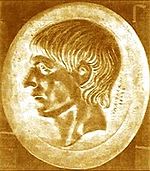 By this time, Hannibal's movements were restricted to the southwestern toe of Italy. Scipio wanted to make the war in Africa, and his great name drew to him a number of volunteers from all parts of Italy. Interestingly, among these volunteers were the shamed survivors of the fiasco at the Battle of Cannae, eager to once again prove their worth as soldiers. Scipio turned Sicily into a camp for training his army.
Scipio realized that the Carthaginian, and especially Numidian superiority in cavalry would prove decisive against the largely infantry forces of the Roman legions. In addition, a large portion of Rome's cavalry were allies of questionable loyalty, or noble equites exempting themselves from being lowly foot soldiers. One anecdote tells of how Scipio pressed into service several hundred Sicilian nobles to create a cavalry force. The Sicilians were quite opposed to this servitude to a foreign occupier (Sicily being under Roman control only since the First Punic War
), and protested vigorously. Scipio assented to their exemption from service providing they pay for a horse, equipment, and a replacement rider for the Roman Army. In this way, Scipio created a trained nucleus of cavalry for his African campaign.
The Roman Senate sent a commission of inquiry to Sicily and found Scipio at the head of a well-equipped and trained fleet and army. Scipio pressed the Senate for permission to cross into Africa. The conservative branch of the Roman Senate, championed by Fabius Maximus
, the Cunctator (Delayer), opposed the mission. Fabius still feared Hannibal's power, and viewed any mission to Africa as dangerous and wasteful to the war effort. Scipio was also harmed by some senators' disdain of his Hellenophile tastes in art, luxuries, and philosophies. The introduction (205 BC) of the Phrygia
n worship of Cybele
and the transference of the image of the goddess herself from Pessinus
to Rome
to bless the expedition may have affected public opinion against Scipio as well. All Scipio could obtain was permission to cross over from Sicily to Africa if it appeared to be in the interests of Rome, but not financial or military support.
At the commissioners' bidding, Scipio sailed in 204 BC and landed near Utica
. Carthage, meanwhile, had secured the friendship of the Numidian
Syphax, whose advance compelled Scipio to abandon the siege of Utica and dig in on the shore between there and Carthage. In 203 BC, he destroyed the combined armies of the Carthaginians and Numidians by approaching by stealth and setting fire to their camp, where the combined army became panicked and fled, when they were mostly killed by Scipio's army. Though not a "battle," both Polybius and Livy estimate that the death toll in this single attack exceeded 40,000 Carthaginian and Numidian dead, and more captured.
Historians are roughly equal in their praise and condemnation for this act. Polybius said, "of all the brilliant exploits performed by Scipio this seems to me the most brilliant and more adventurous." On the other hand, one of Hannibal's principal biographers, Theodore Ayrault Dodge
, goes so far to suggest that this attack was out of cowardice and spares no more than a page upon the event in total, despite the fact that it secured the siege of Utica and effectively put Syphax out of the war. The irony of Dodge's accusations of Scipio's cowardice is that the attack showed traces of Hannibal's penchant for ambush.
Scipio quickly dispatched his two lieutenants, Laelius and Masinissa, to pursue Syphax. They ultimately dethroned Syphax, and ensured Prince Masinissa's coronation as King of the Numidians. Carthage, and especially Hannibal himself, had long relied upon these superb natural horsemen, who would now fight for Rome against Carthage.
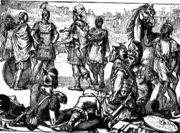 Hannibal did have a trained pool of soldiers who had fought in Italy, as well as eighty war elephants. Hannibal could boast a strength of 58,000 infantry and 6,000 cavalry, compared to Scipio's 34,000 infantry and 8,700 cavalry. The two generals met on a plain between Carthage and Utica on October 19, 202 BC, at the Battle of Zama
. Despite mutual admiration, negotiations foundered due largely to Roman distrust of the Carthaginians as a result of the Carthaginian attack on Saguntum, the breach of protocols which ended the First Punic War (known as Punic Faith), and a perceived breach in contemporary military etiquette, due to Hannibal's numerous ambushes.
Hannibal arranged his infantry in three phalangial lines designed to overlap the Roman lines. His strategy, so oft reliant upon subtle stratagems, was simple: a massive forward attack by the war elephants would create gaps in the Roman lines, which would be exploited by the infantry, supported by the cavalry.
Rather than arranging his forces in the traditional manipular lines, which put the hastati
, principes
, and triarii
in succeeding lines parallel to the enemy's line, Scipio instead put the maniples in lines perpendicular to the enemy, a stratagem designed to counter the war elephants. When the Carthaginian elephants charged, they found well laid traps before the Roman position, and were greeted by Roman trumpeters which drove many back out of confusion and fear. In addition, many elephants were goaded harmlessly through the loose ranks by the velites and other skirmishers. Roman javelins were used to good effect, and the sharp traps caused further disorder among the elephants. Many of them were so distraught that they charged back into their own lines. The Roman infantry was greatly rattled by the elephants, but Massinissa's Numidian and Laelius' Roman cavalry began to drive the opposing cavalry off the field. Both cavalry commanders pursued their routing Carthaginian counterparts, leaving the Carthaginian and Roman infantries to engage one another. The resulting infantry clash was fierce and bloody, with neither side achieving local superiority. The Roman infantry had driven off the two front lines of the Carthaginian army and in the respite, took an opportunity to drink water. The Roman army was then drawn up in one long line (as opposed to the traditional three lines) in order to match the length of Hannibal's line. Scipio's army then marched towards Hannibal's veterans, who had not yet taken part in the battle. The final struggle was bitter, and only won when the allied cavalry rallied and returned to the battle field. Charging the rear of Hannibal's army, they caused what many historians have called the "Roman Cannae".
Many Roman aristocrats, especially Cato, expected Scipio to raze that city to the ground after his victory. However, Scipio dictated extremely moderate terms in contrast to an immoderate Roman Senate. While the security of Rome was guaranteed by demands such as the surrender of the fleet, and a lasting tribute was to be paid, the strictures were sufficiently light for Carthage to regain its full prosperity. With Scipio's consent, Hannibal was allowed to become the civic leader of Carthage, which the Cato family did not forget. In contrast to his moderation towards the Carthaginians, he was cruel towards Roman and Latin deserters: the Latins were beheaded and the Romans crucified.
In 193 BC, Scipio was one of the commissioners sent to Africa to settle a dispute between Massinissa and the Carthaginians, which the commission did not achieve. This may have been because Hannibal, in the service of Antiochus III
of Syria
, might have come to Carthage to gather support for a new attack on Italy. In 190 BC, when the Romans declared war against Antiochus III, Publius offered to join his brother Lucius Cornelius Scipio Asiaticus
if the Senate entrusted the chief command to him. The two brothers brought the war to a conclusion by a decisive victory at Magnesia
in the same year.
, gained ground. When the Scipio
nes returned to Rome, two tribune
s prosecuted (187 BC) Lucius on the grounds of misappropriation of money received from Antiochus. As Lucius was in the act of producing his account-books, his brother wrested them from his hands, tore them in pieces, and flung them on the floor of the Senate house. Scipio then allegedly asked the courts why they were concerned about how 3,000 Talents had been spent and apparently unconcerned about how 15,000 Talents were entering the state coffers (the tribute that Antiochus was paying Rome after his defeat by Lucius). This high-handed act shamed the prosecution, and it appears that the case against Lucius was dismissed, though Lucius would again be prosecuted, and this time convicted, after the death of Scipio.
Scipio himself was subsequently (185 BC) accused of having been bribed by Antiochus. By reminding the people that it was the anniversary of his victory at Zama, he caused an outburst of enthusiasm in his favor. The people crowded round him and followed him to the Capitol, where they offered thanks to the gods and begged them to give Rome more citizens like Scipio Africanus. Despite the popular support that Scipio commanded, there were renewed attempts to bring him to trial, but these appear to have been deflected by his future son-in-law, Tiberius Sempronius Gracchus, the Elder
. It is supposedly in gratitude for this act that Scipio betrothed his youngest daughter Cornelia Africana Minor
(then aged about 5) to Gracchus, several decades her senior. (However, no contemporaneous references to this event exist; what is known is that Gracchus did marry Cornelia, aged about 18, in 172 BC.)
Scipio retired to his country seat at Liternum
on the coast of Campania
. He lived there for the rest of his life, revealing his great magnanimity by attempting to prevent the ruin of the exiled Hannibal by Rome. He died probably in 183 BC (the actual year and date of his death is unknown) aged about 53. His death is said to have taken place under suspicious circumstances, and it is possible that he either died of the lingering effects of the fever contracted while on campaign in 190 BC, or that he took his own life for causes unknown. He is said to have demanded that his body be buried away from his ungrateful city, and the Emperor Augustus
is said to have visited his tomb in Liternum more than 150 years later. However, it is not certain that he was actually buried at Liternum, and no contemporary accounts of his death or funeral exist. It is said that he ordered an inscription on his tomb: "Ingrata patria, ne ossa quidem habebis"—ungrateful fatherland, you will not even have my bones.
Coincidentally, his great rival Hannibal died in Bithynia
in the same year or shortly thereafter, also an exile (albeit far from his native city and not by his own decision), pursued and harassed to the end by Romans such as Titus Quinctius Flamininus
.
), daughter of the consul Lucius Aemilius Paullus who fell at Cannae and sister of another consul Lucius Aemilius Paulus Macedonicus
, he had a happy and fruitful marriage. Aemilia Paulla had unusual freedom and wealth for a patrician married woman, and she was an important role model for many younger Roman woman, just as her youngest daughter Cornelia, Mother of the Gracchi, would be an important role model for many Late Republican Roman noblewomen, including allegedly, the mother of Julius Caesar.
At his death, Scipio Africanus had two living sons. Both rose to become praetors in 174 BC, but took no further part in public life; both died unmarried, relatively young. Publius
, the elder son and heir, adopted his first cousin — Aemilius Paullus (b. 185 BC) as Publius Cornelius Scipio Aemilianus (also known as Scipio Aemilianus Africanus
) well before the Battle of Pydna
in 168 BC.
Scipio and Aemilia Paulla also had two surviving daughters. The elder, Cornelia, married her second cousin Publius Cornelius Scipio Nasica Corculum
(son of the consul of 191 BC who was himself son of Scipio's elder paternal uncle Gnaeus Cornelius Scipio Calvus). This son-in-law was a distinguished Roman in his own right. He became consul (abdicating or resigning in 162 BC for religious reasons, then being re-elected in 155 BC), censor in 159 BC, Princeps Senatus, and died as Pontifex Maximus in 141 BC. Scipio Nasica rose to many of the dignities enjoyed by his late father-in-law, and was noted for his staunch (if ultimately futile) opposition to Cato the Censor over the fate of Carthage from about 157 to 149 BC. They had at least one surviving son (of whom more below).
The younger daughter was more famous in history; Cornelia Africana
, the young wife of the elderly Tiberius Gracchus Major
or Tiberius Sempronius Gracchus, tribune of the plebs, praetor, then consul 177 (then censor and consul again), became the mother of 12 children, the only surviving sons being the famous Tiberius Gracchus
and Gaius Gracchus
. All three surviving children of this union were ill-fated; the brothers Gracchi died relatively young, murdered or forced to commit suicide by more conservative relatives. The eldest child and only surviving daughter, Sempronia
, was married to her mother's first cousin (and her own cousin by adoption) Scipio Aemilianus Africanus
. The couple had no children, and Sempronia grew to hate her husband after he condoned the murder of her brother Tiberius in 132 BC. Scipio's mysterious death in 129 BC, at the age of 56, was blamed by some on his wife, and by others on his political rivals.
Scipio's only descendants living through the late Republican period were the descendants of his two daughters, his sons having died without legitimate surviving issue. His younger daughter's last surviving child Sempronia
, wife and then widow of Scipio Aemilianus, was alive as late as 102 BC. Another descendant was his great-great-granddaughter, Fulvia
Flacca Bambula, the only grandchild of Gaius Gracchus
, best known as the wealthy third wife of Roman
Triumvir Mark Antony
who abandoned her for Cleopatra. Fulvia left several children, of whom at least one, Iullus Antonius
, is known to have left issue surviving into the first century AD.
His other known grandson Publius Cornelius Scipio Nasica Serapio
was far more conservative than his Gracchi cousins. He and his descendants all became increasingly conservative, in stark contrast to the father and grandfathers. Scipio Africanus's eldest grandson Publius Cornelius Scipio Nasica Serapio
became consul in 138, murdered his own cousin Tiberius Sempronius Gracchus
(163–132 BC) in 132. Scipio Nasica Serapio, although Pontifex Maximus
was sent to Asia Minor by the Senate to escape the wrath of the Gracchi supporters, and died mysteriously there in Pergamum, and is believed to have been poisoned by an agent of the Gracchi.
Serapio's son, the fourth Scipio Nasica, was even more conservative, and rose to be consul in 111 BC. This Scipio Nasica's sons became praetors only shortly before the Marsic or Social War (starting 91 BC). However, a grandson (adopted into the plebeian-noble Caecilii Metelli) became the Metellus Scipio who allied himself with Pompey the Great and Cato the Younger
, and who opposed Julius Caesar
. Metellus Scipio was the last Scipio to distinguish himself militarily or politically.
None of Scipio's descendants, apart from Scipio Aemilianus—his wife's nephew who became his adoptive grandson—came close to matching his political career or his military successes.
It is not clear how the consul Publius Cornelius Scipio Salvito
(a former husband of Scribonia
, second wife of Octavian aka Augustus Caesar, and mother of his only legitimate child Julia the Elder
) was related to Scipio Africanus.
(a friend of the family) were present at the Tomb of the Scipios when he visited it.
. As a result, contemporary accounts of his life, particularly his childhood and youth, are virtually non-existent. Even Plutarch's account of Scipio's life, written much later, has been lost. What remains are accounts of his doings in Polybius, Livy's Histories (which say little about his private life), supplemented with the surviving histories of Appian and Cassius Dio, and the odd anecdote in Valerius Maximus. Of these, Polybius was the closest to Scipio Africanus in age and in connections, but his narrative may be biased by his friendship with Scipio's close relatives.
, wrote his own memoirs in Greek and became also noted for his introduction of the clean shaven face fashion among the Romans according to the example of Alexander the Great. This men´s fashion lasted until the time of emperor Hadrian
and then was revived again by Constantine the Great.
He also enjoyed the reputation of being a graceful orator, the secret of his sway being his deep self confidence and radiant sense of fairness.
To his political opponents, he was often harsh and arrogant, but towards others singularly gracious and sympathetic. According to Gellmus, his life was written by Oppius and Hyginus
, and also, it was said, by Plutarch
.
His Graecophile lifestyle, and his unconventional way of wearing the Roman toga, raised much opposition among the conservatives of Rome, led by Cato the Elder
who felt that Greek influence was destroying old Roman culture and making the Roman men effeminate. Cato, as a loyalist of Fabius Maximus
, had been sent out as quaestor to Scipio in Sicily circa 204 BC to investigate charges of military indiscipline, corruption, and other offense against Scipio; none of those charges were found true by the tribunes of the plebs accompanying Cato. (It may or may not be significant that years later, as censor, Cato degraded Scipio's brother Scipio Asiaticus
from the Senate. It is certainly true that some Romans of the day viewed Cato as a representative of the old Romans, and Scipio and his like as Graecophiles.)
He often visited the temple of Jupiter and made offerings there. There was a belief that he was a special favourite of heaven and actually communicated with the gods. It is quite possible that he himself honestly shared this belief. However, the strength of this belief is evident, even a generation later when his adopted grandson, Publius Aemilianus Scipio
was elected to the consulship from the office of tribune. His rise was spectacular and letters survive from soldiers under his command in Hispania show that they believed that he possessed the same abilities as his grandfather. The elder Scipio was a spiritual man as well as a soldier and statesman, and was a priest of Mars. The ability which he is supposed to have been possessed of, is called by the old name, "second sight", and he is supposed to have had prescient dreams in which he saw the future. Livy
describes this belief as it was perceived then, without offering his opinion as to its veracity. Polybius made a case that Scipio's successes resulted from good planning, rational thinking and intelligence, which he said was a higher sign of the Gods favour than prophetic dreams. Polybius suggested people had only suggested Scipio had supernatural powers as they had not appreciated the natural mental gifts which facilitated Scipio's achievements.
, writing in the first century AD, alleged that Scipio Africanus had a weakness for beautiful women, and knowing this, some of his soldiers presented him with a beautiful young woman captured in New Carthage. The woman turned out to be the fiancée of an important Iberian chieftain, and Scipio chose to act as a general and not an ordinary soldier in restoring her, virtue and ransom intact, to her fiancé.
According to Valerius Maximus, Scipio had a dalliance circa 191 BC with one of his own serving girls, which his wife magnanimously overlooked. The affair, if it lasted from circa 191 BC to Scipio's death 183 BC, might have resulted in issue (not mentioned); what is mentioned is that the girl was freed by Aemilia Paulla after Scipio's death and married to one of his freedmen. This account is only found in Valerius Maximus (Memorable Deeds and Sayings 6.7.1-3. L) writing in the 1st century AD, some decades after Livy. If this is correct, clearly Scipio did not hesitate to sleep with his female slaves, like so many other Roman masters. It should be noted however that Valerius Maximus is hostile to Scipio Africanus in other matters such as his frequent visits to the Temple of Jupiter Capitolinus, which Maximus saw as "fake religion." Plutarch
, a Greek historian writing about Roman morality, saw similar conduct not as an example of a husband's immorality, but rather of a husband seeking to spare his wife his debauchery.
as the second among military commanders, confessed that had he beaten Scipio he should have put himself before either of them—though this particular story was probably fabricated by Livy
at a later date.
Metellus Scipio, a descendant of Scipio, commanded legions against Julius Caesar
in Africa until his defeat at the battle of Thapsus
in 49 BC. Popular superstition was that only a Scipio could win a battle in Africa, so Julius Caesar assigned a distant relative of Metellus to his staff in order to say that he too had a Scipio fighting for him.
for Rome, although the two Iberian provinces were not fully pacified for a couple of centuries. His defeat of Hannibal at Zama paved the way for Carthage's eventual destruction in 146 BC. His interest in a Graecophile lifestyle had tremendous influence on the Roman elite; more than a century later, even the conservative Cato Uticensis (great-grandson of the elder Cato) espoused Greek philosophy. Scipio did not introduce Greek ideas or art to the Romans, but his ardent support for the Greek way of life coupled with his own charisma had its inevitable impact. Less beneficially, the Scipios may have led the way in the inevitable chasm that grew up between the Roman elite and the Roman masses, in terms of the way the elite was educated and lived and in the amount of wealth they possessed.
Scipio supported land distribution for his veterans in a tradition harking back to the earliest days of the Republic; yet, his actions were seen as somewhat radical by conservatives. In being a successful general who demanded lands for his soldiers, Scipio may have led the way for later generals such as Gaius Marius
and Julius Caesar
. Yet, Scipio was no Marius nor Caesar. While he did not always respect the mos maiorum
or the decisions of the Senate or certain elected magistrates, he did not seek to use his charisma and reputation to weaken the Republic. (To be fair, the Middle Republic was not as weak as the Late Republic which suffered from massive corruption among the elite, major military threats from the Germans as well as the Gauls and to a lesser extent, Jugurtha
, as well as widening social and economic inequities.) The true measure of Scipio's character in this regard can perhap been seen by his behaviour shortly after returning in triumph from Africa to a grateful Rome. Scipio refused to accept demands for him to become perpetual consul and dictator. For his self restraint in putting the good of the republic ahead of his own gain, Scipio was praised by Livy for showing uncommon greatness of mind - an example conspicuously not emulated by Marius, Sulla or Caesar.
' Punica
. Cicero was mentored by prominent Romans whose ancestors had been associated with Scipio. As a Roman hero, Scipio appeared in Book VI of the Aeneid
where he is shown to Aeneas
in a vision in the underworld. Scipio figures prominently in Livy's "Ab Urbe Condita".
's Divine Comedy: in "Inferno" - Canto XXXI, in "Purgatorio" - Canto XXIX, and in "Paradiso" - Cantos VI and XXVII.
's Latin epic
Africa
. 'The Continence [i.e. moderation] of Scipio' was a stock motif in exemplary literature and art, as was the 'Dream of Scipio', portraying his allegorical choice between Virtue and Luxury. The Continence of Scipio, depicting his clemency and sexual restraint after the fall of Carthago Nova, was an even more popular subject. Versions of the subject were painted by many artists from the Renaissance through to the 19th century, including Andrea Mantegna
and Nicholas Poussin. Scipio is also mentioned in Machiavelli's work The Prince
(Chapter XVII "Concerning Cruelty And Clemency, And Whether It Is Better To Be Loved Than Feared"). Milton
mentions Scipio in Book 9 of Paradise Lost
and in Book 3 of Paradise Regained
.
, Leonardo Vinci
, and Carlo Francesco Pollarolo
. The march from Handel's setting, entitled Scipione
, remains the regimental slow march
of the British Grenadier Guards
. Scipio is also referenced in the Italian national anthem
.
's invasion of Ethiopia
, Benito Mussolini
commissioned an epic film depicting the exploits of Scipio. Scipione l'africano
, written by Carmine Gallone
, won the Mussolini Cup for the greatest Italian film at the 1937 Venice Film Festival
.
In 1971 Luigi Magni
scripted and directed the movie "Scipione, detto anche l'Africano" (Scipio, aka "the African"), starring Marcello Mastroianni
, Vittorio Gassman
, Silvana Mangano
and Woody Strode
, in which the historical events are portrayed in a light and satirical mode, with some intentional references to the political events of the time in which the movie was made.
Jim Thalman wrote and starred in the 2006 film The Secret Under the Rose about the Second Punic War
.
Second Punic War
The Second Punic War, also referred to as The Hannibalic War and The War Against Hannibal, lasted from 218 to 201 BC and involved combatants in the western and eastern Mediterranean. This was the second major war between Carthage and the Roman Republic, with the participation of the Berbers on...
and statesman of the Roman Republic
Roman Republic
The Roman Republic was the period of the ancient Roman civilization where the government operated as a republic. It began with the overthrow of the Roman monarchy, traditionally dated around 508 BC, and its replacement by a government headed by two consuls, elected annually by the citizens and...
. He was best known for defeating Hannibal at the final battle of the Second Punic War at Zama
Battle of Zama
The Battle of Zama, fought around October 19, 202 BC, marked the final and decisive end of the Second Punic War. A Roman army led by Publius Cornelius Scipio Africanus defeated a Carthaginian force led by the legendary commander Hannibal...
, a feat that earned him the agnomen
Agnomen
An agnomen , in the Roman naming convention, was a nickname, just as the cognomen was initially. However, the cognomina eventually became family names, so agnomina were needed to distinguish between similarly named persons...
Africanus, the nickname "the Roman Hannibal", as well as recognition as one of the finest commanders in military history. An earlier great display of his tactical abilities had come already at the Battle of Ilipa
Battle of Ilipa
The Battle of Ilipa in 206 BC was considered Scipio Africanus’s most brilliant victory in his military career during the Second Punic War. Though it may not seem to be as original as Hannibal’s tactic at Cannae, Scipio’s pre-battle maneuver and his Reverse Cannae formation was still a culmination...
.
Early years
Publius Cornelius Scipio, later Africanus from his victory at the Battle of ZamaBattle of Zama
The Battle of Zama, fought around October 19, 202 BC, marked the final and decisive end of the Second Punic War. A Roman army led by Publius Cornelius Scipio Africanus defeated a Carthaginian force led by the legendary commander Hannibal...
, the founder of the Africanus branch of the Cornelii Scipiones, was born by Caesarian section into the Scipio
Scipio (cognomen)
Scipio is a Roman cognomen representing the Cornelii Scipiones, a branch of the Cornelii family. Any individual male of the branch must be named Cornelius Scipio and a female Cornelia. The nomen, Cornelius, signifies that the person belongs to the Cornelia gens, a legally defined clan composed of...
branch of the Cornelia gens. The birth year is calculated from a series of statements made by multiple ancient historians of how old he was when certain events in his life occurred. The statements all seem to agree or be reconcilable: if he was 17 when he led a charge to his father's rescue at the Battle of Ticinus
Battle of Ticinus
The Battle of Ticinus was a battle of the Second Punic War fought between the Carthaginian forces of Hannibal and the Romans under Publius Cornelius Scipio in November 218 BC. The battle took place in the flat country of Pavia county on the right bank of the Ticino River not far north from its...
(218 BC), and 24 when he volunteered to take over the army in Hispania when no one else would (211 BC), after the defeat and death there of his uncle and father, the two consuls, and 27 when he led a victorious campaign against the city of New Carthage on the coast of Hispania (209 BC), then he must have been born in 236/5, usually stated as 236 BC. The year was 517 from the foundation of Rome
Ab urbe condita
Ab urbe condita is Latin for "from the founding of the City ", traditionally set in 753 BC. AUC is a year-numbering system used by some ancient Roman historians to identify particular Roman years...
.
The extended family that brought him into the world and raised and educated him was patrician, with a record of successful public service in the highest offices (these entailed per se both military and civilian duties) extending back at least to the early Roman Republic
Roman Republic
The Roman Republic was the period of the ancient Roman civilization where the government operated as a republic. It began with the overthrow of the Roman monarchy, traditionally dated around 508 BC, and its replacement by a government headed by two consuls, elected annually by the citizens and...
. Before then the historical trail is lost, although the family may have known what it was. Several ancestors had been consuls successively, and his great-grandfather, Lucius Cornelius Scipio Barbatus
Lucius Cornelius Scipio Barbatus
Lucius Cornelius Scipio Barbatus was one of the two elected Roman consuls in 298 BC. He led the Roman army to victory against the Etruscans near Volterra...
, had been patrician censor
Censor (ancient Rome)
The censor was an officer in ancient Rome who was responsible for maintaining the census, supervising public morality, and overseeing certain aspects of the government's finances....
in 280 BC. The Cornelii were counted among the six major patrician families—the others being the Manlii, the Fabii
Fabius
The gens Fabia was one of the most ancient patrician families at Rome. The gens played a prominent part in history soon after the establishment of the Republic, and three brothers are said to have been invested with seven successive consulships, from BC 485 to 479...
, the Aemilii, the Claudii
Claudius (gens)
The gens Claudia, sometimes written Clodia, was one of the most prominent patrician houses at Rome. The gens traced its origin to the earliest days of the Roman Republic...
, and the Valerii
Valerius
Valerius is the nomen of gens Valeria, one of the oldest patrician families of Rome. The name was in use throughout Roman history...
—and at the time Scipio Africanus lived, the Scipiones were probably its most prominent branch, at least in the hindsight of the historians, who have only glowing reports of his family and career. He was unquestionably one of the leading characters of Roman history.
Scipio was the second oldest son of Publius Cornelius Scipio
Publius Cornelius Scipio
Publius Cornelius Scipio was a general and statesman of the Roman Republic.A member of the Corneliagens, Scipio served as consul in 218 BC, the first year of the Second Punic War, and sailed with an army from Pisa to Massilia , with the intention of arresting Hannibal's advance on Italy...
, praetor and consul by his wife Pomponia
Pomponia
Pomponia is the female name for the gens Pomponius of Ancient Rome. This family was one of the oldest families in Rome. Various women bearing this name, of whom five are named below, lived during the Middle and Late Roman Republic and the Roman Empire. The oldest known Pomponia was mother of a...
, who was of a prominently knightly and plebeian family. He had an older brother, Lucius Cornelius Scipio Asiaticus, and a friend since boyhood, Gaius Laelius
Gaius Laelius
Gaius Laelius — also Caius Lelius — general and statesman, was a friend of Scipio Africanus, whom he accompanied on his Iberian campaign...
, who served with him in the military and whom the historian, Polybius
Polybius
Polybius , Greek ) was a Greek historian of the Hellenistic Period noted for his work, The Histories, which covered the period of 220–146 BC in detail. The work describes in part the rise of the Roman Republic and its gradual domination over Greece...
, was able to question concerning the life and character of the great man after his death.
Early military service
Scipio's childhood might be considered to have come to an end with his entry into the army. At an early age, Scipio joined the Roman struggle against CarthageCarthage
Carthage , implying it was a 'new Tyre') is a major urban centre that has existed for nearly 3,000 years on the Gulf of Tunis, developing from a Phoenician colony of the 1st millennium BC...
in the Second Punic War
Second Punic War
The Second Punic War, also referred to as The Hannibalic War and The War Against Hannibal, lasted from 218 to 201 BC and involved combatants in the western and eastern Mediterranean. This was the second major war between Carthage and the Roman Republic, with the participation of the Berbers on...
. At some point, he is said to have promised his father to continue the struggle against Carthage all his life, showing similar dedication to that of his enemy, Hannibal. The young Scipio survived the disastrous battles at Ticinus
Battle of Ticinus
The Battle of Ticinus was a battle of the Second Punic War fought between the Carthaginian forces of Hannibal and the Romans under Publius Cornelius Scipio in November 218 BC. The battle took place in the flat country of Pavia county on the right bank of the Ticino River not far north from its...
, Trebia, and Cannae
Battle of Cannae
The Battle of Cannae was a major battle of the Second Punic War, which took place on August 2, 216 BC near the town of Cannae in Apulia in southeast Italy. The army of Carthage under Hannibal decisively defeated a numerically superior army of the Roman Republic under command of the consuls Lucius...
. According to Polybius, he saved his father's
Publius Cornelius Scipio
Publius Cornelius Scipio was a general and statesman of the Roman Republic.A member of the Corneliagens, Scipio served as consul in 218 BC, the first year of the Second Punic War, and sailed with an army from Pisa to Massilia , with the intention of arresting Hannibal's advance on Italy...
life when he was 18, by "charging the encircling force alone with reckless daring" at the Battle of Ticinus.
Scipio's would-be father-in-law Lucius Aemilius Paullus was killed in 216 BC at the third of these battles, the Battle of Cannae. Despite these defeats at the hands of the Carthaginians
Carthage
Carthage , implying it was a 'new Tyre') is a major urban centre that has existed for nearly 3,000 years on the Gulf of Tunis, developing from a Phoenician colony of the 1st millennium BC...
, Scipio remained focused on securing Roman victory. Scipio was never again to see a Roman force defeated, for once given command at the age of 25 he never lost a battle.
On hearing that Lucius Caecilius Metellus and other politicians were at the point of surrender, Scipio gathered with his followers and stormed into the meeting, where at sword-point he forced all present to swear that they would continue in faithful service to Rome. Fortunately, the Roman Senate
Roman Senate
The Senate of the Roman Republic was a political institution in the ancient Roman Republic, however, it was not an elected body, but one whose members were appointed by the consuls, and later by the censors. After a magistrate served his term in office, it usually was followed with automatic...
was of like mind and refused to entertain thoughts of peace despite the great losses Rome had taken in the war—approximately one-fifth of the men of military age had died within a few years.
He is also thought to have consulted with, or at least informed his mother before deciding to run for quaestor
Quaestor
A Quaestor was a type of public official in the "Cursus honorum" system who supervised financial affairs. In the Roman Republic a quaestor was an elected official whereas, with the autocratic government of the Roman Empire, quaestors were simply appointed....
, the most junior magistrate who was entitled to enter the Senate. Scipio ran for this office at the age of 24 and offered in 211 BC to then take over command in Hispania where he found the enemy west of the Ebro river. Scipio offered himself as a candidate for the quaestorship in the year 213 BC, apparently to assist his less popular cousin, Lucius Cornelius, who was also standing for election. The Tribunes of the Plebs (elected representatives from the Plebeian Assembly) objected to his candidacy, saying that he could not be allowed to stand because he had not yet reached the legal age (curule aediles were automatically entitled to enter the Senate and the legal age for Senate membership was 30). Scipio, already known for his bravery and patriotism, was elected unanimously and the Tribunes abandoned their opposition.
Campaign in Hispania
Gnaeus Cornelius Scipio Calvus
Gnaeus Cornelius Scipio Calvus was a Roman general and statesman.His father was Lucius Cornelius Scipio, son of the patrician censor of 280, Lucius Cornelius Scipio Barbatus. His younger brother was Publius Cornelius Scipio, father of the most famous Scipio – Scipio Africanus...
, were killed in battle against Hannibal's brother, Hasdrubal Barca
Hasdrubal Barca
Hasdrubal was Hamilcar Barca's second son and a Carthaginian general in the Second Punic War. He was a younger brother of the much more famous Hannibal.-Youth and Iberian leadership:...
. In the following year, Scipio offered himself for the command of the new army which the Romans resolved to send to Hispania
Hispania
Another theory holds that the name derives from Ezpanna, the Basque word for "border" or "edge", thus meaning the farthest area or place. Isidore of Sevilla considered Hispania derived from Hispalis....
. In spite of his youth, his noble demeanor and enthusiastic language had made so great an impression that he was unanimously elected to be sent there as proconsul
Proconsul
A proconsul was a governor of a province in the Roman Republic appointed for one year by the senate. In modern usage, the title has been used for a person from one country ruling another country or bluntly interfering in another country's internal affairs.-Ancient Rome:In the Roman Republic, a...
. According to Livy
Livy
Titus Livius — known as Livy in English — was a Roman historian who wrote a monumental history of Rome and the Roman people. Ab Urbe Condita Libri, "Chapters from the Foundation of the City," covering the period from the earliest legends of Rome well before the traditional foundation in 753 BC...
, Scipio was the only man brave enough to ask for this position, and no other candidates wanted the responsibility, considering it a death sentence. In the year of Scipio's arrival (210 BC), all of Hispania south of the Ebro
Ebro
The Ebro or Ebre is one of the most important rivers in the Iberian Peninsula. It is the biggest river by discharge volume in Spain.The Ebro flows through the following cities:*Reinosa in Cantabria.*Miranda de Ebro in Castile and León....
river was under Carthaginian control. Hannibal's brothers Hasdrubal and Mago
Mago Barca
Mago, son of Hamilcar Barca, also spelled Magon, Phoenician MGN, "God sent" , was a member of the Barcid family, and played an important role in the Second Punic War, leading forces of Carthage against the Roman Republic in Hispania, Gallia Cisalpina and Italy...
, and Hasdrubal Gisco
Hasdrubal Gisco
Hasdrubal Gisco or Hasdrubal son of Gisco was a Carthaginian general who fought against Rome in Iberia and North Africa during the Second Punic War. He should not be confused with Hasdrubal Barca, the brother of Hannibal....
were the generals of the Carthaginian forces in Hispania, and Rome was aided by the inability of these three figures to act in concert. The Carthaginians were also preoccupied with revolts in Africa.
Scipio landed at the mouth of the Ebro
Ebro
The Ebro or Ebre is one of the most important rivers in the Iberian Peninsula. It is the biggest river by discharge volume in Spain.The Ebro flows through the following cities:*Reinosa in Cantabria.*Miranda de Ebro in Castile and León....
and was able to surprise and capture Carthago Nova (New Carthage), the headquarters of the Carthaginian power in Hispania. He obtained a rich cache of war stores and supplies, and an excellent harbor and base of operations. Scipio's humanitarian conduct toward prisoners and hostages in Hispania helped in portraying the Romans as liberators as opposed to conquerors. Livy tells the story of the capture of a beautiful woman by his troops, who offered her to Scipio as a prize of war. Scipio was astonished by her beauty, but discovered that the woman was betrothed to a Celtiberian chieftain named Allucius
Allucius
Allucius was a prince of the Celtiberi people of northern Europe around the 3rd century BC. The story told of him by Livy and other writers was that he was betrothed to a beautiful virgin who was taken prisoner by Scipio Africanus in Spain in 209 BC. The woman's fiance, who soon married her,...
. He returned her to her fiancé, along with the money that had been offered by her parents to ransom her. While Scipio was long known for his great chivalry, Scipio doubtless also realized that the Senate's first priority was the war in Italy, and in the midst of the Carthaginian base in Hispania, he was to be outnumbered without much hope of reinforcement. It was paramount therefore that Scipio cooperate with local chieftains to both supply and reinforce his small army. The woman's fiance, who soon married her, naturally brought over his tribe to support the Roman armies.
In 209 BC, Scipio fought his first set piece battle
Set piece
Set piece may refer to:* Set piece , an elaborate sequence which sees either a chase, fight, or other action taking place in an original and memorable way...
, driving back Hasdrubal Barca from his position at Baecula
Battle of Baecula
The Battle of Baecula was Scipio Africanus’s first major field battle after he had taken command of Roman interests in Iberia during the Second Punic War, in which he routed the Carthaginian army under the command of Hasdrubal Barca.-Prelude:...
on the upper Guadalquivir
Guadalquivir
The Guadalquivir is the fifth longest river in the Iberian peninsula and the second longest river to be its whole length in Spain. The Guadalquivir is 657 kilometers long and drains an area of about 58,000 square kilometers...
. Scipio feared that the armies of Mago and Gisco would enter the field and surround his small army. Scipio's objective was, therefore, to quickly eliminate one of the armies to give him the luxury of dealing with the other two piecemeal. The battle was decided by a determined Roman infantry charge up the center of the Carthaginian position. Roman losses are uncertain but may have been considerable in light of an effort by the infantry to scale an elevation defended by Carthaginian light infantry. Scipio then orchestrated a frontal attack by the rest of his infantry to draw out the remainder of the Carthaginian forces.
Hasdrubal had not noticed Scipio's hidden reserves of cavalry moving behind enemy lines, and a Roman cavalry charge created a double envelopment on either flank led by cavalry commander Gaius Laelius
Gaius Laelius
Gaius Laelius — also Caius Lelius — general and statesman, was a friend of Scipio Africanus, whom he accompanied on his Iberian campaign...
and Scipio himself. This broke the back of Hasdrubal's army and routed his forces — an impressive feat for the young Roman versus the veteran Carthaginian general. Despite a Roman victory, Scipio was unable to hinder the Carthaginian march to Italy. Much historical criticism has been leveled at his inability to effectively pursue Hasdrubal, who would eventually cross the Alps only to be defeated by Gaius Claudius Nero
Gaius Claudius Nero
Gaius Claudius Nero was a Roman consul who fought in the Battle of the Metaurus . He was member of the gens Claudia. He is not to be confused with the Roman Emperor Nero.In 207 BC, the thirteenth year of the war, he was elected consul with Marcus Livius Salinator, and with his colleague he led the...
at the Battle of the Metaurus
Battle of the Metaurus
The Battle of the Metaurus was a pivotal battle in the Second Punic War between Rome and Carthage, fought in 207 BC near the Metauro River in present-day Italy. The battle gets a chapter in the classic The Fifteen Decisive Battles of the World by Sir Edward Shepherd Creasy...
.
One popular theory for Scipio's failure to pursue Hasdrubal is that Scipio merely wanted the glory of securing Hispania, and an extended mountain campaign would have endangered that. Others cite the Roman soldiers' appetite for plunder as preventing him from rallying in pursuit. The most probable explanation from a strategic standpoint is Scipio's unwillingness to risk being trapped between Hasdrubal's army on one side and one or both of Gisgo's and Mago's armies, both of superior numerical strength. Mere days after Hasdrubal's defeat, Mago and Gisgo were able to converge in front of the Roman positions, bringing into question what would have happened had Scipio pursued Hasdrubal.
After winning over a number of Hispanian chiefs (namely Indibilis and Mandonius
Indibilis and Mandonius
] Indibilis and Mandonius were chieftains of the Ilergetes , an ancient Iberian people of the Iberian Peninsula. Polybius speaks of the brothers as the most influential and powerful of the Spanish chieftains in that time period. Livy calls one of the chieftains of the Ilergetes "Indibilis",...
), Scipio achieved a decisive victory in 206 BC over the full Carthaginian levy at Ilipa
Battle of Ilipa
The Battle of Ilipa in 206 BC was considered Scipio Africanus’s most brilliant victory in his military career during the Second Punic War. Though it may not seem to be as original as Hannibal’s tactic at Cannae, Scipio’s pre-battle maneuver and his Reverse Cannae formation was still a culmination...
(now the city of Alcalá del Río
Alcalá del Río
Alcalá del Río is a municipality in Seville, Spain. It had a population of 9,317 in 2005. It has an area of about 83 square kilometers and has a population density of 112.3 people per square kilometer. It has an altitude of 30 meters and is situated 13 kilometers away from Seville....
, near Hispalis, now called Seville
Seville
Seville is the artistic, historic, cultural, and financial capital of southern Spain. It is the capital of the autonomous community of Andalusia and of the province of Seville. It is situated on the plain of the River Guadalquivir, with an average elevation of above sea level...
), which resulted in the evacuation of Hispania by the Punic commanders.
After his rapid success in conquering Hispania, and with the idea of striking a blow at Carthage in Africa
North Africa during the Classical Period
The history of North Africa during the period of Classical Antiquity can be divided roughly into the History of Egypt in the east and the history of Ancient Libya in the west. The Roman Republic established the province of Africa in 146 BC after the defeat of Carthage...
, Scipio paid a short visit to the Numidia
Numidia
Numidia was an ancient Berber kingdom in part of present-day Eastern Algeria and Western Tunisia in North Africa. It is known today as the Chawi-land, the land of the Chawi people , the direct descendants of the historical Numidians or the Massyles The kingdom began as a sovereign state and later...
n princes Syphax
Syphax
Syphax was a king of the ancient Algerian tribe Masaesyli of western Numidia during the last quarter of the 3rd century BC. His story is told in Livy's Ab Urbe Condita .-Biography:...
and Massinissa. Numidia was of vital importance to Carthage, supplying both mercenaries and allied forces. In addition to supplying the Numidian cavalry
Numidian cavalry
Numidian cavalry was a type of light cavalry developed by the Numidians, most notably used by Hannibal during the Second Punic War. They were described by the Roman historian Livy as "by far the best horsemen in Africa."...
(on which see the Battle of Cannae
Battle of Cannae
The Battle of Cannae was a major battle of the Second Punic War, which took place on August 2, 216 BC near the town of Cannae in Apulia in southeast Italy. The army of Carthage under Hannibal decisively defeated a numerically superior army of the Roman Republic under command of the consuls Lucius...
), Numidia operated as a buffer for vulnerable Carthage. Scipio managed to receive support from both Syphax and Massinissa. Syphax later changed his mind, married the beautiful Carthaginian noblewoman Sophonisba
Sophonisba
Sophonisba was a Carthaginian noblewoman who lived during the Second Punic War, and the daughter of Hasdrubal Gisco Gisgonis...
, daughter of Hasdrubal the son of Gisco, and fought alongside his Carthaginian in-laws against Massinissa and Scipio in Africa.
On his return to Hispania, Scipio had to quell a mutiny at Sucro
Mutiny at Sucro
The Roman army's mutiny at Sucro, a no longer existing ancient fort in Spain, took place in early 206 BC, during the Roman conquest of Hispania in the Second Punic War against Carthage. The mutineers had several grievances, including not having received the pay due to them and being under-supplied...
which had broken out among his troops. Hannibal's brother Hasdrubal had meanwhile marched for Italy, and in 206 BC Scipio himself, having secured the Roman occupation of Hispania by the capture of Gades
Cádiz
Cadiz is a city and port in southwestern Spain. It is the capital of the homonymous province, one of eight which make up the autonomous community of Andalusia....
, gave up his command and returned to Rome.
African Campaign
In 205 BC, Scipio was unanimously elected to the consulRoman consul
A consul served in the highest elected political office of the Roman Republic.Each year, two consuls were elected together, to serve for a one-year term. Each consul was given veto power over his colleague and the officials would alternate each month...
ship at the age of 31. Scipio intended to go to Africa
Africa
Africa is the world's second largest and second most populous continent, after Asia. At about 30.2 million km² including adjacent islands, it covers 6% of the Earth's total surface area and 20.4% of the total land area...
, but some people in the Senate were envious of him and only let him to go to Sicily
Sicily
Sicily is a region of Italy, and is the largest island in the Mediterranean Sea. Along with the surrounding minor islands, it constitutes an autonomous region of Italy, the Regione Autonoma Siciliana Sicily has a rich and unique culture, especially with regard to the arts, music, literature,...
and did not give him an army. Even so, Scipio started a volunteer army when he was in Sicily.
Scipio realized that the Carthaginian, and especially Numidian superiority in cavalry would prove decisive against the largely infantry forces of the Roman legions. In addition, a large portion of Rome's cavalry were allies of questionable loyalty, or noble equites exempting themselves from being lowly foot soldiers. One anecdote tells of how Scipio pressed into service several hundred Sicilian nobles to create a cavalry force. The Sicilians were quite opposed to this servitude to a foreign occupier (Sicily being under Roman control only since the First Punic War
First Punic War
The First Punic War was the first of three wars fought between Ancient Carthage and the Roman Republic. For 23 years, the two powers struggled for supremacy in the western Mediterranean Sea, primarily on the Mediterranean island of Sicily and its surrounding waters but also to a lesser extent in...
), and protested vigorously. Scipio assented to their exemption from service providing they pay for a horse, equipment, and a replacement rider for the Roman Army. In this way, Scipio created a trained nucleus of cavalry for his African campaign.
The Roman Senate sent a commission of inquiry to Sicily and found Scipio at the head of a well-equipped and trained fleet and army. Scipio pressed the Senate for permission to cross into Africa. The conservative branch of the Roman Senate, championed by Fabius Maximus
Fabius Maximus
Quintus Fabius Maximus Verrucosus Cunctator was a Roman politician and general, born in Rome around 280 BC and died in Rome in 203 BC. He was Roman Consul five times and was twice Dictator in 221 and again in 217 BC. He reached the office of Roman Censor in 230 BC...
, the Cunctator (Delayer), opposed the mission. Fabius still feared Hannibal's power, and viewed any mission to Africa as dangerous and wasteful to the war effort. Scipio was also harmed by some senators' disdain of his Hellenophile tastes in art, luxuries, and philosophies. The introduction (205 BC) of the Phrygia
Phrygia
In antiquity, Phrygia was a kingdom in the west central part of Anatolia, in what is now modern-day Turkey. The Phrygians initially lived in the southern Balkans; according to Herodotus, under the name of Bryges , changing it to Phruges after their final migration to Anatolia, via the...
n worship of Cybele
Cybele
Cybele , was a Phrygian form of the Earth Mother or Great Mother. As with Greek Gaia , her Minoan equivalent Rhea and some aspects of Demeter, Cybele embodies the fertile Earth...
and the transference of the image of the goddess herself from Pessinus
Pessinus
Pessinus was a city in Anatolia, the Asian part of Turkey on the upper course of the river Sakarya River , from which the mythological King Midas is said to have ruled a greater Phrygian realm...
to Rome
Rome
Rome is the capital of Italy and the country's largest and most populated city and comune, with over 2.7 million residents in . The city is located in the central-western portion of the Italian Peninsula, on the Tiber River within the Lazio region of Italy.Rome's history spans two and a half...
to bless the expedition may have affected public opinion against Scipio as well. All Scipio could obtain was permission to cross over from Sicily to Africa if it appeared to be in the interests of Rome, but not financial or military support.
At the commissioners' bidding, Scipio sailed in 204 BC and landed near Utica
Utica, Tunisia
Utica is an ancient city northwest of Carthage near the outflow of the Medjerda River into the Mediterranean Sea, traditionally considered to be the first colony founded by the Phoenicians in North Africa...
. Carthage, meanwhile, had secured the friendship of the Numidian
Numidians
The Numidians were Berber tribes who lived in Numidia, in Algeria east of Constantine and in part of Tunisia. The Numidians were one of the earliest natives to trade with the settlers of Carthage. As Carthage grew, the relationship with the Numidians blossomed. Carthage's military used the Numidian...
Syphax, whose advance compelled Scipio to abandon the siege of Utica and dig in on the shore between there and Carthage. In 203 BC, he destroyed the combined armies of the Carthaginians and Numidians by approaching by stealth and setting fire to their camp, where the combined army became panicked and fled, when they were mostly killed by Scipio's army. Though not a "battle," both Polybius and Livy estimate that the death toll in this single attack exceeded 40,000 Carthaginian and Numidian dead, and more captured.
Historians are roughly equal in their praise and condemnation for this act. Polybius said, "of all the brilliant exploits performed by Scipio this seems to me the most brilliant and more adventurous." On the other hand, one of Hannibal's principal biographers, Theodore Ayrault Dodge
Theodore Ayrault Dodge
Theodore Ayrault Dodge was an American officer and military historian. He fought as a Union officer in the American Civil War; as a writer, he was devoted to both the Civil War and the great generals of ancient and European history....
, goes so far to suggest that this attack was out of cowardice and spares no more than a page upon the event in total, despite the fact that it secured the siege of Utica and effectively put Syphax out of the war. The irony of Dodge's accusations of Scipio's cowardice is that the attack showed traces of Hannibal's penchant for ambush.
Scipio quickly dispatched his two lieutenants, Laelius and Masinissa, to pursue Syphax. They ultimately dethroned Syphax, and ensured Prince Masinissa's coronation as King of the Numidians. Carthage, and especially Hannibal himself, had long relied upon these superb natural horsemen, who would now fight for Rome against Carthage.
War with Hannibal, the Battle of Zama
With Carthage now deserted by her allies, and surrounded by a veteran and undefeated Roman army which Dodge states was the best ever fielded, Carthage began opening diplomatic channels for negotiation. At the same time, Hannibal Barca and his army were recalled to Carthage, and despite the moderate terms offered to Carthage by Scipio, Carthage suddenly suspended negotiations and again prepared for war. The army that Hannibal returned with is a subject of much debate. Advocates for Hannibal often claim that his army was mostly Italians pressed into service from southern Italy, and that most of his elite veterans (and certainly cavalry) were spent. Scipio's advocates tend to be far more suspicious, and believe the number of veteran forces to remain significant.Battle of Zama
The Battle of Zama, fought around October 19, 202 BC, marked the final and decisive end of the Second Punic War. A Roman army led by Publius Cornelius Scipio Africanus defeated a Carthaginian force led by the legendary commander Hannibal...
. Despite mutual admiration, negotiations foundered due largely to Roman distrust of the Carthaginians as a result of the Carthaginian attack on Saguntum, the breach of protocols which ended the First Punic War (known as Punic Faith), and a perceived breach in contemporary military etiquette, due to Hannibal's numerous ambushes.
Hannibal arranged his infantry in three phalangial lines designed to overlap the Roman lines. His strategy, so oft reliant upon subtle stratagems, was simple: a massive forward attack by the war elephants would create gaps in the Roman lines, which would be exploited by the infantry, supported by the cavalry.
Rather than arranging his forces in the traditional manipular lines, which put the hastati
Hastati
Hastatii were a class of infantry in the armies of the early Roman Republic who originally fought as spearmen, and later as swordsmen. They were originally some of the poorest men in the legion, and could afford only modest equipment — light armour and a large shield, in their service as the...
, principes
Principes
Principes were spearmen, and later swordsmen, in the armies of the early Roman Republic. They were men in the prime of their lives who were fairly wealthy, and could afford decent equipment. They were the heavier infantry of the legion who carried large shields and wore good quality armour. Their...
, and triarii
Triarii
Triarii were one of the elements of the early Roman military Manipular legions of the early Roman Republic . They were the oldest and among the wealthiest men in the army, and could afford good quality equipment. They wore heavy metal armour and carried large shields, their usual position being...
in succeeding lines parallel to the enemy's line, Scipio instead put the maniples in lines perpendicular to the enemy, a stratagem designed to counter the war elephants. When the Carthaginian elephants charged, they found well laid traps before the Roman position, and were greeted by Roman trumpeters which drove many back out of confusion and fear. In addition, many elephants were goaded harmlessly through the loose ranks by the velites and other skirmishers. Roman javelins were used to good effect, and the sharp traps caused further disorder among the elephants. Many of them were so distraught that they charged back into their own lines. The Roman infantry was greatly rattled by the elephants, but Massinissa's Numidian and Laelius' Roman cavalry began to drive the opposing cavalry off the field. Both cavalry commanders pursued their routing Carthaginian counterparts, leaving the Carthaginian and Roman infantries to engage one another. The resulting infantry clash was fierce and bloody, with neither side achieving local superiority. The Roman infantry had driven off the two front lines of the Carthaginian army and in the respite, took an opportunity to drink water. The Roman army was then drawn up in one long line (as opposed to the traditional three lines) in order to match the length of Hannibal's line. Scipio's army then marched towards Hannibal's veterans, who had not yet taken part in the battle. The final struggle was bitter, and only won when the allied cavalry rallied and returned to the battle field. Charging the rear of Hannibal's army, they caused what many historians have called the "Roman Cannae".
Many Roman aristocrats, especially Cato, expected Scipio to raze that city to the ground after his victory. However, Scipio dictated extremely moderate terms in contrast to an immoderate Roman Senate. While the security of Rome was guaranteed by demands such as the surrender of the fleet, and a lasting tribute was to be paid, the strictures were sufficiently light for Carthage to regain its full prosperity. With Scipio's consent, Hannibal was allowed to become the civic leader of Carthage, which the Cato family did not forget. In contrast to his moderation towards the Carthaginians, he was cruel towards Roman and Latin deserters: the Latins were beheaded and the Romans crucified.
Return to Rome
Scipio was welcomed back to Rome in triumph with the agnomen of Africanus. He refused the many further honours which the people would have thrust upon him such as Consul for life and Dictator. In the year 199 BC, Scipio was elected Censor and for some years afterwards he lived quietly and took no part in politics.In 193 BC, Scipio was one of the commissioners sent to Africa to settle a dispute between Massinissa and the Carthaginians, which the commission did not achieve. This may have been because Hannibal, in the service of Antiochus III
Antiochus III the Great
Antiochus III the Great Seleucid Greek king who became the 6th ruler of the Seleucid Empire as a youth of about eighteen in 223 BC. Antiochus was an ambitious ruler who ruled over Greater Syria and western Asia towards the end of the 3rd century BC...
of Syria
Seleucid Empire
The Seleucid Empire was a Greek-Macedonian state that was created out of the eastern conquests of Alexander the Great. At the height of its power, it included central Anatolia, the Levant, Mesopotamia, Persia, today's Turkmenistan, Pamir and parts of Pakistan.The Seleucid Empire was a major centre...
, might have come to Carthage to gather support for a new attack on Italy. In 190 BC, when the Romans declared war against Antiochus III, Publius offered to join his brother Lucius Cornelius Scipio Asiaticus
Scipio Asiaticus
Lucius Cornelius Scipio Asiaticus was a Roman general and statesman. He was the son of Publius Cornelius Scipio and the older brother of Publius Cornelius Scipio Africanus...
if the Senate entrusted the chief command to him. The two brothers brought the war to a conclusion by a decisive victory at Magnesia
Battle of Magnesia
The Battle of Magnesia was fought in 190 BC near Magnesia ad Sipylum, on the plains of Lydia , between the Romans, led by the consul Lucius Cornelius Scipio and his brother, the famed general Scipio Africanus, with their ally Eumenes II of Pergamum against the army of Antiochus III the Great of the...
in the same year.
Retirement
Scipio's political enemies, led by Marcus Porcius Cato the ElderCato the Elder
Marcus Porcius Cato was a Roman statesman, commonly referred to as Censorius , Sapiens , Priscus , or Major, Cato the Elder, or Cato the Censor, to distinguish him from his great-grandson, Cato the Younger.He came of an ancient Plebeian family who all were noted for some...
, gained ground. When the Scipio
Scipio (cognomen)
Scipio is a Roman cognomen representing the Cornelii Scipiones, a branch of the Cornelii family. Any individual male of the branch must be named Cornelius Scipio and a female Cornelia. The nomen, Cornelius, signifies that the person belongs to the Cornelia gens, a legally defined clan composed of...
nes returned to Rome, two tribune
Tribune
Tribune was a title shared by elected officials in the Roman Republic. Tribunes had the power to convene the Plebeian Council and to act as its president, which also gave them the right to propose legislation before it. They were sacrosanct, in the sense that any assault on their person was...
s prosecuted (187 BC) Lucius on the grounds of misappropriation of money received from Antiochus. As Lucius was in the act of producing his account-books, his brother wrested them from his hands, tore them in pieces, and flung them on the floor of the Senate house. Scipio then allegedly asked the courts why they were concerned about how 3,000 Talents had been spent and apparently unconcerned about how 15,000 Talents were entering the state coffers (the tribute that Antiochus was paying Rome after his defeat by Lucius). This high-handed act shamed the prosecution, and it appears that the case against Lucius was dismissed, though Lucius would again be prosecuted, and this time convicted, after the death of Scipio.
Scipio himself was subsequently (185 BC) accused of having been bribed by Antiochus. By reminding the people that it was the anniversary of his victory at Zama, he caused an outburst of enthusiasm in his favor. The people crowded round him and followed him to the Capitol, where they offered thanks to the gods and begged them to give Rome more citizens like Scipio Africanus. Despite the popular support that Scipio commanded, there were renewed attempts to bring him to trial, but these appear to have been deflected by his future son-in-law, Tiberius Sempronius Gracchus, the Elder
Tiberius Gracchus Major
Tiberius Gracchus major or Tiberius Sempronius Gracchus was a Roman politician of the 2nd century BC...
. It is supposedly in gratitude for this act that Scipio betrothed his youngest daughter Cornelia Africana Minor
Cornelia Africana
Cornelia Scipionis Africana was the second daughter of Publius Cornelius Scipio Africanus, the hero of the Second Punic War, and Aemilia Paulla. She is remembered as the perfect example of a virtuous Roman woman....
(then aged about 5) to Gracchus, several decades her senior. (However, no contemporaneous references to this event exist; what is known is that Gracchus did marry Cornelia, aged about 18, in 172 BC.)
Scipio retired to his country seat at Liternum
Liternum
Liternum was an ancient town of Campania, Italy, on the low sandy coast between Cumae and the mouth of the Volturnus. It was probably once dependent on Cumae. In 194 BC it became a Roman colony....
on the coast of Campania
Campania
Campania is a region in southern Italy. The region has a population of around 5.8 million people, making it the second-most-populous region of Italy; its total area of 13,590 km² makes it the most densely populated region in the country...
. He lived there for the rest of his life, revealing his great magnanimity by attempting to prevent the ruin of the exiled Hannibal by Rome. He died probably in 183 BC (the actual year and date of his death is unknown) aged about 53. His death is said to have taken place under suspicious circumstances, and it is possible that he either died of the lingering effects of the fever contracted while on campaign in 190 BC, or that he took his own life for causes unknown. He is said to have demanded that his body be buried away from his ungrateful city, and the Emperor Augustus
Augustus
Augustus ;23 September 63 BC – 19 August AD 14) is considered the first emperor of the Roman Empire, which he ruled alone from 27 BC until his death in 14 AD.The dates of his rule are contemporary dates; Augustus lived under two calendars, the Roman Republican until 45 BC, and the Julian...
is said to have visited his tomb in Liternum more than 150 years later. However, it is not certain that he was actually buried at Liternum, and no contemporary accounts of his death or funeral exist. It is said that he ordered an inscription on his tomb: "Ingrata patria, ne ossa quidem habebis"—ungrateful fatherland, you will not even have my bones.
Coincidentally, his great rival Hannibal died in Bithynia
Bithynia
Bithynia was an ancient region, kingdom and Roman province in the northwest of Asia Minor, adjoining the Propontis, the Thracian Bosporus and the Euxine .-Description:...
in the same year or shortly thereafter, also an exile (albeit far from his native city and not by his own decision), pursued and harassed to the end by Romans such as Titus Quinctius Flamininus
Titus Quinctius Flamininus
Titus Quinctius Flamininus was a Roman politician and general instrumental in the Roman conquest of Greece.Member of the gens Quinctia, and brother to Lucius Quinctius Flamininus, he served as a military tribune in the Second Punic war and in 205 BC he was appointed propraetor in Tarentum...
.
Marriage and issue
With his wife Aemilia Paulla (also called Aemilia TertiaAemilia Tertia
Aemilia Tertia, better known as Aemilia Paulla , was the wife of Scipio Africanus , Roman general and statesman...
), daughter of the consul Lucius Aemilius Paullus who fell at Cannae and sister of another consul Lucius Aemilius Paulus Macedonicus
Lucius Aemilius Paulus Macedonicus
Lucius Aemilius Paullus Macedonicus was a two-time consul of the Roman Republic and a noted general who conquered Macedon putting an end to the Antigonid dynasty.-Family:...
, he had a happy and fruitful marriage. Aemilia Paulla had unusual freedom and wealth for a patrician married woman, and she was an important role model for many younger Roman woman, just as her youngest daughter Cornelia, Mother of the Gracchi, would be an important role model for many Late Republican Roman noblewomen, including allegedly, the mother of Julius Caesar.
At his death, Scipio Africanus had two living sons. Both rose to become praetors in 174 BC, but took no further part in public life; both died unmarried, relatively young. Publius
Publius Cornelius Scipio P.f. P.n. Africanus
Publius Cornelius Scipio P.f. P.n. AfricanusWith the Roman acronyms expanded, the full name is Publius Cornelius Scipio Africanus Publii filius Publii nepos, translated as "Publius Cornelius Scipio son of Publius grandson of Publius." In modern times he is more popularly known as the flamen dialis...
, the elder son and heir, adopted his first cousin — Aemilius Paullus (b. 185 BC) as Publius Cornelius Scipio Aemilianus (also known as Scipio Aemilianus Africanus
Scipio Aemilianus Africanus
Publius Cornelius Scipio Aemilianus Africanus Numantinus , also known as Scipio Aemilianus or Scipio Africanus the Younger, was a leading general and politician of the ancient Roman Republic...
) well before the Battle of Pydna
Battle of Pydna
The Battle of Pydna in 168 BC between Rome and the Macedonian Antigonid dynasty saw the further ascendancy of Rome in the Hellenic/Hellenistic world and the end of the Antigonid line of kings, whose power traced back to Alexander the Great.Paul K...
in 168 BC.
Scipio and Aemilia Paulla also had two surviving daughters. The elder, Cornelia, married her second cousin Publius Cornelius Scipio Nasica Corculum
Publius Cornelius Scipio Nasica Corculum
Publius Cornelius Scipio Nasica Corculum was a Roman statesman and member of the gens Cornelia.Corculum was the son of Publius Cornelius Scipio Nasica , and was thus a first cousin once removed of the Roman general Scipio Africanus...
(son of the consul of 191 BC who was himself son of Scipio's elder paternal uncle Gnaeus Cornelius Scipio Calvus). This son-in-law was a distinguished Roman in his own right. He became consul (abdicating or resigning in 162 BC for religious reasons, then being re-elected in 155 BC), censor in 159 BC, Princeps Senatus, and died as Pontifex Maximus in 141 BC. Scipio Nasica rose to many of the dignities enjoyed by his late father-in-law, and was noted for his staunch (if ultimately futile) opposition to Cato the Censor over the fate of Carthage from about 157 to 149 BC. They had at least one surviving son (of whom more below).
The younger daughter was more famous in history; Cornelia Africana
Cornelia Africana
Cornelia Scipionis Africana was the second daughter of Publius Cornelius Scipio Africanus, the hero of the Second Punic War, and Aemilia Paulla. She is remembered as the perfect example of a virtuous Roman woman....
, the young wife of the elderly Tiberius Gracchus Major
Tiberius Gracchus Major
Tiberius Gracchus major or Tiberius Sempronius Gracchus was a Roman politician of the 2nd century BC...
or Tiberius Sempronius Gracchus, tribune of the plebs, praetor, then consul 177 (then censor and consul again), became the mother of 12 children, the only surviving sons being the famous Tiberius Gracchus
Tiberius Gracchus
Tiberius Sempronius Gracchus was a Roman Populares politician of the 2nd century BC and brother of Gaius Gracchus. As a plebeian tribune, his reforms of agrarian legislation caused political turmoil in the Republic. These reforms threatened the holdings of rich landowners in Italy...
and Gaius Gracchus
Gaius Gracchus
Gaius Sempronius Gracchus was a Roman Populari politician in the 2nd century BC and brother of the ill-fated reformer Tiberius Sempronius Gracchus...
. All three surviving children of this union were ill-fated; the brothers Gracchi died relatively young, murdered or forced to commit suicide by more conservative relatives. The eldest child and only surviving daughter, Sempronia
Sempronia
Sempronia is the nomen of the Roman gens Sempronia. Men of the gens were named Sempronius, and women Sempronia. The Sempronii were an important family throughout the history of the Republic...
, was married to her mother's first cousin (and her own cousin by adoption) Scipio Aemilianus Africanus
Scipio Aemilianus Africanus
Publius Cornelius Scipio Aemilianus Africanus Numantinus , also known as Scipio Aemilianus or Scipio Africanus the Younger, was a leading general and politician of the ancient Roman Republic...
. The couple had no children, and Sempronia grew to hate her husband after he condoned the murder of her brother Tiberius in 132 BC. Scipio's mysterious death in 129 BC, at the age of 56, was blamed by some on his wife, and by others on his political rivals.
Scipio's only descendants living through the late Republican period were the descendants of his two daughters, his sons having died without legitimate surviving issue. His younger daughter's last surviving child Sempronia
Sempronia
Sempronia is the nomen of the Roman gens Sempronia. Men of the gens were named Sempronius, and women Sempronia. The Sempronii were an important family throughout the history of the Republic...
, wife and then widow of Scipio Aemilianus, was alive as late as 102 BC. Another descendant was his great-great-granddaughter, Fulvia
Fulvia
Fulvia Flacca Bambula , commonly referred to as simply Fulvia, was an aristocratic Roman woman who lived during the Late Roman Republic. Through her marriage to three of the most promising Roman men of her generation, Publius Clodius Pulcher, Gaius Scribonius Curio and Mark Antony, she gained...
Flacca Bambula, the only grandchild of Gaius Gracchus
Gaius Gracchus
Gaius Sempronius Gracchus was a Roman Populari politician in the 2nd century BC and brother of the ill-fated reformer Tiberius Sempronius Gracchus...
, best known as the wealthy third wife of Roman
Roman Republic
The Roman Republic was the period of the ancient Roman civilization where the government operated as a republic. It began with the overthrow of the Roman monarchy, traditionally dated around 508 BC, and its replacement by a government headed by two consuls, elected annually by the citizens and...
Triumvir Mark Antony
Mark Antony
Marcus Antonius , known in English as Mark Antony, was a Roman politician and general. As a military commander and administrator, he was an important supporter and loyal friend of his mother's cousin Julius Caesar...
who abandoned her for Cleopatra. Fulvia left several children, of whom at least one, Iullus Antonius
Iullus Antonius
Iullus Antonius , also known as Iulus, Julus or Jullus, was the second son of Mark Antony and his third wife Fulvia. He is best known for being the famous lover of Julia the Elder...
, is known to have left issue surviving into the first century AD.
His other known grandson Publius Cornelius Scipio Nasica Serapio
Publius Cornelius Scipio Nasica Serapio
Publius Cornelius Scipio Nasica Serapio , the son of Publius Cornelius Scipio Nasica Corculum and his wife Cornelia Africana Major, was a member of the gens Cornelia and a politician of the ancient Roman Republic. He was consul in 138 BC.He was also a member of the gens Cornelia, a family of...
was far more conservative than his Gracchi cousins. He and his descendants all became increasingly conservative, in stark contrast to the father and grandfathers. Scipio Africanus's eldest grandson Publius Cornelius Scipio Nasica Serapio
Publius Cornelius Scipio Nasica Serapio
Publius Cornelius Scipio Nasica Serapio , the son of Publius Cornelius Scipio Nasica Corculum and his wife Cornelia Africana Major, was a member of the gens Cornelia and a politician of the ancient Roman Republic. He was consul in 138 BC.He was also a member of the gens Cornelia, a family of...
became consul in 138, murdered his own cousin Tiberius Sempronius Gracchus
Tiberius Sempronius Gracchus
Tiberius Sempronius Gracchus may refer to:*Tiberius Sempronius Gracchus , father of Tiberius and Publius Gracchus*Tiberius Sempronius Gracchus , son of the above...
(163–132 BC) in 132. Scipio Nasica Serapio, although Pontifex Maximus
Pontifex Maximus
The Pontifex Maximus was the high priest of the College of Pontiffs in ancient Rome. This was the most important position in the ancient Roman religion, open only to patricians until 254 BC, when a plebeian first occupied this post...
was sent to Asia Minor by the Senate to escape the wrath of the Gracchi supporters, and died mysteriously there in Pergamum, and is believed to have been poisoned by an agent of the Gracchi.
Serapio's son, the fourth Scipio Nasica, was even more conservative, and rose to be consul in 111 BC. This Scipio Nasica's sons became praetors only shortly before the Marsic or Social War (starting 91 BC). However, a grandson (adopted into the plebeian-noble Caecilii Metelli) became the Metellus Scipio who allied himself with Pompey the Great and Cato the Younger
Cato the Younger
Marcus Porcius Cato Uticensis , commonly known as Cato the Younger to distinguish him from his great-grandfather , was a politician and statesman in the late Roman Republic, and a follower of the Stoic philosophy...
, and who opposed Julius Caesar
Julius Caesar
Gaius Julius Caesar was a Roman general and statesman and a distinguished writer of Latin prose. He played a critical role in the gradual transformation of the Roman Republic into the Roman Empire....
. Metellus Scipio was the last Scipio to distinguish himself militarily or politically.
None of Scipio's descendants, apart from Scipio Aemilianus—his wife's nephew who became his adoptive grandson—came close to matching his political career or his military successes.
It is not clear how the consul Publius Cornelius Scipio Salvito
Publius Cornelius Scipio Salvito
Publius Cornelius Scipio ‘Salvito’ was a consul who lived in the late Roman Republic. He was a member of the Cornelia gens and a relative of Scipio Africanus, the Roman general who defeated Hannibal....
(a former husband of Scribonia
Scribonia
Scribonia was the second wife of the Roman Emperor Augustus and the mother of his only natural child, Julia the Elder. She was the mother-in-law of the Emperor Tiberius, great-grandmother of the Emperor Caligula and Empress Agrippina the Younger, grandmother-in-law of the Emperor Claudius, and...
, second wife of Octavian aka Augustus Caesar, and mother of his only legitimate child Julia the Elder
Julia the Elder
Julia the Elder , known to her contemporaries as Julia Caesaris filia or Julia Augusti filia was the daughter and only biological child of Augustus, the first emperor of the Roman Empire. Augustus subsequently adopted several male members of his close family as sons...
) was related to Scipio Africanus.
Resting place of Scipio Africanus
Archaeology has not yet determined the resting place of Scipio Africanus. The Tomb of the Scipios has been discovered and is open to the public, but it is not believed that Scipio Africanus was interred there. The possibility exists that he was returned to Rome and laid to rest there in a still undiscovered crypt. Livy says in his "History of Rome" that statues of Scipio Africanus, Lucius Scipio and the Roman poet EnniusEnnius
Quintus Ennius was a writer during the period of the Roman Republic, and is often considered the father of Roman poetry. He was of Calabrian descent...
(a friend of the family) were present at the Tomb of the Scipios when he visited it.
Lost sources
Scipio is said to have written his memoirs in Greek, but those are lost (perhaps destroyed) along with the history written by his elder son and namesake (adoptive father of Scipio Aemilianus) and his Life by PlutarchPlutarch
Plutarch then named, on his becoming a Roman citizen, Lucius Mestrius Plutarchus , c. 46 – 120 AD, was a Greek historian, biographer, essayist, and Middle Platonist known primarily for his Parallel Lives and Moralia...
. As a result, contemporary accounts of his life, particularly his childhood and youth, are virtually non-existent. Even Plutarch's account of Scipio's life, written much later, has been lost. What remains are accounts of his doings in Polybius, Livy's Histories (which say little about his private life), supplemented with the surviving histories of Appian and Cassius Dio, and the odd anecdote in Valerius Maximus. Of these, Polybius was the closest to Scipio Africanus in age and in connections, but his narrative may be biased by his friendship with Scipio's close relatives.
Roman opinions of Scipio
Scipio was a man of great intellectual culture who could speak and read GreekGreek language
Greek is an independent branch of the Indo-European family of languages. Native to the southern Balkans, it has the longest documented history of any Indo-European language, spanning 34 centuries of written records. Its writing system has been the Greek alphabet for the majority of its history;...
, wrote his own memoirs in Greek and became also noted for his introduction of the clean shaven face fashion among the Romans according to the example of Alexander the Great. This men´s fashion lasted until the time of emperor Hadrian
Hadrian
Hadrian , was Roman Emperor from 117 to 138. He is best known for building Hadrian's Wall, which marked the northern limit of Roman Britain. In Rome, he re-built the Pantheon and constructed the Temple of Venus and Roma. In addition to being emperor, Hadrian was a humanist and was philhellene in...
and then was revived again by Constantine the Great.
He also enjoyed the reputation of being a graceful orator, the secret of his sway being his deep self confidence and radiant sense of fairness.
To his political opponents, he was often harsh and arrogant, but towards others singularly gracious and sympathetic. According to Gellmus, his life was written by Oppius and Hyginus
Hyginus
Hyginus can refer to:People:*Gaius Julius Hyginus , Roman poet, author of Fabulae, reputed author of Poeticon astronomicon*Hyginus Gromaticus, Roman surveyor*Pope Hyginus, also a saint, Bishop of Rome about 140...
, and also, it was said, by Plutarch
Plutarch
Plutarch then named, on his becoming a Roman citizen, Lucius Mestrius Plutarchus , c. 46 – 120 AD, was a Greek historian, biographer, essayist, and Middle Platonist known primarily for his Parallel Lives and Moralia...
.
His Graecophile lifestyle, and his unconventional way of wearing the Roman toga, raised much opposition among the conservatives of Rome, led by Cato the Elder
Cato the Elder
Marcus Porcius Cato was a Roman statesman, commonly referred to as Censorius , Sapiens , Priscus , or Major, Cato the Elder, or Cato the Censor, to distinguish him from his great-grandson, Cato the Younger.He came of an ancient Plebeian family who all were noted for some...
who felt that Greek influence was destroying old Roman culture and making the Roman men effeminate. Cato, as a loyalist of Fabius Maximus
Fabius Maximus
Quintus Fabius Maximus Verrucosus Cunctator was a Roman politician and general, born in Rome around 280 BC and died in Rome in 203 BC. He was Roman Consul five times and was twice Dictator in 221 and again in 217 BC. He reached the office of Roman Censor in 230 BC...
, had been sent out as quaestor to Scipio in Sicily circa 204 BC to investigate charges of military indiscipline, corruption, and other offense against Scipio; none of those charges were found true by the tribunes of the plebs accompanying Cato. (It may or may not be significant that years later, as censor, Cato degraded Scipio's brother Scipio Asiaticus
Scipio Asiaticus
Lucius Cornelius Scipio Asiaticus was a Roman general and statesman. He was the son of Publius Cornelius Scipio and the older brother of Publius Cornelius Scipio Africanus...
from the Senate. It is certainly true that some Romans of the day viewed Cato as a representative of the old Romans, and Scipio and his like as Graecophiles.)
He often visited the temple of Jupiter and made offerings there. There was a belief that he was a special favourite of heaven and actually communicated with the gods. It is quite possible that he himself honestly shared this belief. However, the strength of this belief is evident, even a generation later when his adopted grandson, Publius Aemilianus Scipio
Scipio Aemilianus Africanus
Publius Cornelius Scipio Aemilianus Africanus Numantinus , also known as Scipio Aemilianus or Scipio Africanus the Younger, was a leading general and politician of the ancient Roman Republic...
was elected to the consulship from the office of tribune. His rise was spectacular and letters survive from soldiers under his command in Hispania show that they believed that he possessed the same abilities as his grandfather. The elder Scipio was a spiritual man as well as a soldier and statesman, and was a priest of Mars. The ability which he is supposed to have been possessed of, is called by the old name, "second sight", and he is supposed to have had prescient dreams in which he saw the future. Livy
Livy
Titus Livius — known as Livy in English — was a Roman historian who wrote a monumental history of Rome and the Roman people. Ab Urbe Condita Libri, "Chapters from the Foundation of the City," covering the period from the earliest legends of Rome well before the traditional foundation in 753 BC...
describes this belief as it was perceived then, without offering his opinion as to its veracity. Polybius made a case that Scipio's successes resulted from good planning, rational thinking and intelligence, which he said was a higher sign of the Gods favour than prophetic dreams. Polybius suggested people had only suggested Scipio had supernatural powers as they had not appreciated the natural mental gifts which facilitated Scipio's achievements.
Scipio's promiscuity as related by Roman historians
The Roman historian Valerius MaximusValerius Maximus
Valerius Maximus was a Latin writer and author of a collection of historical anecdotes. He worked during the reign of Tiberius .-Biography:...
, writing in the first century AD, alleged that Scipio Africanus had a weakness for beautiful women, and knowing this, some of his soldiers presented him with a beautiful young woman captured in New Carthage. The woman turned out to be the fiancée of an important Iberian chieftain, and Scipio chose to act as a general and not an ordinary soldier in restoring her, virtue and ransom intact, to her fiancé.
According to Valerius Maximus, Scipio had a dalliance circa 191 BC with one of his own serving girls, which his wife magnanimously overlooked. The affair, if it lasted from circa 191 BC to Scipio's death 183 BC, might have resulted in issue (not mentioned); what is mentioned is that the girl was freed by Aemilia Paulla after Scipio's death and married to one of his freedmen. This account is only found in Valerius Maximus (Memorable Deeds and Sayings 6.7.1-3. L) writing in the 1st century AD, some decades after Livy. If this is correct, clearly Scipio did not hesitate to sleep with his female slaves, like so many other Roman masters. It should be noted however that Valerius Maximus is hostile to Scipio Africanus in other matters such as his frequent visits to the Temple of Jupiter Capitolinus, which Maximus saw as "fake religion." Plutarch
Plutarch
Plutarch then named, on his becoming a Roman citizen, Lucius Mestrius Plutarchus , c. 46 – 120 AD, was a Greek historian, biographer, essayist, and Middle Platonist known primarily for his Parallel Lives and Moralia...
, a Greek historian writing about Roman morality, saw similar conduct not as an example of a husband's immorality, but rather of a husband seeking to spare his wife his debauchery.
Military
Scipio is considered by many to be one of Rome's greatest generals; he never lost a battle. Skillful alike in strategy and in tactics, he had also the faculty of inspiring his soldiers with confidence. According to the story, Hannibal, who regarded Alexander as the first and PyrrhusPyrrhus of Epirus
Pyrrhus or Pyrrhos was a Greek general and statesman of the Hellenistic era. He was king of the Greek tribe of Molossians, of the royal Aeacid house , and later he became king of Epirus and Macedon . He was one of the strongest opponents of early Rome...
as the second among military commanders, confessed that had he beaten Scipio he should have put himself before either of them—though this particular story was probably fabricated by Livy
Livy
Titus Livius — known as Livy in English — was a Roman historian who wrote a monumental history of Rome and the Roman people. Ab Urbe Condita Libri, "Chapters from the Foundation of the City," covering the period from the earliest legends of Rome well before the traditional foundation in 753 BC...
at a later date.
Metellus Scipio, a descendant of Scipio, commanded legions against Julius Caesar
Julius Caesar
Gaius Julius Caesar was a Roman general and statesman and a distinguished writer of Latin prose. He played a critical role in the gradual transformation of the Roman Republic into the Roman Empire....
in Africa until his defeat at the battle of Thapsus
Battle of Thapsus
The Battle of Thapsus took place on April 6, 46 BC near Thapsus . The Republican forces of the Optimates, led by Quintus Caecillius Metellus Scipio, clashed with the veteran forces loyal to Julius Caesar.-Prelude:...
in 49 BC. Popular superstition was that only a Scipio could win a battle in Africa, so Julius Caesar assigned a distant relative of Metellus to his staff in order to say that he too had a Scipio fighting for him.
Political
Scipio was the first Roman general to expand Roman territories outside Italy and islands around the Italian mainland. He conquered the Carthaginian territory of IberiaIberian Peninsula
The Iberian Peninsula , sometimes called Iberia, is located in the extreme southwest of Europe and includes the modern-day sovereign states of Spain, Portugal and Andorra, as well as the British Overseas Territory of Gibraltar...
for Rome, although the two Iberian provinces were not fully pacified for a couple of centuries. His defeat of Hannibal at Zama paved the way for Carthage's eventual destruction in 146 BC. His interest in a Graecophile lifestyle had tremendous influence on the Roman elite; more than a century later, even the conservative Cato Uticensis (great-grandson of the elder Cato) espoused Greek philosophy. Scipio did not introduce Greek ideas or art to the Romans, but his ardent support for the Greek way of life coupled with his own charisma had its inevitable impact. Less beneficially, the Scipios may have led the way in the inevitable chasm that grew up between the Roman elite and the Roman masses, in terms of the way the elite was educated and lived and in the amount of wealth they possessed.
Scipio supported land distribution for his veterans in a tradition harking back to the earliest days of the Republic; yet, his actions were seen as somewhat radical by conservatives. In being a successful general who demanded lands for his soldiers, Scipio may have led the way for later generals such as Gaius Marius
Gaius Marius
Gaius Marius was a Roman general and statesman. He was elected consul an unprecedented seven times during his career. He was also noted for his dramatic reforms of Roman armies, authorizing recruitment of landless citizens, eliminating the manipular military formations, and reorganizing the...
and Julius Caesar
Julius Caesar
Gaius Julius Caesar was a Roman general and statesman and a distinguished writer of Latin prose. He played a critical role in the gradual transformation of the Roman Republic into the Roman Empire....
. Yet, Scipio was no Marius nor Caesar. While he did not always respect the mos maiorum
Mos maiorum
The mos maiorum is the unwritten code from which the ancient Romans derived their social norms. It is the core concept of Roman traditionalism, distinguished from but in dynamic complement to written law. The mos maiorum The mos maiorum ("ancestral custom") is the unwritten code from which the...
or the decisions of the Senate or certain elected magistrates, he did not seek to use his charisma and reputation to weaken the Republic. (To be fair, the Middle Republic was not as weak as the Late Republic which suffered from massive corruption among the elite, major military threats from the Germans as well as the Gauls and to a lesser extent, Jugurtha
Jugurtha
Jugurtha or Jugurthen was a King of Numidia, , born in Cirta .-Background:Until the reign of Jugurtha's grandfather Masinissa, the people of Numidia were semi-nomadic and indistinguishable from the other Libyans in North Africa...
, as well as widening social and economic inequities.) The true measure of Scipio's character in this regard can perhap been seen by his behaviour shortly after returning in triumph from Africa to a grateful Rome. Scipio refused to accept demands for him to become perpetual consul and dictator. For his self restraint in putting the good of the republic ahead of his own gain, Scipio was praised by Livy for showing uncommon greatness of mind - an example conspicuously not emulated by Marius, Sulla or Caesar.
Classical literature
Scipio appears or is mentioned in passing in Cicero's De Republica and De Amicitia, and in Silius ItalicusSilius Italicus
Silius Italicus, in full Tiberius Catius Asconius Silius Italicus , was a Roman consul, orator, and Latin epic poet of the 1st century CE,...
' Punica
Punica
Punica is a small genus of fruit-bearing deciduous shrub or small trees. Its best known species is the pomegranate . The only other species in the genus, the Socotra pomegranate , is endemic on the island of Socotra...
. Cicero was mentored by prominent Romans whose ancestors had been associated with Scipio. As a Roman hero, Scipio appeared in Book VI of the Aeneid
Aeneid
The Aeneid is a Latin epic poem, written by Virgil between 29 and 19 BC, that tells the legendary story of Aeneas, a Trojan who travelled to Italy, where he became the ancestor of the Romans. It is composed of roughly 10,000 lines in dactylic hexameter...
where he is shown to Aeneas
Aeneas
Aeneas , in Greco-Roman mythology, was a Trojan hero, the son of the prince Anchises and the goddess Aphrodite. His father was the second cousin of King Priam of Troy, making Aeneas Priam's second cousin, once removed. The journey of Aeneas from Troy , which led to the founding a hamlet south of...
in a vision in the underworld. Scipio figures prominently in Livy's "Ab Urbe Condita".
Medieval literature
Scipio is mentioned four times in DanteDANTE
Delivery of Advanced Network Technology to Europe is a not-for-profit organisation that plans, builds and operates the international networks that interconnect the various national research and education networks in Europe and surrounding regions...
's Divine Comedy: in "Inferno" - Canto XXXI, in "Purgatorio" - Canto XXIX, and in "Paradiso" - Cantos VI and XXVII.
Renaissance literature and art
Scipio is the hero of PetrarchPetrarch
Francesco Petrarca , known in English as Petrarch, was an Italian scholar, poet and one of the earliest humanists. Petrarch is often called the "Father of Humanism"...
's Latin epic
Epic poetry
An epic is a lengthy narrative poem, ordinarily concerning a serious subject containing details of heroic deeds and events significant to a culture or nation. Oral poetry may qualify as an epic, and Albert Lord and Milman Parry have argued that classical epics were fundamentally an oral poetic form...
Africa
Africa (Petrarch)
Africa is an epic poem in Latin hexameters by the 14th century Italian poet Petrarch . It tells the story of the Second Punic War, in which the Carthaginian general Hannibal invaded Italy, but Roman forces were eventually victorious after an invasion of north Africa led by Publius Cornelius Scipio...
. 'The Continence [i.e. moderation] of Scipio' was a stock motif in exemplary literature and art, as was the 'Dream of Scipio', portraying his allegorical choice between Virtue and Luxury. The Continence of Scipio, depicting his clemency and sexual restraint after the fall of Carthago Nova, was an even more popular subject. Versions of the subject were painted by many artists from the Renaissance through to the 19th century, including Andrea Mantegna
Andrea Mantegna
Andrea Mantegna was an Italian painter, a student of Roman archeology, and son in law of Jacopo Bellini. Like other artists of the time, Mantegna experimented with perspective, e.g., by lowering the horizon in order to create a sense of greater monumentality...
and Nicholas Poussin. Scipio is also mentioned in Machiavelli's work The Prince
The Prince
The Prince is a political treatise by the Italian diplomat, historian and political theorist Niccolò Machiavelli. From correspondence a version appears to have been distributed in 1513, using a Latin title, De Principatibus . But the printed version was not published until 1532, five years after...
(Chapter XVII "Concerning Cruelty And Clemency, And Whether It Is Better To Be Loved Than Feared"). Milton
John Milton
John Milton was an English poet, polemicist, a scholarly man of letters, and a civil servant for the Commonwealth of England under Oliver Cromwell...
mentions Scipio in Book 9 of Paradise Lost
Paradise Lost
Paradise Lost is an epic poem in blank verse by the 17th-century English poet John Milton. It was originally published in 1667 in ten books, with a total of over ten thousand individual lines of verse...
and in Book 3 of Paradise Regained
Paradise Regained
Paradise Regained is a poem by the English poet John Milton, published in 1671. It is connected by name to his earlier and more famous epic poem Paradise Lost, with which it shares similar theological themes...
.
Music
Publius Cornelius Scipio was the title character of a number of Italian operas composed during the baroque period of music, including settings by George Frideric HandelGeorge Frideric Handel
George Frideric Handel was a German-British Baroque composer, famous for his operas, oratorios, anthems and organ concertos. Handel was born in 1685, in a family indifferent to music...
, Leonardo Vinci
Leonardo Vinci
Leonardo Vinci was an Italian composer, best known for his operas.He was born at Strongoli and educated at Naples under Gaetano Greco in the Conservatorio dei Poveri di Gesù Cristo. He first became known for his opere buffe in Neapolitan dialect in 1719; he also composed many opere serie...
, and Carlo Francesco Pollarolo
Carlo Francesco Pollarolo
Carlo Francesco Pollarolo was an Italian composer, chiefly of operas. Born into a musical family, he became the cathedral organist of his home town of Brescia. In the 1680s he began composing operas for performance in nearby Venice. He wrote a total of 85 of them as well as 13 oratorios...
. The march from Handel's setting, entitled Scipione
Scipione
Scipione is an opera in three acts, with music composed by George Frideric Handel for the Royal Academy of Music in 1726. The librettist was Paolo Antonio Rolli. Handel composed Scipione whilst in the middle of writing Alessandro...
, remains the regimental slow march
March (music)
A march, as a musical genre, is a piece of music with a strong regular rhythm which in origin was expressly written for marching to and most frequently performed by a military band. In mood, marches range from the moving death march in Wagner's Götterdämmerung to the brisk military marches of John...
of the British Grenadier Guards
Grenadier Guards
The Grenadier Guards is an infantry regiment of the British Army. It is the most senior regiment of the Guards Division and, as such, is the most senior regiment of infantry. It is not, however, the most senior regiment of the Army, this position being attributed to the Life Guards...
. Scipio is also referenced in the Italian national anthem
Il Canto degli Italiani
Il Canto degli Italiani is the Italian national anthem. It is best known among Italians as Inno di Mameli , after the author of the lyrics, or Fratelli d'Italia , from its opening line...
.
Film
Shortly before ItalyItaly
Italy , officially the Italian Republic languages]] under the European Charter for Regional or Minority Languages. In each of these, Italy's official name is as follows:;;;;;;;;), is a unitary parliamentary republic in South-Central Europe. To the north it borders France, Switzerland, Austria and...
's invasion of Ethiopia
Ethiopia
Ethiopia , officially known as the Federal Democratic Republic of Ethiopia, is a country located in the Horn of Africa. It is the second-most populous nation in Africa, with over 82 million inhabitants, and the tenth-largest by area, occupying 1,100,000 km2...
, Benito Mussolini
Benito Mussolini
Benito Amilcare Andrea Mussolini was an Italian politician who led the National Fascist Party and is credited with being one of the key figures in the creation of Fascism....
commissioned an epic film depicting the exploits of Scipio. Scipione l'africano
Scipio Africanus: The Defeat of Hannibal
Scipione l'africano — in English Scipio Africanus: The Defeat of Hannibal — is an Italian historical film that focuses on Publius Cornelius Scipio from the time of his election as dictator until his defeat of Hannibal at the Battle of Zama in 202 BC. It was directed by Carmine Gallone and stars...
, written by Carmine Gallone
Carmine Gallone
Carmine Gallone was an early acclaimed Italian film director, screenwriter, and film producer. Considered one of Italian cinema's top early directors, he directed over 120 films in his fifty year career between 1913 and 1963.-Filmography:*Il bacio di Cirano *La donna nuda *Senza colpa! *Fior di...
, won the Mussolini Cup for the greatest Italian film at the 1937 Venice Film Festival
Venice Film Festival
The Venice International Film Festival is the oldest international film festival in the world. Founded by Count Giuseppe Volpi in 1932 as the "Esposizione Internazionale d'Arte Cinematografica", the festival has since taken place every year in late August or early September on the island of the...
.
In 1971 Luigi Magni
Luigi Magni
Luigi Magni is an Italian screenwriter and film director active since 1959 as a screenwriter and 1968 as a film director.-Screenwriter:*La cambiale *Il corazziere *Gli attendenti...
scripted and directed the movie "Scipione, detto anche l'Africano" (Scipio, aka "the African"), starring Marcello Mastroianni
Marcello Mastroianni
Marcello Vincenzo Domenico Mastroianni, Knight Grand Cross was an Italian film actor. His honours included British Film Academy Awards, Best Actor awards at the Cannes Film Festival and two Golden Globe Awards.- Personal life :...
, Vittorio Gassman
Vittorio Gassman
Vittorio Gassman Knight Grand Cross OMRI , popularly known as Il Mattatore, was an Italian theatre and film actor and director...
, Silvana Mangano
Silvana Mangano
Silvana Mangano was an Italian actress.Raised in poverty during World War II, Mangano trained as a dancer and worked as a model before winning a "Miss Rome" beauty pageant in 1946...
and Woody Strode
Woody Strode
Woodrow Wilson Woolwine "Woody" Strode was a decathlete and football star who went on to become a pioneering black American film actor. He was nominated for a Golden Globe award for best supporting actor for his role in Spartacus in 1960...
, in which the historical events are portrayed in a light and satirical mode, with some intentional references to the political events of the time in which the movie was made.
Jim Thalman wrote and starred in the 2006 film The Secret Under the Rose about the Second Punic War
Second Punic War
The Second Punic War, also referred to as The Hannibalic War and The War Against Hannibal, lasted from 218 to 201 BC and involved combatants in the western and eastern Mediterranean. This was the second major war between Carthage and the Roman Republic, with the participation of the Berbers on...
.
See also
- Scipio-Paullus-Gracchus family treeScipio-Paullus-Gracchus family treeThe Scipio-Paullus-Gracchus family tree includes the Roman Scipio, Paullus and Gracchus families.See also: List of family trees...
Primary sources
- Livy, Ab urbe condita libri xxvi, xxxviii
- Orosius, Historiae adversus paganos libri iv
- Valerius Maximus, Factorum et dictorum memorabilium libri iii, iv, vii, viii
Secondary sources
- Theodore Ayrault DodgeTheodore Ayrault DodgeTheodore Ayrault Dodge was an American officer and military historian. He fought as a Union officer in the American Civil War; as a writer, he was devoted to both the Civil War and the great generals of ancient and European history....
, Hannibal, Da Capo Press; Reissue edition, 2004. ISBN 0-306-81362-9 - H. H. Scullard, Scipio Africanus: Soldier and Politician, Thames and Hudson, London, 1970. ISBN 0-500-40012-1
- H. H. Scullard, Scipio Africanus in the Second Punic War Thirlwall Prize Essay (University Press, Cambridge, 1930)
- B.H. Liddell Hart, Scipio Africanus: Greater Than Napoleon, W Blackwood and Sons, London, 1926; Biblio and Tannen, New York, 1976. ISBN 0-306-80583-9.