
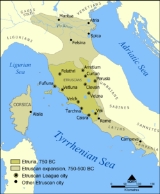
Etruscan civilization is the modern English name given to a civilization of ancient Italy in the area corresponding roughly to
TuscanyTuscany is a region in Italy. It has an area of about 23,000 square kilometres and a population of about 3.75 million inhabitants. The regional capital is Florence ....
. The ancient Romans called its creators the
Tusci or
Etrusci. Their Roman name is the origin of the terms Tuscany, which refers to their heartland, and
EtruriaEtruria—usually referred to in Greek and Latin source texts as Tyrrhenia—was a region of Central Italy, an area that covered part of what now are Tuscany, Latium, Emilia-Romagna, and Umbria. A particularly noteworthy work dealing with Etruscan locations is D. H...
, which can refer to their wider region.
In
Attic GreekAttic Greek is the prestige dialect of Ancient Greek that was spoken in Attica, which includes Athens. Of the ancient dialects, it is the most similar to later Greek, and is the standard form of the language studied in courses of "Ancient Greek". It is sometimes included in Ionic.- Origin and range...
, the Etruscans were known as
(Tyrrhēnioi), earlier
Tyrsenoi, from which the Romans derived the names Tyrrhēni (Etruscans), Tyrrhēnia (Etruria), and Mare Tyrrhēnum (
Tyrrhenian SeaThe Tyrrhenian Sea is part of the Mediterranean Sea off the western coast of Italy.-Geography:The sea is bounded by Corsica and Sardinia , Tuscany, Lazio, Campania, Basilicata and Calabria and Sicily ....
). The Etruscans called themselves
Rasenna, which was syncopated to
Rasna or
Raśna.
As distinguished by its
unique languageThe Etruscan language was spoken and written by the Etruscan civilization, in what is present-day Italy, in the ancient region of Etruria and in parts of Lombardy, Veneto, and Emilia-Romagna...
, this civilization endured from the time of the earliest Etruscan inscriptions (ca. 700 BC) until its assimilation into the
Roman RepublicThe Roman Republic was the period of the ancient Roman civilization where the government operated as a republic. It began with the overthrow of the Roman monarchy, traditionally dated around 508 BC, and its replacement by a government headed by two consuls, elected annually by the citizens and...
in the 1st century BC. At its maximum extent, during the foundational period of Rome and the
Roman kingdomThe Roman Kingdom was the period of the ancient Roman civilization characterized by a monarchical form of government of the city of Rome and its territories....
, it flourished in three confederacies of cities: of Etruria, of the
Po valleyThe Po Valley, Po Plain, Plain of the Po, or Padan Plain is a major geographical feature of Italy. It extends approximately in an east-west direction, with an area of 46,000 km² including its Venetic extension not actually related to the Po River basin; it runs from the Western Alps to the...
with the eastern
AlpsThe Alps is one of the great mountain range systems of Europe, stretching from Austria and Slovenia in the east through Italy, Switzerland, Liechtenstein and Germany to France in the west....
, and of
LatiumLazio is one of the 20 administrative regions of Italy, situated in the central peninsular section of the country. With about 5.7 million residents and a GDP of more than 170 billion euros, Lazio is the third most populated and the second richest region of Italy...
and
CampaniaCampania is a region in southern Italy. The region has a population of around 5.8 million people, making it the second-most-populous region of Italy; its total area of 13,590 km² makes it the most densely populated region in the country...
. Rome was founded within or adjacent to Etruscan territory, and there is considerable evidence that early Rome was dominated by Etruscans until the Romans sacked
VeiiVeii was, in ancient times, an important Etrurian city NNW of Rome, Italy; its site lies in Isola Farnese, a village of Municipio XX, an administrative subdivision of the comune of Rome in the Province of Rome...
in 396 BC.
Culture that is identifiably Etruscan developed in Italy after about 800 BC approximately over the range of the preceding
Iron AgeThe Iron Age is the archaeological period generally occurring after the Bronze Age, marked by the prevalent use of iron. The early period of the age is characterized by the widespread use of iron or steel. The adoption of such material coincided with other changes in society, including differing...
Villanovan cultureThe Villanovan culture was the earliest Iron Age culture of central and northern Italy, abruptly following the Bronze Age Terramare culture and giving way in the 7th century BC to an increasingly orientalizing culture influenced by Greek traders, which was followed without a severe break by the...
. The latter gave way in the 7th century to a culture that was influenced by Greek traders and Greek neighbours in
Magna GraeciaMagna Græcia is the name of the coastal areas of Southern Italy on the Tarentine Gulf that were extensively colonized by Greek settlers; particularly the Achaean colonies of Tarentum, Crotone, and Sybaris, but also, more loosely, the cities of Cumae and Neapolis to the north...
, the Hellenic civilization of southern Italy. After 500 BC the political destiny of Italy passed out of Etruscan hands.
Origin and history
The origins of the Etruscans are lost in prehistory. Historians have no literature, no texts of religion or philosophy; therefore much of what is known about this civilization is derived from grave goods and tomb findings. The main hypotheses are that they are indigenous, probably stemming from the
Villanovan cultureThe Villanovan culture was the earliest Iron Age culture of central and northern Italy, abruptly following the Bronze Age Terramare culture and giving way in the 7th century BC to an increasingly orientalizing culture influenced by Greek traders, which was followed without a severe break by the...
or from the
Near EastThe Near East is a geographical term that covers different countries for geographers, archeologists, and historians, on the one hand, and for political scientists, economists, and journalists, on the other...
. Etruscan expansion was focused both to the north beyond the Apennines and into Campania. Some small towns in the 6th century BC disappeared during this time, ostensibly consumed by greater, more powerful neighbours. However, it is certain that the political structure of the Etruscan culture was similar to, albeit more aristocratic than,
Magna GraeciaMagna Græcia is the name of the coastal areas of Southern Italy on the Tarentine Gulf that were extensively colonized by Greek settlers; particularly the Achaean colonies of Tarentum, Crotone, and Sybaris, but also, more loosely, the cities of Cumae and Neapolis to the north...
in the south. The mining and commerce of metal, especially
copperCopper is a chemical element with the symbol Cu and atomic number 29. It is a ductile metal with very high thermal and electrical conductivity. Pure copper is soft and malleable; an exposed surface has a reddish-orange tarnish...
and iron, led to an enrichment of the Etruscans and to the expansion of their influence in the Italian peninsula and the western Mediterranean sea. Here their interests collided with those of the Greeks, especially in the 6th century BC, when Phoceans of Italy founded colonies along the coast of
FranceThe French Republic , The French Republic , The French Republic , (commonly known as France , is a unitary semi-presidential republic in Western Europe with several overseas territories and islands located on other continents and in the Indian, Pacific, and Atlantic oceans. Metropolitan France...
,
SpainSpain , officially the Kingdom of Spain languages]] under the European Charter for Regional or Minority Languages. In each of these, Spain's official name is as follows:;;;;;;), is a country and member state of the European Union located in southwestern Europe on the Iberian Peninsula...
and
CorsicaCorsica is an island in the Mediterranean Sea. It is located west of Italy, southeast of the French mainland, and north of the island of Sardinia....
. This led the Etruscans to ally themselves with the Carthaginians, whose interests also collided with the Greeks.
Around 540 BC, the
Battle of AlaliaThe naval Battle of Alalia took place between 540 BC and 535 BC off the coast of Corsica between Greeks and the allied Etruscans and Carthaginians...
led to a new distribution of power in the western
Mediterranean SeaThe Mediterranean Sea is a sea connected to the Atlantic Ocean surrounded by the Mediterranean region and almost completely enclosed by land: on the north by Anatolia and Europe, on the south by North Africa, and on the east by the Levant...
. Though the battle had no clear winner,
CarthageCarthage , implying it was a 'new Tyre') is a major urban centre that has existed for nearly 3,000 years on the Gulf of Tunis, developing from a Phoenician colony of the 1st millennium BC...
managed to expand its sphere of influence at the expense of the Greeks, and Etruria saw itself relegated to the northern
Tyrrhenian SeaThe Tyrrhenian Sea is part of the Mediterranean Sea off the western coast of Italy.-Geography:The sea is bounded by Corsica and Sardinia , Tuscany, Lazio, Campania, Basilicata and Calabria and Sicily ....
with full ownership of
CorsicaCorsica is an island in the Mediterranean Sea. It is located west of Italy, southeast of the French mainland, and north of the island of Sardinia....
. From the first half of the 5th century BC, the new international political situation meant the beginning of the Etruscan decline after losing their southern provinces. In 480 BC, Etruria's ally Carthage was defeated by a coalition of Magna Graecia cities led by
SyracuseSyracuse is a historic city in Sicily, the capital of the province of Syracuse. The city is notable for its rich Greek history, culture, amphitheatres, architecture, and as the birthplace of the preeminent mathematician and engineer Archimedes. This 2,700-year-old city played a key role in...
. A few years later, in 474, Syracuse's tyrant
HieroHieron I was the son of Deinomenes, the brother of Gelon and tyrant of Syracuse in Sicily from 478 to 467 BC. In succeeding Gelon, he conspired against a third brother Polyzelos. During his reign, he greatly increased the power of Syracuse...
defeated the Etruscans at the
Battle of CumaeThe Battle of Cumae was a naval battle in 474 BC between the combined navies of Syracuse and Cumae and the Etruscans.Hiero I of Syracuse allied with Aristodemus, the tyrant of Cumae, to defend against Etruscan expansion into southern Italy. In 474 they met and defeated the Etruscan fleet at Cumae...
. Etruria's influence over the cities of
LatiumLazio is one of the 20 administrative regions of Italy, situated in the central peninsular section of the country. With about 5.7 million residents and a GDP of more than 170 billion euros, Lazio is the third most populated and the second richest region of Italy...
and Campania weakened, and it was taken over by Romans and Samnites. In the 4th century, Etruria saw a
GallicGaul was a region of Western Europe during the Iron Age and Roman era, encompassing present day France, Luxembourg and Belgium, most of Switzerland, the western part of Northern Italy, as well as the parts of the Netherlands and Germany on the left bank of the Rhine. The Gauls were the speakers of...
invasion end its influence over the
PoThe Po |Ligurian]]: Bodincus or Bodencus) is a river that flows either or – considering the length of the Maira, a right bank tributary – eastward across northern Italy, from a spring seeping from a stony hillside at Pian del Re, a flat place at the head of the Val Po under the northwest face...
valley and the
AdriaticThe Adriatic Sea is a body of water separating the Italian Peninsula from the Balkan peninsula, and the system of the Apennine Mountains from that of the Dinaric Alps and adjacent ranges...
coast. Meanwhile,
RomeAncient Rome was a thriving civilization that grew on the Italian Peninsula as early as the 8th century BC. Located along the Mediterranean Sea and centered on the city of Rome, it expanded to one of the largest empires in the ancient world....
had started annexing Etruscan cities. This led to the loss of the Northern Etruscan provinces. Etruria was conquered by Rome in the 3rd century BC.
Heritage, founding and Populus Romanus
Those who subscribe to an
ItalicAncient people of Italy are all those people that lived in Italy before the Roman domination.Not all of these various people are linguistically or ethnically closely related...
foundation of Rome, followed by an Etruscan invasion, typically speak of an Etruscan “influence” on Roman culture; that is, cultural objects that were adopted at Rome from neighbouring Etruria. The prevalent view today is that Rome was founded by Italics and merged with Etruscans later. In that case Etruscan cultural objects are not a heritage but are influences.
The main criterion for deciding whether an object originated at Rome and traveled by influence to the Etruscans, or descended to the Romans from the Etruscans, is date. Many, if not most, of the Etruscan cities were older than Rome. If one finds that a given feature was there first, it cannot have originated at Rome. A second criterion is the opinion of the ancient sources. These would indicate that certain institutions and customs came directly from the Etruscans. Rome is located on the edge of what was Etruscan territory. When Etruscan settlements turned up south of the border, it was presumed that the Etruscans spread there after the foundation of Rome, but the settlements are now known to have preceded Rome.
Etruscan settlements were frequently built on a hill—the steeper the better—and surrounded by thick walls. According to
Roman mythologyRoman mythology is the body of traditional stories pertaining to ancient Rome's legendary origins and religious system, as represented in the literature and visual arts of the Romans...
, when
Romulus and RemusRomulus and Remus are Rome's twin founders in its traditional foundation myth, although the former is sometimes said to be the sole founder...
founded Rome, they did so on the
Palatine HillThe Palatine Hill is the centermost of the Seven Hills of Rome and is one of the most ancient parts of the city...
according to Etruscan ritual; that is, they began with a
pomeriumThe pomerium or pomoerium , was the sacred boundary of the city of Rome. In legal terms, Rome existed only within the pomerium; everything beyond it was simply territory belonging to Rome.-Location and extensions:Tradition maintained that it was the original line ploughed by Romulus around the...
or sacred ditch. Then, they proceeded to the walls. Romulus was required to kill Remus when the latter jumped over the wall, breaking its magic spell (see also under
Pons SubliciusThe earliest known bridge of ancient Rome, Italy, the Pons Sublicius, spanned the Tiber River near the Forum Boarium downstream from the Tiber Island, near the foot of the Aventine Hill. According to tradition, its construction was ordered by Ancus Martius around 642 BC, but this date is...
). The name of Rome is believed by some to be Etruscan, occurring in a standard form stating “place from which”:
Velzna-χ, “from Velzna”,
Sveama-χ, “from Sveama”,
Ruma-χ, “from Ruma”. We do not know what it means however. If Tiberius is from
θefarie, then Ruma would have been placed on the Thefar river. A heavily discussed topic between scholars is who was the founding population of Rome. In 390 BC the city of Rome was attacked by the
GaulsThe Gauls were a Celtic people living in Gaul, the region roughly corresponding to what is now France, Belgium, Switzerland and Northern Italy, from the Iron Age through the Roman period. They mostly spoke the Continental Celtic language called Gaulish....
, and as a result may have lost many - though not all - of its earlier records. Certainly, the history of Rome before that date is not as secure as it later becomes, but enough material remains to give a good picture of the development of the city and its institutions.
Later history relates that some Etruscans lived in the
Tuscus vicus, the “Etruscan quarter”, and that there was an Etruscan line of kings (albeit ones descended from a Greek,
Demaratus the CorinthianDemaratus the Corinthian was the father of Lucius Tarquinius Priscus, the fifth King of Rome and the grandfather of Lucius Tarquinius Superbus, the seventh and last king.-Life:...
) which succeeded kings of Latin and Sabine origin. Etruscophile historians would argue that this, together with evidence for institutions, religious elements and other cultural elements, prove that Rome was founded by Italics. The true picture is rather more complicated, not least because the Etruscan cities were separate entities which never came together to form a single Etruscan state. Furthermore, there were strong Latin and Italic elements to Roman culture, and later Romans proudly celebrated these multiple, 'multicultural' influences on the city.
Under Romulus and
NumaNuma Pompilius was the legendary second king of Rome, succeeding Romulus. What tales are descended to us about him come from Valerius Antias, an author from the early part of the 1st century BC known through limited mentions of later authors , Dionysius of Halicarnassus circa 60BC-...
, the people were said to have been divided into 30 curiae and 3
tribeA tribe, viewed historically or developmentally, consists of a social group existing before the development of, or outside of, states.Many anthropologists use the term tribal society to refer to societies organized largely on the basis of kinship, especially corporate descent groups .Some theorists...
s. Few words of Etruscan entered the Latin language, but the names of at least two of the tribes —
Ramnes and
Luceres — seem to be Etruscan. The last kings may have borne the Etruscan title
lucumo, while the
regaliaRegalia is Latin plurale tantum for the privileges and the insignia characteristic of a Sovereign.The word stems from the Latin substantivation of the adjective regalis, 'regal', itself from Rex, 'king'...
were traditionally considered of Etruscan origin: the golden crown, sceptre, the
toga palmata (a special robe), the
sella curulis (curule chair), and above all the primary symbol of state power: the
fascesFasces are a bundle of wooden sticks with an axe blade emerging from the center, which is an image that traditionally symbolizes summary power and jurisdiction, and/or "strength through unity"...
. The latter was a bundle of whipping rods surrounding a double-bladed
axeThe axe, or ax, is an implement that has been used for millennia to shape, split and cut wood; to harvest timber; as a weapon; and as a ceremonial or heraldic symbol...
, carried by the king's
lictorThe lictor was a member of a special class of Roman civil servant, with special tasks of attending and guarding magistrates of the Roman Republic and Empire who held imperium, the right and power to command; essentially, a bodyguard...
s. An example of the fasces are the remains of bronze rods and the axe from a tomb in Etruscan
VetuloniaVetulonia, formerly called Vetulonium , was an ancient town of Etruria, Italy, the site of which is probably occupied by the modern village of Vetulonia, which up to 1887 bore the name of Colonnata and Colonna di Buriano: the site is currently a frazione of the comune of Castiglione della Pescaia,...
. This allowed to identify the depiction of a fasces on the grave
steleA stele , also stela , is a stone or wooden slab, generally taller than it is wide, erected for funerals or commemorative purposes, most usually decorated with the names and titles of the deceased or living — inscribed, carved in relief , or painted onto the slab...
of Avele Feluske, who is shown as a warrior wielding the fasces. The most telling Etruscan feature is the word
populus, which appears as an Etruscan deity, Fufluns.
Populus seems to mean the people assembled in a military body, rather than the general populace.
Government
The historical Etruscans had achieved a
stateA sovereign state, or simply, state, is a state with a defined territory on which it exercises internal and external sovereignty, a permanent population, a government, and the capacity to enter into relations with other sovereign states. It is also normally understood to be a state which is neither...
system of society, with remnants of the
chiefdomA chiefdom is a political economy that organizes regional populations through a hierarchy of the chief.In anthropological theory, one model of human social development rooted in ideas of cultural evolution describes a chiefdom as a form of social organization more complex than a tribe or a band...
and tribal forms. In this they were different from the surrounding Italics, who had
chiefA tribal chief is the leader of a tribal society or chiefdom. Tribal societies with social stratification under a single leader emerged in the Neolithic period out of earlier tribal structures with little stratification, and they remained prevalent throughout the Iron Age.In the case of ...
s and tribes. Rome was in a sense the first Italic state, but it began as an Etruscan one. It is believed that the Etruscan government style changed from total
monarchyA monarchy is a form of government in which the office of head of state is usually held until death or abdication and is often hereditary and includes a royal house. In some cases, the monarch is elected...
to oligarchic
democracyDemocracy is generally defined as a form of government in which all adult citizens have an equal say in the decisions that affect their lives. Ideally, this includes equal participation in the proposal, development and passage of legislation into law...
(as the Roman Republic) in the 6th century BC, while it is important to note this did not happen to all the city states.
The Etruscan state government was essentially a
theocracyTheocracy is a form of organization in which the official policy is to be governed by immediate divine guidance or by officials who are regarded as divinely guided, or simply pursuant to the doctrine of a particular religious sect or religion....
. The government was viewed as being a central authority, over all tribal and clan organizations. It retained the power of life and death; in fact, the
gorgonIn Greek mythology, the Gorgon was a terrifying female creature. The name derives from the Greek word gorgós, which means "dreadful." While descriptions of Gorgons vary across Greek literature, the term commonly refers to any of three sisters who had hair of living, venomous snakes, and a...
, an ancient symbol of that power, appears as a motif in Etruscan decoration. The adherents to this state power were united by a common religion. Political unity in Etruscan society was the city-state, which was probably the referent of
methlum, “district”. Etruscan texts name quite a number of
magistrateA magistrate is an officer of the state; in modern usage the term usually refers to a judge or prosecutor. This was not always the case; in ancient Rome, a magistratus was one of the highest government officers and possessed both judicial and executive powers. Today, in common law systems, a...
s, without much of a hint as to their function: the
camthi, the
parnich, the
purth, the
tamera, the
macstrev, and so on. The people were the
mech. The chief ruler of a
methlum was perhaps a
zilach.
Family
The princely tombs were not of individuals. The inscriptional evidence shows that families were interred there over long periods, marking the growth of the aristocratic family as a fixed institution, parallel to the
gensIn ancient Rome, a gens , plural gentes, referred to a family, consisting of all those individuals who shared the same nomen and claimed descent from a common ancestor. A branch of a gens was called a stirps . The gens was an important social structure at Rome and throughout Italy during the...
at Rome and perhaps even its model. There is no sign of such a hereditary aristocracy in the preceding Villanovan culture. The Etruscans could have used any model of the eastern Mediterranean. That the growth of this class is related to the new acquisition of wealth through trade is unquestioned. The wealthiest cities were located near the coast. At the centre of the lautn was the married couple,
tusurthir. The Etruscans were a monogamous society that emphasized pairing.
Similarly the behaviour of some wealthy women is not uniquely Etruscan. The apparent promiscuous revelry has a spiritual explanation. Swaddling and Bonfante (among others) explain that depictions of the nude embrace, or symplegma, "had the power to ward off evil", as did baring the breast, which was adopted by western civilization as an apotropaic device, appearing finally on the figureheads of sailing ships as a nude female upper torso. It is also possible that Greek and Roman attitudes to the Etruscans were based on a misunderstanding of the place of women within their society. In both Greece and Republican Rome, respectable women were confined to the house and mixed-sex socialising did not occur. Thus the freedom of women within Etruscan society could have been misunderstood as implying their sexual availability. It is worth noting that a number of Etruscan tombs carry funerary inscriptions in the form "X son of (father) and (mother)", indicating the importance of the mother's side of the family.
Military and Etruscan cities
The Etruscans, like the contemporary cultures of
Ancient GreeceAncient Greece is a civilization belonging to a period of Greek history that lasted from the Archaic period of the 8th to 6th centuries BC to the end of antiquity. Immediately following this period was the beginning of the Early Middle Ages and the Byzantine era. Included in Ancient Greece is the...
and
Ancient RomeAncient Rome was a thriving civilization that grew on the Italian Peninsula as early as the 8th century BC. Located along the Mediterranean Sea and centered on the city of Rome, it expanded to one of the largest empires in the ancient world....
, had a significant military tradition. In addition to marking the rank and power of certain individuals in Etruscan culture, warfare was a considerable economic boon to Etruscan civilization. Like many ancient societies, the Etruscans conducted campaigns during summer months, raiding neighboring areas, attempting to gain territory and combating piracy as a means of acquiring valuable resources such as land, prestige, goods, and slaves. It is also likely individuals taken in battle would be ransomed back to their families and clans at high cost. Prisoners could also potentially be sacrificed on tombs as an honor to fallen leaders of Etruscan society, not unlike the sacrifices made by
AchillesIn Greek mythology, Achilles was a Greek hero of the Trojan War, the central character and the greatest warrior of Homer's Iliad.Plato named Achilles the handsomest of the heroes assembled against Troy....
for
PatroclesPatrocles name may refer to:*Patroclus *Patrocles of Thurii tragic poet 5th c.BC*Patrocles teacher of rhetoric mentioned by Quintilian*Patrocles Macedonian general and writer under Seleucus and Antiochus...
.
The range of Etruscan civilization is marked by its cities. They were entirely assimilated by Italic,
CeltThe Celts were a diverse group of tribal societies in Iron Age and Roman-era Europe who spoke Celtic languages.The earliest archaeological culture commonly accepted as Celtic, or rather Proto-Celtic, was the central European Hallstatt culture , named for the rich grave finds in Hallstatt, Austria....
ic, or Roman ethnic groups, but the names survive from inscriptions and their ruins are of aesthetic and historic interest in most of the cities of central Italy. Etruscan cities flourished over most of Italy during the
Roman Iron AgeThe Roman Iron Age is the name that Swedish archaeologist Oscar Montelius gave to a part of the Iron Age in Scandinavia, Northern Germany and the Netherlands....
, marking the farthest extent of Etruscan civilization. They were gradually assimilated first by Italics in the south, then by Celts in the north and finally in Etruria itself by the growing Roman Republic.
That many Roman cities were formerly Etruscan was well known to all the Roman authors. The Etruscan names of the major cities in this category survived in inscriptions and are listed below. Some cities were founded by Etruscans in prehistoric times, and bore entirely Etruscan names. Others were colonized by Etruscans who Etruscanized the name, usually Italic.
Religion
The Etruscan system of belief was an immanent
polytheismPolytheism is the belief of multiple deities also usually assembled into a pantheon of gods and goddesses, along with their own mythologies and rituals....
; that is, all visible phenomena were considered to be a manifestation of
divineDivinity and divine are broadly applied but loosely defined terms, used variously within different faiths and belief systems — and even by different individuals within a given faith — to refer to some transcendent or transcendental power or deity, or its attributes or manifestations in...
power and that power was subdivided into
deitiesA deity is a recognized preternatural or supernatural immortal being, who may be thought of as holy, divine, or sacred, held in high regard, and respected by believers....
that acted continually on the world of man and could be dissuaded or persuaded in favour of human affairs. How to understand the will of deities and how to behave had been "revealed" to the Etruscans by two "initiators",
TagesTages was a founding prophet of Etruscan religion who is known from reports by Latin authors of the late Roman republic and Roman empire. He revealed a cosmic view of divinity and correct methods of ascertaining divine will concerning events of public interest. Divination was undertaken in Roman...
, a child-like figure born from tilled land and immediately gifted with prescience, and
VegoiaVegoia is a nymph and/or sibyl in the Etruscan religious framework that is vested with the responsibility of writing some parts of their large and complex set of sacred books, of initiating the Etruscan people to the arts, rules and rituals of land marking, and of...
, a female figure. Their "teachings" were kept in a series of sacred books. Three layers of deities are evident in the extensive Etruscan art motifs. One appears to be divinities of an indigenous nature:
CathaCatha may refer to:*the shrub Khat*the Etruscan goddess Cautha...
and Usil, the sun;
Tivr, the moon;
SelvansIn Etruscan mythology, Selvans was god of the woodlands, cognate with Roman Silvanus. His name is mentioned on the Piacenza Liver, a bronze model of a sheep's liver used for divinatory rites....
, a civil god; Turan, the goddess of love;
LaranIn Etruscan mythology, Laran was the god of war. In art, he was portrayed as a naked young man with a helmet and a spear. Laran's consort was Turan . Laran would go on to be merged with the Greek pantheon's Ares and his Etruscan companion Veive to form the Roman's god of war: Mars....
, the god of war;
LeinthIn Etruscan mythology, Leinth is the goddess of death, whose name means "Old Age" or "Old Woman". In art, she was portrayed with the face veiled....
, the goddess of death; Maris;
ThalnaIn Etruscan mythology, Thalna was the goddess of childbirth and wife of Tinia. She was depicted in art as a youthful woman.Early Roman Mythology focused on the interlocking and complex interrelations between gods and humans. In this, the Romans maintained a large selection of divinities with...
;
TurmsIn Etruscan mythology, Turms was the equivalent of Greek Hermes, god oftrade and the messenger god between people and gods.Turms is also a character in a book by Mika Waltari "Turms the Immortal" which takesplace at the end times of Etruscan civilization....
; and the ever-popular
FuflunsIn Etruscan mythology, Fufluns was a god of plant life, happiness, wine, health and growth in all things. He is the son of Semla. He was worshipped at Populonia ....
, whose name is related in some unknown way to the city of
PopuloniaPopulonia or Populonia Alta today is a frazione of the comune of Piombino . As of 2009 its population was 17...
and the populus Romanus. Perhaps he was the god of the people.
Ruling over this pantheon of lesser deities were higher ones that seem to reflect the
Indo-EuropeanProto-Indo-European religion is the hypothesized religion of the Proto-Indo-European peoples based on the existence of similarities among the deities, religious practices and mythologies of the Indo-European peoples. Reconstruction of the hypotheses below is based on linguistic evidence using the...
system: Tin or
TiniaTinia was the god of the sky and the highest god in Etruscan mythology, equivalent to the Roman Jupiter and the Greek Zeus. He was the husband of Thalna or Uni and the father of Heracle....
, the sky, Uni his wife (
JunoJuno is an ancient Roman goddess, the protector and special counselor of the state. She is a daughter of Saturn and sister of the chief god Jupiter and the mother of Mars and Vulcan. Juno also looked after the women of Rome. Her Greek equivalent is Hera...
), and Cel, the earth goddess. In addition the Greek gods were taken into the Etruscan system: Aritimi (
ArtemisArtemis was one of the most widely venerated of the Ancient Greek deities. Her Roman equivalent is Diana. Some scholars believe that the name and indeed the goddess herself was originally pre-Greek. Homer refers to her as Artemis Agrotera, Potnia Theron: "Artemis of the wildland, Mistress of Animals"...
),
MenrvaMenrva was an Etruscan goddess of war, art, wisdom and health. She contributed much of her character to Roman Minerva....
(
MinervaMinerva was the Roman goddess whom Romans from the 2nd century BC onwards equated with the Greek goddess Athena. She was the virgin goddess of poetry, medicine, wisdom, commerce, weaving, crafts, magic...
), Pacha (
DionysusDionysus was the god of the grape harvest, winemaking and wine, of ritual madness and ecstasy in Greek mythology. His name in Linear B tablets shows he was worshipped from c. 1500—1100 BC by Mycenean Greeks: other traces of Dionysian-type cult have been found in ancient Minoan Crete...
). The Greek heroes taken from
HomerIn the Western classical tradition Homer , is the author of the Iliad and the Odyssey, and is revered as the greatest ancient Greek epic poet. These epics lie at the beginning of the Western canon of literature, and have had an enormous influence on the history of literature.When he lived is...
also appear extensively in art motifs.
Architecture
The Architecture of the ancient Etruscans adapted the external Greek architecture for their own purposes, which were so different from Greek buildings as to create a new
architecturalArchitecture is both the process and product of planning, designing and construction. Architectural works, in the material form of buildings, are often perceived as cultural and political symbols and as works of art...
style. The two styles are often considered one body of
classical architectureClassical architecture is a mode of architecture employing vocabulary derived in part from the Greek and Roman architecture of classical antiquity, enriched by classicizing architectural practice in Europe since the Renaissance...
. The Etruscans absorbed Greek influence, apparent in many aspects closely related to architecture. The Etruscans had much influence over
Roman architectureAncient Roman architecture adopted certain aspects of Ancient Greek architecture, creating a new architectural style. The Romans were indebted to their Etruscan neighbors and forefathers who supplied them with a wealth of knowledge essential for future architectural solutions, such as hydraulics...
.
Etruscan architecture made lasting contributions to the architecture of Italy, which were adopted by the Romans and through them became standard to western civilization. Rome itself is a repository of Etruscan architectural features, which perhaps did not originate with the Etruscans, but were channeled by them into Roman civilization.
Art, music and literature
Etruscan art was the form of
figurative artFigurative art, sometimes written as figurativism, describes artwork—particularly paintings and sculptures—which are clearly derived from real object sources, and are therefore by definition representational.-Definition:...
produced by the Etruscan civilization in northern Italy between the 9th and 2nd centuries BC. Particularly strong in this tradition were figurative sculpture in terracotta (particularly life-size on
sarcophagiA sarcophagus is a funeral receptacle for a corpse, most commonly carved or cut from stone. The word "sarcophagus" comes from the Greek σαρξ sarx meaning "flesh", and φαγειν phagein meaning "to eat", hence sarkophagus means "flesh-eating"; from the phrase lithos sarkophagos...
or temples) and cast bronze, wall-painting and
metalworkingMetalworking is the process of working with metals to create individual parts, assemblies, or large scale structures. The term covers a wide range of work from large ships and bridges to precise engine parts and delicate jewelry. It therefore includes a correspondingly wide range of skills,...
(especially engraved bronze mirrors). There was also a tradition of
Etruscan vase paintingEtruscan vase painting was produced from the 7th through the 4th centuries BC. It was strongly influenced by Greek vase painting. Besides being producers in their own right, the Etruscans were the main export market for Greek pottery outside Greece...
. Etruscan art was strongly connected to religion; the afterlife was of major importance in Etruscan art.
The Etruscan musical instruments seen in frescoes and bas-reliefs are different types of pipes, such as the
plagiaulosAn aulos or tibia was an ancient Greek wind instrument, depicted often in art and also attested by archaeology.An aulete was the musician who performed on an aulos...
(the pipes of
PanPan , in Greek religion and mythology, is the god of the wild, shepherds and flocks, nature, of mountain wilds, hunting and rustic music, as well as the companion of the nymphs. His name originates within the Greek language, from the word paein , meaning "to pasture." He has the hindquarters, legs,...
or
SyrinxIn classical mythology, Syrinx was a nymph and a follower of Artemis, known for her chastity. Pursued by the amorous Greek god Pan, she ran to the river's edge and asked for assistance from the river nymphs. In answer, she was transformed into hollow water reeds that made a haunting sound when...
), the alabaster pipe and the famous double pipes, accompanied on percussion instruments such as the
tintinnabulumTintinnabulum can refer to:* Tintinnabulum, a bell in a Roman Catholic Basilica* Tintinnabulum , a wind chime* Tintinnabuli - a music compositional style devised by the Estonian composer Arvo Pärt...
,
tympanumTimpani, or kettledrums, are musical instruments in the percussion family. A type of drum, they consist of a skin called a head stretched over a large bowl traditionally made of copper. They are played by striking the head with a specialized drum stick called a timpani stick or timpani mallet...
and
crotalesthumb|right|Crotales are often used with other mallet percussionCrotales , sometimes called antique cymbals, are percussion instruments consisting of small, tuned bronze or brass disks. Each is about 4 inches in diameter with a flat top surface and a nipple on the base. They are commonly...
, and later by stringed instruments like the
lyreThe lyre is a stringed musical instrument known for its use in Greek classical antiquity and later. The word comes from the Greek "λύρα" and the earliest reference to the word is the Mycenaean Greek ru-ra-ta-e, meaning "lyrists", written in Linear B syllabic script...
and
kitharaThe kithara or cithara was an ancient Greek musical instrument in the lyre or lyra family. In modern Greek the word kithara has come to mean "guitar" ....
. With the exception of the
Liber LinteusThe Liber Linteus Zagrabiensis is the longest Etruscan text and the only extant linen book...
, the only written records of Etruscan origin that remain are inscriptions, mainly funerary. The language is written in a script related to the early Euboean Greek alphabet. Etruscan literature is evidenced only in references by later Roman authors.
Language and etymology
Knowledge of the Etruscan language is still far from complete. The Etruscans are believed to have spoken a non-
Indo-EuropeanThe Indo-European languages are a family of several hundred related languages and dialects, including most major current languages of Europe, the Iranian plateau, and South Asia and also historically predominant in Anatolia...
language; the majority consensus is that Etruscan is related only to other members of what is called the
Tyrsenian language familyTyrsenian , named after the Tyrrhenians , is a closely related ancient language family proposed by Helmut Rix , that consists of the extinct Etruscan language of central Italy, the extinct Raetic language of the Alps, and the extinct Lemnian language of the Aegean Sea.-The...
, which in itself is an
isolate familyA language isolate, in the absolute sense, is a natural language with no demonstrable genealogical relationship with other languages; that is, one that has not been demonstrated to descend from an ancestor common with any other language. They are in effect language families consisting of a single...
, that is, unrelated directly to other known language groups. Since Rix (1998) it is widely accepted that the Tyrsenian family groups
RhaeticRaetic is an extinct language spoken in the ancient region of Raetia in the Eastern Alps in pre-Roman and Roman times. It is documented by a limited number of short inscriptions in two variants of the Etruscan alphabet...
and
LemnianThe Lemnian language is a language of the 6th century BC spoken on the island of Lemnos. It is mainly attested by an inscription found on a funerary stele, termed the Lemnos stele, discovered in 1885 near Kaminia. However, fragments of inscriptions on local pottery show that it was spoken there by...
are related to Etruscan.
No etymology exists for
Rasna, the Etruscans' name for themselves. The etymology of
Tusci is based on a beneficiary phrase in the third
Iguvine tabletThe Iguvine Tablets are a series of seven bronze tablets discovered at Iguvium , Italy, in the year 1444. They are also known as Eugubian tablets...
, which is a major source for the
Umbrian languageUmbrian is an extinct Italic language formerly spoken by the Umbri in the ancient Italian region of Umbria. Within the Italic languages it is closely related to the Oscan group and is therefore associated with it in the group of Osco-Umbrian languages...
. The phrase is
turskum ... nomen, "the Tuscan name", from which a root *Tursci can be reconstructed. A metathesis and a word-initial epenthesis produce
E-trus-ci. A common hypothesis is that *Turs- along with Latin turris, "tower", come from
GreekAncient Greek is the stage of the Greek language in the periods spanning the times c. 9th–6th centuries BC, , c. 5th–4th centuries BC , and the c. 3rd century BC – 6th century AD of ancient Greece and the ancient world; being predated in the 2nd millennium BC by Mycenaean Greek...
, "tower." The Tusci were therefore the "people who build towers" or "the tower builders." This venerable etymology is at least as old as
Dionysius of HalicarnassusDionysius of Halicarnassus was a Greek historian and teacher of rhetoric, who flourished during the reign of Caesar Augustus. His literary style was Attistic — imitating Classical Attic Greek in its prime.-Life:...
, who said "And there is no reason why the Greeks should not have called them by this name, both from their living in towers and from the name of one of their rulers."
GiulianoGiuliano Bonfante was an Italian linguistics scholar and expert on the language of the Etruscans and other Italic peoples. He was professor of linguistics at the University of Turin.Bonfante was born in Milan...
and
Larissa BonfanteLarissa Bonfante is an American classicist, Professor of Classics at New York University and an authority on Etruscan language and culture.Born in Naples, 1929, daughter of professor Giuliano Bonfante , Bonfante studied fine arts and classics at Barnard College, gaining her BA in 1954; she gained...
(Bonfante 2002) speculate that Etruscan houses seemed like towers to the simple Latins. It is true that the Etruscans preferred to build hill towns on high precipices enhanced by walls. On the other hand if the Tyrrhenian name came from an incursion of
sea peoplesThe Sea Peoples were a confederacy of seafaring raiders of the second millennium BC who sailed into the eastern Mediterranean, caused political unrest, and attempted to enter or control Egyptian territory during the late 19th dynasty and especially during year 8 of Ramesses III of the 20th Dynasty...
or later migrants then it might well be related to the name of
TroyTroy was a city, both factual and legendary, located in northwest Anatolia in what is now Turkey, southeast of the Dardanelles and beside Mount Ida...
, the city of towers in that case.
External links
- Cities and Cemeteries of Etruria, the book by George Dennis
George Dennis was a British explorer of Etruria; his written account and drawings of the ancient places and monuments of the Etruscan civilization combined with his summary of the ancient sources is among the first of the modern era and remains an indispensable reference in Etruscan studies.-...
at LacusCurtiusLacusCurtius is a website specializing in ancient Rome, currently hosted on a server at the University of Chicago. It went online on August 26, 1997; in January 2008 it had "2786 pages, 690 photos, 675 drawings & engravings, 118 plans, 66 maps." The site is the...
- Etruscan News Online, the Newsletter of the American Section of the Institute for Etruscan and Italic Studies
- Mysterious Etruscans, community dedicated to the preservation of Etruscan culture
- Etruscan Studies, a Journal of the Etruscan Foundation from University of Massachusetts Amherst
- "In Our Time" Melvyn Bragg and his guests discuss the Etruscan civilization, With: Phil Perkins, Professor of Archaeology at the Open University; David Ridgway, Senior Research Fellow at the Institute of Classical Studies at the University of London; and Corinna Riva, Lecturer in Mediterranean Archaeology at University College London.
Cities and sites
- Panorama of Ara della Regina, Tarquinia
- (Soprintendenza per i Beni Archeologici dell'Umbria) "The Cai Cutu Etruscan tomb" An undisturbed late Etruscan family tomb, reused between the 3rd and 1st century BC, reassembled in the National Archeological Museum of Perugia
- Etruscan Splendors from Volterra in Tuscany
- Hypogeum of the Volumnis digital media archive (creative commons
Creative Commons is a non-profit organization headquartered in Mountain View, California, United States devoted to expanding the range of creative works available for others to build upon legally and to share. The organization has released several copyright-licenses known as Creative Commons...
-licensed photos, laser scans, panoramas), data from a University of FerraraThe University of Ferrara is the main university of the city of Ferrara in the Emilia-Romagna region of northern Italy. In the years prior to the First World War the University of Ferrara, with more than 500 students, was the best attended of the free universities in Italy...
/CyArkCyArk is a 501 nonprofit organization located in Oakland, California, United States. The company's website refers to it as a "digital archive of the world’s heritage sites for preservation and education"...
research partnership
Art