


Villa Borghese gardens

Encyclopedia
Villa Borghese is a large landscape garden
in the naturalistic English manner in Rome
, containing a number of buildings, museums (see Galleria Borghese
) and attractions. It is the second largest public park in Rome (80 hectares or 148 acres) after that of the Villa Doria Pamphili
. The gardens were developed for the Villa Borghese Pinciana
("Borghese villa on the Pincian Hill
"), built by the architect Flaminio Ponzio, developing sketches by Scipione Borghese
, who used it as a villa suburbana, a party villa, at the edge of Rome, and to house his art collection. The gardens as they are now were remade in the early nineteenth century.
, nephew of Pope Paul V
and patron of Bernini, began turning this former vineyard into the most extensive gardens built in Rome since Antiquity. The vineyard's site is identified with the gardens of Lucullus
, the most famous in the late Roman republic. In the 19th century much of the garden's former formality was remade as a landscape garden in the English taste (illustration, right). The Villa Borghese gardens were long informally open, but were bought by the commune of Rome and given to the public in 1903. The large landscape park in the English taste contains several villas. The Spanish Steps
lead up to this park, and there is another entrance at the Porte del Popolo by Piazza del Popolo
. The Pincio (the Pincian Hill
of ancient Rome), in the south part of the park, offers one of the greatest views over Rome.
A balustrade (dating from the early seventeenth century) from the gardens, was taken to England in the late 19th century, and installed in the grounds of Cliveden
House, a mansion in Buckinghamshire
, in 1896. The Piazza di Siena, located in the villa, hosted the equestrian
dressage
, individual jumping
, and the jumping part of the eventing
competition for the 1960 Summer Olympics
. In 2004, a species of Italian snail was discovered, still living on the balustrade after more than 100 years in England.
Garden
A garden is a planned space, usually outdoors, set aside for the display, cultivation, and enjoyment of plants and other forms of nature. The garden can incorporate both natural and man-made materials. The most common form today is known as a residential garden, but the term garden has...
in the naturalistic English manner in Rome
Rome
Rome is the capital of Italy and the country's largest and most populated city and comune, with over 2.7 million residents in . The city is located in the central-western portion of the Italian Peninsula, on the Tiber River within the Lazio region of Italy.Rome's history spans two and a half...
, containing a number of buildings, museums (see Galleria Borghese
Galleria Borghese
The Borghese Gallery is an art gallery in Rome, Italy, housed in the former Villa Borghese Pinciana. It is a building that was from the first integral with its gardens, nowadays considered quite separately by tourists as the Villa Borghese gardens...
) and attractions. It is the second largest public park in Rome (80 hectares or 148 acres) after that of the Villa Doria Pamphili
Villa Doria Pamphili
The Villa Doria Pamphili is a seventeenth century villa with what is today the largest landscaped public park in Rome, Italy. It is located in the quarter of Monteverde, on the Gianicolo , just outside the Porta San Pancrazio in the ancient walls of Rome where the ancient road of the Via Aurelia...
. The gardens were developed for the Villa Borghese Pinciana
Galleria Borghese
The Borghese Gallery is an art gallery in Rome, Italy, housed in the former Villa Borghese Pinciana. It is a building that was from the first integral with its gardens, nowadays considered quite separately by tourists as the Villa Borghese gardens...
("Borghese villa on the Pincian Hill
Pincian Hill
The Pincian Hill is a hill in the northeast quadrant of the historical center of Rome. The hill lies to the north of the Quirinal, overlooking the Campus Martius...
"), built by the architect Flaminio Ponzio, developing sketches by Scipione Borghese
Scipione Borghese
Scipione Borghese was an Italian Cardinal, art collector and patron of the arts. A member of the Borghese family, he was the patron of the painter Caravaggio and the artist Bernini...
, who used it as a villa suburbana, a party villa, at the edge of Rome, and to house his art collection. The gardens as they are now were remade in the early nineteenth century.
History
In 1605, Cardinal Scipione BorgheseScipione Borghese
Scipione Borghese was an Italian Cardinal, art collector and patron of the arts. A member of the Borghese family, he was the patron of the painter Caravaggio and the artist Bernini...
, nephew of Pope Paul V
Pope Paul V
-Theology:Paul met with Galileo Galilei in 1616 after Cardinal Bellarmine had, on his orders, warned Galileo not to hold or defend the heliocentric ideas of Copernicus. Whether there was also an order not to teach those ideas in any way has been a matter for controversy...
and patron of Bernini, began turning this former vineyard into the most extensive gardens built in Rome since Antiquity. The vineyard's site is identified with the gardens of Lucullus
Gardens of Lucullus
The Gardens of Lucullus were the setting for an ancient patrician villa on the Pincian Hill on the edge of Rome; they were laid out by Lucius Licinius Lucullus about 60 BCE...
, the most famous in the late Roman republic. In the 19th century much of the garden's former formality was remade as a landscape garden in the English taste (illustration, right). The Villa Borghese gardens were long informally open, but were bought by the commune of Rome and given to the public in 1903. The large landscape park in the English taste contains several villas. The Spanish Steps
Spanish Steps
The Spanish Steps are a set of steps in Rome, Italy, climbing a steep slope between the Piazza di Spagna at the base and Piazza Trinità dei Monti, dominated by the Trinità dei Monti church at the top. The Scalinata is the widest staircase in Europe...
lead up to this park, and there is another entrance at the Porte del Popolo by Piazza del Popolo
Piazza del Popolo
Piazza del Popolo is a large urban square in Rome. The name in modern Italian literally means "People's Square", but historically it derives from the poplars after which the church of Santa Maria del Popolo, in the northeast corner of the piazza, takes its name.The piazza lies inside the northern...
. The Pincio (the Pincian Hill
Pincian Hill
The Pincian Hill is a hill in the northeast quadrant of the historical center of Rome. The hill lies to the north of the Quirinal, overlooking the Campus Martius...
of ancient Rome), in the south part of the park, offers one of the greatest views over Rome.
A balustrade (dating from the early seventeenth century) from the gardens, was taken to England in the late 19th century, and installed in the grounds of Cliveden
Cliveden
Cliveden is an Italianate mansion and estate at Taplow, Buckinghamshire, England. Set on banks above the River Thames, its grounds slope down to the river. The site has been home to an Earl, two Dukes, a Prince of Wales and the Viscounts Astor....
House, a mansion in Buckinghamshire
Buckinghamshire
Buckinghamshire is a ceremonial and non-metropolitan home county in South East England. The county town is Aylesbury, the largest town in the ceremonial county is Milton Keynes and largest town in the non-metropolitan county is High Wycombe....
, in 1896. The Piazza di Siena, located in the villa, hosted the equestrian
Equestrian at the 1960 Summer Olympics
The Equestrian Events at the 1960 Summer Olympics in Rome included dressage, eventing, and show jumping. Eventing and show jumping presented both individual and team medals, dressage presented only individual medals...
dressage
Dressage
Dressage is a competitive equestrian sport, defined by the International Equestrian Federation as "the highest expression of horse training." Competitions are held at all levels from amateur to the World Equestrian Games...
, individual jumping
Jumping
Jumping or leaping is a form of locomotion or movement in which an organism or non-living mechanical system propels itself through the air along a ballistic trajectory...
, and the jumping part of the eventing
Eventing
Eventing is an equestrian event comprising dressage, cross-country, and show jumping. This event has its roots in a comprehensive cavalry test requiring mastery of several types of riding...
competition for the 1960 Summer Olympics
1960 Summer Olympics
The 1960 Summer Olympics, officially known as the Games of the XVII Olympiad, was an international multi-sport event held from August 25 to September 11, 1960 in Rome, Italy...
. In 2004, a species of Italian snail was discovered, still living on the balustrade after more than 100 years in England.
Villas in the gardens
- Today the Galleria BorgheseGalleria BorgheseThe Borghese Gallery is an art gallery in Rome, Italy, housed in the former Villa Borghese Pinciana. It is a building that was from the first integral with its gardens, nowadays considered quite separately by tourists as the Villa Borghese gardens...
is housed in the Villa Borghese itself. The garden Casino Borghese, built on a rise above the Villa by the architect Giovanni VasanzioGiovanni VasanzioGiovanni Vasanzio or Jan van Santen was a Dutch-born architect, garden designer and engraver who spent his mature career in Rome, where he arrived in the 1580s...
, was set up by Camillo Borghese to contain sculptures by Bernini from the Borghese collectionBorghese collectionThe Borghese Collection is a collection of Roman sculptures, old masters and modern art collected by the Roman Borghese family, especially Cardinal Scipione Borghese, from the 17th century on. It includes major collections of Caravaggio, Raphael, and Titian, and of ancient Roman art...
, including his David and his Daphne, and by Antonio CanovaAntonio CanovaAntonio Canova was an Italian sculptor from the Republic of Venice who became famous for his marble sculptures that delicately rendered nude flesh...
(Paolina Borghese), with paintings by TitianTitianTiziano Vecelli or Tiziano Vecellio Tiziano Vecelli or Tiziano Vecellio Tiziano Vecelli or Tiziano Vecellio (c. 1488/1490 – 27 August 1576 better known as Titian was an Italian painter, the most important member of the 16th-century Venetian school. He was born in Pieve di Cadore, near...
, RaphaelRaphaelRaffaello Sanzio da Urbino , better known simply as Raphael, was an Italian painter and architect of the High Renaissance. His work is admired for its clarity of form and ease of composition and for its visual achievement of the Neoplatonic ideal of human grandeur...
and CaravaggioCaravaggioMichelangelo Merisi da Caravaggio was an Italian artist active in Rome, Naples, Malta, and Sicily between 1593 and 1610. His paintings, which combine a realistic observation of the human state, both physical and emotional, with a dramatic use of lighting, had a formative influence on the Baroque...
.
- The Villa GiuliaVilla GiuliaThe Villa Giulia is a villa in Rome, Italy. It was built by Pope Julius III in 1550–1555 on what was then the edge of the city. Today it is publicly owned, and houses the Museo Nazionale Etrusco, an impressive collection of Etruscan art and artifacts....
adjoining the Villa Borghese gardens was built in 1551 - 1555 as a summer residence for Pope Julius IIIPope Julius IIIPope Julius III , born Giovanni Maria Ciocchi del Monte, was Pope from 7 February 1550 to 1555....
; now it contains the Etruscan Museum (Museo Etrusco).
- The Villa MediciVilla MediciThe Villa Medici is a mannerist villa and an architectural complex with a garden contiguous with the larger Borghese gardens, on the Pincian Hill next to Trinità dei Monti in Rome, Italy. The Villa Medici, founded by Ferdinando I de' Medici, Grand Duke of Tuscany and now property of the French...
houses the French Academy in RomeFrench Academy in RomeThe French Academy in Rome is an Academy located in the Villa Medici, within the Villa Borghese, on the Pincio in Rome, Italy.-History:...
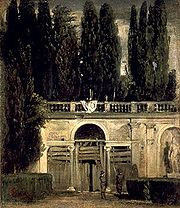
, and the Fortezzuola a Gothic garden structure that houses a collection memorializing the academic modern sculptor Pietro Canonica. In the 1650s, Diego VelázquezDiego VelázquezDiego Rodríguez de Silva y Velázquez was a Spanish painter who was the leading artist in the court of King Philip IV. He was an individualistic artist of the contemporary Baroque period, important as a portrait artist...
painted several depictions of this Villa's garden casino festively illuminated at night. Before electricity, such torchlit illuminations carried an excitement hard to conceive today.
- Other villas scattered through the Villa Borghese gardens are remains of a world expositionInternational Exhibition of Art (1911)International Exhibition of Art was a world's fair held in Rome in 1911 to celebrate the 50th anniversary of the unification of Italy in the same year as another world's fair in Turin . It marked the beginnings of the National Roman Museum...
in Rome in 1911.- The Galleria Nazionale d'Arte ModernaGalleria Nazionale d'Arte ModernaGalleria Nazionale d'Arte Moderna, or the National Gallery of Modern Art , is an art gallery in Rome, Italy, dedicated to modern art....
located in its grounds has a collection of 19th and 20th century paintings emphasizing Italian artists. - Architecturally the most notable of the 1911 exposition pavilions is the English pavilion designed by Sir Edwin LutyensEdwin LutyensSir Edwin Landseer Lutyens, OM, KCIE, PRA, FRIBA was a British architect who is known for imaginatively adapting traditional architectural styles to the requirements of his era...
(who later designed New DelhiNew DelhiNew Delhi is the capital city of India. It serves as the centre of the Government of India and the Government of the National Capital Territory of Delhi. New Delhi is situated within the metropolis of Delhi. It is one of the nine districts of Delhi Union Territory. The total area of the city is...
), now housing the British School at RomeBritish School at RomeThe British School at Rome was established in 1901 and granted a Royal Charter in 1912 as an educational institute in the fields of archaeology, literature, music, and history of Rome and Italy of every period, and for the study of the fine arts and architecture...
.
- The Galleria Nazionale d'Arte Moderna
Other points of interest
- The villa's gardens feature in one of RespighiOttorino RespighiOttorino Respighi was an Italian composer, musicologist and conductor. He is best known for his orchestral "Roman trilogy": Fountains of Rome ; Pines of Rome ; and Roman Festivals...
's Pini di RomaPini di RomaPines of Rome is a symphonic poem written in 1924 by the Italian composer Ottorino Respighi and, together with Fontane di Roma and Feste Romane, forms what is sometimes loosely referred to as his "Roman trilogy"...
. - Beside the 1911 Exposition's villas, there is the Exposition's Zoo, recently redesigned, with minimal caging, as the BioparcoBioparcoBioparco SpA is a zoological garden located on part of the original Villa Borghese estate in Rome, Italy. There are 1114 animals of 222 species maintained.-History:...
, and the Zoological MuseumMuseo Civico di ZoologiaThe Museo Civico di Zoologia is a natural history museum in Rome, central Italy. It is situated next to the Bioparc and can be entered by the Zoo or through the entrance on via Ulisse Aldrovandi...
(Museo di Zoologia).
External links
- 1960 Summer Olympics official report. Volume 1. p. 81.
- 1960 Summer Olympics official report. Volume 2, Part 2. p. 899.
- Galleria Borghese