
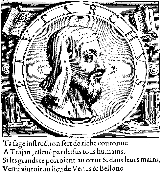
Plutarch, born
Plutarchos (Greek: Πλούταρχος) then, on his becoming a Roman citizen,
Lucius Mestrius Plutarchus (Μέστριος Πλούταρχος),
c. AD 46 – 120, was a Greek
historianAn historian is an individual who studies and writes about history, and is regarded as an authority on it. Historians are concerned with the continuous, methodical narrative and research of past events as relating to the human race; as well as the study of all events in time...
, biographer, essayist, and
Middle PlatonistMiddle Platonism was the development of certain philosophical doctrines associated with Plato from approximately 130 B.C. up to and including late 2nd century A.D. Numenius of Apamea...
known primarily for his
Parallel LivesPlutarch's Lives of the Noble Greeks and Romans, commonly called Parallel Lives or Plutarch's Lives, is a series of biographies of famous men, arranged in tandem to illuminate their common moral virtues or failings, written in the late 1st Century...
and
MoraliaThe Moralia of the first-century Greek priest Plutarch of Delphi is an eclectic collection of 78 essays and transcribed speeches. They give an insight into Roman and Greek life, but often are also fascinating timeless observations in their own right...
. He was born to a prominent family in
ChaeroneaChaeronea is a municipality in the Boeotia Prefecture, Greece. Population 2,218 . It is located in the Kifisós River valley and NW of Thebes. It is the last city of historical Boeotia before the border with Phocis.-History:...
,
BoeotiaBoeotia, also spelled Beotia and Bœotia , formerly Cadmeis, was a region of ancient Greece, north of the eastern part of the Gulf of Corinth. It was bounded on the south by Megaris and the Kithairon mountain range that forms a natural barrier with Attica, on the north by Opuntian Locris and the...
, a town about twenty miles east of
DelphiDelphi is both an archaeological site and a modern town in Greece on the south-western spur of Mount Parnassus in the valley of Phocis...
.
Early life
Plutarch was born in AD 46 in the small town of
ChaeroneaChaeronea is a municipality in the Boeotia Prefecture, Greece. Population 2,218 . It is located in the Kifisós River valley and NW of Thebes. It is the last city of historical Boeotia before the border with Phocis.-History:...
, in the Greek region known as
BoeotiaBoeotia, also spelled Beotia and Bœotia , formerly Cadmeis, was a region of ancient Greece, north of the eastern part of the Gulf of Corinth. It was bounded on the south by Megaris and the Kithairon mountain range that forms a natural barrier with Attica, on the north by Opuntian Locris and the...
. The name of Plutarch's father has not been preserved, but it was probably Nikarchus, from the common habit of Greek families to repeat a name in alternate generations. His family was wealthy. The name of Plutarch's grandfather was Lamprias, as he attested in Moralia and in his Life of Antony. His brothers, Timon and Lamprias, are frequently mentioned in his essays and dialogues, where Timon is spoken of in the most affectionate terms. Rualdus, in his 1624 work
Life of Plutarchus, recovered the name of Plutarch's wife, Timoxena, from internal evidence afforded by his writings. A letter is still extant, addressed by Plutarch to his wife, bidding her not give way to excessive
griefGrief is the multi-faceted response to loss, particularly to the loss of someone or something to which we have formed a bond of attachment. Although conventionally focused on the emotional response to loss, it also has physical, cognitive, behavioral, social, and philosophical dimensions...
at the death of their two year old daughter, who was named Timoxena after her mother. Interestingly, he hinted at a belief in
reincarnationReincarnation, literally "to be made flesh again", is a doctrine or metaphysical belief that some essential part of a living being survives death to be reborn in a new body. This essential part is often referred to as the spirit or soul, the "higher" or "true" self, "divine spark", or "I"...
in that letter of consolation.
The exact number of his sons is not certain, although two of them, Autobulus and second Plutarch, are often mentioned. Plutarch's treatise on the Timaeus of Plato is dedicated to them, and the marriage of his son Autobulus is the occasion of one of the dinner-parties recorded in the 'Table Talk.' Another person, Soklarus, is spoken of in terms which seem to imply that he was Plutarch's son, but this is nowhere definitely stated. His treatise on Marriage Questions, addressed to
EurydiceEurydice in Greek mythology, was an oak nymph or one of the daughters of Apollo . She was the wife of Orpheus. Orpheus loved her dearly; on their wedding day, Orpheus played songs filled with happiness as his bride danced through the meadow. One day, a satyr saw and pursued her. Eurydice stepped...
and Pollianus, seems to speak of her as having been recently an inmate of his house, but without enabling us to form an opinion whether she was his daughter or not.
Plutarch studied
mathematicsMathematics is the science and study of quantity, structure, space, and change. Mathematicians seek out patterns, formulate new conjectures, and establish truth by rigorous deduction from appropriately chosen axioms and definitions....
and
philosophyPhilosophy is the study of general and fundamental problems concerning matters such as existence, knowledge, values, reason, mind, and language. Philosophy is distinguished from other ways of addressing these questions by its critical, generally systematic approach and its reliance on reasoned...
at the
AcademyThe Academy was founded by Plato in ca. 387 BC in Athens. It persisted throughout the Hellenistic period as a skeptical school, until coming to an end after the death of Philo of Larissa in 83 BC...
of
AthensAthens , the capital and largest city of Greece, dominates the Attica periphery; as one of the world's oldest cities, its recorded history spans around 3,400 years....
under Ammonius from 66 to 67.. He had a number of influential friends, including
Quintus Sosius SenecioQuintus Sosius Senecio was a Roman Empire politician.Senecio was consul in 99 and 107. He is probably the same person who was a friend of the Pliny the Younger , and whom Plutarch addresses in several of his lives. .-References:* Prosopographia Imperii Romani S² 777...
and Fundanus, both important
senatorsThe Senate of the Roman Republic was a political institution in the ancient Roman Republic. According to the Greek historian Polybius, our principal source on the Constitution of the Roman Republic, the Roman Senate was the predominant branch of government...
, to whom some of his later writings were dedicated. Plutarch travelled widely in the Mediterranean world, including central Greece,
SpartaSparta was a city-state in ancient Greece, situated on the River Eurotas in the southern part of the Peloponnese. From c. 650 BC it rose to become the dominant military power in the region and as such was recognized as the overall leader of the combined Greek forces during the Greco-Persian Wars...
,
CorinthCorinth, or Korinth Corinth, or Korinth Corinth, or Korinth (Greek Κόρινθος, Kórinthos is a city in Greece. In antiquity it was a city-state, on the Isthmus of Corinth, the narrow stretch of land that joins the Peloponnesus to the mainland of Greece. To the west of the isthmus lies the Gulf of...
, Patrae (Patras), Sardes,
AlexandriaAlexandria , with a population of 4.1 million, is the second-largest city in Egypt, and is the country's largest seaport, serving about 80% of Egypt's imports and exports...
, and two trips to
RomeRome is the capital of Italy and the country's largest and most populated municipality , with over 2.7 million residents in , while the population of the urban area is estimated by Eurostat to be 3.46 million. The metropolitan area of Rome is estimated by OECD to have a population of 3.7 million...
.
At some point, Plutarch took up
Roman citizenshipCitizenship in ancient Rome was a privileged social status afforded to certain individuals with respect to laws, property, and governance.It is hard to offer meaningful generalities across the entire Roman period, as the nature and availability of citizenship was affected by legislation, for...
. As evinced by his new name,
Lucius Mestrius Plutarchus, his sponsor for citizenship was Lucius Mestrius Florus, a Roman of
consularA consul served in the highest elected political office of the Roman Republic and Empire.During the time of ancient Rome as a republic, the consuls were the highest civil and military magistrates, serving as the heads of government for the Republic. An election occurred every year for new consul...
status whom Plutarch also used as an historial source for his
Life of Otho.
| "The soul The soul, in many religions, spiritual traditions, and philosophies, is the spiritual and eternal part of a living being, commonly held to be separable in existence from the body; distinct from the physical part. It is typically thought to consist of ones consciousness and personality, and can be... , being eternal, after deathDeath is the termination of the biological functions that define a living organism. It refers to both a particular event and to the condition that results thereby. The true nature of the latter has for millennia been a central concern of the world's religious traditions and of philosophical... is like a caged bird that has been released. If it has been a long time in the body, and has become tame by many affairs and long habit, the soul will immediately take another body and once again become involved in the troubles of the world. The worst thing about old age is that the soul's memory of the other world grows dim, while at the same time its attachment to things of this world becomes so strong that the soul tends to retain the form that it had in the body. But that soul which remains only a short time within a body, until liberated by the higher powers, quickly recovers its fire and goes on to higher things." |
| Plutarch (The Consolation, Moralia) |
He lived most of his life at
ChaeroneaChaeronea is a municipality in the Boeotia Prefecture, Greece. Population 2,218 . It is located in the Kifisós River valley and NW of Thebes. It is the last city of historical Boeotia before the border with Phocis.-History:...
, and was initiated into the
mysteriesMystery religions, sacred Mysteries or simply Mysteries, were religious cults of the Greco-Roman world, participation in which was reserved to initiates....
of the Greek god
ApolloIn Greek and Roman mythology, Apollo , is one of the most important and many-sided of the Olympian deities...
. However, his duties as the senior of the two priests of
ApolloIn Greek and Roman mythology, Apollo , is one of the most important and many-sided of the Olympian deities...
at the
Oracle of DelphiThe Pythia was the priestess presiding over the Oracle of Apollo at Delphi, located on the slopes of Mount Parnassus. The Pythia was widely credited with giving prophecies inspired by Apollo, giving her a prominence unusual for a woman in male-dominated ancient Greece. The Delphic oracle was...
(where he was responsible for interpreting the auguries of the
PythiaThe Pythia was the priestess presiding over the Oracle of Apollo at Delphi, located on the slopes of Mount Parnassus. The Pythia was widely credited with giving prophecies inspired by Apollo, giving her a prominence unusual for a woman in male-dominated ancient Greece. The Delphic oracle was...
) apparently occupied little of his time. He led an active social and civic life while producing an incredible body of writing, much of which is still extant.
For many years Plutarch served as one of the two priests at the temple of
ApolloIn Greek and Roman mythology, Apollo , is one of the most important and many-sided of the Olympian deities...
at Delphi (the site of the famous Delphic Oracle) twenty miles from his home. By his writings and lectures Plutarch became a celebrity in the Roman empire, yet he continued to reside where he was born, and actively participated in local affairs, even serving as mayor. At his country estate, guests from all over the empire congregated for serious conversation, presided over by Plutarch in his marble chair. Many of these dialogues were recorded and published, and the 78 essays and other works which have survived are now known collectively as the
MoraliaThe Moralia of the first-century Greek priest Plutarch of Delphi is an eclectic collection of 78 essays and transcribed speeches. They give an insight into Roman and Greek life, but often are also fascinating timeless observations in their own right...
.
Work as magistrate and ambassador
In addition to his duties as a priest of the Delphic temple, Plutarch was also a magistrate in Chaeronea and he represented his home on various missions to foreign countries during his early adult years. Plutarch held the office of
archonArchon is a Greek word that means "ruler", frequently used as the title of a specific public office. It is the masculine present participle of the verb stem ἀρχ-, meaning "to rule", derived from the same root as monarch, hierarchy and anarchy.- Ancient Greece :In the early literary period of...
in his native municipality, probably only an annual one which he likely served more than once. He busied himself with all the little matters of the town and undertook the humblest of duties.
The
SudaThe Suda or Souda is a massive 10th century historical encyclopedia of the ancient Mediterranean world, formerly wrongfully attributed to an author called Suidas. The text belongs to the Byzantine Empire and was written in Greek...
, a medieval Greek encyclopedia, states that emperor
TrajanMarcus Ulpius Nerva Traianus, commonly known as Trajan , was a Roman Emperor who reigned from A. D. 98 until his death in A. D. 117...
made Plutarch procurator of
IllyriaIllyria was in Classical antiquity a region in the western part of today's Balkan Peninsula, inhabited by the Illyrians, a heterogeneous coalition of tribes, about whom very little is known, though a number of them are assumed to have been united by a common Illyrian language.Illyria and the...
. However, most historians consider this unlikely, since Illyria was not a procuratorial province, and Plutarch probably did not speak
IllyrianThe Illyrian languages are a group of Indo-European languages that were spoken in the western part of the Balkans in former times by groups identified as Illyrians: Ardiaei, Delmatae, Pannonii, Autariates, Taulanti...
.
According to the 10th century
historianAn historian is an individual who studies and writes about history, and is regarded as an authority on it. Historians are concerned with the continuous, methodical narrative and research of past events as relating to the human race; as well as the study of all events in time...
George SyncellusGeorge Syncellus was a Byzantine chronicler and ecclesiastic. He had lived many years in Palestine as a monk, before coming to Constantinople, where he was appointed syncellus to Tarasius, patriarch of Constantinople...
, late in Plutarch's life, emperor
HadrianPublius Aelius Hadrianus was emperor of Rome from AD 117 to 138, as well as a Stoic and Epicurean philosopher...
appointed him nominal
procuratorA procurator was the title of various officials of the Roman Empire, posts mostly filled by equites . A procurator Augusti was the governor of the smaller imperial provinces...
of
AchaeaAchaea was a province of the Roman Empire, consisting of the modern-day Peloponnese in southern Greece and bordered on the north by the provinces of Epirus and Macedonia. The region was annexed to the Roman Republic in 146 BC following the sack of Corinth by the campaign of Roman general Lucius...
– a position that entitled him to wear the vestments and ornaments of a consul himself.
Plutarch died between the years AD 119 and 127.
Lives of the Roman emperors
The first biographical works to be written by Plutarch were the Lives of the Roman Emperors from Augustus to Vitellius. Of these, only the Lives of Galba and Otho survive. The Lives of Tiberius and Nero are extant only as fragments, provided by Dasmascius (Life of Tiberius, cf. his Life of Isidore) and Plutarch himself (Life of Nero, cf. Galba 2.1), respectively. These early emperors’ biographies were probably published under the Flavian dynasty or during the reign of Nerva (AD 96-98).
There is reason to believe that the two Lives still extant, those of Galba and Otho, “ought to be considered as a single work.” Therefore they do not form a part of the Plutarchian canon of single biographies – as represented by the Life of Aratus of Sicyon and the Life of Artaxerxes (the biographies of Hesiod, Pindar, Crates and Daiphantus were lost). Unlike in these biographies, in Galba-Otho the individual characters of the persons portrayed are not depicted for their own sake but instead serve as an illustration of an abstract principle; namely the adherence or non-adherence to Plutarch’s morally-founded ideal of governing as a Princeps (cf. Galba 1.3; Moralia 328D-E). Arguing from the perspective of Platonian political philosophy (cf. Republic 375E, 410D-E, 411E-412A, 442B-C), in Galba-Otho Plutarch reveals the constitutional principles of the Principate in the time of the civil war after Nero’s death. While morally questioning the behavior of the autocrats, he also gives an impression of their tragic destinies, ruthlessly competing for the throne and finally destroying each other. “The Caesars’ house in Rome, the Palatium, received in a shorter space of time no less than four Emperors,” Plutarch writes, “passing, as it were, across the stage, and one making room for another to enter” (Galba 1).
Galba-Otho was handed down through different channels. It can be found in the appendix to Plutarch’s Parallel Lives as well as in various Moralia manuscripts, most prominently in Maximus Planudes’s edition where Galba and Otho appear as “Opera” XXV and XXVI. Thus it seems reasonable to maintain that Galba-Otho was from early on considered as an illustration of a moral-ethical approach, possibly even by Plutarch himself.
Parallel Lives
Plutarch's best-known work is the
Parallel LivesPlutarch's Lives of the Noble Greeks and Romans, commonly called Parallel Lives or Plutarch's Lives, is a series of biographies of famous men, arranged in tandem to illuminate their common moral virtues or failings, written in the late 1st Century...
, a series of
biographiesA biography is a description or account of someone's life and the times, which is usually published in the form of a book or essay, or in some other form, such as a film. An autobiography is a biography of a person's life written or told by that same person...
of famous Greeks and Romans, arranged in pairs to illuminate their common
moralMorality has three principal meanings.In its first, descriptive usage, morality means a code of conduct or belief concerning matters of what is moral or immoral...
virtues and vices. The surviving
Lives contain 23 pairs, each with one Greek
Life and one Roman
Life, as well as four unpaired single
Lives.
As is explained in the opening paragraph of his
Life of Alexander, Plutarch was not concerned with history so much as the influence of character, good or bad, on the lives and destinies of men. Whereas sometimes he barely touched on epoch-making events, he devoted much space to charming anecdote and incidental triviality, reasoning that this often said far more for his subjects than even their most famous accomplishments. He sought to provide rounded portraits, likening his craft to that of a painter; indeed, he went to tremendous effort (often leading to tenuous comparisons) to draw parallels between physical appearance and
moral characterMoral character or character is an evaluation of a particular individual's moral qualities. The concept of character can imply a variety of attributes including the existence or lack of virtues such as integrity, courage, fortitude, honesty, and loyalty, or of good behaviors or habits...
. In many ways he must count among the earliest
moral philosophersEthics is a branch of philosophy which seeks to address questions about morality, such as what the fundamental semantic, ontological, and epistemic nature of ethics or morality is , how moral values should be determined , how a moral outcome can be achieved in specific situations , how moral...
.
Some of the
Lives, such as those of
HeraclesIn Greek mythology, Heracles or Herakles , Alcides or Alcaeus , was a divine hero, the son of Zeus and Alcmene, foster son of Amphitryon and great-grandson of Perseus...
,
Philip II of MacedonPhilip II of Macedon, Philip II of Macedon, Philip II of Macedon, ( — φίλος = friend + ίππος = horse — transliterated 382 – 336 BC, was an ancient Greek king (basileus) of Macedon from 359 BC until his assassination in 336. He was the father of Alexander the Great and Philip...
and
Scipio AfricanusPublius Cornelius Scipio Africanus also known as Scipio Africanus, Scipio the Elder, and Africanus the Elder was a general in the Second Punic War and statesman of the Roman Republic...
, no longer exist; many of the remaining
Lives are truncated, contain obvious
lacunaeA lacuna is a gap in a manuscript, inscription, text, painting, or a musical work.The state of old manuscripts or inscriptions which have weathered or been damaged sometimes gives rise to lacunae — passages consisting of a word or words that are missing or illegible. Palimpsests are particularly...
or have been tampered with by later writers. Extant
Lives include those on
SolonSolon was an Athenian statesman, lawmaker, and elegiac poet. He is remembered particularly for his efforts to legislate against political, economic and moral decline in archaic Athens...
,
ThemistoclesThemistocles ; c. 524–459 BC, was an Athenian politician and general. He was one of a new breed of politicians who rose to prominence in the early years of the Athenian democracy, along with his great rival Aristides...
,
AristidesAristides was an Athenian statesman, nicknamed "the Just".- Biography :He was the son of Lysimachus, and a member of a family of moderate fortune. Of his early life we are only told that he became a follower of the statesman Cleisthenes and sided with the aristocratic party in Athenian politics...
,
PericlesPericles was a prominent and influential statesman, orator, and general of Athens during the city's Golden Age—specifically, the time between the Persian and Peloponnesian wars...
,
AlcibiadesAlcibiades Cleiniou Scambonides , was a prominent Athenian statesman, orator, and general. He was the last famous member of his mother's aristocratic family, the Alcmaeonidae, which fell from prominence after the Peloponnesian War...
,
NiciasNicias or Nikias was an Athenian politician and general during the period of the Peloponnesian War. Nicias was a member of the Athenian aristocracy because he had inherited a large fortune from his father, which was invested into the silver mines around Attica's Mt. Laurium...
,
DemosthenesDemosthenes was a prominent Greek statesman and orator of ancient Athens. His orations constitute a significant expression of contemporary Athenian intellectual prowess and provide an insight into the politics and culture of ancient Greece during the 4th century BC. Demosthenes learned rhetoric by...
,
PhilopoemenPhilopoemen , was a skilled Greek general and statesman, who was Achaean Strategos on eight occasions....
,
TimoleonTimoleon , son of Timodemus, of Corinth was a Greek statesman and general.As the champion of Greece against Carthage he is closely connected with the history of Sicily, especially Syracuse.-Early Life:...
,
Dion of SyracuseDion , tyrant of Syracuse in Sicily, was the son of Hipparinus, and brother-in-law of Dionysius I of Syracuse.-Family:Dion was the son of the Syracusan statesman Hipparinus, who had assisted the despot Dionysius I, in the Syracusan army. Hipparinus' other children were Megacles and Aristomache...
,
Alexander the GreatAlexander III of Macedon, popularly known as Alexander the Great , was an Ancient Greek king of Macedon who created one of the largest empires in ancient history...
,
Pyrrhus of EpirusPyrrhus or Pyrrhos was a Greek general of the Hellenistic era. He was king of the Greek tribe of Molossians, of the royal Aeacid house , and later he became King of Epirus and Macedon . He was one of the strongest opponents of early Rome...
,
RomulusRomulus and Remus are considered to be the traditional founders of Rome, appearing in Roman mythology as the twin sons of the Vestal Virgin Rhea Silvia, fathered by the god of war, Mars...
,
Numa PompiliusNuma Pompilius was the second king of Rome, succeeding Romulus.-Life and Reign:Plutarch tells that Numa was the youngest of Pomponius' four sons, born on the day of Rome's founding . He lived a severe life of discipline and banished all luxury from his home...
,
Coriolanus]Gaius Marcius Coriolanus was a possibly legendary Roman general who lived in the 5th century BC. He received his toponymic title "Coriolanus" because of his exceptional valor in a Roman siege of the Volscian city of Corioli. He was then promoted to a general...
, Aemilius Paullus,
Tiberius GracchusTiberius Sempronius Gracchus was a Roman politician of the 2nd century BC and brother of Gaius Gracchus. As a plebeian tribune, he caused political turmoil in the Republic by his attempts to legislate agrarian reforms...
,
Gaius GracchusGaius Sempronius Gracchus was a Roman politician in the second century BC and brother of the ill-fated reformer Tiberius Sempronius Gracchus...
,
Gaius MariusGaius Marius was a Roman general and politician elected consul an unprecedented seven times during his career...
,
SullaLucius Cornelius Sulla Felix , or simply Sulla, was a Roman general and politician, holding the office of consul twice as well as the dictatorship....
, Sertorius,
LucullusLucius Licinius Lucullus , was one of the canonical great men of Roman history, ever included in the biographical collections of leading generals and politicians, which originated in the biographical compendium of famous Romans published by his contemporary Marcus Terentius Varro...
,
PompeyGnaeus Pompeius Magnus, also known as Pompey /'pɑmpi/, Pompey the Great or Pompey the Triumvir , was a military and political leader of the late Roman Republic...
,
Julius CaesarGaius Julius Caesar , , was a Roman military and political leader. He played a critical role in the transformation of the Roman Republic into the Roman Empire....
,
CiceroMarcus Tullius Cicero was a Roman philosopher, statesman, lawyer, political theorist, and Roman constitutionalist. Cicero is widely considered one of Rome's greatest orators and prose stylists.Cicero is generally perceived to be one of the most versatile minds of ancient Rome...
,
Mark AntonyMarcus Antonius , known in English as Mark Antony, was a Roman politician and General. He was an important supporter and the loyal friend of Gaius Julius Caesar as a military commander and administrator, being Caesar's second cousin, once removed, by his mother Julia Antonia...
, and
Marcus Junius BrutusMarcus Junius Brutus , often referred to simply as Brutus, was a politician of the late Roman Republic...
.
Life of Alexander
Plutarch's
Life of Alexander, written as a parallel to that of Julius Caesar, is one of only five extant tertiary sources on the Macedonian conqueror
Alexander the GreatAlexander III of Macedon, popularly known as Alexander the Great , was an Ancient Greek king of Macedon who created one of the largest empires in ancient history...
. It includes
anecdoteAn anecdote is a short tale narrating an interesting or amusing biographical incident. It may be as brief as the setting and provocation of a bon mot. An anecdote is supposed to be based on a real incident involving actual persons, whether famous or not...
s and descriptions of events that appear in no other source, just as Plutarch's portrait of
Numa PompiliusNuma Pompilius was the second king of Rome, succeeding Romulus.-Life and Reign:Plutarch tells that Numa was the youngest of Pomponius' four sons, born on the day of Rome's founding . He lived a severe life of discipline and banished all luxury from his home...
, the putative second king of Rome, holds much that is unique on the early
Roman calendarThe Roman calendar changed its form several times in the time between the foundation of Rome and the fall of the Roman Empire. This article generally discusses the early Roman or pre-Julian calendars...
.
Plutarch devotes a great deal of space to Alexander's drive and desire, and strives to determine how much of it was presaged in his youth. He also draws extensively on the work of Lysippus, Alexander's favourite sculptor, to provide what is probably the fullest and most accurate description of the conqueror's physical appearance.
When it comes to his character, however, Plutarch is often rather less accurate, ascribing inordinate amounts of self-control to a man who very often lost it. It is significant, though, that the subject incurs less admiration from his biographer as the narrative progresses and the deeds that it recounts become less savoury.
Much, too, is made of Alexander's scorn for luxury: "He desired not pleasure or wealth, but only excellence and glory." This also is probably untrue, for Alexander's tastes grew more extravagant as he grew older.
Life of Pyrrhus
Plutarch's
Life of Pyrrhus is a key text because it is the main historical account on Roman history for the period from 293 to 264 BC, for which neither
DionysiusDionysius of Halicarnassus was a Greek historian and teacher of rhetoric, who flourished during the reign of Caesar Augustus.-Life:...
nor
LivyTitus Livius , known as Livy in English, was a Roman historian who wrote a monumental history of Rome and the Roman people, Ab Urbe Condita Libri, "Chapters from the Foundation of the City," covering the period from the earliest legends of Rome well before the traditional foundation in 753 BC...
have surviving texts.
Criticism of Parallel Lives
| "It is not histories I am writing, but lives; and in the most glorious deeds there is not always an indication of virtue or vice, indeed a small thing like a phrase or a jest often makes a greater revelation of a character than battles where thousands die." |
| Plutarch (Life of Alexander/Life of Julius Caesar, Parallel Lives, [tr. E.L. Bowie]) |
Plutarch stretches and occasionally fabricates the similarities between famous Greeks and Romans in order that he may write their biographies as parallels. The lives of Nicias and Crassus, for example, have nothing in common except that both were rich and both suffered great military defeats at the ends of their lives.
In his
Life of Pompey, Plutarch praises Pompey's trustworthy character and tactful behaviour in order to conjure a moral judgement that opposes most historical accounts. Plutarch delivers anecdotes with moral points, rather than in-depth comparative analyses of the causes of the fall of the Achaemenid Empire and the
Roman RepublicThe Roman Republic was the phase of the ancient Roman civilization characterized by a republican form of government. It began with the overthrow of the Roman monarchy, c...
, and tends on occasion to fit facts to hypotheses rather than the other, more scholastically acceptable way round.
On the other hand, he generally sets out his moral anecdotes in chronological order (unlike, say, his Roman contemporary
SuetoniusGaius Suetonius Tranquillus, commonly known as Suetonius , was an equestrian and a historian during the Roman Empire. His most important surviving work is a set of biographies of twelve successive Roman rulers, from Julius Caesar until Domitian, entitled De Vita Caesarum...
) and is rarely narrow-minded and unrealistic, almost always prepared to acknowledge the complexity of the human condition where moralising cannot explain it.
Moralia
The remainder of Plutarch's surviving work is collected under the title of the
MoraliaThe Moralia of the first-century Greek priest Plutarch of Delphi is an eclectic collection of 78 essays and transcribed speeches. They give an insight into Roman and Greek life, but often are also fascinating timeless observations in their own right...
(loosely translated as
Customs and Mores). It is an eclectic collection of seventy-eight essays and transcribed speeches, which includes
On Fraternal Affection—a discourse on honour and affection of siblings toward each other,
On the Fortune or the Virtue of Alexander the GreatAlexander III of Macedon, popularly known as Alexander the Great , was an Ancient Greek king of Macedon who created one of the largest empires in ancient history...
—an important adjunct to his Life of the great king,
On the Worship of IsisIsis was a goddess in Ancient Egyptian religious beliefs, whose worship spread throughout the Greco-Roman world. She was worshiped as the ideal mother, wife, patron of nature and magic. She was the friend of slaves, sinners, artisans, the downtrodden, as well as listening to the prayers of the...
and OsirisOsiris was an Egyptian god, usually called the god of the Afterlife, underworld or dead.Osiris is one of the oldest gods for whom records have been found; one of the oldest known attestations...
(a crucial source of information on
EgyptianAncient Egypt was an ancient civilization of eastern North Africa, concentrated along the lower reaches of the Nile River in what is now the modern country of Egypt. The civilization coalesced around 3150 BC with the political unification of Upper and Lower Egypt under the first pharaoh, and...
religious rites), along with more philosophical treatises, such as
On the Decline of the Oracles,
On the Delays of the Divine Vengeance,
On Peace of Mind and lighter fare, such as
OdysseusOdysseus or Ulysses , in Greek mythology , was a legendary Greek king of Ithaca and the hero of Homer's epic poem, The Odyssey...
and GryllusGryllus is a genus of crickets. Members of the genus are typically 15–31 mm long and darkly coloured . Species are usually recognised by their life histories and by their song .-Species:The genus contains the following species :...
, a humorous
dialogueA dialogue is a conversation between two or more people. It is also a literary form in which two or more parties engage in a discussion.-Literary and philosophical genre:...
between
HomerHomer is a legendary ancient Greek epic poet, traditionally said to be the author of the epic poems the Iliad and the Odyssey...
's Odysseus and one of
CirceIn Greek mythology, Circe is a minor goddess of magic living on the island of Aeaea....
's enchanted pigs. The
Moralia was composed first, while writing the Lives occupied much of the last two decades of Plutarch's own life.
On the Malice of Herodotus
In
On the Malice of Herodotus Plutarch criticizes the historian
HerodotusHerodotus of Halicarnassus was a Greek historian who lived in the 5th century BC and is regarded as the "Father of History" in Western culture. He was the first historian known to collect his materials systematically, test their accuracy to a certain extent and arrange them in a...
for all manners of prejudice and misrepresentation. It has been called the “first instance in literature of the slashing review.” The 19th century English historian
George GroteGeorge Grote was an English classical historian, best known in the field for a major work, the voluminous History of Greece, still read.-Biography:He was born at Clay Hill near Beckenham in Kent...
considered this essay a serious attack upon the works of Herodotus, and speaks of the "honourable frankness which Plutarch calls his malignity." Plutarch makes some palpable hits, catching Herodotus out in various errors, but it is also probable that it was merely a rhetorical exercise, in which Plutarch plays devil's advocate to see what could be said against so favourite and well-known a writer. According to Plutarch scholar R. H. Barrow, Herodotus’ real failing in Plutarch’s eyes was to advance any criticism at all of those states that saved Greece from Persia. “Plutarch,” he concluded, “is fanatically biased in favor of the Greek cities; they can do no wrong.”
Questions
Book IV of the
Moralia contains the
Roman and Greek Questions. The customs of Romans and Greeks are illuminated in little essays that pose questions such as 'Why were patricians not permitted to live on the Capitoline?'
(no. 91) and then suggests answers to them, often several mutually exclusive.
Pseudo-Plutarch
Pseudo-Plutarch is the conventional name given to the unknown authors of a number of pseudepigrapha attributed to Plutarch. Some editions of the
Moralia include several works now known to be pseudepigrapha: among these are the
Lives of the Ten Orators (biographies of the Ten Orators of ancient
AthensAthens , the capital and largest city of Greece, dominates the Attica periphery; as one of the world's oldest cities, its recorded history spans around 3,400 years....
, based on
Caecilius of CalacteCaecilius, of Calacte in Sicily, Greek rhetorician, flourished at Rome during the reign of Augustus.Originally called Archagathus, he took the name of Caecilius from his patron, one of the Metelli. According to the Suda, he was of the Jewish faith...
),
The Doctrines of the Philosophers, and
On Music. One "pseudo-Plutarch" is held responsible for all of these works, though their authorship is of course unknown. The thoughts and opinions recorded are not Plutarch's and come from a slightly later era, though they are all classical in origin.
Lost works
The Romans loved the
Lives, and enough copies were written out over the centuries so that a copy of most of the lives managed to survive to the present day. Some scholars, however, believe that only a third to one-half of Plutarch’s corpus is extant. The lost works of Plutarch are determined by references in his own texts to them and from other authors' references over time. There are traces of twelve more Lives that are now lost.
Plutarch's general procedure for the
Lives was to write the life of a prominent Greek, then cast about for a suitable Roman parallel, and end with a brief comparison of the Greek and Roman lives. Currently, only nineteen of the parallel lives end with a comparison while possibly they all did at one time. Also missing are many of his
Lives which appear in a list of his writings, those of Hercules, the first pair of
Parallel Lives,
Scipio AfricanusPublius Cornelius Scipio Africanus also known as Scipio Africanus, Scipio the Elder, and Africanus the Elder was a general in the Second Punic War and statesman of the Roman Republic...
and
EpaminondasEpaminondas was a Theban general and statesman of the 4th century BC who transformed the Ancient Greek city-state of Thebes, leading it out of Spartan subjugation into a preeminent position in Greek politics...
, and the companions to the four solo biographies. Even the lives of such important figures as
AugustusGaius Julius Caesar Augustus was the first emperor of the Roman Empire, which he ruled alone from 27 BC until his death in AD 14.
[These are the contemporary dates; Augustus lived under two calendars, the Roman Republican until 45 BC, and the Julian after 45 BC...]
,
ClaudiusTiberius Claudius Caesar Augustus Germanicus was the fourth Roman Emperor, a member of the Julio-Claudian dynasty, ruling from 24 January AD 41 to his death in AD 54...
and
NeroNero Claudius Caesar Augustus Germanicus , born Lucius Domitius Ahenobarbus, also called Nero Claudius Caesar Drusus Germanicus, was the fifth and last Roman emperor of the Julio-Claudian dynasty. Nero was adopted by his great uncle Claudius to become heir to the throne...
have not been found and may be lost forever.
Influence
Plutarch's writings had an enormous influence on
EnglishEnglish literature is the literature written in the English language, including literature composed in English by writers not necessarily from England; Joseph Conrad was born in Poland, Robert Burns was Scottish, James Joyce was Irish, Dylan Thomas was Welsh, Edgar Allan Poe was American, V.S....
and
French literatureFrench literature is, generally speaking, literature written in the French language, particularly by citizens of France; it may also refer to literature written by people living in France who speak other traditional non-French languages. Literature written by citizens of other nations such as...
.
ShakespeareWilliam Shakespeare was an English poet and playwright, widely regarded as the greatest writer in the English language and the world's preeminent dramatist. He is often called England's national poet and the "Bard of Avon"...
in
his playsWilliam Shakespeare's plays have the reputation of being among the greatest in the English language and in Western literature. Traditionally divided into the genres of tragedy, history, and comedy, they have been translated into every major living language, in addition to being continually...
paraphrased parts of
Thomas NorthSir Thomas North was an English translator of Plutarch, second son of the 1st Baron North.-Life:He is supposed to have been a student of Peterhouse, Cambridge, and was entered at Lincoln's Inn in 1557. In 1574 he accompanied his brother, Lord North, on a visit to the French court. He served as...
's translation of selected
Lives, and occasionally quoted from them in verbatim.
Ralph Waldo EmersonRalph Waldo Emerson was an American essayist, philosopher, and poet, best remembered for leading the Transcendentalist movement of the early 19th century. His teachings directly influenced the growing New Thought movement of the mid 1800s...
and the
TranscendentalistsTranscendentalism was a group of new ideas in literature, religion, culture, and philosophy that emerged in New England in the early to middle 19th century...
were greatly influenced by the
Moralia — so much so, in fact, that Emerson called the Lives "a bible for heroes" in his glowing introduction to the five-volume 19th-century edition. He also opined that it was impossible to "read Plutarch without a tingling of the blood; and I accept the saying of the Chinese
MenciusMencius , most accepted dates: 372 – 289 BCE; other possible dates: 385 – 303/302 BCE) was a Chinese philosopher who was arguably the most famous Confucian after Confucius himself.-Life:...
: 'A sage is the instructor of a hundred ages. When the manners of Loo are heard of, the stupid become intelligent, and the wavering, determined.'"
Montaigne'sMichel Eyquem de Montaigne was one of the most influential writers of the French Renaissance. Montaigne is known for popularizing the essay as a literary genre...
own
EssaysEssays is the title given to a collection of 107 essays written by Michel de Montaigne that was first published in 1580. Montaigne essentially invented the literary form of essay, a short subjective treatment of a given topic, of which the book contains a large number...
draw extensively on Plutarch's
Moralia and are consciously modelled on the Greek's easygoing and discursive inquiries into science, manners, customs and beliefs.
Essays contains more than 400 references to Plutarch and his works.
James BoswellJames Boswell, 9th Laird of Auchinleck was a lawyer, diarist, and author born in Edinburgh, Scotland; he is best known for his biography of Samuel Johnson...
quoted Plutarch on writing lives, rather than biographies, in the introduction to his own
Life of Samuel Johnson. Other admirers included
Ben JonsonBenjamin Jonson was an English Renaissance dramatist, poet and actor. A contemporary of William Shakespeare, he is best known for his satirical plays, particularly Volpone, The Alchemist, and Bartholomew Fair, which are considered his best, and his lyric poems...
,
John DrydenJohn Dryden was an influential English poet, literary critic, translator, and playwright who dominated the literary life of Restoration England to such a point that the period came to be known in literary circles as the Age of Dryden.-Early life:Dryden was born in the village rectory of Aldwincle...
,
Alexander HamiltonAlexander Hamilton was the first United States Secretary of the Treasury, a Founding Father, economist, and political philosopher...
,
John MiltonJohn Milton was an English poet, author, polemicist and civil servant for the Commonwealth of England. He is best known for his epic poem Paradise Lost and for his treatise condemning censorship, Areopagitica....
, and
Francis BaconFrancis Bacon,1st Viscount St Alban KC , son of Nicholas Bacon by his second wife Anne Bacon, was an English philosopher, statesman, scientist, lawyer, jurist, and author. He served both as Attorney General and Lord Chancellor of England...
, as well as such disparate figures as
Cotton MatherCotton Mather . A.B. 1678 , A.M. 1681; honorary doctorate 1710 , was a socially and politically influential New England Puritan minister, prolific author, and pamphleteer. Cotton Mather is often remembered for his connection to the Salem witch trials...
and
Robert BrowningRobert Browning was an English poet and milly playwright whose mastery of dramatic verse, especially dramatic monologues, made him one of the foremost Victorian poets.-Early years:...
.
Plutarch's influence declined in the 19th and 20th centuries, but it remains embedded in the popular ideas of Greek and Roman history.
Translations of Lives and Moralia
There are translations in Latin, English, French, German, Italian and Polish.
Italian translations
Giuliano PisaniGiuliano Pisani is a classical philologist, scholar of ancient Greek and Latin literature. Graduated in ancient Greek history at Padua University with Prof...
,
Moralia I - «La serenità interiore» e altri testi sulla terapia dell'anima, with Greek text, Italian translation, introduction and notes, La Biblioteca dell'Immagine, Pordenone 1989, pp. LIX-508 (
De tranquillitate animi; De virtute et vitio; De virtute morali; An virtus doceri possit; Quomodo quis suos in virtute sentiat profectus; Animine an corporis affectiones sint peiores; De vitioso pudore; De cohibenda ira; De garrulitate; De curiositate ; De invidia et odio ; De cupiditate divitiarum)
Giuliano PisaniGiuliano Pisani is a classical philologist, scholar of ancient Greek and Latin literature. Graduated in ancient Greek history at Padua University with Prof...
,
Moralia II - L'educazione dei ragazzi, with Greek text, Italian translation, introduction and notes, La Biblioteca dell'Immagine, Pordenone, 1990, pp. XXXVIII-451 (
De liberis educandis; Quomodo adolescens poetas audire debeat ; De recta ratione audiendi ; De musica, in collaboration with Leo Citelli)
Giuliano PisaniGiuliano Pisani is a classical philologist, scholar of ancient Greek and Latin literature. Graduated in ancient Greek history at Padua University with Prof...
,
Moralia III - Etica e politica, with Greek text, Italian translation, introduction and notes, La Biblioteca dell'Immagine, Pordenone, 1992, pp. XLIII-490 (
Praecepta gerendae rei publicae; An seni sit gerenda res publica; De capienda ex inimicis utilitate; De se ipsum citra invidiam laudando; Maxime cum principibus philosopho esse disserendum; Ad principem ineruditum; De unius in republica dominatione, populari statu et paucorum imperio; De exilio)
Giuliano PisaniGiuliano Pisani is a classical philologist, scholar of ancient Greek and Latin literature. Graduated in ancient Greek history at Padua University with Prof...
, Plutarco,
Vite di Lisandro e Silla, Fondazione Lorenzo Valla, 1997 (in collaboration with Maria Gabriella Angeli Bertinelli, Mario Manfredini, Luigi Piccirilli).
French translations
Jacques AmyotJacques Amyot , French Renaissance writer and translator, was born of poor parents, at Melun.He found his way to the university of Paris, where he supported himself by serving some of the richer students. He was nineteen when he became M.A. at Paris, and later he graduated doctor of civil law at...
's translations brought Plutarch's works to Western Europe. He went to Italy and studied the Vatican text of Plutarch, from which he published a French translation of the
Lives in 1559 and
Moralia in 1572, which were widely read by educated Europe. Amyot's translations had as deep an impression in England as France, because Thomas North later published his English translation of the
Lives in 1579 based on Amyot’s French translation instead of the original Greek.
English translations
Plutarch's
Lives were translated into English, from Amyot's version, by Sir Thomas North in 1579. The complete
Moralia was first translated into English from the original Greek by
Philemon HollandPhilemon Holland was an English translator.His father, John Holland, was a clergyman who fled the Kingdom of England during the persecutions of Mary I of England...
in 1603.
In 1683,
John DrydenJohn Dryden was an influential English poet, literary critic, translator, and playwright who dominated the literary life of Restoration England to such a point that the period came to be known in literary circles as the Age of Dryden.-Early life:Dryden was born in the village rectory of Aldwincle...
began a life of Plutarch and oversaw a translation of the
Lives by several hands and based on the original Greek. This translation has been reworked and revised several times, most recently in the nineteenth century by the English poet and classicist
Arthur Hugh CloughArthur Hugh Clough was an English poet, and the brother of Anne Jemima Clough.-Early years:Arthur Clough was born in Liverpool to James Butler Clough, a cotton merchant of Welsh descent, and Anne Perfect, originally from Yorkshire...
which can be found in
The Modern Library Random House, Inc. translation.
From 1901–1912, American classicist
Bernadotte Perrin produced a new translation of the
Lives for the
Loeb Classical LibraryThe Loeb Classical Library is a series of books, today published by Harvard University Press, which presents important works of ancient Greek and Latin Literature in a way designed to make the text accessible to the broadest possible audience, by presenting the original Greek or Latin text on each...
series. The
Moralia are also included in the Loeb series, though are translated by various authors.
Latin translations
There are multiple translations of Parallel Lives into Latin, most notably the one titled "Pour le Dauphin" (French for "for the Prince") written by a scribe in the court of
Louis XV of FranceLouis XV ruled as King of France and of Navarre from 1 September 1715 until his death on 10 May 1774...
and a 1470 Ulrich Han translation.
Johann Friedrich Salomon Kaltwasser
Plutarch's
Lives and Moralia were translated into German by Johann Friedrich Salomon Kaltwasser:
- Vitae parallelae. Vergleichende Lebensbeschreibungen. 10 Bände. Magdeburg 1799-1806.
- Moralia. Moralische Abhandlungen. 9 Bde. Frankfurt a.M. 1783-1800.
Subsequent German translations
- Biographies
- Konrat Ziegler (Hrsg.): Große Griechen und Römer. 6 Bde. Zürich 1954-1965. (Bibliothek der alten Welt).
- Moralia
- Konrat Ziegler (Hrsg.):Plutarch. Über Gott und Vorsehung, Dämonen und Weissagung, Zürich 1952. (Bibliothek der alten Welt)
- Bruno Snell (Hrsg.):Plutarch. Von der Ruhe des Gemüts - und andere Schriften, Zürich 1948. (Bibliothek der alten Welt)
- Hans-Josef Klauck
Hans-Josef Klauck is the Naomi Shenstone Donnelley Professor of New Testament and Early Christian Literature in the University of Chicago Divinity School. He also has an appointment in the University of Chicago's Department of New Testament and Early Christian Literature...
(Hrsg.): Plutarch. Moralphilosophische Schriften, Stuttgart 1997. (Reclams Universal-Bibliothek)
- Herwig Görgemanns (Hrsg.):Plutarch. Drei Religionsphilosophische Schriften, Düsseldorf 2003. (Tusculum)
Plutarch's works
Secondary material