


Swiss Guard

Encyclopedia
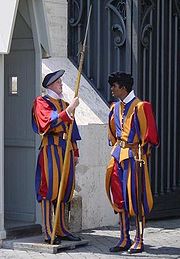
Soldier
A soldier is a member of the land component of national armed forces; whereas a soldier hired for service in a foreign army would be termed a mercenary...
s who have served as bodyguards, ceremonial guards, and palace
Palace
A palace is a grand residence, especially a royal residence or the home of a head of state or some other high-ranking dignitary, such as a bishop or archbishop. The word itself is derived from the Latin name Palātium, for Palatine Hill, one of the seven hills in Rome. In many parts of Europe, the...
guards at foreign Europe
Europe
Europe is, by convention, one of the world's seven continents. Comprising the westernmost peninsula of Eurasia, Europe is generally 'divided' from Asia to its east by the watershed divides of the Ural and Caucasus Mountains, the Ural River, the Caspian and Black Seas, and the waterways connecting...
an courts since the late 15th century. They have had a high reputation for discipline, as well as loyalty to their employers. Apart from household and guard units, regular Swiss mercenary
Mercenary
A mercenary, is a person who takes part in an armed conflict based on the promise of material compensation rather than having a direct interest in, or a legal obligation to, the conflict itself. A non-conscript professional member of a regular army is not considered to be a mercenary although he...
regiment
Regiment
A regiment is a major tactical military unit, composed of variable numbers of batteries, squadrons or battalions, commanded by a colonel or lieutenant colonel...
s have served as line troops in various armies; notably those of France
France
The French Republic , The French Republic , The French Republic , (commonly known as France , is a unitary semi-presidential republic in Western Europe with several overseas territories and islands located on other continents and in the Indian, Pacific, and Atlantic oceans. Metropolitan France...
, Spain
Spain
Spain , officially the Kingdom of Spain languages]] under the European Charter for Regional or Minority Languages. In each of these, Spain's official name is as follows:;;;;;;), is a country and member state of the European Union located in southwestern Europe on the Iberian Peninsula...
and Naples
Naples
Naples is a city in Southern Italy, situated on the country's west coast by the Gulf of Naples. Lying between two notable volcanic regions, Mount Vesuvius and the Phlegraean Fields, it is the capital of the region of Campania and of the province of Naples...
up to the 19th century. In contemporary usage, the name Swiss Guards generally refers to the Pontifical
Pope
The Pope is the Bishop of Rome, a position that makes him the leader of the worldwide Catholic Church . In the Catholic Church, the Pope is regarded as the successor of Saint Peter, the Apostle...
Swiss Guard of Vatican City
Vatican City
Vatican City , or Vatican City State, in Italian officially Stato della Città del Vaticano , which translates literally as State of the City of the Vatican, is a landlocked sovereign city-state whose territory consists of a walled enclave within the city of Rome, Italy. It has an area of...
.
Various units of Swiss Guards existed for hundreds of years. The earliest such unit was the Swiss Hundred Guard (Cent-Garde) at the French court (1497 – 1830). This small force was complemented in 1567 by a Swiss Guards regiment. The Papal Swiss Guard now in the Vatican City State was founded in 1506 and is the only Swiss Guard that still exists. In the 18th century several other Swiss Guards existed for periods in various European courts.
The institution reflects the situation of Switzerland at the time. Unlike the present, Switzerland was a poor country whose young men often sought their fortunes abroad.
Swiss Guards in France
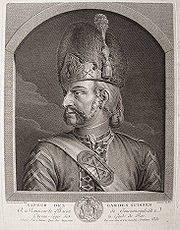
Hundred Swiss (cent suisses)
The Hundred Swiss were created in 1480 when Louis XI retained a Swiss company for his personal guard. By 1496 they comprised one hundred guardsmen plus about twenty-seven officers and sergeants. Their main role was the protection of the King within the palace as the garde du dedans du Louvre (the Louvre indoor guard), but in the earlier part of their history they accompanied the King to war. In the Battle of PaviaBattle of Pavia
The Battle of Pavia, fought on the morning of 24 February 1525, was the decisive engagement of the Italian War of 1521–26.A Spanish-Imperial army under the nominal command of Charles de Lannoy attacked the French army under the personal command of Francis I of France in the great hunting preserve...
(1525) the Hundred Swiss of King Francis I
Francis I of France
Francis I was King of France from 1515 until his death. During his reign, huge cultural changes took place in France and he has been called France's original Renaissance monarch...
were slain before Francis was captured by the Spanish. The Hundred Swiss shared the indoor guard with the King's Bodyguards (Garde du Corps
Garde du Corps (France)
The Garde du Corps was the senior formation of the King of France's Household Cavalry within the Maison du Roi.-History:The oldest company in the Garde du Corps was the Company of Scottish Archers, later just the 1st Scottish Company or Garde Écossaise, formed in 1419 from Scots that fought for...
), who were Frenchmen.
The Hundred Swiss were armed with halberd
Halberd
A halberd is a two-handed pole weapon that came to prominent use during the 14th and 15th centuries. Possibly the word halberd comes from the German words Halm , and Barte - in modern-day German, the weapon is called Hellebarde. The halberd consists of an axe blade topped with a spike mounted on...
s, the blade of which carried the Royal arms in gold, as well as gold-hilted swords. Their ceremonial dress as worn until 1789 comprised an elaborate 16th century Swiss costume covered with braiding and livery lace. A plainer dark blue and red uniform with bearskin
Bearskin
A bearskin is a tall fur cap, usually worn as part of a ceremonial military uniform. Traditionally, the bearskin was the headgear of grenadiers, and is still worn by grenadier and guards regiments in various armies.-Origins:...
headdress was worn for ordinary duties.
The cent suisses company was disbanded after Louis XVI left Versailles
Versailles
Versailles , a city renowned for its château, the Palace of Versailles, was the de facto capital of the kingdom of France for over a century, from 1682 to 1789. It is now a wealthy suburb of Paris and remains an important administrative and judicial centre...
in October 1789. It was however refounded on 15 July 1814 with an establishment of 136 guardsmen and eight officers. The Hundred Swiss accompanied Louis XVIII into exile in Belgium the following year and returned with him to Paris following Waterloo
Battle of Waterloo
The Battle of Waterloo was fought on Sunday 18 June 1815 near Waterloo in present-day Belgium, then part of the United Kingdom of the Netherlands...
. The unit then resumed its traditional role of palace guards at the Tuileries but in 1817 it was replaced by a new guard company drawn from the French regiments of the Royal Guard.
Swiss Guards (Gardes suisses)
King Francis I of FranceFrancis I of France
Francis I was King of France from 1515 until his death. During his reign, huge cultural changes took place in France and he has been called France's original Renaissance monarch...
used some 120,000 Swiss mercenaries in his wars. In 1616, King Louis XIII
Louis XIII of France
Louis XIII was a Bourbon monarch who ruled as King of France and of Navarre from 1610 to 1643.Louis was only eight years old when he succeeded his father. His mother, Marie de Medici, acted as regent during Louis' minority...
gave a regiment of Swiss infantry the name of Gardes suisses (Swiss Guards). The new regiment had the primary role of protecting the doors, gates and outer perimeters of the various royal palaces. This unit was officially a regiment of the line, but it was generally regarded as part of the King's Military Household
Maison militaire du roi de France
The maison militaire du roi de France was the military part of the royal household or Maison du Roi in France under the Ancien Régime. The term only appeared in 1671, though such a gathering of units pre-dates this...
.
During the 17th and 18th centuries the Swiss Guards maintained a reputation for discipline and steadiness in both peacetime service and foreign campaigning. Their officers were all Swiss and their rate of pay substantially higher than that of the regular French soldiers. Internal discipline was maintained according to Swiss codes which were significantly harsher than those of the regular French Army.
By the 16th century the Swiss Guards were brigaded with the Regiment of French Guards (Gardes françaises
Gardes Françaises
The Gardes Françaises was one of the two non-ceremonial infantry regiments in the "Maison du Roi" of the French Army under the Ancien Régime. The other regiment was the Gardes Suisses, which made the Gardes Françaises the only one recruited from France.-History:The regiment was created in 1563 by...
), with whom they shared the outer guard, and were in peace-time stationed in barracks on the outskirts of Paris
Paris
Paris is the capital and largest city in France, situated on the river Seine, in northern France, at the heart of the Île-de-France region...
. Like the eleven Swiss regiments of line infantry in French service, the Gardes suisses wore red coats. The line regiments had black, yellow or light blue facings but the Swiss Guards were distinguished by dark blue lapels and cuffs edged in white embroidery. Only the grenadier company wore bearskins while the other companies wore the standard tricorn headdress of the French infantry. The Guards were recruited from all the Swiss cantons. The nominal establishment was 1,600 men though actual numbers normally seem to have been below this.
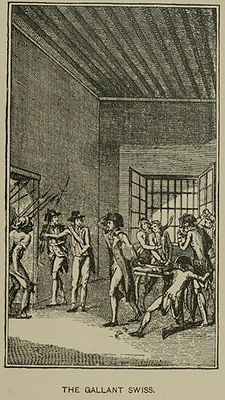
Swiss Guards during the Revolution
The most famous episode in the history of the Swiss Guards was their defence of the Tuileries PalaceTuileries Palace
The Tuileries Palace was a royal palace in Paris which stood on the right bank of the River Seine until 1871, when it was destroyed in the upheaval during the suppression of the Paris Commune...
in central Paris during the French Revolution
French Revolution
The French Revolution , sometimes distinguished as the 'Great French Revolution' , was a period of radical social and political upheaval in France and Europe. The absolute monarchy that had ruled France for centuries collapsed in three years...
. Of the nine hundred Swiss Guards defending the Palace on August 10, 1792
10th of August (French Revolution)
On 10 August 1792, during the French Revolution, revolutionary Fédéré militias — with the backing of a new municipal government of Paris that came to be known as the "insurrectionary" Paris Commune and ultimately supported by the National Guard — besieged the Tuileries palace. King Louis XVI and...
, about six hundred were killed during the fighting or massacred after surrender. One group of sixty Swiss were taken as prisoners to the Paris City Hall before being killed by the crowd there. An estimated hundred and sixty more died in prison of their wounds, or were killed during the September Massacres
September Massacres
The September Massacres were a wave of mob violence which overtook Paris in late summer 1792, during the French Revolution. By the time it had subsided, half the prison population of Paris had been executed: some 1,200 trapped prisoners, including many women and young boys...
that followed. Apart from fewer than a hundred Swiss who escaped from the Tuileries, some hidden by sympathetic Parisians, the only survivors of the regiment were a three-hundred-strong detachment which had been sent to Normandy to escort grain convoys a few days before August 10th. The Swiss officers were mostly amongst those massacred, although Major Karl Josef von Bachmann
Karl Josef von Bachmann
Karl Joseph Anton Leodegar Freiherr von Bachmann was a Swiss aristocrat and soldier.- Family and Early life :...
in command at the Tuileries was formally tried and guillotined in September, still wearing his red uniform coat. Two Swiss officers, the captains Henri de Salis and Joseph Zimmermann, did however survive and went on to reach senior rank under Napoleon and the Restoration.
There appears to be no truth in the charge that Louis XVI caused the defeat and destruction of the Guards by ordering them to lay down their arms when they could still have held the Tuileries. Rather, the Swiss ran low on ammunition and were overwhelmed by superior numbers when fighting broke out spontaneously after the Royal Family had been escorted from the Palace to take refuge with the National Assembly
National Assembly
National Assembly is either a legislature, or the lower house of a bicameral legislature in some countries. The best known National Assembly, and the first legislature to be known by this title, was that established during the French Revolution in 1789, known as the Assemblée nationale...
. A note has survived written by the King ordering the Swiss to retire from the Palace and return to their barracks but this was only acted on after their position had become untenable. The regimental standards had been secretly buried by the adjutant shortly before the regiment was summoned to the Tuileries on the night of 8/9 August, indicating that the likely end was foreseen. They were discovered by a gardener and ceremoniously burned by the new Republican authorities.
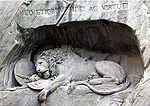
Bertel Thorvaldsen
Bertel Thorvaldsen was a Danish-Icelandic sculptor of international fame, who spent most of his life in Italy . Thorvaldsen was born in Copenhagen into a Danish/Icelandic family of humble means, and was accepted to the Royal Academy of Arts when he was eleven years old...
's Lion Monument
Lion Monument
The Lion Monument , or the Lion of Lucerne, is a sculpture in Lucerne, Switzerland, designed by Bertel Thorvaldsen and hewn in 1820–21 by Lukas Ahorn...
in Lucerne
Lucerne
Lucerne is a city in north-central Switzerland, in the German-speaking portion of that country. Lucerne is the capital of the Canton of Lucerne and the capital of the district of the same name. With a population of about 76,200 people, Lucerne is the most populous city in Central Switzerland, and...
, dedicated in 1821, which shows a dying lion collapsed upon broken symbols of the French monarchy. An inscription on the monument lists the twenty-six Swiss officers who died on 10 August and 2–3 September 1792, and records that approximately 760 Swiss Guardsmen were killed on those days.
Swiss Guards following the Restoration
The French Revolution abolished mercenary troops in its citizen army, but Napoleon INapoleon I
Napoleon Bonaparte was a French military and political leader during the latter stages of the French Revolution.As Napoleon I, he was Emperor of the French from 1804 to 1815...
and the Restoration Monarchy both made use of Swiss troops. Four Swiss infantry regiments were employed by Napoleon, serving in both Spain and Russia. Two of the eight infantry regiments included in the Garde Royale from 1815 to 1830 were Swiss and can be regarded as successors of the old Gardes suisses. When the Tuileries was stormed again, in the July Revolution
July Revolution
The French Revolution of 1830, also known as the July Revolution or in French, saw the overthrow of King Charles X of France, the French Bourbon monarch, and the ascent of his cousin Louis-Philippe, Duke of Orléans, who himself, after 18 precarious years on the throne, would in turn be overthrown...
(July 29, 1830), the Swiss regiments, fearful of another massacre, were withdrawn or melted into the crowd. They were not used again. In 1831 disbanded veterans of the Swiss regiments and another foreign unit, the Hohenlohe Regiment
Hohenlohe Regiment
The Hohenlohe Regiment was an infantry regiment of the French Army established after the abdication of Napoleon Bonaparte and consisting of foreign soldiers who wished to continue service in the French Army.-History:...
, were recruited into the newly raised French Foreign Legion
French Foreign Legion
The French Foreign Legion is a unique military service wing of the French Army established in 1831. The foreign legion was exclusively created for foreign nationals willing to serve in the French Armed Forces...
for service in Algeria.
Swiss constitutional prohibition
The Swiss constitutionSwiss Federal Constitution
The Federal Constitution of 18 April 1999 is the third and current federal constitution of Switzerland. It establishes the Swiss Confederation as a federal republic of 26 cantons , contains a catalogue of individual and popular rights , delineates the responsibilities of the...
, as amended in 1874, forbade all military capitulations and recruitment of Swiss by foreign powers, although volunteering in foreign armies continued until prohibited outright, in 1927.
Swiss Guards in other European States
Swiss Guard units similar to those of France were in existence at several other Royal Courts at the dates indicated below:- From 1579 on, a Swiss Guard served the House of SavoyHouse of SavoyThe House of Savoy was formed in the early 11th century in the historical Savoy region. Through gradual expansion, it grew from ruling a small county in that region to eventually rule the Kingdom of Italy from 1861 until the end of World War II, king of Croatia and King of Armenia...
, rulers of SavoySavoySavoy is a region of France. It comprises roughly the territory of the Western Alps situated between Lake Geneva in the north and Monaco and the Mediterranean coast in the south....
and later the Kingdom of SardiniaKingdom of SardiniaThe Kingdom of Sardinia consisted of the island of Sardinia first as a part of the Crown of Aragon and subsequently the Spanish Empire , and second as a part of the composite state of the House of Savoy . Its capital was originally Cagliari, in the south of the island, and later Turin, on the...
. The Guard was dissolved in 1798. - From 1696 to 1713, a Swiss Guard served at the court of Frederick I of PrussiaFrederick I of PrussiaFrederick I , of the Hohenzollern dynasty, was Elector of Brandenburg and Duke of Prussia in personal union . The latter function he upgraded to royalty, becoming the first King in Prussia . From 1707 he was in personal union the sovereign prince of the Principality of Neuchâtel...
. - a Swiss Guard also existed in the Grand Duchy of TuscanyGrand Duchy of TuscanyThe Grand Duchy of Tuscany was a central Italian monarchy that existed, with interruptions, from 1569 to 1859, replacing the Duchy of Florence. The grand duchy's capital was Florence...
. - a Cent-Suisse unit was in existence from 1730 until 1757 and again from 1763 to 1814 in the Kingdom of SaxonyKingdom of SaxonyThe Kingdom of Saxony , lasting between 1806 and 1918, was an independent member of a number of historical confederacies in Napoleonic through post-Napoleonic Germany. From 1871 it was part of the German Empire. It became a Free state in the era of Weimar Republic in 1918 after the end of World War...
. - a similar unit existed from 1734 until 1789 in the Kingdom of NaplesKingdom of NaplesThe Kingdom of Naples, comprising the southern part of the Italian peninsula, was the remainder of the old Kingdom of Sicily after secession of the island of Sicily as a result of the Sicilian Vespers rebellion of 1282. Known to contemporaries as the Kingdom of Sicily, it is dubbed Kingdom of...
. Swiss line infantry regiments continued to serve in the Neapolitan Army until the 1860s. - From 1748 until 1796, a company of Swiss (Cent-Suisses) served as a personal guard for the Stadhouder of the Dutch Republic; besides a Dutch Guard Regiment, there was also a Swiss Guard Regiment. William I, the King of the NetherlandsNetherlandsThe Netherlands is a constituent country of the Kingdom of the Netherlands, located mainly in North-West Europe and with several islands in the Caribbean. Mainland Netherlands borders the North Sea to the north and west, Belgium to the south, and Germany to the east, and shares maritime borders...
, incorporated four regiments of Swiss infantry in the new Dutch Army between 1814 and 1829, of which the 4th (Regiment Swiss nr. 32) served as Guard Infantry, until the Swiss regiments were disbanded and new official Guard Regiments of Grenadiers and Jagers were raised. - For a brief time (1748–1767) during the reign of EmpressAustrian EmpireThe Austrian Empire was a modern era successor empire, which was centered on what is today's Austria and which officially lasted from 1804 to 1867. It was followed by the Empire of Austria-Hungary, whose proclamation was a diplomatic move that elevated Hungary's status within the Austrian Empire...
Maria TheresaMaria Theresa of AustriaMaria Theresa Walburga Amalia Christina was the only female ruler of the Habsburg dominions and the last of the House of Habsburg. She was the sovereign of Austria, Hungary, Croatia, Bohemia, Mantua, Milan, Lodomeria and Galicia, the Austrian Netherlands and Parma...
(reigned 1740–1780), approximately 250 to 450 soldiers from Switzerland guarded the Hofburg, the winter palace in ViennaViennaVienna is the capital and largest city of the Republic of Austria and one of the nine states of Austria. Vienna is Austria's primary city, with a population of about 1.723 million , and is by far the largest city in Austria, as well as its cultural, economic, and political centre...
. They replaced previous military units that had performed that duty, and were later replaced by others. The oldest courtyard of the palace is still called the "Swiss Court" (Schweizerhof) in acknowledgement of their 20-year presence. - In Portugal, a Swiss regiment was raised by the Count of Lippe on June 12, 1762. It comprised two battalions (commanded by Colonel Gabriel Thorman and Colonel Marcus Saussure) of 809 men each, consisting of four companies of Swiss troops plus four non-Swiss companies, for a total of 1618 men. Enlistment was for six years, and the soldiers could not be required to serve at sea. Half the soldiers had to be Swiss, while the other half could be made up of Germans and Hungarians. The Portuguese government paid the sum of 2,960,000 reisPortuguese realThe real was the unit of currency of Portugal from around 1430 until 1911. It replaced the dinheiro at the rate of 1 real = 840 dinheiros and was itself replaced by the escudo at a rate of 1 escudo = 1000 réis...
to raise, arm and equip these two battalions. Colonels paid for their officers. Each soldier earned 4,537 reis per month plus a daily ration of bread. On June 22, 1763, Colonel Gabriel Thorman was sentenced to imprisonment until he returned funds and property embezzled from his regiment, while Colonel Marcus Saussure was sentenced to death for desertion. The regiment was disbanded on 17 September 1763 by a decree that also ordered the raising of a new Swiss regiment (the "Reais EstrangeirosForeign legionForeign legion or Foreign Legion is a title which has been used by a small number of military units composed of foreign volunteers.It usually refers to the French Foreign Legion, part of the French Army established in 1831.It can also refer to:...
"), which met a similar fate to its predecessor. Its eight companies comprised ninety soldiers each, plus the superior and inferior officers. It was ordered dissolved in 1765, and its commander, Colonel Luiz Henrique Graveson, condemned by a council of war to death by hangingHangingHanging is the lethal suspension of a person by a ligature. The Oxford English Dictionary states that hanging in this sense is "specifically to put to death by suspension by the neck", though it formerly also referred to crucifixion and death by impalement in which the body would remain...
. This sentence was commuted to a firing-squad, and the execution was carried out on November 15, 1765, in the field of Ourique, on January 2, 1766.
Pontifical Swiss Guard
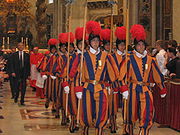
German language
German is a West Germanic language, related to and classified alongside English and Dutch. With an estimated 90 – 98 million native speakers, German is one of the world's major languages and is the most widely-spoken first language in the European Union....
: Schweizergarde,or Das Corps der Päpstlichen Schweizergarde Italian
Italian language
Italian is a Romance language spoken mainly in Europe: Italy, Switzerland, San Marino, Vatican City, by minorities in Malta, Monaco, Croatia, Slovenia, France, Libya, Eritrea, and Somalia, and by immigrant communities in the Americas and Australia...
: Guardia Svizzera Pontificia, Latin
Latin
Latin is an Italic language originally spoken in Latium and Ancient Rome. It, along with most European languages, is a descendant of the ancient Proto-Indo-European language. Although it is considered a dead language, a number of scholars and members of the Christian clergy speak it fluently, and...
: Pontificia Cohors Helvetica, or Cohors Pedestris Helvetiorum a Sacra Custodia Pontificis) is something of an exception to the Swiss rulings of 1874 and 1927. It is a small force
Army
An army An army An army (from Latin arma "arms, weapons" via Old French armée, "armed" (feminine), in the broadest sense, is the land-based military of a nation or state. It may also include other branches of the military such as the air force via means of aviation corps...
maintained by the Holy See
Holy See
The Holy See is the episcopal jurisdiction of the Catholic Church in Rome, in which its Bishop is commonly known as the Pope. It is the preeminent episcopal see of the Catholic Church, forming the central government of the Church. As such, diplomatically, and in other spheres the Holy See acts and...
and is responsible for the safety of the Pope
Pope
The Pope is the Bishop of Rome, a position that makes him the leader of the worldwide Catholic Church . In the Catholic Church, the Pope is regarded as the successor of Saint Peter, the Apostle...
, including the security of the Apostolic Palace
Apostolic Palace
The Apostolic Palace is the official residence of the Pope, which is located in Vatican City. It is also known as the Sacred Palace, the Papal Palace and the Palace of the Vatican...
. It serves as the de facto military of Vatican City.
History
The history of the Swiss Guards has its origins in the 15th century. Pope Sixtus IVPope Sixtus IV
Pope Sixtus IV , born Francesco della Rovere, was Pope from 1471 to 1484. His accomplishments as Pope included the establishment of the Sistine Chapel; the group of artists that he brought together introduced the Early Renaissance into Rome with the first masterpiece of the city's new artistic age,...
(1471–1484) already made a previous alliance with the Swiss Confederation and built barracks in Via Pellegrino after foreseeing the possibility of recruiting Swiss mercenaries. The pact was renewed by Innocent VIII
Pope Innocent VIII
Pope Innocent VIII , born Giovanni Battista Cybo , was Pope from 1484 until his death.-Early years:Giovanni Battista Cybo was born at Genoa of Greek extraction...
(1484–1492) in order to use them against the Duke of Milan. Alexander VI
Pope Alexander VI
Pope Alexander VI , born Roderic Llançol i Borja was Pope from 1492 until his death on 18 August 1503. He is one of the most controversial of the Renaissance popes, and his Italianized surname—Borgia—became a byword for the debased standards of the Papacy of that era, most notoriously the Banquet...
(1492–1503) later actually used the Swiss mercenaries during their alliance with the King of France. During the time of the Borgias, however, the Italian Wars
Italian Wars
The Italian Wars, often referred to as the Great Italian Wars or the Great Wars of Italy and sometimes as the Habsburg–Valois Wars, were a series of conflicts from 1494 to 1559 that involved, at various times, most of the city-states of Italy, the Papal States, most of the major states of Western...
began in which the Swiss mercenaries were a fixture in the front lines among the warring factions, sometimes for France and sometimes for the Holy See or the Holy Roman Empire
Holy Roman Empire
The Holy Roman Empire was a realm that existed from 962 to 1806 in Central Europe.It was ruled by the Holy Roman Emperor. Its character changed during the Middle Ages and the Early Modern period, when the power of the emperor gradually weakened in favour of the princes...
. The mercenaries enlisted when they heard King Charles VIII of France
Charles VIII of France
Charles VIII, called the Affable, , was King of France from 1483 to his death in 1498. Charles was a member of the House of Valois...
was going to raise a war against Naples. Among the participants in the war against Naples was Cardinal Giuliano della Rovere, the future Pope Julius II
Pope Julius II
Pope Julius II , nicknamed "The Fearsome Pope" and "The Warrior Pope" , born Giuliano della Rovere, was Pope from 1503 to 1513...
(1503–1513), who was well acquainted with the Swiss having been Bishop of Lausanne
Bishop of Lausanne
The Bishop of Lausanne was a Prince-Bishop of the Holy Roman Empire and the Ordinary of the diocese of Lausanne, Switzerland .Bern secularized the bishopric in 1536....
years earlier. The expedition failed in part thanks to new alliances made by Alexander VI against the French. When Cardinal della Rovere became pope Julius II
Pope Julius II
Pope Julius II , nicknamed "The Fearsome Pope" and "The Warrior Pope" , born Giuliano della Rovere, was Pope from 1503 to 1513...
in 1503, he asked the Swiss Diet to provide him with a constant corps of 200 Swiss mercenaries. In September 1505, the first contingent of 150 soldiers started their march towards Rome, under the command of Kaspar von Silenen
Kaspar von Silenen
Kaspar von Silenen was the first commander or commandant of the Swiss Guards. He led the first contingent of 150 Swiss mercenaries who marched from September 1505 and entered the Vatican on January 22, 1506 during the pontificate of Pope Julius II....
, and entered the city on January 22, 1506, today given as the official date of the Guard's foundation. "The Swiss see the sad situation of the Church of God, Mother of Christianity, and realize how grave and dangerous it is that any tyrant, avid for wealth, can assault with impunity, the common Mother of Christianity," declared Huldrych Zwingli
Huldrych Zwingli
Ulrich Zwingli was a leader of the Reformation in Switzerland. Born during a time of emerging Swiss patriotism and increasing criticism of the Swiss mercenary system, he attended the University of Vienna and the University of Basel, a scholarly centre of humanism...
, a Swiss Catholic who later became a Protestant reformer
Protestant Reformation
The Protestant Reformation was a 16th-century split within Western Christianity initiated by Martin Luther, John Calvin and other early Protestants. The efforts of the self-described "reformers", who objected to the doctrines, rituals and ecclesiastical structure of the Roman Catholic Church, led...
. Pope Julius II later granted them the title "Defenders of the Church's freedom".
The force has varied greatly in size over the years and has even been disbanded. Its first, and most significant, hostile engagement was on May 6, 1527 when 147 of the 189 Guards, including their commander, died fighting the troops of Holy Roman Emperor Charles V
Charles V, Holy Roman Emperor
Charles V was ruler of the Holy Roman Empire from 1519 and, as Charles I, of the Spanish Empire from 1516 until his voluntary retirement and abdication in favor of his younger brother Ferdinand I and his son Philip II in 1556.As...
in the stand of the Swiss Guard
Stand of the Swiss Guard
The Stand of the Swiss Guard took place during the sacking of Rome on May 6, 1527, when the Pope's Swiss guards held off troops loyal to the Habsburgs long enough for Pope Clement to escape.-Background:...
during the Sack of Rome
Sack of Rome (1527)
The Sack of Rome on 6 May 1527 was a military event carried out by the mutinous troops of Charles V, Holy Roman Emperor in Rome, then part of the Papal States...
in order to allow Clement VII to escape through the Passetto di Borgo
Passetto di Borgo
The Passetto di Borgo, or simply Passetto, is an elevated passage that links the Vatican City with the Castel Sant'Angelo. It is an approximately 800 m long corridor, located in the rione of Borgo. It was erected in 1277 by Pope Nicholas III, but parts of the wall were built by Totila during the...
, escorted by the other 40 guards. The last stand battlefield is located on the left side of St Peter's Basilica, close to the Campo Santo Teutonico (German Graveyard).
The Swiss Guard has served the popes since the 16th century. Ceremonially, they shared duties in the Papal household with the Palatine Guard
Palatine Guard
The Palatine Guard was a military unit of the Vatican. It was formed in 1850 by Pope Pius IX, who ordered that the two militia units of the Papal States be amalgamated...
and Noble Guard, both of which were disbanded in 1970 under Paul VI. Today the Papal Swiss Guard have taken over the ceremonial roles of the former units. At the end of 2005, there were 135 members of the Swiss Guard. This number consisted of a Commandant (bearing the rank of oberst
Oberst
Oberst is a military rank in several German-speaking and Scandinavian countries, equivalent to Colonel. It is currently used by both the ground and air forces of Austria, Germany, Switzerland, Denmark and Norway. The Swedish rank överste is a direct translation, as are the Finnish rank eversti...
or Colonel
Colonel
Colonel , abbreviated Col or COL, is a military rank of a senior commissioned officer. It or a corresponding rank exists in most armies and in many air forces; the naval equivalent rank is generally "Captain". It is also used in some police forces and other paramilitary rank structures...
), a chaplain
Chaplain
Traditionally, a chaplain is a minister in a specialized setting such as a priest, pastor, rabbi, or imam or lay representative of a religion attached to a secular institution such as a hospital, prison, military unit, police department, university, or private chapel...
, three officers, one sergeant major
Sergeant Major
Sergeants major is a senior non-commissioned rank or appointment in many militaries around the world. In Commonwealth countries, Sergeants Major are usually appointments held by senior non-commissioned officers or warrant officers...
(feldwebel), 30 NCOs
Non-commissioned officer
A non-commissioned officer , called a sub-officer in some countries, is a military officer who has not been given a commission...
, and 99 halberdiers, the rank equivalent to private (so called because of their traditional Halberd
Halberd
A halberd is a two-handed pole weapon that came to prominent use during the 14th and 15th centuries. Possibly the word halberd comes from the German words Halm , and Barte - in modern-day German, the weapon is called Hellebarde. The halberd consists of an axe blade topped with a spike mounted on...
).
Recruitment and service
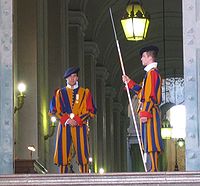
Military of Switzerland
The Swiss Armed Forces perform the roles of Switzerland's militia and regular army. Under the country's militia system, professional soldiers constitute about 5 percent of military personnel; the rest are male citizen conscripts 19 to 34 years old...
and can obtain certificates of good conduct. Recruits must have a professional degree or high school diploma and must be between 19 and 30 years of age and at least 174 cm (5 ft, 8.5 in) tall. In 2009, the Swiss Guard commandant, Daniel Anrig, suggested that the Guard might someday be open to recruiting women, but he added that the admission of female recruits remained far in the future.
Qualified candidates must apply to serve. If accepted, new guards are sworn on May 6 every year in the San Damaso Courtyard in the Vatican (May 6 is the anniversary of the Sack of Rome
Sack of Rome (1527)
The Sack of Rome on 6 May 1527 was a military event carried out by the mutinous troops of Charles V, Holy Roman Emperor in Rome, then part of the Papal States...
). In 2008 the ceremony took place in the presence of the head of the Swiss army. The chaplain
Chaplain
Traditionally, a chaplain is a minister in a specialized setting such as a priest, pastor, rabbi, or imam or lay representative of a religion attached to a secular institution such as a hospital, prison, military unit, police department, university, or private chapel...
of the guard reads aloud the oath
Oath
An oath is either a statement of fact or a promise calling upon something or someone that the oath maker considers sacred, usually God, as a witness to the binding nature of the promise or the truth of the statement of fact. To swear is to take an oath, to make a solemn vow...
in the language of the guard (mostly German
German language
German is a West Germanic language, related to and classified alongside English and Dutch. With an estimated 90 – 98 million native speakers, German is one of the world's major languages and is the most widely-spoken first language in the European Union....
, some French
French language
French is a Romance language spoken as a first language in France, the Romandy region in Switzerland, Wallonia and Brussels in Belgium, Monaco, the regions of Quebec and Acadia in Canada, and by various communities elsewhere. Second-language speakers of French are distributed throughout many parts...
, a little Italian
Italian language
Italian is a Romance language spoken mainly in Europe: Italy, Switzerland, San Marino, Vatican City, by minorities in Malta, Monaco, Croatia, Slovenia, France, Libya, Eritrea, and Somalia, and by immigrant communities in the Americas and Australia...
):
- (German version) "Ich schwöre, treu, redlich und ehrenhaft zu dienen dem regierenden Papst Benedikt XVI und seinen rechtmäßigen Nachfolgern, und mich mit ganzer Kraft für sie einzusetzen, bereit, wenn es erheischt sein sollte, selbst mein Leben für sie hinzugeben. Ich übernehme dieselbe Verpflichtung gegenüber dem Heiligen Kollegium der Kardinäle während der Sedisvakanz des Apostolischen Stuhls. Ich verspreche überdies dem Herrn Kommandanten und meinen übrigen Vorgesetzten Achtung, Treue und Gehorsam. Ich schwöre, alles das zu beobachten, was die Ehre meines Standes von mir verlangt."
- (English translation) "I vow to faithfully, honestly and honourably serve the reigning Pope Benedict XVI and his legitimate successors, and to dedicate myself to them with all my strength, ready to sacrifice, should it become necessary, even my own life for them. I likewise assume this promise toward the members of the Sacred College of Cardinals during the period of the Sede VacanteSede vacanteSede vacante is an expression, used in the Canon Law of the Catholic Church, that refers to the vacancy of the episcopal see of a particular church...
of the Apostolic SeeApostolic SeeIn Christianity, an apostolic see is any episcopal see whose foundation is attributed to one or more of the apostles of Jesus.Out of the many such sees, five acquired special importance in Chalcedonian Christianity and became classified as the Pentarchy in Eastern Orthodox Christianity...
. Furthermore, I pledge to the Commandant and to my other superiors respect, fidelity, and obedience. I swear to abide by all the requirements attendant to the dignity of my rank."
When his name is called, each new guard approaches the Swiss Guard's flag, grasping the banner in his left hand. He raises his right hand with his thumb, index, and middle finger extended along three axes, a gesture that symbolizes the Holy Trinity
Trinity
The Christian doctrine of the Trinity defines God as three divine persons : the Father, the Son , and the Holy Spirit. The three persons are distinct yet coexist in unity, and are co-equal, co-eternal and consubstantial . Put another way, the three persons of the Trinity are of one being...
, and speaks:
- "Ich,
[Name des Rekruten] , schwöre, alles das, was mir soeben vorgelesen wurde, gewissenhaft und treu zu halten, so wahr mir Gott und seine Heiligen helfen."
- "I,
[name of the new guard] , swear diligently and faithfully to abide by all that has just been read out to me, so grant me God and so help me his SaintSaintA saint is a holy person. In various religions, saints are people who are believed to have exceptional holiness.In Christian usage, "saint" refers to any believer who is "in Christ", and in whom Christ dwells, whether in heaven or in earth...
s."
The term of service is between 2 and 25 years.
Uniforms
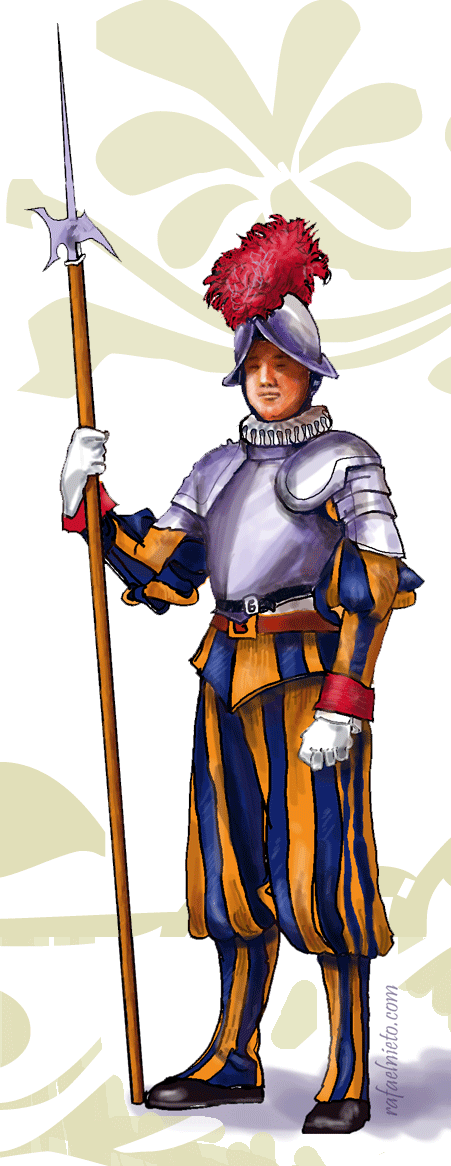
Renaissance
The Renaissance was a cultural movement that spanned roughly the 14th to the 17th century, beginning in Italy in the Late Middle Ages and later spreading to the rest of Europe. The term is also used more loosely to refer to the historical era, but since the changes of the Renaissance were not...
appearance. Commandant
Commandant
Commandant is a senior title often given to the officer in charge of a large training establishment or academy. This usage is common in anglophone nations...
Jules Repond (1910–1921) created the current uniforms in 1914.
While both Michelangelo
Michelangelo
Michelangelo di Lodovico Buonarroti Simoni , commonly known as Michelangelo, was an Italian Renaissance painter, sculptor, architect, poet, and engineer who exerted an unparalleled influence on the development of Western art...
and a painting of the Swiss Guard bearing Pope Julius II
Pope Julius II
Pope Julius II , nicknamed "The Fearsome Pope" and "The Warrior Pope" , born Giuliano della Rovere, was Pope from 1503 to 1513...
on a litter
Litter (vehicle)
The litter is a class of wheelless vehicles, a type of human-powered transport, for the transport of persons. Examples of litter vehicles include lectica , jiao [较] , sedan chairs , palanquin , Woh , gama...
(by Raphael
Raphael
Raffaello Sanzio da Urbino , better known simply as Raphael, was an Italian painter and architect of the High Renaissance. His work is admired for its clarity of form and ease of composition and for its visual achievement of the Neoplatonic ideal of human grandeur...
) are often cited as inspiration for the Swiss Guard uniform, the actual uniforms worn by those soldiers are of the style which appears by today's standards as a large skirt, a common style in uniforms during the Renaissance
Italian Renaissance
The Italian Renaissance began the opening phase of the Renaissance, a period of great cultural change and achievement in Europe that spanned the period from the end of the 13th century to about 1600, marking the transition between Medieval and Early Modern Europe...
.
A very clear expression of the modern Swiss Guard uniform can be seen in a 1577 fresco by Jacopo Coppi of the Empress Eudoxia
Licinia Eudoxia
Licinia Eudoxia was a Roman Empress, daughter of Eastern Emperor Theodosius II and wife of the Western Emperors Valentinian III and Petronius Maximus.- Family :...
conversing with Pope Sixtus III
Pope Sixtus III
Pope Saint Sixtus III was pope from 31 July 432 to 18 August 440.The name of Sixtus is often connected with a great building boom in Rome: Santa Sabina on the Aventine Hill was dedicated during his pontificate and he built Santa Maria Maggiore, whose dedication to Mary the Mother of God reflected...
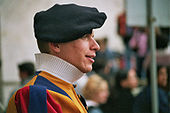
. It is clearly the precursor of today's recognizable three-colored uniform with boot covers, white gloves, a high or ruff collar, and either a black beret or a black Comb morion (silver for high occasions). Sergeants wear a black top with crimson leggings, while other officers wear an all-crimson uniform.
The regular duty uniform is more functional, consisting of a simpler solid blue version of the more colorful tri-color grand gala uniform, worn with a simple brown belt, a flat white collar and a black beret. For new recruits and rifle practice, a simple light blue overall with a brown belt may be worn. During cold or inclement weather, a dark blue cape is worn over the regular uniform. The original colors (blue and yellow) were issued by Pope Julius II
Pope Julius II
Pope Julius II , nicknamed "The Fearsome Pope" and "The Warrior Pope" , born Giuliano della Rovere, was Pope from 1503 to 1513...
taking his family (Della Rovere) colors. Pope Leo X
Pope Leo X
Pope Leo X , born Giovanni di Lorenzo de' Medici, was the Pope from 1513 to his death in 1521. He was the last non-priest to be elected Pope. He is known for granting indulgences for those who donated to reconstruct St. Peter's Basilica and his challenging of Martin Luther's 95 Theses...
added the red to reflect his family's Medici colors.
Headwear is typically a black beret for daily duties, while a black or silver morion helmet with red, white, yellow and black, and purple ostrich feather is worn for ceremonial duties, the former for guard duty or drill; the latter for high ceremonial occasions such as the annual swearing in ceremony or reception of foreign heads of state.
The tailors of the uniforms work inside the Swiss Guard barracks. The uniform weighs 8 pounds (3.6 kg), and may be the heaviest uniform in use by any standing army today. The Renaissance style makes them one of the most complicated to construct. A single uniform requires 154 pieces and takes nearly 32 hours and 3 fittings to complete.
Equipment
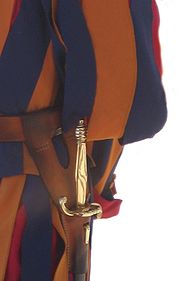
Rapier
A rapier is a slender, sharply pointed sword, ideally used for thrusting attacks, used mainly in Early Modern Europe during the 16th and 17th centuries.-Description:...
or straight sabre) and receive instruction in the ceremonial use of their halberd
Halberd
A halberd is a two-handed pole weapon that came to prominent use during the 14th and 15th centuries. Possibly the word halberd comes from the German words Halm , and Barte - in modern-day German, the weapon is called Hellebarde. The halberd consists of an axe blade topped with a spike mounted on...
on a four-sided pole which is held on their right during marches, drill, and regular formations in their official duties around the Vatican. The halberd includes a loose metal ring just below the halberd blade, which makes a loud clink when an individual or formation comes to attention. Other weapons and regalia carried by higher ranking non-halberdiers include a command baton, a partisan
Partisan (weapon)
A partisan is a type of polearm that was used in Europe during the middle ages. It consisted of a spearhead mounted on a long shaft with protrusions on the sides which aided the user in parrying sword thrusts...
, a flamberge
Flamberge
A flame-bladed sword or wave-bladed sword has a characteristically undulating style of blade. The wave in the blade is often considered to contribute a flame-like quality to the appearance of a sword...
(a wavy two-handed sword), and a breastplate with shoulder guards.
Besides their traditional arms, the Swiss Guard also has contemporary non-ceremonial small arms
Small arms
Small arms is a term of art used by armed forces to denote infantry weapons an individual soldier may carry. The description is usually limited to revolvers, pistols, submachine guns, carbines, assault rifles, battle rifles, multiple barrel firearms, sniper rifles, squad automatic weapons, light...
. The Guard also engages in yearly rifle competition and receives self-defense instruction, as well as basic instruction on defensive bodyguard tactics similar to those used in the protection of many heads of state.
The Swiss Guard use the SIG Sauer P220 handgun (P75) and the SIG SG 550
SIG SG 550
The SG 550 is an assault rifle manufactured by Swiss Arms AG of Neuhausen, Switzerland...
assault rifle. These are the standard issue weapons of the Swiss Army. The Swiss Army have promised to provide standard issue weapons to the Swiss Guard. These weapons would be familiar to the Swiss Guard as all members have served in the Swiss Army.
Other issues
1981 Pope John Paul II assassination attempt
The first attempted assassination of Pope John Paul II took place on Wednesday, May 13, 1981, in St. Peter's Square at Vatican City. The Pope was shot and critically wounded by Mehmet Ali Ağca while he was entering the square. The Pope was struck 4 times, and suffered severe blood loss. Ağca was...
on Pope John Paul II
Pope John Paul II
Blessed Pope John Paul II , born Karol Józef Wojtyła , reigned as Pope of the Catholic Church and Sovereign of Vatican City from 16 October 1978 until his death on 2 April 2005, at of age. His was the second-longest documented pontificate, which lasted ; only Pope Pius IX ...
by Mehmet Ali Ağca
Mehmet Ali Agca
Mehmet Ali Ağca is a Turkish assassin who murdered left-wing journalist Abdi İpekçi on February 1, 1979 and later shot and wounded Pope John Paul II on May 13, 1981, after escaping from a Turkish prison. After serving 19 years of imprisonment in Italy, he was deported to Turkey, where he served a...
, a much stronger emphasis has been placed on the Swiss Guards' functional, non-ceremonial roles. This has included enhanced training in unarmed combat and small arms.
On May 4, 1998, the Swiss Guard experienced one of its greatest scandals in over 100 years when the commander of the Guard, Alois Estermann
Alois Estermann
Alois Estermann was a senior officer of the Swiss Guard who was murdered in his apartment in the Vatican City.Estermann was born in Gunzwil, in the Canton of Lucerne...
was murdered in unclear circumstances in Vatican City. According to the official Vatican version, Estermann and his wife, Gladys Meza Romero, were killed by the young Swiss Guard Cédric Tornay, who later committed suicide. Estermann had been named commander of the Swiss Guard the same day.
Commissioned officers
- OberstOberstOberst is a military rank in several German-speaking and Scandinavian countries, equivalent to Colonel. It is currently used by both the ground and air forces of Austria, Germany, Switzerland, Denmark and Norway. The Swedish rank överste is a direct translation, as are the Finnish rank eversti...
(ColonelColonelColonel , abbreviated Col or COL, is a military rank of a senior commissioned officer. It or a corresponding rank exists in most armies and in many air forces; the naval equivalent rank is generally "Captain". It is also used in some police forces and other paramilitary rank structures...
— the commandantCommandantCommandant is a senior title often given to the officer in charge of a large training establishment or academy. This usage is common in anglophone nations...
of the Guard) - OberstleutnantOberstleutnantOberstleutnant is a German Army and Air Force rank equal to Lieutenant Colonel, above Major, and below Oberst.There are two paygrade associated to the rank of Oberstleutnant...
(Lieutenant ColonelLieutenant colonelLieutenant colonel is a rank of commissioned officer in the armies and most marine forces and some air forces of the world, typically ranking above a major and below a colonel. The rank of lieutenant colonel is often shortened to simply "colonel" in conversation and in unofficial correspondence...
— the vice-commandant) - Kaplan (ChaplainChaplainTraditionally, a chaplain is a minister in a specialized setting such as a priest, pastor, rabbi, or imam or lay representative of a religion attached to a secular institution such as a hospital, prison, military unit, police department, university, or private chapel...
— considered the same rank as a lieutenant colonel) - MajorMajorMajor is a rank of commissioned officer, with corresponding ranks existing in almost every military in the world.When used unhyphenated, in conjunction with no other indicator of rank, the term refers to the rank just senior to that of an Army captain and just below the rank of lieutenant colonel. ...
- HauptmannHauptmannHauptmann is a German word usually translated as captain when it is used as an officer's rank in the German, Austrian and Swiss armies. While "haupt" in contemporary German means "main", it also has the dated meaning of "head", i.e...
(CaptainCaptain (OF-2)The army rank of captain is a commissioned officer rank historically corresponding to command of a company of soldiers. The rank is also used by some air forces and marine forces. Today a captain is typically either the commander or second-in-command of a company or artillery battery...
)
Non-commissioned officers
- FeldwebelFeldwebelFeldwebel is a German military rank which has existed since at least the 18th century with usage as a title dating to the Middle Ages. The word Feldwebel is usually translated as sergeant being rated OR-6 in the NATO rank comparison scale, equivalent to the British Army Sergeant and the US Army...
(Sergeant-major) - WachtmeisterWachtmeisterWachtmeister was a German, Austrian and Swiss military rank of non-commissioned officers. It was also adopted into Russian Army vakhmistr and was used as Sergeant-grade rank in cavalry , then Special Corps of Gendarmes and Cossack cavalry and Cossack Leib Guard units...
(SergeantSergeantSergeant is a rank used in some form by most militaries, police forces, and other uniformed organizations around the world. Its origins are the Latin serviens, "one who serves", through the French term Sergent....
) - Korporal (CorporalCorporalCorporal is a rank in use in some form by most militaries and by some police forces or other uniformed organizations. It is usually equivalent to NATO Rank Code OR-4....
) - Vizekorporal (Vice-corporal; closest British equivalent would be lance corporalLance CorporalLance corporal is a military rank, used by many armed forces worldwide, and also by some police forces and other uniformed organizations. It is below the rank of corporal, and is typically the lowest non-commissioned officer, usually equivalent to the NATO Rank Grade OR-3.- Etymology :The presumed...
)
2006 anniversary - 500 years in service
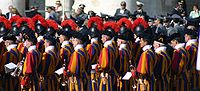
Also on parade at this event were the Company of Pikemen and Musketeers of the Honourable Artillery Company
Honourable Artillery Company
The Honourable Artillery Company was incorporated by Royal Charter in 1537 by King Henry VIII. Today it is a Registered Charity whose purpose is to attend to the “better defence of the realm"...
of London. The Band and Corps of Drums of the HAC also provided musical support, and HAC members attended as guests.
Banner
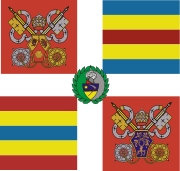
The Pontifical Swiss Guard banner is divided by a white cross into quarters. In the right lower corner is displayed Pope Julius II's coat-of-arms, in the middle is displayed the commander's own coat-of-arms. The ruling Pope's coat-of-arms is in the left upper quarter: the other quarters display the Swiss Guard colors.Commanders of the Pontifical Swiss Guard
- Kaspar von SilenenKaspar von SilenenKaspar von Silenen was the first commander or commandant of the Swiss Guards. He led the first contingent of 150 Swiss mercenaries who marched from September 1505 and entered the Vatican on January 22, 1506 during the pontificate of Pope Julius II....
, Uri (1506–1517) - Markus Röist, Zürich (1518–1524)
- Kaspar RöistKaspar RöistKaspar Röist was a Swiss papal official and commander of the papacy's Swiss Guard. He died whilst commanding it in its stand during the sack of Rome in 1527....
, Zürich (1524–1527) - Jost von Meggen, Luzern (1548–1559)
- Kaspar Leo von Silenen, Luzern (1559–1564)
- Jost Segesser von Brunegg, Luzern (1566–1592)
- Stephan Alexander Segesser von Brunegg, Luzern (1592–1629)
- Nikolaus Fleckenstein, Luzern (1629–1640)
- Jost Fleckenstein, Luzern (1640–1652)
- Johann Rudolf Pfyffer von AltishofenJohann Rudolf Pfyffer von AltishofenJohann Rudolf Pfyffer von Altishofen was the Commander of the Swiss Guard from 1652 to 1657 protecting Popes Innocent X and Alexander VII at the Vatican....
, Luzern (1652–1657) - Ludwig Pfyffer von Altishofen, Luzern (1658–1686)
- Franz Pfyffer von Altishofen, Luzern (1686–1696)
- Johann Kaspar Mayr von Baldegg, Luzern (1696–1704)
- Johann Konrad Pfyffer von Altishofen, Luzern (1712–1727)
- Franz Ludwig Pfyffer von Altishofen, Luzern (1727–1754)
- Jost Ignaz Pfyffer von Altishofen, Luzern (1754–1782)
- Franz Alois Pfyffer von Altishofen, Luzern (1783–1798)
- Karl Leodegar Pfyffer von Altishofen, Luzern (1800–1834)
- Martin Pfyffer von Altishofen, Luzern (1835–1847)
- Franz Xaver Leopold Meyer von Schauensee, Luzern (1847–1860)
- Alfred von Sonnenberg, Luzern (1860–1878)
- Louis-Martin de Courten, Wallis (1878–1901)
- Leopold Meyer von Schauensee, Luzern (1901–1910)
- Jules Repond, Freiburg (1910–1921)
- Alois Hirschbühl, Graubünden (1921–1935)
- Georg von Sury d'Aspremont, Solothurn (1935–1942)
- Heinrich Pfyffer von Altishofen, Luzern (1942–1957)
- Robert Nünlis, Luzern (1957–1972)
- Franz Pfyffer von Altishofen, Luzern (1972–1982)
- Roland Buchs, Freiburg (1982–1997, 1998)
- Alois EstermannAlois EstermannAlois Estermann was a senior officer of the Swiss Guard who was murdered in his apartment in the Vatican City.Estermann was born in Gunzwil, in the Canton of Lucerne...
, Luzern (1998) - Pius SegmüllerPius SegmüllerPius Segmüller is a Swiss politician and former commander of the Swiss Guard in the Vatican City .Segmüller was appointed Commander of the Swiss Guard following the death of Alois Estermann...
, St. Gallen (1998–2002) - Elmar Theodor MäderElmar MäderElmar Theodor Mäder was the thirty-third and former Commandant of the Pontifical Swiss Guards. He held the rank of colonel in the Guards.-Biography:...
, St. Gallen (2002–2008) - Daniel Rudolf AnrigDaniel AnrigDaniel Rudolf Anrig is the current Commandant of the Pontifical Swiss Guard since his appointment by Pope Benedict XVI on 19 August 2008. He replaced Elmar Mäder who had served as Commandant of the Swiss Guard since 2002. He is the thirty fourth Commandant of the Pontifical Swiss...
, St. Gallen (2008-)
Former Pontifical Guard Corps
- Noble Guard
- Palatine GuardPalatine GuardThe Palatine Guard was a military unit of the Vatican. It was formed in 1850 by Pope Pius IX, who ordered that the two militia units of the Papal States be amalgamated...
- Corsican Guard
- Papal ZouavesPapal ZouavesThe Papal Zouaves were an infantry force formed in defence of the Papal States.-Origin:The Zouaves evolved out of a unit formed by Christophe Léon Louis Juchault de Lamoricière...
In popular culture
- When writing Hamlet, Shakespeare assumed (perhaps relying on his sourcesSources of HamletThe sources of Hamlet, a tragedy by William Shakespeare believed to have been written between 1599 and 1601, trace back as far as pre-13th century Icelandic tales. The generic "hero-as-fool" story is so old and is expressed in the literature of so many cultures that scholars have hypothesized that...
) that the royal house of Denmark employed a Swiss Guard: In Act V, Scene v (line 98) he has King Claudius exclaim "Where are my Switzers? Let them guard the door". - George Bernard ShawGeorge Bernard ShawGeorge Bernard Shaw was an Irish playwright and a co-founder of the London School of Economics. Although his first profitable writing was music and literary criticism, in which capacity he wrote many highly articulate pieces of journalism, his main talent was for drama, and he wrote more than 60...
's 1894 play, Arms and the ManArms and the ManArms and the Man is a comedy by George Bernard Shaw, whose title comes from the opening words of Virgil's Aeneid in Latin:"Arma virumque cano" ....
and Oscar StrausOscar Straus (composer)Oscar Nathan Straus was a Viennese composer of operettas and film scores and songs. He also wrote about 500 cabaret songs, chamber music, and orchestral and choral works...
's operettaOperettaOperetta is a genre of light opera, light in terms both of music and subject matter. It is also closely related, in English-language works, to forms of musical theatre.-Origins:...
The Chocolate SoldierThe Chocolate SoldierThe Chocolate Soldier is an operetta composed in 1908 by Oscar Straus based on George Bernard Shaw's 1894 play, Arms and the Man...
, which it inspired, involve a Swiss man volunteering for service in a (fictional) war in the Balkans, which was possible at the time it was written. - The Pontifical Swiss Guards play a major part in Dan Brown's book Angels and DemonsAngels and DemonsAngels & Demons is a 2000 bestselling mystery-thriller novel written by American author Dan Brown and published by Pocket Books. The novel introduces the character Robert Langdon, who is also the protagonist of Brown's subsequent 2003 novel, The Da Vinci Code, and 2009 novel, The Lost Symbol...
, which describes a fictional conspiracy to destroy the Vatican. - The Pontifical Swiss Guards, known as Papal Guard, play a minor role in the open-world game Assassin's Creed: BrotherhoodAssassin's Creed: BrotherhoodAssassin's Creed: Brotherhood is a historical third person, stealth action-adventure video game developed by Ubisoft for PlayStation 3, Xbox 360, Microsoft Windows and Mac OS X. It was released for PlayStation 3 and Xbox 360 in November 2010, Microsoft Windows in March 2011 and Mac OS X in May 2011...
, where they are the guards of Pope Alexander VI and are commanded by the captain general of the Papal Armies, Cesare Borgia. - In Tom Clancy'sTom ClancyThomas Leo "Tom" Clancy, Jr. is an American author, best known for his technically detailed espionage, military science, and techno thriller storylines set during and in the aftermath of the Cold War, along with video games on which he did not work, but which bear his name for licensing and...
Sum of All FearsThe Sum of All FearsThe Sum of All Fears is the best-selling thriller novel by Dan Fogelman and Tom Clancy, and part of the Jack Ryan series. It was the fourth book of the series to be turned into a film. An interesting historical note is that this book was released just days before the Moscow uprising in 1991, which...
, the Swiss Guards are integral to the new plan for peace in Israel. Outfitted in urban camouflage tactical gear and equipped with modern weapons, they are the chosen solution to security on the Temple MountTemple MountThe Temple Mount, known in Hebrew as , and in Arabic as the Haram Ash-Sharif , is one of the most important religious sites in the Old City of Jerusalem. It has been used as a religious site for thousands of years...
. They are nicknamed 'Robosoldiers' for their appearance and demeanor (all are over 6'1" (185 cm) tall and weigh at least 180 lbs (85 kg)). - In the two last books of the Hyperion CantosHyperion CantosThe Hyperion Cantos is a series of science fiction novels by Dan Simmons. Set in the far future, and focusing more on plot and story development than technical detail, it falls into the soft science fiction category...
, where the Catholic Church rules a large part of the humanity, Swiss Guards are elite forces in its military. - Swiss guards may be hired as mercenaries in the popular 2005 real-time strategy game, Age of Empires IIIAge of Empires IIIAge of Empires III is a real-time strategy game developed by Microsoft Corporation's Ensemble Studios and published by Microsoft Game Studios. The Mac version was ported over and developed by Destineer's MacSoft Games and published by Destineer and MacSoft Games...
.
External links
- The Vatican's Official Swiss Guard site
- Contemporary account of the attack on the Tuileries and the massacre of the Swiss Guards, August 10, 1792
- Swiss Watchers, The GuardianThe GuardianThe Guardian, formerly known as The Manchester Guardian , is a British national daily newspaper in the Berliner format...
, April 5, 2005 - Giga-Catholic Information
- Oath ceremony photo
- Five Hundred Years of Loyalty
- Insignia of Rank (officers and other ranks) Pontifical Swiss Guard at uniforminsignia.com
