

List of Byzantine Emperors

Encyclopedia
This is a list of the Emperor
s of the East Roman or Byzantine Empire
. This list does not include numerous co-emperors who never attained sole or senior status as rulers, nor the various usurpers or rebels who claimed the imperial title (on whom see List of Byzantine usurpers).
This list begins with Constantine the Great, the first Christian Roman Emperor, who founded Constantinople
, and who was regarded by the later Byzantine Emperors as the model ruler. Diocletian
before him is sometimes considered the first "Byzantine" Emperor in a political sense, as he replaced the republican trappings of the office with a straightforward autocracy
, marking the transition from the Principate
to the absolutist Dominate
, a more typically oriental and Hellenistic form of monarchy that would characterize the Empire. It was under Constantine however that the major characteristics of the Byzantine state emerged: a Roman polity centered at Constantinople and culturally dominated by the Greek East, with Christianity as the state religion.
All Byzantine Emperors regarded themselves as Roman Emperors, the term "Byzantine" being coined firstly by Western historiography much later, in the 16th century. Although the Pope of Rome
and the Germanic rulers of the West recognized the Eastern Empire's claim to the Roman legacy after the fall of the Western Roman Empire
, on 25 December 800, Pope Leo III
crowned King of Franks Charlemagne
as the Roman Emperor
(which eventually led to the formation of the Holy Roman Empire
) due to uneasy relations with the Orthodox East
, an act which was much resented by the Byzantines. This happened after the coronation of Empress Irene, who, as a woman, was not recognized by the Pope to have a right to the throne.
The title of all Emperors listed preceding Heraclius
was officially Augustus
, although various other titles such as Dominus
were used as well. For official purposes, their names were preceded by Imperator
Caesar
and followed by Augustus. Following Heraclius, the title commonly became the Greek Basileus
(Gr. Βασιλεύς), which had formerly meant generally "king", "sovereign
" but now was used in place of Imperator. Following the establishment of a rival Empire in Western Europe (the Holy Roman Empire
), the title Autokrator
(Gr. Αυτοκράτωρ) was also increasingly used. In the later centuries of the Empire, the emperor could be often referred to by Western Christians as the "Emperor of the Greeks," though they still considered themselves "Roman" Emperors. Towards the end of the Empire, they referred to themselves as "[Emperor's name] in Christ, Emperor and Autocrat of the Romans."
Laskarid dynasty (Empire of Nicaea
Emperor
An emperor is a monarch, usually the sovereign ruler of an empire or another type of imperial realm. Empress, the female equivalent, may indicate an emperor's wife or a woman who rules in her own right...
s of the East Roman or Byzantine Empire
Byzantine Empire
The Byzantine Empire was the Eastern Roman Empire during the periods of Late Antiquity and the Middle Ages, centred on the capital of Constantinople. Known simply as the Roman Empire or Romania to its inhabitants and neighbours, the Empire was the direct continuation of the Ancient Roman State...
. This list does not include numerous co-emperors who never attained sole or senior status as rulers, nor the various usurpers or rebels who claimed the imperial title (on whom see List of Byzantine usurpers).
This list begins with Constantine the Great, the first Christian Roman Emperor, who founded Constantinople
Constantinople
Constantinople was the capital of the Roman, Eastern Roman, Byzantine, Latin, and Ottoman Empires. Throughout most of the Middle Ages, Constantinople was Europe's largest and wealthiest city.-Names:...
, and who was regarded by the later Byzantine Emperors as the model ruler. Diocletian
Diocletian
Diocletian |latinized]] upon his accession to Diocletian . c. 22 December 244 – 3 December 311), was a Roman Emperor from 284 to 305....
before him is sometimes considered the first "Byzantine" Emperor in a political sense, as he replaced the republican trappings of the office with a straightforward autocracy
Autocracy
An autocracy is a form of government in which one person is the supreme power within the state. It is derived from the Greek : and , and may be translated as "one who rules by himself". It is distinct from oligarchy and democracy...
, marking the transition from the Principate
Principate
The Principate is the first period of the Roman Empire, extending from the beginning of the reign of Caesar Augustus to the Crisis of the Third Century, after which it was replaced with the Dominate. The Principate is characterized by a concerted effort on the part of the Emperors to preserve the...
to the absolutist Dominate
Dominate
The Dominate was the "despotic" latter phase of government in the ancient Roman Empire from the conclusion of the Third Century Crisis of 235–284 until the formal date of the collapse of the Western Empire in AD 476. It followed the period known as the Principate...
, a more typically oriental and Hellenistic form of monarchy that would characterize the Empire. It was under Constantine however that the major characteristics of the Byzantine state emerged: a Roman polity centered at Constantinople and culturally dominated by the Greek East, with Christianity as the state religion.
All Byzantine Emperors regarded themselves as Roman Emperors, the term "Byzantine" being coined firstly by Western historiography much later, in the 16th century. Although the Pope of Rome
Pope
The Pope is the Bishop of Rome, a position that makes him the leader of the worldwide Catholic Church . In the Catholic Church, the Pope is regarded as the successor of Saint Peter, the Apostle...
and the Germanic rulers of the West recognized the Eastern Empire's claim to the Roman legacy after the fall of the Western Roman Empire
Western Roman Empire
The Western Roman Empire was the western half of the Roman Empire after its division by Diocletian in 285; the other half of the Roman Empire was the Eastern Roman Empire, commonly referred to today as the Byzantine Empire....
, on 25 December 800, Pope Leo III
Pope Leo III
Pope Saint Leo III was Pope from 795 to his death in 816. Protected by Charlemagne from his enemies in Rome, he subsequently strengthened Charlemagne's position by crowning him as Roman Emperor....
crowned King of Franks Charlemagne
Charlemagne
Charlemagne was King of the Franks from 768 and Emperor of the Romans from 800 to his death in 814. He expanded the Frankish kingdom into an empire that incorporated much of Western and Central Europe. During his reign, he conquered Italy and was crowned by Pope Leo III on 25 December 800...
as the Roman Emperor
Holy Roman Emperor
The Holy Roman Emperor is a term used by historians to denote a medieval ruler who, as German King, had also received the title of "Emperor of the Romans" from the Pope...
(which eventually led to the formation of the Holy Roman Empire
Holy Roman Empire
The Holy Roman Empire was a realm that existed from 962 to 1806 in Central Europe.It was ruled by the Holy Roman Emperor. Its character changed during the Middle Ages and the Early Modern period, when the power of the emperor gradually weakened in favour of the princes...
) due to uneasy relations with the Orthodox East
Eastern Orthodox Church
The Orthodox Church, officially called the Orthodox Catholic Church and commonly referred to as the Eastern Orthodox Church, is the second largest Christian denomination in the world, with an estimated 300 million adherents mainly in the countries of Belarus, Bulgaria, Cyprus, Georgia, Greece,...
, an act which was much resented by the Byzantines. This happened after the coronation of Empress Irene, who, as a woman, was not recognized by the Pope to have a right to the throne.
The title of all Emperors listed preceding Heraclius
Heraclius
Heraclius was Byzantine Emperor from 610 to 641.He was responsible for introducing Greek as the empire's official language. His rise to power began in 608, when he and his father, Heraclius the Elder, the exarch of Africa, successfully led a revolt against the unpopular usurper Phocas.Heraclius'...
was officially Augustus
Augustus (honorific)
Augustus , Latin for "majestic," "the increaser," or "venerable", was an Ancient Roman title, which was first held by Gaius Julius Caesar Augustus , and subsequently came to be considered one of the titles of what are now known as the Roman Emperors...
, although various other titles such as Dominus
Dominus (title)
Dominus is the Latin word for master or owner. As a title of sovereignty the term under the Roman Republic had all the associations of the Greek Tyrannos; refused during the early principate, it finally became an official title of the Roman Emperors under Diocletian...
were used as well. For official purposes, their names were preceded by Imperator
Imperator
The Latin word Imperator was originally a title roughly equivalent to commander under the Roman Republic. Later it became a part of the titulature of the Roman Emperors as part of their cognomen. The English word emperor derives from imperator via Old French Empreur...
Caesar
Caesar (title)
Caesar is a title of imperial character. It derives from the cognomen of Julius Caesar, the Roman dictator...
and followed by Augustus. Following Heraclius, the title commonly became the Greek Basileus
Basileus
Basileus is a Greek term and title that has signified various types of monarchs in history. It is perhaps best known in English as a title used by the Byzantine Emperors, but also has a longer history of use for persons of authority and sovereigns in ancient Greece, as well as for the kings of...
(Gr. Βασιλεύς), which had formerly meant generally "king", "sovereign
Monarch
A monarch is the person who heads a monarchy. This is a form of government in which a state or polity is ruled or controlled by an individual who typically inherits the throne by birth and occasionally rules for life or until abdication...
" but now was used in place of Imperator. Following the establishment of a rival Empire in Western Europe (the Holy Roman Empire
Holy Roman Empire
The Holy Roman Empire was a realm that existed from 962 to 1806 in Central Europe.It was ruled by the Holy Roman Emperor. Its character changed during the Middle Ages and the Early Modern period, when the power of the emperor gradually weakened in favour of the princes...
), the title Autokrator
Autokrator
Autokratōr is a Greek epithet applied to an individual who exercises absolute power, unrestrained by superiors. In a historical context, it has been applied to military commanders-in-chief, and to Roman and Byzantine emperors as the translation of the Latin title imperator. Its connection with...
(Gr. Αυτοκράτωρ) was also increasingly used. In the later centuries of the Empire, the emperor could be often referred to by Western Christians as the "Emperor of the Greeks," though they still considered themselves "Roman" Emperors. Towards the end of the Empire, they referred to themselves as "[Emperor's name] in Christ, Emperor and Autocrat of the Romans."
Constantinian dynasty (306–363)
| Name | Reign | Comments | |
|---|---|---|---|
 |
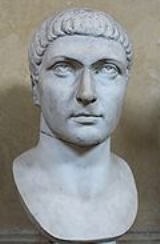
Constantine "the Great" Constantine I Constantine the Great , also known as Constantine I or Saint Constantine, was Roman Emperor from 306 to 337. Well known for being the first Roman emperor to convert to Christianity, Constantine and co-Emperor Licinius issued the Edict of Milan in 313, which proclaimed religious tolerance of all... (Greek: Κωνσταντίνος Α' ο Μέγας, Latin: Gaius Flavius Valerius Aurelius Constantinus) |
19 September 324 – 22 May 337 |
Born on 27 February c. 280 as the son of the Augustus Constantius Chlorus Constantius Chlorus Constantius I , commonly known as Constantius Chlorus, was Roman Emperor from 293 to 306. He was the father of Constantine the Great and founder of the Constantinian dynasty. As Caesar he defeated the usurper Allectus in Britain and campaigned extensively along the Rhine frontier, defeating the... . Proclaimed Augustus of the western empire upon the death of his father on 25 July 306 and later united the whole empire |
 |
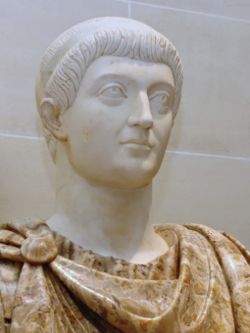
Constantius [II Constantius II Constantius II , was Roman Emperor from 337 to 361. The second son of Constantine I and Fausta, he ascended to the throne with his brothers Constantine II and Constans upon their father's death.... ] (Κωνστάντιος [Β'], Flavius Iulius Constantius) |
22 May 337 – 5 October 361 |
Born on 7 August 317, the second son of Constantine I. Inherited Eastern third of Roman Empire upon his father's death, sole Roman Emperor from 351. Died of illness on campaign |
 |
Constans I Constans Constans , was Roman Emperor from 337 to 350. He defeated his brother Constantine II in 340, but anger in the army over his personal life and preference for his barbarian bodyguards saw the general Magnentius rebel, resulting in Constans’ assassination in 350.-Career:Constans was the third and... (Κώνστας Α', Flavius Iulius Constans) |
22 May 337 – 350 |
Born c. 323, the third son of Constantine I. Inherited central third of Roman Empire upon his father's death, acquired the Balkans in 338. Assassinated during the revolt of Magnentius Magnentius Flavius Magnus Magnentius was a usurper of the Roman Empire .-Early life and career:... |
-cng.jpg) |
Julian "the Apostate" Julian the Apostate Julian "the Apostate" , commonly known as Julian, or also Julian the Philosopher, was Roman Emperor from 361 to 363 and a noted philosopher and Greek writer.... (Ιουλιανός "ο Παραβάτης", Flavius Claudius Iulianus) |
5 October 361 – 28 June 363 |
Born in May 332, grandson of Constantius Chlorus and cousin of Constantius II. Proclaimed by his army in Gaul, became legitimate Emperor upon the death of Constantius. Killed on campaign against Sassanid Persia |
Non-dynastic (363–364)
| Name | Reign | Comments | |
|---|---|---|---|
 |
Jovian (Ιοβιανός, Flavius Claudius Iovianus) |
28 June 363 – 17 February 364 |
Born c. 332. Captain of the guards under Julian, elected by the army upon Julian's death. Died on journey back to Constantinople |
Valentinian dynasty (364–379)
| Name | Reign | Comments | |
|---|---|---|---|
 |
Valentinian I Valentinian I Valentinian I , also known as Valentinian the Great, was Roman emperor from 364 to 375. Upon becoming emperor he made his brother Valens his co-emperor, giving him rule of the eastern provinces while Valentinian retained the west.... (Ουαλεντιανός, Flavius Valentinianus) |
26 February 364 – 17 November 375 |
Born in 321. An officer under Julian and Jovian, he was elected by the army upon Jovian's death. He soon appointed his younger brother Valens as Emperor of the East. Died of cerebral haemorrhage |
 |
Valens Valens Valens was the Eastern Roman Emperor from 364 to 378. He was given the eastern half of the empire by his brother Valentinian I after the latter's accession to the throne... (Ουάλης, Flavius Iulius Valens) |
28 March 364 – 9 August 378 |
Born in 328. A soldier of the Roman army, he was appointed Emperor of the East by his elder brother Valentinian I. Killed at the Battle of Adrianople Battle of Adrianople The Battle of Adrianople , sometimes known as the Battle of Hadrianopolis, was fought between a Roman army led by the Roman Emperor Valens and Gothic rebels led by Fritigern... |
 |
Gratian Gratian Gratian was Roman Emperor from 375 to 383.The eldest son of Valentinian I, during his youth Gratian accompanied his father on several campaigns along the Rhine and Danube frontiers. Upon the death of Valentinian in 375, Gratian's brother Valentinian II was declared emperor by his father's soldiers... (Γρατιανός, Flavius Gratianus) |
9 August 378 – 19 January 379 |
Born on 18 April/23 May 359, the son of Valentinian I. Emperor of the West, he inherited rule of the East upon the death of Valens and appointed Theodosius I as Emperor of the East. Assassinated on 25 August 383 during the rebellion of Magnus Maximus Magnus Maximus Magnus Maximus , also known as Maximianus and Macsen Wledig in Welsh, was Western Roman Emperor from 383 to 388. As commander of Britain, he usurped the throne against Emperor Gratian in 383... |
Theodosian dynasty (379–457)
| Name | Reign | Comments | |
|---|---|---|---|
 |
Theodosius I "the Great" Theodosius I Theodosius I , also known as Theodosius the Great, was Roman Emperor from 379 to 395. Theodosius was the last emperor to rule over both the eastern and the western halves of the Roman Empire. During his reign, the Goths secured control of Illyricum after the Gothic War, establishing their homeland... (Θεοδόσιος Α' ο Μέγας, Flavius Theodosius) |
19 January 379 – 17 January 395 |
Born on 11 January 347. Aristocrat and military leader, brother-in-law of Gratian, who appointed him as emperor of the East. From 392 until his death sole Roman Emperor. |
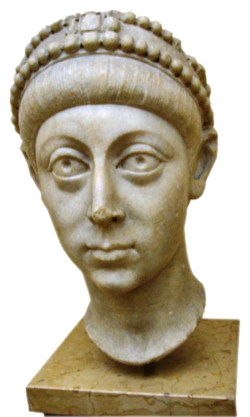 |
Arcadius Arcadius Arcadius was the Byzantine Emperor from 395 to his death. He was the eldest son of Theodosius I and his first wife Aelia Flaccilla, and brother of the Western Emperor Honorius... (Αρκάδιος, Flavius Arcadius) |
17 January 395 – 1 May 408 |
Born in 377/378, the eldest son of Theodosius I. Succeeded upon the death of his father. |
| Theodosius II Theodosius II Theodosius II , commonly surnamed Theodosius the Younger, or Theodosius the Calligrapher, was Byzantine Emperor from 408 to 450. He is mostly known for promulgating the Theodosian law code, and for the construction of the Theodosian Walls of Constantinople... (Θεοδόσιος Β', Flavius Theodosius) |
1 May 408 – 28 July 450 |
Born on 10 April 401, the only son of Arcadius. Succeeded upon the death of his father. As a minor, the praetorian prefect Anthemius Anthemius (praetorian prefect) Flavius Anthemius was a high-ranking official of the late Roman Empire. He is notable as a Praetorian prefect of the East and effective regent of the Eastern Roman Empire during the later reign of Arcadius and the first years of Theodosius II, as well as for the construction of the first set of... was regent in 408–414. He died in a riding accident. |
|
 |
Marcian Marcian Marcian was Byzantine Emperor from 450 to 457. Marcian's rule marked a recovery of the Eastern Empire, which the Emperor protected from external menaces and reformed economically and financially... (Μαρκιανός, Flavius Valerius Marcianus) |
450 – January 457 | Born in 396. A soldier and politician, he became emperor after being wed by the Augusta Pulcheria Pulcheria Aelia Pulcheria was the daughter of Eastern Roman Emperor Arcadius and Empress Aelia Eudoxia. She was the second child born to Arcadius and Eudoxia. Her oldest sister was Flaccilla born in 397, but is assumed she had died young. Her younger siblings were Theodosius II, the future emperor and... , sister of Theodosius II, following the latter's death. Died of gangrene Gangrene Gangrene is a serious and potentially life-threatening condition that arises when a considerable mass of body tissue dies . This may occur after an injury or infection, or in people suffering from any chronic health problem affecting blood circulation. The primary cause of gangrene is reduced blood... . |
Leonid dynasty (457–518)
| Name | Reign | Comments | |
|---|---|---|---|
 |
Leo I "the Thracian" Leo I (emperor) Leo I was Byzantine Emperor from 457 to 474. A native of Dacia Aureliana near historic Thrace, he was known as Leo the Thracian .... (Λέων Α' ο Θράξ, Flavius Valerius Leo) |
7 February 457 – 18 January 474 |
Born in Dacia Dacia Aureliana Dacia Aureliana was a province of the Roman Empire found by Emperor Aurelian, after his retreat from Dacia Traiana in 271. Between 271/275 and 285, it occupied most of what is today Bulgaria. Its capital was in Serdica... in 401. A common soldier, he was chosen by Aspar Aspar Flavius Ardabur Aspar was an Alan patrician and magister militum of the Eastern Roman Empire. Aspar's family exerted a great influence on the Eastern Roman Emperors for half a century, from the 420s to his death in 471, over Theodosius II, Marcian and Leo I, who, in the end, had him killed.Alans... , commander-in-chief of the army. Died of dysentery. |
-coin.jpg) |
Leo II Leo II (emperor) Leo II was Byzantine Emperor for less than a year in 474. He was the son of Zeno and Ariadne, and maternal grandson of Leo I and Verina. As Leo's closest male relative, he was named successor upon his grandfather's death. After taking his father as colleague, he died of an unknown disease about 10... (Λέων Β', Flavius Leo) |
18 January – 17 November 474 |
Born in 467, the grandson of Leo I. Succeeded upon the death of Leo I. Died of an unknown disease, possibly poisoned. |
 |
Zeno Zeno (emperor) Zeno , originally named Tarasis, was Byzantine Emperor from 474 to 475 and again from 476 to 491. Domestic revolts and religious dissension plagued his reign, which nevertheless succeeded to some extent in foreign issues... (Ζήνων, Flavius Zeno) |
17 November 474 – 9 April 491 |
Born c.425 at Zenonopolis Zenonopolis Zenonopolis was a city in Isauria, originally called Rusumblada but renamed in honour of Emperor Zeno , who was born there.... , Isauria Isauria Isauria , in ancient geography, is a rugged isolated district in the interior of South Asia Minor, of very different extent at different periods, but generally covering what is now the district of Bozkır and its surroundings in the Konya province of Turkey, or the core of the Taurus Mountains. In... , originally named Tarasicodissa. Son-in-law of Leo I, he was bypassed in the succession because of his barbarian origin. Named co-emperor by his son on 9 February 474, he succeeded upon the death of Leo II. Deposed by Basiliscus, brother-in-law of Leo, he fled to his native country and regained the throne in August 476. |
 |
Basiliscus Basiliscus Basiliscus was Eastern Roman Emperor from 475 to 476. A member of the House of Leo, he came to power when Emperor Zeno had been forced out of Constantinople by a revolt.... (Βασιλίσκος, Flavius Basiliscus) |
9 January 475 – August 476 |
General and brother-in-law of Leo I, he seized power from Zeno but was again deposed by him. Died in 476/477 |
| Anastasius I Anastasius I (emperor) Anastasius I was Byzantine Emperor from 491 to 518. During his reign the Roman eastern frontier underwent extensive re-fortification, including the construction of Dara, a stronghold intended to counter the Persian fortress of Nisibis.... (Αναστάσιος Α', Flavius Anastasius) |
11 April 491 – 9 July 518 |
Born c. 430 at Dyrrhachium, Epirus nova. A palace official (silentiarius Silentiarius Silentiarius, Hellenized to silentiarios and Anglicized to silentiary, was the Latin title given to a class of courtiers in the Byzantine imperial court, responsible for order and silence in the Great Palace of Constantinople... ) and son-in-law of Leo I, he was chosen as Emperor by Empress-dowager Ariadne Ariadne (empress) Aelia Ariadne was the Empress consort of Zeno and Anastasius I of the Byzantine Empire.-Family:Ariadne was a daughter of Leo I and Verina. Her mother was a sister of Basiliscus.... |
|
Justinian dynasty (518–602)
| Name | Reign | Comments | |
|---|---|---|---|
 |
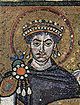
Justin I Justin I Justin I was Byzantine Emperor from 518 to 527. He rose through the ranks of the army and ultimately became its Emperor, in spite of the fact he was illiterate and almost 70 years old at the time of accession... (Ιουστίνος Α', Flavius Iustinus) |
July 518 – 1 August 527 |
Born c. 450 at Bederiana (Justiniana Prima Justiniana Prima Justiniana Prima is an archaeological site near today's Lebane in southern Serbia, It was a Byzantine city that served as the seat of an Archbishopric that had jurisdiction of the Central Balkans... ), Dardania. Officer and commander of the Excubitors Excubitors The Excubitors were founded in circa 460 AD as the imperial guards of the early Byzantine emperors. Their commanders soon acquired great influence and provided a series of emperors in the 6th century... bodyguard under Anastasius I, he was elected by army and people upon the death of Anastasius I. |
 |
Justinian I "the Great" Justinian I Justinian I ; , ; 483– 13 or 14 November 565), commonly known as Justinian the Great, was Byzantine Emperor from 527 to 565. During his reign, Justinian sought to revive the Empire's greatness and reconquer the lost western half of the classical Roman Empire.One of the most important figures of... (Ιουστινιανός Α' ο Μέγας, Flavius Petrus Sabbatius Iustinianus) |
1 August 527 – 13/14 November 565 |
Born in 482/483 at Tauresium Tauresium Tauresium or known as Gradište is an archaeological site in Macedonia, located approximately 20 km south-east of the capital Skopje. Tauresium is the birthplace of Byzantine Emperor Justinian I and King Theodahad of the Ostrogoths .- Name :The ancient town of Tauresium is located on the... (Taor), Macedonia Macedonia (Roman province) The Roman province of Macedonia was officially established in 146 BC, after the Roman general Quintus Caecilius Metellus defeated Andriscus of Macedon, the last Ancient King of Macedon in 148 BC, and after the four client republics established by Rome in the region were dissolved... . Nephew of Justin I, possibly raised to co-emperor on 1 April 527. Succeeded on Justin I's death. |
 |
Justin II Justin II Justin II was Byzantine Emperor from 565 to 578. He was the husband of Sophia, nephew of Justinian I and the late Empress Theodora, and was therefore a member of the Justinian Dynasty. His reign is marked by war with Persia and the loss of the greater part of Italy... (Ιουστίνος Β', Flavius Iustinus Iunior) |
14 November 565 – 5 October 578 |
Born c. 520. Nephew of Justinian I, he seized the throne on the death of Justinian I with support of army and Senate. Became insane, hence in 573–574 under the regency of his wife Sophia Sophia (empress) Aelia Sophia was the Empress consort of Justin II of the Byzantine Empire from 565 to 578. She was specifically interested in economic matters and was involved in financial matters during Justin's reign... , and in 574–578 under the regency of Tiberius Constantine. |
 |
Tiberius II Constantine Tiberius II Constantine Tiberius II Constantine was Byzantine Emperor from 574 to 582.During his reign, Tiberius II Constantine gave away 7,200 pounds of gold each year for four years.... (Τιβέριος Β', Flavius Tiberius Constantinus) |
5 October 578 – 14 August 582 |
Born c. 520, commander of the Excubitors Excubitors The Excubitors were founded in circa 460 AD as the imperial guards of the early Byzantine emperors. Their commanders soon acquired great influence and provided a series of emperors in the 6th century... , friend and adoptive son of Justin. Was named Caesar Caesar (title) Caesar is a title of imperial character. It derives from the cognomen of Julius Caesar, the Roman dictator... and regent in 574. Succeeded on Justin II's death. |
 |
Maurice Maurice (emperor) Maurice was Byzantine Emperor from 582 to 602.A prominent general in his youth, Maurice fought with success against the Sassanid Persians... (Μαυρίκιος, Flavius Mauricius Tiberius) |
14 August 582 – 22 November 602 |
Born in 539 at Arabissus, Cappadocia Cappadocia Cappadocia is a historical region in Central Anatolia, largely in Nevşehir Province.In the time of Herodotus, the Cappadocians were reported as occupying the whole region from Mount Taurus to the vicinity of the Euxine... . Became an official and later a general. Married the daughter of Tiberius II and succeeded him upon his death. Named his son Theodosius Theodosius (son of Maurice) Theodosius was the eldest son of Byzantine Emperor Maurice and was co-emperor from 590 until his deposition and execution during a military revolt in November 602. Along with his father-in-law Germanus, he was briefly proposed as successor to Maurice by the troops, but the army eventually... as co-emperor in 600. Deposed by Phocas and executed on 27 November 602 at Chalcedon Chalcedon Chalcedon , sometimes transliterated as Chalkedon) was an ancient maritime town of Bithynia, in Asia Minor, almost directly opposite Byzantium, south of Scutari . It is now a district of the city of Istanbul named Kadıköy... . |
Non-dynastic (602–610)
| Name | Reign | Comments | |
|---|---|---|---|
| Phocas Phocas Phocas was Byzantine Emperor from 602 to 610. He usurped the throne from the Emperor Maurice, and was himself overthrown by Heraclius after losing a civil war.-Origins:... (Φωκάς, Flavius Phocas) |
23 November 602 – 4 October 610 |
Subaltern in the Balkan army, he led a rebellion that deposed Maurice. Increasingly unpopular and tyrannical, he was deposed and executed by Heraclius. |
Heraclian dynasty (610–711)
| Name | Reign | Comments | |
|---|---|---|---|
| Heraclius Heraclius Heraclius was Byzantine Emperor from 610 to 641.He was responsible for introducing Greek as the empire's official language. His rise to power began in 608, when he and his father, Heraclius the Elder, the exarch of Africa, successfully led a revolt against the unpopular usurper Phocas.Heraclius'... (Ηράκλειος, Flavius Heraclius) |
5 October 610 – 11 February 641 |
Born c. 575 as the eldest son of the Exarch of Africa, Heraclius the Elder Heraclius the Elder Heraclius the Elder was an East Roman general and the father of Byzantine Emperor Heraclius . Of Armenian origin, the elder Heraclius distinguished himself in the wars against the Sassanid Persians in the 580s. Ca. 600, he was appointed as the Exarch of Africa. In 608, he rebelled with his son... . Began a revolt against Phocas in 609 and deposed him in October 610. Brought the Byzantine-Sassanid War of 602–628 Byzantine-Sassanid War of 602–628 The Byzantine–Sassanid War of 602–628 was the final and most devastating of the series of wars fought between the Roman Empire and the Sassanid Empire. The previous war had ended in 591 after Emperor Maurice had helped the Sassanian king Khosrau II regain his throne. In 602, Maurice was murdered... to successful conclusion but was unable to stop the Muslim conquest of Syria Muslim conquest of Syria The Muslim conquest of Syria occurred in the first half of the 7th century, and refers to the region known as the Bilad al-Sham, the Levant, or Greater Syria... . |
|
 |
Constantine III formally Heraclius New Constantine (Ηράκλειος νέος Κωνσταντίνος, Heraclius Novus Constantinus) |
11 February – 24/26 May 641 |
Born on 3 May 612 as the eldest son of Heraclius by his first wife Fabia Eudokia. Named co-emperor in 613, he succeeded to throne with his younger brother Heraklonas following the death of Heraclius. Died of tuberculosis, allegedly poisoned by Empress-dowager Martina. |
|
Heraklonas Heraklonas Constantinus Heraclius , known in English as Heraklonas, Heraclonas, or Heracleonas , was the son of Heraclius and his niece Martina, and was Byzantine Emperor briefly between February and September 641.... (Ηρακλωνάς, Heraclianus) formally Constantine Heraclius (Κωνσταντίνος Ηράκλειος, Constantinus Heraclius) |
11 February 641 – September 641 |
Born in 626 to Heraclius' second wife Martina, named co-emperor in 638. Succeeded to throne with Constantine III following the death of Heraclius. Sole emperor after the death of Constantine III, under the regency of Martina, but was forced to name Constans II Constans II Constans II , also called Constantine the Bearded , was Byzantine emperor from 641 to 668. He also was the last emperor to become consul in 642, becoming the last Roman consul in history.... co-emperor by the army, and was deposed by the Senate Byzantine Senate The Byzantine Senate or Eastern Roman Senate was the continuation of the Roman Senate, established in the 4th century by Constantine I. It survived for centuries but was increasingly irrelevant until its eventual disappearance in the 13th century.... in September 641. |
 |
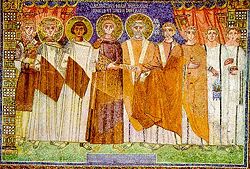
Constans II Constans II Constans II , also called Constantine the Bearded , was Byzantine emperor from 641 to 668. He also was the last emperor to become consul in 642, becoming the last Roman consul in history.... (Κώνστας Β', Constantus II) formally Constantine "the Bearded", (Κωνσταντίνος ο Πωγωνάτος) |
September 641 – 15 September 668 |
Born on 7 November 630, the son of Constantine III. Raised to co-emperor in summer 641 after his father's death due to army pressure, he became sole emperor after the forced abdication of his uncle Heraklonas. Baptized Heraclius, he reigned as Constantine. "Constans" is his nickname. Moved his seat to Syracuse, where he was assassinated, possibly on the orders of Mezezius Mezezius Mezezius was an Armenian noble who served as a general of Byzantium, later usurping the Byzantine throne in Sicily from 668 to 669.According to a letter from Pope Gregory II to Emperor Leo III, he was Count of the Opsikion, the imperial retinue , and a later Syriac chronicle describes him as a... . |
 |
Constantine IV "the Bearded" Constantine IV Constantine IV , , sometimes incorrectly called Pogonatos, "the Bearded", by confusion with his father; was Byzantine emperor from 668 to 685... (Κωνσταντίνος Δ' ο Πωγωνάτος) |
15 September 668 – September 685 |
Born in 652, he succeeded following the murder of his father Constans II. Erroneously called "Constantine the Bearded" by historians through confusion with his father. He repelled the First Arab Siege of Constantinople, and died of dysentery. |
 |
Justinian II "the Slit-nosed" Justinian II Justinian II , surnamed the Rhinotmetos or Rhinotmetus , was the last Byzantine Emperor of the Heraclian Dynasty, reigning from 685 to 695 and again from 705 to 711... (Ιουστινιανός Β' ο Ρινότμητος) |
September 685 – 695 |
Born in 669, he was named co-emperor in 681 and became sole emperor upon Constantine IV's death. Deposed by military revolt in 695, mutilated (hence his surname) and exiled to Cherson, whence he recovered his throne in 705. |
 |
Leontios Leontios Leontios was Byzantine emperor from 695 to 698. He came to power by overthrowing the Emperor Justinian II, but was overthrown in his turn by Tiberios III. His actual and official name was Leo , but he is known by the name used for him in Byzantine chronicles.- Early life :Leontios was born in... (Λεόντιος) |
695–698 | General from Isauria Isauria Isauria , in ancient geography, is a rugged isolated district in the interior of South Asia Minor, of very different extent at different periods, but generally covering what is now the district of Bozkır and its surroundings in the Konya province of Turkey, or the core of the Taurus Mountains. In... , he deposed Justinian II and was overthrown in another revolt in 698. He was executed in February 706. |
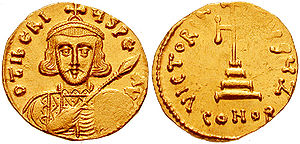 |
Tiberius III (II) Apsimar Tiberios III Tiberios III was Byzantine emperor from 698 to 21 August 705. Although his rule was considered generally successful, especially in containing the Arab threat to the east, he was overthrown by the former emperor Justinian II and subsequently executed.-Rise to power:Tiberius was a Germanic naval... (Τιβέριος Γ' Αψίμαρος) |
698–705 | Admiral of Germanic origin, originally named Apsimar. He rebelled against Leontios after a failed expedition. Reigned under the name of Tiberius until deposed by Justinian II in 705. Executed in February 706. |
|
Justinian II "the Slit-nosed" Justinian II Justinian II , surnamed the Rhinotmetos or Rhinotmetus , was the last Byzantine Emperor of the Heraclian Dynasty, reigning from 685 to 695 and again from 705 to 711... (Ιουστινιανός Β' ο Ρινότμητος) |
August 705 – December 711 |
Returned on the throne with Bulgar First Bulgarian Empire The First Bulgarian Empire was a medieval Bulgarian state founded in the north-eastern Balkans in c. 680 by the Bulgars, uniting with seven South Slavic tribes... support. Named son Tiberius as co-emperor in 706. Deposed and killed by military revolt. |
Non-dynastic (711–717)
| Name | Reign | Comments | |
|---|---|---|---|
 |
Philippikos Bardanes (Φιλιππικός Βαρδάνης) |
December 711 – 3 June 713 |
A general of Armenian Armenians Armenian people or Armenians are a nation and ethnic group native to the Armenian Highland.The largest concentration is in Armenia having a nearly-homogeneous population with 97.9% or 3,145,354 being ethnic Armenian.... origin, he deposed Justinian II and was in turn overthrown by a revolt of the Opsician troops. |
 |
Anastasios II (Αναστάσιος Β') |
June 713 – November 715 |
Originally named Artemios. A bureaucrat and secretary under Philippikos, he was raised to the purple by the soldiers who overthrew Philippikos. Deposed by another military revolt, he led an abortive attempt to regain the throne in 718 and was killed. |
 |
Theodosios III Theodosios III Theodosios III or Theodosius III , was Byzantine Emperor from 715 to March 25, 717.Theodosius was a financial officer and tax collector in the southern portion of the theme of Opsikion. According to one theory he was the son of the former Emperor Tiberius III. When the thematic troops rebelled... (Θεοδόσιος Γ') |
May 715 – 25 March 717 |
A fiscal official, he was proclaimed emperor by the rebellious Opsician troops. Entered Constantinople in November 715. Abdicated following the revolt of Leo the Isaurian and became a monk. |
Isaurian dynasty (717–802)
| Name | Reign | Comments | |
|---|---|---|---|
 |
Leo III "the Isaurian" Leo III the Isaurian Leo III the Isaurian or the Syrian , was Byzantine emperor from 717 until his death in 741... (Λέων Γ΄ ο Ίσαυρος) |
25 March 717 – 18 June 741 |
Born c. 685 in Germanikeia Kahramanmaras -Industry:Kahramanmaraş's industry is mainly based on textile and ice cream. Kahramanmaraş is one of the biggest textile industry cities of Turkey. Companies like Kipaş, İskur, Arsan and Bozkurt are one of the richest companies in the city... , Commagene, he became a general. Rose in rebellion and secured the throne in spring 717. Repelled the Second Arab Siege of Constantinople and initiated the Byzantine Iconoclasm. |
|
Constantine V "the Dung-named" Constantine V Constantine V was Byzantine emperor from 741 to 775; ); .-Early life:... (Κωνσταντίνος Ε΄ ο Κοπρώνυμος) |
18 June 741 – 14 September 775 |
Born in July 718, the only son of Leo III. Co-emperor since 720, he succeeded upon his father's death. After overcoming the usurpation of Artabasdos, he continued his father's iconoclastic policies (which earned him the surname "the Dung-named" by hostile later chroniclers) and won several victories against the Arabs and the Bulgars. |
| Artabasdos Artabasdos Artavasdos, Latinized as Artabasdos or Artabasdus , was Byzantine Emperor of Armenian descent from June 741 or 742 until November 743... (Αρτάβασδος) |
June 741/742 – 2 November 743 |
General and son-in-law of Leo III, Count of the Opsician Theme Opsikion The Opsician Theme or simply Opsikion was a Byzantine theme located in northwestern Asia Minor . Created from the imperial retinue army, the Opsikion was the largest and most prestigious of the early themes, being located closest to Constantinople... . Led a revolt that secured Constantinople, but was defeated and deposed by Constantine V, who blinded and tonsured him. |
|
 |
Leo IV "the Khazar" Leo IV the Khazar Leo IV the Khazar was Byzantine Emperor from 775 to 780 CE.Leo was the son of Emperor Constantine V by his first wife, Irene of Khazaria , the daughter of a Khagan of the Khazars... (Λέων Δ΄ ο Χάζαρος) |
14 September 775 – 8 September 780 |
Born on 25 January 750 as the eldest son of Constantine V. Co-emperor since 751, he succeeded upon his father's death. |
|
Constantine VI (Κωνσταντίνος ΣΤ΄) |
8 September 780 – August 797 |
Born in 771, the only child of Leo IV. Co-emperor in 776, sole emperor upon Leo's death in 780, until 790 under the regency of his mother, Irene of Athens. He was overthrown on Irene's orders, blinded and imprisoned, probably dying of his wounds shortly after. |
.jpg) |
Irene of Athens (Ειρήνη η Αθηναία) |
August 797 – 31 October 802 |
Born c. 752 in Athens Athens Athens , is the capital and largest city of Greece. Athens dominates the Attica region and is one of the world's oldest cities, as its recorded history spans around 3,400 years. Classical Athens was a powerful city-state... , she married Leo IV. Regent for her son Constantine VI in 780–790, she overthrew him in 797 and became empress-regnant. Deposed in a palace coup in 802, she was exiled and died on 9 August 803. |
Dynasty of Nikephoros (802–813)
| Name | Reign | Comments | |
|---|---|---|---|
 |
Nikephoros I "the Logothete" Nikephoros I Nikephoros I or Nicephorus I, Logothetes or Genikos was Byzantine emperor from 802 to 811, when he was killed in the Battle of Pliska.... (Νικηφόρος Α΄ ο Λογοθέτης) |
31 October 802 – 26 July 811 |
General Logothete (finance minister) under Irene, led initially successful campaigns against the Bulgars but was killed at the Battle of Pliska Battle of Pliska The Battle of Pliska or Battle of Vărbitsa Pass was a series of battles between troops, gathered from all parts of the Byzantine Empire, led by the Emperor Nicephorus I Genik, and Bulgaria, governed by Khan Krum... . |
|
Staurakios Staurakios Staurakios or Stauracius was Byzantine emperor from July 26 to October 2, 811 in succession to his father, Nikephoros I, who had fallen at the Battle of Pliska... (Σταυράκιος) |
2 October 811 – 11 January 812 |
Only son of Nikephoros I, crowned co-emperor in December 803. Succeeded on his father's death, however he had been heavily wounded at Pliska and left paralyzed. He was forced to resign, and retired to a monastery where he died soon after. |
.jpg) |
Michael I Rangabe Michael I Rangabe Michael I Rangabes was Byzantine Emperor from 811 to 813.Michael was the son of the patrician Theophylaktos Rangabes, the admiral of the Aegean fleet... (Μιχαήλ Α΄ Ραγκαβέ) |
11 January 812 – 11 July 813 |
Son-in-law of Nikephoros I, he succeeded Staurakios on his abdication. Resigned after the revolt under Leo the Armenian and retired to a monastery, where he died on 11 January 844. |
Non-dynastic (813–820)
| Name | Reign | Comments | |
|---|---|---|---|
| Leo V "the Armenian" Leo V the Armenian Leo V the Armenian was emperor of the Byzantine Empire from 813 to 820. A senior general, he forced his predecessor, Michael I Rangabe, to abdicate and assumed the throne. He ended the decade-long war with the Bulgars, and initiated the second period of Byzantine Iconoclasm... (Λέων Ε' ο Αρμένιος) |
11 July 813 – 25 December 820 |
General of Armenian origin, born c. 775. He rebelled against Michael I and became emperor. Appointed his son Symbatios co-emperor under the name of Constantine Constantine (son of Leo V) Symbatios , variously also Sabbatios or Sambates in some sources, was the eldest son of the Byzantine emperor Leo V the Armenian . Soon after the coronation of his father, he was crowned co-emperor and renamed Constantine... on Christmans 813. Revived Byzantine Iconoclasm. Murdered by a conspiracy led by Michael the Amorian. |
|
Phrygian or Amorian dynasty (820–867)
| Name | Reign | Comments | |
|---|---|---|---|
| Michael II "the Stammerer" or "the Amorian" Michael II Michael II , surnamed the Amorian or the Stammerer , reigned as Byzantine emperor from December 820 to his death on 2 October 829, and the first ruler of the Phrygian or Amorian dynasty.... (Μιχαήλ Β΄ ο Τραυλός/Ψελλός, ο εξ Αμορίου) |
25 December 820 – 2 October 829 |
Born in 770 at Amorium Amorium Amorium was a city in Phrygia, Asia Minor which was founded in the Hellenistic period, flourished under the Byzantine Empire, and declined after the Arab sack of 838. Its ruins are located near the village of Hisarköy, Turkey.... , he became an army officer. A friend of Leo V, he was raised to high office but led the conspiracy that murdered him. Survived the rebellion of Thomas the Slav Thomas the Slav Thomas the Slav was a 9th-century Byzantine military commander, most notable for leading a wide-scale revolt against Emperor Michael II the Amorian in 820–823.... , lost Crete Crete Crete is the largest and most populous of the Greek islands, the fifth largest island in the Mediterranean Sea, and one of the thirteen administrative regions of Greece. It forms a significant part of the economy and cultural heritage of Greece while retaining its own local cultural traits... to the Arabs and faced the beginning of the Muslim conquest of Sicily, reinforced iconoclasm. |
|
 |
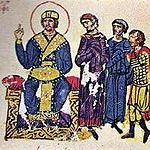
Theophilos Theophilos (emperor) Theophilos was the Byzantine emperor from 829 until his death in 842. He was the second emperor of the Phrygian dynasty, and the last emperor supporting iconoclasm... (Θεόφιλος) |
2 October 829 – 20 January 842 |
Born in 813, as the only son of Michael II. Co-emperor since 821, he succeeded on his father's death. |
 |
Michael III "the Drunkard" Michael III Michael III , , Byzantine Emperor from 842 to 867. Michael III was the third and traditionally last member of the Amorian-Phrygian Dynasty... (Μιχαήλ Γ΄ ο Μέθυσος) |
20 January 842 – 23 September 867 |
Born on 19 January 840, he succeeded on Theophilos' death. Under the regency of his mother Theodora until 856, and of his uncle Bardas Bardas Bardas was a Byzantine noble and high-ranking minister. As the brother of Empress Theodora, he rose to high office under Theophilos . Although sidelined after Theophilos' death by Theodora and Theoktistos, in 856 he engineered Theoktistos' fall and became the regent for his nephew, Michael III... in 862–866. Ended iconoclasm. Murdered by Basil the Macedonian. A pleasure-loving ruler, he was nicknamed "the Drunkard" by later, pro-Basil chroniclers . |
Macedonian dynasty (867–1056)
| Picture | Name | Status | Birth | Emperor from | Emperor until | Death |
|---|---|---|---|---|---|---|
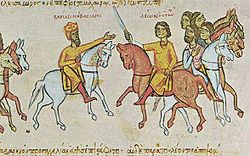 |
Basil I the Macedonian Βασίλειος Α΄ ο Μακεδών |
Imperial officer of Armenian origin, born in the Theme of Macedonia | c. 811 | 867 |
2 August 886 | |
| Leo VI the Wise Leo VI the Wise Leo VI, surnamed the Wise or the Philosopher , was Byzantine emperor from 886 to 912. The second ruler of the Macedonian dynasty , he was very well-read, leading to his surname... Λέων ΣΤ΄ ο Σοφός |
likely either son of Basil I or Michael III | 19 September 866 | 886 |
11 May 912 | ||
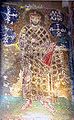 |
Alexander (III) Αλέξανδρος Γ΄ |
son of Basil I | 870 | 912 |
913 | |
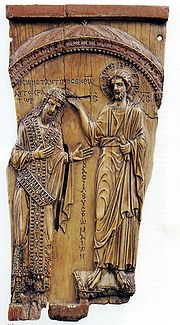 |
Constantine VII Porphyrogennetos Constantine VII Constantine VII Porphyrogennetos or Porphyrogenitus, "the Purple-born" was the fourth Emperor of the Macedonian dynasty of the Byzantine Empire, reigning from 913 to 959... Κωνσταντίνος Ζ΄ ο Πορφυρογέννητος |
son of Leo VI, until 945 he reigned under regents or senior co-emperors | 9 September 905 | 15 May 908 |
9 November 959 | |
| Romanos I Lekapenos Ρωμανός Α΄ Λεκαπηνός |
Admiral and father-in-law of Constantine VII, became senior emperor in 920 until his abdication in 944 | c. 870 | 17 December 920 |
16 December 944 | 15 June 948 | |
| Romanos II Porphyrogennetos Romanos II Romanos II was a Byzantine emperor. He succeeded his father Constantine VII in 959 at the age of twenty-one, and died suddenly in 963.-Life:... Ρωμανός Β΄ ο Πορφυρογέννητος |
son of Constantine VII | 15 March 938 | November 959 |
15 March 963 | ||
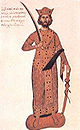 |
Nikephoros II Phokas Νικηφόρος Β΄ Φωκάς |
married Theophano, Romanos II's widow, regent for Basil II | c. 912 | 16 August 963 |
969 | |
| John I Tzimiskes John I Tzimiskes John I Tzimiskes or Tzimisces, was Byzantine Emperor from December 11, 969 to January 10, 976. A brilliant and intuitive general, John's short reign saw the expansion of the empire's borders and the strengthening of Byzantium itself.- Background :... Iωάννης Α΄ Κουρκούας ο Τσιμισκής |
brother-in-law of Romanus II | c. 925 | 11 December 969 |
10 January 976 | ||
 |
Basil II the Bulgar-Slayer Basil II Basil II , known in his time as Basil the Porphyrogenitus and Basil the Young to distinguish him from his ancestor Basil I the Macedonian, was a Byzantine emperor from the Macedonian dynasty who reigned from 10 January 976 to 15 December 1025.The first part of his long reign was dominated... Βασίλειος Β΄ ο Βουλγαροκτόνος |
son of Romanos II | 958 | 10 January 976 |
15 December 1025 | |
 |
Constantine VIII Constantine VIII Constantine VIII was reigning Byzantine emperor from December 15, 1025 until his death. He was the son of the Emperor Romanos II and Theophano, and the younger brother of the eminent Basil II, who died childless and thus left the rule of the Byzantine Empire in his hands.-Family:As... Κωνσταντίνος Η΄ ο Πορφυρογέννητος |
son of Romanos II | 960 | 15 December 1025 |
15 November 1028 | |
 |
Zoe Zoe (empress) Zoe reigned as Byzantine Empress alongside her sister Theodora from April 19 to June 11, 1042... Ζωή η Πορφυρογέννητη |
daughter of Constantine VIII | c. 978 | 15 November 1028 |
June 1050 | |
 |
Romanos III Argyros Ρωμανός Γ΄ Αργυρός |
Zoe's first husband | 968 | 15 November 1028 |
11 April 1034 | |
| Michael IV the Paphlagonian Μιχαήλ Δ΄ ο Παφλαγών |
Zoe's second husband | 1010 | 11 April 1034 |
10 December 1041 | ||
 |
Michael V Michael V Michael V "the Caulker" or Kalaphates , , was Byzantine emperor for 4 months in 1041–1042, as the nephew and successor of Michael IV and the adoptive son of his wife, the Empress Zoe.Michael V was the son of Stephen by Maria, a sister of Emperor Michael IV... the Caulker Μιχαήλ Ε΄ ο Καλαφάτης |
Michael IV's nephew | 1015 | 10 December 1041 |
20 April 1042 | 24 August 1042 |
 |
Theodora Theodora (11th century) Theodora was a Byzantine Empress. Born into the Macedonian dynasty that had ruled the Byzantine Empire for almost two hundred years, she was co-empress with her sister Zoe for two months in 1042 and sole empress from 11 January 1055 to after 31 August 1056... Θεοδώρα |
daughter of Constantine VIII | 984 | 20 April 1042 |
1042 | after 31 August 1056 |
| Constantine IX Monomachos Constantine IX Monomachos Constantine IX Monomachos, Latinized as Constantine IX Monomachus , c. 1000 – January 11, 1055, reigned as Byzantine emperor from June 11, 1042 to January 11, 1055. He had been chosen by the Empress Zoe as a husband and co-emperor in 1042, although he had been exiled for conspiring... Κωνσταντίνος Θ΄ Μονομάχος |
Zoe's third husband | c. 1000 | 11 June 1042 |
11 January 1055 | ||
|
Theodora Theodora (11th century) Theodora was a Byzantine Empress. Born into the Macedonian dynasty that had ruled the Byzantine Empire for almost two hundred years, she was co-empress with her sister Zoe for two months in 1042 and sole empress from 11 January 1055 to after 31 August 1056... Θεοδώρα |
daughter of Constantine VIII | 984 | 11 January 1055 |
after 31 August 1056 | |
Non-dynastic (1056–1057)
| Name | Reign | Comments | |
|---|---|---|---|
| Michael VI Bringas, "Stratiotikos" or "the Old" (Μιχαήλ ΣΤ΄ Βρίγγας, ο Στρατιωτικός, ο Γέρων) |
September 1056 – 31 August 1057 |
A court bureaucrat and military logothete (hence his first sobriquet). Deposed by military revolt under Isaac Komnenos, he retired to a monastery where he died in 1059. | |
Komnenid dynasty (1057–1059)
| Name | Reign | Comments | |
|---|---|---|---|
 |
Isaac I Komnenos Isaac I Komnenos Isaac I Komnenos was Byzantine Emperor from 1057 to 1059, and the first reigning member of the Komnenos dynasty... (Ισαάκιος Α΄ Κομνηνός) |
5 June 1057 – 22 November 1059 |
Born c. 1005, a successful general. he rose in revolt leading the eastern armies and was declared Emperor, was recognized after Michael VI's abdication on 31 August 1057. He resigned in 1059 and died c. 1061. |
Doukid dynasty (1059–1081)
| Name | Reign | Comments | |
|---|---|---|---|
 |
Constantine X Doukas (Κωνσταντίνος Ι΄ Δούκας) |
24 November 1059 – 22 May 1067 |
Born in 1006, he became a general and close ally of Isaac Komnenos, and succeeded him as emperor on his abdication. Named his sons Michael, Andronikos Andronikos Doukas (co-emperor) Andronikos Doukas , Latinized as Andronicus Ducas, was the third son of Byzantine Emperor Constantine X Doukas and younger brother of Byzantine Emperor Michael VII Doukas . Unlike his other brothers, he was not named junior co-emperor by his father, and was raised to the dignity only by Romanos IV... and Konstantios Konstantios Doukas Konstantios Doukas , Latinized as Constantius Ducas, was the son of Byzantine Emperor Constantine X Doukas and younger brother of Byzantine Emperor Michael VII Doukas... as co-emperors |
 |
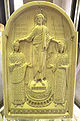
Michael VII Doukas (Μιχαήλ Ζ΄ Δούκας) |
22 May 1067 – 24 March 1078 |
Born in 1050 as the eldest son of Constantine X. Co-emperor since 1059, he succeeded on his father's death. Due to his minority he was under the regency of his mother, Eudokia Makrembolitissa Eudokia Makrembolitissa Eudokia Makrembolitissa was the second wife of the Byzantine emperor Constantine X Doukas. After his death she acted as regent and became the wife of Romanos IV Diogenes... , in 1067–1068, and relegated to junior emperor under her second husband Romanos IV Diogenes in 1068–1071. Senior emperor in 1071–1078, he named his son Constantine Constantine Doukas Constantine Doukas or Ducas , was Byzantine co-emperor from c. 1074 to 1078 and from 1081 to 1087. He was the son of Emperor Michael VII Doukas and his Georgian wife Maria of Alania.... co-emperor alongside his brothers. He abdicated before the revolt of Nikephoros Botaneiates, retired to a monastery and died c. 1090. |
 |
Romanos IV Diogenes (Ρωμανός Δ΄ Διογένης) |
1 January 1068 – 24 October 1071 |
Born in 1032, a successful general he married empress-dowager Eudokia Makrembolitissa Eudokia Makrembolitissa Eudokia Makrembolitissa was the second wife of the Byzantine emperor Constantine X Doukas. After his death she acted as regent and became the wife of Romanos IV Diogenes... and became senior emperor as guardian of her sons by Constantine X. Deposed by the Doukas partisans after the Battle of Manzikert Battle of Manzikert The Battle of Manzikert , was fought between the Byzantine Empire and Seljuq Turks led by Alp Arslan on August 26, 1071 near Manzikert... , blinded in June 1072 and exiled. He died soon after. |
 |
Nikephoros III Botaneiates (Νικηφόρος Γ΄ Βοτανειάτης) |
31 March 1078 – 4 April 1081 |
Born in 1001, he was the strategos Strategos Strategos, plural strategoi, is used in Greek to mean "general". In the Hellenistic and Byzantine Empires the term was also used to describe a military governor... of the Anatolic Theme Anatolic Theme The Anatolic Theme , more properly known as the Theme of the Anatolics was a Byzantine theme in central Asia Minor... . He rebelled against Michael VII and was welcomed into the capital. He weathered several revolts, but was overthrown by the Komnenos Komnenos Komnenós or Comnenus was the name of a ruling family of the Eastern Roman Empire , who halted the political decline of the Empire from c.1081 to c.1185.-Origins:... clan. He retired to a monastery where he died on 10 December of the same year (1081). |
Komnenid dynasty (1081–1185)
| Name | Reign | Comments | |
|---|---|---|---|
| Alexios I Komnenos Alexios I Komnenos Alexios I Komnenos, Latinized as Alexius I Comnenus , was Byzantine emperor from 1081 to 1118, and although he was not the founder of the Komnenian dynasty, it was during his reign that the Komnenos family came to full power. The title 'Nobilissimus' was given to senior army commanders,... (Αλέξιος Α' Κομνηνός) |
4 April 1081 – 15 August 1118 |
Born in 1048, a nephew of Isaac I Komnenos. A distinguished general, he overthrew Nikephoros III. His reign was dominated by wars against the Normans Normans The Normans were the people who gave their name to Normandy, a region in northern France. They were descended from Norse Viking conquerors of the territory and the native population of Frankish and Gallo-Roman stock... and the Seljuk Turks, as well as the arrival of the First Crusade First Crusade The First Crusade was a military expedition by Western Christianity to regain the Holy Lands taken in the Muslim conquest of the Levant, ultimately resulting in the recapture of Jerusalem... and the establishment of independent Crusader states Crusader states The Crusader states were a number of mostly 12th- and 13th-century feudal states created by Western European crusaders in Asia Minor, Greece and the Holy Land , and during the Northern Crusades in the eastern Baltic area... . He retained Constantine Doukas as co-emperor until 1087 and named his eldest son John co-emperor in 1092. |
|
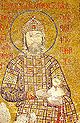 |
John II Komnenos John II Komnenos John II Komnenos was Byzantine Emperor from 1118 to 1143. Also known as Kaloïōannēs , he was the eldest son of Emperor Alexios I Komnenos and Irene Doukaina... (Ιωάννης Β' Κομνηνός) |
15 August 1118 – 8 April 1143 |
Born on 13 September 1087 as the eldest son of Alexios I. Co-emperor since 1092, he succeeded upon his father's death. His reign was focused on wars with the Turks. A popular and frugal ruler, he was known as "John the Good". Named his eldest son Alexios co-emperor in 1122, but he died before him. |
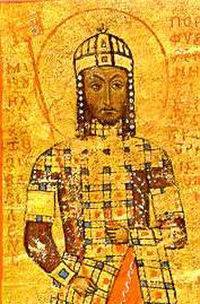 |
Manuel I Komnenos Manuel I Komnenos Manuel I Komnenos was a Byzantine Emperor of the 12th century who reigned over a crucial turning point in the history of Byzantium and the Mediterranean.... (Μανουήλ Α' Κομνηνός) |
1143 – 24 September 1180 |
Born on 28 November 1118 as the third and youngest son of John II, he was chosen as emperor over his elder brother Isaac by his father on his deathbed. An energetic ruler, he launched campaigns against the Turks, humbled Hungary Kingdom of Hungary The Kingdom of Hungary comprised present-day Hungary, Slovakia and Croatia , Transylvania , Carpatho Ruthenia , Vojvodina , Burgenland , and other smaller territories surrounding present-day Hungary's borders... , achieved supremacy over the Crusader states and tried unsuccessfully to recover Italy. His extravagance and constant campaigning however depleted the Empire's resources. |
| Alexios II Komnenos Alexios II Komnenos Alexios II Komnenos or Alexius II Comnenus , Byzantine emperor , was the son of Emperor Manuel I Komnenos and Maria, daughter of Raymond, prince of Antioch... (Αλέξιος B' Κομνηνός) |
24 September 1180 – October 1183 |
Born on 14 September 1169 as the only son of Manuel I. In 1180–1182 under the regency of his mother, Maria of Antioch Maria of Antioch Maria of Antioch was a Byzantine empress as the wife of the Byzantine Emperor Manuel I Komnenos. She was the daughter of Constance of Antioch and her first husband Raymond of Poitiers... . She was overthrown by Andronikos I Komnenos, who became co-emperor and finally had Alexios II deposed and killed. |
|
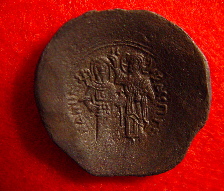 |
Andronikos I Komnenos Andronikos I Komnenos Andronikos I Komnenos was Byzantine Emperor from 1183 to 1185). He was the son of Isaac Komnenos and grandson of Emperor Alexios I Komnenos.-Early years:... (Ανδρόνικος Α' Κομνηνός) |
1183 – 11 September 1185 |
Born c. 1118, a nephew of John II by his brother Isaac. A general, he was imprisoned for conspiring against John II, but escaped and spent 15 years in exile in various courts in eastern Europe and the Middle East. He seized the regency from Maria of Antioch in 1182 and subsequently throne from his nephew Alexios II. An unpopular ruler, he was overthrown and lynched in a popular uprising. |
Angelid dynasty (1185–1204)
| Name | Reign | Comments | |
|---|---|---|---|
 |
Isaac II Angelos Isaac II Angelos Isaac II Angelos was Byzantine emperor from 1185 to 1195, and again from 1203 to 1204.... (Ισαάκιος Β' Άγγελος) |
1185–1195 | Born in September 1156, Isaac came to the throne at the head of a popular revolt against Andronikos I. His reign was marked by revolts and wars in the Balkans, especially against a resurgent Bulgaria Second Bulgarian Empire The Second Bulgarian Empire was a medieval Bulgarian state which existed between 1185 and 1396 . A successor of the First Bulgarian Empire, it reached the peak of its power under Kaloyan and Ivan Asen II before gradually being conquered by the Ottomans in the late 14th-early 15th century... . He was deposed, blinded and imprisoned by his elder brother, Alexios III. |
| Alexios III Angelos Alexios III Angelos Alexios III Angelos was Byzantine Emperor from 1195 to 1203.- Early life:Alexios III Angelos was the second son of Andronikos Angelos and Euphrosyne Kastamonitissa. Andronicus was himself a son of Theodora Komnene, the youngest daughter of Emperor Alexios I Komnenos and Irene Doukaina. Thus... (Αλέξιος Γ' Άγγελος) |
1195 – 17/18 July 1203 |
Born in 1153, Alexios was the elder brother of Isaac II. His reign was marked by misgovernment and the increasing autonomy of provincial magnates. He was deposed by the Fourth Crusade Fourth Crusade The Fourth Crusade was originally intended to conquer Muslim-controlled Jerusalem by means of an invasion through Egypt. Instead, in April 1204, the Crusaders of Western Europe invaded and conquered the Christian city of Constantinople, capital of the Eastern Roman Empire... and fled Constantinople, roaming Greece and Asia Minor, searching for support to regain his throne. He died in Nicaean Empire of Nicaea The Empire of Nicaea was the largest of the three Byzantine Greek successor states founded by the aristocracy of the Byzantine Empire that fled after Constantinople was occupied by Western European and Venetian forces during the Fourth Crusade... captivity in 1211. |
|
|
Isaac II Angelos Isaac II Angelos Isaac II Angelos was Byzantine emperor from 1185 to 1195, and again from 1203 to 1204.... (Ισαάκιος Β' Άγγελος) |
18 July 1203 – 27/28 January 1204 |
Restored to his throne by the Crusaders, actual rule fell to his son Alexios IV. Due to their failure to deal with the Crusaders' demands, he was deposed by Alexios V Doukas in January 1204 and died on 28 January 1204, perhaps of poison. |
 |
Alexios IV Angelos Alexios IV Angelos Alexios IV Angelos was Byzantine Emperor from August 1203 to January 1204. He was the son of emperor Isaac II Angelus and his first wife Irene. His paternal uncle was Emperor Alexius III Angelus.... (Αλέξιος Δ' Άγγελος) |
1 August 1203 – 27/28 January 1204 |
Born in 1182, the son of Isaac II. He enlisted the Fourth Crusade to return his father to the throne, and reigned alongside his restored father. Due to their failure to deal with the Crusaders' demands, he was deposed by Alexios V Doukas in January 1204, and was strangled on 8 February. |
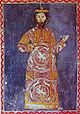 |
Alexios V Doukas "Mourtzouphlos" (Αλέξιος Ε' Δούκας ο Μούρτζουφλος) |
5 February 1204 – 13 April 1204 |
Born in 1140, the son-in-law of Alexios III and a prominent aristocrat, he deposed Isaac II and Alexios IV in a palace coup. He tried to repel the Crusaders, but they captured Constantinople Siege of Constantinople (1204) The Siege of Constantinople occurred in 1204; it destroyed parts of the capital of the Byzantine Empire as it was confiscated by Western European and Venetian Crusaders... forcing Mourtzouphlos to flee. He joined the exiled Alexios III, but was later blinded by the latter. Captured by the Crusaders, he was executed in December 1205. |
Laskarid dynasty (Empire of NicaeaEmpire of NicaeaThe Empire of Nicaea was the largest of the three Byzantine Greek successor states founded by the aristocracy of the Byzantine Empire that fled after Constantinople was occupied by Western European and Venetian forces during the Fourth Crusade...
, 1204–1261)
| Name | Reign | Comments | |
|---|---|---|---|
| Theodore I Laskaris Theodore I Laskaris Theodoros I Komnenos Laskaris was emperor of Nicaea .-Family:Theodore Laskaris was born to the Laskaris, a noble but not particularly renowned Byzantine family of Constantinople. He was the son of Manuel Laskaris and wife Ioanna Karatzaina . He had four older brothers: Manuel Laskaris Theodoros... (Θεόδωρος Α΄ Λάσκαρις) |
1205– December 1221/1222 |
Born c. 1174, he rose to prominence as a son-in-law of Alexios III. His brother Constantine Laskaris Constantine Laskaris Constantine Laskaris was Byzantine emperor for a few months from 1204 to early 1205.-Early years:Constantine Laskaris was born of a noble but not particularly renowned Byzantine family. Virtually nothing is known of him prior to the events of the Fourth Crusade... was elected emperor by the citizens of Constantinople on the day the city fell to the Crusaders; he later fled to Nicaea, where Theodore organized the Greek resistance to the Latins. Proclaimed emperor after Constantine's death in 1205, Theodore was crowned only in 1208. He managed to stop the Latin advance in Asia and to repel Seljuk attacks, establishing the Empire of Nicaea Empire of Nicaea The Empire of Nicaea was the largest of the three Byzantine Greek successor states founded by the aristocracy of the Byzantine Empire that fled after Constantinople was occupied by Western European and Venetian forces during the Fourth Crusade... as the strongest of the Greek successor states. |
|
| John III Doukas Vatatzes John III Doukas Vatatzes John III Doukas Vatatzes, Latinized as Ducas Vatatzes |Nymphaion]]) was emperor of Nicaea 1221–1254.-Life:John Doukas Vatatzes was probably the son of the general Basileios Vatatzes, Duke of Thrace, who died in 1193, and his wife, an unnamed daughter of Isaakios Angelos and cousin of the Emperors... (Ιωάννης Γ' Δούκας Βατάτζης) |
15 December 1221/1222– 3 November 1254 |
Born c. 1192, he became the son-in-law and successor of Theodore I in 1212. A capable ruler and soldier, he expanded his state in Bithynia, Thrace and Macedonia at the expense of the Latin Empire Latin Empire The Latin Empire or Latin Empire of Constantinople is the name given by historians to the feudal Crusader state founded by the leaders of the Fourth Crusade on lands captured from the Byzantine Empire. It was established after the capture of Constantinople in 1204 and lasted until 1261... , Bulgaria and the rival Greek state of Epirus Despotate of Epirus The Despotate or Principality of Epirus was one of the Byzantine Greek successor states of the Byzantine Empire that emerged in the aftermath of the Fourth Crusade in 1204. It claimed to be the legitimate successor of the Byzantine Empire, along with the Empire of Nicaea, and the Empire of Trebizond... . |
|
| Theodore II Laskaris Theodore II Laskaris Theodore II Doukas Laskaris or Ducas Lascaris was emperor of Nicaea, 1254–1258.-Life:Theodore II Doukas Laskaris was the only son of Emperor John III Doukas Vatatzes and Eirene Laskarina, the daughter of Emperor Theodore I Laskaris and Anna Angelina, a daughter of Emperor Alexios III Angelos and... (Θεόδωρος Β' Λάσκαρις) |
3 November 1254– 18 August 1258 |
Born in 1221/1222 as the only son of John III, he succeeded on his father's death. His reign was marked by his hostility towards the major houses of the aristocracy, and by his victory against Bulgaria and the subsequent expansion into and Albania. | |
| John IV Laskaris John IV Laskaris John IV Doukas Laskaris was emperor of Nicaea from August 18, 1258 to December 25, 1261... (Ιωάννης Δ' Λάσκαρις) |
18 August 1258– 25 December 1261 |
Born on 25 December 1250 as the only son of Theodore II, he succeeded on his father's death. Due to his minority, the regency was exercised at first by George Mouzalon George Mouzalon George Mouzalon was a high official of the Empire of Nicaea under Theodore II Laskaris . Of humble origin, he became Theodore's companion in childhood and was raised to high state office upon the latter's assumption of power. This caused great resentment from the aristocracy, which had monopolized... until is assassination, and then by Michael Palaiologos Michael VIII Palaiologos Michael VIII Palaiologos or Palaeologus reigned as Byzantine Emperor 1259–1282. Michael VIII was the founder of the Palaiologan dynasty that would rule the Byzantine Empire until the Fall of Constantinople in 1453... , who within months was crowned senior emperor. After the recovery of Constantinople in August 1261, Palaiologos sidelined John IV completely, had him blinded and imprisoned. John IV died c. 1305. |
|
Palaiologan Dynasty (restored to Constantinople, 1261–1453)
| Picture | Name | Status | Birth | Emperor from | Emperor until | Death |
|---|---|---|---|---|---|---|
 |
Michael VIII Palaiologos Michael VIII Palaiologos Michael VIII Palaiologos or Palaeologus reigned as Byzantine Emperor 1259–1282. Michael VIII was the founder of the Palaiologan dynasty that would rule the Byzantine Empire until the Fall of Constantinople in 1453... Μιχαήλ Η' Παλαιολόγος |
Great-grandson of Alexios III, grandnephew of John III by marriage | 1223 | 1 January 1259 as co-emperor, senior emperor since 25 December 1261 | 11 December 1282 | 11 December 1282 |
 |
Andronikos II Palaiologos Andronikos II Palaiologos Andronikos II Palaiologos , Latinized as Andronicus II Palaeologus, was Byzantine emperor from 1282 to 1328. He was the eldest surviving son of Michael VIII Palaiologos and Theodora Doukaina Vatatzina, grandniece of John III Doukas Vatatzes... Ανδρόνικος Παλαιολόγος |
Son of Michael VIII | 25 March 1259 | nominal co-emperor in September, 1261, crowned in 1272. Senior emperor on 11 December 1282 | 24 May 1328 | 13 February 1332 |
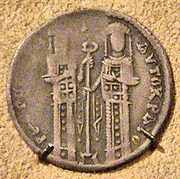 |
Michael IX Palaiologos Michael IX Palaiologos Michael IX Palaiologos or Palaeologus , , reigned as Byzantine co-emperor with full imperial style 1294/1295–1320... Μιχαήλ Θ' Παλαιολόγος |
Son of Andronikos II | 17 April 1277 | co-emperor in 1281, crowned in 1294/1295. | 12 October 1320 | 12 October 1320 |
| Andronikos III Palaiologos Andronikos III Palaiologos Andronikos III Palaiologos, Latinized as Andronicus III Palaeologus was Byzantine emperor from 1328 to 1341, after being rival emperor since 1321. Andronikos III was the son of Michael IX Palaiologos and Rita of Armenia... Ανδρόνικος Γ' Παλαιολόγος |
Son of Michael IX | 25 March 1297 | co-emperor in 1316, rival emperor since July, 1321. Senior emperor on 24 May 1328. | 15 June 1341 | 15 June 1341 | |
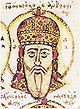 |
John V Palaiologos John V Palaiologos John V Palaiologos was a Byzantine emperor, who succeeded his father in 1341, at age nine.-Biography:... Ιωάννης Ε' Παλαιολόγος |
Son of Andronikos III | 18 June 1332 | Emperor in 15 June 1341 | 8 February 1347 | 16 February 1391 |
 |
John VI Kantakouzenos John VI Kantakouzenos John VI Kantakouzenos or Cantacuzenus was the Byzantine emperor from 1347 to 1354.-Early life:Born in Constantinople, John Kantakouzenos was the son of a Michael Kantakouzenos, governor of the Morea. Through his mother Theodora Palaiologina Angelina, he was a descendant of the reigning house of... Ιωάννης ΣΤ' Καντακουζηνός |
A maternal relative of the Palaiologoi Palaiologos Palaiologos , often latinized as Palaeologus, was a Byzantine Greek noble family, which produced the last ruling dynasty of the Byzantine Empire. After the Fourth Crusade, members of the family fled to the neighboring Empire of Nicaea, where Michael VIII Palaiologos became co-emperor in 1259,... |
c. 1292 | rival emperor on 26 October 1341, senior emperor on 8 February 1347. | 4 December 1354 | 15 June 1383 |
| Matthew Kantakouzenos Matthew Kantakouzenos Matthew Kantakouzenos or Cantacuzenus was Byzantine Emperor from 1353 to 1357.-Life:... Ματθαίος Καντακουζηνός |
Son of John VI, brother-in-law of John V | c. 1325 | co-emperor on 15 April 1353, rival emperor since 4 December 1354. | December, 1357 | between 1383 and 1391 | |
|
John V Palaiologos John V Palaiologos John V Palaiologos was a Byzantine emperor, who succeeded his father in 1341, at age nine.-Biography:... Ιωάννης Ε' Παλαιολόγος |
Son of Andronikos III, son-in-law of John VI | 18 June 1332 | co-emperor in 1347, rival emperor in 1352. Senior Emperor on 4 December 1354 | 12 August 1376 | 16 February 1391 |
| Andronikos IV Palaiologos Andronikos IV Palaiologos Andronikos IV Palaiologos was Byzantine Emperor from 1376 to 1379.-Life:... Ανδρόνικος Δ΄ Παλαιολόγος |
Son of John V, grandson of John VI | 2 April 1348 | co-emperor c. 1352, Senior Emperor on 12 August 1376 | 1 July 1379 | 28 June 1385 | |
|
John V Palaiologos John V Palaiologos John V Palaiologos was a Byzantine emperor, who succeeded his father in 1341, at age nine.-Biography:... Ιωάννης Ε' Παλαιολόγος |
Son of Andronikos III, son-in-law of John VI | 18 June 1332 | Senior Emperor on 1 July 1379 | 14 April 1390 | 16 February 1391 |
| John VII Palaiologos John VII Palaiologos John VII Palaiologos was Byzantine Emperor for five months in 1390.-Life:... Ιωάννης Ζ' Παλαιολόγος |
Son of Andronikos IV | 1370 | Co-emperor from 1376 to 1379, senior emperor on 14 April 1390. | 17 September 1390 | 22 September 1408 | |
|
John V Palaiologos John V Palaiologos John V Palaiologos was a Byzantine emperor, who succeeded his father in 1341, at age nine.-Biography:... Ιωάννης Ε' Παλαιολόγος |
Son of Andronikos III, son-in-law of John VI | 18 June 1332 | Senior Emperor on 17 September 1390 | 16 February 1391 | 16 February 1391 |
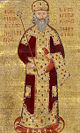 |
Manuel II Palaiologos Manuel II Palaiologos Manuel II Palaiologos or Palaeologus was Byzantine Emperor from 1391 to 1425.-Life:... Μανουήλ Β' Παλαιολόγος |
Son of John V, grandson of John VI, brother of Andronikos IV | 27 June 1350 | Co-emperor in 1373, Senior Emperor on 16 February 1391 | 21 July 1425 | 21 July 1425 |
| Andronikos V Palaiologos Andronikos V Palaiologos Andronikos V Palaiologos was co-emperor of the Byzantine Empire with his father John VII Palaiologos.-Life:... Ανδρόνικος Ε' Παλαιολόγος |
Son of John VII | c. 1400 | co-emperor c. 1403 | c. 1407 | c. 1407 | |
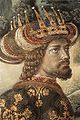 |
John VIII Palaiologos John VIII Palaiologos John VIII Palaiologos or Palaeologus , was the penultimate reigning Byzantine Emperor, ruling from 1425 to 1448.-Life:John VIII Palaiologos was the eldest son of Manuel II Palaiologos and Helena Dragaš, the daughter of the Serbian prince Constantine Dragaš... Ιωάννης Η' |
Son of Manuel II | 18 December 1392 | Co-emperor c. 1416, sole emperor on 21 July 1425 | 31 October 1448 | 31 October 1448 |
| Constantine XI Palaiologos Κωνσταντίνος ΙΑ' Παλαιολόγος | Son of Manuel II, brother of John VIII | 8 February 1405 | 6 January 1449 | 29 May 1453 | 29 May 1453 | |
Palaiologan Dynasty (claimants in exile)
| Picture | Name | Status | Birth | Emperor from | Emperor until | Death |
|---|---|---|---|---|---|---|
| Demetrios Palaiologos Demetrios Palaiologos Demetrios Palaiologos or Demetrius Palaeologus , Despot in the Morea de facto 1436–1438 and 1451–1460 and de jure 1438–1451, previously governor of Lemnos 1422–1440, and of Mesembria 1440–1451... Δημήτριος Παλαιολόγος |
Son of Manuel II, brother of John VIII and Constantine XI | c. 1407 | 1453 | 1460 | 1470 | |
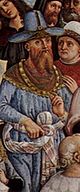 |
Thomas Palaiologos Thomas Palaiologos Thomas Palaiologos was Despot in Morea from 1428 until the Ottoman conquest in 1460. After the desertion of his older brother to the Turks in 1460, Thomas Palaiologos became the legitimate claimant to the Byzantine throne... Θωμάς Παλαιολόγος |
Son of Manuel II, brother of John VIII and Constantine XI | c. 1409 | 1453 | 12 May 1465 | 12 May 1465 |
| Andreas Palaiologos Andreas Palaiologos Andreas Palaiologos titular Byzantine emperor and Despot of Morea from 1465 until his death in 1502.-Biography:He was the nephew of Constantine XI Palaiologos, the last Byzantine Emperor of Constantinople... Ανδρέας Παλαιολόγος |
Son of Thomas | c. 1453 | 12 May 1465 | 1502 | 1502 | |