

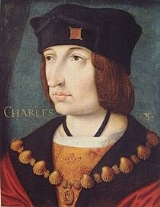
Charles VIII of France

Encyclopedia
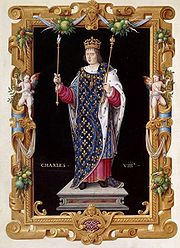
Charles VIII, called the Affable, (30 June 1470 – 7 April 1498), was King of France from 1483 to his death in 1498. Charles was a member of the House of Valois. His intervention in Italy
initiated the long series of Italian Wars
which characterized the first half of the 16th century.
in France, the only surviving son of King Louis XI
by his second wife Charlotte of Savoy
. His godfather was Edward of Westminster
the son of King Henry VI of England who had been living in France since the deposition of his father by King Edward IV. Charles succeeded to the throne on 30 August 1483, at age 13. His health was poor and he was regarded by his contemporaries as of pleasant disposition but foolish and unsuited for the business of the state. In accordance with Louis XI's wishes, the regency of the Kingdom was granted to Charles' elder sister, Anne
, a formidably intelligent and shrewd woman described by her father as "the least insane woman in France." She would rule as regent, together with her husband Peter II, Duke of Bourbon
, until 1491.
, and Mary, Duchess of Burgundy
; the marriage had been arranged by Louis XI, Maximilian, and the Estates of the Low Countries, as part of the Peace of Arras
between France and Burgundy
. Margaret brought the Counties of Artois and Burgundy to France as her dowry, and she was raised in the French court as prospective Queen consort.
In 1488, however, Francis II, Duke of Brittany, died in a riding accident, leaving his 11-year old daughter Anne
as his heiress. Anne, who feared for her Duchy's independence against the ambitions of France, arranged a marriage in 1490 between herself and Maximilian, who had already married Mary of Burgundy in much the same circumstances in 1477 — thus making Anne a stepmother to Margaret of Austria. The Beaujeus refused to countenance such a marriage, however, since it would place Maximilian and his family, the Habsburgs, on two French borders; Brittany was invaded by the French army, Maximilian was unable to help, and Anne of Brittany was forced to renounce Maximilian (whom she had only married by proxy), and agree to be married to Charles VIII instead.
In December 1491, in an elaborate ceremony at the Château de Langeais
, Charles and Anne of Brittany were married. The 14-year-old Duchess Anne, not happy with the arranged marriage
, arrived for her wedding with her entourage carrying two beds. However, Charles's marriage brought him independence from his relatives, and thereafter he managed affairs according to his own inclinations. Queen Anne lived at the Clos Lucé
in Amboise.
There still remained the matter of Charles's first intended, the young Margaret of Austria. Although the cancellation of her betrothal meant that she by rights should have been returned to her family, Charles did not initially do so, intending to marry her usefully elsewhere in France. It was an abominable situation for Margaret, who informed her father in her letters that she was so determined to escape her situation that she would even flee Paris in her nightgown if it gave her freedom. Eventually, in 1493, she was returned to her family, together with her dowry.
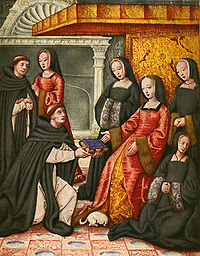
Around the king there was a circle of court poets, the most memorable being the Italian humanist Publio Fausto Andrelini
from Forlì
, who spread the New Learning
in France.
 To secure France against invasions, Charles made treaties with Austria
and England, buying their neutrality with big concessions. He devoted France's resources to building up a large army, including one of Europe's first siege trains with artillery
.
In 1489, Pope Innocent VIII
, then being at odds with Ferdinand I of Naples
, offered Naples to Charles, who had a vague claim to the Kingdom of Naples
through his paternal grandmother, Marie of Anjou
. In 1494,
Ludovico Sforza
, Duke of Milan, was threatened by Ferdinand's successor Alfonso II
, and urged Charles to go take Naples. Charles was also urged on by his favorite courtier, Étienne de Vesc
. Thus encouraged, Charles imagined himself capable of actually taking Naples.
Charles entered Italy
with 25,000 men (including 8,000 Swiss mercenaries
) in 1494 and marched across the peninsula, reaching Naples on 22 February 1495. The French army subdued Florence
in passing and took Naples without a pitched battle or siege. Alfonso was expelled and Charles was crowned King of Naples.
There were those in the Republic of Florence who appreciated the presence of the King and his Army. The famous friar Savonarola believed that King Charles VIII was God's tool to purify the corruption of Florence. Once the King had ousted the evil sinners of Florence the city would become center of morality and thus the appropriate place to restructure the Church. This situation would eventually spill over into another conflict between Pope Alexander VI, who despised the King in Italy, and Savonarola, who called for the King's intervention. This conflict would eventually lead Savonarola to be suspected of heresy and executed by the State.
The speed and power of the French advance frightened the other Italian rulers, including the Pope and even Ludovico of Milan. They formed an anti-French coalition, the League of Venice. At Fornovo
in July 1495, the League defeated Charles, despite losing 2,000 men to his 1,000. Charles lost nearly all the booty of the campaign and had to withdraw to France. His remaining garrisons in Naples were quickly subdued by Aragonese allies of Alfonso.
Over the next few years, Charles tried to rebuild his army, and resume the campaign. But he was hampered by the large debts incurred in 1494–95. He never succeeded in gaining anything substantive.
) in Amboise he struck his head on the lintel of a door. A few hours later, he fell into a sudden coma, and then died.
.
Since his children predeceased him, Charles was the last of the elder branch of the House of Valois
. Upon his death, the throne passed to his father's second cousin, the Duke of Orléans, who reigned as King Louis XII
.
In the 2011 Showtime series The Borgias
, Charles VIII is portrayed by French actor Michel Muller.
Italian Peninsula
The Italian Peninsula or Apennine Peninsula is one of the three large peninsulas of Southern Europe , spanning from the Po Valley in the north to the central Mediterranean Sea in the south. The peninsula's shape gives it the nickname Lo Stivale...
initiated the long series of Italian Wars
Italian Wars
The Italian Wars, often referred to as the Great Italian Wars or the Great Wars of Italy and sometimes as the Habsburg–Valois Wars, were a series of conflicts from 1494 to 1559 that involved, at various times, most of the city-states of Italy, the Papal States, most of the major states of Western...
which characterized the first half of the 16th century.
Childhood and youth
Charles was born at the Château d'AmboiseChâteau d'Amboise
The royal Château at Amboise is a château located in Amboise, in the Indre-et-Loire département of the Loire Valley in France.-Origins and royal residence:...
in France, the only surviving son of King Louis XI
Louis XI of France
Louis XI , called the Prudent , was the King of France from 1461 to 1483. He was the son of Charles VII of France and Mary of Anjou, a member of the House of Valois....
by his second wife Charlotte of Savoy
Charlotte of Savoy
Charlotte of Savoy was the second wife and only Queen consort of Louis XI of France. She had three surviving children, one of whom succeeded Louis as King Charles VIII of France, with her eldest daughter, Anne of France, acting as his regent.- Family :She was a daughter of Louis, Duke of Savoy,...
. His godfather was Edward of Westminster
Edward of Westminster
Edward of Westminster , also known as Edward of Lancaster, was the only son of King Henry VI of England and Margaret of Anjou...
the son of King Henry VI of England who had been living in France since the deposition of his father by King Edward IV. Charles succeeded to the throne on 30 August 1483, at age 13. His health was poor and he was regarded by his contemporaries as of pleasant disposition but foolish and unsuited for the business of the state. In accordance with Louis XI's wishes, the regency of the Kingdom was granted to Charles' elder sister, Anne
Anne of France
Anne of France was the eldest daughter of Louis XI of France and his second wife, Charlotte of Savoy. Anne was the sister of King Charles VIII of France, for whom she acted as regent during his minority; and of Joan of France, who was briefly queen consort to Louis XII...
, a formidably intelligent and shrewd woman described by her father as "the least insane woman in France." She would rule as regent, together with her husband Peter II, Duke of Bourbon
Peter II, Duke of Bourbon
Peter II, Duke of Bourbon was the son of Charles I, Duke of Bourbon and Agnes of Burgundy, and a member of the House of Bourbon...
, until 1491.
Marriages
Charles was betrothed on 22 July 1483 to Margaret of Austria, the daughter of Maximilian I, Holy Roman EmperorMaximilian I, Holy Roman Emperor
Maximilian I , the son of Frederick III, Holy Roman Emperor and Eleanor of Portugal, was King of the Romans from 1486 and Holy Roman Emperor from 1493 until his death, though he was never in fact crowned by the Pope, the journey to Rome always being too risky...
, and Mary, Duchess of Burgundy
Mary of Burgundy
Mary of Burgundy ruled the Burgundian territories in Low Countries and was suo jure Duchess of Burgundy from 1477 until her death...
; the marriage had been arranged by Louis XI, Maximilian, and the Estates of the Low Countries, as part of the Peace of Arras
Treaty of Arras (1482)
The Treaty of Arras was signed at Arras on 23 December 1482 by King Louis XI of France and Archduke Maximilian I of Habsburg as heir of the Burgundian Netherlands in the course of the Burgundian succession crisis....
between France and Burgundy
Duchy of Burgundy
The Duchy of Burgundy , was heir to an ancient and prestigious reputation and a large division of the lands of the Second Kingdom of Burgundy and in its own right was one of the geographically larger ducal territories in the emergence of Early Modern Europe from Medieval Europe.Even in that...
. Margaret brought the Counties of Artois and Burgundy to France as her dowry, and she was raised in the French court as prospective Queen consort.
In 1488, however, Francis II, Duke of Brittany, died in a riding accident, leaving his 11-year old daughter Anne
Anne of Brittany
Anne, Duchess of Brittany , also known as Anna of Brittany , was a Breton ruler, who was to become queen to two successive French kings. She was born in Nantes, Brittany, and was the daughter of Francis II, Duke of Brittany and Margaret of Foix. Her maternal grandparents were Queen Eleanor of...
as his heiress. Anne, who feared for her Duchy's independence against the ambitions of France, arranged a marriage in 1490 between herself and Maximilian, who had already married Mary of Burgundy in much the same circumstances in 1477 — thus making Anne a stepmother to Margaret of Austria. The Beaujeus refused to countenance such a marriage, however, since it would place Maximilian and his family, the Habsburgs, on two French borders; Brittany was invaded by the French army, Maximilian was unable to help, and Anne of Brittany was forced to renounce Maximilian (whom she had only married by proxy), and agree to be married to Charles VIII instead.
In December 1491, in an elaborate ceremony at the Château de Langeais
Château de Langeais
The Château de Langeais is a castle in Indre-et-Loire, France, built on a promontory created by the small valley of the Roumer River at the opening to the Val de Loire...
, Charles and Anne of Brittany were married. The 14-year-old Duchess Anne, not happy with the arranged marriage
Arranged marriage
An arranged marriage is a practice in which someone other than the couple getting married makes the selection of the persons to be wed, meanwhile curtailing or avoiding the process of courtship. Such marriages had deep roots in royal and aristocratic families around the world...
, arrived for her wedding with her entourage carrying two beds. However, Charles's marriage brought him independence from his relatives, and thereafter he managed affairs according to his own inclinations. Queen Anne lived at the Clos Lucé
Clos Lucé
Clos Lucé is a mansion in Amboise, France, located 500 metres from the royal Château d'Amboise, to which it is connected by an underground passageway. Built by Étienne le Loup in the middle of the fifteenth century, it was acquired in 1490 by Charles VIII of France for his wife, Anne de Bretagne...
in Amboise.
There still remained the matter of Charles's first intended, the young Margaret of Austria. Although the cancellation of her betrothal meant that she by rights should have been returned to her family, Charles did not initially do so, intending to marry her usefully elsewhere in France. It was an abominable situation for Margaret, who informed her father in her letters that she was so determined to escape her situation that she would even flee Paris in her nightgown if it gave her freedom. Eventually, in 1493, she was returned to her family, together with her dowry.
Around the king there was a circle of court poets, the most memorable being the Italian humanist Publio Fausto Andrelini
Publio Fausto Andrelini
[Publio] Fausto Andrelini was an Italian humanist poet, an intimate friend of Erasmus in the 1490s, who spread the New Learning in France...
from Forlì
Forlì
Forlì is a comune and city in Emilia-Romagna, Italy, and is the capital of the province of Forlì-Cesena. The city is situated along the Via Emilia, to the right of the Montone river, and is an important agricultural centre...
, who spread the New Learning
New Learning
In the history of ideas the New Learning in Europe is a term for Renaissance humanism, developed in the later fifteenth century. Newly retrieved classical texts sparked philological study of a refined and classical Latin style in prose and poetry....
in France.
The Italian War
Austria
Austria , officially the Republic of Austria , is a landlocked country of roughly 8.4 million people in Central Europe. It is bordered by the Czech Republic and Germany to the north, Slovakia and Hungary to the east, Slovenia and Italy to the south, and Switzerland and Liechtenstein to the...
and England, buying their neutrality with big concessions. He devoted France's resources to building up a large army, including one of Europe's first siege trains with artillery
Artillery
Originally applied to any group of infantry primarily armed with projectile weapons, artillery has over time become limited in meaning to refer only to those engines of war that operate by projection of munitions far beyond the range of effect of personal weapons...
.
In 1489, Pope Innocent VIII
Pope Innocent VIII
Pope Innocent VIII , born Giovanni Battista Cybo , was Pope from 1484 until his death.-Early years:Giovanni Battista Cybo was born at Genoa of Greek extraction...
, then being at odds with Ferdinand I of Naples
Ferdinand I of Naples
Ferdinand I , also called Don Ferrante, was the King of Naples from 1458 to 1494. He was the natural son of Alfonso V of Aragon by Giraldona Carlino.-Biography:...
, offered Naples to Charles, who had a vague claim to the Kingdom of Naples
Kingdom of Naples
The Kingdom of Naples, comprising the southern part of the Italian peninsula, was the remainder of the old Kingdom of Sicily after secession of the island of Sicily as a result of the Sicilian Vespers rebellion of 1282. Known to contemporaries as the Kingdom of Sicily, it is dubbed Kingdom of...
through his paternal grandmother, Marie of Anjou
Marie of Anjou
Marie of Anjou was the Queen consort of King Charles VII of France from 1422 to 1461. Her mother, Yolande of Aragon, played a leading role in the last phase of the Hundred Years' War.-Family:...
. In 1494,
Ludovico Sforza
Ludovico Sforza
Ludovico Sforza , was Duke of Milan from 1489 until his death. A member of the Sforza family, he was the fourth son of Francesco Sforza. He was famed as a patron of Leonardo da Vinci and other artists, and presided over the final and most productive stage of the Milanese Renaissance...
, Duke of Milan, was threatened by Ferdinand's successor Alfonso II
Alfonso II of Naples
Alfonso II of Naples , also called Alfonso II d'Aragon, was King of Naples from 25 January 1494 to 22 February 1495 with the title King of Naples and Jerusalem...
, and urged Charles to go take Naples. Charles was also urged on by his favorite courtier, Étienne de Vesc
Étienne de Vesc
Étienne de Vesc , was a courtier of Louis XI of France and a formative influence on Charles VIII, whom he strongly encouraged in the French adventure into Italy in the First Italian War .-Biography:...
. Thus encouraged, Charles imagined himself capable of actually taking Naples.
Charles entered Italy
Italy
Italy , officially the Italian Republic languages]] under the European Charter for Regional or Minority Languages. In each of these, Italy's official name is as follows:;;;;;;;;), is a unitary parliamentary republic in South-Central Europe. To the north it borders France, Switzerland, Austria and...
with 25,000 men (including 8,000 Swiss mercenaries
Swiss mercenaries
Swiss mercenaries were notable for their service in foreign armies, especially the armies of the Kings of France, throughout the Early Modern period of European history, from the Later Middle Ages into the Age of the European Enlightenment...
) in 1494 and marched across the peninsula, reaching Naples on 22 February 1495. The French army subdued Florence
Florence
Florence is the capital city of the Italian region of Tuscany and of the province of Florence. It is the most populous city in Tuscany, with approximately 370,000 inhabitants, expanding to over 1.5 million in the metropolitan area....
in passing and took Naples without a pitched battle or siege. Alfonso was expelled and Charles was crowned King of Naples.
There were those in the Republic of Florence who appreciated the presence of the King and his Army. The famous friar Savonarola believed that King Charles VIII was God's tool to purify the corruption of Florence. Once the King had ousted the evil sinners of Florence the city would become center of morality and thus the appropriate place to restructure the Church. This situation would eventually spill over into another conflict between Pope Alexander VI, who despised the King in Italy, and Savonarola, who called for the King's intervention. This conflict would eventually lead Savonarola to be suspected of heresy and executed by the State.
The speed and power of the French advance frightened the other Italian rulers, including the Pope and even Ludovico of Milan. They formed an anti-French coalition, the League of Venice. At Fornovo
Battle of Fornovo
The Battle of Fornovo took place 30 km southwest of the city of Parma on 6 July 1495. The League of Venice was able to temporarily expel the French from the Italian Peninsula. It was the first major battle of the Italian Wars.-Antecedents:...
in July 1495, the League defeated Charles, despite losing 2,000 men to his 1,000. Charles lost nearly all the booty of the campaign and had to withdraw to France. His remaining garrisons in Naples were quickly subdued by Aragonese allies of Alfonso.
Over the next few years, Charles tried to rebuild his army, and resume the campaign. But he was hampered by the large debts incurred in 1494–95. He never succeeded in gaining anything substantive.
Death
Charles died in 1498, two and a half years after his retreat from Italy, as the result of an accident. While playing jeu de paume (real tennisReal tennis
Real tennis – one of several games sometimes called "the sport of kings" – is the original indoor racquet sport from which the modern game of lawn tennis , is descended...
) in Amboise he struck his head on the lintel of a door. A few hours later, he fell into a sudden coma, and then died.
Legacy
Charles bequeathed a meagre legacy: he left France in debt and in disarray as a result of his ambition. However, his expedition did strengthen cultural ties to Italy, energising French art and letters in the latter part of the RenaissanceRenaissance
The Renaissance was a cultural movement that spanned roughly the 14th to the 17th century, beginning in Italy in the Late Middle Ages and later spreading to the rest of Europe. The term is also used more loosely to refer to the historical era, but since the changes of the Renaissance were not...
.
Since his children predeceased him, Charles was the last of the elder branch of the House of Valois
Valois Dynasty
The House of Valois was a cadet branch of the Capetian dynasty, succeeding the House of Capet as kings of France from 1328 to 1589...
. Upon his death, the throne passed to his father's second cousin, the Duke of Orléans, who reigned as King Louis XII
Louis XII of France
Louis proved to be a popular king. At the end of his reign the crown deficit was no greater than it had been when he succeeded Charles VIII in 1498, despite several expensive military campaigns in Italy. His fiscal reforms of 1504 and 1508 tightened and improved procedures for the collection of taxes...
.
Issue
The marriage with Anne resulted in the birth of four children:- Charles-OrlandCharles Orlando, Dauphin of FranceCharles Orlando, Dauphin of France was the eldest son and heir of Charles VIII of France and Anne of Brittany....
, Dauphin of France (11 October 1492 – 16 December 1495). - Charles, Dauphin of France (8 September – 2 October 1496).
- François, Dauphin of France (July 1497).
- Princess Anne of France (1498).
Representations in Popular Culture
Charles VIII's invasion of Italy and his relations with Pope Alexander VI are depicted in the novel The Sultan's Helmsman.In the 2011 Showtime series The Borgias
The Borgias (2011 TV series)
The Borgias is a 2011 historical fiction television series created by Neil Jordan.The series is based on the Borgia family, an Italian dynasty of Spanish origin, and stars Jeremy Irons as Pope Alexander VI with David Oakes, François Arnaud, Holliday Grainger and Aidan Alexander as Juan, Cesare,...
, Charles VIII is portrayed by French actor Michel Muller.