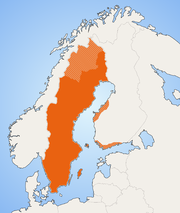
Sweden officially the Kingdom of Sweden (
SwedishSwedish is a North Germanic language, spoken by approximately 10 million people, predominantly in Sweden and parts of Finland, especially along its coast and on the Åland islands. It is largely mutually intelligible with Norwegian and Danish...
: ), is a
Nordic countryThe Nordic countries make up a region in Northern Europe and the North Atlantic which consists of Denmark, Finland, Iceland, Norway and Sweden and their associated territories, the Faroe Islands, Greenland and Åland...
on the
Scandinavian PeninsulaThe Scandinavian Peninsula is a peninsula in Northern Europe, which today covers Norway, Sweden, and most of northern Finland. Prior to the 17th and 18th centuries, large parts of the southern peninsula—including the core region of Scania from which the peninsula takes its name—were part of...
in
Northern EuropeNorthern Europe is the northern part or region of Europe. Northern Europe typically refers to the seven countries in the northern part of the European subcontinent which includes Denmark, Estonia, Latvia, Lithuania, Norway, Finland and Sweden...
. Sweden borders with
NorwayNorway , officially the Kingdom of Norway, is a Nordic unitary constitutional monarchy whose territory comprises the western portion of the Scandinavian Peninsula, Jan Mayen, and the Arctic archipelago of Svalbard and Bouvet Island. Norway has a total area of and a population of about 4.9 million...
and
FinlandFinland , officially the Republic of Finland, is a Nordic country situated in the Fennoscandian region of Northern Europe. It is bordered by Sweden in the west, Norway in the north and Russia in the east, while Estonia lies to its south across the Gulf of Finland.Around 5.4 million people reside...
and is connected to
DenmarkDenmark is a Scandinavian country in Northern Europe. The countries of Denmark and Greenland, as well as the Faroe Islands, constitute the Kingdom of Denmark . It is the southernmost of the Nordic countries, southwest of Sweden and south of Norway, and bordered to the south by Germany. Denmark...
by a bridge-tunnel across the
ÖresundThe Sound , is the strait that separates the Danish island Zealand from the southern Swedish province of Scania. Its width is just at the narrowest point between Helsingør, Denmark, and Helsingborg, Sweden...
.
At 450295 square kilometres (173,859.9 sq mi), Sweden is the third largest country in the
European UnionThe European Union is an economic and political union of 27 independent member states which are located primarily in Europe. The EU traces its origins from the European Coal and Steel Community and the European Economic Community , formed by six countries in 1958...
by area, with a total population of about 9.4 million. Sweden has a low
population densityPopulation density is a measurement of population per unit area or unit volume. It is frequently applied to living organisms, and particularly to humans...
of 21 PD/km2 with the population mostly concentrated to the southern half of the country. About 85% of the population live in urban areas. Sweden's capital is
StockholmStockholm is the capital and the largest city of Sweden and constitutes the most populated urban area in Scandinavia. Stockholm is the most populous city in Sweden, with a population of 851,155 in the municipality , 1.37 million in the urban area , and around 2.1 million in the metropolitan area...
, which is also the largest city.
Sweden emerged as an independent and unified country during the
Middle AgesThe Middle Ages is a periodization of European history from the 5th century to the 15th century. The Middle Ages follows the fall of the Western Roman Empire in 476 and precedes the Early Modern Era. It is the middle period of a three-period division of Western history: Classic, Medieval and Modern...
. In the 17th century, the country expanded its territories to form the
Swedish EmpireThe Swedish Empire refers to the Kingdom of Sweden between 1561 and 1721 . During this time, Sweden was one of the great European powers. In Swedish, the period is called Stormaktstiden, literally meaning "the Great Power Era"...
. The empire grew to be one of the
great powerA great power is a nation or state that has the ability to exert its influence on a global scale. Great powers characteristically possess military and economic strength and diplomatic and cultural influence which may cause small powers to consider the opinions of great powers before taking actions...
s of Europe in the 17th and early 18th century. Most of the conquered territories outside the Scandinavian Peninsula were lost during the 18th and 19th centuries. The eastern half of Sweden, present-day Finland, was lost to
RussiaThe Russian Empire was a state that existed from 1721 until the Russian Revolution of 1917. It was the successor to the Tsardom of Russia and the predecessor of the Soviet Union...
in 1809. The last war in which Sweden was directly involved was in 1814, when Sweden by military means forced Norway into a personal union. Since then, Sweden has been at peace, adopting a non-aligned foreign policy in peacetime and
neutralityA neutral power in a particular war is a sovereign state which declares itself to be neutral towards the belligerents. A non-belligerent state does not need to be neutral. The rights and duties of a neutral power are defined in Sections 5 and 13 of the Hague Convention of 1907...
in wartime.
Today, Sweden is a
constitutional monarchyConstitutional monarchy is a form of government in which a monarch acts as head of state within the parameters of a constitution, whether it be a written, uncodified or blended constitution...
with a parliamentary democracy of government and a highly developed economy. In 2010, it ranked fourth in the world in
The EconomistThe Economist is an English-language weekly news and international affairs publication owned by The Economist Newspaper Ltd. and edited in offices in the City of Westminster, London, England. Continuous publication began under founder James Wilson in September 1843...
s
Democracy IndexThe Democracy Index is an index compiled by the Economist Intelligence Unit that claims to measure the state of democracy in 167 countries, of which 166 are sovereign states and 165 are UN member states...
and ninth in the
United NationsThe United Nations is an international organization whose stated aims are facilitating cooperation in international law, international security, economic development, social progress, human rights, and achievement of world peace...
'
Human Development IndexThe Human Development Index is a composite statistic used to rank countries by level of "human development" and separate "very high human development", "high human development", "medium human development", and "low human development" countries...
. In 2010, the
World Economic ForumThe World Economic Forum is a Swiss non-profit foundation, based in Cologny, Geneva, best known for its annual meeting in Davos, a mountain resort in Graubünden, in the eastern Alps region of Switzerland....
ranked Sweden as the second most competitive country in the world, after Switzerland. Sweden has been a member of the European Union since 1 January 1995 and is a member of the OECD.
Etymology
The modern name Sweden is derived through
back-formationIn etymology, back-formation is the process of creating a new lexeme, usually by removing actual or supposed affixes. The resulting neologism is called a back-formation, a term coined by James Murray in 1889...
from Old English Swēoþēod, which meant "people of the Swedes" (Old Norse Svíþjóð, Latin Suetidi). This word is derived from Sweon/Sweonas (Old Norse Sviar, Latin Suiones). The Swedish name Sverige (a conjunction of the words Svea and Rike, first recorded as Swēorice in
BeowulfBeowulf , but modern scholars agree in naming it after the hero whose life is its subject." of an Old English heroic epic poem consisting of 3182 alliterative long lines, set in Scandinavia, commonly cited as one of the most important works of Anglo-Saxon literature.It survives in a single...
, with the consonant 'k' softened to 'g' – compare "rige" in modern
DanishDanish is a North Germanic language spoken by around six million people, principally in the country of Denmark. It is also spoken by 50,000 Germans of Danish ethnicity in the northern parts of Schleswig-Holstein, Germany, where it holds the status of minority language...
) literally means "Kingdom of the Swedes", excluding the
GeatGeats , and sometimes Goths) were a North Germanic tribe inhabiting what is now Götaland in modern Sweden...
s in
GötalandGötaland , Gothia, Gothland, Gothenland, Gautland or Geatland is one of three lands of Sweden and comprises provinces...
.
Variations of the name Sweden are used in most languages, with the exception of Danish and
NorwegianNorwegian is a North Germanic language spoken primarily in Norway, where it is the official language. Together with Swedish and Danish, Norwegian forms a continuum of more or less mutually intelligible local and regional variants .These Scandinavian languages together with the Faroese language...
using Sverige,
IcelandicIcelandic is a North Germanic language, the main language of Iceland. Its closest relative is Faroese.Icelandic is an Indo-European language belonging to the North Germanic or Nordic branch of the Germanic languages. Historically, it was the westernmost of the Indo-European languages prior to the...
Svíþjóð, and the more notable exception of some
Finno-Ugric languagesFinno-Ugric , Finno-Ugrian or Fenno-Ugric is a traditional group of languages in the Uralic language family that comprises the Finno-Permic and Ugric language families....
where Ruotsi (
FinnishFinnish is the language spoken by the majority of the population in Finland Primarily for use by restaurant menus and by ethnic Finns outside Finland. It is one of the two official languages of Finland and an official minority language in Sweden. In Sweden, both standard Finnish and Meänkieli, a...
) and Rootsi (
EstonianEstonian is the official language of Estonia, spoken by about 1.1 million people in Estonia and tens of thousands in various émigré communities...
) are used, names commonly considered etymologically related to the English name for Russia, referring to the people, Rus', originally from the coastal areas of
RoslagenRoslagen is the name of the coastal areas of Uppland province in Sweden, which also constitutes the northern part of the Stockholm archipelago....
,
UpplandUppland is a historical province or landskap on the eastern coast of Sweden, just north of Stockholm, the capital. It borders Södermanland, Västmanland and Gästrikland. It is also bounded by lake Mälaren and the Baltic sea...
.
The etymology of Swedes, and thus Sweden, is generally not agreed upon but may derive from Proto-Germanic Swihoniz meaning "one's own", referring to one's own Germanic tribe.
Prehistory
Sweden's prehistory begins in the
Allerød warm periodThe Allerød period was a warm and moist global interstadial that occurred at the end of the last glacial period. The Allerød oscillation raised temperatures , before they declined again in the succeeding Younger Dryas period, which was followed by the present interglacial period.In some regions,...
c. 12,000 BC with Late Palaeolithic
reindeerThe reindeer , also known as the caribou in North America, is a deer from the Arctic and Subarctic, including both resident and migratory populations. While overall widespread and numerous, some of its subspecies are rare and one has already gone extinct.Reindeer vary considerably in color and size...
-hunting camps of the
Bromme cultureThe Bromme culture is a late Upper Paleolithic culture dated to the Allerød Oscillation, ca 9700 BC-9000 BC , a warmer spell between the Elder Dryas and the Younger Dryas, the last cold periods of the late Weichsel Glaciation....
at the edge of the ice in what is now the country's southernmost province. This period was characterized by small bands of
hunter-gatherer-fishersA hunter-gatherer or forage society is one in which most or all food is obtained from wild plants and animals, in contrast to agricultural societies which rely mainly on domesticated species. Hunting and gathering was the ancestral subsistence mode of Homo, and all modern humans were...
using
flintFlint is a hard, sedimentary cryptocrystalline form of the mineral quartz, categorized as a variety of chert. It occurs chiefly as nodules and masses in sedimentary rocks, such as chalks and limestones. Inside the nodule, flint is usually dark grey, black, green, white, or brown in colour, and...
technology.
Sweden enters proto-history with the
GermaniaThe Germania , written by Gaius Cornelius Tacitus around 98, is an ethnographic work on the Germanic tribes outside the Roman Empire.-Contents:...
of
TacitusPublius Cornelius Tacitus was a senator and a historian of the Roman Empire. The surviving portions of his two major works—the Annals and the Histories—examine the reigns of the Roman Emperors Tiberius, Claudius, Nero and those who reigned in the Year of the Four Emperors...
in AD 98. In Germania 44, 45 he mentions the Swedes (Suiones) as a powerful tribe (distinguished not merely for their arms and men, but for their powerful fleets) with ships that had a
prowthumb|right|295pxThe prow is the forward most part of a ship's bow that cuts through the water. The prow is the part of the bow above the waterline. The terms prow and bow are often used interchangeably to describe the most forward part of a ship and its surrounding parts...
in both ends (
longshipLongships were sea vessels made and used by the Vikings from the Nordic countries for trade, commerce, exploration, and warfare during the Viking Age. The longship’s design evolved over many years, beginning in the Stone Age with the invention of the umiak and continuing up to the 9th century with...
s). Which kings (kuningaz) ruled these Suiones is unknown, but
Norse mythologyNorse mythology, a subset of Germanic mythology, is the overall term for the myths, legends and beliefs about supernatural beings of Norse pagans. It flourished prior to the Christianization of Scandinavia, during the Early Middle Ages, and passed into Nordic folklore, with some aspects surviving...
presents a long line of legendary and semi-legendary kings going back to the last centuries BC. As for literacy in Sweden itself, the
runic scriptThe runic alphabets are a set of related alphabets using letters known as runes to write various Germanic languages before the adoption of the Latin alphabet and for specialized purposes thereafter...
was in use among the south Scandinavian elite by at least the 2nd century AD, but all that has come down to the present from the Roman Period is curt inscriptions on artefacts, mainly of male names, demonstrating that the people of south Scandinavia spoke Proto-Norse at the time, a language ancestral to Swedish and other
North Germanic languagesThe North Germanic languages or Scandinavian languages, the languages of Scandinavians, make up one of the three branches of the Germanic languages, a sub-family of the Indo-European languages, along with the West Germanic languages and the extinct East Germanic languages...
.
In the 6th century
JordanesJordanes, also written Jordanis or Jornandes, was a 6th century Roman bureaucrat, who turned his hand to history later in life....
named two tribes he calls the Suehans and the Suetidi who lived in
ScandzaScandza was the name given to Scandinavia by the Roman historian Jordanes in his work Getica, written while in Constantinople around AD 551. He described the area to set the stage for his treatment of the Goths' migration from southern Sweden to Gothiscandza...
. These two names are both considered to refer to the same tribe. The Suehans, he says, has very fine horses just as the "Thyringi" tribe (alia vero gens ibi moratur Suehans, quae velud Thyringi equis utuntur eximiis).
Snorri SturlusonSnorri Sturluson was an Icelandic historian, poet, and politician. He was twice elected lawspeaker at the Icelandic parliament, the Althing...
wrote that the contemporary Swedish king Adils (Eadgils) had the finest horses of his days. The Suehans were the suppliers of black fox skins for the Roman market. Then Jordanes names the Suetidi which is considered to be the Latin form of Svitjod. He writes that the Suetidi are the tallest of men together with the Dani who were of the same stock. Later he mentions other Scandinavian tribes for being of the same height.
Originating in semi-legendary Scandza, believed to be somewhere in modern
GötalandGötaland , Gothia, Gothland, Gothenland, Gautland or Geatland is one of three lands of Sweden and comprises provinces...
, Sweden, a
GothicThe Goths were an East Germanic tribe of Scandinavian origin whose two branches, the Visigoths and the Ostrogoths, played an important role in the fall of the Roman Empire and the emergence of Medieval Europe....
population had crossed the
Baltic SeaThe Baltic Sea is a brackish mediterranean sea located in Northern Europe, from 53°N to 66°N latitude and from 20°E to 26°E longitude. It is bounded by the Scandinavian Peninsula, the mainland of Europe, and the Danish islands. It drains into the Kattegat by way of the Øresund, the Great Belt and...
before the 2nd century AD, reaching
ScythiaIn antiquity, Scythian or Scyths were terms used by the Greeks to refer to certain Iranian groups of horse-riding nomadic pastoralists who dwelt on the Pontic-Caspian steppe...
at the coast of the
Black SeaThe Black Sea is bounded by Europe, Anatolia and the Caucasus and is ultimately connected to the Atlantic Ocean via the Mediterranean and the Aegean seas and various straits. The Bosphorus strait connects it to the Sea of Marmara, and the strait of the Dardanelles connects that sea to the Aegean...
in modern
UkraineUkraine is a country in Eastern Europe. It has an area of 603,628 km², making it the second largest contiguous country on the European continent, after Russia...
where Goths left their archaeological traces in the
Chernyakhov cultureThe Sântana de Mureș–Chernyakhiv culture is the name given to an archaeological culture which flourished between the 2nd and 5th centuries in a wide area of Eastern Europe, specifically in what today constitutes Ukraine, Romania, Moldova, and parts of Belarus...
. In the 5th and 6th centuries, they became divided as the Visigoths and the Ostrogoths, and established powerful successor-states of the
Roman EmpireThe Roman Empire was the post-Republican period of the ancient Roman civilization, characterised by an autocratic form of government and large territorial holdings in Europe and around the Mediterranean....
in the
Iberian peninsulaThe Iberian Peninsula , sometimes called Iberia, is located in the extreme southwest of Europe and includes the modern-day sovereign states of Spain, Portugal and Andorra, as well as the British Overseas Territory of Gibraltar...
and Italy.
Crimean GothicCrimean Gothic was a Gothic dialect spoken by the Crimean Goths in some isolated locations in Crimea until the late 18th century....
communities appear to have survived intact in
CrimeaCrimea , or the Autonomous Republic of Crimea , is a sub-national unit, an autonomous republic, of Ukraine. It is located on the northern coast of the Black Sea, occupying a peninsula of the same name...
until the late 18th century.
Viking and Middle Ages
The Swedish
Viking AgeViking Age is the term for the period in European history, especially Northern European and Scandinavian history, spanning the late 8th to 11th centuries. Scandinavian Vikings explored Europe by its oceans and rivers through trade and warfare. The Vikings also reached Iceland, Greenland,...
lasted roughly between the 8th and 11th centuries. It is believed that Swedish Vikings and Gutar mainly travelled east and south, going to Finland, the Baltic countries, Russia,
BelarusBelarus , officially the Republic of Belarus, is a landlocked country in Eastern Europe, bordered clockwise by Russia to the northeast, Ukraine to the south, Poland to the west, and Lithuania and Latvia to the northwest. Its capital is Minsk; other major cities include Brest, Grodno , Gomel ,...
,
UkraineUkraine is a country in Eastern Europe. It has an area of 603,628 km², making it the second largest contiguous country on the European continent, after Russia...
the
Black SeaThe Black Sea is bounded by Europe, Anatolia and the Caucasus and is ultimately connected to the Atlantic Ocean via the Mediterranean and the Aegean seas and various straits. The Bosphorus strait connects it to the Sea of Marmara, and the strait of the Dardanelles connects that sea to the Aegean...
and further as far as
BaghdadBaghdad is the capital of Iraq, as well as the coterminous Baghdad Governorate. The population of Baghdad in 2011 is approximately 7,216,040...
. Their routes passed through the Dnieper down south to
ConstantinopleConstantinople was the capital of the Roman, Eastern Roman, Byzantine, Latin, and Ottoman Empires. Throughout most of the Middle Ages, Constantinople was Europe's largest and wealthiest city.-Names:...
, on which they did numerous raids. The Byzantine Emperor
TheophilosTheophilos was the Byzantine emperor from 829 until his death in 842. He was the second emperor of the Phrygian dynasty, and the last emperor supporting iconoclasm...
noticed their great skills in war and invited them to serve as his personal bodyguard, known as the
varangian guardThe Varangian Guard was an elite unit of the Byzantine Army in 10th to the 14th centuries, whose members served as personal bodyguards of the Byzantine Emperors....
. The Swedish Vikings, called "Rus" are also believed to be the founding fathers of Kievan Rus. The Arabic traveller "Ibn Fadlan" described these Vikings as following: The adventures of these Swedish Vikings are commemorated on many runestones in Sweden, such as the
Greece RunestonesThe Greece runestones are about 30 runestones containing information related to voyages made by Norsemen to the Eastern Roman Empire. They were made during the Viking Age until about 1100 and were engraved in the Old Norse language with Scandinavian runes...
and the
Varangian RunestonesThe Varangian Runestones are runestones that mention voyages to the East or the Eastern route , or to more specific eastern locations such as Garðaríki ....
. There was also considerable participation in expeditions westwards, which are commemorated on stones such as the
England RunestonesThe England runestones is a group of about 30 runestones that refer to Viking Age voyages to England. They constitute one of the largest groups of runestones that mention voyages to other countries, and they are comparable in number only to the approximately 30 Greece Runestones and the 26 Ingvar...
. The last major Swedish Viking expedition appears to have been the ill-fated expedition of
Ingvar the Far-TravelledIngvar the Far-Travelled was the leader of an unsuccessful Viking attack against Persia, in 1036–1042.There were several Caspian expeditions of the Rus' in the course of the 10th century...
to
SerklandIn Old Norse sources, such as sagas and runestones, Særkland or Serkland was the name of the Abbasid Caliphate and probably some neighbouring Muslim regions....
, the region south-east of the
Caspian SeaThe Caspian Sea is the largest enclosed body of water on Earth by area, variously classed as the world's largest lake or a full-fledged sea. The sea has a surface area of and a volume of...
. Its members are commemorated on the
Ingvar RunestonesThe Ingvar Runestones is the name of c. 26 Varangian Runestones that were raised in commemoration of those who died in the Swedish Viking expedition to the Caspian Sea of Ingvar the Far-Travelled....
, none of which mentions any survivor. What happened to the crew is unknown, but it is believed that they died of sickness.
The Kingdom of Sweden
It is not known when and how the kingdom of Sweden was born, but the
list of Swedish monarchs is drawn from the first kings known to have ruled both
SvealandSvealand , Swealand or Sweden proper is the historical core region of Sweden. It is located in south central Sweden and is one of three lands of Sweden, bounded to the north by Norrland and to the south by Götaland. Deep forests, Tiveden, Tylöskog, Kolmården, separated Svealand from Götaland...
(Sweden) and
GötalandGötaland , Gothia, Gothland, Gothenland, Gautland or Geatland is one of three lands of Sweden and comprises provinces...
(Gothia) as one province, beginning with Erik the Victorious. Sweden and Gothia were two separate nations long before that into antiquity. It is not known how long they existed,
BeowulfBeowulf , but modern scholars agree in naming it after the hero whose life is its subject." of an Old English heroic epic poem consisting of 3182 alliterative long lines, set in Scandinavia, commonly cited as one of the most important works of Anglo-Saxon literature.It survives in a single...
described semi-legendary
Swedish-Geatish warsThe Swedish-Geatish wars refer to semi-legendary 6th century battles between Swedes and Geats that are described in the Anglo-Saxon epic Beowulf...
in the 6th century.
Cultural advances
During the early stages of the Scandinavian Viking Age,
YstadYstad is a "locality", or town, and the seat of Ystad Municipality, Skåne County, Sweden, with 17,286 inhabitants .Settlement dates back to the 11th century and the town has become a busy ferryport, local administrative centre and tourist attraction...
in
ScaniaScania is the southernmost of the 25 traditional non-administrative provinces of Sweden, constituting a peninsula on the southern tip of the Scandinavian peninsula, and some adjacent islands. The modern administrative subdivision Skåne County is almost, but not totally, congruent with the...
and
PavikenPaviken is a lake near Västergarn on western Gotland. The lake and its surroundings form the nature reserve Paviken.During the Viking Age, Paviken was a cove connected to the Baltic Sea. It formed a natural harbour which was improved by jetties...
on
GotlandGotland is a county, province, municipality and diocese of Sweden; it is Sweden's largest island and the largest island in the Baltic Sea. At 3,140 square kilometers in area, the region makes up less than one percent of Sweden's total land area...
, in present-day Sweden, were flourishing trade centres. Remains of what is believed to have been a large market have been found in Ystad dating from 600–700 AD. In Paviken, an important centre of trade in the Baltic region during the 9th and 10th century, remains have been found of a large Viking Age harbour with shipbuilding yards and handicraft industries. Between 800 and 1000, trade brought an abundance of silver to Gotland, and according to some scholars, the Gotlanders of this era hoarded more silver than the rest of the population of Scandinavia combined.
St. Ansgar is usually credited for introducing
ChristianityChristianity is a monotheistic religion based on the life and teachings of Jesus as presented in canonical gospels and other New Testament writings...
in 829, but the new religion did not begin to fully replace
paganismPaganism is a blanket term, typically used to refer to non-Abrahamic, indigenous polytheistic religious traditions....
until the 12th century. During the 11th century, Christianity became the most prevalent religion, and from 1050 Sweden is counted as a Christian nation. The period between 1100 and 1400 was characterized by internal power struggles and competition among the Nordic kingdoms. Swedish kings also began to expand the Swedish-controlled territory in Finland, creating conflicts with the Rus who no longer had any connection with Sweden.
Feudal institutions in Sweden
Except for the province of Skane, on the southernmost tip of Sweden which was under Danish control during this time,
feudalismFeudalism was a set of legal and military customs in medieval Europe that flourished between the 9th and 15th centuries, which, broadly defined, was a system for ordering society around relationships derived from the holding of land in exchange for service or labour.Although derived from the...
never developed in Sweden as it did in the rest of Europe. Therefore, the peasantry remained largely a class of free farmers throughout most of Swedish history.
SlaverySlavery is a system under which people are treated as property to be bought and sold, and are forced to work. Slaves can be held against their will from the time of their capture, purchase or birth, and deprived of the right to leave, to refuse to work, or to demand compensation...
(also called
thrallThrall was the term for a serf or unfree servant in Scandinavian culture during the Viking Age.Thralls were the lowest in the social order and usually provided unskilled labor during the Viking era.-Etymology:...
dom) was not common in Sweden, and what slavery there was tended to be driven out of existence by the spread of Christianity, the difficulty in obtaining slaves from the lands east of the Baltic Sea, and by the development of cities before the 16th century Indeed, both slavery and
serfdomSerfdom is the status of peasants under feudalism, specifically relating to Manorialism. It was a condition of bondage or modified slavery which developed primarily during the High Middle Ages in Europe and lasted to the mid-19th century...
were abolished altogether by a decree of King Magnus Erickson in 1335. Former slaves tended to be absorbed into the peasantry and some became labourers in the towns. Still, Sweden remained a poor and economically backward country in which barter was the means of exchange. For instance, the farmers of the province of
DalslandDalsland is a Swedish traditional province, or landskap, situated in Götaland in southern Sweden. Lying to the west of Lake Vänern, it is bordered by Värmland to the north, Västergötland to the southeast, Bohuslän to the west, and Norway to the northwest....
would transport their butter to the mining districts of Sweden and exchange it there for iron, which they would then take down to the coast and trade the iron for fish they needed for food while the iron would be shipped abroad.
The Plague in Sweden
In the 14th century, Sweden was struck by the
Black DeathThe Black Death was one of the most devastating pandemics in human history, peaking in Europe between 1348 and 1350. Of several competing theories, the dominant explanation for the Black Death is the plague theory, which attributes the outbreak to the bacterium Yersinia pestis. Thought to have...
. The population of Sweden was decimated. During this period the Swedish cities also began to acquire greater rights and were strongly influenced by German merchants of the
Hanseatic LeagueThe Hanseatic League was an economic alliance of trading cities and their merchant guilds that dominated trade along the coast of Northern Europe...
, active especially at
Visby-See also:* Battle of Visby* Gotland University College* List of governors of Gotland County-External links:* - Visby*...
. In 1319, Sweden and Norway were united under King
Magnus ErikssonMagnus Eriksson as Magnus IV was king of Sweden , including Finland, as Magnus VII King of Norway , including Iceland and Greenland, and also ruled Scania . He has also vindictively been called Magnus Smek...
, and in 1397 Queen
Margaret I of DenmarkMargaret I was Queen of Denmark, Norway and Sweden and founder of the Kalmar Union, which united the Scandinavian countries for over a century. Although she acted as queen regnant, the laws of contemporary Danish succession denied her formal queenship. Her title in Denmark was derived from her...
effected the personal union of Sweden, Norway, and Denmark through the
Kalmar UnionThe Kalmar Union is a historiographical term meaning a series of personal unions that united the three kingdoms of Denmark, Norway , and Sweden under a single monarch, though intermittently and with a population...
. However, Margaret's successors, whose rule was also centred in Denmark, were unable to control the Swedish nobility.
Minors and Regents
A large number of children inherited the Swedish crown over the course of the kingdom's existence, consequentlyreal power was held for long periods by regents (notably those of the
StureSture was the name of two influential families in Sweden from the late 15th century to the early 16th century. One member of one of these families and two members of the other served as Regents of Sweden in the Kalmar Union between 1470 and 1520...
family) chosen by the Swedish parliament. King
Christian II of DenmarkChristian II was King of Denmark, Norway and Sweden , during the Kalmar Union.-Background:...
, who asserted his claim to Sweden by force of arms, ordered a massacre in 1520 of Swedish nobles at Stockholm. This came to be known as the "Stockholm blood bath" and stirred the Swedish nobility to new resistance and, on 6 June (now Sweden's national holiday) in 1523, they made Gustav Vasa their king. This is sometimes considered as the foundation of modern Sweden. Shortly afterwards he rejected
CatholicismCatholicism is a broad term for the body of the Catholic faith, its theologies and doctrines, its liturgical, ethical, spiritual, and behavioral characteristics, as well as a religious people as a whole....
and led Sweden into the
Protestant ReformationThe Protestant Reformation was a 16th-century split within Western Christianity initiated by Martin Luther, John Calvin and other early Protestants. The efforts of the self-described "reformers", who objected to the doctrines, rituals and ecclesiastical structure of the Roman Catholic Church, led...
. Economically, Gustav Vasa broke the monopoly of the Hanseatic League over Swedish Baltic Sea trade.
The Hanseatic League had been officially formed at
LübeckThe Hanseatic City of Lübeck is the second-largest city in Schleswig-Holstein, in northern Germany, and one of the major ports of Germany. It was for several centuries the "capital" of the Hanseatic League and, because of its Brick Gothic architectural heritage, is listed by UNESCO as a World...
on
the sea coastThe Baltic Sea is a brackish mediterranean sea located in Northern Europe, from 53°N to 66°N latitude and from 20°E to 26°E longitude. It is bounded by the Scandinavian Peninsula, the mainland of Europe, and the Danish islands. It drains into the Kattegat by way of the Øresund, the Great Belt and...
of
Northern GermanyThe Holy Roman Empire was a realm that existed from 962 to 1806 in Central Europe.It was ruled by the Holy Roman Emperor. Its character changed during the Middle Ages and the Early Modern period, when the power of the emperor gradually weakened in favour of the princes...
in 1356. The Hanseatic League sought civil and
commercialWhile business refers to the value-creating activities of an organization for profit, commerce means the whole system of an economy that constitutes an environment for business. The system includes legal, economic, political, social, cultural, and technological systems that are in operation in any...
privileges from the princes and royalty of the countries and cities along the coasts of the Baltic Sea. In exchange they offered a certain amount of protection. Having their own navy the Hansa were able to sweep the Baltic Sea free of pirates. The privileges obtained by the Hansa included assurances that only Hansa citizens would be allowed to trade from the ports where they were located. They also sought agreement to be free of all customs and taxes. With these concessions, Lübeck merchants flocked to Stockholm, Sweden and soon came to dominate the economic life of that city and made the port city of Stockholm into the leading commercial and industrial city of Sweden. Under the Hanseatic trade 2/3rds of Stockholm's imports consisted of textiles and 1/3 of salt. Exports from Sweden consisted of iron and copper.
However, the Swedes began to resent the monopoly trading position of the Hansa (mostly German citizens) and to resent the income they felt they lost to the Hansa. Consequently, when Gustav Vasa or Gustav I broke the monopoly power of the Hanseatic League he was regarded as a hero to the Swedish people. History now views Gustav I as the father of the modern Swedish nation. The foundations laid by Gustav would take time to develop. Furthermore, when Sweden did develop, freed itself from the Hanseatic League and entered its golden era, the fact the peasantry had traditionally been free meant that more of the economic benefits flowed back to them rather than going to a feudal landowning class. This was not the case in other countries of Europe like Poland were the peasantry was still bound by serfdom and a strong feudalistic land owning system.
Swedish Empire
During the 17th century Sweden emerged as a European
great powerA great power is a nation or state that has the ability to exert its influence on a global scale. Great powers characteristically possess military and economic strength and diplomatic and cultural influence which may cause small powers to consider the opinions of great powers before taking actions...
. Before the emergence of the Swedish Empire, Sweden was a very poor and scarcely populated country on the fringe of European civilization, with no significant power or reputation. Sweden rose to prominence on a continental scale during the tenure of king
Gustavus AdolphusGustav II Adolf has been widely known in English by his Latinized name Gustavus Adolphus Magnus and variously in historical writings also as Gustavus, or Gustavus the Great, or Gustav Adolph the Great,...
, seizing territories from Russia and Poland–Lithuania in multiple conflicts, including the
Thirty Years' WarThe Thirty Years' War was fought primarily in what is now Germany, and at various points involved most countries in Europe. It was one of the most destructive conflicts in European history....
.
During the Thirty Years' War, Sweden conquered approximately half of the Holy Roman states. Gustav Adolphus planned to become the new
Holy Roman EmperorThe Holy Roman Emperor is a term used by historians to denote a medieval ruler who, as German King, had also received the title of "Emperor of the Romans" from the Pope...
, ruling over a united Scandinavia and the Holy Roman states, but he died at the
Battle of LützenThe Battle of Lützen was one of the most decisive battles of the Thirty Years' War. It was a Protestant victory, but cost the life of one of the most important leaders of the Protestant alliance, Gustavus Adolphus of Sweden, which caused the Protestant campaign to lose direction.- Prelude to the...
in 1632. After the
Battle of NördlingenThe Battle of Nördlingen was fought on 27 August or 6 September , 1634 during the Thirty Years' War. The Roman Catholic Imperial army, bolstered by 18,000 Spanish and Italian soldiers, won a crushing victory over the combined Protestant armies of Sweden and their German-Protestant allies .After...
, Sweden's only significant military defeat of the war, pro-Swedish sentiment among the German states faded. These German provinces excluded themselves from Swedish power one by one, leaving Sweden with only a few northern German territories:
Swedish PomeraniaSwedish Pomerania was a Dominion under the Swedish Crown from 1630 to 1815, situated on what is now the Baltic coast of Germany and Poland. Following the Polish War and the Thirty Years' War, Sweden held extensive control over the lands on the southern Baltic coast, including Pomerania and parts...
,
Bremen-VerdenBremen-Verden, formally the Duchies of Bremen and Verden , were two territories and immediate fiefs of the Holy Roman Empire, which emerged and gained Imperial immediacy in 1180...
and
WismarWismar , is a small port and Hanseatic League town in northern Germany on the Baltic Sea, in the state of Mecklenburg-Vorpommern,about 45 km due east of Lübeck, and 30 km due north of Schwerin. Its natural harbour, located in the Bay of Wismar is well-protected by a promontory. The...
. The Swedish armies may have destroyed up to 2,000 castles, 18,000 villages and 1,500 towns in
GermanyThe Holy Roman Empire was dominated by the House of Habsburg throughout the Early Modern period.The Habsburg Monarchy refers to the territories ruled by the Austrian branch of the House of Habsburg, and then by the successor House of Habsburg-Lorraine, between 1526 and 1867/1918...
, one-third of all German towns.
In the middle of the 17th century Sweden was the third largest country in Europe by land area, only surpassed by Russia and Spain. Sweden reached its largest territorial extent under the rule of Charles X after the
treaty of RoskildeThe Treaty of Roskilde was concluded on 26 February or 8 March 1658 during the Second Northern War between Frederick III of Denmark–Norway and Charles X Gustav of Sweden in the Danish city of Roskilde...
in 1658.
The foundation of Sweden's success during this period is credited to Gustav I's major changes on the Swedish economy in the 16th century, and his introduction of
ProtestantismProtestantism is one of the three major groupings within Christianity. It is a movement that began in Germany in the early 16th century as a reaction against medieval Roman Catholic doctrines and practices, especially in regards to salvation, justification, and ecclesiology.The doctrines of the...
. In the 17th century, Sweden was engaged in many wars, for example with the
Polish-Lithuanian CommonwealthThe Polish–Lithuanian Commonwealth was a dualistic state of Poland and Lithuania ruled by a common monarch. It was the largest and one of the most populous countries of 16th- and 17th‑century Europe with some and a multi-ethnic population of 11 million at its peak in the early 17th century...
with both sides competing for territories of today's
Baltic statesThe term Baltic states refers to the Baltic territories which gained independence from the Russian Empire in the wake of World War I: primarily the contiguous trio of Estonia, Latvia, Lithuania ; Finland also fell within the scope of the term after initially gaining independence in the 1920s.The...
, with the disastrous
Battle of KircholmThe Battle of Kircholm was one of the major battles in the Polish-Swedish War of 1600-1611. The battle was decided in 20 minutes by the devastating charge of Polish-Lithuanian cavalry, the Winged Hussars...
being one of the highlights. One-third of the Finnish population died in the devastating
famineA famine is a widespread scarcity of food, caused by several factors including crop failure, overpopulation, or government policies. This phenomenon is usually accompanied or followed by regional malnutrition, starvation, epidemic, and increased mortality. Every continent in the world has...
that struck the country in 1696. Famine also hit Sweden, killing roughly 10% of Sweden's population.
The Swedes conducted a series of invasions into the
Polish-Lithuanian CommonwealthThe Polish–Lithuanian Commonwealth was a dualistic state of Poland and Lithuania ruled by a common monarch. It was the largest and one of the most populous countries of 16th- and 17th‑century Europe with some and a multi-ethnic population of 11 million at its peak in the early 17th century...
, known as the Deluge. After more than half a century of almost constant warfare, the Swedish economy had deteriorated. It became the lifetime task of Charles' son,
Charles XICharles XI also Carl, was King of Sweden from 1660 until his death, in a period in Swedish history known as the Swedish empire ....
, to rebuild the economy and refit the army. His legacy to his son, the coming ruler of Sweden
Charles XIICharles XII also Carl of Sweden, , Latinized to Carolus Rex, Turkish: Demirbaş Şarl, also known as Charles the Habitué was the King of the Swedish Empire from 1697 to 1718...
, was one of the finest arsenals in the world, a large standing army and a great fleet. Sweden's largest threat at this time, Russia, had a larger army but was far behind in both equipment and training.
After the
Battle of NarvaThe Battle of Narva on 19 November 1700 was an early battle in the Great Northern War. A Swedish relief army under Charles XII of Sweden defeated a Russian siege force three times its size. Before, Charles XII had forced Denmark-Norway to sign the Treaty of Travendal...
in 1700, one of the first battles of the
Great Northern WarThe Great Northern War was a conflict in which a coalition led by the Tsardom of Russia successfully contested the supremacy of the Swedish Empire in northern Central Europe and Eastern Europe. The initial leaders of the anti-Swedish alliance were Peter I the Great of Russia, Frederick IV of...
, the Russian army was so severely decimated that Sweden had an open chance to invade Russia. However, Charles did not pursue the Russian army, instead turning against Poland-Lithuania and defeating the Polish king Augustus II and his Saxon allies at the
Battle of KliszowThe Battle of Klissow took place on July 8 / July 9 / July 19, 1702 near Kliszów, Poland-Lithuania, during the Great Northern War...
in 1702. This gave Russia time to rebuild and modernize its army.
After the success of invading Poland, Charles decided to make an invasion attempt of Russia which ended in a decisive Russian victory at the
Battle of PoltavaThe Battle of Poltava on 27 June 1709 was the decisive victory of Peter I of Russia over the Swedish forces under Field Marshal Carl Gustav Rehnskiöld in one of the battles of the Great Northern War. It is widely believed to have been the beginning of Sweden's decline as a Great Power; the...
in 1709. After a long march exposed to
CossackCossacks are a group of predominantly East Slavic people who originally were members of democratic, semi-military communities in what is today Ukraine and Southern Russia inhabiting sparsely populated areas and islands in the lower Dnieper and Don basins and who played an important role in the...
raids, Russian Tsar Peter the Great's scorched-earth techniques and the
cold Russian climateThe Russian Winter is a common explanation for military failures of invaders in Russia. Common nicknames are General Frost, General Winter and General Snow. Another was "General Mud"....
, the Swedes stood weakened with a shattered morale and enormously outnumbered against the Russian army at Poltava. The defeat meant the beginning of the end for the Swedish Empire.
Charles XII attempted to invade Norway 1716; however, he was shot dead at
Fredriksten fortress-History:This Fortresses was constructed ny Denmark-Norway in the 17th century as a replacement for the border fortress at Bohus, which had been lost when the province of Bohuslän was ceded to Sweden by the terms of the Treaty of Roskilde in 1658...
in 1718. The Swedes were not militarily defeated at Fredriksten, but the whole structure and organization of the Norwegian campaign fell apart with the king's death, and the army withdrew.
Forced to cede large areas of land in the
Treaty of NystadThe Treaty of Nystad was the last peace treaty of the Great Northern War. It was concluded between the Tsardom of Russia and Swedish Empire on 30 August / 10 September 1721 in the then Swedish town of Nystad , after Sweden had settled with the other parties in Stockholm and Frederiksborg.During...
in 1721, Sweden also lost its place as an empire and as the dominant state on the Baltic Sea. With Sweden's lost influence, Russia emerged as an empire and became one of Europe's dominant nations. As the war finally ended in 1721, Sweden had lost an estimated 200,000 men, 150,000 of those from the area of present-day Sweden and 50,000 from the Finnish part of Sweden.
In the 18th century, Sweden did not have enough resources to maintain its territories outside Scandinavia, and most of them were lost, culminating with the 1809 loss of eastern Sweden to Russia which became the highly autonomous
Grand Principality of FinlandThe Grand Duchy of Finland was the predecessor state of modern Finland. It existed 1809–1917 as part of the Russian Empire and was ruled by the Russian czar as Grand Prince.- History :...
in Imperial Russia.
In interest of re-establishing Swedish dominance in the Baltic Sea, Sweden allied itself against its traditional ally and benefactor, France, in the
Napoleonic WarsThe Napoleonic Wars were a series of wars declared against Napoleon's French Empire by opposing coalitions that ran from 1803 to 1815. As a continuation of the wars sparked by the French Revolution of 1789, they revolutionised European armies and played out on an unprecedented scale, mainly due to...
. Sweden's role in the
Battle of LeipzigThe Battle of Leipzig or Battle of the Nations, on 16–19 October 1813, was fought by the coalition armies of Russia, Prussia, Austria and Sweden against the French army of Napoleon. Napoleon's army also contained Polish and Italian troops as well as Germans from the Confederation of the Rhine...
gave it the authority to force Denmark-Norway, an ally of France, to cede Norway to the King of Sweden on 14 January 1814 in exchange for northern German provinces, at the
Treaty of KielThe Treaty of Kiel or Peace of Kiel was concluded between the United Kingdom of Great Britain and Ireland and the Kingdom of Sweden on one side and the Kingdoms of Denmark and Norway on the other side on 14 January 1814 in Kiel...
. The Norwegian attempts to keep their status as a sovereign state were rejected by the Swedish king, Charles XIII. He launched a military campaign against Norway on 27 July 1814, ending in the
Convention of MossThe Convention of Moss was a cease fire agreement, signed August 14, 1814, between the Swedish King and the Norwegian Storting. It followed the Swedish-Norwegian War due to Norway's claim to sovereignty...
, which forced Norway into a
personal unionThe Union between Sweden and Norway , officially the United Kingdoms of Sweden and Norway, consisted of present-day Sweden and Norway between 1814 and 1905, when they were united under one monarch in a personal union....
with Sweden under the Swedish crown, which lasted until 1905. The 1814 campaign was the last war in which Sweden participated as a combatant. Swedish troops partake in peace-keeping missions and currently have forces deployed in
AfghanistanAfghanistan , officially the Islamic Republic of Afghanistan, is a landlocked country located in the centre of Asia, forming South Asia, Central Asia and the Middle East. With a population of about 29 million, it has an area of , making it the 42nd most populous and 41st largest nation in the world...
and
KosovoKosovo is a region in southeastern Europe. Part of the Ottoman Empire for more than five centuries, later the Autonomous Province of Kosovo and Metohija within Serbia...
.
Modern history
There was a significant population increase during the 18th and 19th centuries, which the writer
Esaias TegnérEsaias Tegnér , was a Swedish writer, professor of Greek language, and bishop. He was during the 19th century regarded as the father of modern poetry in Sweden, mainly through the national romantic epos Frithjof's Saga. He has been called Sweden's first modern man...
in 1833 attributed to "the peace, the (
smallpoxSmallpox was an infectious disease unique to humans, caused by either of two virus variants, Variola major and Variola minor. The disease is also known by the Latin names Variola or Variola vera, which is a derivative of the Latin varius, meaning "spotted", or varus, meaning "pimple"...
)
vaccineA vaccine is a biological preparation that improves immunity to a particular disease. A vaccine typically contains an agent that resembles a disease-causing microorganism, and is often made from weakened or killed forms of the microbe or its toxins...
, and the potatoes". Between 1750 and 1850, the population in Sweden doubled. According to some scholars, mass emigration to America became the only way to prevent famine and rebellion; over 1% of the population emigrated annually during the 1880s.
Nevertheless, Sweden remained poor, retaining a nearly entirely agricultural economy even as Denmark and Western European countries began to industrialize.
Many looked towards America for a better life during this time. It is believed that between 1850 and 1910 more than one million Swedes moved to the United States.
In the early 20th century, more Swedes lived in
ChicagoChicago is the largest city in the US state of Illinois. With nearly 2.7 million residents, it is the most populous city in the Midwestern United States and the third most populous in the US, after New York City and Los Angeles...
than in
GothenburgGothenburg is the second-largest city in Sweden and the fifth-largest in the Nordic countries. Situated on the west coast of Sweden, the city proper has a population of 519,399, with 549,839 in the urban area and total of 937,015 inhabitants in the metropolitan area...
(Sweden's second largest city). Most Swedish immigrants moved to the
Midwestern United StatesThe Midwestern United States is one of the four U.S. geographic regions defined by the United States Census Bureau, providing an official definition of the American Midwest....
, with a large population in
MinnesotaMinnesota is a U.S. state located in the Midwestern United States. The twelfth largest state of the U.S., it is the twenty-first most populous, with 5.3 million residents. Minnesota was carved out of the eastern half of the Minnesota Territory and admitted to the Union as the thirty-second state...
, with a few others moving to other parts of the United States and Canada.
Despite the slow rate of industrialization into the 19th century, many important changes were taking place in the agrarian economy because of innovations and the large population growth. These innovations included government-sponsored programs of
enclosureEnclosure or inclosure is the process which ends traditional rights such as mowing meadows for hay, or grazing livestock on common land. Once enclosed, these uses of the land become restricted to the owner, and it ceases to be common land. In England and Wales the term is also used for the...
, aggressive exploitation of agricultural lands, and the introduction of new crops such as the potato. Because the Swedish peasantry had never been enserfed as elsewhere in Europe, the Swedish farming culture began to take on a critical role in the Swedish political process, which has continued through modern times with modern Agrarian party (now called the Centre Party). Between 1870 and 1914, Sweden began developing the industrialized economy that exists today.
Strong grassroots movements sprung up in Sweden during the latter half of the 19th century (
trade unionA trade union, trades union or labor union is an organization of workers that have banded together to achieve common goals such as better working conditions. The trade union, through its leadership, bargains with the employer on behalf of union members and negotiates labour contracts with...
s, temperance groups, and independent religious groups), creating a strong foundation of democratic principles. In 1889 The Swedish Social Democratic Party was founded. These movements precipitated Sweden's migration into a modern parliamentary democracy, achieved by the time of World War I. As the
Industrial RevolutionThe Industrial Revolution was a period from the 18th to the 19th century where major changes in agriculture, manufacturing, mining, transportation, and technology had a profound effect on the social, economic and cultural conditions of the times...
progressed during the 20th century, people gradually began moving into cities to work in factories and became involved in
socialistSocialism is an economic system characterized by social ownership of the means of production and cooperative management of the economy; or a political philosophy advocating such a system. "Social ownership" may refer to any one of, or a combination of, the following: cooperative enterprises,...
unions. A communist revolution was avoided in 1917, following the re-introduction of parliamentarism, and the country was
democratizedDemocratization is the transition to a more democratic political regime. It may be the transition from an authoritarian regime to a full democracy, a transition from an authoritarian political system to a semi-democracy or transition from a semi-authoritarian political system to a democratic...
.
World Wars
Sweden remained officially neutral during World War I and World War II, although its neutrality during World War II has been disputed. Sweden was under German influence for much of the war, as ties to the rest of the world were cut off through blockades. The Swedish government felt that it was in no position to openly contest Germany, and therefore made some concessions. Sweden also supplied steel and machined parts to Germany throughout the war. However, Sweden supported Norwegian resistance, and in 1943 helped rescue Danish Jews from deportation to concentration camps. Sweden also supported Finland in the
Winter WarThe Winter War was a military conflict between the Soviet Union and Finland. It began with a Soviet offensive on 30 November 1939 – three months after the start of World War II and the Soviet invasion of Poland – and ended on 13 March 1940 with the Moscow Peace Treaty...
and the
Continuation WarThe Continuation War was the second of two wars fought between Finland and the Soviet Union during World War II.At the time of the war, the Finnish side used the name to make clear its perceived relationship to the preceding Winter War...
with volunteers and
materielMateriel is a term used in English to refer to the equipment and supplies in military and commercial supply chain management....
.
Toward the end of the war, Sweden began to play a role in humanitarian efforts and many refugees, among them many Jews from Nazi-occupied Europe, were saved partly because of the Swedish involvement in rescue missions at the internment camps and partly because Sweden served as a haven for refugees, primarily from the
Nordic countriesThe Nordic countries make up a region in Northern Europe and the North Atlantic which consists of Denmark, Finland, Iceland, Norway and Sweden and their associated territories, the Faroe Islands, Greenland and Åland...
and the
Baltic statesThe term Baltic states refers to the Baltic territories which gained independence from the Russian Empire in the wake of World War I: primarily the contiguous trio of Estonia, Latvia, Lithuania ; Finland also fell within the scope of the term after initially gaining independence in the 1920s.The...
. The Swedish diplomat
Raoul WallenbergRaoul Wallenberg was a Swedish businessman, diplomat and humanitarian. He is widely celebrated for his successful efforts to rescue thousands of Jews in Nazi-occupied Hungary from the Holocaust, during the later stages of World War II...
and his colleagues may have saved up to 100,000 Hungarian Jews. Nevertheless, internal and external critics have argued that Sweden could have done more to resist the Nazi war effort, even if risking occupation.
Post-war era
Sweden was officially a neutral country and remained outside
NATO or
Warsaw pactThe Warsaw Treaty Organization of Friendship, Cooperation, and Mutual Assistance , or more commonly referred to as the Warsaw Pact, was a mutual defense treaty subscribed to by eight communist states in Eastern Europe...
membership during the cold war, but privately Sweden's leadership had strong ties with the United States and other western governments.
Following the war, Sweden took advantage of an intact industrial base, social stability and its natural resources to expand its industry to supply the rebuilding of Europe. Sweden was part of the
Marshall PlanThe Marshall Plan was the large-scale American program to aid Europe where the United States gave monetary support to help rebuild European economies after the end of World War II in order to combat the spread of Soviet communism. The plan was in operation for four years beginning in April 1948...
and participated in the Organization of Economic Co-operation and Development (OECD). During most of the post-war era, the country was governed by the
Swedish Social Democratic PartyThe Swedish Social Democratic Workers' Party, , contesting elections as 'the Workers' Party – the Social Democrats' , or sometimes referred to just as 'the Social Democrats' and most commonly as Sossarna ; is the oldest and largest political party in Sweden. The party was founded in 1889...
largely in cooperation with
trade unionsThe Swedish Trade Union Confederation , commonly referred to as LO, is a national trade union centre, an umbrella organisation for fifteen Swedish trade unions that organise mainly "blue-collar" workers...
and industry. The government actively pursued an internationally competitive manufacturing sector of primarily large corporations.
Sweden, like countries around the globe, entered a period of economic decline and upheaval, following the oil embargoes of 1973–74 and 1978–79. In the 1980s pillars of Swedish industry were massively restructured. Shipbuilding was discontinued, wood pulp was integrated into modernized paper production, the steel industry was concentrated and specialized, and mechanical engineering was robotized.
Between 1970 and 1990 the overall tax burden rose by over 10%, and the growth was low compared to other countries in Western Europe. The marginal income tax for workers reached over 80%. Eventually government spent over half of the country's
gross domestic productGross domestic product refers to the market value of all final goods and services produced within a country in a given period. GDP per capita is often considered an indicator of a country's standard of living....
. Sweden GDP per capita ranking declined during this time.
Recent history
A bursting
real estateIn general use, esp. North American, 'real estate' is taken to mean "Property consisting of land and the buildings on it, along with its natural resources such as crops, minerals, or water; immovable property of this nature; an interest vested in this; an item of real property; buildings or...
bubble caused by inadequate controls on lending combined with an
international----International mostly means something that involves more than one country. The term international as a word means involvement of, interaction between or encompassing more than one nation, or generally beyond national boundaries...
recession and a policy switch from anti-unemployment policies to anti-inflationary policies resulted in a fiscal crisis in the early 1990s. Sweden's GDP declined by around 5%. In 1992, there was a run on the currency, with the central bank briefly jacking up interest to 500%.
The response of the government was to cut spending and institute a multitude of reforms to improve Sweden's competitiveness, among them reducing the
welfare stateA welfare state is a "concept of government in which the state plays a key role in the protection and promotion of the economic and social well-being of its citizens. It is based on the principles of equality of opportunity, equitable distribution of wealth, and public responsibility for those...
and privatising public services and goods. Much of the political establishment promoted EU membership, and the Swedish referendum passed with 52% in favour of joining the EU on 13 November 1994. Sweden joined the
European UnionThe European Union is an economic and political union of 27 independent member states which are located primarily in Europe. The EU traces its origins from the European Coal and Steel Community and the European Economic Community , formed by six countries in 1958...
on 1 January 1995.
Sweden remains non-aligned militarily, although it participates in some joint military exercises with
NATO and some other countries, in addition to extensive cooperation with other European countries in the area of defence technology and defence industry. Among others, Swedish companies export weapons that are used by the American military in Iraq. Sweden also has a long history of participating in international military operations, including most recently,
AfghanistanAfghanistan , officially the Islamic Republic of Afghanistan, is a landlocked country located in the centre of Asia, forming South Asia, Central Asia and the Middle East. With a population of about 29 million, it has an area of , making it the 42nd most populous and 41st largest nation in the world...
, where Swedish troops are under NATO command, and in EU sponsored peacekeeping operations in UN protectorate
KosovoKosovo is a region in southeastern Europe. Part of the Ottoman Empire for more than five centuries, later the Autonomous Province of Kosovo and Metohija within Serbia...
,
Bosnia and HerzegovinaBosnia and Herzegovina , sometimes called Bosnia-Herzegovina or simply Bosnia, is a country in Southern Europe, on the Balkan Peninsula. Bordered by Croatia to the north, west and south, Serbia to the east, and Montenegro to the southeast, Bosnia and Herzegovina is almost landlocked, except for the...
, and
CyprusCyprus , officially the Republic of Cyprus , is a Eurasian island country, member of the European Union, in the Eastern Mediterranean, east of Greece, south of Turkey, west of Syria and north of Egypt. It is the third largest island in the Mediterranean Sea.The earliest known human activity on the...
. Sweden held the chair of the
European UnionThe European Union is an economic and political union of 27 independent member states which are located primarily in Europe. The EU traces its origins from the European Coal and Steel Community and the European Economic Community , formed by six countries in 1958...
from 1 July to 31 December 2009.
Geography
Situated in
NorthernNorthern Europe is the northern part or region of Europe. Northern Europe typically refers to the seven countries in the northern part of the European subcontinent which includes Denmark, Estonia, Latvia, Lithuania, Norway, Finland and Sweden...
EuropeEurope is, by convention, one of the world's seven continents. Comprising the westernmost peninsula of Eurasia, Europe is generally 'divided' from Asia to its east by the watershed divides of the Ural and Caucasus Mountains, the Ural River, the Caspian and Black Seas, and the waterways connecting...
, Sweden lies west of the
Baltic SeaThe Baltic Sea is a brackish mediterranean sea located in Northern Europe, from 53°N to 66°N latitude and from 20°E to 26°E longitude. It is bounded by the Scandinavian Peninsula, the mainland of Europe, and the Danish islands. It drains into the Kattegat by way of the Øresund, the Great Belt and...
and
Gulf of BothniaThe Gulf of Bothnia is the northernmost arm of the Baltic Sea. It is situated between Finland's west coast and Sweden's east coast. In the south of the gulf lie the Åland Islands, between the Sea of Åland and the Archipelago Sea.-Name:...
, providing a long coastline, and forms the eastern part of the
Scandinavian PeninsulaThe Scandinavian Peninsula is a peninsula in Northern Europe, which today covers Norway, Sweden, and most of northern Finland. Prior to the 17th and 18th centuries, large parts of the southern peninsula—including the core region of Scania from which the peninsula takes its name—were part of...
. To the west is the Scandinavian mountain chain (Skanderna), a range that separates Sweden from
NorwayNorway , officially the Kingdom of Norway, is a Nordic unitary constitutional monarchy whose territory comprises the western portion of the Scandinavian Peninsula, Jan Mayen, and the Arctic archipelago of Svalbard and Bouvet Island. Norway has a total area of and a population of about 4.9 million...
.
FinlandFinland , officially the Republic of Finland, is a Nordic country situated in the Fennoscandian region of Northern Europe. It is bordered by Sweden in the west, Norway in the north and Russia in the east, while Estonia lies to its south across the Gulf of Finland.Around 5.4 million people reside...
is located to its northeast. It has maritime borders with
DenmarkDenmark is a Scandinavian country in Northern Europe. The countries of Denmark and Greenland, as well as the Faroe Islands, constitute the Kingdom of Denmark . It is the southernmost of the Nordic countries, southwest of Sweden and south of Norway, and bordered to the south by Germany. Denmark...
,
GermanyGermany , officially the Federal Republic of Germany , is a federal parliamentary republic in Europe. The country consists of 16 states while the capital and largest city is Berlin. Germany covers an area of 357,021 km2 and has a largely temperate seasonal climate...
,
PolandPoland , officially the Republic of Poland , is a country in Central Europe bordered by Germany to the west; the Czech Republic and Slovakia to the south; Ukraine, Belarus and Lithuania to the east; and the Baltic Sea and Kaliningrad Oblast, a Russian exclave, to the north...
,
RussiaRussia or , officially known as both Russia and the Russian Federation , is a country in northern Eurasia. It is a federal semi-presidential republic, comprising 83 federal subjects...
,
LithuaniaLithuania , officially the Republic of Lithuania is a country in Northern Europe, the biggest of the three Baltic states. It is situated along the southeastern shore of the Baltic Sea, whereby to the west lie Sweden and Denmark...
,
LatviaLatvia , officially the Republic of Latvia , is a country in the Baltic region of Northern Europe. It is bordered to the north by Estonia , to the south by Lithuania , to the east by the Russian Federation , to the southeast by Belarus and shares maritime borders to the west with Sweden...
and
EstoniaEstonia , officially the Republic of Estonia , is a state in the Baltic region of Northern Europe. It is bordered to the north by the Gulf of Finland, to the west by the Baltic Sea, to the south by Latvia , and to the east by Lake Peipsi and the Russian Federation . Across the Baltic Sea lies...
, and it is also linked to
DenmarkDenmark is a Scandinavian country in Northern Europe. The countries of Denmark and Greenland, as well as the Faroe Islands, constitute the Kingdom of Denmark . It is the southernmost of the Nordic countries, southwest of Sweden and south of Norway, and bordered to the south by Germany. Denmark...
(southwest) by the
Öresund BridgeThe Øresund or Öresund Bridge is a combined twin-track railway and dual carriageway bridge-tunnel across the Øresund strait.The bridge connects Sweden and Denmark, and it is the longest road and rail bridge in Europe. The Øresund Bridge also connects two major Metropolitan Areas: those of the...
.
Sweden lies between latitudes
55°The 55th parallel north is a circle of latitude that is 55 degrees north of the Earth's equatorial plane. It crosses Europe, Asia, the Pacific Ocean, North America, and the Atlantic Ocean....
and
70° NThe 70th parallel north is a circle of latitude that is 70 degrees north of the Earth's equatorial plane, in the Arctic. It crosses the Atlantic Ocean, Europe, Asia and North America, and passes through some of the southern seas of the Arctic Ocean....
, and mostly between longitudes
11°The meridian 11° east of Greenwich is a line of longitude that extends from the North Pole across the Arctic Ocean, Europe, Africa, the Atlantic Ocean, the Southern Ocean, and Antarctica to the South Pole....
and
25° EThe meridian 25° east of Greenwich is a line of longitude that extends from the North Pole across the Arctic Ocean, Europe, Africa, the Indian Ocean, the Southern Ocean, and Antarctica to the South Pole....
(part of
Stora DrammenStora Drammen is the westernmost point of Sweden. It is an islet northwest of Kosteröarna, off Strömstad in Bohuslän. Its location is ....
island is just west of 11°).
At 449964 km² (173,732 sq mi), Sweden is the 55th largest country in the world, the 4th
largest country entirely in EuropeThis is a list of countries and territories in Europe by population density. The list includes all entities falling even partially under any of the various common definitions of Europe, geographic or political....
, and the largest in Northern Europe. The lowest elevation in Sweden is in the bay of Lake Hammarsjön, near
KristianstadKristianstad is a city and the seat of Kristianstad Municipality, Skåne County, Sweden with 35,711 inhabitants in 2010.-History:The city was founded in 1614 by King Christian IV of Denmark, the city's name literally means 'Town of Christian', as a planned city after the burning of the town of Vä...
at -2.41 m below sea level. The highest point is
KebnekaiseKebnekaise is the highest mountain in Sweden and Sápmi. The Kebnekaise massif, which is part of the Scandinavian Mountains, has two peaks, of which the southern, glaciated one is highest at above sea level at the latest time of measurement. The north top is free of ice...
at 2111 m (6,926 ft)
above sea levelThe term above mean sea level refers to the elevation or altitude of any object, relative to the average sea level datum. AMSL is used extensively in radio by engineers to determine the coverage area a station will be able to reach...
.
Sweden has 25
provincesThe provinces of Sweden, landskap, are historical, geographical and cultural regions. Sweden has 25 provinces and they have no administrative function, but remain historical legacies and the means of cultural identification....
or landskap (landscapes), based on culture, geography and history. While these provinces serve no political or administrative purpose, they play an important role for people's self-identification. The provinces are usually grouped together in three large
landsThe lands of Sweden are three traditional parts, essentially three collectives of provinces, in Sweden. These "lands" have no administrative function, and there is no official designation for this subdivision level...
, parts, the northern
NorrlandNorrland is one of the three lands of Sweden , the northern part, consisting of nine provinces. The term Norrland is not used for any administrative purpose, but it is common in everyday language, e.g...
, the central
SvealandSvealand , Swealand or Sweden proper is the historical core region of Sweden. It is located in south central Sweden and is one of three lands of Sweden, bounded to the north by Norrland and to the south by Götaland. Deep forests, Tiveden, Tylöskog, Kolmården, separated Svealand from Götaland...
and southern
GötalandGötaland , Gothia, Gothland, Gothenland, Gautland or Geatland is one of three lands of Sweden and comprises provinces...
. The sparsely populated Norrland encompasses almost 60% of the country.
About 15% of Sweden lies north of the
Arctic CircleThe Arctic Circle is one of the five major circles of latitude that mark maps of the Earth. For Epoch 2011, it is the parallel of latitude that runs north of the Equator....
. Southern Sweden is predominantly agricultural, with increasing forest coverage northward. Around 65% of Sweden's total land area is covered with forests. The highest population density is in the Öresund Region in southern Sweden, along the western coast up to central
Bohuslän' is a Swedish traditional province, or landskap, situated in Götaland on the northernmost part of the country's west coast. It is bordered by Dalsland to the northeast, Västergötland to the southeast, the Skagerrak arm of the North Sea to the west, and the county of Østfold in Norway to the north...
, and in the valley of lake
MälarenLake Mälaren is the third-largest lake in Sweden, after Lakes Vänern and Vättern. Its area is 1,140 km² and its greatest depth is 64 m. Mälaren spans 120 kilometers from east to west...
and Stockholm.
GotlandGotland is a county, province, municipality and diocese of Sweden; it is Sweden's largest island and the largest island in the Baltic Sea. At 3,140 square kilometers in area, the region makes up less than one percent of Sweden's total land area...
and
Öland' is the second largest Swedish island and the smallest of the traditional provinces of Sweden. Öland has an area of 1,342 km² and is located in the Baltic Sea just off the coast of Småland. The island has 25,000 inhabitants, but during Swedish Midsummer it is visited by up to 500,000 people...
are Sweden's largest islands;
VänernVänern is the largest lake in Sweden, the largest lake in the EU and the third largest lake in Europe after Ladoga and Onega in Russia. It is located in the provinces of Västergötland, Dalsland, and Värmland in the southwest of the country.- History :...
and
VätternVättern is the second largest lake in Sweden, after Lake Vänern and the sixth largest lake in Europe. It is a long, finger-shaped body of fresh water in south central Sweden to the southeast of Vänern pointing at the tip of Scandinavia....
are its largest lakes. Vänern is the third largest in Europe, after
Lake LadogaLake Ladoga is a freshwater lake located in the Republic of Karelia and Leningrad Oblast in northwestern Russia, not far from Saint Petersburg. It is the largest lake in Europe, and the 14th largest lake by area in the world.-Geography:...
and
Lake OnegaLake Onega is a lake in the north-west European part of Russia, located on the territory of Republic of Karelia, Leningrad Oblast and Vologda Oblast. It belongs to the basin of Baltic Sea, Atlantic Ocean, and is the second largest lake in Europe after Lake Ladoga...
in Russia.
Climate
Most of Sweden has a temperate climate, despite its northern
latitudeIn geography, the latitude of a location on the Earth is the angular distance of that location south or north of the Equator. The latitude is an angle, and is usually measured in degrees . The equator has a latitude of 0°, the North pole has a latitude of 90° north , and the South pole has a...
, with four distinct seasons and mild temperatures throughout the year. The country can be divided into three types of climate; the southernmost part has an
oceanic climateAn oceanic climate, also called marine west coast climate, maritime climate, Cascadian climate and British climate for Köppen climate classification Cfb and subtropical highland for Köppen Cfb or Cwb, is a type of climate typically found along the west coasts at the middle latitudes of some of the...
, the central part has a
humid continental climateA humid continental climate is a climatic region typified by large seasonal temperature differences, with warm to hot summers and cold winters....
and the northernmost part has a
subarctic climateThe subarctic climate is a climate characterized by long, usually very cold winters, and short, cool to mild summers. It is found on large landmasses, away from the moderating effects of an ocean, generally at latitudes from 50° to 70°N poleward of the humid continental climates...
.
However, Sweden is much warmer and drier than other places at a similar latitude, and even somewhat farther south, mainly because of the
Gulf StreamThe Gulf Stream, together with its northern extension towards Europe, the North Atlantic Drift, is a powerful, warm, and swift Atlantic ocean current that originates at the tip of Florida, and follows the eastern coastlines of the United States and Newfoundland before crossing the Atlantic Ocean...
. For example, central and southern Sweden has much warmer winters than many parts of Russia, Canada, and the northern United States. Because of its high latitude, the length of daylight varies greatly. North of the
Arctic CircleThe Arctic Circle is one of the five major circles of latitude that mark maps of the Earth. For Epoch 2011, it is the parallel of latitude that runs north of the Equator....
, the sun never sets for part of each summer, and it never rises for part of each winter. In the capital,
StockholmStockholm is the capital and the largest city of Sweden and constitutes the most populated urban area in Scandinavia. Stockholm is the most populous city in Sweden, with a population of 851,155 in the municipality , 1.37 million in the urban area , and around 2.1 million in the metropolitan area...
, daylight lasts for more than 18 hours in late June but only around 6 hours in late December. Sweden receives between 1,100 to 1,900 hours of sunshine annually.
Temperatures vary greatly from north to south. Southern and central parts of the country have warm summers and cold winters, with average high temperatures of 20 to 25 °C (68 to 77 F)
and lows of 12 to 15 °C (53.6 to 59 F)
in the summer, and average temperatures of -4 °C in the winter,
while the northern part of the country has shorter, cooler summers and longer, colder and snowier winters, with temperatures that often drop below freezing from September through May.
The highest temperature ever recorded in Sweden was 38 °C (100.4 °F) in
MålillaMålilla is a locality situated in Hultsfred Municipality, Kalmar County, Sweden with 1,605 inhabitants in 2005.It is more commonly known as the temperature capital of Sweden due to the frequent records, both high and low, being set there. A Swedish record high temperature of +38°C was set on June...
in 1947, while the coldest temperature ever recorded was -52.6 °C in Vuoggatjålme in 1966.
On average, most of Sweden receives between 500 and 800 mm (20 and 31 in) of precipitation each year, making it considerably drier than the
global averageIn meteorology, precipitation In meteorology, precipitation In meteorology, precipitation (also known as one of the classes of hydrometeors, which are atmospheric water phenomena is any product of the condensation of atmospheric water vapor that falls under gravity. The main forms of precipitation...
. The southwestern part of the country receives more precipitation, between 1000 and 1200 mm (39 and 47 in), and some mountain areas in the north are estimated to receive up to 2000 mm (79 in). Despite northerly locations, southern and central Sweden may have almost no snow in some winters.
Average high and low temperatures in various cities in Sweden (°C)
| City |
Jan |
Feb |
Mar |
Apr |
May |
Jun |
Jul |
Aug |
Sep |
Oct |
Nov |
Dec |
| Kiruna Kiruna is the northernmost city in Sweden, situated in Lapland province, with 18,154 inhabitants in 2005. It is the seat of Kiruna Municipality Kiruna (Northern Sami: Giron, Finnish: Kiiruna) is the northernmost city in Sweden, situated in Lapland province, with 18,154 inhabitants in 2005. It is...
|
−10/−16 |
−8/−15 |
−4/−13 |
2/−7 |
8/0 |
14/6 |
17/8 |
14/6 |
9/2 |
1/−4 |
−5/−10 |
−8/−15 |
| Östersund Östersund is an urban area in Jämtland in the middle of Sweden. It is the seat of Östersund Municipality and the capital of Jämtland County. Östersund is located at the shores of Sweden's fifth largest lake, Storsjön, opposite the island Frösön, and is the only city in Jämtland. Östersund is the...
|
−5/−10 |
−3/−9 |
0/−6 |
5/−2 |
12/3 |
16/8 |
18/10 |
17/10 |
12/6 |
6/2 |
0/−3 |
−3/−8 |
StockholmStockholm is the capital and the largest city of Sweden and constitutes the most populated urban area in Scandinavia. Stockholm is the most populous city in Sweden, with a population of 851,155 in the municipality , 1.37 million in the urban area , and around 2.1 million in the metropolitan area...
|
1/−2 |
1/−3 |
4/−2 |
11/3 |
16/8 |
20/12 |
23/15 |
22/14 |
17/10 |
10/6 |
5/2 |
1/−1 |
GothenburgGothenburg is the second-largest city in Sweden and the fifth-largest in the Nordic countries. Situated on the west coast of Sweden, the city proper has a population of 519,399, with 549,839 in the urban area and total of 937,015 inhabitants in the metropolitan area...
(Göteborg) |
2/−1 |
4/−1 |
6/0 |
11/3 |
16/8 |
19/12 |
22/14 |
22/14 |
18/10 |
12/6 |
7/3 |
3/−1 |
| Visby -See also:* Battle of Visby* Gotland University College* List of governors of Gotland County-External links:* - Visby*...
|
1/−2 |
1/−3 |
3/−2 |
9/1 |
14/6 |
18/10 |
21/13 |
20/13 |
16/9 |
10/6 |
5/2 |
2/0 |
MalmöMalmö , in the southernmost province of Scania, is the third most populous city in Sweden, after Stockholm and Gothenburg.Malmö is the seat of Malmö Municipality and the capital of Skåne County...
|
3/−1 |
3/−1 |
6/0 |
12/3 |
17/8 |
19/11 |
22/13 |
22/14 |
18/10 |
12/6 |
8/4 |
4/1 |
Politics
Sweden is a
constitutional monarchyConstitutional monarchy is a form of government in which a monarch acts as head of state within the parameters of a constitution, whether it be a written, uncodified or blended constitution...
, in which King Carl XVI Gustaf is head of state, but royal power has long been limited to official and ceremonial functions. The
Economist Intelligence UnitThe Economist Intelligence Unit is part of the Economist Group.It is a research and advisory company providing country, industry and management analysis worldwide and incorporates the former Business International Corporation, a U.S. company acquired by the parent organization in 1986...
, while acknowledging that democracy is difficult to measure, listed Sweden in fourth place in 2010 in its index of democracy assessing 167 countries.
The nation's legislative body is the
RiksdagThe Riksdag is the national legislative assembly of Sweden. The riksdag is a unicameral assembly with 349 members , who are elected on a proportional basis to serve fixed terms of four years...
(Swedish Parliament), with 349 members, which chooses the
Prime MinisterThe Prime Minister is the head of government in the Kingdom of Sweden. Before the creation of the office of a Prime Minister in 1876, Sweden did not have a head of government separate from its head of state, namely the King, in whom the executive authority was vested...
. Parliamentary elections are held every four years, on the third Sunday of September.
Administrative divisions
Sweden is a
unitary stateA unitary state is a state governed as one single unit in which the central government is supreme and any administrative divisions exercise only powers that their central government chooses to delegate...
, currently divided into
twenty-one countiesThe Counties of Sweden are the first level administrative and political subdivisions of Sweden. Sweden is divided into 21 counties. The counties were established in 1634 on Count Axel Oxenstierna's initiative, superseding the historical provinces of Sweden to introduce a modern administration...
:
StockholmStockholm County is a county or län on the Baltic sea coast of Sweden. It borders Uppsala County and Södermanland County. It also borders Mälaren and the Baltic Sea. The city of Stockholm is the capital of Sweden. Stockholm County is divided by the historic provinces of Uppland and Södermanland...
,
UppsalaUppsala County is a county or län on the eastern coast of Sweden. It borders the counties of Stockholm, Södermanland, Västmanland, Gävleborg, and the Baltic Sea.- Province :For History, Geography and Culture see: Uppland...
,
SödermanlandSödermanland County is a county or län on the south east coast of Sweden. It borders the counties of Östergötland, Örebro, Västmanland, Uppsala, Stockholm and to the Baltic sea....
,
ÖstergötlandÖstergötland County is a county or län in southeastern Sweden. It borders the counties of Kalmar to the southeast, Jönköping to the southwest, Västra Götaland to the west, Örebro to the northwest, Södermanland to the northeast, and the Baltic Sea to the east.Östergötland County has a population of...
,
JönköpingJönköping County is a county or län in southern Sweden. It borders the counties of Halland, Västra Götaland, Östergötland, Kalmar and Kronoberg. The capital is Jönköping.- Provinces :...
,
KronobergKronoberg County is a County or län in southern Sweden. It borders the counties of Skåne, Halland, Jönköping, Kalmar and Blekinge. Its capital is the city Växjö.- Province :For History, Geography and Culture see: Småland...
,
KalmarKalmar County is a county or län in southern Sweden. It borders the counties of Kronoberg, Jönköping, Blekinge and Östergötland. To the east in the Baltic Sea is the island Gotland....
,
GotlandGotland County is a county or län of Sweden. Gotland is located in the Baltic Sea to the east of Öland, and is the largest of Sweden's islands. Counties are usually sub-divided into municipalities, but Gotland County only consists of one municipality: Gotland Municipality. Gotland County at...
,
BlekingeBlekinge County is a county or län in the south of Sweden. It borders the Counties of Skåne, Kronoberg, Kalmar and the Baltic Sea. The capital is Karlskrona...
,
SkåneSkåne County is the southernmost administrative county or län, of Sweden, basically corresponding to the historical province Scania. It borders the counties of Halland, Kronoberg and Blekinge. The seat of residence for the Skåne Governor is the town of Malmö...
,
HallandHalland County is a county on the western coast of Sweden. It corresponds roughly to the cultural and historical province of Halland. The capital is Halmstad....
,
Västra GötalandVästra Götaland County is a county or län on the western coast of Sweden.The county is the second largest of Sweden's counties and it is subdivided into 49 municipalities . Its population of 1,550,000 amounts to 17% of Sweden's population...
,
VärmlandVärmland County is a county or län in west central Sweden. It borders the Swedish counties of Dalarna, Örebro and Västra Götaland, as well as the Norwegian counties of Østfold, Akershus and Hedmark to the west.- Province :...
,
ÖrebroÖrebro County is a county or län in central Sweden. It borders the counties of Västra Götaland, Värmland, Dalarna, Västmanland, Södermanland and Östergötland.- Province :...
,
VästmanlandVästmanland County is a county or län in central Sweden. It borders to the counties of Södermanland, Örebro, Gävleborg, Dalarna and Uppsala...
,
DalarnaDalarna County is a county or län in middle Sweden. It borders the counties of Jämtland, Gävleborg, Västmanland, Örebro and Värmland. It is also bordered by the Norwegian counties of Hedmark and Sør-Trøndelag in the west...
,
GävleborgGävleborg County is a county or län on the Baltic Sea coast of Sweden. It borders to the counties of Uppsala, Västmanland, Dalarna, Jämtland and Västernorrland. The capital is Gävle.- Administration :...
,
VästernorrlandVästernorrland County is a county or län in the north of Sweden. It is bordered by the counties of Gävleborg, Jämtland, Västerbotten and the Gulf of Bothnia.- Province :...
,
JämtlandJämtland County is a county or län in the middle of Sweden consisting of the provinces of Jämtland and Härjedalen, along with minor parts of Hälsingland and Ångermanland, plus two tiny uninhabited strips of Lapland and Dalarna. Jämtland County constitutes 12 percent of Sweden's total area, and is...
,
VästerbottenVästerbotten County is a county or län in the north of Sweden. It borders the counties of Västernorrland, Jämtland, and Norrbotten, as well as the Norwegian county of Nordland and the Gulf of Bothnia.- Provinces :...
and
NorrbottenNorrbotten County is the northernmost county or län of Sweden. It borders Västerbotten County to the southwest, the Gulf of Bothnia to the southeast. It also borders the counties of Nordland and Troms in Norway to the northwest, and Lapland Province in Finland to the northeast.The name...
.
Each county has a
County Administrative BoardA County Administrative Board is a Government appointed board of a County in Sweden. It is led by a Governor or Landshövding appointed for a term of six years and the list of succession, in most cases, stretches back to 1634 when the counties were created...
or länsstyrelse, which is a Government appointed board. It is led by a Governor or Landshövding appointed for a term of six years and the list of succession, in most cases, stretches back to 1634 when the counties were created by the Swedish Lord High Chancellor
Axel OxenstiernaAxel Gustafsson Oxenstierna af Södermöre , Count of Södermöre, was a Swedish statesman. He became a member of the Swedish Privy Council in 1609 and served as Lord High Chancellor of Sweden from 1612 until his death. He was a confidant of first Gustavus Adolphus and then Queen Christina.Oxenstierna...
. The main responsibility of the County Administrative Board is to coordinate the development of the county in line with goals set in national politics. In each county there is also a
County CouncilA county council, or landsting, is an elected assembly of a county in Sweden. A county council is a political entity, elected by the county electorate and typically its main responsibilities lie within the public health care system. In each county there is also a county administrative board which...
or landsting which is a policy-making assembly elected by the residents of the county.
Each county further divides into a number of
municipalitiesThe municipalities of Sweden are the local government entities of Sweden. The current 290 municipalities are organized into 21 counties...
or kommuner, with a total of 290 municipalities in 2004.
MunicipalA municipality is essentially an urban administrative division having corporate status and usually powers of self-government. It can also be used to mean the governing body of a municipality. A municipality is a general-purpose administrative subdivision, as opposed to a special-purpose district...
government in Sweden is similar to
city commission governmentCity commission government is a form of municipal government which once was common in the United States, but many cities which were formerly governed by commission have since switched to the council-manager form of government...
and
cabinet-style councilA Cabinet-style Council is a type of local government which has been introduced in the United Kingdom for Local Councils following the introduction of the Local Government Act 2000....
government. A legislative municipal assembly (kommunfullmäktige) of between 31 and 101 members (always an uneven number) is elected from
party-list proportional representationParty-list proportional representation systems are a family of voting systems emphasizing proportional representation in elections in which multiple candidates are elected...
at municipal elections, held every four years in conjunction with the national parliamentary elections.
The municipalities are divided into a total of 2,512
parishesThe Parishes of Sweden are subdivisions within the Church of Sweden that historically were called socken but nowadays are called församling...
, or församlingar. These have traditionally been a subdivision of the
Church of SwedenThe Church of Sweden is the largest Christian church in Sweden. The church professes the Lutheran faith and is a member of the Porvoo Communion. With 6,589,769 baptized members, it is the largest Lutheran church in the world, although combined, there are more Lutherans in the member churches of...
but still have importance as districts for census and elections.
There are older historical divisions, primarily the
twenty-five provincesThe provinces of Sweden, landskap, are historical, geographical and cultural regions. Sweden has 25 provinces and they have no administrative function, but remain historical legacies and the means of cultural identification....
and
three landsThe lands of Sweden are three traditional parts, essentially three collectives of provinces, in Sweden. These "lands" have no administrative function, and there is no official designation for this subdivision level...
, which still retain cultural significance.
Political history
The actual age of the kingdom of Sweden is unknown. It depends mostly on whether Sweden should be considered a nation when the Svear (Sweonas) ruled
SvealandSvealand , Swealand or Sweden proper is the historical core region of Sweden. It is located in south central Sweden and is one of three lands of Sweden, bounded to the north by Norrland and to the south by Götaland. Deep forests, Tiveden, Tylöskog, Kolmården, separated Svealand from Götaland...
or if the emergence of the nation started with the Svear and the Götar (Geats) of
GötalandGötaland , Gothia, Gothland, Gothenland, Gautland or Geatland is one of three lands of Sweden and comprises provinces...
being united under one ruler. In the first case, Sweden was first mentioned as having one single ruler in the year 98 by
TacitusPublius Cornelius Tacitus was a senator and a historian of the Roman Empire. The surviving portions of his two major works—the Annals and the Histories—examine the reigns of the Roman Emperors Tiberius, Claudius, Nero and those who reigned in the Year of the Four Emperors...
, but it is almost impossible to know for how long it had been this way. However, historians usually start the line of Swedish monarchs from when Svealand and Götaland were ruled under the same king, namely
Erik the VictoriousEric the Victorious was the first Swedish king about whom anything definite is known...
(Geat) and his son Olof Skötkonung in the 10th century. These events are often described as the
consolidation of SwedenThe consolidation of Sweden was a long process during which the loosely organized social system consolidated under the power of the king. The actual age of the Swedish kingdom is unknown...
, although substantial areas were conquered and incorporated later.
Earlier kings, for which no reliable historical sources exist, can be read about in
mythical kings of SwedenIn sources such as Heimskringla and Ynglinga saga there appear early Swedish kings who belong in the domain of mythology.From about the 6th century, these kings are gradually succeeded by Swedish semi-legendary kings with at least partial claim to historicity....
and
semi-legendary kings of SwedenThe semi-legendary kings of Sweden are the long line of Swedish kings who preceded Eric the Victorious, according to sources such as the Norse Sagas, Beowulf, Rimbert, Adam of Bremen and Saxo Grammaticus, but who are of disputed historicity because many of them appear in more or less unreliable...
. Many of these kings are only mentioned in various saga and blend with
Norse mythologyNorse mythology, a subset of Germanic mythology, is the overall term for the myths, legends and beliefs about supernatural beings of Norse pagans. It flourished prior to the Christianization of Scandinavia, during the Early Middle Ages, and passed into Nordic folklore, with some aspects surviving...
.
The title Sveriges och Götes Konung was last used for Gustaf I of Sweden, after which the title became "King of Sweden,
of the GothsThe title of King of the Goths was for many centuries borne by both the Kings of Sweden and the Kings of Denmark, denoting sovereignty or claimed sovereignty over the antique people of the Goths....
and
of the WendsThe title of King of the Wends denoted sovereignty or claims over once-Slavic lands of southern coasts of the Baltic Sea, those otherwise called Mecklenburg, Holstein and Pomerania, and was used from 12th century to 1972 by Kings of Denmark and from ca 1540 to 1973 by the Kings of Sweden.The...
" (Sveriges, Götes och Vendes Konung) in official documentation. Up until the beginning of the 1920s, all laws in Sweden were introduced with the words, "We, the king of Sweden, of the Goths and Wends". This title was used up until 1973. The present King of Sweden, Carl XVI Gustaf, was the first monarch officially proclaimed "King of Sweden" (Sveriges Konung) with no additional peoples mentioned in his title.
The term Riksdag was used for the first time in the 1540s, although the first meeting where representatives of different social groups were called to discuss and determine affairs affecting the country as a whole took place as early as 1435, in the town of
ArbogaArboga is a locality and the seat of Arboga Municipality in Västmanland County, Sweden with 10,369 inhabitants in 2005.-Overview:The city of Arboga is known to have existed as a town since the 13th century but the area has been inhabited since around 900 AD...
. During the assemblies of 1527 and 1544, under King Gustav Vasa, representatives of all four
estates of the realmThe Estates of the realm were the broad social orders of the hierarchically conceived society, recognized in the Middle Ages and Early Modern period in Christian Europe; they are sometimes distinguished as the three estates: the clergy, the nobility, and commoners, and are often referred to by...
(
clergyClergy is the generic term used to describe the formal religious leadership within a given religion. A clergyman, churchman or cleric is a member of the clergy, especially one who is a priest, preacher, pastor, or other religious professional....
,
nobilityThe Swedish nobility were historically a legally and/or socially privileged class in Sweden, part of the so-called frälse . Today, the nobility is still very much a part of Swedish society but they do not maintain many of their former privileges...
,
townsmenIn sociology and political science, bourgeoisie describes a range of groups across history. In the Western world, between the late 18th century and the present day, the bourgeoisie is a social class "characterized by their ownership of capital and their related culture." A member of the...
and peasants) were called on to participate for the first time. The monarchy became hereditary in 1544.
Executive power was historically shared between the King and a noble
Privy CouncilA privy council is a body that advises the head of state of a nation, typically, but not always, in the context of a monarchic government. The word "privy" means "private" or "secret"; thus, a privy council was originally a committee of the monarch's closest advisors to give confidential advice on...
until 1680, followed by the King's
autocratic ruleAn autocracy is a form of government in which one person is the supreme power within the state. It is derived from the Greek : and , and may be translated as "one who rules by himself". It is distinct from oligarchy and democracy...
initiated by the common estates of the Parliament. As a reaction to the failed
Great Northern WarThe Great Northern War was a conflict in which a coalition led by the Tsardom of Russia successfully contested the supremacy of the Swedish Empire in northern Central Europe and Eastern Europe. The initial leaders of the anti-Swedish alliance were Peter I the Great of Russia, Frederick IV of...
, a
parliamentary systemA parliamentary system is a system of government in which the ministers of the executive branch get their democratic legitimacy from the legislature and are accountable to that body, such that the executive and legislative branches are intertwined....
was introduced in 1719, followed by three different flavours of
constitutional monarchyConstitutional monarchy is a form of government in which a monarch acts as head of state within the parameters of a constitution, whether it be a written, uncodified or blended constitution...
in 1772, 1789 and 1809, the latter granting several civil liberties. The monarch remains as the formal, but merely symbolic,
head of stateA head of state is the individual that serves as the chief public representative of a monarchy, republic, federation, commonwealth or other kind of state. His or her role generally includes legitimizing the state and exercising the political powers, functions, and duties granted to the head of...
with
ceremonialA ceremony is an event of ritual significance, performed on a special occasion. The word may be of Etruscan origin.-Ceremonial occasions:A ceremony may mark a rite of passage in a human life, marking the significance of, for example:* birth...
duties.
The
Riksdag of the EstatesThe Riksdag of the Estates , was the name used for the Estates of the Swedish realm when they were assembled. Until its dissolution in 1866, the institution was the highest authority in Sweden next to the King...
consisted of two chambers. In 1866 Sweden became a
constitutional monarchyConstitutional monarchy is a form of government in which a monarch acts as head of state within the parameters of a constitution, whether it be a written, uncodified or blended constitution...
with a bicameral parliament, with the First Chamber indirectly elected by
local governmentLocal government refers collectively to administrative authorities over areas that are smaller than a state.The term is used to contrast with offices at nation-state level, which are referred to as the central government, national government, or federal government...
s, and the Second Chamber directly elected in national elections every four years. In 1971 the Riksdag became unicameral. Legislative power was (symbolically) shared between king and parliament until 1975. Swedish taxation is controlled by the
RiksdagThe Riksdag is the national legislative assembly of Sweden. The riksdag is a unicameral assembly with 349 members , who are elected on a proportional basis to serve fixed terms of four years...
(parliament).
Sweden has a history of strong political involvement by ordinary people through its "popular movements" (Folkrörelser), the most notable being trade unions, the independent Christian movement, the
temperance movementA temperance movement is a social movement urging reduced use of alcoholic beverages. Temperance movements may criticize excessive alcohol use, promote complete abstinence , or pressure the government to enact anti-alcohol legislation or complete prohibition of alcohol.-Temperance movement by...
, the women's movement and more recently the sports and intellectual property pirate movements.
Sweden is currently leading the EU in statistics measuring equality in the political system and equality in the
educationEducation in its broadest, general sense is the means through which the aims and habits of a group of people lives on from one generation to the next. Generally, it occurs through any experience that has a formative effect on the way one thinks, feels, or acts...
system. The Global Gender Gap Report 2006 ranked Sweden as the number one country in terms of
gender equalityGender equality is the goal of the equality of the genders, stemming from a belief in the injustice of myriad forms of gender inequality.- Concept :...
.
Political system
Constitutionally, the 349-member Riksdag (
ParliamentA parliament is a legislature, especially in those countries whose system of government is based on the Westminster system modeled after that of the United Kingdom. The name is derived from the French , the action of parler : a parlement is a discussion. The term came to mean a meeting at which...
) holds supreme authority in modern Sweden. The Riksdag is responsible for choosing the prime minister, who then appoints the government department heads (cabinet ministers). Legislative power is only exercised by the Riksdag.
Executive powerExecutive Power is Vince Flynn's fifth novel, and the fourth to feature Mitch Rapp, an American agent that works for the CIA as an operative for a covert counter terrorism unit called the "Orion Team."-Plot summary:...
is exercised by the prime minister and the cabinet, while the
judiciaryThe judiciary is the system of courts that interprets and applies the law in the name of the state. The judiciary also provides a mechanism for the resolution of disputes...
is independent. Sweden lacks compulsory judicial review, although the non-compulsory review carried out by lagrådet (Law Council) is mostly respected in technical matters but less so in controversial political matters. Acts of the parliament and government decrees can be made inapplicable at every level if they are manifestly against constitutional laws. However, because of the restrictions in this form of judicial review and a weak judiciary, this has had little practical consequence.
Legislation may be initiated by the cabinet or by members of Parliament. Members are elected on the basis of
proportional representationProportional representation is a concept in voting systems used to elect an assembly or council. PR means that the number of seats won by a party or group of candidates is proportionate to the number of votes received. For example, under a PR voting system if 30% of voters support a particular...
to a four-year term. The
Constitution of SwedenThe Swedish Constitution consists of four fundamental laws :* The 1810 Act of Succession * The 1949 Freedom of the Press Act * The 1974 Instrument of Government * The 1991 Fundamental Law on Freedom of Expression...
can be altered by the Riksdag, which requires a simple but absolute majority with two separate votes, separated by general elections in between. Sweden has three other constitutional laws: the Act of Royal Succession, the Freedom of Press Act and the Fundamental Law on Freedom of Expression.
The
Swedish Social Democratic PartyThe Swedish Social Democratic Workers' Party, , contesting elections as 'the Workers' Party – the Social Democrats' , or sometimes referred to just as 'the Social Democrats' and most commonly as Sossarna ; is the oldest and largest political party in Sweden. The party was founded in 1889...
has played a leading political role since 1917, after Reformists had confirmed their strength and the
revolutionariesThe Left Party is a socialist and feminist political party in Sweden, from 1967 to 1990 known as the Left Party – The Communists .On welfare issues, the party opposes privatizations...
left the party. After 1932, cabinets have been dominated by the Social Democrats. Only five general elections (1976, 1979, 1991, 2006 and 2010) have given the centre-right bloc enough seats in Parliament to form a government. However, due to poor economic performance since the beginning of the 1970s, and especially since the fiscal crisis of the early 1990s, Sweden's political system has become less one-sided, and more like other European countries.
In the 2006 general election the
Moderate PartyThe Moderate Party is a centre-right, liberal conservative political party in Sweden. The party was founded in 1904 as the General Electoral League by a group of conservatives in the Swedish parliament...
, allied with the
Centre PartyThe Centre Party is a centrist political party in Sweden. The party maintains close ties to rural Sweden and describes itself as "a green social liberal party". The ideology is sometimes called agrarian, but in a European context, the Centre Party can perhaps best be characterized as social...
,
Liberal People's PartyThe Liberal People's Party is a political party in Sweden. The party advocates social liberalism and is part of the governing centre-right coalition The Alliance, which achieved a majority in the general election of 17 September 2006...
, and the
Christian DemocratsThe Christian Democrats ) is a political party in Sweden. The party was founded in 1964 but did not enter parliament until 1985 in an electoral cooperation with the Centre Party and on the Christian Democrats' own accord in 1991. The leader since April 3, 2004 is Göran Hägglund. He succeeded Alf...
formed the centre-right
Alliance for SwedenThe Alliance , formerly Alliance for Sweden , is a political alliance in Sweden. It consists of the four centre-right parties in the Riksdag...
and won a majority of the votes. Together they formed a majority government under the leadership of the Moderate party's leader
Fredrik ReinfeldtJohn Fredrik Reinfeldt is the Prime Minister of Sweden, leader of the liberal conservative Moderate Party and former President of the European Council...
. In the September 2010 election the Alliance contended against a unified left block consisting of the Social Democrats, the Greens and the Left Party. It also saw the first election of the conservative
Sweden DemocratsThe Sweden Democrats is a political party in Sweden, founded in 1988. SD describes itself as a nationalist movement although others use the term far-right. Since 2005, its party chairman is Jimmie Åkesson, while Björn Söder is the party secretary and parliamentary group leader. An Anemone...
into the Riksdag.
Following is the current party lineup in the Swedish parliament, , organized by voting blocks:
| English name | Swedish name | Abbr. | Seats |
| Moderate Party |
Moderata samlingspartiet |
(M) |
107 |
| Liberal People's Party |
Folkpartiet liberalerna |
(FP) |
24 |
| Centre Party |
Centerpartiet |
(C) |
23 |
| Christian Democrats |
Kristdemokraterna |
(KD) |
19 |
| Total centre-right block | | | 173 |
| Social Democrats |
Socialdemokraterna |
(S) |
112 |
| The Greens |
Miljöpartiet |
(MP) |
25 |
| Left Party |
Vänsterpartiet |
(V) |
19 |
| Total centre-left block | | | 156 |
| Sweden Democrats |
Sverigedemokraterna |
(SD) |
19 |
| Independent member |
utan partibeteckning |
|
1 |
| Total parliament | | | 349 |
The Alliance won a plurality of 173 seats, but remained two seats short of a 175-seat majority. Nevertheless, neither the Alliance, nor the left block chose to form a coalition with the Sweden Democrats, and the Alliance is currently governing as a minority government.
Election turnout in Sweden has always been high by international comparison, although it has declined in recent decades, and is currently around 80% (80.11 in 2002, and 81.99% in 2006). Swedish politicians enjoyed a high degree of confidence from the citizens in the 1960s, However, that confidence level has since declined steadily, and is now at a markedly lower level than in its Scandinavian neighbours.
Some Swedish political figures have become known worldwide, among these are:
Raoul WallenbergRaoul Wallenberg was a Swedish businessman, diplomat and humanitarian. He is widely celebrated for his successful efforts to rescue thousands of Jews in Nazi-occupied Hungary from the Holocaust, during the later stages of World War II...
,
Folke BernadotteFolke Bernadotte, Count of Wisborg was a Swedish diplomat and nobleman noted for his negotiation of the release of about 31,000 prisoners from German concentration camps during World War II, including 450 Danish Jews from Theresienstadt released on 14 April 1945...
, former
Secretary GeneralThe Secretary-General of the United Nations is the head of the Secretariat of the United Nations, one of the principal organs of the United Nations. The Secretary-General also acts as the de facto spokesperson and leader of the United Nations....
of the
United NationsThe United Nations is an international organization whose stated aims are facilitating cooperation in international law, international security, economic development, social progress, human rights, and achievement of world peace...
Dag HammarskjöldDag Hjalmar Agne Carl Hammarskjöld was a Swedish diplomat, economist, and author. An early Secretary-General of the United Nations, he served from April 1953 until his death in a plane crash in September 1961. He is the only person to have been awarded a posthumous Nobel Peace Prize. Hammarskjöld...
, former Prime Minister
Olof PalmeSven Olof Joachim Palme was a Swedish politician. A long-time protegé of Prime Minister Tage Erlander, Palme led the Swedish Social Democratic Party from 1969 to his assassination, and was a two-term Prime Minister of Sweden, heading a Privy Council Government from 1969 to 1976 and a cabinet...
, former Prime Minister and
Foreign ministerA Minister of Foreign Affairs, or foreign minister, is a cabinet minister who helps form the foreign policy of a sovereign state. The foreign minister is often regarded as the most senior ministerial position below that of the head of government . It is often granted to the deputy prime minister in...
Carl Bildt, Honorary KCMG is a Swedish politician, diplomat and nobleman. Formerly Prime Minister of Sweden from 1991 to 1994 and leader of the liberal conservative Moderate Party from 1986 to 1999, Bildt has served as Swedish Minister for Foreign Affairs since 6 October 2006...
, former President of the
General Assembly of the United NationsFor two articles dealing with membership in the General Assembly, see:* General Assembly members* General Assembly observersThe United Nations General Assembly is one of the five principal organs of the United Nations and the only one in which all member nations have equal representation...
Jan EliassonJan Kenneth Eliasson is a Swedish diplomat and Social Democratic politician.- Biography :Jan Eliasson was born in a working-class family in Gothenburg. He was an AFS exchange student in Indiana, United States, from 1957 to 1958 and was commissioned reserve officer after military training at the...
, and former
International Atomic Energy AgencyThe International Atomic Energy Agency is an international organization that seeks to promote the peaceful use of nuclear energy, and to inhibit its use for any military purpose, including nuclear weapons. The IAEA was established as an autonomous organization on 29 July 1957...
Iraq inspector
Hans Blixis a Swedish diplomat and politician for the Liberal People's Party. He was Swedish Minister for Foreign Affairs . Blix was also the head of the United Nations Monitoring, Verification and Inspection Commission from March 2000 to June 2003, when he was succeeded by Dimitris Perrikos...
.
Law, law enforcement, and judicial system
The
Supreme Court of SwedenThe Supreme Court of Sweden is the supreme court and the third and final instance in all civil and criminal cases in Sweden. Before a case can be decided by the Supreme Court, leave to appeal must be obtained, and with few exceptions, leave to appeal can be granted only when the case is of...
is the third and final instance in all civil and criminal cases in Sweden. Before a case can be decided by the
Supreme CourtA supreme court is the highest court within the hierarchy of many legal jurisdictions. Other descriptions for such courts include court of last resort, instance court, judgment court, high court, or apex court...
, leave to appeal must be obtained, and with few exceptions, leave to appeal can be granted only when the case is of interest as a
precedentIn common law legal systems, a precedent or authority is a principle or rule established in a legal case that a court or other judicial body may apply when deciding subsequent cases with similar issues or facts...
. The Supreme Court consists of 16 Councillors of Justice or justitieråd which are appointed by the
governmentThe Government of the Kingdom of Sweden is the supreme executive authority of Sweden. It consists of the Prime Minister and cabinet ministers appointed by the Prime Minister. The Government is responsible for their actions to the Riksdag, which is the legislative assembly...
, but the court as an institution is independent of the
RiksdagThe Riksdag is the national legislative assembly of Sweden. The riksdag is a unicameral assembly with 349 members , who are elected on a proportional basis to serve fixed terms of four years...
, and the government is not able to interfere with the decisions of the court.
Law enforcement in SwedenLaw enforcement in Sweden is carried out by several government entities, mainly run by the Government of Sweden.- Structure :The organization mainly tasked with law enforcement is the Swedish Police. In addition, under certain circumstances other government agencies can be tasked with law...
is carried out by several government entities. The
Swedish Police ServiceThe Swedish Police Service is a collection of Government agencies concerned with police matters in Sweden. The Swedish Police Service consists of 28,500 employees of which 39 per cent are women. The staff consists of 20,000 police officers of which 25 per cent are women and 8,500 civilian staff of...
is a
Government agencyThe Government agencies in Sweden are state controlled organizations who act independently to carry out the policies of the Swedish Government. The Government Ministries are relatively small and merely policy-making organizations, allowed to control agencies by policy decisions but not by direct...
concerned with
policeThe police is a personification of the state designated to put in practice the enforced law, protect property and reduce civil disorder in civilian matters. Their powers include the legitimized use of force...
matters. The National Task Force is a national
SWATA SWAT team is an elite tactical unit in various national law enforcement departments. They are trained to perform high-risk operations that fall outside of the abilities of regular officers...
unit within the National Criminal Investigation Department.
Swedish Security ServiceThe Swedish Security Service , former name Rikspolisstyrelsens säkerhetsavdelning , is the security service of Sweden, belonging to the Swedish National Police Board....
's responsibilities are
counter-espionage-Cast:* Warren William as Michael Lanyard* Eric Blore as Jamison* Hillary Brooke as Pamela Hart* Thurston Hall as Insp. Crane* Fred Kelsey as Detective Wesley Dickens* Forrest Tucker as Anton Schugg* Matthew Boulton as Inspector J...
, anti-
terroristTerrorism is the systematic use of terror, especially as a means of coercion. In the international community, however, terrorism has no universally agreed, legally binding, criminal law definition...
activities, protection of the
constitutionA constitution is a set of fundamental principles or established precedents according to which a state or other organization is governed. These rules together make up, i.e. constitute, what the entity is...
and protection of sensitive objects and people.
According to a victimization survey of 1,201 residents in 2005, Sweden has above average crime rates compared to other EU countries. Sweden has high or above average levels of assaults, sexual assaults, hate crimes, and consumer fraud. Sweden has low levels of burglary, car theft and drug problems. Bribe seeking is rare.
Foreign relations
Throughout the 20th century, Swedish foreign policy was based on the principle of non-alignment in peacetime and
neutralityA neutral power in a particular war is a sovereign state which declares itself to be neutral towards the belligerents. A non-belligerent state does not need to be neutral. The rights and duties of a neutral power are defined in Sections 5 and 13 of the Hague Convention of 1907...
in wartime. Sweden's government pursued an independent course of nonalignment in times of peace so that neutrality would be possible in the event of war.
Sweden's doctrine of neutrality is often traced back to the 19th century as the country has not been in a
state of warWar is a state of organized, armed, and often prolonged conflict carried on between states, nations, or other parties typified by extreme aggression, social disruption, and usually high mortality. War should be understood as an actual, intentional and widespread armed conflict between political...
since the end of the
Swedish campaign against NorwayThe Swedish-Norwegian War, also known as the Campaign against Norway, was fought between Sweden and Norway in the summer of 1814. The war resulted in Norway entering into union with Sweden, but with its own constitution and parliament.-Background:...
in 1814. During World War II Sweden joined neither the allied nor
axisThe Axis powers , also known as the Axis alliance, Axis nations, Axis countries, or just the Axis, was an alignment of great powers during the mid-20th century that fought World War II against the Allies. It began in 1936 with treaties of friendship between Germany and Italy and between Germany and...
powers. This has sometimes been disputed since in effect Sweden allowed in select cases the Nazi regime to use its railroad system to transport troops and goods, especially iron ore from mines in northern Sweden, which was vital to the German war machine. However, Sweden also indirectly contributed to the defence of Finland in the
Winter WarThe Winter War was a military conflict between the Soviet Union and Finland. It began with a Soviet offensive on 30 November 1939 – three months after the start of World War II and the Soviet invasion of Poland – and ended on 13 March 1940 with the Moscow Peace Treaty...
, and permitted the training of Norwegian and Danish troops in Sweden after 1943.
During the early
Cold WarThe Cold War was the continuing state from roughly 1946 to 1991 of political conflict, military tension, proxy wars, and economic competition between the Communist World—primarily the Soviet Union and its satellite states and allies—and the powers of the Western world, primarily the United States...
era, Sweden combined its policy of non-alignment and a low profile in international affairs with a
security policySecurity policy is a definition of what it means to be secure for a system, organization or other entity. For an organization, it addresses the constraints on behavior of its members as well as constraints imposed on adversaries by mechanisms such as doors, locks, keys and walls...
based on strong national defence. The function of the Swedish military was to deter attack. At the same time, the country maintained relatively close informal connections with the Western bloc, especially in the realm of intelligence exchange. In 1952, a Swedish DC-3 was
shot downThe Catalina affair was an incident on June 13, 1952, when a Swedish military Douglas DC-3A-360 Skytrain flying over the Baltic Sea carrying out signals intelligence gathering operations for the Swedish National Defence Radio Establishment , disappeared east of the isle of Gotska Sandön.Three days...
over the Baltic Sea by a Soviet
MiG-15The Mikoyan-Gurevich MiG-15 was a jet fighter developed for the USSR by Artem Mikoyan and Mikhail Gurevich. The MiG-15 was one of the first successful swept-wing jet fighters, and it achieved fame in the skies over Korea, where early in the war, it outclassed all straight-winged enemy fighters in...
jetA jet aircraft is an aircraft propelled by jet engines. Jet aircraft generally fly much faster than propeller-powered aircraft and at higher altitudes – as high as . At these altitudes, jet engines achieve maximum efficiency over long distances. The engines in propeller-powered aircraft...
fighterA fighter aircraft is a military aircraft designed primarily for air-to-air combat with other aircraft, as opposed to a bomber, which is designed primarily to attack ground targets...
. Later investigations revealed that the plane was actually gathering information for
NATO. Another plane, a
CatalinaThe Consolidated PBY Catalina was an American flying boat of the 1930s and 1940s produced by Consolidated Aircraft. It was one of the most widely used multi-role aircraft of World War II. PBYs served with every branch of the United States Armed Forces and in the air forces and navies of many other...
search and rescueSearch and rescue is the search for and provision of aid to people who are in distress or imminent danger.The general field of search and rescue includes many specialty sub-fields, mostly based upon terrain considerations...
plane, was sent out a few days later and shot down by the Soviets as well. Olof Palme, the former prime minister of Sweden, visited
CubaThe Republic of Cuba is an island nation in the Caribbean. The nation of Cuba consists of the main island of Cuba, the Isla de la Juventud, and several archipelagos. Havana is the largest city in Cuba and the country's capital. Santiago de Cuba is the second largest city...
during the 1970s and showed his support for Cuba in his speech.
Beginning in the late 1960s, Sweden for a period attempted to play a more significant and independent role in international relations. This involved significant activity in international peace efforts, especially through the
United NationsThe United Nations is an international organization whose stated aims are facilitating cooperation in international law, international security, economic development, social progress, human rights, and achievement of world peace...
, and in support to the
Third WorldThe term Third World arose during the Cold War to define countries that remained non-aligned with either capitalism and NATO , or communism and the Soviet Union...
. Since the assassination of
Olof PalmeSven Olof Joachim Palme was a Swedish politician. A long-time protegé of Prime Minister Tage Erlander, Palme led the Swedish Social Democratic Party from 1969 to his assassination, and was a two-term Prime Minister of Sweden, heading a Privy Council Government from 1969 to 1976 and a cabinet...
in 1986 and the end of the Cold War, this has been significantly toned down, although Sweden remains comparatively active in peace keeping missions and maintains a generous foreign aid budget.
In 1981 a Soviet
Whiskey class submarineWhiskey-class submarines are a class of naval submarines that the Soviet Union built in the early Cold War period.-Design:...
ran aground close to the Swedish naval base at
KarlskronaKarlskrona is a locality and the seat of Karlskrona Municipality, Blekinge County, Sweden with 35,212 inhabitants in 2010. It is also the capital of Blekinge County. Karlskrona is known as Sweden's only baroque city and is host to Sweden's only remaining naval base and the headquarters of the...
in the southern part of the country. It has never been clearly established whether the submarine ended up on the shoals through a navigational mistake or if it was a matter of
espionageEspionage or spying involves an individual obtaining information that is considered secret or confidential without the permission of the holder of the information. Espionage is inherently clandestine, lest the legitimate holder of the information change plans or take other countermeasures once it...
against Swedish military potential. The incident triggered a diplomatic crisis between Sweden and the Soviet Union.
Since 1995 Sweden has been a member of the
European UnionThe European Union is an economic and political union of 27 independent member states which are located primarily in Europe. The EU traces its origins from the European Coal and Steel Community and the European Economic Community , formed by six countries in 1958...
, and as a consequence of a new world security situation the country's foreign policy doctrine has been partly modified, with Sweden playing a more active role in European security co-operation.
Military
Försvarsmakten (
Swedish Armed ForcesThe Swedish Armed Forces is a Swedish Government Agency responsible for the operation of the armed forces of the Realm. The primary task of the agency is to train, organize and to deploy military forces, domestically and abroad, while maintaining the long-term ability to defend the Realm in the...
) is a government agency reporting to the Swedish
Ministry of DefenceThe Ministry of Defence is a Swedish government ministry responsible for the national defence policy.The Ministry of Defence has existed in its present form since 1920...
and responsible for the
peacetimeIn politics, peacetime is defined as any period of time where there are no violent conflicts occurring. For example, the time after World War II is considered peacetime in Western Europe and the United States....
operation of the armed forces of Sweden. The primary task of the agency is to train and deploy peace support forces abroad, while maintaining the long-term ability to refocus on the defence of Sweden in the event of war. The armed forces are divided into
ArmyAn army An army An army (from Latin arma "arms, weapons" via Old French armée, "armed" (feminine), in the broadest sense, is the land-based military of a nation or state. It may also include other branches of the military such as the air force via means of aviation corps...
,
Air ForceAn air force, also known in some countries as an air army, is in the broadest sense, the national military organization that primarily conducts aerial warfare. More specifically, it is the branch of a nation's armed services that is responsible for aerial warfare as distinct from an army, navy or...
and
NavyA navy is the branch of a nation's armed forces principally designated for naval and amphibious warfare; namely, lake- or ocean-borne combat operations and related functions...
. The head of the armed forces is the Supreme Commander (Överbefälhavaren, ÖB), the most senior officer in the country. Up to 1974 the head of state (=the King) was pro forma Commander-in-Chief, but in reality it was clearly understood all through the 20th century that the Monarch would have no active role as a military leader.
When King Gustav V asserted his right to decide and bypass the government in military matters just before the First World War ("borggårdskrisen", the Castle Court Crisis) it was seen as a deliberate provocation against established terms of how the country would be ruled. The office of an appointed Supreme Commander was set up in 1939; before that date, from the late 19th century onwards, the leading men of the army and navy would report directly to the cabinet (and the king), and no fully unified command existed in the professional military sphere itself.
Until the end of the Cold War, nearly all males reaching the age of
military serviceMilitary service, in its simplest sense, is service by an individual or group in an army or other militia, whether as a chosen job or as a result of an involuntary draft . Some nations require a specific amount of military service from every citizen...
were
conscriptedConscription is the compulsory enlistment of people in some sort of national service, most often military service. Conscription dates back to antiquity and continues in some countries to the present day under various names...
. In recent years, the number of conscripted males has shrunk dramatically, while the number of female volunteers has increased slightly. Recruitment has generally shifted towards finding the most motivated recruits, rather than solely those otherwise most fit for service. All soldiers serving abroad must by law be volunteers. In 1975 the total number of conscripts was 45,000. By 2003 it was down to 15,000.
On 1 July 2010 Sweden stopped routine conscription, switching to an all volunteer force unless otherwise required for defence readiness. The need to recruit only the soldiers later prepared to volunteer for international service will be emphasized. The total forces gathered would consist of about 60,000 men. This could be compared with the 80s before the fall of the Soviet Union, when Sweden could gather up to 1,000,000 men.
Swedish units have taken part in peacekeeping operations in the Democratic Republic of Congo,
CyprusCyprus , officially the Republic of Cyprus , is a Eurasian island country, member of the European Union, in the Eastern Mediterranean, east of Greece, south of Turkey, west of Syria and north of Egypt. It is the third largest island in the Mediterranean Sea.The earliest known human activity on the...
,
Bosnia and HerzegovinaBosnia and Herzegovina , sometimes called Bosnia-Herzegovina or simply Bosnia, is a country in Southern Europe, on the Balkan Peninsula. Bordered by Croatia to the north, west and south, Serbia to the east, and Montenegro to the southeast, Bosnia and Herzegovina is almost landlocked, except for the...
,
KosovoKosovo is a region in southeastern Europe. Part of the Ottoman Empire for more than five centuries, later the Autonomous Province of Kosovo and Metohija within Serbia...
,
LiberiaLiberia , officially the Republic of Liberia, is a country in West Africa. It is bordered by Sierra Leone on the west, Guinea on the north and Côte d'Ivoire on the east. Liberia's coastline is composed of mostly mangrove forests while the more sparsely populated inland consists of forests that open...
,
LebanonLebanon , officially the Republic of LebanonRepublic of Lebanon is the most common term used by Lebanese government agencies. The term Lebanese Republic, a literal translation of the official Arabic and French names that is not used in today's world. Arabic is the most common language spoken among...
,
AfghanistanAfghanistan , officially the Islamic Republic of Afghanistan, is a landlocked country located in the centre of Asia, forming South Asia, Central Asia and the Middle East. With a population of about 29 million, it has an area of , making it the 42nd most populous and 41st largest nation in the world...
and
ChadChad , officially known as the Republic of Chad, is a landlocked country in Central Africa. It is bordered by Libya to the north, Sudan to the east, the Central African Republic to the south, Cameroon and Nigeria to the southwest, and Niger to the west...
.
Currently, one of the most important tasks for the Swedish Armed Forces has been to form a Swedish-led
EU Battle GroupAn EU Battlegroup is a military unit adhering to the Common Security and Defence Policy of the European Union . Often based on contributions from a coalition of member states, each of the eighteen Battlegroups consists of a battalion-sized force reinforced with combat support elements...
to which Norway, Finland, Ireland and Estonia will also contribute.
The Nordic Battle Group (NBG) had a 10-day deployment readiness during the first half of 2008 and, although Swedish-led, had its Operational Headquarters (OHQ) in Northwood, outside London.
Economy
Sweden is an export-oriented
mixed economyMixed economy is an economic system in which both the state and private sector direct the economy, reflecting characteristics of both market economies and planned economies. Most mixed economies can be described as market economies with strong regulatory oversight, in addition to having a variety...
featuring a modern distribution system, excellent internal and external communications, and a skilled
labourThe workforce is the labour pool in employment. It is generally used to describe those working for a single company or industry, but can also apply to a geographic region like a city, country, state, etc. The term generally excludes the employers or management, and implies those involved in...
force.
TimberTimber may refer to:* Timber, a term common in the United Kingdom and Australia for wood materials * Timber, Oregon, an unincorporated community in the U.S...
,
hydropowerHydropower, hydraulic power, hydrokinetic power or water power is power that is derived from the force or energy of falling water, which may be harnessed for useful purposes. Since ancient times, hydropower has been used for irrigation and the operation of various mechanical devices, such as...
and
iron ore constitute the resource base of an economy heavily oriented toward foreign trade. Sweden's engineering sector accounts for 50% of output and exports. Telecommunications, the automotive industry and the pharmaceutical industries are also of great importance.
AgricultureAgriculture is the cultivation of animals, plants, fungi and other life forms for food, fiber, and other products used to sustain life. Agriculture was the key implement in the rise of sedentary human civilization, whereby farming of domesticated species created food surpluses that nurtured the...
accounts for 2% of
GDPGross domestic product refers to the market value of all final goods and services produced within a country in a given period. GDP per capita is often considered an indicator of a country's standard of living....
and employment. Income is relatively flatly distributed, Sweden has the lowest
Gini coefficientThe Gini coefficient is a measure of statistical dispersion developed by the Italian statistician and sociologist Corrado Gini and published in his 1912 paper "Variability and Mutability" ....
(0.23) of any country.
In terms of structure, the Swedish economy is characterised by a large, knowledge-intensive and export-oriented manufacturing sector, an increasing, but comparatively small,
businessA business is an organization engaged in the trade of goods, services, or both to consumers. Businesses are predominant in capitalist economies, where most of them are privately owned and administered to earn profit to increase the wealth of their owners. Businesses may also be not-for-profit...
service sector, and by international standards, a large public service sector. Large organisations both in manufacturing and services dominate the Swedish economy.
The 20 largest (by turnover in 2007) companies registered in Sweden are
VolvoAB Volvo is a Swedish builder of commercial vehicles, including trucks, buses and construction equipment. Volvo also supplies marine and industrial drive systems, aerospace components and financial services...
,
EricssonEricsson , one of Sweden's largest companies, is a provider of telecommunication and data communication systems, and related services, covering a range of technologies, including especially mobile networks...
,
VattenfallVattenfall is a Swedish power company. The name Vattenfall is Swedish for waterfall, and is an abbreviation of its original name, Royal Waterfall Board...
,
SkanskaSkanska AB, is a multinational construction and development company based in Sweden, where it also is the largest construction company. The company's head office is in Solna, north of Stockholm.-History:...
, Sony Ericsson Mobile Communications AB,
Svenska Cellulosa AktiebolagetSvenska Cellulosa Aktiebolaget is a Swedish consumer goods company and pulp and paper manufacturer with headquarters in Stockholm. It has approximately 45,000 employees and a turnover of approximately SEK 107 billion...
,
ElectroluxThe Electrolux Group is a Swedish appliance maker.As of 2010 the 2nd largest home appliance manufacturer in the world after Whirlpool, its products sell under a variety of brand names including its own and are primarily major appliances and vacuum cleaners...
, Volvo Personvagnar,
TeliaSoneraTeliaSonera AB is the dominant telephone company and mobile network operator in Sweden and Finland. The company has operations in other countries in Northern, Eastern Europe, Central Asia and Spain, with a total of 150 million mobile customers...
,
SandvikSandvik is a Swedish company founded in 1862 by Göran Fredrik Göransson in Sandviken. It is a high-technology engineering group and a world-leader in tooling, stainless steel alloys and materials technology, mining and construction...
,
ScaniaScania Aktiebolag , commonly referred to as Scania AB or just Scania, is a major Swedish automotive industry manufacturer of commercial vehicles - specifically heavy trucks and buses...
,
ICA, Hennes & Mauritz,
IKEAIKEA is a privately held, international home products company that designs and sells ready-to-assemble furniture such as beds and desks, appliances and home accessories. The company is the world's largest furniture retailer...
,
NordeaNordea Bank AB is a Stockholm-based financial services group operating in Northern Europe. The bank is the result of the successive mergers and acquisitions of the Swedish, Finnish, Danish and Norwegian banks of Nordbanken, Merita Bank, Unibank and Kreditkassen that took place between 1997 and 2000...
,
PreemPreem is a Swedish petroleum corporation owned by Ethiopia born Saudi Arabian Citizen Mohammed H. Al-Amoudi, that owns 530 petrol stations in Sweden. Preem also own two oil refineries in Sweden, Preemraff Göteborg in Gothenburg and Preemraff Lysekil outside of Lysekil. Both refineries together...
,
Atlas CopcoAtlas Copco is a Swedish industrial company that was founded in 1873. It manufactures industrial tooling and equipment.The Atlas Copco Group is a global industrial group of companies headquartered in Stockholm, Sweden. Revenues for 2009 totaled 63 billion SEK. The Group employs more than 33,000...
,
SecuritasSecuritas AB is a security services , monitoring, consulting and investigation group, based in Stockholm, Sweden. The group has approximately 300,000 employees in 50 countries in North America, Europe, Latin America, Asia, the Middle East and Africa. Securitas AB is listed at Nasdaq OMX Stockholm,...
,
NordstjernanNordstjernan is a Swedish investment company. Nordstjernan is a fourth-generation family company controlled by the Axel and Margaret Ax:son Johnson Foundation. The origin is the shipping company Nordstjernan, which was founded in 1890.-The first generation:...
and
SKFSKF, Svenska Kullagerfabriken AB , later AB SKF, is a Swedish bearing company founded in 1907, supplying bearings, seals, lubrication and lubrication systems, maintenance products, mechatronics products, power transmission products and related services globally.-History:The company was founded on...
. Sweden's industry is overwhelmingly in
privateIn economics, the private sector is that part of the economy, sometimes referred to as the citizen sector, which is run by private individuals or groups, usually as a means of enterprise for profit, and is not controlled by the state...
control; unlike some other industrialised Western countries, such as Austria and Italy, publicly owned enterprises have always been of minor importance.
Some 4.5 million residents are working, out of which around a third has tertiary education. GDP per hour worked is the world's 9th highest at 31 USD in 2006, compared to 22 USD in Spain and 35 USD in United States. GDP per hour worked is growing 2½ per cent per year for the economy as a whole and the trade-terms-balanced productivity growth is 2%. According to OECD, deregulation, globalisation, and technology sector growth have been key productivity drivers. Sweden is a world leader in privatised pensions and pension funding problems are relatively small compared to many other Western European countries.
The typical worker receives 40% of his income after the
tax wedgeThe tax wedge is the deviation from equilibrium price/quantity as a result of a taxation, which results in consumers paying more, and suppliers receiving less....
. The slowly declining overall taxation, 51.1% of GDP in 2007, is still nearly double of that in the United States or Ireland. The share of employment financed via tax income amounts to a third of Swedish workforce, a substantially higher proportion than in most other countries. Overall, GDP growth has been fast since reforms in the early 1990s, especially in manufacturing.
The
World Economic ForumThe World Economic Forum is a Swiss non-profit foundation, based in Cologny, Geneva, best known for its annual meeting in Davos, a mountain resort in Graubünden, in the eastern Alps region of Switzerland....
2009–2010 competitiveness index ranks Sweden the 4th most competitive economy in the world. In the
World Economic ForumThe World Economic Forum is a Swiss non-profit foundation, based in Cologny, Geneva, best known for its annual meeting in Davos, a mountain resort in Graubünden, in the eastern Alps region of Switzerland....
2010–2011 Global Competitiveness Report, Sweden climbed two positions, and is now ranked 2nd in the world. Sweden is ranked 6th in the IMD Competitiveness Yearbook 2009, scoring high in private sector efficiency. According to the book, The Flight of the Creative Class, by the U.S. economist, Professor
Richard FloridaRichard Florida is an American urban studies theorist.Richard Florida's focus is on social and economic theory. He is currently a professor and head of the Martin Prosperity Institute at the Rotman School of Management, at the University of Toronto. He also heads a private consulting firm, the...
of the
University of TorontoThe University of Toronto is a public research university in Toronto, Ontario, Canada, situated on the grounds that surround Queen's Park. It was founded by royal charter in 1827 as King's College, the first institution of higher learning in Upper Canada...
, Sweden is ranked as having the best
creativityCreativity refers to the phenomenon whereby a person creates something new that has some kind of value. What counts as "new" may be in reference to the individual creator, or to the society or domain within which the novelty occurs...
in Europe for business and is predicted to become a talent magnet for the world's most purposeful workers. The book compiled an index to measure the kind of creativity it claims is most useful to business—talent, technology and tolerance.
Sweden maintains its own currency, the
Swedish kronaThe krona has been the currency of Sweden since 1873. Both the ISO code "SEK" and currency sign "kr" are in common use; the former precedes or follows the value, the latter usually follows it, but especially in the past, it sometimes preceded the value...
(SEK), a result of the Swedes having rejected the
euroThe euro is the official currency of the eurozone: 17 of the 27 member states of the European Union. It is also the currency used by the Institutions of the European Union. The eurozone consists of Austria, Belgium, Cyprus, Estonia, Finland, France, Germany, Greece, Ireland, Italy, Luxembourg,...
in a referendum. The Swedish
RiksbankSveriges Riksbank, or simply Riksbanken, is the central bank of Sweden and the world's oldest central bank. It is sometimes called the Swedish National Bank or the Bank of Sweden .-History:...
—founded in 1668 and thus making it the oldest central bank in the world—is currently focusing on price stability with an
inflationIn economics, inflation is a rise in the general level of prices of goods and services in an economy over a period of time.When the general price level rises, each unit of currency buys fewer goods and services. Consequently, inflation also reflects an erosion in the purchasing power of money – a...
target of 2%. According to the Economic Survey of Sweden 2007 by the OECD, the average inflation in Sweden has been one of the lowest among European countries since the mid-1990s, largely because of deregulation and quick utilisation of globalisation.
The largest trade flows are with Germany, the United States, Norway, the United Kingdom, Denmark and Finland.
Energy
Sweden's energy market is largely privatized. The
Nordic energy marketNordic energy market is a common market for energy in Nordic countries. It is one of the first free energy markets in Europe and is traded in NASDAQ OMX Commodities Europe and Nord Pool Spot. In 2003, the largest market shares were as follows: Vattenfall 17%, Fortum 14.1%, Statkraft 8.9%, E.on...
is one of the first liberalized energy markets in Europe and it is traded in NASDAQ OMX Commodities Europe and
Nord Pool SpotNord Pool Spot runs the largest market for electrical energy in the world, measured in volume traded and in market share. It operates in Norway, Denmark, Sweden, Finland, and Estonia. More than 70% of the total consumption of electrical energy in the Nordic market is traded through Nord Pool...
. In 2006, out of a total electricity production of 139
TWhTWH or twh could refer to:*Tennessee Walking Horse, a breed of horse* Toronto Western Hospital, a hospital in Toronto, Canada* TWH Bus & Coach, a bus company in Romford, England* Terrawatt-hour, measure of electrical energy, 1012 watt-hours...
, electricity from hydropower accounted for 61 TWh (44%), and
nuclear powerNuclear power is the use of sustained nuclear fission to generate heat and electricity. Nuclear power plants provide about 6% of the world's energy and 13–14% of the world's electricity, with the U.S., France, and Japan together accounting for about 50% of nuclear generated electricity...
delivered 65 TWh (47%). At the same time, the use of
biofuelBiofuel is a type of fuel whose energy is derived from biological carbon fixation. Biofuels include fuels derived from biomass conversion, as well as solid biomass, liquid fuels and various biogases...
s,
peatPeat is an accumulation of partially decayed vegetation matter or histosol. Peat forms in wetland bogs, moors, muskegs, pocosins, mires, and peat swamp forests. Peat is harvested as an important source of fuel in certain parts of the world...
etc. produced 13 TWh (9%) of electricity, while wind power produced 1 TWh (1%). Sweden was a net importer of electricity by a margin of 6 TWh.
BiomassBiomass, as a renewable energy source, is biological material from living, or recently living organisms. As an energy source, biomass can either be used directly, or converted into other energy products such as biofuel....
is mainly used to produce heat for
district heatingDistrict heating is a system for distributing heat generated in a centralized location for residential and commercial heating requirements such as space heating and water heating...
and
central heatingA central heating system provides warmth to the whole interior of a building from one point to multiple rooms. When combined with other systems in order to control the building climate, the whole system may be a HVAC system.Central heating differs from local heating in that the heat generation...
and industry processes.
The
1973 oil crisisThe 1973 oil crisis started in October 1973, when the members of Organization of Arab Petroleum Exporting Countries or the OAPEC proclaimed an oil embargo. This was "in response to the U.S. decision to re-supply the Israeli military" during the Yom Kippur war. It lasted until March 1974. With the...
strengthened Sweden's commitment to decrease dependence on imported fossil fuels. Since then,
electricityElectricity is a general term encompassing a variety of phenomena resulting from the presence and flow of electric charge. These include many easily recognizable phenomena, such as lightning, static electricity, and the flow of electrical current in an electrical wire...
has been generated mostly from
hydropowerHydropower, hydraulic power, hydrokinetic power or water power is power that is derived from the force or energy of falling water, which may be harnessed for useful purposes. Since ancient times, hydropower has been used for irrigation and the operation of various mechanical devices, such as...
and nuclear power. The use of nuclear power has been limited, however. Among other things, the accident of
Three Mile Island Nuclear Generating StationThree Mile Island Nuclear Generating Station is a civilian nuclear power plant located on Three Mile Island in the Susquehanna River, south of Harrisburg, Pennsylvania. It has two separate units, known as TMI-1 and TMI-2...
(United States) prompted the Swedish parliament to ban new nuclear plants. In March 2005, an opinion poll showed that 83% supported maintaining or increasing nuclear power. Politicians have made announcements about
oil phase-out in SwedenIn 2005 the government of Sweden appointed a commission to draw up a comprehensive programme to reduce Sweden's dependence on petroleum, natural gas and other ‘fossil raw materials’ by 2020. In June 2006 the commission issued its report, entitled Making Sweden an OIL-FREE Society...
, decrease of nuclear power, and multi-billion dollar investments in
renewable energyRenewable energy is energy which comes from natural resources such as sunlight, wind, rain, tides, and geothermal heat, which are renewable . About 16% of global final energy consumption comes from renewables, with 10% coming from traditional biomass, which is mainly used for heating, and 3.4% from...
and energy efficiency. The country has for many years pursued a strategy of indirect taxation as an instrument of
environmental policyEnvironmental policy is any [course of] action deliberately taken [or not taken] to manage human activities with a view to prevent, reduce, or mitigate harmful effects on nature and natural resources, and ensuring that man-made changes to the environment do not have harmful effects on...
, including
energy taxAn energy tax is a tax that increases the price of energy . Arguments in favour of energy taxes have included the pursuit of macroeconomic objectives, e.g., fiscal deficit reduction in the 1990s, as well as environmental benefits, i.e., reduced pollution...
es in general and
carbon dioxideCarbon dioxide is a naturally occurring chemical compound composed of two oxygen atoms covalently bonded to a single carbon atom...
taxes in particular.
Transport
Sweden has 162707 km (101,101.7 mi) of paved road and 1428 km (887.3 mi) of expressways.
Motorways run through Sweden, Denmark and over the
Öresund BridgeThe Øresund or Öresund Bridge is a combined twin-track railway and dual carriageway bridge-tunnel across the Øresund strait.The bridge connects Sweden and Denmark, and it is the longest road and rail bridge in Europe. The Øresund Bridge also connects two major Metropolitan Areas: those of the...
to
StockholmStockholm is the capital and the largest city of Sweden and constitutes the most populated urban area in Scandinavia. Stockholm is the most populous city in Sweden, with a population of 851,155 in the municipality , 1.37 million in the urban area , and around 2.1 million in the metropolitan area...
,
GothenburgGothenburg is the second-largest city in Sweden and the fifth-largest in the Nordic countries. Situated on the west coast of Sweden, the city proper has a population of 519,399, with 549,839 in the urban area and total of 937,015 inhabitants in the metropolitan area...
,
Uppsala- Economy :Today Uppsala is well established in medical research and recognized for its leading position in biotechnology.*Abbott Medical Optics *GE Healthcare*Pfizer *Phadia, an offshoot of Pharmacia*Fresenius*Q-Med...
and
UddevallaUddevalla is a city and the seat of Uddevalla Municipality, Västra Götaland County, Sweden with 30,513 inhabitants in 2005.It is located at the bay Byfjorden, of the south-eastern part of the sea known as Skagerrak...
. The system of motorways is still under construction and a new motorway from Uppsala to
GävleGävle is a city in Sweden, the seat of Gävle Municipality and the capital of Gävleborg County. It had 71,033 inhabitants in 12/31 2010. It is the oldest city in the historical Norrland , having received its charter in 1446 from Christopher of Bavaria.-History:It is believed that the name Gävle...
was finished on 17 October 2007. Sweden had left-hand traffic (Vänstertrafik in Swedish) from approximately 1736 and continued to do so well into the 20th century. Voters rejected right-hand traffic in 1955, but after the Riksdag passed legislation in 1963 changeover took place in 1967, known in Swedish as
Dagen HDagen H , today mostly called "Högertrafikomläggningen" , was the day, 3 September 1967, on which traffic in Sweden switched from driving on the left-hand side of the road to the right...
.
The
Stockholm metroThe Stockholm Metro is a metro system in Stockholm, Sweden. The first line opened in 1950, and today the system has 100 stations in use, of which 47 are underground and 53 above ground. There are seven lines numbered from 10 to 19, in three groups identified by a color: the Green, Red and Blue lines...
is the only subway system in Sweden and serves the city of Stockholm, 100 metro stations are in use.
The
rail transportRail transport is a means of conveyance of passengers and goods by way of wheeled vehicles running on rail tracks. In contrast to road transport, where vehicles merely run on a prepared surface, rail vehicles are also directionally guided by the tracks they run on...
market is privatized, but while there are many privately owned enterprises, many operators are still owned by state. The counties have financing, ticket and marketing responsibility for local trains. For other trains the operators handle tickets and marketing themselves. Operators include
SJSJ is a government-owned passenger train operator in Sweden. SJ was created in 2000, out of the public transport division of Statens Järnvägar, when the former government agency was divided into six separate government-owned limited companies.-Overview:SJ's operations fall broadly into subsidised...
,
Veolia TransportVeolia Transport is the international transport services division of the French-based multinational company Veolia Environnement...
, DSB,
Green Cargo,
TågkompanietTågkompaniet or Svenska Tågkompaniet AB is a Swedish railway company that operates franchises in Northern Sweden and Greater Stockholm. The company was founded in 1999 by three former railway employees in Statens Järnvägar and the investment company Småföretagsinvest/Fylkinvest...
and
Inlandsbanan-External links:* - Official site* - Information for railpass travellers...
. Most of the railways are owned and operated by Trafikverket.
The largest airports include
Stockholm-Arlanda AirportStockholm Arlanda Airport , is an international airport located in the Sigtuna Municipality of Sweden, near the town of Märsta, north of Stockholm and nearly , by road, south-east of Uppsala....
(16.1 million passengers in 2009) 40 km (24.9 mi) north of Stockholm,
Gothenburg-Landvetter AirportGothenburg-Landvetter Airport is an international airport serving the Gothenburg region in Sweden. With 4.3 million passengers in 2006 it is Sweden's second-largest airport...
(4.3 million passengers in 2008), and
Stockholm-Skavsta AirportStockholm-Skavsta Airport , or Nyköping Airport is an international airport near Nyköping, Sweden, approximately southwest of Stockholm. It is served by low-cost airlines and cargo operators...
(2.0 million passengers). Sweden hosts the two largest port companies in Scandinavia, Port of Göteborg AB (
GothenburgGothenburg is the second-largest city in Sweden and the fifth-largest in the Nordic countries. Situated on the west coast of Sweden, the city proper has a population of 519,399, with 549,839 in the urban area and total of 937,015 inhabitants in the metropolitan area...
) and the transnational company
Copenhagen Malmö Port ABThe Copenhagen Malmö Port is the trans-national port authority for the cities of Copenhagen, Denmark and Malmö, Sweden....
.
Public policy
Sweden has one of the most highly developed welfare states in the world. The country has a higher level of social spending to GDP than any other nation. Additionally it provides equal as well as comprehensive access to education and health care.
Historically, Sweden provided solid support for
free tradeUnder a free trade policy, prices emerge from supply and demand, and are the sole determinant of resource allocation. 'Free' trade differs from other forms of trade policy where the allocation of goods and services among trading countries are determined by price strategies that may differ from...
(except agriculture) and mostly relatively strong and stable property rights (both private and public), though some economists have pointed out that Sweden promoted industries with tariffs and used publicly subsidised R&D during the country's early critical years of industrialisation. After World War II a succession of governments expanded the welfare state by raising the tax level. During this period Sweden's economic growth was also one of the highest in the industrial world. A series of successive social reforms transformed the country into one of the most equal and developed on earth. The consistent growth of the welfare state led to Swedes achieving unprecedented levels of social mobility and quality of life—to this day Sweden consistently ranks at the top of league tables for health, literacy and Human Development—far ahead of some wealthier countries (for example the United States).
However, from the 1970s and onwards Sweden's GDP growth fell behind other industrialised countries and the country's per capita ranking fell from the 4th to 14th place in a few decades. From the mid 90s until today Sweden's economic growth has once again accelerated and has been higher than in most other industrialised countries (including the US) during the last 15 years.
Sweden began slowing the expansion of the welfare state in the 1980s, or even trimming it back, and according to the OECD and McKinsey, Sweden has recently been relatively quick to adopt neo-liberal policies, such as deregulation, compared to countries such as France. The current Swedish government is continuing the trend of moderate rollbacks of previous social reforms. Growth has been higher than in many other EU-15 countries.
Sweden adopted neo-liberal agricultural policies in 1990. Since the 1930s, the agricultural sector had been subject to price controls. In June 1990, the Parliament voted for a new agricultural policy marking a significant shift away from price controls. As a result, food prices fell somewhat. However, the liberalizations soon became moot because EU agricultural controls supervened.
Since the late 1960s, Sweden has had the highest tax quota (as percentage of GDP) in the industrialised world, although today the gap has narrowed and Denmark has surpassed Sweden as the most heavily taxed country among developed countries. Sweden has a two step
progressive taxA progressive tax is a tax by which the tax rate increases as the taxable base amount increases. "Progressive" describes a distribution effect on income or expenditure, referring to the way the rate progresses from low to high, where the average tax rate is less than the marginal tax rate...
scale with a municipal income tax of about 30% and an additional high-income state tax of 20–25% when a salary exceeds roughly 320,000 SEK per year.
Payroll taxPayroll tax generally refers to two different kinds of similar taxes. The first kind is a tax that employers are required to withhold from employees' wages, also known as withholding tax, pay-as-you-earn tax , or pay-as-you-go tax...
es amount to 32%. In addition, a national
VATA value added tax or value-added tax is a form of consumption tax. From the perspective of the buyer, it is a tax on the purchase price. From that of the seller, it is a tax only on the "value added" to a product, material or service, from an accounting point of view, by this stage of its...
of 25% is added to many things bought by private citizens, with the exception of food (12% VAT), transportation, and books (6% VAT). Certain items are subject to additional taxes, e.g. electricity, petrol/diesel and alcoholic beverages.
, total tax revenue was 47.8% of GDP, the second highest tax burden among developed countries, down from 49.1% 2006. Sweden's inverted
tax wedgeThe tax wedge is the deviation from equilibrium price/quantity as a result of a taxation, which results in consumers paying more, and suppliers receiving less....
– the amount going to the service worker's wallet – is approximately 15% compared to 10% in Belgium, 30% in Ireland, and 50% in United States. Public sector spending amounts to 53% of the GDP. State and municipal employees total around a third of the workforce, much more than in most Western countries. Only Denmark has a larger public sector (38% of Danish workforce). Spending on transfers is also high.
Eighty percent of the workforce is organised in trade-unions which also have the right to elect two representatives to the board in all Swedish companies with more than 25 employees. Sweden has a relatively high amount of sick leave per worker in OECD: the average worker loses 24 days due to sickness. In December 2008, the number employed in age group 16–64 was 75.0%. The employment tendency was very strong in 2007. The positive trend continued during the first half of 2008, but the rate of increase slackened. According to
Statistics Sweden, the unemployment rate in December 2008 was at 6.4%.
Science
Altogether, the public and the private sector in Sweden allocate nearly four per cent of GDP to research & development (R&D) per year, which makes Sweden one of the countries that invest most in R&D in terms of percentage of GDP. The standard of Swedish research is high and Sweden is a world leader in a number of fields. Sweden tops Europe in comparative statistics both in terms of research investments as a percentage of GDP as well as in the number of published scientific works per capita.
Though a relatively small country, Sweden has long been at the forefront of research and development. For several decades the Swedish government has prioritized scientific and R&D activities. This strong engagement has helped make Sweden a leading country in terms of
innovationInnovation is the creation of better or more effective products, processes, technologies, or ideas that are accepted by markets, governments, and society...
. In international comparison, high-technology manufacturing is relatively large in all high-technology segments, and particularly in
telecommunicationTelecommunication is the transmission of information over significant distances to communicate. In earlier times, telecommunications involved the use of visual signals, such as beacons, smoke signals, semaphore telegraphs, signal flags, and optical heliographs, or audio messages via coded...
s and pharmaceuticals.
Sweden ranked either as the first or second country publishing the highest number of scientific publications in the fields of medical science,
natural scienceThe natural sciences are branches of science that seek to elucidate the rules that govern the natural world by using empirical and scientific methods...
and
engineeringEngineering is the discipline, art, skill and profession of acquiring and applying scientific, mathematical, economic, social, and practical knowledge, in order to design and build structures, machines, devices, systems, materials and processes that safely realize improvements to the lives of...
in 2001. Sweden was world-leading in medical science and second only to Switzerland in natural science and engineering in terms of the number of publications per capita.
Stockholm, the capital of Sweden, is home to NORDITA, the Nordic Institute for Theoretical Physics.
Technology
In the 18th century Sweden's
scientific revolutionThe Scientific Revolution is an era associated primarily with the 16th and 17th centuries during which new ideas and knowledge in physics, astronomy, biology, medicine and chemistry transformed medieval and ancient views of nature and laid the foundations for modern science...
took off. Previously, technical progress had mainly come from mainland Europe.
In 1739, the
Royal Swedish Academy of SciencesThe Royal Swedish Academy of Sciences or Kungliga Vetenskapsakademien is one of the Royal Academies of Sweden. The Academy is an independent, non-governmental scientific organization which acts to promote the sciences, primarily the natural sciences and mathematics.The Academy was founded on 2...
was founded, with people such as
Carolus LinnaeusCarl Linnaeus , also known after his ennoblement as , was a Swedish botanist, physician, and zoologist, who laid the foundations for the modern scheme of binomial nomenclature. He is known as the father of modern taxonomy, and is also considered one of the fathers of modern ecology...
and
Anders CelsiusAnders Celsius was a Swedish astronomer. He was professor of astronomy at Uppsala University from 1730 to 1744, but traveled from 1732 to 1735 visiting notable observatories in Germany, Italy and France. He founded the Uppsala Astronomical Observatory in 1741, and in 1742 he proposed the Celsius...
as early members. Many of the companies founded by early pioneers are still remain major international brands.
Gustaf DalénNils Gustaf Dalén was a Swedish Nobel Laureate and industrialist, the founder of the AGA company and inventor of the AGA cooker and the Dalén light...
founded
AGAAGA AB, previously AB Gasaccumulator and AB Svenska Gasaccumulator, was a Swedish industrial gas company founded in 1904. Nobel Prize laureate Gustaf Dalén was instrumental in the success of the company. Important inventions included the AGA cooker and the Dalén light. In the 1990's AGA conceived...
, and received the Nobel Prize for his
sun valveA sun valve is a form of flow control valve, notable because it earned its inventor Gustaf Dalén the Nobel prize in physics....
.
Alfred NobelAlfred Bernhard Nobel was a Swedish chemist, engineer, innovator, and armaments manufacturer. He is the inventor of dynamite. Nobel also owned Bofors, which he had redirected from its previous role as primarily an iron and steel producer to a major manufacturer of cannon and other armaments...
invented
dynamiteDynamite is an explosive material based on nitroglycerin, initially using diatomaceous earth , or another absorbent substance such as powdered shells, clay, sawdust, or wood pulp. Dynamites using organic materials such as sawdust are less stable and such use has been generally discontinued...
and instituted the
Nobel PrizeThe Nobel Prizes are annual international awards bestowed by Scandinavian committees in recognition of cultural and scientific advances. The will of the Swedish chemist Alfred Nobel, the inventor of dynamite, established the prizes in 1895...
s.
Lars Magnus EricssonLars Magnus Ericsson was a Swedish inventor, entrepreneur and founder of telephone equipment manufacturer Ericsson ....
started the company bearing his name,
EricssonEricsson , one of Sweden's largest companies, is a provider of telecommunication and data communication systems, and related services, covering a range of technologies, including especially mobile networks...
, still one of the largest telecom companies in the world.
Jonas WenströmJonas Wenström was a Swedish engineer and inventor. He invented in Sweden the three-phase electric power system, the basis for ASEA ....
was an early pioneer in
alternating currentIn alternating current the movement of electric charge periodically reverses direction. In direct current , the flow of electric charge is only in one direction....
and is along with
SerbiaSerbia , officially the Republic of Serbia , is a landlocked country located at the crossroads of Central and Southeast Europe, covering the southern part of the Carpathian basin and the central part of the Balkans...
n inventor
Nikola TeslaNikola Tesla was a Serbian-American inventor, mechanical engineer, and electrical engineer...
credited as one of the inventors of the three-phase electrical system.
The traditional engineering industry is still a major source of Swedish inventions, but pharmaceuticals, electronics and other high-tech industries are gaining ground.
Tetra PakTetra Pak is a multinational food processing and packaging company of Swedish origin. It was founded in 1951 in Lund, Sweden, by Ruben Rausing. It was Erik Wallenberg who invented the tetrahedral package, today known as Tetra Classic...
was an invention for storing liquid foods, invented by
Erik WallenbergErik Wallenberg was a Swedish researcher, and as an employee of the Tetra Pak company invented the first Tetra Pak packaging in 1944....
. Losec, an ulcer medicine, was the world's best-selling drug in the 1990s and was developed by
AstraZenecaAstraZeneca plc is a global pharmaceutical and biologics company headquartered in London, United Kingdom. It is the world's seventh-largest pharmaceutical company measured by revenues and has operations in over 100 countries...
. More recently
Håkan LansAnders Håkan Lans is a Swedish inventor. His patented inventions are a color graphics processor and an "Arrangement for producing a pattern on a light-sensitive surface"...
invented the
Automatic Identification SystemThe Automatic Identification System is an automatic tracking system used on ships and by Vessel traffic services for identifying and locating vessels by electronically exchanging data with other nearby ships and AIS Base stations...
, a worldwide standard for shipping and civil aviation navigation. A large portion of the Swedish economy is to this day based on the export of technical inventions, and many large multinational corporations from Sweden have their origins in the ingenuity of Swedish inventors.
Swedish inventors hold a total of 33,523
patentA patent is a form of intellectual property. It consists of a set of exclusive rights granted by a sovereign state to an inventor or their assignee for a limited period of time in exchange for the public disclosure of an invention....
s in the United States as of 2007, according to the
United States Patent and Trademark OfficeThe United States Patent and Trademark Office is an agency in the United States Department of Commerce that issues patents to inventors and businesses for their inventions, and trademark registration for product and intellectual property identification.The USPTO is based in Alexandria, Virginia,...
. As a nation, only ten other countries hold more patents than Sweden.
Demographics
, the total population of Sweden was estimated to be 9,325,429. The population exceeded 9 million for the first time on approximately 12 August 2004 according to
Statistics Sweden. The
population densityPopulation density is a measurement of population per unit area or unit volume. It is frequently applied to living organisms, and particularly to humans...
is 20.6 people per km² (53.3 per square mile) and it is substantially higher in the south than in the north. About 85% of the population live in urban areas. The capital city
StockholmStockholm is the capital and the largest city of Sweden and constitutes the most populated urban area in Scandinavia. Stockholm is the most populous city in Sweden, with a population of 851,155 in the municipality , 1.37 million in the urban area , and around 2.1 million in the metropolitan area...
has a population of about 800,000 (with 1.3 million in the urban area and 2 million in the metropolitan area). The second and third largest cities are
GothenburgGothenburg is the second-largest city in Sweden and the fifth-largest in the Nordic countries. Situated on the west coast of Sweden, the city proper has a population of 519,399, with 549,839 in the urban area and total of 937,015 inhabitants in the metropolitan area...
and
MalmöMalmö , in the southernmost province of Scania, is the third most populous city in Sweden, after Stockholm and Gothenburg.Malmö is the seat of Malmö Municipality and the capital of Skåne County...
.
Between 1820 and 1930, approximately 1.3 million Swedes, a third of the country's population, emigrated to North America, and most of them to the United States. There are more than 4.4 million
Swedish AmericanSwedish Americans are Americans of Swedish descent, especially the descendants of about 1.2 million immigrants from Sweden during 1885-1915. Most were Lutherans who affiliated with the Evangelical Lutheran Church in America ; some were Methodists...
s according to a 2006 U.S. Census Bureau estimate. In Canada, the community of Swedish ancestry is 330,000 strong.
| Largest cities |
StockholmStockholm is the capital and the largest city of Sweden and constitutes the most populated urban area in Scandinavia. Stockholm is the most populous city in Sweden, with a population of 851,155 in the municipality , 1.37 million in the urban area , and around 2.1 million in the metropolitan area...
GothenburgGothenburg is the second-largest city in Sweden and the fifth-largest in the Nordic countries. Situated on the west coast of Sweden, the city proper has a population of 519,399, with 549,839 in the urban area and total of 937,015 inhabitants in the metropolitan area...
|
# |
City |
Urban area Urban area is a common English translation of the Swedish term tätort. The official term in English, used by Statistics Sweden, is, however, locality. There are 1,940 localities in Sweden . They could be compared with census-designated places in the United States.A tätort in Sweden has a minimum of...
population |
Metro Sweden has three Metropolitan Areas consisting of the areas surrounding the three largest cities, Stockholm, Gothenburg and Malmö. The statistics is retrieved from Statistics Sweden and the statistics released September 30 2011...
population |
MalmöMalmö , in the southernmost province of Scania, is the third most populous city in Sweden, after Stockholm and Gothenburg.Malmö is the seat of Malmö Municipality and the capital of Skåne County...
Uppsala- Economy :Today Uppsala is well established in medical research and recognized for its leading position in biotechnology.*Abbott Medical Optics *GE Healthcare*Pfizer *Phadia, an offshoot of Pharmacia*Fresenius*Q-Med...
|
| 1 |
StockholmStockholm is the capital and the largest city of Sweden and constitutes the most populated urban area in Scandinavia. Stockholm is the most populous city in Sweden, with a population of 851,155 in the municipality , 1.37 million in the urban area , and around 2.1 million in the metropolitan area...
|
1,372,565 |
2,019,182 |
|
| 2 |
GothenburgGothenburg is the second-largest city in Sweden and the fifth-largest in the Nordic countries. Situated on the west coast of Sweden, the city proper has a population of 519,399, with 549,839 in the urban area and total of 937,015 inhabitants in the metropolitan area...
|
549,839 |
926,654 |
|
| 3 |
MalmöMalmö , in the southernmost province of Scania, is the third most populous city in Sweden, after Stockholm and Gothenburg.Malmö is the seat of Malmö Municipality and the capital of Skåne County...
|
280,415 |
635,224 |
|
| 4 |
Uppsala- Economy :Today Uppsala is well established in medical research and recognized for its leading position in biotechnology.*Abbott Medical Optics *GE Healthcare*Pfizer *Phadia, an offshoot of Pharmacia*Fresenius*Q-Med...
|
140,454 |
| 5 |
VästeråsVästerås is a city in central Sweden, located on the shore of Lake Mälaren in the province Västmanland, some 100 km west of Stockholm...
|
110,877 |
| 6 |
Örebro-Sites of interest:Örebro's old town Wadköping is located on the banks of Svartån . It contains many 18th and 19th century wooden houses, along with museums and exhibitions....
|
107,038 |
| 7 |
LinköpingLinköping is a city in southern middle Sweden, with 104 232 inhabitants in 2010. It is the seat of Linköping Municipality with 146 736 inhabitants and the capital of Östergötland County...
|
104,232 |
| 8 |
HelsingborgHelsingborg is a city and the seat of Helsingborg Municipality, Skåne County, Sweden with 97,122 inhabitants in 2010. Helsingborg is the centre of an area in the Øresund region of about 320,000 inhabitants in north-west Scania, and is Sweden's closest point to Denmark, with the Danish city...
|
97,122 |
|
| 9 |
Jönköping-Notable people:*Lillian Asplund, RMS Titanic survivor*John Bauer, illustrator, painter*Amy Diamond, singer*Agnetha Fältskog, ABBA*Carl Henrik Fredriksson, editor-in-chief and co-founder of Eurozine*Anders Gustafsson, kayaker, Olympian...
|
89,396 |
| 10 |
Norrköping Norrköping is a city in the province of Östergötland in eastern Sweden and the seat of Norrköping Municipality, Östergötland County. The city has a population of 87,247 inhabitants in 2010, out of a municipal total of 130,050, making it Sweden's tenth largest city and eighth largest...
|
87,247 |
Language
The official language of Sweden is
SwedishSwedish is a North Germanic language, spoken by approximately 10 million people, predominantly in Sweden and parts of Finland, especially along its coast and on the Åland islands. It is largely mutually intelligible with Norwegian and Danish...
, a
North Germanic languageThe North Germanic languages or Scandinavian languages, the languages of Scandinavians, make up one of the three branches of the Germanic languages, a sub-family of the Indo-European languages, along with the West Germanic languages and the extinct East Germanic languages...
, related and very similar to
DanishDanish is a North Germanic language spoken by around six million people, principally in the country of Denmark. It is also spoken by 50,000 Germans of Danish ethnicity in the northern parts of Schleswig-Holstein, Germany, where it holds the status of minority language...
and
NorwegianNorwegian is a North Germanic language spoken primarily in Norway, where it is the official language. Together with Swedish and Danish, Norwegian forms a continuum of more or less mutually intelligible local and regional variants .These Scandinavian languages together with the Faroese language...
, but differing in pronunciation and
orthographyThe orthography of a language specifies a standardized way of using a specific writing system to write the language. Where more than one writing system is used for a language, for example Kurdish, Uyghur, Serbian or Inuktitut, there can be more than one orthography...
. Norwegians have little difficulty understanding Swedish, and Danes can also understand it, with slightly more difficulty than the Norwegians. The dialects spoken in Scania, the southernmost part of the country, are influenced by Danish because
the region traditionally was a part of DenmarkSkåneland or Skånelandene are terms used in historical contexts in Scandinavia to describe the area on the southern and south-western part of the Scandinavian peninsula, which under the Treaty of Roskilde was transferred from Denmark to Sweden. It corresponds to the provinces of Blekinge,...
and is nowadays situated closely to it.
Sweden FinnsSweden Finns are a Finnish speaking minority in Sweden. The Finnish-speaking Swedes are not to be confused with the Swedish speaking Finland-Swedes in Finland . In 2008 there were over 675 000 people in Sweden who were either born in Finland or have at least one parent or grandparent who was born...
are Sweden's largest linguistic minority, comprising about 5% of Sweden's population, and
FinnishFinnish is the language spoken by the majority of the population in Finland Primarily for use by restaurant menus and by ethnic Finns outside Finland. It is one of the two official languages of Finland and an official minority language in Sweden. In Sweden, both standard Finnish and Meänkieli, a...
is recognized as a minority language.
Along with Finnish,
four other minority languagesIn 1999, the Minority Language Committee of Sweden formally declared five minority languages of Sweden: Finnish, Sami language, Romani, Yiddish, and Meänkieli ....
are also recognized:
MeänkieliMeänkieli is the name used in Sweden for Finnish dialects spoken in the northernmost parts of the country, around the valley of the Torne River....
,
SamiSami or Saami is a general name for a group of Uralic languages spoken by the Sami people in parts of northern Finland, Norway, Sweden and extreme northwestern Russia, in Northern Europe. Sami is frequently and erroneously believed to be a single language. Several names are used for the Sami...
, Romani and
YiddishYiddish is a High German language of Ashkenazi Jewish origin, spoken throughout the world. It developed as a fusion of German dialects with Hebrew, Aramaic, Slavic languages and traces of Romance languages...
. Swedish became Sweden's official language on 1 July 2009, when a new language law was implemented. The issue of whether Swedish should be declared the official language has been raised in the past, and the parliament voted on the matter in 2005, but the proposal narrowly failed.
In varying degrees, depending largely on frequency of interaction with English, a majority of Swedes, especially those born after World War II, understand and speak English due to trade links, the popularity of overseas travel, a strong Anglo-American influence and the tradition of
subtitlingSubtitles are textual versions of the dialog in films and television programs, usually displayed at the bottom of the screen. They can either be a form of written translation of a dialog in a foreign language, or a written rendering of the dialog in the same language, with or without added...
rather than dubbing foreign television shows and films, and the
relative similarityThe Germanic languages constitute a sub-branch of the Indo-European language family. The common ancestor of all of the languages in this branch is called Proto-Germanic , which was spoken in approximately the mid-1st millennium BC in Iron Age northern Europe...
of the two languages which makes learning English easier. In a 2005 survey by
EurobarometerEurobarometer is a series of surveys regularly performed on behalf of the European Commission since 1973. It produces reports of public opinion of certain issues relating to the European Union across the member states...
, 89% of Swedes reported the ability to speak English.
English became a compulsory subject for
secondary schoolSecondary education is the stage of education following primary education. Secondary education includes the final stage of compulsory education and in many countries it is entirely compulsory. The next stage of education is usually college or university...
students studying
natural scienceThe natural sciences are branches of science that seek to elucidate the rules that govern the natural world by using empirical and scientific methods...
s as early as 1849, and has been a compulsory subject for all Swedish students since the late 1940s. Depending on the local school authorities, English is currently a compulsory subject between
first gradeFirst grade is a year of primary education in schools in the United States and English-speaking provinces of Canada. It is the first school year after kindergarten...
and
ninth gradeNinth grade is the ninth post-kindergarten year of school education in some school systems. The students are 13 to 15 years of age, depending on when their birthday occurs. Depending on the school district, ninth grade is usually the first year of high school....
, with all students continuing in secondary school studying English for at least another year. Most students also study one and sometimes two additional languages. These include (but are not limited to)
GermanGerman is a West Germanic language, related to and classified alongside English and Dutch. With an estimated 90 – 98 million native speakers, German is one of the world's major languages and is the most widely-spoken first language in the European Union....
,
FrenchFrench is a Romance language spoken as a first language in France, the Romandy region in Switzerland, Wallonia and Brussels in Belgium, Monaco, the regions of Quebec and Acadia in Canada, and by various communities elsewhere. Second-language speakers of French are distributed throughout many parts...
and Spanish. Some Danish and Norwegian is at times also taught as part of Swedish courses for native speakers.
Religion
Before the 11th century, Swedes adhered to
Norse paganismNorse paganism is the religious traditions of the Norsemen, a Germanic people living in the Nordic countries. Norse paganism is therefore a subset of Germanic paganism, which was practiced in the lands inhabited by the Germanic tribes across most of Northern and Central Europe in the Viking Age...
, worshiping
ÆsirIn Old Norse, áss is the term denoting a member of the principal pantheon in Norse paganism. This pantheon includes Odin, Frigg, Thor, Baldr and Tyr. The second pantheon comprises the Vanir...
gods, with its centre at the
Temple in UppsalaThe Temple at Uppsala was a religious center in Norse paganism once located at what is now Gamla Uppsala , Sweden attested in Adam of Bremen's 11th century work Gesta Hammaburgensis ecclesiae pontificum and in Heimskringla, written by Snorri Sturluson in the 13th century...
. With
ChristianizationThe historical phenomenon of Christianization is the conversion of individuals to Christianity or the conversion of entire peoples at once...
in the 11th century, the laws of the country were changed, forbidding worship of other deities into the late 19th century.
After the
Protestant ReformationThe Protestant Reformation was a 16th-century split within Western Christianity initiated by Martin Luther, John Calvin and other early Protestants. The efforts of the self-described "reformers", who objected to the doctrines, rituals and ecclesiastical structure of the Roman Catholic Church, led...
in the 1530s, a change led by
Martin LutherMartin Luther was a German priest, professor of theology and iconic figure of the Protestant Reformation. He strongly disputed the claim that freedom from God's punishment for sin could be purchased with money. He confronted indulgence salesman Johann Tetzel with his Ninety-Five Theses in 1517...
's Swedish associate
Olaus PetriOlof Persson , better known under the Latin form of his name, Olaus Petri , was a clergyman, writer, and a major contributor to the Protestant Reformation in Sweden...
, the authority of the Roman Catholic Church was abolished. The church and state were separated, allowing
LutheranismLutheranism is a major branch of Western Christianity that identifies with the theology of Martin Luther, a German reformer. Luther's efforts to reform the theology and practice of the church launched the Protestant Reformation...
to prevail. This process was completed by the
Uppsala SynodThe Uppsala Synod in 1593 was the most important synod of the Lutheran Church of Sweden. Sweden had gone through its Protestant Reformation and broken with Roman Catholicism in the 1520s, but an official confession of faith had never been declared....
of 1593. Lutheranism became Sweden's official religion. During the era following the
ReformationThe Protestant Reformation was a 16th-century split within Western Christianity initiated by Martin Luther, John Calvin and other early Protestants. The efforts of the self-described "reformers", who objected to the doctrines, rituals and ecclesiastical structure of the Roman Catholic Church, led...
, usually known as the period of
Lutheran OrthodoxyLutheran orthodoxy was an era in the history of Lutheranism, which began in 1580 from the writing of the Book of Concord and ended at the Age of Enlightenment. Lutheran orthodoxy was paralleled by similar eras in Calvinism and tridentine Roman Catholicism after the...
, small groups of non-Lutherans, especially
CalvinistCalvinism is a Protestant theological system and an approach to the Christian life...
DutchmenThe Dutch people are an ethnic group native to the Netherlands. They share a common culture and speak the Dutch language. Dutch people and their descendants are found in migrant communities worldwide, notably in Suriname, Chile, Brazil, Canada, Australia, South Africa, New Zealand, and the United...
, the Moravian Church and
WalloonsWalloons are a French-speaking people who live in Belgium, principally in Wallonia. Walloons are a distinctive community within Belgium, important historical and anthropological criteria bind Walloons to the French people. More generally, the term also refers to the inhabitants of the Walloon...
or French Huguenots from Belgium, played a significant role in trade and industry, and were quietly tolerated as long as they kept a low religious profile. The
SamiThe Sami people, also spelled Sámi, or Saami, are the arctic indigenous people inhabiting Sápmi, which today encompasses parts of far northern Sweden, Norway, Finland, the Kola Peninsula of Russia, and the border area between south and middle Sweden and Norway. The Sámi are Europe’s northernmost...
originally had their own shamanistic religion, but they converted to Lutheranism by the work of Swedish missionaries in the 17th and 18th centuries.
With religious liberalizations in the late 18th century believers of other faiths, including
JudaismJudaism ) is the "religion, philosophy, and way of life" of the Jewish people...
and Roman Catholicism, were allowed to openly live and work in the country. However, until 1860 it remained illegal for Lutheran Swedes to convert to another religion. The 19th century saw the arrival of various
evangelicalLow church is a term of distinction in the Church of England or other Anglican churches initially designed to be pejorative. During the series of doctrinal and ecclesiastic challenges to the established church in the 16th and 17th centuries, commentators and others began to refer to those groups...
free churchThe term "free church" refers to a Christian denomination that is intrinsically separated from government . A free church does not define government policy, nor have governments define church policy or theology, nor seeks or receives government endorsement or funding for its general mission...
es, and, towards the end of the century,
secularismSecularism is the principle of separation between government institutions and the persons mandated to represent the State from religious institutions and religious dignitaries...
, leading many to distance themselves from Church rituals. Leaving the
Church of SwedenThe Church of Sweden is the largest Christian church in Sweden. The church professes the Lutheran faith and is a member of the Porvoo Communion. With 6,589,769 baptized members, it is the largest Lutheran church in the world, although combined, there are more Lutherans in the member churches of...
became legal with the so-called dissenter law of 1860, but only under the provision of entering another Christian denomination. The right to stand outside any religious denomination was formally established in the Law on
Freedom of ReligionFreedom of religion is a principle that supports the freedom of an individual or community, in public or private, to manifest religion or belief in teaching, practice, worship, and observance; the concept is generally recognized also to include the freedom to change religion or not to follow any...
in 1951. In 2000 the Church of Sweden was separated from the state and Sweden ceased to have any official church.
Church of Sweden
| Year |
Population |
Church members |
Percentage |
| 1972 |
8,146,000 |
7,754,784 |
95.2% |
| 1980 |
8,278,000 |
7,690,636 |
92.9% |
| 1990 |
8,573,000 |
7,630,350 |
89.0% |
| 2000 |
8,880,000 |
7,360,825 |
82.9% |
| 2005 |
9,048,000 |
6,967,498 |
77.0% |
| 2006 |
9,119,000 |
6,893,901 |
75.6% |
| 2007 |
9,179,000 |
6,820,161 |
74.3% |
| 2008 |
9,262,000 |
6,751,952 |
72.9% |
| 2009 |
– |
6,664,064 |
71.3% |
At the end of 2009, 71.3% of Swedes belonged to the Church of Sweden (Lutheran); this number has been decreasing by about 1% a year for the last two decades. However, only approximately 2% of the church's members regularly attend Sunday services.
The reason for the large number of inactive members is partly that until 1996, children automatically became members at birth if at least one of the parents was a member. Since 1996, only children that are christened become members. Some 275,000 Swedes are today members of various free churches (where congregation attendance is much higher), and, in addition,
immigrationImmigration is the act of foreigners passing or coming into a country for the purpose of permanent residence...
has meant that there are now some 92,000 Roman Catholics and 100,000
Eastern Orthodox ChristiansThe Orthodox Church, officially called the Orthodox Catholic Church and commonly referred to as the Eastern Orthodox Church, is the second largest Christian denomination in the world, with an estimated 300 million adherents mainly in the countries of Belarus, Bulgaria, Cyprus, Georgia, Greece,...
living in Sweden.
Because of
immigrationImmigration is the act of foreigners passing or coming into a country for the purpose of permanent residence...
, Sweden also has a significant
MuslimA Muslim, also spelled Moslem, is an adherent of Islam, a monotheistic, Abrahamic religion based on the Quran, which Muslims consider the verbatim word of God as revealed to prophet Muhammad. "Muslim" is the Arabic term for "submitter" .Muslims believe that God is one and incomparable...
population. They number about 500,000, but only approximately 5% (25,000) of these actively practice Islam (in the sense of attending Friday prayer and praying five times a day).
Despite a high formal membership rate in the
Church of SwedenThe Church of Sweden is the largest Christian church in Sweden. The church professes the Lutheran faith and is a member of the Porvoo Communion. With 6,589,769 baptized members, it is the largest Lutheran church in the world, although combined, there are more Lutherans in the member churches of...
, some studies have found Sweden to be one of the least religious countries in the world, with one of the highest levels of
atheismAtheism is, in a broad sense, the rejection of belief in the existence of deities. In a narrower sense, atheism is specifically the position that there are no deities...
. According to different studies, between 46% and 85% of Swedes do not believe in God. In the Eurostat survey, 23% of Swedish citizens responded that "they believe there is a God", whereas 53% answered that "they believe there is some sort of spirit or life force" and 23% that "they do not believe there is any sort of spirit, God, or life force". Nevertheless, despite a lack of belief in God, these individuals resented the term atheist, and still called themselves Christians, being content with remaining in the Church of Sweden. Other research has shown that religion in Sweden continues to play a role in cultural identity. This is evidenced by the fact that around 80 percent of adults continue to remain members of the Lutheran Church despite having to pay a
church taxA church tax is a tax imposed on members of some religious congregations in Austria, Denmark, Finland, Germany, Iceland, Italy, Sweden, some parts of Switzerland and several other countries.- Germany :About 70% of church revenues come from church tax...
; moreover, rates of
baptismIn Christianity, baptism is for the majority the rite of admission , almost invariably with the use of water, into the Christian Church generally and also membership of a particular church tradition...
remain high and church weddings are increasing in Sweden.
Health
Healthcare in Sweden is similar in quality to other developed nations. Sweden ranks in the top five countries with respect to low
infant mortalityInfant mortality is defined as the number of infant deaths per 1000 live births. Traditionally, the most common cause worldwide was dehydration from diarrhea. However, the spreading information about Oral Re-hydration Solution to mothers around the world has decreased the rate of children dying...
. It also ranks high in
life expectancyLife expectancy is the expected number of years of life remaining at a given age. It is denoted by ex, which means the average number of subsequent years of life for someone now aged x, according to a particular mortality experience...
and in safe
drinking waterDrinking water or potable water is water pure enough to be consumed or used with low risk of immediate or long term harm. In most developed countries, the water supplied to households, commerce and industry is all of drinking water standard, even though only a very small proportion is actually...
. A person seeking care first contacts a clinic for a doctor's appointment, and may then be referred to a specialist by the clinic physician, who may in turn recommend either in-patient or out-patient treatment, or an elective care option. The health care is governed by the 21
landstingA county council, or landsting, is an elected assembly of a county in Sweden. A county council is a political entity, elected by the county electorate and typically its main responsibilities lie within the public health care system. In each county there is also a county administrative board which...
of Sweden and is mainly funded by taxes, with nominal fees for patients.
Education
Children aged 1–5 years old are guaranteed a place in a public
kindergartenA kindergarten is a preschool educational institution for children. The term was created by Friedrich Fröbel for the play and activity institute that he created in 1837 in Bad Blankenburg as a social experience for children for their transition from home to school...
( or, colloquially, dagis). Between the ages of 6 and 16, children attend compulsory comprehensive school. In the
Programme for International Student AssessmentThe Programme for International Student Assessment is a worldwide evaluation in OECD member countries of 15-year-old school pupils' scholastic performance, performed first in 2000 and repeated every three years...
(PISA), Swedish 15-year-old pupils score close to the OECD average. After completing the 9th grade, about 90% of the students continue with a three-year upper secondary school (gymnasium), which can lead to both a job qualification or entrance eligibility to university. The school system is largely financed by taxes.
The Swedish government treats public and independent schools equally by introducing
education voucherA school voucher, also called an education voucher, is a certificate issued by the government, which parents can apply toward tuition at a private school , rather than at the state school to which their child is assigned...
s in 1992 as one of the first countries in the world after The Netherlands. Anyone can establish a for-profit school and the municipality must pay new schools the same amount as municipal schools get.
School lunch is free for all students in Sweden, and usually includes one or two different kinds of hot meals, a vegetarian meal, salad bar, fruit, bread, milk and water. Some schools, especially kindergartens and middle schools, even serve breakfast for free to those who want to eat before school starts.
There are a number of different
universities and colleges in Sweden, the oldest and largest of which are situated in
UppsalaUppsala University is a research university in Uppsala, Sweden, and is the oldest university in Scandinavia, founded in 1477. It consistently ranks among the best universities in Northern Europe in international rankings and is generally considered one of the most prestigious institutions of...
,
LundLund University , located in the city of Lund in the province of Scania, Sweden, is one of northern Europe's most prestigious universities and one of Scandinavia's largest institutions for education and research, frequently ranked among the world's top 100 universities...
, Gothenburg and
StockholmStockholm University is a state university in Stockholm, Sweden. It has over 28,000 students at four faculties, making it one of the largest universities in Scandinavia. The institution is also frequently regarded as one of the top 100 universities in the world...
. Only a few countries such as Canada, the United States, Japan and
South KoreaThe Republic of Korea , , is a sovereign state in East Asia, located on the southern portion of the Korean Peninsula. It is neighbored by the People's Republic of China to the west, Japan to the east, North Korea to the north, and the East China Sea and Republic of China to the south...
have higher levels of
tertiary educationTertiary education, also referred to as third stage, third level, and post-secondary education, is the educational level following the completion of a school providing a secondary education, such as a high school, secondary school, university-preparatory school...
degree holders. Along with several other European countries, the government also subsidises tuition of international students pursuing a degree at Swedish institutions, although a recent bill passed in the Swedish parliament will limit this subsidy to students from EEA countries and Switzerland.
Immigration
Immigration has been a major source of
population growthPopulation growth is the change in a population over time, and can be quantified as the change in the number of individuals of any species in a population using "per unit time" for measurement....
and cultural change throughout much of the
history of SwedenModern Sweden started out of the Kalmar Union formed in 1397 and by the unification of the country by King Gustav Vasa in the 16th century. In the 17th century Sweden expanded its territories to form the Swedish empire. Most of these conquered territories had to be given up during the 18th century...
. Sweden has been transformed from a nation of
emigrationEmigration is the act of leaving one's country or region to settle in another. It is the same as immigration but from the perspective of the country of origin. Human movement before the establishment of political boundaries or within one state is termed migration. There are many reasons why people...
ending after World War I to a nation of
immigrationImmigration is the act of foreigners passing or coming into a country for the purpose of permanent residence...
from World War II onwards. The economic, social, and political aspects of immigration have caused controversy regarding ethnicity, economic benefits, jobs for non-immigrants, settlement patterns, impact on upward
social mobilitySocial mobility refers to the movement of people in a population from one social class or economic level to another. It typically refers to vertical mobility -- movement of individuals or groups up from one socio-economic level to another, often by changing jobs or marrying; but can also refer to...
, crime, and voting behaviour.
According to
EurostatEurostat is a Directorate-General of the European Commission located in Luxembourg. Its main responsibilities are to provide the European Union with statistical information at European level and to promote the integration of statistical methods across the Member States of the European Union,...
, in 2010, there were 1.33 million foreign-born residents in Sweden, corresponding to 14.3% of the total population. Of these, 859 000 (9.2%) were born outside the
EUThe European Union is an economic and political union of 27 independent member states which are located primarily in Europe. The EU traces its origins from the European Coal and Steel Community and the European Economic Community , formed by six countries in 1958...
and 477 000 (5.1%) were born in another EU Member State.
In 2009, immigration reached its highest level since records began with 102,280 people emigrating to Sweden. Immigrants in Sweden are mostly concentrated in the
urban areaAn urban area is characterized by higher population density and vast human features in comparison to areas surrounding it. Urban areas may be cities, towns or conurbations, but the term is not commonly extended to rural settlements such as villages and hamlets.Urban areas are created and further...
s of
SvealandSvealand , Swealand or Sweden proper is the historical core region of Sweden. It is located in south central Sweden and is one of three lands of Sweden, bounded to the north by Norrland and to the south by Götaland. Deep forests, Tiveden, Tylöskog, Kolmården, separated Svealand from Götaland...
and
GötalandGötaland , Gothia, Gothland, Gothenland, Gautland or Geatland is one of three lands of Sweden and comprises provinces...
. Since the early 1970s, immigration to Sweden has been mostly due to refugee migration and family reunification from countries in the
Middle EastThe Middle East is a region that encompasses Western Asia and Northern Africa. It is often used as a synonym for Near East, in opposition to Far East...
,
AfricaAfrica is the world's second largest and second most populous continent, after Asia. At about 30.2 million km² including adjacent islands, it covers 6% of the Earth's total surface area and 20.4% of the total land area...
and
Latin AmericaLatin America is a region of the Americas where Romance languages – particularly Spanish and Portuguese, and variably French – are primarily spoken. Latin America has an area of approximately 21,069,500 km² , almost 3.9% of the Earth's surface or 14.1% of its land surface area...
.
The largest groups in 2010 were:
- (172,218)
-
 Kingdom of Yugoslavia Former Yugoslavia
The Socialist Federal Republic of Yugoslavia was the Yugoslav state that existed from the abolition of the Yugoslav monarchy until it was dissolved in 1992 amid the Yugoslav Wars. It was a socialist state and a federation made up of six socialist republics: Bosnia and Herzegovina, Croatia,...
(152,268)
- Iraq
Iraq ; officially the Republic of Iraq is a country in Western Asia spanning most of the northwestern end of the Zagros mountain range, the eastern part of the Syrian Desert and the northern part of the Arabian Desert....
(117,919)
- (67,518)
- (59,922)
- (47,803)
- (46,002)
- (43,819)
- (40,766)
- (31,734)
Culture
Sweden has many authors of worldwide recognition including
August StrindbergJohan August Strindberg was a Swedish playwright, novelist, poet, essayist and painter. A prolific writer who often drew directly on his personal experience, Strindberg's career spanned four decades, during which time he wrote over 60 plays and more than 30 works of fiction, autobiography,...
,
Astrid LindgrenAstrid Anna Emilia Lindgren , 14 November 1907 – 28 January 2002) was a Swedish author and screenwriter who is the world's 25th most translated author and has sold roughly 145 million copies worldwide...
, and
Nobel PrizeThe Nobel Prizes are annual international awards bestowed by Scandinavian committees in recognition of cultural and scientific advances. The will of the Swedish chemist Alfred Nobel, the inventor of dynamite, established the prizes in 1895...
winners
Selma LagerlöfSelma Ottilia Lovisa Lagerlöf was a Swedish author. She was the first female writer to win the Nobel Prize in Literature, and most widely known for her children's book Nils Holgerssons underbara resa genom Sverige ....
and
Harry MartinsonHarry Martinson was a Swedish sailor, author and poet. In 1949 he was elected into the Swedish Academy. He was awarded a joint Nobel Prize in Literature in 1974 together with fellow Swede Eyvind Johnson. The choice for Eyvind Johnson and Harry Martinson was very controversial as both were on the...
. In total seven
Nobel Prizes in LiteratureSince 1901, the Nobel Prize in Literature has been awarded annually to an author from any country who has, in the words from the will of Alfred Nobel, produced "in the field of literature the most outstanding work in an ideal direction"...
have been awarded to Swedes. The nation's most well-known artists are painters such as
Carl LarssonCarl Larsson was a Swedish painter and interior designer, representative of the Arts and Crafts Movement. His many paintings include oils, watercolors, and frescoes...
and
Anders ZornAnders Leonard Zorn was one of Sweden’s foremost artists who obtained international success as a painter, sculptor and printmaker in etching.-Biography:...
, and the sculptors Tobias Sergel and
Carl MillesCarl Milles was a Swedish sculptor, best known for his fountains. He was married to artist Olga Milles and brother to Ruth Milles and half brother to the architect Evert Milles...
.
Swedish 20th-century culture is noted by pioneering works in the early days of
cinemaA film, also called a movie or motion picture, is a series of still or moving images. It is produced by recording photographic images with cameras, or by creating images using animation techniques or visual effects...
, with
Mauritz StillerMauritz Stiller was a Finnish-Swedish actor, screenwriter and silent film director, who was mostly active in Sweden.-Life:...
and
Victor SjöströmVictor Sjöström was a Swedish actor, screenwriter, and film director.- Biography:Born in Silbodal, in the Värmland region of Sweden, he was only a year old when his father, Olof Adolf Sjöström, moved the family to Brooklyn, New York. His mother died when he was seven years old in 1886...
. In the 1920s–1980s, the filmmaker
Ingmar BergmanErnst Ingmar Bergman was a Swedish director, writer and producer for film, stage and television. Described by Woody Allen as "probably the greatest film artist, all things considered, since the invention of the motion picture camera", he is recognized as one of the most accomplished and...
and actors
Greta GarboGreta Garbo , born Greta Lovisa Gustafsson, was a Swedish film actress. Garbo was an international star and icon during Hollywood's silent and classic periods. Many of Garbo's films were sensational hits, and all but three were profitable...
and
Ingrid BergmanIngrid Bergman was a Swedish actress who starred in a variety of European and American films. She won three Academy Awards, two Emmy Awards, and the Tony Award for Best Actress. She is ranked as the fourth greatest female star of American cinema of all time by the American Film Institute...
became internationally noted people within cinema. More recently, the films of
Lukas Moodysson- External links :*...
and
Lasse HallströmLars Sven "Lasse" Hallström is a Swedish film director. He was nominated for an Academy Award for Best Director for My Life as a Dog and later for The Cider House Rules .-Life and career:...
have received international recognition.
Throughout the 1960s and 1970s Sweden was seen as an international leader in what is now referred to as the "
sexual revolutionThe sexual revolution was a social movement that challenged traditional codes of behavior related to sexuality and interpersonal relationships throughout the Western world from the 1960s into the 1980s...
", with
gender equalityGender equality is the goal of the equality of the genders, stemming from a belief in the injustice of myriad forms of gender inequality.- Concept :...
having particularly been promoted. At the present time, the number of single people is one of the highest in the world. The early Swedish film
I Am Curious (Yellow)I Am Curious is a 1967 Swedish drama film written and directed by Vilgot Sjöman and starring Sjöman and Lena Nyman. It is a companion film to 1968's I Am Curious ; the two were initially intended to be one 3½ hour film...
(1967) reflected a liberal view of sexuality, including scenes of love making that caught international attention, and introduced the concept of the "Swedish sin".
Sweden has also become very liberal towards
homosexualityHomosexuality is romantic or sexual attraction or behavior between members of the same sex or gender. As a sexual orientation, homosexuality refers to "an enduring pattern of or disposition to experience sexual, affectional, or romantic attractions" primarily or exclusively to people of the same...
, as is reflected in the popular acceptance of films such as
Show Me LoveShow Me Love is a 1998 Swedish film directed by Lukas Moodysson. Its original Swedish title is Fucking Åmål. The film is centered around the lives of two seemingly disparate teenage girls who begin a tentative romantic relationship. The film first premiered outside Sweden at the 1998 Cannes Film...
, which is about two young lesbians in the small Swedish town of Åmål. Since 1 May 2009, Sweden repealed its "registered partnership" laws and fully replaced them with gender-neutral marriage,
Sweden also offers domestic partnerships for both same-sex and opposite-sex couples. Cohabitation (sammanboende) by couples of all ages, including teenagers as well as elderly couples, is widespread. Recently, Sweden is experiencing a baby boom.
Music
Sweden has a rich musical tradition, ranging from mediaeval folk ballads to
hip hop musicEmerging in the first half of the 1980s, Swedish hip hop was first heard from the cities of Stockholm and Malmö. In the early days, most rappers in Sweden rapped in English. Funkalics and The Latin Kings, two very different acts united by their innovative use of the Swedish language, debuted a...
. The music of the pre-Christian Norse has been lost to history, although historical re-creations have been attempted based on instruments found in Viking sites. The instruments used were the
lurA lur is a long natural blowing horn without finger holes that is played by embouchure. Lurs can be straight or curved in various shapes. The purpose of the curves was to make long instruments easier to carry A lur is a long natural blowing horn without finger holes that is played by embouchure....
(a sort of trumpet), simple string instruments, wooden flutes and drums. It is possible that the Viking musical legacy lives on in some of the old Swedish folk music.
Sweden has a significant
folk-musicSweden shares the tradition of Nordic folk dance music with its neighboring countries including polka, schottische, waltz, polska and mazurka. The accordion, clarinet, fiddle and nyckelharpa are among the most common Swedish folk instruments. This instrumental genre is the biggest one in Swedish...
scene, both in the traditional style as well as more modern interpretations which often mix in elements of rock and jazz.
VäsenVäsen is a Swedish folk music band originally consisting of Olov Johansson , Mikael Marin and Roger Tallroth . Later André Ferrari also joined the group. they have released 14 albums, and have toured every year also outside of Europe...
is more of a traditionalist group, using a unique, traditional Swedish instrument called the
nyckelharpaA nyckelharpa , sometimes called a keyed fiddle, is a traditional Swedish musical instrument. It is a string instrument or chordophone. Its keys are attached to tangents which, when a key is depressed, serve as frets to change the pitch of the string.The nyckelharpa is similar in appearance to a...
while
GarmarnaGarmarna is a Swedish folk rock band. Their songs are mainly old Scandinavian ballads.- Biography :Garmarna was founded in 1990. Stefan Brisland-Ferner, Gotte Ringqvist and Rickard Westman were inspired by old Swedish music, which they had heard in a theatre. They began searching for old tunes and...
,
NordmanNordman is a Swedish group founded in 1993, that mixes folk music with rock and pop. This genre is called etnorock or folk rock in Swedish. The group consists of Håkan Hemlin, as singer and frontman and Mats Wester, who plays the nyckelharpa as well as serving as the main songwriter..The group's...
and
HedningarnaHedningarna is a Swedish and, for some years partly Finnish, folk music band that mixes electronics and rock with elements from old Scandinavian folk music. Their music features Yoik or juoiggus, a traditional Sami form of song.-History:...
have more modern elements.
There is also
SamiThe Sami people, also spelled Sámi, or Saami, are the arctic indigenous people inhabiting Sápmi, which today encompasses parts of far northern Sweden, Norway, Finland, the Kola Peninsula of Russia, and the border area between south and middle Sweden and Norway. The Sámi are Europe’s northernmost...
music, called the joik, which is actually a type of chant which is part of the traditional Saami animistic spirituality but has gained recognition in the international world of folk music. Sweden's most classic and notable composers includes
Carl Michael Bellmanwas a Swedish poet and composer. Bellman is a central figure in the Swedish song tradition and remains a very important influence in Swedish music, as well as in Scandinavian literature in general, to this day....
and
Franz BerwaldFranz Adolf Berwald was a Swedish Romantic composer who was generally ignored during his lifetime. He made his living as an orthopedic surgeon and later as the manager of a saw mill and glass factory....
.
Sweden also has a prominent choral music tradition, deriving in part from the cultural importance of Swedish folk songs. In fact, out of a population of 9.2 million, it is estimated that five to six hundred thousand people sing in choirs.
Sweden is the third largest music exporter in the world, with over 800 million dollars in 2007 years revenue, surpassed only by the US and the UK.
ABBAABBA was a Swedish pop group formed in Stockholm in 1970 which consisted of Anni-Frid Lyngstad, Björn Ulvaeus, Benny Andersson and Agnetha Fältskog...
was one of the first internationally well-known popular music bands from Sweden, and still ranks among the
most prominent bands in the world, with about 370 million records sold. With ABBA, Sweden entered into a new era, in which Swedish pop music gained international prominence.
There have been many other internationally successful bands since, such as
RoxetteRoxette are a Swedish pop music duo, consisting of Marie Fredriksson and Per Gessle . Formed in 1986, the duo became an international act from the late 1980s, when they released their breakthrough album Look Sharp!...
,
Ace of BaseAce of Base is a pop band based in Gothenburg, Sweden. Its original lineup consisted of Ulf "Buddha" Ekberg, and three siblings, Jonas "Joker" Berggren, Malin "Linn" Berggren and Jenny Berggren...
,
EuropeEurope is a Swedish rock band formed in Upplands Väsby in 1979 under the name Force by vocalist Joey Tempest, guitarist John Norum and drummer Tony Reno. Although widely associated with glam metal, the band's sound incorporates heavy metal and hard rock elements...
, A-teens,
The CardigansThe Cardigans are a Swedish rock band formed in the town of Jönköping in October 1992.Their debut album Emmerdale gave them a solid base in their home country and enjoyed some success abroad, especially in Japan. It was not until their second album Life that an international reputation was secured...
and
The HivesThe Hives are a Swedish garage rock band that first garnered attention in the early 2000s as a prominent group of the garage rock revival. Their mainstream success came with the release of the "greatest hits" album Your New Favourite Band, featuring their most well-known song "Hate to Say I Told...
, to name some of the biggest, and recently there has been a surge of Swedish
Indie popIndie pop is a genre of alternative rock music that originated in the United Kingdom in the mid 1980s, with its roots in the Scottish post-punk bands on the Postcard Records label in the early '80s, such as Orange Juice, Josef K and Aztec Camera, and the dominant UK independent band of the mid...
bands such as
Loney, DearLoney, Dear is the pseudonym of Swedish singer-songwriter and multi-instrumentalist Emil Svanängen. He has self-released four albums of music in his native Sweden. His first major release came in February, 2007 in the U.S. when Sub Pop re-issued his album Loney, Noir.-History:Emil Svanängen...
,
Shout Out LoudsShout Out Louds are an indie rock band from Stockholm, Sweden.The group has toured with bands such as The Strokes, Kings of Leon, The Magic Numbers, The Rosebuds, The Essex Green, and Johnossi...
,
The Radio Dept.The Radio Dept. is a dream pop band from Lund, Sweden signed to Labrador Records.-History:The band was conceived in 1995 by schoolmates Elin Almered and Johan Duncanson, who named the group after a gas-station-turned-radio-repair-shop called "Radioavdelningen"...
and
DungenDungen is a Swedish rock band based in Stockholm. Often classified as progg or psychedelic rock, Dungen is also influenced by Swedish folk music, classic rock, progressive rock, garage rock and alternative rock....
, a group which incorporates many elements of Swedish traditional folk music in their sound. One of the biggest bands in Sweden is the rock band
KentKent is a Swedish alternative rock band founded in Eskilstuna in 1990, with the name Coca-Cola Kids, later Jones & Giftet , and Havsänglar...
.
Sweden has also become known for a large number of
heavy metalHeavy metal is a genre of rock music that developed in the late 1960s and early 1970s, largely in the Midlands of the United Kingdom and the United States...
(mostly
death metalDeath metal is an extreme subgenre of heavy metal. It typically employs heavily distorted guitars, tremolo picking, deep growling vocals, blast beat drumming, minor keys or atonality, and complex song structures with multiple tempo changes....
and
melodic death metalMelodic death metal is a heavy metal music style that combines elements from the New Wave of British Heavy Metal with elements of death metal. The style was developed during the early and mid-1990s, primarily in England and Scandinavia...
) as well as
progressiveProgressive metal is a subgenre of heavy metal originating in the United Kingdom and North America in the late 1980s...
- and
power metalPower metal is a style of heavy metal combining characteristics of traditional metal with speed metal, often within symphonic context. The term refers to two different but related styles: the first pioneered and largely practiced in North America with a harder sound similar to speed metal, and a...
bands. Some of the most popular being
In FlamesIn Flames is a Swedish heavy metal band from Gothenburg, formed in 1990. Since the band's inception in 1993, they have released ten studio albums and one live DVD...
,
Amon AmarthAmon Amarth is a Swedish viking metal band from Tumba, Sweden founded in 1992, and takes its name from the Sindarin translation of Mount Doom, a location in J. R. R. Tolkien's Middle-earth. The band comprises vocalist Johan Hegg, guitarists Olavi Mikkonen and Johan Söderberg, bassist Ted Lundström...
,
HammerFallHammerFall is a power metal band from Gothenburg, Sweden. The band was formed in 1993 by ex-Ceremonial Oath guitarist Oscar Dronjak.- Early days :...
,
Pain of SalvationPain of Salvation is a Swedish progressive rock band featuring Daniel Gildenlöw, who is the lyricist, chief composer, guitarist, and lead vocalist. Their sound is characterised by powerful, accentuated guitar work, broad vocal range, abrupt switching between heavy and calm passages, intense...
,
Dark TranquillityDark Tranquillity is a Swedish melodic death metal band from Gothenburg. They are one of the longest-standing bands from the original Gothenburg metal scene, and are one of the most integral pioneers of the melodic death metal genre of music....
,
OpethOpeth is a Swedish heavy metal band from Stockholm, formed in 1990. Though the group has been through several personnel changes, singer, guitarist, and songwriter Mikael Åkerfeldt has remained Opeth's driving force throughout the years...
, Arch Enemy and
MeshuggahMeshuggah is an extreme metal band from Umeå, Sweden, formed in 1987. Meshuggah's line-up has primarily consisted of founding members vocalist Jens Kidman and lead guitarist Fredrik Thordendal, drummer Tomas Haake, who joined in 1990, and rhythm guitarist Mårten Hagström, who joined in 1992...
. The renowned
neoclassical power metalNeo-classical metal is a subgenre of heavy metal music that is heavily influenced by classical music. It refers to a very technical performanceExact quote from the french text: "L'arrivée du néoclassique remet au goût du jour la virtuosité et le travail de l'instrument", « Les secrets du metal-...
guitarist Yngwie Malmsteen is also from Sweden.
Sweden has a rather lively jazz scene. During the last sixty years or so it has attained a remarkably high artistic standard, stimulated by domestic as well as external influences and experiences. The Centre for Swedish Folk Music and Jazz Research has published an overview of jazz in Sweden by Lars Westin.
Architecture
Before the 13th century most buildings were made of brick, but a shift began towards stone. Early Swedish stone buildings are the
RomanesqueRomanesque architecture is an architectural style of Medieval Europe characterised by semi-circular arches. There is no consensus for the beginning date of the Romanesque architecture, with proposals ranging from the 6th to the 10th century. It developed in the 12th century into the Gothic style,...
churches on the country side. As so happens, many of them were built in
ScaniaScania is the southernmost of the 25 traditional non-administrative provinces of Sweden, constituting a peninsula on the southern tip of the Scandinavian peninsula, and some adjacent islands. The modern administrative subdivision Skåne County is almost, but not totally, congruent with the...
and are in effect Danish churches. This would include the magnificent
Lund CathedralThe Lund Cathedral is the Lutheran cathedral in Lund, Scania, Sweden. It is the seat of the bishop of Lund of the Church of Sweden.- History :...
from the 11th century and the somewhat younger church in
DalbyDalby is a Scandinavian place name meaning "valley settlement", during the Viking Age, the name was brought to England and it later also became an English surname...
, but also many early Gothic churches built through influences of the
Hanseatic LeagueThe Hanseatic League was an economic alliance of trading cities and their merchant guilds that dominated trade along the coast of Northern Europe...
, such as in
YstadYstad is a "locality", or town, and the seat of Ystad Municipality, Skåne County, Sweden, with 17,286 inhabitants .Settlement dates back to the 11th century and the town has become a busy ferryport, local administrative centre and tourist attraction...
,
MalmöMalmö , in the southernmost province of Scania, is the third most populous city in Sweden, after Stockholm and Gothenburg.Malmö is the seat of Malmö Municipality and the capital of Skåne County...
and
HelsingborgHelsingborg is a city and the seat of Helsingborg Municipality, Skåne County, Sweden with 97,122 inhabitants in 2010. Helsingborg is the centre of an area in the Øresund region of about 320,000 inhabitants in north-west Scania, and is Sweden's closest point to Denmark, with the Danish city...
.
CathedralA cathedral is a Christian church that contains the seat of a bishop...
s in other parts of Sweden were also built as seats of Sweden's bishops. The
Skara CathedralSkara Cathedral is a church in the Swedish city of Skara. The cathedral is the seat for the bishop of the Church of Sweden Diocese of Skara....
is of
brickA brick is a block of ceramic material used in masonry construction, usually laid using various kinds of mortar. It has been regarded as one of the longest lasting and strongest building materials used throughout history.-History:...
s from the 14th century, and the
Uppsala CathedralUppsala Cathedral is a cathedral located centrally in the city of Uppsala, Sweden. It dates back to the late 13th century and at a height of 118.7 m is the tallest church building in Scandinavia. Originally built under Roman Catholicism and used for coronations of the Swedish monarch, since the...
in the 15th. In 1230 the foundations of the
LinköpingLinköping is a city in southern middle Sweden, with 104 232 inhabitants in 2010. It is the seat of Linköping Municipality with 146 736 inhabitants and the capital of Östergötland County...
Cathedral were made, the material was there
limestoneLimestone is a sedimentary rock composed largely of the minerals calcite and aragonite, which are different crystal forms of calcium carbonate . Many limestones are composed from skeletal fragments of marine organisms such as coral or foraminifera....
, but the building took some 250 years to finish.
Among older structures are also some significant fortresses and other historical buildings such as at
Borgholm CastleBorgholm Castle in Borgholm, Sweden, is today only a ruin of the fortress that was first built in the second half of the 12th century and many times rebuilt in later centuries. It is linked to Halltorps estate, somewhat to the south...
, Halltorps Manor and
EketorpEketorp is an Iron Age fort in southeastern Öland, Sweden, which was extensively reconstructed and enlarged in the Middle Ages. Throughout the ages the fortification has served a variety of somewhat differing uses: from defensive ringfort, to medieval safe haven and thence a cavalry garrison...
fortress on the island
Öland' is the second largest Swedish island and the smallest of the traditional provinces of Sweden. Öland has an area of 1,342 km² and is located in the Baltic Sea just off the coast of Småland. The island has 25,000 inhabitants, but during Swedish Midsummer it is visited by up to 500,000 people...
, the
NyköpingNyköping is a locality and the seat of Nyköping Municipality, Södermanland County, Sweden with 32,427 inhabitants in 2005. The city is also the capital of Södermanland County.- History :...
fortress and the
Visby-See also:* Battle of Visby* Gotland University College* List of governors of Gotland County-External links:* - Visby*...
ring wall.
Around 1520 Sweden was out of the
Middle AgeMiddle age is the period of age beyond young adulthood but before the onset of old age. Various attempts have been made to define this age, which is around the third quarter of the average life span of human beings....
s and united under King Gustav Vasa, who immediately initiated grand mansions, castles and fortresses to be built. Some of the more magnificent include the
KalmarKalmar is a city in Småland in the south-east of Sweden, situated by the Baltic Sea. It had 62,767 inhabitants in 2010 and is the seat of Kalmar Municipality. It is also the capital of Kalmar County, which comprises 12 municipalities with a total of 233,776 inhabitants .From the thirteenth to the...
fortress, the
Gripsholm CastleGripsholm Castle is a castle in Mariefred, Södermanland, in Sweden and is regarded as one of Sweden's finest historical monuments. It is located by lake Mälaren in south central Sweden, in the municipality of Strängnäs, about 60 km west of Stockholm....
and the one at
VadstenaVadstena is a locality and the seat of Vadstena Municipality, Östergötland County, Sweden, with 5,612 inhabitants in 2005. From 1974 to 1979 Vadstena was administered as part of Motala Municipality....
.
In the next two centuries, Sweden was designated by
Baroque architectureBaroque architecture is a term used to describe the building style of the Baroque era, begun in late sixteenth century Italy, that took the Roman vocabulary of Renaissance architecture and used it in a new rhetorical and theatrical fashion, often to express the triumph of the Catholic Church and...
and later the
rococoRococo , also referred to as "Late Baroque", is an 18th-century style which developed as Baroque artists gave up their symmetry and became increasingly ornate, florid, and playful...
. Notable projects from that time include the city
KarlskronaKarlskrona is a locality and the seat of Karlskrona Municipality, Blekinge County, Sweden with 35,212 inhabitants in 2010. It is also the capital of Blekinge County. Karlskrona is known as Sweden's only baroque city and is host to Sweden's only remaining naval base and the headquarters of the...
, which has now also been declared a World Heritage Site and the
Drottningholm PalaceThe Drottningholm Palace is the private residence of the Swedish royal family. It is located in Drottningholm. It is built on the island Lovön , and is one of Sweden's Royal Palaces. It was originally built in the late 16th century. It served as a residence of the Swedish royal court for most of...
.
1930 was the year of the great Stockholm exhibition, which marked the breakthrough of
FunctionalismFunctionalism, in architecture, is the principle that architects should design a building based on the purpose of that building. This statement is less self-evident than it first appears, and is a matter of confusion and controversy within the profession, particularly in regard to modern...
, or "funkis" as it became known. The style came to dominate in the following decades. Some notable projects of this kind were the Million Programme, offering affordable but anti-human living in large apartment complexes.
Media
Swedes are among the greatest consumers of newspapers in the world, and nearly every town is served by a local paper. The country's main quality morning papers are
Dagens Nyheter is a daily newspaper in Sweden. It has the largest circulation of Swedish morning newspapers, followed by Göteborgs-Posten and Svenska Dagbladet, and is the only morning newspaper that is distributed to subscribers across the whole country. In 2009 DN had a circulation of 316,000, reaching 881...
(liberal),
Göteborgs-PostenGöteborgs-Posten is a major daily newspaper in Sweden. It is published in Gothenburg, with containing coverage of local, regional, national and international issues. It is chiefly distributed in western Götaland. It has the second largest national circulation, after Dagens Nyheter and before...
(liberal),
Svenska DagbladetSvenska Dagbladet is a daily newspaper in Sweden. The first issue appeared on 18 December 1884. Svenska Dagbladet is published in Stockholm and provides coverage of national and international news as well as local coverage of the Greater Stockholm region...
(liberal conservative) and Sydsvenska Dagbladet (liberal). The two largest evening tabloids are
AftonbladetAftonbladet is a Swedish tabloid founded by Lars Johan Hierta in 1830 during the modernization of Sweden. It is one of the larger daily newspapers in the Nordic countries. Aftonbladet is owned by the Swedish Trade Union Confederation and Norwegian media group Schibsted, and its editorial page...
(social democratic) and
ExpressenExpressen is one of two nationwide evening tabloid newspapers in Sweden, the other being Aftonbladet. Expressen was founded in 1944; its symbol is a wasp and slogans "it stings" or "Expressen to your rescue", always on the reader's side....
(liberal). The ad-financed, free international morning paper,
Metro InternationalMetro International is a Swedish media company based in Luxembourg that publishes the Metro newspapers. Metro International's advertising sales have grown at a compound annual growth rate of 41% since launch of the first newspaper edition in 1995. It is a freesheet, meaning that distribution is...
, was originally founded in Stockholm, Sweden. The country's news is reported in English by, among others,
The LocalThe Local is an English-language online news portal localised for Sweden, Germany, France and Switzerland. Each site, while alike in appearance, has separate editorial teams, each focused on its respective market....
(liberal).
The public broadcasting companies held a monopoly on radio and television for a long time in Sweden. Licence funded radio broadcasts started in 1925. A second radio network was started in 1954 and a third opened 1962 in response to pirate radio stations. Non-profit community radio was allowed in 1979 and in 1993 commercial local radio started.
The licence funded television service was officially launched in 1956. A second channel,
TV2SVT2, until 1996 TV2, is one of two television channels broadcast by Sveriges Television in Sweden. It was started by Sveriges Radio in 1969. SVT2 is generally more specialist, compared to SVT1.-History:...
, was launched in 1969. These two channels (operated by
Sveriges TelevisionSveriges Television AB , Sweden's Television, is a national television broadcaster based in Sweden, funded by a compulsory fee to be paid by all television owners...
since the late '70s) held a monopoly until the 1980s when cable and satellite television became available. The first Swedish language satellite service was
TV3TV3 is a television channel targeted at a Swedish language audience owned by Viasat . It was founded on 31 December 1987 by entrepreneur Jan Stenbeck as joint Scandinavian channel, but Denmark and Norway soon got their own versions of TV3...
which started broadcasting from London in 1987. It was followed by
Kanal 5Kanal 5 is a Swedish commercial television channel established in 1989. It is owned by the media corporation ProSiebenSat.1 Media.After a troublesome 1990s, Kanal 5 launched new strategies in the early 2000s that established it as a popular entertainment channel targeting young people...
in 1989 (then known as Nordic Channel) and TV4 in 1990.
In 1991 the government announced it would begin taking applications from private television companies wishing to broadcast on the
terrestrial networkTerrestrial television is a mode of television broadcasting which does not involve satellite transmission or cables — typically using radio waves through transmitting and receiving antennas or television antenna aerials...
. TV4, which had previously been broadcasting via satellite, was granted a permit and began its terrestrial broadcasts in 1992, becoming the first private channel to broadcast television content from within the country.
Around half the population are connected to cable television.
Digital terrestrial television in SwedenDigital terrestrial television was launched in Sweden in 1999. The shutdown of the analogue equivalent started on September 19, 2005, and was finalized on October 29, 2007....
started in 1999 and the last analogue terrestrial broadcasts were terminated in 2007.
Literature
The first literary text from Sweden is the
Rök RunestoneThe Rök Runestone is one of the most famous runestones, featuring the longest known runic inscription in stone. It can now be seen by the church in Rök , Östergötland, Sweden...
, carved during the
Viking AgeViking Age is the term for the period in European history, especially Northern European and Scandinavian history, spanning the late 8th to 11th centuries. Scandinavian Vikings explored Europe by its oceans and rivers through trade and warfare. The Vikings also reached Iceland, Greenland,...
c. 800 AD. With the conversion of the land to Christianity around 1100 AD, Sweden entered the
Middle AgesThe Middle Ages is a periodization of European history from the 5th century to the 15th century. The Middle Ages follows the fall of the Western Roman Empire in 476 and precedes the Early Modern Era. It is the middle period of a three-period division of Western history: Classic, Medieval and Modern...
, during which monastic writers preferred to use Latin. Therefore there are only a few texts in the Old Swedish from that period. Swedish literature only flourished when the Swedish language was standardized in the 16th century, a standardization largely due to the full translation of the Bible into Swedish in 1541. This translation is the so-called
Gustav Vasa BibleThe Gustav Vasa Bible is the common name of the Swedish Bible translation published in 1540-41. The full title is as appears on the right: Biblia / Thet är / All then Helgha Scrifft / på Swensko...
.
With improved education and the freedom brought by
secularizationSecularization is the transformation of a society from close identification with religious values and institutions toward non-religious values and secular institutions...
, the 17th century saw several notable authors develop the Swedish language further. Some key figures include
Georg StiernhielmGeorg Stiernhielm was a Swedish civil servant, linguist and poet. Stiernhielm was born in a middle-class family in the village Svartskär in Vika parish in Dalarna...
(17th century), who was the first to write classical poetry in Swedish;
Johan Henric KellgrenJohan Henrik Kellgren was a Swedish poet and critic.-Biography:He was born at Floby in Västergötland...
(18th century), the first to write fluent Swedish prose;
Carl Michael Bellmanwas a Swedish poet and composer. Bellman is a central figure in the Swedish song tradition and remains a very important influence in Swedish music, as well as in Scandinavian literature in general, to this day....
(late 18th century), the first writer of
burlesqueBurlesque is a literary, dramatic or musical work intended to cause laughter by caricaturing the manner or spirit of serious works, or by ludicrous treatment of their subjects...
ballads; and
August StrindbergJohan August Strindberg was a Swedish playwright, novelist, poet, essayist and painter. A prolific writer who often drew directly on his personal experience, Strindberg's career spanned four decades, during which time he wrote over 60 plays and more than 30 works of fiction, autobiography,...
(late 19th century), a socio-realistic writer and playwright who won worldwide fame. The early 20th century continued to produce notable authors, such as
Selma LagerlöfSelma Ottilia Lovisa Lagerlöf was a Swedish author. She was the first female writer to win the Nobel Prize in Literature, and most widely known for her children's book Nils Holgerssons underbara resa genom Sverige ....
, (
Nobel laureateSince 1901, the Nobel Prize in Literature has been awarded annually to an author from any country who has, in the words from the will of Alfred Nobel, produced "in the field of literature the most outstanding work in an ideal direction"...
1909),
Verner von HeidenstamCarl Gustaf Verner von Heidenstam was a Swedish poet and novelist, a laureate of the Nobel Prize in Literature in 1916. He was a member of the Swedish Academy from 1912...
(Nobel laureate 1916) and
Pär LagerkvistPär Fabian Lagerkvist was a Swedish author who was awarded the Nobel Prize in Literature in 1951.Lagerkvist wrote poems, plays, novels, stories, and essays of considerable expressive power and influence from his early 20s to his late 70s...
(Nobel laureate 1951).
In recent decades, a handful of Swedish writers have established themselves internationally, including the detective novelist
Henning MankellHenning Mankell is a Swedish crime writer, children's author, leftist activist and dramatist, best known for a series of mystery novels starring his most famous creation, Inspector Kurt Wallander.-Life and career:...
and the writer of spy fiction
Jan GuillouJan Oskar Sverre Lucien Henri Guillou is a Swedish author and journalist. Among his books are a series of spy fiction novels about a spy named Carl Hamilton, and a trilogy of historical fiction novels about a Knight Templar, Arn Magnusson...
. The Swedish writer to have made the most lasting impression on world literature is the children's book writer
Astrid LindgrenAstrid Anna Emilia Lindgren , 14 November 1907 – 28 January 2002) was a Swedish author and screenwriter who is the world's 25th most translated author and has sold roughly 145 million copies worldwide...
, and her books about
Pippi LongstockingPippi Longstocking is a fictional character in a series of children's books by Swedish author Astrid Lindgren, and adapted into multiple films and television series...
, Emil, and others. In 2008, the second best-selling fiction author in the world was
Stieg LarssonKarl Stig-Erland Larsson , who wrote professionally as Stieg Larsson, was a Swedish journalist and writer, born in Skelleftehamn outside Skellefteå. He is best known for writing the "Millennium series" of crime novels, which were published posthumously...
, whose Millennium series of crime novels is being published posthumously to critical acclaim. Larsson drew heavily on the work of Lindgren by basing his central character, Lisbeth Salander, on Longstocking.
Holidays
Apart from traditional Protestant
Christian holidaysThe liturgical year, also known as the church year, consists of the cycle of liturgical seasons in Christian churches which determines when feast days, including celebrations of saints, are to be observed, and which portions of Scripture are to be read. Distinct liturgical colours may appear in...
, Sweden also celebrates some unique holidays, some of a pre-Christian tradition. They include
MidsummerMidsummer may simply refer to the period of time centered upon the summer solstice, but more often refers to specific European celebrations that accompany the actual solstice, or that take place on a day between June 21 and June 24, and the preceding evening. The exact dates vary between different...
celebrating the summer
solsticeA solstice is an astronomical event that happens twice each year when the Sun's apparent position in the sky, as viewed from Earth, reaches its northernmost or southernmost extremes...
;
Walpurgis NightWalpurgis Night is a traditional spring festival on 30 April or 1 May in large parts of Central and Northern Europe. It is often celebrated with dancing and with bonfires. It is exactly six months from All Hallows' Eve.-Name:...
(Valborgsmässoafton) on 30 April lighting bonfires; and
Labour DayLabour Day or Labor Day is an annual holiday to celebrate the economic and social achievements of workers. Labour Day has its origins in the labour union movement, specifically the eight-hour day movement, which advocated eight hours for work, eight hours for recreation, and eight hours for...
or Mayday on 1 May is dedicated to socialist demonstrations. The day of giver-of-light
Saint LuciaSaint Lucy , also known as Saint Lucia, was a wealthy young Christian martyr who is venerated as a saint by Roman Catholic, Anglican, Lutheran, and Orthodox Christians. Her feast day in the West is 13 December; with a name derived from lux, lucis "light", she is the patron saint of those who are...
, 13 December, is widely acknowledged in elaborate celebrations which betoken its Italian origin and commence the month-long Christmas season.
6 June is the
National Day of SwedenNational Day of Sweden is a national holiday so observed in Sweden on 6 June every year. The day was renamed and justified as the national day by Riksdagen, the Swedish parliament, in 1983...
and, as of 2005, a public holiday. Furthermore, there are
official flag dayBy Swedish law a number of days of the calendar year are designated as official flag days. This means that the Flag of Sweden is flown on all public flag poles and buildings. Hoisting of the Swedish flag on private flag poles on these days is also strongly encouraged, but not mandatory.Flying of...
observances and a Namesdays in Sweden calendar. In August many Swedes have kräftskivor (crayfish dinner parties).
Martin of ToursMartin of Tours was a Bishop of Tours whose shrine became a famous stopping-point for pilgrims on the road to Santiago de Compostela. Around his name much legendary material accrued, and he has become one of the most familiar and recognizable Christian saints...
Eve is celebrated in
ScaniaScania is the southernmost of the 25 traditional non-administrative provinces of Sweden, constituting a peninsula on the southern tip of the Scandinavian peninsula, and some adjacent islands. The modern administrative subdivision Skåne County is almost, but not totally, congruent with the...
in November with Mårten Gås parties, where roast goose and
svartsoppaSvartsoppa is a soup consumed traditionally and mostly in the province of Scania in Southern Sweden. The main ingredient is goose blood...
('black soup', made of goose stock, fruit, spices, spirits and goose blood) are served. The
SamiThe Sami people, also spelled Sámi, or Saami, are the arctic indigenous people inhabiting Sápmi, which today encompasses parts of far northern Sweden, Norway, Finland, the Kola Peninsula of Russia, and the border area between south and middle Sweden and Norway. The Sámi are Europe’s northernmost...
, one of Sweden's indigenous minorities, have their holiday on 6 February and Scania celebrate their Scanian Flag day on the third Sunday in July.
Cuisine
Swedish cuisine, like that of the other
ScandinaviaScandinavia is a cultural, historical and ethno-linguistic region in northern Europe that includes the three kingdoms of Denmark, Norway and Sweden, characterized by their common ethno-cultural heritage and language. Modern Norway and Sweden proper are situated on the Scandinavian Peninsula,...
n countries (
DenmarkDanish cuisine is shaped by the practice of fishing and farming, including the cultivation of the soil for raising crops and the raising of domesticated animals, and the history of Denmark. Danish cuisine is known for its open sandwiches , meat balls and sweet pastry...
,
NorwayNorwegian cuisine in its traditional form is based largely on the raw materials readily available in Norway and its mountains, wilderness and coast...
and
FinlandFinnish cuisine is notable for generally combining traditional country fare and haute cuisine with contemporary continental style cooking. Fish and meat play a prominent role in traditional Finnish dishes from the western part of the country, while the dishes from the eastern part have...
), was traditionally simple.
FishFish are a paraphyletic group of organisms that consist of all gill-bearing aquatic vertebrate animals that lack limbs with digits. Included in this definition are the living hagfish, lampreys, and cartilaginous and bony fish, as well as various extinct related groups...
(particularly
herringHerring is an oily fish of the genus Clupea, found in the shallow, temperate waters of the North Pacific and the North Atlantic oceans, including the Baltic Sea. Three species of Clupea are recognized. The main taxa, the Atlantic herring and the Pacific herring may each be divided into subspecies...
),
meatMeat is animal flesh that is used as food. Most often, this means the skeletal muscle and associated fat and other tissues, but it may also describe other edible tissues such as organs and offal...
,
potatoThe potato is a starchy, tuberous crop from the perennial Solanum tuberosum of the Solanaceae family . The word potato may refer to the plant itself as well as the edible tuber. In the region of the Andes, there are some other closely related cultivated potato species...
es and dairy products played prominent roles. Spices were sparse. Famous dishes include Swedish meatballs, traditionally served with gravy, boiled potatoes and
lingonberry jamLingonberry jam is a staple food in Scandinavian cuisine.Because lingonberries are plentiful in the forested areas of the inland, the jam is easy to prepare, and has good keeping qualities, it has always been very popular with traditional dishes such as kroppkakor, pitepalt, potato cake,...
; pancakes,
lutfiskLutefisk or Lutfisk is a traditional dish of the Nordic countries and parts of the Midwest United States. It is made from aged stockfish or dried/salted whitefish and lye . It is gelatinous in texture, and has an extremely strong, pungent odor...
, and
SmörgåsbordSmörgåsbord is a type of Scandinavian meal served buffet-style with multiple dishes of various foods on a table, originating in Sweden. In Norway it is called koldtbord, in Denmark it is called det kolde bord, in Finland seisova pöytä and in Estonia rootsi laud...
, or lavish buffet.
AkvavitAkvavit or aquavit is a traditional flavoured spirit that is principally produced in Scandinavia, where it has been produced since the 15th century....
is a popular alcoholic
distilled beverageA distilled beverage, liquor, or spirit is an alcoholic beverage containing ethanol that is produced by distilling ethanol produced by means of fermenting grain, fruit, or vegetables...
, and the drinking of
snapsSnaps is a Danish and Swedish word for a small shot of a strong alcoholic beverage taken during the course of a meal. A ritual that is associated with drinking snaps is a tradition in Scandinavia, especially in Denmark and Sweden, where it is very common to drink snaps at holidays such as...
is of cultural importance. The traditional flat and dry
crisp breadCrisp bread or hard bread is a flat and dry type of bread or cracker, containing mostly rye flour...
has developed into several contemporary variants. Regionally important foods are the
surströmmingSurströmming herring") is a northern Swedish dish consisting of fermented Baltic herring. Surströmming is sold in cans, which often bulge during shipping and storage, due to the continued fermentation. When opened, the contents release a strong and sometimes overwhelming odor, which explains why...
(a fermented fish) in Northern Sweden and
eelEels are an order of fish, which consists of four suborders, 20 families, 111 genera and approximately 800 species. Most eels are predators...
in
ScaniaScania is the southernmost of the 25 traditional non-administrative provinces of Sweden, constituting a peninsula on the southern tip of the Scandinavian peninsula, and some adjacent islands. The modern administrative subdivision Skåne County is almost, but not totally, congruent with the...
in Southern Sweden.
Swedish traditional dishes, some of which are many hundreds of years old, others perhaps a century or less, are still a very important part of Swedish everyday meals, in spite of the fact that modern day Swedish cuisine adopts many
international----International mostly means something that involves more than one country. The term international as a word means involvement of, interaction between or encompassing more than one nation, or generally beyond national boundaries...
dishes.
In August, at the traditional feast known as crayfish party, kräftskiva, Swedes eat large amounts of boiled
crayfishCrayfish, crawfish, or crawdads – members of the superfamilies Astacoidea and Parastacoidea – are freshwater crustaceans resembling small lobsters, to which they are related...
with boiled potato and dill.
Cinema
Swedes have been fairly prominent in the film area through the years, several successful Swedish Hollywood actors can be mentioned:
Ingrid BergmanIngrid Bergman was a Swedish actress who starred in a variety of European and American films. She won three Academy Awards, two Emmy Awards, and the Tony Award for Best Actress. She is ranked as the fourth greatest female star of American cinema of all time by the American Film Institute...
,
Greta GarboGreta Garbo , born Greta Lovisa Gustafsson, was a Swedish film actress. Garbo was an international star and icon during Hollywood's silent and classic periods. Many of Garbo's films were sensational hits, and all but three were profitable...
,
Max von SydowMax von Sydow is a Swedish actor. He has also held French citizenship since 2002. He has starred in many films and had supporting roles in dozens more...
,
Dolph LundgrenDolph Lundgren is a Swedish actor, director, and martial artist. He belongs to a generation of film actors who epitomise the movie action hero stereotype including Sylvester Stallone, Arnold Schwarzenegger, Bruce Willis, Chuck Norris, Steven Seagal and Jean-Claude Van Damme.A graduate in chemical...
,
Lena OlinLena Maria Jonna Olin is a Swedish actress.-Early life:Olin was born the youngest of three children, in Stockholm, Sweden. She is the daughter of actress Britta Holmberg and the director Stig Olin...
,
Britt EklandBritt-Marie Ekland is a Swedish actress and singer, and a long time resident of the United Kingdom. She is best known for her roles as a Bond girl in The Man with the Golden Gun, and in the British cult horror film The Wicker Man, as well as her marriage to actor Peter Sellers, and her...
,
Maud AdamsMaud Solveig Christina Wikström , known professionally as Maud Adams, is a Swedish actress, known for her roles as two different Bond girls: in The Man with the Golden Gun , and as the title character in Octopussy .-Early life:Adams was born Maud Solveig Christina Wikström in Luleå, Sweden, the...
,
Stellan SkarsgårdStellan John Skarsgård is a Swedish actor, known internationally for his film roles in Angels & Demons, Breaking the Waves, The Hunt for Red October, Ronin, Good Will Hunting, Pirates of the Caribbean: Dead Man's Chest, Pirates of the Caribbean: At World's End, Dominion: Prequel to the Exorcist,...
,
Peter Stormareis a Swedish film, stage, voice and television actor as well as a theatrical director, playwright and musician.- Early life :...
,
Izabella ScorupcoIzabella Scorupco is a Polish-Swedish actress and model, best known for her portrayal of Bond girl Natalya Simonova in the 1995 James Bond film GoldenEye.- Biography :...
,
Pernilla AugustPernilla August is a Swedish actress, director and script-writer. Being one of Sweden's leading actresses and a long time collaborator with director Ingmar Bergman, she won the Best Actress Award at the 1992 Cannes Film Festival for her role in his The Best Intentions...
,
Ann-MargretAnn-Margret Olsson is a Swedish-American actress, singer and dancer whose professional name is Ann-Margret. She became famous for her starring roles in Bye Bye Birdie, Viva Las Vegas, The Cincinnati Kid, Carnal Knowledge, and Tommy...
,
Anita EkbergKerstin Anita Marianne Ekberg is a Swedish model, actress and cult sex symbol. She is best known for her role as Sylvia in the 1960 Federico Fellini film La Dolce Vita which features the legendary scene of her cavorting in Trevi Fountain alongside Marcello Mastroianni.-Biography:Ekberg was born in...
,
Alexander SkarsgårdAlexander Johan Hjalmar Skarsgård is a Swedish actor. He is best known for his roles as vampire Eric Northman on the HBO series True Blood, Meekus in Zoolander and Brad Colbert in the HBO miniseries Generation Kill.-Early life:...
,
Harriet AnderssonHarriet Andersson is a Swedish actress, known outside Sweden for being part of one of director Ingmar Bergman's stock company....
,
Bibi AnderssonBibi Andersson is a Swedish actress.-Early life:Bibi Andersson was born as Berit Elisabeth Andersson in Kungsholmen, Stockholm, the daughter of Karin , a social worker, and Josef Andersson, a businessman...
,
Ingrid ThulinIngrid Lilian Thulin was a Swedish film actress.-Biography:Thulin was born in Sollefteå, Ångermanland, northern Sweden, the daughter of Nanna and Adam Thulin, a fisherman...
,
Malin ÅkermanMalin Maria Åkerman is a Swedish–Canadian actress and model. She was born in Stockholm, Sweden and moved to Canada at the age of two. As a child, she appeared in several television commercials before going on to win a modelling contract at age sixteen...
and
Gunnar BjörnstrandGunnar Björnstrand was a Swedish actor known for his frequent work with writer/director Ingmar Bergman. He was born in Stockholm. He appeared in over 180 films....
. Amongst several directors who have made internationally successful films can be mentioned:
Ingmar BergmanErnst Ingmar Bergman was a Swedish director, writer and producer for film, stage and television. Described by Woody Allen as "probably the greatest film artist, all things considered, since the invention of the motion picture camera", he is recognized as one of the most accomplished and...
,
Lukas Moodysson- External links :*...
and
Lasse HallströmLars Sven "Lasse" Hallström is a Swedish film director. He was nominated for an Academy Award for Best Director for My Life as a Dog and later for The Cider House Rules .-Life and career:...
.
Fashion
Interest in fashion is big in Sweden and the country is headquartering famous brands like
Hennes & MauritzH & M Hennes & Mauritz AB is a Swedish retail-clothing company, known for its fast-fashion clothing offerings for women, men, teenagers and children....
(operating as H&M), J. Lindeberg (operating as JL),
AcneAcne Studios is part of the creative collective Acne which was founded in Stockholm, Sweden in 1996. In 1997, co-founder Jonny Johansson created one hundred pairs of jeans in raw denim with red stitching and gave them away to friends and family in Stockholm. This became the foundation of the...
, Gina Tricot,
LindexLindex is a Swedish fashion chain, known for its fast fashion clothing offerings for women, teenagers and children. Lindex has around 400 stores in Scandinavia including Iceland, the Baltic States, Russia, central Europe, the Middle East as of November 2011...
,
Tiger of SwedenTiger of Sweden was founded 1903 in the Swedish town Uddevalla, by the tailors Markus Schwarmann and Hjalmar Nordström. It is a classical brand of men's wear. Tiger of Sweden began, during the 1990s, to develop suits attractive to the young and trendy inner-city crowd.Its line of products include...
,
Odd MollyOdd Molly is a brand owned by the company Odd Molly International AB and was founded 25 March in 2002.Their main production is in clothing and accessories, but new product categories are planned such as sunglasses and optical lenses...
,
Cheap MondayCheap Monday is a Swedish clothing label. It was founded in 2000 by Örjan Andersson and Adam Friberg, originally as a second-hand clothing store, in a suburb of Stockholm. The clothes started selling at March 10, 2004, and from the beginning in only one store called Weekday. The name of the brand...
, Dr. Denim,
GantGANT is a formerly Swedish but currently Swiss clothing brand of American heritage launched in New Haven in 1949. The brand has since then been further developed, being influenced by European styles, and is now a global clothing business...
, Resteröds,
Nudie JeansNudie Jeans is a Swedish premium clothing brand originating in Gothenburg and a subsidiary of Svenska Jeans AB, founded in 1999 by Maria Erixsson, a former employee and AD of Lee Europe and Swedish designer JC. As of 2003, the company had 12 employees, revenue of 93 million Swedish kronor and a...
,
WESCWeSC , or We as it is casually known, is a Swedish clothing brand, based mainly on skateboarding influences and style. Founded in 1999, it has quickly become one of Sweden's most popular brands, within Sweden as well as internationally...
, WAX, Uniforms for the Dedicated,
Filippa KFilippa K, is a Swedish clothing company. Founded in 1993 by Filippa Knutsson, Filippa K has grown to be one of Sweden's leading fashion brands....
,
NakknaNakkna is a Swedish fashion label based in Stockholm, Sweden.Founded in 2003. Nakkna is known for its avant-garde, yet commercial, designs where complex constructions and draping are manifested in clean shapes without unnecessary embellishment. Nakkna is sold in fashion stores through Europe and...
and
Fifth Avenue Shoe RepairFifth Avenue Shoe Repair is a Swedish fashion label founded in 2004 by Astrid Olsson and Lee Cotter. In January 2009 the label received the "Designer of the Year" at the Swedish Elle Style Awards....
within its borders. These companies, however, are composed largely of buyers who import fashionable goods from throughout Europe and America, continuing the trend of Swedish business toward multinational economic dependency like many of its neighbours.
Sports
Sport activities are a national movement with half of the population actively participating, much thanks to the heavy government subsidies of sport associations (föreningsstöd). The two main spectator sports are football and
ice hockeyIce hockey, often referred to as hockey, is a team sport played on ice, in which skaters use wooden or composite sticks to shoot a hard rubber puck into their opponent's net. The game is played between two teams of six players each. Five members of each team skate up and down the ice trying to take...
. Second to football, horse sports have the highest number of practitioners, mostly women. Thereafter follow
golfGolf is a precision club and ball sport, in which competing players use many types of clubs to hit balls into a series of holes on a golf course using the fewest number of strokes....
, athletics, and the
team sportA team sport includes any sport which involves players working together towards a shared objective. A team sport is an activity in which a group of individuals, on the same team, work together to accomplish an ultimate goal which is usually to win. This can be done in a number of ways such as...
s of
handballHandball is a team sport in which two teams of seven players each pass a ball to throw it into the goal of the other team...
,
floorballFloorball, a type of floor hockey, is an indoor team sport which was developed in the 1970s in Sweden. Floorball is most popular in areas where the sport has developed the longest, such as the Czech Republic, Denmark, Estonia, Finland, Latvia, Norway, Sweden and Switzerland. The game is played...
,
basketballBasketball is a team sport in which two teams of five players try to score points by throwing or "shooting" a ball through the top of a basketball hoop while following a set of rules...
and
bandyBandy is a team winter sport played on ice, in which skaters use sticks to direct a ball into the opposing team's goal.The rules of the game have many similarities to those of association football: the game is played on a rectangle of ice the same size as a football field. Each team has 11 players,...
.
The Swedish ice hockey team
Tre KronorThe Swedish men's national ice hockey team, or Tre Kronor , as it is called in Sweden, is one of the most successful ice hockey teams in the world...
is regarded as one of the best in the world. The team has won the
World ChampionshipsThe Ice Hockey World Championships are an annual ice hockey tournament organized by the International Ice Hockey Federation . First officially held at the 1920 Summer Olympics, it is the sport's highest profile annual international tournament. The IIHF was created in 1908 while the European...
eight times, placing them third in the all-time medal count. Tre Kronor also won Olympic gold medals in 1994 and 2006. In 2006, Tre Kronor became the first national hockey team to win both the Olympic and world championships in the same year. The
Swedish national football teamThe Swedish national football team represents Sweden in association football and is controlled by the Swedish Football Association, the governing body for Football in Sweden. Sweden's home ground is Råsunda Stadium in Stockholms län and their head coach is Erik Hamrén. Sweden made their first...
has seen some success at the World Cup in the past, finishing second when they hosted the tournament in 1958, and third twice, in 1950 and 1994.
Athletics has enjoyed a surge in popularity due to several successful athletes in recent years, such as
Carolina KlüftCarolina Evelyn Klüft is a Swedish athlete competing in triple jump, long jump and formerly in heptathlon and pentathlon. She won the Olympic heptathlon title in 2004...
,
Stefan HolmStefan Christian Holm is a retired Swedish high jumper. He has won an Olympic gold medal, a silver in the World Championships, and one silver and one bronze medal in the European Championships...
,
Christian OlssonChristian Olsson is a Swedish athlete competing in high jump and triple jump. He has won an Olympic gold medal, three gold and one silver medal in the World Championships and two gold medals in the European Championships...
,
Patrik SjöbergJan Niklas Patrik Sjöberg is a former Swedish high jumper and previous world record holder. With , he holds the Swedish as well as the European record in men's high jump...
,
Johan WissmanJohan Lukas Wissman is a Swedish athlete from Helsingborg, specializing in the 200 and 400 m. He is the current national record holder in both of these events....
and
Kajsa BergqvistKajsa Margareta Bergqvist is a Swedish former high jumper. She won one bronze medal in the Olympic Games, one gold and two bronze medals in the World Championships in Athletics and one gold and one bronze in the European Championships. Her personal outdoor record of 2.06 m, set in Germany in 2003,...
.
Sweden is also the seventh most successful country in the
Olympic GamesThe Olympic Games is a major international event featuring summer and winter sports, in which thousands of athletes participate in a variety of competitions. The Olympic Games have come to be regarded as the world’s foremost sports competition where more than 200 nations participate...
, as of 2010.
In schools, on meadows and in parks, the game
brännbollBrännboll is a game similar to rounders, baseball, lapta and pesäpallo played on amateur level throughout Sweden, Norway, Denmark and Germany, mostly on fields and in public parks, but it is also part of the PE curriculum in some areas...
, a sport similar to
baseballBaseball is a bat-and-ball sport played between two teams of nine players each. The aim is to score runs by hitting a thrown ball with a bat and touching a series of four bases arranged at the corners of a ninety-foot diamond...
, is commonly played for fun. Other leisure sports are the historical game of
kubbKubb is a lawn game where the object is to knock over wooden blocks by throwing wooden sticks at them. Kubb can be simply described as a combination of bowling and horseshoes...
, and
boulesBoules is a collective name for games played with metal balls.Two of the most played boule games are pétanque and boule lyonnaise. The aim of the game is to get large, heavy balls as close to the 'jack' as you can. It is very popular especially in France, but also Italy, where it may often be seen...
among the older generation.
Sweden hosted the
1912 Summer OlympicsThe 1912 Summer Olympics, officially known as the Games of the V Olympiad, were an international multi-sport event held in Stockholm, Sweden, between 5 May and 27 July 1912. Twenty-eight nations and 2,407 competitors, including 48 women, competed in 102 events in 14 sports...
and the
FIFA World CupThe FIFA World Cup, often simply the World Cup, is an international association football competition contested by the senior men's national teams of the members of Fédération Internationale de Football Association , the sport's global governing body...
in
1958The 1958 FIFA World Cup, the sixth staging of the World Cup, was hosted by Sweden from 8 June to 29 June. The tournament was won by Brazil, who beat Sweden 5–2 in the final for their first title. To date, this marks the only occasion that a World Cup staged in Europe was not won by a European...
. Other big sports events held here include
1992 UEFA European Football ChampionshipThe 1992 UEFA European Football Championship final tournament was hosted by Sweden between 10 and 26 June 1992. It was the ninth European Football Championship, which is held every four years and supported by UEFA. Eight national teams contested the championship, which was won by Denmark, one of...
,
FIFA Women's World Cup 1995The FIFA Women's World Cup 1995 was held in Sweden and won by Norway.-Venues:-Teams:As in the previous edition of the FIFA Women's World cup, held in 1991, 12 teams participated in the final tournament...
, and several championships of
ice hockeyIce hockey, often referred to as hockey, is a team sport played on ice, in which skaters use wooden or composite sticks to shoot a hard rubber puck into their opponent's net. The game is played between two teams of six players each. Five members of each team skate up and down the ice trying to take...
,
curlingCurling is a sport in which players slide stones across a sheet of ice towards a target area. It is related to bowls, boule and shuffleboard. Two teams, each of four players, take turns sliding heavy, polished granite stones, also called "rocks", across the ice curling sheet towards the house, a...
, athletics,
skiingSkiing is a recreational activity using skis as equipment for traveling over snow. Skis are used in conjunction with boots that connect to the ski with use of a binding....
,
bandyBandy is a team winter sport played on ice, in which skaters use sticks to direct a ball into the opposing team's goal.The rules of the game have many similarities to those of association football: the game is played on a rectangle of ice the same size as a football field. Each team has 11 players,...
,
figure skatingFigure skating is an Olympic sport in which individuals, pairs, or groups perform spins, jumps, footwork and other intricate and challenging moves on ice skates. Figure skaters compete at various levels from beginner up to the Olympic level , and at local, national, and international competitions...
and
swimmingSwimming is a sport governed by the Fédération Internationale de Natation .-History: Competitive swimming in Europe began around 1800 BCE, mostly in the form of the freestyle. In 1873 Steve Bowyer introduced the trudgen to Western swimming competitions, after copying the front crawl used by Native...
.
Successful
tennisTennis is a sport usually played between two players or between two teams of two players each . Each player uses a racket that is strung to strike a hollow rubber ball covered with felt over a net into the opponent's court. Tennis is an Olympic sport and is played at all levels of society at all...
players include former world No. 1's
Björn BorgBjörn Rune Borg is a former world no. 1 tennis player from Sweden. Between 1974 and 1981 he won 11 Grand Slam singles titles. He won five consecutive Wimbledon singles titles and six French Open singles titles...
,
Mats WilanderMats Wilander is a former World No. 1 tennis player from Sweden. From 1982 through 1988, he won seven Grand Slam singles titles , and one Grand Slam men's doubles title...
and
Stefan EdbergStefan Bengt Edberg is a former World No. 1 professional tennis player from Sweden. A major proponent of the serve-and-volley style of tennis, he won six Grand Slam singles titles and three Grand Slam men's doubles titles. He also won one season ending championship title the Masters Grand Prix...
.
Other famous Swedish athletes include the
heavyweightHeavyweight is a division, or weight class, in boxing. Fighters who weigh over 200 pounds are considered heavyweights by the major professional boxing organizations: the International Boxing Federation, the World Boxing Association, the World Boxing Council, and the World Boxing...
boxingBoxing, also called pugilism, is a combat sport in which two people fight each other using their fists. Boxing is supervised by a referee over a series of between one to three minute intervals called rounds...
champion and
International Boxing Hall of FameThe modern International Boxing Hall of Fame is located in Canastota, New York, United States, within driving distance from the Baseball Hall of Fame and Museum in Cooperstown and the National Soccer Hall of Fame in Oneonta...
r –
Ingemar JohanssonJens Ingemar Johansson was a Swedish boxer and former heavyweight champion of the world. Johansson was the fifth heavyweight champion born outside the United States. In 1959 he defeated Floyd Patterson by TKO in the third round, after flooring Patterson seven times in that round, to win the World...
;
World Golf Hall of FameThe World Golf Hall of Fame is located at World Golf Village near St. Augustine, Florida, in the United States, and it is unusual among sports halls of fame in that a single site serves both men and women. It is supported by a consortium of 26 golf organizations from all over the world.The Hall of...
r –
Annika SörenstamAnnika Sörenstam is a Swedish-American professional golfer whose achievements rank her as one of the most successful golfers in history. Before stepping away from competitive golf at the end of the 2008 season, she won 90 international tournaments as a professional, making her the female golfer...
and multiple World Championships and Olympics medalist in
table tennisTable tennis, also known as ping-pong, is a sport in which two or four players hit a lightweight, hollow ball back and forth using table tennis rackets. The game takes place on a hard table divided by a net...
–
Jan-Ove WaldnerJan-Ove Waldner is a Swedish table tennis player. He is known as "the Mozart of table tennis" and is a legend in his native Sweden as well as in China. In China he is known as 老瓦 Lao Wa - "Old Wa" or 常青树 Chang Qing Shu - "Evergreen"...
.
Arne BorgClaes Arne Borg was a Swedish swimmer. He is best known for breaking 32 world records during the 1920s.He won the Svenska Dagbladet Gold Medal in 1926...
, Gunnar Larsson,
Anders HolmertzAnders Holmertz is a Swedish retired swimmer who was a leader in freestyle races in the 1980s and at the beginning of 1990s, though often missing personal success. He also settled a record in the 400 m freestyle...
,
Stefan NystrandStefan Nystrand is a freestyle swimmer from Sweden.-Biography:His father Sture Nystrand is a Swede and his mother Smiljana Kokeza is Croatian from Split...
,
Therese AlshammarMalin Therese Alshammar is a Swedish swimmer who has won three Olympic medals, 25 World Championship medals, and 43 European Championship medals. Standing at 1.80 m, she is a specialist of short races in freestyle and butterfly...
,
Anna-Karin KammerlingAnna-Karin Kammerling is a world-record breaking Swedish swimmer, who was born in Malmö, Sweden. Currently she resides in Sundsvall and trains with the Sundsvalls Swim Club under coach Hans Bergquist....
,
Emma IgelströmEmma Igelström is a former breaststroke swimmer and European record holder from Sweden. She competed in the 2000 Olympics She quit her career because of Bulimia nervosa.-Long course :...
are some of the renowned swimmers, who have been successful in Olympics and/or World Championships.
Notable in motorsports are: Two time DTM (
Deutsche Tourenwagen MastersThe Deutsche Tourenwagen Masters is a touring car racing series based in Germany, but also with rounds elsewhere in Europe....
) and
Race of ChampionsThe Race of Champions is an international motorsport event held at the end of each year, featuring some of the world's best racing and rally drivers...
winner
Mattias EkströmMattias Ekström is a racing driver from Sweden. He has been competing in the Deutsche Tourenwagen Masters for Audi since 2001. He is a two-time DTM champion and a three-time winner of the Race of Champions.-Career:...
, Multiple
Speedway World ChampionThe World Championship of Speedway is an international competition between the highest ranked motorcycle speedway riders of the world. Today, it is organised as a series of Speedway Grand Prix events, where points are awarded according to performance in the event and tallied up at the end of each...
Tony RickardssonTony Rickardsson is a retired Swedish motorcycle speedway rider. He is widely acknowledged as being the most successful speedway rider of the current era, having won six Speedway World Championship titles in 15 attempts. He has two daughters, Michelle and Natalie with his wife Anna...
;
British Touring Car ChampionThe British Touring Car Championship is a touring car racing series held each year in the United Kingdom. The Championship was established in 1958 as the British Saloon Car Championship and has run to various rules over the years – "production cars", then FIA Group 1 or 2 in the late 1960s...
Rickard RydellRickard Rydell is a Swedish racing driver. He won the 1998 British Touring Car Championship, the 2011 Scandinavian Touring Car Championship, and has also been a frontrunner in the European/World Touring Car Championship.-Early career:In the early 1990s, Rydell raced in various Formula Three series...
and the IRL and Indy 500 champion
Kenny BräckKenny Bräck is a race car driver from Sweden. Until his retirement from racing, he competed in the CART, Indy Racing League and the IROC series. He is the winner of the 1999 Indianapolis 500 and the 1998 driving champion of the Indy Racing League. He survived one of the racing sport's biggest...
,
F1Formula One, also known as Formula 1 or F1 and referred to officially as the FIA Formula One World Championship, is the highest class of single seater auto racing sanctioned by the Fédération Internationale de l'Automobile . The "formula" designation in the name refers to a set of rules with which...
Grand PrixGrand Prix motor racing has its roots in organised automobile racing that began in France as far back as 1894. It quickly evolved from a simple road race from one town to the next, to endurance tests for car and driver...
winner,
Ronnie PetersonBengt Ronnie Peterson was a Swedish racing driver. He was a two-time runner-up in the FIA Formula One World Drivers' Championship.Peterson began his motor racing career in kart racing, traditionally the discipline where the majority of race drivers begin their careers in open-wheel racing...
and
Björn WaldegårdBjörn Waldegård from Rimbo is a former Swedish rally driver, and the winner of the inaugural World Rally Championship for drivers in 1979...
who won the
Safari RallyThe Safari Rally is considered by many to be the world's toughest rally. It was first held from 27 May to 1 June 1953 as the East African Coronation Safari in Kenya, Uganda and Tanganyika, as a celebration of the coronation of Queen Elizabeth II...
in 1977, the
Monte Carlo RallyThe Monte Carlo Rally or Rally Monte Carlo is a rallying event organised each year by the Automobile Club de Monaco which also organises the Formula One Monaco Grand Prix and the Rallye Monte-Carlo Historique. The rally takes place along the French Riviera in the Principality of Monaco and...
in 1969 and 1970 as well as the British RAC Rally in 1977.
Sweden has also been internationally successful in
equestrianEquestrianism more often known as riding, horseback riding or horse riding refers to the skill of riding, driving, or vaulting with horses...
(
Malin BaryardMalin Baryard is a Swedish equestrian, competing in show jumping. Baryard started to ride at the age of six and went on to be a very accomplished show jumper. She won a gold medal in the Swedish Championships at the age of just 14...
), golf (
Jesper ParnevikJesper Bo Parnevik is a Swedish professional golfer. He spent 38 weeks in the top 10 of the Official World Golf Rankings in 2000 and 2001.-Early years:...
,
Annika SörenstamAnnika Sörenstam is a Swedish-American professional golfer whose achievements rank her as one of the most successful golfers in history. Before stepping away from competitive golf at the end of the 2008 season, she won 90 international tournaments as a professional, making her the female golfer...
) and speed-skating.
In
cyclingCycling, also called bicycling or biking, is the use of bicycles for transport, recreation, or for sport. Persons engaged in cycling are cyclists or bicyclists...
Sweden has the 1971
GiroThe Giro d'Italia , also simply known as The Giro, is a long distance road bicycle racing stage race for professional cyclists held over three weeks in May/early June in and around Italy. The Giro is one of the three Grand Tours , and is part of the UCI World Ranking calendar...
winner
Gösta PetterssonGösta Pettersson is a Swedish former professional road racing cyclist and three-time Olympic medalist. The highlight of his career was his overall win in the 1971 Giro d'Italia...
, two-time Giro runner up
Tommy PrimTommy Prim was a professional cyclist who rode for the Italian Bianchi team between the years of 1980 and 1986...
, 2004
Paris-RoubaixParis–Roubaix is a one-day professional bicycle road race in northern France near the Belgian frontier. Since its beginning in 1896 until 1967 it started in Paris and ended in Roubaix ; since 1968 the start city is Compiègne , whilst the finish is still in Roubaix...
winner
Magnus BäckstedtMagnus Bäckstedt is a Swedish professional road bicycle racer.He began as a skier, selected for the national team when he was 14. His greatest achievement in cycling is winning Paris–Roubaix in 2004. Bäckstedt is 1m 93 tall and weighs 94 kg...
as well as several other top professional cyclists including current riders
Thomas LövkvistThomas Löfkvist is a Swedish professional road bicycle racer riding for the UCI ProTour . He became the youngest Swedish professional road bicycle racer when he started his professional bicycling career in at the age of 19 in 2004...
, Gustav Larsson and
Fredrik KessiakoffFredrik Carl Wilhelm Kessiakoff is a Swedish professional road bicycle racer for UCI ProTour team . Kessiakoff turned to road racing in 2009, having had a successful career as a professional mountain biker for many years, winning the Swedish national championship 4 times, and finishing third at...
.
See also
External links
Government
General information
- Sweden entry at Encyclopædia Britannica
The Encyclopædia Britannica , published by Encyclopædia Britannica, Inc., is a general knowledge English-language encyclopaedia that is available in print, as a DVD, and on the Internet. It is written and continuously updated by about 100 full-time editors and more than 4,000 expert...
- Sweden from UCB Libraries GovPubs
News media
Travel
Other
The source of this article is
wikipedia, the free encyclopedia. The text of this article is licensed under the
GFDL.


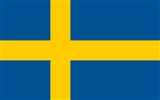


.jpg)
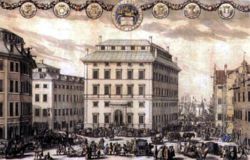
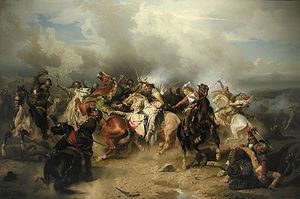
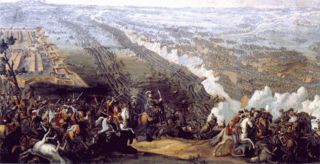
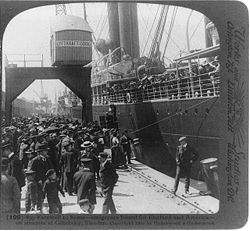
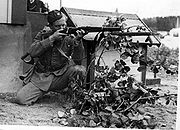
.jpg)