

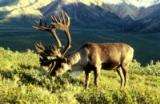
Reindeer

Encyclopedia
The reindeer also known as the caribou in North America
, is a deer
from the Arctic
and Subarctic
, including both resident and migratory
populations. While overall widespread and numerous, some of its subspecies
are rare and one (or two, depending on taxonomy
) has already gone extinct.
Reindeer vary considerably in color and size. Both sexes grow antler
s, though they are typically larger in males. There are a few populations where females lack antlers completely.
Wild reindeer hunting and herding
of semi-domesticated reindeer (for meat, hides, antlers, milk and transportation) is important to several Arctic and Subarctic people. Even far outside its range, the reindeer is well known due to the myth, probably originating in early 19th century America, in which Santa Claus
's sleigh is pulled by flying reindeer, a popular secular element of Christmas
. In Lapland
, reindeer pull pulks.
, being present in both tundra
and taiga
(boreal forest). Originally, the reindeer was found in Scandinavia
, eastern Europe
, Russia
, Mongolia
, and northern China
north of the 50th latitude
. In North America, it was found in Canada
, Alaska
(USA), and the northern conterminous USA from Washington to Maine
. In the 19th century, it was apparently still present in southern Idaho
. It also occurred naturally on Sakhalin
, Greenland
, and probably even in historical times in Ireland
. During the late Pleistocene
era, reindeer were found as far south as Nevada
and Tennessee
in North America and Spain
in Europe. Today, wild reindeer have disappeared from many areas within this large historical range, especially from the southern parts, where it vanished almost everywhere. Large populations of wild reindeer are still found in Norway
, Finland
, Siberia
, Greenland
, Alaska
, and Canada
.
Domesticated
reindeer are mostly found in northern Fennoscandia
and Russia, with a herd of approximately 150-170 reindeer living around the Cairngorms
region in Scotland
. The last remaining wild tundra reindeer in Europe are found in portions of southern Norway
.
A few reindeer from Norway were introduced to the South Atlantic island of South Georgia
in the beginning of the 20th century. The South Georgian reindeer
total some 2600 animals in two distinct herds separated by glacier
s. Although the flag
and the coat of arms
of the territory contain an image of a reindeer, they are under threat of eradication because of the environmental damage they cause. Around 4000 reindeer have been introduced into the French sub-Antarctic archipelago of Kerguelen Islands
. East Iceland
has a small herd of about 2500–3000 animals.
Caribou and reindeer numbers have fluctuated historically, but many herds are in decline across their range. This global decline is linked to climate change
for northern, migratory caribou and reindeer herds and industrial disturbance of caribou habitat for sedentary, non-migratory herds.
island is very small compared to other subspecies (a phenomenon known as insular dwarfism
), with females having a length of approximately 150 cm (59.1 in), and a weight around 53 kg (116.8 lb) in the spring and 70 kg (154.3 lb) in the autumn. Males are approximately 160 cm (63 in) long, and weigh around 65 kg (143.3 lb) in the spring and 90 kg (198.4 lb) in the autumn. The reindeer from Svalbard are also relatively short-legged and may have a shoulder height of as little as 80 cm (31.5 in), thereby following Allen's rule
.
Domesticated reindeer are shorter-legged and heavier than their wild counterparts.
varies considerably, both individually, and depending on season and subspecies. Northern populations, which usually are relatively small, are whiter, while southern populations, which typically are relatively large, are darker. This can be seen well in North America, where the northermost subspecies, the Peary caribou
, is the whitest and smallest subspecies of the continent, while the southermost subspecies, the Woodland Caribou
, is the darkest and largest. The coat
has two layers of fur, a dense wool
ly undercoat and longer-haired overcoat consisting of hollow, air-filled hairs.
s, which (in the Scandinavian variety) for old males fall off in December, for young males in the early spring, and for females in the summer. The antlers typically have two separate groups of points, a lower and upper. There is considerable subspecific variation in the size of the antlers (e.g., rather small and spindly in the northernmost subspecies), but in some subspecies the bull reindeer's antlers are the second largest of any extant deer, after the moose
, and can range up to 100 cm (39.4 in) in width and 135 cm (53.1 in) in beam length. They have the largest antlers relative to body size among deer.
s. Incoming cold air is warmed by the animal's body heat
before entering the lungs, and water is condensed from the expired air and captured before the deer's breath is exhaled, used to moisten dry incoming air and possibly absorbed into the blood through the mucous membrane
s.
Reindeer hooves
adapt to the season: in the summer, when the tundra is soft and wet, the footpads become sponge-like and provide extra traction. In the winter, the pads shrink and tighten, exposing the rim of the hoof, which cuts into the ice
and crusted snow
to keep it from slipping. This also enables them to dig down (an activity known as "cratering") through the snow to their favorite food, a lichen
known as reindeer moss
. The knees of many species of reindeer are adapted to produce a clicking sound as they walk.
in 2011 revealed that reindeer can see light with wavelengths as low as 320 nm, considerably below the human threshold of 400 nm. It is thought that this ability helps them to survive in the Arctic, because many objects that blend into the landscape in normally visible light, such as urine and fur, produce sharp contrasts in ultraviolet.
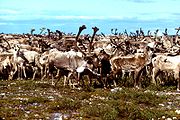 Reindeer are ruminant
s, having a four-chambered stomach. They mainly eat lichen
s in winter, especially reindeer moss
. However, they also eat the leaves of willow
s and birch
es, as well as sedge
s and grass
es. There is some evidence to suggest that on occasion, they will also feed on lemming
s, arctic char
, and bird eggs
. Reindeer herded by the Chukchis
have been known to devour mushrooms enthusiastically in late summer.
Calves may be born the following May or June. After 45 days, the calves are able to graze and forage but continue suckling until the following autumn and become independent from their mothers.
the furthest of any terrestrial mammal, travelling up to 5000 km (3,106.9 mi) a year, and covering 1000000 km² (386,102.2 sq mi). Other populations (e.g., in Europe) have a shorter migration, and some, for example the subspecies R. t. pearsoni and R. t. platyrhynchus (both restricted to islands), are residents that only make local movements.
Normally travelling about 19 kilometre a day while migrating, the caribou can run at speeds of 60 kilometre per hour. During the spring migration smaller herds will group together to form larger herds of 50,000 to 500,000 animals but during autumn migrations, the groups become smaller, and the reindeer begin to mate. During the winter, reindeer travel to forested areas to forage under the snow. By spring, groups leave their winter grounds to go to the calving grounds. A reindeer can swim easily and quickly, normally at 6.5 km/h (4 mph) but if necessary at 10 km/h (6.2 mph), and migrating herds will not hesitate to swim across a large lake or broad river.
s prey on calves and are the most prolific hunter on calving grounds. Wolverine
will take newborn calves or birthing cows, as well as (less commonly) infirm adults. Brown Bear
s and polar bear
s prey on reindeer of all ages, but like the wolverines they are most likely to attack weaker animals, such as calves and sick deer.
The Gray Wolf
is the most effective natural predator of adult reindeer, especially during the winter. As carrion, caribou are fed on by fox
es, raven
s and hawk
s.
Blood-sucking insects, such as black flies
and mosquito
es, are a plague to reindeer during the summer and can cause enough stress to inhibit feeding and calving behaviors.
In one case, the entire body of a reindeer was found in a Greenland shark
(possibly a case of scavenging), a species found in the far northern Atlantic.
The population numbers of some of these predators is influenced by the migration of reindeer.
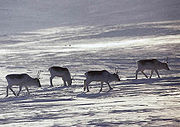 Since 1961, reindeer have been divided into two major groups, the tundra reindeer with six subspecies and the woodland reindeer with three subspecies. Among the tundra subspecies are small-bodied, high-Arctic island forms. These island subspecies are probably not closely related, since the Svalbard reindeer seems to have evolved from large European reindeer, whereas Peary caribou and the extinct Arctic reindeer are closely related and probably evolved in high-Arctic North America.
The following list is partial, as four subspecies which are restricted to Russia and neighbouring regions have been left out. These are R. tarandus buskensis, R. tarandus pearsoni (Novaya Zemlya
reindeer), R. tarandus phylarchus (Kamchatka/Okhotsk
reindeer) and R. tarandus sibiricus (Siberia
n Tundra reindeer).
Humans started hunting reindeer in the Mesolithic
and Neolithic
periods, and humans are today the main predator in many areas. Norway and Greenland have unbroken traditions of hunting wild reindeer from the ice age
until the present day. In the non-forested mountains of central Norway
, such as Jotunheimen
, it is still possible to find remains of stone-built trapping pit
s, guiding fences, and bow rests, built especially for hunting reindeer. These can, with some certainty, be dated to the Migration Period
, although it is not unlikely that they have been in use since the Stone Age
.
Norway
is now preparing to apply for nomination as a World Heritage Site
for areas with traces and traditions of reindeer hunting in Dovrefjell-Sunndalsfjella National Park
, Reinheimen National Park
and Rondane National Park
in Central Sør-Norge (Southern Norway). There is in these parts of Norway an unbroken tradition of reindeer hunting from post-glacial stone age until today.
Wild caribou are still hunted in North America and Greenland. In the traditional lifestyle of the Inuit
people, Northern First Nations
people, Alaska Natives
, and the Kalaallit
of Greenland, the caribou is an important source of food, clothing, shelter, and tools. Many Gwichʼin people, who depend on the Porcupine caribou
, still follow traditional caribou management practices that include a prohibition against selling caribou meat and limits on the number of caribou to be taken per hunting trip.
The blood of the caribou was supposedly mixed with alcohol as drink by hunters and loggers in colonial Quebec to counter the cold. This drink is now enjoyed without the blood as a wine and whiskey drink known as Caribou
.
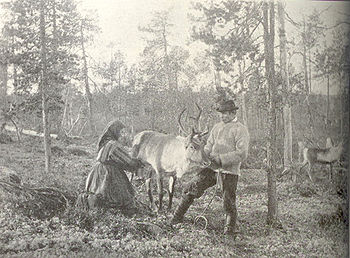 Reindeer have been herded
for centuries by several Arctic and Subarctic people including the Sami
and the Nenets
. They are raised for their meat, hides, antlers and, to a lesser extent, for milk and transportation. Reindeer are not considered fully domesticated, as they generally roam free on pasture grounds. In traditional nomadic herding, reindeer herders migrate with their herds between coast and inland areas according to an annual migration route, and herds are keenly tended. However, reindeer were not bred in captivity, though they were tamed for milking as well as for use as draught animals or beasts of burden
.
The use of reindeer as semi-domesticated livestock in Alaska was introduced in the late 19th century by the U.S. Revenue Cutter Service, with assistance from Sheldon Jackson
, as a means of providing a livelihood for Native peoples
there. Reindeer were imported first from Siberia, and later also from Norway. A regular mail run in Wales, Alaska
, used a sleigh drawn by reindeer. In Alaska, reindeer herders use satellite
telemetry to track their herds, using online maps and databases to chart the herd's progress.
, Nenets
, Khants
, Evenks
, Yukaghir
s, Chukchi
, and Koryaks
in Eurasia
. It is believed that domestication started between the Bronze
and Iron Age
s. Siberian deer owners also use the reindeer to ride on (Siberian reindeer are larger than their Scandinavian relatives). For breeders, a single owner may own hundreds or even thousands of animals. The numbers of Russian herders have been drastically reduced since the fall of the Soviet Union
. The fur
and meat is sold, which is an important source of income. Reindeer were introduced into Alaska near the end of the 19th century; they interbreed with native caribou subspecies there. Reindeer herders on the Seward Peninsula
have experienced significant losses to their herds from animals (such as wolves) following the wild caribou during their migrations.
Reindeer meat
is popular in the Scandinavian countries. Reindeer meatball
s are sold canned. Sautéed reindeer is the best-known dish in Lapland. In Alaska and Finland, reindeer sausage
is sold in supermarkets and grocery store
s. Reindeer meat is very tender and lean. It can be prepared fresh, but also dried, salted, hot- and cold-smoked. In addition to meat, almost all internal organs of reindeer can be eaten, some being traditional dishes. Furthermore, Lapin Poron liha, fresh reindeer meat completely produced and packed in Finnish Lapland, is protected in Europe with PDO classification.
Reindeer antler
is powdered and sold as an aphrodisiac
, nutritional or medicinal supplement to Asian markets.
Caribou have been a major source of subsistence for Canadian Inuit
.
and Theophrastus
have short accounts – probably based on the same source – of an ox-sized deer species, named tarandos, living in the land of the Bodines
in Scythia
, which was able to change the colour of its fur to obtain camouflage. The latter is probably a misunderstanding of the seasonal change in reindeer fur colour. The descriptions have been interpreted as being of reindeer living in the southern Ural Mountains
at c. 350 BC
A deer-like animal described by Julius Caesar
in his Commentarii de Bello Gallico
(chapter 6.26) from the Hercynian Forest
in the year 53 BC is most certainly to be interpreted as reindeer:
According to Olaus Magnus
's Historia de Gentibus Septentrionalibus – printed in Rome
in 1555 – Gustav I of Sweden
sent 10 reindeer to Albert I, Duke of Prussia
, in the year 1533. It may be these animals that Conrad Gessner
had seen or heard of.
, was used by Albertus Magnus
in his De animalibus, fol. Liber 22, Cap. 268: "Dicitur Rangyfer quasi ramifer". This word may go back to a Saami
word raingo. For the origin of the word tarandus, which Linnaeus chose as the species epithet
, he made reference to Ulisse Aldrovandi
's Quadrupedum omnium bisulcorum historia fol. 859–863, Cap. 30: De Tarando (1621). However, Aldrovandi
– and before him Konrad Gesner – thought that rangifer and tarandus were two separate animals. In any case, the tarandos name goes back to Aristotle
and Theophrastus
– see above.
origin (Old Norse
hreinn, which again goes back to Proto-Germanic *hrainaz and Proto-Indo-European
*kroinos meaning "horned animal"). In the Uralic
languages, Sami
poatsu (in Northern Sami
boazu, in Lule Sami
boatsoj, in Pite Sami
båtsoj, in Southern Sami
bovtse), Mari
pučə and Udmurt
pudžej, all referring to domesticated reindeer, go back to *počaw, an Iranian loanword deriving from Proto-Indo-European *peḱu-, meaning "cattle". The Finnish name poro may also stem from the same. The name caribou comes, through French, from Mi'kmaq qalipu, meaning "snow shoveler", referring to its habit of pawing through the snow for food. In Inuktitut
, the caribou is known by the name tuktu. In Cree-Montagnais-Naskapi dialects the caribou is called atihkw.
tale, Santa Claus's sleigh is pulled by flying reindeer. These were first named in the 1823 poem "A Visit from St. Nicholas
", where they are called Dasher, Dancer, Prancer, Vixen, Comet, Cupid, Dunder, and Blixem. Dunder was later changed to Donder and—in other works—Donner (in German, "thunder"), and Blixem was later changed to Bliksem, then Blitzen (German for "lightning"). Some consider Rudolph as part of the group as well, though he was not part of the original named work referenced previously. Rudolph was added by Robert L. May in 1939 as "Rudolph the Red-Nosed Reindeer
".
According to the British comedy panel game QI
, Rudolph the Red-Nosed Reindeer and all of Santa's other reindeer must be either female
or castrated
, because male
reindeer lose their antlers during winter.
 Several Norwegian municipalities have one or more reindeer depicted in their coats-of-arms: Eidfjord
, Porsanger
, Rendalen
, Tromsø
, Vadsø
, and Vågå
. The historic province of Västerbotten
in Sweden
has a reindeer in its coat of arms. The present Västerbotten County
has very different borders and uses the reindeer combined with other symbols in its coat-of-arms. The city of Piteå
also has a reindeer. The logo for Umeå University
features three reindeer.
The Canadian 25-cent coin, or "quarter
" features a depiction of a caribou on one face. The caribou is the official provincial animal of Newfoundland and Labrador
, Canada, and appears on the coat of arms of Nunavut
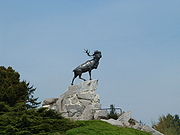
. A caribou statue was erected at the center of the Beaumont-Hamel Newfoundland Memorial
, marking the spot in France where hundreds of soldiers from Newfoundland were killed and wounded in the First World War
and there is a replica in Bowring Park, in St. John's, Newfoundland's capital city.
Two municipalities in Finland have reindeer motifs in their coats-of-arms: Kuusamo
has a running reindeer and Inari
a fish with reindeer antlers.
}
}}
North America
North America is a continent wholly within the Northern Hemisphere and almost wholly within the Western Hemisphere. It is also considered a northern subcontinent of the Americas...
, is a deer
Deer
Deer are the ruminant mammals forming the family Cervidae. Species in the Cervidae family include white-tailed deer, elk, moose, red deer, reindeer, fallow deer, roe deer and chital. Male deer of all species and female reindeer grow and shed new antlers each year...
from the Arctic
Arctic
The Arctic is a region located at the northern-most part of the Earth. The Arctic consists of the Arctic Ocean and parts of Canada, Russia, Greenland, the United States, Norway, Sweden, Finland, and Iceland. The Arctic region consists of a vast, ice-covered ocean, surrounded by treeless permafrost...
and Subarctic
Subarctic
The Subarctic is a region in the Northern Hemisphere immediately south of the true Arctic and covering much of Alaska, Canada, the north of Scandinavia, Siberia, and northern Mongolia...
, including both resident and migratory
Animal migration
Animal migration is the relatively long-distance movement of individuals, usually on a seasonal basis. It is a ubiquitous phenomenon, found in all major animal groups, including birds, mammals, fish, reptiles, amphibians, insects, and crustaceans. The trigger for the migration may be local...
populations. While overall widespread and numerous, some of its subspecies
Subspecies
Subspecies in biological classification, is either a taxonomic rank subordinate to species, ora taxonomic unit in that rank . A subspecies cannot be recognized in isolation: a species will either be recognized as having no subspecies at all or two or more, never just one...
are rare and one (or two, depending on taxonomy
Taxonomy
Taxonomy is the science of identifying and naming species, and arranging them into a classification. The field of taxonomy, sometimes referred to as "biological taxonomy", revolves around the description and use of taxonomic units, known as taxa...
) has already gone extinct.
Reindeer vary considerably in color and size. Both sexes grow antler
Antler
Antlers are the usually large, branching bony appendages on the heads of most deer species.-Etymology:Antler originally meant the lowest tine, the "brow tine"...
s, though they are typically larger in males. There are a few populations where females lack antlers completely.
Wild reindeer hunting and herding
Herding
Herding is the act of bringing individual animals together into a group , maintaining the group and moving the group from place to place—or any combination of those. While the layperson uses the term "herding", most individuals involved in the process term it mustering, "working stock" or...
of semi-domesticated reindeer (for meat, hides, antlers, milk and transportation) is important to several Arctic and Subarctic people. Even far outside its range, the reindeer is well known due to the myth, probably originating in early 19th century America, in which Santa Claus
Santa Claus
Santa Claus is a folklore figure in various cultures who distributes gifts to children, normally on Christmas Eve. Each name is a variation of Saint Nicholas, but refers to Santa Claus...
's sleigh is pulled by flying reindeer, a popular secular element of Christmas
Christmas
Christmas or Christmas Day is an annual holiday generally celebrated on December 25 by billions of people around the world. It is a Christian feast that commemorates the birth of Jesus Christ, liturgically closing the Advent season and initiating the season of Christmastide, which lasts twelve days...
. In Lapland
Lapland (region)
Lapland is a region in northern Fennoscandia, largely within the Arctic Circle. It streches across Norway, Sweden, Finland and the Kola Peninsula . On the North it is bounded by the Barents Sea, on the West by the Norwegian Sea and on the East by the White Sea...
, reindeer pull pulks.
Distribution and habitat
The reindeer is a widespread and numerous species in the northern HolarcticHolarctic
The Holarctic ecozone refers to the habitats found throughout the northern continents of the world as a whole. This region is divided into the Palearctic, consisting of Northern Africa and all of Eurasia, with the exception of Southeast Asia and the Indian subcontinent, and the Nearctic,...
, being present in both tundra
Tundra
In physical geography, tundra is a biome where the tree growth is hindered by low temperatures and short growing seasons. The term tundra comes through Russian тундра from the Kildin Sami word tūndâr "uplands," "treeless mountain tract." There are three types of tundra: Arctic tundra, alpine...
and taiga
Taiga
Taiga , also known as the boreal forest, is a biome characterized by coniferous forests.Taiga is the world's largest terrestrial biome. In North America it covers most of inland Canada and Alaska as well as parts of the extreme northern continental United States and is known as the Northwoods...
(boreal forest). Originally, the reindeer was found in Scandinavia
Scandinavia
Scandinavia is a cultural, historical and ethno-linguistic region in northern Europe that includes the three kingdoms of Denmark, Norway and Sweden, characterized by their common ethno-cultural heritage and language. Modern Norway and Sweden proper are situated on the Scandinavian Peninsula,...
, eastern Europe
Europe
Europe is, by convention, one of the world's seven continents. Comprising the westernmost peninsula of Eurasia, Europe is generally 'divided' from Asia to its east by the watershed divides of the Ural and Caucasus Mountains, the Ural River, the Caspian and Black Seas, and the waterways connecting...
, Russia
Russia
Russia or , officially known as both Russia and the Russian Federation , is a country in northern Eurasia. It is a federal semi-presidential republic, comprising 83 federal subjects...
, Mongolia
Mongolia
Mongolia is a landlocked country in East and Central Asia. It is bordered by Russia to the north and China to the south, east and west. Although Mongolia does not share a border with Kazakhstan, its western-most point is only from Kazakhstan's eastern tip. Ulan Bator, the capital and largest...
, and northern China
China
Chinese civilization may refer to:* China for more general discussion of the country.* Chinese culture* Greater China, the transnational community of ethnic Chinese.* History of China* Sinosphere, the area historically affected by Chinese culture...
north of the 50th latitude
50th parallel north
The 50th parallel north is a circle of latitude that is 50 degrees north of the Earth's equatorial plane. It crosses Europe, Asia, the Pacific Ocean, North America, and the Atlantic Ocean....
. In North America, it was found in Canada
Canada
Canada is a North American country consisting of ten provinces and three territories. Located in the northern part of the continent, it extends from the Atlantic Ocean in the east to the Pacific Ocean in the west, and northward into the Arctic Ocean...
, Alaska
Alaska
Alaska is the largest state in the United States by area. It is situated in the northwest extremity of the North American continent, with Canada to the east, the Arctic Ocean to the north, and the Pacific Ocean to the west and south, with Russia further west across the Bering Strait...
(USA), and the northern conterminous USA from Washington to Maine
Maine
Maine is a state in the New England region of the northeastern United States, bordered by the Atlantic Ocean to the east and south, New Hampshire to the west, and the Canadian provinces of Quebec to the northwest and New Brunswick to the northeast. Maine is both the northernmost and easternmost...
. In the 19th century, it was apparently still present in southern Idaho
Idaho
Idaho is a state in the Rocky Mountain area of the United States. The state's largest city and capital is Boise. Residents are called "Idahoans". Idaho was admitted to the Union on July 3, 1890, as the 43rd state....
. It also occurred naturally on Sakhalin
Sakhalin
Sakhalin or Saghalien, is a large island in the North Pacific, lying between 45°50' and 54°24' N.It is part of Russia, and is Russia's largest island, and is administered as part of Sakhalin Oblast...
, Greenland
Greenland
Greenland is an autonomous country within the Kingdom of Denmark, located between the Arctic and Atlantic Oceans, east of the Canadian Arctic Archipelago. Though physiographically a part of the continent of North America, Greenland has been politically and culturally associated with Europe for...
, and probably even in historical times in Ireland
Ireland
Ireland is an island to the northwest of continental Europe. It is the third-largest island in Europe and the twentieth-largest island on Earth...
. During the late Pleistocene
Pleistocene
The Pleistocene is the epoch from 2,588,000 to 11,700 years BP that spans the world's recent period of repeated glaciations. The name pleistocene is derived from the Greek and ....
era, reindeer were found as far south as Nevada
Nevada
Nevada is a state in the western, mountain west, and southwestern regions of the United States. With an area of and a population of about 2.7 million, it is the 7th-largest and 35th-most populous state. Over two-thirds of Nevada's people live in the Las Vegas metropolitan area, which contains its...
and Tennessee
Tennessee
Tennessee is a U.S. state located in the Southeastern United States. It has a population of 6,346,105, making it the nation's 17th-largest state by population, and covers , making it the 36th-largest by total land area...
in North America and Spain
Spain
Spain , officially the Kingdom of Spain languages]] under the European Charter for Regional or Minority Languages. In each of these, Spain's official name is as follows:;;;;;;), is a country and member state of the European Union located in southwestern Europe on the Iberian Peninsula...
in Europe. Today, wild reindeer have disappeared from many areas within this large historical range, especially from the southern parts, where it vanished almost everywhere. Large populations of wild reindeer are still found in Norway
Norway
Norway , officially the Kingdom of Norway, is a Nordic unitary constitutional monarchy whose territory comprises the western portion of the Scandinavian Peninsula, Jan Mayen, and the Arctic archipelago of Svalbard and Bouvet Island. Norway has a total area of and a population of about 4.9 million...
, Finland
Finland
Finland , officially the Republic of Finland, is a Nordic country situated in the Fennoscandian region of Northern Europe. It is bordered by Sweden in the west, Norway in the north and Russia in the east, while Estonia lies to its south across the Gulf of Finland.Around 5.4 million people reside...
, Siberia
Siberia
Siberia is an extensive region constituting almost all of Northern Asia. Comprising the central and eastern portion of the Russian Federation, it was part of the Soviet Union from its beginning, as its predecessor states, the Tsardom of Russia and the Russian Empire, conquered it during the 16th...
, Greenland
Greenland
Greenland is an autonomous country within the Kingdom of Denmark, located between the Arctic and Atlantic Oceans, east of the Canadian Arctic Archipelago. Though physiographically a part of the continent of North America, Greenland has been politically and culturally associated with Europe for...
, Alaska
Alaska
Alaska is the largest state in the United States by area. It is situated in the northwest extremity of the North American continent, with Canada to the east, the Arctic Ocean to the north, and the Pacific Ocean to the west and south, with Russia further west across the Bering Strait...
, and Canada
Canada
Canada is a North American country consisting of ten provinces and three territories. Located in the northern part of the continent, it extends from the Atlantic Ocean in the east to the Pacific Ocean in the west, and northward into the Arctic Ocean...
.
Domesticated
Domestication
Domestication or taming is the process whereby a population of animals or plants, through a process of selection, becomes accustomed to human provision and control. In the Convention on Biological Diversity a domesticated species is defined as a 'species in which the evolutionary process has been...
reindeer are mostly found in northern Fennoscandia
Fennoscandia
Fennoscandia and Fenno-Scandinavia are geographic and geological terms used to describe the Scandinavian Peninsula, the Kola Peninsula, Karelia and Finland...
and Russia, with a herd of approximately 150-170 reindeer living around the Cairngorms
Cairngorms
The Cairngorms are a mountain range in the eastern Highlands of Scotland closely associated with the mountain of the same name - Cairn Gorm.-Name:...
region in Scotland
Scotland
Scotland is a country that is part of the United Kingdom. Occupying the northern third of the island of Great Britain, it shares a border with England to the south and is bounded by the North Sea to the east, the Atlantic Ocean to the north and west, and the North Channel and Irish Sea to the...
. The last remaining wild tundra reindeer in Europe are found in portions of southern Norway
Norway
Norway , officially the Kingdom of Norway, is a Nordic unitary constitutional monarchy whose territory comprises the western portion of the Scandinavian Peninsula, Jan Mayen, and the Arctic archipelago of Svalbard and Bouvet Island. Norway has a total area of and a population of about 4.9 million...
.
A few reindeer from Norway were introduced to the South Atlantic island of South Georgia
South Georgia and the South Sandwich Islands
South Georgia and the South Sandwich Islands is a British overseas territory and overseas territory of the European Union in the southern Atlantic Ocean. It is a remote and inhospitable collection of islands, consisting of South Georgia and a chain of smaller islands, known as the South Sandwich...
in the beginning of the 20th century. The South Georgian reindeer
Reindeer in South Georgia
Reindeer in South Georgia are an example of an animal which has been introduced outside its native range. The reindeer, a species of deer adapted to arctic and subarctic climates, was introduced to the subantarctic island of South Georgia by Norwegian whalers in the early 20th century...
total some 2600 animals in two distinct herds separated by glacier
Glacier
A glacier is a large persistent body of ice that forms where the accumulation of snow exceeds its ablation over many years, often centuries. At least 0.1 km² in area and 50 m thick, but often much larger, a glacier slowly deforms and flows due to stresses induced by its weight...
s. Although the flag
Flag
A flag is a piece of fabric with a distinctive design that is usually rectangular and used as a symbol, as a signaling device, or decoration. The term flag is also used to refer to the graphic design employed by a flag, or to its depiction in another medium.The first flags were used to assist...
and the coat of arms
Coat of arms
A coat of arms is a unique heraldic design on a shield or escutcheon or on a surcoat or tabard used to cover and protect armour and to identify the wearer. Thus the term is often stated as "coat-armour", because it was anciently displayed on the front of a coat of cloth...
of the territory contain an image of a reindeer, they are under threat of eradication because of the environmental damage they cause. Around 4000 reindeer have been introduced into the French sub-Antarctic archipelago of Kerguelen Islands
Kerguelen Islands
The Kerguelen Islands , also known as the Desolation Islands, are a group of islands in the southern Indian Ocean constituting the emerged part of the otherwise submerged Kerguelen Plateau. The islands, along with Adélie Land, the Crozet Islands and the Amsterdam and Saint Paul Islands are part of...
. East Iceland
Iceland
Iceland , described as the Republic of Iceland, is a Nordic and European island country in the North Atlantic Ocean, on the Mid-Atlantic Ridge. Iceland also refers to the main island of the country, which contains almost all the population and almost all the land area. The country has a population...
has a small herd of about 2500–3000 animals.
Caribou and reindeer numbers have fluctuated historically, but many herds are in decline across their range. This global decline is linked to climate change
Climate change
Climate change is a significant and lasting change in the statistical distribution of weather patterns over periods ranging from decades to millions of years. It may be a change in average weather conditions or the distribution of events around that average...
for northern, migratory caribou and reindeer herds and industrial disturbance of caribou habitat for sedentary, non-migratory herds.
Size
The females usually measure 162 centimetre in length and weigh 79 kilogram The males (or "bulls") are typically larger (although the extent to which varies in the different subspecies), measuring 180 centimetre in length and usually weighing 92 kilogram, though exceptionally large males have weighed as much as 318 kg (701.1 lb). Shoulder height typically measure from 85 centimetre, and the tail is 14 centimetre long. The subspecies R. t. platyrhynchus from SvalbardSvalbard
Svalbard is an archipelago in the Arctic, constituting the northernmost part of Norway. It is located north of mainland Europe, midway between mainland Norway and the North Pole. The group of islands range from 74° to 81° north latitude , and from 10° to 35° east longitude. Spitsbergen is the...
island is very small compared to other subspecies (a phenomenon known as insular dwarfism
Insular dwarfism
Insular dwarfism, a form of phyletic dwarfism, is the process and condition of the reduction in size of large animals – typically mammals – when their population's range is limited to a small environment, primarily islands. This natural process is distinct from the intentional creation of dwarf...
), with females having a length of approximately 150 cm (59.1 in), and a weight around 53 kg (116.8 lb) in the spring and 70 kg (154.3 lb) in the autumn. Males are approximately 160 cm (63 in) long, and weigh around 65 kg (143.3 lb) in the spring and 90 kg (198.4 lb) in the autumn. The reindeer from Svalbard are also relatively short-legged and may have a shoulder height of as little as 80 cm (31.5 in), thereby following Allen's rule
Allen's rule
Allen's rule is a biological rule posited by Joel Asaph Allen in 1877. It states that endotherms from colder climates usually have shorter limbs than the equivalent animals from warmer climates.- Theory :...
.
Domesticated reindeer are shorter-legged and heavier than their wild counterparts.
Fur
The colour of the furFur
Fur is a synonym for hair, used more in reference to non-human animals, usually mammals; particularly those with extensives body hair coverage. The term is sometimes used to refer to the body hair of an animal as a complete coat, also known as the "pelage". Fur is also used to refer to animal...
varies considerably, both individually, and depending on season and subspecies. Northern populations, which usually are relatively small, are whiter, while southern populations, which typically are relatively large, are darker. This can be seen well in North America, where the northermost subspecies, the Peary caribou
Peary Caribou
The Peary Caribou is a caribou subspecies found in the high Arctic islands of Canada's Nunavut and Northwest territories. They are the smallest of the North American caribou, with the females weighing an average of 60 kg and the males 110 kg...
, is the whitest and smallest subspecies of the continent, while the southermost subspecies, the Woodland Caribou
Migratory Woodland Caribou
The migratory woodland caribou , also known as the forest caribou or woodland caribou , is a subspecies of the caribou...
, is the darkest and largest. The coat
Coat (animal)
Coat, or the nature and quality of a show mammal's pelage, is important to the animal fancy in the judging of the animal, particularly at conformation dog shows, cat shows and horse shows...
has two layers of fur, a dense wool
Wool
Wool is the textile fiber obtained from sheep and certain other animals, including cashmere from goats, mohair from goats, qiviut from muskoxen, vicuña, alpaca, camel from animals in the camel family, and angora from rabbits....
ly undercoat and longer-haired overcoat consisting of hollow, air-filled hairs.
Antlers
In most populations both sexes grow antlerAntler
Antlers are the usually large, branching bony appendages on the heads of most deer species.-Etymology:Antler originally meant the lowest tine, the "brow tine"...
s, which (in the Scandinavian variety) for old males fall off in December, for young males in the early spring, and for females in the summer. The antlers typically have two separate groups of points, a lower and upper. There is considerable subspecific variation in the size of the antlers (e.g., rather small and spindly in the northernmost subspecies), but in some subspecies the bull reindeer's antlers are the second largest of any extant deer, after the moose
Moose
The moose or Eurasian elk is the largest extant species in the deer family. Moose are distinguished by the palmate antlers of the males; other members of the family have antlers with a dendritic configuration...
, and can range up to 100 cm (39.4 in) in width and 135 cm (53.1 in) in beam length. They have the largest antlers relative to body size among deer.
Nose and hooves
Reindeer have specialized noses featuring nasal turbinate bones that dramatically increase the surface area within the nostrilNostril
A nostril is one of the two channels of the nose, from the point where they bifurcate to the external opening. In birds and mammals, they contain branched bones or cartilages called turbinates, whose function is to warm air on inhalation and remove moisture on exhalation...
s. Incoming cold air is warmed by the animal's body heat
Thermoregulation
Thermoregulation is the ability of an organism to keep its body temperature within certain boundaries, even when the surrounding temperature is very different...
before entering the lungs, and water is condensed from the expired air and captured before the deer's breath is exhaled, used to moisten dry incoming air and possibly absorbed into the blood through the mucous membrane
Mucous membrane
The mucous membranes are linings of mostly endodermal origin, covered in epithelium, which are involved in absorption and secretion. They line cavities that are exposed to the external environment and internal organs...
s.
Reindeer hooves
Hoof
A hoof , plural hooves or hoofs , is the tip of a toe of an ungulate mammal, strengthened by a thick horny covering. The hoof consists of a hard or rubbery sole, and a hard wall formed by a thick nail rolled around the tip of the toe. The weight of the animal is normally borne by both the sole...
adapt to the season: in the summer, when the tundra is soft and wet, the footpads become sponge-like and provide extra traction. In the winter, the pads shrink and tighten, exposing the rim of the hoof, which cuts into the ice
Ice
Ice is water frozen into the solid state. Usually ice is the phase known as ice Ih, which is the most abundant of the varying solid phases on the Earth's surface. It can appear transparent or opaque bluish-white color, depending on the presence of impurities or air inclusions...
and crusted snow
Snow
Snow is a form of precipitation within the Earth's atmosphere in the form of crystalline water ice, consisting of a multitude of snowflakes that fall from clouds. Since snow is composed of small ice particles, it is a granular material. It has an open and therefore soft structure, unless packed by...
to keep it from slipping. This also enables them to dig down (an activity known as "cratering") through the snow to their favorite food, a lichen
Lichen
Lichens are composite organisms consisting of a symbiotic organism composed of a fungus with a photosynthetic partner , usually either a green alga or cyanobacterium...
known as reindeer moss
Cladonia rangiferina
Cladonia rangiferina, also known as Reindeer lichen , lat., is a light-colored, fruticose lichen belonging to the family Cladoniaceae. It grows in both hot and cold climates in well-drained, open environments. Found primarily in areas of alpine tundra, it is extremely cold-hardy.Other common names...
. The knees of many species of reindeer are adapted to produce a clicking sound as they walk.
Vision
Reindeer are thought to be the only mammals that can see ultraviolet light. A study conducted by researchers from the University College LondonUniversity College London
University College London is a public research university located in London, United Kingdom and the oldest and largest constituent college of the federal University of London...
in 2011 revealed that reindeer can see light with wavelengths as low as 320 nm, considerably below the human threshold of 400 nm. It is thought that this ability helps them to survive in the Arctic, because many objects that blend into the landscape in normally visible light, such as urine and fur, produce sharp contrasts in ultraviolet.
Diet
Ruminant
A ruminant is a mammal of the order Artiodactyla that digests plant-based food by initially softening it within the animal's first compartment of the stomach, principally through bacterial actions, then regurgitating the semi-digested mass, now known as cud, and chewing it again...
s, having a four-chambered stomach. They mainly eat lichen
Lichen
Lichens are composite organisms consisting of a symbiotic organism composed of a fungus with a photosynthetic partner , usually either a green alga or cyanobacterium...
s in winter, especially reindeer moss
Cladonia rangiferina
Cladonia rangiferina, also known as Reindeer lichen , lat., is a light-colored, fruticose lichen belonging to the family Cladoniaceae. It grows in both hot and cold climates in well-drained, open environments. Found primarily in areas of alpine tundra, it is extremely cold-hardy.Other common names...
. However, they also eat the leaves of willow
Willow
Willows, sallows, and osiers form the genus Salix, around 400 species of deciduous trees and shrubs, found primarily on moist soils in cold and temperate regions of the Northern Hemisphere...
s and birch
Birch
Birch is a tree or shrub of the genus Betula , in the family Betulaceae, closely related to the beech/oak family, Fagaceae. The Betula genus contains 30–60 known taxa...
es, as well as sedge
Cyperaceae
Cyperaceae are a family of monocotyledonous graminoid flowering plants known as sedges, which superficially resemble grasses or rushes. The family is large, with some 5,500 species described in about 109 genera. These species are widely distributed, with the centers of diversity for the group...
s and grass
Grass
Grasses, or more technically graminoids, are monocotyledonous, usually herbaceous plants with narrow leaves growing from the base. They include the "true grasses", of the Poaceae family, as well as the sedges and the rushes . The true grasses include cereals, bamboo and the grasses of lawns ...
es. There is some evidence to suggest that on occasion, they will also feed on lemming
Lemming
Lemmings are small rodents, usually found in or near the Arctic, in tundra biomes. They are subniveal animals, and together with voles and muskrats, they make up the subfamily Arvicolinae , which forms part of the largest mammal radiation by far, the superfamily Muroidea, which also includes rats,...
s, arctic char
Arctic char
Arctic char or Arctic charr is both a freshwater and saltwater fish in the Salmonidae family, native to Arctic, sub-Arctic and alpine lakes and coastal waters. No other freshwater fish is found as far north. It is the only species of fish in Lake Hazen, on Ellesmere Island in the Canadian Arctic...
, and bird eggs
Egg (biology)
An egg is an organic vessel in which an embryo first begins to develop. In most birds, reptiles, insects, molluscs, fish, and monotremes, an egg is the zygote, resulting from fertilization of the ovum, which is expelled from the body and permitted to develop outside the body until the developing...
. Reindeer herded by the Chukchis
Chukchi people
The Chukchi, or Chukchee , ) are an indigenous people inhabiting the Chukchi Peninsula and the shores of the Chukchi Sea and the Bering Sea region of the Arctic Ocean within the Russian Federation. They speak the Chukchi language...
have been known to devour mushrooms enthusiastically in late summer.
Reproduction
Mating occurs from late September to early November. Males battle for access to females. Two males will lock each other's antlers together and try to push each other away. The most dominant males can collect as many as 15-20 females to mate with. A male will stop eating during this time and lose much of its body reserves.Calves may be born the following May or June. After 45 days, the calves are able to graze and forage but continue suckling until the following autumn and become independent from their mothers.
Migration
Some populations of the North American caribou migrateAnimal migration
Animal migration is the relatively long-distance movement of individuals, usually on a seasonal basis. It is a ubiquitous phenomenon, found in all major animal groups, including birds, mammals, fish, reptiles, amphibians, insects, and crustaceans. The trigger for the migration may be local...
the furthest of any terrestrial mammal, travelling up to 5000 km (3,106.9 mi) a year, and covering 1000000 km² (386,102.2 sq mi). Other populations (e.g., in Europe) have a shorter migration, and some, for example the subspecies R. t. pearsoni and R. t. platyrhynchus (both restricted to islands), are residents that only make local movements.
Normally travelling about 19 kilometre a day while migrating, the caribou can run at speeds of 60 kilometre per hour. During the spring migration smaller herds will group together to form larger herds of 50,000 to 500,000 animals but during autumn migrations, the groups become smaller, and the reindeer begin to mate. During the winter, reindeer travel to forested areas to forage under the snow. By spring, groups leave their winter grounds to go to the calving grounds. A reindeer can swim easily and quickly, normally at 6.5 km/h (4 mph) but if necessary at 10 km/h (6.2 mph), and migrating herds will not hesitate to swim across a large lake or broad river.
Predators
A variety of predators prey heavily on reindeer. Golden EagleGolden Eagle
The Golden Eagle is one of the best known birds of prey in the Northern Hemisphere. Like all eagles, it belongs to the family Accipitridae. Once widespread across the Holarctic, it has disappeared from many of the more heavily populated areas...
s prey on calves and are the most prolific hunter on calving grounds. Wolverine
Wolverine
The wolverine, pronounced , Gulo gulo , also referred to as glutton, carcajou, skunk bear, or quickhatch, is the largest land-dwelling species of the family Mustelidae . It is a stocky and muscular carnivore, more closely resembling a small bear than other mustelids...
will take newborn calves or birthing cows, as well as (less commonly) infirm adults. Brown Bear
Brown Bear
The brown bear is a large bear distributed across much of northern Eurasia and North America. It can weigh from and its largest subspecies, the Kodiak Bear, rivals the polar bear as the largest member of the bear family and as the largest land-based predator.There are several recognized...
s and polar bear
Polar Bear
The polar bear is a bear native largely within the Arctic Circle encompassing the Arctic Ocean, its surrounding seas and surrounding land masses. It is the world's largest land carnivore and also the largest bear, together with the omnivorous Kodiak Bear, which is approximately the same size...
s prey on reindeer of all ages, but like the wolverines they are most likely to attack weaker animals, such as calves and sick deer.
The Gray Wolf
Gray Wolf
The gray wolf , also known as the wolf, is the largest extant wild member of the Canidae family...
is the most effective natural predator of adult reindeer, especially during the winter. As carrion, caribou are fed on by fox
Fox
Fox is a common name for many species of omnivorous mammals belonging to the Canidae family. Foxes are small to medium-sized canids , characterized by possessing a long narrow snout, and a bushy tail .Members of about 37 species are referred to as foxes, of which only 12 species actually belong to...
es, raven
Raven
Raven is the common name given to several larger-bodied members of the genus Corvus—but in Europe and North America the Common Raven is normally implied...
s and hawk
Hawk
The term hawk can be used in several ways:* In strict usage in Australia and Africa, to mean any of the species in the subfamily Accipitrinae, which comprises the genera Accipiter, Micronisus, Melierax, Urotriorchis and Megatriorchis. The large and widespread Accipiter genus includes goshawks,...
s.
Blood-sucking insects, such as black flies
Black fly
A black fly is any member of the family Simuliidae of the Culicomorpha infraorder. They are related to the Ceratopogonidae, Chironomidae, and Thaumaleidae. There are over 1,800 known species of black flies . Most species belong to the immense genus Simulium...
and mosquito
Mosquito
Mosquitoes are members of a family of nematocerid flies: the Culicidae . The word Mosquito is from the Spanish and Portuguese for little fly...
es, are a plague to reindeer during the summer and can cause enough stress to inhibit feeding and calving behaviors.
In one case, the entire body of a reindeer was found in a Greenland shark
Greenland shark
The Greenland shark, Somniosus microcephalus, also known as the sleeper shark, gurry shark, ground shark, grey shark, or by the Inuit languages name Eqalussuaq, is a large shark native to the waters of the North Atlantic Ocean around Greenland and Iceland. These sharks live farther north than any...
(possibly a case of scavenging), a species found in the far northern Atlantic.
The population numbers of some of these predators is influenced by the migration of reindeer.
Subspecies
The following list is partial, as four subspecies which are restricted to Russia and neighbouring regions have been left out. These are R. tarandus buskensis, R. tarandus pearsoni (Novaya Zemlya
Novaya Zemlya
Novaya Zemlya , also known in Dutch as Nova Zembla and in Norwegian as , is an archipelago in the Arctic Ocean in the north of Russia and the extreme northeast of Europe, the easternmost point of Europe lying at Cape Flissingsky on the northern island...
reindeer), R. tarandus phylarchus (Kamchatka/Okhotsk
Sea of Okhotsk
The Sea of Okhotsk is a marginal sea of the western Pacific Ocean, lying between the Kamchatka Peninsula on the east, the Kuril Islands on the southeast, the island of Hokkaidō to the far south, the island of Sakhalin along the west, and a long stretch of eastern Siberian coast along the west and...
reindeer) and R. tarandus sibiricus (Siberia
Siberia
Siberia is an extensive region constituting almost all of Northern Asia. Comprising the central and eastern portion of the Russian Federation, it was part of the Soviet Union from its beginning, as its predecessor states, the Tsardom of Russia and the Russian Empire, conquered it during the 16th...
n Tundra reindeer).
Tundra reindeer
- †Arctic reindeer (R. tarandus eogroenlandicus), an extinctExtinctionIn biology and ecology, extinction is the end of an organism or of a group of organisms , normally a species. The moment of extinction is generally considered to be the death of the last individual of the species, although the capacity to breed and recover may have been lost before this point...
subspeciesSubspeciesSubspecies in biological classification, is either a taxonomic rank subordinate to species, ora taxonomic unit in that rank . A subspecies cannot be recognized in isolation: a species will either be recognized as having no subspecies at all or two or more, never just one...
found until 1900 in eastern GreenlandGreenlandGreenland is an autonomous country within the Kingdom of Denmark, located between the Arctic and Atlantic Oceans, east of the Canadian Arctic Archipelago. Though physiographically a part of the continent of North America, Greenland has been politically and culturally associated with Europe for...
. - Peary caribouPeary CaribouThe Peary Caribou is a caribou subspecies found in the high Arctic islands of Canada's Nunavut and Northwest territories. They are the smallest of the North American caribou, with the females weighing an average of 60 kg and the males 110 kg...
(R. tarandus pearyi), found in the northern islands of the NunavutNunavutNunavut is the largest and newest federal territory of Canada; it was separated officially from the Northwest Territories on April 1, 1999, via the Nunavut Act and the Nunavut Land Claims Agreement Act, though the actual boundaries had been established in 1993...
and the Northwest TerritoriesNorthwest TerritoriesThe Northwest Territories is a federal territory of Canada.Located in northern Canada, the territory borders Canada's two other territories, Yukon to the west and Nunavut to the east, and three provinces: British Columbia to the southwest, and Alberta and Saskatchewan to the south...
of Canada. - Svalbard reindeer (R. tarandus platyrhynchus), found on the SvalbardSvalbardSvalbard is an archipelago in the Arctic, constituting the northernmost part of Norway. It is located north of mainland Europe, midway between mainland Norway and the North Pole. The group of islands range from 74° to 81° north latitude , and from 10° to 35° east longitude. Spitsbergen is the...
islands of NorwayNorwayNorway , officially the Kingdom of Norway, is a Nordic unitary constitutional monarchy whose territory comprises the western portion of the Scandinavian Peninsula, Jan Mayen, and the Arctic archipelago of Svalbard and Bouvet Island. Norway has a total area of and a population of about 4.9 million...
, is the smallest subspecies of reindeer. - Mountain reindeer (R. tarandus tarandus), found in the Arctic tundra of Eurasia, including the Fennoscandia peninsula of northern Europe.
- Porcupine caribouPorcupine caribouThe Porcupine caribou or Grant's caribou is a subspecies of the caribou found in Alaska and adjacent parts of Canada. It resembles the Barren-ground Caribou and is sometimes included in it....
or Grant's caribou (R. tarandus granti), which are found in AlaskaAlaskaAlaska is the largest state in the United States by area. It is situated in the northwest extremity of the North American continent, with Canada to the east, the Arctic Ocean to the north, and the Pacific Ocean to the west and south, with Russia further west across the Bering Strait...
, the YukonYukonYukon is the westernmost and smallest of Canada's three federal territories. It was named after the Yukon River. The word Yukon means "Great River" in Gwich’in....
, and the Northwest TerritoriesNorthwest TerritoriesThe Northwest Territories is a federal territory of Canada.Located in northern Canada, the territory borders Canada's two other territories, Yukon to the west and Nunavut to the east, and three provinces: British Columbia to the southwest, and Alberta and Saskatchewan to the south...
of Canada. Very similar to R. tarandus groenlandicus, and probably better regarded as a junior synonym of that subspecies.
- Barren-ground caribouBarren-ground CaribouBarren-ground Caribou is a subspecies of the caribou that is found mainly in the Canadian territories Nunavut and the Northwest Territories and western Greenland. It sometimes includes the similar porcupine caribou, in which case the barren-ground caribou also is found in Alaska...
(R. tarandus groenlandicus), found in Nunavut and the Northwest Territories of Canada and in western Greenland.
Woodland reindeer
- Finnish forest reindeerFinnish Forest ReindeerThe Finnish forest reindeer is a rare and threatened subspecies of reindeer native to Finland and northwestern Russia. They are found primarily in Russian Karelia, and the provinces of North Karelia, Savonia and Kainuu in Finland, though some range into central south Finland...
(R. tarandus fennicus), found in the wild in only two areas of the Fennoscandia peninsulaFennoscandiaFennoscandia and Fenno-Scandinavia are geographic and geological terms used to describe the Scandinavian Peninsula, the Kola Peninsula, Karelia and Finland...
of Northern EuropeNorthern EuropeNorthern Europe is the northern part or region of Europe. Northern Europe typically refers to the seven countries in the northern part of the European subcontinent which includes Denmark, Estonia, Latvia, Lithuania, Norway, Finland and Sweden...
, in Finnish/Russian KareliaKareliaKarelia , the land of the Karelian peoples, is an area in Northern Europe of historical significance for Finland, Russia, and Sweden...
, and a small population in central south FinlandFinlandFinland , officially the Republic of Finland, is a Nordic country situated in the Fennoscandian region of Northern Europe. It is bordered by Sweden in the west, Norway in the north and Russia in the east, while Estonia lies to its south across the Gulf of Finland.Around 5.4 million people reside...
. The Karelia population reaches far into Russia, however, so far that it remains an open question whether reindeer further to the east are R. t. fennicus as well. - Migratory woodland caribouMigratory Woodland CaribouThe migratory woodland caribou , also known as the forest caribou or woodland caribou , is a subspecies of the caribou...
(R. tarandus caribou), or forest caribou, once found in the North American taigaTaigaTaiga , also known as the boreal forest, is a biome characterized by coniferous forests.Taiga is the world's largest terrestrial biome. In North America it covers most of inland Canada and Alaska as well as parts of the extreme northern continental United States and is known as the Northwoods...
(boreal forest) from Alaska to Newfoundland and LabradorNewfoundland and LabradorNewfoundland and Labrador is the easternmost province of Canada. Situated in the country's Atlantic region, it incorporates the island of Newfoundland and mainland Labrador with a combined area of . As of April 2011, the province's estimated population is 508,400...
and as far south as New EnglandNew EnglandNew England is a region in the northeastern corner of the United States consisting of the six states of Maine, New Hampshire, Vermont, Massachusetts, Rhode Island, and Connecticut...
, Idaho, and Washington. Woodland caribou have disappeared from most of their original southern range and are considered threatenedThreatened speciesThreatened species are any speciesg animals, plants, fungi, etc.) which are vulnerable to endangerment in the near future.The World Conservation Union is the foremost authority on threatened species, and treats threatened species not as a single category, but as a group of three categories,...
where they remain, with the notable exception of the Migratory woodland caribou of northern QuebecQuebecQuebec or is a province in east-central Canada. It is the only Canadian province with a predominantly French-speaking population and the only one whose sole official language is French at the provincial level....
and LabradorLabradorLabrador is the distinct, northerly region of the Canadian province of Newfoundland and Labrador. It comprises the mainland portion of the province, separated from the island of Newfoundland by the Strait of Belle Isle...
, Canada. The name of the CaribooCaribooThe Cariboo is an intermontane region of British Columbia along a plateau stretching from the Fraser Canyon to the Cariboo Mountains. The name is a reference to the woodland caribou that were once abundant in the region...
district of central British ColumbiaBritish ColumbiaBritish Columbia is the westernmost of Canada's provinces and is known for its natural beauty, as reflected in its Latin motto, Splendor sine occasu . Its name was chosen by Queen Victoria in 1858...
relates to their once-large numbers there, but they have almost vanished from that area in the last century. A herd is protected in the Caribou MountainsCaribou Mountains (Alberta)The Caribou Mountains are a mountain range surrounding an elevated plateau in northern Alberta, Canada and which rise north of the lower Peace River, and are bounded to the north and east by the Wood Buffalo National Park....
in AlbertaAlbertaAlberta is a province of Canada. It had an estimated population of 3.7 million in 2010 making it the most populous of Canada's three prairie provinces...
. The above quoted range includes R. tarandus caboti (Labrador caribou), R. tarandus osborni (Osborn's caribou – from British Columbia) and R. tarandus terraenovae (Newfoundland caribou). Based on a review in 1961, these were considered invalid and included in R. tarandus caribou, but some recent authorities have considered them all valid, even suggesting that they are quite distinct. An analysis of mtDNA in 2005 found differences between the caribous from Newfoundland, Labrador, south-western Canada and south-eastern Canada, but maintained all in R. tarandus caribou. - †Queen Charlotte Islands caribouQueen Charlotte Islands caribouThe Queen Charlotte Islands Caribou or Dawson's Caribou is an extinct subspecies of the caribou that once lived on Graham Island, the largest of the Queen Charlotte Islands in British Columbia, Canada. Possible causes of extinction include habitat destruction, introduced disease and overhunting....
(R. tarandus dawsoni) from the Queen Charlotte IslandsQueen Charlotte IslandsHaida Gwaii , formerly the Queen Charlotte Islands, is an archipelago on the North Coast of British Columbia, Canada. Haida Gwaii consists of two main islands: Graham Island in the north, and Moresby Island in the south, along with approximately 150 smaller islands with a total landmass of...
was believed to represent a distinct subspecies. It became extinct at the beginning of the 20th century. However, recent DNADNADeoxyribonucleic acid is a nucleic acid that contains the genetic instructions used in the development and functioning of all known living organisms . The DNA segments that carry this genetic information are called genes, but other DNA sequences have structural purposes, or are involved in...
analysis from mitochondrial DNAMitochondrial DNAMitochondrial DNA is the DNA located in organelles called mitochondria, structures within eukaryotic cells that convert the chemical energy from food into a form that cells can use, adenosine triphosphate...
of the remains from those reindeer suggest that the animals from the Queen Charlotte Islands were not genetically distinct from the Canadian mainland reindeer subspecies.
Hunting
Reindeer hunting by humans has a very long history, and caribou/wild reindeer "may well be the species of single greatest importance in the entire anthropological literature on hunting."Humans started hunting reindeer in the Mesolithic
Mesolithic
The Mesolithic is an archaeological concept used to refer to certain groups of archaeological cultures defined as falling between the Paleolithic and the Neolithic....
and Neolithic
Neolithic
The Neolithic Age, Era, or Period, or New Stone Age, was a period in the development of human technology, beginning about 9500 BC in some parts of the Middle East, and later in other parts of the world. It is traditionally considered as the last part of the Stone Age...
periods, and humans are today the main predator in many areas. Norway and Greenland have unbroken traditions of hunting wild reindeer from the ice age
Ice age
An ice age or, more precisely, glacial age, is a generic geological period of long-term reduction in the temperature of the Earth's surface and atmosphere, resulting in the presence or expansion of continental ice sheets, polar ice sheets and alpine glaciers...
until the present day. In the non-forested mountains of central Norway
Norway
Norway , officially the Kingdom of Norway, is a Nordic unitary constitutional monarchy whose territory comprises the western portion of the Scandinavian Peninsula, Jan Mayen, and the Arctic archipelago of Svalbard and Bouvet Island. Norway has a total area of and a population of about 4.9 million...
, such as Jotunheimen
Jotunheimen
Jotunheimen is a mountainous area of roughly 3,500 km² in Southern Norway and is part of the long range known as the Scandinavian Mountains. The 29 highest mountains in Norway are all in Jotunheimen, including the very highest - Galdhøpiggen...
, it is still possible to find remains of stone-built trapping pit
Trapping pit
Trapping pits are deep pits dug into the ground, or built from stone, in order to trap animals.European rock drawings and cave paintings reveal that the elk and moose have been hunted since the stone age using trapping pits. In Northern Scandinavia one can still find remains of trapping pits used...
s, guiding fences, and bow rests, built especially for hunting reindeer. These can, with some certainty, be dated to the Migration Period
Migration Period
The Migration Period, also called the Barbarian Invasions , was a period of intensified human migration in Europe that occurred from c. 400 to 800 CE. This period marked the transition from Late Antiquity to the Early Middle Ages...
, although it is not unlikely that they have been in use since the Stone Age
Stone Age
The Stone Age is a broad prehistoric period, lasting about 2.5 million years , during which humans and their predecessor species in the genus Homo, as well as the earlier partly contemporary genera Australopithecus and Paranthropus, widely used exclusively stone as their hard material in the...
.
Norway
Norway
Norway , officially the Kingdom of Norway, is a Nordic unitary constitutional monarchy whose territory comprises the western portion of the Scandinavian Peninsula, Jan Mayen, and the Arctic archipelago of Svalbard and Bouvet Island. Norway has a total area of and a population of about 4.9 million...
is now preparing to apply for nomination as a World Heritage Site
World Heritage Site
A UNESCO World Heritage Site is a place that is listed by the UNESCO as of special cultural or physical significance...
for areas with traces and traditions of reindeer hunting in Dovrefjell-Sunndalsfjella National Park
Dovrefjell-Sunndalsfjella National Park
Dovrefjell–Sunndalsfjella National Park is a National Park in Norway. It was founded in 2002 to replace and enlarge the former Dovrefjell National Park, originally founded in 1974...
, Reinheimen National Park
Reinheimen National Park
Reinheimen National Park was established in 2006. The park consists of a continuous protected mountain area. It is located in Møre og Romsdal and Oppland counties in Norway. The park includes parts of the municipalities of Lesja, Skjåk, Vågå, Lom, Norddal, and Rauma...
and Rondane National Park
Rondane National Park
Rondane National Park is the oldest national park in Norway, established on 21 December 1962. The park contains ten peaks above , with the highest being Rondslottet at an altitude of . The park is an important habitat for herds of wild reindeer....
in Central Sør-Norge (Southern Norway). There is in these parts of Norway an unbroken tradition of reindeer hunting from post-glacial stone age until today.
Wild caribou are still hunted in North America and Greenland. In the traditional lifestyle of the Inuit
Inuit
The Inuit are a group of culturally similar indigenous peoples inhabiting the Arctic regions of Canada , Denmark , Russia and the United States . Inuit means “the people” in the Inuktitut language...
people, Northern First Nations
First Nations
First Nations is a term that collectively refers to various Aboriginal peoples in Canada who are neither Inuit nor Métis. There are currently over 630 recognised First Nations governments or bands spread across Canada, roughly half of which are in the provinces of Ontario and British Columbia. The...
people, Alaska Natives
Alaska Natives
Alaska Natives are the indigenous peoples of Alaska. They include: Aleut, Inuit, Tlingit, Haida, Tsimshian, Eyak, and a number of Northern Athabaskan cultures.-History:In 1912 the Alaska Native Brotherhood was founded...
, and the Kalaallit
Kalaallit
Kalaallit is the contemporary term in the Kalaallisut language for the indigenous people living in Greenland, also called the Kalaallit Nunaat. The singular term is kalaaleq. The Kalaallit are a part of the Arctic Inuit people. The language spoken by Inuit in Greenland is Kalaallisut.Historically,...
of Greenland, the caribou is an important source of food, clothing, shelter, and tools. Many Gwichʼin people, who depend on the Porcupine caribou
Porcupine caribou
The Porcupine caribou or Grant's caribou is a subspecies of the caribou found in Alaska and adjacent parts of Canada. It resembles the Barren-ground Caribou and is sometimes included in it....
, still follow traditional caribou management practices that include a prohibition against selling caribou meat and limits on the number of caribou to be taken per hunting trip.
The blood of the caribou was supposedly mixed with alcohol as drink by hunters and loggers in colonial Quebec to counter the cold. This drink is now enjoyed without the blood as a wine and whiskey drink known as Caribou
Caribou (drink)
Caribou is a sweet Québécois alcoholic beverage composed of red wine, hard liquor, usually whisky, and maple syrup or sugar.Caribou can be made at home but is now available as a premixed beverage by the Société des alcools du Québec. It can be consumed hot or cold depending on the weather and...
.
Reindeer husbandry
Herding
Herding is the act of bringing individual animals together into a group , maintaining the group and moving the group from place to place—or any combination of those. While the layperson uses the term "herding", most individuals involved in the process term it mustering, "working stock" or...
for centuries by several Arctic and Subarctic people including the Sami
Sami people
The Sami people, also spelled Sámi, or Saami, are the arctic indigenous people inhabiting Sápmi, which today encompasses parts of far northern Sweden, Norway, Finland, the Kola Peninsula of Russia, and the border area between south and middle Sweden and Norway. The Sámi are Europe’s northernmost...
and the Nenets
Nenets people
The Nenets are an indigenous people in Russia. According to the latest census in 2002, there are 41,302 Nenets in the Russian Federation, most of them living in the Yamalo-Nenets Autonomous Okrug and Nenets Autonomous Okrug...
. They are raised for their meat, hides, antlers and, to a lesser extent, for milk and transportation. Reindeer are not considered fully domesticated, as they generally roam free on pasture grounds. In traditional nomadic herding, reindeer herders migrate with their herds between coast and inland areas according to an annual migration route, and herds are keenly tended. However, reindeer were not bred in captivity, though they were tamed for milking as well as for use as draught animals or beasts of burden
Working animal
A working animal is an animal, usually domesticated, that is kept by humans and trained to perform tasks. They may be close members of the family, such as guide or service dogs, or they may be animals trained strictly to perform a job, such as logging elephants. They may also be used for milk, a...
.
The use of reindeer as semi-domesticated livestock in Alaska was introduced in the late 19th century by the U.S. Revenue Cutter Service, with assistance from Sheldon Jackson
Sheldon Jackson
Sheldon Jackson was a Presbyterian missionary who also became a political leader. During this career he travelled about 1 million miles and established over 100 missions and churches in the Western United States. He is best remembered for his extensive work during the final quarter of the 19th...
, as a means of providing a livelihood for Native peoples
Indigenous peoples
Indigenous peoples are ethnic groups that are defined as indigenous according to one of the various definitions of the term, there is no universally accepted definition but most of which carry connotations of being the "original inhabitants" of a territory....
there. Reindeer were imported first from Siberia, and later also from Norway. A regular mail run in Wales, Alaska
Wales, Alaska
Wales is a town in the Nome Census Area, Alaska, United States. At the 2000 census the population was 152. It is the westernmost town on the American mainland.-Geography:...
, used a sleigh drawn by reindeer. In Alaska, reindeer herders use satellite
Satellite
In the context of spaceflight, a satellite is an object which has been placed into orbit by human endeavour. Such objects are sometimes called artificial satellites to distinguish them from natural satellites such as the Moon....
telemetry to track their herds, using online maps and databases to chart the herd's progress.
Economy
The reindeer has (or has had) an important economic role for all circumpolar peoples, including the SaamiSami people
The Sami people, also spelled Sámi, or Saami, are the arctic indigenous people inhabiting Sápmi, which today encompasses parts of far northern Sweden, Norway, Finland, the Kola Peninsula of Russia, and the border area between south and middle Sweden and Norway. The Sámi are Europe’s northernmost...
, Nenets
Nenets people
The Nenets are an indigenous people in Russia. According to the latest census in 2002, there are 41,302 Nenets in the Russian Federation, most of them living in the Yamalo-Nenets Autonomous Okrug and Nenets Autonomous Okrug...
, Khants
Khanty people
Khanty / Hanti are an indigenous people calling themselves Khanti, Khande, Kantek , living in Khanty-Mansi Autonomous Okrug, a region historically known as "Yugra" in Russia, together with the Mansi. In the autonomous okrug, the Khanty and Mansi languages are given co-official status with Russian...
, Evenks
Evenks
The Evenks are a Tungusic people of Northern Asia. In Russia, the Evenks are recognized as one of the Indigenous peoples of the Russian North, with a population of 35,527...
, Yukaghir
Yukaghir
The Yukaghir, or Yukagirs , деткиль ) are a people in East Siberia, living in the basin of the Kolyma River.-Region:The Tundra Yukaghirs live in the Lower Kolyma region in the Sakha Republic; the Taiga Yukaghirs in the Upper Kolyma region in the Sakha Republic and in Srednekansky District of...
s, Chukchi
Chukchi people
The Chukchi, or Chukchee , ) are an indigenous people inhabiting the Chukchi Peninsula and the shores of the Chukchi Sea and the Bering Sea region of the Arctic Ocean within the Russian Federation. They speak the Chukchi language...
, and Koryaks
Koryaks
Koryaks are an indigenous people of Kamchatka Krai in the Russian Far East, who inhabit the coastlands of the Bering Sea to the south of the Anadyr basin and the country to the immediate north of the Kamchatka Peninsula, the southernmost limit of their range being Tigilsk. They are akin to the...
in Eurasia
Eurasia
Eurasia is a continent or supercontinent comprising the traditional continents of Europe and Asia ; covering about 52,990,000 km2 or about 10.6% of the Earth's surface located primarily in the eastern and northern hemispheres...
. It is believed that domestication started between the Bronze
Bronze Age
The Bronze Age is a period characterized by the use of copper and its alloy bronze as the chief hard materials in the manufacture of some implements and weapons. Chronologically, it stands between the Stone Age and Iron Age...
and Iron Age
Iron Age
The Iron Age is the archaeological period generally occurring after the Bronze Age, marked by the prevalent use of iron. The early period of the age is characterized by the widespread use of iron or steel. The adoption of such material coincided with other changes in society, including differing...
s. Siberian deer owners also use the reindeer to ride on (Siberian reindeer are larger than their Scandinavian relatives). For breeders, a single owner may own hundreds or even thousands of animals. The numbers of Russian herders have been drastically reduced since the fall of the Soviet Union
Soviet Union
The Soviet Union , officially the Union of Soviet Socialist Republics , was a constitutionally socialist state that existed in Eurasia between 1922 and 1991....
. The fur
Fur
Fur is a synonym for hair, used more in reference to non-human animals, usually mammals; particularly those with extensives body hair coverage. The term is sometimes used to refer to the body hair of an animal as a complete coat, also known as the "pelage". Fur is also used to refer to animal...
and meat is sold, which is an important source of income. Reindeer were introduced into Alaska near the end of the 19th century; they interbreed with native caribou subspecies there. Reindeer herders on the Seward Peninsula
Seward Peninsula
The Seward Peninsula is a large peninsula on the western coast of the U.S. state of Alaska. It projects about into the Bering Sea between Norton Sound, the Bering Strait, the Chukchi Sea, and Kotzebue Sound, just below the Arctic Circle...
have experienced significant losses to their herds from animals (such as wolves) following the wild caribou during their migrations.
Reindeer meat
Meat
Meat is animal flesh that is used as food. Most often, this means the skeletal muscle and associated fat and other tissues, but it may also describe other edible tissues such as organs and offal...
is popular in the Scandinavian countries. Reindeer meatball
Meatball
A meatball is made from an amount of ground meat rolled into a small ball, sometimes along with other ingredients, such as breadcrumbs, minced onion, spices, and possibly eggs...
s are sold canned. Sautéed reindeer is the best-known dish in Lapland. In Alaska and Finland, reindeer sausage
Sausage
A sausage is a food usually made from ground meat , mixed with salt, herbs, and other spices, although vegetarian sausages are available. The word sausage is derived from Old French saussiche, from the Latin word salsus, meaning salted.Typically, a sausage is formed in a casing traditionally made...
is sold in supermarkets and grocery store
Grocery store
A grocery store is a store that retails food. A grocer, the owner of a grocery store, stocks different kinds of foods from assorted places and cultures, and sells these "groceries" to customers. Large grocery stores that stock products other than food, such as clothing or household items, are...
s. Reindeer meat is very tender and lean. It can be prepared fresh, but also dried, salted, hot- and cold-smoked. In addition to meat, almost all internal organs of reindeer can be eaten, some being traditional dishes. Furthermore, Lapin Poron liha, fresh reindeer meat completely produced and packed in Finnish Lapland, is protected in Europe with PDO classification.
Reindeer antler
Antler
Antlers are the usually large, branching bony appendages on the heads of most deer species.-Etymology:Antler originally meant the lowest tine, the "brow tine"...
is powdered and sold as an aphrodisiac
Aphrodisiac
An aphrodisiac is a substance that increases sexual desire. The name comes from Aphrodite, the Greek goddess of sexuality and love. Throughout history, many foods, drinks, and behaviors have had a reputation for making sex more attainable and/or pleasurable...
, nutritional or medicinal supplement to Asian markets.
Caribou have been a major source of subsistence for Canadian Inuit
Inuit
The Inuit are a group of culturally similar indigenous peoples inhabiting the Arctic regions of Canada , Denmark , Russia and the United States . Inuit means “the people” in the Inuktitut language...
.
In history
Both AristotleAristotle
Aristotle was a Greek philosopher and polymath, a student of Plato and teacher of Alexander the Great. His writings cover many subjects, including physics, metaphysics, poetry, theater, music, logic, rhetoric, linguistics, politics, government, ethics, biology, and zoology...
and Theophrastus
Theophrastus
Theophrastus , a Greek native of Eresos in Lesbos, was the successor to Aristotle in the Peripatetic school. He came to Athens at a young age, and initially studied in Plato's school. After Plato's death he attached himself to Aristotle. Aristotle bequeathed to Theophrastus his writings, and...
have short accounts – probably based on the same source – of an ox-sized deer species, named tarandos, living in the land of the Bodines
Budini
The Budini were an ancient people who lived in Scythia, in what is today Ukraine.Herodotus wrote in his Histories :...
in Scythia
Scythia
In antiquity, Scythian or Scyths were terms used by the Greeks to refer to certain Iranian groups of horse-riding nomadic pastoralists who dwelt on the Pontic-Caspian steppe...
, which was able to change the colour of its fur to obtain camouflage. The latter is probably a misunderstanding of the seasonal change in reindeer fur colour. The descriptions have been interpreted as being of reindeer living in the southern Ural Mountains
Ural Mountains
The Ural Mountains , or simply the Urals, are a mountain range that runs approximately from north to south through western Russia, from the coast of the Arctic Ocean to the Ural River and northwestern Kazakhstan. Their eastern side is usually considered the natural boundary between Europe and Asia...
at c. 350 BC
A deer-like animal described by Julius Caesar
Julius Caesar
Gaius Julius Caesar was a Roman general and statesman and a distinguished writer of Latin prose. He played a critical role in the gradual transformation of the Roman Republic into the Roman Empire....
in his Commentarii de Bello Gallico
Commentarii de Bello Gallico
Commentarii de Bello Gallico is Julius Caesar's firsthand account of the Gallic Wars, written as a third-person narrative. In it Caesar describes the battles and intrigues that took place in the nine years he spent fighting local armies in Gaul that opposed Roman domination.The "Gaul" that Caesar...
(chapter 6.26) from the Hercynian Forest
Hercynian Forest
The Hercynian Forest was an ancient and dense forest that stretched eastward from the Rhine River across southern Germany and formed the northern boundary of that part of Europe known to writers of antiquity. The ancient sources are equivocal about how far east it extended...
in the year 53 BC is most certainly to be interpreted as reindeer:
According to Olaus Magnus
Olaus Magnus
Olaus Magnus was a Swedish ecclesiastic and writer, who did pioneering work for the interest of Nordic people. He was reported as born in October 1490 in Östergötland, and died on August 1, 1557. Magnus, Latin for the Swedish Stor “great”, is a Latin family name taken personally, and not a...
's Historia de Gentibus Septentrionalibus – printed in Rome
Rome
Rome is the capital of Italy and the country's largest and most populated city and comune, with over 2.7 million residents in . The city is located in the central-western portion of the Italian Peninsula, on the Tiber River within the Lazio region of Italy.Rome's history spans two and a half...
in 1555 – Gustav I of Sweden
Gustav I of Sweden
Gustav I of Sweden, born Gustav Eriksson of the Vasa noble family and later known simply as Gustav Vasa , was King of Sweden from 1523 until his death....
sent 10 reindeer to Albert I, Duke of Prussia
Albert I, Duke of Prussia
Albert of Prussia was the 37th Grand Master of the Teutonic Knights and, after converting to Lutheranism, the first duke of the Duchy of Prussia, which was the first state to adopt the Lutheran faith and Protestantism as the official state religion...
, in the year 1533. It may be these animals that Conrad Gessner
Conrad Gessner
Conrad Gessner was a Swiss naturalist and bibliographer. His five-volume Historiae animalium is considered the beginning of modern zoology, and the flowering plant genus Gesneria is named after him...
had seen or heard of.
Name etymology
The name rangifer, which Linnaeus chose as the name for the reindeer genusGenus
In biology, a genus is a low-level taxonomic rank used in the biological classification of living and fossil organisms, which is an example of definition by genus and differentia...
, was used by Albertus Magnus
Albertus Magnus
Albertus Magnus, O.P. , also known as Albert the Great and Albert of Cologne, is a Catholic saint. He was a German Dominican friar and a bishop, who achieved fame for his comprehensive knowledge of and advocacy for the peaceful coexistence of science and religion. Those such as James A. Weisheipl...
in his De animalibus, fol. Liber 22, Cap. 268: "Dicitur Rangyfer quasi ramifer". This word may go back to a Saami
Sami languages
Sami or Saami is a general name for a group of Uralic languages spoken by the Sami people in parts of northern Finland, Norway, Sweden and extreme northwestern Russia, in Northern Europe. Sami is frequently and erroneously believed to be a single language. Several names are used for the Sami...
word raingo. For the origin of the word tarandus, which Linnaeus chose as the species epithet
Epithet
An epithet or byname is a descriptive term accompanying or occurring in place of a name and having entered common usage. It has various shades of meaning when applied to seemingly real or fictitious people, divinities, objects, and binomial nomenclature. It is also a descriptive title...
, he made reference to Ulisse Aldrovandi
Ulisse Aldrovandi
Ulisse Aldrovandi was an Italian naturalist, the moving force behind Bologna's botanical garden, one of the first in Europe. Carolus Linnaeus and the comte de Buffon reckoned him the father of natural history studies...
's Quadrupedum omnium bisulcorum historia fol. 859–863, Cap. 30: De Tarando (1621). However, Aldrovandi
Ulisse Aldrovandi
Ulisse Aldrovandi was an Italian naturalist, the moving force behind Bologna's botanical garden, one of the first in Europe. Carolus Linnaeus and the comte de Buffon reckoned him the father of natural history studies...
– and before him Konrad Gesner – thought that rangifer and tarandus were two separate animals. In any case, the tarandos name goes back to Aristotle
Aristotle
Aristotle was a Greek philosopher and polymath, a student of Plato and teacher of Alexander the Great. His writings cover many subjects, including physics, metaphysics, poetry, theater, music, logic, rhetoric, linguistics, politics, government, ethics, biology, and zoology...
and Theophrastus
Theophrastus
Theophrastus , a Greek native of Eresos in Lesbos, was the successor to Aristotle in the Peripatetic school. He came to Athens at a young age, and initially studied in Plato's school. After Plato's death he attached himself to Aristotle. Aristotle bequeathed to Theophrastus his writings, and...
– see above.
Local names
The name rein (-deer) is of NorseNorsemen
Norsemen is used to refer to the group of people as a whole who spoke what is now called the Old Norse language belonging to the North Germanic branch of Indo-European languages, especially Norwegian, Icelandic, Faroese, Swedish and Danish in their earlier forms.The meaning of Norseman was "people...
origin (Old Norse
Old Norse
Old Norse is a North Germanic language that was spoken by inhabitants of Scandinavia and inhabitants of their overseas settlements during the Viking Age, until about 1300....
hreinn, which again goes back to Proto-Germanic *hrainaz and Proto-Indo-European
Proto-Indo-European language
The Proto-Indo-European language is the reconstructed common ancestor of the Indo-European languages, spoken by the Proto-Indo-Europeans...
*kroinos meaning "horned animal"). In the Uralic
Uralic languages
The Uralic languages constitute a language family of some three dozen languages spoken by approximately 25 million people. The healthiest Uralic languages in terms of the number of native speakers are Hungarian, Finnish, Estonian, Mari and Udmurt...
languages, Sami
Sami languages
Sami or Saami is a general name for a group of Uralic languages spoken by the Sami people in parts of northern Finland, Norway, Sweden and extreme northwestern Russia, in Northern Europe. Sami is frequently and erroneously believed to be a single language. Several names are used for the Sami...
poatsu (in Northern Sami
Northern Sami
Northern or North Sami is the most widely spoken of all Sami languages. The speaking area of Northern Sami covers the northern parts of Norway, Sweden and Finland...
boazu, in Lule Sami
Lule Sami
Lule Sami is a Uralic, Sami language spoken in Lule Lappmark, i.e., around Luleå, Sweden and in the northern parts of Nordland county in Norway, especially Tysfjord municipality, where Lule Sami is an official language...
boatsoj, in Pite Sami
Pite Sami
Pite Sami, also known as Arjeplog Sami, is a Sami language traditionally spoken in Sweden and Norway. It is a critically endangered language that has only about 25–50 native speakers left and is now only spoken on the Swedish side of the border along the Pite River in the north of Arjeplog...
båtsoj, in Southern Sami
Southern Sami
Southern Sami is the southwestern-most of the Sami languages. It is a seriously endangered language; the last strongholds of this language are the municipalities of Snåsa and Hattfjelldal in Norway...
bovtse), Mari
Mari language
The Mari language , spoken by more than 600,000 people, belongs to the Uralic language family. It is spoken primarily in the Mari Republic of the Russian Federation as well as in the area along the Vyatka river basin and eastwards to the Urals...
pučə and Udmurt
Udmurt language
Udmurt is an Uralic language, part of the Permic subgroup, spoken by the Udmurt natives of the Russian constituent republic of Udmurtia, where it is coofficial with Russian. It is written in the Cyrillic script with five additional characters. Together with Komi and Komi-Permyak languages, it...
pudžej, all referring to domesticated reindeer, go back to *počaw, an Iranian loanword deriving from Proto-Indo-European *peḱu-, meaning "cattle". The Finnish name poro may also stem from the same. The name caribou comes, through French, from Mi'kmaq qalipu, meaning "snow shoveler", referring to its habit of pawing through the snow for food. In Inuktitut
Inuktitut
Inuktitut or Eastern Canadian Inuktitut, Eastern Canadian Inuit language is the name of some of the Inuit languages spoken in Canada...
, the caribou is known by the name tuktu. In Cree-Montagnais-Naskapi dialects the caribou is called atihkw.
Reindeer in Christmas
Santa Claus's reindeer
In the Santa ClausSanta Claus
Santa Claus is a folklore figure in various cultures who distributes gifts to children, normally on Christmas Eve. Each name is a variation of Saint Nicholas, but refers to Santa Claus...
tale, Santa Claus's sleigh is pulled by flying reindeer. These were first named in the 1823 poem "A Visit from St. Nicholas
A Visit from St. Nicholas
"A Visit from St. Nicholas", also known as "The Night Before Christmas" and "'Twas the Night Before Christmas" from its first line, is a poem first published anonymously in 1823 and generally attributed to Clement Clarke Moore, although the claim has also been made that it was written by Henry...
", where they are called Dasher, Dancer, Prancer, Vixen, Comet, Cupid, Dunder, and Blixem. Dunder was later changed to Donder and—in other works—Donner (in German, "thunder"), and Blixem was later changed to Bliksem, then Blitzen (German for "lightning"). Some consider Rudolph as part of the group as well, though he was not part of the original named work referenced previously. Rudolph was added by Robert L. May in 1939 as "Rudolph the Red-Nosed Reindeer
Rudolph the Red-Nosed Reindeer
Rudolph the Red-nosed Reindeer is a fictional reindeer with a glowing red nose. He is popularly known as "Santa's 9th Reindeer" and, when depicted, is the lead reindeer pulling Santa's sleigh on Christmas Eve. The luminosity of his nose is so great that it illuminates the team's path through...
".
According to the British comedy panel game QI
QI
QI is a British comedy panel game television quiz show created and co-produced by John Lloyd, hosted by Stephen Fry, and featuring permanent panellist Alan Davies. Most of the questions are extremely obscure, making it unlikely that the correct answer will be given...
, Rudolph the Red-Nosed Reindeer and all of Santa's other reindeer must be either female
Female
Female is the sex of an organism, or a part of an organism, which produces non-mobile ova .- Defining characteristics :The ova are defined as the larger gametes in a heterogamous reproduction system, while the smaller, usually motile gamete, the spermatozoon, is produced by the male...
or castrated
Castration
Castration is any action, surgical, chemical, or otherwise, by which a male loses the functions of the testicles or a female loses the functions of the ovaries.-Humans:...
, because male
Male
Male refers to the biological sex of an organism, or part of an organism, which produces small mobile gametes, called spermatozoa. Each spermatozoon can fuse with a larger female gamete or ovum, in the process of fertilization...
reindeer lose their antlers during winter.
Heraldry and symbols
Eidfjord
Eidfjord is a municipality in the county of Hordaland, Norway. Eidfjord was separated from Ulvik May 1, 1891....
, Porsanger
Porsanger
Porsanger or Porsáŋgu or Porsanki is a municipality in Finnmark county, Norway. The administrative centre of the municipality is the village of Lakselv...
, Rendalen
Rendalen
Rendalen is a municipality in Hedmark county, Norway. It is part of the traditional region of Østerdalen. The administrative centre of the municipality is the village of Bergset.-Name:...
, Tromsø
Tromsø
Tromsø is a city and municipality in Troms county, Norway. The administrative centre of the municipality is the city of Tromsø.Tromsø city is the ninth largest urban area in Norway by population, and the seventh largest city in Norway by population...
, Vadsø
Vadsø
is a city and municipality in Finnmark county, Norway. The city is the administrative centre of the municipality and the county of Finnmark....
, and Vågå
Vågå
Vågå is a municipality in Oppland county, Norway. It is part of the traditional region of Gudbrandsdal. The administrative centre of the municipality is the village of Vågåmo....
. The historic province of Västerbotten
Västerbotten
', English exonym: West Bothnia, is a province or landskap in the north of Sweden. It borders Ångermanland, Lapland, Norrbotten and the Gulf of Bothnia. It is famous for the cheese with the same name as the province.- Administration :...
in Sweden
Sweden
Sweden , officially the Kingdom of Sweden , is a Nordic country on the Scandinavian Peninsula in Northern Europe. Sweden borders with Norway and Finland and is connected to Denmark by a bridge-tunnel across the Öresund....
has a reindeer in its coat of arms. The present Västerbotten County
Västerbotten County
Västerbotten County is a county or län in the north of Sweden. It borders the counties of Västernorrland, Jämtland, and Norrbotten, as well as the Norwegian county of Nordland and the Gulf of Bothnia.- Provinces :...
has very different borders and uses the reindeer combined with other symbols in its coat-of-arms. The city of Piteå
Piteå
Piteå is a locality and the seat of Piteå Municipality in Norrbotten County, Sweden. The town has 22,650 inhabitants out of a municipal total of 41,000 in 2008.- Geography :...
also has a reindeer. The logo for Umeå University
Umeå University
Umeå University is a university in Umeå in the mid-northern region of Sweden. The university was founded in 1965 and is the fifth oldest within Sweden's present borders....
features three reindeer.
The Canadian 25-cent coin, or "quarter
Quarter (Canadian coin)
The quarter is a Canadian coin, valued at 25 cents or one-fourth of a Canadian dollar. It is a small, circular coin of silver colour. According to the Royal Canadian Mint, the official name for the coin is the 25-cent piece, but in practice it is simply called a quarter.-History of...
" features a depiction of a caribou on one face. The caribou is the official provincial animal of Newfoundland and Labrador
Newfoundland and Labrador
Newfoundland and Labrador is the easternmost province of Canada. Situated in the country's Atlantic region, it incorporates the island of Newfoundland and mainland Labrador with a combined area of . As of April 2011, the province's estimated population is 508,400...
, Canada, and appears on the coat of arms of Nunavut
Coat of arms of Nunavut
The coat of arms of the territory of Nunavut was granted by a warrant of Roméo LeBlanc, Governor General of Canada, dated 31 March 1999, one day before the territory of Nunavut, Canada was created. The same document specified the flag of Nunavut.- Overview :...
. A caribou statue was erected at the center of the Beaumont-Hamel Newfoundland Memorial
Beaumont-Hamel Newfoundland Memorial
The Beaumont-Hamel Newfoundland Memorial is a memorial site in France dedicated to the commemoration of Dominion of Newfoundland forces members who were killed during World War I. The preserved battlefield park encompasses the grounds over which the Newfoundland Regiment made their unsuccessful...
, marking the spot in France where hundreds of soldiers from Newfoundland were killed and wounded in the First World War
World War I
World War I , which was predominantly called the World War or the Great War from its occurrence until 1939, and the First World War or World War I thereafter, was a major war centred in Europe that began on 28 July 1914 and lasted until 11 November 1918...
and there is a replica in Bowring Park, in St. John's, Newfoundland's capital city.
Two municipalities in Finland have reindeer motifs in their coats-of-arms: Kuusamo
Kuusamo
Kuusamo is a town and municipality in Finland. It is located in the Oulu province and is part of the Northern Ostrobothnia region. The municipality has a population of and covers an area of of which is water. The population density is ....
has a running reindeer and Inari
Inari, Finland
Inari is Finland's largest, sparsely populated municipality with four official languages, more than any other in the country. Its major sources of income are lumber industry and nature maintenance. With the museum Siida in the village of Inari, it is a center of Sami culture...
a fish with reindeer antlers.
External links
- The Reindeer Portal, Source of Information About Reindeer Husbandry Worldwide
- Rangifer.net has a map of subspecies ranges.
- 1935 Reindeer Herding in the Northwest Territories
- General information on Caribou and Reindeer
- Human Role in Reindeer/Caribou Systems
- Reindeer Studies in South Georgia and Norway
- Reindeer hunting as World Heritage – a ten thousand year-long tradition
- The Scandinavian reindeer (Rangifer tarandus L.) after the last glacial maximum: time, seasonality and human exploitation
- Adaptations To Life In The Arctic – Instructional slide-show, University of Alaska
- Rangifer – world's only scientific journal dealing exclusively with husbandry, management and biology of Arctic and northern ungulates

}
}}
Caribou-specific links (North America)
- Mammal Fact Sheets: Caribou
- Frequently Asked Questions about Caribou from the Arctic National Wildlife RefugeArctic National Wildlife RefugeThe Arctic National Wildlife Refuge is a national wildlife refuge in northeastern Alaska, United States. It consists of in the Alaska North Slope region. It is the largest National Wildlife Refuge in the country, slightly larger than the Yukon Delta National Wildlife Refuge...
- Caribou and You – Campaign by CPAWS to protect the Woodland caribou, a species at risk in Canada
- Newfoundland Five-Year Caribou Strategy Seeks to Address Declining Populations