

Swedish Police Service

Encyclopedia
The Swedish Police Service is a collection of Government agencies
concerned with police
matters in Sweden
. The Swedish Police Service consists of 28,500 employees of which 39 per cent are women. The staff consists of 20,000 police officers of which 25 per cent are women and 8,500 civilian staff of which 70 per cent are women. Almost all active duty police officers are members of the Swedish Police Union
(Polisförbundet).
The Swedish Police Service consists of the Swedish National Police Board and 21 county police authorities.
The National Police Board also consists of two national departments:
The National Criminal Investigations Department, Rikskriminalpolisen (RKP)
Responsibilities:
The Swedish Security Service
, Säkerhetspolisen (SÄPO)
Responsibilities:
there is a County Police Authority, which is headed by a County Police Commissioner. There is also a County Police Board, consisting of local politicians and the commissioner. The Commissioners and the members of the board are all appointed by the Government of Sweden
. The County Police Authorities report to the National Police Board which in turn report to the Ministry of Justice.
emergency response teams and the paramilitary National Task Force . For larger issues, there is also opportunity to receive reinforcement from auxiliary Beredskapspolisen.
, Gothenburg
, Östersund
and Boden
). The type used at present is the Eurocopter EC-135.
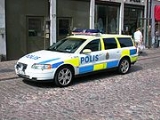
. In 2005, Swedish police cars changed to a blue and fluorescent yellow livery (Battenburg markings
), from a white and blue one. Most Swedish police cars are either Volvos or Saabs, with the same livery all over Sweden.
for the Swedish police is the SIG Sauer P226, P228 & P239), extra magazine, expandable baton, handcuffs
, Sepura
radio, Nokia
mobile phone, pepper spray
, keys and gloves. They also have a duffel bag
which has additional equipment including masks 90 and vest. Many police officers also carry a RAKEL radio communication device. All police officers must carry identification.
system, RAKEL (RadioKommunikation för Effektiv Ledning,"Radio Communication for Effective Command and Control"). Police made the first tests with RAKEL in April 2006.
Since radio systems can be scanned
, for sensitive information the police choose to use cell phones that are practically impossible to intercept, even though the cellphone only allows calls between the communication center and an individual officer, while the radio allows a large number of police units to communicate with each other simultaneously.
Government agencies in Sweden
The Government agencies in Sweden are state controlled organizations who act independently to carry out the policies of the Swedish Government. The Government Ministries are relatively small and merely policy-making organizations, allowed to control agencies by policy decisions but not by direct...
concerned with police
Police
The police is a personification of the state designated to put in practice the enforced law, protect property and reduce civil disorder in civilian matters. Their powers include the legitimized use of force...
matters in Sweden
Sweden
Sweden , officially the Kingdom of Sweden , is a Nordic country on the Scandinavian Peninsula in Northern Europe. Sweden borders with Norway and Finland and is connected to Denmark by a bridge-tunnel across the Öresund....
. The Swedish Police Service consists of 28,500 employees of which 39 per cent are women. The staff consists of 20,000 police officers of which 25 per cent are women and 8,500 civilian staff of which 70 per cent are women. Almost all active duty police officers are members of the Swedish Police Union
Swedish Police Union
The Swedish Police Union is a trade union in Sweden. It has a membership of 18,500 , and is affiliated with the Swedish Confederation of Professional Employees, and EuroCOP. It also maintains contact with the Swedish branch of the International Police Association.-External links:* official site....
(Polisförbundet).
The Swedish Police Service consists of the Swedish National Police Board and 21 county police authorities.
The Swedish National Police Board
The Swedish National Police Board (Rikspolisstyrelsen) is the central administrative and supervisory authority of the police service. It is also the supervisory authority of the National Laboratory of Forensic Science. The SNPB is headed by the National Police Commissioner who is appointed by the government. The current National Police Commissioner is Bengt Svenson. Among other things, the SNPB is responsible for the development of new working methods and technological and administrative support. It is also - through the National Police Academy - responsible for the training of police officers. It is also the principal agency for the Swedish National Laboratory of Forensic Science.The National Police Board also consists of two national departments:
The National Criminal Investigations Department, Rikskriminalpolisen (RKP)
Responsibilities:
- Organised Crime
- National Task Force
- Police Liaison Officers
The Swedish Security Service
Swedish Security Service
The Swedish Security Service , former name Rikspolisstyrelsens säkerhetsavdelning , is the security service of Sweden, belonging to the Swedish National Police Board....
, Säkerhetspolisen (SÄPO)
Responsibilities:
- Counterintelligence
- VIP Protection
- Counter terrorism
- National security
County Police Authorities
In each of the 21 Counties of SwedenCounties of Sweden
The Counties of Sweden are the first level administrative and political subdivisions of Sweden. Sweden is divided into 21 counties. The counties were established in 1634 on Count Axel Oxenstierna's initiative, superseding the historical provinces of Sweden to introduce a modern administration...
there is a County Police Authority, which is headed by a County Police Commissioner. There is also a County Police Board, consisting of local politicians and the commissioner. The Commissioners and the members of the board are all appointed by the Government of Sweden
Government of Sweden
The Government of the Kingdom of Sweden is the supreme executive authority of Sweden. It consists of the Prime Minister and cabinet ministers appointed by the Prime Minister. The Government is responsible for their actions to the Riksdag, which is the legislative assembly...
. The County Police Authorities report to the National Police Board which in turn report to the Ministry of Justice.
Crisis management
The police have special units that are used in more difficult situations or serious security threats, such as the PiketenPiketen
Piketen is an emergency response asset of the Swedish Police Service, similar to the SWAT in the United States.Piketen is called in when situations occur that are too dangerous for ordinary police to handle, such as hostage situations, arresting armed suspects and arresting barricaded suspects...
emergency response teams and the paramilitary National Task Force . For larger issues, there is also opportunity to receive reinforcement from auxiliary Beredskapspolisen.
Aircraft
The Swedish police operate a number of helicopters as support units. Tasked mainly with observation and search duties while being stationed in a number of locations in Sweden (StockholmStockholm
Stockholm is the capital and the largest city of Sweden and constitutes the most populated urban area in Scandinavia. Stockholm is the most populous city in Sweden, with a population of 851,155 in the municipality , 1.37 million in the urban area , and around 2.1 million in the metropolitan area...
, Gothenburg
Gothenburg
Gothenburg is the second-largest city in Sweden and the fifth-largest in the Nordic countries. Situated on the west coast of Sweden, the city proper has a population of 519,399, with 549,839 in the urban area and total of 937,015 inhabitants in the metropolitan area...
, Östersund
Östersund
Östersund is an urban area in Jämtland in the middle of Sweden. It is the seat of Östersund Municipality and the capital of Jämtland County. Östersund is located at the shores of Sweden's fifth largest lake, Storsjön, opposite the island Frösön, and is the only city in Jämtland. Östersund is the...
and Boden
Boden, Sweden
Boden is a locality and the seat of Boden Municipality in Norrbotten County, Sweden with 18,680 inhabitants in 2005.- History :The town of Boden started as a railway junction where the Northern Line met with the Ore Line from the rich iron ore fields in northern Sweden.The town experienced...
). The type used at present is the Eurocopter EC-135.
Ground vehicles
For most of the 20th century, Swedish police vehicles were painted black and whiteBlack and white (slang)
Black and white is an American slang term for a police car that is painted in large panels of black and white or generally any "marked" police car. Historically, this scheme was much favored by North American police forces because it allowed the unambiguous recognition of patrol units from a...
. In 2005, Swedish police cars changed to a blue and fluorescent yellow livery (Battenburg markings
Battenburg markings
Battenburg refers to a pattern of high-visibility markings used to maximise conspicuity, primarily used on vehicles of the emergency services, but also in other applications such as uniforms...
), from a white and blue one. Most Swedish police cars are either Volvos or Saabs, with the same livery all over Sweden.
Personal Equipment
Almost all officers wear a waistbelt which carries a service pistol (the official side armSide arm
A side arm is a weapon, usually a pistol but can be a dagger, as used in pre-modern times, which is worn on the body in a holster to permit immediate access and use. A side arm is typically required equipment for military personnel and sometimes carried by law enforcement personnel...
for the Swedish police is the SIG Sauer P226, P228 & P239), extra magazine, expandable baton, handcuffs
Handcuffs
Handcuffs are restraint devices designed to secure an individual's wrists close together. They comprise two parts, linked together by a chain, a hinge, or rigid bar. Each half has a rotating arm which engages with a ratchet that prevents it from being opened once closed around a person's wrist...
, Sepura
Sepura
Sepura plc is the only major network-independent TETRA terminal supplier. It designs, develops and supplies digital radios for the public safety market as well as Military, Transport and Utilities...
radio, Nokia
Nokia
Nokia Corporation is a Finnish multinational communications corporation that is headquartered in Keilaniemi, Espoo, a city neighbouring Finland's capital Helsinki...
mobile phone, pepper spray
Pepper spray
Pepper spray, also known as OC spray , OC gas, and capsicum spray, is a lachrymatory agent that is used in riot control, crowd control and personal self-defense, including defense against dogs and bears...
, keys and gloves. They also have a duffel bag
Duffel bag
A duffel bag is a large cylindrical bag made of cloth with a drawstring closure at the top....
which has additional equipment including masks 90 and vest. Many police officers also carry a RAKEL radio communication device. All police officers must carry identification.
Radio communications
Currently the police use two radio systems, the analogue S70 and S80. S70 is used nationwide, while S80 is used as a complement to the S70 in Stockholm, Gothenburg and Malmö. Both systems are becoming obsolete and the Swedish Emergency Management Agency (SEMA) began the introduction of a new digital radioDigital radio
Digital radio has several meanings:1. Today the most common meaning is digital radio broadcasting technologies, such as the digital audio broadcasting system, also known as Eureka 147. In these systems, the analog audio signal is digitized into zeros and ones, compressed using formats such as...
system, RAKEL (RadioKommunikation för Effektiv Ledning,"Radio Communication for Effective Command and Control"). Police made the first tests with RAKEL in April 2006.
Since radio systems can be scanned
Scanner (radio)
A scanner is a radio receiver that can automatically tune, or scan, two or more discrete frequencies, stopping when it finds a signal on one of them and then continuing to scan other frequencies when the initial transmission ceases....
, for sensitive information the police choose to use cell phones that are practically impossible to intercept, even though the cellphone only allows calls between the communication center and an individual officer, while the radio allows a large number of police units to communicate with each other simultaneously.