

Rococo

Encyclopedia
Baroque
The Baroque is a period and the style that used exaggerated motion and clear, easily interpreted detail to produce drama, tension, exuberance, and grandeur in sculpture, painting, literature, dance, and music...
artists gave up their symmetry and became increasingly ornate, florid, and playful. Rococo rooms were designed as total works of art with elegant and ornate furniture, small sculptures, ornamental mirrors, and tapestry
Tapestry
Tapestry is a form of textile art, traditionally woven on a vertical loom, however it can also be woven on a floor loom as well. It is composed of two sets of interlaced threads, those running parallel to the length and those parallel to the width ; the warp threads are set up under tension on a...
complementing architecture, reliefs, and wall paintings. It was largely supplanted by the Neoclassic
Neoclassicism
Neoclassicism is the name given to Western movements in the decorative and visual arts, literature, theatre, music, and architecture that draw inspiration from the "classical" art and culture of Ancient Greece or Ancient Rome...
style. In 1835 the Dictionary of the French Academy stated that the word Rococo "usually covers the kind of ornament, style and design associated with Louis XV's reign and the beginning of that of Louis XVI". It includes therefore, all types of art produced around the middle of the 18th century in France.
The word Rococo is seen as a combination of the French rocaille, meaning stone, and coquilles, meaning shell, due to reliance on these objects as motifs of decoration. The term Rococo may also be interpreted as a combination of the word "barocco" (an irregularly shaped pearl, possibly the source of the word "baroque") and the French "rocaille" (a popular form of garden or interior ornamentation using shells and pebbles), and may be used to describe the refined and fanciful style that became fashionable in parts of Europe during the eighteenth century. Owing to Rococo love of shell-like curves and focus on decorative arts, some critics used the term to derogatively imply that the style was frivolous or merely modish. When the term was first used in English in about 1836, it was a colloquialism
Colloquialism
A colloquialism is a word or phrase that is common in everyday, unconstrained conversation rather than in formal speech, academic writing, or paralinguistics. Dictionaries often display colloquial words and phrases with the abbreviation colloq. as an identifier...
meaning "old-fashioned". As a matter of fact, the style received harsh criticism, and was seen by some to be superficial and of poor taste, especially when compared to neoclassicism; despite this, it has been praised for its aesthetic qualities, and since the mid-19th century, the term has been accepted by art historians. While there is still some debate about the historical significance of the style to art in general, Rococo is now widely recognized as a major period in the development of European art.
Historical development
Rococo developed first in the decorative arts and interior design. Louis XIVLouis XIV of France
Louis XIV , known as Louis the Great or the Sun King , was a Bourbon monarch who ruled as King of France and Navarre. His reign, from 1643 to his death in 1715, began at the age of four and lasted seventy-two years, three months, and eighteen days...
's succession brought a change in the court artists and general artistic fashion. By the end of the king's long reign, rich Baroque designs were giving way to lighter elements with more curves and natural patterns. These elements are obvious in the architectural designs of Nicolas Pineau
Nicolas Pineau
Nicolas Pineau was a French carver and ornamental designer, one of the leaders who initiated the exuberant asymmetrical phase of the high Rococo. He worked in St...
. During the Régence
Régence
The Régence is the period in French history between 1715 and 1723, when King Louis XV was a minor and the land was governed by a Regent, Philippe d'Orléans, the nephew of Louis XIV of France....
, court life moved away from Versailles
Palace of Versailles
The Palace of Versailles , or simply Versailles, is a royal château in Versailles in the Île-de-France region of France. In French it is the Château de Versailles....
and this artistic change became well established, first in the royal palace and then throughout French high society. The delicacy and playfulness of Rococo designs is often seen as perfectly in tune with the excesses of Louis XV
Louis XV of France
Louis XV was a Bourbon monarch who ruled as King of France and of Navarre from 1 September 1715 until his death. He succeeded his great-grandfather at the age of five, his first cousin Philippe II, Duke of Orléans, served as Regent of the kingdom until Louis's majority in 1723...
's reign.
The 1730s represented the height of Rococo development in France. The style had spread beyond architecture and furniture to painting and sculpture, exemplified by the works of Antoine Watteau
Antoine Watteau
Jean-Antoine Watteau was a French painter whose brief career spurred the revival of interest in colour and movement...
and François Boucher
François Boucher
François Boucher was a French painter, a proponent of Rococo taste, known for his idyllic and voluptuous paintings on classical themes, decorative allegories representing the arts or pastoral occupations, intended as a sort of two-dimensional furniture...
. Rococo still maintained the Baroque taste for complex forms and intricate patterns, but by this point, it had begun to integrate a variety of diverse characteristics, including a taste for Oriental designs and asymmetric compositions.
The Rococo style spread with French artists and engraved publications. It was readily received in the Catholic parts of Germany, Bohemia
Bohemia
Bohemia is a historical region in central Europe, occupying the western two-thirds of the traditional Czech Lands. It is located in the contemporary Czech Republic with its capital in Prague...
, and Austria, where it was merged with the lively German Baroque traditions. German Rococo was applied with enthusiasm to churches and palaces, particularly in the south, while Frederician Rococo
Frederician Rococo
Frederician Rococo is a form of rococo, which developed in Prussia during the reign of Frederick the Great and combined influences from both France and the Netherlands. Its most famous adherent was the architect Georg Wenzeslaus von Knobelsdorff. Furthermore, the painter Antoine Pesne and even...
developed in the Kingdom of Prussia
Kingdom of Prussia
The Kingdom of Prussia was a German kingdom from 1701 to 1918. Until the defeat of Germany in World War I, it comprised almost two-thirds of the area of the German Empire...
. Architects often draped their interiors in clouds of fluffy white stucco. In Italy, the late Baroque styles of Borromini
Francesco Borromini
Francesco Borromini, byname of Francesco Castelli was an architect from Ticino who, with his contemporaries, Gian Lorenzo Bernini and Pietro da Cortona, was a leading figure in the emergence of Roman Baroque architecture.A keen student of the architecture of Michelangelo and the ruins of...
and Guarini
Camillo-Guarino Guarini
thumb|300px|The [[Carignano Palace]] in Turin.Camillo-Guarino Guarini was an Italian architect of the Piedmontese Baroque, active in Turin as well as Sicily, France, and Portugal. He was a Theatine priest, mathematician, and writer.-Biography:Guarini was born in Modena...
set the tone for Rococo in Turin, Venice, Naples and Sicily, while the arts in Tuscany and Rome remained more wedded to Baroque.
Thomas Chippendale
Thomas Chippendale was a London cabinet-maker and furniture designer in the mid-Georgian, English Rococo, and Neoclassical styles. In 1754 he published a book of his designs, titled The Gentleman and Cabinet Maker's Director...
transformed British furniture design through his adaptation and refinement of the style. William Hogarth
William Hogarth
William Hogarth was an English painter, printmaker, pictorial satirist, social critic and editorial cartoonist who has been credited with pioneering western sequential art. His work ranged from realistic portraiture to comic strip-like series of pictures called "modern moral subjects"...
helped develop a theoretical foundation for Rococo beauty. Though not intentionally referencing the movement, he argued in his Analysis of Beauty (1753) that the undulating lines and S-curves prominent in Rococo were the basis for grace and beauty in art or nature (unlike the straight line or the circle in Classicism
Classicism
Classicism, in the arts, refers generally to a high regard for classical antiquity, as setting standards for taste which the classicists seek to emulate. The art of classicism typically seeks to be formal and restrained: of the Discobolus Sir Kenneth Clark observed, "if we object to his restraint...
). The development of Rococo in Great Britain is considered to have been connected with the revival
Gothic Revival architecture
The Gothic Revival is an architectural movement that began in the 1740s in England...
of interest in Gothic architecture
Gothic architecture
Gothic architecture is a style of architecture that flourished during the high and late medieval period. It evolved from Romanesque architecture and was succeeded by Renaissance architecture....
early in the 18th century.
The beginning of the end for Rococo came in the early 1760s as figures like Voltaire
Voltaire
François-Marie Arouet , better known by the pen name Voltaire , was a French Enlightenment writer, historian and philosopher famous for his wit and for his advocacy of civil liberties, including freedom of religion, free trade and separation of church and state...
and Jacques-François Blondel
Jacques-François Blondel
Jacques-François Blondel was a French architect. He was the grandson of François Blondel , whose course of architecture had appeared in four volumes in 1683 -Biography:...
began to voice their criticism of the superficiality and degeneracy of the art. Blondel decried the "ridiculous jumble of shells, dragons, reeds, palm-trees and plants" in contemporary interiors.
By 1785, Rococo had passed out of fashion in France, replaced by the order and seriousness of Neoclassical artists like Jacques Louis David. In Germany, late 18th century Rococo was ridiculed as Zopf und Perücke ("pigtail and periwig"), and this phase is sometimes referred to as Zopfstil. Rococo remained popular in the provinces and in Italy, until the second phase of neoclassicism, "Empire style", arrived with Napoleonic governments and swept Rococo away.
There was a renewed interest in the Rococo style between 1820 and 1870. The British were among the first to revive the "Louis XIV style" as it was miscalled at first, and paid inflated prices for second-hand Rococo luxury goods that could scarcely be sold in Paris. But prominent artists like Eugène Delacroix
Eugène Delacroix
Ferdinand Victor Eugène Delacroix was a French Romantic artist regarded from the outset of his career as the leader of the French Romantic school...
and patrons like Empress Eugénie also rediscovered the value of grace and playfulness in art and design.
Furniture and decorative objects
The lighthearted themes and intricate designs of Rococo presented themselves best at a more intimate scale than the imposing Baroque architectureBaroque architecture
Baroque architecture is a term used to describe the building style of the Baroque era, begun in late sixteenth century Italy, that took the Roman vocabulary of Renaissance architecture and used it in a new rhetorical and theatrical fashion, often to express the triumph of the Catholic Church and...
and sculpture. It is not surprising, then, that French Rococo art was at home indoors. Metalwork, porcelain figures and especially furniture rose to new pre-eminence as the French upper classes sought to outfit their homes in the now fashionable style.
Rococo style took pleasure in asymmetry, a taste that was new to European style. This practice of leaving elements unbalanced for effect is called contraste.
During the Rococo period, furniture was lighthearted, physically and visually. The idea of furniture had evolved to a symbol of status and took on a role in comfort and versatility. Furniture could be easily moved around for gatherings, and many specialized forms came to be such as the fauteuil chair, the voyeuse chair, and the berger en gondola. Changes in design of these chairs ranges from cushioned detached arms, lengthening of the cushioned back (also known as "hammerhead") and a loose seat cushion. Furniture was also freestanding, instead of being anchored by the wall, to accentuate the lighthearted atmosphere and versatility of each piece. Mahogany was widely used in furniture construction due to its strength, resulting in the absence of the stretcher as seen on many chairs of the time. Also, the use of mirrors hung above mantels became ever more popular in light of the development of unblemished glass.
In a full-blown Rococo design, like the Table d'appartement (c. 1730), by German designer J. A. Meissonnier, working in Paris (illustration, below), any reference to tectonic form is gone: even the marble slab top is shaped. Apron, legs, stretcher have all been seamlessly integrated into a flow of opposed c-scrolls and "rocaille." The knot (noeud) of the stretcher shows the asymmetrical "contraste" that was a Rococo innovation.

Dynasties of Parisian ébénistes, some of them German-born, developed a style of surfaces curved in three dimensions (bombé), where matched veneers (marquetry
Marquetry
Marquetry is the art and craft of applying pieces of veneer to a structure to form decorative patterns, designs or pictures. The technique may be applied to case furniture or even seat furniture, to decorative small objects with smooth, veneerable surfaces or to freestanding pictorial panels...
temporarily being in eclipse) or vernis martin japanning was effortlessly complemented by gilt-bronze ("ormolu") mounts: Antoine Gaudreau
Antoine Gaudreau
Antoine-Robert Gaudreau was a Parisian ébéniste who was appointed Ébéniste du Roi and was the principal supplier of furniture for the royal châteaux during the early years of Louis XV's reign. He is largely known through the copious documentation of the Garde-Meuble de la Couronne; he entered the...
, Charles Cressent
Charles Cressent
Charles Cressent was a French furniture-maker, sculptor and fondeur-ciseleur of the régence style. As the second son of François Cressent, sculpteur du roi, and grandson of Charles Cressent, a furniture-maker of Amiens, who also became a sculptor, he inherited the tastes and aptitudes which were...
, Jean-Pierre Latz
Jean-Pierre Latz
Jean-Pierre Latz was one of the handful of truly outstanding cabinetmakers working in Paris in the mid-18th century. Like several of his peers in the French capital, he was of German origin...
, Jean-François Oeben
Jean-François Oeben
Jean-François Oeben, or Johann Franz Oeben was a French cabinetmaker whose career was spent in Paris. He is the maternal grandfather of the painter Eugène Delacroix....
, Bernard II van Risamburgh
Bernard II van Risamburgh
Bernard II van Risamburgh, sometimes Risen Burgh was a Parisian ébéniste of Dutch and French extraction, one of the outstanding cabinetmakers working in the Rococo style. "Bernard II's furniture is brilliant in almost every respect...
are the outstanding names.
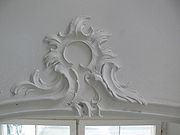
François de Cuvilliés
François de Cuvilliés was a Belgian-born Bavarian decorative designer and architect who was instrumental in bringing the Rococo style to the Wittelsbach court at Munich and to Central Europe in general.Cuvilliés was so diminutive in stature that it was as a court dwarf he first came to the notice...
, Nicholas Pineau and Bartolomeo Rastrelli
Bartolomeo Rastrelli
Francesco Bartolomeo Rastrelli was an Italian architect naturalized Russian. He developed an easily recognizable style of Late Baroque, both sumptuous and majestic...
exported Parisian styles in person to Munich
Munich
Munich The city's motto is "" . Before 2006, it was "Weltstadt mit Herz" . Its native name, , is derived from the Old High German Munichen, meaning "by the monks' place". The city's name derives from the monks of the Benedictine order who founded the city; hence the monk depicted on the city's coat...
and Saint Petersburg
Saint Petersburg
Saint Petersburg is a city and a federal subject of Russia located on the Neva River at the head of the Gulf of Finland on the Baltic Sea...
, while the German Juste-Aurèle Meissonier found his career at Paris. The guiding spirits of the Parisian rococo were a small group of marchands-merciers, the forerunners of modern decorators, led by Simon-Philippe Poirier.
In French furniture
French furniture
French furniture comprises both the most sophisticated furniture made in Paris for king and court, aristocrats and rich upper bourgeoisie, on the one hand, and French provincial furniture made in the provincial cities and towns many of which, like Lyon and Liège, retained cultural identities...
the style remained somewhat more reserved, since the ornaments were mostly of wood, or, after the fashion of wood-carving, less robust and naturalistic and less exuberant in the mixture of natural with artificial forms of all kinds (e.g. plant motives, stalactitic representations, grotesques, masks, implements of various professions, badges, paintings, precious stones).
British
Great Britain
Great Britain or Britain is an island situated to the northwest of Continental Europe. It is the ninth largest island in the world, and the largest European island, as well as the largest of the British Isles...
Rococo tended to be more restrained. Thomas Chippendale's furniture designs kept the curves and feel, but stopped short of the French heights of whimsy. The most successful exponent of British Rococo was probably Thomas Johnson
Thomas Johnson (designer)
Thomas Johnson was an English wood carver and furniture maker.- Work :He worked in London and is particularly known for bold or extreme use and mixture of rococo, Chinese, and rustic motifs. He was said to be one of the most successful exponents of the rococo style, giving it a vitality not seen...
, a gifted carver and furniture designer working in London in the mid-18th century.
The word 'Rococo' is derived from the French "rocaille", a word used to describe the rock and shell work of the Versailles grottoes. Many pieces of carved furniture dating from the 18th century—in particular, mirror frames—depict rocks, shells, and dripping water in their composition, frequently in association with Chinese figures and pagodas.
Garden design
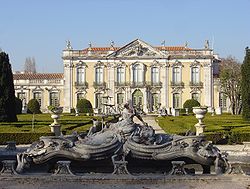
- Main: Garden à la françaiseGarden à la françaiseThe French formal garden, also called jardin à la française, is a style of garden based on symmetry and the principle of imposing order over nature. It reached its apogee in the 17th century with the creation of the Gardens of Versailles, designed for Louis XIV by the landscape architect André Le...
Examples designed by André Le Nôtre
André Le Nôtre
André Le Nôtre was a French landscape architect and the principal gardener of King Louis XIV of France...
:
- Gardens of VersaillesGardens of VersaillesThe Gardens of Versailles occupy part of what was once the Domaine royal de Versailles, the royal demesne of the château of Versailles. Situated to the west of the palace, the gardens cover some 800 hectares of land, much of which is landscaped in the classic French Garden style perfected here by...
- Vaux-le-VicomteVaux-le-VicomteThe Château de Vaux-le-Vicomte is a baroque French château located in Maincy, near Melun, 55 km southeast of Paris in the Seine-et-Marne département of France...
- Château de ChantillyChâteau de ChantillyThe Château de Chantilly is a historic château located in the town of Chantilly, France. It comprises two attached buildings; the Grand Château, destroyed during the French Revolution and rebuilt in the 1870s, and the Petit Château which was built around 1560 for Anne de Montmorency...
Architecture
- Main: Rococo architecture
Rococo architecture, as mentioned above, was a lighter, more graceful, yet also more elaborate version of Baroque architecture
Baroque architecture
Baroque architecture is a term used to describe the building style of the Baroque era, begun in late sixteenth century Italy, that took the Roman vocabulary of Renaissance architecture and used it in a new rhetorical and theatrical fashion, often to express the triumph of the Catholic Church and...
, which was ornate and austere. Whilst the styles were similar, there are some notable differences between both Rococo and Baroque architecture, one of them being symmetry, since Rococo emphasised the asymmetry of forms, whilst Baroque was the opposite. The styles, despite both being richly decorated, also had different themes; the Baroque, for instance, was more serious, placing an emphasis on religion, and was often characterized by Christian themes (as a matter of fact, the Baroque began in Rome as a response to the Protestant Reformation
Protestant Reformation
The Protestant Reformation was a 16th-century split within Western Christianity initiated by Martin Luther, John Calvin and other early Protestants. The efforts of the self-described "reformers", who objected to the doctrines, rituals and ecclesiastical structure of the Roman Catholic Church, led...
); Rococo architecture was an 18th-century, more secular, adaptation of the Baroque which was characterized by more light-hearted and jocular themes. Other elements belonging to the architectural style of Rococo include numerous curves and decorations, as well as the usage of pale colours.
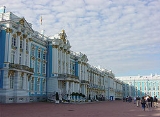
There are numerous examples of Rococo buildings as well as architects. Amongst the most famous include the Catherine Palace, in Russia, the Queluz National Palace in Portugal, the Augustusburg and Falkenlust Palaces, Brühl
Augustusburg and Falkenlust Palaces, Brühl
The Augustusburg and Falkenlust palaces is a historical building complex in Brühl, North Rhine-Westphalia, Germany, which have been listed as a UNESCO cultural World Heritage Site since 1984. They are connected by the spacious gardens and trees of the Schlosspark.Augustusburg Palace and its parks...
, the Chinese House (Potsdam)
Chinese House (Potsdam)
The Chinese House is a garden pavilion in Sanssouci Park in Potsdam. Frederick the Great had it built, about seven hundred meters southwest of the Sanssouci Summer Palace, to adorn his flower and vegetable garden...
the Charlottenburg Palace
Charlottenburg Palace
Charlottenburg Palace is the largest palace in Berlin, Germany, and the only royal residency in the city dating back to the time of the Hohenzollern family. It is located in the Charlottenburg district of the Charlottenburg-Wilmersdorf burough.The palace was built at the end of the 17th century...
in Germany, as well as elements of the Château de Versailles
Palace of Versailles
The Palace of Versailles , or simply Versailles, is a royal château in Versailles in the Île-de-France region of France. In French it is the Château de Versailles....
in France. Architects who were renowned for their constructions using the style include Francesco Bartolomeo Rastrelli
Francesco Bartolomeo Rastrelli
Francesco Bartolomeo Rastrelli was an Italian architect naturalized Russian. He developed an easily recognizable style of Late Baroque, both sumptuous and majestic...
, an Italian architect who worked in Russia and who was noted for his lavish and opulent works, Philip de Lange
Philip de Lange
Philip de Lange was a leading Dutch-Danish architect who designed many different types of building in various styles including Dutch Baroque and Rococo.-Early life and family:...
, who worked in both Danish and Dutch Rococo architecture, or Matthäus Daniel Pöppelmann
Matthäus Daniel Pöppelmann
Matthäus Daniel Pöppelmann was a German master builder who helped to rebuild Dresden after the fire of 1685, and designed Dresden Castle and the Pillnitz church.Pöppelmann was born in Herford...
, who worked in the late Baroque style and who contributed to the reconstruction of the city of Dresden
Dresden
Dresden is the capital city of the Free State of Saxony in Germany. It is situated in a valley on the River Elbe, near the Czech border. The Dresden conurbation is part of the Saxon Triangle metropolitan area....
, in Germany.
Rococo architecture also brought significant changes to the building of edifices, placing an emphasis on privacy rather than the grand public majesty of Baroque architecture, as well as improving the structure of buildings in order to create a more healthy environment.
Interior design
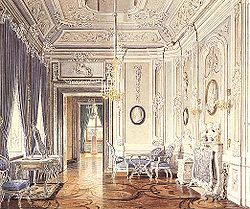
Castle Solitude
Castle Solitude in Stuttgart, Germany , was built as a hunting lodge between 1764 and 1769 under Duke Karl Eugen of Württemberg. It is not a true castle, but rather a rococo palace. Since 1956 the area is part of the urban district of Stuttgart-West. The castle is located on a high plain between...
in Stuttgart
Stuttgart
Stuttgart is the capital of the state of Baden-Württemberg in southern Germany. The sixth-largest city in Germany, Stuttgart has a population of 600,038 while the metropolitan area has a population of 5.3 million ....
and Chinese Palace in Oranienbaum
Oranienbaum, Russia
Oranienbaum is a Russian royal residence, located on the Gulf of Finland west of St. Petersburg. The Palace ensemble and the city centre are UNESCO World Heritage Sites.-History:...
, the Bavaria
Bavaria
Bavaria, formally the Free State of Bavaria is a state of Germany, located in the southeast of Germany. With an area of , it is the largest state by area, forming almost 20% of the total land area of Germany...
n church of Wies
Wies
The Pilgrimage Church of Wies is an oval rococo church, designed in the late 1740s by Dominikus Zimmermann, who for the last eleven years of his life lived nearby. It is located in the foothills of the Alps, in the municipality of Steingaden in the Weilheim-Schongau district, Bavaria, Germany.In...
and Sanssouci
Sanssouci
Sanssouci is the name of the former summer palace of Frederick the Great, King of Prussia, in Potsdam, near Berlin. It is often counted among the German rivals of Versailles. While Sanssouci is in the more intimate Rococo style and is far smaller than its French Baroque counterpart, it too is...
in Potsdam
Potsdam
Potsdam is the capital city of the German federal state of Brandenburg and part of the Berlin/Brandenburg Metropolitan Region. It is situated on the River Havel, southwest of Berlin city centre....
are examples of how Rococo made its way into European architecture.
In those Continental contexts where Rococo is fully in control, sportive, fantastic, and sculptured forms are expressed with abstract ornament using flaming, leafy or shell-like textures in asymmetrical sweeps and flourishes and broken curves; intimate Rococo interiors suppress architectonic
Architectonic
Architectonic may mean:*pertaining to architecture, or suggesting the qualities of architecture*in Aristotelianism, as well as Kantianism, systematization of all knowledge...
divisions of architrave, frieze and cornice for the picturesque, the curious, and the whimsical, expressed in plastic materials like carved wood and above all stucco
Stucco
Stucco or render is a material made of an aggregate, a binder, and water. Stucco is applied wet and hardens to a very dense solid. It is used as decorative coating for walls and ceilings and as a sculptural and artistic material in architecture...
(as in the work of the Wessobrunner School
Wessobrunner School
The Wessobrunner School is the name for a group of Baroque stucco-workers that, beginning at the end of the 17th century, developed in the Benedictine Wessobrunn Abbey in Bavaria, Germany....
). Walls, ceiling, furniture
Furniture
Furniture is the mass noun for the movable objects intended to support various human activities such as seating and sleeping in beds, to hold objects at a convenient height for work using horizontal surfaces above the ground, or to store things...
, and works of metal and porcelain
Porcelain
Porcelain is a ceramic material made by heating raw materials, generally including clay in the form of kaolin, in a kiln to temperatures between and...
present a unified ensemble. The Rococo palette is softer and paler than the rich primary colors and dark tonalities favored in Baroque tastes.
A few anti-architectural hints rapidly evolved into full-blown Rococo at the end of the 1720s and began to affect interiors and decorative art
Decorative art
The decorative arts is traditionally a term for the design and manufacture of functional objects. It includes interior design, but not usually architecture. The decorative arts are often categorized in opposition to the "fine arts", namely, painting, drawing, photography, and large-scale...
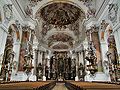
s throughout Europe. The richest forms of German Rococo are in Catholic Germany (illustration, above).
Rococo plasterwork by immigrant Italian-Swiss artists like Bagutti and Artari is a feature of houses by James Gibbs
James Gibbs
James Gibbs was one of Britain's most influential architects. Born in Scotland, he trained as an architect in Rome, and practised mainly in England...
, and the Franchini brothers working in Ireland equalled anything that was attempted in Great Britain.
Inaugurated in some rooms in Versailles, it unfolds its magnificence in several Parisian buildings (especially the Hôtel Soubise). In Germany, French and German artists (Cuvilliés
François de Cuvilliés
François de Cuvilliés was a Belgian-born Bavarian decorative designer and architect who was instrumental in bringing the Rococo style to the Wittelsbach court at Munich and to Central Europe in general.Cuvilliés was so diminutive in stature that it was as a court dwarf he first came to the notice...
, Neumann, Knobelsdorff
Georg Wenzeslaus von Knobelsdorff
Hans Georg Wenzeslaus von Knobelsdorff was a painter and architect in Prussia.Knobelsdorff was born in Kuckädel, now in Krosno Odrzańskie County. A soldier in the service of Prussia, he resigned his commission in 1729 as captain so that he could pursue his interest in architecture...
, etc.) effected the dignified equipment of the Amalienburg
Amalienburg
The Amalienburg is a small hunting lodge in the Nymphenburg Palace of Munich, southern Germany. It was constructed in 1734-1739 by François de Cuvilliés, in Rococo style, for the Holy Roman Emperor Charles VII and his wife, Maria Amalia of Austria....
near Munich
Munich
Munich The city's motto is "" . Before 2006, it was "Weltstadt mit Herz" . Its native name, , is derived from the Old High German Munichen, meaning "by the monks' place". The city's name derives from the monks of the Benedictine order who founded the city; hence the monk depicted on the city's coat...
, and the castles of Würzburg
Würzburg
Würzburg is a city in the region of Franconia which lies in the northern tip of Bavaria, Germany. Located at the Main River, it is the capital of the Regierungsbezirk Lower Franconia. The regional dialect is Franconian....
, Potsdam
Potsdam
Potsdam is the capital city of the German federal state of Brandenburg and part of the Berlin/Brandenburg Metropolitan Region. It is situated on the River Havel, southwest of Berlin city centre....
, Charlottenburg
Charlottenburg
Charlottenburg is a locality of Berlin within the borough of Charlottenburg-Wilmersdorf, named after Queen consort Sophia Charlotte...
, Brühl
Brühl, North Rhine-Westphalia
Brühl is a town in the Rhineland of Germany. It is located in Rhein-Erft-Kreis, 20 km south of Cologne city center and at the edge of Naturpark Kottenforst-Ville Nature Reserve.-History:...
, Bruchsal
Bruchsal
Bruchsal is a city at the western edge of the Kraichgau, approximately 20 km northeast of Karlsruhe in the state of Baden-Württemberg, Germany...
, Solitude
Castle Solitude
Castle Solitude in Stuttgart, Germany , was built as a hunting lodge between 1764 and 1769 under Duke Karl Eugen of Württemberg. It is not a true castle, but rather a rococo palace. Since 1956 the area is part of the urban district of Stuttgart-West. The castle is located on a high plain between...
(Stuttgart
Stuttgart
Stuttgart is the capital of the state of Baden-Württemberg in southern Germany. The sixth-largest city in Germany, Stuttgart has a population of 600,038 while the metropolitan area has a population of 5.3 million ....
), and Schönbrunn
Schönbrunn Palace
Schönbrunn Palace is a former imperial 1,441-room Rococo summer residence in Vienna, Austria. One of the most important cultural monuments in the country, since the 1960s it has been one of the major tourist attractions in Vienna...
.
In Great Britain, one of Hogarth
William Hogarth
William Hogarth was an English painter, printmaker, pictorial satirist, social critic and editorial cartoonist who has been credited with pioneering western sequential art. His work ranged from realistic portraiture to comic strip-like series of pictures called "modern moral subjects"...
's set of paintings forming a melodramatic morality tale titled Marriage à la Mode, engraved in 1745, shows the parade rooms of a stylish London house, in which the only rococo is in plasterwork of the salon's ceiling. Palladian architecture is in control. Here, on the Kentian
William Kent
William Kent , born in Bridlington, Yorkshire, was an eminent English architect, landscape architect and furniture designer of the early 18th century.He was baptised as William Cant.-Education:...
mantel, the crowd of Chinese vases and mandarins are satirically rendered as hideous little monstrosities, and the Rococo wall clock is a jumble of leafy branches.
In general, Rococo is an entirely interior style, because the wealthy and aristocratic moved back to Paris from Versailles. Paris was already built up and so rather than engaging in major architectural additions, they simply renovated the interiors of the existing buildings.
Painting
Though Rococo originated in the purely decorative arts, the style showed clearly in painting. These painters used delicate colors and curving forms, decorating their canvases with cherubs and myths of love. Portraiture was also popular among Rococo painters. Some works show a sort of naughtiness or impurity in the behavior of their subjects, showing the historical trend of departing away from the Baroque's church/state orientation. Landscapes were pastoral and often depicted the leisurely outings of aristocratic couples.Jean-Antoine Watteau (1684–1721) is generally considered the first great Rococo painter. He had a great influence on later painters, including François Boucher
François Boucher
François Boucher was a French painter, a proponent of Rococo taste, known for his idyllic and voluptuous paintings on classical themes, decorative allegories representing the arts or pastoral occupations, intended as a sort of two-dimensional furniture...
(1703–1770) and Jean-Honoré Fragonard
Jean-Honoré Fragonard
Jean-Honoré Fragonard was a French painter and printmaker whose late Rococo manner was distinguished by remarkable facility, exuberance, and hedonism. One of the most prolific artists active in the last decades of the Ancien Régime, Fragonard produced more than 550 paintings , of which only five...
(1732–1806), two masters of the late period. Even Thomas Gainsborough
Thomas Gainsborough
Thomas Gainsborough was an English portrait and landscape painter.-Suffolk:Thomas Gainsborough was born in Sudbury, Suffolk. He was the youngest son of John Gainsborough, a weaver and maker of woolen goods. At the age of thirteen he impressed his father with his penciling skills so that he let...
's (1727–1788) delicate touch and sensitivity are reflective of the Rococo spirit. Élisabeth-Louise Vigée-Le Brun's (1755–1842) style also shows a great deal of Rococo influence, particularly in her portraits of Marie Antoinette
Marie Antoinette
Marie Antoinette ; 2 November 1755 – 16 October 1793) was an Archduchess of Austria and the Queen of France and of Navarre. She was the fifteenth and penultimate child of Holy Roman Empress Maria Theresa and Holy Roman Emperor Francis I....
. Other Rococo painters include: Jean François de Troy
Jean François de Troy
Jean François de Troy was a French Rococo painter and tapestry designer. He was one of a family of painters, being the son of the portrait painter François de Troy , under whom he first studied, and at whose expense he first went to Italy from 1699 to 1706, staying in Rome, but also visiting many...
(1679–1752), Jean-Baptiste van Loo
Jean-Baptiste van Loo
Jean-Baptiste van Loo was a French subject and portrait painter.-Biography:He was born in Aix-en-Provence, and was instructed in art by his father Louis-Abraham van Loo, son of Jacob van Loo...
(1685–1745), his two sons Louis-Michel van Loo
Louis-Michel van Loo
Louis-Michel van Loo was a French painter.He studied under his father, the painter Jean-Baptiste van Loo, at Turin and Rome, and he won a prize at the Académie Royale de Peinture et de Sculpture in Paris in 1725...
(1707–1771) and Charles-Amédée-Philippe van Loo
Charles-Amédée-Philippe van Loo
Charles-Amédée-Philippe van Loo was a French painter of allegorical scenes and portraits.He studied under his father, the painter Jean-Baptiste van Loo, at Turin and Rome, where in 1738 he won the Prix de Rome, then at Aix-en-Provence, before returning to Paris in 1745...
(1719–1795), his younger brother Charles-André van Loo
Charles-André van Loo
Carle or Charles-André van Loo was a French subject painter, and a younger brother of Jean-Baptiste van Loo and grandson of Jacob van Loo. He was the most famous member of a successful dynasty of painters of Dutch origin...
(1705–1765), and Nicolas Lancret
Nicolas Lancret
Nicolas Lancret , French painter, was born in Paris, and became a brilliant depicter of light comedy which reflected the tastes and manners of French society under the regent Orleans....
(1690–1743). Both Jean-Baptiste-Siméon Chardin
Jean-Baptiste-Siméon Chardin
Jean-Baptiste-Siméon Chardin was an 18th-century French painter. He is considered a master of still life, and is also noted for his genre paintings which depict kitchen maids, children, and domestic activities...
(1699–1779) and Jean-Baptiste Greuze
Jean-Baptiste Greuze
Jean-Baptiste Greuze was a French painter.-Early life:He was born at Tournus, Saône-et-Loire. He is generally said to have formed his own talent; this is, however, true only in the most limited sense, for at an early age his inclinations, though thwarted by his father, were encouraged by a...
(1725–1805), were important French painters of the Rococo era who are considered Anti-Rococo.
During the Rococo era Portrait
Portrait
thumb|250px|right|Portrait of [[Thomas Jefferson]] by [[Rembrandt Peale]], 1805. [[New-York Historical Society]].A portrait is a painting, photograph, sculpture, or other artistic representation of a person, in which the face and its expression is predominant. The intent is to display the likeness,...
ure was an important component of painting in all countries, but especially in Great Britain, where the leaders were William Hogarth
William Hogarth
William Hogarth was an English painter, printmaker, pictorial satirist, social critic and editorial cartoonist who has been credited with pioneering western sequential art. His work ranged from realistic portraiture to comic strip-like series of pictures called "modern moral subjects"...
(1697–1764), in a blunt realist style, and Francis Hayman
Francis Hayman
Francis Hayman was an English painter and illustrator who became one of the founding members of the Royal Academy in 1768 and later its first librarian....
(1708–1776), Angelica Kauffman who was Swiss, (1741–1807), Thomas Gainsborough
Thomas Gainsborough
Thomas Gainsborough was an English portrait and landscape painter.-Suffolk:Thomas Gainsborough was born in Sudbury, Suffolk. He was the youngest son of John Gainsborough, a weaver and maker of woolen goods. At the age of thirteen he impressed his father with his penciling skills so that he let...
and Joshua Reynolds
Joshua Reynolds
Sir Joshua Reynolds RA FRS FRSA was an influential 18th-century English painter, specialising in portraits and promoting the "Grand Style" in painting which depended on idealization of the imperfect. He was one of the founders and first President of the Royal Academy...
(1723–1792), in more flattering styles influenced by Antony Van Dyck (1599–1641). While in France during the Rococo era Jean-Baptiste Greuze
Jean-Baptiste Greuze
Jean-Baptiste Greuze was a French painter.-Early life:He was born at Tournus, Saône-et-Loire. He is generally said to have formed his own talent; this is, however, true only in the most limited sense, for at an early age his inclinations, though thwarted by his father, were encouraged by a...
was the favorite painter of Denis Diderot
Denis Diderot
Denis Diderot was a French philosopher, art critic, and writer. He was a prominent person during the Enlightenment and is best known for serving as co-founder and chief editor of and contributor to the Encyclopédie....
(1713–1785), and Maurice Quentin de La Tour
Maurice Quentin de La Tour
Maurice Quentin de La Tour was a French Rococo portraitist who worked primarily with pastels. Among his most famous subjects were Voltaire, Rousseau, Louis XV and Madame de Pompadour.-Biography:...
(1704–1788), and Élisabeth Vigée-Lebrun were highly accomplished Portrait painters
Portrait painting
Portrait painting is a genre in painting, where the intent is to depict the visual appearance of the subject. Beside human beings, animals, pets and even inanimate objects can be chosen as the subject for a portrait...
and History painters
History painting
History painting is a genre in painting defined by subject matter rather than an artistic style, depicting a moment in a narrative story, rather than a static subject such as a portrait...
.
Rococo era painting
Sculpture
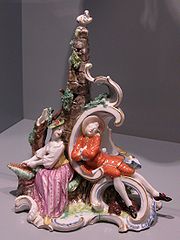
Sculpture was another area where the Rococo was widely adopted.Étienne-Maurice Falconet (1716–1791) is widely considered one of the best representatives of French Rococo. In general, this style was best expressed through delicate porcelain sculpture rather than imposing marble statues. Falconet himself was director of a famous porcelain factory at Sèvres
Sèvres
Sèvres is a commune in the southwestern suburbs of Paris, France. It is located from the centre of Paris.The town is known for its porcelain manufacture, the Manufacture nationale de Sèvres, making the famous Sèvres porcelain, as well as being the location of the International Bureau of Weights...
. The themes of love and gaiety were reflected in sculpture, as were elements of nature, curving lines and asymmetry.
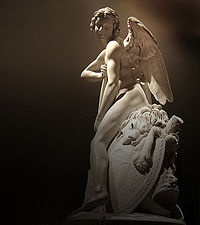
The sculptor Edmé Bouchardon
Edmé Bouchardon
Edmé Bouchardon was a French sculptor, esteemed in his day as the greatest sculptor of his time and valued as a draughtsman as well.-Biography:...
represented Cupid
Cupid
In Roman mythology, Cupid is the god of desire, affection and erotic love. He is the son of the goddess Venus and the god Mars. His Greek counterpart is Eros...
engaged in carving his darts of love from the club of Hercules
Hercules
Hercules is the Roman name for Greek demigod Heracles, son of Zeus , and the mortal Alcmene...
(illustration); this serves as an excellent symbol of the Rococo style—the demigod is transformed into the soft child, the bone-shattering club becomes the heart-scathing arrows, just as marble
Marble
Marble is a metamorphic rock composed of recrystallized carbonate minerals, most commonly calcite or dolomite.Geologists use the term "marble" to refer to metamorphosed limestone; however stonemasons use the term more broadly to encompass unmetamorphosed limestone.Marble is commonly used for...
is so freely replaced by stucco
Stucco
Stucco or render is a material made of an aggregate, a binder, and water. Stucco is applied wet and hardens to a very dense solid. It is used as decorative coating for walls and ceilings and as a sculptural and artistic material in architecture...
. In this connection, the French sculptors, Jean-Louis Lemoyne
Jean-Louis Lemoyne
Jean-Louis Lemoyne was a French sculptor whose works were commissioned by Louis XIV and Louis XV.His sculptures are featured in major art museums, including the Louvre, the Metropolitan Museum of Art, the Frick Collection, the Museum of Fine Arts, and the National Gallery of Art...
, Jean-Baptiste Lemoyne
Jean-Baptiste Lemoyne
Jean-Baptiste Lemoyne was a French sculptor, among the greatest French portraitists. He was the pupil of his father, Jean-Louis Lemoyne, and of Robert Le Lorrain....
, Robert Le Lorrain
Robert Le Lorrain
Robert Le Lorrain was a French baroque sculptor who was born in Paris. He was born into a family of bureaucrats, the son of Claude Le Lorrain, a business agent of Nicolas Fouquet, Louis XIV's Minister of Finance. Le Lorrain was a student of the French sculptor, painter, and architect, Pierre...
, Michel Clodion, and Pigalle
Jean-Baptiste Pigalle
Jean-Baptiste Pigalle was a French sculptor.He was born in Paris, the seventh child of a carpenter. Although he failed to obtain the Grand Prix, after a severe struggle he entered the Académie Royale and became one of the most popular sculptors of his day.His earlier work, such as Child with Cage ...
may be mentioned in passing.
Music
The Galante StyleGalante music
A new style of classical music, fashionable from the 1720s to the 1770s, was called Galante music. It consciously simplified contrapuntal texture and intense composing techniques that realized a pattern on the page and substituted a clear leading voice with a transparent accompaniment....
was the equivalent of Rococo in music history
Music history
Music history, sometimes called historical musicology, is the highly diverse subfield of the broader discipline of musicology that studies the composition, performance, reception, and criticism of music over time...
, too, between Baroque and Classical, and it is not easy to define in words. The rococo music style itself developed out of baroque music, particularly in France. It can be characterized as intimate music with extremely refined decoration forms. Exemplars include Jean Philippe Rameau and Louis-Claude Daquin
Louis-Claude Daquin
Louis-Claude Daquin , was a French composer of Jewish birth writing in the Baroque and Galant styles. He was a virtuoso organist and harpsichordist.-Life:...
.
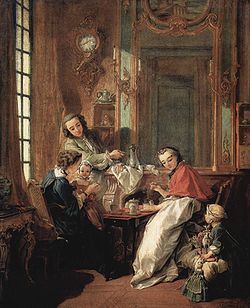
Boucher's painting Le Déjeuner (above) provides a glimpse of the society which Rococo reflected. "Courtly" would be pretentious in this upper bourgeois circle, yet the man's gesture is gallant. The stylish but cozy interior, the informal decorous intimacy of people's manners, the curious and delightful details everywhere one turns one's eye, the luxury of sipping chocolate: all are "galante."
Rococo "worldliness" and the Roman Catholic Church
An interesting illustration of the hostility sometimes aroused by this style (similar to that of early Modernists to High Victorian style) can be found in the critical view of Rococo taken by the 1913 Catholic Encyclopedia, especially on the unsuitable nature of Rococo for ecclesiastical contexts.See also
- Rococo in Portugal
- Cultural movementCultural movementA cultural movement is a change in the way a number of different disciplines approach their work. This embodies all art forms, the sciences, and philosophies. Historically, different nations or regions of the world have gone through their own independent sequence of movements in culture, but as...
- Gilded woodcarvingGilded woodcarvingGilded woodcarvingGilded woodcarving in Portugal is, along with the tile, one of its most original and rich artistic expressions. It is usually used in the internal decoration of churches and cathedrals, but also as part of the decoration of noble halls in palaces and large public buildings,...
- History of paintingHistory of paintingThe history of painting reaches back in time to artifacts from pre-historic humans, and spans all cultures. It represents a continuous, though periodically disrupted tradition from Antiquity. Across cultures, and spanning continents and millennia, the history of painting is an ongoing river of...
- Timeline of Italian artists to 1800
- Illusionistic ceiling painting
Further reading
- Arno Schönberger and Halldor Soehner, 1960. The Age of Rococo Published in the US as The Rococo Age: Art and Civilization of the 18th Century (Originally published in German, 1959).