
All Topics  
Danish language


   Email Print
   Bookmark   Link


Danish language


Danish (; ) is one of the North Germanic languages
North Germanic languages

The North Germanic languages or Scandinavian languages make up one of the three branches of the Germanic languages, a sub-family of the Indo-European languages, along with the West Germanic languages and the extinct East Germanic languages....
 (also called Scandinavian
North Germanic languages

The North Germanic languages or Scandinavian languages make up one of the three branches of the Germanic languages, a sub-family of the Indo-European languages, along with the West Germanic languages and the extinct East Germanic languages....
 languages), a sub-group of the Germanic
Germanic languages

The Germanic languages are a group of related languages that constitute a branch of the Indo-European languages language family. The common ancestor of all the languages in this branch is Proto-Germanic, spoken in approximately the mid-1st millennium BC in Pre-Roman Iron Age....
 branch of the Indo-European languages
Indo-European languages

The Indo-European languages are a Language family of several hundred related languages and dialects, including most major languages of Europe, the Iranian plateau , Central Asia and the Indian subcontinent ....
. It is spoken by around 6 million people, mainly in Denmark
Denmark

Denmark is a Scandinavian country in northern Europe and the senior member of the Kingdom of Denmark. It is the southernmost of the Nordic countries....
; the language is also used by the 50,000 Danes in the northern parts of Schleswig-Holstein
Schleswig-Holstein

Schleswig-Holstein is the Northern Germany of the sixteen States of Germany of Germany. Its capital city is Kiel, other notable cities are L?beck and Flensburg....
 in Germany
Germany

Germany , officially the Federal Republic of Germany , is a country in Central Europe. It is bordered to the north by the North Sea, Denmark, and the Baltic Sea; to the east by Poland and the Czech Republic; to the south by Austria and Switzerland; and to the west by France, Luxembourg, Belgium, and the Netherlands....
 where it holds the status of minority language. Danish also holds official status and is a mandatory subject in school in the Danish territories of Greenland
Greenland

Greenland is a member country of the Kingdom of Denmark located between the Arctic Ocean and Atlantic Oceans, east of the Canadian Arctic Archipelago....
 and the Faroe Islands
Faroe Islands

The Faroe Islands or Faeroe Islands or simply Faroe or Faeroes are an island group situated between the Norwegian Sea and the North Atlantic Ocean, approximately half way between Scotland and Iceland....
, which now enjoy limited autonomy.


Discussion
Ask a question about 'Danish language'
Start a new discussion about 'Danish language'
Answer questions from other users
Full Discussion Forum


Encyclopedia


Danish (; ) is one of the North Germanic languages
North Germanic languages

The North Germanic languages or Scandinavian languages make up one of the three branches of the Germanic languages, a sub-family of the Indo-European languages, along with the West Germanic languages and the extinct East Germanic languages....
 (also called Scandinavian
North Germanic languages

The North Germanic languages or Scandinavian languages make up one of the three branches of the Germanic languages, a sub-family of the Indo-European languages, along with the West Germanic languages and the extinct East Germanic languages....
 languages), a sub-group of the Germanic
Germanic languages

The Germanic languages are a group of related languages that constitute a branch of the Indo-European languages language family. The common ancestor of all the languages in this branch is Proto-Germanic, spoken in approximately the mid-1st millennium BC in Pre-Roman Iron Age....
 branch of the Indo-European languages
Indo-European languages

The Indo-European languages are a Language family of several hundred related languages and dialects, including most major languages of Europe, the Iranian plateau , Central Asia and the Indian subcontinent ....
. It is spoken by around 6 million people, mainly in Denmark
Denmark

Denmark is a Scandinavian country in northern Europe and the senior member of the Kingdom of Denmark. It is the southernmost of the Nordic countries....
; the language is also used by the 50,000 Danes in the northern parts of Schleswig-Holstein
Schleswig-Holstein

Schleswig-Holstein is the Northern Germany of the sixteen States of Germany of Germany. Its capital city is Kiel, other notable cities are L?beck and Flensburg....
 in Germany
Germany

Germany , officially the Federal Republic of Germany , is a country in Central Europe. It is bordered to the north by the North Sea, Denmark, and the Baltic Sea; to the east by Poland and the Czech Republic; to the south by Austria and Switzerland; and to the west by France, Luxembourg, Belgium, and the Netherlands....
 where it holds the status of minority language. Danish also holds official status and is a mandatory subject in school in the Danish territories of Greenland
Greenland

Greenland is a member country of the Kingdom of Denmark located between the Arctic Ocean and Atlantic Oceans, east of the Canadian Arctic Archipelago....
 and the Faroe Islands
Faroe Islands

The Faroe Islands or Faeroe Islands or simply Faroe or Faeroes are an island group situated between the Norwegian Sea and the North Atlantic Ocean, approximately half way between Scotland and Iceland....
, which now enjoy limited autonomy. In Iceland
Iceland

Iceland, officially the Republic of Iceland , is an island country located in the North Atlantic Ocean between mainland Europe and Greenland....
 and the Faroe Islands
Faroe Islands

The Faroe Islands or Faeroe Islands or simply Faroe or Faeroes are an island group situated between the Norwegian Sea and the North Atlantic Ocean, approximately half way between Scotland and Iceland....
, Danish is taught as a compulsory foreign language in schools. There are also Danish language communities in Argentina
Argentina

Argentina, officially the Argentine Republic , is a country in South America, constituted as a federation of 23 provinces and an autonomous city....
, the U.S.
United States

The United States of America is a Federal government constitutional republic comprising U.S. state and a federal district. The country is situated mostly in central North America, where its Contiguous United States and Washington, D.C., the Capital districts and territories, lie between the Pacific Ocean and Atlantic Oceans, Borders of the U...
 and Canada
Canada

Canada is a country occupying most of northern North America, extending from the Atlantic Ocean in the east to the Pacific Ocean in the west and northward into the Arctic Ocean....
.

Classification

Danish, together with Swedish
Swedish language

Swedish is a North Germanic languages language, spoken by around 10 million people, predominantly in Sweden and parts of Finland, especially along the coast and on the ?land islands....
, derives from the East Norse dialect group, while Norwegian
Norwegian language

Norwegian is a North Germanic languages language spoken primarily in Norway, where it is an official language. It is also spoken as a second language among Norwegian-Americans in the United States of America, especially in the central northern states....
 is classified as a West Norse language together with Faroese
Faroese language

Faroese , often also spelled Faeroese , is a West Nordic or West Scandinavian language spoken by 48,000 people in the Faroe Islands and about 12,000 Faroese people in Denmark....
 and Icelandic
Icelandic language

Icelandic is a North Germanic languages, the language of Iceland. Its closest relative is Faroese language and Norwegian dialects such as Telemark dialect and Sognam?l....
. A more recent classification based on mutual intelligibility
Mutual intelligibility

In linguistics, mutual intelligibility is recognized as a relationship between languages in which speakers of different but related languages can readily understand each other without intentional study or extraordinary effort....
 separates modern spoken Danish, Norwegian and Swedish into a Mainland Scandinavian group while Icelandic and Faroese are placed in a separate category labeled Insular Scandinavian.

Written Danish and Norwegian Bokmål
Bokmål

Bokm?l , also known as Riksm?l or Dano-Norwegian, is the more commonly used of the two Norwegian language written standard languages, the other being Nynorsk....
 are particularly close, though the phonology
Phonology

Phonology is the systematic use of sound to encode meaning in any spoken human language, or the field of linguistics studying this use. Just as a language has syntax and vocabulary, it also has a phonology in the sense of a sound system....
 (that is, the system of relationships among the speech sounds that constitute the fundamental components of the language) and the prosody
Prosody (linguistics)

In linguistics, prosody is the rhythm, stress , and intonation of connected speech . Prosody may reflect various features of the speaker or the utterance: the emotional state of a speaker; whether an utterance is a statement, a question, or a command; whether the speaker is being ironic or sarcastic; emphasis, contrast, and focus ; or othe...
 (the patterns of stress and intonation) differ somewhat. Proficient speakers of any of the three languages can understand the others, though studies have shown that speakers of Norwegian generally understand both Danish and Swedish far better than Swedes or Danes understand each other. Both Swedes and Danes also understand Norwegian better than they understand each other's languages.

History

In the 8th century, the common Germanic language of Scandinavia
Scandinavia

Scandinavia is a historical and geographical subregion in northern Europe that includes the Scandinavian Peninsula. It consists of the kingdoms of Norway, Sweden, and Denmark; some authorities also include Finland and some might even include Iceland....
, Proto-Norse, had undergone some changes and evolved into Old Norse
Old Norse

Old Norse is a North Germanic languages that was spoken by inhabitants of Scandinavia and inhabitants of their overseas settlements during the Viking Age, until about 1300....
. This language began to undergo new changes that did not spread to all of Scandinavia, which resulted in the appearance of two similar dialects, Old West Norse (Norway
Norway

Norway , officially the Kingdom of Norway, is a constitutional monarchy in Northern Europe that occupies the western portion of the Scandinavian Peninsula....
 and Iceland
Iceland

Iceland, officially the Republic of Iceland , is an island country located in the North Atlantic Ocean between mainland Europe and Greenland....
) and Old East Norse (Denmark
Denmark

Denmark is a Scandinavian country in northern Europe and the senior member of the Kingdom of Denmark. It is the southernmost of the Nordic countries....
 and Sweden
Sweden

Sweden , officially the Kingdom of Sweden , is a Nordic countries on the Scandinavian Peninsula in Northern Europe. Sweden has land borders with Norway to the west and Finland to the northeast, and it is connected to Denmark by the ?resund Bridge in the south....
).

Old East Norse is in Sweden called Runic Swedish and in east Denmark Runic Danish, but until the 12th century, the dialect was roughly the same in the two countries. The dialects are called runic due to the fact that the main body of text appears in the runic alphabet
Runic alphabet

The runic alphabets are a set of related alphabets using Letter known as runes to write various Germanic languages prior to the adoption of the Latin alphabet and for specialized purposes thereafter....
. Unlike Proto-Norse, which was written with the Elder Futhark
Elder Futhark

The Elder Futhark is the oldest form of the runic alphabet, used by Germanic tribes for Northwest Germanic and Migration period Germanic dialects of the 2nd to 8th centuries for inscriptions on artifacts and runestones....
 alphabet, Old Norse was written with the Younger Futhark
Younger Futhark

The Younger Futhark, also called Scandinavian runes, is a runic alphabet, a reduced form of the Elder Futhark, consisting of only 16 characters, in use from ca....
 alphabet, which only had 16 letters. Due to the limited number of runes, some runes were used for a range of phoneme
Phoneme

In human language, a phoneme is the smallest posited linguistically distinctive unit of sound. Phonemes carry no semantic content themselves. In theoretical terms, phonemes are not the physical segment s themselves, but cognitive abstractions or categorizations of them....
s, such as the rune for the vowel
Vowel

In phonetics, a vowel is a sound in spoken language, such as English ah! or oh! , pronounced with an open vocal tract so that there is no build-up of air pressure at any point above the glottis....
 u which was also used for the vowels o, ø and y, and the rune for i which was also used for e.

A change that separated Old East Norse (Runic Swedish/Danish) from Old West Norse was the change of the diphthong
Diphthong

In phonetics, a diphthong, or , is a contour vowel?that is, a unitary vowel that changes vowel quality during its pronunciation, or "glides", with a glissando of the tongue from one articulation to another, as in the English words eye, boy, and cow. This contrasts with "pure" vowels, or monophthongs, where the tongue is held s...
 æi (Old West Norse ei) to the monophthong
Monophthong

A monophthong is a "pure" vowel sound, one whose articulation at both beginning and end is relatively fixed, and which does not semivowel towards a new position of articulation; compare diphthong....
 e, as in stæin to sten. This is reflected in runic inscriptions where the older read stain and the later stin. There was also a change of au as in dauðr into ø as in døðr. This change is shown in runic inscriptions as a change from tauþr into tuþr. Moreover, the øy (Old West Norse ey) diphthong changed into ø as well, as in the Old Norse word for "island".

Some famous authors of works in Danish are existential
Existentialism

Existentialism is a term that has been applied to the work of a number of nineteenth and twentieth century philosophers who, despite profound doctrinal differences, took the human subject — not merely the thinking subject, but the acting, feeling, living human individual and his or her conditions of existence — as a starting point...
 philosopher Søren Kierkegaard
Søren Kierkegaard

S?ren Aabye Kierkegaard was a prolific 19th century Denmark philosopher and theologian. Kierkegaard strongly criticised both the Hegelianism of his time, and what he saw as the empty ceremony of the Church of Denmark....
, prolific fairy tale
Fairy tale

A fairy tale is a fictional story that may feature folklore characters such as Fairy, goblins, Elf, trolls, giant , and talking animals, and usually enchanted, often involving a far-fetched sequence of events....
 author Hans Christian Andersen
Hans Christian Andersen

Hans Christian Andersen , also known as simply H. C. Andersen ); was a Denmark author and poet, most famous for his fairy tales. Among his best-known stories are "The Steadfast Tin Soldier", "The Snow Queen", "The Little Mermaid", "Thumbelina", "The Little Match Girl", "The Ugly Duckling" and "The Red Shoes "....
, and playwright Ludvig Holberg
Ludvig Holberg

Ludvig Holberg, Baron of Holberg was a writer, essayist, philosopher, historian and playwright born in Bergen, Norway during the time of the Denmark-Norway, and spent most of his adult life in Denmark....
. Three 20th century Danish authors have become Nobel Prize
Nobel Prize

The Nobel Prize , established in the 1895 will of Swedish chemist Alfred Nobel; it was first awarded in Nobel Prize in Physics, Nobel Prize in Chemistry, Nobel Prize in Physiology or Medicine, Nobel Prize in Literature, and Nobel Peace Prize in 1901....
 laureates in Literature
Nobel Prize in Literature

The Nobel Prize in Literature is awarded annually, since 1901, to an author from any country who has, in the words from the will of Alfred Nobel, produced "in the field of literature the most outstanding work in an ideal direction" ....
: Karl Adolph Gjellerup
Karl Adolph Gjellerup

Karl Gjellerup was a Denmark poetry and novelist who together with his compatriot Henrik Pontoppidan won the Nobel Prize in Literature in 1917....
 and Henrik Pontoppidan
Henrik Pontoppidan

Henrik Pontoppidan was a realist writer who shared with Karl Adolph Gjellerup the Nobel Prize for Literature in 1917 for "his authentic descriptions of present-day life in Denmark." Pontoppidan's novels and short stories — informed with a desire for social progress but despairing, later in his life, of its realization — present a...
 (joint recipients in 1917) and Johannes Vilhelm Jensen
Johannes Vilhelm Jensen

Johannes Vilhelm Jensen, in Denmark always called Johannes V. Jensen, was a Denmark author, often considered the first great Danish writer of the 20th century....
 (awarded 1944).

Danish was once widely spoken in the northeast counties of England. Many Danish derived words, such as "gate" (gade) for street, still survive in Yorkshire
Yorkshire

Yorkshire is a Historic counties of England of northern England and the largest in Great Britain. Because of its great size, over time functions were increasingly undertaken by its subdivisions, which have been subject to History of local government in Yorkshire....
 and other parts of eastern England colonized by Danish Vikings. The city of York
York

York is a walled city, sited at the confluence of the rivers River Ouse, Yorkshire and River Foss in North Yorkshire, England. The city status in the United Kingdom is noted for its rich heritage and it has played an important role throughout much of its almost 2,000 year existence....
 was once the Danish settlement of Jorvik.

The first printed book in Danish dates from 1495. The first complete translation of the Bible
Bible

The Bible is the central religious text of Judaism and Christianity. The exact Books of the Bible is dependent on the religious traditions of specific denominations....
 in Danish was published in 1550.

Geographical distribution

Danish is the national language of Denmark
Denmark

Denmark is a Scandinavian country in northern Europe and the senior member of the Kingdom of Denmark. It is the southernmost of the Nordic countries....
, one of two official languages of Greenland
Greenland

Greenland is a member country of the Kingdom of Denmark located between the Arctic Ocean and Atlantic Oceans, east of the Canadian Arctic Archipelago....
 (alongside Greenlandic) and the Faroes
Faroe Islands

The Faroe Islands or Faeroe Islands or simply Faroe or Faeroes are an island group situated between the Norwegian Sea and the North Atlantic Ocean, approximately half way between Scotland and Iceland....
 (alongside Faroese
Faroese language

Faroese , often also spelled Faeroese , is a West Nordic or West Scandinavian language spoken by 48,000 people in the Faroe Islands and about 12,000 Faroese people in Denmark....
). In addition, there is a small community of Danish speakers in Southern Schleswig
Southern Schleswig

Southern Schleswig is a name for the geographical area covering the thirty or forty northernmost kilometers of Germany, where Germany borders upon Denmark....
, the portion of Germany
Germany

Germany , officially the Federal Republic of Germany , is a country in Central Europe. It is bordered to the north by the North Sea, Denmark, and the Baltic Sea; to the east by Poland and the Czech Republic; to the south by Austria and Switzerland; and to the west by France, Luxembourg, Belgium, and the Netherlands....
 bordering Denmark, where it is an officially recognized regional language
Regional language

A regional language is a language spoken in an area of a nation state, whether it be a small area, a Federalism state or province, or some wider area....
, just as German
German language

German is a West Germanic languages, thus related to and classified alongside English language and Dutch language. It is one of the world's world language and the most widely spoken mother tongue in the European Union....
 is north of the border. Furthermore, Danish is one of the official languages of the European Union
European Union

The European Union is an economic and political union of 27 European Union member state, located primarily in Europe. It was established by the Treaty of Maastricht on 1 November 1993 upon the foundations of the pre-existing European Economic Community....
 and one of the working languages of the Nordic Council
Nordic Council

The Nordic Council and the Nordic Council of Ministers is a partially dormant intergovernmental forum for co-operation between the Nordic countries....
. Under the Nordic Language Convention
Nordic Language Convention

The Nordic Language Convention is a Treaty of linguistic rights which came into force in March 1, 1987, under the auspices of the Nordic Council....
, citizens of the Nordic countries
Nordic countries

File:Location Nordic Council.svgThe Nordic countries make up a region in Northern Europe and far northeastern North America, called the Nordic region, consisting of Denmark, Finland, Iceland, Norway and Sweden and their associated territories which include the Faroe Islands, Greenland and ?land....
 speaking Danish have the opportunity to use their native language when interacting with official bodies in other Nordic countries without being liable to any interpretation
Interpreting

Language interpreting or interpretation is the intellectual activity of facilitating oral and sign-language communication, either simultaneously or consecutively, between two or more users of different languages....
 or translation
Translation

Translation is the hermeneutics of the Meaning of a text and the subsequent production of an Dynamic and formal equivalence text, likewise called a "translation," that communicates the same message in another language....
 costs.

There is no law stipulating an official language for Denmark, making Danish the de facto
De facto

De facto is a Latin expression that means "concerning the fact" or in practice but not necessarily ordained by law. It is commonly used in contrast to de jure when referring to matters of law, governance, or technique that are found in the common experience as created or developed without or contrary to a regulation....
 language only. The Code of Civil Procedure does, however, lay down Danish as the language of the courts. Since 1997 public authorities have been obliged to observe the official spelling by way of the Orthography Law.

Dialects

Standard Danish (rigsdansk) is the language based on dialects spoken in and around the capital of Copenhagen
Copenhagen

Copenhagen is the capital and largest city of Denmark, with an urban area with a population of 1,153,615 . Copenhagen is situated on the Islands of Zealand and Amager....
. Unlike Swedish and Norwegian, Danish does not have more than one regional speech norm. More than 25% of all Danish speakers live in the metropolitan area of the capital and most government agencies, institutions and major businesses keep their main offices in Copenhagen, something that has resulted in a very homogeneous national speech norm. In contrast, though Oslo
Oslo

is the Capital and largest List of cities in Norway in Norway.Metropolitan Oslo or the Greater Oslo Region makes up the third largest urban area in Scandinavia after Metropolitan Stockholm and Metropolitan Copenhagen....
 (Norway) and Stockholm
Stockholm

is the capital and largest city of Sweden. It is the site of the national Swedish Government of Sweden, the Parliament of Sweden, and the official residence of the Swedish Monarchy of Sweden....
 (Sweden) are quite dominant in terms of speech standards, cities like Bergen, Gothenburg
Gothenburg

Gothenburg ) is the second largest city in Sweden after Stockholm and the fifth largest amongst the Nordic countries. The city is located on the south west-coast....
 and the Malmö
Malmö

is the third most populous urban areas in Sweden in Sweden, situated in its southernmost province of Scania.Malm? is the seat of Malm? Municipality and the capital of Sk?ne County....
-Lund
Lund

is a Urban areas in Sweden in the provinces of Sweden of Scania, southern Sweden. The town has 76,188 inhabitants out of a municipal total of 105,000....
 region are large and influential enough to create secondary regional norms, making the standard language more varied than is the case with Danish. The general agreement is that Standard Danish is based on a form of Copenhagen dialect, but the specific norm is, as with most language norms, difficult to pinpoint for both laypeople and scholars. Historically Standard Danish emerged as a compromise between the dialect of Zealand and Scania. The first layers of it can be seen in east Danish provincial law texts such as Skånske Lov
Scanian Law

Scanian law is the oldest Denmark provincial law and one of the first Nordic countries provincial laws to be written down. It was used in the geographic region of Danish Sk?neland, which at the time included Scania, Halland, Blekinge and the island of Bornholm....
, just as we can recognize west Danish in laws from the same ages in Jyske Lov.

Despite the relative cultural monopoly of the capital and the centralised government, the divided geography of the country allowed distinct rural dialects to flourish during the centuries. Such "genuine" dialect
Dialect

A dialect is a variety of a language that is characteristic of a particular group of the language's speakers. The term is applied most often to regional speech patterns, but a dialect may also be defined by other factors, such as social class....
s were formerly spoken by a vast majority of the population, but have declined much since the 1960s. They still exist in communities out on the countryside, but most speakers in these areas generally speak a regionalized form of Standard Danish, when speaking with one who speaks to them in that same standard. Usually an adaptation of the local dialect to rigsdansk is spoken, though code-switching
Code-switching

Code-switching is a term in linguistics referring to using more than one language or Variety in conversation. Multilingualism, who can speak at least two languages, have the ability to use elements of both languages when conversing with another bilingual....
 between the standard-like norm and a distinct dialect is common.

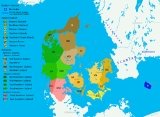
Danish is divided into three distinct dialect groups:
  • Eastern Danish (østdansk), including the Bornholm
    Bornholmsk

    Bornholmsk, a dialect of Danish language, is spoken on the Baltic Sea island of Bornholm. It was originally part of the East Danish dialect continuum, which includes the dialects of southern Sweden, but became isolated in the Danish dialect landscape after 1658, when Sweden annexed Sk?ne, Halland and Blekinge....
    , Scanian and Halland dialects
  • Island Danish (ømål or ødansk), including dialects of Zealand, Funen, Lolland, Falster, and Møn
  • Jutlandic
    Jutlandic

    Jutlandic or Jutish is a term for the western dialects of Danish language, spoken on the peninsula of Jutland.The different subdialects of Jutlandic differ somewhat from each other, and are generally grouped in three main dialects:...
     (jysk), further divided in North, East, West and South Jutlandic


Historically, Eastern Danish includes what are occasionally considered Southern Swedish dialects. The background for this lies in the loss of the originally Danish provinces Blekinge
Blekinge

is one of the provinces of Sweden , situated in the south of the country. It borders Sm?land, Sk?ne and the Baltic Sea.Blekinge consists of 5 towns; Karlskrona, Ronneby, Karlshamn, S?lvesborg and Olofstr?m....
, Halland
Halland

is one of the traditional provinces of Sweden , on the western coast of Sweden. It borders V?sterg?tland, Sm?land, Sk?ne and the sea of Kattegat....
 and Scania to Sweden in 1658. The island Bornholm in the Baltic also belongs to this group, but remained Danish. A few generations ago, the classical dialects spoken in the southern Swedish provinces could still be argued to be more Eastern Danish than Swedish, being similar to the dialect of Bornholm. Today influx of Standard Swedish vocabulary has generally meant that Scanian and Bornholmish are closer to the modern national standards than to each other. The Bornholm dialect has also maintained to this day many ancient features, such as a distinction between three grammatical gender
Grammatical gender

In linguistics, grammatical genders, sometimes also called noun classes, are classes of nouns reflected in the behavior of associated words; every noun must belong to one of the classes and there should be very few which belong to several classes at once....
s, which the central Island Danish dialects gave up during the 20th century. Standard Danish has two genders, and Western Jutlandic only one, similar to English.

Today, Standard Danish is most similar to the Island Danish dialect group.

Sound system


The sound system of Danish is in many ways unique among the world's languages. It is quite prone to considerable reduction and assimilation
Assimilation (linguistics)

Assimilation is a common phonological process by which the phonetics of a speech segment becomes more like that of another segment in a word . A common example of assimilation would be "don't be silly" where the and in "don't" become and , where said naturally in many accents and discourse styles ....
 of both consonants and vowels even in very formal standard language. A rare feature is the presence of a prosodic feature called stød
Stød

St?d is a suprasegmental unit of Danish language phonology, which in its most common form is a kind of creaky voice , but may also be realized as a glottal stop, above all in emphatic pronunciation....
 in Danish (lit. "push; thrust"). This is a form of laryngealization or creaky voice
Creaky voice

In linguistics, creaky voice , is a special kind of phonation in which the arytenoid cartilages in the larynx are drawn together; as a result, the vocal folds are compressed rather tightly, becoming relatively slack and compact....
, only occasionally realized as a full glottal stop
Glottal stop

The glottal stop, or more fully, the voiceless glottal plosive, is a type of consonantal sound which is used in many Speech communication languages....
 (especially in emphatic pronunciation). It can be the only distinguishing feature between certain words, thus creating minimal pair
Minimal pair

In phonology, minimal pairs are pairs of words or phrases in a particular language, which differ in only one phonological element, such as a Phone , phoneme, toneme or chroneme and have a distinct meaning....
s (e.g. bønder "peasants" with stød vs. bønner "beans" or "prayers" without). The distribution of stød in the lexicon is clearly related to the distribution of the common Scandinavian tonal
Tone (linguistics)

Tone is the use of pitch in language to distinguish lexical or grammatical meaning?that is, to distinguish or inflection words. All languages use pitch to express emotional and other paralinguistic information, and to convey emphasis, contrast, and other such features in what is called intonation , but not all languages use tones to distingu...
 word accents found in most dialects of Norwegian
Norwegian language

Norwegian is a North Germanic languages language spoken primarily in Norway, where it is an official language. It is also spoken as a second language among Norwegian-Americans in the United States of America, especially in the central northern states....
 and Swedish
Swedish language

Swedish is a North Germanic languages language, spoken by around 10 million people, predominantly in Sweden and parts of Finland, especially along the coast and on the ?land islands....
, including the national standard language
Standard language

A standard language is a particular variety of a language that has been given either legal or quasi-legal status. As it is usually the form promoted in schools and the media, it is usually considered by speakers of the language to be more "correct" in some sense than other dialects....
s. Most linguists today believe that stød is a development of the word accents, rather than the other way round. Some have theorized it emerged from the overwhelming influence of Low German
Low German

Low German or Low Saxon is any of the regional language varieties of the West Germanic languages spoken mainly in northern Germany and the eastern part of the Netherlands....
 in medieval times, having flattened the originally Nordic melodic accent, but stød is absent in most southern Danish dialects where Low German impact would have been the greatest. Stød generally occurs in words that have "accent 1" in Swedish and Norwegian and that were monosyllabic in Old Norse
Old Norse

Old Norse is a North Germanic languages that was spoken by inhabitants of Scandinavia and inhabitants of their overseas settlements during the Viking Age, until about 1300....
, while no-stød occurs in words that have "accent 2" in Swedish and Norwegian and that were polysyllabic in Old Norse. Danish therefore sounds quite different from Swedish and Norwegian; to speakers of the other two, it sounds in some ways like a native French or German speaker trying to speak their own languages, or trying to speak "with a potato in the throat". (For example, French loanwords in Danish tend to be pronounced closer to the original French than the same words would be in other Germanic languages.)

Unlike the neighboring Continental Scandinavian languages, the prosody
Prosody (linguistics)

In linguistics, prosody is the rhythm, stress , and intonation of connected speech . Prosody may reflect various features of the speaker or the utterance: the emotional state of a speaker; whether an utterance is a statement, a question, or a command; whether the speaker is being ironic or sarcastic; emphasis, contrast, and focus ; or othe...
 of Danish does not have phonemic pitch. Stress
Stress (linguistics)

In linguistics, stress is the relative emphasis that may be given to certain syllables in a word. The term is also used for similar patterns of phonetic prominence inside syllables....
 is phonemic and distinguishes words such as billigst ['bilist] "cheapest" and bilist [bi'list] "car driver".

Vowels


Modern Standard Danish has 20 vowel phoneme
Phoneme

In human language, a phoneme is the smallest posited linguistically distinctive unit of sound. Phonemes carry no semantic content themselves. In theoretical terms, phonemes are not the physical segment s themselves, but cognitive abstractions or categorizations of them....
s. All but two of these vowels may be either long and short, with the exceptions being schwa
Schwa

In linguistics, specifically phonetics and phonology, schwa can mean the following:*An stress and tone neutral vowel sound in any language, often but not necessarily a mid-central vowel....
 and . The long and short realizations often differ in quality
Vowel

In phonetics, a vowel is a sound in spoken language, such as English ah! or oh! , pronounced with an open vocal tract so that there is no build-up of air pressure at any point above the glottis....
 and there are several allophones that differ if they occur together with an . For example, is lowered when it occurs either before or after and is pronounced when it is long.

Consonants


are devoiced
Phonation

Phonation has slightly different meanings depending on the subfield of phonetics. Among some phoneticians, phonation is the process by which the vocal folds produce certain sounds through quasi-periodic vibration....
 in all contexts. often have slight frication, but are usually pronounced as approximants. The distinction between , / and is only made in the beginning of a word or at the beginning of a stressed syllable. Hence lappe and labbe are rendered . The combination of is realized as an alveolo-palatal fricative
Voiceless alveolo-palatal fricative

The voiceless alveolo-palatal fricative is a type of consonantal sound, used in some Speech communication languages. The symbol in the International Phonetic Alphabet that represents this sound is , and the equivalent X-SAMPA symbol is s....
, , making it possible to postulate a tentative -phoneme in Danish. can be described as "tautosyllabic", meaning that it takes the form of either a phonetic consonant or vowel. At the beginning of a word or after a consonant, it is pronounced as a uvular fricative
Voiced uvular fricative

The voiced uvular fricative is a type of consonantal sound, used in some Speech communication languages. The symbol in the International Phonetic Alphabet that represents this sound is , and the equivalent X-SAMPA symbol is R....
, , but in most other positions it is either realised as a non-syllabic low central vowel
Near-open central vowel

The near-open central vowel is a type of vowel sound, used in some Speech communication languages. The symbol in the International Phonetic Alphabet that represents this sound is , and the equivalent X-SAMPA symbol is 6....
, (which is almost identical to how /r/ is often pronounced in German
German language

German is a West Germanic languages, thus related to and classified alongside English language and Dutch language. It is one of the world's world language and the most widely spoken mother tongue in the European Union....
) or simply coalesces with the preceding vowel. The phenomenon is also comparable to non-rhotic pronunciations of English.

Grammar


The infinitive forms of Danish verbs end in a vowel, which in almost all cases is the letter e. Verbs are conjugated according to tense
Grammatical tense

Grammatical tense is a temporal language quality expressing the time at, during, or over which a state or action denoted by a verb occurs.Tense is one of at least five qualities, along with grammatical mood, grammatical voice, grammatical aspect, and grammatical person, which verb forms may express....
, but otherwise do not vary according to person
Grammatical person

Grammatical person, in linguistics, is deixis reference to a participant in an event, such as the speaker, the addressee, or others. Grammatical person typically defines a language's set of personal pronouns....
 or number
Grammatical number

In linguistics, grammatical number is a grammatical category of nouns, pronouns, and adjective and verb agreement that expresses count distinctions ....
. For example the present tense form of the Danish infinitive verb spise ("to eat") is spiser; this form is the same regardless of whether the subject is in the first, second, or third person, or whether it is singular or plural. This extreme ease of conjugating verbs is made up for by the many irregular verb
Irregular verb

In contrast to regular verbs, irregular verbs are those verbs that fall outside the standard patterns of grammatical conjugation in the languages in which they occur....
s in the language.

Standard Danish nouns fall into only two grammatical genders: common and neuter, while some dialects still often have masculine, feminine and neuter. West Jutlandic has only one gender, but has developed a distinction between countable and uncountable material (den træ "the tree", det træ, "the wood"). This is sometimes observed in Standard Danish as well (usually det mælk although strictly grammatically it should be den mælk "that milk"). While the majority of Danish nouns (ca. 75%) have the common gender, and neuter is often used for inanimate objects, the genders of nouns are not generally predictable and must in most cases be memorized. A distinctive feature of the Scandinavian languages, including Danish, is an enclitic definite article. To demonstrate: The common gender word "a man" (indefinite) is en mand but "the man" (definite) is manden. The neuter equivalent would be "a house" (indefinite) et hus, "the house" (definite) huset. Even though the definite and indefinite articles have separate origins, they have become homographs in Danish. In the plural, the definite article is -(e)ne, as the plural endings are - / -e / -er. The enclitic article is not used when an adjective is added to the noun; here the demonstrative pronoun is used instead: den store mand "the big man", "the big house", det store hus.

Like most Germanic languages, Danish joins compound nouns. The example kvindehåndboldlandsholdet, "the female handball national team", illustrates that it does so to a significantly higher degree than English
English language

English is a West Germanic language that originated in Anglo-Saxon England and has lingua franca status in many parts of the world as a result of the military, economic, scientific, political and cultural influence of the British Empire in the 18th, 19th and early 20th centuries and that of the United States from the mid 20th century onwa...
. In some cases, nouns are joined with an extra s, like landsmand (from land, "country", and mand, "man", meaning "compatriot"), but landmand (from same roots, meaning "farmer"). Some words are joined with an extra e, like gæstebog (from gæst and bog, meaning "guest book").

Vocabulary


Danish words are largely derived from the Old Norse language, with new words formed by compounding. A large percentage of Danish words, however, hail from Middle Low German
Middle Low German

Middle Low German is a language that is the descendant of Old Saxon and is the ancestor of modern Low German. It served as the international lingua franca of the Hanseatic League....
 (for example, betale = to pay, måske = maybe). Later on, standard German
German language

German is a West Germanic languages, thus related to and classified alongside English language and Dutch language. It is one of the world's world language and the most widely spoken mother tongue in the European Union....
 and French
French language

French is a Romance language spoken around the world by around 80 million people as first language, by 190 million as second language, and by about another 200 million people as an acquired tongue, with significant speakers in 54 countries....
 and now English
English language

English is a West Germanic language that originated in Anglo-Saxon England and has lingua franca status in many parts of the world as a result of the military, economic, scientific, political and cultural influence of the British Empire in the 18th, 19th and early 20th centuries and that of the United States from the mid 20th century onwa...
 have superseded Low German influence - although many old Nordic words remain, they fall out of favor when the new come in, such as can be seen with æde (to eat) which became less common when the Low German spise came into fashion. Because English and Danish are related languages, many common words are very similar in the two languages. For example, the following Danish words are easily recognizable in their written form to English speakers: have, over, under, for, give, flag, salt, kat. When pronounced, these words sound quite different from their English equivalents, due to the Great Vowel Shift
Great Vowel Shift

The Great Vowel Shift was a major change in the pronunciation of the English language that took place in the south of England between 1200 and 1600....
 of English. In addition, the word by, meaning "village" or "town", occurs in several English placenames, such as Whitby and Selby, as remnants of the Viking
Viking

A Viking is one of the Norsemen explorers, warriors, merchants, and Piracy who raided and colonized wide areas of Europe from the late eighth to the early eleventh century....
 occupation. A lot of Danish words are directly derived from English, such as harddisk or skateboard.

Numerals

In Danish numerals, the tens and units digits of numbers above 20 are reversed when spoken or written, such that 21 is rendered enogtyve, i.e. one and twenty. This is similar to German
German language

German is a West Germanic languages, thus related to and classified alongside English language and Dutch language. It is one of the world's world language and the most widely spoken mother tongue in the European Union....
, Dutch
Dutch language

Dutch is a West Germanic languages spoken by over 22 million people as a first language, and about 5 million people as a second language."1% of the EU population claims to speak Dutch well enough in order to have a conversation." Outside the European Union the number of second language speakers of Dutch is very small. Most native...
 (and Afrikaans), some variants of Norwegian
Norwegian language

Norwegian is a North Germanic languages language spoken primarily in Norway, where it is an official language. It is also spoken as a second language among Norwegian-Americans in the United States of America, especially in the central northern states....
, Slovenian
Slovenian

The terms Slovene and Slovenian refer to anything related to Slovenes and Slovenia. Both terms have been used for a long time in English language....
 and Arabic.

The numeral halvanden means 1.5 (literally "half second"). The numerals halvtredje (2.5) and halvfjerde (3.5), likewise constructed by "overcounting", are now obsolete, but still implicitly used in the vigesimal system described below. Similarly, the time halv tre, literally "half three", is half past two.

Danish numerals from 50 to 90 are (like the French
French language

French is a Romance language spoken around the world by around 80 million people as first language, by 190 million as second language, and by about another 200 million people as an acquired tongue, with significant speakers in 54 countries....
 numerals 80 and 90) based on a vigesimal
Vigesimal

The vigesimal or Base - numeral system is based on 20 ....
 system, not shared with the other Scandinavian languages. This means that the score is used as a base number: Tres (short for tre-sinds-tyve) means 3 times 20, that is 60. Similarly, halvtreds (short for halvtredje-sinds-tyve) means 2.5 times 20, that is 50. The ending sindstyve is archaic in cardinal number
Cardinal number

In mathematics, cardinal numbers, or cardinals for short, are a generalization of the natural numbers used to measure the cardinality of Set ....
s, but still used in ordinal number
Ordinal number

In set theory, an ordinal number, or just ordinal, is the order type of a well-order. They are usually identified with hereditarily transitive sets....
s. Thus, "fifty-two" is usually rendered to-og-halvtreds, whereas "fifty-second" is to-og-halvtredsindstyvende. An exception is in cheque-writing, where traditionally the ten-base without reversal is used to write out the amount above twenty; thus, fireti (4 times 10 or 40), seksti-to (6 times 10 plus 2 or 62), niti-syv (9 times 10 plus 7 or 97). Likewise, the Danish fifty-kroner note is labeled "Femti".

For large numbers (one billion or larger), Danish uses the long scale
Long and short scales

The long and short scales are two different numerical systems used throughout the world:Note that the difference between the two scales grows as numbers get larger....
, so that e.g. one U.S. billion (1,000,000,0000) is called milliard, and one U.S. trillion (1,000,000,000,000) is called billion.

Writing system


The oldest preserved examples of written Danish (from the Iron and Viking Ages) are in the Runic alphabet
Runic alphabet

The runic alphabets are a set of related alphabets using Letter known as runes to write various Germanic languages prior to the adoption of the Latin alphabet and for specialized purposes thereafter....
. The introduction of Christianity
Christianity

Christianity is a Monotheistic religion #Christian view religion centered on the life and teachings of Jesus as New Testament view on Jesus' life....
 also brought the Latin alphabet
Latin alphabet

The Latin alphabet, also called the Roman alphabet, is the most widely used alphabetic writing system in the world today. It evolved from the western variety of the Greek alphabet called the Cumae alphabet, and was initially developed by the Ancient Romes to write the Latin....
 to Denmark, and at the end of the High Middle Ages
High Middle Ages

The High Middle Ages was the periodization of history of Europe in the 11th, 12th, and 13th centuries . The High Middle Ages were preceded by the Early Middle Ages and followed by the Late Middle Ages, which by convention end around 1500....
 the Runes had more or less been replaced by the Latin letters.

As in Germany
Germany

Germany , officially the Federal Republic of Germany , is a country in Central Europe. It is bordered to the north by the North Sea, Denmark, and the Baltic Sea; to the east by Poland and the Czech Republic; to the south by Austria and Switzerland; and to the west by France, Luxembourg, Belgium, and the Netherlands....
, the Fraktur types were still commonly used in the late 19th century (until 1875, Danish children were taught to read Fraktur letters in school), and most books were printed with Fraktur typesetting even in the beginning of the 20th century. Also as in German, nouns were capitalized until after World War II.

The modern Danish alphabet is similar to the English one, with three additional letters: æ
Æ

? is a grapheme formed from the letters a and e. Originally a ligature representing a Latin diphthong, it has been promoted to the full status of a letter in the alphabets of many languages....
, ø
Ø

? , is a vowel and a Letter used in the Danish and Norwegian alphabet, Faroese language#Alphabet and Danish and Norwegian alphabet languages....
, and å
Å

The Letter ? represents various sounds in the Swedish alphabet, Finnish alphabet , Danish alphabet, Norwegian alphabet, North Frisian language, Walloon language, Chamorro language, and Istro-Romanian language alphabets....
, which come at the end of the alphabet, in that order. A spelling reform
Spelling reform

Many languages have undergone spelling reform, where a deliberate, often officially sanctioned or mandated, change to spelling takes place. Proposals for such reform are also common....
 in 1948 introduced the letter å, already in use in Norwegian and Swedish, into the Danish alphabet to replace the letter aa; the old usage still occurs in some personal and geographical names and old documents (for example, the name of the city of Aalborg
Aalborg

Aalborg is a city in Denmark. Its population, as of 2008, is 121,818, making it the fourth largest in the country after Copenhagen, Aarhus, and Odense....
 is spelled with Aa following a decision from the City Council in the 1970s). When representing the å sound, aa is treated just like å in alphabetical sorting, even though it looks like two letters. When the letters are not available (e.g., in URLs), they are replaced by ae (Æ, æ), oe (Ø, ø) or o, and aa (Å, å), respectively.

The same spelling reform changed the spelling of a few common words, such as the past tense vilde (would), kunde (could) and skulde (should), to their current forms of ville, kunne and skulle (making them identical to the infinitives in writing, as they are in speech), and did away with the practice of capitalising all nouns, which is still done in German
German language

German is a West Germanic languages, thus related to and classified alongside English language and Dutch language. It is one of the world's world language and the most widely spoken mother tongue in the European Union....
. Modern Danish and Norwegian use the same alphabet, though spelling differs somewhat.

See also

  • Jutlandic
    Jutlandic

    Jutlandic or Jutish is a term for the western dialects of Danish language, spoken on the peninsula of Jutland.The different subdialects of Jutlandic differ somewhat from each other, and are generally grouped in three main dialects:...
  • South Jutlandic
  • Differences between Norwegian Bokmål and Standard Danish
    Differences between Norwegian Bokmål and Standard Danish

    Danish and Norwegian Bokm?l are very similar languages, but differences between them do exist. The languages are mutually intelligible, with the primary differences being in pronunciation and in the sound system as a whole....


External links

  • including Japanese translation
  • an online Danish grammar
  • a Danish course with audio