
|
|
|
|
Baptism
|
| |
|
| |
In Christianity, baptism is the sacramental act of cleansing in water that admits one as a full member of the Church. Most Christians, such as Roman Catholics, Eastern Orthodox, Lutherans, Anglicans, and Methodists are baptized as infants. Baptists and certain other groups baptize only after a person accepts Jesus Christ as their Savior ("believer's baptism"). Most Christians baptize in the name of the Father, Son, and Holy Spirit, but some baptize in Jesus' name only.
John the Baptist baptized for repentance, baptizing Jesus and many others. In the Gospel of St. Matthew, the resurrected Jesus commands his disciples to baptize (see Great Commission). Scholars are divided on whether or not Jesus baptized and, if so, to what extent.

Discussion
Ask a question about 'Baptism'
Start a new discussion about 'Baptism'
Answer questions from other users
|
Timeline
Encyclopedia
In Christianity, baptism is the sacramental act of cleansing in water that admits one as a full member of the Church. Most Christians, such as Roman Catholics, Eastern Orthodox, Lutherans, Anglicans, and Methodists are baptized as infants. Baptists and certain other groups baptize only after a person accepts Jesus Christ as their Savior ("believer's baptism"). Most Christians baptize in the name of the Father, Son, and Holy Spirit, but some baptize in Jesus' name only.
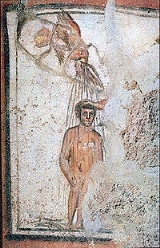
John the Baptist baptized for repentance, baptizing Jesus and many others. In the Gospel of St. Matthew, the resurrected Jesus commands his disciples to baptize (see Great Commission). Scholars are divided on whether or not Jesus baptized and, if so, to what extent. The most usual form of baptism among Early Christians was for the candidate to stand in water and water to be poured over the upper body.
Baptism has traditionally been seen as necessary for salvation. Martyrdom was identified early in church history as baptism by blood, allowing martyrs who had not been baptized by water to be saved. Later, the Church identified baptism by desire, by which, when joined with repentance for their sins, and charity, those preparing for baptism who die before actually receiving the sacrament are considered to be saved.
By analogy, the English word "baptism" is used of any ceremony, trial, or experience by which one is initiated, purified, or given a name. See Other initiation ceremonies below.
Meaning of the word in the New Testament As Christians of different traditions dispute whether immersion is necessary for baptism, the precise meaning of the Greek word has become important for exegesis.
The Greek-English Lexicon of Liddell and Scott gives the primary meaning of the word (transliterated as "baptizô"), from which the English word baptism is derived, as dip, plunge, but indicates, giving as an example, that another meaning is perform ablutions.
Liddell and Scott is not the only authority to state that the Greek word ßapt??? does not mean exclusively, dip, plunge or immerse. Scholars of various denominations point to two passages in the New Testament as indicating that the word, when applied to a person, did not always indicate submersion. It is Jewish custom that, before any meal of which bread forms a part, the hands must be solemnly washed, and this washing must be done by pouring water on the hands, not by dipping them in water. uses the verb of such a ritual washing: a Pharisee, at whose house Jesus ate, "was astonished to see that he did not first wash ( – literally, "be baptized" or "baptize himself") before dinner." This is the passage that Liddell and Scott cites as an instance of the use of to mean perform ablutions. The other New Testament passage pointed to is : "The Pharisees ... do not eat unless they wash (, the ordinary word for washing) their hands thoroughly, observing the tradition of the elders; and when they come from the market place, they do not eat unless they wash themselves (literally, "baptize themselves" - )".
History Baptism has been part of Christianity from the start, as shown by the many mentions in the Acts of the Apostles and the Pauline epistles. Christians consider Jesus to have instituted the sacrament of baptism. How explicit Jesus' intentions were and whether he envisioned a continuing, organized Church is a matter of dispute among scholars.
Background in Jewish ritual Although the term "baptism" is not used to describe the Jewish rituals, the purification rites (or mikvah - ritual immersion) in Jewish laws and tradition have some similarity to baptism, and the two have been linked although their relationship is disputed. In the Jewish Bible and other Jewish texts, immersion in water for ritual purification was established for restoration to a condition of "ritual purity" in specific circumstances. For example, Jews who (according to the Law of Moses) became ritually defiled by contact with a corpse had to use the mikvah before being allowed to participate in the Holy Temple. Immersion is required for converts to Judaism as part of their conversion. Immersion in the mikvah represents a change in status in regards to purification, restoration, and qualification for full religious participation in the life of the community, ensuring that the cleansed person will not impose uncleanness on property or its owners (see Numbers Chapter
Baptism of Jesus At the start of his ministry, Jesus was baptized in the Jordan River by John the Baptist. John the Baptist preached repentance in the face of God's imminent judgment and had a very large following during the time of Jesus, with many people seeking John's baptismal purification in the River Jordan. Second-century evidence relates the early claims of the Mandeans to be a continuation of John's religious following, who maintain baptism as a central rite to the modern day. Many of the earliest followers of Jesus were other people who, like him, were baptized in the Jordan by John the Baptist.
Scholars broadly agree that the baptism of Jesus is one of the most authentic, or historically likely, events in the life of the historical Jesus. Jesus and his earliest disciples accepted the validity of John's baptism. Early Christianity practiced a baptism of repentance in relation to the forgiveness of sins, baptizing in the name of Jesus Christ. Christian baptism has its origin in the baptism of Jesus, in both a direct and historical sense.
The event raised the issue of Jesus' potential submission to John the Baptist and seemed contradictory to the Christian belief in the sinless nature of Jesus Christ. Attempts to address this theological difficulty are apparent in the earliest Christian writings, including the Gospels. For Mark, the baptism by John is the setting for the theophany, the revelation of Jesus' divine identity as the Son of God . Matthew shows John objecting to baptizing Jesus, an obvious superior, and only agreeing when overruled by Jesus and omits Mark's reference to baptism for the forgiveness of sins. Luke emphasizes the subservience of John to Jesus while both are still in the womb , and omits the role of John in the baptism of Jesus . The Gospel of John omits the episode.
Questions over the baptism of Jesus were a theological conundrum that occupied Christian theologians and apologists throughout the early centuries of Christianity. Early explanations that have remained popular throughout history include Ignatius of Antioch's assertion that Jesus was baptized to purify the waters of baptism, and Justin Martyr's explanation that Jesus was baptized in his role as the ideal example for all mankind.
Baptism by Jesus According to the The Cambridge Companion to Jesus, the Gospel of John explicitly confirms that Jesus baptized , reinforcing the central place of baptism in the message of Jesus. (The Cambridge Companion further states that the initiatory baptism of Jesus and the requirement to "repent and accept baptism" in earliest Christianity were further evidence of baptism's central place in the "good news".)
The Gospel of John mentions both that Jesus baptized and did not baptize. Many scholars consider the statement that Jesus did not baptize, but rather his disciples baptized , to be a later editorial insertion. Theologian Thomas L. Brodie asserts this is unlikely, postulating that there is no need to attribute it to contradiction and editorial insertion; it represents a theme of Jesus taking on a more distant leadership role, passing on responsibility to the disciples.
Gerd Theissen and Annette Merz assert that John 4:2 provides context and clarification for the preceding statements in the Gospel of John indicating Jesus baptized. That is, Jesus did not baptize directly, but rather his disciples baptized in his name. Theissen and Merz state that ritual purification, such as baptism, was highly unlikely to be practiced by the anti-ritualistic Jesus, who emphasized an "ethical repentance" in place of ritual adherence. (The Oxford Dictionary of World Religions also states that Jesus did not baptize as part of his ministry.)
New Testament Saint Paul and Acts both refer to baptism. For Paul, it effects and represents the believer's union with Christ, Christ's death, and His resurrection; cleanses one of sin; incorporates one into the Body of Christ, and makes one "drink of the Spirit" . In Acts, its prerequisites are faith and repentance. Acts associates baptism with receiving the Spirit, but the exact connection is not always the same.
Acts of the Apostles states that about 3,000 people in Jerusalem were baptized in one day on Pentecost. It further relates baptisms of men and women in Samaria, of an Ethiopian eunuch, of Saul of Tarsus of the household of Cornelius, of Lydia's household, of the Philippi jailer's household, of many Corinthians, and of certain Corinthians baptized by Paul personally.
The New Testament nowhere specifically authorizes infant baptism, but considers the children of Christians to be Christians , with no suggestion that they require baptism at a later age.
Apostolic period Baptism was typically by immersion, pouring water on someone standing in a stream or pool.
The Didache or Teaching of the Twelve Apostles, an anonymous book of 16 short chapters, is probably the earliest known written instructions, outside of the Bible, for administering baptism. Most scholars date it to about the year 100. It indicates a preference for baptizing in "living" (i.e. running, as in a river or stream) water at its natural temperature, but considers that, if necessary, it is enough to pour water of any kind on the head: "Concerning baptism, baptize this way: Having first said all these things, baptize into the name of the Father, and of the Son, and of the Holy Spirit, in living water. But if you have no living water, baptize into other water; and if you cannot do so in cold water, do so in warm. But if you have neither, pour out water three times upon the head into the name of Father and Son and Holy Spirit."
In imitation of the baptism of Jesus in the Jordan, early Christians preferred rivers for performing baptisms, and this was also suitable for the baptism of large crowds. Since rivers were not available everywhere, some important writers of the second and third centuries remarked that seas, lakes, ponds and springs are equally proper baptismal sites.
Baptism has been in the name of the Father, Son, and Holy Spirit since at least the end of the 1st century. While Acts speaks of baptism in Jesus' name, whether that formula was ever used has been questioned.
The tradition of infant baptism is nowhere clearly stated in the 1st century.
Early Christianity Early Christian beliefs regarding baptism were variable. In the most usual form of early Christian baptism, the candidate stood in water and water was poured over the upper body.The theology of baptism attained precision in the 3rd and 4th centuries.
Evidence for infant baptism, which would remain universal until the Protestant Reformation, has been seen in second-century writers such as Justin Martyr and Irenaeus and is more explicit in the Apostolic Tradition of Hippolytus of Rome (c. 170 – c. 236).
As baptism forgave sins, the issue of sins committed after baptism arose. Hardliners periodically insisted that apostasy, even under threat of death, and other grievous sins could cut one off forever from the Church, but the Church consistently readmitted the repentant. Some early Christians delayed baptism until they were dying, as is said to have been the motive for which Constantine delayed receiving baptism.
Baptism of the sick or dying used means other than even partial immersion and was still considered valid.
Early Middle Ages Infant baptism became common, alongside the developing theology of original sin, displacing the earlier common practice of delaying baptism until the deathbed. Against Pelagius, Augustine insisted that baptism was necessary for salvation even for virtuous people and for children.
Middle Ages The twelfth century saw the meaning of the word "sacrament" narrowed down and restricted to seven rites, among them that of baptism, while other symbolic rites came to be called "sacramentals".
In the period between the twelfth and the fourteenth centuries, affusion (pouring) became the usual manner of administering baptism in Western Europe, though immersion continued to be found in some places even as late as the sixteenth century. Throughout the Middle Ages, there was therefore considerable variation in the kind of facility required for baptism, from the baptismal pool large enough to immerse several adults simultaneously of the 13th century Baptistery at Pisa, to the half-metre deep basin in the 6th century baptistery of the old Cologne Cathedral.
Both East and West considered washing with water and the Trinitarian baptismal formula necessary for administering the rite. Scholasticism referred to these two elements as the matter and the form of the sacrament, employing terms taken from the then prevailing Aristotelian philosophy.
Protestant Reformation In the 16th century, various Reformers broke from the Roman Catholic Church and challenged numerous church doctrines and practices.
Martin Luther recategorized all the sacraments other than baptism and the eucharist as rites. Zwingli differed with Luther here, denying sacramental status even of these. Swiss Reformer Huldrych Zwingli identified baptism and the Lord's supper as sacraments, but in the sense of an initiatory ceremony or pledging. His understanding of these sacraments as symbolic differentiated him from Luther. However, all those Reformers and the Protestant/reformed churches in their tradition continued the practice of infant baptism.
Anabaptists ("Rebaptizers") rejected church authority so thoroughly that they even denied the validity of baptism outside their sect. They rebaptized converts. The Amish, Hutterites, and other groups descend from this tradition.
Modern practice Today, baptism is most readily identified with Christianity, where it symbolizes the cleansing (remission) of sins, and the union of the believer with Christ in His death, burial and resurrection so that he may be called "saved" or "born again." Most Christian groups use water to baptize and agree that it is important, yet may strongly disagree with other groups regarding aspects of the rite such as:
- manner or method of baptism
- recipients of baptism
- meaning and effects of baptism
A few Christian groups assert that water baptism has been supplanted by the promised "baptism of the Holy Spirit", and water baptism was unnecessarily carried over from the early Jewish Christian practice.
Manner of baptism Christian baptism is performed in the following forms:
Aspersion Aspersion is the sprinkling of water on the head.
Affusion Affusion is the pouring of water over the head.
Immersion Immersion is a method of baptism employed at least from the second century, whereby part of the candidate's body was submerged in the baptismal water which was poured over the remainder. The term is occasionally loosely used to include submersion, from which it is strictly to be distinguished. The rite is still found in the Eastern Church. In the Latin Church, immersion seems to have prevailed until the twelfth century.
Submersion Submersion (also called "total immersion" or, loosely, "immersion") is the form of baptism in which the water completely covers the candidate's body. Though immersion is now also common, submersion is practised in the Orthodox and several of the other Eastern Churches, as well as in the Ambrosian Rite. It is one of the methods provided in the Roman Catholic rite for the baptism of infants. On the basis of it has been generally supposed to have been the custom of the early Church, but this view has been challenged from the evidence of primitive pictorial representations and measurements of surviving early baptismal fonts.
Biblical passages such as and are often interpreted to mean that baptism is by full immersion (submersion) in water in order to represent a death and burial (when the person being baptized is submerged under the water, as if buried), and a resurrection (when the person comes up out of the water, as if rising from the grave) - a "death" and a "burial" to an old way of life focused on sinning, and a "resurrection" to the start of a new life as a Christian focused on God. is also sometimes taken as implying that baptism is by complete immersion in water to represent a birth to a new life as a Christian (when the person being baptized comes out of the water).
Meaning and effects of baptism There are differences in views about the effect of baptism for a Christian. Some Christian groups assert baptism is a requirement for salvation and a sacrament, and speak of "baptismal regeneration." This view is shared by the Roman Catholic and Eastern Orthodox traditions, and by Churches formed early during the Protestant Reformation such as Lutheran and Anglican. For example, Martin Luther said:
Much later Restorationist Churches such as the Churches of Christ and The Church of Jesus Christ of Latter-day Saints also espouse baptism as necessary for salvation.
For Roman Catholics, baptism by water is a sacrament of initiation into the life of children of God (Catechism of the Catholic Church, 1212-13). It configures the person to Christ (CCC 1272), and obliges the Christian to share in the Church's apostolic and missionary activity (CCC 1270). The Catholic Tradition holds that there are three types of baptism by which one can be saved: sacramental baptism (with water), baptism of desire (explicit or implicit desire to be part of the Church founded by Jesus Christ), and baptism of blood (see topic below).
By contrast, evangelical and fundamentalist Protestant groups recognize baptism as an act of obedience to and identity with Jesus as the Christ. They say that baptism has no sacramental (saving) power, and only testifies outwardly to the invisible and internal operation of God's power, which is completely separate from the rite itself.
Comparative summary Comparative Summary of Baptisms of Denominations of Christian Influence.
| Denomination | Beliefs about Baptism | Type of Baptism | Baptize Infants? | Baptism Regenerates, Gives Spiritual Life | Standard |
|---|
| Anglican Communion | A sign of profession and a mark of separation which, received rightly, affirms the forgiveness received by a believer through faith. | By submersion, immersion or pouring. | Yes. | No. (Except for the Diocese of Sydney) | Trinity | | Apostolic Brethren | Necessary for salvation because it conveys spiritual rebirth. | By submersion only. Also stress the necessity of a “second” Baptism of a special outpouring from the Holy Spirit. | No. | Yes. | Jesus | | Baptists | A divine ordinance, a symbolic ritual, a mechanism for publically declaring one's faith, and a sign of having already been saved, but not necessary for salvation. See Baptist - Believer's Baptism. | By submersion only. | No. | No. | Trinity | | Christadelphians | Baptism is essential for the salvation of a believer. It is only effective if somebody believes the true gospel message before they are baptized. Baptism is an external symbol of an internal change in the believer: it represents a death to an old, sinful way of life, and the start of a new life as a Christian, summed up as the repentance of the believer - it therefore leads to forgiveness from God, who forgives people who repent. Although someone is only baptized once, a believer must live by the principles of their baptism (i.e. death to sin, and a new life following Jesus) throughout their life. | By submersion only | No | Yes | Jesus | | Churches of Christ | Baptism is a must for salvation as commanded by Jesus, Mark 16:16; Matt. 28:19. One receives forgiveness of sin, the gift of the Holy Spirit, and addition to God's church. Acts 2:38-41. This is done after one has expressed their faith in Jesus Christ as the Son of God and repented from their sins. | Submersion only | No | Yes | Trinity | | The Church of Jesus Christ of Latter-day Saints | An ordinance essential to enter the Celestial Kingdom of Heaven and preparatory for receiving the Gift of the Holy Ghost by the laying on of hands. | By submersion performed by a person holding proper priesthood authority. | No | Yes | Father, and the Son, and the Holy Ghost (The LDS church doesn't believe in the Nicean trinity) | | Eastern Orthodox Church / Eastern Catholic | The old man dies the "New Man" is born free from ancestral sin. A new name is given. All previous commitments and sins are null and void. | By 3-fold submersion or immersion (other forms only in emergency, must be corrected by priest if possible). | Yes. Confirmation and communion immediately follows. | Yes | Trinity | | Jehovah’s Witnesses | Baptism is necessary for salvation as part of the entire baptismal arrangement: as an expression of obedience to Jesus' command, as a public symbol of the saving faith in the ransom sacrifice of Jesus Christ (Romans 10:10), and as an indication of repentance from dead works and the dedication of one's life to Jehovah. (1 Peter 2:21) However, baptism does not guarantee salvation. | By submersion only; typical candidates are baptized at district and circuit conventions. | No | Yes | Jesus | |
| Denomination (Continued) | Beliefs about Baptism | Type of Baptism | Baptize Infants? | Baptism Regenerates, Gives Spiritual Life | Standard |
|---|
| Lutherans | Baptism is how God miraculously delivers a person from sin, death, and the devil; gives new life; and brings one into Christ’s kingdom forever (Titus 3:5). | By sprinkling, pouring, immersion or submersion. | Yes | Yes | Trinity | | Methodists | The Sacrament of initiation into Christ's holy church whereby one is incorporated into God's mighty acts of salvation and given new birth through water and the spirit. Baptism washes away sin and clothes one in the righteousness of Christ. | By sprinkling, pouring, immersion or submersion. | Yes | Yes | Trinity | | (Various “Holiness” groups, Christian Missionary Alliance, Assemblies of God) | Water Baptism is an ordinance, a symbolic ritual used to witness to having accepted Christ as personal Savior. | By submersion. Also stress the necessity of a “second” Baptism of a special outpouring from the Holy Spirit. | No | Varies | Trinity | | Pentecostal | Not necessary for Salvation, but is encouraged | By submersion only | No | Yes | Trinity | | Presbyterian and most Reformed churches | An ordinance, a symbolic ritual, and a seal of the adult believer’s present faith. | By sprinkling, pouring, immersion or submersion | Yes, to indicate membership in the New Covenant. | No | Trinity | | Quakers | Only an external symbol that is no longer to be practiced. | Do not believe in Baptism of water, but only in an inward, ongoing purification of the human spirit in a life of discipline led by the Holy Spirit. | — | — | — | | Revivalism | A necessary step for salvation. | By submersion, with the expectation of receiving the Holy Spirit. | No | Yes | Trinity | | Roman Catholic Church | "Necessary for salvation for those to whom the Gospel has been proclaimed and who have had the possibility of asking for this sacrament" (Catechism of the Catholic Church, 1257) | Usually by pouring in the West, by submersion or immersion in the East; sprinkling admitted only if the water then flows on the head. | Yes | Yes | Trinity | | Seventh-day Adventists | Not stated as the way to salvation, but a prerequisite for salvation since it symbolizes the acceptance of Jesus as your savior. A time for person to express personal faith in Christ. | By submersion only. | No | No | Trinity | | United Church of Christ | One of two sacraments. Baptism is an outward sign of God's inward grace. It is not necessary for membership in a local congregation. However, it is a common practice for both infants and adults. | By sprinkling, pouring, immersion or submersion. | Yes, to indicate membership in the New Covenant. | No | Trinity | | Anabaptist | Baptism is considered by the majority of Anabaptist Churches (anabaptist means to baptize again) to be essential to Christian faith and salvation. It is considered a biblical ordinance along with communion, feet washing, the holy kiss, the christian woman's head covering, anointing with oil, and marriage. The Anabaptists also have stood historically against the practice of infant baptism. The Anabaptists stood firmly against infant baptism in a time when the Church and State were one and when people were made a citizen through baptism into the officially sanctioned Church (Reformed or Catholic). Belief and repentance are believed to precede and follow baptism. | By pouring, immersion or submersion. | No | Yes | Trinity |
Ecumenical statement The ecumenical paper Baptism, Eucharist and Ministry, prepared by representatives across a spectrum of Orthodox, Roman Catholic, and Protestant traditions of Christianity, attempts to express a common understanding of baptism, as it is derived from the New Testament.
- "…according to , baptisms follow from Peter's preaching baptism in the name of Jesus and lead those baptized to the receiving of Christ's Spirit, the Holy Ghost, and life in the community: "They devoted themselves to the apostles' teaching and fellowship, to the breaking of bread and the prayers" (
The Church recognizes two equivalents of baptism with water: "baptism of blood" and "baptism of desire." Baptism of blood is that undergone by unbaptized individuals who are martyred for the Faith, while baptism of desire generally applies to catechumens who die before they can be baptized. The Catechism of the Catholic Church describes these two forms:
The Church has always held the firm conviction that those who suffer death for the sake of the faith without having received Baptism are baptized by their death for and with Christ. This Baptism of blood, like the desire for Baptism, brings about the fruits of Baptism without being a sacrament. (1258)
For catechumens who die before their Baptism, their explicit desire to receive it, together with repentance for their sins, and charity, assures them the salvation that they were not able to receive through the sacrament. (1259)
Non-Christians who seek God with a sincere heart and, moved by grace, try to do God's will as they know it through the dictates of conscience can also be saved without water baptism; they are said to desire it implicitly. (cf. Catechism, 1260). As for unbaptized infants, the Church is unsure of their fate; "the Church can only entrust them to the mercy of God" (Catechism, 1261).
Validity considerations by some Churches Since Roman Catholic, Orthodox, Anglican and Lutheran Churches teach that baptism is a sacrament having actual spiritual and salvific effects, certain criteria must be complied with for it to be valid (i.e., to actually have those effects.) Violation of some rules regarding baptism renders the baptism illicit (in violation of the Church's laws) but still valid. For example, if a priest introduces some variation in the authorized rite for the ceremony, the baptism may still be valid (provided certain key criteria are met).
One of the criteria for validity is that the correct form of words be used. Latin Rite Roman Catholics and Episcopalians/Anglicans use the form "I baptize you..."; Eastern Orthodox and some Eastern Catholic Churches use the form "This servant of Christ is baptized..." or "This person is baptized by my hands…." These Churches recognize each other's form of baptism as valid to varying degrees. The Roman Catholic Church teaches that the use of the verb "baptize" is essential.
It is also considered essential that the Trinitarian formula ("in the name of the Father, and of the Son, and of the Holy Spirit") be used; thus they do not accept as valid baptisms of non-Trinitarian churches such as Oneness Pentecostals. There was an ancient controversy over baptism using the formula that Oneness Pentecostals use, with some ancient authorities holding it to be valid.
Another condition is that water be used. Some Christian groups historically have rejected the use of water for baptism, for example the Albigensians. These baptisms would not be valid, nor would a baptism in which some other liquid was used.
Another requirement is that the celebrant intends to perform baptism. This requirement entails merely the intention "to do what the Church does," not necessarily to have Christian faith, since it is not the person baptizing, but the Holy Spirit working through the sacrament, who produces the effects of the sacrament. Doubt about the faith of the baptizer is thus no ground for doubt about the validity of the baptism.
Some conditions expressly do not affect validity — for example, whether submersion, immersion, affusion or aspersion is used. However, if water is sprinkled, there is a danger that the water may not touch the skin of the unbaptized. If the water does not flow on the skin, there is no ablution and so no baptism.
If for a medical or other legitimate reason the water cannot be poured on the head, it may be poured over another principal part of the body, such as the chest. In such case validity is uncertain and the person will be considered to be conditionally baptized – until such time as they can be baptized in the traditional manner later.
In many communions it does not affect validity for a single submersion or pouring to be performed rather than a triple, but in Orthodoxy this is controversial.
According to the Catholic Church, baptism imparts an indelible "seal" upon the soul of the baptized. Thus, once baptized, an individual cannot be baptized again. This teaching was affirmed against the Donatists who practiced rebaptism. Baptism is said to operate ex opere operato and is valid even if administered in heresy or schism. Like holy orders, it confers a "character" on the recipient, who can never be rebaptized.
Recognition of baptism by other denominations The Roman Catholic, Lutheran, Anglican, Presbyterian and Methodist Churches accept baptism performed by other denominations within this group as valid, subject to certain conditions. It is only possible to be baptized once, thus people with valid baptisms from other denominations may not be baptized again upon conversion or transfer. Such people are accepted upon making a profession of faith and, if they have not yet validly received the sacrament of confirmation, by being confirmed. In some cases it can be difficult to decide if the original baptism was in fact valid; if there is doubt, conditional baptism is administered, with a formula on the lines of "If you are not yet baptized, I baptize you…."
In the still recent past, it was common practice in the Roman Catholic Church to baptize conditionally almost every convert from Protestantism because of a perceived difficulty in judging about the validity in any concrete case. In the case of the major Protestant Churches, agreements involving assurances about the manner in which they administer baptism has ended this practice, which sometimes continues for other groups of Protestant tradition. The Catholic Church has always recognized the validity of both baptism and chrismation in the Churches of Eastern Christianity. On the other hand, it has explicitly denied the validity of baptism conferred in the Church of Jesus Christ of Latter-day Saints.
Practice in the Eastern Orthodox Church for converts from other communions is not uniform, but even a convert received without administration of baptism is considered to have his previous baptism retroactively filled with grace by whatever form is used to accept him, such as by chrismation or confession. The exact procedure is dependent on local canons and is the subject of some controversy.
In the eyes of the Catholic Church, the baptism conferred by the Church of Jesus Christ of Latter-day Saints is invalid. An published together with the official declaration to that effect gave reasons for that judgement, summed up in the following words: "The Baptism of the Catholic Church and that of the Church of Jesus Christ of Latter-day Saints differ essentially, both for what concerns faith in the Father, Son and Holy Spirit, in whose name Baptism is conferred, and for what concerns the relationship to Christ who instituted it."
The Church of Jesus Christ of Latter-day Saints stresses that baptism must be administered by one having proper authority; consequently, the Church does not recognize the baptism of any other church as valid.
Who may administer a baptism There is debate among Christian churches as to who can administer baptism. The examples given in the New Testament only show apostles and deacons administering baptism. Ancient Christian churches interpret this as indicating that baptism should be performed by the clergy except in extremis, i.e., when the one being baptized is in immediate danger of death. Then anyone may baptize, provided, in the view of the Eastern Orthodox Church, the person who does the baptizing is a member of that Church, or, in the view of the Roman Catholic Church, that the person, even if not baptized, intends to do what the Church does in administering the rite. Many Protestant churches see no specific prohibition in the biblical examples and permit any believer to baptize another.
In the Latin Rite Catholic Church the ordinary minister of baptism is a member of the clergy (bishop, priest or deacon), but in normal circumstances only the Parish Priest of the person to be baptized, or someone authorized by the Parish Priest, may do so licitly "If the ordinary minister is absent or impeded, a catechist or some other person deputed to this office by the local Ordinary, may lawfully confer baptism; indeed, in a case of necessity, any person who has the requisite intention may do so By "a case of necessity" is meant imminent danger of death because of either illness or an external threat. "The requisite intention" is, at the minimum level, the intention "to do what the Church does" through the rite of baptism.
In the Eastern Catholic Churches, a deacon is not considered an ordinary minister. Administration of the sacrament is reserved, as in the Latin Rite, to the Parish Priest. But, "in case of necessity (in extremis), baptism can be administered by a deacon or, in his absence or if he is impeded, by another cleric, a member of an institute of consecrated life, or by any other Christian faithful; even by the mother or father, if another person is not available who knows how to baptize".
The discipline of the Eastern Orthodox Church, Oriental Orthodoxy and the Assyrian Church of the East is similar to that of the Eastern Catholic Churches. They require the baptizer, even in cases of necessity, to be of their own faith, on the grounds that a person cannot convey what he himself does not possess, in this case membership in the Church. The Latin Rite Catholic Church does not insist on this condition, considering that the effect of the sacrament, such as membership of the Church, is not produced by the person who baptizes, but by the Holy Spirit. For the Orthodox, while Baptism in extremis may be administered by a deacon or any layperson, if the newly-baptized person survives, a priest must still perform the other prayers of the Rite of Baptism, and administer the Mystery of Chrismation.
The discipline of Anglicanism is similar to that of the Latin Rite Catholic Church. For Methodists and many other Protestant denominations, too, the ordinary minister of baptism is a duly ordained or appointed minister of religion.
Newer movements of Protestant Evangelical churches, particularly non-denominational, have begun to allow those persons most instrumental in one's faith to baptize.
In The Church of Jesus Christ of Latter-day Saints, only a man who has been ordained to the Aaronic Priesthood holding the priesthood office of Priest or higher office in the Melchizedek Priesthood may administer baptism.
Anabaptist and Baptist baptism Anabaptists ("re-baptizers") and Baptists promote adult baptism, or "believer's baptism."
Early Anabaptists were labeled such because they re-baptized persons whom they felt had not been properly baptized (having received infant baptism, sprinkling, or baptism of any sort by another denomination). Some modern Baptists do not believe baptism by submersion is the only legitimate form of baptism, they simply perform baptism by submersion for members who wish to be baptized. It does not imply that any previous form of baptism by affusion or sprinkling is invalid. Baptism is an act identifying one as having accepted Jesus Christ as Savior. And "one enters by baptism into the membership of the church which performs it."
Baptist theologians (such as John Gill) teach that baptism is only for those who can understand and profess their faith. This is called believer's baptism. Some, such as Gill, argue that the regulative principle of worship, which many paedobaptists also advocate and which states that elements of worship (including baptism) must be based on explicit commands of Scripture, is violated by infant baptism. Some would argue that according to this understanding, the re-baptisms that Baptists generally perform if a person was not regenerate when baptized also violate the Regulative Principle for Worship. Furthermore, because the New Covenant is described in as a time when all who were members of it would have the law written on their hearts and would know God, Baptist theology teaches that only those who are born again, as indicated by a profession of faith, are members of the New Covenant. They view this text as speaking of the visible church in the present age, rather than as a prophetic text of God's New Covenant in Christ administered to all saints from Genesis to the present, which will be fulfilled when Christ returns to earth. Baptism is therefore not administered to those unable to make a credible confession of saving faith in Christ prior to being baptized; but it will be administered upon making this confession, regardless of the confessor's age. Some Baptist churches take exception to this and are very hesitant to baptize young children because they want to confirm whether or not they are regenerate. A confession alone is not enough for these churches, they want to see fruit of regeneration in the life of the person to be baptized, which some argue violates the example set forth in the book of Acts, which performed immediate baptisms.
Those who hold views influenced by the Baptists may perform the ceremony indoors in a baptismal font, a swimming pool, or a bathtub, or outdoors in a creek or river: as long as there is water, nothing prevents the performance of Baptism. Protestant groups influenced by these convictions usually emphasize that it memorializes the death, burial and resurrection of Jesus , which according to the grace of God has become the basis of repentance and new life for those who have professed belief in Him, symbolizing spiritual death with regard to sin and a new life of faith in God. They typically teach that baptism does not accomplish anything in itself, but is an outward sign or testimony, a personal act, indicating the invisible reality that the person's sins have already been washed away by the cross of Christ, and applied to their life according to their profession of faith. It is also understood to be a covenantal act, signifying entrance into the New Covenant of Christ (; , ).
For Baptists, baptism is a requirement for church membership, rather than a necessary requirement for salvation. Once baptized, a Baptist may move their membership to another congregation by letter.
The above description applies not just to those denominations using Baptist in their names, but also to a wide variety of Protestant denominations who have taken influence from the Anabaptist tradition.
Reformed and Covenant Theology view Paedobaptist Covenant theologians see the administration of all the biblical covenants, including the New Covenant, as including a principle of familial, corporate inclusion or "generational succession." The biblical covenants between God and man include signs and seals that visibly represent the realities behind the covenants. These visible signs and symbols of God's covenant redemption are administered in a corporate manner (for instance, to households), not in an exclusively individualistic manner.
Baptism is considered by the Reformed churches as the visible sign of entrance into the New Covenant and therefore may be administered individually to new believers making a public profession of faith. Paedobaptists further believe this extends corporately to the households of believers which typically would include children, or individually to children or infants of believing parents (see Infant baptism). In this view, baptism is thus seen as the functional replacement and sacramental equivalent of the Abrahamic rite of circumcision and symbolizes the internal cleansing from sin, among other things.
Baptism in The Church of Jesus Christ of Latter-day Saints - This section is a part of a on The Church of Jesus Christ of Latter-day Saints.
In the Latter Day Saint movement, baptism is recognized as the first ordinance of the gospel. As with many other Restorationist faiths, baptism must be by submersion for the remission of sins (meaning that through baptism, past sins are forgiven), and occurs after one has shown faith and repentance. LDS baptism does not intend to remit any sins other than personal ones, as the LDS Church does not believe in original sin.
Latter Day Saint baptisms also occur only after an "age of accountability", or the age at which a child begins to know right from wrong (similar to the age of reason), which is defined by the church as the age of eight years. Mormonism rejects infant baptism. In addition, Mormonism requires that baptism may only be performed with one who has been called and ordained by God with priesthood authority. Since the LDS Church has a lay priesthood, children raised in an LDS family are usually baptized by a father or close male friend or family member who has achieved the office of priest, which is conferred to "worthy" male members at the age of 16.
Latter Day Saints do not believe that the gift of the Holy Spirit occurs immediately after baptism; rather, the gift is given by the laying on of hands in a separate confirmation ritual after baptism. This ritual is believed to be confirmed by Paul's actions in Acts 19:6, where, following the baptism of several followers of Christ, he "laid his hands upon" those who were baptized and they then received the Holy Ghost.
The process of repentance and sanctification continues by partaking of the sacrament every week, which Latter Day Saints consider to be a renewal of one's baptismal covenant with God. They also believe that baptism is symbolic both of Jesus's death, burial and resurrection and of the death and burial of the natural or sinful man and rebirth as a disciple of Jesus of the one baptized.
In The Church of Jesus Christ of Latter-day Saints (or "Mormon" Church), baptism and confirmation are only the first of several ordinances believed to be required for exaltation. Membership into the LDS Church is granted only by baptism whether or not a person has been raised in the church. As Latter-day Saints do not recognize the validity of baptisms of other faiths, all who come into the church as converts are baptized, even if they have previously received baptism in another faith. The person being baptized must be at least eight years old. The church also practices baptism for the dead "vicariously" or "by proxy" in their temples for anyone who did not receive these ordinances while living. (LDS doctrine holds the concept of moral agency sacred, so deceased individuals baptized by proxy are believed to have the absolute right to accept or reject the ordinances done for them. Proxy baptism for the dead does not mean that the person is automatically considered a member of the church, posthumously or otherwise, only that the ordinance of baptism has been performed for them.)
Baptisms inside and outside the temples are usually done in a font, although they can be performed in any body of water in which the person may be completely immersed. In Latter-day Saint temples, where proxy baptisms are performed for the dead, the fonts rest on the sculptures of twelve oxen representing the twelve tribes of Israel, following the pattern of the "molten sea" in the Temple of Solomon (see 2 Chronicles 4:2-5). Great care is taken in the execution of the baptism; if the baptism is not executed properly it must be redone. The person administering the baptism must recite the prayer exactly, and immerse every part, limb, hair and clothing of the person being baptized. If there are any mistakes, or if any part of the person being baptized is not fully immersed, the baptism must be redone. In addition to the baptizer, two priesthood holders witness the baptism to ensure that it is performed properly.
The Book of Mormon discusses people who lived prior to the life of Jesus who had Christian practices, including baptism.
Jehovah's Witnesses Baptism is also practiced by Jehovah's Witnesses, who believe that it should be performed by complete immersion (submersion) only when one is old enough to understand the significance of it. They teach that water baptism is an outward symbol that one has made a complete, unreserved, and unconditional dedication through Jesus Christ to do the will of Jehovah God. Jehovah's Witnesses usually baptize converts at large conventions rather than at the local Kingdom Halls.
Baptism in Churches of Christ There is no single statement of conformity on the doctrine of baptism as practiced by Churches of Christ, yet there are several similarities among the vast majority of congregations: Basically, Churches of Christ believe in the age of accountability and believer's baptism. Churches of Christ practice submersion baptism only and do not baptize infants. However, they also believe that baptism is necessary for salvation. There is no restriction upon who may perform a baptism, but it is usually done by an adult male. Adult converts are baptized, as are children who are old enough to understand that they are accountable for their sins and to understand the sacrifice of Christ and the meaning of his death, burial, and resurrection.
Scriptural Basis: Churches of Christ interpret Matthew's version of the Great Commission as evidence that baptism is a command that comes straight from Jesus Christ. compares baptism to a "burial", in their view indicating, along with other descriptions in the Gospels and Acts of the Apostles, that baptism was a submersion. They see as teaching that repentance precedes baptism and that the remission of sins occurs at baptism. They often cite this verse when discussing the doctrine of baptism. (cf. , , ). They say that ("Now as they went down the road, they came to some water. And the eunuch said, "See, here is water. What hinders me from being baptized?") and other passages assert that the baptismal burial is in water, not in some spiritual or figurative element.
Churches of Christ sites quote ("Baptism doth also now save us") and take it to mean that baptism is essential to salvation. And the same verse goes on to say, "not the removal of dirt from flesh [ie, with water], but the appeal of a clean conscience to God. The second part of this verse confirms their belief that there is nothing magical about the water, but rather it is the act of obedience that results in salvation. states that baptism puts one into the death of Christ, and that baptism clothes one in Christ. has also been cited to exclude salvation without baptism.
Baptism in Hyperdispensationalism Hyperdispensationalists assert:
- The great commission and its baptism is directed to early Jewish believers, not the Gentile believers of mid-Acts or later.
- The baptism of is Peter's call for Israel to repent of complicity in the death of the Messiah; not as a Gospel announcement of atonement for sin, a later doctrine revealed by Paul.
Water baptism found early in the book of Acts is, according to this view, now supplanted by the one baptism foretold by John the Baptist (, , , ). The one baptism for today, it is asserted, is the "baptism of the Holy Spirit" . This, "spirit" baptism, however, is unlikely given the texts and facts that the baptisms of the Eunuch and the household of Cornelius were explicitly in water. Further evidence points to the humanly administered Great Commission which was to last until the end of the world . Therefore, the baptism the Ephesians underwent was water by context (; ). Likewise, Holy Spirit Baptism is recorded as only occurring twice in all the book of Acts to selected individuals (; ). Finally, it is argued that only Jesus possessed the power to baptize with the Holy Spirit and with Fire which eliminates any mortal ever doing, , .
"John answered, saying to all, "I indeed baptize you with water; but One mightier than I is coming, whose sandal strap I am not worthy to loose. He will baptize you with the Holy Spirit and fire"
Many in this group also argue that John's promised baptism by fire is pending, referring to the destruction of the world by fire (, , ).
John, as he said "baptized with water," as did Jesus's disciples to the early, Jewish Christian church. Jesus himself never personally baptized with water, but did so through his disciples . Unlike Jesus' first Apostles, Paul, his Apostle to the Gentiles, was sent to preach rather than to baptize but did occasionally baptize, for instance in Corinth and in Philippi , in the same manner as they (cf. ). In he also taught the spiritual significance of the submerging in baptism and how one contacts the atoning death of Christ in such.
Another Hyperdispensationalist view Other Hyperdispensationalists believe that baptism was necessary only for a short period between Christ's ascension and mid-Acts. The great commission ( and its baptism was directed to early Jewish believers, not the Gentile believers of mid-Acts or later. Any Jew who believed did not receive salvation (, ) or the Holy Spirit until they were baptized. This period ended with the calling of Paul . Peter's reaction when the Gentiles received the Holy Spirit before baptism is worthy of note.
Other initiation ceremonies Many cultures practice or have practiced initiation rites, with or without the use of water, including the ancient Egyptian, the Hebraic/Jewish, the Babylonian, the Mayan, and the Norse cultures. The modern Japanese practice of Miyamairi is such as ceremony that does not use water. In some, such evidence may be archaeological and descriptive in nature, rather than a modern practice.
Mystery religion initiation rites Apuleius, a second-century Roman writer, described an initiation into the mysteries of | |