
All Topics  
Solstice

 
Solstice

   Email Print
   Bookmark   Link


Solstice


A solstice is an astronomical event that occurs twice each year, when the tilt of the Earth
Earth

Earth is the third planet from the Sun. Earth is the largest of the terrestrial planets in the Solar System in diameter, mass and density. It is also referred to as the World and Wiktionary:Terra.Note that by International Astronomical Union convention, the term "Terra" is used for naming extensive land masses, rather...
's axis
Rotation

A rotation is a movement of an object in a circular motion. A two-dimensional object rotates around a center of rotation. A Three-dimensional space object rotates around a line called an axis....
 is most inclined toward or away from the Sun
Sun

The Sun , a G V star, is the star at the center of the Solar System. The Earth and other matter orbit the Sun, which by itself accounts for about 98.6% of the Solar System's mass....
, causing the Sun's apparent position in the sky to reach its northernmost
North

North is one of the four cardinal directions, specifically the direction that, in Western culture, is treated as the fundamental direction:...
 or southernmost
South

South is one of the cardinal directions and is opposite to the north.By Western world Norm , the bottom side of a map is south; the southern direction has azimuth or bearing of 180?....
 extreme. The name is derived from the Latin
Latin

Latin is an Italic language, historically spoken in Latium and Ancient Rome. Through the Military history of the Roman Empire, Latin spread throughout the Mediterranean and a large part of Europe....
 sol (sun) and sistere (to stand still), because at the solstices, the Sun stands still in declination
Declination

In astronomy, declination is one of the two coordinates of the equatorial coordinate system, the other being either right ascension or hour angle....
; that is, the apparent movement of the Sun's path north or south comes to stop before reversing direction.

The term solstice can also be used in a wider sense, as the date (day) when this occurs.


Discussion
Ask a question about 'Solstice'
Start a new discussion about 'Solstice'
Answer questions from other users
Full Discussion Forum


Encyclopedia


A solstice is an astronomical event that occurs twice each year, when the tilt of the Earth
Earth

Earth is the third planet from the Sun. Earth is the largest of the terrestrial planets in the Solar System in diameter, mass and density. It is also referred to as the World and Wiktionary:Terra.Note that by International Astronomical Union convention, the term "Terra" is used for naming extensive land masses, rather...
's axis
Rotation

A rotation is a movement of an object in a circular motion. A two-dimensional object rotates around a center of rotation. A Three-dimensional space object rotates around a line called an axis....
 is most inclined toward or away from the Sun
Sun

The Sun , a G V star, is the star at the center of the Solar System. The Earth and other matter orbit the Sun, which by itself accounts for about 98.6% of the Solar System's mass....
, causing the Sun's apparent position in the sky to reach its northernmost
North

North is one of the four cardinal directions, specifically the direction that, in Western culture, is treated as the fundamental direction:...
 or southernmost
South

South is one of the cardinal directions and is opposite to the north.By Western world Norm , the bottom side of a map is south; the southern direction has azimuth or bearing of 180?....
 extreme. The name is derived from the Latin
Latin

Latin is an Italic language, historically spoken in Latium and Ancient Rome. Through the Military history of the Roman Empire, Latin spread throughout the Mediterranean and a large part of Europe....
 sol (sun) and sistere (to stand still), because at the solstices, the Sun stands still in declination
Declination

In astronomy, declination is one of the two coordinates of the equatorial coordinate system, the other being either right ascension or hour angle....
; that is, the apparent movement of the Sun's path north or south comes to stop before reversing direction.

The term solstice can also be used in a wider sense, as the date (day) when this occurs. The solstices, together with the equinox
Equinox

Equinoxes occur twice a year, when the tilt of the Earth's axis is inclined neither away from nor toward the Sun, causing the Sun to be located vertically above a point on the equator....
es, are connected with the seasons. In some cultures they are considered to start or separate the seasons while in others they fall in the middle.

Definitions and frames of reference


Of the many ways in which solstice can be defined, one of the most common (and perhaps most easily understood) is by the astronomical phenomenon for which it is named, which is readily observable by anyone on Earth: a "sun-standing." This modern scientific word descends from a Latin scientific word in use in the late Roman republic
Roman Republic

The Roman Republic was the phase of the Ancient Rome characterized by a republican form of government; a period which began with the overthrow of the Roman Roman Kingdom, c....
 of the 1st century BC: solstitium. Pliny
Pliny the Elder

Gaius Plinius Secundus , better known as Pliny the Elder, was an ancient author, naturalist or natural philosopher and naval and military commander of some importance who wrote Natural History ....
 uses it a number of times in his Natural History with the same meaning that it has today. It contains two Latin-language segments, sol, "sun", and -stitium, "stoppage." The Romans used "standing" to refer to a component of the relative velocity
Relative velocity

In kinematics, relative velocity is the vector vector #Addition and scalar multiplication between the Velocity of two objects, as evaluated in terms of a single coordinate system, usually an inertial frame of reference unless specifically stated otherwise....
 of the Sun as it is observed in the sky. Relative velocity is the motion of an object from the point of view of an observer in a frame of reference
Frame of reference

A frame of reference in physics, may refer to a coordinate system or Cartesian coordinate system within which to measure the position, orientation , and other properties of objects in it, or it may refer to an observational reference frame tied to the state of motion of an Observer ....
. From a fixed position on the ground, the sun appears to orbit around the Earth.

To an observer in inertial space
Inertial space

In physics, the expression inertial space refers to the background reference that is provided by the phenomenon of inertia.Inertia is opposition to change of velocity, that is: change of velocity with respect to the background, the background that all physical objects are embedded in....
, the Earth is seen to rotate about an axis
Rotation

A rotation is a movement of an object in a circular motion. A two-dimensional object rotates around a center of rotation. A Three-dimensional space object rotates around a line called an axis....
 and revolve
ORBit

ORBit is a Common Object Request Broker Architecture 2.4 compliant Object Request Broker . It features mature C , C++ and Python bindings, and less developed bindings for Perl, Lisp , Pascal , Ruby , and Tcl....
 around the Sun in an elliptical
Ellipse

In mathematics, an ellipse is the apparent shape of a circle viewed obliquely from outside it, as distinct from a hyperbola which is the shape seen from inside....
 path with the Sun at one focus
Focus (geometry)

In geometry, the foci, , are a pair of special points used in describing conic sections. The four types of conic sections are the circle, parabola, ellipse, and hyperbola....
. The Earth's axis is tilted
Axial tilt

In astronomy, axial tilt is the inclination angle of a planet axis of rotation in relation to its Orbital plane . It is also called axial inclination or obliquity....
 with respect to the plane of the Earth's orbit
Orbital plane (astronomy)

The orbital plane of an object orbiting another is the geometrical Plane in which the orbit is embedding. Three points in space suffice to define the orbital plane....
 and this axis maintains a position that changes little with respect to the background of star
Star

A star is a massive, luminous ball of Plasma that is held together by its own gravity. The nearest star to Earth is the Sun, which is the source of most of the energy on Earth....
s. An observer on Earth therefore sees a solar path that is the result of both rotation and revolution.

The component of the Sun's motion seen by an earthbound observer caused by the revolution of the tilted axis, which, keeping the same angle in space, is oriented toward or away from the Sun, is an observed diurnal increment (and lateral offset) of the elevation of the Sun at noon for roughly six months and observed daily decrement for the remaining six months. At maximum or minimum elevation
Elevation

The elevation of a geographic location is its height above a fixed reference point, often the above mean sea level. Elevation, or geometric height, is mainly used when referring to points on the Earth's surface, while altitude or geopotential height is used for points above the surface, such as an aircraft in flight or a s...
 the relative motion at 90° to the horizon
Horizon

The horizon is the apparent line that separates earth from sky.More precisely, it is the line that divides all of the directions one can possibly look into two categories: those which intersect the Earth's surface, and those which do not....
 stops and changes direction by 180°. The maximum is the summer solstice and the minimum is the winter solstice. The path of the Sun, or ecliptic
Ecliptic

The ecliptic is the apparent path that the Sun traces out in the sky during the year. As it appears to move in the sky in relation to the stars, the apparent path aligns with the planets throughout the course of the year....
, sweeps north and south between the northern and southern hemispheres. The days are longer around the summer solstice and shorter around the winter solstice. When the Sun's path crosses the equator the days and nights are of equal length; this is known as an equinox
Equinox

Equinoxes occur twice a year, when the tilt of the Earth's axis is inclined neither away from nor toward the Sun, causing the Sun to be located vertically above a point on the equator....
. There are two solstices and two equinoxes.

Heliocentric view of the seasons


The cause of the seasons is that the Earth's axis of rotation is not perpendicular to its orbital plane (the flat plane made through the center of mass (barycenter) of the solar system (near or within the Sun) and the successive locations of Earth during the year), but currently makes an angle of about 23.44° (called the "obliquity of the ecliptic"), and that the axis keeps its orientation with respect to inertial space
Inertial space

In physics, the expression inertial space refers to the background reference that is provided by the phenomenon of inertia.Inertia is opposition to change of velocity, that is: change of velocity with respect to the background, the background that all physical objects are embedded in....
. As a consequence, for half the year (from around 20 March to 22 September) the northern hemisphere is inclined toward the Sun, with the maximum around 21 June, while for the other half year the southern hemisphere has this distinction, with the maximum around 21 December. The two moments when the inclination of Earth's rotational axis has maximum effect are the solstices.

The table at the top of the article gives the instances of equinoxes and solstices over several years. Refer to the equinox
Equinox

Equinoxes occur twice a year, when the tilt of the Earth's axis is inclined neither away from nor toward the Sun, causing the Sun to be located vertically above a point on the equator....
 article for some remarks.

At the northern solstice the subsolar point reaches to 23.44° north, known as the tropic of Cancer
Tropic of Cancer

The Tropic of Cancer, or Northern tropic, is one of five major degree measures or major circle of latitude that mark maps of the Earth. It is the northernmost latitude at which the Sun can appear directly overhead at noon....
. Likewise at the southern solstice the same thing happens for latitude 23.44° south, known as the tropic of Capricorn
Tropic of Capricorn

The Tropic of Capricorn, or Southern tropic, is one of the five major circle of latitude that mark maps of the Earth. It lies 23degree 26' 22? south of the Equator, and marks the most southerly latitude at which the sun can appear directly overhead at noon....
. The sub-solar point will cross every latitude between these two extremes exactly twice per year.

Also during the northern solstice places situated at latitude 66.56° north, known as the Arctic Circle
Arctic Circle

The Arctic Circle is one of the five major circle of latitude that mark maps of the Earth. It is the parallel of latitude that runs 66degree 33'39? north of the Equator....
 will see the Sun just on the horizon during midnight, and all places north of it will see the Sun above horizon for 24 hours. That is the midnight sun
Midnight sun

The midnight sun is a natural phenomenon occurring in latitudes north and nearby to the south of the Arctic Circle, and south and nearby to the north of the Antarctic Circle where the sun remains visible at the local midnight....
 or midsummer-night sun or polar day. On the other hand, places at latitude 66.56° south, known as the Antarctic Circle
Antarctic Circle

The Antarctic Circle is one of the five major circle of latitude that mark maps of the Earth. As of 2000, it lies at latitude 66degree 33' 39? south of the equator....
 will see the Sun just on the horizon during midday, and all places south of it will not see the Sun above horizon at any time of the day. That is the polar night
Polar night

The polar night is the night lasting more than 24 hours, usually inside the polar circles. The opposite phenomenon, when the sun stays above the horizon for a long time is called the polar day, or midnight sun....
. During the southern solstice the effects on both hemispheres are just the opposite.
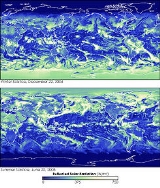
Reflectedsolarradiation Solstices
At the temperate
Temperate

In geography, temperate or tepid latitudes of the globe lie between the tropics and the polar circles. The changes in these regions between summer and winter are generally mild, rather than extreme hot or cold....
 latitudes, during summer the Sun remains longer and higher above the horizon, while in winter it remains shorter and lower. This is the cause of summer heat and winter cold.

The seasons are not caused by the varying distance of Earth from the Sun due to the orbital eccentricity
Orbital eccentricity

In astrodynamics, under standard assumptions in astrodynamics, any orbit must be of conic section shape. The eccentricity of this conic section, the orbit's eccentricity, is an important parameter of the orbit that defines its absolute shape....
 of the Earth's orbit. This variation does make such a contribution, but is small compared with the effects of exposure because of Earth's tilt. Currently the Earth reaches perihelion at the beginning of January, which is during the northern winter and the southern summer. At that time Earth, being closest to the Sun and therefore getting more heat, does not enter summer as the whole planet however. Although it is true that the northern winter is somewhat warmer than the southern winter, the placement of the continents, ice-covered Antarctica
Antarctica

Antarctica is Earth's southernmost continent, overlying the South Pole. It is situated in the Antarctica of the southern hemisphere, almost entirely south of the Antarctic Circle, and is surrounded by the Southern Ocean....
 in particular, may also play an important factor. In the same way, during aphelion at the beginning of July, the Sun is farther away, but that still leaves the northern summer and southern winter as they are with only minor effects.

Due to Milankovitch cycles
Milankovitch cycles

Milankovitch cycles are the collective effect of changes in the Earth's movements upon its climate, named after Serbian civil engineering and mathematician Milutin Milankovic....
, the Earth's axial tilt and orbital eccentricity will change over thousands of years. Thus in 10,000 years one would find that Earth's northern winter occurs at aphelion and its northern summer at perihelion. The severity of seasonal change—the average temperature difference between summer and winter in location—will also change over time because the Earth's axial tilt fluctuates between 22.1 and 24.5 degrees.

Geocentric view of the seasons


Solstice 0
Solstice 20
Solstice 50
Solstice 70
Solstice 90
The explanation given in the previous section is useful for observers in outer space. They would see how the Earth revolves around the Sun and how the distribution of sunlight on the planet would change over the year. To observers on Earth, it is also useful to see how the Sun seems to revolve around them. These pictures show such a perspective as follows. They show the day arcs of the Sun, the paths the Sun tracks along the celestial dome in its diurnal movement
Diurnal motion

Diurnal motion is an astronomy term referring to the apparent daily motion of stars around the Earth, or more precisely around the two celestial poles....
. The pictures show this for every hour on both solstice days. The longer arc is always the summer track and the shorter one the winter track. The two tracks are at a distance of 46.88° (2 × 23.44°) away from each other.

In addition, some 'ghost' suns are indicated below the horizon, as much as 18° down. The Sun in this area causes twilight
Twilight

Twilight is the time between dawn and sunrise, and the time between sunset and dusk. Sunlight Scattering in the upper Earth's atmosphere illuminates the lower atmosphere, and the surface of the Earth is not completely lit or completely dark....
. The pictures can be used for both the northern and southern hemispheres. The observer is supposed to sit near the tree on the island in the middle of the ocean. The green arrows give the cardinal directions.

  • On the northern hemisphere the north is to the left, the Sun rises in the east (far arrow), culminates
    Culmination

    In astronomy, the culmination, at a given point, of a planet, star, constellation, etc. is the time within the diurnal motion when it appears on an observer's meridian ....
     in the south (to the right) while moving to the right and sets in the west (near arrow). Both rise and set positions are displaced towards the north in summer, and towards the south for the winter track.
  • On the southern hemisphere the south is to the left, the Sun rises in the east (near arrow), culminates in the north (to the right) while moving to the left and sets in the west (far arrow). Both rise and set positions are displaced towards the south in summer, and towards the north for the winter track.


The following special cases are depicted.

  • On the equator
    Equator

    The equator is the intersection of the Earth's surface with the Plane perpendicular to the Earth's rotation and containing the Earth's center of mass....
     the Sun is not overhead every day, as some people think. In fact that happens only on two days of the year, the equinoxes. The solstices are the dates that the Sun stays farthest away from the zenith
    Zenith

    In broad terms, the zenith is the direction pointing directly above a particular location . Since the concept of being above is itself somewhat vague, scientists define the zenith in more rigorous terms....
    , only reaching an altitude of 66.56° either to the north or the south. The only thing special about the equator is that all days of the year, solstices included, have roughly the same length of about 12 hours, so that it makes no sense to talk about summer and winter. Instead, tropical areas often have wet and dry seasons.
  • The day arcs at 20° latitude. The Sun culminates at 46.56° altitude in winter and 93.44° altitude in summer. In this case an angle larger than 90° means that the culmination takes place at an altitude of 86.56° in the opposite cardinal direction. For example in the southern hemisphere, the Sun remains in the north during winter, but can reach over the zenith to the south in midsummer. Summer days are longer than winter days, but the difference is no more than two or three hours. The daily path of the Sun is steep at the horizon the whole year round, resulting in a twilight of only about one hour.
  • The day arcs at 50° latitude. The winter Sun does not rise more than 16.56° above the horizon at midday, and 63.44° in summer above the same horizon direction. The difference in the length of the day between summer and winter is striking - slightly less than 8 hours at midwinter, to slightly more than 16 hours in midsummer. Likewise is the difference in direction of sunrise and sunset. Also note the different steepness of the daily path of the Sun above the horizon in summer and winter. It is much shallower in winter. Therefore not only is the Sun not reaching as high, it also seems not to be in a hurry to do so. But conversely this means that in summer the Sun is not in a hurry to dip deeply below the horizon at night. At this latitude at midnight the summer sun is only 16.56° below the horizon, which means that astronomical twilight continues the whole night. This phenomenon is known as the grey nights, nights when it does not get dark enough for astronomers to do their observations. Above 60° latitude the Sun would be even closer to the horizon, only 6.56° away from it. Then civil twilight continues the whole night. This phenomenon is known as the white nights. And above 66.56° latitude, of course, one would get the midnight sun
    Midnight sun

    The midnight sun is a natural phenomenon occurring in latitudes north and nearby to the south of the Arctic Circle, and south and nearby to the north of the Antarctic Circle where the sun remains visible at the local midnight....
    .
  • The day arcs at 70° latitude. At local noon the winter Sun culminates at -3.44°, and the summer Sun at 43.44°. Said another way, during the winter the Sun does not rise above the horizon, it is the polar night. There will be still a strong twilight though. At local midnight the summer Sun culminates at 3.44°, said another way, it does not set, it is the polar day.
  • The day arcs at the pole. At the time of the summer or winter solstices, the Sun is 23.44° degrees above or below the horizon respectively, irrespective of time of day. Whilst the Sun is up (during summer months) it will circle around the whole sky, appearing to stay at same angle from the horizon, therefore the concept of day or night is meaningless. The angle of elevation will gradually change on an annual cycle, with the Sun reaching its highest point at the summer Solstice, and rising or setting at the Equinox
    Equinox

    Equinoxes occur twice a year, when the tilt of the Earth's axis is inclined neither away from nor toward the Sun, causing the Sun to be located vertically above a point on the equator....
    , with extended periods of twilight lasting several days after the autumn equinox and before the spring equinox.


Cultural aspects


Ancient Greek names and concepts


The concept of the solstices was embedded in ancient Greek celestial navigation
Celestial navigation

Celestial navigation, also known as astronavigation, is a position fixing technique that was devised to help sailors cross the featureless oceans without having to rely on dead reckoning to enable them to strike land....
. As soon as they discovered that the Earth is spherical they devised the concept of the celestial sphere
Celestial sphere

In astronomy and navigation, the celestial sphere is an imagination rotation sphere of "gigantic radius", concentric spheres and coaxial with the Earth....
, an imaginary spherical surface rotating with the heavenly bodies (ouranioi) fixed in it (the modern one does not rotate, but the stars in it do). As long as no assumptions are made concerning the distances of those bodies from Earth or from each other, the sphere can be accepted as real and is in fact still in use.

The star
Star

A star is a massive, luminous ball of Plasma that is held together by its own gravity. The nearest star to Earth is the Sun, which is the source of most of the energy on Earth....
s move across the inner surface of the celestial sphere
Sphere

A sphere is a symmetrical geometrical object. In non-mathematical usage, the term is used to refer either to a round ball or to its two-dimensional surface....
 along the circumference
Circumference

The circumference is the distance around a closed curve. Circumference is a kind of perimeter....
s of circle
Circle

A circle is a simple shape of Euclidean geometry consisting of those point in a plane which are the same distance from a given point called the center....
s in parallel
Parallel

From Greek language: pa???????? Parallel may refer to:...
 planes perpendicular
Perpendicular

In geometry, two line or plane , are considered perpendicular to each other if they form congruence adjacent angles angles . The term may be used as a noun or adjective....
 to the Earth's axis extended indefinitely into the heavens and intersecting the celestial sphere in a celestial pole. The Sun and the planet
Planet

A planet , as 2006 definition of planet by the International Astronomical Union , is a celestial body orbiting a star or Stellar evolution#Stellar remnants that is massive enough to be rounded by its own gravity, is not massive enough to cause thermonuclear fusion, and has cleared the neighbourhood of planetesimals....
s do not move in these parallel paths but along another circle, the ecliptic, whose plane is at an angle, the obliquity of the ecliptic, to the axis, bringing the Sun and planets across the paths of and in among the stars.*

Cleomedes
Cleomedes

Cleomedes was a Ancient Greece astronomer who is known chiefly for his book On the Circular Motions of the Celestial Bodies....
 states:
The band of the Zodiac
Zodiac

Zodiac denotes an annual cycle of twelve stations along the ecliptic, the apparent path of the Sun across the heavens through the constellations that divide the ecliptic into twelve equal zones of celestial longitude....
 (zodiakos kuklos, "zodiacal circle") is at an oblique angle (loksos) because it is positioned between the tropical circles and equinoctial circle touching each of the tropical circles at one point … This Zodiac has a determinable width (set at 8° today) … that is why it is described by three circles: the central one is called "heliacal" (heliakos, "of the sun").


The term heliacal circle is used for the ecliptic, which is in the center of the zodiacal circle, conceived as a band including the noted constellations named on mythical themes. Other authors use Zodiac to mean ecliptic, which first appears in a gloss of unknown author in a passage of Cleomedes where he is explaining that the Moon
Moon

The Moon is Earth's only natural satellite and the List of natural satellites by diameter satellite in the Solar System. The average centre-to-centre distance from the Earth to the Moon is km, about thirty times the diameter of the Earth....
 is in the zodiacal circle as well and periodically crosses the path of the Sun. As some of these crossings represent eclipse
Eclipse

An eclipse is an astronomical event that occurs when one celestial object moves into the shadow of another. The term is derived from the ancient Greek noun , from verb , "I cease to exist," a combination of prefix , from preposition , "out," and of verb , "I am absent"....
s of the Moon, the path of the Sun is given a synonym, the ekleiptikos (kuklos) from ekleipsis, "eclipse."

English names


The two solstices can be distinguished by different pairs of names, depending on which feature one wants to stress.

  • Summer solstice and winter solstice are the most common names. However, these can be ambiguous since seasons of the northern hemisphere
    Northern Hemisphere

    The Northern Hemisphere is the half of a planet that is north of the equator?the word sphere literally means 'half sphere'. It is also that half of the celestial sphere north of the celestial equator....
     and southern hemisphere
    Southern Hemisphere

    The Southern Hemisphere is the half of a planet that is south of the equator?the word sphere literally means 'half ball'. It is also that half of the celestial sphere south of the celestial equator....
     are opposites, and the summer solstice of one hemisphere is the winter solstice of the other. These are also known as the 'longest' or 'shortest' days of the year.
  • Northern solstice and southern solstice indicate the direction of the Sun's apparent movement. The northern solstice is in June on Earth, when the Sun is directly over the Tropic of Cancer
    Tropic of Cancer

    The Tropic of Cancer, or Northern tropic, is one of five major degree measures or major circle of latitude that mark maps of the Earth. It is the northernmost latitude at which the Sun can appear directly overhead at noon....
     in the Northern Hemisphere
    Northern Hemisphere

    The Northern Hemisphere is the half of a planet that is north of the equator?the word sphere literally means 'half sphere'. It is also that half of the celestial sphere north of the celestial equator....
    , and the southern solstice is in December, when the Sun is directly over the Tropic of Capricorn
    Tropic of Capricorn

    The Tropic of Capricorn, or Southern tropic, is one of the five major circle of latitude that mark maps of the Earth. It lies 23degree 26' 22? south of the Equator, and marks the most southerly latitude at which the sun can appear directly overhead at noon....
     in the Southern Hemisphere
    Southern Hemisphere

    The Southern Hemisphere is the half of a planet that is south of the equator?the word sphere literally means 'half ball'. It is also that half of the celestial sphere south of the celestial equator....
    .
  • June solstice and December solstice are an alternative to the more common "summer" and "winter" terms, but without the ambiguity as to which hemisphere is the context. They are still not universal, however, as not all people use a solar-based calendar where the solstices occur every year in the same month (as they do not in the Islamic Calendar
    Islamic calendar

    The Islamic calendar or Muslim calendar or Hijri calendar is a lunar calendar used to date events in many predominantly Muslim countries, and used by Muslims everywhere to determine the proper day on which to celebrate Islamic holy days and festivals....
     and Hebrew calendar
    Hebrew calendar

    The Hebrew calendar or Jewish calendar is a lunisolar calendar used by Jews, now predominantly for religious purposes. It is used to reckon the Jewish New Year and dates for Jewish holidays, and also to determine appropriate Torah reading of Torah portions, Yahrzeits , and daily Psalm reading, among many ceremonial uses....
    , for example), and the names are not useful for other planets (Mars
    MARS

    In cryptography, MARS is a block cipher that was IBM's submission to the Advanced Encryption Standard process. MARS was selected as an AES finalist in August 1999, after the AES2 conference in March 1999, where it was voted as the fifth and last finalist algorithm....
    , for example), even though these planets do have seasons.
  • First point of Cancer
    Cancer (astrology)

    Cancer is the fourth astrological sign in the Zodiac, originating from the Cancer . In western astrology, this sign is no longer aligned with the constellation as a result of the Precession ....
     and first point of Capricorn
    Capricorn (astrology)

    Capricorn is the tenth astrological sign in the Zodiac, originating from the Capricornus. In western astrology, this sign is no longer aligned with the constellation as a result of the Precession ....
    . One disadvantage of these names is that, due to the precession of the equinoxes
    Precession of the equinoxes

    In astronomy, precession refers to a gravitationally-induced slow but continuous change in an astronomical body's rotational axis or orbital path....
    , the astrological signs
    Zodiac

    Zodiac denotes an annual cycle of twelve stations along the ecliptic, the apparent path of the Sun across the heavens through the constellations that divide the ecliptic into twelve equal zones of celestial longitude....
     where these solstices are located no longer correspond with the actual constellation
    Constellation

    A constellation is a group of stars that appear to have a physical proximity in the sky. The stars in a constellation are often vastly distant from each other, but they appear close to each other from the perspective of Earth....
    s.
  • Taurus
    Taurus (constellation)

    Taurus is one of the constellations of the zodiac. Its name is Latin for cattle, and its symbol is , a stylized bull's head. Taurus is a large and prominent constellation in the northern hemisphere's winter sky, between Aries to the west and Gemini to the east; to the north lie Perseus and Auriga , to the southeast Orion , to the south E...
     solstice
    and Sagittarius
    Sagittarius (constellation)

    Sagittarius is one of the constellations of the zodiac. Its name is Latin for the archer, and its symbol is , a stylized arrow. Sagittarius is commonly represented as a centaur drawing a bow....
     solstice
    are names that indicate in which constellations the two solstices are currently located. These terms are not widely used, though, and until December 1989 the first solstice was in Gemini
    Gemini (constellation)

    Gemini is one of the constellations of the zodiac. Its name is Latin for "twins", and it is associated with the twins Castor and Pollux in Greek mythology....
    , according to official IAU
    International Astronomical Union

    The International Astronomical Union is a collection of professional astronomers, at the Ph.D. level and beyond, active in professional research and education in astronomy....
     boundaries.
  • The Latin
    Latin

    Latin is an Italic language, historically spoken in Latium and Ancient Rome. Through the Military history of the Roman Empire, Latin spread throughout the Mediterranean and a large part of Europe....
     names Hibernal solstice (winter), and Aestival solstice (summer) are sometimes used.


Solstice terms in East Asia


The traditional East Asian calendars divide a year into 24 solar term
Solar term

A solar term is one of 24 points in traditional East Asian lunisolar calendars that matches a particular astronomical event or signifies some natural phenomenon....
s. Xiŕzhě (pinyin
Pinyin

Pinyin, more formally Hanyu pinyin, is the most commonly used Romanization system for Standard Mandarin. Hanyu is the Chinese Language, and pinyin means "phonetics", or more literally, "spelling sound" or "spelled sound"....
)
or Geshi (romaji
Romanization of Japanese

The romanization of Japanese or is the use of the Latin alphabet to write the Japanese language. Japanese is normally written in logogram borrowed from Chinese and syllabary scripts ....
)
is the 10th solar term, and marks the summer solstice. It begins when the Sun reaches the celestial longitude of 90° (around June 21) and ends when the Sun reaches the longitude of 105° (around July 7). Xiŕzhě more often refers in particular to the day when the Sun is exactly at the celestial longitude of 90°.

Dongzhě (pinyin
Pinyin

Pinyin, more formally Hanyu pinyin, is the most commonly used Romanization system for Standard Mandarin. Hanyu is the Chinese Language, and pinyin means "phonetics", or more literally, "spelling sound" or "spelled sound"....
)
or Toji (romaji
Romanization of Japanese

The romanization of Japanese or is the use of the Latin alphabet to write the Japanese language. Japanese is normally written in logogram borrowed from Chinese and syllabary scripts ....
)
is the 22nd solar term, and marks the winter solstice. It begins when the Sun reaches the celestial longitude of 270° (around December 22 ) and ends when the Sun reaches the longitude of 285° (around January 5). Dongzhě more often refers in particular to the day when the Sun is exactly at the celestial longitude of 270°.

The solstices (as well as the equinox
Equinox

Equinoxes occur twice a year, when the tilt of the Earth's axis is inclined neither away from nor toward the Sun, causing the Sun to be located vertically above a point on the equator....
es) mark the middle of the seasons in East Asian calendars. Here, the Chinese character ? means "extreme", so the terms for the solstices directly signify the summits of summer and winter, a linkage that may not be immediately obvious in Western languages.

Solstice celebrations


The term solstice can also be used in a wider sense, as the date (day) that such a passage happens. The solstices, together with the equinox
Equinox

Equinoxes occur twice a year, when the tilt of the Earth's axis is inclined neither away from nor toward the Sun, causing the Sun to be located vertically above a point on the equator....
es, are connected with the seasons. In some languages they are considered to start or separate the seasons; in others they are considered to be centre points (in English, in the Northern hemisphere, for example, the period around the June solstice is known as midsummer
Midsummer

Many people say that the fairies dance on midsummer's eve, and those in Ireland may even stay up all night watching for them. They re said to dance after huge feasts, then sing and play music and tell stories....
, and Midsummer's Day is 24 June, about three days after the solstice itself). Similarly 25 December is the start of the Christmas
Christmas

Christmas , also referred to as Christmas Day, is an annual holiday celebrated on December 25 that commemorates the birth of Jesus. The day marks the beginning of the larger season of Christmastide, which lasts Twelve Days of Christmas....
 celebration, which was a pagan festival in pre-Christian times, and is the day the Sun begins to return to the northern hemisphere.

Many cultures celebrate various combinations of the winter and summer solstices, the equinoxes, and the midpoints between them, leading to various holidays arising around these events. For the December solstice, Christmas
Christmas

Christmas , also referred to as Christmas Day, is an annual holiday celebrated on December 25 that commemorates the birth of Jesus. The day marks the beginning of the larger season of Christmastide, which lasts Twelve Days of Christmas....
 is the most popular holiday to have arisen. In addition, Yalda
Yalda

Shab-e Yalda or Shab-e Chelleh is an Iranian festivals originally celebrated on the Northern Hemisphere longest night of the year, that is, on the eve of the Winter Solstice....
, Saturnalia
Saturnalia

Saturnalia is the festival with which the Romans commemorated the dedication of the temple of the god Saturn , which was on 17 December. Over the years, it expanded to a whole week, to 23 December....
, Karachun, Hanukkah
Hanukkah

File:PikiWiki Israel 146 Hanukka ?????.JpgHanukkah , also known as the Festival of Lights, is an eight-day Jewish holiday commemorating the rededication of the Temple in Jerusalem in Jerusalem at the time of the Maccabean Revolt of the 2nd century BCE....
, Kwanzaa
Kwanzaa

Kwanzaa is a week-long Africa American holiday honoring African heritage, marked by participants lighting a kinara . It is observed from December 26 to January 1 each year....
 and Yule
Yule

Yule or Yule-tide is a List of winter festivals that was initially celebrated by the historical Germanic peoples as a Germanic paganism religious festival, though it was later absorbed into, and equated with, the Christianity festival of Christmas....
 (see winter solstice
Winter solstice

Winter solstice may refer to:* Winter solstice* Winter Solstice *...
 for more) are also celebrated around this time. For the June solstice, Christian cultures celebrate the feast of St. John
John the Baptist

John the Baptist was a mission preacher and a major religious figure who led a movement of baptism at the Jordan River in expectation of a divine apocalypse that would restore occupied Israel....
 from June 23 to June 24 (see St. John's Eve
St. John's Eve

The evening of June 23, St. John's Eve, is the eve of celebration before the Feast Day of John the Baptist. The Gospel of Luke states that John was born about six months before Jesus, therefore the feast of John the Baptist falls on June 24, six months before Christmas....
, Ivan Kupala Day
Ivan Kupala Day

Ivan Kupala Day is celebrated in Russia, Belarus and Ukraine currently on 7 July in the Gregorian or Old Style and New Style dates calendar, which is 24 June in the Julian or Old Style and New Style dates calendar still used by many of the Orthodox Churches....
, Midsummer
Midsummer

Many people say that the fairies dance on midsummer's eve, and those in Ireland may even stay up all night watching for them. They re said to dance after huge feasts, then sing and play music and tell stories....
), while Neopagans observe Midsummer
Midsummer

Many people say that the fairies dance on midsummer's eve, and those in Ireland may even stay up all night watching for them. They re said to dance after huge feasts, then sing and play music and tell stories....
. For the vernal (spring) equinox, several spring-time festivals are celebrated, such as the observance in Judaism
Judaism

Judaism is a set of beliefs and practices originating in the Hebrew Bible , as later further explored and explained in the Talmud and other texts....
 of Passover
Passover

Passover is a Jewish and Samaritan holy day and festival commemorating God sparing the Israelites when He killed the first born of Egypt, and is followed by the seven day Feast of the Unleavened Bread commemorating the Exodus from Ancient Egypt and the liberation of the Israelites from Judaism and slavery....
. The autumnal equinox has also given rise to various holidays, such as the Jewish holiday of Sukkot
Sukkot

Sukkot , is a Hebrew Bible pilgrimage Jewish holiday that occurs in autumn on the 15th day of the month of Tishrei . The holiday lasts seven days, including Chol Hamoed....
. At the midpoints between these four solar events, cross-quarter day
Cross-quarter day

A cross-quarter day is a day falling approximately halfway between a solstice and an equinox. These days originated as paganism holidays in Sweden, Norway, Finland, United Kingdom and Ireland, and survive in modern times as neopaganism holidays....
s are celebrated.

In many cultures the solstices and equinoxes traditionally determine the midpoint of the seasons, which can be seen in the celebrations called midsummer
Midsummer

Many people say that the fairies dance on midsummer's eve, and those in Ireland may even stay up all night watching for them. They re said to dance after huge feasts, then sing and play music and tell stories....
 and midwinter. Along this vein, the Japanese
Japanese people

The are the predominant ethnic group of Japan. Worldwide, approximately 130 million people are of Japanese descent; of these, approximately 127 million are residents of Japan....
 celebrate the start of each season with an occurrence known as Setsubun
Setsubun

In Japan, Setsubun is the day before the beginning of each season. The name literally means "seasonal division", but usually the term refers to the Spring Setsubun, properly called Lichun celebrated yearly on February 3 as part of the ....
. The cumulative cooling and warming that result from the tilt of the planet become most pronounced after the solstices.

In the Hindu calendar
Hindu calendar

The Hindu calendar used in ancient times has undergone many changes in the process of regionalization, and today there are several regional Indian calendars, as well as an Indian national calendar....
, two sidereal solstices are named Uttarayana
Uttarayana

Uttarayana is the six month period between Makar Sankranti around and Karka Sankranti around , when the Sun travels towards north on the celestial sphere....
 and Dakshinayana. The former occurs around January 14 each year, while the latter occurs around July 14 each year. These mark the movement of the Sun along a sidereally fixed zodiac
Zodiac

Zodiac denotes an annual cycle of twelve stations along the ecliptic, the apparent path of the Sun across the heavens through the constellations that divide the ecliptic into twelve equal zones of celestial longitude....
 (precession is ignored) into Mesha, a zodiacal sign which corresponded with Aries
Aries (astrology)

Aries, the domestic sheep, is the first astrological sign in the Zodiac, originating from the Aries . In western astrology, this sign is no longer aligned with the constellation as a result of the Precession ....
 about 285, and into Tula, the opposite zodiacal sign which corresponded with Libra
Libra (astrology)

Libra is the seventh astrological sign in the Zodiac, originating from the Libra . In western astrology, this sign is no longer aligned with the constellation as a result of the Precession ....
 about 285.

Solstice determination


Unlike the equinox
Equinox

Equinoxes occur twice a year, when the tilt of the Earth's axis is inclined neither away from nor toward the Sun, causing the Sun to be located vertically above a point on the equator....
, the solstice time is not easy to determine. The changes in Solar declination become smaller as the sun gets closer to its maximum/minimum declination. The days before and after the solstice, the declination speed is less than 30 arcseconds/day which is less than 1/60th of the angular size of the sun, or the equivalent

This diference is hardly detectable with indirect viewing based devices like sextant
Sextant

:For the history and development of the sextant see Reflecting instrument#The sextantA sextant is an measuring instrument generally used to measure the altitude of a astronomical object above the horizon....
 equiped with a vernier
Vernier

Vernier can refer to:*Persons**Pierre Vernier , a French mathematician and instrument inventor.*Places**Vernier, Switzerland, a Municipalities of Switzerland in the Canton of Geneva, Switzerland....
, and imposible with more traditional tools like a gnomon
Gnomon

The gnomon is the part of a sundial that casts the shadow. Gnomon is an ancient Greek word meaning "indicator", "one who discerns," or "that which reveals."...
 or an astrolabe
Astrolabe

astrolabe is a historical astronomical Measuring instrument used by classical astronomy, navigators, and astrologers. Its many uses included locating and predicting the positions of the Sun, Moon, planets and stars; determining local time given local latitude and vice-versa; surveying; and triangulation....
. It is also hard to detect the changes on sunrise/sunset azimuth due to the atmospheric refraction
Atmospheric refraction

Atmospheric refraction is the deviation of light or other electromagnetic wave from a straight line as it passes through the atmosphere due to the variation in air density as a function of altitude....
 changes. Those accuracy issues render imposible to determine the solstice day based on observations made within the 3 (or even 5) days surrounding the solstice, without the use of more complex tools.

Ptolomy used an aproximation method based on interpolation, which is still used by nowadays amateurs. This method consists on recording the declination angle at noon during some days before and after the solstice, trying to find two separate days with the same declination. When those two days are found, the halfway time between both noons is estimated solstice time. An interval of 45 days has been postulated, as the best one to achieve up to a quarter-day precision, in the solstice determination.

See also


  • Midsummer
    Midsummer

    Many people say that the fairies dance on midsummer's eve, and those in Ireland may even stay up all night watching for them. They re said to dance after huge feasts, then sing and play music and tell stories....
  • Winter solstice
    Winter solstice

    Winter solstice may refer to:* Winter solstice* Winter Solstice *...
  • Zoroastrian calendar
    Zoroastrian calendar

    The Zoroastrian calendar is a religious calendar used by members of the Zoroastrian faith, and it is an approximation of the solar calendar. To this day, Zoroastrianism, irrespective of geographic location, adhere to this calendar for religious purposes....
  • Iranian calendar
    Iranian calendar

    The Iranian calendar or Solar Hejri is an astronomical solar calendar and one of the longest chronological records in history and is currently used in Iran and Afghanistan as the main official calendar....


External links


Calculations, plots and tables


  • (Formulas and Graphs)
  • The Sun API is freeware
    Freeware

    Freeware is computer software that is available for use at no cost or for an optional fee. Freeware is different from shareware; the latter obliges the user to pay ....
     and claimed accurate. For Microsoft Windows Operating Systems (presumably 32-bit only) (Note DLL may run under Wine (software)
    Wine (software)

    Wine is a free software software application that aims to allow Unix-like computer operating systems on the x86 architecture or x86-64 architecture to execute programs written for Microsoft Windows....
    ).


Debate about season start

  • (from the Bad Astronomer)
  • (from the The Straight Dope)


Pictures and videos