
All Topics  
Conscription


   Email Print
   Bookmark   Link


Conscription


Conscription (also known as "The Draft", the "Call-up" or "National service") is a general term for involuntary labor demanded by an established authority. It is most often used in the specific sense of government policies that require citizens to serve in the armed forces
Military

A military is an organization authorized by its nation to use force, usually including use of weapons, in defending its country by combating actual or Threat of force ....
. It is known by various names — for example, the most recent conscription program in the United States
United States

The United States of America is a Federal government constitutional republic comprising U.S. state and a federal district. The country is situated mostly in central North America, where its Contiguous United States and Washington, D.C., the Capital districts and territories, lie between the Pacific Ocean and Atlantic Oceans, Borders of the U...
 was known colloquially as "the draft
Conscription in the United States

Conscription in the United States has been employed several times, usually during war but also during the nominal peace of the Cold War. The United States discontinued the draft in 1973, moving to an all-volunteer United States Military, thus there is currently no mandatory conscription....
". Many nations do not maintain conscription forces, instead relying on a volunteer or professional military most of the time, although many of these countries still reserve the possibility of conscription for wartime and during times of crises.

Referring to compulsory service in the armed forces, the term "conscription" has two main meanings:


The term "conscription" refers only to the mandatory service; thus, those undergoing conscription are known as "conscripts" or "selectee" in the United States (from the Selective Service System
Selective Service System

The Selective Service System serves at least two purposes. It is the means by which the United States administers conscription in the United States....
 or the Selective Service Initiative announced in 2004).

In the U.S.
United States

The United States of America is a Federal government constitutional republic comprising U.S. state and a federal district. The country is situated mostly in central North America, where its Contiguous United States and Washington, D.C., the Capital districts and territories, lie between the Pacific Ocean and Atlantic Oceans, Borders of the U...
 the term "enlisted" is often used to refer only to those who have volunteered for service in roles other than as commissioned officers.

r the system of feudalism
Feudalism

Feudalism, a term first used in the early modern period , in its most classic sense refers to a Middle Ages European political system composed of a set of reciprocal law and military obligations among the warrior nobility, revolving around the three key concepts of lords, vassals, and fiefs....
 in the medieval period, most peasants and freemen were expected to provide one man of suitable age per family for military duty when requested by either the king or the local lord.


Discussion
Ask a question about 'Conscription'
Start a new discussion about 'Conscription'
Answer questions from other users
Full Discussion Forum


Timeline

1793   Universal conscription in France

1863   American Civil War (New York Draft Riots): In New York City, opponents of conscription begin three days of violent rioting, which would later be regarded as the worst in the history of the United States.

1916   Prime Minister of Australia Billy Hughes is expelled from the Labor Party over his support for conscription.

1917   World War I: The Selective Service Act passes the U.S. Congress giving the President the power of conscription.

1917   World War I: Conscription begins in the United States as "Army registration day."

1919   December 5 — Turkish ministry of war releases Greeks, Armenians and Jews from military service

1930   One-year conscription comes into force in France

1942   World War II: A national plebiscite is held in Canada on the issue of conscription.

1944   William Lyon Mackenzie King introduces conscription in Canada (see Conscription Crisis of 1944).

1962   The East German government readopts conscription.


Encyclopedia


Conscription (also known as "The Draft", the "Call-up" or "National service") is a general term for involuntary labor demanded by an established authority. It is most often used in the specific sense of government policies that require citizens to serve in the armed forces
Military

A military is an organization authorized by its nation to use force, usually including use of weapons, in defending its country by combating actual or Threat of force ....
. It is known by various names — for example, the most recent conscription program in the United States
United States

The United States of America is a Federal government constitutional republic comprising U.S. state and a federal district. The country is situated mostly in central North America, where its Contiguous United States and Washington, D.C., the Capital districts and territories, lie between the Pacific Ocean and Atlantic Oceans, Borders of the U...
 was known colloquially as "the draft
Conscription in the United States

Conscription in the United States has been employed several times, usually during war but also during the nominal peace of the Cold War. The United States discontinued the draft in 1973, moving to an all-volunteer United States Military, thus there is currently no mandatory conscription....
". Many nations do not maintain conscription forces, instead relying on a volunteer or professional military most of the time, although many of these countries still reserve the possibility of conscription for wartime and during times of crises.

Referring to compulsory service in the armed forces, the term "conscription" has two main meanings:

  • compulsory service, usually of young men of a given age, e.g., 17 – 18, for a set period of time, commonly one-to-two years. In the United Kingdom
    United Kingdom

    The United Kingdom of Great Britain and Northern Ireland, commonly known as the United Kingdom , the UK or Britain,is a sovereign state located off the northwestern coast of continental Europe....
     and Singapore
    Singapore

    Singapore , officially the Republic of Singapore, is an island country microstate located at the southern tip of the Malay Peninsula. It lies 137 kilometres north of the equator, south of the Malaysian state of Johor and north of Indonesia's Riau Islands....
     this was commonly known as "national service"; in New Zealand
    New Zealand

    New Zealand is an island country in the south-western Pacific Ocean comprising two main landmasses , and numerous Islands of New Zealand, most notably Stewart Island/Rakiura and the Chatham Islands....
    , at first compulsory military training
    Compulsory Military Training in New Zealand

    Compulsory Military Training , a form of conscription, has been used in New Zealand during a number of historical periods....
     and later national service
    National service

    National service is a common name for mandatory or voluntary government service programs . National service was common in the 20th century, and many young people spent one or more years in such programs....
    ; in Norway
    Norway

    Norway , officially the Kingdom of Norway, is a constitutional monarchy in Northern Europe that occupies the western portion of the Scandinavian Peninsula....
    , Safeguard Duty/1st time service.
  • compulsory service, for an indefinite period of time, in the context of a widespread mobilisation of forces for fighting war, including on the home territory, usually imposed on men in a much wider age group (e.g., 18 – 55). (In the United Kingdom this was commonly known as "call-up").


The term "conscription" refers only to the mandatory service; thus, those undergoing conscription are known as "conscripts" or "selectee" in the United States (from the Selective Service System
Selective Service System

The Selective Service System serves at least two purposes. It is the means by which the United States administers conscription in the United States....
 or the Selective Service Initiative announced in 2004).

In the U.S.
United States

The United States of America is a Federal government constitutional republic comprising U.S. state and a federal district. The country is situated mostly in central North America, where its Contiguous United States and Washington, D.C., the Capital districts and territories, lie between the Pacific Ocean and Atlantic Oceans, Borders of the U...
 the term "enlisted" is often used to refer only to those who have volunteered for service in roles other than as commissioned officers.

History


Feudal Levies

Under the system of feudalism
Feudalism

Feudalism, a term first used in the early modern period , in its most classic sense refers to a Middle Ages European political system composed of a set of reciprocal law and military obligations among the warrior nobility, revolving around the three key concepts of lords, vassals, and fiefs....
 in the medieval period, most peasants and freemen were expected to provide one man of suitable age per family for military duty when requested by either the king or the local lord. The men sequestered in this way were called levies and fought as infantry. This was essentially an early form of conscription, and those that refused became outlaws
Outlaws

An outlaw is a person living outside the law....
. Although the exact laws varied greatly depending on the country and the period, generally these levies were only obliged to fight for one to three months.

Military slavery

The system of military slaves was widely used by Turks in the Middle East
Middle East

File:GreaterMiddleEast1.pngThe Middle East is a region that spans southwestern Asia, western Asia, and northeastern Africa. It has no clear boundaries, often used as a synonym to Near East, in opposition to Far East....
 from the 9th until the 19th century, even though Islam
Islam

Islam is a Monotheism, Abrahamic religion originating with the teachings of the Prophets of Islam Muhammad, a 7th century Arab religious and political figure....
 prohibits slavery.

In the middle of the 14th century, Ottoman
Ottoman Empire

The Ottoman Empire , also known by its contemporaries as the Turkish Empire or Turkey , was an empire that lasted from 1299?1923. It was Treaty of Lausanne by the Republic of Turkey, which was officially proclaimed on October 29, 1923....
 Sultan Murad I
Murad I

Murad I was the ruler of the Ottoman Empire, Sultan of R?m, from 1359 to 1389. He was the son of Orhan I and the Valide Sultan Nil?fer Hatun , daughter of the Prince of Yarhisar or Byzantine Empire Princess Helen , who was of ethnic Greek people descent and became the ruler following his father's death in 1359....
 built his own personal slave army called the Kapikulu. The new force was built by kidnapping large numbers of children, especially from Europeans and Russians during large raids or as a form of tribute known as the devsirme (translated "blood tax" or "child collection"). The captive children, far from their families and cultures, were persuaded to convert to Islam
Islam

Islam is a Monotheism, Abrahamic religion originating with the teachings of the Prophets of Islam Muhammad, a 7th century Arab religious and political figure....
.

The young girls were put under various categories of training and testing for intellectual ability, physical beauty, and other talents. Blond and blue eyed women or dark-haired pale-complected women who fit preconceived Turkic ideals of beauty were especially prized. Those that had the best abilities were then put through various sexual traumas to prepare them as permanent sex slaves to whet the Sultan's sexual appetite and give him children. Believing in the superior native talent of European — especially northern European nationalities — the Sultans put the young boys, into various levels of stress, endurance, and fighting levels over several years. Those that showed special promise in fighting skills were trained in advanced and arcane warrior skills, put into the sultan's personal service, and turned into the ultimate fighting weapons known as the Janissaries
Janissary

The Janissaries comprised infantry units that formed the Ottoman Empire sultan's household troops and bodyguards. The force was created by the Sultan Murad I from Christian slaves in the 14th century and was abolished by Sultan Mahmud II in 1826 with the Auspicious Incident....
, the most famous branch of the Kapikulu. This soldier class became a decisive factor in the Ottoman invasions of Europe
Ottoman wars in Europe

The wars of the Ottoman Empire in Europe are also sometimes referred to as the Ottoman Wars or as Turkish Wars, particularly in older, European texts....
.

Most of the military commanders of the Ottoman forces, imperial administrators and de facto rulers of the Ottoman Empire, such as Pargali Ibrahim Pasha
Pargali Ibrahim Pasha

Pargali Ibrahim Pasha or Frenk Ibrahim Pasha was the first Grand Vizier appointed by Suleiman the Magnificent of the Ottoman Empire . In 1523, he replaced Piri Mehmed Pasha, who had been appointed in 1518 by S?leyman I's father, the preceding sultan Selim I, and remained in office for 13 years, till 1536, during which time he attained...
 and Sokollu Mehmet Pasa, were recruited in this way. By 1609 the Sultan's Kapikulu forces increased to about 100,000. As European Christian states increased in military power, they were able to stem and eventually repel most of the Islamic riazzas into the European heartland. Additionally, the raise in awareness by the common European to their national and religious identity through greater literacy and education also made it increasingly problematic for Turkish indoctrination to work effectively on the kidnapped children. The Sultan increasingly began turning to the Barbary Pirates whose depredations continued upon white travelers, thereby providing a continued supply of captured children for the Sultan's human slave system. Eventually the Sultan had to turn to foreign volunteers from the adept warrior clans of Circassians in southern Russia to fill his Janissary armies. As a whole the system began to break down, and the loyalty of the Jannissaries became increasingly suspect. Mahmud II
Mahmud II

Mahmud II was the 30th Sultan of the Ottoman Empire from 1808 until his death in 1839. He was born at Topkapi Palace, Istanbul, the son of Sultan Abdul Hamid I....
 forcibly disbanded Janissary corps in 1826.

Similar to the Janissaries in origin and means of development and probably the basis of the Janissaries, were the Mamluks. The Mamluks were also usually captured European or non-Muslim Iranian and Turkish children who had been kidnapped or bought as slaves from the Barbary coasts. Similar to the Turks, the Egyptians indoctrinated the children into becoming fanatical Islamic slave soldiers who served the Muslim caliph
Caliph

The Caliph is the head of state in a Caliphate, and the title for the leader of the Islamic Ummah, an Islamic community ruled by the Shari'ah....
s and the Ayyubid sultans during the Middle Ages
Middle Ages

File:Karl 1 mit papst gelasius gregor1 sacramentar v karl d kahlen.jpgThe Middle Ages of European history are a period in history which lasted for roughly a millennium, commonly dated from the fall of the Roman Empire in the 5th century to the beginning of the Early Modern Period in the 16th century, marked by the division of Western Christi...
. The first mamluks served the Abbasid
Abbasid

The Abbasid Caliphate was the third of the Islamic Caliphates of the Islamic Empire. The Caliphate is one of the high points of Islam, and at the time Muslim civilization, together with that of Byzantium, China and India, was the most developed part of the world....
 caliphs in 9th century Baghdad
Baghdad

Baghdad is the Capital of Iraq and of Baghdad Governorate, with which it is also coterminous. With a municipal population estimated at 6.5 million, it is the largest city in Iraq, and the second largest city in the Arab World....
. Over time they became a powerful military caste
Caste

Castes are hereditary systems of wikt:occupation, endogamy, culture, social class, and political power, the assignment of individuals to places in the social hierarchy is determined by social group and culture....
, and on more than one occasion they seized power for themselves, for example, ruling Egypt
Egypt

Egypt is a country mainly in North Africa, with the Sinai Peninsula forming a land bridge in Western Asia. Covering an area of about , Egypt borders the Mediterranean Sea to the north, the Gaza Strip and Israel to the northeast, the Red Sea to the east, Sudan to the south and Libya to the west....
 from 1250-1517. From 1250 Egypt
Egypt

Egypt is a country mainly in North Africa, with the Sinai Peninsula forming a land bridge in Western Asia. Covering an area of about , Egypt borders the Mediterranean Sea to the north, the Gaza Strip and Israel to the northeast, the Red Sea to the east, Sudan to the south and Libya to the west....
 had been ruled by the Bahri dynasty
Bahri dynasty

The Bahri dynasty or Bahriyya Mamluks was a Mamluk dynasty of mostly Kipchaks Turkic peoples origin that ruled Egypt from 1250 to 1382 when they were succeeded by the Burji dynasty, another group of Mamluks....
 of Kipchak origin. Slaves from the Caucasus served in the army and formed an elite corp of troops eventually revolting in Egypt to form the Burgi dynasty. Mamluks excellent fighting abilities, massed Islamic Jihadi armies, and overwhelming numbers succeeded in overcoming and genociding the grossly outnumbered Christian European Crusader fortresses in the Holy Land. They were mainly responsible for preventing the Mongol Ilkhanate
Ilkhanate

The Ilkhanate, also spelled Il-khanate or Il Khanate , was a Mongol khanate established in Persia in the 13th century, considered a part of the Mongol Empire....
 of Persia and Iraq from entering Egypt.

On the western coast of Africa, Berber Muslims also attempted to put into practice the process of capturing non-Muslims and brainwashing them into fanatical Muslims. In Morocco, the Berber looked south rather than north. The Moroccan Sultan Moulay Ismail "the Bloodthirsty" (1672-1727) raised a corps of 150,000 black slaves, called his Black Guard
Black Guard

The Black Guard were charged with fighting Ismail's campaigns against the European-controlled fortress enclaves dotting his empire's coast and with patrolling Morocco's unstable countryside: They crushed rebellions against Ismail's rule not only by Moroccan Berber clans but also by Ismail's seditious sons, who defected from service as his provinci...
, who coerced the country into submission.

Invention of modern conscription

Modern conscription, the massed military enlistment of national citizens (today recognized as "the draft"), was devised during the French Revolution
French Revolution

The French Revolution was a period of political and social upheaval and radical change in the history of France, during which the French governmental structure, previously an absolute monarchy with feudalism for the aristocracy and Roman Catholic Church clergy, underwent radical change to forms based on Age of Enlightenment principles of cit...
, allowing the Republic to defend itself from the attacks of other European monarchies. Deputy Jean-Baptiste Jourdan
Jean-Baptiste Jourdan

Jean-Baptiste Jourdan, 1st Comte Jourdan , was a marshal of France notable for his service during the French Revolutionary War and Napoleonic War....
 gave its name to the September 5, 1798 Act, whose first article stated: "Any Frenchman is a soldier and owes himself to the defense of the nation
Patriotism

Patriotism is commonly defined as love of and/or devotion to one's country. The word comes from the Latin language, patria, and Greek language patritha. However, patriotism has had different meanings over time, and its meaning is highly dependent upon context, geography and philosophy....
." It enabled the creation of the Grande Armée, what Napoleon Bonaparte
Napoleon I of France

Napoleon Bonaparte later known as Emperor Napoleon I, was a military and political leader of France whose actions shaped European politics in the early 19th century....
 called "the nation in arms," which successfully battled European professional armies. More than 2.6 million men were inducted into the French military in this way between the years 1800 and 1813.

The defeat of the disorganized Prussian Army
Prussian Army

The Prussian Army was the army of the Kingdom of Prussia. It was vital to the development of Brandenburg-Prussia as a European power.The Prussian Army had its roots in the meager mercenary forces of Brandenburg during the Thirty Years' War....
 shocked the Prussian establishment, which had largely felt invincible after the Frederician
Frederick II of Prussia

Frederick II was a monarch of Kingdom of Prussia from the House of Hohenzollern. In his role as a prince-elector of the Holy Roman Empire, he was Frederick IV of Margraviate of Brandenburg....
 victories. Scharnhorst
Gerhard von Scharnhorst

Gerhard Johann David von Scharnhorst was a general in Prussian service, Chief of the Prussian General Staff, noted for both his writings, his reforms of the Prussian army, and his leadership during the Napoleonic Wars....
 advocated adopting the levée en masse
Levée en masse

Lev?e en masse is defined in Article 4, letter A paragraph 6 of the Third Geneva Convention. It is a French language term for mass conscription during the French Revolutionary Wars, particularly for the one from 23 August 1793....
, the military conscription used by France. Krümpersystem was the beginning of short-term compulsory service in Prussia, as opposed to the long-term conscription previously used.

In Russian Empire
Russian Empire

File:Russian Emperor Flag.jpgFile:Romanov Flag.svgThe Russian Empire was a state that existed from 1721 until the Russian Revolution of 1917....
, the service time was 25 years at the beginning of the 19th century. In 1834 it was decreased to 20 years. The recruits should have been not younger than 17 and not older than 35. In 1874 universal conscription on the modern pattern was introduced, an innovation only made possible by the abolition of serfdom in 1861. New military law decreed that all male Russian subjects, when they reached the age of 20, were eligible to serve in the military for six years.

Conscription was introduced in the Union Army
Union Army

The Union Army was the army that fought for the Union during the American Civil War. It was also known as the Federal Army, the U.S....
 during the American Civil War
American Civil War

The American Civil War , also known as the War Between the States and several Naming the American Civil War, was a civil war in the United States....
. The 1863 Enrollment Act
Enrollment Act

The Enrollment Act of March 3, 1863, was legislation passed by the United States Congress during the American Civil War to provide fresh manpower for the Union Army....
 permitted draftees to hire paid substitutes to fight in their place. This, and the bounty
Bounty jumper

Bounty jumpers were men who enlisted in the Union army during the American Civil War only to collect a bounty and then leave. The conscription of 1863 allowed individuals to pay a bounty to someone else to fight in their place rather than be drafted....
 system, led to widespread dislike of conscription by the public at large; the New York Draft Riots
New York Draft Riots

The New York Draft Riots , were Riot in New York City that were the culmination of discontent with new laws passed by United States Congress to Conscription in the United States#Early drafts men to fight in the ongoing American Civil War....
 were one symptom. In addition, draftees were viewed with disdain by volunteer soldiers and their officers. In the end, the draft provided only 6% of the Union Army's manpower. Conscription was not employed again in the U.S. until 1917.

According to philosopher Michel Foucault
Michel Foucault

Michel Foucault was a French philosophy, historian, intellectual, Critical theory and sociologist. He held a chair at the Coll?ge de France with the title "History of Systems of Thought," and also taught at the University of California, Berkeley....
, conscription is one of the forms taken by "disciplinary institutions", along with hospitals, schools and prisons. Louis Althusser
Louis Althusser

Louis Pierre Althusser was a Marxist philosophy. He was born in Algeria and studied at the ?cole Normale Sup?rieure in Paris, where he eventually became Professor of Philosophy....
 has also underlined how Machiavelli was one of the first modern theorists to think the relationship between conscription and the creation of a nation, or successfully bolstering patriotism
Patriotism

Patriotism is commonly defined as love of and/or devotion to one's country. The word comes from the Latin language, patria, and Greek language patritha. However, patriotism has had different meanings over time, and its meaning is highly dependent upon context, geography and philosophy....
. Machiavelli despised the use of mercenaries and professional armies, which at that time were ravaging the divided Italian states.

Sending conscripts to foreign wars that do not directly affect the home nation's security has historically been very politically contentious in democracies. For instance, during World War I
World War I

World War I, or the First World War , was a global military conflict which involved the Great powers, organized into two opposing military alliances: the Allies of World War I and the Central Powers....
, bitter disputes broke out in Canada
Canada

Canada is a country occupying most of northern North America, extending from the Atlantic Ocean in the east to the Pacific Ocean in the west and northward into the Arctic Ocean....
 (see Conscription Crisis of 1917
Conscription Crisis of 1917

The Conscription Crisis of 1917 was a political and military crisis in Canada during World War I....
), Australia
Australia

Australia, officially the Commonwealth of Australia, is a country in the southern hemisphere comprising the Australia of the world's smallest continent, the major island of Tasmania, and numerous list of islands of Australia in the Indian Ocean and Pacific Oceans....
 and New Zealand
New Zealand

New Zealand is an island country in the south-western Pacific Ocean comprising two main landmasses , and numerous Islands of New Zealand, most notably Stewart Island/Rakiura and the Chatham Islands....
 (see Compulsory Military Training) over conscription. Canada also had a political dispute over conscription during World War II
World War II

World War II, or the Second World War , was a global military conflict which involved a Participants in World War II, including all of the great powers, organised into two opposing military alliances: the Allies of World War II and the Axis powers....
 (see Conscription Crisis of 1944
Conscription Crisis of 1944

The Conscription Crisis of 1944 was a political and military crisis following the introduction of conscription in Canada during World War II. It was similar to the Conscription Crisis of 1917, but was not as politically damaging....
). Similarly, mass protests against conscription to fight the Vietnam War
Vietnam War

The Vietnam War, also known as the Second Indochina Wars, the Vietnam Conflict, or often in Vietnam the American War occurred in Vietnam, Laos and Cambodia from 1959 to April 30, 1975....
 occurred in several countries in the late 1960s. (See also: Conscription Crisis
Conscription crisis

A conscription crisis is a public dispute about a policy of conscription, or mandatory service in the military, also known as a "draft". A dispute can become a crisis when submission to military service becomes highly controversial and popular revolt ensues....
)

Currently, countries that draft women into military service are China
China

China is a Culture of China, an ancient civilization, and, depending on perspective, a national or multinational entity extending over a large area in East Asia....
, Cuba
Cuba

The Republic of Cuba is a country in the Caribbean. It consists of the island of Cuba , the island of Isla de la Juventud, and several adjacent small islands....
, Eritrea
Eritrea

Eritrea , officially the Country of Eritrea, is a country in Northeast Africa. It is bordered by Sudan in the west, Ethiopia in the south, and Djibouti in the southeast....
, Israel
Israel

Israel officially the State of Israel , is a country in the Middle East located on the eastern shore of the Mediterranean Sea. It borders Lebanon in the north, Syria in the northeast, Jordan in the east, and Egypt on the southwest, and contains geographically diverse features within its relatively small area....
, Libya
Libya

Libya , officially the Great Socialist People's Libyan Arab Jamahiriya , is a country located in North Africa. Bordering the Mediterranean Sea to the north, Libya lies between Egypt to the east, Sudan to the southeast, Chad and Niger to the south, and Algeria and Tunisia to the west....
, Malaysia
Malaysia

Malaysia is a federation that consists of States of Malaysia in Southeast Asia with a total landmass of . The capital city is Kuala Lumpur, while Putrajaya is the seat of the federal government....
, North Korea
North Korea

North Korea, officially the Democratic People's Republic of Korea , is a state in East Asia, occupying the northern half of the Korean Peninsula....
, Peru
Peru

Peru , officially the Republic of Peru , is a country in western South America. It is bordered on the north by Ecuador and Colombia, on the east by Brazil, on the southeast by Bolivia, on the south by Chile, and on the west by the Pacific Ocean....
, and Taiwan
Taiwan

Taiwan is an island in East Asia. "Taiwan" is also commonly used to refer to the country governed by the Republic of China and to the ROC itself, which governs the island of Taiwan, Orchid Island and Green Island, Taiwan in the Pacific Ocean off the Taiwan coast, the Penghu islands in the Taiwan Strait, and Kinmen and the Matsu Islands...
 . In 2002, Sweden
Sweden

Sweden , officially the Kingdom of Sweden , is a Nordic countries on the Scandinavian Peninsula in Northern Europe. Sweden has land borders with Norway to the west and Finland to the northeast, and it is connected to Denmark by the ?resund Bridge in the south....
's government asked its army to consider mandatory military service for women. During World War II, women were drafted into the armed forces of the United Kingdom
United Kingdom

The United Kingdom of Great Britain and Northern Ireland, commonly known as the United Kingdom , the UK or Britain,is a sovereign state located off the northwestern coast of continental Europe....
 and the Soviet Union
Soviet Union

The Union of Soviet Socialist Republics was a Constitution of the Soviet Union socialist state that existed in Eurasia from 1922 to 1991.The name is a translation of the , romanization of Russian Soyuz Sovetskikh Sotsialisticheskikh Respublik, abbreviated ????, SSSR....
. The United States
United States

The United States of America is a Federal government constitutional republic comprising U.S. state and a federal district. The country is situated mostly in central North America, where its Contiguous United States and Washington, D.C., the Capital districts and territories, lie between the Pacific Ocean and Atlantic Oceans, Borders of the U...
 came close to drafting women into the Nurse Corps
Nurse Corps

Most professional military employ specialised military nurses. They are often organised as a distinct nurse corps....
 in preparation for a planned invasion of Japan
Operation Downfall

Operation Downfall was the overall Allies of World War II plan for the invasion of Japan near the end of World War II. The operation was cancelled when Surrender of Japan following the atomic bombings of Hiroshima and Nagasaki of Hiroshima and Nagasaki, Nagasaki, and the Soviet Union's declaration of war against Japan....
.

In 1981 in the United States, several men filed lawsuit in the case Rostker v. Goldberg
Rostker v. Goldberg

Rostker v. Goldberg, Case citation , was a decision of the United States Supreme Court holding that the U.S. Congress could require the Selective Service system to adopt a policy of requiring only men to register for the Conscription....
, alleging that the Military Selective Service Act violates the Due Process Clause of the Fifth Amendment
Fifth Amendment to the United States Constitution

The Fifth Amendment of the United States Constitution, which is part of the United States Bill of Rights, protects against abuse of government authority in a legal procedure....
 by requiring that men only and not also women register with the SSS. The Supreme Court
Supreme Court of the United States

The Supreme Court of the United States is the highest judicial body in the United States, and leads the federal United States federal courts. It consists of the Chief Justice of the United States and eight Associate Justice of the Supreme Court of the United States, who are nominated by the President of the United States and confirmed with th...
 eventually upheld the Act, stating that "the argument for registering women was based on considerations of equity, but Congress was entitled, in the exercise of its constitutional powers, to focus on the question of military need, rather than 'equity.'"

On October 1, 1999 in the Taiwan Area, the Judicial Yuan
Judicial Yuan

The Judicial Yuan is one of five branches of the government of the Republic of China in Taipei and serves as the highest judicial organ in Republic of China....
 of the Republic of China in its Interpretation 490 considered that the physical differences between males and females and the derived role differentiation in their respective social functions and lives would not make drafting males only violating the Constitution of the Republic of China
Constitution of the Republic of China

The Constitution of the Republic of China is the fundamental law of the Republic of China , with jurisdiction over Taiwan, Penghu, Kinmen, and Matsu ....
. However, transsexual persons are exempt from the Taiwanese conscription.

Conscientious objection

A conscientious objector
Conscientious objector

A conscientious objector is an individual who, on religious, moral or ethical grounds, refuses to participate as a combatant in war or, in some cases, to take any role that would support a combatant organization armed forces....
 is an individual whose personal beliefs are incompatible with military service
Armed forces

The armed forces of a country are its government-sponsored defense, fighting forces, and organizations. They exist to further the foreign and domestic policies of their governing body, and to defend that body and the nation it represents from external and internal aggressors....
, or sometimes with any role in the armed forces. In some countries, conscientious objectors have special legal status, which augments their conscription duties. For example, Sweden
Sweden

Sweden , officially the Kingdom of Sweden , is a Nordic countries on the Scandinavian Peninsula in Northern Europe. Sweden has land borders with Norway to the west and Finland to the northeast, and it is connected to Denmark by the ?resund Bridge in the south....
 allows conscientious objectors to choose a service in the "weapons-free" branch, such as an airport fireman
Fireman

Fireman may refer to:* Firefighter, employed that is to extinguish fires and rescue people from harms way* Fire Officer, a senior ranking firefighter or Fire Safety Inspector in the UK...
, nurse
Nurse

A nurse is a healthcare professional, who along with other health care professionals, is responsible for the treatment, safety, and recovery of Acute or Chronic ill or injured people, health maintenance of the healthy, and treatment of life-threatening emergencies in a wide range of health care settings....
 or telecommunications technician. Some may also refuse such service as they feel that they still are a part of the military complex. The reasons for refusing to serve are varied. Some conscientious objectors are so for religious reasons — notably, the members of the historic peace churches
Peace churches

Peace churches are Christian churches, groups or communities advocating Christian pacifism. The term historic peace churches refers specifically to three church groups: the Church of the Brethren, the Mennonites, and the Religious Society of Friends ....
 are pacifist
Pacifism

Pacifism is the opposition to war or violence as a means of settling disputes or gaining advantage. Pacifism covers a spectrum of views ranging from the belief that international disputes can and should be peacefully resolved; to calls for the abolition of the institutions of the military and war; to opposition to any organization of society...
 by doctrine, and Jehovah's Witnesses
Jehovah's Witnesses

Jehovah's Witnesses is a restorationism, Millenarianism Christianity religious movement. Sociology of religion have classified the group as an Adventism sect....
, while not strictly speaking pacifists, refuse to participate in the armed services on the grounds that they believe Christians
Christianity

Christianity is a Monotheistic religion #Christian view religion centered on the life and teachings of Jesus as New Testament view on Jesus' life....
 should be neutral in worldly conflicts.

Draft evaders

Main article : Draft dodger
Draft dodger

A draft dodger, draft evader or draft resister, is a person who avoids or otherwise violates the conscription policies of the nation in which he or she is a citizen or resident, by leaving the country, going into hiding, attempting to fraudulently obtain conscientious objector status, or by open resistance ....
Not everyone who is conscripted is willing to go to war. In the United States, especially during the Vietnam Era, some used political connections to ensure that they were placed well away from any potential harm, serving in what was termed a Champagne unit
Champagne unit

Champagne unit is a pejorative term used to describe US military units that had been staffed by celebrities or people from wealthy or politically powerful families....
.

Many would avoid military service altogether through college deferments, by becoming fathers, or serving in various exempt jobs (teaching was one possibility). Others used educational exemptions, became conscientious objectors or pretended to be conscientious objectors, although they might then be drafted for non-combat work, such as serving as a combat medic
Combat medic

Combat medics are trained military personnel who are responsible for providing first aid and frontline medicine on the battlefield. They are also responsible for providing continuing medical care in the absence of a readily available physician, including care for disease and non battle injury....
. It was also possible they could be asked to do similar civilian work, such as being a hospital orderly.

It was, in fact, quite easy for those with some knowledge of the system to avoid being drafted. A simple route, widely publicized, was to get a medical rejection. While a person could claim to have symptoms (or feign homosexuality
Homosexuality

Homosexuality refers to human sexual behavior or same-sex attraction between people of the same sex or to homosexual orientation. As a sexual orientation, homosexuality refers to "having sexual and romantic attraction primarily or exclusively to members of one?s own sex"; "it also refers to an individual?s sense of personal and social identi...
), if enough physicians sent letters that a person had a problem, he might well be rejected. It often wasn't worth the Army's time to dispute this claim. Such an approach worked best in a larger city where there was no stigma to not serving, and the potential draftee was not known to those reviewing him.

For others, the most common method of avoiding the draft was to cross the border into another country. People who have been "called up" for military service and who attempted to avoid it in some way were known as "draft-dodgers". Particularly during the Vietnam War, U.S. draft-dodgers usually made their way to Canada
Canada

Canada is a country occupying most of northern North America, extending from the Atlantic Ocean in the east to the Pacific Ocean in the west and northward into the Arctic Ocean....
, Mexico
Mexico

The United Mexican States , commonly known as Mexico , is a federalism constitutionalism republic in North America. It is bordered on the north by the United States; on the south and west by the Pacific Ocean; on the southeast by Guatemala, Belize, and the Caribbean Sea; and on the east by the Gulf of Mexico....
 or Sweden
Sweden

Sweden , officially the Kingdom of Sweden , is a Nordic countries on the Scandinavian Peninsula in Northern Europe. Sweden has land borders with Norway to the west and Finland to the northeast, and it is connected to Denmark by the ?resund Bridge in the south....
.

Many people looked upon draft-dodgers with scorn as being "cowards", but some supported them in their efforts. In the late years of the Vietnam War
Vietnam War

The Vietnam War, also known as the Second Indochina Wars, the Vietnam Conflict, or often in Vietnam the American War occurred in Vietnam, Laos and Cambodia from 1959 to April 30, 1975....
, objections against it and support for draft-dodgers was much more outspoken, because of the casualties suffered by American troops, and the actual cause and purpose of the war being heavily questioned.

Toward the end of the U.S. draft, an attempt was made to make the system somewhat fairer by turning it into a lottery, with each of the year's calendar dates randomly assigned a number. Men born on lower numbered dates were called up for review. For the reasons given above, this did not make the system any fairer, and the entire system ended in 1973. Today, American men 18-25 are required to register with the government, but there has not been a callup since the Vietnam Era.

Draft resisters

Historically, there has been resistance to conscription in almost every country and situation where it has been imposed. The New York Draft Riots
New York Draft Riots

The New York Draft Riots , were Riot in New York City that were the culmination of discontent with new laws passed by United States Congress to Conscription in the United States#Early drafts men to fight in the ongoing American Civil War....
 (July 11 to July 16, 1863; known at the time as Draft Week), were violent disturbances in New York City
New York City

The City of New York is the List of United States cities by population in the United States, while the New York metropolitan area ranks among the List of urban areas by population....
 that were the culmination of discontent with new laws passed by Congress
United States Congress

The United States Congress is the Bicameralism legislature of the Federal government of the United States of the United States of America, consisting of two houses, the United States Senate and the United States House of Representatives....
 to draft
Conscription in the United States

Conscription in the United States has been employed several times, usually during war but also during the nominal peace of the Cold War. The United States discontinued the draft in 1973, moving to an all-volunteer United States Military, thus there is currently no mandatory conscription....
 men to fight in the ongoing American Civil War
American Civil War

The American Civil War , also known as the War Between the States and several Naming the American Civil War, was a civil war in the United States....
. The Central Asian Revolt started in the summer of 1916, when the Russian Empire
Russian Empire

File:Russian Emperor Flag.jpgFile:Romanov Flag.svgThe Russian Empire was a state that existed from 1721 until the Russian Revolution of 1917....
 government ended its exemption of Muslims from military service.

In the USA and some other countries, the Vietnam War
Vietnam War

The Vietnam War, also known as the Second Indochina Wars, the Vietnam Conflict, or often in Vietnam the American War occurred in Vietnam, Laos and Cambodia from 1959 to April 30, 1975....
 saw new levels of opposition to conscription and the Selective Service System
Selective Service System

The Selective Service System serves at least two purposes. It is the means by which the United States administers conscription in the United States....
. Many people opposed to and facing conscription chose to either apply for classification and assignment to civilian alternative service or noncombatant service within the military as conscientious objectors, or to evade the draft by fleeing to a neutral country. A small proportion, like Muhammad Ali
Muhammad Ali

Muhammad Ali is a retired United States boxing and former three-time List of heavyweight boxing champions.As an amateur, Ali won a gold medal at the Summer Olympic Games in the light heavyweight division gold medal....
, chose to resist the draft by publicly and politically fighting conscription. Some people resist at the point of registration for the draft. In the USA since 1980, for example, the draft resistance movement has focused on mandatory draft registration. Others resist at the point of induction, when they are ordered to put on a uniform, when they are ordered to carry or use a weapon, or when they are ordered into combat.

There are those who are immune to the draft in certain countries; These people include anyone who works for the government (Teachers, police officers, lawmakers, etc), People who work for government contractor
Government contractor

A government contractor is a private company that produces goods or services under contract for the government. Often the terms of the contract specify Cost-plus contract – i.e., the contractor gets paid for its costs, plus a specified profit margin....
s, and those who work in jobs essential to the operation of the country (waste management, power plants, etc). In the United Kingdom
United Kingdom

The United Kingdom of Great Britain and Northern Ireland, commonly known as the United Kingdom , the UK or Britain,is a sovereign state located off the northwestern coast of continental Europe....
 this is known as a Reserved occupation
Reserved occupation

A reserved occupation is an occupation considered important enough to a country that those serving in such occupations are exempt - in fact forbidden - from military service....
 as it is deemed necessary to the survival of the nation.

In Israel, the Muslim and Christian Arab minority, as well as many ultra-Orthodox Jews are also exempt from mandatory service. This exemption, however, does not cover Druze Israeli citizens and several Bedouin Muslim villages. Permanent residents such as the Druzes of the Golan Heights are also excused. Exemption does not prevent members of the exempted groups from volunteering although such behavior is marginal.

Though some conscripts feel that they benefited from their experience in the military, others feel that their time could have been spent more productively pursuing their chosen studies or career paths. Individual resentment may also be compounded by the typically low or no wages paid to conscripts, especially in countries such as Greece
Greece

Greece , officially the Hellenic Republic , is a country in southeastern Europe, situated on the southern end of the Balkans. It has borders with Albania, Bulgaria and the former Yugoslav Republic of Macedonia to the north, and Turkey to the east....
, South Korea
South Korea

South Korea, officially the Republic of Korea , ), often referred to as Korea and the "names of Korea#Revival of the names", is a Semi-presidential system republic in East Asia, located in the southern half of the Korean Peninsula....
, Finland
Finland

Finland , officially the Republic of Finland , is a Nordic countries situated in the Fennoscandian region of northern Europe. It borders Sweden on the west, Russia on the east, and Norway on the north, while Estonia lies to its south across the Gulf of Finland....
, Singapore
Singapore

Singapore , officially the Republic of Singapore, is an island country microstate located at the southern tip of the Malay Peninsula. It lies 137 kilometres north of the equator, south of the Malaysian state of Johor and north of Indonesia's Riau Islands....
 and Iran
Iran

Iran , officially the Islamic Republic of Iran and formerly known internationally as Persian Empire until 1935, is a country in Central Eurasia, located on the northeastern shore of the Persian Gulf and the southern shore of the Caspian Sea....
. The Finnish army does not pay any wages to conscripts, but instead grants them a daily allowance of 3.60 to 8.25 euros, depending of length of tour of duty. The Greek Army pays a monthly allowance which at the moment stands at 8.62 euros (per month)for privates. Reserve Officers earn more but have to pay for their living expenses off-base themselves.

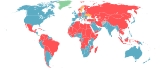
Countries with and without mandatory military service

See: Military service
Military service

Military service in its simplest sense, is service by an individual or group in an army or other military organization, whether as a chosen job or as a result of an involuntary draft ....


Conscription by country — Examples
CountryLand areaGDP nominal (US$M)Per capita
GDP (US$)
PopulationGovernmentConscription
Albania 27,398 $10,620 $2,949.57 3,619,778 emerging democracy Yes
Algeria 2,381,740 $90,000 $2,700.01 33,333,216 republic Yes
Angola 1,246,700 $28,610 $2,332.92 12,263,596 republic; multiparty presidential regime Yes
Argentina 2,736,690 $210,000 $5,210.67 40,301,927 republic Legal, not practiced
Australia 7,617,930 $644,700 $31,550.09 20,434,176 federal parliamentary democracy No (banned as enshrined by parliament in 1972
Austria 82,444 $310,100 $37,818.07 8,233,300 federal republic Yes
Bahamas 10,070 $6,586, $21,547.17 307,451 constitutional parliamentary democracy No
Bangladesh 133,910 $72,420 $481.36 153,546,896 parliamentary democracy No
Belgium 30,528 $316,200 $31,400 10,584,534 democracy No (conscription suspended since 1994)
Belize 22,806 $1,274 $4,327.67 301,270 parliamentary democracy Military service is voluntary
Bhutan 47,000 $1,308 $561.89 682,321 constitutional monarchy; special treaty relationship with India Yes (selective)
Bolivia 1,084,390 $13,190 $1,446.41 9,247,816 republic
Bosnia and Herzegovina 51,197 $14,780 $3,246.78 4,590,310 emerging federal democratic republic Yes
Brazil 1,314,000 $967,000 $6,915.40 196,342,592 federal republic Yes
Bulgaria 110,550 $39,610 $5,409.09 7,262,675 parliamentary democracy No (abolished by law in January 1, 2008)
Burma 657,740 $13,530 $285.60 47,758,180 military junta Officially prohibited, de facto still practiced
China 9,326,410 $3,251,000 $2,459.43 1,330,044,544 Communist state Yes (selective)
Croatia 56,414 $51,360 $11,430.32 4,491,543 presidential/parliamentary democracy No (abolished by law in 2008)
Cuba 110,860 $45,580 $4,000.34 11,423,952 Communist state
Denmark 42,394 $311,900 $57,039.71 5,484,723 constitutional monarchy Yes
Djibouti 22,980 $841 $1,694.29 506,221 republic No
El Salvador 20,720 $20,370 $2,931.75 7,066,403 republic Legal, not practiced
Finland 304,473 $245,000 $46,769.475,244,749 republic Yes
France 640,053Includes the overseas regions of French Guiana, Guadeloupe, Martinique, and Reunion. $2,560,000 $35,240.62 61,037,510 republicNo (conscription suspended since 2001)
Gambia 10,000 $653 $386.77 1,735,464 republic No
Germany 349,223 $3,322,000 $40,315.05 82,369,552 federal republic Yes (Alternative service
Alternative service

Alternative service is a form of national service performed in lieu of conscription for various reasons, such as conscientious objection, inadequate health, or political reasons....
available)
Greece 130,800 $314,600 $29,384.60 10,722,816 parliamentary republic Yes
Grenada 344 $590 $6,557.67 90,343 parliamentary democracy No (no military service)
Hungary 92,340 $138,400 $13,901.01 9,930,915 parliamentary democracy Yes
Iran 1,636,000 $193,500 $2,958.83 68,251,090 theocratic republic Yes
India 2,973,190 $1,099,000 $972.68 1,147,995,904 federal republic No
Israel 20,330 $161,900 $25,191.86 7,112,359 parliamentary democracy
Jamaica 10,831 $11,210 $4,032.18 2,804,332 constitutional parliamentary democracy No
Japan 374,744 $4,384,000 $34,402.26 127,288,416 constitutional monarchy with a parliamentary government No
Jordan 91,971 $16,010 $2,644.89 6,198,677 constitutional monarchy No (suspended indefinitely in 1992)
Korea, North 120,410 $40,000 $1,800 23,479,088 Communist state one-man dictatorship Yes
Korea, South 98,190 $957,100 $19,514.81 48,379,392 republic Yes
Kuwait 17,820 $60,720 $24,234.11 2,505,559 constitutional emirate Yes
Lebanon 10,230 $24,640 $6,276.90 3,971,941 republic No (abolished in 2007)
Libya 1,759,540 $57,060 $9,451.85 6,173,579 jamahiriya (a state of the masses) in theory, governed by the populace through local councils; in practice, an authoritarian state Yes
Luxembourg 2,586 $50,160 $104,451.69 486,006 constitutional monarchy No
Macedonia, Republic of 24,856 $7,497 $3,646.55 2,061,315 parliamentary democracy Yes
Malaysia 328,550 $186,500, $7,513.71 25,274,132 constitutional monarchy No
Maldives 300 $1,049 $2,842.58 385,925 republic No
Malta 316 $7,419 $18,460.73 403,532 republic No
Moldova 33,371 $4,227 $978.36 4,324,450 republic Yes
Netherlands 33,883 $768,700, $46,389.35 16,645,313 constitutional monarchy No
New Zealand 268,021 $128,100 $31,124.18 4,173,460 parliamentary democracy No
Philippines 298,170 $144,100 $1,582.17 96,061,680 Republic Yes
Poland 304,459 $420,300 $10,911.71 38,500,696 republic No
Qatar 11,437 $67,760 $74,688.97 824,789 emirate No
Romania 230,340 $166,000 $7,451.95 22,246,862 republic No (ended in 2007)
Russia 16,995,800 $1,290,000 $9,124.49 140,702,096 federation Yes
Rwanda 24,948 $3,320 $335.10 10,186,063 republic; presidential, multiparty system No
Saudi Arabia 376,000 $276,900 $13,622.68 28,146,656 monarchy No
Seychelles 455 $710 $8,669.64 82,247 republic Yes
Singapore 682.7 $161,300 $35,427.12 4,608,167 parliamentary republic
Slovenia 20,151 $46,080 $22,933.99 2,007,711 parliamentary republic yes
South Africa 1,219,912 $282,600 $6,423.04 48,782,756 republic No
Spain 499,542 $1,439,000 $35,576.37 40,491,052 parliamentary monarchy Yes
Syria 184,050 $37,760 $1,954.98 19,747,586 republic under an authoritarian military-dominated regime Yes
Swaziland 17,203 $2,936 $2,591.20 1,128,814 monarchy No
Switzerland 39,770 $423,900 $56,111.06 7,581,520 formally a confederation but similar in structure to a federal republic Yes
Taiwan
(Republic of China)
32,260 $383,300 $16,768.11 22,920,946 multiparty democracy Yes (alternative service
Alternative service

Alternative service is a form of national service performed in lieu of conscription for various reasons, such as conscientious objection, inadequate health, or political reasons....
 available
Thailand 511,770 $245,700 $3,776.0 65,493,296 constitutional monarchy Yes
Tonga 718 $219 $1,873.06 119,009 constitutional monarchy No
Trinidad and Tobago 5,128 $20,700 $19,590.99 1,047,366 parliamentary democracy No
Turkey 770,760 $663,400 $9,322.83 71,892,808 republican parliamentary democracy Yes
United Kingdom 241,590 $2,773,000, $45,626.38 60,943,912 constitutional monarchy No (except Bermuda Regiment
Bermuda Regiment

The Bermuda Regiment is the home defence unit of the United Kingdom British Overseas Territory of Bermuda. It is a single Territorial Army infantry battalion#British Army that was formed by the amalgamation in 1965 of two originally-voluntary units, the all white Bermuda Volunteer Rifle Corps and the mostly black Bermuda Militia Artillery ....
 )
United States 9,161,923 $13,840,000 $45,958.70 303,824,640 Presidential federal republic No
Vanuatu 12,200 $455 $2,146.52 215,446 parliamentary republic No


Arguments against conscription


Universal Declaration of Human Rights

Many arguments opposed to conscription, or opposed to gender-discriminated conscription, arise from its alleged violation of the principles of the Universal Declaration of Human Rights
Universal Declaration of Human Rights

The Universal Declaration of Human Rights is a declaration adopted by the United Nations General Assembly . The Guinness Book of Records describes the UDHR as the "Most Translated Document" in the world....
 of the United Nations
United Nations

The United Nations is an international organization whose stated aims are to facilitate cooperation in international law, international security, economic development, Social change, human rights and achieving world peace....
. In particular:
  • Art.2: Everyone is entitled to all the rights and freedoms set forth in this Declaration, without distinction of any kind, such as (…) sex (…)
  • Art.3: Everyone has the right to life, liberty and security of person.
  • Art.4: No one shall be held in (…) servitude (…)
  • Art.18: Everyone has the right to freedom of thought, conscience and religion; this right includes freedom to change his religion or belief, and freedom, either alone or in community with others and in public or private, to manifest his religion or belief in teaching, practice, worship and observance.
  • Art.20: (…) No one may be compelled to belong to an association.
  • Art.23: Everyone has the right (…) to free choice of employment (…)


In addition, many constitutions do provide similar rights in countries where there is or has been some form of conscription after World War II
World War II

World War II, or the Second World War , was a global military conflict which involved a Participants in World War II, including all of the great powers, organised into two opposing military alliances: the Allies of World War II and the Axis powers....
 or that maintain a possibility of conscription in time of war.

Slavery

Conscription subjects individual personalities to militarism. It is a form of servitude. That nations routinely tolerate it, is just one more proof of its debilitating influence.
Albert Einstein
Albert Einstein

Albert Einstein was a Germany-born theoretical physics. He is best known for his theory of relativity and specifically mass?energy equivalence, expressed by the equation E = mc2....
, Sigmund Freud
Sigmund Freud

Sigmund Freud , born Sigismund Schlomo Freud , was an Austrian psychiatrist who founded the psychoanalysis of psychology. Freud is best known for his theories of the unconscious mind and the defense mechanism of Psychological repression and for creating the clinical practice of psychoanalysis for curing psychopathology through dialogue...
, H.G. Wells, Bertrand Russell
Bertrand Russell

Bertrand Arthur William Russell, 3rd Earl Russell, Order of Merit , Fellow of the Royal Society , was a British people philosopher, mathematical logic, mathematician, historian, advocate for social reform, and pacifism....
 and Thomas Mann
Thomas Mann

Paul Thomas Mann was a German literature, short story writer, social critic, philanthropist, essayist, and 1929 Nobel Prize for Literature, known for his series of highly symbolic and irony epic novels and novellas, noted for their insight into the psychology of the artist and the intellectual....
 in Against Conscription and the Military Training of Youth — 1930


Some groups, such as libertarians, say that the draft constitutes slavery
Slavery

Slavery is a form of forced labor where a person is compelled to Labor for another . Slaves are held against their will from the time of their capture, purchase, or birth, and are deprived of the right to leave, to refuse to work, or to receive Remuneration in return for their labor....
, since it is mandatory work. Under the Thirteenth Amendment
Thirteenth Amendment to the United States Constitution

The Thirteenth Amendment to the United States Constitution officially abolished and continues to prohibit slavery and involuntary servitude, except as punishment for a crime....
 to the U.S. Constitution, slavery or other involuntary servitude is not allowed unless it is part of punishment for a crime. They therefore see the draft as unconstitutional
Constitutionality

Constitutionality is the status of a law, a procedure, or an act's accordance with the laws or guidelines set forth in the applicable constitution....
 (at least in the U.S.) and immoral. In 1918, the Supreme Court
Supreme Court of the United States

The Supreme Court of the United States is the highest judicial body in the United States, and leads the federal United States federal courts. It consists of the Chief Justice of the United States and eight Associate Justice of the Supreme Court of the United States, who are nominated by the President of the United States and confirmed with th...
 ruled that the World War I
World War I

World War I, or the First World War , was a global military conflict which involved the Great powers, organized into two opposing military alliances: the Allies of World War I and the Central Powers....
 draft did not violate the United States Constitution
United States Constitution

The Constitution of the United States of America is the supreme law of the United States. It is the foundation and source of the legal authority underlying the existence of the United States of America; the Federal Government of the United States; and all the State & local governments and Territorial Administrative bodies contained therein....
. Arver v. United States, . The Court detailed its conclusion that the limited powers of the federal government included conscription. Its only statement on the Thirteenth Amendment
Thirteenth Amendment to the United States Constitution

The Thirteenth Amendment to the United States Constitution officially abolished and continues to prohibit slavery and involuntary servitude, except as punishment for a crime....
 issue reads thus:
Finally, as we are unable to conceive upon what theory the exaction by government from the citizen of the performance of his supreme and noble duty of contributing to the defense of the rights and honor of the nation as the result of a war declared by the great representative body of the people can be said to be the imposition of involuntary servitude
Involuntary servitude

Involuntary servitude is a United States law and constitutional term for a person laboring against that person's will to benefit another, under some form of coercion....
 in violation of the prohibitions of the Thirteenth Amendment, we are constrained to the conclusion that the contention to that effect is refuted by its mere statement.


In the USSR, most of the conscripts received only very basic training and were used for forced labor unrelated to actual military service — such as building Dacha
Dacha

Dacha is a Russian word for seasonal or year-round second homes located in the exurbs of Soviet and Russian cities. In some cases it is occupied part of the year by its owner or rented out to urban residents as a summer retreat....
s (second homes) for officers or digging up potatoes in the field with zero wage cost. This contributed to the lack of incentives for the Soviet-planned economy system to produce better combined harvesting machines and Soviet agriculture remained low-tech.

In Soviet-bloc Hungary
Hungary

Hungary , officially in English the Republic of Hungary , is a landlocked country in the Carpathian Basin of Central Europe, bordered by Austria, Slovakia, Ukraine, Romania, Serbia, Croatia, and Slovenia....
, more than half of pre-1989 conscripts received a mere few weeks of rifle
Rifle

A rifle is a firearm designed to be fired from the shoulder, with a barrel that has a helical groove or pattern of grooves cut into the barrel walls....
 training and were swiftly assigned to "working squadrons," which usually hand-built rail tracks
Rail tracks

Rail tracks are used on rail transports , which, together with Railroad switch , guide trains without the need for steering. Tracks consist of two parallel steel Rail profile, which are laid upon Railroad tie that are embedded in track ballast to form the railroad track....
 "for free", and in very poor quality. At the same time, railway tracks in Western Europe were being built to high-quality standards by semi-automatic, rail-rolling factories operated by a professional workforce.

Ageism

Conscription is usually limited to young people, and the burden of conscription is almost never spread equally across all age groups. The youngest people considered qualified are usually conscripted first. Opponents of ageism, and advocates of youth liberation, argue that age-based military conscription is the most severe disparity on the basis of age of any government mandate on individuals. This argument is epitomized by the Phil Ochs
Phil Ochs

Philip David Ochs was a United States protest song and songwriter who was known for his sharp wit, sardonic humor, earnest humanism, political activism, insightful and alliterative lyrics, and haunting voice....
 song, "I Ain't Marching Anymore": "It's always the old who lead us to the war; it's always the young who fall." Even in countries with elected governments, conscripts are often too young to be allowed to vote or participate in decisions on whether to go to war or to impose or set policies for conscription. The Twenty-sixth Amendment to the United States Constitution
Twenty-sixth Amendment to the United States Constitution

The 'Twenty-sixth Amendment' to the United States Constitution standardized the voting age to 18. It was adopted in response to student activism against the Vietnam War and to partially overrule the Supreme Court of the United States decision in Oregon v....
, which lowered the voting age to 18, was proposed and approved largely in response to criticism of conscription based on the unfairness of drafting men too young to be allowed to vote. But draft-age voters in the USA are still overwhelmingly outnumbered by voters considered to be too old to be conscripted.

Sexism

Traditionally conscription has been limited to the male population. Women and non-able-bodied
Able-bodied

Able-bodied refers, in law, to an individual's physical or mental capacity for gainful employment or military service, and it is in this sense that the term is also used regarding eligibility for payment of child support or alimony....
 males have been exempted from conscription. Many societies have traditionally considered conscription as a test of manhood and a rite of passage
Rite of passage

A rite of passage is a ritual that marks a change in a person's social status. It is a universal phenomenon which can show anthropologists what social hierarchies, values and beliefs are important in specific cultures....
 from boyhood into manhood.

Discipline problems

No military can operate effectively without discipline. Discipline can either be taught from esprit de corps, already-acquired motivation of the personnel or be fundamentally embedded into the troops through guidance from leadership. One can speculate that volunteers manifest less undisciplined behavior, however citizens conscripted might have little motivation to serve. As motivation is based on coercion
Coercion

Coercion is the practice of compelling a person or manipulating them to behave in an involuntary way by use of threats, intimidation, trickery, or some other form of pressure or force....
, the corrective action imposed upon undisciplined conscriptees is often harsh. Capital punishment
Capital punishment

Capital punishment, the death penalty or execution, is the killing of a person by procedural law for Punishment#Retribution and Punishment#Incapacitation....
, usually by firing squad, was used almost universally to maintain discipline in conscript militaries during wartime. Antony Beevor has estimated the executions covered some 1% to 5% of all conscript losses in World War II. This can be best summarized by a statement from Leon Trotsky
Leon Trotsky

Leon Trotsky , born Lev Davidovich Bronstein , was a Bolshevik revolutionary and Marxism theorist. He was one of the leaders of the Russian October Revolution, second only to Lenin....
:

An army cannot be built without reprisals. Masses of men cannot be led to death unless the command has the death penalty in its arsenal. So long as those malicious tailless apes that are so proud of their technical achievements — the animals that we call men — will build armies and wage wars, the command will always be obliged to place the soldiers between the possible death in the front and the inevitable one in the rear.


Consequently, conscript armies are more likely to mutiny than all-volunteer forces, and can in extreme cases turn against their own (see fragging).

Discipline problems become much worse when the ablest of the youth are forced to serve against their will under the authority of people they consider less intelligent, untalented, or simply because of unquestioned authority. This was seldom a problem in the period of Industrialism when only the upper classes had access to higher education, but proved problematic in the Vietnam War
Vietnam War

The Vietnam War, also known as the Second Indochina Wars, the Vietnam Conflict, or often in Vietnam the American War occurred in Vietnam, Laos and Cambodia from 1959 to April 30, 1975....
, when college students were conscripted to fight under non-commissioned officers, many of whom had not finished high school
High school

High school is the name used in some parts of the world to describe an institution which provides all or part of secondary education. The term originated in Scotland and spread to the New World countries as the high prestige that the Scottish educational system had at the time led several countries to employ Scottish educators to develop the...
 and few of whom had any higher education.

Nationalism and promoting militarism

The military draft is predicated on the assumption that nations have rights that supersede those of the individual. In the words of Einstein and Gandhi's Anti-Conscription Manifesto, "The State which thinks itself entitled to force its citizens to go to war will never pay proper regard to the value and happiness of their lives in peace." The building of large conscript armies coincided with the rise of virulent nationalism
Nationalism

Nationalism refers to an ideology, a feeling, a form of culture, or a social movement that focuses on the nation. While there is significant debate over the historical origins of nations, nearly all Expert accept that nationalism, at least as an ideology and social movement, is a Modernity phenomenon originating in Europe....
 in the 19th and 20th centuries, culminating in World War II
World War II

World War II, or the Second World War , was a global military conflict which involved a Participants in World War II, including all of the great powers, organised into two opposing military alliances: the Allies of World War II and the Axis powers....
.

In peacetime, conscription can create an atmosphere of militarism
Militarism

File:CaptainJ.R.Jellicoe.jpgMilitarism is the belief or desire of a government or people that a country should maintain a strong military capability and be prepared to use it aggressively to defend or promote national interests....
 and bigotry
Bigotry

A bigot is a person who is intolerant of or takes offence to the opinions, lifestyles or identities differing from his or her own, and bigotry is the corresponding attitude or mindset....
 in society. Many young men in countries with compulsory conscription develop a cynical stance about militarism because the mandatory nature of conscription creates low morale among soldiers. This is especially true in countries where nationalist feelings are weak to begin with, such as Austria
Austria

Austria , officially the Republic of Austria , is a landlocked country in Central Europe. It borders both Germany and the Czech Republic to the north, Slovakia and Hungary to the east, Slovenia and Italy to the south, and Switzerland and Liechtenstein to the west....
, Germany
Germany

Germany , officially the Federal Republic of Germany , is a country in Central Europe. It is bordered to the north by the North Sea, Denmark, and the Baltic Sea; to the east by Poland and the Czech Republic; to the south by Austria and Switzerland; and to the west by France, Luxembourg, Belgium, and the Netherlands....
 and Sweden
Sweden

Sweden , officially the Kingdom of Sweden , is a Nordic countries on the Scandinavian Peninsula in Northern Europe. Sweden has land borders with Norway to the west and Finland to the northeast, and it is connected to Denmark by the ?resund Bridge in the south....
, or where conditions are brutal.

Men who have had military training can also be more ready to use violence to solve conflicts than those who have not. Conscription also may create an atmosphere of chauvinism
Chauvinism

Chauvinism is extreme and unreasoning partisanship on behalf of a group to which one belongs, especially when the partisanship includes malice and hatred towards a rival group....
, sexism
Sexism

Sexism, a term coined in the late 20th century, refers to the belief or attitude that one gender or sex is inferior to or less valuable than the other....
 and discrimination
Discrimination

Discrimination toward or against a person or group is the treatment or consideration based on class or category rather than individual merit. It is usually associated with prejudice....
 against those men who haven't served in the armed forces.

Justification for attacks on civilians

Conscription is a component of total war
Total war

Total war is a war of unlimited scope in which a belligerent engages in a mobilization of all available Factors of productions at their disposal, whether human, industrial, agricultural, military, natural, technological, or otherwise, in order to entirely destroy or render beyond use their rival's capacity to continue resistance....
, and can also be used as an example of established policy to justify a government's demand that other sacrifices be required of civilians. Once a draft is allowed, Justice Louis Brandeis
Louis Brandeis

Louis Dembitz Brandeis was an American lawyer, Supreme Court Justice, advocate of privacy, and developer of the Brandeis Brief in Muller v. Oregon....
 argued, "all bets are off". Arguably this results in a blurring of the moral distinction between civilians and the military as legitimate military targets, leading to attacks on civilians. Examples would include the indiscriminate bombing of cities conducted by both sides during World War II
World War II

World War II, or the Second World War , was a global military conflict which involved a Participants in World War II, including all of the great powers, organised into two opposing military alliances: the Allies of World War II and the Axis powers....
, the My Lai Massacre
My Lai Massacre

The My Lai Massacre was the mass murder of 347 to 504 unarmed citizens in South Vietnam, entirely civilians and some of them women and children, conducted by U.S....
. It has been popular recently to call civilian deaths "collateral damage" although their deaths are highly predictable. In fact, during the last century, civilian deaths have grown compared to military deaths in conflict.

Quality

One of the objections raised is that a conscript force would be of lower quality than a volunteer army. First, short periods of service do not allow for much skill building. Second, there is a possibility of a morale drop in units with conscripts, leading to a reduction in quality as officers and NCOs work to alleviate those problems.

The biggest problem is that the pace of training has to be adjusted to the level of the lowest quality candidate. Combined with the short tour of duty, this renders the skills of the conscripts very low. Therefore the elite
Elite

Elite is taken originally from the Latin, eligere, "to elect". In sociology as in general usage, the elite is a relatively small dominant Group within a large society, which enjoys a privileged status envied by individuals of lower social status....
 units of all armies which have conscription, are composed entirely of selected volunteers, such as Parachute Rangers in the Finnish army.

Likewise, the military training of the conscripts is almost universally very rudimentary. It seldom goes beyond drill
Parade (military)

A military parade is a formation of soldiers whose movement is restricted. The American usage is "formation or military review". The military parade is now mostly ceremonial, though soldiers from time immemorial up until the late 19th century fought in formation....
, shooting
Shooting

Shooting is the act or process of firing rifles, shotguns or other projectile weapons such as Bow s or crossbows. Even the firing of artillery, rockets and missiles can be called shooting....
 practice, rudimentary specialization on one's service branch and weapons and basic battlefield training. Likewise, many nations have used conscripts simply as indentured, low-cost work force, organized as "work battalions" for agriculture and building infrastructure instead of decent military service.

Economics

It can be argued that in a cost-to-benefit ratio, conscription during peace time is not worthwhile. Months or years of service amongst the most fit subtracts from the productivity of the economy; add to this the cost of training them, and in some countries paying them. Compared to these extensive costs, some would argue there is very little benefit, if there ever were war conscription and basic training could be completed quickly, and in most countries where conscription is compulsory there is little threat of war in any case.

The cost to particularly in times of military duress, such as the current U.S. conflict in Iraq, conscription serves as an instrument through which fresh soldiers may be readied when reserves and voluntary troops have been over utilized. These new troops ultimately provide more efficient use of U.S. economic resources since individuals plan for military involvement as a normal activity. Draft assignments, in contrast, disrupt everyday activity and lead to possibly greater economic shock.

The cost of conscription can be related to the parable of the broken window
Parable of the broken window

The parable of the broken window was created by Fr?d?ric Bastiat in his 1850 essay to illuminate the notion of hidden costs.Bastiat uses this story to introduce a concept he calls the broken window fallacy, which is related to the Unintended consequences, in that both involve an incomplete accounting for the consequences of an a...
. Military service can be related to any work. The costs of work do not disappear anywhere even if no salary is paid. The work effort of the conscripts is effectively wasted; unwilling work force is extremely inefficient and the conscripts also lose their the costs of all-volunteer paid force. The impact is especially severe in wartime, when civilian professionals are forced to fight as amateur soldiers. Not only is the work effort of the conscripts wasted and productivity is lost, but professionally-skilled conscripts are also difficult to replace in the civilian work force. Every soldier conscripted in the army is taken away from his civilian work, and away from contributing to the economy which funds the military. This is not a problem in an agrarian or pre-industrialized state where the level of education is universally low, and where a worker is easily replaced by another. However, this proves extremely problematic in a post-industrial society
Post-industrial society

A post-industrial society is a society in which an economic transition has occurred from a secondary industry to a Tertiary sector of the economy, a diffusion of national and global capital, and mass privatization....
 where educational levels are high and where the work force is highly sophisticated and a replacement for a conscripted specialist is difficult to find. Even direr economic consequences result if the professional conscripted as an amateur soldier is killed or maimed for life; his work effort and productivity is irrevocably lost.

Draft as a tool to subjugate society

Another argument sees conscription as a tool for dictatorship
Dictatorship

A dictatorship is usually defined as an Autocracy form of government in which the government is ruled by an individual, the dictator, without hereditary ascension....
s to control and re-educate
Reeducation

Reeducation may refer to:* Brainwashing, efforts aimed at instilling certain beliefs in people against their will* Reeducation through labor, also called laojiao, a form of penal detention in China....
 a population instead of being a means for an oppressed people to infiltrate the military as the power base for every dictatorship. Especially since the military is inherently based on giving and obeying orders, instead of democracy, it is argued that a draft is a far more effective tool to instill obedience and unconditional following into society than giving a democratic populace the opportunity to control the military. Supporting that argument is the fact, that Nazi Germany
Nazi Germany

Nazi Germany and the Third Reich are the colloquial English names for Germany under the regime of Adolf Hitler and the Nazi Party , which established a Totalitarianism dictatorship that existed from 1933 to 1945....
 changed the Reichswehr
Reichswehr

The Reichswehr formed the armed forces of Germany from 1919 until 1935, when it was renamed the Wehrmacht .At the end of World War I, the forces of the German Empire had mostly disintegrated, the men making their way home individually or in small groups....
 from an all-volunteer army in 1934 into the conscription-based Wehrmacht
Wehrmacht

Wehrmacht was the name of the unified armed forces of Germany from 1935 to 1945. It consisted of the Heer , the Kriegsmarine and the Luftwaffe ....
.

Also almost all contemporary dictatorships have a military draft (Syria
Syria

Syria , officially the Syrian Arab Republic , is an Arab-majority country in Southwest Asia, bordering Lebanon and the Mediterranean Sea to the west, Israel to the southwest, Jordan to the south, Iraq to the east, and Turkey to the north....
, North Korea
North Korea

North Korea, officially the Democratic People's Republic of Korea , is a state in East Asia, occupying the northern half of the Korean Peninsula....
, as well as Iraq
Iraq

Iraq , officially the Republic of Iraq , is a country in Western Asia spanning most of the northwestern end of the Zagros Mountains, the eastern part of the Syrian Desert and the northern part of the Arabian Desert....
 under Saddam Hussein). Virtually all former military dictatorship
Military dictatorship

A military dictatorship is a form of government wherein the political power resides with the military. It is similar but not identical to a stratocracy, a state ruled directly by the military....
s relied heavily on conscribing their entire adolescent male populations (with the military dictatorship of Burma being a notable exception). The former military dictatorships of Turkey
Turkey

Turkey , known officially as the Republic of Turkey , is a Eurasian country that stretches across the Anatolian peninsula in southwest Asia and Thrace in the Balkans region of Southern Europe....
, Greece
Greece

Greece , officially the Hellenic Republic , is a country in southeastern Europe, situated on the southern end of the Balkans. It has borders with Albania, Bulgaria and the former Yugoslav Republic of Macedonia to the north, and Turkey to the east....
, Spain
Spain

Spain or the Kingdom of Spain , is a country located in Southern Europe on the Iberian Peninsula.The Spanish constitution does not establish any official denomination of the country, even though Espa?a , Estado espa?ol and Naci?n espa?ola are used interchangeably....
, Chile
Chile

Chile, officially the Republic of Chile , is a country in South America occupying a long and narrow coastal strip wedged between the Andes mountains and the Pacific Ocean....
, Argentina
Argentina

Argentina, officially the Argentine Republic , is a country in South America, constituted as a federation of 23 provinces and an autonomous city....
, Brazil
Brazil

Brazil , officially the Federative Republic of Brazil , is a country in South America. It is the List of countries and outlying territories by total area country by geographical area, occupying nearly half of South America, the List of countries by population country, and the fourth most populous democracy in the world....
, Indonesia
Indonesia

The Republic of Indonesia , is a transcontinental country in Southeast Asia and Oceania. Comprising Islands of Indonesia, it is the world's largest Archipelago state....
 and Libya
Libya

Libya , officially the Great Socialist People's Libyan Arab Jamahiriya , is a country located in North Africa. Bordering the Mediterranean Sea to the north, Libya lies between Egypt to the east, Sudan to the southeast, Chad and Niger to the south, and Algeria and Tunisia to the west....
 maintained draft systems throughout their reigns as well as all formerly communist dictatorships and the Soviet Union
Soviet Union

The Union of Soviet Socialist Republics was a Constitution of the Soviet Union socialist state that existed in Eurasia from 1922 to 1991.The name is a translation of the , romanization of Russian Soyuz Sovetskikh Sotsialisticheskikh Respublik, abbreviated ????, SSSR....
 itself.

Arguments for conscription


Valuable training

Some communitarians
Communitarianism

Communitarianism, as a group of related but distinct philosophies, began in the late 20th century, opposing in its opinion exalted forms of individualism while advocating phenomena such as civil society....
 argue that peacetime conscription is an ideal tool for teaching a population basic, important skills such as first aid
First aid

First aid is the provision of initial care for an illness or injury. It is usually performed by a layman to a sick or injured Casualty until definitive medical treatment can be accessed....
, swimming
Swimming

Swimming is the movement by humans or animals through water, usually without artificial assistance. Swimming is an activity that can be both useful and recreational....
, and wilderness survival. They also argue that conscription makes for a more disciplined and skilled workforce, as men and women leave the military and take the skills which they honed there back to their civilian jobs.

Rite of passage

In many countries, conscription serves as a rite of passage
Rite of passage

A rite of passage is a ritual that marks a change in a person's social status. It is a universal phenomenon which can show anthropologists what social hierarchies, values and beliefs are important in specific cultures....
. The prospective man is tested, to see whether or not he can endure the hardships of military training and earn the right to be called a man. Military service, in countries that have it, may then be seen as the test of manhood. Conscription may inspire camaraderie, unifying a people: all able-bodied males together as a union have had the same experience and are soldiers, and that may create unity and a national spirit.

Draft as protection against democracy-destroying military coups

Some argue that conscription should be connected to democracy. A professional army can possibly become a dangerous state-within-a-state. Military virtue
Virtue

Virtue is morality excellence. Personal virtues are characteristics Value as promoting individual and collective well-being, and thus Goodness and value theory by definition....
s such as obedience to orders and respect for the chain of command can possibly be abused by aspiring dictator
Dictator

A dictator is an authoritarian ruler who assumes sole and absolute power without hereditary ascension such as an absolute monarch. When other states call the head of state of a particular state a dictator, that state is called a dictatorship....
s. Armed forces can attract — consciously or unconsciously — people who prefer authoritarian
Authoritarianism

Authoritarianism describes a form of government characterized by an emphasis on the authority of the state in a republic or union. It is a political system controlled by nonelected rulers who usually permit some degree of individual freedom....
 systems. The army can even become the only chance for a job and decent life in times of unemployment (this was crucial in the rise of Japanese militarism
Japanese militarism

refers to the ideology in the Empire of Japan that militarism should dominate the political and social life of the nation, and that the strength of the military is equal to the strength of a nation....
), or for despised minorities. Such people may come to regard the army as their home and elevate it above the state.

On the other hand, once in power dictators such as Napoléon Bonaparte, Adolf Hitler
Adolf Hitler

Adolf Hitler was an Austrian-born Germany politician and the leader of the National Socialist German Workers Party , popularly known as the Nazi Party....
, and Saddam Hussein
Saddam Hussein

Saddam Hussein Abd al-Majid al-Tikriti was the President of Iraq of Iraq from 16 July 1979 until 9 April 2003.A leading member of the revolutionary Ba'ath Party, which espoused secular pan-Arabism, economic modernization, and Arab socialism, Saddam played a key role in the 1968 coup that brought the party to long-term power....
 have used conscription. The most significant attempt on Hitler's life was from the professional component of his military.

One should also note the 1980 Turkish coup d'état and many other coup d'état
Coup d'état

A coup d??tat , often simply called a coup, is the sudden unconstitutional overthrow of a government by a part of the state establishment – usually the military – to replace the branch of the stricken government, either with another civil government or with a military government....
s because the military was dissatisfied with the democratic election, despite the fact that Turkey had a military based on conscripts.

Manpower

Small countries have several options to raise a sizeable army. One is to put every able-bodied man under arms. This is how Switzerland
Switzerland

Switzerland is a landlocked Swiss Alps country of roughly 7.7 million people in Western Europe with an area of 41,285 km?. Switzerland is a federal republic consisting of 26 states called Cantons of Switzerland....
 managed to stay independent despite repeated attacks throughout history. The Swiss militias were so successful that their fighting style and weapons (especially the halberd
Halberd

A halberd is a two-handed pole weapon that came to prominent use during the 14th and 15th centuries. Possibly the word halberd comes from the German words Halm , and Barte ....
) were quickly adopted by their enemies. This in turn made the Swiss very popular as mercenaries; many rulers even raised Swiss Guard
Swiss Guard

Swiss Guards is the name given to the Swiss soldiers who have served as bodyguards, ceremonial guards, and palace guards at foreign European courts since the late 15th century....
s. The rich Flemish trade cities of the early 14th century raised huge militias that could even defeat armies of knights. The famous Battle of the Golden Spurs
Battle of the Golden Spurs

The Battle of the Golden Spurs was fought on July 11, 1302, near Kortrijk in Flanders. The date of the battle is the official celebration day of the Flemish community in Belgium....
 (1302) is a good example.

Other options for national defense include membership in a military alliance like NATO
NATO

The North Atlantic Treaty Organization , also called the Atlantic Alliance, is a military alliance established by the signing of the North Atlantic Treaty on 4 April 1949....
, as is the case for countries like Belgium
Belgium

* A small German-speaking Community of Belgium exists in eastern Wallonia. Belgium's linguistic diversity and related political and cultural conflicts are reflected in the history of Belgium and a complex Communities and regions of Belgium....
 and Luxembourg
Luxembourg

Luxembourg , officially the Grand Duchy of Luxembourg , is a small landlocked country in western Europe, bordered by Belgium, France, and Germany....
. Switzerland started out as a military alliance between independent cantons. However, the membership in such alliance decreases the independence of a country, making it dependent on its stronger allies. Several NATO members maintain conscription, so an alliance is not mutually exclusive with conscription.

Also, a wealthy small country could hire a professional mercenary
Mercenary

A mercenary is a person who takes part in an armed conflict, who is not a national or a party to the conflict, and is "motivated to take part in the hostilities essentially by the desire for private gain and, in fact, is promised, by or on behalf of a party to the conflict, material compensation substantially in excess of that promised or p...
 army. This approach does, however, require wealth and men who are willing to hire on. Moreover, it requires some means to control the mercenaries if they became unruly.

Due to the attrition inherent in warfare, it is difficult to maintain the numbers needed for a wholly professional military, especially in a lengthy war. Complicating matters is the fact that military service in such times becomes more and more unattractive, even if the war has broad support. It is for this reason that the previously all-volunteer Union Army
Union Army

The Union Army was the army that fought for the Union during the American Civil War. It was also known as the Federal Army, the U.S....
 and the World War I
World War I

World War I, or the First World War , was a global military conflict which involved the Great powers, organized into two opposing military alliances: the Allies of World War I and the Central Powers....
 British Army
British Army

The British Army is the Army branch of the British Armed Forces. It came into being with the unification of the Kingdoms of Kingdom of England and Kingdom of Scotland into the Kingdom of Great Britain in 1707....
 switched to conscription after a few years of combat and its associated losses.

However, conscription creates numbers but not quality. Niccolò Machiavelli
Niccolò Machiavelli

Niccol? di Bernardo dei Machiavelli is the philosopher, writer, and Italian politician considered the founder of modern political science. As a Renaissance Man, he was a Diplomacy, Political philosophy, musician, poet, and playwright, but, foremost, he was a Civil Servant of the Florence....
's attempts to raise a conscript army in Florence
Florence

Florence is the Capital city of the Italy Regions of Italy of Tuscany and of the provinces of Italy Province of Florence. It is the most populous city in Tuscany and has a population of 364,779 ....
 ended in catastrophe; the conscripts did not have adequate training or experience, and were awkward to perform drill and maneuver. If the conscript army is trained only during the crisis, the limits on time and resources on training enable only rudimentary training; anything else is to be learnt on the battlefield. However, this can be avoided by peace-time conscription to train a large reserve usable in a crisis. The quality of the reserve must be maintained by steady refresher exercises. In several countries where conscription is in use, the length (and quality) of the training is virtually similar to that of professional armies.

The losses to conscript armies on the battlefield are often large, but waste of manpower is limited by the fact that the supply of able-bodied males in a nation is not inexhaustible. In addition, any government waging a prolonged war with conscripts will risk losing popular support and following loss of power. For a democratic government, this limits the use of conscript forces for wars that are fights for existence. Pursuing national interests or expeditionary wars may still necessitate a large professional army.

Conscripts can also be used away from combat roles, in such duties as garrisoning important areas, internal security, protection of supply routes, thus relieving the professionals for the front.

Conscript quality

The manpower quality of a conscript force is considered poor in many countries and conversely, governments are reluctant to invest in professional-quality training of conscripts, giving poor-quality forces. However, in some countries with conscription, the personnel diversity of the conscript force is considered its greatest strength. Admittedly, there are persons who would not be employed by a professional force, but these are a minority and can be discharged for medical reasons in extreme cases.

However, the conscript force may also receive the best of the youth, who would never join a professional army. Many conscripts are from such social strata that they would have much more lucrative employment or would be studying, were they not obliged to serve. These persons provide talented manpower that can easily be trained for technical and leadership duties. As junior NCO and commissioned officer positions are filled with leadership-trained conscripts, the size and cost of the professional cadre is much smaller. As these ex-conscripts, as reservists, mature and lose their fighting fitness, they can be subsequently retrained and given emergency positions corresponding their civilian expertise. For example, a transport manager who is a reserve officer might serve as a battalion logistics chief during wartime. The leadership-trained conscripts can also be recruited to the regular forces. The vast improvement of the Egyptian Army
Egyptian Army

The Egyptian Army is the largest service branch within the Military of Egypt. It is estimated to number around 340,000, plus around 375,000 reservists for a total of 655-715,000....
 in between the Six Day War and the Yom Kippur War
Yom Kippur War

The Yom Kippur War, Ramadan War or October War , also known as the 1973 Arab-Israeli War and the Fourth Arab-Israeli War, was fought from October 6 to October 26, 1973 by a coalition of Arab states led by Egypt and Syria against Israel....
 has been attributed to the decision to conscript college graduates who were previously exempt.

In lengthy wars such as World War II
World War II

World War II, or the Second World War , was a global military conflict which involved a Participants in World War II, including all of the great powers, organised into two opposing military alliances: the Allies of World War II and the Axis powers....
, the differences between conscripts and professionals may disappear over time. During war commanders look to the combat experience of soldiers and units as an indication of quality, and conscripts who have seen action will be far more valuable to their superiors than green professionals.

The worst problem is that the training must be designed by the physical fitness and the learning ability of the least able of the youth. However, this can be at least partly avoided by differentiating the conscript training. Even the least able can usually fulfill important roles in relatively easy logistics duties, while the most able can be trained quite well as specialists. In many cases, the conscript servicemates may have social or societal problems, they may be criminal
Crime

Societies define Crime as the breach of one or more rules or laws for which some Government or force may ultimately prescribe a punishment.The word crime originates from the Latin crimen , from the Latin root cerno and Greek ????? = "I judge"....
s, bullies or drug abuse
Drug abuse

Drug abuse has a huge range of definitions related to taking a psychoactive drug or performance enhancing drug for a non-therapeutic or non-medical effect....
rs, or they may even be sociopaths
Psychopathy

Psychopathy is a psychology construct that describes chronic immoral and antisocial behavior.The term is often used interchangeably with sociopathy....
. Allowing such persons to serve is problematic. They may corrode the capability of the unit, even endangering the safety of the others. Some countries have recognized this problem, and attempt to exclude the potential troublemakers even before they get to serve, using medical discharges, for example. On the other hand, in some countries (like in Russia) the problems with this issue are extremely dire (see dedovschina). There is also the argument that if the problem can be classified as juvenile delinquency
Juvenile delinquency

Juvenile delinquency refers to criminal act acts performed by juvenile s. Most legal systems prescribe specific procedures for dealing with juveniles, such as juvenile detention centers....
, then the military functions as a "men's school". By giving responsibility, youth development
Youth development

Youth development or adolescent development is the process through which adolescences acquire the cognitive, social, and emotional skills and abilities required to navigate life....
 is induced, and adolescent-typical criminal behavior ceases. The problem is that the coercion
Coercion

Coercion is the practice of compelling a person or manipulating them to behave in an involuntary way by use of threats, intimidation, trickery, or some other form of pressure or force....
 type environment of conscription armies encourage avoidance of responsibility, rather than accepting it, being more likely to promote such antisocial behaviour than to discourage it.

Political and moral motives

Jean Jacques Rousseau argued vehemently against professional armies, feeling it was the right and privilege of every citizen to participate to the defense of the whole society and a mark of moral decline to leave this business to professionals. He based this view on the development of the Roman republic
Roman Republic

The Roman Republic was the phase of the Ancient Rome characterized by a republican form of government; a period which began with the overthrow of the Roman Roman Kingdom, c....
, which came to an end at the same time as the Roman army changed from a conscript to professional force. Similarly, Aristotle
Aristotle

Aristotle was a Greeks philosopher, a student of Plato and teacher of Alexander the Great. He wrote on many subjects, including physics, metaphysics, Poetics , theater, music, logic, rhetoric, politics, government, ethics, biology and zoology....
 linked the division of armed service among the populace intimately with the political order of the state.

Some ideologies
Ideology

An ideology is a set of aims and ideas, especially in politics. An ideology can be thought of as a comprehensive vision, as a way of looking at things , as in common sense and several philosophical tendencies , or a set of ideas proposed by the dominant class of a society to all members of this society....
 and cultures, and those based on collectivism
Collectivism

Collectivism is a term used to describe any moral, political, or social outlook, that stresses human interdependence and the importance of a collective, rather than the importance of separate individuals....
 or statism
Statism

Statism is a term that may refer to any of the following:# Government having a major role in the the direction of the economy, both through state-owned enterprises and indirectly through the central planning of overall economy....
, value the society and common good above the life of an individual. Those ideologies and world-views justify the state to force its members to protect itself and risk their lives for the common good. In states based on society-centered ideologies, world-views and religions, conscription is the natural way of raising the army.Other proponents such as the late William James
William James

William James was a pioneering American psychology and philosophy trained as a medical doctor. He wrote influential books on the young science of psychology, educational psychology, psychology of religion experience and mysticism, and the philosophy of pragmatism....
 consider both mandatory military and national service
National service

National service is a common name for mandatory or voluntary government service programs . National service was common in the 20th century, and many young people spent one or more years in such programs....
 as ways of instilling maturity in young adults as well a way to entail a sense of "sacrifice" and "self-denial".

In the era of total war
Total war

Total war is a war of unlimited scope in which a belligerent engages in a mobilization of all available Factors of productions at their disposal, whether human, industrial, agricultural, military, natural, technological, or otherwise, in order to entirely destroy or render beyond use their rival's capacity to continue resistance....
, the conscription is the only alternative for a small nation to build an army of credible strength without depending on alliances. This is particularly the case when the opposing state is significantly larger. In such a case, a voluntary force often can not, regardless of its quality, stand against the sheer numbers of the opposing force.

The right of the state to conscript its citizens can be founded on utilitarianist principles. If a greater good would achieved, every thing considered, by sacrificing some soldiers a state should be willing to make this sacrifice. This assumes that state have right to use its citizens for achieving greater good for the humankind.

Conscription in the United Kingdom is often eulogised for its potential as a beneficial harsh or life-changing treatment, with views expressed including that the military is better placed than the justice system to deal with miscreants, that it would improve youth in general to be brought into line by military training and service, or simply that the suggestion that criminals should be “sent to Iraq
Iraq War

The Iraq War, also known as the Second Gulf War, the Occupation of Iraq, and Operation Iraqi Freedom, is an ongoing conflicts military campaign which began on March 20, 2003 with the 2003 invasion of Iraq by a Multinational force in Iraq now led by and composed almost entirely of troops from the United States and United King...
”. This view, which was the subject of the song “Call up the Groups” by The Barron Knights soon after the end of National Service, underpinned the Bad Lads’ Army TV series, which aimed to “recreate” National Service with first ordinary and later “bad” young men, who necessarily were volunteers who had chosen to attempt to change their lives through the programme. The idea is not seriously considered politically on the basis that standards of troops recruited voluntarily will be higher.

Economics

In a very large war, (such as World War II
World War II

World War II, or the Second World War , was a global military conflict which involved a Participants in World War II, including all of the great powers, organised into two opposing military alliances: the Allies of World War II and the Axis powers....
) raising a large enough volunteer military would require dramatic increases in taxes or budget deficits. In such cases conscription can have lower negative impact than the impact of these higher taxes and possibly be more equitable (higher taxes would penalize those out of service much more than those in service). Research into fiscal impacts of conscription in World War II
World War II

World War II, or the Second World War , was a global military conflict which involved a Participants in World War II, including all of the great powers, organised into two opposing military alliances: the Allies of World War II and the Axis powers....
 suggest a volunteer army raised to the same size would have had worse economic impact in terms of economic growth.

It is estimated by the British military that in a professional military, one company deployed for active duty in peacekeeping corresponds to three inactive companies at home. Salaries for each are paid from the military budget. The draft is still used in many countries, notably in Asia, as a way to enlist their military. In contrast, volunteers from a trained reserve are in their civilian jobs when they are not deployed.

See also

  • Antimilitarism
    Antimilitarism

    Antimilitarism is a doctrine commonly found in the anarchist and, more globally, in the socialist movement, which may be both characterized as internationalist movements....
  • Arrière-ban
    Arrière-ban

    Arri?re-ban, in France customs, is a general proclamation whereby the King of France summons to war all his vassals and their vassals. To the Provost of Paris belongs the convoking and commanding of the arri?re-ban....
  • Bermudians Against the Draft
    Bermudians Against the Draft

    Bermudians Against the Draft is a joint action group established in the British overseas territories of Bermuda to challenge the legality of Conscription based on principles of natural justice and judicial review....
     (BAD) - a pending court case challenging the legality of continued conscription by the Bermuda Regiment
    Bermuda Regiment

    The Bermuda Regiment is the home defence unit of the United Kingdom British Overseas Territory of Bermuda. It is a single Territorial Army infantry battalion#British Army that was formed by the amalgamation in 1965 of two originally-voluntary units, the all white Bermuda Volunteer Rifle Corps and the mostly black Bermuda Militia Artillery ....
     as a military agency of a British Overseas Territory of the United Kingdom.
  • Bevin Boys
    Bevin Boys

    Bevin Boys were young British men conscription to work in the coal mines of the United Kingdom, from December 1943 until 1948. Chosen at random from conscripts but also including volunteers, nearly 48,000 Bevin Boys performed vital but largely unrecognised service in the mines, many not being released until years after the war....
  • Conscientious objection
  • Conscription in the United States
    Conscription in the United States

    Conscription in the United States has been employed several times, usually during war but also during the nominal peace of the Cold War. The United States discontinued the draft in 1973, moving to an all-volunteer United States Military, thus there is currently no mandatory conscription....
  • Corvée
    Corvée

    Corv?e is labour, often but not always unpaid, that persons in power have authority to compel their subjects to perform, unless commuted in some way, such as by a cash payment; sometimes this was an option of the payer, sometimes of the payee, and sometimes not an option....
  • Flogging as military punishment
  • Michel Foucault
    Michel Foucault

    Michel Foucault was a French philosophy, historian, intellectual, Critical theory and sociologist. He held a chair at the Coll?ge de France with the title "History of Systems of Thought," and also taught at the University of California, Berkeley....
    's theory of "disciplinary institutions"
  • Impressment
    Impressment

    Impressment is the act of compelling people to serve in the military, usually by force and without notice. Unlike "shanghaiing", impressment is carried out by law, or under color #Color of law, and forces the impressed person into military rather than commercial sea service....
     and the Quota System
    Quota System (Royal Navy)

    The Quota System , introduced by Prime Minister William Pitt the Younger in 1795, required each English county to provide a quota of men for the Royal Navy, based on its population and the number of its seaports — London, for example, had to provide 5,704 quotamen, while Yorkshire had to provide 1,081....
  • Indentured servant
    Indentured servant

    An indentured servant is a form of debt bondage worker. The laborer is under contract of an employer for usually three to seven years, in exchange for their transportation, food, drink, clothing, lodging and other necessities....
  • Involuntary servitude
    Involuntary servitude

    Involuntary servitude is a United States law and constitutional term for a person laboring against that person's will to benefit another, under some form of coercion....
  • Levée en masse
    Levée en masse

    Lev?e en masse is defined in Article 4, letter A paragraph 6 of the Third Geneva Convention. It is a French language term for mass conscription during the French Revolutionary Wars, particularly for the one from 23 August 1793....
  • Machiavelli's thought on the superiority of conscription over mercenaries and professional armies.
  • Men's Rights
    Men's rights

    The term men's rights refers to Freedom and entitlements of men and boys of all ages. These rights may or may not be institutionalized, ignored or suppressed by law, local custom, and behavior in a particular society....
  • Military history
    Military history

    Military history is a humanities List of academic disciplines within the scope of History recording of War in the Human history, and its impact on the societies, their cultures, economies and changing Politics and international relationships....
  • Military service
    Military service

    Military service in its simplest sense, is service by an individual or group in an army or other military organization, whether as a chosen job or as a result of an involuntary draft ....
  • Military of Switzerland
    Military of Switzerland

    The military of Switzerland, officially known as the Schweizer Armee or Swiss Armed Forces, is a unique institution somewhere between a militia and a regular Swiss Army....
  • National Service
    National service

    National service is a common name for mandatory or voluntary government service programs . National service was common in the 20th century, and many young people spent one or more years in such programs....
  • Slavery
    Slavery

    Slavery is a form of forced labor where a person is compelled to Labor for another . Slaves are held against their will from the time of their capture, purchase, or birth, and are deprived of the right to leave, to refuse to work, or to receive Remuneration in return for their labor....
  • Rousseau, Jean-Jacques
    Jean-Jacques Rousseau

    Jean Jacques Rousseau was a major philosopher, writer, and composer of the eighteenth century The Age of Enlightenment, whose political philosophy influenced the French Revolution and the development of modern political and educational thought....
  • Timeline of women's participation in warfare
  • Military recruitment
    Military recruitment

    Military recruitment is the act of requesting people, usually male adults, to join a military voluntarily. Involuntary military recruitment is known as conscription....
  • Economic conscription
    Economic conscription

    Economic conscription is a term used to describe mechanisms for recruitment of personnel for the armed forces through the use of economic conditions....
  • Volunteer military
    Volunteer military

    A volunteer military or all-volunteer military is one which derives its manpower from volunteers rather than conscription or mandatory service....
  • Civil conscription
    Civil conscription

    Civil conscription is conscription used for forcing people to work in non-military projects.Civil conscription is used by various governments around the world, along them Greece., where it has been used numerous times and it is called p???t??? ep?st??te?s?....


Further reading

  • Levi, Margaret. 1997. Consent, Dissent and Patriotism. New York: Cambridge University Press.


External links

  • : a survey around the world, conducted by "War Resisters' International" about conscription and conscientious objection to military service.
  • .
  • Albert Einstein and Mahatma Gandhi. .
  • : Information and links on the military draft issue.