
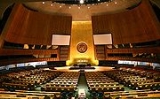
United Nations General Assembly
The United Nations General Assembly is one of the five principal organs of the United Nations. It is the main deliberative organ of the United Nations. It is made up of all
United Nations member states and meets in regular yearly sessions under a president elected from among the representatives.
As the only
UN organ in which all members are represented, the Assembly serves as a forum for members to discuss issues of international law and make decisions on the functioning of the organization.
Encyclopedia
The
United Nations General Assembly is one of the five principal organs of the United Nations. It is the main deliberative organ of the United Nations. It is made up of all
United Nations member states and meets in regular yearly sessions under a president elected from among the representatives.
As the only
UN organ in which all members are represented, the Assembly serves as a forum for members to discuss issues of international law and make decisions on the functioning of the organization.
Overview
The General Assembly meets in regular, special and emergency special session. Its regular annual session usually begins on the third Tuesday in September and its work is suspended in late December. It reconvenes as required in the following year. The session concludes in September on the day before the next session begins. The President of the General Assembly is elected at least three months prior to the opening of each session . The General Debate follows, when all the members have the opportunity to address the assembly over a two-week period. Traditionally, the Secretary-General makes the first statement, followed by the president of the assembly. The first session was convened on 10 January 1946 in the
Westminster Central Hall in
London and included representatives of 51 nations.
Voting in the General Assembly on important questions – recommendations on peace and security; election of members to organs; admission, suspension, and expulsion of members; budgetary matters – is by a two-thirds majority of those present and voting. Other questions are decided by majority vote. Each member country has one vote. Apart from approval of budgetary matters, including adoption of a scale of assessment, Assembly resolutions are not binding on the members. The Assembly may make recommendations on any matters within the scope of the UN, except matters of peace and security under Security Council consideration. The one state, one vote power structure theoretically allows states comprising just eight percent of the world population to pass a resolution by a two-thirds vote.
During the
1980s, the Assembly became a forum for the North-South dialogue – the discussion of issues between industrialized nations and developing countries. These issues came to the fore because of the phenomenal growth and changing makeup of the UN membership. In 1945, the UN had 51 members. It now has 192, of which more than two-thirds are
developing countries. Because of their numbers, developing countries are often able to determine the agenda of the Assembly , the character of its debates, and the nature of its decisions. For many developing countries, the UN is the source of much of their diplomatic influence and the principal outlet for their foreign relations initiatives.
Special Sessions
Special sessions may be convened at the request of the
UN Security Council, or a majority of UN members, or, if the majority concurs, of a single member. A special session was held in October 1995 at the head of government level to commemorate the UN's 50th anniversary. Another special session was held in September 2000 to celebrate the millennium; it put forward the Millennium Development Goals. A further special session was held in September 2005 to commemorate the UN's 60th anniversary; it assessed progress on the Millennium Development Goals, and discussed
Kofi Annan's
In Larger Freedom proposals.
Emergency Special Sessions
The General Assembly may take action on maintaining international peace and security if the
UN Security Council is unable, usually due to disagreement among the permanent members, to exercise its primary responsibility. If not in session at the time, the General Assembly may meet in emergency special session within twenty-four hours of the request therefor. Such emergency special session shall be called if requested by the Security Council on the vote of any seven members, or by a majority of the Members of the United Nations.
The "Uniting for Peace" resolutions, adopted in 1950, empower the Assembly to convene in emergency special session to recommend collective measures – including the use of armed force – in the case of a breach of the peace or act of aggression. Two-thirds of the members must approve any such recommendation. Emergency special sessions under this procedure have been held on ten occasions. The two most recent, in 1982 and 1997 through 2003 respectively, have both been convened in response to actions by
Israel. The ninth considered the situation in the occupied Arab territories following Israel's unilateral extension of its laws, jurisdiction, and administration to the Golan Heights. The tenth was triggered by the occupation of
East Jerusalem and dealt with the issue of
Palestine.
At the first Special Session of the UN General Assembly held in 1947,
Oswaldo Aranha, then head of the
Brazilian delegation to the UN, began a tradition that has remained until today whereby the first speaker at this major international forum is always a Brazilian.
Subsidiary organs
The General Assembly subsidiary organs are divided into 5 categories: Boards , Commissions , Committees , Councils and Panel , working group and others .
General Assembly reform
See also: Reform of the United NationsOn 21 March 2005,
Secretary-General Kofi Annan presented a report,
In Larger Freedom, that criticized the General Assembly for focusing so much on consensus that it was passing watered-down resolutions reflecting "the lowest common denominator of widely different opinions." He also criticized the Assembly for trying to address too broad an agenda, instead of focusing on "the major substantive issues of the day, such as international
migration and the long-debated comprehensive convention on
terrorism." Annan recommended streamlining the General Assembly's agenda, committee structure, and procedures; strengthening the role and authority of its President; enhancing the role of civil society; and establishing a mechanism to review the decisions of its committees, in order to minimize unfunded mandates and micromanagement of the
UN Secretariat. Annan reminded UN members of their responsibility to implement reforms, if they expect to realize improvements in UN effectiveness:
See also
External links
- A subsection of the overall UN webcast site .
- Annan, Kofi: , In Larger Freedom, 21 March 2005.
- - Official site
- - UK Government site