


Distilled beverage

Encyclopedia
A distilled beverage, liquor, or spirit is an alcoholic beverage
containing ethanol
that is produced by distilling
(i.e., concentrating by distillation
) ethanol produced by means of fermenting
grain, fruit, or vegetables. This excludes undistilled fermented beverages such as beer
, wine
, and hard cider
.
The term hard liquor is used in North America to distinguish distilled beverages from undistilled ones (implicitly weaker).
(ABV). Popular spirits include brandy
, fruit brandy (also known as eau-de-vie or schnapps
), gin
, rum
, tequila
, vodka
, and whisky
.
Distilled beverages that are bottled with added sugar and added flavorings, such as Grand Marnier
, Frangelico
, and American schnapps, are liqueur
s. In common usage, the distinction between spirits and liqueurs is widely unknown or ignored; consequently all alcoholic beverages other than beer and wine are generally referred to as spirits.
Beer
and wine
, which are not distilled beverages, are limited to a maximum alcohol content of about 20% ABV, as most yeast
s cannot reproduce when the concentration of alcohol is above this level; consequently, fermentation
ceases at that point.
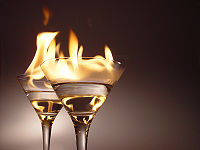 Liquor that contains 40% ABV
(80 US proof) will catch fire if heated to about 79 °F (26.1 °C) and if an ignition source is applied to it. (This is called its flash point
. The flash point of pure alcohol
is 62.88 °F (17.2 °C), less than average room temperature.)
The flash points of alcohol concentrations from 10% ABV to 96% ABV are shown below:
Beverages that have a low concentration of alcohol will burn if sufficiently heated and an ignition source (such as an electric spark
or a match) is applied to them. For example, the flash point of ordinary wine containing 12.5% alcohol is about 125 °F (51.7 °C).
, an early use of the word in the English language, meaning simply "a liquid," can be dated to 1225. The first use that the OED mentions of its meaning "a liquid for drinking" occurred in the 14th century. Its use as a term for “an intoxicating alcoholic drink” appeared in the 16th century.
The term "spirit" in reference to alcohol stems from Middle Eastern alchemy. These alchemists were more concerned with medical elixir
s than with transmuting lead into gold. The vapor given off and collected during an alchemical process (as with distillation of alcohol) was called a spirit
of the original material.
working in Alexandria in the 1st century AD. Distilled water
was described in the 2nd century AD by Alexander of Aphrodisias
. The Alexandrians were using a distillation alembic
or still
device in the 3rd century AD. The medieval Arabs learned the distillation process from the Alexandrians and used it extensively, but there is no evidence that they distilled alcohol. The earliest evidence of the distillation of alcohol comes from the School of Salerno in southern Italy in the 12th century. Fractional distillation
was developed by Tadeo Alderotti in the 13th century.
. This technique involves freezing the alcoholic beverage and then removing the ice. The freezing technique had limitations in geography and implementation and consequently was not widely used.
A notable drawback of this technique is that it concentrates
toxins such as methanol
and fusel alcohols, rather than reducing their concentration.
was developed by Tadeo Alderotti in the 13th century.
In 1437, burned water (brandy) was mentioned in the records of the County of Katzenelnbogen
in Germany. It was served in a tall, narrow glass called a “goderulffe.”
Paracelsus
gave alcohol its modern name, taking it from an Arabic word that means "finely divided," in reference to what is done to wine. His test was to burn a spoonful without leaving any residue. Other ways of testing were to burn a cloth soaked in it without actually harming the cloth. In both cases, to achieve this effect the alcohol had to have been at least 95 percent, close to the maximum concentration attainable through distillation (see purification of ethanol).
Claims upon the origin of specific beverages are controversial, often invoking national pride, but they are plausible after the 12th century AD when Irish whiskey
and German brandy
became available. These spirits would have had a much lower alcohol content
(about 40% ABV
) than the alchemists' pure distillations, and they were likely first thought of as medicinal elixir
s. Consumption of distilled beverages rose dramatically in Europe in and after the mid 14th century, when distilled liquors were commonly used as remedies for the Black Death
. Around 1400 it was discovered how to distill spirits from wheat, barley, and rye beers, a cheaper option than grapes. Thus began the "national" drinks of Europe: jenever
(Belgium and the Netherlands), gin
(England), schnapps
(Germany), grappa
(Italy), horilka
(Ukraine), akvavit
/snaps
(Scandinavia), vodka
(Russia and Poland), rakia
(the Balkans), poitín
(Ireland). The actual names only emerged in the 16th century but the drinks were well known prior to that date.
, rice
, and potatoes have been called into service as inexpensive replacements for traditional grains and fruit. For tequila
, the blue agave plant is used. Chemists have discovered the scientific principles behind aging, and have devised ways to accelerate aging without introducing harsh flavors. Modern filters have allowed distillers to remove unwanted residue and produce smoother finished products. Most of all, marketing has developed a worldwide market for distilled beverages among populations that previously did not drink spirits.
Microdistilling
is a trend that began to develop in the United States
following the emergence and immense popularity of microbrewing and craft beer in the last decades of the 20th century. It is different from megadistilling in the quantity and quality of output.
In some jurisdictions in the United States, including those that allow unlicensed individuals to make their own beer and wine
, it is illegal to distill beverage alcohol without an appropriate license. In those jurisdictions, selling a still also requires an appropriate licence. It is legal to distill beverage alcohol as a hobby for personal use in some countries including, but not limited to, Italy, Canada, New Zealand and to a limited degree the UK. In those jurisdictions where it is illegal to distill beverage alcohol some people circumvent those laws by pretending to distill alcohol for fuel
but consuming the product. It is important not to confuse ethanol
, which is a type of alcohol used for both beverages and fuel, with methanol
, which is a different alcohol fuel
that is poisonous. Methanol is also produced as a byproduct of beverage distillation, but only in small amounts which are ordinarily separated out during the beverage production process. Methanol will cause blindness or death if consumed in large amounts.
measures and publishes alcohol consumption patterns in different countries. The WHO measures alcohol consumed by persons 15 years of age or older and reports it on the basis of liters of pure alcohol consumed per capita
in a given year in a country. (See List of countries by alcohol consumption.)
----
Alcoholic beverage
An alcoholic beverage is a drink containing ethanol, commonly known as alcohol. Alcoholic beverages are divided into three general classes: beers, wines, and spirits. They are legally consumed in most countries, and over 100 countries have laws regulating their production, sale, and consumption...
containing ethanol
Ethanol
Ethanol, also called ethyl alcohol, pure alcohol, grain alcohol, or drinking alcohol, is a volatile, flammable, colorless liquid. It is a psychoactive drug and one of the oldest recreational drugs. Best known as the type of alcohol found in alcoholic beverages, it is also used in thermometers, as a...
that is produced by distilling
Distillation
Distillation is a method of separating mixtures based on differences in volatilities of components in a boiling liquid mixture. Distillation is a unit operation, or a physical separation process, and not a chemical reaction....
(i.e., concentrating by distillation
Concentration
In chemistry, concentration is defined as the abundance of a constituent divided by the total volume of a mixture. Four types can be distinguished: mass concentration, molar concentration, number concentration, and volume concentration...
) ethanol produced by means of fermenting
Ethanol fermentation
Ethanol fermentation, also referred to as alcoholic fermentation, is a biological process in which sugars such as glucose, fructose, and sucrose are converted into cellular energy and thereby produce ethanol and carbon dioxide as metabolic waste products...
grain, fruit, or vegetables. This excludes undistilled fermented beverages such as beer
Beer
Beer is the world's most widely consumed andprobably oldest alcoholic beverage; it is the third most popular drink overall, after water and tea. It is produced by the brewing and fermentation of sugars, mainly derived from malted cereal grains, most commonly malted barley and malted wheat...
, wine
Wine
Wine is an alcoholic beverage, made of fermented fruit juice, usually from grapes. The natural chemical balance of grapes lets them ferment without the addition of sugars, acids, enzymes, or other nutrients. Grape wine is produced by fermenting crushed grapes using various types of yeast. Yeast...
, and hard cider
Cider
Cider or cyder is a fermented alcoholic beverage made from apple juice. Cider varies in alcohol content from 2% abv to 8.5% abv or more in traditional English ciders. In some regions, such as Germany and America, cider may be termed "apple wine"...
.
The term hard liquor is used in North America to distinguish distilled beverages from undistilled ones (implicitly weaker).
Types
The term spirit refers to a distilled beverage that contains no added sugar and has at least 20% alcohol by volumeAlcohol by volume
Alcohol by volume is a standard measure of how much alcohol is contained in an alcoholic beverage .The ABV standard is used worldwide....
(ABV). Popular spirits include brandy
Brandy
Brandy is a spirit produced by distilling wine. Brandy generally contains 35%–60% alcohol by volume and is typically taken as an after-dinner drink...
, fruit brandy (also known as eau-de-vie or schnapps
Schnapps
Schnapps is a type of distilled alcoholic beverage. The English word schnapps is derived from the German Schnaps , which can refer to any strong alcoholic drink but particularly those containing at least 32% ABV...
), gin
Gin
Gin is a spirit which derives its predominant flavour from juniper berries . Although several different styles of gin have existed since its origins, it is broadly differentiated into two basic legal categories...
, rum
Rum
Rum is a distilled alcoholic beverage made from sugarcane by-products such as molasses, or directly from sugarcane juice, by a process of fermentation and distillation. The distillate, a clear liquid, is then usually aged in oak barrels...
, tequila
Tequila
Tequila is a spirit made from the blue agave plant, primarily in the area surrounding the city of Tequila, northwest of Guadalajara, and in the highlands of the western Mexican state of Jalisco....
, vodka
Vodka
Vodka , is a distilled beverage. It is composed primarily of water and ethanol with traces of impurities and flavorings. Vodka is made by the distillation of fermented substances such as grains, potatoes, or sometimes fruits....
, and whisky
Whisky
Whisky or whiskey is a type of distilled alcoholic beverage made from fermented grain mash. Different grains are used for different varieties, including barley, malted barley, rye, malted rye, wheat, and corn...
.
Distilled beverages that are bottled with added sugar and added flavorings, such as Grand Marnier
Grand Marnier
Grand Marnier is a liqueur created in 1880 by Alexandre Marnier-Lapostolle. It is made from a blend of true cognacs and distilled essence of bitter orange. Grand Marnier is 40% alcohol . It is produced in several varieties, most of which can be consumed "neat" as a digestif and can be used in...
, Frangelico
Frangelico
Frangelico is a brand of noisette, or hazelnut and herb-flavored liqueur which is produced in Canale, Italy. It is 20% alcohol by volume, 40 proof. It was released in the 1980s, gaining attention largely because of its unusual packaging: its bottle was designed to look like a friar, complete with...
, and American schnapps, are liqueur
Liqueur
A liqueur is an alcoholic beverage that has been flavored with fruit, herbs, nuts, spices, flowers, or cream and bottled with added sugar. Liqueurs are typically quite sweet; they are usually not aged for long but may have resting periods during their production to allow flavors to marry.The...
s. In common usage, the distinction between spirits and liqueurs is widely unknown or ignored; consequently all alcoholic beverages other than beer and wine are generally referred to as spirits.
Beer
Beer
Beer is the world's most widely consumed andprobably oldest alcoholic beverage; it is the third most popular drink overall, after water and tea. It is produced by the brewing and fermentation of sugars, mainly derived from malted cereal grains, most commonly malted barley and malted wheat...
and wine
Wine
Wine is an alcoholic beverage, made of fermented fruit juice, usually from grapes. The natural chemical balance of grapes lets them ferment without the addition of sugars, acids, enzymes, or other nutrients. Grape wine is produced by fermenting crushed grapes using various types of yeast. Yeast...
, which are not distilled beverages, are limited to a maximum alcohol content of about 20% ABV, as most yeast
Yeast
Yeasts are eukaryotic micro-organisms classified in the kingdom Fungi, with 1,500 species currently described estimated to be only 1% of all fungal species. Most reproduce asexually by mitosis, and many do so by an asymmetric division process called budding...
s cannot reproduce when the concentration of alcohol is above this level; consequently, fermentation
Fermentation (wine)
The process of fermentation in wine turns grape juice into an alcoholic beverage. During fermentation, yeast interact with sugars in the juice to create ethanol, commonly known as ethyl alcohol, and carbon dioxide...
ceases at that point.
Serving
- Neat or straightStraight up (bartending)In bartending, the term straight up refers to an alcoholic drink that is shaken or stirred with ice and then strained and served without ice in a stemmed glass....
— The spirit is served at room temperature without any additional ingredient. - Straight upStraight up (bartending)In bartending, the term straight up refers to an alcoholic drink that is shaken or stirred with ice and then strained and served without ice in a stemmed glass....
— This term refers to an alcoholic drink that is shaken or stirred with ice, strained, and served in a stemmed glassCocktail glassA cocktail glass is a stemmed glass which has a cone-shaped bowl placed upon a stem above a flat base. It is mainly used to serve cocktails. Its form derives from the fact that all cocktails are traditionally served chilled and contain an aromatic element...
. - On the rocks — The spirit is served over ice cubeIce cubeIce cubes are small, roughly cube-shaped pieces of ice, conventionally used to cool beverages. Ice cubes are often preferred over crushed ice because they melt more slowly; they are standard in mixed drinks that call for ice, in which case the drink is said to be "on the rocks."Ice cubes are...
s. - With a simple mixer such as club sodaCarbonated waterCarbonated water is water into which carbon dioxide gas under pressure has been dissolved, a process that causes the water to become effervescent....
, tonic waterTonic waterTonic water is a carbonated soft drink in which quinine is dissolved. Originally used as a prophylactic against malaria, tonic water usually now has a significantly lower quinine content and is consumed for its distinctively bitter taste...
, juiceJuiceJuice is the liquid that is naturally contained in fruit or vegetable tissue.Juice is prepared by mechanically squeezing or macerating fruit or vegetable flesh without the application of heat or solvents. For example, orange juice is the liquid extract of the fruit of the orange tree...
, or colaColaCola is a carbonated beverage that was typically flavored by the kola nut as well as vanilla and other flavorings, however, some colas are now flavored artificially. It became popular worldwide after druggist John Pemberton invented Coca-Cola in 1886...
. - As an ingredient of a cocktailCocktailA cocktail is an alcoholic mixed drink that contains two or more ingredients—at least one of the ingredients must be a spirit.Cocktails were originally a mixture of spirits, sugar, water, and bitters. The word has come to mean almost any mixed drink that contains alcohol...
. - As an ingredient of a shooter.
- With water.
- With water poured over sugar (as with absintheAbsintheAbsinthe is historically described as a distilled, highly alcoholic beverage. It is an anise-flavoured spirit derived from herbs, including the flowers and leaves of the herb Artemisia absinthium, commonly referred to as "grande wormwood", together with green anise and sweet fennel...
).
Flammability
ABV
ABV is a three-letter acronym that may refer to:* Alcohol by volume, a measure of the alcohol content of alcoholic drinks* Nnamdi Azikiwe International Airport, Abuja, Nigeria, from its IATA airport code...
(80 US proof) will catch fire if heated to about 79 °F (26.1 °C) and if an ignition source is applied to it. (This is called its flash point
Flash point
The flash point of a volatile material is the lowest temperature at which it can vaporize to form an ignitable mixture in air. Measuring a flash point requires an ignition source...
. The flash point of pure alcohol
Ethanol
Ethanol, also called ethyl alcohol, pure alcohol, grain alcohol, or drinking alcohol, is a volatile, flammable, colorless liquid. It is a psychoactive drug and one of the oldest recreational drugs. Best known as the type of alcohol found in alcoholic beverages, it is also used in thermometers, as a...
is 62.88 °F (17.2 °C), less than average room temperature.)
The flash points of alcohol concentrations from 10% ABV to 96% ABV are shown below:
- 10% — 120 °F (48.9 °C) — wine
- 20% — 97 °F (36.1 °C) — fortified wineFortified wineFortified wine is wine to which a distilled beverage has been added. Fortified wine is distinguished from spirits made from wine in that spirits are produced by means of distillation, while fortified wine is simply wine that has had a spirit added to it...
- 30% — 84 °F (28.9 °C)
- 40% — 79 °F (26.1 °C) — typical whisky, brandy
- 50% — 75 °F (23.9 °C) — strong whisky
- 60% — 72 °F (22.2 °C)
- 70% — 70 °F (21.1 °C) — absintheAbsintheAbsinthe is historically described as a distilled, highly alcoholic beverage. It is an anise-flavoured spirit derived from herbs, including the flowers and leaves of the herb Artemisia absinthium, commonly referred to as "grande wormwood", together with green anise and sweet fennel...
- 80% — 68 °F (20 °C)
- 90% — 63 °F (17.2 °C) — neutral grain spiritNeutral grain spiritNeutral grain spirit is a clear, colorless, flammable liquid that has been distilled from a grain-based mash to a very high level of ethanol content...
- 96% — 63 °F (17.2 °C)
Beverages that have a low concentration of alcohol will burn if sufficiently heated and an ignition source (such as an electric spark
Electric spark
An electric spark is a type of electrostatic discharge that occurs when an electric field creates an ionized electrically conductive channel in air producing a brief emission of light and sound. A spark is formed when the electric field strength exceeds the dielectric field strength of air...
or a match) is applied to them. For example, the flash point of ordinary wine containing 12.5% alcohol is about 125 °F (51.7 °C).
Etymology
The origin of "liquor" and its close relative "liquid" was the Latin verb liquere, meaning "to be fluid." According to the Oxford English DictionaryOxford English Dictionary
The Oxford English Dictionary , published by the Oxford University Press, is the self-styled premier dictionary of the English language. Two fully bound print editions of the OED have been published under its current name, in 1928 and 1989. The first edition was published in twelve volumes , and...
, an early use of the word in the English language, meaning simply "a liquid," can be dated to 1225. The first use that the OED mentions of its meaning "a liquid for drinking" occurred in the 14th century. Its use as a term for “an intoxicating alcoholic drink” appeared in the 16th century.
The term "spirit" in reference to alcohol stems from Middle Eastern alchemy. These alchemists were more concerned with medical elixir
Elixir
An elixir is a clear, sweet-flavored liquid used for medicinal purposes, to be taken orally and intended to cure one's ills. When used as a pharmaceutical preparation, an elixir contains at least one active ingredient designed to be taken orally....
s than with transmuting lead into gold. The vapor given off and collected during an alchemical process (as with distillation of alcohol) was called a spirit
Spirit
The English word spirit has many differing meanings and connotations, most of them relating to a non-corporeal substance contrasted with the material body.The spirit of a living thing usually refers to or explains its consciousness.The notions of a person's "spirit" and "soul" often also overlap,...
of the original material.
History of distillation
The first clear evidence of distillation comes from Greek alchemistsAlchemy
Alchemy is an influential philosophical tradition whose early practitioners’ claims to profound powers were known from antiquity. The defining objectives of alchemy are varied; these include the creation of the fabled philosopher's stone possessing powers including the capability of turning base...
working in Alexandria in the 1st century AD. Distilled water
Distilled water
Distilled water is water that has many of its impurities removed through distillation. Distillation involves boiling the water and then condensing the steam into a clean container.-History:...
was described in the 2nd century AD by Alexander of Aphrodisias
Alexander of Aphrodisias
Alexander of Aphrodisias was a Peripatetic philosopher and the most celebrated of the Ancient Greek commentators on the writings of Aristotle. He was a native of Aphrodisias in Caria, and lived and taught in Athens at the beginning of the 3rd century, where he held a position as head of the...
. The Alexandrians were using a distillation alembic
Alembic
An alembic is an alchemical still consisting of two vessels connected by a tube...
or still
Still
A still is a permanent apparatus used to distill miscible or immiscible liquid mixtures by heating to selectively boil and then cooling to condense the vapor...
device in the 3rd century AD. The medieval Arabs learned the distillation process from the Alexandrians and used it extensively, but there is no evidence that they distilled alcohol. The earliest evidence of the distillation of alcohol comes from the School of Salerno in southern Italy in the 12th century. Fractional distillation
Fractional distillation
Fractional distillation is the separation of a mixture into its component parts, or fractions, such as in separating chemical compounds by their boiling point by heating them to a temperature at which several fractions of the compound will evaporate. It is a special type of distillation...
was developed by Tadeo Alderotti in the 13th century.
Central Asia
Freeze distillation, the "Mongolian still," is known to have been in use in Central Asia sometime in the early Middle AgesMiddle Ages
The Middle Ages is a periodization of European history from the 5th century to the 15th century. The Middle Ages follows the fall of the Western Roman Empire in 476 and precedes the Early Modern Era. It is the middle period of a three-period division of Western history: Classic, Medieval and Modern...
. This technique involves freezing the alcoholic beverage and then removing the ice. The freezing technique had limitations in geography and implementation and consequently was not widely used.
A notable drawback of this technique is that it concentrates
Concentration
In chemistry, concentration is defined as the abundance of a constituent divided by the total volume of a mixture. Four types can be distinguished: mass concentration, molar concentration, number concentration, and volume concentration...
toxins such as methanol
Methanol
Methanol, also known as methyl alcohol, wood alcohol, wood naphtha or wood spirits, is a chemical with the formula CH3OH . It is the simplest alcohol, and is a light, volatile, colorless, flammable liquid with a distinctive odor very similar to, but slightly sweeter than, ethanol...
and fusel alcohols, rather than reducing their concentration.
Medieval Europe
Although the Greeks and Arabs knew the art of distillation, the earliest written evidence for the distillation of alcohol comes from the School of Salerno in the 12th century. The production method was written in code, suggesting that it was being kept secret. Fractional distillationFractional distillation
Fractional distillation is the separation of a mixture into its component parts, or fractions, such as in separating chemical compounds by their boiling point by heating them to a temperature at which several fractions of the compound will evaporate. It is a special type of distillation...
was developed by Tadeo Alderotti in the 13th century.
In 1437, burned water (brandy) was mentioned in the records of the County of Katzenelnbogen
County of Katzenelnbogen
The County of Katzenelnbogen was an immediate state of the Holy Roman Empire. It existed between 1095 and 1479, when it was inherited by the Landgraves of Hesse.The estate comprised two separate territories...
in Germany. It was served in a tall, narrow glass called a “goderulffe.”
Paracelsus
Paracelsus
Paracelsus was a German-Swiss Renaissance physician, botanist, alchemist, astrologer, and general occultist....
gave alcohol its modern name, taking it from an Arabic word that means "finely divided," in reference to what is done to wine. His test was to burn a spoonful without leaving any residue. Other ways of testing were to burn a cloth soaked in it without actually harming the cloth. In both cases, to achieve this effect the alcohol had to have been at least 95 percent, close to the maximum concentration attainable through distillation (see purification of ethanol).
Claims upon the origin of specific beverages are controversial, often invoking national pride, but they are plausible after the 12th century AD when Irish whiskey
Irish whiskey
Irish whiskey is whiskey made in Ireland.Key regulations defining Irish whiskey and its production are established by the Irish Whiskey Act of 1980, and are relatively simple...
and German brandy
Brandy
Brandy is a spirit produced by distilling wine. Brandy generally contains 35%–60% alcohol by volume and is typically taken as an after-dinner drink...
became available. These spirits would have had a much lower alcohol content
Alcohol by volume
Alcohol by volume is a standard measure of how much alcohol is contained in an alcoholic beverage .The ABV standard is used worldwide....
(about 40% ABV
ABV
ABV is a three-letter acronym that may refer to:* Alcohol by volume, a measure of the alcohol content of alcoholic drinks* Nnamdi Azikiwe International Airport, Abuja, Nigeria, from its IATA airport code...
) than the alchemists' pure distillations, and they were likely first thought of as medicinal elixir
Elixir
An elixir is a clear, sweet-flavored liquid used for medicinal purposes, to be taken orally and intended to cure one's ills. When used as a pharmaceutical preparation, an elixir contains at least one active ingredient designed to be taken orally....
s. Consumption of distilled beverages rose dramatically in Europe in and after the mid 14th century, when distilled liquors were commonly used as remedies for the Black Death
Black Death
The Black Death was one of the most devastating pandemics in human history, peaking in Europe between 1348 and 1350. Of several competing theories, the dominant explanation for the Black Death is the plague theory, which attributes the outbreak to the bacterium Yersinia pestis. Thought to have...
. Around 1400 it was discovered how to distill spirits from wheat, barley, and rye beers, a cheaper option than grapes. Thus began the "national" drinks of Europe: jenever
Jenever
Jenever , is the juniper-flavored and strongly alcoholic traditional liquor of the Netherlands and Belgium, from which gin evolved...
(Belgium and the Netherlands), gin
Gin
Gin is a spirit which derives its predominant flavour from juniper berries . Although several different styles of gin have existed since its origins, it is broadly differentiated into two basic legal categories...
(England), schnapps
Schnapps
Schnapps is a type of distilled alcoholic beverage. The English word schnapps is derived from the German Schnaps , which can refer to any strong alcoholic drink but particularly those containing at least 32% ABV...
(Germany), grappa
Grappa
Grappa is an alcoholic beverage, a fragrant, grape-based pomace brandy of Italian origin that contains 35%–60% alcohol by volume...
(Italy), horilka
Horilka
Horilka is a Ukrainian alcoholic beverage. The word horilka may also be used in a generic sense in the Ukrainian language to mean whisky, or other strong spirits and etymologically is similar to the Ukrainian word for burning - hority. Home-distilled horilka, moonshine, is called samogon ....
(Ukraine), akvavit
Akvavit
Akvavit or aquavit is a traditional flavoured spirit that is principally produced in Scandinavia, where it has been produced since the 15th century....
/snaps
Snaps
Snaps is a Danish and Swedish word for a small shot of a strong alcoholic beverage taken during the course of a meal. A ritual that is associated with drinking snaps is a tradition in Scandinavia, especially in Denmark and Sweden, where it is very common to drink snaps at holidays such as...
(Scandinavia), vodka
Vodka
Vodka , is a distilled beverage. It is composed primarily of water and ethanol with traces of impurities and flavorings. Vodka is made by the distillation of fermented substances such as grains, potatoes, or sometimes fruits....
(Russia and Poland), rakia
Rakia
Rakia is an alcoholic beverage that is produced by distillation of fermented fruit; it is a popular beverage throughout the Balkans. Its alcohol content is normally 40% ABV, but home-produced rakia can be stronger . Prepečenica is double-distilled rakia which has an alcohol content that may...
(the Balkans), poitín
Poitín
Poitín , anglicised as poteen, is a traditional Irish distilled, highly alcoholic beverage . Poitín was traditionally distilled in a small pot still and the term is a diminutive of the Irish word pota, meaning "pot"...
(Ireland). The actual names only emerged in the 16th century but the drinks were well known prior to that date.
Modern distillation
Except for the invention of the continuous still in the 19th century, the basic process of distillation has not changed since the 8th century. In fact, many still prefer traditional methods of distillation to their modern counterparts. For example, traditional French alembic copper pot distillation systems can be found across Europe and North America today. Other novel methods such as freeze distillation have had limited use. There have been many changes in the methods used to prepare organic material for the still, and the ways the distilled beverage is finished and marketed. Knowledge of the principles of sanitation and access to standardised yeast strains have improved the quality of the base ingredient; larger, more efficient stills produce more product per square foot and reduce waste; ingredients such as cornMaize
Maize known in many English-speaking countries as corn or mielie/mealie, is a grain domesticated by indigenous peoples in Mesoamerica in prehistoric times. The leafy stalk produces ears which contain seeds called kernels. Though technically a grain, maize kernels are used in cooking as a vegetable...
, rice
Rice
Rice is the seed of the monocot plants Oryza sativa or Oryza glaberrima . As a cereal grain, it is the most important staple food for a large part of the world's human population, especially in East Asia, Southeast Asia, South Asia, the Middle East, and the West Indies...
, and potatoes have been called into service as inexpensive replacements for traditional grains and fruit. For tequila
Tequila
Tequila is a spirit made from the blue agave plant, primarily in the area surrounding the city of Tequila, northwest of Guadalajara, and in the highlands of the western Mexican state of Jalisco....
, the blue agave plant is used. Chemists have discovered the scientific principles behind aging, and have devised ways to accelerate aging without introducing harsh flavors. Modern filters have allowed distillers to remove unwanted residue and produce smoother finished products. Most of all, marketing has developed a worldwide market for distilled beverages among populations that previously did not drink spirits.
Microdistilling
Microdistillery
A microdistillery is a small, often 'boutique', distillery established to produce beverage grade alcohol in relatively small quantities. While the term is most commonly used in the United States, micro-distilleries have been established in Europe for many years, either as small cognac distilleries...
is a trend that began to develop in the United States
United States
The United States of America is a federal constitutional republic comprising fifty states and a federal district...
following the emergence and immense popularity of microbrewing and craft beer in the last decades of the 20th century. It is different from megadistilling in the quantity and quality of output.
In some jurisdictions in the United States, including those that allow unlicensed individuals to make their own beer and wine
Homebrewing
Homebrewing is the brewing of beer, wine, sake, mead, cider, perry and other beverages through fermentation on a small scale as a hobby for personal consumption, free distribution at social gatherings, amateur brewing competitions or other non-commercial reasons...
, it is illegal to distill beverage alcohol without an appropriate license. In those jurisdictions, selling a still also requires an appropriate licence. It is legal to distill beverage alcohol as a hobby for personal use in some countries including, but not limited to, Italy, Canada, New Zealand and to a limited degree the UK. In those jurisdictions where it is illegal to distill beverage alcohol some people circumvent those laws by pretending to distill alcohol for fuel
Alcohol fuel
Although fossil fuels have become the dominant energy resource for the modern world, alcohol has been used as a fuel throughout history. The first four aliphatic alcohols are of interest as fuels because they can be synthesized chemically or biologically, and they have characteristics which allow...
but consuming the product. It is important not to confuse ethanol
Ethanol
Ethanol, also called ethyl alcohol, pure alcohol, grain alcohol, or drinking alcohol, is a volatile, flammable, colorless liquid. It is a psychoactive drug and one of the oldest recreational drugs. Best known as the type of alcohol found in alcoholic beverages, it is also used in thermometers, as a...
, which is a type of alcohol used for both beverages and fuel, with methanol
Methanol
Methanol, also known as methyl alcohol, wood alcohol, wood naphtha or wood spirits, is a chemical with the formula CH3OH . It is the simplest alcohol, and is a light, volatile, colorless, flammable liquid with a distinctive odor very similar to, but slightly sweeter than, ethanol...
, which is a different alcohol fuel
Alcohol fuel
Although fossil fuels have become the dominant energy resource for the modern world, alcohol has been used as a fuel throughout history. The first four aliphatic alcohols are of interest as fuels because they can be synthesized chemically or biologically, and they have characteristics which allow...
that is poisonous. Methanol is also produced as a byproduct of beverage distillation, but only in small amounts which are ordinarily separated out during the beverage production process. Methanol will cause blindness or death if consumed in large amounts.
Alcohol consumption by country
The World Health OrganizationWorld Health Organization
The World Health Organization is a specialized agency of the United Nations that acts as a coordinating authority on international public health. Established on 7 April 1948, with headquarters in Geneva, Switzerland, the agency inherited the mandate and resources of its predecessor, the Health...
measures and publishes alcohol consumption patterns in different countries. The WHO measures alcohol consumed by persons 15 years of age or older and reports it on the basis of liters of pure alcohol consumed per capita
Per capita
Per capita is a Latin prepositional phrase: per and capita . The phrase thus means "by heads" or "for each head", i.e. per individual or per person...
in a given year in a country. (See List of countries by alcohol consumption.)
See also
- AbsintheAbsintheAbsinthe is historically described as a distilled, highly alcoholic beverage. It is an anise-flavoured spirit derived from herbs, including the flowers and leaves of the herb Artemisia absinthium, commonly referred to as "grande wormwood", together with green anise and sweet fennel...
- AguardienteAguardienteAguardiente , aiguardent , aguardente , and augardente are generic terms for alcoholic beverages that contain between 29% and 60% alcohol by volume...
- Alcoholic beverageAlcoholic beverageAn alcoholic beverage is a drink containing ethanol, commonly known as alcohol. Alcoholic beverages are divided into three general classes: beers, wines, and spirits. They are legally consumed in most countries, and over 100 countries have laws regulating their production, sale, and consumption...
- Arak
- ArrackArrackArrack is a distilled alcoholic drink typically produced in South Asia and South East Asia, made from either the fermented sap of coconut flowers, sugarcane, grain or fruit depending upon the country of origin...
- BaijiuBaijiuBaijiu , or shaojiu is a Chinese distilled alcoholic beverage. The name baijiu literally means "white liquor," "white alcohol" or "white spirits". Baijiu is often translated as "wine" or "white wine"...
/ ShōchūShochuis a Japanese distilled beverage. It is typically distilled from barley, sweet potatoes, or rice, though it is sometimes produced from other ingredients such as brown sugar, buckwheat or chestnut. Typically shōchū contains 25% alcohol by volume...
/ SojuSojuSoju is a distilled beverage native to Korea. Its taste is comparable to vodka, though often slightly sweeter due to sugars added in the manufacturing process, and more commonly consumed neat.Most brands of soju are made in South Korea... - BrandyBrandyBrandy is a spirit produced by distilling wine. Brandy generally contains 35%–60% alcohol by volume and is typically taken as an after-dinner drink...
- CachaçaCachaçaCachaça is a liquor made from fermented sugarcane.It is the most popular distilled alcoholic beverage in Brazil. It is also known as aguardente, pinga, caninha and many other names...
- Eau de vieEau de vieAn eau de vie is a clear, colorless fruit brandy that is produced by means of fermentation and double distillation...
- Er guo tou
- FennyFennyFenny or Feni is a Goan Spirit made from either coconut or the juice of the cashew apple. The popular brands of fenny are 'Cashyo' , 'Reals' , and 'Big Boss'...
- GinGinGin is a spirit which derives its predominant flavour from juniper berries . Although several different styles of gin have existed since its origins, it is broadly differentiated into two basic legal categories...
(and JeneverJeneverJenever , is the juniper-flavored and strongly alcoholic traditional liquor of the Netherlands and Belgium, from which gin evolved...
) - HorilkaHorilkaHorilka is a Ukrainian alcoholic beverage. The word horilka may also be used in a generic sense in the Ukrainian language to mean whisky, or other strong spirits and etymologically is similar to the Ukrainian word for burning - hority. Home-distilled horilka, moonshine, is called samogon ....
- Liquor storeLiquor storeIn the United States, Australia and Canada, a liquor store is a type of store that specializes in the sale of alcoholic beverages. In South Africa and Namibia these stores are generally called bottle stores....
- MezcalMezcalMezcal, or mescal, is a distilled alcoholic beverage made from the maguey plant native to Mexico. The word mezcal comes from Nahuatl metl and ixcalli which mean 'oven cooked agave.'...
- MoonshineMoonshineMoonshine is an illegally produced distilled beverage...
- Neutral grain spiritNeutral grain spiritNeutral grain spirit is a clear, colorless, flammable liquid that has been distilled from a grain-based mash to a very high level of ethanol content...
- PiscoPiscoPisco is a colorless or yellowish-to-amber colored grape brandy produced in winemaking regions of Chile and Peru. Pisco was developed by Spanish settlers in the 16th century as an alternative to orujo, a pomace brandy that was being imported from Spain...
- PoitínPoitínPoitín , anglicised as poteen, is a traditional Irish distilled, highly alcoholic beverage . Poitín was traditionally distilled in a small pot still and the term is a diminutive of the Irish word pota, meaning "pot"...
- RakiaRakiaRakia is an alcoholic beverage that is produced by distillation of fermented fruit; it is a popular beverage throughout the Balkans. Its alcohol content is normally 40% ABV, but home-produced rakia can be stronger . Prepečenica is double-distilled rakia which has an alcohol content that may...
- RumRumRum is a distilled alcoholic beverage made from sugarcane by-products such as molasses, or directly from sugarcane juice, by a process of fermentation and distillation. The distillate, a clear liquid, is then usually aged in oak barrels...
- SchnappsSchnappsSchnapps is a type of distilled alcoholic beverage. The English word schnapps is derived from the German Schnaps , which can refer to any strong alcoholic drink but particularly those containing at least 32% ABV...
- TequilaTequilaTequila is a spirit made from the blue agave plant, primarily in the area surrounding the city of Tequila, northwest of Guadalajara, and in the highlands of the western Mexican state of Jalisco....
- VodkaVodkaVodka , is a distilled beverage. It is composed primarily of water and ethanol with traces of impurities and flavorings. Vodka is made by the distillation of fermented substances such as grains, potatoes, or sometimes fruits....
- WhiskyWhiskyWhisky or whiskey is a type of distilled alcoholic beverage made from fermented grain mash. Different grains are used for different varieties, including barley, malted barley, rye, malted rye, wheat, and corn...
External links
----