
|
|
|
|
Eel
|
| |
|
| |
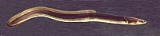
True eels (Anguilliformes) are an order of fish, which consists of four suborders, 19 families, 110 genera and approximately 600 species. Most eels are predators. The term "eel" is also used for some other similarly shaped fish, such as electric eels and spiny eels, but these are not members of the Anguilliformes order.
Description True eels are elongated fishes, ranging in length from in the one-jawed eel (Monognathus ahlstromi) to in the giant moray.

Discussion
Ask a question about 'Eel'
Start a new discussion about 'Eel'
Answer questions from other users
|
Recent Posts

Encyclopedia
True eels (Anguilliformes) are an order of fish, which consists of four suborders, 19 families, 110 genera and approximately 600 species. Most eels are predators. The term "eel" is also used for some other similarly shaped fish, such as electric eels and spiny eels, but these are not members of the Anguilliformes order.
Description True eels are elongated fishes, ranging in length from in the one-jawed eel (Monognathus ahlstromi) to in the giant moray. They have no pelvic fins, and many species also lack pectoral fins. The dorsal and anal fins are fused with the caudal or tail fin, to form a single ribbon running along much of the length of the animal.
Most true eels prefer to dwell in shallow waters or hide at the bottom layer of the ocean, sometimes in holes. These holes are called eel pits. Only the Anguillidae family regularly lives in fresh water, and returning to the sea to breed. Some eels dwell in water as deep as , or are active swimmers (the family Nemichthyidae — to a depth of .
Eels possess a flat and transparent larva, called a leptocephalus. These drift in the surface waters of the sea feeding on dissolved nutrients, before developing into a young eel, referred to as an elver, and seeking out the adult habitat.
Classification
This classification follows FishBase in dividing the eels into fifteen families. Additional families that are included in other classifications (notably ITIS and Systema Naturae 2000) are noted below the family with which they are synomized in the FishBase system.
Suborders and families
Suborder Anguilloidei
Suborder Congroidei
Suborder Nemichthyoidei
Suborder Synaphobranchoidei
- Synaphobranchidae (cutthroat eels)
- Including Dysommidae, Nettodaridae, and Simenchelyidae
In some classifications the family Cyematidae of bobtail snipe eels is included in the Anguilliformes, but in the FishBase system that family is included in the order Saccopharyngiformes.
The electric eel of South America is not a true eel, but is more closely related to the Carp.
Use by humans
Freshwater eels (unagi) and marine eels (conger eel, anago) are commonly used in Japanese cuisine - foods such as Unadon and Unajuu are popular but expensive. Eels are also very popular as food in Chinese cuisine, particularly Cantonese and Shanghai cuisine. Eel prices in Hong Kong often reached ¥1000 per kilogram, and even exceeded ¥5000 per kilogram at one time. Eel is also popular in Korean cuisine and is seen as a source of "stamina" for men. The European eel and other freshwater eels are eaten in Europe, the United States, and other places around the world. A traditional East London food is jellied eels although demand for them has reduced significantly since the end of World War II. The Basque delicacy angulas consists of deep-fried elver (young eels).. New Zealand longfin eel is a traditional food for Maori in New Zealand. In Italian cuisine eels from the Comacchio area (a swampy zone along the Adriatic coast) are specially prized along with the freshwater ones of the Bolsena Lake. In northern Germany, The Netherlands and in Sweden, smoked eel is considered a delicacy.
Eels are popular among marine aquarists in the United States, particularly the Moray eel which is commonly kept in tropical saltwater aquariums.
Elvers were once eaten by fishermen as a cheap dish, but environmental changes have led to increased rarity of the fish. They are now considered a delicacy and are priced at up to £700 per kg in the United Kingdom.
Name
The English name eel descends from Old English ?l, Common Germanic *laz. Also from the common Germanic are Middle Dutch ael, Old High German âl, Old Norse áll. Katz (1998)
identifies a number of Indo-European cognates, among them the second part of the Latin name of the eels, anguilla, which is attested in its simplex form illa in a glossary only, and likewise the Greek word for "eel", egkhelys, the second part being attested in Hesychius as elyes. The first compound member, anguis "snake", is cognate to other Indo-European words for "snake", cf. Old Irish escung "eel", Old High German unc "snake", Lithuanian angìs, Greek ophis, okhis, Vedic Sanskrit áhi, Avestan aži, Armenian auj, iž, Old Church Slavonic *ž?, all from Proto-Indo-European *oguhis, eguhis. The word also appears in Old English igil "hedgehog" (named as the "snake eater"), and perhaps in the egi- of Old High German egidehsa "wall lizard".
The name of Bellerophon (?e??e???t??, attested in a variant ???e??f??t?? in Eustathius of Thessalonica) according to this theory is also related, translating to "the slayer of the serpent" (ahihán), the e??e??- being an adjective for a lost e???- "snake", directly comparable to Hittite ellu-essar- "snake pit". This myth likely came to Greece via Anatolia, and in the Hittite version, the dragon is called Illuyanka, the illuy- part being cognate to the illa word, and the -anka part being cognate to the angu word for "snake". From these forms, no unambiguous Proto-Indo-European form for the eel word can be reconstructed, it could have been *el(l)-u-, *el(l)-o- or similar.
Further information Eel blood is toxic, but the toxic protein it contains is destroyed by cooking. The toxin derived from eel blood serum was used by Charles Robert Richet in his Nobel winning research which discovered anaphylaxis (by injecting it into dogs and observing the effect).
One of the famous attractions of the Pacific island of Huahine (part of the Society Islands in French Polynesia), is the bridge that crosses over a stream with 3- to long eels. These eels are deemed sacred by local mythology.
See also
External links
|
| |
|
|