
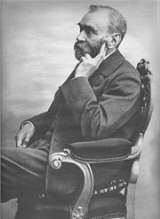
The
Nobel Prizes are annual international awards bestowed by Scandinavian committees in recognition of cultural and scientific advances. The will of the Swedish chemist
Alfred NobelAlfred Bernhard Nobel was a Swedish chemist, engineer, innovator, and armaments manufacturer. He is the inventor of dynamite. Nobel also owned Bofors, which he had redirected from its previous role as primarily an iron and steel producer to a major manufacturer of cannon and other armaments...
, the inventor of
dynamiteDynamite is an explosive material based on nitroglycerin, initially using diatomaceous earth , or another absorbent substance such as powdered shells, clay, sawdust, or wood pulp. Dynamites using organic materials such as sawdust are less stable and such use has been generally discontinued...
, established the prizes in 1895. The prizes in
PhysicsThe Nobel Prize in Physics is awarded once a year by the Royal Swedish Academy of Sciences. It is one of the five Nobel Prizes established by the will of Alfred Nobel in 1895 and awarded since 1901; the others are the Nobel Prize in Chemistry, Nobel Prize in Literature, Nobel Peace Prize, and...
,
ChemistryThe Nobel Prize in Chemistry is awarded annually by the Royal Swedish Academy of Sciences to scientists in the various fields of chemistry. It is one of the five Nobel Prizes established by the will of Alfred Nobel in 1895, awarded for outstanding contributions in chemistry, physics, literature,...
,
Physiology or MedicineThe Nobel Prize in Physiology or Medicine administered by the Nobel Foundation, is awarded once a year for outstanding discoveries in the field of life science and medicine. It is one of five Nobel Prizes established in 1895 by Swedish chemist Alfred Nobel, the inventor of dynamite, in his will...
,
LiteratureSince 1901, the Nobel Prize in Literature has been awarded annually to an author from any country who has, in the words from the will of Alfred Nobel, produced "in the field of literature the most outstanding work in an ideal direction"...
, and
PeaceThe Nobel Peace Prize is one of the five Nobel Prizes bequeathed by the Swedish industrialist and inventor Alfred Nobel.-Background:According to Nobel's will, the Peace Prize shall be awarded to the person who...
were first awarded in 1901.
The Peace Prize is awarded in
OsloOslo is a municipality, as well as the capital and most populous city in Norway. As a municipality , it was established on 1 January 1838. Founded around 1048 by King Harald III of Norway, the city was largely destroyed by fire in 1624. The city was moved under the reign of Denmark–Norway's King...
, Norway, while the other prizes are awarded in
StockholmStockholm is the capital and the largest city of Sweden and constitutes the most populated urban area in Scandinavia. Stockholm is the most populous city in Sweden, with a population of 851,155 in the municipality , 1.37 million in the urban area , and around 2.1 million in the metropolitan area...
, Sweden. Each Nobel Prize is regarded as the most prestigious award in its field.
In 1968,
Sveriges RiksbankSveriges Riksbank, or simply Riksbanken, is the central bank of Sweden and the world's oldest central bank. It is sometimes called the Swedish National Bank or the Bank of Sweden .-History:...
instituted an award that is often associated with the Nobel prizes, the
Sveriges Riksbank Prize in Economic Sciences in Memory of Alfred NobelThe Nobel Memorial Prize in Economic Sciences, commonly referred to as the Nobel Prize in Economics, but officially the Sveriges Riksbank Prize in Economic Sciences in Memory of Alfred Nobel , is an award for outstanding contributions to the field of economics, generally regarded as one of the...
. The first such prize was awarded in 1969. Although it is not an official Nobel Prize, its announcements and presentations are made along with the other prizes.
The
Royal Swedish Academy of SciencesThe Royal Swedish Academy of Sciences or Kungliga Vetenskapsakademien is one of the Royal Academies of Sweden. The Academy is an independent, non-governmental scientific organization which acts to promote the sciences, primarily the natural sciences and mathematics.The Academy was founded on 2...
awards the Nobel Prize in Physics, the Nobel Prize in Chemistry, and the Nobel Memorial Prize in Economic Sciences. The
Nobel AssemblyThe Nobel Assembly at Karolinska Institutet is a body at Karolinska Institutet which awards the Nobel Prize in Physiology or Medicine.The Nobel Assembly consists of fifty professors in medical subjects at Karolinska Institutet, appointed by the faculty of the Institute, and is a private...
at
Karolinska InstitutetKarolinska institutet is a medical university in Solna within the Stockholm urban area, Sweden, and one of Europe's largest medical universities...
awards the Nobel Prize in Physiology or Medicine. The
Swedish AcademyThe Swedish Academy , founded in 1786 by King Gustav III, is one of the Royal Academies of Sweden.-History:The Swedish Academy was founded in 1786 by King Gustav III. Modelled after the Académie française, it has 18 members. The motto of the Academy is "Talent and Taste"...
grants the Nobel Prize in Literature. The Nobel Peace Prize is not awarded by a Swedish organisation but by the
Norwegian Nobel CommitteeThe Norwegian Nobel Committee awards the Nobel Peace Prize each year.Its five members are appointed by the Norwegian Parliament and roughly represent the political makeup of that body.-History:...
.
Each recipient, or laureate, receives a gold medal, a
diplomaA diploma is a certificate or deed issued by an educational institution, such as a university, that testifies that the recipient has successfully completed a particular course of study or confers an academic degree. In countries such as the United Kingdom and Australia, the word diploma refers to...
, and a sum of money which depends on the
Nobel FoundationThe Nobel Foundation is a private institution founded on 29 June 1900 to manage the finances and administration of the Nobel Prizes. The Foundation is based on the last will of Alfred Nobel, the inventor of dynamite....
's income that year. In 2011, each prize was worth million (c. , €1.15 million). The prize is not awarded posthumously; however, if a person is awarded a prize and dies before receiving it, the prize may still be presented." A prize may not be shared among more than three people. The average number of laureates per prize has increased substantially over the 20th century.
History
Alfred NobelAlfred Bernhard Nobel was a Swedish chemist, engineer, innovator, and armaments manufacturer. He is the inventor of dynamite. Nobel also owned Bofors, which he had redirected from its previous role as primarily an iron and steel producer to a major manufacturer of cannon and other armaments...
was born on 21 October 1833 in
StockholmStockholm is the capital and the largest city of Sweden and constitutes the most populated urban area in Scandinavia. Stockholm is the most populous city in Sweden, with a population of 851,155 in the municipality , 1.37 million in the urban area , and around 2.1 million in the metropolitan area...
, Sweden, into a family of engineers. He was a chemist, engineer, and inventor. In 1894 Nobel purchased the
BoforsThe name Bofors has been associated with the iron industry for more than 350 years.Located in Karlskoga, Sweden, the company originates from the hammer mill "Boofors" founded 1646. The modern corporate structure was created in 1873 with the foundation of Aktiebolaget Bofors-Gullspång...
iron and steel mill, which he made into a major
armamentsA weapon, arm, or armament is a tool or instrument used with the aim of causing damage or harm to living beings or artificial structures or systems...
manufacturerManufacturing is the use of machines, tools and labor to produce goods for use or sale. The term may refer to a range of human activity, from handicraft to high tech, but is most commonly applied to industrial production, in which raw materials are transformed into finished goods on a large scale...
. Nobel also invented
ballistiteBallistite is a smokeless propellant made from two high explosives, nitrocellulose and nitroglycerine. It was developed and patented by Alfred Nobel in the late 19th century.-The development of smokeless powders:...
, a precursor to many smokeless military explosives, especially the British smokeless powder
corditeCordite is a family of smokeless propellants developed and produced in the United Kingdom from 1889 to replace gunpowder as a military propellant. Like gunpowder, cordite is classified as a low explosive because of its slow burning rates and consequently low brisance...
. Nobel was even involved in a patent infringement lawsuit over cordite. Nobel amassed a fortune during his lifetime. Most of his wealth was from his 355 inventions, of which dynamite is the most famous.
In 1888, Alfred was astonished to read his own obituary, titled
‘The merchant of death is dead’, in a French newspaper. As it was Alfred's brother
LudvigLudvig Immanuel Nobel was an engineer, a noted businessman and a humanitarian. One of the most prominent members of the Nobel family, he was the son of Immanuel Nobel and Alfred Nobel's older brother...
who had died, the obituary was eight years premature. The article disconcerted Nobel and made him apprehensive about how he would be remembered. This inspired him to change his will. On 10 December 1896 Alfred Nobel died in his villa in
San Remo, ItalySanremo or San Remo is a city with about 57,000 inhabitants on the Mediterranean coast of western Liguria in north-western Italy. Founded in Roman times, the city is best known as a tourist destination on the Italian Riviera. It hosts numerous cultural events, such as the Sanremo Music Festival...
from a cerebral haemorrhage. He was 63 years old.
To widespread astonishment, Nobel's last will specified that his fortune be used to create a series of prizes for those who confer the "greatest benefit on mankind" in
physicsPhysics is a natural science that involves the study of matter and its motion through spacetime, along with related concepts such as energy and force. More broadly, it is the general analysis of nature, conducted in order to understand how the universe behaves.Physics is one of the oldest academic...
,
chemistryChemistry is the science of matter, especially its chemical reactions, but also its composition, structure and properties. Chemistry is concerned with atoms and their interactions with other atoms, and particularly with the properties of chemical bonds....
,
peacePeace is a state of harmony characterized by the lack of violent conflict. Commonly understood as the absence of hostility, peace also suggests the existence of healthy or newly healed interpersonal or international relationships, prosperity in matters of social or economic welfare, the...
,
physiologyPhysiology is the science of the function of living systems. This includes how organisms, organ systems, organs, cells, and bio-molecules carry out the chemical or physical functions that exist in a living system. The highest honor awarded in physiology is the Nobel Prize in Physiology or...
or
medicineMedicine is the science and art of healing. It encompasses a variety of health care practices evolved to maintain and restore health by the prevention and treatment of illness....
, and
literatureLiterature is the art of written works, and is not bound to published sources...
. Nobel wrote several wills during his lifetime. The last was written over a year before he died, signed at the Swedish-Norwegian Club in Paris on 27 November 1895. Nobel bequeathed 94% of his total assets, 31 million SEK (c. US$186 million, €150 million in 2008), to establish the five Nobel Prizes. Because of scepticism surrounding the will, it was not until 26 April 1897 that it was approved by the Storting in Norway. The executors of Nobel's will,
Ragnar SohlmanRagnar Sohlman was a Swedish chemical engineer, manager, civil servant, and creator of the Nobel Foundation.- Biography :...
and Rudolf Lilljequist, formed the Nobel Foundation to take care of Nobel's fortune and organise the award of prizes.
Nobel's instructions named a
Norwegian Nobel CommitteeThe Norwegian Nobel Committee awards the Nobel Peace Prize each year.Its five members are appointed by the Norwegian Parliament and roughly represent the political makeup of that body.-History:...
to award the Peace Prize, the members of whom were appointed shortly after the will was approved in April 1897. Soon thereafter, the other prize-awarding organisations were established. These were the Karolinska Institutet on 7 June, the Swedish Academy on 9 June, and the Royal Swedish Academy of Sciences on 11 June. The Nobel Foundation reached an agreement on guidelines for how the prizes should be awarded, and in 1900, the Nobel Foundation's newly-created
statuteA statute is a formal written enactment of a legislative authority that governs a state, city, or county. Typically, statutes command or prohibit something, or declare policy. The word is often used to distinguish law made by legislative bodies from case law, decided by courts, and regulations...
s were promulgated by
King Oscar IIOscar II , baptised Oscar Fredrik was King of Sweden from 1872 until his death and King of Norway from 1872 until 1905. The third son of King Oscar I of Sweden and Josephine of Leuchtenberg, he was a descendant of Gustav I of Sweden through his mother.-Early life:At his birth in Stockholm, Oscar...
. In 1905, the
Union between Sweden and NorwayThe Union between Sweden and Norway , officially the United Kingdoms of Sweden and Norway, consisted of present-day Sweden and Norway between 1814 and 1905, when they were united under one monarch in a personal union....
was dissolved. Thereafter Norway's Nobel Committee was responsible for awarding the Nobel Peace Prize and the Swedish institutions retained responsibility for the other prizes.
Nobel Foundation
The Nobel Foundation was founded as a private organisation on 29 June 1900, to manage the finances and administration of the Nobel Prizes. In accordance with Nobel's will, the primary task of the Foundation is to manage the fortune Nobel left.
RobertRobert Hjalmar Nobel was the oldest son of Immanuel Nobel and his wife Caroline Andrietta Ahlsell, brother of Ludvig and Alfred Nobel....
and Ludwig Nobel were involved in the oil business in Azerbaijan and according to Swedish historian E. Bargengren, who accessed the Nobel family archives, it was this "decision to allow withdrawal of Alfred's money from
BakuBaku , sometimes spelled as Baki or Bakou, is the capital and largest city of Azerbaijan, as well as the largest city on the Caspian Sea and of the Caucasus region. It is located on the southern shore of the Absheron Peninsula, which projects into the Caspian Sea. The city consists of two principal...
that became the decisive factor that enabled the Nobel Prizes to be established". Another important task of the Nobel Foundation is to market the prizes internationally and to oversee informal administration related to the prizes. The Foundation is not involved in the process of selecting the Nobel laureates. In many ways the Nobel Foundation is similar to an
investment companyAn investment company is a company whose main business is holding securities of other companies purely for investment purposes. The investment company invests money on behalf of its shareholders who in turn share in the profits and losses....
, in that it invests Nobel's money to create a solid funding base for the prizes and the administrative activities. The Nobel Foundation is exempt from all taxes in Sweden (since 1946) and from investment taxes in the United States (since 1953). Since the 1980s, the Foundation's investments have become more profitable and as of 31 December 2007, the assets controlled by the Nobel Foundation amounted to 3.628 billion Swedish
kronor (c. US$560 million).
According to the statutes, the Foundation consists of a board of five Swedish or Norwegian citizens, with its seat in Stockholm. The Chairman of the Board is appointed by the Swedish
King in CouncilThe High Council of Sweden or Council of the Realm consisted originally of those men of noble, common and clergical background, that the king saw fit for advisory service...
, with the other four members appointed by the
trusteeTrustee is a legal term which, in its broadest sense, can refer to any person who holds property, authority, or a position of trust or responsibility for the benefit of another...
s of the prize-awarding institutions. An
Executive DirectorExecutive director is a term sometimes applied to the chief executive officer or managing director of an organization, company, or corporation. It is widely used in North American non-profit organizations, though in recent decades many U.S. nonprofits have adopted the title "President/CEO"...
is chosen from among the
board membersA board of directors is a body of elected or appointed members who jointly oversee the activities of a company or organization. Other names include board of governors, board of managers, board of regents, board of trustees, and board of visitors...
, a Deputy Director is appointed by the King in Council, and two deputies are appointed by the trustees. However, since 1995 all the members of the board have been chosen by the trustees, and the Executive Director and the Deputy Director appointed by the board itself. As well as the board, the Nobel Foundation is made up of the prize-awarding institutions (the Royal Swedish Academy of Sciences, the Nobel Assembly at Karolinska Institute, the Swedish Academy, and the Norwegian Nobel Committee), the trustees of these institutions, and
auditThe general definition of an audit is an evaluation of a person, organization, system, process, enterprise, project or product. The term most commonly refers to audits in accounting, but similar concepts also exist in project management, quality management, and energy conservation.- Accounting...
ors.
First prizes
Once the Nobel Foundation and its guidelines were in place, the
Nobel CommitteeA Nobel Committee is the working body responsible for the most of the work involved in selecting Nobel Prize laureates. There are five Nobel Committees, one for each Nobel Prize....
s began collecting nominations for the inaugural prizes. Subsequently they sent a list of preliminary candidates to the prize-awarding institutions. Originally, the Norwegian Nobel Committee appointed prominent figures including
Jørgen LøvlandJørgen Gunnarsson Løvland was a Norwegian politician and Prime Minister. He was Minister of Labour 1898-1899, 1900-1902 and 1902-1903, member of the Council of State Division in Stockholm 1899-1900, Prime Minister in Stockholm in 1905, Minister of Foreign Affairs 1905 and 1905-1907, Prime Minister...
,
Bjørnstjerne BjørnsonBjørnstjerne Martinius Bjørnson was a Norwegian writer and the 1903 Nobel Prize in Literature laureate. Bjørnson is considered as one of The Four Greats Norwegian writers; the others being Henrik Ibsen, Jonas Lie, and Alexander Kielland...
and
Johannes SteenJohannes Wilhelm Christian Steen was a Norwegian politician, Prime Minister of Norway from 1891 to 1893 and from 1898 to 1902....
to give the Nobel Peace Prize credibility. The committee awarded the Peace Prize to two prominent figures in the growing peace movement around the end of the 19th century:
Frédéric PassyFrédéric Passy was a French economist and a joint winner of the first Nobel Peace Prize awarded in 1901.- Biography :...
was co-founder of the
Inter-Parliamentary Union and
Henry DunantJean Henri Dunant , aka Henry Dunant, was a Swiss businessman and social activist. During a business trip in 1859, he was witness to the aftermath of the Battle of Solferino in modern day Italy...
was founder of the
International Committee of the Red CrossThe International Committee of the Red Cross is a private humanitarian institution based in Geneva, Switzerland. States parties to the four Geneva Conventions of 1949 and their Additional Protocols of 1977 and 2005, have given the ICRC a mandate to protect the victims of international and...
.
The Nobel Committee's Physics Prize shortlist cited
Wilhelm Conrad RöntgenWilhelm Conrad Röntgen was a German physicist, who, on 8 November 1895, produced and detected electromagnetic radiation in a wavelength range today known as X-rays or Röntgen rays, an achievement that earned him the first Nobel Prize in Physics in 1901....
's discovery of
X-rayX-radiation is a form of electromagnetic radiation. X-rays have a wavelength in the range of 0.01 to 10 nanometers, corresponding to frequencies in the range 30 petahertz to 30 exahertz and energies in the range 120 eV to 120 keV. They are shorter in wavelength than UV rays and longer than gamma...
s and
Philipp LenardPhilipp Eduard Anton von Lenard , known in Hungarian as Lénárd Fülöp Eduárd Antal, was a Hungarian - German physicist and the winner of the Nobel Prize for Physics in 1905 for his research on cathode rays and the discovery of many of their properties...
's work on cathode rays. The Academy of Sciences selected Röntgen for the prize. In the last decades of the 19th century, many chemists had made significant contributions. Thus, with the Chemistry Prize, the Academy "was chiefly faced with merely deciding the order in which these scientists should be awarded the prize." The Academy received 20 nominations, eleven of them for Jacobus van't Hoff. Van't Hoff was awarded the prize for his contributions in chemical thermodynamics.
The Swedish Academy chose the poet
Sully PrudhommeRené François Armand Prudhomme was a French poet and essayist, winner of the first Nobel Prize in Literature, in 1901....
for the first Nobel Prize in Literature. A group including 42 Swedish writers, artists and literary critics protested against this decision, having expected
Leo TolstoyLev Nikolayevich Tolstoy was a Russian writer who primarily wrote novels and short stories. Later in life, he also wrote plays and essays. His two most famous works, the novels War and Peace and Anna Karenina, are acknowledged as two of the greatest novels of all time and a pinnacle of realist...
to win. Some, including Burton Feldman, have criticised this prize because they consider Prudhomme a mediocre poet. Feldman's explanation is that most of the Academy members preferred
Victorian literatureVictorian literature is the literature produced during the reign of Queen Victoria . It forms a link and transition between the writers of the romantic period and the very different literature of the 20th century....
and thus selected a Victorian poet. The first Physiology or Medicine Prize went to the German physiologist and microbiologist Emil von Behring. During the 1890s, von Behring developed an
antitoxinAn antitoxin is an antibody with the ability to neutralize a specific toxin. Antitoxins are produced by certain animals, plants, and bacteria. Although they are most effective in neutralizing toxins, they can kill bacteria and other microorganisms. Antitoxins are made within organisms, but can be...
to treat
diphtheriaDiphtheria is an upper respiratory tract illness caused by Corynebacterium diphtheriae, a facultative anaerobic, Gram-positive bacterium. It is characterized by sore throat, low fever, and an adherent membrane on the tonsils, pharynx, and/or nasal cavity...
, which until then was causing thousands of deaths each year.
World War II
In 1938 and 1939,
Adolf HitlerAdolf Hitler was an Austrian-born German politician and the leader of the National Socialist German Workers Party , commonly referred to as the Nazi Party). He was Chancellor of Germany from 1933 to 1945, and head of state from 1934 to 1945...
's Third Reich forbade three laureates from Germany (
Richard KuhnRichard Kuhn was an Austrian-German biochemist, Nobel laureate, and Nazi collaborator.-Early life:Kuhn was born in Vienna, Austria where he attended grammar school and high school. His interest in chemistry surfaced early; however he had many interests and decided late to study chemistry...
,
Adolf Friedrich Johann ButenandtAdolf Friedrich Johann Butenandt was a German biochemist and member of the Nazi party. He was awarded the Nobel Prize in Chemistry in 1939 for his "work on sex hormones." He initially rejected the award in accordance with government policy, but accepted it in 1949 after World War...
, and
Gerhard DomagkGerhard Johannes Paul Domagk was a German pathologist and bacteriologist credited with the discovery of Sulfonamidochrysoidine – the first commercially available antibiotic – for which he received the 1939 Nobel Prize in Physiology or Medicine.Domagk was born in Lagow, Brandenburg, the...
) from accepting their prizes. Each man was later able to receive the diploma and medal. Even though Sweden was officially neutral during World War II, the prizes were awarded irregularly. In 1939, the Peace Prize was not awarded. No prize was awarded in any category from 1940–42, due to the
occupation of Norway by GermanyThe occupation of Norway by Nazi Germany started with the German invasion of Norway on April 9, 1940, and ended on May 8, 1945, after the capitulation of German forces in Europe. Throughout this period, Norway was continuously occupied by the Wehrmacht...
. In the subsequent year, all prizes were awarded except those for literature and peace.
During the occupation of Norway, three members of the Norwegian Nobel Committee fled into exile. The remaining members escaped persecution from the
NazisNazism, the common short form name of National Socialism was the ideology and practice of the Nazi Party and of Nazi Germany...
when the Nobel Foundation stated that the Committee building in
OsloOslo is a municipality, as well as the capital and most populous city in Norway. As a municipality , it was established on 1 January 1838. Founded around 1048 by King Harald III of Norway, the city was largely destroyed by fire in 1624. The city was moved under the reign of Denmark–Norway's King...
was Swedish property. Thus it was a safe haven from the German military, which was not at war with Sweden. These members kept the work of the Committee going but did not award any prizes. In 1944 the Nobel Foundation, together with the three members in exile, made sure that nominations were submitted for the Peace Prize and that the prize could be awarded once again.
Prize in Economic Sciences
In 1968,
Sveriges RiksbankSveriges Riksbank, or simply Riksbanken, is the central bank of Sweden and the world's oldest central bank. It is sometimes called the Swedish National Bank or the Bank of Sweden .-History:...
celebrated its 300th anniversary by donating a large sum of money to the Nobel Foundation to be used to set up a prize in honor of Nobel. The following year, the
Nobel Memorial Prize in Economic SciencesThe Nobel Memorial Prize in Economic Sciences, commonly referred to as the Nobel Prize in Economics, but officially the Sveriges Riksbank Prize in Economic Sciences in Memory of Alfred Nobel , is an award for outstanding contributions to the field of economics, generally regarded as one of the...
was awarded for the first time. The Royal Swedish Academy of Sciences became responsible for selecting laureates. The first laureates for the Economics Prize were
Jan TinbergenJan Tinbergen , was a Dutch economist. He was awarded the first Bank of Sweden Prize in Economic Sciences in Memory of Alfred Nobel in 1969, which he shared with Ragnar Frisch for having developed and applied dynamic models for the analysis of economic processes...
and Ragnar Frisch "for having developed and applied dynamic models for the analysis of economic processes." Although not a Nobel Prize, it is intimately identified with the other awards; the laureates are announced with the Nobel Prize recipients, and the Prize in Economic Sciences is presented at the Swedish Nobel Prize Award Ceremony. The Board of the Nobel Foundation decided that after this addition, it would allow no further new prizes.
Award process
The award process is similar for all of the Nobel Prizes; the main difference is in who can make nominations for each of them.
Nominations
Nomination forms are sent by the Nobel Committee to about 3000 individuals, usually in September the year before the prizes are awarded. These individuals are often academics working in a relevant area. For the Peace Prize, inquiries are sent to governments, members of
international courtInternational courts are formed by treaties between nations, or under the authority of an international organization such as the United Nations — this includes ad hoc tribunals and permanent institutions, but excludes any courts arising purely under national authority.Early examples of...
s, professors and rectors, former Peace Prize laureates and current or former members of the Norwegian Nobel Committee. The deadline for the return of the nomination forms is 31 January of the year of the award. The Nobel Committee nominates about 300 potential laureates from these forms and additional names. The nominees are not publicly named, nor are they told that they are being considered for the prize. All nomination records for a prize are sealed for 50 years from the awarding of the prize.
Selection
The Nobel Committee then prepares a report reflecting the advice of experts in the relevant fields. This, along with the list of preliminary candidates, is submitted to the prize-awarding institutions. The institutions meet to choose the laureate or laureates in each field by a majority vote. Their decision, which cannot be appealed, is announced immediately after the vote. A maximum of three laureates and two different works may be selected per award. Except for the Peace Prize, which can be awarded to institutions, the awards can only be given to individuals. If the Peace Prize is not awarded, the money is split among the scientific prizes. This has happened 19 times so far.
Posthumous nominations
Although posthumous nominations are not permitted, individuals who die in the months between their nomination and the decision of the prize committee were originally eligible to receive the prize. This has occurred twice: the 1931 Literature Prize awarded to
Erik Axel KarlfeldtErik Axel Karlfeldt was a Swedish poet whose highly symbolist poetry masquerading as regionalism was popular and won him the Nobel Prize in Literature posthumously in 1931. It has been rumored that he had been offered, but declined, the award already in 1919.Karlfeldt was born into a farmer's...
, and the 1961 Peace Prize awarded to UN Secretary General
Dag HammarskjöldDag Hjalmar Agne Carl Hammarskjöld was a Swedish diplomat, economist, and author. An early Secretary-General of the United Nations, he served from April 1953 until his death in a plane crash in September 1961. He is the only person to have been awarded a posthumous Nobel Peace Prize. Hammarskjöld...
. Since 1974, laureates must be thought alive at the time of the October announcement. There has been one laureate,
William VickreyWilliam Spencer Vickrey was a Canadian professor of economics and Nobel Laureate. Vickrey was awarded the Nobel Memorial Prize in Economics with James Mirrlees for their research into the economic theory of incentives under asymmetric information...
, who died after the prize was announced but before it could be presented. On 3 October 2011, the laureates for the
Nobel Prize in Physiology or MedicineThe Nobel Prize in Physiology or Medicine administered by the Nobel Foundation, is awarded once a year for outstanding discoveries in the field of life science and medicine. It is one of five Nobel Prizes established in 1895 by Swedish chemist Alfred Nobel, the inventor of dynamite, in his will...
were announced; however, the committee was not aware that one of the laureates,
Ralph M. SteinmanRalph Marvin Steinman was a Canadian immunologist and cell biologist at Rockefeller University, who in 1973 coined the term dendritic cells while working as a postdoc in the lab of Zanvil A. Cohn, also at Rockefeller University....
, had died three days earlier, on September 30. The committee was considering what to do about Steinman's prize, since the rule is that the prize is not awarded posthumously. The committee later decided that as the decision to award Steinman the prize "was made in good faith," it would remain unchanged.
Recognition time lag
Nobel's will provides for prizes to be awarded in recognition of discoveries made "during the preceding year". Early on, the awards usually recognised recent discoveries. However, some of these early discoveries were later discredited. For example,
Johannes FibigerJohannes Andreas Grib Fibiger was a Danish scientist, physician, and professor of pathological anatomy who won the 1926 Nobel Prize in Physiology or Medicine. Fibiger had claimed to find an organism he called Spiroptera carcinoma that caused cancer in mice and rats. He received a Nobel prize for...
was awarded the 1926 Prize for
Physiology or MedicineThe Nobel Prize in Physiology or Medicine administered by the Nobel Foundation, is awarded once a year for outstanding discoveries in the field of life science and medicine. It is one of five Nobel Prizes established in 1895 by Swedish chemist Alfred Nobel, the inventor of dynamite, in his will...
for his purported discovery of a parasite that caused cancer. To avoid this embarrassment, the awards increasingly recognised scientific discoveries that had withstood the test of time. According to Ralf Pettersson, former chairman of the Nobel Prize Committee for Physiology or Medicine, "the criterion ‘the previous year’ is interpreted by the Nobel Assembly as the year when the full impact of the discovery has become evident."
The interval between the award and the accomplishment it recognises varies from discipline to discipline. The Literature Prize is typically awarded to recognise a cumulative lifetime body of work rather than a single achievement. The Peace Prize can also be awarded for a lifetime body of work. For example 2008 laureate Martti Ahtisaari was awarded for his work to resolve international conflicts. However, they can also be awarded for specific recent events. For instance,
Kofi AnnanKofi Atta Annan is a Ghanaian diplomat who served as the seventh Secretary-General of the UN from 1 January 1997 to 31 December 2006...
was awarded the 2001 Peace Prize just four years after becoming the Secretary-General of the United Nations. Similarly
Yasser ArafatMohammed Yasser Abdel Rahman Abdel Raouf Arafat al-Qudwa al-Husseini , popularly known as Yasser Arafat or by his kunya Abu Ammar , was a Palestinian leader and a Laureate of the Nobel Prize. He was Chairman of the Palestine Liberation Organization , President of the Palestinian National Authority...
,
Yitzhak Rabin' was an Israeli politician, statesman and general. He was the fifth Prime Minister of Israel, serving two terms in office, 1974–77 and 1992 until his assassination in 1995....
, and
Shimon PeresGCMG is the ninth President of the State of Israel. Peres served twice as the eighth Prime Minister of Israel and once as Interim Prime Minister, and has been a member of 12 cabinets in a political career spanning over 66 years...
received the 1994 award, about a year after they successfully concluded the
Oslo AccordsThe Oslo Accords, officially called the Declaration of Principles on Interim Self-Government Arrangements or Declaration of Principles , was an attempt to resolve the ongoing Palestinian-Israeli conflict...
.
Although Nobel's will stated that prizes should be awarded for contributions made "during the preceding year", awards for physics, chemistry, and medicine are typically awarded once the achievement has been widely accepted. This may sometimes take decades - for example,
Subrahmanyan ChandrasekharSubrahmanyan Chandrasekhar, FRS ) was an Indian origin American astrophysicist who, with William A. Fowler, won the 1983 Nobel Prize for Physics for key discoveries that led to the currently accepted theory on the later evolutionary stages of massive stars...
shared the 1983 Physics Prize for his 1930s work on stellar structure and evolution. Not all scientists live long enough for their work to be recognised. Some discoveries can never be considered for a prize if their impact is realised after the discoverers have died.
Award ceremonies
Apart from the Peace Prize, the Nobel Prizes are presented in Stockholm, Sweden, at the annual Prize Award Ceremony on 10 December, the anniversary of Nobel's death. The recipients' lectures are normally held in the days prior to the award ceremony. The Peace Prize and its recipients' lectures are presented at the annual Prize Award Ceremony in Oslo, Norway, usually on 10 December. The award ceremonies and the associated banquets are typically major international events. The Prizes awarded in Sweden's ceremonies' are held at the
Stockholm Concert HallThe Stockholm Concert Hall is the main hall for orchestral music in Stockholm, Sweden. Designed by Ivar Tengbom and inaugurated in 1926, it is the home to the Royal Stockholm Philharmonic Orchestra. It is also where the awarding ceremony for the Nobel Prizes, Polar Music Prize are held annually....
, with the Nobel banquet following immediately at
Stockholm City HallStockholm City Hall is the building of the Municipal Council for the City of Stockholm in Sweden. It stands on the eastern tip of Kungsholmen island, next to Riddarfjärden's northern shore and facing the islands of Riddarholmen and Södermalm. It houses offices and conference rooms as well as...
. The Nobel Peace Prize ceremony has been held at the
Norwegian Nobel InstituteThe Norwegian Nobel Institute was established in 1904 in Kristiania , Norway.The principal duty of the Nobel Institute is to assist the Norwegian Nobel Committee in the task of selecting the recipient of the Nobel Peace Prize and to organize the annual Nobel event in Oslo.The institute is situated...
(1905–1946); at the
auditoriumAn auditorium is a room built to enable an audience to hear and watch performances at venues such as theatres. For movie theaters, the number of auditoriums is expressed as the number of screens.- Etymology :...
of the
University of OsloThe University of Oslo , formerly The Royal Frederick University , is the oldest and largest university in Norway, situated in the Norwegian capital of Oslo. The university was founded in 1811 and was modelled after the recently established University of Berlin...
(1947–1989); and at
Oslo City HallOslo City Hall houses the city council, city administration, and art studios and galleries. The construction started in 1931, but was paused by the outbreak of World War II, before the official inauguration in 1950. Its characteristic architecture, artworks and the Nobel Peace Prize ceremony, held...
(1990–).
The highlight of the Nobel Prize Award Ceremony in Stockholm occurs when each Nobel Laureate steps forward to receive the prize from the hands of the King of Sweden. In Oslo, the Chairman of the Norwegian Nobel Committee presents the Nobel Peace Prize in the presence of the King of Norway. Since 1902, the King of Sweden has presented all the prizes, except the Peace Prize, in Stockholm. At first King Oscar II did not approve of awarding grand prizes to foreigners, but is said to have changed his mind once his attention had been drawn to the publicity value of the prizes for Sweden.
Nobel banquet
After the award ceremony in Sweden, a banquet is held at the Stockholm City Hall, which is attended by the Swedish Royal Family and around 1,300 guests. The banquet features a three-course dinner, entertainment and dancing and is extensively covered by local and international media. Before 1930, the banquet in Sweden was held in the ballroom of Stockholm's Grand Hotel.
The Nobel Peace Prize banquet is held in Oslo at the Grand Hotel after the award ceremony. As well as the laureate, other guests include the President of the Storting, the Prime Minister and (since 2006) the King and Queen of Norway. In total there are about 250 guests attending who all are treated a five-course meal. For the first time in its history, the banquet was cancelled in Oslo in 1979 because the laureate
Mother TeresaMother Teresa , born Agnes Gonxha Bojaxhiu , was a Roman Catholic nun of Albanian ethnicity and Indian citizenship, who founded the Missionaries of Charity in Calcutta, India, in 1950...
refused to attend, saying the money would be better spent on the poor. Mother Teresa used the US$7,000 that was to be spent on the banquet to hold a dinner for 2,000 homeless people on Christmas Day.
Nobel lectures
According to the statutes of the Nobel Foundation, each laureate is required to give a public lecture on a subject related to the topic of their prize. These lectures normally occur during Nobel Week (the week leading up to the award ceremony and banquet, which begins with the laureates arriving in Stockholm and normally ends with the Nobel banquet), but this is not mandatory. The laureate is only obliged to give the lecture within six months of receiving the prize. Some have happened even later. For example, US president
Theodore RooseveltTheodore "Teddy" Roosevelt was the 26th President of the United States . He is noted for his exuberant personality, range of interests and achievements, and his leadership of the Progressive Movement, as well as his "cowboy" persona and robust masculinity...
won the Peace Prize in 1906 but gave his lecture in 1910, after his term in office. The lectures are organised by the same association who selected the laureates.
Medals
The Nobel Prize medals, minted by
MyntverketMyntverket is a private Swedish company that produces coins and medals, most notably the Swedish national coins and the Nobel Prize medals. As of 2008, Swedish coins are now minted by Myntverket's parent company, Mint of Finland Ltd in Helsinki, Finland, ending a 1012 year history of minting...
in Sweden and the Mint of Norway since 1902, are registered trademarks of the Nobel Foundation. Each medal features an image of Alfred Nobel in left profile on the
obverseObverse and its opposite, reverse, refer to the two flat faces of coins and some other two-sided objects, including paper money, flags , seals, medals, drawings, old master prints and other works of art, and printed fabrics. In this usage, obverse means the front face of the object and reverse...
. The medals for physics, chemistry, physiology or medicine, and literature have identical obverses, showing the image of Alfred Nobel and the years of his birth and death. Nobel's portrait also appears on the obverse of the Peace Prize medal and the medal for the Economics Prize, but with a slightly different design. For instance, the laureate's name is engraved on the rim of the Economics medal. The image on the reverse of a medal varies according to the institution awarding the prize. The reverse sides of the medals for chemistry and physics share the same design.
All medals made before 1980 were struck in 23
caratThe karat or carat is a unit of purity for gold alloys.- Measure :Karat purity is measured as 24 times the purity by mass:where...
gold. Since then they have been struck in 18 carat green gold plated with 24 carat gold. The weight of each medal varies with the value of gold, but averages about 175 gram (0.385808958823536 lb) for each medal. The diameter is 66 millimetres (2.6 in) and the thickness varies between 5.2 millimetre (0.204724409448819 in) and 2.4 millimetre (0.094488188976378 in). Because of the high value of their gold content and tendency to be on public display, Nobel medals are subject to medal theft. During World War II, the medals of German scientists
Max von LaueMax Theodor Felix von Laue was a German physicist who won the Nobel Prize in Physics in 1914 for his discovery of the diffraction of X-rays by crystals...
and
James FranckJames Franck was a German Jewish physicist and Nobel laureate.-Biography:Franck was born to Jacob Franck and Rebecca Nachum Drucker. Franck completed his Ph.D...
were sent to Copenhagen for safekeeping. When Germany invaded Denmark, chemist
George de HevesyGeorge Charles de Hevesy, Georg Karl von Hevesy, was a Hungarian radiochemist and Nobel laureate, recognized in 1943 for his key role in the development of radioactive tracers to study chemical processes such as in the metabolism of animals.- Early years :Hevesy György was born in Budapest,...
dissolved them in
aqua regiaAqua regia or aqua regis is a highly corrosive mixture of acids, fuming yellow or red solution, also called nitro-hydrochloric acid. The mixture is formed by freshly mixing concentrated nitric acid and hydrochloric acid, usually in a volume ratio of 1:3, respectively...
, to prevent confiscation by
Nazi GermanyNazi Germany , also known as the Third Reich , but officially called German Reich from 1933 to 1943 and Greater German Reich from 26 June 1943 onward, is the name commonly used to refer to the state of Germany from 1933 to 1945, when it was a totalitarian dictatorship ruled by...
and to prevent legal problems for the holders. After the war, the gold was recovered from solution, and the medals re-cast.
Diplomas
Nobel laureates receive a diploma directly from the hands of the King of Sweden or the Chairman of the Norwegian Nobel Committee. Each diploma is uniquely designed by the prize-awarding institutions for the laureates that receive them. The diploma contains a picture and text which states the name of the laureate and normally a citation of why they received the prize. None of the Nobel Peace Prize laureates has ever had a citation on their diplomas.
Award money
The laureates are given a sum of money when they receive their prizes, in the form of a document confirming the amount awarded. The amount of prize money depends upon how much money the Nobel Foundation can award each year. The purse has increased since the 1980s, when the prize money was 880 000 SEK (c. 2.6 million SEK, US$350 000 or €295,000 today). In 2009, the monetary award was 10 million SEK (US$1.4 million, €950,000). If there are two laureates in a particular category, the award grant is divided equally between the recipients. If there are three, the awarding committee has the option of dividing the grant equally, or awarding one-half to one recipient and one-quarter to each of the others. It is not uncommon for recipients to donate prize money to benefit scientific, cultural, or humanitarian causes.
Controversial recipients
Among other criticisms, the Nobel Committees have been accused of having a political agenda, and of omitting more deserving candidates. They have also been accused of
EurocentrismEurocentrism is the practice of viewing the world from a European perspective and with an implied belief, either consciously or subconsciously, in the preeminence of European culture...
, especially for the Literature Prize.
Peace Prize
Among the most criticised Nobel Peace Prizes was the one awarded to
Henry KissingerHeinz Alfred "Henry" Kissinger is a German-born American academic, political scientist, diplomat, and businessman. He is a recipient of the Nobel Peace Prize. He served as National Security Advisor and later concurrently as Secretary of State in the administrations of Presidents Richard Nixon and...
and Lê Ðức Thọ, who later declined the prize. This led to two Norwegian Nobel Committee members resigning. Kissinger and Thọ were awarded the prize for negotiating a ceasefire between
North VietnamThe Democratic Republic of Vietnam , was a communist state that ruled the northern half of Vietnam from 1954 until 1976 following the Geneva Conference and laid claim to all of Vietnam from 1945 to 1954 during the First Indochina War, during which they controlled pockets of territory throughout...
and the United States in January 1973. However, when the award was announced, both sides were still engaging in hostilities. Many critics were of the opinion that Kissinger was not a peace-maker but the opposite; responsible for widening the war.
Yasser ArafatMohammed Yasser Abdel Rahman Abdel Raouf Arafat al-Qudwa al-Husseini , popularly known as Yasser Arafat or by his kunya Abu Ammar , was a Palestinian leader and a Laureate of the Nobel Prize. He was Chairman of the Palestine Liberation Organization , President of the Palestinian National Authority...
,
Shimon PeresGCMG is the ninth President of the State of Israel. Peres served twice as the eighth Prime Minister of Israel and once as Interim Prime Minister, and has been a member of 12 cabinets in a political career spanning over 66 years...
, and
Yitzhak Rabin' was an Israeli politician, statesman and general. He was the fifth Prime Minister of Israel, serving two terms in office, 1974–77 and 1992 until his assassination in 1995....
received the Peace Prize in 1994 for their efforts in making peace between Israel and Palestine. Many issues, such as the plight of Palestinian refugees, had not been addressed and no final status agreement was reached. Immediately after the award was announced, one of the five Norwegian Nobel Committee members denounced Arafat as a terrorist and resigned. Additional misgivings about Arafat were widely expressed in various newspapers.
Another controversial Peace Prize was that awarded to
Barack ObamaBarack Hussein Obama II is the 44th and current President of the United States. He is the first African American to hold the office. Obama previously served as a United States Senator from Illinois, from January 2005 until he resigned following his victory in the 2008 presidential election.Born in...
in 2009The 2009 Nobel Peace Prize was awarded to U.S. President Barack Obama "for his extraordinary efforts to strengthen international diplomacy and cooperation between people." The Norwegian Nobel Committee announced the award on October 9, 2009, citing Obama's promotion of nuclear nonproliferation and...
. Nominations had closed only eleven days after Obama took office as President, but the actual evaluation occurred over the next eight months. Obama himself stated that he did not feel deserving of the award, or worthy of the company it would place him in. Past Peace Prize laureates were divided, some saying that Obama deserved the award, and others saying he had not yet earned it. Obama's award, along with the previous Peace Prizes for
Jimmy CarterJames Earl "Jimmy" Carter, Jr. is an American politician who served as the 39th President of the United States and was the recipient of the 2002 Nobel Peace Prize, the only U.S. President to have received the Prize after leaving office...
and
Al GoreAlbert Arnold "Al" Gore, Jr. served as the 45th Vice President of the United States , under President Bill Clinton. He was the Democratic Party's nominee for President in the 2000 U.S. presidential election....
, also prompted accusations of a
left-wingIn politics, Left, left-wing and leftist generally refer to support for social change to create a more egalitarian society...
bias.
Literature Prize
The award of the 2004 Literature Prize to
Elfriede JelinekElfriede Jelinek is an Austrian playwright and novelist. She was awarded the Nobel Prize in Literature in 2004 for her "musical flow of voices and counter-voices in novels and plays that, with extraordinary linguistic zeal, reveal the absurdity of society's clichés and their subjugating power."-...
drew a protest from a member of the Swedish Academy,
Knut AhnlundKnut Emil Ahnlund is a Swedish literary historian, writer, and member of the Swedish Academy.Ahnlund is an expert on 19th and 20th century Nordic, especially Danish, literature. He wrote his doctoral dissertation on Henrik Pontoppidan, and has later written on Gustav Wied and Sven Lidman, among...
. Ahnlund resigned, alleging that the selection of Jelinek had caused "irreparable damage to all progressive forces, it has also confused the general view of literature as an art." He alleged that Jelinek's works were "a mass of text shovelled together without artistic structure." The 2009 Literature Prize to
Herta MüllerHerta Müller is a Romanian-born German novelist, poet and essayist noted for her works depicting the effects of violence, cruelty and terror, usually in the setting of Communist Romania under the repressive Nicolae Ceauşescu regime which she experienced herself...
also generated criticism. According to
The Washington PostThe Washington Post is Washington, D.C.'s largest newspaper and its oldest still-existing paper, founded in 1877. Located in the capital of the United States, The Post has a particular emphasis on national politics. D.C., Maryland, and Virginia editions are printed for daily circulation...
many US literary critics and professors had never previously heard of her. This made many feel that the prizes were too Eurocentric.
Science prizes
In 1949, the Portuguese neurologist António Egas Moniz received the Physiology or Medicine Prize for his development of the prefrontal leucotomy. The previous year Dr. Walter Freeman had developed a version of the procedure which was faster and easier to carry out. Due in part to the publicity surrounding the original procedure, Freeman's procedure was prescribed without due consideration or regard for modern
medical ethicsMedical ethics is a system of moral principles that apply values and judgments to the practice of medicine. As a scholarly discipline, medical ethics encompasses its practical application in clinical settings as well as work on its history, philosophy, theology, and sociology.-History:Historically,...
. Endorsed by such influential publications as
The New England Journal of Medicine, leucotomy or "lobotomy" became so popular that about 5,000 lobotomies were performed in the United States in the three years immediately following Moniz's receipt of the Prize.
Overlooked achievements
The Norwegian Nobel Committee confirmed that
Mahatma GandhiMohandas Karamchand Gandhi , pronounced . 2 October 1869 – 30 January 1948) was the pre-eminent political and ideological leader of India during the Indian independence movement...
was nominated for the Peace Prize in 1937–39, 1947 and a few days before he was assassinated in January 1948. Later members of the Norwegian Nobel Committee expressed regret that he was not given the prize. Geir Lundestad, Secretary of Norwegian Nobel Committee in 2006 said, "The greatest omission in our 106 year history is undoubtedly that Mahatma Gandhi never received the Nobel Peace prize. Gandhi could do without the Nobel Peace prize, Whether Nobel committee can do without Gandhi is the question". In 1948, the year of Gandhi's death, the Nobel Committee declined to award a prize on the grounds that "there was no suitable living candidate" that year. Later, when the
Dalai LamaThe 14th Dalai Lama is the 14th and current Dalai Lama. Dalai Lamas are the most influential figures in the Gelugpa lineage of Tibetan Buddhism, although the 14th has consolidated control over the other lineages in recent years...
was awarded the Peace Prize in 1989, the chairman of the committee said that this was "in part a tribute to the memory of Mahatma Gandhi." Other high profile individuals with widely recognised contributions to peace have been missed out. As well as Gandhi,
Foreign PolicyForeign Policy is a bimonthly American magazine founded in 1970 by Samuel P. Huntington and Warren Demian Manshel.Originally, the magazine was a quarterly...
lists
Eleanor RooseveltAnna Eleanor Roosevelt was the First Lady of the United States from 1933 to 1945. She supported the New Deal policies of her husband, distant cousin Franklin Delano Roosevelt, and became an advocate for civil rights. After her husband's death in 1945, Roosevelt continued to be an international...
,
Václav HavelVáclav Havel is a Czech playwright, essayist, poet, dissident and politician. He was the tenth and last President of Czechoslovakia and the first President of the Czech Republic . He has written over twenty plays and numerous non-fiction works, translated internationally...
,
Ken Saro-WiwaKenule "Ken" Beeson Saro Wiwa was a Nigerian author, television producer, environmental activist, and winner of the Right Livelihood Award and the Goldman Environmental Prize...
,
Sari NusseibehSari Nusseibeh , and raised in Jerusalem, is a Palestinian professor of philosophy and president of the Al-Quds University in Jerusalem...
and
Corazon AquinoMaria Corazon Sumulong Cojuangco-Aquino was the 11th President of the Philippines and the first woman to hold that office in Philippine history. She is best remembered for leading the 1986 People Power Revolution, which toppled Ferdinand Marcos and restored democracy in the Philippines...
as people who "never won the prize, but should have."
The Literature Prize also has controversial omissions.
Adam KirschAdam Kirsch is an American poet and literary critic.-Early life and education:Kirsch is the son of lawyer, author, and biblical scholar Jonathan Kirsch, and a 1997 graduate of Harvard College.-Career:...
has suggested that many notable writers have missed out on the award for political or extra-literary reasons. The heavy focus on European and Swedish authors has been a subject of criticism. The Eurocentric nature of the award was acknowledged by
Peter EnglundPeter Englund is a Swedish author and historian, and the permanent secretary of the Swedish Academy since 1 June 2009.-Biography:...
, the 2009 Permanent Secretary of the Swedish Academy, as a problem with the award and was attributed to the tendency for the academy to relate more to European authors. Notable writers that have been overlooked for the Literature Prize include;
Émile ZolaÉmile François Zola was a French writer, the most important exemplar of the literary school of naturalism and an important contributor to the development of theatrical naturalism...
,
Jorge Luis BorgesJorge Francisco Isidoro Luis Borges Acevedo , known as Jorge Luis Borges , was an Argentine writer, essayist, poet and translator born in Buenos Aires. In 1914 his family moved to Switzerland where he attended school, receiving his baccalauréat from the Collège de Genève in 1918. The family...
,
Marcel ProustValentin Louis Georges Eugène Marcel Proust was a French novelist, critic, and essayist best known for his monumental À la recherche du temps perdu...
,
Ezra PoundEzra Weston Loomis Pound was an American expatriate poet and critic and a major figure in the early modernist movement in poetry...
,
James JoyceJames Augustine Aloysius Joyce was an Irish novelist and poet, considered to be one of the most influential writers in the modernist avant-garde of the early 20th century...
,
August StrindbergJohan August Strindberg was a Swedish playwright, novelist, poet, essayist and painter. A prolific writer who often drew directly on his personal experience, Strindberg's career spanned four decades, during which time he wrote over 60 plays and more than 30 works of fiction, autobiography,...
,
Simon VestdijkSimon Vestdijk was a Dutch writer.Born in the small town of Harlingen, Vestdijk studied medicine in Amsterdam, but turned to literature after a few years as a doctor. He became one of the most important 20th-century writers in the Netherlands. His prolificness as a novelist was legendary, but he...
,
John UpdikeJohn Hoyer Updike was an American novelist, poet, short story writer, art critic, and literary critic....
,
Arthur MillerArthur Asher Miller was an American playwright and essayist. He was a prominent figure in American theatre, writing dramas that include plays such as All My Sons , Death of a Salesman , The Crucible , and A View from the Bridge .Miller was often in the public eye,...
,
Chinua AchebeAlbert Chinụalụmọgụ Achebe popularly known as Chinua Achebe is a Nigerian novelist, poet, professor, and critic...
and
Mark TwainSamuel Langhorne Clemens , better known by his pen name Mark Twain, was an American author and humorist...
.
The strict rule against awarding a prize to more than three people is also controversial. When a prize is awarded to recognise an achievement by a team of more than three collaborators one or more will miss out. For example, in 2002, the prize was awarded to
Koichi Tanakais a Japanese scientist who shared the Nobel Prize in Chemistry in 2002 for developing a novel method for mass spectrometric analyses of biological macromolecules with John Bennett Fenn and Kurt Wuthrich ....
and John Fenn for the development of
mass spectrometryMass spectrometry is an analytical technique that measures the mass-to-charge ratio of charged particles.It is used for determining masses of particles, for determining the elemental composition of a sample or molecule, and for elucidating the chemical structures of molecules, such as peptides and...
in
protein chemistryProteins are biochemical compounds consisting of one or more polypeptides typically folded into a globular or fibrous form, facilitating a biological function. A polypeptide is a single linear polymer chain of amino acids bonded together by peptide bonds between the carboxyl and amino groups of...
, an award that did not recognise the achievements of
Franz HillenkampFranz Hillenkamp is a German mass spectrometry scientist developer with Michael Karas of the matrix-assisted laser desorption/ionization technique.-Awards:...
and
Michael KarasMichael Karas is a German physical chemistry scientist and Professor, known for his researches on matrix-assisted laser desorption/ionization , a technique in mass spectrometry....
of the Institute for Physical and Theoretical Chemistry at the University of Frankfurt. Similarly, the prohibition of posthumous awards fails to recognise achievements by an individual or collaborator who dies before the prize is awarded. In 1962,
Francis CrickFrancis Harry Compton Crick OM FRS was an English molecular biologist, biophysicist, and neuroscientist, and most noted for being one of two co-discoverers of the structure of the DNA molecule in 1953, together with James D. Watson...
,
James D. WatsonJames Dewey Watson is an American molecular biologist, geneticist, and zoologist, best known as one of the co-discoverers of the structure of DNA in 1953 with Francis Crick...
, and
Maurice WilkinsMaurice Hugh Frederick Wilkins CBE FRS was a New Zealand-born English physicist and molecular biologist, and Nobel Laureate whose research contributed to the scientific understanding of phosphorescence, isotope separation, optical microscopy and X-ray diffraction, and to the development of radar...
were awarded the Physiology or Medicine Prize for discovering the structure of
DNADeoxyribonucleic acid is a nucleic acid that contains the genetic instructions used in the development and functioning of all known living organisms . The DNA segments that carry this genetic information are called genes, but other DNA sequences have structural purposes, or are involved in...
.
Rosalind FranklinRosalind Elsie Franklin was a British biophysicist and X-ray crystallographer who made critical contributions to the understanding of the fine molecular structures of DNA, RNA, viruses, coal and graphite...
, a key contributor in that discovery, died of
ovarian cancerOvarian cancer is a cancerous growth arising from the ovary. Symptoms are frequently very subtle early on and may include: bloating, pelvic pain, difficulty eating and frequent urination, and are easily confused with other illnesses....
four years earlier.
Emphasis on discoveries over inventions
Alfred Nobel left his fortune to finance annual prizes to be awarded "to those who, during the preceding year, shall have conferred the greatest benefit on mankind." He stated that the Nobel Prizes in Physics should be given "to the person who shall have made the most important 'discovery' or 'invention' within the field of physics." Nobel did not emphasise discoveries, but they have historically been held in higher respect by the Nobel Prize Committee than inventions: 77% of the Physics Prizes have been given to discoveries, compared with only 23% to inventions. Christoph Bartneck and Matthias Rauterberg, in papers published in
NatureNature, first published on 4 November 1869, is ranked the world's most cited interdisciplinary scientific journal by the Science Edition of the 2010 Journal Citation Reports...
and
Technoetic Arts, have argued this emphasis on discoveries has moved the Nobel Prize away from its original intention of rewarding the greatest contribution to society.
Specially distinguished laureates
Multiple laureates
Four people have received two Nobel Prizes.
Maria Skłodowska-CurieMarie Skłodowska-Curie was a physicist and chemist famous for her pioneering research on radioactivity. She was the first person honored with two Nobel Prizes—in physics and chemistry...
received the Physics Prize in 1903 for the discovery of
radioactivityRadioactive decay is the process by which an atomic nucleus of an unstable atom loses energy by emitting ionizing particles . The emission is spontaneous, in that the atom decays without any physical interaction with another particle from outside the atom...
and the Chemistry Prize in 1911 for the isolation of pure
radiumRadium is a chemical element with atomic number 88, represented by the symbol Ra. Radium is an almost pure-white alkaline earth metal, but it readily oxidizes on exposure to air, becoming black in color. All isotopes of radium are highly radioactive, with the most stable isotope being radium-226,...
, making her the only person to win a Nobel Prize in two different sciences.
Linus PaulingLinus Carl Pauling was an American chemist, biochemist, peace activist, author, and educator. He was one of the most influential chemists in history and ranks among the most important scientists of the 20th century...
won the 1954 Chemistry Prize for his research into the
chemical bondA chemical bond is an attraction between atoms that allows the formation of chemical substances that contain two or more atoms. The bond is caused by the electromagnetic force attraction between opposite charges, either between electrons and nuclei, or as the result of a dipole attraction...
and its application to the
structureA chemical structure includes molecular geometry, electronic structure and crystal structure of molecules. Molecular geometry refers to the spatial arrangement of atoms in a molecule and the chemical bonds that hold the atoms together. Molecular geometry can range from the very simple, such as...
of complex substances. Pauling also won the Peace Prize in 1962 for his anti-nuclear activism, making him the only laureate of two unshared prizes.
John BardeenJohn Bardeen was an American physicist and electrical engineer, the only person to have won the Nobel Prize in Physics twice: first in 1956 with William Shockley and Walter Brattain for the invention of the transistor; and again in 1972 with Leon Neil Cooper and John Robert Schrieffer for a...
received the Physics Prize twice: in 1956 for the invention of the
transistorA transistor is a semiconductor device used to amplify and switch electronic signals and power. It is composed of a semiconductor material with at least three terminals for connection to an external circuit. A voltage or current applied to one pair of the transistor's terminals changes the current...
and in 1972 for the theory of
superconductivitySuperconductivity is a phenomenon of exactly zero electrical resistance occurring in certain materials below a characteristic temperature. It was discovered by Heike Kamerlingh Onnes on April 8, 1911 in Leiden. Like ferromagnetism and atomic spectral lines, superconductivity is a quantum...
.
Frederick SangerFrederick Sanger, OM, CH, CBE, FRS is an English biochemist and a two-time Nobel laureate in chemistry, the only person to have been so. In 1958 he was awarded a Nobel prize in chemistry "for his work on the structure of proteins, especially that of insulin"...
received the prize twice in Chemistry: in 1958 for determining the structure of the
insulinInsulin is a hormone central to regulating carbohydrate and fat metabolism in the body. Insulin causes cells in the liver, muscle, and fat tissue to take up glucose from the blood, storing it as glycogen in the liver and muscle....
molecule and in 1980 for inventing a method of determining base sequences in DNA.
Two organisations have received the Peace Prize multiple times. The International Committee of the Red Cross received it three times: in 1917 and 1944 for its work during the world wars; and in 1963 during the year of its centenary. The
United Nations High Commissioner for RefugeesThe Office of the United Nations High Commissioner for Refugees , also known as The UN Refugee Agency is a United Nations agency mandated to protect and support refugees at the request of a government or the UN itself and assists in their voluntary repatriation, local integration or resettlement to...
has won the Peace Prize twice for assisting refugees: in 1954 and 1981.
Family laureates
The
CurieThe Curies were a family of distinguished scientists:* Marie Curie , Polish-French chemist and physicist, two time Nobel Prize winner* Pierre Curie , French physicist and Nobel Prize winner, Marie's husband...
family has received the most prizes, with five.
Maria Skłodowska-CurieMarie Skłodowska-Curie was a physicist and chemist famous for her pioneering research on radioactivity. She was the first person honored with two Nobel Prizes—in physics and chemistry...
received the prizes in Physics (in 1903) and Chemistry (in 1911). Her husband,
Pierre CuriePierre Curie was a French physicist, a pioneer in crystallography, magnetism, piezoelectricity and radioactivity, and Nobel laureate. He was the son of Dr. Eugène Curie and Sophie-Claire Depouilly Curie ...
, shared the 1903 Physics prize with her. Their daughter,
Irène Joliot-CurieIrène Joliot-Curie was a French scientist, the daughter of Marie Skłodowska-Curie and Pierre Curie and the wife of Frédéric Joliot-Curie. Jointly with her husband, Joliot-Curie was awarded the Nobel Prize for chemistry in 1935 for their discovery of artificial radioactivity. This made the Curies...
, received the Chemistry Prize in 1935 together with her husband
Frédéric Joliot-CurieJean Frédéric Joliot-Curie , born Jean Frédéric Joliot, was a French physicist and Nobel laureate.-Early years:...
. In addition, the husband of Marie Curie's second daughter,
Henry LabouisseHenry Richardson Labouisse, Jr. was an American diplomat and statesman. He was the third Director of the United Nations Relief and Works Agency for Palestine Refugees in the Near East from 1954 to 1958. He was the director of the United Nations Children's Fund for fifteen years...
, was the director of UNICEF when it won the Nobel Peace Prize in 1965.
Although no family matches the Curie family's record, there have been several with two laureates.
The husband-and-wife team of Gerty Radnitz Cori and
Carl Ferdinand CoriCarl Ferdinand Cori was a Czech biochemist and pharmacologist born in Prague who, together with his wife Gerty Cori and Argentine physiologist Bernardo Houssay, received a Nobel Prize in 1947 for their discovery of how glycogen – a derivative of glucose – is broken down and...
shared the 1947 Prize in Physiology or Medicine.
J. J. ThomsonSir Joseph John "J. J." Thomson, OM, FRS was a British physicist and Nobel laureate. He is credited for the discovery of the electron and of isotopes, and the invention of the mass spectrometer...
was awarded the Physics Prize in 1906 for showing that
electronThe electron is a subatomic particle with a negative elementary electric charge. It has no known components or substructure; in other words, it is generally thought to be an elementary particle. An electron has a mass that is approximately 1/1836 that of the proton...
s are particles. His son,
George Paget ThomsonSir George Paget Thomson, FRS was an English physicist and Nobel laureate in physics recognised for his discovery with Clinton Davisson of the wave properties of the electron by electron diffraction.-Biography:...
, received the same prize in 1937 for showing that they also have the properties of waves.
William Henry BraggSir William Henry Bragg OM, KBE, PRS was a British physicist, chemist, mathematician and active sportsman who uniquely shared a Nobel Prize with his son William Lawrence Bragg - the 1915 Nobel Prize in Physics...
together with his son,
William Lawrence BraggSir William Lawrence Bragg CH OBE MC FRS was an Australian-born British physicist and X-ray crystallographer, discoverer of the Bragg law of X-ray diffraction, which is basic for the determination of crystal structure. He was joint winner of the Nobel Prize for Physics in 1915. He was knighted...
, shared the Physics Prize in 1915.
Niels BohrNiels Henrik David Bohr was a Danish physicist who made foundational contributions to understanding atomic structure and quantum mechanics, for which he received the Nobel Prize in Physics in 1922. Bohr mentored and collaborated with many of the top physicists of the century at his institute in...
won the Physics prize in 1922, and his son, Aage Bohr, won the same prize in 1975.
Manne SiegbahnKarl Manne Georg Siegbahn FRS was a Swedish physicist who was awarded the Nobel Prize in Physics in 1924 "for his discoveries and research in the field of X-ray spectroscopy"....
, who received the Physics Prize in 1924, was the father of
Kai SiegbahnKai Manne Börje Siegbahn was a Swedish physicist.He was born in Lund, Sweden, and his father Manne Siegbahn also won the Nobel Prize in Physics, in 1924. Siegbahn earned his doctorate at the University of Stockholm in 1944...
, who received the Physics Prize in 1981.
Hans von Euler-ChelpinHans Karl August Simon von Euler-Chelpin was a German-born Swedish biochemist. He won the Nobel Prize in Chemistry in 1929 with Arthur Harden for their investigations on the fermentation of sugar and fermentative enzymes.He was professor of general and organic chemistry at Stockholm University...
, who received the Chemistry Prize in 1929, was the father of
Ulf von EulerUlf Svante von Euler was a Swedish physiologist and pharmacologist. He won a Nobel Prize in Physiology or Medicine in 1970 for his work on neurotransmitters.-Life:...
, who was awarded the Physiology or Medicine Prize in 1970. C.V. Raman won the Physics Prize in 1930 and was the uncle of
Subrahmanyan ChandrasekharSubrahmanyan Chandrasekhar, FRS ) was an Indian origin American astrophysicist who, with William A. Fowler, won the 1983 Nobel Prize for Physics for key discoveries that led to the currently accepted theory on the later evolutionary stages of massive stars...
, who won the same prize in 1983.
Arthur KornbergArthur Kornberg was an American biochemist who won the Nobel Prize in Physiology or Medicine 1959 for his discovery of "the mechanisms in the biological synthesis of deoxyribonucleic acid " together with Dr. Severo Ochoa of New York University...
received the Physiology or Medicine Prize in 1959. Kornberg's son,
RogerRoger David Kornberg is an American biochemist and professor of structural biology at Stanford University School of Medicine.Kornberg was awarded the Nobel Prize in Chemistry in 2006 for his studies of the process by which genetic information from DNA is copied to RNA, "the molecular basis of...
later received the Chemistry Prize in 2006.
Jan TinbergenJan Tinbergen , was a Dutch economist. He was awarded the first Bank of Sweden Prize in Economic Sciences in Memory of Alfred Nobel in 1969, which he shared with Ragnar Frisch for having developed and applied dynamic models for the analysis of economic processes...
, who won the first Economics Prize in 1969, was the brother of
Nikolaas TinbergenNikolaas "Niko" Tinbergen was a Dutch ethologist and ornithologist who shared the 1973 Nobel Prize in Physiology or Medicine with Karl von Frisch and Konrad Lorenz for their discoveries concerning organization and elicitation of individual and social behaviour patterns in animals.In the 1960s he...
, who received the 1973 Physiology or Medicine Prize.
Refusals and constraints
Two laureates have voluntarily declined the Nobel Prize. In 1964
Jean-Paul SartreJean-Paul Charles Aymard Sartre was a French existentialist philosopher, playwright, novelist, screenwriter, political activist, biographer, and literary critic. He was one of the leading figures in 20th century French philosophy, particularly Marxism, and was one of the key figures in literary...
was awarded the Literature Prize but refused, stating, "A writer must refuse to allow himself to be transformed into an institution, even if it takes place in the most honourable form." The other is Lê Ðức Thọ, chosen for the 1973 Peace Prize for his role in the Paris Peace Accords. He declined, stating that there was no actual peace in Vietnam.
During the Third Reich, Adolf Hitler hindered
Richard KuhnRichard Kuhn was an Austrian-German biochemist, Nobel laureate, and Nazi collaborator.-Early life:Kuhn was born in Vienna, Austria where he attended grammar school and high school. His interest in chemistry surfaced early; however he had many interests and decided late to study chemistry...
,
Adolf ButenandtAdolf Friedrich Johann Butenandt was a German biochemist and member of the Nazi party. He was awarded the Nobel Prize in Chemistry in 1939 for his "work on sex hormones." He initially rejected the award in accordance with government policy, but accepted it in 1949 after World War...
, and
Gerhard DomagkGerhard Johannes Paul Domagk was a German pathologist and bacteriologist credited with the discovery of Sulfonamidochrysoidine – the first commercially available antibiotic – for which he received the 1939 Nobel Prize in Physiology or Medicine.Domagk was born in Lagow, Brandenburg, the...
from accepting their prizes. All of them were awarded their diplomas and gold medals after World War II. In 1958,
Boris PasternakBoris Leonidovich Pasternak was a Russian language poet, novelist, and literary translator. In his native Russia, Pasternak's anthology My Sister Life, is one of the most influential collections ever published in the Russian language...
declined his prize for literature due to fear of what the Soviet Union government might do if he travelled to Stockholm to accept his prize. In return, the Swedish Academy refused his refusal, saying "this refusal, of course, in no way alters the validity of the award." The Academy announced with regret that the presentation of the Literature Prize could not take place that year, holding it until 1989 when Pasternak's son accepted the prize on his behalf.
Monument to Nobel Prize
The memorial symbol
"Planet of Alfred Nobel" was opened in Dnipropetrovsk University of Economics and Law at September 13, 2008. It is a granite monument on which the hand supports the globe. Around the globe is the trace of
flying figure of a woman - the goddess of science, reason and intellect.
On the globe there are 802 Nobel laureates' reliefs made of a composite alloy obtained when disposing military strategic missiles.
See also
- Crafoord Prize
The Crafoord Prize is an annual science prize established in 1980 by Holger Crafoord, a Swedish industrialist, and his wife Anna-Greta Crafoord...
- Fields Medal
The Fields Medal, officially known as International Medal for Outstanding Discoveries in Mathematics, is a prize awarded to two, three, or four mathematicians not over 40 years of age at each International Congress of the International Mathematical Union , a meeting that takes place every four...
- Ig Nobel Prize
The Ig Nobel Prizes are an American parody of the Nobel Prizes and are given each year in early October for ten unusual or trivial achievements in scientific research. The stated aim of the prizes is to "first make people laugh, and then make them think"...
- List of Nobel laureates
- List of Nobel laureates by university affiliation
- List of prizes, medals, and awards
- Nobel Conference
The Nobel Conference is the first ongoing academic conference in the United States to have the official authorization of the Nobel Foundation in Stockholm, Sweden. It is held annually at Gustavus Adolphus College in St...
- Nobel Library
The Nobel Library is the public library of the Swedish academy instituted to assist the evaluation of Nobel laureates to the Prize in Literature and other awards granted by the academy...
- Nobel Museum
The Nobel Museum is a museum devoted to circulate information on the Nobel Prize, Nobel laureates from 1901 to present, and the life of the founder of the prize, Alfred Nobel...
- Nobel Peace Center
Nobel Peace Center is a showcase for the Nobel Peace Prize and the ideals it represents. The Center is also an arena where culture and politics merge to promote involvement, debate and reflection around topics such as war, peace and conflict resolution....
- Ramon Magsaysay Award
The Ramon Magsaysay Award is an annual award established to perpetuate former Philippine President Ramon Magsaysay's example of integrity in government, courageous service to the people, and pragmatic idealism within a democratic society. The Ramon Magsaysay Award is often considered Asia's Nobel...
- Right Livelihood Award
The Right Livelihood Award, also referred to as the "Alternative Nobel Prize", is a prestigious international award to honour those "working on practical and exemplary solutions to the most urgent challenges facing the world today". The prize was established in 1980 by Jakob von Uexkull, and is...
(Alternative Nobel Prize)
- Rolf Schock Prizes in Logic and Philosophy, Mathematics, Visual Arts, and Musical Arts
- Shaw Prize
The Shaw Prize is an annual award first presented by the Shaw Prize Foundation in 2004. Established in 2002 in Hong Kong, it honours living "individuals, regardless of race, nationality and religious belief, who have achieved significant breakthrough in academic and scientific research or...
- Turing Award
The Turing Award, in full The ACM A.M. Turing Award, is an annual award given by the Association for Computing Machinery to "an individual selected for contributions of a technical nature made to the computing community. The contributions should be of lasting and major technical importance to the...
External links