
All Topics  
Saint Lucy

 
Saint Lucy

   Email Print
   Bookmark   Link


Saint Lucy


This article is about the Catholic saint. For other meanings, see Saint Lucia (disambiguation)
Saint Lucia (disambiguation)

Saint Lucy, a Christian saint known as Santa Lucia in Italian and Santa Luc?a in Spanish, has given her name to many places, and things that take their names from those places:...


Saint Lucy, also known as Saint Lucia or Saint Lukia, (283 – 304) was a wealthy young Christian martyr
Christian martyrs

A Christian martyr is one who is killed for religious persecution, through stoning, crucifixion or Execution by burning etc. The word 'martyr' comes from the Greek word which means "witness."...
 who is venerated as a saint
Saint

A saint in Christianity is a human being who has been called to holiness. The term is used differently by various denominations, with some, such as the Anglicans, Methodists, and Lutherans distinguishing between Saints and saints....
 by both Catholic
Catholic

Catholic is an adjective derived from the Greek language adjective , meaning "whole" or "complete". In the context of Christianity ecclesiology, it has a rich history and several usages....
 and Orthodox Christians. Her feast day in the West is 13 December, by the unreformed Julian calendar
Julian calendar

The Julian calendar, a reform of the Roman calendar, was introduced by Julius Caesar in 46 BC, and came into force in 45 BC . It was chosen after consultation with the astronomer Sosigenes of Alexandria and was probably designed to approximate the tropical year, known at least since Hipparchus....
 the longest night of the year; with a name derived from
lux, lucis "light", she is the patron saint of those who are blind
Blindness

Blindness is the condition of lacking visual perception due to physiological or neurological factors.Various scales have been developed to describe the extent of vision loss and define "blindness." Total blindness is the complete lack of form and visual light perception and is clinically recorded as "NLP," an abbreviation for "no ligh...
.


Discussion
Ask a question about 'Saint Lucy'
Start a new discussion about 'Saint Lucy'
Answer questions from other users
Full Discussion Forum


Recent Posts


Encyclopedia


This article is about the Catholic saint. For other meanings, see Saint Lucia (disambiguation)
Saint Lucia (disambiguation)

Saint Lucy, a Christian saint known as Santa Lucia in Italian and Santa Luc?a in Spanish, has given her name to many places, and things that take their names from those places:...


Saint Lucy, also known as Saint Lucia or Saint Lukia, (283 – 304) was a wealthy young Christian martyr
Christian martyrs

A Christian martyr is one who is killed for religious persecution, through stoning, crucifixion or Execution by burning etc. The word 'martyr' comes from the Greek word which means "witness."...
 who is venerated as a saint
Saint

A saint in Christianity is a human being who has been called to holiness. The term is used differently by various denominations, with some, such as the Anglicans, Methodists, and Lutherans distinguishing between Saints and saints....
 by both Catholic
Catholic

Catholic is an adjective derived from the Greek language adjective , meaning "whole" or "complete". In the context of Christianity ecclesiology, it has a rich history and several usages....
 and Orthodox Christians. Her feast day in the West is 13 December, by the unreformed Julian calendar
Julian calendar

The Julian calendar, a reform of the Roman calendar, was introduced by Julius Caesar in 46 BC, and came into force in 45 BC . It was chosen after consultation with the astronomer Sosigenes of Alexandria and was probably designed to approximate the tropical year, known at least since Hipparchus....
 the longest night of the year; with a name derived from
lux, lucis "light", she is the patron saint of those who are blind
Blindness

Blindness is the condition of lacking visual perception due to physiological or neurological factors.Various scales have been developed to describe the extent of vision loss and define "blindness." Total blindness is the complete lack of form and visual light perception and is clinically recorded as "NLP," an abbreviation for "no ligh...
. Saint Lucy is one of the very few saints celebrated by members of the Lutheran Church among the Scandinavia
Scandinavia

Scandinavia is a historical and geographical subregion in northern Europe that includes the Scandinavian Peninsula. It consists of the kingdoms of Norway, Sweden, and Denmark; some authorities also include Finland and some might even include Iceland....
n peoples, who take part in Saint Lucy's Day celebrations that retain many elements of Germanic paganism
Germanic paganism

Germanic paganism refers to the religion beliefs of the Germanic peoples preceding Christianization. The best documented version of the Germanic pagan religions is 10th and 11th century Norse paganism, though other information can be found from Anglo-Saxon paganism and Continental Germanic mythology....
. Saint Lucy is one of seven women, aside from the Blessed Virgin Mary
Blessed Virgin Mary

The Blessed Virgin Mary, sometimes shortened to The Blessed Virgin or The Virgin Mary, is a traditional title used by most Christians and most specifically used by liturgical Christians such as Roman Catholics, Anglicanism, Eastern Orthodox and Eastern Catholics, and some others to describe Mary, mother of Jesus, the mother of...
, commemorated by name in the Canon of the Mass
Canon of the Mass

Canon of the Mass is the name given in the Roman Missal, from the first typical edition of Pope Pius V in 1570 to that of Pope John XXIII in 1962, to the part of the Mass of the Roman Rite that begins after the Sanctus with the words Te igitur....
.

Her hagiography
Hagiography

Hagiography is the study of saints. A hagiography, from Greek ' and ' , refers literally to writings on the subject of such holy people, and specifically the biography of ecclesiastical and secular leaders....
 tells us that Lucy was a Christian during the Diocletian persecution
Diocletian Persecution

The Diocletianic Persecution was the last, and most severe, episode of persecution of Christians in the Roman empire. It began in 303, under the rule of Roman Emperor Diocletian and his colleagues, Maximian, Galerius, and Constantius Chlorus....
. She consecrated her virginity to God, refused to marry a pagan, and had her dowry distributed to the poor. Her would-be husband denounced her as a Christian to the governor of Syracuse, Sicily. Miraculously unable to move her or burn her, the guards stabbed and killed her.

The oldest record of her story comes from the fifth-century accounts of saints' lives. By the sixth century, her story was widespread, so that she appears in the Sacramentary of Pope Gregory I
Pope Gregory I

Pope Saint Gregory I or Gregory the Great was pope from 3 September 590 until his death.He is also known as Gregory the Dialogist in Eastern Orthodoxy because of his Dialogues....
. At the opening of the eighth century Aldhelm included a brief account of her life among the virgins praised in
De laude virginitatis, and in the following century the Venerable Bede included her in his Martyrology
Martyrology

A martyrology is a catalogue or list of martyrs , arranged in the calendar order of their anniversaries or feasts. Local martyrologies record exclusively the custom of a particular Church....
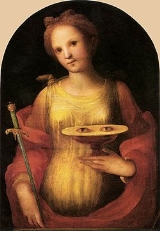
. In medieval accounts, Saint Lucy's eyes are gouged out prior to her execution. In art, her eyes sometimes appear on a plate that she is holding.

Until 1861 relics of Saint Lucy were venerated in a church dedicated to her in Venice
Venice

Venice is a city in northern Italy, the capital city of the Italian regions Veneto, a population of 271,251 . Together with Padua, Italy, the city is included in the Padua-Venice Metropolitan Area ....
; after its demolition, they were translated to the church of San Geremia.

The Roman Catholic calendar of saints
Roman Catholic calendar of saints

The General Roman Calendar indicates the days of the year to which are assigned the liturgical celebrations of Saint and of the mysteries of the Jesus Christ that are to be observed wherever the Roman Rite is used....
 formerly had a commemoration of Saints Lucy and Geminianus on 16 September. This was removed in 1969, as a duplication of the feast of her
dies natalis on 13 December and because the Geminianus in question, mentioned in the Passio of Saint Lucy, seems to be a merely fictitious figure, unrelated to the Geminianus whose feast is on 31 January.

Life

Lucy's Latin name
Lucia shares a root (luc) with the Latin word for light, lux. "In 'Lucy' is said, the way of light" Jacobus de Voragine
Jacobus de Voragine

Blessed Jacobus de Varagine or Voragine...
 stated at the beginning of his
vita of the Blessed Virgin Lucy, in Legenda Aurea
Golden Legend

The Golden Legend, Legenda Aurea, or Legenda Sanctorum by Jacobus de Voragine is a collection of fanciful hagiography or lives of the saints, that became a late Middle Ages bestseller....
, the most widely-read version of the Lucy legend in the Middle Ages
Middle Ages

File:Karl 1 mit papst gelasius gregor1 sacramentar v karl d kahlen.jpgThe Middle Ages of European history are a period in history which lasted for roughly a millennium, commonly dated from the fall of the Roman Empire in the 5th century to the beginning of the Early Modern Period in the 16th century, marked by the division of Western Christi...
.

Because people wanted to shed light on Lucy's bravery, legends grew up, reported in the
acta
Hagiography

Hagiography is the study of saints. A hagiography, from Greek ' and ' , refers literally to writings on the subject of such holy people, and specifically the biography of ecclesiastical and secular leaders....
that are associated with her name. All the details are conventional ones also associated with other female martyrs of the early 4th century. Her Roman father died when she was young, leaving her and her mother without a protecting guardian. Her mother, Eutychia, had suffered four years with a "bloody flux" but Lucy had heard the renown of Saint Agatha, the patroness of Catania
Catania

Catania is an Italy city on the east coast of Sicily facing the Ionian Sea, between Messina and Syracuse, Sicily. It is the capital of the Province of Catania, and with 298,957 inhabitants it is the second-largest city on the island....
, "and when they were at a Mass, one read a gospel that made mention of a woman who was healed of the bloody flux
Dysentery

Dysentery is a disorder of the digestive system that results in severe diarrhea containing mucus and/or blood in the feces. If untreated, Dysentery can be fatal....
 by touching of the hem of the coat of Jesus Christ," which, according to the
Legenda Aurea, convinced her mother to pray together at Saint Agatha's tomb. They stayed up all night praying, until they fell asleep, exhausted. Saint Agatha appeared in a vision to Lucy and said, "Soon you shall be the glory of Syracuse, as I am of Catania." At that instant Eutychia was cured.

Eutychia had arranged a marriage for Lucy with a pagan bridegroom, but Lucy urged that the dowry be spent on alms
Alms

Alms or almsgiving exists in a number of religions. In general, it involves giving materially to another as an act of religious virtue....
 so that she might retain her virginity
Virginity

A Virgin is, originally, a woman who has never had sexual intercourse. Virginity is the state of being a virgin. The term has traditionally also been applied to men....
. Euthychia suggested that the sums would make a good bequest, but Lucy countered, "...whatever you give away at death for the Lord's sake you give because you cannot take it with you. Give now to the true Savior, while you are healthy, whatever you intended to give away at your death." News that the patrimony and jewels were being distributed came to the ears of Lucy's betrothed
Betrothal

Betrothal is a formal state of engagement to be marriage.Historically betrothal was a formal contract, blessed or officiated by a religious authority....
, who heard from a chattering nurse that Lucy had found a nobler Bridegroom.

Her rejected pagan bridegroom denounced Lucy as a Christian to the magistrate Paschasius, who ordered her to burn a sacrifice to the emperor's image. Lucy replied that she had given all that she had: "I offer to Him myself, let Him do with His offering as it pleases Him." Sentenced to be defiled in a brothel, Lucy asserted:

The Christian tradition states that when the guards came to take her away they found her so filled with the Holy Spirit
Holy Spirit

In Christianity, the Holy Ghost or Holy Spirit is the spirit of God. The term Christ , is also used to refer to this presence. That is, the Spirit is considered to act in concert with and share an essential nature with God the Father and God the Son ....
 that she was stiff and heavy as a mountain; they could not move her even when they hitched her to a team of oxen. Even with a dagger through her throat she prophesied against her persecutor. As final torture, her eyes were gouged out. She was miraculously still able to see without her eyes. In paintings St. Lucy is frequently shown holding her eyes on a golden plate.

Legend

of St. Lucy at Saint Leonard of Port Maurice Church in the North End
North End, Boston, Massachusetts

Boston, Massachusetts's North End is the city's oldest residential community, where people have lived continuously since it was settled in the 1630s....
 of Boston
Boston, Massachusetts

Boston is the State capital and largest city of the Commonwealth of Massachusetts, and is one of the oldest cities in the United States. The largest city in New England, Boston is considered the economic and cultural center of the region, and is sometimes regarded as the unofficial "Capital of New England." Boston city proper had a 2007 est...
]] Jacobus de Voragine did not include the episode of Lucy's
passion that has been most vivid to her devotés ever since the Middle Ages: having her eyes torn out. It should be noted that another account dates this loss of eyes to before her martyrdom, claiming that in response to a suitor who admired her beautiful eyes, "she cut them out and sent them to him, asking to be left in peace thereafter." Lucy was represented in Gothic art holding a dish with two eyes on it (illustration above). The legend concludes with God restoring Lucy's eyes.

Dante
DANTE

DANTE is a not-for-profit organisation that plans, builds and operates the international networks that interconnect the various National Research and Education Networks in Europe and surrounding regions....
 also mentions Lucia in
Inferno
The Divine Comedy

The Divine Comedy , written by Dante Alighieri between 1308 and his death in 1321, is widely considered the central epic poem of Italian literature, and is seen as one of the greatest works of world literature....
Canto II as the messenger "of all cruelty the foe" sent to Beatrice
Beatrice Portinari

Beatrice Portinari was born in Florence, Italy, and became the principal inspiration for Dante Alighieri's La Vita Nuova.Portinari also appears as his guide in Divine Comedy in the last book, Paradiso, and in the last four canti of Purgatorio....
 from "The blessed Dame" (Divine Mercy), to rouse Beatrice to send Virgil to Dante's aid. She has instructed Virgil to guide Dante through Hell and Purgatory. Lucia is only referenced indirectly in Virgil's discourse within the narrative and doesn't appear; the reasons for her appearing in this intermediary role are still somewhat unclear to scholars, although doubtless Dante had some allegorical end in mind, perhaps having Lucy as a figure of Illuminating Grace or Mercy or even Justice. Nonetheless Dante obviously regarded Lucia with great reverence, placing her opposite Adam within the Mystic Rose in Canto XXXII of the Paradiso.

In Mark Musa's translation of Dante's
Purgatorio, it is noted that Lucy was admired by an undesirable suitor for her beautiful eyes. To stay chaste she plucked out her own eyes, a great sacrifice for which God gave her a pair of even more beautiful eyes.

Lucy's name also played a large part in naming Lucy as a patron saint of the blind and those with eye-trouble. She was the patroness of Syracuse.

Relics

Sigebert (1030-1112), a monk of Gembloux
Gembloux

Gembloux is a Wallonia municipality located in the Belgium province of Namur . On 1 January 2006 the municipality had 21,964 inhabitants. The total area is 95.86 km?, giving a population density of 229 inhabitants per km?....
, in his
sermo de Sancta Lucia, chronicled that her body lay undisturbed in Sicily for 400 years, before Faroald II, Duke of Spoleto
Faroald II of Spoleto

Faroald II was the duke of Spoleto from 703, when he succeeded his own father Thrasimund I of Spoleto.Faroald attacked and took Classis, the port of Ravenna, but he was ordered to return it by King Liutprand....
, captured the island and transferred the body to Corfinium
Corfinium

Corfinium was a city in Ancient Rome Italy, on the eastern side of the Apennine mountains, due east of Rome. It is now near the modern Corfinio, in the province of L'Aquila ....
 in the Abruzzo
Abruzzo

Abruzzo is a region in Italy, its western border lies less than 50 miles due east of Rome. Abruzzo borders the region of Marche to the north, Lazio to the west and south-west, Molise to the south-east, and the Adriatic Sea to the east....
, Italy. From there it was removed by the Emperor Otho I in 972 to Metz
Metz

Metz is a city in the northeast of France, capital of the Lorraine R?gion in France and prefecture of the Moselle Departments of France.It is located at the confluence of the Moselle River and the Seille rivers....
 and deposited in the church of St. Vincent. It was from this shrine that an arm of the saint was taken to the monastery of Luitburg in the Diocese of Spires
Spires

Spires is the name of:* SPIRES, a database for publications in High-Energy Physics* Speyer , a city in Germany* The Spires, a commercial conference centre, operated out of Church House, Belfast, Belfast by the Presbyterian Church in Ireland...
 - an incident celebrated by Sigebert himself in verse.

The subsequent history of the relics is not clear. On their capture of Constantinople
Constantinople

Constantinople was the empire capital of the Roman Empire , the Byzantine Empire , the Latin Empire , and the Ottoman Empire . Strategically located between the Golden Horn and the Sea of Marmara at the point where Europe meets Asia, Byzantine Constantinople had been the capital of a Christendom empire, successor to ancient ancient Greece...
 in 1204, the French found some relics attributed to Saint Lucy in the city, and Enrico Dandolo
Enrico Dandolo

Enrico Dandolo was the thirty-ninth Doge of Venice from 1193 until his death. Remembered for his blindness, piety, longevity, and shrewdness, he is infamous for his role in the Fourth Crusade which he, at age ninety, directed against the Byzantine Empire, sacking Constantinople....
, Doge of Venice
Doge of Venice

The Doge was the chief magistrate and leader of the Republic of Venice for over a thousand years. Doges of Venice were elected for life by the city-state's aristocracy....
, secured them for the monastery of St. George at Venice
Venice

Venice is a city in northern Italy, the capital city of the Italian regions Veneto, a population of 271,251 . Together with Padua, Italy, the city is included in the Padua-Venice Metropolitan Area ....
. In 1513 the Venetians presented to Louis XII of France
Louis XII of France

Louis XII , called "the Father of the People" was the thirty-fifth List of French monarchs of France and the sole monarch from the House of Valois Cadet branch of the House of Valois....
 the saint's head, which he deposited in the cathedral church of Bourges
Bourges

Bourges is a commune in France in central France on the Y?vre river. It is the capital of the Departments of France of Cher and also was the capital of the former provinces of France of Berry ....
. Another account, however, states that the head was brought to Bourges from Rome where it had been transferred during the time when the relics rested in Corfinium. The remainder of the relics remain in Venice: they were transfered to the church of San Geremia
San Geremia

San Geremia is a church in Venice, northern Italy, located in the sestiere of Cannaregio. The edifice is popular as the seat of the cult of Saint Lucy of Syracuse, Italy, whose remains are housed inside....
 when the church of Santa Lucia was demolished in the 19th century to make way for the new railway terminus. A century later, on 7 November 1981, thieves stole all her bones, except her head. Police recovered them five weeks later, on her feast day. Other parts of the corpse have found their way to Rome, Naples, Verona, Lisbon, Milan, as well as Germany and France.

Popular celebration


As her brief day brings the longest night of the year by the old reckoning, John Donne
John Donne

John Donne was an England Literature in English#Jacobean literature poet, preacher and a major representative of the metaphysical poets of the period....
's poem, "A Nocturnal upon St. Lucie's Day, being the shortest day", begins with: "'Tis the year's midnight, and it is the day's," and expresses, in a mourning piece, the withdrawal of the world-spirit into sterility and darkness, where "The world's whole sap is sunk." .

This timing, and her name meaning light, is a factor in the particular devotion to St. Lucy in Scandinavia
Scandinavia

Scandinavia is a historical and geographical subregion in northern Europe that includes the Scandinavian Peninsula. It consists of the kingdoms of Norway, Sweden, and Denmark; some authorities also include Finland and some might even include Iceland....
n countries, where young girls dress as the saint in honor of the feast. A special devotion to St. Lucy is present in the North Eastern regions of Italy.

External links

  • St. Lucy (e-text, in English)