
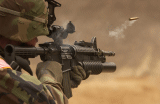
War is a state of organized, armed, and often prolonged conflict carried on between
statesA state is an organized political community, living under a government. States may be sovereign and may enjoy a monopoly on the legal initiation of force and are not dependent on, or subject to any other power or state. Many states are federated states which participate in a federal union...
,
nationA nation may refer to a community of people who share a common language, culture, ethnicity, descent, and/or history. In this definition, a nation has no physical borders. However, it can also refer to people who share a common territory and government irrespective of their ethnic make-up...
s, or other parties typified by extreme
aggressionIn psychology, as well as other social and behavioral sciences, aggression refers to behavior between members of the same species that is intended to cause humiliation, pain, or harm. Ferguson and Beaver defined aggressive behavior as "Behavior which is intended to increase the social dominance of...
,
socialThe term social refers to a characteristic of living organisms...
disruption, and usually high mortality. War should be understood as an actual, intentional and widespread armed conflict between political communities, and therefore is defined as a form of
political violencePolitical violence is a common means used by people and governments around the world to achieve political goals. Many groups and individuals believe that their political systems will never respond to their political demands. As a result they believe that violence is not only justified but also...
. The set of techniques used by a group to carry out war is known as
warfare. An absence of war is usually called
peacePeace is a state of harmony characterized by the lack of violent conflict. Commonly understood as the absence of hostility, peace also suggests the existence of healthy or newly healed interpersonal or international relationships, prosperity in matters of social or economic welfare, the...
.
In 2003, Nobel Laureate Richard E. Smalley identified war as the sixth (of ten) biggest problems facing the society of mankind for the next fifty years. In the 1832
treatiseA treatise is a formal and systematic written discourse on some subject, generally longer and treating it in greater depth than an essay, and more concerned with investigating or exposing the principles of the subject.-Noteworthy treatises:...
"On WarVom Kriege is a book on war and military strategy by Prussian general Carl von Clausewitz , written mostly after the Napoleonic wars, between 1816 and 1830, and published posthumously by his wife in 1832. It has been translated into English several times as On War...
", Prussian military general and theoretician
Carl Von ClausewitzCarl Philipp Gottfried von Clausewitz was a Prussian soldier and German military theorist who stressed the moral and political aspects of war...
defined war as follows: "
War is thus an act of force to compel our enemy to do our will."
While some scholars see warfare as an inescapable and integral aspect of human culture, others argue that it is only inevitable under certain socio-cultural or ecological circumstances. Some scholars argue that the practice of war is not linked to any single type of political organization or society. Rather, as discussed by
John KeeganSir John Keegan OBE FRSL is a British military historian, lecturer, writer and journalist. He has published many works on the nature of combat between the 14th and 21st centuries concerning land, air, maritime, and intelligence warfare, as well as the psychology of battle.-Life and career:John...
in his
History Of Warfare, war is a universal phenomenon whose form and scope is defined by the society that wages it. Another argument suggests that since there are human societies in which warfare does not exist, humans may not be naturally disposed for warfare, which emerges under particular circumstance. The ever changing technologies and potentials of war extend along a historical continuum. At the one end lies the
endemic warfareEndemic warfare is the state of continual, low-threshold warfare in a tribal warrior society. Endemic warfare is often highly ritualized and plays an important function in assisting the formation of a social structure among the tribes' men by proving themselves in battle.Ritual fighting permits...
of the
PaleolithicThe Paleolithic Age, Era or Period, is a prehistoric period of human history distinguished by the development of the most primitive stone tools discovered , and covers roughly 99% of human technological prehistory...
with its stones and clubs, and the naturally limited loss of life associated with the use of such weapons. Found at the other end of this continuum is
nuclear warfareNuclear warfare, or atomic warfare, is a military conflict or political strategy in which nuclear weaponry is detonated on an opponent. Compared to conventional warfare, nuclear warfare can be vastly more destructive in range and extent of damage...
, along with the recently developed possible outcome of its use, namely the rather sobering potential risk of the complete
extinction of the human speciesHuman extinction is the end of the human species. Various scenarios have been discussed in science, popular culture, and religion . The scope of this article is existential risks. Humans are very widespread on the Earth, and live in communities which are capable of some kind of basic survival in...
.
Etymology
The English word
war derives from the late Old English (c.1050) words
wyrre and
werre; the
Old North FrenchOld French was the Romance dialect continuum spoken in territories that span roughly the northern half of modern France and parts of modern Belgium and Switzerland from the 9th century to the 14th century...
werre; the
FrankishThe Franks were a confederation of Germanic tribes first attested in the third century AD as living north and east of the Lower Rhine River. From the third to fifth centuries some Franks raided Roman territory while other Franks joined the Roman troops in Gaul. Only the Salian Franks formed a...
werra; and the
Proto-GermanicProto-Germanic , or Common Germanic, as it is sometimes known, is the unattested, reconstructed proto-language of all the Germanic languages, such as modern English, Frisian, Dutch, Afrikaans, German, Luxembourgish, Danish, Norwegian, Icelandic, Faroese, and Swedish.The Proto-Germanic language is...
werso. The denotation of
war derives from the
Old SaxonOld Saxon, also known as Old Low German, is the earliest recorded form of Low German, documented from the 8th century until the 12th century, when it evolved into Middle Low German. It was spoken on the north-west coast of Germany and in the Netherlands by Saxon peoples...
werran,
Old High GermanThe term Old High German refers to the earliest stage of the German language and it conventionally covers the period from around 500 to 1050. Coherent written texts do not appear until the second half of the 8th century, and some treat the period before 750 as 'prehistoric' and date the start of...
werran, and the German
verwirren: “to confuse”, “to perplex”, and “to bring into confusion”. Another posited derivation is from the
Ancient GreekAncient Greek is the stage of the Greek language in the periods spanning the times c. 9th–6th centuries BC, , c. 5th–4th centuries BC , and the c. 3rd century BC – 6th century AD of ancient Greece and the ancient world; being predated in the 2nd millennium BC by Mycenaean Greek...
barbaros, the Old Persian
varhara, and the Sanscrit
varvar and
barbara. In
GermanGerman is a West Germanic language, related to and classified alongside English and Dutch. With an estimated 90 – 98 million native speakers, German is one of the world's major languages and is the most widely-spoken first language in the European Union....
, the equivalent is
Krieg; the equivalent
SpanishSpanish , also known as Castilian , is a Romance language in the Ibero-Romance group that evolved from several languages and dialects in central-northern Iberia around the 9th century and gradually spread with the expansion of the Kingdom of Castile into central and southern Iberia during the...
,
PortuguesePortuguese is a Romance language that arose in the medieval Kingdom of Galicia, nowadays Galicia and Northern Portugal. The southern part of the Kingdom of Galicia became independent as the County of Portugal in 1095...
, and
ItalianItalian is a Romance language spoken mainly in Europe: Italy, Switzerland, San Marino, Vatican City, by minorities in Malta, Monaco, Croatia, Slovenia, France, Libya, Eritrea, and Somalia, and by immigrant communities in the Americas and Australia...
words for
war is
guerra, derived from the Germanic
werra (“fight”, “tumult”). Etymologic legend has it that the Romanic peoples adopted a foreign, Germanic word for
war, to avoid using the
LatinLatin is an Italic language originally spoken in Latium and Ancient Rome. It, along with most European languages, is a descendant of the ancient Proto-Indo-European language. Although it is considered a dead language, a number of scholars and members of the Christian clergy speak it fluently, and...
bellum, because, when sounded, it tended to merge with the sound of the word
bello (beautiful).
History of warfare
Before the dawn of civilization, war likely consisted of small-scale raiding. One half of the people found in a
NubiaNubia is a region along the Nile river, which is located in northern Sudan and southern Egypt.There were a number of small Nubian kingdoms throughout the Middle Ages, the last of which collapsed in 1504, when Nubia became divided between Egypt and the Sennar sultanate resulting in the Arabization...
n cemetery dating to as early as 12,000 years ago had died of violence. Since the rise of the
stateA state is an organized political community, living under a government. States may be sovereign and may enjoy a monopoly on the legal initiation of force and are not dependent on, or subject to any other power or state. Many states are federated states which participate in a federal union...
some 5,000 years ago, military activity has occurred over much of the globe. The advent of
gunpowderGunpowder, also known since in the late 19th century as black powder, was the first chemical explosive and the only one known until the mid 1800s. It is a mixture of sulfur, charcoal, and potassium nitrate - with the sulfur and charcoal acting as fuels, while the saltpeter works as an oxidizer...
and the acceleration of technological advances led to modern warfare. According to Conway W. Henderson, "One source claims 14,500 wars have taken place between 3500 BC and the late 20th century, costing 3.5 billion lives, leaving only 300 years of peace (Beer 1981: 20)."
In
War Before CivilizationWar Before Civilization: the Myth of the Peaceful Savage is a book by Lawrence H. Keeley, an archeology professor at the University of Illinois who specialises in prehistoric Europe. The book deals with warfare conducted throughout human history by societies with little technology...
, Lawrence H. Keeley, a professor at the
University of IllinoisThe University of Illinois at Urbana–Champaign is a large public research-intensive university in the state of Illinois, United States. It is the flagship campus of the University of Illinois system...
, says that approximately 90–95% of known societies throughout history engaged in at least occasional warfare, and many fought constantly.
William D. Rubinstein wrote that "Pre-literate societies, even those organised in a relatively advanced way, were renowned for their studied cruelty . . . in 1826
ShakaShaka kaSenzangakhona , also known as Shaka Zulu , was the most influential leader of the Zulu Kingdom....
and an army of 50,000 literally destroyed the
NdwandweThe Ndwandwe clan are a subgroup of the Nguni people who populate sections of Southern Africa.The Ndwandwe, with the Mthethwa, were a significant power in present-day Zululand at the turn of the nineteenth century...
, a rival tribe. This report stated that the Ndwandwe numbered at least 40,000: 'they were all put to death' ".
In Western Europe, since the late 18th century, more than 150 conflicts and about 600 battles have taken place.
The
Human Security Report 2005The Human Security Report 2005 is a report outlining declining world trends of global violence from the early 1990s to 2003. The study reported major worldwide declines in the number of armed conflicts, genocides, military coups and international crises, as well as in the number of battle-related...
documented a significant decline in the number and severity of armed conflicts since the end of the
Cold WarThe Cold War was the continuing state from roughly 1946 to 1991 of political conflict, military tension, proxy wars, and economic competition between the Communist World—primarily the Soviet Union and its satellite states and allies—and the powers of the Western world, primarily the United States...
in the early 1990s. However, the evidence examined in the 2008 edition of the Center for International Development and Conflict Management's "Peace and Conflict" study indicated that the overall decline in conflicts had stalled.
Recent rapid increases in the technologies of war, and therefore in its destructiveness (see
Mutual assured destructionMutual Assured Destruction, or mutually assured destruction , is a doctrine of military strategy and national security policy in which a full-scale use of high-yield weapons of mass destruction by two opposing sides would effectively result in the complete, utter and irrevocable annihilation of...
), have caused widespread public concern, and have in all probability forestalled, and may hopefully altogether prevent the outbreak of a nuclear World War III. At the end of each of the last two World Wars, concerted and popular efforts were made to come to a greater understanding of the underlying dynamics of war and to thereby hopefully reduce or even eliminate it all together. These efforts materialized in the forms of the
League of NationsThe League of Nations was an intergovernmental organization founded as a result of the Paris Peace Conference that ended the First World War. It was the first permanent international organization whose principal mission was to maintain world peace...
, and its successor, the
United NationsThe United Nations is an international organization whose stated aims are facilitating cooperation in international law, international security, economic development, social progress, human rights, and achievement of world peace...
.
Shortly after
World War IIWorld War II, or the Second World War , was a global conflict lasting from 1939 to 1945, involving most of the world's nations—including all of the great powers—eventually forming two opposing military alliances: the Allies and the Axis...
, as a token of support for this concept, most nations joined the United Nations.
During this same post-war period, with the aim of further delegitimizing war as an acceptable and logical extension of foreign policy, most national governments also renamed their Ministries or Departments of War as their Ministries or Departments of Defense, for example, the former US Department of War was renamed as the US Department of Defense .
In 1947, in view of the rapidly increasingly destructive consequences of modern warfare, and with a particular concern for the consequences and costs of the newly developed atom bomb, the initial developer of the concept of this bomb,
Albert EinsteinAlbert Einstein was a German-born theoretical physicist who developed the theory of general relativity, effecting a revolution in physics. For this achievement, Einstein is often regarded as the father of modern physics and one of the most prolific intellects in human history...
famously stated,
"I know not with what weapons World War III will be fought, but World War IV will be fought with sticks and stones."
Fortunately, the anticipated costs of a possible third world war are currently no longer deemed as acceptable by most, thus little motivation currently seems to exist on an international level for such a war.
Still since the close of World War II, limited non-nuclear conflicts continue, and surprisingly enough, some outspoken celebrities and politicians have even advocated for the proclamation of another world war.
Mao ZedongMao Zedong, also transliterated as Mao Tse-tung , and commonly referred to as Chairman Mao , was a Chinese Communist revolutionary, guerrilla warfare strategist, Marxist political philosopher, and leader of the Chinese Revolution...
urged the socialist camp not to fear nuclear war with the United States since, even if
'half of mankind died, the other half would remain while imperialism would be razed to the ground and the whole world would become socialist'.
Ten largest wars (by death toll)
Three of the ten most costly wars, in terms of loss of life, have been waged in the last century. These are of course the two World Wars, then followed by the
Second Sino-Japanese WarThe Second Sino-Japanese War was a military conflict fought primarily between the Republic of China and the Empire of Japan. From 1937 to 1941, China fought Japan with some economic help from Germany , the Soviet Union and the United States...
(which is sometimes considered part of
World War IIWorld War II, or the Second World War , was a global conflict lasting from 1939 to 1945, involving most of the world's nations—including all of the great powers—eventually forming two opposing military alliances: the Allies and the Axis...
, or overlapping with that war). Most of the others involved China or neighboring peoples. The death toll of World War II, being 60 million plus, surpasses all other war-death-tolls by a factor of two. This may be due to significant recent advances in weapons technologies, as well as recent increases in the overall human population.
- 60,000,000–72,000,000 - World War II
World War II, or the Second World War , was a global conflict lasting from 1939 to 1945, involving most of the world's nations—including all of the great powers—eventually forming two opposing military alliances: the Allies and the Axis...
(1939–1945), (see World War II casualtiesWorld War II was the deadliest military conflict in history. Over 60 million people were killed, which was over 2.5% of the world population. The tables below give a detailed country-by-country count of human losses.-Total dead:...
)
- 36,000,000 - An Shi Rebellion
The An Lushan Rebellion took place in China during the Tang Dynasty from CE December 16, 755 to CE February 17, 763, beginning when general An Lushan declared himself emperor, establishing the rival Yan Dynasty in Northern China...
(China, 755–763)
- 30,000,000–60,000,000 - Mongol Conquests
The Mongol Empire , initially named as Greater Mongol State was a great empire during the 13th and 14th centuries...
(13th century) (see Mongol invasionsMongol invasions progressed throughout the 13th century, resulting in the vast Mongol Empire which covered much of Asia and Eastern Europe by 1300....
and Tatar invasionsThe Mongol invasion of Europe from the east took place over the course of three centuries, from the Middle Ages to the early modern period.The terms Tatars or Tartars are applied to nomadic Turkic peoples who, themselves, were conquered by Mongols and incorporated into their horde...
)
- 25,000,000 - Qing dynasty
The Qing Dynasty was the last dynasty of China, ruling from 1644 to 1912 with a brief, abortive restoration in 1917. It was preceded by the Ming Dynasty and followed by the Republic of China....
conquest of Ming dynastyThe Ming Dynasty, also Empire of the Great Ming, was the ruling dynasty of China from 1368 to 1644, following the collapse of the Mongol-led Yuan Dynasty. The Ming, "one of the greatest eras of orderly government and social stability in human history", was the last dynasty in China ruled by ethnic...
(1616–1662)
- 20,000,000 - World War I
World War I , which was predominantly called the World War or the Great War from its occurrence until 1939, and the First World War or World War I thereafter, was a major war centred in Europe that began on 28 July 1914 and lasted until 11 November 1918...
(1914–1918) (see World War I casualtiesThe total number of military and civilian casualties in World War I were over 35 million. There were over 15 million deaths and 20 million wounded ranking it among the deadliest conflicts in human history....
)
- 20,000,000 - Taiping Rebellion
The Taiping Rebellion was a widespread civil war in southern China from 1850 to 1864, led by heterodox Christian convert Hong Xiuquan, who, having received visions, maintained that he was the younger brother of Jesus Christ, against the ruling Manchu-led Qing Dynasty...
(China, 1850–1864) (see Dungan revolt)
- 20,000,000 - Second Sino-Japanese War
The Second Sino-Japanese War was a military conflict fought primarily between the Republic of China and the Empire of Japan. From 1937 to 1941, China fought Japan with some economic help from Germany , the Soviet Union and the United States...
(1937–1945)
- 8,000,000–12,000,000 - Dungan revolt (China, 1862 –1877)
- 7,000,000–20,000,000 Conquests of Tamerlane (1370–1405)
- 5,000,000–9,000,000 - Russian Civil War and Foreign Intervention
The Russian Civil War was a multi-party war that occurred within the former Russian Empire after the Russian provisional government collapsed to the Soviets, under the domination of the Bolshevik party. Soviet forces first assumed power in Petrograd The Russian Civil War (1917–1923) was a...
(1917–1922)
Types of Warfare
War, to become known as one, must entail some degree of confrontation using weapons and other military technology and equipment by
armed forcesThe armed forces of a country are its government-sponsored defense, fighting forces, and organizations. They exist to further the foreign and domestic policies of their governing body, and to defend that body and the nation it represents from external aggressors. In some countries paramilitary...
employing
military tacticsMilitary tactics, the science and art of organizing an army or an air force, are the techniques for using weapons or military units in combination for engaging and defeating an enemy in battle. Changes in philosophy and technology over time have been reflected in changes to military tactics. In...
and operational art within the broad
military strategyMilitary strategy is a set of ideas implemented by military organizations to pursue desired strategic goals. Derived from the Greek strategos, strategy when it appeared in use during the 18th century, was seen in its narrow sense as the "art of the general", 'the art of arrangement' of troops...
subject to
military logisticsMilitary logistics is the discipline of planning and carrying out the movement and maintenance of military forces. In its most comprehensive sense, it is those aspects or military operations that deal with:...
.
War StudiesWar studies is the multi-disciplinary study of war. It is distinct from military history in that it encompasses a variety of fields:*Laws of war*Philosophy of war**Ethics of war***Just War Theory**Deterrence theory*Psychology of war...
by military theorists throughout
military historyMilitary history is a humanities discipline within the scope of general historical recording of armed conflict in the history of humanity, and its impact on the societies, their cultures, economies and changing intra and international relationships....
have sought to identify the
philosophy of warThe philosophy of war examines war beyond the typical questions of weaponry and strategy, inquiring into such things as the meaning and etiology of war, the relationship between war and human nature, and the ethics of war...
, and to reduce it to a
military scienceMilitary science is the process of translating national defence policy to produce military capability by employing military scientists, including theorists, researchers, experimental scientists, applied scientists, designers, engineers, test technicians, and military personnel responsible for...
.
In general, modern military science considers several factors before a National defence policy is created to allow a war to commence: the environment in the area(s) of combat operations, the posture national forces will adopt on the commencement of a war, and the type of warfare troops will be engaged in.
Conventional warfareConventional warfare is a form of warfare conducted byusing conventional military weapons and battlefield tactics between two or more states in open confrontation. The forces on each side are well-defined, and fight using weapons that primarily target the opposing army...
is an attempt to reduce an opponent's military capability through open battle. It is a declared war between existing states in which nuclear, biological, or chemical weapons are not used or only see limited deployment in support of conventional military goals and maneuvers.
The opposite of conventional warfare,
unconventional warfareUnconventional warfare is the opposite of conventional warfare. Where conventional warfare is used to reduce an opponent's military capability, unconventional warfare is an attempt to achieve military victory through acquiescence, capitulation, or clandestine support for one side of an existing...
, is an attempt to achieve military victory through acquiescence, capitulation, or clandestine support for one side of an existing conflict.
Nuclear warfareNuclear warfare, or atomic warfare, is a military conflict or political strategy in which nuclear weaponry is detonated on an opponent. Compared to conventional warfare, nuclear warfare can be vastly more destructive in range and extent of damage...
is warfare in which
nuclear weaponA nuclear weapon is an explosive device that derives its destructive force from nuclear reactions, either fission or a combination of fission and fusion. Both reactions release vast quantities of energy from relatively small amounts of matter. The first fission bomb test released the same amount...
s are the primary, or a major, method of coercing the capitulation of the other side, as opposed to a supporting tactical or strategic role in a conventional conflict.
Civil warA civil war is a war between organized groups within the same nation state or republic, or, less commonly, between two countries created from a formerly-united nation state....
is a war where the forces in conflict belong to the same nation or political entity and are vying for control of or independence from that nation or political entity.
Asymmetric warfareAsymmetric warfare is war between belligerents whose relative military power differs significantly, or whose strategy or tactics differ significantly....
is a conflict between two populations of drastically different levels of military capability or size. Asymmetric conflicts often result in
guerrillaGuerrilla warfare is a form of irregular warfare and refers to conflicts in which a small group of combatants including, but not limited to, armed civilians use military tactics, such as ambushes, sabotage, raids, the element of surprise, and extraordinary mobility to harass a larger and...
tactics being used to overcome the sometimes vast gaps in technology and force size.
Intentional air pollution in combat is one of a collection of techniques collectively called
chemical warfareChemical warfare involves using the toxic properties of chemical substances as weapons. This type of warfare is distinct from Nuclear warfare and Biological warfare, which together make up NBC, the military acronym for Nuclear, Biological, and Chemical...
. Poison gas as a
chemical weaponChemical warfare involves using the toxic properties of chemical substances as weapons. This type of warfare is distinct from Nuclear warfare and Biological warfare, which together make up NBC, the military acronym for Nuclear, Biological, and Chemical...
was principally used during
World War IWorld War I , which was predominantly called the World War or the Great War from its occurrence until 1939, and the First World War or World War I thereafter, was a major war centred in Europe that began on 28 July 1914 and lasted until 11 November 1918...
, and resulted in an estimated 91,198 deaths and 1,205,655 injuries. Various treaties have sought to ban its further use. Non-lethal chemical weapons, such as tear gas and
pepper sprayPepper spray, also known as OC spray , OC gas, and capsicum spray, is a lachrymatory agent that is used in riot control, crowd control and personal self-defense, including defense against dogs and bears...
, are widely used, sometimes with deadly effect.
Warfare environment
The environment in which a war is fought has a significant impact on the type of combat which takes place, and can include within its area different types of terrain. This, in turn, means that soldiers have to be trained to fight in a specific types of environments and terrains that generally reflects troops' mobility limitations or enablers.
These include:
Warfare by objective
- Defensive warfare
A Strategic defence is a type of military planning doctrine and a set of combat activities used for the purpose of deterring, resisting and repelling a strategic offensive, conducted as either a territorial or airspace invasion, or a naval offensive to interrupt shipping lane traffic as a form of...
- Offensive warfare
Warfare by doctrine
- Attrition warfare
Attrition warfare is a military strategy in which a belligerent side attempts to win a war by wearing down its enemy to the point of collapse through continuous losses in personnel and matériel....
/Fabian warfare
- Maneuver warfare
Maneuver warfare, or manoeuvre warfare , is the term used by military theorists for a concept of warfare that advocates attempting to defeat an adversary by incapacitating their decision-making through shock and disruption brought about by movement...
- Guerilla warfare
Guerrilla warfare is a form of irregular warfare and refers to conflicts in which a small group of combatants including, but not limited to, armed civilians use military tactics, such as ambushes, sabotage, raids, the element of surprise, and extraordinary mobility to harass a larger and...
- Static warfare/Positional warfare
- Insurgency
An insurgency is an armed rebellion against a constituted authority when those taking part in the rebellion are not recognized as belligerents...
warfare
- Counterinsurgency warfare
Warfare by terrain
- Jungle warfare
Jungle warfare is a term used to cover the special techniques needed for military units to survive and fight in jungle terrain.It has been the topic of extensive study by military strategists, and was an important part of the planning for both sides in many conflicts, including World War II and the...
- Desert warfare
Desert warfare is combat in deserts. In desert warfare the elements can sometimes be more dangerous than the actual enemy. The desert terrain is the second most inhospitable to troops following a cold environment...
- Mountain warfare
Mountain warfare refers to warfare in the mountains or similarly rough terrain. This type of warfare is also called Alpine warfare, named after the Alps mountains...
- Arctic warfare
Arctic warfare or winter warfare is a term used to describe armed conflict that takes place in an exceptionally cold weather, usually in snowy and icy terrain, sometimes on ice-covered bodies of water...
- Naval warfare
Naval warfare is combat in and on seas, oceans, or any other major bodies of water such as large lakes and wide rivers.-History:Mankind has fought battles on the sea for more than 3,000 years. Land warfare would seem, initially, to be irrelevant and entirely removed from warfare on the open ocean,...
- Littoral warfare
- Urban warfare
Urban warfare is combat conducted in urban areas such as towns and cities. Urban combat is very different from combat in the open at both the operational and tactical level...
Behaviour and conduct in war
The behaviour of troops in warfare varies considerably, both individually and as units or armies. In some circumstances, troops may engage in
genocideGenocide is defined as "the deliberate and systematic destruction, in whole or in part, of an ethnic, racial, religious, or national group", though what constitutes enough of a "part" to qualify as genocide has been subject to much debate by legal scholars...
,
war rapeWar rapes are rapes committed by soldiers, other combatants or civilians during armed conflict or war, or during military occupation, distinguished from sexual assaults and rape committed amongst troops in military service...
and
ethnic cleansingEthnic cleansing is a purposeful policy designed by one ethnic or religious group to remove by violent and terror-inspiring means the civilian population of another ethnic orreligious group from certain geographic areas....
. Commonly, however, the conduct of troops may be limited to posturing and sham attacks, leading to highly rule-bound and often largely symbolic combat in which casualties are much reduced from that which would be expected if soldiers were genuinely violent towards the enemy. Situations of deliberate dampening of hostilities occurred in
World War IWorld War I , which was predominantly called the World War or the Great War from its occurrence until 1939, and the First World War or World War I thereafter, was a major war centred in Europe that began on 28 July 1914 and lasted until 11 November 1918...
by some accounts,
e.g., a volley of gunfire being exchanged after a misplaced mortar hit the British line, after which a German soldier shouted an apology to British forces, effectively stopping a hostile exchange of gunfire. Other examples of non-aggression, also from
World War IWorld War I , which was predominantly called the World War or the Great War from its occurrence until 1939, and the First World War or World War I thereafter, was a major war centred in Europe that began on 28 July 1914 and lasted until 11 November 1918...
, are detailed in "Good-Bye to All That." These include spontaneous ceasefires to rebuild defences and retrieve casualties, alongside behaviour such as refusing to shoot at enemy during ablutions and the taking of great risks (described as 1 in 20) to retrieve enemy wounded from the battlefield. The most notable spontaneous ceasefire of
World War IWorld War I , which was predominantly called the World War or the Great War from its occurrence until 1939, and the First World War or World War I thereafter, was a major war centred in Europe that began on 28 July 1914 and lasted until 11 November 1918...
was the
Christmas truceChristmas truce was a series of widespread unofficial ceasefires that took place along the Western Front around Christmas of 1914, during the First World War...
.
The psychological separation between combatants, and the destructive power of modern weaponry, may act to override this effect and facilitate participation by combatants in the mass slaughter of combatants or civilians, such as in the bombing of
Dresden in World War IIThe Bombing of Dresden was a military bombing by the British Royal Air Force and the United States Army Air Force and as part of the Allied forces between 13 February and 15 February 1945 in the Second World War...
. The unusual circumstances of warfare can incite apparently normal individuals to commit atrocities.
Effects of war
On soldiers
Soldiers subject to combat in war often suffer psychological and physical casualties, including depression, Post Traumatic Stress Disorder, disease, injury, and death.
During World War II, research conducted by US Army Brigadier General S.L.A. Marshall found that, on average, only 15% to 20% of American riflemen in WWII combat fired at the enemy. In Civil War Collector’s Encyclopedia, F.A. Lord notes that of the 27,574 discarded muskets found on the Gettysburg battlefield, nearly 90% were loaded, with 12,000 loaded more than once and 6,000 loaded 3 to 10 times. These studies suggest that most soldiers resist firing their weapons in combat, that- as some theorists argue- human beings have an inherent resistance to killing their fellow human beings. Swank and Marchand’s WWII study found that after sixty days of continuous combat, 98% of all surviving soldiers will become psychiatric casualties. Psychiatric casualties manifest themselves in fatigue cases, confusional states, conversion hysteria, anxiety, obsessional and compulsive states, and character disorders.
Additionally, it has been estimated that anywhere from 18% to 54% of Vietnam war veterans suffered from Post Traumatic Stress Disorder.
Based on 1860 census figures, 8% of all white American males aged 13 to 43 died in the
American Civil WarThe American Civil War was a civil war fought in the United States of America. In response to the election of Abraham Lincoln as President of the United States, 11 southern slave states declared their secession from the United States and formed the Confederate States of America ; the other 25...
, including about 6% in the North and approximately 18% in the South. The war remains the deadliest conflict in American history, resulting in the deaths of 620,000 soldiers. United States military casualties of war since 1775 have totaled over two million. Of the 60 million European soldiers who were mobilized in
World War IWorld War I , which was predominantly called the World War or the Great War from its occurrence until 1939, and the First World War or World War I thereafter, was a major war centred in Europe that began on 28 July 1914 and lasted until 11 November 1918...
, 8 million were killed, 7 million were permanently disabled, and 15 million were seriously injured.
During
NapoleonNapoleon Bonaparte was a French military and political leader during the latter stages of the French Revolution.As Napoleon I, he was Emperor of the French from 1804 to 1815...
's retreat from
MoscowMoscow is the capital, the most populous city, and the most populous federal subject of Russia. The city is a major political, economic, cultural, scientific, religious, financial, educational, and transportation centre of Russia and the continent...
, more French soldiers died of
typhusEpidemic typhus is a form of typhus so named because the disease often causes epidemics following wars and natural disasters...
than were killed by the Russians. Felix Markham thinks that 450,000 crossed the
NemanNeman or Niemen or Nemunas, is a major Eastern European river rising in Belarus and flowing through Lithuania before draining into the Curonian Lagoon and then into the Baltic Sea at Klaipėda. It is the northern border between Lithuania and Russia's Kaliningrad Oblast in its lower reaches...
on 25 June 1812, of whom less than 40,000 recrossed in anything like a recognizable military formation. More soldiers were killed from 1500-1914 by typhus than from all military action during that time combined. In addition, if it were not for the modern medical advances there would be thousands of more dead from disease and infection. For instance, during the
Seven Years' WarThe Seven Years' War was a global military war between 1756 and 1763, involving most of the great powers of the time and affecting Europe, North America, Central America, the West African coast, India, and the Philippines...
, the
Royal NavyThe Royal Navy is the naval warfare service branch of the British Armed Forces. Founded in the 16th century, it is the oldest service branch and is known as the Senior Service...
reported that it conscripted 184,899 sailors, of whom 133,708 died of disease or were 'missing'.
It is estimated that 378 000 people died due to war each year between 1985 and 1994.
On civilians
Many wars have been accompanied by significant depopulations, along with destruction of infrastructure and resources (which may lead to
famineA famine is a widespread scarcity of food, caused by several factors including crop failure, overpopulation, or government policies. This phenomenon is usually accompanied or followed by regional malnutrition, starvation, epidemic, and increased mortality. Every continent in the world has...
, disease, and death in the civilian population). Civilians in war zones may also be subject to war atrocities such as
genocideGenocide is defined as "the deliberate and systematic destruction, in whole or in part, of an ethnic, racial, religious, or national group", though what constitutes enough of a "part" to qualify as genocide has been subject to much debate by legal scholars...
, while survivors may suffer the psychological aftereffects of witnessing the destruction of war. During the
Thirty Years' WarThe Thirty Years' War was fought primarily in what is now Germany, and at various points involved most countries in Europe. It was one of the most destructive conflicts in European history....
in Europe, for example, the population of the
GermanThe Holy Roman Empire was a realm that existed from 962 to 1806 in Central Europe.It was ruled by the Holy Roman Emperor. Its character changed during the Middle Ages and the Early Modern period, when the power of the emperor gradually weakened in favour of the princes...
states was reduced by about 30%. The
SwedishThe Swedish Empire refers to the Kingdom of Sweden between 1561 and 1721 . During this time, Sweden was one of the great European powers. In Swedish, the period is called Stormaktstiden, literally meaning "the Great Power Era"...
armies alone may have destroyed up to 2,000 castles, 18,000 villages and 1,500 towns in Germany, one-third of all German towns.
Estimates for the total
casualties of World War IIWorld War II was the deadliest military conflict in history. Over 60 million people were killed, which was over 2.5% of the world population. The tables below give a detailed country-by-country count of human losses.-Total dead:...
vary, but most suggest that some 60 million people died in the war, comprising around 20 million soldiers and 40 million civilians. The
Soviet UnionThe Soviet Union , officially the Union of Soviet Socialist Republics , was a constitutionally socialist state that existed in Eurasia between 1922 and 1991....
lost around
27 million peopleWorld War II casualties of the Soviet Union from all related causes are commonly estimated in excess of 20,000,000, both civilians and military, although the statistics vary to a great extent. Most of the casualties occurred from 22 June 1941, after Nazi Germany invaded the USSR.-Military losses:In...
during the war, about half of all World War II casualties. Since a high proportion of those killed were young men, the postwar Soviet population was 45 to 50 million fewer than post–1939 projections would have led one to expect. The largest number of civilian deaths in a single city was 1.2 million citizens dead during the 872-day
Siege of LeningradThe Siege of Leningrad, also known as the Leningrad Blockade was a prolonged military operation resulting from the failure of the German Army Group North to capture Leningrad, now known as Saint Petersburg, in the Eastern Front theatre of World War II. It started on 8 September 1941, when the last...
.
On the economy
Once a war has ended, losing nations are sometimes required to pay
war reparationsWar reparations are payments intended to cover damage or injury during a war. Generally, the term war reparations refers to money or goods changing hands, rather than such property transfers as the annexation of land.- History :...
to the victorious nations. In certain cases, land is ceded to the victorious nations. For example, the territory of
Alsace-LorraineThe Imperial Territory of Alsace-Lorraine was a territory created by the German Empire in 1871 after it annexed most of Alsace and the Moselle region of Lorraine following its victory in the Franco-Prussian War. The Alsatian part lay in the Rhine Valley on the west bank of the Rhine River and east...
has been traded between France and Germany on three different occasions.
Typically speaking, war becomes very intertwined with the economy and many wars are partially or entirely based on economic reasons such as the
American Civil WarThe American Civil War was a civil war fought in the United States of America. In response to the election of Abraham Lincoln as President of the United States, 11 southern slave states declared their secession from the United States and formed the Confederate States of America ; the other 25...
. In some cases war has stimulated a country's economy (World War II is often credited with bringing America out of the
Great DepressionThe Great Depression was a severe worldwide economic depression in the decade preceding World War II. The timing of the Great Depression varied across nations, but in most countries it started in about 1929 and lasted until the late 1930s or early 1940s...
) but in many cases, such as the wars of Louis XIV, the
Franco-Prussian WarThe Franco-Prussian War or Franco-German War, often referred to in France as the 1870 War was a conflict between the Second French Empire and the Kingdom of Prussia. Prussia was aided by the North German Confederation, of which it was a member, and the South German states of Baden, Württemberg and...
, and
World War IWorld War I , which was predominantly called the World War or the Great War from its occurrence until 1939, and the First World War or World War I thereafter, was a major war centred in Europe that began on 28 July 1914 and lasted until 11 November 1918...
, warfare serves only to damage the economy of the countries involved. For example, Russia's involvement in World War I took such a toll on the Russian economy that it almost collapsed and greatly contributed to the start of the
Russian Revolution of 1917The Russian Revolution is the collective term for a series of revolutions in Russia in 1917, which destroyed the Tsarist autocracy and led to the creation of the Soviet Union. The Tsar was deposed and replaced by a provisional government in the first revolution of February 1917...
.
World War II
One of the starkest illustrations of the effect of war upon economies is the Second World War. The
Great DepressionThe Great Depression was a severe worldwide economic depression in the decade preceding World War II. The timing of the Great Depression varied across nations, but in most countries it started in about 1929 and lasted until the late 1930s or early 1940s...
of the 1930s ended as nations increased their production of war materials to serve the
war effortIn politics and military planning, a war effort refers to a coordinated mobilization of society's resources—both industrial and human—towards the support of a military force...
. The financial cost of World War II is estimated at about a $1944 billion U.S. dollars worldwide, making it the most costly war in capital as well as lives.
By the end of the war, the European economy had collapsed with 70% of the industrial infrastructure destroyed. Property damage in the Soviet Union inflicted by the
Axis invasionThe Eastern Front of World War II was a theatre of World War II between the European Axis powers and co-belligerent Finland against the Soviet Union, Poland, and some other Allies which encompassed Northern, Southern and Eastern Europe from 22 June 1941 to 9 May 1945...
was estimated to a value of 679 billion rubles. The combined damage consisted of complete or partial destruction of 1,710 cities and towns, 70,000 villages/hamlets, 2,508 church buildings, 31,850 industrial establishments, 40,000 miles of railroad, 4100 railroad stations, 40,000 hospitals, 84,000 schools, and 43,000 public libraries.
Factors ending a war
The political and economic circumstances, in the peace that follows war, usually depend on the
facts on the groundFacts on the ground is a diplomatic term that means the situation in reality as opposed to in the abstract. It originated in discussions of the Israeli–Palestinian conflict, where it was used to refer to Israeli settlements built in the occupied West Bank, which were intended to establish permanent...
. Where evenly matched adversaries decide that the conflict has resulted in a
stalemateStalemate is a situation in chess where the player whose turn it is to move is not in check but has no legal moves. A stalemate ends the game in a draw. Stalemate is covered in the rules of chess....
, they may cease hostilities to avoid further loss of life and property. They may decide to restore the antebellum territorial boundaries, redraw boundaries at the line of military control, or negotiate to keep or exchange captured territory. Negotiations between parties involved at the end of a war often result in a
treatyA treaty is an express agreement under international law entered into by actors in international law, namely sovereign states and international organizations. A treaty may also be known as an agreement, protocol, covenant, convention or exchange of letters, among other terms...
, such as the
Treaty of VersaillesThe Treaty of Versailles was one of the peace treaties at the end of World War I. It ended the state of war between Germany and the Allied Powers. It was signed on 28 June 1919, exactly five years after the assassination of Archduke Franz Ferdinand. The other Central Powers on the German side of...
of 1919, which ended the
First World WarWorld War I , which was predominantly called the World War or the Great War from its occurrence until 1939, and the First World War or World War I thereafter, was a major war centred in Europe that began on 28 July 1914 and lasted until 11 November 1918...
.
A warring party that
surrendersSurrender is when soldiers, nations or other combatants stop fighting and eventually become prisoners of war, either as individuals or when ordered to by their officers. A white flag is a common symbol of surrender, as is the gesture of raising one's hands empty and open above one's head.When the...
or
capitulatesCapitulation , an agreement in time of war for the surrender to a hostile armed force of a particular body of troops, a town or a territory....
may have little negotiating power, with the victorious side either imposing a settlement or dictating most of the terms of any treaty. A common result is that conquered territory is brought under the dominion of the stronger military power. An
unconditional surrenderUnconditional surrender is a surrender without conditions, in which no guarantees are given to the surrendering party. In modern times unconditional surrenders most often include guarantees provided by international law. Announcing that only unconditional surrender is acceptable puts psychological...
is made in the face of overwhelming military force as an attempt to prevent further harm to life and property. For example, the
Empire of JapanThe Empire of Japan is the name of the state of Japan that existed from the Meiji Restoration on 3 January 1868 to the enactment of the post-World War II Constitution of...
gave an unconditional surrender to the
Allies of World War IIThe Allies of World War II were the countries that opposed the Axis powers during the Second World War . Former Axis states contributing to the Allied victory are not considered Allied states...
after the
atomic bombings of Hiroshima and NagasakiDuring the final stages of World War II in 1945, the United States conducted two atomic bombings against the cities of Hiroshima and Nagasaki in Japan, the first on August 6, 1945, and the second on August 9, 1945. These two events are the only use of nuclear weapons in war to date.For six months...
(see
Surrender of JapanThe surrender of Japan in 1945 brought hostilities of World War II to a close. By the end of July 1945, the Imperial Japanese Navy was incapable of conducting operations and an Allied invasion of Japan was imminent...
), the preceding massive strategic bombardment of Japan and declaration of war and the immediate invasion of Manchuria by the Soviet Union. A settlement or surrender may also be obtained through
deceptionDeception, beguilement, deceit, bluff, mystification, bad faith, and subterfuge are acts to propagate beliefs that are not true, or not the whole truth . Deception can involve dissimulation, propaganda, and sleight of hand. It can employ distraction, camouflage or concealment...
or bluffing.
Many other wars, however, have ended in complete destruction of the opposing territory, such as the Battle of Carthage of the
Third Punic WarThe Third Punic War was the third and last of the Punic Wars fought between the former Phoenician colony of Carthage, and the Roman Republic...
between the
PhoeniciaPhoenicia , was an ancient civilization in Canaan which covered most of the western, coastal part of the Fertile Crescent. Several major Phoenician cities were built on the coastline of the Mediterranean. It was an enterprising maritime trading culture that spread across the Mediterranean from 1550...
n city of
CarthageCarthage , implying it was a 'new Tyre') is a major urban centre that has existed for nearly 3,000 years on the Gulf of Tunis, developing from a Phoenician colony of the 1st millennium BC...
and Ancient Rome in 149 BC. In 146 BC the Romans burned the city, enslaved its citizens, and razed the buildings.
Some wars or aggressive actions end when the military objective of the victorious side has been achieved. Others do not, especially in cases where the state structures do not exist, or have collapsed prior to the victory of the conqueror. In such cases, disorganised
guerilla warfareGuerrilla warfare is a form of irregular warfare and refers to conflicts in which a small group of combatants including, but not limited to, armed civilians use military tactics, such as ambushes, sabotage, raids, the element of surprise, and extraordinary mobility to harass a larger and...
may continue for a considerable period. In cases of complete surrender conquered territories may be brought under the permanent dominion of the victorious side. A raid for the purposes of
lootingLooting —also referred to as sacking, plundering, despoiling, despoliation, and pillaging—is the indiscriminate taking of goods by force as part of a military or political victory, or during a catastrophe, such as during war, natural disaster, or rioting...
may be completed with the successful capture of goods. In other cases an aggressor may decide to end hostilities to avoid continued losses and cease hostilities without obtaining the original objective, such as happened in the Iran–Iraq War.
Some hostilities, such as
insurgencyAn insurgency is an armed rebellion against a constituted authority when those taking part in the rebellion are not recognized as belligerents...
or
civil warA civil war is a war between organized groups within the same nation state or republic, or, less commonly, between two countries created from a formerly-united nation state....
, may persist for long periods of time with only a low level of military activity. In some cases there is no negotiation of any official treaty, but fighting may trail off and eventually stop after the political demands of the belligerent groups have been reconciled, a political settlement has been negotiated, the combatants are gradually killed or decide the conflict is futile, or the belligerents cease active military engagement but still threatens each other. An example is the
Chinese Civil WarThe Chinese Civil War was a civil war fought between the Kuomintang , the governing party of the Republic of China, and the Communist Party of China , for the control of China which eventually led to China's division into two Chinas, Republic of China and People's Republic of...
which essentially ceased by 1950 but the
People's Republic of ChinaChina , officially the People's Republic of China , is the most populous country in the world, with over 1.3 billion citizens. Located in East Asia, the country covers approximately 9.6 million square kilometres...
fought diplomatically to isolate Taiwan, but it still threatens
Republic of ChinaThe Republic of China , commonly known as Taiwan , is a unitary sovereign state located in East Asia. Originally based in mainland China, the Republic of China currently governs the island of Taiwan , which forms over 99% of its current territory, as well as Penghu, Kinmen, Matsu and other minor...
(commonly, "
TaiwanTaiwan , also known, especially in the past, as Formosa , is the largest island of the same-named island group of East Asia in the western Pacific Ocean and located off the southeastern coast of mainland China. The island forms over 99% of the current territory of the Republic of China following...
") with an invasion. For this reason,some historians consider the war not ended but continuing.
List of ongoing wars
Conflicts in the following list are currently causing at least 1,000 violent deaths per year, a categorization used by the Uppsala Conflict Data Program and recognised by the
United NationsThe United Nations is an international organization whose stated aims are facilitating cooperation in international law, international security, economic development, social progress, human rights, and achievement of world peace...
. The UN also use the term "
low intensity conflictLow intensity conflict is the use of military forces applied selectively and with restraint to enforce compliance with the policies or objectives of the political body controlling the military force...
," which can overlap with the 1,000 violent deaths per year categorisation.
| Start of conflict |
War/conflict |
Location |
Cumulative fatalities |
Fatalities in 2010/11 |
| 1964 |
Colombian Armed Conflict |
Colombia |
50,000+ |
1,000+ |
| 1967 |
Naxalite-Maoist insurgencyThe Naxalite-Maoist insurgency is an ongoing conflict between Maoist groups, known as Naxalites or Naxals, and the Indian government.In 2006 Prime Minister Manmohan Singh called the Naxalites "The single biggest internal security challenge ever faced by our country."...
|
India |
~11,200 |
1,174+ |
| 1978 |
Afghan civil war |
Afghanistan |
600,000–2,000,000 |
10,461+ |
| 1991 |
Somali Civil WarThe Somali Civil War is an ongoing civil war taking place in Somalia. The conflict, which began in 1991, has caused destabilisation throughout the country, with the current phase of the conflict seeing the Somali government losing substantial control of the state to rebel forces...
|
Somalia |
300,000–400,000 |
2,318+ |
| 2003 |
Iraq War |
Iraq |
102,344–1,455,590 |
4,571+ |
| 2004 |
War in North-West PakistanThe War in North-West Pakistan is an armed conflict between the Pakistan Armed Forces and armed religious groups such as the Tehrik-i-Taliban Pakistan , Lashkar-e-Islam, TSNM, Arab and Central Asian militants including Al-Qaeda, regional armed movements and elements of organized crime.The armed...
|
Pakistan |
30,452 |
7,435 |
| 2004 |
Shia Insurgency in Yemen |
Yemen and Saudi Arabia |
25,000 |
8,000 |
| 2006 |
Mexican Drug WarThe Mexican Drug War is an ongoing armed conflict taking place among rival drug cartels who fight each other for regional control, and Mexican government forces who seek to combat drug trafficking. However, the government's principal goal has been to put down the drug-related violence that was...
|
Mexico |
39,392+ |
24,374 |
| 2009 |
Sudanese nomadic conflicts |
Sudan |
2,000–2,500 |
708 |
| 2011 |
Sudan–SPLM-N conflict The Sudan–SPLM-N conflict is an ongoing conflict in 2011 between the Army of Sudan and the Sudanese Revolutionary Front, particularly the Sudan People's Liberation Movement-North , a northern affiliate of the Sudan People's Liberation Army/Movement in South Sudan...
|
Sudan |
1,500+ |
1,500+ |
| 2011 |
2011 Syrian uprising The 2011 Syrian uprising is an ongoing internal conflict occurring in Syria. Protests started on 26 January 2011, and escalated into an uprising by 15 March 2011...
|
Syria |
3,000+ |
3,000+ |
Efforts to stop wars
Anti-war movements have existed for every major war in the 20th century, including, most prominently,
World War IWorld War I , which was predominantly called the World War or the Great War from its occurrence until 1939, and the First World War or World War I thereafter, was a major war centred in Europe that began on 28 July 1914 and lasted until 11 November 1918...
,
World War IIWorld War II, or the Second World War , was a global conflict lasting from 1939 to 1945, involving most of the world's nations—including all of the great powers—eventually forming two opposing military alliances: the Allies and the Axis...
, and the
Vietnam WarThe Vietnam War was a Cold War-era military conflict that occurred in Vietnam, Laos, and Cambodia from 1 November 1955 to the fall of Saigon on 30 April 1975. This war followed the First Indochina War and was fought between North Vietnam, supported by its communist allies, and the government of...
. In the 21st century, worldwide anti-war movements occurred ever since the United States declared wars in Afghanistan and Iraq. In 2001, the US government decided to invade Afghanistan to fight against international terrorism that caused the September 11 attacks. Opposition to the War in Afghanistan spread all over the world. Protests occurred in cities in Europe, Asia, and all over the United States, criticizing its ineffectiveness and illegitimacy. However, they did not stop the US engagement in the war. As of now, the public view worldwide does not seem to favor the war. Organizations like
Stop the War CoalitionThe Stop the War Coalition is a United Kingdom group set up on 21 September 2001 that campaigns against what it believes are unjust wars....
, based in the United Kingdom, keep working on campaigning against the War. They raise awareness of the war, organize demonstrations, and lobby the governments.
There also exist significant worldwide
opposition to the Iraq WarSignificant opposition to the Iraq War occurred worldwide, both before and during the initial 2003 invasion of Iraq by the United States, United Kingdom, and smaller contingents from other nations, and throughout the subsequent occupation...
. The US engaged in the war to eliminate the weapons of mass destruction that the Iraqi government allegedly had developed. Critics oppose the war based on the argument of violation of sovereignty, civilian deaths, absence of the UN approval, and lack of justification. However, they did not stop the involvement again. Since then, the US government has been harshly criticized by the public, domestically and internationally, for its conduct during the war, especially in the killings of civilians. Even though the government has been counting the US soldiers up until now, they have refused to release numbers on the civilian deaths. Individual projects like
Iraq Body Count projectIraq Body Count project is a web-based effort to record civilian deaths resulting from the US-led 2003 invasion of Iraq. Included are deaths attributable to coalition and insurgent military action, sectarian violence and criminal violence, which refers to excess civilian deaths caused by criminal...
tries to reveal the actual number of deaths from the war based on journalistic data, showing the civilian effort to face the truth of war.
Mexican Drug WarThe Mexican Drug War is an ongoing armed conflict taking place among rival drug cartels who fight each other for regional control, and Mexican government forces who seek to combat drug trafficking. However, the government's principal goal has been to put down the drug-related violence that was...
, with estimated casualty of 40,000 since December 2006, has been recently facing a fundamental opposition. In 2011, the movement for peace and justice has started a popular middle-class movement against the war. It has won the recognition of President Calderon who started the war, but has not ended the war.
Governments also use the method of
disarmamentDisarmament is the act of reducing, limiting, or abolishing weapons. Disarmament generally refers to a country's military or specific type of weaponry. Disarmament is often taken to mean total elimination of weapons of mass destruction, such as nuclear arms...
to stop and prevent the cost of war.
Motivations
Motivations for war may be different for those ordering the war than for those undertaking the war. For example, in the
Third Punic WarThe Third Punic War was the third and last of the Punic Wars fought between the former Phoenician colony of Carthage, and the Roman Republic...
, Rome's leaders may have wished to make war with
CarthageCarthage , implying it was a 'new Tyre') is a major urban centre that has existed for nearly 3,000 years on the Gulf of Tunis, developing from a Phoenician colony of the 1st millennium BC...
for the purpose of eliminating a resurgent rival, while the individual soldiers may have been motivated by a wish to make money. Since many people are involved, a war may acquire a life of its own from the confluence of many different motivations.
The Jewish
TalmudThe Talmud is a central text of mainstream Judaism. It takes the form of a record of rabbinic discussions pertaining to Jewish law, ethics, philosophy, customs and history....
describes in the BeReshit Rabbah commentary on the fight between
Cain and AbelIn the Hebrew Bible, Cain and Abel are two sons of Adam and Eve. The Qur'an mentions the story, calling them the two sons of Adam only....
(Parashot BeReshit XXII:7) that there are three universal reasons for wars: A) Economic, B) Ideological/religious, and C) Power/pride/love (personal).
In
Why Nations Go to War, by
John G. StoessingerJohn G. Stoessinger, Ph.D. , a prize winning author of ten leading books on world politics, has been the recipient of the distinguished Bancroft Prize for History for The Might of Nations, and has served as Acting Director for the Political Affairs Division at the United Nations. On the eve of...
, the author points out that both sides will claim that morality justifies their fight. He also states that the rationale for beginning a war depends on an overly optimistic assessment of the outcome of hostilities (casualties and costs), and on
misperceptions of the enemy's intentionsIn social psychology, the fundamental attribution error describes the tendency to over-value dispositional or personality-based explanations for the observed behaviors of others while under-valuing situational explanations for those behaviors...
.
As the strategic and tactical aspects of warfare are always changing, theories and doctrines relating to warfare are often reformulated before, during, and after every major war.
Carl Von ClausewitzCarl Philipp Gottfried von Clausewitz was a Prussian soldier and German military theorist who stressed the moral and political aspects of war...
said, 'Every age had its own kind of war, its own limiting conditions, and its own peculiar preconceptions.'. The one constant factor is war’s employment of organized violence and the resultant destruction of property and/ or lives that necessarily follows.
Psychoanalytic psychology
Dutch psychoanalyst
Joost MeerlooJoost Abraham Maurits Meerloo was a Dutch Doctor of Medicine and psychoanalyst.Born as Abraham Maurits 'Bram' Meerloo in The Hague, Netherlands, he came to United States in 1946, was naturalized in 1950, and resumed Dutch citizenship in 1972. Dr. Meerloo was a practicing psychiatrist for over...
held that, "War is often ... a mass discharge of accumulated internal rage (where)... the inner fears of mankind are discharged in mass destruction." Thus war can sometimes be a means by which man's own frustration at his inability to master his own self is expressed and temporarily relieved via his unleashing of destructive behavior upon
others. In this destructive scenario, these
others are made to serve as the scapegoat of man's own unspoken and subconscious frustrations and fears.
Other psychoanalysts such as E.F.M. Durban and
John BowlbyEdward John Mostyn "John" Bowlby was a British psychologist, psychiatrist and psychoanalyst, notable for his interest in child development and for his pioneering work in attachment theory.- Family background :...
have argued that human beings are
inherentlyInheritance is the practice of passing on property, titles, debts, rights and obligations upon the death of an individual. It has long played an important role in human societies...
violent. This aggressiveness is fueled by
displacementIn Freudian psychology, displacement is an unconscious defense mechanism whereby the mind redirects effects from an object felt to be dangerous or unacceptable to an object felt to be safe or acceptable...
and
projectionPsychological projection or projection bias is a psychological defense mechanism where a person subconsciously denies his or her own attributes, thoughts, and emotions, which are then ascribed to the outside world, usually to other people...
where a person transfers his or her grievances into bias and hatred against other races, religions, nations or
ideologiesAn ideology is a set of ideas that constitutes one's goals, expectations, and actions. An ideology can be thought of as a comprehensive vision, as a way of looking at things , as in common sense and several philosophical tendencies , or a set of ideas proposed by the dominant class of a society to...
. By this theory, the nation state preserves order in the local society while creating an outlet for aggression through warfare. If war is innate to human nature, as is presupposed and predetermined by many psychological theories, then there is little hope of ever escaping it.
The Italian psychoanalyst Franco Fornari, a follower of
Melanie KleinMelanie Reizes Klein was an Austrian-born British psychoanalyst who devised novel therapeutic techniques for children that had an impact on child psychology and contemporary psychoanalysis...
, thought that war was the paranoid or projective “elaboration” of mourning. Fornari thought that war and violence develop out of our “love need”: our wish to preserve and defend the sacred object to which we are attached, namely our early mother and our fusion with her. For the adult, nations are the sacred objects that generate warfare. Fornari focused upon sacrifice as the essence of war: the astonishing willingness of human beings to die for their country, to give over their bodies to their nation.
Despite Fornari's theory that man's altruistic desire for self-sacrifice for a noble cause is a contributing factor towards war, in history only a tiny fraction of wars have originated from a desire for war from the general populace. Far more often the general population has been reluctantly drawn into war by its rulers. One psychological theory that looks at the leaders is advanced by Maurice Walsh. He argues that the general populace is more neutral towards war and that wars only occur when leaders with a psychologically abnormal disregard for human life are placed into power. War is caused by leaders that seek war such as
NapoleonNapoleon Bonaparte was a French military and political leader during the latter stages of the French Revolution.As Napoleon I, he was Emperor of the French from 1804 to 1815...
and
HitlerAdolf Hitler was an Austrian-born German politician and the leader of the National Socialist German Workers Party , commonly referred to as the Nazi Party). He was Chancellor of Germany from 1933 to 1945, and head of state from 1934 to 1945...
. Such leaders most often come to power in times of crisis when the populace opts for a decisive leader, who then leads the nation to war.
Evolutionary theories
Several theories concern the evolutionary origins of warfare. There are two main schools one sees organized warfare as a emerging only in the mesolithic, as a result of the emergence of complex social organization, higher population density and political organization and competition over resources. The other school tends to see human warfare simply as an extension of animal behavior, such as territoriality and sexual
competitionCompetition is a contest between individuals, groups, animals, etc. for territory, a niche, or a location of resources. It arises whenever two and only two strive for a goal which cannot be shared. Competition occurs naturally between living organisms which co-exist in the same environment. For...
.
This school argues that since organized warlike behavior patterns are also found in many other primate species such as
chimpanzeeChimpanzee, sometimes colloquially chimp, is the common name for the two extant species of ape in the genus Pan. The Congo River forms the boundary between the native habitat of the two species:...
s,
as well as in many
antAnts are social insects of the family Formicidae and, along with the related wasps and bees, belong to the order Hymenoptera. Ants evolved from wasp-like ancestors in the mid-Cretaceous period between 110 and 130 million years ago and diversified after the rise of flowering plants. More than...
species, this suggests that between group conflict is a general feature of animal social behavior. Biologists studying primate behavior have added to the debate, documenting warlike activities among several primate species and seeing similarities to humans. Others argue that while war may be a natural phenomenon, the development of technology and complex social organization has accelerated the scale of warfare to exceptional levels among modern humans, starting at some point in the mesolithic, and escalating with the development of weaponry and large-scale state formations.
One line of evidence for violent conflict among the ancestors of humans is
sexual dimorphismSexual dimorphism is a phenotypic difference between males and females of the same species. Examples of such differences include differences in morphology, ornamentation, and behavior.-Examples:-Ornamentation / coloration:...
. In species that have high levels of male competition over females, males tend to be larger and stronger than females. Humans, have considerable sexual dimorphism, although lower than our nearest primate relatives. The average man is stronger than 99,9% of women. The strength difference is greater for upper-body strength than for lower-body strength. Men are also larger, faster, and more aggressive. Their skeleton, especially in the vulnerable face, is more robust. This suggests that male competition has been an important factor in human evolution.
Steven PinkerSteven Arthur Pinker is a Canadian-American experimental psychologist, cognitive scientist, linguist and popular science author...
in his book
The Blank SlateThe Blank Slate: The Modern Denial of Human Nature is a best-selling 2002 book by Steven Pinker arguing against tabula rasa models of the social sciences. Pinker argues that human behavior is substantially shaped by evolutionary psychological adaptations...
argues that raiding or warfare between groups of humans in the ancestral environment was often beneficial for the victors. This includes gaining control over scarce resources as well as the women of the defeated or raided group. Various features of modern warfare such as alliances between groups and
preemptive warA preemptive war is a war that is commenced in an attempt to repel or defeat a perceived inevitable offensive or invasion, or to gain a strategic advantage in an impending war before that threat materializes. It is a war which preemptively 'breaks the peace'. The term: 'preemptive war' is...
s were likely part of these conflicts. In order to have a credible
deterrenceDeterrence may refer to:* Deterrence theory, a theory of war, especially regarding nuclear weapons* Deterrence , a theory of justice* Deterrence , a psychological theory...
against other groups (as well as on an individual level), it was important to have a reputation for retaliation, causing humans to develop instincts for
revengeRevenge is a harmful action against a person or group in response to a grievance, be it real or perceived. It is also called payback, retribution, retaliation or vengeance; it may be characterized, justly or unjustly, as a form of justice.-Function in society:Some societies believe that the...
as well as for protecting a group's (or an individual's) reputation ("honor"). Pinker argues that the development of the state and the police have dramatically reduced the level of warfare and violence compared to the ancestral environment. Whenever the state breaks down, which can be very locally such as in poor areas of a city, humans again organize in groups for protection and aggression and concepts such as violent revenge and protecting honor again become extremely important.
Ashley MontaguMontague Francis Ashley Montagu was a British-American anthropologist and humanist, of Jewish ancestry, who popularized topics such as race and gender and their relation to politics and development...
strongly denied universalistic instinctual arguments, arguing that social factors and childhood socialization are important in determining the nature and presence of warfare. Thus, he argues, while human aggression may be a universal occurrence, warfare is not, and would appear to have been a historical invention, associated with certain types of human societies. This argument has been supported by ethnographic research conducted in societies where the concept of aggression seems to be entirely absent - e.g. the Chewong of the Malay peninsula. Crofoot and Wrangham have instead argued that warfare, if defined as group interactions in which "coalitions attempt to aggressively dominate or kill members of others groups", is a characteristic of most human societies. Those in which it has been lacking "tend to be societies that were politically dominated by their neighbors".
Economic theories
War can be seen as a growth of
economicAn economy consists of the economic system of a country or other area; the labor, capital and land resources; and the manufacturing, trade, distribution, and consumption of goods and services of that area...
competition in a competitive international system. In this view wars begin as a pursuit of markets for
natural resourceNatural resources occur naturally within environments that exist relatively undisturbed by mankind, in a natural form. A natural resource is often characterized by amounts of biodiversity and geodiversity existent in various ecosystems....
s and for wealth. While this theory has been applied to many conflicts, such counter arguments become less valid as the increasing mobility of capital and information level the distributions of wealth worldwide, or when considering that it is relative, not absolute, wealth differences that may fuel wars. There are those on the extreme right of the political spectrum who provide support,
fascistFascism is a radical authoritarian nationalist political ideology. Fascists seek to rejuvenate their nation based on commitment to the national community as an organic entity, in which individuals are bound together in national identity by suprapersonal connections of ancestry, culture, and blood...
s in particular, by asserting a natural right of the strong to whatever the weak cannot hold by force. Some centrist,
capitalistCapitalism is an economic system that became dominant in the Western world following the demise of feudalism. There is no consensus on the precise definition nor on how the term should be used as a historical category...
, world leaders, including Presidents of the United States and US Generals, expressed support for an economic view of war.
Marxist theories
The
MarxistMarxism is an economic and sociopolitical worldview and method of socioeconomic inquiry that centers upon a materialist interpretation of history, a dialectical view of social change, and an analysis and critique of the development of capitalism. Marxism was pioneered in the early to mid 19th...
theory of war is quasi-economic in that it states that all modern wars are caused by competition for resources and markets between great (
imperialistImperialism, as defined by Dictionary of Human Geography, is "the creation and/or maintenance of an unequal economic, cultural, and territorial relationships, usually between states and often in the form of an empire, based on domination and subordination." The imperialism of the last 500 years,...
) powers, claiming these wars are a natural result of the
free marketA free market is a competitive market where prices are determined by supply and demand. However, the term is also commonly used for markets in which economic intervention and regulation by the state is limited to tax collection, and enforcement of private ownership and contracts...
and
class systemSocial classes are economic or cultural arrangements of groups in society. Class is an essential object of analysis for sociologists, political scientists, economists, anthropologists and social historians. In the social sciences, social class is often discussed in terms of 'social stratification'...
. Part of the theory is that war will only disappear once a
world revolutionWorld revolution is the Marxist concept of overthrowing capitalism in all countries through the conscious revolutionary action of the organized working class...
, over-throwing free markets and class systems, has occurred. German Communist Rosa Luxembourg theorized that
imperialismImperialism, as defined by Dictionary of Human Geography, is "the creation and/or maintenance of an unequal economic, cultural, and territorial relationships, usually between states and often in the form of an empire, based on domination and subordination." The imperialism of the last 500 years,...
was the result of capitalist countries needing new markets. Expansion of the
means of productionMeans of production refers to physical, non-human inputs used in production—the factories, machines, and tools used to produce wealth — along with both infrastructural capital and natural capital. This includes the classical factors of production minus financial capital and minus human capital...
is only possible if there is a corresponding growth in consumer demand. Since the workers in a capitalist economy would be unable to fill the demand, producers must expand into non-capitalist markets to find consumers for their goods, hence driving imperialism.
Demographic theories
Demographic theories can be grouped into two classes, Malthusian theories and youth bulge theories.
Malthusian theories
Malthusian theories see expanding population and scarce resources as a source of violent conflict.
Pope Urban II Pope Urban II , born Otho de Lagery , was Pope from 12 March 1088 until his death on July 29 1099...
in 1095, on the eve of the
First CrusadeThe First Crusade was a military expedition by Western Christianity to regain the Holy Lands taken in the Muslim conquest of the Levant, ultimately resulting in the recapture of Jerusalem...
, spoke:
This is one of the earliest expressions of what has come to be called the Malthusian theory of war, in which wars are caused by expanding populations and limited resources.
Thomas MalthusThe Reverend Thomas Robert Malthus FRS was an English scholar, influential in political economy and demography. Malthus popularized the economic theory of rent....
(1766–1834) wrote that populations always increase until they are limited by war,
diseaseA disease is an abnormal condition affecting the body of an organism. It is often construed to be a medical condition associated with specific symptoms and signs. It may be caused by external factors, such as infectious disease, or it may be caused by internal dysfunctions, such as autoimmune...
, or
famineA famine is a widespread scarcity of food, caused by several factors including crop failure, overpopulation, or government policies. This phenomenon is usually accompanied or followed by regional malnutrition, starvation, epidemic, and increased mortality. Every continent in the world has...
.
This theory is thought by Malthusians to account for the relative decrease in wars during the past fifty years, especially in the
developed worldA developed country is a country that has a high level of development according to some criteria. Which criteria, and which countries are classified as being developed, is a contentious issue...
, where advances in agriculture have made it possible to support a much larger population than was formerly the case, and where
birth controlBirth control is an umbrella term for several techniques and methods used to prevent fertilization or to interrupt pregnancy at various stages. Birth control techniques and methods include contraception , contragestion and abortion...
has dramatically slowed the increase in population.
Youth bulge theory
Youth bulge theory differs significantly from Malthusian theories. Its adherents see a combination of large male youth cohorts - as graphically represented as a "youth bulge" in a
population pyramidA population pyramid, also called an age structure diagram, is a graphical illustration that shows the distribution of various age groups in a population , which forms the shape of a pyramid when the population is growing...
- with a lack of regular, peaceful
employmentEmployment is a contract between two parties, one being the employer and the other being the employee. An employee may be defined as:- Employee :...
opportunities as a risk pool for violence.
While Malthusian theories focus on a disparity between a growing population and available natural resources, youth bulge theory focuses on a disparity between non-inheriting, 'excess' young males and available social positions within the existing social system of
division of labourDivision of labour is the specialisation of cooperative labour in specific, circumscribed tasks and likeroles. Historically an increasingly complex division of labour is closely associated with the growth of total output and trade, the rise of capitalism, and of the complexity of industrialisation...
.
Contributors to the development of youth bulge theory include French sociologist Gaston Bouthoul, U.S. sociologist
Jack A. GoldstoneJack A. Goldstone is an American sociologist and political scientist, specializing in studies of social movements, revolutions, and international politics. According to Peter Turchin , he made a significant contribution to the development of cliodynamics...
, U.S. political scientist Gary Fuller, and German sociologist
Gunnar HeinsohnGunnar Heinsohn is a German sociologist and economist. He was born in Gdynia, Poland, under German occupation used as Kriegsmarine-Arsenal and named Gotenhafen, on November 21, 1943 to Roswitha Heinsohn, née Maurer and the late Kapitänleutnant Heinrich Heinsohn, last serving on U-438...
.
Samuel HuntingtonSamuel Phillips Huntington was an influential American political scientist who wrote highly-regarded books in a half-dozen sub-fields of political science, starting in 1957...
has modified his Clash of Civilizations theory by using youth bulge theory as its foundation:
Youth Bulge theories represent a relatively recent development but seem to have become more influential in guiding U.S. foreign policy and military strategy as both Goldstone and Fuller have acted as consultants to the U.S. Government. CIA Inspector General
John L. HelgersonJohn L. Helgerson is a long-time official of the United States' most senior intelligence agency, the CIA.Helgerson was the CIA Inspector General from 2002-2009. Helgerson is a graduate of Saint Olaf College...
referred to youth bulge theory in his 2002 report "The National Security Implications of Global Demographic Change".
According to Heinsohn, who has proposed youth bulge theory in its most generalized form, a youth bulge occurs when 30 to 40 percent of the males of a nation belong to the "fighting age" cohorts from 15 to 29 years of age. It will follow periods with
total fertility rateThe total fertility rate of a population is the average number of children that would be born to a woman over her lifetime if she were to experience the exact current age-specific fertility rates through her lifetime, and she...
s as high as 4-8 children per woman with a 15-29 year delay.
A total fertility rate of 2.1 children born by a woman during her lifetime represents a situation of in which the son will replace the father, and the daughter will replace the mother accounting for a small proportion of deaths to factors such as illness and accidents. Thus, a total fertility rate of 2.1 represents replacement level, while anything below represents a
sub-replacement fertilitySub-replacement fertility is a total fertility rate that leads to each new generation being less populous than the previous one in a given area. In developed countries sub-replacement fertility is any rate below approximately 2.1 children born per woman, but the threshold can be as high as 3.4...
rate leading to
population declinePopulation decline can refer to the decline in population of any organism, but this article refers to population decline in humans. It is a term usually used to describe any great reduction in a human population...
.
Total fertility rates above 2.1 will lead to population growth and to a youth bulge. A total fertility rate of 4-8 children per mother implies 2-4 sons per mother. Consequently, one father has to leave not 1, but 2 to 4 social positions (jobs) to give all his sons a perspective for life, which is usually hard to achieve. Since respectable positions cannot be increased at the same speed as food, textbooks and vaccines, many "angry young men" find themselves in a situation that tends to escalate their adolescent anger into violence: they are
- Demographically superfluous,
- Might be out of work or stuck in a menial job, and
- Often have no access to a legal sex life before a career can earn them enough to provide for a family. See: Hypergamy
Hypergamy is the act or practice of seeking a spouse of higher socioeconomic status, or caste status than oneself....
, WaithoodWaithood refers to the period of stagnation in the lives of young unemployed college graduates in the Middle East and North Africa region, described as "a kind of prolonged adolescence"....
.
The combination of these stress factors according to Heinsohn usually heads for one of six different exits:
- Emigration
Emigration is the act of leaving one's country or region to settle in another. It is the same as immigration but from the perspective of the country of origin. Human movement before the establishment of political boundaries or within one state is termed migration. There are many reasons why people...
("non violent colonization")
- Violent Crime
Crime is the breach of rules or laws for which some governing authority can ultimately prescribe a conviction...
- Rebellion or putsch
- Civil war
A civil war is a war between organized groups within the same nation state or republic, or, less commonly, between two countries created from a formerly-united nation state....
and/or revolutionA revolution is a fundamental change in power or organizational structures that takes place in a relatively short period of time.Aristotle described two types of political revolution:...
- Genocide
Genocide is defined as "the deliberate and systematic destruction, in whole or in part, of an ethnic, racial, religious, or national group", though what constitutes enough of a "part" to qualify as genocide has been subject to much debate by legal scholars...
(to take over the positions of the slaughtered)
- Conquest
Conquest is the act of military subjugation of an enemy by force of arms. One example is the Norman conquest of England, which provided the subjugation of the Kingdom of England and the acquisition of the English crown by William the Conqueror in 1066...
(violent colonization, frequently including genocide abroad).
Religions and ideologies are seen as secondary factors that are being used to legitimate violence, but will not lead to violence by themselves if no youth bulge is present. Consequently, youth bulge theorists see both past "Christianist" European colonialism and imperialism and today's "Islamist" civil unrest and terrorism as results of high birth rates producing youth bulges. With the
Gaza Stripthumb|Gaza city skylineThe Gaza Strip lies on the Eastern coast of the Mediterranean Sea. The Strip borders Egypt on the southwest and Israel on the south, east and north. It is about long, and between 6 and 12 kilometres wide, with a total area of...
now being seen as another example of youth-bulge-driven violence, especially if compared to
LebanonLebanon , officially the Republic of LebanonRepublic of Lebanon is the most common term used by Lebanese government agencies. The term Lebanese Republic, a literal translation of the official Arabic and French names that is not used in today's world. Arabic is the most common language spoken among...
which is geographically close, yet remarkably more peaceful.
Among prominent historical events that have been linked to the existence of youth bulges is the role played by the historically large youth cohorts in the rebellion and revolution waves of early modern Europe, including
French RevolutionThe French Revolution , sometimes distinguished as the 'Great French Revolution' , was a period of radical social and political upheaval in France and Europe. The absolute monarchy that had ruled France for centuries collapsed in three years...
of 1789, and the importance of economic depression hitting the largest German youth cohorts ever in explaining the rise of
NazismNazism, the common short form name of National Socialism was the ideology and practice of the Nazi Party and of Nazi Germany...
in Germany in the 1930s. The 1994
Rwandan GenocideThe Rwandan Genocide was the 1994 mass murder of an estimated 800,000 people in the small East African nation of Rwanda. Over the course of approximately 100 days through mid-July, over 500,000 people were killed, according to a Human Rights Watch estimate...
has also been analyzed as following a massive youth bulge.
While the implications of population growth have been known since the completion of the
National Security Study Memorandum 200National Security Study Memorandum 200: Implications of Worldwide Population Growth for U.S. Security and Overseas Interests was completed on December 10, 1974 by the United States National Security Council under the direction of Henry Kissinger....
in 1974, neither the U.S. nor the WHO have implemented the recommended measures to control population growth to avert the terrorist threat. Prominent demographer
Stephen D. MumfordStephen Douglas Mumford is an American expert on fertility and population growth.Mumford was born August 28, 1942 in Louisville, Kentucky. He did his undergraduate studies in agriculture at the University of Kentucky, graduating in 1966...
attributes this to the influence of the Catholic Church.
Youth Bulge theory has been subjected to statistical analysis by the World Bank,
Population Action InternationalPopulation Action International is an international nongovernmental organization that uses research and advocacy to improve global access to family planning and reproductive health care...
, and the
Berlin Institute for Population and DevelopmentThe Berlin Institute for Population and Development is an independent scientific research institute that aims to improve the way in which international demographic change is perceived and dealt with in the context of sustainable development. To reach this goal, the institute publishes studies and...
. Detailed demographic data for most countries is available at the international database of the
United States Census BureauThe United States Census Bureau is the government agency that is responsible for the United States Census. It also gathers other national demographic and economic data...
. Statistic data about historical development of demographic and economic parameters over the last 200 years for each country can be visualized at Gapminder.
Youth bulge theories have been criticized as leading to racial, gender and age "discrimination".
Rationalist theories
Rationalist theories of war assume that both sides to a potential war are rational, which is to say that each side wants to get the best possible outcome for itself for the least possible loss of life and property to its own side. Given this assumption, if both countries knew in advance how the war would turn out, it would be better for both of them to just accept the post-war outcome without having to actually pay the costs of fighting the war. This is based on the notion, generally agreed to by almost all scholars of war since
Carl von ClausewitzCarl Philipp Gottfried von Clausewitz was a Prussian soldier and German military theorist who stressed the moral and political aspects of war...
, that wars are reciprocal, that all wars require both a decision to attack and also a decision to resist attack.
Rationalist theory offers three reasons why some countries cannot find a bargain and instead resort to war: issue indivisibility,
information asymmetryIn economics and contract theory, information asymmetry deals with the study of decisions in transactions where one party has more or better information than the other. This creates an imbalance of power in transactions which can sometimes cause the transactions to go awry, a kind of market failure...
with incentive to deceive, and the inability to make credible commitments.
Issue indivisibility occurs when the two parties cannot avoid war by bargaining because the thing over which they are fighting cannot be shared between them, only owned entirely by one side or the other. Religious issues, such as control over the
Temple MountThe Temple Mount, known in Hebrew as , and in Arabic as the Haram Ash-Sharif , is one of the most important religious sites in the Old City of Jerusalem. It has been used as a religious site for thousands of years...
in Jerusalem, are more likely to be indivisible than economic issues.
A bigger branch of the theory, advanced by scholars of international relations such as
Geoffrey BlaineyGeoffrey Norman Blainey AC , is a prominent Australian historian.Blainey was born in Melbourne and raised in a series of Victorian country towns before attending Wesley College and the University of Melbourne. While at university he was editor of Farrago, the newspaper of the University of...
, is that both sides decide to go to war and one side may have miscalculated.
Some go further and say that there is a problem of information asymmetry with incentives to misrepresent. The two countries may not agree on who would win a war between them, or whether victory would be overwhelming or merely eked out, because each side has military secrets about its own capabilities. They will not avoid the bargaining
failureFailure refers to the state or condition of not meeting a desirable or intended objective, and may be viewed as the opposite of success. Product failure ranges from failure to sell the product to fracture of the product, in the worst cases leading to personal injury, the province of forensic...
by sharing their secrets, since they cannot trust each other not to lie and exaggerate their strength to extract more concessions. For example, Sweden made efforts to deceive Nazi Germany that it would resist an attack fiercely, partly by playing on the myth of Aryan superiority and by making sure that
Hermann GöringHermann Wilhelm Göring, was a German politician, military leader, and a leading member of the Nazi Party. He was a veteran of World War I as an ace fighter pilot, and a recipient of the coveted Pour le Mérite, also known as "The Blue Max"...
only saw elite troops in action, often dressed up as regular soldiers, when he came to visit.
The American decision to enter the
Vietnam WarThe Vietnam War was a Cold War-era military conflict that occurred in Vietnam, Laos, and Cambodia from 1 November 1955 to the fall of Saigon on 30 April 1975. This war followed the First Indochina War and was fought between North Vietnam, supported by its communist allies, and the government of...
was made with the full knowledge that the communist forces would resist them, but did not believe that the guerrillas had the capability to long oppose
American forcesThe United States Armed Forces are the military forces of the United States. They consist of the Army, Navy, Marine Corps, Air Force, and Coast Guard.The United States has a strong tradition of civilian control of the military...
.
Thirdly, bargaining may fail due to the states' inability to make credible commitments. In this scenario, the two countries might be able to come to a bargain that would avert war if they could stick to it, but the benefits of the bargain will make one side more powerful and lead it to demand even more in the future, so that the weaker side has an incentive to make a stand now.
Rationalist explanations of war can be critiqued on a number of grounds. The assumptions of cost-benefit calculations become dubious in the most extreme genocidal cases of World War II, where the only bargain offered in some cases was infinitely bad. Rationalist theories typically assume that the state acts as a unitary individual, doing what is best for the state as a whole; this is problematic when, for example, the country's leader is beholden to a very small number of people, as in a personalistic dictatorship. Rationalist theory also assumes that the actors are rational, able to accurately assess their likelihood of success or failure, but the proponents of the psychological theories above would disagree.
Rationalist theories are usually explicated with
game theoryGame theory is a mathematical method for analyzing calculated circumstances, such as in games, where a person’s success is based upon the choices of others...
, for example, the
Peace War GameAn iterated game originally played in academic groups and by computer simulation for years to study possible strategies of cooperation and aggression. As peace makers became richer over time it became clear that making war had greater costs than initially anticipated...
, not a
wargameMilitary simulations, also known informally as war games, are simulations in which theories of warfare can be tested and refined without the need for actual hostilities. Many professional contemporary analysts object to the term wargames as this is generally taken to be referring to the civilian...
as such, rather a simulation of economic decisions underlying war.
Political science theories
The statistical analysis of war was pioneered by
Lewis Fry RichardsonLewis Fry Richardson, FRS was an English mathematician, physicist, meteorologist, psychologist and pacifist who pioneered modern mathematical techniques of weather forecasting, and the application of similar techniques to studying the causes of wars and how to prevent them...
following
World War IWorld War I , which was predominantly called the World War or the Great War from its occurrence until 1939, and the First World War or World War I thereafter, was a major war centred in Europe that began on 28 July 1914 and lasted until 11 November 1918...
. More recent databases of wars and armed conflict have been assembled by the Correlates of War Project, Peter Brecke and the Uppsala Conflict Data Program.
There are several different
international relations theoryInternational relations theory is the study of international relations from a theoretical perspective; it attempts to provide a conceptual framework upon which international relations can be analyzed. Ole Holsti describes international relations theories act as a pair of coloured sunglasses,...
schools. Supporters of realism in international relations argue that the motivation of states is the quest for security.
Which sometimes is argued to contradict the realist view, that there is much empirical evidence to support the claim that states that are
democraciesDemocracy is generally defined as a form of government in which all adult citizens have an equal say in the decisions that affect their lives. Ideally, this includes equal participation in the proposal, development and passage of legislation into law...
do not go to war with each other, an idea that has come to be known as the
democratic peace theoryDemocratic peace theory is the theory that democracies don't go to war with each other. How well the theory matches reality depends a great deal on one's definition of "democracy" and "war"...
. Other factors included are difference in moral and religious beliefs, economical and trade disagreements, declaring independence, and others.
Another major theory relating to
power in international relationsPower in international relations is defined in several different ways. Political scientists, historians, and practitioners of international relations have used the following concepts of political power:...
and
machtpolitikPower politics, or Machtpolitik , is a state of international relations in which sovereigns protect their own interests by threatening one another with military, economic, or political aggression...
is the
Power Transition theoryThe Power transition theory is a theory about the cyclical nature of war, in relation to the power in international relations.Created by A.F.K. Organski, and originally published in his textbook, World Politics , power transition theory today describes international politics as a hierarchy, with 4...
, which distributes the world into a hierarchy and explains major wars as part of a cycle of
hegemonsHegemony is an indirect form of imperial dominance in which the hegemon rules sub-ordinate states by the implied means of power rather than direct military force. In Ancient Greece , hegemony denoted the politico–military dominance of a city-state over other city-states...
being destabilized by a
great powerA great power is a nation or state that has the ability to exert its influence on a global scale. Great powers characteristically possess military and economic strength and diplomatic and cultural influence which may cause small powers to consider the opinions of great powers before taking actions...
which does not support the hegemons' control.
Military adventurism can sometimes be used by political leaders as a means of boosting their domestic popularity, as has been recorded in US war-time presidential popularity surveys taken during the presidencies of several recent US leaders.
Morality of wars
The seeming contradiction between warfare and morality has led to serious
moralMorality is the differentiation among intentions, decisions, and actions between those that are good and bad . A moral code is a system of morality and a moral is any one practice or teaching within a moral code...
questions, which have been the subject of debate for thousands of years. The debate, generally speaking, has two main viewpoints: Pacifists, who believe that war is inherently immoral and therefore is never justified regardless of circumstances, and those who believe that war is sometimes necessary and can be moral.
There are two different aspects to ethics in war, according to the most prominent and influential thought on justice and war: The Just War Theory. First is
Jus ad bellumJus ad bellum is a set of criteria that are to be consulted before engaging in war, in order to determine whether entering into war is permissible; that is, whether it is a just war....
(literally translated as "right to war"), which dictates which unfriendly acts and circumstances justify a proper authority in declaring war on another nation. There are six main criteria for the declaration of a just war: first, any just war must be declared by a lawful authority; second, it must be a just and righteous cause, with sufficient gravity to merit large-scale violence; third, the just belligerent must have rightful intentions - namely, that they seek to advance good and curtail evil; fourth, a just belligerent must have a reasonable chance of success; fifth, the war must be a last resort; and sixth, the ends being sought must be proportional to means being used.
Once a just war has been declared, the second standard, or aspect, is put into effect. Jus In bello, which literally translates to "right in war", are the ethical rules of conduct when conducting war. The two main principles in
jus in bello are proportionality and discrimination. Proportionality regards how much force is necessary and morally appropriate to the ends being sought and the injustice suffered. The principle of Discrimination determines who are the legitimate targets in a war, and specifically makes a separation between combatants, who it is permissible to kill, and non-combatants, who it is not. Failure to follow these rules can result in the loss of legitimacy for the just war belligerent, and so thereby forfeit the moral right and justice of their cause.
The Just War standard is as old as Western Civilization itself, and still has significant impact on thinking about the morality of wars and violence today. Just War Theory was foundational in the creation of the
United NationsThe United Nations is an international organization whose stated aims are facilitating cooperation in international law, international security, economic development, social progress, human rights, and achievement of world peace...
and in
International LawPublic international law concerns the structure and conduct of sovereign states; analogous entities, such as the Holy See; and intergovernmental organizations. To a lesser degree, international law also may affect multinational corporations and individuals, an impact increasingly evolving beyond...
's regulations on legitimate war.
These two positions generally cover the broad philosophical and ethical bents mainstream society. However, there are several theories on and about War which are in the minority in culture, but which, because of the influence they have had in recent history, demand mention here. These strains of thought on human society and war can be broken up into two main camps: Marxist and Fascist, both of which view war as purely practical.
Marxism, and other such historicist ideals, hold that history advances through a set of dialectics (as stated by
Heinrich Moritz ChalybäusHeinrich Moritz Chalybäus was a German philosopher best known for his exegetical work on philosophy, such as his characterisation of Hegel's dialectic as positing a triad of thesis-antithesis-synthesis....
: thesis, antithesis, synthesis). Marx, and his followers, in particular held that history advances through violence.
Marxism-LeninismMarxism–Leninism is a communist ideology, officially based upon the theories of Marxism and Vladimir Lenin, that promotes the development and creation of a international communist society through the leadership of a vanguard party over a revolutionary socialist state that represents a dictatorship...
, in fact, held the belief that outright incitement to violence and war was necessary to topple
CapitalismCapitalism is an economic system that became dominant in the Western world following the demise of feudalism. There is no consensus on the precise definition nor on how the term should be used as a historical category...
and free the
proletariatThe proletariat is a term used to identify a lower social class, usually the working class; a member of such a class is proletarian...
. In these theories, the question of ethics has no place, as the value of the war is entirely dependent on whether it advances the revolution or synthesis.
Fascism, and the ideals it encompasses, such as
PragmatismPragmatism is a philosophical tradition centered on the linking of practice and theory. It describes a process where theory is extracted from practice, and applied back to practice to form what is called intelligent practice...
,
RacismRacism is the belief that inherent different traits in human racial groups justify discrimination. In the modern English language, the term "racism" is used predominantly as a pejorative epithet. It is applied especially to the practice or advocacy of racial discrimination of a pernicious nature...
, and
Social DarwinismSocial Darwinism is a term commonly used for theories of society that emerged in England and the United States in the 1870s, seeking to apply the principles of Darwinian evolution to sociology and politics...
, hold that violence is good. Pragmatism holds that war and violence can be good if it serves the ends of the people, without regard for universal morality. Racism holds that violence is good so that a master race can be established, or to purge an inferior race from the earth, or both. Social Darwinism thinks that violence is sometimes necessary to weed the unfit from society so that civilization can flourish. These are broad archetypes for the general position that the ends justify the means.
See also
Possible causes
- Peak water
The term Peak Water has been put forward as a concept to help understand growing constraints on the availability, quality, and use of freshwater resources...
- Peak uranium
Peak uranium is the point in time that the maximum global uranium production rate is reached. After that peak, the rate of production enters a terminal decline. While uranium is used in nuclear weapons, its primary use is for energy generation via nuclear fission of uranium-235 isotope in a nuclear...
- Peak oil
Peak oil is the point in time when the maximum rate of global petroleum extraction is reached, after which the rate of production enters terminal decline. This concept is based on the observed production rates of individual oil wells, projected reserves and the combined production rate of a field...
- Religious war
A religious war; Latin: bellum sacrum; is a war caused by, or justified by, religious differences. It can involve one state with an established religion against another state with a different religion or a different sect within the same religion, or a religiously motivated group attempting to...
- Racism
Racism is the belief that inherent different traits in human racial groups justify discrimination. In the modern English language, the term "racism" is used predominantly as a pejorative epithet. It is applied especially to the practice or advocacy of racial discrimination of a pernicious nature...
General reference
- Undeclared war
An undeclared war is a conflict that is fought between two or more nations without a formal declaration of war being issued.Since United Nations action in Korea, a number of democratic governments have pursued usually limited warfare by characterizing them as something else, such as a "military...
- Colonial war
Colonial war is a blanket term relating to the various conflicts that arose as the result of overseas territories being settled by foreignpowers creating a colony...
- Religious war
A religious war; Latin: bellum sacrum; is a war caused by, or justified by, religious differences. It can involve one state with an established religion against another state with a different religion or a different sect within the same religion, or a religiously motivated group attempting to...
- Breakaway states
- Casus belli
is a Latin expression meaning the justification for acts of war. means "incident", "rupture" or indeed "case", while means bellic...
- Fault line war
A fault line war is one that takes place between two or more identity groups from different civilizations. It is a communal conflict between states or groups from different civilizations that has become violent. These wars may take place between states, between nongovernmental groups, or between...
- Islam and war
In the context of warfare, jihad has been used to describe either the fighting or the motives behind it.The beginnings of Jihad are traced back to the words and actions of Muhammad and the Qur'an. This encourages the use of Jihad against non-Muslims...
- Horses in warfare
The first use of horses in warfare occurred over 5,000 years ago. The earliest evidence of horses ridden in warfare dates from Eurasia between 4000 and 3000 BC. A Sumerian illustration of warfare from 2500 BC depicts some type of equine pulling wagons...
- Sun Tzu
Sun Wu , style name Changqing , better known as Sun Tzu or Sunzi , was an ancient Chinese military general, strategist and philosopher who is traditionally believed, and who is most likely, to have authored The Art of War, an influential ancient Chinese book on military strategy...
, The Art of WarThe Art of War is an ancient Chinese military treatise that is attributed to Sun Tzu , a high ranking military general and strategist during the late Spring and Autumn period...
- War cycles
The theory of war cycles holds that wars happen in cycles.-The cycles of war:The forerunner of the study of war cycles was Edward R Dewey, with Quincy Wright's monumental A Study of War adding impetus to the discipline...
- Water conflicts
Water conflict is a term describing a conflict between countries, states, or groups over an access to water resources. The United Nations recognizes that water disputes result from opposing interests of water users, public or private....
- Nuclear war
Nuclear warfare, or atomic warfare, is a military conflict or political strategy in which nuclear weaponry is detonated on an opponent. Compared to conventional warfare, nuclear warfare can be vastly more destructive in range and extent of damage...
- War as metaphor
The use of war as metaphor is a literary trope of long-standing. An example is the Culture War in the United States. In Metaphors We Live By, George Lakoff and Mark Johnson describe Jimmy Carter's application of "war" as metaphor for the energy crisis of 1974.In discussing the morality of the use...
War-related lists
Law of war
- International humanitarian law
International humanitarian law , often referred to as the laws of war, the laws and customs of war or the law of armed conflict, is the legal corpus that comprises "the Geneva Conventions and the Hague Conventions, as well as subsequent treaties, case law, and customary international law." It...
- Customary international humanitarian law
Customary international humanitarian law is a body of unwritten rules of public international law, which govern conduct during armed conflict.-Customary international law:...
Related Topics
- Genocide
Genocide is defined as "the deliberate and systematic destruction, in whole or in part, of an ethnic, racial, religious, or national group", though what constitutes enough of a "part" to qualify as genocide has been subject to much debate by legal scholars...
- Famine
A famine is a widespread scarcity of food, caused by several factors including crop failure, overpopulation, or government policies. This phenomenon is usually accompanied or followed by regional malnutrition, starvation, epidemic, and increased mortality. Every continent in the world has...
- Police Brutality
Police brutality is the intentional use of excessive force, usually physical, but potentially also in the form of verbal attacks and psychological intimidation, by a police officer....
- Torture
Torture is the act of inflicting severe pain as a means of punishment, revenge, forcing information or a confession, or simply as an act of cruelty. Throughout history, torture has often been used as a method of political re-education, interrogation, punishment, and coercion...
- Capital Punishment
Capital punishment, the death penalty, or execution is the sentence of death upon a person by the state as a punishment for an offence. Crimes that can result in a death penalty are known as capital crimes or capital offences. The term capital originates from the Latin capitalis, literally...
External links