

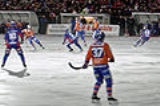
Bandy

Encyclopedia
Bandy is a team winter sport
played on ice
, in which skaters use sticks to direct a ball into the opposing team's goal.
The rules of the game have many similarities to those of association football: the game is played on a rectangle of ice the same size as a football field. Each team has 11 players, one of whom is a goalkeeper
. A standard bandy match consists of two halves of 45 minutes each. The offside
rule is also similar to that observed in association football. Bandy is sometimes referred to as "winter football" or "football of the winter" in Scandinavia and ball hockey on ice in canada
The primary rule is that the players (other than the goalkeepers) may not intentionally touch the ball with their heads, hands or arms during play. Although players usually use their sticks to move the ball around, they may use any part of their bodies other than their heads, hands or arms and may use their skates in a limited manner. Heading the ball will result in a five-minute penalty.
In typical game play, players attempt to propel the ball toward their opponents' goal through individual control of the ball, such as by dribbling
, passing the ball to a team-mate, and by taking shots at the goal, which is guarded by the opposing goalkeeper. Opposing players may try to regain control of the ball by intercepting a pass or through tackling the opponent who controls the ball; however, physical contact between opponents is limited. Bandy is generally a free-flowing game, with play stopping only when the ball has left the field of play, or when play is stopped by the referee
. After a stoppage, play can recommence with a free stroke, a penalty shot or a corner stroke. If the ball has left the field along the sidelines, the referee must decide which team touched the ball last, and award a restart stroke to the opposing team, just like football's throw-in.
The rules do not specify any player positions other than goalkeeper, but a number of player specialisations have evolved. Broadly, these include three main categories: forwards, whose main task is to score goals; defenders, who specialise in preventing their opponents from scoring; and midfielders, who dispossess the opposition and keep possession of the ball to pass it to the forwards; players in these positions are referred to as outfield players, to discern them from the single goalkeeper. These positions are further differentiated by which side of the field the player spends most time in. For example, there are central defenders, and left and right midfielders. The ten outfield players may be arranged in these positions in any combination (for example, there may be three defenders, five midfielders, and two forwards), and the number of players in each position determines the style of the team's play; more forwards and fewer defenders would create a more aggressive and offensive-minded game, while the reverse would create a slower, more defensive style of play. While players may spend most of the game in a specific position, there are few restrictions on player movement, and players can switch positions at any time. The layout of the players on the pitch is called the team's formation, and defining the team's formation and tactics is usually the prerogative of the team's manager(s).
website.
Any number of players may be replaced by substitutes during the course of the game. Substitutions can be performed without notifying the referee and can be performed while the ball is in play. However, if the substitute enters the ice before his teammate has left it, this will result in a five-minute ban. A team can bring at the most four substitutes to the game and one of these is likely to be an extra goalkeeper.
A game is officiated by a referee, the authority to enforce the rules, and whose decisions are final. The referee may be assisted by one or two assistant referees.
, a helmet
, a mouth guard and, in the case of the goalkeeper, a face guard. The teams must wear uniforms that make it easy to distinguish the two teams. The skates
, sticks and any tape on the stick must be of another colour than the ball.
In addition to the aforementioned equipment, various protections are used to protect knees, elbows, genitals and throat. The pants and gloves may contain padding. And you must always ha one bandykolle. And the ball can be orange or purple, the purple ball is impossible to see for the supporters.
and considerably larger than an ice hockey
rink. Along the sidelines a 15 cm (6 in) high border (vant, sarg, wand, wall) is placed to prevent the ball from leaving the ice. It should not be attached to the ice, to glide upon collisions, and should end 1–3 metres away from the corners.
Centered at each shortline is a 3.5 m wide and 2.1 m high goal cage and in front of the cage is a half-circular penalty area with a 17 m radius. A penalty spot is located 12 metres in front of the goal and there are two free-stroke spots at the penalty area line, each surrounded by a 5 m circle.
A centre spot denotes the center of the field and a circle of radius 5 m is centered at it. A centre-line is drawn through the centre spot and parallel with the shortlines.
At each of the corners, a 1 m radius quarter-circle is drawn, and a dotted line is painted parallel to the shortline and five metres away from it without extending into the penalty area. The dotted line can be replaced with a half-metre long line starting at the edge of the penalty area and extending towards the sideline, five metres from the shortline.
The referee is the official timekeeper for the match, and may make an allowance for time lost through substitutions, injured players requiring attention, or other stoppages. This added time is commonly referred to as stoppage time or injury time, and must be reported to the match secretary and the two captains. The referee alone signals the end of the match.
In league competitions games may end in a draw, but in some knockout competitions if a game is tied at the end of regulation time it may go into extra time, which consists of two further 15-minute periods. If the score is still tied after extra time, the game will be replayed. As an alternative, the extra two times 15-minutes may be played as "Golden goal" which means that the first team that scores during the extra-time wins the game. If both extra periods are played without a scored goal, a penalty shootout will settle the game. The teams shoot five penalties each and if this doesn't settle the game, the teams shoot one more penalty each until one of them misses and the other scores.
If the time runs out while a team is preparing for a free-stroke or penalty, the strike should still be made but it must go into the goal by one shot to count as a goal. Similarly, a goal made via a corner stroke should be allowed, but it must be executed using only one shot in addition to the strike needed to put the ball in play.
Rather than stopping play, the referee
may allow play to continue when its continuation will benefit the team against which an offence has been committed. This is known as "playing an advantage". The referee may "call back" play and penalise the original offence if the anticipated advantage does not ensue within a short period of time, typically taken to be four to five seconds. Even if an offence is not penalised because the referee plays an advantage, the offender may still be sanctioned (see below) for any associated misconduct at the next stoppage of play.
If a defender violently attacks an opponent within the penalty area, a penalty shot is awarded. Certain other offences, when carried out within the penalty area, result in a penalty shot provided there is a goal situation. These offences include a defender holding or hooking an attacker, or blocking a goal situation with a lifted skate, thrown stick or glove and so on. Also, the defenders (with the exception of the goal-keeper) are not allowed to kneel or lay on the ice. The final offences that might mandate a penalty shot are those of hitting or blocking an opponent's stick or touching the ball with the hands, arms, stick or head above the shoulders. If any of these actions is carried out in a non-goal situation, they shall be awarded with a free-stroke from one of the free-stroke spots at the penalty area line. A penalty shot should always be accompanied by a 5 or 10 minutes penalty (see below). If the penalty results in a goal, the penalty should be considered personal meaning that a substitute can be sent in for the penalised player. This does not apply in the event of a red card (see below).
The third time a player receives a penalty, it will be a personal penalty meaning he or she will miss the remainder of the match. A substitute can enter the field after five or ten minutes. A full game penalty can be received upon using abusive language or directly attacking an opponent and means that the player can neither play nor be substituted for the remainder of the game. A match penalty is indicated through the use of a red card.
for men were first held in 1957 and then every two years starting in 1961, and every year since 2003. Currently there are 13 (WCS 2008) countries participating in the world championships. The participating countries vary from year to year. Finland won the 2004 world championship in Västerås
. All other championships have been won by the Soviet Union
, Russia
, or Sweden
.
In February 2004, Sweden won the first World Championship for women, hosted in Finland. The second women's World Championships were held in Roseville, Minnesota
at the Guidant John Rose Minnesota Oval
in the USA in 2006 and once again Sweden won, defeating Russia in the final (3-1).
in Ljusdal
, Sweden, which is the biggest bandy tournament for club teams on elite level. With matches played day and night, the tournament is played in four days in late October. The winner in 2008 was Edsbyns IF
, the dominant team in Swedish bandy who had won five straight Swedish championships. The winner in 2011 was Yenisey from Russia.
. It is a pre-season
tournament held in Edsbyn
, Sweden
and features clubs from Russia and Sweden
.
(FIB), has 28 members (2011). Formed in 1955, the name was changed from International Bandy Federation in 2001 after the International Olympic Committee
approved it as a "recognized sport". "IBF" was already occupied. In 2004, FIB was fully accepted by IOC.http://bandyquebec.com/index.php?option=com_content&view=article&id=57&Itemid=68
at the VI Olympic Winter Games in 1952 (Oslo
, Norway), and is IOC accepted, it has not become an official Olympic sport
. Only three teams played bandy at the 1952 Winter Olympics
: Finland, Norway and Sweden.
The International Skating Union
in 2007 got the right to within three years add another discipline to the Olympic programme in 2014, and that discipline might be bandy. ISU and FIB already have an agreement to share the same arenas.
, open to members of the Olympic Council of Asia
, bandy for men was included for the first time. With Japan as a new FIB member, the international federation is working towards including bandy also in the next games in Sapporo-Obihiro 2017
.
In the western world, Britain has played an important role in the development of bandy. A game similar to bandy was known in Wales
as Bando
. It was played throughout the country in varying forms and is still to be found in some areas. The earliest example of the Welsh language
term bando occurs in a dictionary by John Walters published in 1770–94. It was particularly popular in the Cynffig-Margam
district of the Vale of Glamorgan
where wide stretches of sandy beaches afforded ample room for play. As a winter sport, British bandy originated in the Fens
of East Anglia
where large expanses of ice formed on flooded meadows or shallow washes in cold winters, and skating was a tradition. Members of the Bury Fen Bandy Club published rules of the game in 1882, and introduced it into other countries. The first international match was played between Bury Fen and Haarlem
from the Netherlands.
Bandy is now played in a few nations, including Argentina
, Armenia
, Australia
, Belarus
, Canada
, China
, Estonia
, Finland
, Great Britain, Hungary
, India
, Ireland
, Italy
, Japan
, Kazakhstan
, Kyrgyzstan
, Latvia
, Lithuania
, Mongolia
, the Netherlands
, Norway
, Poland
, Russia
, Serbia
, Sweden
, Switzerland
, Ukraine
, and the United States
.
during the great frost of 1813-1814, although it is probable that the game had been played there in the previous century. Bury Fen Bandy Club from Bluntisham-cum-Earith
, near St Ives
, was the most successful team, remaining unbeaten until the winter of 1890-1891. Charles G Tebbutt of the Bury Fen bandy club was responsible for the first published rules of bandy in 1882, and also for introducing the game into the Netherlands and Sweden, as well as elsewhere in England where it became popular with cricket, rowing and hockey clubs. Tebbutt's home-made bandy stick can be seen in the Norris Museum in St Ives.
England won the European Bandy Championships in 1913, but that turned out to be the grand finale, and bandy is now virtually unknown in England. In March 2004, Norwegian ex-player Edgar Malman invited two big clubs to play a rink bandy exhibition game in Streatham, London. Russian
Champions and World Cup Winner Vodnik
met Swedish Champions Edsbyns IF
in a match that ended 10-10. In 2010 England became a Federation of International Bandy
member. The federation is based in Cambridgeshire, the historical heartland. So far there´s no activity on the ice.
playing bandy on Saint Petersburg
's frozen Neva river. Russians played bandy with sticks made out of juniper wood, later adopting skates. By the second half of the 19th century the game also became popular among the masses throughout the Russian Empire
. Traditionally the Russians used a longer skate blade than other nations, giving them the advantage of skating faster. However, they would find it more difficult to turn quickly. A bandy skate has a longer blade than a hockey skate, and the "Russian skate" even longer.
When the Federation of International Bandy was formed in 1955, with the Soviet Union as one of its founding members, the Russians adopted the international rules of the game developed in England in the 19th century.
Bandy in Sweden is famous for its "culture" - both playing bandy and being a spectator requires great fortitude and dedication. A "bandy briefcase" is the classic accessory for spectating - it is typically made of brown leather, well worn and contain a warm drink in a thermos and/or a bottle of liquor.
Bandy is most often played at outdoor arenas during winter time, so the need for spectators to carry flask or thermoses of 'warming' liquid like Glögg is a natural effect.
A notable tradition is "Annandagsbandy", bandy on the day after Christmas Day, which formerly marked the start of the bandy season and always draw bigger crowds than usual. Matches traditionally begin at 1:15 PM.
The play-off match for the Swedish Championship is played every year on the third Sunday of March at Studenternas Idrottsplats in Uppsala
, drawing crowds in excess of 20,000. The reason for why the play-off match is set in Uppsala is because of IFK Uppsala and its success in the beginning of the 20th century. IFK Uppsala won 11 titles in the Swedish Championships between 1907 and 1920.
Sweden is the current world champion in 2010.
.
After WWII the number of teams rose, but mild winters in the 1970s and 80s shrunk the league, and in 2003 only 5 clubs (teams) fought out the 1st division. Later, the number of artificially frozen pitches has risen, and the number of clubs has started a slight increase.
From 1912 to 1928 the game was played 7-a-side and Ready (Oslo
) won 13 titles. Since 1928 the sport has been played 11-a-side, and Drafn (Drammen
) have won 19 titles (including one from the 7-man game).
During the 1960s crowd attendance could be anything from 200 to 4000, but these days only a handful visitors cheer their side. Big games though, can still attract 2000 people.
. The sport is known by this name in many countries though there are a few notable exceptions. In Russian bandy is called "Russian hockey" (русский хоккей) or more frequently "hockey with a ball" (xоккей с мячом) while ice hockey is called "hockey with a puck" (xоккей с шайбой) or more frequently just "hockey". In Belarussian and Ukrainian it is also called "hockey with a ball" (хакей з мячам and хокей з м'ячем, respectively). In Kazakh bandy is known as "ball hockey" (допты хоккей). In Finnish the two sports are distinguished as "ice ball" (jääpallo) and "ice puck" (jääkiekko). In Estonian and Hungarian, bandy is also called "ice ball" (jääpall and jéglabda, respectively), although in Hungarian it is more often called "bandy" nowadays.
Winter sport
A winter sport is a sport which is played on snow or ice. Most such sports are variations of skiing, ice skating and sledding. Traditionally such sports were only played in cold areas during winter, but artificial snow and ice allow more flexibility...
played on ice
Ice
Ice is water frozen into the solid state. Usually ice is the phase known as ice Ih, which is the most abundant of the varying solid phases on the Earth's surface. It can appear transparent or opaque bluish-white color, depending on the presence of impurities or air inclusions...
, in which skaters use sticks to direct a ball into the opposing team's goal.
The rules of the game have many similarities to those of association football: the game is played on a rectangle of ice the same size as a football field. Each team has 11 players, one of whom is a goalkeeper
Goalkeeper
In many team sports which involve scoring goals, a goalkeeper is a designated player charged with directly preventing the opposing team from scoring by intercepting shots at goal...
. A standard bandy match consists of two halves of 45 minutes each. The offside
Offside (sport)
Offside is a rule used by several different team sports regulating aspects of player positioning. It is particularly used in field sports with rules deriving from the various codes of football, such as association football, rugby and field hockey, as well as in ice hockey.Offside rules are...
rule is also similar to that observed in association football. Bandy is sometimes referred to as "winter football" or "football of the winter" in Scandinavia and ball hockey on ice in canada
Game
Bandy is played on ice, using a single round ball. Two teams of 11 players each compete to get the ball into the other team's goal using sticks, thereby scoring a goal. Analogous to soccer, a goal cannot be scored from a stroke-in or goal throw, and unlike soccer, a goal cannot be scored directly from a stroke-off or corner stroke. In contrast to soccer, however, all free strokes are “direct” and allow a goal to be scored without another player touching the ball. The team that has scored more goals at the end of the game is the winner; if both teams have scored an equal number of goals, then the game is a draw. There are exceptions to this rule, however.The primary rule is that the players (other than the goalkeepers) may not intentionally touch the ball with their heads, hands or arms during play. Although players usually use their sticks to move the ball around, they may use any part of their bodies other than their heads, hands or arms and may use their skates in a limited manner. Heading the ball will result in a five-minute penalty.
In typical game play, players attempt to propel the ball toward their opponents' goal through individual control of the ball, such as by dribbling
Dribbling
In sports, dribbling refers to the maneuvering of a ball around a defender through short skillful taps or kicks with either the legs , hands , stick or swimming strokes...
, passing the ball to a team-mate, and by taking shots at the goal, which is guarded by the opposing goalkeeper. Opposing players may try to regain control of the ball by intercepting a pass or through tackling the opponent who controls the ball; however, physical contact between opponents is limited. Bandy is generally a free-flowing game, with play stopping only when the ball has left the field of play, or when play is stopped by the referee
Referee
A referee is the person of authority, in a variety of sports, who is responsible for presiding over the game from a neutral point of view and making on the fly decisions that enforce the rules of the sport...
. After a stoppage, play can recommence with a free stroke, a penalty shot or a corner stroke. If the ball has left the field along the sidelines, the referee must decide which team touched the ball last, and award a restart stroke to the opposing team, just like football's throw-in.
The rules do not specify any player positions other than goalkeeper, but a number of player specialisations have evolved. Broadly, these include three main categories: forwards, whose main task is to score goals; defenders, who specialise in preventing their opponents from scoring; and midfielders, who dispossess the opposition and keep possession of the ball to pass it to the forwards; players in these positions are referred to as outfield players, to discern them from the single goalkeeper. These positions are further differentiated by which side of the field the player spends most time in. For example, there are central defenders, and left and right midfielders. The ten outfield players may be arranged in these positions in any combination (for example, there may be three defenders, five midfielders, and two forwards), and the number of players in each position determines the style of the team's play; more forwards and fewer defenders would create a more aggressive and offensive-minded game, while the reverse would create a slower, more defensive style of play. While players may spend most of the game in a specific position, there are few restrictions on player movement, and players can switch positions at any time. The layout of the players on the pitch is called the team's formation, and defining the team's formation and tactics is usually the prerogative of the team's manager(s).
Overview
There are eight rules in the official bandy rules. The same rules are designed to apply to all levels of bandy, although certain modifications for groups such as juniors, seniors or women are permitted. The rules are often framed in broad terms, which allow flexibility in their application depending on the nature of the game. The rules can be found on the official website of the Federation of International BandyFederation of International Bandy
The Federation of International Bandy is the international governing body for the sport of bandy. It was formed in 1955 in Stockholm, Sweden, and has had its base in Sweden since 1979. The present offices are situated in Katrineholm....
website.
Players and officials
Each team consists of a maximum of 11 players (excluding substitutes), one of whom must be the goalkeeper. A team of fewer than eight players may not start a game. Goalkeepers are the only players allowed to play the ball with their hands or arms, but they are only allowed to do so within the penalty area in front of their own goal. Though there are a variety of positions in which the outfield (non-goalkeeper) players are strategically placed by a coach, these positions are not defined or required by the rules of the game.Any number of players may be replaced by substitutes during the course of the game. Substitutions can be performed without notifying the referee and can be performed while the ball is in play. However, if the substitute enters the ice before his teammate has left it, this will result in a five-minute ban. A team can bring at the most four substitutes to the game and one of these is likely to be an extra goalkeeper.
A game is officiated by a referee, the authority to enforce the rules, and whose decisions are final. The referee may be assisted by one or two assistant referees.
Equipment
The basic equipment players are required to wear includes a pair of skatesIce skate
Ice skates are boots with blades attached to the bottom, used to propel the bearer across a sheet of ice. They are worn as footwear in many sports, including ice hockey, bandy and figure skating. The first ice skates were made from leg bones of horse, ox or deer, and were attached to feet with...
, a helmet
Helmet
A helmet is a form of protective gear worn on the head to protect it from injuries.Ceremonial or symbolic helmets without protective function are sometimes used. The oldest known use of helmets was by Assyrian soldiers in 900BC, who wore thick leather or bronze helmets to protect the head from...
, a mouth guard and, in the case of the goalkeeper, a face guard. The teams must wear uniforms that make it easy to distinguish the two teams. The skates
Ice skate
Ice skates are boots with blades attached to the bottom, used to propel the bearer across a sheet of ice. They are worn as footwear in many sports, including ice hockey, bandy and figure skating. The first ice skates were made from leg bones of horse, ox or deer, and were attached to feet with...
, sticks and any tape on the stick must be of another colour than the ball.
In addition to the aforementioned equipment, various protections are used to protect knees, elbows, genitals and throat. The pants and gloves may contain padding. And you must always ha one bandykolle. And the ball can be orange or purple, the purple ball is impossible to see for the supporters.
The bandy stick
The stick used in Bandy is a natural part of the sport. The stick should be made of an approved material such as wood or another similar material and it should not contain any metals or sharp parts which can hurt the surrounding players. The bandy stick should be crooked and the bend of the blade is split up into 5 different dimensions, where 1 has the smallest bend and 5 has the most. Bend 4 is the most common size in professional bandy. The bandy stick should not have similar colours as the ball; orange or pink and it should not be longer than 127 centimeters, the breadth should not exceed 7 centimetres.Field
The size of a bandy field is in the range 4,050 - 7,150 square metres (45-65 by 90–110 metres), about the same size as a football pitchAssociation football pitch
An association football pitch is the playing surface for the game of association football made of turf. Its dimensions and markings are defined by Law 1 of the Laws of the Game, "The Field of Play".All line markings on the pitch form part of the area which they define...
and considerably larger than an ice hockey
Ice hockey
Ice hockey, often referred to as hockey, is a team sport played on ice, in which skaters use wooden or composite sticks to shoot a hard rubber puck into their opponent's net. The game is played between two teams of six players each. Five members of each team skate up and down the ice trying to take...
rink. Along the sidelines a 15 cm (6 in) high border (vant, sarg, wand, wall) is placed to prevent the ball from leaving the ice. It should not be attached to the ice, to glide upon collisions, and should end 1–3 metres away from the corners.
Centered at each shortline is a 3.5 m wide and 2.1 m high goal cage and in front of the cage is a half-circular penalty area with a 17 m radius. A penalty spot is located 12 metres in front of the goal and there are two free-stroke spots at the penalty area line, each surrounded by a 5 m circle.
A centre spot denotes the center of the field and a circle of radius 5 m is centered at it. A centre-line is drawn through the centre spot and parallel with the shortlines.
At each of the corners, a 1 m radius quarter-circle is drawn, and a dotted line is painted parallel to the shortline and five metres away from it without extending into the penalty area. The dotted line can be replaced with a half-metre long line starting at the edge of the penalty area and extending towards the sideline, five metres from the shortline.
Duration and tie-breaking measures
A standard adult bandy match consists of two periods of 45 minutes each, known as halves. Each half runs continuously, meaning that the clock is not stopped when the ball is out of play; the referee can, however, make allowance for time lost through significant stoppages as described below. There is usually a 15-minute "half-time" break between halves. The end of the match is known as full-time.The referee is the official timekeeper for the match, and may make an allowance for time lost through substitutions, injured players requiring attention, or other stoppages. This added time is commonly referred to as stoppage time or injury time, and must be reported to the match secretary and the two captains. The referee alone signals the end of the match.
In league competitions games may end in a draw, but in some knockout competitions if a game is tied at the end of regulation time it may go into extra time, which consists of two further 15-minute periods. If the score is still tied after extra time, the game will be replayed. As an alternative, the extra two times 15-minutes may be played as "Golden goal" which means that the first team that scores during the extra-time wins the game. If both extra periods are played without a scored goal, a penalty shootout will settle the game. The teams shoot five penalties each and if this doesn't settle the game, the teams shoot one more penalty each until one of them misses and the other scores.
Ball in and out of play
Under the rules, the two basic states of play during a game are ball in play and ball out of play. From the beginning of each playing period with a stroke-off (a set strike from the centre-spot by one team) until the end of the playing period, the ball is in play at all times, except when either the ball leaves the field of play, or play is stopped by the referee. When the ball becomes out of play, play is restarted by one of eight restart methods depending on how it went out of play:| Method | Description |
|---|---|
| Stroke-off | Following a goal by the opposing team, or to begin each period of play. |
| Goal-throw | When the ball has wholly crossed the goal line without a goal having been scored and having last been touched by a member of the attacking team; awarded to the defending team. |
| Corner stroke | When the ball has wholly crossed the goal line without a goal having been scored and having last been touched by a member of the defending team; awarded to attacking team. The defending team must locate themselves behind goal line and the attacking team must be situated outside the penalty area with everyone but the executor no closer to the shortline than 5 m. As soon as the corner is shot, the attackers may enter the penalty area and the defenders may rush to try to stop the ball. |
| Free-stroke | Awarded to fouled team following certain listed offences, or to the opposing team upon a team causing the ball to leave the field over the side-line. |
| Penalty shot | Awarded to the fouled team following a foul usually punishable by a free-shot but that has occurred within their opponent's penalty area. |
| Face-off | Occurs when the referee has stopped play for any other reason (for example,, a serious injury to a player, interference by an external party, or a ball becoming defective). This restart is uncommon in adult games. |
If the time runs out while a team is preparing for a free-stroke or penalty, the strike should still be made but it must go into the goal by one shot to count as a goal. Similarly, a goal made via a corner stroke should be allowed, but it must be executed using only one shot in addition to the strike needed to put the ball in play.
Free-strokes and penalty shots
Free-strokes can be awarded to a team if a player of the opposite team offends any rule, for example, by hitting with the stick against the opponent's stick or skates. Free-strokes can also be awarded upon incorrect execution of corner-strikes, free-strikes, goal-throws, and so on. or the use of incorrect equipment, such as a broken stick.Rather than stopping play, the referee
Referee
A referee is the person of authority, in a variety of sports, who is responsible for presiding over the game from a neutral point of view and making on the fly decisions that enforce the rules of the sport...
may allow play to continue when its continuation will benefit the team against which an offence has been committed. This is known as "playing an advantage". The referee may "call back" play and penalise the original offence if the anticipated advantage does not ensue within a short period of time, typically taken to be four to five seconds. Even if an offence is not penalised because the referee plays an advantage, the offender may still be sanctioned (see below) for any associated misconduct at the next stoppage of play.
If a defender violently attacks an opponent within the penalty area, a penalty shot is awarded. Certain other offences, when carried out within the penalty area, result in a penalty shot provided there is a goal situation. These offences include a defender holding or hooking an attacker, or blocking a goal situation with a lifted skate, thrown stick or glove and so on. Also, the defenders (with the exception of the goal-keeper) are not allowed to kneel or lay on the ice. The final offences that might mandate a penalty shot are those of hitting or blocking an opponent's stick or touching the ball with the hands, arms, stick or head above the shoulders. If any of these actions is carried out in a non-goal situation, they shall be awarded with a free-stroke from one of the free-stroke spots at the penalty area line. A penalty shot should always be accompanied by a 5 or 10 minutes penalty (see below). If the penalty results in a goal, the penalty should be considered personal meaning that a substitute can be sent in for the penalised player. This does not apply in the event of a red card (see below).
Warnings and penalties
A ten minutes penalty is indicated through the use of a blue card and can be caused by protesting or behaving incorrectly, attacking an opponent violently or stopping the ball incorrectly to get an advantage.The third time a player receives a penalty, it will be a personal penalty meaning he or she will miss the remainder of the match. A substitute can enter the field after five or ten minutes. A full game penalty can be received upon using abusive language or directly attacking an opponent and means that the player can neither play nor be substituted for the remainder of the game. A match penalty is indicated through the use of a red card.
Offside
The offside rule effectively limits the ability of attacking players to remain forward (i.e. closer to the opponent's goal-line) of the ball, the second-to-last defending player (which can include the goalkeeper), and the half-way line. This rule is in effect just like that of Soccer.Varieties
Rink bandy is a variety played on an ice hockey-size rink.http://www.internationalbandy.com/viewNavMenu.do?menuID=26 Some FIB countries don't have a large ice surface and only play rink bandy at home.International
World Championships
The Bandy World ChampionshipsBandy World Championships
The Bandy World Championships are a competition between bandy-playing nations. The tournament is administrated by the Federation of International Bandy....
for men were first held in 1957 and then every two years starting in 1961, and every year since 2003. Currently there are 13 (WCS 2008) countries participating in the world championships. The participating countries vary from year to year. Finland won the 2004 world championship in Västerås
Västerås
Västerås is a city in central Sweden, located on the shore of Lake Mälaren in the province Västmanland, some 100 km west of Stockholm...
. All other championships have been won by the Soviet Union
Soviet Union
The Soviet Union , officially the Union of Soviet Socialist Republics , was a constitutionally socialist state that existed in Eurasia between 1922 and 1991....
, Russia
Russia
Russia or , officially known as both Russia and the Russian Federation , is a country in northern Eurasia. It is a federal semi-presidential republic, comprising 83 federal subjects...
, or Sweden
Sweden
Sweden , officially the Kingdom of Sweden , is a Nordic country on the Scandinavian Peninsula in Northern Europe. Sweden borders with Norway and Finland and is connected to Denmark by a bridge-tunnel across the Öresund....
.
In February 2004, Sweden won the first World Championship for women, hosted in Finland. The second women's World Championships were held in Roseville, Minnesota
Roseville, Minnesota
As of the census of 2000, there were 33,690 people, 14,598 households, and 8,598 families residing in the city. The population density was 2,543.9 people per square mile . There were 14,917 housing units at an average density of 1,126.4 per square mile...
at the Guidant John Rose Minnesota Oval
Guidant John Rose Minnesota Oval
The Guidant John Rose Minnesota Oval is an outdoor ice rink in Roseville, Minnesota, United States. It is claimed to be the largest artificial outdoor skating surface in the North America. The facility was constructed from June to December 1993...
in the USA in 2006 and once again Sweden won, defeating Russia in the final (3-1).
World Cup
The World Championships should not be confused with the annual World CupBandy World Cup
The Bandy World Cup is held every year in Ljusdal in Sweden. 2009 and 2010 it will be played indoors in Sandviken until Ljusdal get their indoor arena...
in Ljusdal
Ljusdal Municipality
Ljusdal Municipality is one of Sweden's 290 Municipalities within Gävleborg County. Its seat is Ljusdal.The municipality was formed in 1971 by the amalgamation of the market town of Ljusdal with the rural municipalities Järvsö, Färila, Los and Ramsjö.- Geography :Geographically the town is...
, Sweden, which is the biggest bandy tournament for club teams on elite level. With matches played day and night, the tournament is played in four days in late October. The winner in 2008 was Edsbyns IF
Edsbyns IF
Edsbyns IF, founded on 6 June 1909, is a sports club in Edsbyn in Ovanåker Municipality in Sweden. The bandy section of the club was founded as late as in 1925 and in 2000 the section was formally made a club of its own....
, the dominant team in Swedish bandy who had won five straight Swedish championships. The winner in 2011 was Yenisey from Russia.
Champions Cup
Another club tournament is the Champions CupFIB Champions Cup
FIB Champions Cup is international bandy tournament held annually in September on indoor Dina-Arena in Edsbyn, Sweden from 2004 when 8 strongest clubs from Sweden and Russia competed for Cup for the first time. Next year the format was changed expanding the number of participants to 12...
. It is a pre-season
Season (sports)
In an organized sports league, a season is the portion of one year in which regulated games of the sport are in session. For example, in Major League Baseball, one season lasts approximately from April 1 through October 1; in Association football, it is generally from August until May In an...
tournament held in Edsbyn
Edsbyn
Edsbyn is a locality and the seat of Ovanåker Municipality, Gävleborg County, Sweden with 4,060 inhabitants in 2005.Edsbyn is most famous for their ski manufacturing industry, and the sports club Edsbyns IF.-Climate:...
, Sweden
Sweden
Sweden , officially the Kingdom of Sweden , is a Nordic country on the Scandinavian Peninsula in Northern Europe. Sweden borders with Norway and Finland and is connected to Denmark by a bridge-tunnel across the Öresund....
and features clubs from Russia and Sweden
Elitserien (bandy)
The Elitserien is since the 2007–08 season the highest bandy league in Sweden. It consist of 14 teams. The season ends with a final on Studenternas IP in Uppsala. From 2013 the final will be played in Swedbank Arena, Solna....
.
International federation
The Federation of International BandyFederation of International Bandy
The Federation of International Bandy is the international governing body for the sport of bandy. It was formed in 1955 in Stockholm, Sweden, and has had its base in Sweden since 1979. The present offices are situated in Katrineholm....
(FIB), has 28 members (2011). Formed in 1955, the name was changed from International Bandy Federation in 2001 after the International Olympic Committee
International Olympic Committee
The International Olympic Committee is an international corporation based in Lausanne, Switzerland, created by Pierre de Coubertin on 23 June 1894 with Demetrios Vikelas as its first president...
approved it as a "recognized sport". "IBF" was already occupied. In 2004, FIB was fully accepted by IOC.http://bandyquebec.com/index.php?option=com_content&view=article&id=57&Itemid=68
Olympic Games
Although bandy was the demonstration sportDemonstration sport
A demonstration sport is a sport which is played to promote itself, most commonly during the Olympic Games, but also at other sporting events.Demonstration sports were officially introduced in 1912 Summer Olympics, when Sweden decided to include glima, traditional Icelandic wrestling, in the...
at the VI Olympic Winter Games in 1952 (Oslo
Oslo
Oslo is a municipality, as well as the capital and most populous city in Norway. As a municipality , it was established on 1 January 1838. Founded around 1048 by King Harald III of Norway, the city was largely destroyed by fire in 1624. The city was moved under the reign of Denmark–Norway's King...
, Norway), and is IOC accepted, it has not become an official Olympic sport
Olympic sports
Olympic sports, as defined by the International Olympic Committee, are all the sports contested in the Summer and Winter Olympic Games. The Summer Olympics, as of 2012, will include 26 sports, with two additionall sports due to be added in 2016...
. Only three teams played bandy at the 1952 Winter Olympics
Bandy at the 1952 Winter Olympics
Bandy was held as a demonstration sport at the 1952 Winter Olympics in Oslo. This was the first official international bandy tournament, since the first Bandy World Championships were not held until five years later, in 1957....
: Finland, Norway and Sweden.
The International Skating Union
International Skating Union
The International Skating Union is the international governing body for competitive ice skating disciplines, including figure skating, synchronized skating, speed skating, and short track speed skating. It was founded in Scheveningen, Netherlands in 1892, making it one of the oldest international...
in 2007 got the right to within three years add another discipline to the Olympic programme in 2014, and that discipline might be bandy. ISU and FIB already have an agreement to share the same arenas.
Asian Winter Games
At the 2011 Asian Winter GamesBandy at the 2011 Asian Winter Games
Bandy at the 2011 Asian Winter Games was held at Medeo in Almaty, Kazakhstan.-Medal table: -Medalists:-Preliminaries:---------Final:...
, open to members of the Olympic Council of Asia
Olympic Council of Asia
The Olympic Council of Asia is a governing body of sports in Asia, currently with 45 member National Olympic Committees. The current president is Sheikh Fahad Al-Sabah. The oldest NOC is from Japan and Philippines, recognized by the International Olympic Committee in 1911; whereas East Timor is...
, bandy for men was included for the first time. With Japan as a new FIB member, the international federation is working towards including bandy also in the next games in Sapporo-Obihiro 2017
2017 Asian Winter Games
The 2017 Asian Winter Games is the eighth Asian Winter Games that will be held in Sapporo, Japan. These Games were originally scheduled for 2015...
.
History
Games that are accepted as direct predecessors to bandy have been recorded in Russian monastery records dating back to the 10th to 11th centuries. A game that could be recognized as essentially modern bandy was played in Russia by the early 1700s, although the rules used differed from those that were invented in England at a much later date. All the way through modern times, Russia has kept a top position in the Bandy area, being one of the founding nations of the International Federation, as well as the most successful team in the World Championships. Russians see themselves as the creators of the sport, which is reflected by the unofficial title for bandy, "Russian hockey," or "русский хоккей."In the western world, Britain has played an important role in the development of bandy. A game similar to bandy was known in Wales
Wales
Wales is a country that is part of the United Kingdom and the island of Great Britain, bordered by England to its east and the Atlantic Ocean and Irish Sea to its west. It has a population of three million, and a total area of 20,779 km²...
as Bando
Bando (sport)
Bando is a team sport – related to hockey, hurling, shinty, and bandy – which was first recorded in Wales in the eighteenth century. The game is played on a large level field between teams of up to thirty players each of them equipped with a bando: a curve-ended stick resembling that used in field...
. It was played throughout the country in varying forms and is still to be found in some areas. The earliest example of the Welsh language
Welsh language
Welsh is a member of the Brythonic branch of the Celtic languages spoken natively in Wales, by some along the Welsh border in England, and in Y Wladfa...
term bando occurs in a dictionary by John Walters published in 1770–94. It was particularly popular in the Cynffig-Margam
Margam
Margam is a suburb of Port Talbot in the Welsh county borough of Neath Port Talbot, Wales, close to junction 39 of the M4 motorway.- History :...
district of the Vale of Glamorgan
Vale of Glamorgan
The Vale of Glamorgan is a county borough in Wales; an exceptionally rich agricultural area, it lies in the southern part of Glamorgan, South Wales...
where wide stretches of sandy beaches afforded ample room for play. As a winter sport, British bandy originated in the Fens
The Fens
The Fens, also known as the , are a naturally marshy region in eastern England. Most of the fens were drained several centuries ago, resulting in a flat, damp, low-lying agricultural region....
of East Anglia
East Anglia
East Anglia is a traditional name for a region of eastern England, named after an ancient Anglo-Saxon kingdom, the Kingdom of the East Angles. The Angles took their name from their homeland Angeln, in northern Germany. East Anglia initially consisted of Norfolk and Suffolk, but upon the marriage of...
where large expanses of ice formed on flooded meadows or shallow washes in cold winters, and skating was a tradition. Members of the Bury Fen Bandy Club published rules of the game in 1882, and introduced it into other countries. The first international match was played between Bury Fen and Haarlem
Haarlem
Haarlem is a municipality and a city in the Netherlands. It is the capital of the province of North Holland, the northern half of Holland, which at one time was the most powerful of the seven provinces of the Dutch Republic...
from the Netherlands.
Bandy is now played in a few nations, including Argentina
Argentina
Argentina , officially the Argentine Republic , is the second largest country in South America by land area, after Brazil. It is constituted as a federation of 23 provinces and an autonomous city, Buenos Aires...
, Armenia
Armenia
Armenia , officially the Republic of Armenia , is a landlocked mountainous country in the Caucasus region of Eurasia...
, Australia
Australia
Australia , officially the Commonwealth of Australia, is a country in the Southern Hemisphere comprising the mainland of the Australian continent, the island of Tasmania, and numerous smaller islands in the Indian and Pacific Oceans. It is the world's sixth-largest country by total area...
, Belarus
Belarus
Belarus , officially the Republic of Belarus, is a landlocked country in Eastern Europe, bordered clockwise by Russia to the northeast, Ukraine to the south, Poland to the west, and Lithuania and Latvia to the northwest. Its capital is Minsk; other major cities include Brest, Grodno , Gomel ,...
, Canada
Canada
Canada is a North American country consisting of ten provinces and three territories. Located in the northern part of the continent, it extends from the Atlantic Ocean in the east to the Pacific Ocean in the west, and northward into the Arctic Ocean...
, China
China
Chinese civilization may refer to:* China for more general discussion of the country.* Chinese culture* Greater China, the transnational community of ethnic Chinese.* History of China* Sinosphere, the area historically affected by Chinese culture...
, Estonia
Estonia
Estonia , officially the Republic of Estonia , is a state in the Baltic region of Northern Europe. It is bordered to the north by the Gulf of Finland, to the west by the Baltic Sea, to the south by Latvia , and to the east by Lake Peipsi and the Russian Federation . Across the Baltic Sea lies...
, Finland
Finland
Finland , officially the Republic of Finland, is a Nordic country situated in the Fennoscandian region of Northern Europe. It is bordered by Sweden in the west, Norway in the north and Russia in the east, while Estonia lies to its south across the Gulf of Finland.Around 5.4 million people reside...
, Great Britain, Hungary
Hungary
Hungary , officially the Republic of Hungary , is a landlocked country in Central Europe. It is situated in the Carpathian Basin and is bordered by Slovakia to the north, Ukraine and Romania to the east, Serbia and Croatia to the south, Slovenia to the southwest and Austria to the west. The...
, India
India
India , officially the Republic of India , is a country in South Asia. It is the seventh-largest country by geographical area, the second-most populous country with over 1.2 billion people, and the most populous democracy in the world...
, Ireland
Ireland
Ireland is an island to the northwest of continental Europe. It is the third-largest island in Europe and the twentieth-largest island on Earth...
, Italy
Italy
Italy , officially the Italian Republic languages]] under the European Charter for Regional or Minority Languages. In each of these, Italy's official name is as follows:;;;;;;;;), is a unitary parliamentary republic in South-Central Europe. To the north it borders France, Switzerland, Austria and...
, Japan
Japan
Japan is an island nation in East Asia. Located in the Pacific Ocean, it lies to the east of the Sea of Japan, China, North Korea, South Korea and Russia, stretching from the Sea of Okhotsk in the north to the East China Sea and Taiwan in the south...
, Kazakhstan
Kazakhstan
Kazakhstan , officially the Republic of Kazakhstan, is a transcontinental country in Central Asia and Eastern Europe. Ranked as the ninth largest country in the world, it is also the world's largest landlocked country; its territory of is greater than Western Europe...
, Kyrgyzstan
Kyrgyzstan
Kyrgyzstan , officially the Kyrgyz Republic is one of the world's six independent Turkic states . Located in Central Asia, landlocked and mountainous, Kyrgyzstan is bordered by Kazakhstan to the north, Uzbekistan to the west, Tajikistan to the southwest and China to the east...
, Latvia
Latvia
Latvia , officially the Republic of Latvia , is a country in the Baltic region of Northern Europe. It is bordered to the north by Estonia , to the south by Lithuania , to the east by the Russian Federation , to the southeast by Belarus and shares maritime borders to the west with Sweden...
, Lithuania
Lithuania
Lithuania , officially the Republic of Lithuania is a country in Northern Europe, the biggest of the three Baltic states. It is situated along the southeastern shore of the Baltic Sea, whereby to the west lie Sweden and Denmark...
, Mongolia
Mongolia
Mongolia is a landlocked country in East and Central Asia. It is bordered by Russia to the north and China to the south, east and west. Although Mongolia does not share a border with Kazakhstan, its western-most point is only from Kazakhstan's eastern tip. Ulan Bator, the capital and largest...
, the Netherlands
Netherlands
The Netherlands is a constituent country of the Kingdom of the Netherlands, located mainly in North-West Europe and with several islands in the Caribbean. Mainland Netherlands borders the North Sea to the north and west, Belgium to the south, and Germany to the east, and shares maritime borders...
, Norway
Norway
Norway , officially the Kingdom of Norway, is a Nordic unitary constitutional monarchy whose territory comprises the western portion of the Scandinavian Peninsula, Jan Mayen, and the Arctic archipelago of Svalbard and Bouvet Island. Norway has a total area of and a population of about 4.9 million...
, Poland
Poland
Poland , officially the Republic of Poland , is a country in Central Europe bordered by Germany to the west; the Czech Republic and Slovakia to the south; Ukraine, Belarus and Lithuania to the east; and the Baltic Sea and Kaliningrad Oblast, a Russian exclave, to the north...
, Russia
Russia
Russia or , officially known as both Russia and the Russian Federation , is a country in northern Eurasia. It is a federal semi-presidential republic, comprising 83 federal subjects...
, Serbia
Serbia
Serbia , officially the Republic of Serbia , is a landlocked country located at the crossroads of Central and Southeast Europe, covering the southern part of the Carpathian basin and the central part of the Balkans...
, Sweden
Sweden
Sweden , officially the Kingdom of Sweden , is a Nordic country on the Scandinavian Peninsula in Northern Europe. Sweden borders with Norway and Finland and is connected to Denmark by a bridge-tunnel across the Öresund....
, Switzerland
Switzerland
Switzerland name of one of the Swiss cantons. ; ; ; or ), in its full name the Swiss Confederation , is a federal republic consisting of 26 cantons, with Bern as the seat of the federal authorities. The country is situated in Western Europe,Or Central Europe depending on the definition....
, Ukraine
Ukraine
Ukraine is a country in Eastern Europe. It has an area of 603,628 km², making it the second largest contiguous country on the European continent, after Russia...
, and the United States
United States
The United States of America is a federal constitutional republic comprising fifty states and a federal district...
.
England
The first recorded games of bandy on ice took place in The FensThe Fens
The Fens, also known as the , are a naturally marshy region in eastern England. Most of the fens were drained several centuries ago, resulting in a flat, damp, low-lying agricultural region....
during the great frost of 1813-1814, although it is probable that the game had been played there in the previous century. Bury Fen Bandy Club from Bluntisham-cum-Earith
Bluntisham
Bluntisham is a village in the Huntingdonshire district of Cambridgeshire), England. It is near Earith east of St Ives.The Prime Meridian passes through the western edge of Bluntisham.Also known as Bluntisham-cum-Earith...
, near St Ives
St Ives, Cambridgeshire
St Ives is a market town in Cambridgeshire, England, around north-west of the city of Cambridge and north of London. It lies within the historic county boundaries of Huntingdonshire.-History:...
, was the most successful team, remaining unbeaten until the winter of 1890-1891. Charles G Tebbutt of the Bury Fen bandy club was responsible for the first published rules of bandy in 1882, and also for introducing the game into the Netherlands and Sweden, as well as elsewhere in England where it became popular with cricket, rowing and hockey clubs. Tebbutt's home-made bandy stick can be seen in the Norris Museum in St Ives.
England won the European Bandy Championships in 1913, but that turned out to be the grand finale, and bandy is now virtually unknown in England. In March 2004, Norwegian ex-player Edgar Malman invited two big clubs to play a rink bandy exhibition game in Streatham, London. Russian
Champions and World Cup Winner Vodnik
Vodnik
Vodnik is a bandy club from Arkhangelsk in Russia. Vodnik was founded in 1925 and in the mid-1990s it became a major team in both Russian and international bandy...
met Swedish Champions Edsbyns IF
Edsbyns IF
Edsbyns IF, founded on 6 June 1909, is a sports club in Edsbyn in Ovanåker Municipality in Sweden. The bandy section of the club was founded as late as in 1925 and in 2000 the section was formally made a club of its own....
in a match that ended 10-10. In 2010 England became a Federation of International Bandy
Federation of International Bandy
The Federation of International Bandy is the international governing body for the sport of bandy. It was formed in 1955 in Stockholm, Sweden, and has had its base in Sweden since 1979. The present offices are situated in Katrineholm....
member. The federation is based in Cambridgeshire, the historical heartland. So far there´s no activity on the ice.
Russia
In Russia bandy is known as hockey with a ball or simply Russian hockey. The game became popular among nobility in early 1700s, with the royal court of Peter I the GreatPeter I of Russia
Peter the Great, Peter I or Pyotr Alexeyevich Romanov Dates indicated by the letters "O.S." are Old Style. All other dates in this article are New Style. ruled the Tsardom of Russia and later the Russian Empire from until his death, jointly ruling before 1696 with his half-brother, Ivan V...
playing bandy on Saint Petersburg
Saint Petersburg
Saint Petersburg is a city and a federal subject of Russia located on the Neva River at the head of the Gulf of Finland on the Baltic Sea...
's frozen Neva river. Russians played bandy with sticks made out of juniper wood, later adopting skates. By the second half of the 19th century the game also became popular among the masses throughout the Russian Empire
Russian Empire
The Russian Empire was a state that existed from 1721 until the Russian Revolution of 1917. It was the successor to the Tsardom of Russia and the predecessor of the Soviet Union...
. Traditionally the Russians used a longer skate blade than other nations, giving them the advantage of skating faster. However, they would find it more difficult to turn quickly. A bandy skate has a longer blade than a hockey skate, and the "Russian skate" even longer.
When the Federation of International Bandy was formed in 1955, with the Soviet Union as one of its founding members, the Russians adopted the international rules of the game developed in England in the 19th century.
Sweden
Bandy was introduced to Sweden in 1895. The Swedish royal family, barons and diplomats were the first players. Swedish championships for men have been played annually since 1907. In the 1920s students played the game and it became a largely middle class sport. After Slottsbrons IF won the Swedish championship in 1934 it became popular amongst workers in the smaller industrial towns and villages. Bandy remains the main winter sport in many of these places.Bandy in Sweden is famous for its "culture" - both playing bandy and being a spectator requires great fortitude and dedication. A "bandy briefcase" is the classic accessory for spectating - it is typically made of brown leather, well worn and contain a warm drink in a thermos and/or a bottle of liquor.
Bandy is most often played at outdoor arenas during winter time, so the need for spectators to carry flask or thermoses of 'warming' liquid like Glögg is a natural effect.
A notable tradition is "Annandagsbandy", bandy on the day after Christmas Day, which formerly marked the start of the bandy season and always draw bigger crowds than usual. Matches traditionally begin at 1:15 PM.
The play-off match for the Swedish Championship is played every year on the third Sunday of March at Studenternas Idrottsplats in Uppsala
Uppsala
- Economy :Today Uppsala is well established in medical research and recognized for its leading position in biotechnology.*Abbott Medical Optics *GE Healthcare*Pfizer *Phadia, an offshoot of Pharmacia*Fresenius*Q-Med...
, drawing crowds in excess of 20,000. The reason for why the play-off match is set in Uppsala is because of IFK Uppsala and its success in the beginning of the 20th century. IFK Uppsala won 11 titles in the Swedish Championships between 1907 and 1920.
Sweden is the current world champion in 2010.
Finland
Bandy was introduced to Finland from Russia in the 1890s. The first Finnish national championships were held in 1908. The top national league is called BandyliigaBandyliiga
The Bandyliiga is the top level of bandy in Finland. The league was founded in 1908, and has been played every year except 1918, 1940, and 1942.-Teams:-Champions:...
.
Norway
Bandy was introduced to Norway in the 1910s. The Swedes contributed largely, and clubs sprang up around the capital of Oslo. In 1912 the Norwegians played their first National Championship, which was played annually up to 1940. During WWII, illegal bandy was played in hidden places in forests, on ponds and lakes. In 1943, -44 and -45, illegal championships were held. In 1946 legal play resumed and goes on still.After WWII the number of teams rose, but mild winters in the 1970s and 80s shrunk the league, and in 2003 only 5 clubs (teams) fought out the 1st division. Later, the number of artificially frozen pitches has risen, and the number of clubs has started a slight increase.
From 1912 to 1928 the game was played 7-a-side and Ready (Oslo
Oslo
Oslo is a municipality, as well as the capital and most populous city in Norway. As a municipality , it was established on 1 January 1838. Founded around 1048 by King Harald III of Norway, the city was largely destroyed by fire in 1624. The city was moved under the reign of Denmark–Norway's King...
) won 13 titles. Since 1928 the sport has been played 11-a-side, and Drafn (Drammen
Drammen
Drammen is a city in Buskerud County, Norway. The port and river city of Drammen is centrally located in the eastern and most populated part of Norway.-Location:...
) have won 19 titles (including one from the 7-man game).
During the 1960s crowd attendance could be anything from 200 to 4000, but these days only a handful visitors cheer their side. Big games though, can still attract 2000 people.
Names
Old names for bandy are hockey on the ice or hockey on ice. Since the mid-20th century the term bandy is usually preferred to prevent confusion with ice hockeyIce hockey
Ice hockey, often referred to as hockey, is a team sport played on ice, in which skaters use wooden or composite sticks to shoot a hard rubber puck into their opponent's net. The game is played between two teams of six players each. Five members of each team skate up and down the ice trying to take...
. The sport is known by this name in many countries though there are a few notable exceptions. In Russian bandy is called "Russian hockey" (русский хоккей) or more frequently "hockey with a ball" (xоккей с мячом) while ice hockey is called "hockey with a puck" (xоккей с шайбой) or more frequently just "hockey". In Belarussian and Ukrainian it is also called "hockey with a ball" (хакей з мячам and хокей з м'ячем, respectively). In Kazakh bandy is known as "ball hockey" (допты хоккей). In Finnish the two sports are distinguished as "ice ball" (jääpallo) and "ice puck" (jääkiekko). In Estonian and Hungarian, bandy is also called "ice ball" (jääpall and jéglabda, respectively), although in Hungarian it is more often called "bandy" nowadays.
National Bandy Federations
- ArgentinaArgentinaArgentina , officially the Argentine Republic , is the second largest country in South America by land area, after Brazil. It is constituted as a federation of 23 provinces and an autonomous city, Buenos Aires...
- Argentine Bandy Union - ArmeniaArmeniaArmenia , officially the Republic of Armenia , is a landlocked mountainous country in the Caucasus region of Eurasia...
- Armenian National Federation of Bandy - AustraliaAustraliaAustralia , officially the Commonwealth of Australia, is a country in the Southern Hemisphere comprising the mainland of the Australian continent, the island of Tasmania, and numerous smaller islands in the Indian and Pacific Oceans. It is the world's sixth-largest country by total area...
- Australian Bandy League - CanadaCanadaCanada is a North American country consisting of ten provinces and three territories. Located in the northern part of the continent, it extends from the Atlantic Ocean in the east to the Pacific Ocean in the west, and northward into the Arctic Ocean...
- Canada Bandy - People's Republic of ChinaPeople's Republic of ChinaChina , officially the People's Republic of China , is the most populous country in the world, with over 1.3 billion citizens. Located in East Asia, the country covers approximately 9.6 million square kilometres...
- Chinese Winter Sports Federation - BelarusBelarusBelarus , officially the Republic of Belarus, is a landlocked country in Eastern Europe, bordered clockwise by Russia to the northeast, Ukraine to the south, Poland to the west, and Lithuania and Latvia to the northwest. Its capital is Minsk; other major cities include Brest, Grodno , Gomel ,...
- Беларуская федэрацыя хакея з мячaм (Belarusian Bandy Federation) - EstoniaEstoniaEstonia , officially the Republic of Estonia , is a state in the Baltic region of Northern Europe. It is bordered to the north by the Gulf of Finland, to the west by the Baltic Sea, to the south by Latvia , and to the east by Lake Peipsi and the Russian Federation . Across the Baltic Sea lies...
- Eesti Jääpalliliit - FinlandFinlandFinland , officially the Republic of Finland, is a Nordic country situated in the Fennoscandian region of Northern Europe. It is bordered by Sweden in the west, Norway in the north and Russia in the east, while Estonia lies to its south across the Gulf of Finland.Around 5.4 million people reside...
- Suomen Jääpalloliitto - HungaryHungaryHungary , officially the Republic of Hungary , is a landlocked country in Central Europe. It is situated in the Carpathian Basin and is bordered by Slovakia to the north, Ukraine and Romania to the east, Serbia and Croatia to the south, Slovenia to the southwest and Austria to the west. The...
- Magyar Bandy Szövetség - IndiaIndiaIndia , officially the Republic of India , is a country in South Asia. It is the seventh-largest country by geographical area, the second-most populous country with over 1.2 billion people, and the most populous democracy in the world...
- Bandy Federation of India - IrelandIrelandIreland is an island to the northwest of continental Europe. It is the third-largest island in Europe and the twentieth-largest island on Earth...
- Bandy Federation of Ireland - ItalyItalyItaly , officially the Italian Republic languages]] under the European Charter for Regional or Minority Languages. In each of these, Italy's official name is as follows:;;;;;;;;), is a unitary parliamentary republic in South-Central Europe. To the north it borders France, Switzerland, Austria and...
- Federazione Italiana Bandy - KazakhstanKazakhstanKazakhstan , officially the Republic of Kazakhstan, is a transcontinental country in Central Asia and Eastern Europe. Ranked as the ninth largest country in the world, it is also the world's largest landlocked country; its territory of is greater than Western Europe...
- Kazakhstan Bandy Federation - KyrgyzstanKyrgyzstanKyrgyzstan , officially the Kyrgyz Republic is one of the world's six independent Turkic states . Located in Central Asia, landlocked and mountainous, Kyrgyzstan is bordered by Kazakhstan to the north, Uzbekistan to the west, Tajikistan to the southwest and China to the east...
- Bandy Federation of Kyrgyzstan - LatviaLatviaLatvia , officially the Republic of Latvia , is a country in the Baltic region of Northern Europe. It is bordered to the north by Estonia , to the south by Lithuania , to the east by the Russian Federation , to the southeast by Belarus and shares maritime borders to the west with Sweden...
- Latvijas Bendija Federācija - LithuaniaLithuaniaLithuania , officially the Republic of Lithuania is a country in Northern Europe, the biggest of the three Baltic states. It is situated along the southeastern shore of the Baltic Sea, whereby to the west lie Sweden and Denmark...
- Lithuanian Bandy Association - MongoliaMongoliaMongolia is a landlocked country in East and Central Asia. It is bordered by Russia to the north and China to the south, east and west. Although Mongolia does not share a border with Kazakhstan, its western-most point is only from Kazakhstan's eastern tip. Ulan Bator, the capital and largest...
- Bandy Federation of Mongolia - NetherlandsNetherlandsThe Netherlands is a constituent country of the Kingdom of the Netherlands, located mainly in North-West Europe and with several islands in the Caribbean. Mainland Netherlands borders the North Sea to the north and west, Belgium to the south, and Germany to the east, and shares maritime borders...
- Nederlandse Roller sport & Bandy Bond - PolandPolandPoland , officially the Republic of Poland , is a country in Central Europe bordered by Germany to the west; the Czech Republic and Slovakia to the south; Ukraine, Belarus and Lithuania to the east; and the Baltic Sea and Kaliningrad Oblast, a Russian exclave, to the north...
- Bandy Federation of Poland - NorwayNorwayNorway , officially the Kingdom of Norway, is a Nordic unitary constitutional monarchy whose territory comprises the western portion of the Scandinavian Peninsula, Jan Mayen, and the Arctic archipelago of Svalbard and Bouvet Island. Norway has a total area of and a population of about 4.9 million...
- Norges Bandyforbund - RussiaRussiaRussia or , officially known as both Russia and the Russian Federation , is a country in northern Eurasia. It is a federal semi-presidential republic, comprising 83 federal subjects...
- Всероссийская федерация хоккея с мячом (All Russian bandy federation)All Russian bandy federationThe All Russian bandy federation is the governing body for bandy in the Russian Federation. It was formally founded in 1992 even if it has been a member of the Federation of International Bandy in its own right since 1991, when it replaced the old Soviet federation. Its history goes back to 1898.... - SerbiaSerbiaSerbia , officially the Republic of Serbia , is a landlocked country located at the crossroads of Central and Southeast Europe, covering the southern part of the Carpathian basin and the central part of the Balkans...
- Bandy Federation of Serbia - SwedenSwedenSweden , officially the Kingdom of Sweden , is a Nordic country on the Scandinavian Peninsula in Northern Europe. Sweden borders with Norway and Finland and is connected to Denmark by a bridge-tunnel across the Öresund....
- Svenska Bandyförbundet - SwitzerlandSwitzerlandSwitzerland name of one of the Swiss cantons. ; ; ; or ), in its full name the Swiss Confederation , is a federal republic consisting of 26 cantons, with Bern as the seat of the federal authorities. The country is situated in Western Europe,Or Central Europe depending on the definition....
- Bandy Federation of Switzerland - UkraineUkraineUkraine is a country in Eastern Europe. It has an area of 603,628 km², making it the second largest contiguous country on the European continent, after Russia...
- Українськa Федерація хокею з м'ячем та рінк-бенді (Ukrainian Bandy and Rinkbandy Federation) - United StatesUnited StatesThe United States of America is a federal constitutional republic comprising fifty states and a federal district...
- American Bandy AssociationAmerican Bandy AssociationAmerican Bandy Association is the governing body of bandy in the United States. It is headquartered in Minnesota. The American Bandy Association was established in 1981 and became a member of the Federation of International Bandy the same year....
External links
- What is Bandy? - History and rules of Bandy.
- Federation of International Bandy
- Bandysidan links - One of the most extensive link directories about bandy
- Klein, Jeff Z. "It's Not Hockey, It's Bandy," The New York Times, Friday, January 29, 2010.
- International bandy forum