

Norwegian language

Encyclopedia
Norwegian is a North Germanic
language
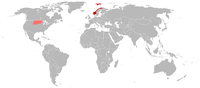
spoken primarily in Norway
, where it is the official language. Together with Swedish
and Danish
, Norwegian forms a continuum
of more or less mutually intelligible local and regional variants (see Danish language).
These Scandinavian languages together with the Faroese language
and Icelandic language
, as well as some extinct languages, constitute the North Germanic languages
(also called Scandinavian languages). Faroese and Icelandic are hardly mutually intelligible with Norwegian in their spoken form, because continental Scandinavian has diverged from them.
As established by law and governmental policy, there are two official forms of written Norwegian Bokmål
(literally "book language") and Nynorsk
(literally "new Norwegian"). The Norwegian Language Council
is responsible for regulating the two forms, and recommends the terms "Norwegian Bokmål" and "Norwegian Nynorsk" in English. Two other written forms without official status also exist: Riksmål ("national language"), which is to a large extent the same language as Bokmål, but somewhat closer to the Danish language, is regulated by the Norwegian Academy, which translates it as "Standard Norwegian". Høgnorsk
("High Norwegian") is a more purist
form of Nynorsk that rejects most of the reforms from the 20th century, but is not widely used.
There is no officially sanctioned standard of spoken Norwegian, and most Norwegians speak their own dialect
in all circumstances. The sociolect
of the urban upper and middle class in East Norway can be regarded as a de facto spoken standard for Bokmål because it adopted many characteristics from Danish when Norway was under Danish rule. This so-called standard østnorsk ("Standard Eastern Norwegian") is the form generally taught to foreign students.
From the 16th to the 19th centuries, Danish was the standard written language of Norway. As a result, the development of modern written Norwegian has been subject to strong controversy related to nationalism
, rural versus urban discourse, and Norway's literary history. Historically, Bokmål is a Norwegianised variety of Danish, while Nynorsk is a language form based on Norwegian dialects and puristic
opposition to Danish. The now abandoned official policy to merge Bokmål and Nynorsk into one common language called Samnorsk through a series of spelling reforms has created a wide spectrum of varieties of both Bokmål and Nynorsk. The unofficial form known as Riksmål is considered more conservative
than Bokmål, and the unofficial Høgnorsk
more conservative than Nynorsk.
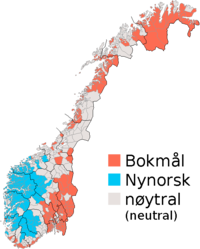
Norwegians are educated in both Bokmål and Nynorsk. A 2005 poll indicates that 86.3% use primarily Bokmål as their daily written language, 5.5% use both Bokmål and Nynorsk, and 7.5% use primarily Nynorsk. Thus 13% are frequently writing Nynorsk, though the majority speak dialects that resemble Nynorsk more closely than Bokmål. Broadly speaking, Nynorsk writing is widespread in Western Norway, though not in major urban areas, and also in the upper parts of mountain valleys in the southern and eastern parts of Norway. Examples are Setesdal
, the western part of Telemark
county (fylke) and several municipalities in Hallingdal
, Valdres
and Gudbrandsdalen. It is little used elsewhere, but 30–40 years ago it also had strongholds in many rural parts of Trøndelag (Mid-Norway) and the south part of Northern Norway (Nordland county). Today, not only is Nynorsk the official language of 4 of the 19 Norwegian counties (fylker), but also of many municipalities in 5 other counties. The Norwegian broadcasting corporation
(NRK) broadcasts in both Bokmål and Nynorsk, and all governmental agencies are required to support both written languages. Bokmål is used in 92% of all written publications, Nynorsk in 8% (2000).
Norwegian is one of the working languages of the Nordic Council
. Under the Nordic Language Convention
, citizens of the Nordic countries
who speak Norwegian have the opportunity to use their native language when interacting with official bodies in other Nordic countries without being liable to any interpretation
or translation
costs.
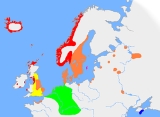
traders spread the language across Europe
and into Russia
, making Old Norse one of the most widespread languages for a time. According to tradition, King Harald Fairhair united Norway in 872. Around this time, a runic alphabet
was used. According to writings found on stone tablets from this period of history, the language showed remarkably little deviation between different regions. Runes had been in limited use since at least the 3rd century. Around 1030, Christianity
came to Norway, bringing with it the Latin alphabet
. Norwegian manuscripts in the new alphabet began to appear about a century later. The Norwegian language began to deviate from its neighbors around this time as well.
Viking explorers had begun to settle Iceland
in the 9th century, carrying with them the Old Norse language. Over time, Old Norse developed into "Western" and "Eastern" variants. Western Norse covered Norway and overseas settlements in Iceland, Greenland, the Faroe Islands and the Shetland Islands, while Eastern Norse developed in Denmark
and south-central Sweden
. The language of Iceland and Norway was practically the same up until the 14th century, when they started to deviate from each other.
The language phase traditionally dated to 1350–1525 is known as Middle Norwegian and is seen by many as a transitional period from Old Norwegian
to Modern Norwegian
. The reason for this is that although most languages are in a state of constant change, Norwegian phonology, morphology and syntax changed considerably during this time. The use of grammatical case, and a great portion of the conjugation of verbs was lost and replaced by a more fixed syntax, use of prepositions and a greater use of auxiliary based verb forms. During the late Old Norse period and this period there was also a considerable adoption of Middle Low German
vocabulary. Similar development in grammar and phonology happened in Swedish and Danish, keeping the dialect continuum
in continental Scandinavia intact, but with greater dialectal variation. This process did not, however, occur in the same way in Faroese
and Icelandic
. These languages remain conservative to this day, when it comes to grammar and vocabulary, so mutual intelligibility with continental Scandinavia was lost.
unified Norway, Sweden and Denmark, and from 1536 Norway was subordinated under the Kingdom of Denmark–Norway. Danish became the commonly written language among Norway's literate class. Spoken Danish was gradually adopted by the urban elite, first at formal occasions, and gradually a more relaxed variety was adopted in everyday speech. The everyday speech went through a koinéization
process, involving grammatical simplification and Norwegianised pronunciation. When the union ended in 1814 the Dano-Norwegian
koiné
had become the mother tongue of a substantial part of the Norwegian elite, but the more Danish-sounding solemn variety was still used on formal occasions.
Norway was forced to enter a new personal union with Sweden, shortly after the end of the former one with Denmark. However, Norwegians began to push for true independence by embracing democracy
and attempting to enforce the constitutional declaration of being a sovereign state. Part of this nationalist movement was directed towards the development of an independent Norwegian language. Three major paths were available: do nothing (Norwegian written language, i.e. Danish, was already different from Swedish), Norwegianise the Danish language, or build a new national language based on Modern Norwegian dialects. All three approaches were attempted.
Meanwhile, a nationalistic movement strove for the development of a new written Norwegian. Ivar Aasen
, a self-taught linguist, began his work to create a new Norwegian language at the age of 22. He traveled around the country, comparing the dialects in different regions, and examined the development of Icelandic
, which had largely escaped the influences Norwegian had come under. He called his work, which was published in several books from 1848 to 1873, Landsmål
, meaning national language. The name "Landsmål" is sometimes interpreted as "rural language" or "country language," but this was clearly not Aasen's intended meaning.
The name of the Danish language in Norway was a topic of hot dispute through the 19th century. Its proponents claimed that it was a language common to Norway and Denmark, and no more Danish than Norwegian. The proponents of Landsmål thought that the Danish character of the language should not be concealed. In 1899, Bjørnstjerne Bjørnson
proposed the neutral name Riksmål, meaning national language like Landsmål, and this was officially adopted along with the 1907 spelling reform. The name "Riksmål" is sometimes interpreted as "state language," but this meaning is secondary at best, compare to Danish rigsmål
from where the name was borrowed.
After the personal union with Sweden was dissolved in 1905, both languages were developed further and reached what is now considered their classic forms after a reform in 1917. Riksmål was in 1929 officially renamed Bokmål
(literally "Book language"), and Landsmål to Nynorsk
(literally "New Norwegian"). A proposition to substitute Dano-Norwegian for Bokmål lost in parliament by a single vote. The name Nynorsk, the linguistic term for Modern Norwegian
, was chosen for contrast to Danish and emphasis on the historical connection to Old Norwegian. Today this meaning is often lost, and it is commonly mistaken as a "new" Norwegian in contrast to the "real" Norwegian Bokmål.
Bokmål and Nynorsk were made closer by a reform in 1938. This was a result of a state policy to merge Nynorsk and Bokmål into one language, called "Samnorsk" (Common Norwegian). A 1946 poll showed that this policy was supported by 79% of Norwegians at the time. However, opponents of the official policy still managed to create a massive protest movement against Samnorsk in the 1950s, fighting in particular the use of "radical" forms in Bokmål text books in schools. In the reform in 1959, the 1938 reform was partially reversed in Bokmål, but Nynorsk was changed further towards Bokmål. Since then Bokmål has reverted even further toward traditional Riksmål, while Nynorsk still adheres to the 1959 standard. Therefore a small minority of Nynorsk enthusiasts uses a more conservative standard called Høgnorsk
. The Samnorsk policy had little influence after 1960, and was officially abandoned in 2002.
The post-alveolar consonants only appear in East-Norwegian dialects as a result of Sandhi
, combining -ɾ with d, l, n, s, and t.
The pronunciation of the letter r varies according to dialect. In East-Norwegian dialects, it is a flap ɾ, whereas it in Western and Southern Norway, and for some speakers also in Eastern Norway is rendered more gutturally as χ or ʁ.
The dialects of North-Western Norway use a post-alveolar trill r in this position.
language with two distinct pitch patterns, just like Swedish. They are used to differentiate two-syllable words with otherwise identical pronunciation. For example, in many East Norwegian dialects, the word "" (farmers) is pronounced using tone 1, while "" (beans or prayers) uses tone 2. Though the differences in spelling occasionally allow the words to be distinguished in written language, in most cases the minimal pairs are written alike, since written Norwegian has no explicit accent marks. In most eastern low-tone dialects, accent 1 uses a low flat pitch in the first syllable, while accent 2 uses a high, sharply falling pitch in the first syllable and a low pitch in the beginning of the second syllable. In both accents, these pitch movements are followed by a rise of intonation
al nature (phrase accent), the size (and presence) of which signals emphasis/focus and which corresponds in function to the normal accent in languages that lack lexical tone
, such as English. That rise culminates in the final syllable of an accentual phrase, while the utterance-final fall that is so common in most languages is either very small or absent.
There are significant variations in pitch accent between dialects. Thus, in most of western and northern Norway (the so-called high-pitch dialects) accent 1 is falling, while accent 2 is rising in the first syllable and falling in the second syllable or somewhere around the syllable boundary. The pitch accents (as well as the peculiar phrase accent in the low-tone dialects) give the Norwegian language a "singing" quality which makes it fairly easy to distinguish from other languages.
Interestingly, accent 1 generally occurs in words that were monosyllabic in Old Norse
, and accent 2 in words that were polysyllabic.
The letters c, q, w, x and z are only used in loanword
s. As loanwords are assimilated into Norwegian, their spelling might change to reflect Norwegian pronunciation and the principles of Norwegian orthography, e.g. zebra
in Norwegian is written sebra. Due to historical reasons, some otherwise Norwegian family names are also written using these letters.
Some letters may be modified by diacritic
s: é, è, ê, ó, ò, and ô. In Nynorsk, ì and ù and ỳ are occasionally seen as well. The diacritics are not compulsory, but may in a few cases distinguish between different meanings of the word, e.g.: for (for/to), fór (went), fòr (furrow) and fôr (fodder). Loanwords may be spelled with other diacritics, most notably ü, á and à.
(Norwegian Language Council) that determines, after approval from the Ministry of Culture, official spelling, grammar, and vocabulary for the Norwegian language. The board's work has been subject to considerable controversy throughout the years.
Both Nynorsk and Bokmål have a great variety of optional forms. The Bokmål that uses the forms that are close to Riksmål is called moderate or conservative, depending on one's viewpoint, while the Bokmål that uses the forms that are close to Nynorsk is called radical. Nynorsk has forms that are close to the original Landsmål and forms that are close to Bokmål.
Wikipedia
has a separate version for each of the written varieties.
 Opponents of the spelling reforms aimed at bringing Bokmål closer to Nynorsk have retained the name Riksmål and employ spelling and grammar that predate the Samnorsk movement. Riksmål and conservative versions of Bokmål have been the de facto standard written language of Norway for most of the 20th century, being used by large newspapers, encyclopedias, and a significant proportion of the population of the capital Oslo, surrounding areas, and other urban areas, as well as much of the literary tradition. Since the reforms of 1981 and 2003 (effective in 2005), the official Bokmål can be adapted to be almost identical with modern Riksmål. The differences between written Riksmål and Bokmål are comparable to American and British English differences
.
Riksmål is regulated by the Norwegian Academy, which determines acceptable spelling, grammar, and vocabulary.
, but has found no widespread use.
, Dagbladet
and VG
) are published in Bokmål or Riksmål. Some major regional newspapers (including Bergens Tidende
and Stavanger Aftenblad
), many political journals, and many local newspapers use both Bokmål and Nynorsk.
s are inflected
or declined
in definiteness
(indefinite/definite) and number
(singular/plural). In some dialects, definite nouns are furthermore declined in case
(nominative
/dative
).
As in most Indo-European languages (English
being one of a few exceptions), nouns are classified by gender
, which has consequences for the declension of agreeing adjective
s and determiner
s. Norwegian has three genders: masculine, feminine and neuter, except the Bergen
dialect which has only two genders: common and neuter. Riksmål and conservative Bokmål traditionally have two genders like Danish, but more modern language has three genders, especially in its spoken form.
The declension of regular nouns depends on gender. Some dialects and variants of Nynorsk furthermore have different declension of weak and strong feminines and neuters.
As of June 5, 2005, all feminine nouns can be written as masculine nouns (bokmål only), giving the written language only two genders – common and neuter.
s have two inflectional paradigms. The weak inflection is applicable when the argument is definite
, the strong inflection is used when the argument is indefinite
. In both paradigms the adjective is declined in comparison
(positive/comparative/superlative). Strong, positive
adjectives are furthermore declined in gender
and number
in agreement with their argument. In some southwestern dialects, the weak positive is also declined in gender and number, with one form for feminine and plural, and one form for masculine and neuter.
In Norwegian, a definite noun has a suffixed article (cf. above). Noteworthy, however, when a definitive noun is preceded by an adjective (or a numeral), a definite article is placed in front of the adjective in addition to the suffixed article of the noun, double definiteness. (In Bokmål, though, the suffixed article may be dropped in these cases, due to its Danish origin.) Example in Nynorsk: huset - det grøne huset (the house - the green house).
verb
s are inflected or conjugated
in mood
: indicative/imperative/subjunctive. The subjunctive mood
is constrained to a handful of verbs. The indicative verbs are conjugated in tense
, present
/ past
. In Bokmål and Standard Østnorsk, the infinitive and present tense also has a passive
form, whilst Nynorsk only has a passive infinitive (which is used less frequently than its Bokmål counterpart). In a few dialects, indicative verbs are also conjugated in number
. Conjugation in person
is lost in Norwegian.
There are four non-finite verb
forms: infinitive
, passive
infinitive, and the two participle
s perfective/past participle and imperfective/present participle.
The participles are verbal adjectives. The imperfective participle has no further declension, but the perfective participle is declined in gender
(not in Bokmål and Standard Østnorsk) and number
like strong, positive adjectives. The definite
form of the participle is identical to the plural form.
As with other Germanic languages, Norwegian verbs can be either weak
or strong
.
s are declined in case
, nominative
/ accusative
. Some of the dialects that have preserved the dative
in nouns, also have a dative case instead of the accusative case in personal pronouns, while others have accusative in pronouns and dative in nouns, effectively giving these dialects three distinct cases.
In the most comprehensive Norwegian grammar, Norsk referansegrammatikk, the categorization of personal pronouns by person
, gender
, and number
is not regarded as inflection. As with nouns, adjectives must agree with the gender and number of pronoun arguments.
Other pronouns have no inflection.
The so called possessive
, demonstrative and relative
pronouns are no longer regarded to be pronouns.
Pronouns are a closed class
.
Bokmål, like English, has two sets of 3rd person pronouns. Han and hun refer to male and female individuals respectively, den and det refer to impersonal or inanimate nouns, of masculine/feminine or neutral gender respectively. In contrast, Nynorsk and most dialects use the same set of pronouns (han (m.), ho (f.) and det (n.)) for both personal and impersonal references. Det also has expletive
and cataphoric uses like in the English examples it rains and it was known by everyone (that) he had travelled the world.
of Norwegian determiner
s are declined in gender
and number
in agreement with their argument. Not all determiners are inflected.
es without inflection, i.e. lexical categories
with grammatical function and a finite number of members that may not be distinguished by morphological criteria. These are interjection
s, conjunctions
, subjunctions
, prepositions, and adverbs. The inclusion of adverbs here requires that traditional adverbs that are inflected in comparison
be classified as adjectives, as is sometimes done.
, the head
, i.e. the part determining the compound's class, is the last part. Only the first part has primary stress. For instance, the compound tenketank (think tank) has primary stress on the first syllable and is a noun (some sort of tank).
Compound words are written together in Norwegian, which can cause words to become very long, for example sannsynlighetsmaksimeringsestimator (maximum likelihood
estimator
) and menneskerettighetsorganisasjoner (human rights organisations). Another example is the title høyesterettsjustitiarius (Chief Justice of the Supreme Court, originally a combination of supreme court
and the actual title, justiciar
). Note also the translation En midtsommernattsdrøm (A Midsummer Night's Dream).
If they are not written together, each part will naturally be read with primary stress, and the meaning of the compound is lost. This is sometimes forgotten, occasionally with humorous results. Instead of writing, for example, lammekoteletter (lamb chops), people make the mistake of writing lamme koteletter (lame, or paralyzed, chops). The original message can even be reversed, as when røykfritt (no smoking, lit. "smoke free") becomes røyk fritt (smoke freely).
Other examples include:
These misunderstandings occur because most nouns can be interpreted as verbs or other types of words.
Similar misunderstandings can be achieved in English too. The following are examples of phrases that both in Norwegian and English mean one thing as a compound word, and something different when regarded as separate words:
, which had a huge influence on Norwegian vocabulary from the late Middle Ages onwards partially even influencing grammatical structures, such as genitive constructions. At present, the main source of new loanwords is English e.g. rapper, e-mail, catering, juice, bag (originally a loan word to English from Old Norse). However, Norwegian is considered to be less influenced by English than, for instance, Swedish, or particularly, Danish.
Some loanwords have their spelling changed to reflect Norwegian pronunciation rules, but in general Norwegianised spellings of these words tend to take a long time to sink in: e.g. sjåfør (from French
chauffeur) and revansj (from French revanche) are now the common Norwegian spellings, but juice is more often used than the Norwegianised form jus, catering more often than keitering, service more often than sørvis, etc.
North Germanic languages
The North Germanic languages or Scandinavian languages, the languages of Scandinavians, make up one of the three branches of the Germanic languages, a sub-family of the Indo-European languages, along with the West Germanic languages and the extinct East Germanic languages...
language
Language
Language may refer either to the specifically human capacity for acquiring and using complex systems of communication, or to a specific instance of such a system of complex communication...
spoken primarily in Norway
Norway
Norway , officially the Kingdom of Norway, is a Nordic unitary constitutional monarchy whose territory comprises the western portion of the Scandinavian Peninsula, Jan Mayen, and the Arctic archipelago of Svalbard and Bouvet Island. Norway has a total area of and a population of about 4.9 million...
, where it is the official language. Together with Swedish
Swedish language
Swedish is a North Germanic language, spoken by approximately 10 million people, predominantly in Sweden and parts of Finland, especially along its coast and on the Åland islands. It is largely mutually intelligible with Norwegian and Danish...
and Danish
Danish language
Danish is a North Germanic language spoken by around six million people, principally in the country of Denmark. It is also spoken by 50,000 Germans of Danish ethnicity in the northern parts of Schleswig-Holstein, Germany, where it holds the status of minority language...
, Norwegian forms a continuum
Dialect continuum
A dialect continuum, or dialect area, was defined by Leonard Bloomfield as a range of dialects spoken across some geographical area that differ only slightly between neighboring areas, but as one travels in any direction, these differences accumulate such that speakers from opposite ends of the...
of more or less mutually intelligible local and regional variants (see Danish language).
These Scandinavian languages together with the Faroese language
Faroese language
Faroese , is an Insular Nordic language spoken by 48,000 people in the Faroe Islands and about 25,000 Faroese people in Denmark and elsewhere...
and Icelandic language
Icelandic language
Icelandic is a North Germanic language, the main language of Iceland. Its closest relative is Faroese.Icelandic is an Indo-European language belonging to the North Germanic or Nordic branch of the Germanic languages. Historically, it was the westernmost of the Indo-European languages prior to the...
, as well as some extinct languages, constitute the North Germanic languages
North Germanic languages
The North Germanic languages or Scandinavian languages, the languages of Scandinavians, make up one of the three branches of the Germanic languages, a sub-family of the Indo-European languages, along with the West Germanic languages and the extinct East Germanic languages...
(also called Scandinavian languages). Faroese and Icelandic are hardly mutually intelligible with Norwegian in their spoken form, because continental Scandinavian has diverged from them.
As established by law and governmental policy, there are two official forms of written Norwegian Bokmål
Bokmål
Bokmål is one of two official Norwegian written standard languages, the other being Nynorsk. Bokmål is used by 85–90% of the population in Norway, and is the standard most commonly taught to foreign students of the Norwegian language....
(literally "book language") and Nynorsk
Nynorsk
Nynorsk or New Norwegian is one of two official written standards for the Norwegian language, the other being Bokmål. The standard language was created by Ivar Aasen during the mid-19th century, to provide a Norwegian alternative to the Danish language which was commonly written in Norway at the...
(literally "new Norwegian"). The Norwegian Language Council
Norwegian Language Council
The Norwegian Language Council was the regulation authority for the Norwegian language. It has been superseded by The Language Council of Norway .The council had 38 members, and created lists of acceptable word forms...
is responsible for regulating the two forms, and recommends the terms "Norwegian Bokmål" and "Norwegian Nynorsk" in English. Two other written forms without official status also exist: Riksmål ("national language"), which is to a large extent the same language as Bokmål, but somewhat closer to the Danish language, is regulated by the Norwegian Academy, which translates it as "Standard Norwegian". Høgnorsk
Høgnorsk
Høgnorsk, meaning "High Norwegian", is a term for varieties of the Norwegian language form Nynorsk that reject most of the official reforms that have been introduced since the creation of Landsmål...
("High Norwegian") is a more purist
Linguistic purism
Linguistic purism or linguistic protectionism is the practice of defining one variety of a language as being purer than other varieties. The ideal of purity is often opposed in reference to a perceived decline from an "ideal past" or an unwanted similarity with other languages, but sometimes simply...
form of Nynorsk that rejects most of the reforms from the 20th century, but is not widely used.
There is no officially sanctioned standard of spoken Norwegian, and most Norwegians speak their own dialect
Norwegian dialects
The Norwegian dialects are commonly divided into 4 main groups, North Norwegian , Trøndelag Norwegian , West Norwegian , and East Norwegian...
in all circumstances. The sociolect
Sociolect
In sociolinguistics, a sociolect or social dialect is a variety of language associated with a social group such as a socioeconomic class, an ethnic group, an age group, etc....
of the urban upper and middle class in East Norway can be regarded as a de facto spoken standard for Bokmål because it adopted many characteristics from Danish when Norway was under Danish rule. This so-called standard østnorsk ("Standard Eastern Norwegian") is the form generally taught to foreign students.
From the 16th to the 19th centuries, Danish was the standard written language of Norway. As a result, the development of modern written Norwegian has been subject to strong controversy related to nationalism
Nationalism
Nationalism is a political ideology that involves a strong identification of a group of individuals with a political entity defined in national terms, i.e. a nation. In the 'modernist' image of the nation, it is nationalism that creates national identity. There are various definitions for what...
, rural versus urban discourse, and Norway's literary history. Historically, Bokmål is a Norwegianised variety of Danish, while Nynorsk is a language form based on Norwegian dialects and puristic
Linguistic purism
Linguistic purism or linguistic protectionism is the practice of defining one variety of a language as being purer than other varieties. The ideal of purity is often opposed in reference to a perceived decline from an "ideal past" or an unwanted similarity with other languages, but sometimes simply...
opposition to Danish. The now abandoned official policy to merge Bokmål and Nynorsk into one common language called Samnorsk through a series of spelling reforms has created a wide spectrum of varieties of both Bokmål and Nynorsk. The unofficial form known as Riksmål is considered more conservative
Conservative (language)
In linguistics, a conservative form, variety, or modality is one that has changed relatively little over its history, or which is relatively resistant to change...
than Bokmål, and the unofficial Høgnorsk
Høgnorsk
Høgnorsk, meaning "High Norwegian", is a term for varieties of the Norwegian language form Nynorsk that reject most of the official reforms that have been introduced since the creation of Landsmål...
more conservative than Nynorsk.
Norwegians are educated in both Bokmål and Nynorsk. A 2005 poll indicates that 86.3% use primarily Bokmål as their daily written language, 5.5% use both Bokmål and Nynorsk, and 7.5% use primarily Nynorsk. Thus 13% are frequently writing Nynorsk, though the majority speak dialects that resemble Nynorsk more closely than Bokmål. Broadly speaking, Nynorsk writing is widespread in Western Norway, though not in major urban areas, and also in the upper parts of mountain valleys in the southern and eastern parts of Norway. Examples are Setesdal
Setesdal
Setesdal is a valley and a traditional district in Aust-Agder County in southern Norway. It consists of the municipalities of Bykle, Valle, Bygland, Iveland, and Evje og Hornnes....
, the western part of Telemark
Telemark
is a county in Norway, bordering Vestfold, Buskerud, Hordaland, Rogaland and Aust-Agder. The county administration is in Skien. Until 1919 the county was known as Bratsberg amt.-Location:...
county (fylke) and several municipalities in Hallingdal
Hallingdal
Hallingdal is a valley and traditional district in Buskerud county in Norway. It consists of the municipalities of Flå, Nes, Gol, Hemsedal, Ål and Hol.-History:Ancient routes went to Vestlandet through Valdres and Hallingdal and down Røldal to Odda...
, Valdres
Valdres
Valdres is a traditional district in central, southern Norway, situated between Gudbrandsdal and Hallingdal.Administratively, Valdres belongs to Oppland. It consists of the municipalities Nord-Aurdal, Sør-Aurdal, Øystre Slidre, Vestre Slidre, Vang and Etnedal. The main town in the region is...
and Gudbrandsdalen. It is little used elsewhere, but 30–40 years ago it also had strongholds in many rural parts of Trøndelag (Mid-Norway) and the south part of Northern Norway (Nordland county). Today, not only is Nynorsk the official language of 4 of the 19 Norwegian counties (fylker), but also of many municipalities in 5 other counties. The Norwegian broadcasting corporation
Norsk Rikskringkasting
The Norwegian Broadcasting Corporation , which is usually known as NRK, is the Norwegian government-owned radio and television public broadcasting company, and the largest media organisation in Norway...
(NRK) broadcasts in both Bokmål and Nynorsk, and all governmental agencies are required to support both written languages. Bokmål is used in 92% of all written publications, Nynorsk in 8% (2000).
Norwegian is one of the working languages of the Nordic Council
Nordic Council
The Nordic Council is a geo-political, inter-parliamentary forum for co-operation between the Nordic countries. It was established following World War II and its first concrete result was the introduction in 1952 of a common labour market and free movement across borders without passports for the...
. Under the Nordic Language Convention
Nordic Language Convention
The Nordic Language Convention is a convention of linguistic rights which came into force on 1 March 1987, under the auspices of the Nordic Council. Under the Convention, citizens of the Nordic countries have the opportunity to use their native language when interacting with official bodies in...
, citizens of the Nordic countries
Nordic countries
The Nordic countries make up a region in Northern Europe and the North Atlantic which consists of Denmark, Finland, Iceland, Norway and Sweden and their associated territories, the Faroe Islands, Greenland and Åland...
who speak Norwegian have the opportunity to use their native language when interacting with official bodies in other Nordic countries without being liable to any interpretation
Interpreting
Language interpretation is the facilitating of oral or sign-language communication, either simultaneously or consecutively, between users of different languages...
or translation
Translation
Translation is the communication of the meaning of a source-language text by means of an equivalent target-language text. Whereas interpreting undoubtedly antedates writing, translation began only after the appearance of written literature; there exist partial translations of the Sumerian Epic of...
costs.
From Old Norse to Scandinavian languages
The languages now spoken in Scandinavia developed from the Old Norse language, which did not differ greatly between what are now Danish, Norwegian, and Swedish areas. In fact, VikingViking
The term Viking is customarily used to refer to the Norse explorers, warriors, merchants, and pirates who raided, traded, explored and settled in wide areas of Europe, Asia and the North Atlantic islands from the late 8th to the mid-11th century.These Norsemen used their famed longships to...
traders spread the language across Europe
Europe
Europe is, by convention, one of the world's seven continents. Comprising the westernmost peninsula of Eurasia, Europe is generally 'divided' from Asia to its east by the watershed divides of the Ural and Caucasus Mountains, the Ural River, the Caspian and Black Seas, and the waterways connecting...
and into Russia
Russia
Russia or , officially known as both Russia and the Russian Federation , is a country in northern Eurasia. It is a federal semi-presidential republic, comprising 83 federal subjects...
, making Old Norse one of the most widespread languages for a time. According to tradition, King Harald Fairhair united Norway in 872. Around this time, a runic alphabet
Runic alphabet
The runic alphabets are a set of related alphabets using letters known as runes to write various Germanic languages before the adoption of the Latin alphabet and for specialized purposes thereafter...
was used. According to writings found on stone tablets from this period of history, the language showed remarkably little deviation between different regions. Runes had been in limited use since at least the 3rd century. Around 1030, Christianity
Christianity
Christianity is a monotheistic religion based on the life and teachings of Jesus as presented in canonical gospels and other New Testament writings...
came to Norway, bringing with it the Latin alphabet
Latin alphabet
The Latin alphabet, also called the Roman alphabet, is the most recognized alphabet used in the world today. It evolved from a western variety of the Greek alphabet called the Cumaean alphabet, which was adopted and modified by the Etruscans who ruled early Rome...
. Norwegian manuscripts in the new alphabet began to appear about a century later. The Norwegian language began to deviate from its neighbors around this time as well.
Viking explorers had begun to settle Iceland
Iceland
Iceland , described as the Republic of Iceland, is a Nordic and European island country in the North Atlantic Ocean, on the Mid-Atlantic Ridge. Iceland also refers to the main island of the country, which contains almost all the population and almost all the land area. The country has a population...
in the 9th century, carrying with them the Old Norse language. Over time, Old Norse developed into "Western" and "Eastern" variants. Western Norse covered Norway and overseas settlements in Iceland, Greenland, the Faroe Islands and the Shetland Islands, while Eastern Norse developed in Denmark
Lands of Denmark
The three lands of Denmark historically formed the Danish kingdom from its unification and consolidation in the 9th century:*Zealand and the islands south of it, with Roskilde as a centre...
and south-central Sweden
Lands of Sweden
The lands of Sweden are three traditional parts, essentially three collectives of provinces, in Sweden. These "lands" have no administrative function, and there is no official designation for this subdivision level...
. The language of Iceland and Norway was practically the same up until the 14th century, when they started to deviate from each other.
The language phase traditionally dated to 1350–1525 is known as Middle Norwegian and is seen by many as a transitional period from Old Norwegian
Old Norwegian
Old Norwegian refers to a group of Old Norse dialects spoken and written in Norway in the Middle Ages. They bridged the dialect continuum from Old East Norse to Old West Norse.-Old Norwegian vs Common Norse:...
to Modern Norwegian
Modern Norwegian
Modern Norwegian is the Norwegian language that emerged after the Middle Norwegian transition period . The transition to Modern Norwegian is usually dated to 1525, or 1536, the year of the Protestant Reformation and the beginning of the Kingdom of Denmark-Norway .The Norwegian linguistic term for...
. The reason for this is that although most languages are in a state of constant change, Norwegian phonology, morphology and syntax changed considerably during this time. The use of grammatical case, and a great portion of the conjugation of verbs was lost and replaced by a more fixed syntax, use of prepositions and a greater use of auxiliary based verb forms. During the late Old Norse period and this period there was also a considerable adoption of Middle Low German
Middle Low German
Middle Low German is a language that is the descendant of Old Saxon and is the ancestor of modern Low German. It served as the international lingua franca of the Hanseatic League...
vocabulary. Similar development in grammar and phonology happened in Swedish and Danish, keeping the dialect continuum
Dialect continuum
A dialect continuum, or dialect area, was defined by Leonard Bloomfield as a range of dialects spoken across some geographical area that differ only slightly between neighboring areas, but as one travels in any direction, these differences accumulate such that speakers from opposite ends of the...
in continental Scandinavia intact, but with greater dialectal variation. This process did not, however, occur in the same way in Faroese
Faroese language
Faroese , is an Insular Nordic language spoken by 48,000 people in the Faroe Islands and about 25,000 Faroese people in Denmark and elsewhere...
and Icelandic
Icelandic language
Icelandic is a North Germanic language, the main language of Iceland. Its closest relative is Faroese.Icelandic is an Indo-European language belonging to the North Germanic or Nordic branch of the Germanic languages. Historically, it was the westernmost of the Indo-European languages prior to the...
. These languages remain conservative to this day, when it comes to grammar and vocabulary, so mutual intelligibility with continental Scandinavia was lost.
Danish and Swedish rule
In 1397, the Kalmar UnionKalmar Union
The Kalmar Union is a historiographical term meaning a series of personal unions that united the three kingdoms of Denmark, Norway , and Sweden under a single monarch, though intermittently and with a population...
unified Norway, Sweden and Denmark, and from 1536 Norway was subordinated under the Kingdom of Denmark–Norway. Danish became the commonly written language among Norway's literate class. Spoken Danish was gradually adopted by the urban elite, first at formal occasions, and gradually a more relaxed variety was adopted in everyday speech. The everyday speech went through a koinéization
Koine language
In linguistics, a koiné language is a standard language or dialect that has arisen as a result of contact between two mutually intelligible varieties of the same language. Since the speakers have understood one another from before the advent of the koiné, the koineization process is not as rapid...
process, involving grammatical simplification and Norwegianised pronunciation. When the union ended in 1814 the Dano-Norwegian
Dano-Norwegian
Dano-Norwegian is a linguistic term for a koiné that evolved among the urban elite in Norwegian cities during the later years of the union between the Kingdoms of Denmark and Norway . It is from this koiné that Riksmål and Bokmål developed...
koiné
Koine language
In linguistics, a koiné language is a standard language or dialect that has arisen as a result of contact between two mutually intelligible varieties of the same language. Since the speakers have understood one another from before the advent of the koiné, the koineization process is not as rapid...
had become the mother tongue of a substantial part of the Norwegian elite, but the more Danish-sounding solemn variety was still used on formal occasions.
Norway was forced to enter a new personal union with Sweden, shortly after the end of the former one with Denmark. However, Norwegians began to push for true independence by embracing democracy
Democracy
Democracy is generally defined as a form of government in which all adult citizens have an equal say in the decisions that affect their lives. Ideally, this includes equal participation in the proposal, development and passage of legislation into law...
and attempting to enforce the constitutional declaration of being a sovereign state. Part of this nationalist movement was directed towards the development of an independent Norwegian language. Three major paths were available: do nothing (Norwegian written language, i.e. Danish, was already different from Swedish), Norwegianise the Danish language, or build a new national language based on Modern Norwegian dialects. All three approaches were attempted.
Danish to Norwegian
From the 1840s, some writers experimented with a Norwegianised Danish by incorporating words that were descriptive of Norwegian scenery and folk life, and adopting a more Norwegian syntax. Knud Knudsen proposed to change spelling and inflection in accordance with the Dano-Norwegian koiné, known as "cultivated everyday speech." A small adjustment in this direction was implemented in the first official reform of Danish language in Norway in 1862 and more extensively after his death in two official reforms in 1907 and 1917.Meanwhile, a nationalistic movement strove for the development of a new written Norwegian. Ivar Aasen
Ivar Aasen
Ivar Andreas Aasen was a Norwegian philologist, lexicographer, playwright and poet.-Background:...
, a self-taught linguist, began his work to create a new Norwegian language at the age of 22. He traveled around the country, comparing the dialects in different regions, and examined the development of Icelandic
Icelandic language
Icelandic is a North Germanic language, the main language of Iceland. Its closest relative is Faroese.Icelandic is an Indo-European language belonging to the North Germanic or Nordic branch of the Germanic languages. Historically, it was the westernmost of the Indo-European languages prior to the...
, which had largely escaped the influences Norwegian had come under. He called his work, which was published in several books from 1848 to 1873, Landsmål
Landsmål
Landsmål, meaning "language of the land/country", was the name Ivar Aasen gave the Norwegian orthography he created in the 19th century. In 1885 it was adopted as an official language in Norway alongside Danish. In 1929, Landsmål was renamed Nynorsk...
, meaning national language. The name "Landsmål" is sometimes interpreted as "rural language" or "country language," but this was clearly not Aasen's intended meaning.
The name of the Danish language in Norway was a topic of hot dispute through the 19th century. Its proponents claimed that it was a language common to Norway and Denmark, and no more Danish than Norwegian. The proponents of Landsmål thought that the Danish character of the language should not be concealed. In 1899, Bjørnstjerne Bjørnson
Bjørnstjerne Bjørnson
Bjørnstjerne Martinius Bjørnson was a Norwegian writer and the 1903 Nobel Prize in Literature laureate. Bjørnson is considered as one of The Four Greats Norwegian writers; the others being Henrik Ibsen, Jonas Lie, and Alexander Kielland...
proposed the neutral name Riksmål, meaning national language like Landsmål, and this was officially adopted along with the 1907 spelling reform. The name "Riksmål" is sometimes interpreted as "state language," but this meaning is secondary at best, compare to Danish rigsmål
Danish language
Danish is a North Germanic language spoken by around six million people, principally in the country of Denmark. It is also spoken by 50,000 Germans of Danish ethnicity in the northern parts of Schleswig-Holstein, Germany, where it holds the status of minority language...
from where the name was borrowed.
After the personal union with Sweden was dissolved in 1905, both languages were developed further and reached what is now considered their classic forms after a reform in 1917. Riksmål was in 1929 officially renamed Bokmål
Bokmål
Bokmål is one of two official Norwegian written standard languages, the other being Nynorsk. Bokmål is used by 85–90% of the population in Norway, and is the standard most commonly taught to foreign students of the Norwegian language....
(literally "Book language"), and Landsmål to Nynorsk
Nynorsk
Nynorsk or New Norwegian is one of two official written standards for the Norwegian language, the other being Bokmål. The standard language was created by Ivar Aasen during the mid-19th century, to provide a Norwegian alternative to the Danish language which was commonly written in Norway at the...
(literally "New Norwegian"). A proposition to substitute Dano-Norwegian for Bokmål lost in parliament by a single vote. The name Nynorsk, the linguistic term for Modern Norwegian
Modern Norwegian
Modern Norwegian is the Norwegian language that emerged after the Middle Norwegian transition period . The transition to Modern Norwegian is usually dated to 1525, or 1536, the year of the Protestant Reformation and the beginning of the Kingdom of Denmark-Norway .The Norwegian linguistic term for...
, was chosen for contrast to Danish and emphasis on the historical connection to Old Norwegian. Today this meaning is often lost, and it is commonly mistaken as a "new" Norwegian in contrast to the "real" Norwegian Bokmål.
Bokmål and Nynorsk were made closer by a reform in 1938. This was a result of a state policy to merge Nynorsk and Bokmål into one language, called "Samnorsk" (Common Norwegian). A 1946 poll showed that this policy was supported by 79% of Norwegians at the time. However, opponents of the official policy still managed to create a massive protest movement against Samnorsk in the 1950s, fighting in particular the use of "radical" forms in Bokmål text books in schools. In the reform in 1959, the 1938 reform was partially reversed in Bokmål, but Nynorsk was changed further towards Bokmål. Since then Bokmål has reverted even further toward traditional Riksmål, while Nynorsk still adheres to the 1959 standard. Therefore a small minority of Nynorsk enthusiasts uses a more conservative standard called Høgnorsk
Høgnorsk
Høgnorsk, meaning "High Norwegian", is a term for varieties of the Norwegian language form Nynorsk that reject most of the official reforms that have been introduced since the creation of Landsmål...
. The Samnorsk policy had little influence after 1960, and was officially abandoned in 2002.
Phonology
The sound system of Norwegian is similar to Swedish. There is considerable variation among the dialects, but the variant generally taught to foreign students is Standard Østnorsk.Consonants
| Labial Labial consonant Labial consonants are consonants in which one or both lips are the active articulator. This precludes linguolabials, in which the tip of the tongue reaches for the posterior side of the upper lip and which are considered coronals... |
Dental/Alveolar Alveolar consonant Alveolar consonants are articulated with the tongue against or close to the superior alveolar ridge, which is called that because it contains the alveoli of the superior teeth... |
Post- alveolar Postalveolar consonant Postalveolar consonants are consonants articulated with the tongue near or touching the back of the alveolar ridge, further back in the mouth than the alveolar consonants, which are at the ridge itself, but not as far back as the hard palate... |
Palatal Palatal consonant Palatal consonants are consonants articulated with the body of the tongue raised against the hard palate... |
Velar Velar consonant Velars are consonants articulated with the back part of the tongue against the soft palate, the back part of the roof of the mouth, known also as the velum).... |
Uvular Uvular consonant Uvulars are consonants articulated with the back of the tongue against or near the uvula, that is, further back in the mouth than velar consonants. Uvulars may be plosives, fricatives, nasal stops, trills, or approximants, though the IPA does not provide a separate symbol for the approximant, and... |
Glottal Glottal consonant Glottal consonants, also called laryngeal consonants, are consonants articulated with the glottis. Many phoneticians consider them, or at least the so-called fricative, to be transitional states of the glottis without a point of articulation as other consonants have; in fact, some do not consider... |
|||||||
|---|---|---|---|---|---|---|---|---|---|---|---|---|---|
| Nasal Nasal consonant A nasal consonant is a type of consonant produced with a lowered velum in the mouth, allowing air to escape freely through the nose. Examples of nasal consonants in English are and , in words such as nose and mouth.- Definition :... |
m | n | ɳ | ŋ | |||||||||
| Plosive | p | b | t | d | ʈ | ɖ | k | ɡ | |||||
| Fricative Fricative consonant Fricatives are consonants produced by forcing air through a narrow channel made by placing two articulators close together. These may be the lower lip against the upper teeth, in the case of ; the back of the tongue against the soft palate, in the case of German , the final consonant of Bach; or... |
f | s | ʂ | ʃ | ç | χ | ʁ | h | |||||
| Approximant Approximant consonant Approximants are speech sounds that involve the articulators approaching each other but not narrowly enough or with enough articulatory precision to create turbulent airflow. Therefore, approximants fall between fricatives, which do produce a turbulent airstream, and vowels, which produce no... |
ʋ | l | ɭ | j | |||||||||
| Flap Flap consonant In phonetics, a flap or tap is a type of consonantal sound, which is produced with a single contraction of the muscles so that one articulator is thrown against another.-Contrast with stops and trills:... |
ɾ | ɽ | |||||||||||
| Trill Trill consonant In phonetics, a trill is a consonantal sound produced by vibrations between the articulator and the place of articulation. Standard Spanish <rr> as in perro is an alveolar trill, while in Parisian French it is almost always uvular.... |
r | ||||||||||||
The post-alveolar consonants only appear in East-Norwegian dialects as a result of Sandhi
Sandhi
Sandhi is a cover term for a wide variety of phonological processes that occur at morpheme or word boundaries . Examples include the fusion of sounds across word boundaries and the alteration of sounds due to neighboring sounds or due to the grammatical function of adjacent words...
, combining -ɾ with d, l, n, s, and t.
The pronunciation of the letter r varies according to dialect. In East-Norwegian dialects, it is a flap ɾ, whereas it in Western and Southern Norway, and for some speakers also in Eastern Norway is rendered more gutturally as χ or ʁ.
The dialects of North-Western Norway use a post-alveolar trill r in this position.
Vowels
| Orthography Orthography The orthography of a language specifies a standardized way of using a specific writing system to write the language. Where more than one writing system is used for a language, for example Kurdish, Uyghur, Serbian or Inuktitut, there can be more than one orthography... |
IPA | Description |
|---|---|---|
| a | /ɑ/ | Open back unrounded |
| ai | /ɑɪ̯/ | |
| au | /æʉ/ | |
| e (short) | /ɛ/, /æ/ | open mid front unrounded |
| e (long) | /e/, /æ/ | close-mid front unrounded |
| e (weak) | /ə/ | schwa (mid central unrounded) |
| ei | /æɪ/, /ɛɪ/ | |
| i (short) | /ɪ/ | close front unrounded |
| i (long) | /i/ | close front unrounded |
| o | /u, o, ɔ/ | close back rounded |
| oi | /ɔʏ/ | |
| u | /ʉ/, /u/ | close central rounded (close front extra rounded) |
| y (short) | /ʏ/ | close front rounded (close front less rounded) |
| y (long) | /y/ | close front rounded (close front less rounded) |
| æ Æ Æ is a grapheme formed from the letters a and e. Originally a ligature representing a Latin diphthong, it has been promoted to the full status of a letter in the alphabets of some languages, including Danish, Faroese, Norwegian and Icelandic... |
/æ/, /ɛ/ | near open front unrounded |
| ø Ø Ø — minuscule: "ø", is a vowel and a letter used in the Danish, Faroese, Norwegian and Southern Sami languages.It's mostly used as a representation of mid front rounded vowels, such as ø œ, except for Southern Sami where it's used as an [oe] diphtong.The name of this letter is the same as the sound... |
/ø/ | close-mid front rounded |
| ø Ø Ø — minuscule: "ø", is a vowel and a letter used in the Danish, Faroese, Norwegian and Southern Sami languages.It's mostly used as a representation of mid front rounded vowels, such as ø œ, except for Southern Sami where it's used as an [oe] diphtong.The name of this letter is the same as the sound... y |
/øʏ/ | |
| å Å Å represents various sounds in several languages. Å is part of the alphabets used for the Alemannic and the Bavarian-Austrian dialects of German... |
/ɔ/ | open-mid back rounded |
Accent
Norwegian is a pitch accentPitch accent
Pitch accent is a linguistic term of convenience for a variety of restricted tone systems that use variations in pitch to give prominence to a syllable or mora within a word. The placement of this tone or the way it is realized can give different meanings to otherwise similar words...
language with two distinct pitch patterns, just like Swedish. They are used to differentiate two-syllable words with otherwise identical pronunciation. For example, in many East Norwegian dialects, the word "" (farmers) is pronounced using tone 1, while "" (beans or prayers) uses tone 2. Though the differences in spelling occasionally allow the words to be distinguished in written language, in most cases the minimal pairs are written alike, since written Norwegian has no explicit accent marks. In most eastern low-tone dialects, accent 1 uses a low flat pitch in the first syllable, while accent 2 uses a high, sharply falling pitch in the first syllable and a low pitch in the beginning of the second syllable. In both accents, these pitch movements are followed by a rise of intonation
Intonation (linguistics)
In linguistics, intonation is variation of pitch while speaking which is not used to distinguish words. It contrasts with tone, in which pitch variation does distinguish words. Intonation, rhythm, and stress are the three main elements of linguistic prosody...
al nature (phrase accent), the size (and presence) of which signals emphasis/focus and which corresponds in function to the normal accent in languages that lack lexical tone
Tone (linguistics)
Tone is the use of pitch in language to distinguish lexical or grammatical meaning—that is, to distinguish or inflect words. All verbal languages use pitch to express emotional and other paralinguistic information, and to convey emphasis, contrast, and other such features in what is called...
, such as English. That rise culminates in the final syllable of an accentual phrase, while the utterance-final fall that is so common in most languages is either very small or absent.
There are significant variations in pitch accent between dialects. Thus, in most of western and northern Norway (the so-called high-pitch dialects) accent 1 is falling, while accent 2 is rising in the first syllable and falling in the second syllable or somewhere around the syllable boundary. The pitch accents (as well as the peculiar phrase accent in the low-tone dialects) give the Norwegian language a "singing" quality which makes it fairly easy to distinguish from other languages.
Interestingly, accent 1 generally occurs in words that were monosyllabic in Old Norse
Old Norse
Old Norse is a North Germanic language that was spoken by inhabitants of Scandinavia and inhabitants of their overseas settlements during the Viking Age, until about 1300....
, and accent 2 in words that were polysyllabic.
Alphabet
The Norwegian alphabet has 29 letters.| A A A is the first letter and a vowel in the basic modern Latin alphabet. It is similar to the Ancient Greek letter Alpha, from which it derives.- Origins :... |
B B B is the second letter in the basic modern Latin alphabet. It is used to represent a variety of bilabial sounds , most commonly a voiced bilabial plosive.-History:... |
C C Ĉ or ĉ is a consonant in Esperanto orthography, representing the sound .Esperanto orthography uses a diacritic for all four of its postalveolar consonants, as do the Latin-based Slavic alphabets... |
D D D is the fourth letter in the basic modern Latin alphabet.- History :The Semitic letter Dâlet may have developed from the logogram for a fish or a door. There are various Egyptian hieroglyphs that might have inspired this. In Semitic, Ancient Greek, and Latin, the letter represented ; in the... |
E E E is the fifth letter and a vowel in the basic modern Latin alphabet. It is the most commonly used letter in the Czech, Danish, Dutch, English, French, German, Hungarian, Latin, Norwegian, Spanish, and Swedish languages.-History:... |
F F F is the sixth letter in the basic modern Latin alphabet.-History:The origin of ⟨f⟩ is the Semitic letter vâv that represented a sound like or . Graphically, it originally probably depicted either a hook or a club... |
G G G is the seventh letter in the basic modern Latin alphabet.-History:The letter 'G' was introduced in the Old Latin period as a variant of ⟨c⟩ to distinguish voiced, from voiceless, . The recorded originator of ⟨g⟩ is freedman Spurius Carvilius Ruga, the first Roman to open a fee-paying school,... |
H H H .) is the eighth letter in the basic modern Latin alphabet.-History:The Semitic letter ⟨ח⟩ most likely represented the voiceless pharyngeal fricative . The form of the letter probably stood for a fence or posts.... |
I I I is the ninth letter and a vowel in the basic modern Latin alphabet.-History:In Semitic, the letter may have originated in a hieroglyph for an arm that represented a voiced pharyngeal fricative in Egyptian, but was reassigned to by Semites, because their word for "arm" began with that sound... |
J J Ĵ or ĵ is a letter in Esperanto orthography representing the sound .While Esperanto orthography uses a diacritic for its four postalveolar consonants, as do the Latin-based Slavic alphabets, the base letters are Romano-Germanic... |
K K K is the eleventh letter of the English and basic modern Latin alphabet.-History and usage:In English, the letter K usually represents the voiceless velar plosive; this sound is also transcribed by in the International Phonetic Alphabet and X-SAMPA.... |
L L Ł or ł, described in English as L with stroke, is a letter of the Polish, Kashubian, Sorbian, Łacinka , Łatynka , Wilamowicean, Navajo, Dene Suline, Inupiaq, Zuni, Hupa, and Dogrib alphabets, several proposed alphabets for the Venetian language, and the ISO 11940 romanization of the Thai alphabet... |
M M M is the thirteenth letter of the basic modern Latin alphabet.-History:The letter M is derived from the Phoenician Mem, via the Greek Mu . Semitic Mem probably originally pictured water... |
N N N is the fourteenth letter in the basic modern Latin alphabet.- History of the forms :One of the most common hieroglyphs, snake, was used in Egyptian writing to stand for a sound like English ⟨J⟩, because the Egyptian word for "snake" was djet... |
O O O is the fifteenth letter and a vowel in the basic modern Latin alphabet.The letter was derived from the Semitic `Ayin , which represented a consonant, probably , the sound represented by the Arabic letter ع called `Ayn. This Semitic letter in its original form seems to have been inspired by a... |
P P P is the sixteenth letter of the basic modern Latin alphabet.-Usage:In English and most other European languages, P is a voiceless bilabial plosive. Both initial and final Ps can be combined with many other discrete consonants in English words... |
Q Q Q is the seventeenth letter of the basic modern Latin alphabet.- History :The Semitic sound value of Qôp was , a sound common to Semitic languages, but not found in English or most Indo-European ones... |
R R R is the eighteenth letter of the basic modern Latin alphabet.-History:The original Semitic letter may have been inspired by an Egyptian hieroglyph for tp, "head". It was used for by Semites because in their language, the word for "head" was rêš . It developed into Greek Ρ and Latin R... |
S S S is the nineteenth letter in the ISO basic Latin alphabet.-History: Semitic Šîn represented a voiceless postalveolar fricative . Greek did not have this sound, so the Greek sigma came to represent... |
T T T is the 20th letter in the basic modern Latin alphabet. It is the most commonly used consonant and the second most common letter in the English language.- History :Taw was the last letter of the Western Semitic and Hebrew alphabets... |
U U U is the twenty-first letter and a vowel in the basic modern Latin alphabet.-History:The letter U ultimately comes from the Semitic letter Waw by way of the letter Y. See the letter Y for details.... |
V V V is the twenty-second letter in the basic modern Latin alphabet.-Letter:The letter V comes from the Semitic letter Waw, as do the modern letters F, U, W, and Y. See F for details.... |
W W W is the 23rd letter in the basic modern Latin alphabet.In other Germanic languages, including German, its pronunciation is similar or identical to that of English V... |
X X X is the twenty-fourth letter in the basic modern Latin alphabet.-Uses:In mathematics, x is commonly used as the name for an independent variable or unknown value. The usage of x to represent an independent or unknown variable can be traced back to the Arabic word šay شيء = “thing,” used in Arabic... |
Y Y Y is the twenty-fifth letter in the basic modern Latin alphabet and represents either a vowel or a consonant in English.-Name:In Latin, Y was named Y Graeca "Greek Y". This was pronounced as I Graeca "Greek I", since Latin speakers had trouble pronouncing , which was not a native sound... |
Z Z Z is the twenty-sixth and final letter of the basic modern Latin alphabet.-Name and pronunciation:In most dialects of English, the letter's name is zed , reflecting its derivation from the Greek zeta but in American English, its name is zee , deriving from a late 17th century English dialectal... |
Æ Æ Æ is a grapheme formed from the letters a and e. Originally a ligature representing a Latin diphthong, it has been promoted to the full status of a letter in the alphabets of some languages, including Danish, Faroese, Norwegian and Icelandic... |
Ø Ø Ø — minuscule: "ø", is a vowel and a letter used in the Danish, Faroese, Norwegian and Southern Sami languages.It's mostly used as a representation of mid front rounded vowels, such as ø œ, except for Southern Sami where it's used as an [oe] diphtong.The name of this letter is the same as the sound... |
Å Å Å represents various sounds in several languages. Å is part of the alphabets used for the Alemannic and the Bavarian-Austrian dialects of German... |
| a | b | c | d | e | f | g | h | i | j | k | l | m | n | o | p | q | r | s | t | u | v | w | x | y | z | æ | ø | å |
The letters c, q, w, x and z are only used in loanword
Loanword
A loanword is a word borrowed from a donor language and incorporated into a recipient language. By contrast, a calque or loan translation is a related concept where the meaning or idiom is borrowed rather than the lexical item itself. The word loanword is itself a calque of the German Lehnwort,...
s. As loanwords are assimilated into Norwegian, their spelling might change to reflect Norwegian pronunciation and the principles of Norwegian orthography, e.g. zebra
Zebra
Zebras are several species of African equids united by their distinctive black and white stripes. Their stripes come in different patterns unique to each individual. They are generally social animals that live in small harems to large herds...
in Norwegian is written sebra. Due to historical reasons, some otherwise Norwegian family names are also written using these letters.
Some letters may be modified by diacritic
Diacritic
A diacritic is a glyph added to a letter, or basic glyph. The term derives from the Greek διακριτικός . Diacritic is both an adjective and a noun, whereas diacritical is only an adjective. Some diacritical marks, such as the acute and grave are often called accents...
s: é, è, ê, ó, ò, and ô. In Nynorsk, ì and ù and ỳ are occasionally seen as well. The diacritics are not compulsory, but may in a few cases distinguish between different meanings of the word, e.g.: for (for/to), fór (went), fòr (furrow) and fôr (fodder). Loanwords may be spelled with other diacritics, most notably ü, á and à.
Bokmål and Nynorsk
Like some other European countries, Norway has an official "advisory board" SpråkrådetNorwegian Language Council
The Norwegian Language Council was the regulation authority for the Norwegian language. It has been superseded by The Language Council of Norway .The council had 38 members, and created lists of acceptable word forms...
(Norwegian Language Council) that determines, after approval from the Ministry of Culture, official spelling, grammar, and vocabulary for the Norwegian language. The board's work has been subject to considerable controversy throughout the years.
Both Nynorsk and Bokmål have a great variety of optional forms. The Bokmål that uses the forms that are close to Riksmål is called moderate or conservative, depending on one's viewpoint, while the Bokmål that uses the forms that are close to Nynorsk is called radical. Nynorsk has forms that are close to the original Landsmål and forms that are close to Bokmål.
Wikipedia
Wikipedia
Wikipedia is a free, web-based, collaborative, multilingual encyclopedia project supported by the non-profit Wikimedia Foundation. Its 20 million articles have been written collaboratively by volunteers around the world. Almost all of its articles can be edited by anyone with access to the site,...
has a separate version for each of the written varieties.
Riksmål
American and British English differences
This is one of a series of articles about the differences between British English and American English, which, for the purposes of these articles, are defined as follows:...
.
Riksmål is regulated by the Norwegian Academy, which determines acceptable spelling, grammar, and vocabulary.
Høgnorsk
There is also an unofficial form of Nynorsk, called Høgnorsk, discarding the post-1917 reforms, and thus close to Ivar Aasen's original Landsmål. It is supported by Ivar Aasen-sambandetIvar Aasen-sambandet
Ivar Aasen-sambandet is an umbrella organization of associations and individuals promoting the use of the Høgnorsk variant of the Norwegian language.- History :...
, but has found no widespread use.
Current usage
In 2010 86.5% of the pupils in the primary and lower secondary schools in Norway receive education in Bokmål, while 13.0% receive education in Nynorsk. From the eighth grade onwards pupils are required to learn both. Out of the 431 municipalities in Norway, 161 have declared that they wish to communicate with the central authorities in Bokmål, 116 (representing 12% of the population) in Nynorsk, while 156 are neutral. Of 4,549 state publications in 2000 8% were in Nynorsk, and 92% in Bokmål. The large national newspapers (AftenpostenAftenposten
Aftenposten is Norway's largest newspaper. It retook this position in 2010, taking it from the tabloid Verdens Gang which had been the largest newspaper for several decades. It is based in Oslo. The morning edition, which is distributed across all of Norway, had a circulation of 250,179 in 2007...
, Dagbladet
Dagbladet
Dagbladet is Norway's second largest tabloid newspaper, and the third largest newspaper overall with a circulation of 105,255 copies in 2009, 18,128 papers less than in 2008. The editor in chief is Lars Helle....
and VG
Verdens Gang
Verdens Gang , generally known under the abbreviation VG, is a Norwegian tabloid newspaper...
) are published in Bokmål or Riksmål. Some major regional newspapers (including Bergens Tidende
Bergens Tidende
Bergens Tidende is Norway's fourth largest newspaper and largest newspaper outside Oslo, with a circulation of about 87,000 copies . Founded in 1868, it is a Norwegian-language newspaper published daily in Bergen. It reaches approximately 260,000 readers every day , mainly in the counties of...
and Stavanger Aftenblad
Stavanger Aftenblad
Stavanger Aftenblad or simply Aftenbladet is a daily newspaper in Stavanger, Norway. It was founded in 1893 by the priest Lars Oftedal, and was for a long period a publication for the Liberal Party. It had a circulation of 68,186 copies in 2005...
), many political journals, and many local newspapers use both Bokmål and Nynorsk.
Dialects
There is general agreement that a wide range of differences makes it difficult to estimate the number of different Norwegian dialects. Variations in grammar, syntax, vocabulary, and pronunciation cut across geographical boundaries and can create a distinct dialect at the level of farm clusters. Dialects are in some cases so dissimilar as to be unintelligible to unfamiliar listeners. Many linguists note a trend toward regionalization of dialects that diminishes the differences at such local levels; there is, however, a renewed interest in preserving distinct dialects.U.S. communities with high percentages of people who use the Norwegian language
U.S. cities with high percentages of people who use the Norwegian language are:- Blair, WisconsinBlair, WisconsinBlair is a city in Trempealeau County, Wisconsin, along the Trempealeau River. The population was 1,273 at the 2000 census.Blair is on the former Green Bay and Western Railroad, which ran down the Trempealeau River valley to Winona, Minnesota.-History:...
8.54% - Westby, WisconsinWestby, WisconsinWestby is a city in Vernon County, Wisconsin, United States. The population was 2,045 at the 2000 census.-History:Westby was named after general store owner and Civil War Union soldier Ole T. Westby of Biri, Norway, where many of the city's Norwegian-American settlers originated...
7.67% - Northwood, North DakotaNorthwood, North Dakota-External links:*...
4.41% - Fertile, MinnesotaFertile, MinnesotaAs of the census of 2000, there were 893 people, 396 households, and 220 families residing in the city. The population density was 471.9 people per square mile . There were 433 housing units at an average density of 228.8 per square mile...
4.26% - Spring Grove, MinnesotaSpring Grove, MinnesotaSpring Grove is a city in Houston County, Minnesota, United States. The population was 1,330 at the 2010 census.-Geography:According to the United States Census Bureau, the city has a total area of , all of it land...
4.14% - Mayville, North DakotaMayville, North DakotaMayville is a city in Traill County, North Dakota in the United States. The population was 1,858 at the 2010 census, which makes Mayville the largest community in Traill County. Mayville was founded in 1881....
3.56% - Strum, WisconsinStrum, WisconsinStrum is a village in Trempealeau County, Wisconsin, along the Buffalo River. The population was 1,001 at the 2000 census.-Geography:Strum is located at ....
2.86% - Crosby, North DakotaCrosby, North DakotaAs of the census of 2000, there were 1,089 people, 489 households, and 290 families residing in the city. The population density was 807.6 people per square mile . There were 637 housing units at an average density of 472.4 per square mile...
2.81% - Twin Valley, MinnesotaTwin Valley, MinnesotaAs of the census of 2000, there were 865 people, 360 households, and 192 families residing in the city. The population density was 987.0 people per square mile . There were 399 housing units at an average density of 455.3 per square mile...
2.54% - Cooperstown, North DakotaCooperstown, North DakotaAs of the census of 2000, there were 1,053 people, 489 households, and 270 families residing in the city. The population density was 1,128.2 people per square mile . There were 563 housing units at an average density of 603.2 per square mile...
2.21%
U.S. counties with high percentages of people who use Norwegian language
U.S. counties with high percentages of people who use Norwegian language are:- Divide County, North DakotaDivide County, North Dakota-Major highways:* U.S. Highway 85* North Dakota Highway 5* North Dakota Highway 40* North Dakota Highway 42- Places of interest :Two petroglyphs are displayed at Writing Rock State Historical Site in Writing Rock Township.-Demographics:...
2.3% - Griggs County, North DakotaGriggs County, North Dakota-Major highways:* North Dakota Highway 1* North Dakota Highway 45* North Dakota Highway 65* North Dakota Highway 200-Demographics:As of the census of 2000, there were 2,754 people, 1,178 households, and 781 families residing in the county. The population density was 4 people per square mile...
2.0% - Nelson County, North DakotaNelson County, North Dakota-National protected areas:*Johnson Lake National Wildlife Refuge *Lambs Lake National Wildlife Refuge*Rose Lake National Wildlife Refuge*Stump Lake National Wildlife Refuge-Demographics:...
2.0% - Norman County, Minnesota 2.0%
- Traill County, North DakotaTraill County, North DakotaTraill County is a county located in the U.S. state of North Dakota. The 2010 census listed the population at 8,121. Its county seat is Hillsboro, and its largest city is Mayville.-History:...
2.0% - Vernon County, WisconsinVernon County, WisconsinVernon County is a county in the U.S. state of Wisconsin. As of 2009, the population estimate was 29,324. Its county seat is Viroqua.-History:...
1.8% - Steele County, North DakotaSteele County, North Dakota-Demographics:As of the census of 2000, there were 2,258 people, 923 households, and 635 families residing in the county. The population density was 3 people per square mile . There were 1,231 housing units at an average density of 2 per square mile...
1.6% - Trempealeau County, WisconsinTrempealeau County, WisconsinTrempealeau County is a county located in the U.S. state of Wisconsin. As of 2009, the population estimate was 27,754. Its county seat is Whitehall.-History:Patches of woodland are all that remain of the brush and light forest that once covered the county...
1.6% - Lac qui Parle County, MinnesotaLac qui Parle County, MinnesotaAs of the census of 2000, there were 8,067 people, 3,316 households, and 2,225 families residing in the county. The population density was 10 people per square mile . There were 3,774 housing units at an average density of 5 per square mile...
1.5% - Pennington County, MinnesotaPennington County, MinnesotaAs of the census of 2000, there were 13,584 people, 5,525 households, and 3,552 families residing in the county. The population density was 22 people per square mile . There were 6,033 housing units at an average density of 10 per square mile...
1.0%
Norwegian language by state
| State | Norwegian language | Percent |
|---|---|---|
 United States United States |
55,311 | 0.0% |
 Minnesota Minnesota |
8,060 | 0.1% |
 California California |
5,865 | 0.0% |
 Washington Washington |
5,460 | 0.0% |
 New York New York |
4,200 | 0.0% |
 Wisconsin Wisconsin |
3,520 | 0.0% |
 North Dakota North Dakota |
2,809 | 0.4% |
 Florida Florida |
2,709 | 0.0% |
 Republic of Texas Republic of Texas |
2,209 | 0.0% |
 New Jersey New Jersey |
1,829 | 0.0% |
 Illinois Illinois |
1,389 | 0.0% |
 Iowa Iowa |
1,150 | 0.0% |
 Colorado Colorado |
1,110 | 0.0% |
 Oregon Oregon |
1,105 | 0.0% |
 Arizona Arizona |
1,069 | 0.0% |
 Utah Utah |
1,055 | 0.0% |
Norwegian language by province
| Province | Norwegian language | Percent |
|---|---|---|
 Canada Canada |
7,710 | 0.02% |
 British Columbia British Columbia |
3,420 | 0.08% |
 Alberta Alberta |
1,360 | 0.04% |
 Ontario Ontario |
1,145 | 0.00% |
 Saskatchewan Saskatchewan |
895 | 0.09% |
 Quebec Quebec |
370 | 0.00% |
 Nova Scotia Nova Scotia |
175 | 0.01% |
 Manitoba Manitoba |
160 | 0.01% |
 Newfoundland and Labrador Newfoundland and Labrador |
95 | 0.01% |
 New Brunswick New Brunswick |
80 | 0.01% |
 Yukon Yukon |
10 | 0.03% |
 Northwest Territories Northwest Territories |
0 | 0.00% |
 Nunavut Nunavut |
0 | 0.00% |
 Prince Edward Island Prince Edward Island |
0 | 0.00% |
Examples
Below are a few sentences giving an indication of the differences between Bokmål and Nynorsk, compared to the conservative (nearer to Danish) form Riksmål, Danish, as well as Old Norse, Swedish, Faroese, Icelandic (the living language grammatically closest to Old Norse), Old English and other modern Germanic languages:| Language | Phrase | |||
|---|---|---|---|---|
| I come from Norway | What is his name? | This is a horse | The rainbow has many colors | |
| Bokmål Bokmål Bokmål is one of two official Norwegian written standard languages, the other being Nynorsk. Bokmål is used by 85–90% of the population in Norway, and is the standard most commonly taught to foreign students of the Norwegian language.... |
Jeg kommer fra Norge | Hva heter han? | Dette er en hest | Regnbuen har mange farger |
| Riksmål | Regnbuen har mange farver | |||
| Danish Danish language Danish is a North Germanic language spoken by around six million people, principally in the country of Denmark. It is also spoken by 50,000 Germans of Danish ethnicity in the northern parts of Schleswig-Holstein, Germany, where it holds the status of minority language... |
Hvad hedder han? | |||
| Nynorsk Nynorsk Nynorsk or New Norwegian is one of two official written standards for the Norwegian language, the other being Bokmål. The standard language was created by Ivar Aasen during the mid-19th century, to provide a Norwegian alternative to the Danish language which was commonly written in Norway at the... |
Eg kjem frå Noreg | Kva heiter han? | Dette er ein hest | Regnbogen har mange fargar/leter Regnbogen er mangleta |
| Høgnorsk Høgnorsk Høgnorsk, meaning "High Norwegian", is a term for varieties of the Norwegian language form Nynorsk that reject most of the official reforms that have been introduced since the creation of Landsmål... |
Regnbogen hev mange leter Regnbogen er manglìta |
|||
| Old Norse Old Norse Old Norse is a North Germanic language that was spoken by inhabitants of Scandinavia and inhabitants of their overseas settlements during the Viking Age, until about 1300.... |
Ek kem frá Noregi | Hvat heitir hann? | Þetta er hross/Þessi er hestr | Regnboginn er marglitr |
| Icelandic Icelandic language Icelandic is a North Germanic language, the main language of Iceland. Its closest relative is Faroese.Icelandic is an Indo-European language belonging to the North Germanic or Nordic branch of the Germanic languages. Historically, it was the westernmost of the Indo-European languages prior to the... |
Ég kem frá Noregi | Hvað heitir hann? | Þetta er hross/Þessi er hestur | Regnboginn er marglitur |
| Faroese Faroese language Faroese , is an Insular Nordic language spoken by 48,000 people in the Faroe Islands and about 25,000 Faroese people in Denmark and elsewhere... |
Eg komi frá Noregi/Norra | Hvat eitur hann?/Hvat heitir hann? | Hetta er eitt ross/ein hestur | Ælabogin hevur nógvar litir/ Ælabogin er marglitur |
| Swedish Swedish language Swedish is a North Germanic language, spoken by approximately 10 million people, predominantly in Sweden and parts of Finland, especially along its coast and on the Åland islands. It is largely mutually intelligible with Norwegian and Danish... |
Jag kommer från Norge | Vad heter han? | Detta är en häst | Regnbågen har många färger |
| Old English | Ic cume fram Norwegan | Hwat hatþ he? | Þis is hors | Se regnboga hæfð manige hiw |
| German German language German is a West Germanic language, related to and classified alongside English and Dutch. With an estimated 90 – 98 million native speakers, German is one of the world's major languages and is the most widely-spoken first language in the European Union.... |
Ich komme aus Norwegen | Wie heißt er? | Dies ist ein Pferd/Ross | Der Regenbogen hat viele Farben |
| Dutch Dutch language Dutch is a West Germanic language and the native language of the majority of the population of the Netherlands, Belgium, and Suriname, the three member states of the Dutch Language Union. Most speakers live in the European Union, where it is a first language for about 23 million and a second... |
Ik kom uit Noorwegen | Hoe heet hij? | Dit is een paard (ros) | De regenboog heeft veel kleuren |
| Afrikaans | Ek kom van Noorweë af | Hoe heet hy? | Dit is 'n perd | Die reënboog het baie kleure |
| West Frisian West Frisian language West Frisian is a language spoken mostly in the province of Friesland in the north of the Netherlands. West Frisian is the name by which this language is usually known outside the Netherlands, to distinguish it from the closely related Frisian languages of Saterland Frisian and North Frisian,... |
Ik kom út Noarwegen | Hoe hjit er? | Dit is in hynder/happe | De reinbôge hat mannich kleuren |
Nouns
Norwegian nounNoun
In linguistics, a noun is a member of a large, open lexical category whose members can occur as the main word in the subject of a clause, the object of a verb, or the object of a preposition .Lexical categories are defined in terms of how their members combine with other kinds of...
s are inflected
Inflection
In grammar, inflection or inflexion is the modification of a word to express different grammatical categories such as tense, grammatical mood, grammatical voice, aspect, person, number, gender and case...
or declined
Declension
In linguistics, declension is the inflection of nouns, pronouns, adjectives, and articles to indicate number , case , and gender...
in definiteness
Definiteness
In grammatical theory, definiteness is a feature of noun phrases, distinguishing between entities which are specific and identifiable in a given context and entities which are not ....
(indefinite/definite) and number
Grammatical number
In linguistics, grammatical number is a grammatical category of nouns, pronouns, and adjective and verb agreement that expresses count distinctions ....
(singular/plural). In some dialects, definite nouns are furthermore declined in case
Grammatical case
In grammar, the case of a noun or pronoun is an inflectional form that indicates its grammatical function in a phrase, clause, or sentence. For example, a pronoun may play the role of subject , of direct object , or of possessor...
(nominative
Nominative case
The nominative case is one of the grammatical cases of a noun or other part of speech, which generally marks the subject of a verb or the predicate noun or predicate adjective, as opposed to its object or other verb arguments...
/dative
Dative case
The dative case is a grammatical case generally used to indicate the noun to whom something is given, as in "George gave Jamie a drink"....
).
As in most Indo-European languages (English
English language
English is a West Germanic language that arose in the Anglo-Saxon kingdoms of England and spread into what was to become south-east Scotland under the influence of the Anglian medieval kingdom of Northumbria...
being one of a few exceptions), nouns are classified by gender
Grammatical gender
Grammatical gender is defined linguistically as a system of classes of nouns which trigger specific types of inflections in associated words, such as adjectives, verbs and others. For a system of noun classes to be a gender system, every noun must belong to one of the classes and there should be...
, which has consequences for the declension of agreeing adjective
Adjective
In grammar, an adjective is a 'describing' word; the main syntactic role of which is to qualify a noun or noun phrase, giving more information about the object signified....
s and determiner
Determiner (class)
A determiner is a noun-modifier that expresses the reference of a noun or noun-phrase in the context, rather than attributes expressed by adjectives...
s. Norwegian has three genders: masculine, feminine and neuter, except the Bergen
Bergen
Bergen is the second largest city in Norway with a population of as of , . Bergen is the administrative centre of Hordaland county. Greater Bergen or Bergen Metropolitan Area as defined by Statistics Norway, has a population of as of , ....
dialect which has only two genders: common and neuter. Riksmål and conservative Bokmål traditionally have two genders like Danish, but more modern language has three genders, especially in its spoken form.
| Singular | Plural | ||
|---|---|---|---|
| Indefinite | Definite | Indefinite | Definite |
| en båt | båten | båter | båtene |
The declension of regular nouns depends on gender. Some dialects and variants of Nynorsk furthermore have different declension of weak and strong feminines and neuters.
| m. | en gutt (a boy) |
gutten (the boy) |
gutter (boys) |
guttene (the boys) |
|---|---|---|---|---|
| f. | ei/en dør (a door) |
døra/døren (the door) |
dører (doors) |
dørene (the doors) |
| n. | et hus (a house) |
huset (the house) |
hus (houses) |
husene/husa (the houses) |
As of June 5, 2005, all feminine nouns can be written as masculine nouns (bokmål only), giving the written language only two genders – common and neuter.
| m. | ein gut (a boy) |
guten (the boy) |
gutar (boys) |
gutane (the boys) |
|---|---|---|---|---|
| f. | ei sol (a sun) |
sola/soli (the sun) |
soler (suns) |
solene (the suns) |
| ei kyrkje/kyrkja (a church) |
kyrkja (the church) |
kyrkjer/kyrkjor (churches) |
kyrkjene/kyrkjone (the churches) |
|
| n. | eit hus (a house) |
huset (the house) |
hus (houses) |
husa/husi (the houses) |
| eit hjarta/hjarte (a heart) |
hjarta/hjartet (the heart) |
hjarto/hjarte (hearts) |
hjarto/hjarta (the hearts) |
Adjectives
Norwegian adjectiveAdjective
In grammar, an adjective is a 'describing' word; the main syntactic role of which is to qualify a noun or noun phrase, giving more information about the object signified....
s have two inflectional paradigms. The weak inflection is applicable when the argument is definite
Definiteness
In grammatical theory, definiteness is a feature of noun phrases, distinguishing between entities which are specific and identifiable in a given context and entities which are not ....
, the strong inflection is used when the argument is indefinite
Definiteness
In grammatical theory, definiteness is a feature of noun phrases, distinguishing between entities which are specific and identifiable in a given context and entities which are not ....
. In both paradigms the adjective is declined in comparison
Comparison (grammar)
Comparison, in grammar, is a property of adjectives and adverbs in most languages; it describes systems that distinguish the degree to which the modifier modifies its complement....
(positive/comparative/superlative). Strong, positive
Positive (linguistics)
Positive is the form of an adjective or adverb on which comparative and superlative are formed, in English, with the suffixes -ier, -lier, -iest, or -liest, or the forms more/less for polysyllabic adjectives/adverbs. In English, good is a positive adjectival form corresponding to the comparative...
adjectives are furthermore declined in gender
Grammatical gender
Grammatical gender is defined linguistically as a system of classes of nouns which trigger specific types of inflections in associated words, such as adjectives, verbs and others. For a system of noun classes to be a gender system, every noun must belong to one of the classes and there should be...
and number
Grammatical number
In linguistics, grammatical number is a grammatical category of nouns, pronouns, and adjective and verb agreement that expresses count distinctions ....
in agreement with their argument. In some southwestern dialects, the weak positive is also declined in gender and number, with one form for feminine and plural, and one form for masculine and neuter.
In Norwegian, a definite noun has a suffixed article (cf. above). Noteworthy, however, when a definitive noun is preceded by an adjective (or a numeral), a definite article is placed in front of the adjective in addition to the suffixed article of the noun, double definiteness. (In Bokmål, though, the suffixed article may be dropped in these cases, due to its Danish origin.) Example in Nynorsk: huset - det grøne huset (the house - the green house).
| Positive Positive (linguistics) Positive is the form of an adjective or adverb on which comparative and superlative are formed, in English, with the suffixes -ier, -lier, -iest, or -liest, or the forms more/less for polysyllabic adjectives/adverbs. In English, good is a positive adjectival form corresponding to the comparative... |
Comparative Comparative In grammar, the comparative is the form of an adjective or adverb which denotes the degree or grade by which a person, thing, or other entity has a property or quality greater or less in extent than that of another, and is used in this context with a subordinating conjunction, such as than,... |
Superlative Superlative In grammar, the superlative is the form of an adjective that indicates that the person or thing modified has the quality of the adjective to a degree greater than that of anything it is being compared to in a given context. English superlatives are typically formed with the suffix -est In... |
|---|---|---|
| grønne | grønnere | grønneste |
| Positive Positive (linguistics) Positive is the form of an adjective or adverb on which comparative and superlative are formed, in English, with the suffixes -ier, -lier, -iest, or -liest, or the forms more/less for polysyllabic adjectives/adverbs. In English, good is a positive adjectival form corresponding to the comparative... |
Comparative Comparative In grammar, the comparative is the form of an adjective or adverb which denotes the degree or grade by which a person, thing, or other entity has a property or quality greater or less in extent than that of another, and is used in this context with a subordinating conjunction, such as than,... |
Superlative Superlative In grammar, the superlative is the form of an adjective that indicates that the person or thing modified has the quality of the adjective to a degree greater than that of anything it is being compared to in a given context. English superlatives are typically formed with the suffix -est In... |
|||
|---|---|---|---|---|---|
| Masculine | Feminine | Neuter | Plural | ||
| grønn | grønn | grønt | grønne | grønnere | grønnest |
| Positive Positive (linguistics) Positive is the form of an adjective or adverb on which comparative and superlative are formed, in English, with the suffixes -ier, -lier, -iest, or -liest, or the forms more/less for polysyllabic adjectives/adverbs. In English, good is a positive adjectival form corresponding to the comparative... |
Comparative Comparative In grammar, the comparative is the form of an adjective or adverb which denotes the degree or grade by which a person, thing, or other entity has a property or quality greater or less in extent than that of another, and is used in this context with a subordinating conjunction, such as than,... |
Superlative Superlative In grammar, the superlative is the form of an adjective that indicates that the person or thing modified has the quality of the adjective to a degree greater than that of anything it is being compared to in a given context. English superlatives are typically formed with the suffix -est In... |
|---|---|---|
| grøne | grønare | grønaste |
| Positive Positive (linguistics) Positive is the form of an adjective or adverb on which comparative and superlative are formed, in English, with the suffixes -ier, -lier, -iest, or -liest, or the forms more/less for polysyllabic adjectives/adverbs. In English, good is a positive adjectival form corresponding to the comparative... |
Comparative Comparative In grammar, the comparative is the form of an adjective or adverb which denotes the degree or grade by which a person, thing, or other entity has a property or quality greater or less in extent than that of another, and is used in this context with a subordinating conjunction, such as than,... |
Superlative Superlative In grammar, the superlative is the form of an adjective that indicates that the person or thing modified has the quality of the adjective to a degree greater than that of anything it is being compared to in a given context. English superlatives are typically formed with the suffix -est In... |
|||
|---|---|---|---|---|---|
| Masculine | Feminine | Neuter | Plural | ||
| grøn | grøn | grønt | grøne | grønare | grønast |
Verbs
Norwegian finiteFinite verb
A finite verb is a verb that is inflected for person and for tense according to the rules and categories of the languages in which it occurs. Finite verbs can form independent clauses, which can stand on their own as complete sentences....
verb
Verb
A verb, from the Latin verbum meaning word, is a word that in syntax conveys an action , or a state of being . In the usual description of English, the basic form, with or without the particle to, is the infinitive...
s are inflected or conjugated
Grammatical conjugation
In linguistics, conjugation is the creation of derived forms of a verb from its principal parts by inflection . Conjugation may be affected by person, number, gender, tense, aspect, mood, voice, or other grammatical categories...
in mood
Grammatical mood
In linguistics, grammatical mood is a grammatical feature of verbs, used to signal modality. That is, it is the use of verbal inflections that allow speakers to express their attitude toward what they are saying...
: indicative/imperative/subjunctive. The subjunctive mood
Subjunctive mood
In grammar, the subjunctive mood is a verb mood typically used in subordinate clauses to express various states of irreality such as wish, emotion, possibility, judgment, opinion, necessity, or action that has not yet occurred....
is constrained to a handful of verbs. The indicative verbs are conjugated in tense
Grammatical tense
A tense is a grammatical category that locates a situation in time, to indicate when the situation takes place.Bernard Comrie, Aspect, 1976:6:...
, present
Present tense
The present tense is a grammatical tense that locates a situation or event in present time. This linguistic definition refers to a concept that indicates a feature of the meaning of a verb...
/ past
Past tense
The past tense is a grammatical tense that places an action or situation in the past of the current moment , or prior to some specified time that may be in the speaker's past, present, or future...
. In Bokmål and Standard Østnorsk, the infinitive and present tense also has a passive
Passive voice
Passive voice is a grammatical voice common in many of the world's languages. Passive is used in a clause whose subject expresses the theme or patient of the main verb. That is, the subject undergoes an action or has its state changed. A sentence whose theme is marked as grammatical subject is...
form, whilst Nynorsk only has a passive infinitive (which is used less frequently than its Bokmål counterpart). In a few dialects, indicative verbs are also conjugated in number
Grammatical number
In linguistics, grammatical number is a grammatical category of nouns, pronouns, and adjective and verb agreement that expresses count distinctions ....
. Conjugation in person
Grammatical person
Grammatical person, in linguistics, is deictic reference to a participant in an event; such as the speaker, the addressee, or others. Grammatical person typically defines a language's set of personal pronouns...
is lost in Norwegian.
There are four non-finite verb
Non-finite verb
In linguistics, a non-finite verb is a verb form that is not limited by a subject and, more generally, is not fully inflected by categories that are marked inflectionally in language, such as tense, aspect, mood, number, gender, and person...
forms: infinitive
Infinitive
In grammar, infinitive is the name for certain verb forms that exist in many languages. In the usual description of English, the infinitive of a verb is its basic form with or without the particle to: therefore, do and to do, be and to be, and so on are infinitives...
, passive
Passive voice
Passive voice is a grammatical voice common in many of the world's languages. Passive is used in a clause whose subject expresses the theme or patient of the main verb. That is, the subject undergoes an action or has its state changed. A sentence whose theme is marked as grammatical subject is...
infinitive, and the two participle
Participle
In linguistics, a participle is a word that shares some characteristics of both verbs and adjectives. It can be used in compound verb tenses or voices , or as a modifier...
s perfective/past participle and imperfective/present participle.
The participles are verbal adjectives. The imperfective participle has no further declension, but the perfective participle is declined in gender
Grammatical gender
Grammatical gender is defined linguistically as a system of classes of nouns which trigger specific types of inflections in associated words, such as adjectives, verbs and others. For a system of noun classes to be a gender system, every noun must belong to one of the classes and there should be...
(not in Bokmål and Standard Østnorsk) and number
Grammatical number
In linguistics, grammatical number is a grammatical category of nouns, pronouns, and adjective and verb agreement that expresses count distinctions ....
like strong, positive adjectives. The definite
Definiteness
In grammatical theory, definiteness is a feature of noun phrases, distinguishing between entities which are specific and identifiable in a given context and entities which are not ....
form of the participle is identical to the plural form.
As with other Germanic languages, Norwegian verbs can be either weak
Germanic weak verb
In Germanic languages, including English, weak verbs are by far the largest group of verbs, which are therefore often regarded as the norm, though historically they are not the oldest or most original group.-General description:...
or strong
Germanic strong verb
In the Germanic languages, a strong verb is one which marks its past tense by means of ablaut. In English, these are verbs like sing, sang, sung...
.
| Finite Finite verb A finite verb is a verb that is inflected for person and for tense according to the rules and categories of the languages in which it occurs. Finite verbs can form independent clauses, which can stand on their own as complete sentences.... |
Non-finite Non-finite verb In linguistics, a non-finite verb is a verb form that is not limited by a subject and, more generally, is not fully inflected by categories that are marked inflectionally in language, such as tense, aspect, mood, number, gender, and person... |
|||||||||
|---|---|---|---|---|---|---|---|---|---|---|
| Indicative | Subjunctive Subjunctive mood In grammar, the subjunctive mood is a verb mood typically used in subordinate clauses to express various states of irreality such as wish, emotion, possibility, judgment, opinion, necessity, or action that has not yet occurred.... |
Imperative Imperative mood The imperative mood expresses commands or requests as a grammatical mood. These commands or requests urge the audience to act a certain way. It also may signal a prohibition, permission, or any other kind of exhortation.- Morphology :... |
Verbal noun Verbal noun In linguistics, the verbal noun turns a verb into a noun and corresponds to the infinitive in English language usage. In English the infinitive form of the verb is formed when preceded by to, e.g... s |
Verbal adjectives (Participle Participle In linguistics, a participle is a word that shares some characteristics of both verbs and adjectives. It can be used in compound verb tenses or voices , or as a modifier... s) |
||||||
| Present Present tense The present tense is a grammatical tense that locates a situation or event in present time. This linguistic definition refers to a concept that indicates a feature of the meaning of a verb... |
Past Past tense The past tense is a grammatical tense that places an action or situation in the past of the current moment , or prior to some specified time that may be in the speaker's past, present, or future... |
Infinitive Infinitive In grammar, infinitive is the name for certain verb forms that exist in many languages. In the usual description of English, the infinitive of a verb is its basic form with or without the particle to: therefore, do and to do, be and to be, and so on are infinitives... |
Imperfective | Perfective | ||||||
| Active Active voice Active voice is a grammatical voice common in many of the world's languages. It is the unmarked voice for clauses featuring a transitive verb in nominative–accusative languages, including English and most other Indo-European languages.... |
Passive Passive voice Passive voice is a grammatical voice common in many of the world's languages. Passive is used in a clause whose subject expresses the theme or patient of the main verb. That is, the subject undergoes an action or has its state changed. A sentence whose theme is marked as grammatical subject is... |
Masculine | Feminine | Neuter | Plural/Def | |||||
| lever | levde | leve | lev | leva | levast | levande | levd | levd | levt | levde |
| Finite Finite verb A finite verb is a verb that is inflected for person and for tense according to the rules and categories of the languages in which it occurs. Finite verbs can form independent clauses, which can stand on their own as complete sentences.... |
Non-finite Non-finite verb In linguistics, a non-finite verb is a verb form that is not limited by a subject and, more generally, is not fully inflected by categories that are marked inflectionally in language, such as tense, aspect, mood, number, gender, and person... |
||||||||
|---|---|---|---|---|---|---|---|---|---|
| Indicative | Subjunctive Subjunctive mood In grammar, the subjunctive mood is a verb mood typically used in subordinate clauses to express various states of irreality such as wish, emotion, possibility, judgment, opinion, necessity, or action that has not yet occurred.... |
Imperative Imperative mood The imperative mood expresses commands or requests as a grammatical mood. These commands or requests urge the audience to act a certain way. It also may signal a prohibition, permission, or any other kind of exhortation.- Morphology :... |
Verbal noun Verbal noun In linguistics, the verbal noun turns a verb into a noun and corresponds to the infinitive in English language usage. In English the infinitive form of the verb is formed when preceded by to, e.g... s |
Verbal adjectives (Participle Participle In linguistics, a participle is a word that shares some characteristics of both verbs and adjectives. It can be used in compound verb tenses or voices , or as a modifier... s) |
|||||
| Present Present tense The present tense is a grammatical tense that locates a situation or event in present time. This linguistic definition refers to a concept that indicates a feature of the meaning of a verb... |
Past Past tense The past tense is a grammatical tense that places an action or situation in the past of the current moment , or prior to some specified time that may be in the speaker's past, present, or future... |
Infinitive Infinitive In grammar, infinitive is the name for certain verb forms that exist in many languages. In the usual description of English, the infinitive of a verb is its basic form with or without the particle to: therefore, do and to do, be and to be, and so on are infinitives... |
Imperfective | Perfective | |||||
| Active Active voice Active voice is a grammatical voice common in many of the world's languages. It is the unmarked voice for clauses featuring a transitive verb in nominative–accusative languages, including English and most other Indo-European languages.... |
Passive Passive voice Passive voice is a grammatical voice common in many of the world's languages. Passive is used in a clause whose subject expresses the theme or patient of the main verb. That is, the subject undergoes an action or has its state changed. A sentence whose theme is marked as grammatical subject is... |
Active Active voice Active voice is a grammatical voice common in many of the world's languages. It is the unmarked voice for clauses featuring a transitive verb in nominative–accusative languages, including English and most other Indo-European languages.... |
Passive Passive voice Passive voice is a grammatical voice common in many of the world's languages. Passive is used in a clause whose subject expresses the theme or patient of the main verb. That is, the subject undergoes an action or has its state changed. A sentence whose theme is marked as grammatical subject is... |
Singular | Plural/Def | ||||
| lever | leves | levde/ levet | leve | lev | leve | leves | levende | levd | levde/ levet |
Pronouns
Norwegian personal pronounPronoun
In linguistics and grammar, a pronoun is a pro-form that substitutes for a noun , such as, in English, the words it and he...
s are declined in case
Grammatical case
In grammar, the case of a noun or pronoun is an inflectional form that indicates its grammatical function in a phrase, clause, or sentence. For example, a pronoun may play the role of subject , of direct object , or of possessor...
, nominative
Nominative case
The nominative case is one of the grammatical cases of a noun or other part of speech, which generally marks the subject of a verb or the predicate noun or predicate adjective, as opposed to its object or other verb arguments...
/ accusative
Accusative case
The accusative case of a noun is the grammatical case used to mark the direct object of a transitive verb. The same case is used in many languages for the objects of prepositions...
. Some of the dialects that have preserved the dative
Dative case
The dative case is a grammatical case generally used to indicate the noun to whom something is given, as in "George gave Jamie a drink"....
in nouns, also have a dative case instead of the accusative case in personal pronouns, while others have accusative in pronouns and dative in nouns, effectively giving these dialects three distinct cases.
In the most comprehensive Norwegian grammar, Norsk referansegrammatikk, the categorization of personal pronouns by person
Grammatical person
Grammatical person, in linguistics, is deictic reference to a participant in an event; such as the speaker, the addressee, or others. Grammatical person typically defines a language's set of personal pronouns...
, gender
Grammatical gender
Grammatical gender is defined linguistically as a system of classes of nouns which trigger specific types of inflections in associated words, such as adjectives, verbs and others. For a system of noun classes to be a gender system, every noun must belong to one of the classes and there should be...
, and number
Grammatical number
In linguistics, grammatical number is a grammatical category of nouns, pronouns, and adjective and verb agreement that expresses count distinctions ....
is not regarded as inflection. As with nouns, adjectives must agree with the gender and number of pronoun arguments.
Other pronouns have no inflection.
The so called possessive
Possessive pronoun
A possessive pronoun is a part of speech that substitutes for a noun phrase that begins with a possessive determiner . For example, in the sentence These glasses are mine, not yours, the words mine and yours are possessive pronouns and stand for my glasses and your glasses, respectively...
, demonstrative and relative
Relative pronoun
A relative pronoun is a pronoun that marks a relative clause within a larger sentence. It is called a relative pronoun because it relates the relative clause to the noun that it modifies. In English, the relative pronouns are: who, whom, whose, whosever, whosesoever, which, and, in some...
pronouns are no longer regarded to be pronouns.
Pronouns are a closed class
Closed class
In linguistics, a closed class is a word class to which no new items can normally be added, and that usually contains a relatively small number of items. Typical closed classes found in many languages are adpositions , determiners, conjunctions, and pronouns.Contrastingly, an open class offers...
.
| Nominative Nominative case The nominative case is one of the grammatical cases of a noun or other part of speech, which generally marks the subject of a verb or the predicate noun or predicate adjective, as opposed to its object or other verb arguments... |
Accusative Accusative case The accusative case of a noun is the grammatical case used to mark the direct object of a transitive verb. The same case is used in many languages for the objects of prepositions... |
English equivalent English language English is a West Germanic language that arose in the Anglo-Saxon kingdoms of England and spread into what was to become south-east Scotland under the influence of the Anglian medieval kingdom of Northumbria... |
|---|---|---|
| jeg | meg | I, me |
| du | deg | you (singular) |
| han | ham/han | he, him |
| hun | henne | she, her |
| den | den | it (masculine/feminine) |
| det | det | it (neuter) |
| vi | oss | we, us |
| dere | dere | you (plural) |
| de | dem | they, them |
| Nominative Nominative case The nominative case is one of the grammatical cases of a noun or other part of speech, which generally marks the subject of a verb or the predicate noun or predicate adjective, as opposed to its object or other verb arguments... |
Accusative Accusative case The accusative case of a noun is the grammatical case used to mark the direct object of a transitive verb. The same case is used in many languages for the objects of prepositions... |
English equivalent English language English is a West Germanic language that arose in the Anglo-Saxon kingdoms of England and spread into what was to become south-east Scotland under the influence of the Anglian medieval kingdom of Northumbria... |
|---|---|---|
| eg | meg | I, me |
| du | deg | you (singular) |
| han | han/honom | he, him or it (masculine) |
| ho | ho/henne | she, her or it (feminine) |
| det | det | it (neuter) |
| me/vi | oss | we, us |
| de | dykk | you (plural) |
| dei | dei | they, them |
Bokmål, like English, has two sets of 3rd person pronouns. Han and hun refer to male and female individuals respectively, den and det refer to impersonal or inanimate nouns, of masculine/feminine or neutral gender respectively. In contrast, Nynorsk and most dialects use the same set of pronouns (han (m.), ho (f.) and det (n.)) for both personal and impersonal references. Det also has expletive
Syntactic expletive
Syntactic expletives are words that perform a syntactic role but contribute nothing to meaning. Expletive subjects are part of the grammar of many non-pro-drop languages such as English, whose clauses normally require overt provision of subject even when the subject can be pragmatically inferred...
and cataphoric uses like in the English examples it rains and it was known by everyone (that) he had travelled the world.
Determiners
The closed classClosed class
In linguistics, a closed class is a word class to which no new items can normally be added, and that usually contains a relatively small number of items. Typical closed classes found in many languages are adpositions , determiners, conjunctions, and pronouns.Contrastingly, an open class offers...
of Norwegian determiner
Determiner (class)
A determiner is a noun-modifier that expresses the reference of a noun or noun-phrase in the context, rather than attributes expressed by adjectives...
s are declined in gender
Grammatical gender
Grammatical gender is defined linguistically as a system of classes of nouns which trigger specific types of inflections in associated words, such as adjectives, verbs and others. For a system of noun classes to be a gender system, every noun must belong to one of the classes and there should be...
and number
Grammatical number
In linguistics, grammatical number is a grammatical category of nouns, pronouns, and adjective and verb agreement that expresses count distinctions ....
in agreement with their argument. Not all determiners are inflected.
| Masculine | Feminine | Neuter | Plural |
|---|---|---|---|
| egen | egen | eget | egne |
| Masculine | Feminine | Neuter | Plural |
|---|---|---|---|
| eigen | eiga/eigi | eige/eigi | eigne |
Particle classes
Norwegian has five closed classClosed class
In linguistics, a closed class is a word class to which no new items can normally be added, and that usually contains a relatively small number of items. Typical closed classes found in many languages are adpositions , determiners, conjunctions, and pronouns.Contrastingly, an open class offers...
es without inflection, i.e. lexical categories
Lexical category
In grammar, a part of speech is a linguistic category of words , which is generally defined by the syntactic or morphological behaviour of the lexical item in question. Common linguistic categories include noun and verb, among others...
with grammatical function and a finite number of members that may not be distinguished by morphological criteria. These are interjection
Interjection
In grammar, an interjection or exclamation is a word used to express an emotion or sentiment on the part of the speaker . Filled pauses such as uh, er, um are also considered interjections...
s, conjunctions
Grammatical conjunction
In grammar, a conjunction is a part of speech that connects two words, sentences, phrases or clauses together. A discourse connective is a conjunction joining sentences. This definition may overlap with that of other parts of speech, so what constitutes a "conjunction" must be defined for each...
, subjunctions
Grammatical conjunction
In grammar, a conjunction is a part of speech that connects two words, sentences, phrases or clauses together. A discourse connective is a conjunction joining sentences. This definition may overlap with that of other parts of speech, so what constitutes a "conjunction" must be defined for each...
, prepositions, and adverbs. The inclusion of adverbs here requires that traditional adverbs that are inflected in comparison
Comparison (grammar)
Comparison, in grammar, is a property of adjectives and adverbs in most languages; it describes systems that distinguish the degree to which the modifier modifies its complement....
be classified as adjectives, as is sometimes done.
Compound words
In Norwegian compound wordsCompound (linguistics)
In linguistics, a compound is a lexeme that consists of more than one stem. Compounding or composition is the word formation that creates compound lexemes...
, the head
Head (linguistics)
In linguistics, the head is the word that determines the syntactic type of the phrase of which it is a member, or analogously the stem that determines the semantic category of a compound of which it is a component. The other elements modify the head....
, i.e. the part determining the compound's class, is the last part. Only the first part has primary stress. For instance, the compound tenketank (think tank) has primary stress on the first syllable and is a noun (some sort of tank).
Compound words are written together in Norwegian, which can cause words to become very long, for example sannsynlighetsmaksimeringsestimator (maximum likelihood
Maximum likelihood
In statistics, maximum-likelihood estimation is a method of estimating the parameters of a statistical model. When applied to a data set and given a statistical model, maximum-likelihood estimation provides estimates for the model's parameters....
estimator
Estimator
In statistics, an estimator is a rule for calculating an estimate of a given quantity based on observed data: thus the rule and its result are distinguished....
) and menneskerettighetsorganisasjoner (human rights organisations). Another example is the title høyesterettsjustitiarius (Chief Justice of the Supreme Court, originally a combination of supreme court
Supreme court
A supreme court is the highest court within the hierarchy of many legal jurisdictions. Other descriptions for such courts include court of last resort, instance court, judgment court, high court, or apex court...
and the actual title, justiciar
Justiciar
In medieval England and Ireland the Chief Justiciar was roughly equivalent to a modern Prime Minister as the monarch's chief minister. Similar positions existed on the Continent, particularly in Norman Italy. The term is the English form of the medieval Latin justiciarius or justitiarius In...
). Note also the translation En midtsommernattsdrøm (A Midsummer Night's Dream).
If they are not written together, each part will naturally be read with primary stress, and the meaning of the compound is lost. This is sometimes forgotten, occasionally with humorous results. Instead of writing, for example, lammekoteletter (lamb chops), people make the mistake of writing lamme koteletter (lame, or paralyzed, chops). The original message can even be reversed, as when røykfritt (no smoking, lit. "smoke free") becomes røyk fritt (smoke freely).
Other examples include:
- Terrasse dør ("Terrace dies") instead of Terrassedør ("Terrace door")
- Tunfisk biter ("Tuna bites", verb) instead of Tunfiskbiter ("Tuna bits", noun)
- Smult ringer ("Lard is calling", verb) instead of Smultringer ("Doughnuts")
- Tyveri sikret ("Theft guaranteed") instead of Tyverisikret ("Theft proof")
- Stekt kylling lever ("Fried chicken lives", verb) instead of Stekt kyllinglever ("Fried chicken liver", noun)
- Smør brød ("Butter bread", verb) instead of Smørbrød ("Sandwich")
- Klipp fisk ("Cut fish", verb) instead of Klippfisk ("Clipfish")
- På hytte taket ("On cottage roof") instead of På hyttetaket ("On the cottage roof")
- Altfor Norge ("Too much Norway") instead of Alt for Norge ("All for Norway", the royal motto of Norway)
- Forsiktig hetstradisjon ("Careful tradition of abuse") instead of Forsiktighetstradisjon ("Tradition of carefulness").
These misunderstandings occur because most nouns can be interpreted as verbs or other types of words.
Similar misunderstandings can be achieved in English too. The following are examples of phrases that both in Norwegian and English mean one thing as a compound word, and something different when regarded as separate words:
- stavekontroll (spellchecker) or stave kontroll (spell checker)
- kokebok (cookbook) or koke bok (cook book)
- ekte håndlagde vafler (real handmade waffles) or ekte hånd lagde vafler (real hand made waffles)
Vocabulary
By far the largest part of the modern vocabulary of Norwegian dates back to Old Norse. The largest source of loanwords is Middle Low GermanMiddle Low German
Middle Low German is a language that is the descendant of Old Saxon and is the ancestor of modern Low German. It served as the international lingua franca of the Hanseatic League...
, which had a huge influence on Norwegian vocabulary from the late Middle Ages onwards partially even influencing grammatical structures, such as genitive constructions. At present, the main source of new loanwords is English e.g. rapper, e-mail, catering, juice, bag (originally a loan word to English from Old Norse). However, Norwegian is considered to be less influenced by English than, for instance, Swedish, or particularly, Danish.
Some loanwords have their spelling changed to reflect Norwegian pronunciation rules, but in general Norwegianised spellings of these words tend to take a long time to sink in: e.g. sjåfør (from French
French language
French is a Romance language spoken as a first language in France, the Romandy region in Switzerland, Wallonia and Brussels in Belgium, Monaco, the regions of Quebec and Acadia in Canada, and by various communities elsewhere. Second-language speakers of French are distributed throughout many parts...
chauffeur) and revansj (from French revanche) are now the common Norwegian spellings, but juice is more often used than the Norwegianised form jus, catering more often than keitering, service more often than sørvis, etc.
See also
- Differences between the Norwegian and Danish languages
- Norse
- Det Norske Akademi for Sprog og Litteratur
- Noregs MållagNoregs MållagNoregs Mållag is the main organisation for Norwegian Nynorsk , one of the two official written standards of the Norwegian language. In the Norwegian language struggle, it advocates the use of Nynorsk...
- Norsk OrdbokNorsk Ordbok (Nynorsk)Norsk Ordbok is a comprehensive dictionary of written New Norwegian and the Norwegian dialects, planned to twelve volumes and with seven volumes published. The work will be completed in 2014. It is edited at the University of Oslo, published by the Norwegian publishing house Det Norske Samlaget,...
- RiksmålsforbundetRiksmålsforbundetRiksmålsforbundet is the main organisation for Riksmål, one of the written standard of the Norwegian language ....
- Russenorsk
- List of Indo-European languages
- Numbers in various languages
- Norwegianism
External links
- Norwegian Phrasebook at Wikitravel
- Norwegian-English Dictionary (2)
- Apertium Translation of words, text or websites (URL) between Norwegian Nynorsk and Norwegian Bokmål.
- EasyTrans.org Easily translate words between English, Norwegian and Spanish.
- Learn Norwegian! - rated list of online Norwegian courses.