


Midsummer

Encyclopedia
Midsummer may simply refer to the period of time centered upon the summer solstice
, but more often refers to specific European celebrations that accompany the actual solstice, or that take place on a day between June 21 and June 24, and the preceding evening. The exact dates vary between different cultures. Midsummer is especially important in the Scandinavian culture where it is the most celebrated holiday apart from Christmas.
They are particularly important in Northern Europe - Sweden
, Norway
, Denmark
, Estonia
, Finland
, Latvia
and Lithuania
– but are also found in Germany
, Ireland
, parts of Britain
(Cornwall
especially), France
, Italy
, Malta
, Portugal
, Spain
, Ukraine
, other parts of Europe, and elsewhere - such as Canada
, the United States
, Puerto Rico, and also in the Southern Hemisphere
(mostly in Brazil
, Argentina
and Australia
), where this imported European celebration would be more appropriately called Midwinter.
Midsummer is also sometimes referred to by Neopagans
and others as Litha, stemming from Bede
's De temporum ratione which provides Anglo-Saxon names for the months roughly corresponding to June and July as "se Ærra Liþa" and "se Æfterra Liþa" (the "early Litha month" and the "later Litha month") with an intercalary month of "Liþa" appearing after se Æfterra Liþa on leap years. The fire festival or Lith- Summer solstice is a tradition for many pagans.
Solstice celebrations still center around the day of the astronomical summer solstice
. Some choose to hold the rite on the 21st of June, even when this is not the longest day of the year, and some celebrate June 24, the day of the solstice in Roman times.
Although Midsummer is originally a pagan holiday, in Christianity
it is associated with the nativity of John the Baptist, which is observed on the same day, June 24, in the Catholic, Orthodox and some Protestant churches. It is six months before Christmas
because Luke 1:26 and Luke 1.36 imply that John the Baptist
was born six months earlier than Jesus
, although the Bible does not say at which time of the year this happened.
In Estonia
, Latvia
, Lithuania
and Quebec
(Canada), the traditional Midsummer day, June 24, is a public holiday
. So it was formerly also in Sweden
and Finland
, but in these countries it was, in the 1950s, moved to the Saturday between June 19 and June 26.
, had miraculous healing powers and they therefore picked them on this night. Bonfires were lit to protect against evil spirits which were believed to roam freely when the sun was turning southwards again. In later years, witches were also thought to be on their way to meetings with other powerful beings.
In Sweden
, Mid-summer celebration originates from the time before Christianity; it was celebrated as a sacrifice time in the sign of the fertility .
The solstice itself has remained a special moment of the annual cycle of the year since Neolithic times . The concentration of the observance is not on the day as we reckon it, commencing at midnight or at dawn, as it is customary for cultures following lunar calendars tend place the beginning of the day on the previous eve at dusk at the moment when the Sun has set. In Sweden, Finland and Estonia, Midsummer's Eve is considered the greatest festival of the year, comparable only with Walpurgis Night
, Christmas Eve
, and New Year's Eve
.
In the 7th century, Saint Eligius
(died 659/60) warned the recently converted inhabitants of Flanders against the age-old pagan solstice celebrations. According to the Vita by his companion Ouen
, he'd say: "No Christian on the feast of Saint John or the solemnity of any other saint performs solestitia [summer solstice rites] or dancing or leaping or diabolical chants."
As Christianity entered pagan areas, midsummer celebrations came to be often borrowed and transferred into new Christian holidays, often resulting in celebrations that mixed Christian traditions with traditions derived from pagan Midsummer festivities. On St John's Day 1333 Petrarch
watched women at Cologne
rinsing their hands and arms in the Rhine "so that the threatening calamities of the coming year might be washed away by bathing in the river."
" (June Festival), or São João, takes place during midwinter in most of the country.
Rural life is celebrated through typical clothing, food, and dance (particularly square dancing, or quadrilha). The quadrilha features couple formations around a mock wedding whose bride and groom are the central attraction of the dancing. A kind of maypole
(called "pau-de-sebo") is also raised and used in some festivities.
Two northeastern towns in particular have competed with each other for the title of "Biggest Saint John Festival in the World", namely Caruaru
(in the state of Pernambuco
), and Campina Grande
, in Paraíba
. As festivities also coincide with the corn harvest, dishes served during this period are commonly made with corn, such as canjica
and pamonha
; dishes also include peanuts, potatoes, sausages, and sweet rice. The celebrations are very colorful and festive and include the use of fireworks
and bonfires.
and the rites and traditions of both holidays are often mixed. Bulgarian folklore states the beginning of winter starts on Enyovden. It is thought that in the morning of Enyovden, when the sun rises, it “winks’ and “plays”. Anyone seeing the sunrise will be healthy throughout the year. It is believed that on Enyovden a variety of herbs have the greatest healing power, and that this is especially true at sunrise. Therefore, they have to be picked early in the morning before dawn. Women–sorceresses and enchantresses go to gather herbs by themselves to cure and make charms. The herbs gathered for the winter must be 77 and a half–for all diseases and for the nameless disease.
, Canada
, the celebration of June 24 was brought to New France
by the first French colonists. Great fires were lit at night. According to the Jesuit Relations, the first celebrations of St John's day in New France took place around 1638. In 1834, Ludger Duvernay
, printer and editor of La Minerve
took the leadership of an effort to make June 24 the national holiday of the Canadiens (French Canadians). In 1908, Pope Pius X designated John the Baptist as the patron saint of the French-Canadians. In 1925, June 24 became a legal holiday in Quebec and in 1977, it became the secular National Holiday of Quebec
. It still is the tradition to light great fires on the night of the 24th of June.
, midsummer is called Ivanje (Ivan being Croatian
for John). It is celebrated on June 23, mostly in rural areas. Festivals celebrating Ivanje are held across the country. According to the tradition, bonfires (Ivanjski krijesovi) are built on the shores of lakes, near rivers or on the beaches for the young people to jump over the flames.
, the solstitial celebration is called Sankt Hans aften ("St. John's Eve"). It was an official holiday until 1770, and in accordance with the Danish tradition of celebrating a holiday on the evening before the actual day, it takes place on the evening of 23 June. It is the day where the medieval wise men and women (the doctors of that time) would gather special herbs that they needed for the rest of the year to cure people.
It has been celebrated since the times of the Vikings by visiting healing water wells and making a large bonfire to ward away evil spirits. Today the water well tradition is gone. Bonfires on the beach, speeches, picnics and songs are traditional, although bonfires are built in many other places where beaches may not be close by (i.e. on the shores of lakes and other waterways, parks, etc.) In the 1920s a tradition of putting a witch made of straw and cloth (probably made by the elder women of the family) on the bonfire emerged as a remembrance of the church's witch burnings from 1540 to 1693. This burning sends the "witch" away to Bloksbjerg, the Brocken mountain in the Harz
region of Germany
where the great witch gathering was thought to be held on this day. Some Danes regard the relatively new symbolic witch burning as inappropriate.
In 1885 Holger Drachmann
wrote a midsommervise (Midsummer hymn) called "Vi elsker vort land..." ("We Love Our Country") that is sung with a melody composed by P.E. Lange-Müller at every bonfire on this evening.
, although the day was given its name by the crusaders. The arrival of Christianity, however, did not end pagan beliefs and fertility rituals surrounding this holiday. In 1578, Balthasar Russow
wrote in his Livonian Chronicle about Estonians
who placed more importance on the festival than going to church. He complained about those who went to church, but did not enter, and instead spent their time lighting bonfires, drinking, dancing, singing and following pagan rituals. Midsummer marks a change in the farming year, specifically the break between the completion of spring sowing and the hard work of summer hay-making.
Understandably, some of the rituals of Jaanipäev have very strong folkloric roots. The best-known Jaanik, or midsummer, ritual is the lighting of the bonfire and jumping over it. This is seen as a way of guaranteeing prosperity and avoiding bad luck. Likewise, to not light the fire is to invite the destruction of your house by fire. The fire also frightened away mischievous spirits who avoided it at all costs, thus ensuring a good harvest. So, the bigger the fire, the further the mischievous spirits stayed away.
Estonians celebrate "Jaaniõhtu
" on the eve of the Summer Solstice (June 23) with bonfires. On the islands of Saaremaa
and Hiiumaa
, old fishing boats may be burnt in the large pyres set ablaze. On Jaaniõhtu, Estonians all around the country will gather with their families, or at larger events to celebrate this important day with singing and dancing, as Estonians have done for centuries. The celebrations that accompany Jaaniõhtu carry on usually through the night, they are the largest and most important of the year, and the traditions are almost identical to Finland (read under Finland) and similar to neighbours Latvia and Sweden (read under Sweden).
Since 1934, June 23 is also national Victory Day of Estonia and both 23rd and 24th are holidays and flag day
s. The Estonian flag is not lowered in the night between these two days.
St. John's Eve (jóansøka) is generally not celebrated. However, on the southernmost island of Suðuroy
it is observed by lighting a bonfire. Only one bonfire is lit on the island as one of the two biggest towns hosts the celebration alternately every other year.
. In Karelia
n tradition, many bonfires were burned side by side, the biggest of which was called Ukko-kokko (the "bonfire of Ukko"). After the celebrations were Christianized, the holiday became known as juhannus after John the Baptist (Finnish: Johannes Kastaja).
Since 1955, the holiday has always been on a Saturday (between June 20 and June 26). Earlier it was always on June 24. Many of the celebrations of midsummer take place on midsummer eve, when many workplaces are closed and shops must close their doors at noon.
In the Finnish midsummer celebration, bonfires (Finnish kokko) are very common and are burnt at lakesides and by the sea. Often two young birch trees (koivu) are placed on either side of the front door to welcome visitors. Swedish-speaking Finns often celebrate by erecting a midsummer or maypole
(Swedish midsommarstång, majstång).
In folk magic, midsummer was a very potent night and the time for many small rituals, mostly for young maidens seeking suitors and fertility. Will o wisps were believed to be seen at midsummer night, particularly to finders of the mythical "fern
in bloom" and possessors of the "fern seed", marking a treasure. An important feature of the midsummer in Finland is the white night and the midnight sun
. Because of Finland's location spanning around the Arctic Circle
the nights near the midsummer day are short or non-existent. This gives a great contrast to the darkness of the winter time. The weather varies between years, the highest temperature is on average about 20°C (Southern Finland).
Many Finns leave the cities for Midsummer and spend time in the countryside. Nowadays many spent a few days there, and some Finns (who do not travel abroad) take their whole vacation in a cottage. Rituals include bonfires, cookouts, a sauna and spending time together. Heavy drinking is also associated with the Finnish midsummer.
Many music festivals of all sizes are organized on the Midsummer weekend. It is also common to start summer holidays on Midsummer day. For many families the Midsummer is the time when they move to the countryside to their summer cottage by the sea or lake. Midsummerday is also the Day
of the Finnish Flag
. The flag is hoisted at 6 pm on Midsummer eve and flown all night till 9 pm the following evening. Finnish American
s in the New Finland
district, Saskatchewan, Canada celebrate Juhannus.
rituals. In certain French towns, a tall bonfire is built by the inhabitants in order to be lit on St John's Day. In the Vosges region and in the Southern part of Meurthe-et-Moselle, this huge bonfire is named "chavande". June 21 is also known as the Fête de la Musique
.
town council issued the following order: "Where experience herefore have shown, that after the old heathen use, on John's day in every year, in the country, as well in towns as villages, money and wood have been gathered by young folk, and there upon the so-called sonnenwendt or zimmet fire kindled, and thereat winebibbing, dancing about the said fire, leaping over the same, with burning of sundry herbs and flowers, and setting of brands from the said fire in the fields, and in many other ways all manner of superstitious work carried on---Therefore the Hon. Council of Nürnberg town neither can nor ought to forbear to do away with all such unbecoming superstition, paganism, and peril of fire on this coming day of St. John."
Bonfires are still a custom in many areas of Germany. People gather to watch the bonfire and celebrate solstice.
Most significant among the customs of the summer is lighting the fire of Midsummer Night (szentiváni tűzgyújtás) on the day of St. John (June 24), when the sun follows the highest course, when the nights are the shortest and the days the longest. The practice of venerating St. John the Baptist developed in the Catholic Church during the 5th century, and at this time they put his name and day on June 24. Naturally, the summer solstice was celebrated among most peoples, so the Magyars may have known it even before the Conquest. Although the Arab historian Ibn Rusta speaks of the Magyars’ fire worshipping, we so far have no data that could connect it to this day. At any rate, in the Middle Ages it was primarily an ecclesiastical festivity, but from the 16th century on the sources recall it as a folk custom. The most important episode of the custom is the lighting of the fire.
The custom survived longest and in the most complete form in the north-western part of the linguistic region, where as late as the 1930s they still lit a Midsummer Night fire. The way of arranging the participants by age and by sex has suggested the possibility that these groups sang by answering each other, but there are hardly any remnants that appear to support this possibility. People jumped over the fire after they lit it. This practice is mentioned as early as the 16th century, although at that time in connection with a wedding; still, it is called “Midsummer Night fire”. The purpose of jumping over the fire is partly to purify, partly because they believed that those whose jump is very successful will get married during the following carnival.
either on or on the weekend nearest to Midsummer. In rural spots particularly the north-west, bonfires are lit on hilltops. This tradition harks back to pagan times and is now associated with "st johns night". The Irish environmental protection agency after much initial upset in the west of Ireland has an exemption for the burning of fires outside during midsummer night.
, the feast of Saint John the Baptist has been celebrated in Florence
from medieval times, certainly in the Renaissance, with festivals sometimes lasting the three days from 21 to 24 June. This happens nowadays also in Cesena
with a special street market and celebration that last from June 21 to 24. Saint John the Baptist is the patron saint of Genoa, Florence and Turin
where a fireworks display takes place at the celebration on the river.
In Turin
Saint John's cult is also diffused since medieval times when the city stops to work for two days and people from the surroundings comes to dance around the bonfire in the central square.
most of the former midsummer customs are largely ignored nowadays. The custom known as Les cônes d'la Saint Jean was observed as late as the 1970s - horns or conch shells were blown. Ringing the bachîn (a large brass preserving pan) at midsummer to frighten away evil spirits survived as a custom on some farms until the 1940s and has been revived as a folk performance in the 21st century.
, Midsummer is called Jāņi
(Jānis being Latvian for John) or Līgo
svētki (svētki = festival). It is a national holiday celebrated on a large scale by almost everyone in Latvia and by people of Latvian origin abroad. Celebrations consist of a lot of traditional and mostly Pagan elements - eating Jāņu cheese, drinking beer, singing hundreds of Latvian folk songs dedicated to Jāņi, burning bonfire to keep light all through the night and jumping over it, wearing wreaths of flowers (for the women) and leaves (for the men) together with modern commercial products and ideas. Oak wreaths are worn by men named Jānis in honor of their name day. Small oak branches with leaves are attached to cars in Latvia during the festivity. Jāņi has been a strong aspect of Latvian culture throughout history, originating in pre-Christian Latvia.
In the western town of Kuldīga
, revellers mark the holiday by running naked through the town at three in the morning. The event has taken place for the past seven years. Runners are rewarded with beer, and police are on hand in case any "puritans" attempt to interfere with the naked run.
. The day is also called Jonsok, which means "John's wake", important in Roman Catholic
times with pilgrimage
s to churches and holy springs. For instance, up until 1840 there was a pilgrimage to the stave church
in Røldal
(southwest Norway) whose crucifix was said to have healing powers. Today, however, Sankthansaften is largely regarded as a secular or even pre-Christian event.
In most places the main event is the burning of a large bonfire. In parts of Norway a custom of arranging mock marriages, both between adults and between children, is still kept alive. The wedding was meant to symbolize the blossoming of new life. Such weddings are known to have taken place in the 1800s, but the custom is believed to be older.
It is also said that if a girl puts flowers under her pillow that night, she will dream of her future husband.
– the Eastern Pomeranian and Kashubia
n regions – midsummer is celebrated on June 23. People dress in traditional Polka dress, and girls throw wreaths made of flowers into the Baltic Sea
, and into lakes or rivers. The midsummer day celebration starts at about 8:00 p.m. and lasts all night until sunrise. People celebrate this special day every year and call it Noc Świętojańska which means St. John's Night. On that day in big Polish
cities (like Warsaw
and Kraków
) there are many organized events, the most popular event being the Wianki
in Kraków
, which means wreaths.
(June 13), St John's Day in Porto
, Braga
, Figueira da Foz
, Vila do Conde, and Almada
(June 24), St Peter's day in Seixal, Sintra
, Póvoa de Varzim
, and Barcelos
(June 29). The actual Midsummer, St John's day, is celebrated traditionally more in Porto
and Braga
.
Saints’ days are full of fun and merriment. The streets are decorated with balloons and arches made out of brightly coloured paper; people dance in the city's small squares, and altars, dedicated to the saints, are put up as a way of asking for good fortune. These holidays are days of festivities with good food and refreshments, people eat Caldo Verde (cabbage and potato soup), Sardinha Assada (grilled sardines), bread and drink red wine and água-pé (grape juice with a small percentage of alcohol).
In Lisbon
, in Avenida da Liberdade, there are the Marchas, a parade of folklore and costumes of the inhabitants from the city's different traditional quarters, with hundreds of singers and dancers and a vast audience applauding their favorite participants. As St Anthony is the matchmaker saint, it is still the tradition in Lisbon
to celebrate multiple marriages (200 to 300) and still following the tradition, if you are attracted to someone, one can declare himself in the heat of the festivities by offering to the loved person a manjerico (a flower-pot with a sweet basil plant) and a love poem.
In Porto
and Braga
St John's is a festival that is lived to the full in the streets, where anything is permitted. People carry a whole plant of flowering garlic with them (or a little plastic hammer), which they use to bang their neighbors over the head for good luck. According to one Portuguese Grandmother, the tradition is that St. John was a scalliwag in his youth and the people hit him on the head with the garlic saying "return to the right path". There is also dancing, while the highlight of the night is the firework display over the River Douro (in Porto
) and down Avenida da Liberdade (in Braga
). Across the country the traditional midsummer bonfire is also built, and following an ancient pagan tradition, revelers try to jump over the bonfire, this in order to gain protection during the rest of the year.
In Póvoa de Varzim, a traditional fisher town, midsummer was also celebrated during St. John's day, but most festivities were changed to Saint Peter's Day, the day that was declared as municipal holiday. All the traditional elements were kept, such as the bonfire, the celebrations occur in the streets and include the rusgas, in which inhabitants of one neighborhood (bairro
) visit in a parade other neighborhoods in the evening of June 28th. Women are dressed as tricana (women of the common people dressed in a particular traditional costume with a sensual walking style). Each neighborhood has its own festival, neighborhood colors and altar to Saint Peter. In the 21st century, younger population although participating strongly in this festival, now use contemporary ways to celebrate this festival, such as the very popular Saint Peter rave
s in the waterfront.
, with wheat wreath, while the other girls, dressed in white wear a veil with bedstraw
flowers. Midsummer fairs are held in many Romanian villages and cities. The oldest and best known midsummer fair in Romania is the Drăgaica fair
, held in Buzău
between 10 and 24 June every year.
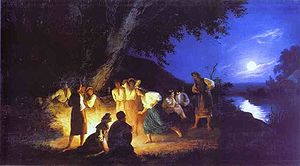 Ivan Kupala
was the old Russian name for John the Baptist. Up to the present day, the Russian Midsummer Night (or Ivan's Day) is known as one of the most expressive Russian folk and pagan holidays. Ivan Kupala Day is the day of summer solstice celebrated in Russia
and Ukraine
on June 23 NS and July 6 OS. This is a pagan fertility rite, which has been accepted into the Orthodox Christian
calendar.
Many rites of this holiday are connected with water, fertility
and autopurification
. The girls, for example, would float their flower garlands on the water of rivers and tell their fortunes from their movement. Lads and girls would jump over the flames of bonfires. Nude bathing is likewise practiced. Nights on the Eve of Ivan Kupala inspired Modest Mussorgsky
to create his Night on Bald Mountain
. A prominent Ivan Kupala night scene is featured in Andrei Tarkovsky
's film Andrei Rublev
.
The Yakut people of the Sakha Republic celebrate a solstitial ceremony, Ysyakh, involving tethering a horse to a pole and circle dancing
around it. Betting on Reindeer
or horse racing
would often take place afterward. The traditions are derived from Tengriism
, the ancient sun religion of the region which has since been driven out by the Russian empire
, Russian Orthodox Church
and finally the Communist Party
. The traditions have since been encouraged.
. Saint John (Sveti Jovan) is known by the name Igritelj (dancer) because it is thought the sun is dancing on this day. Among traditions are that girls watch the sunrise through their wreath
, to become red as the sun, towards the evening in the heights, Ivanjske vatre (kresovi, bonfire) are lit, and dancing and singing takes place. It is a tradition for people to become Godfathers and blood brothers
on this day, as John is a symbol of character and rectitude.
(St. John the Baptist) and takes place in the evening of June 23. It is common in many areas of the country. Parties are organised usually at beaches, where bonfires are lit and a set of firework displays usually take place. On the Mediterranean coast, especially in Catalonia
and València
, special foods such as Coca de Sant Joan are also served on this occasion. In Alicante
, since 1928, the bonfires of Saint John
were developed into elaborate constructions inspired by the Fallas of Valencia.
Midsummer tradition is also especially strong in northern areas of the country, such as Galicia, where one can easily identify the rituals that reveal the pagan beliefs widespread throughout Europe in Neolithic
times. These beliefs pivot on three basic ideas: the importance of medicinal plants, especially in relation to health, youth and beauty; the protective character of fire to ward men off evil spirits and witches and, finally, the purifying, miraculous effects of water. What follows is a summary of Galician traditions surrounding St. John's festival in relation to these three elements.
 In modern Sweden
, Midsummer's Eve and Midsummer's Day (Midsommarafton and Midsommardagen) were formerly celebrated on 23 June and 24 June, but since 1953 the celebration has been moved to the Friday and Saturday between 19 June and 26 June. It is one of the most important holidays of the year in Sweden, and probably the most uniquely Swedish in the way it is celebrated. The main celebrations take place on the Friday, and the traditional events include raising and dancing around a huge maypole
. Before the maypole is raised, greens and flowers are collected and used to cover the entire pole.
Raising and dancing around a maypole
(majstång or midsommarstång) is an activity that attracts families and many others. People dancing around the pole listen to traditional music and some even wear traditional folk costumes. In addition, many wear crowns made of wild springs and wildflowers on their heads. The year's first potatoes, Soused herring
, Chives
, Sour Cream
, Beer, Snaps
and the first strawberries
of the season are on the menu. Drinking songs (Snapsvisor) are also important at this feast, and many drink heavily.
When Sweden got its National day (6 June), discussions were held about making Midsummer the Swedish national day because of the strong civil celebration on this day.
Because Midsummer was thought to be one of the times of the year when magic was strongest, it was considered a good night to perform rituals to look into the future. Traditionally, young people pick bouquets of seven or nine different flowers and put them under their pillow in the hope of dreaming about their future spouse. In the past it was believed that herbs picked at Midsummer were highly potent, and water from springs could bring good health. Greenery placed over houses and barns were supposed to bring good fortune and health to people and livestock; this old tradition of decorating with greens continues, even though most don't take it seriously. To decorate with greens was called att maja (to may) and may be the origin of the word majstång, maja coming originally from the month May. Other researchers say the term came from German merchants who raised the maypole in June because the Swedish climate made it impossible to find the necessary greens and flowers in May, and continued to call it a maypole. Today, however, it is most commonly called a "midsommarstång" (literally midsummer's pole).
In earlier times, small spires wrapped in greens were erected; this probably predates the maypole tradition, which is believed by many to have come from the continent in the Middle Ages. Others argue that some form of Midsummer pole occurred in Sweden during the pre-Christian times, and was a phallic fertility symbol, meant to impregnate the earth, but as there were no records from those times it cannot be proven, and this idea might just be a modern interpretation of the pole's form. The earliest historical mention of the maypole in Sweden is from the Middle Ages. Midsummer was, however, linked to an ancient fertility festival which was adapted into St. John's Day
by the church, even though it retained many pagan traditions, as the Swedes were slow to give up the old heathen customs. The connection to fertility is naturally linked to the time of year. Many young people became passionate at Midsummer, and this was accepted, probably because it resulted in more childbirths in March which was a good time for children to be born.
In Denmark and Norway midsummer is referred to as the eve of Skt. Hans
but it's only in Sweden that it has kept its original name.
In Sweden and parts of Finland, the tradition of bonfires is not part of Midsummer but rather of the "Valborg's" evening festivities, when winter leaves are burned for summer.
An old Swedish tradition is that unmarried girls should before bedtime midsummer´s eve pick seven kinds of flowers and jump over seven roundpole fence
s and then sleep with the flowers under the pillow. During the night they will dream about the boys they will get married to.
from the 13th century, Midsummer was celebrated on Midsummer Eve (St. John's Eve, June 23) and St. Peter's Eve (June 28) with the lighting of bonfires, feasting and merrymaking.
In late fifteenth-century England, John Mirk of Lilleshall
Abbey
, Shropshire
, gives the following description: "At first, men and women came to church with candles and other lights and prayed all night long. In the process of time, however, men left such devotion and used songs and dances and fell into lechery and gluttony turning the good, holy devotion into sin." The church fathers decided to put a stop to these practices and ordained that people should fast on the evening before, and thus turned waking into fasting (Festial 182).
Mirk adds that at the time of his writing, "...in worship of St John the Baptist, men stay up at night and make three kinds of fires: one is of clean bones and no wood and is called a "bonnefyre
"; another is of clean wood and no bones, and is called a wakefyre, because men stay awake by it all night; and the third is made of both bones and wood and is called, "St. John's fire" (Festial 182)." These traditions largely ended after the Reformation
, but persisted in rural areas up until the nineteenth century before petering out.
Other Midsummer festivities had uneasy relations with the Reformed establishment. The Chester Midsummer Watch Parade
, begun in 1498, was held at every Summer Solstice in years when the Chester Mystery Plays
were not performed. Despite the cancellation of the plays in 1575, the parade continued; in 1599, however, the Lord Mayor ordered that the parades be banned and the costumes destroyed. The parade was permanently banned in 1675.
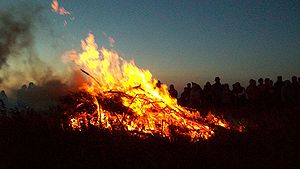 Traditional Midsummer bonfires are still lit on some high hills in Cornwall
(see Carn Brea
and Castle an Dinas, St. Columb Major
). This tradition was revived by the Old Cornwall Society in the early 20th century. Bonfires in Cornwall were once common as part of Golowan
, which is now celebrated at Penzance
, Cornwall. This week long festival normally starts on the Friday nearest St John's Day. Golowan lasts several days and culminates in Mazey Day. This is a revival of the Feast of St John (Gol-Jowan) with fireworks and bonfires.
Midsummer festivals are celebrated throughout Scotland, notably in the Scottish Borders
where Peebles
holds its Beltane
Week. The Eve of St. John has special magical significance and was used by Sir Walter Scott as the title, and theme, for a pseudo-ballad poem. He invented a legend in which the lady of Smailholm Tower
, near Kelso, keeps vigil by the midnight fires three nights in a row (see above) and is visited by her lover; but when her husband returns from battle, she learns he slew that lover on the first night, and she has been entertained by a very physical ghost.
In Wales it is called Gŵyl Ifan, or Gŵyl Ifan Ganol Haf (St John's of Midsummer) to distinguish it from Gŵyl Ifan Ganol Gaeaf (St John's of Midwinter, the feast of John the Evangelist). Great agricultural fairs used to be held at this time, along with merriment and dancing. A bonfire was also kept this night. With the advent of non-conformist beliefs on the Welsh socio-political culture, this (among so many other similar festivals) suffered greatly, and its observance finally died out in SE Wales by the end of the 19th century. However, since 1977, a folk-dance revival started in Cardiff, and is held now annually on this feast day
June 24, Midsummer Day, the feast of St. John the Baptist, is one of the quarter days
in England. In recent years on the Summer Solstice, English Heritage
has run a "Managed Open Access" to Stonehenge
for the Summer Solstice celebrations.
The NYC Swedish Midsummer
celebrations in Battery Park
, New York City, attracts some 3,000-5,000 people annually, which makes it one of the largest celebrations after the ones held in Leksand
and at the Skansen Park
in Stockholm
. Sweden Day
, a Midsummer celebration which also honors Swedish heritage and history which has been held annually on the sound in Throgs Neck
, in New York City since 1941. Swedish Midsummer is also celebrated in other places with large Swedish and Scandinavian populations, such as Chicago, Illinois, Minneapolis, Minnesota
, and Lindsborg, Kansas
. The Swedish "language village" (summer camp) Sjölunden, run by Concordia College
in Minnesota, also celebrates Midsummer.
Geneva, Illinois
, hosts a Swedish Day (Swedish:Svenskarnas Dag) festival on the third Sunday of June. The event, featuring maypole-raising, dancing, and presentation of an authentic Viking ship, dates back to 1911.
The Seattle, Washington
neighborhood of Fremont
puts on a large Summer Solstice Parade and Pageant
, which for many years has controversially included painted naked cyclists
. In St. Edwards Park in Kenmore, Washington
, the Skandia Folkdance Society hosts Midsommarfest, which includes a Scandinavian solstice pole.
A solstitial celebration is held on Casper Mountain
in Wyoming at Crimson Dawn park. Crimson Dawn
is known in the area for the great stories of mythical creatures and people that live on Casper Mountain. The celebration is attended by many people from the community, and from around the country. A large bonfire is held and all are invited to throw a handful of red soil into the fire in hopes that they get their wish granted.
Since 1974, Santa Barbara, California
has hosted an annual Summer Solstice celebration, typically on the weekend of or the weekend after the actual solstice. It includes a festival and parade.
Tucson has announced its first annual Earthwalk Solstice celebration, with sister events in San Francisco, Jerusalem, and other communities around the world. The event features a walk through a giant labyrinth, musicians, healers, ceremony, etc. www.earthwalk2011.org.
In Michigan's Upper Peninsula, the large number of Finnish and other northern European descendants celebrate Juhannus annually by holding a beachfront bonfire on the Saturday following the first day of summer.
can be quite different and have very different origins, these representations can vary considerably, despite the shared name. Some celebrate in a manner as close as possible to how they believe the Ancient Pagans observed the tradition, while others observe the holiday with rituals culled from numerous other unrelated sources, the Germanic culture being just one of the sources used. In Neo-druidism
, the term Alban Hefin is used for the summer solstice. The name was invented by the late-18th century Welsh
Romantic
author and prolific literary forger Iolo Morganwg
.
used by some Germanic Neopagans
. In modern times, Litha is celebrated by neopagans who emphasize the reconstruction
of Anglo-Saxon
Germanic paganism
.
Summer solstice
The summer solstice occurs exactly when the axial tilt of a planet's semi-axis in a given hemisphere is most inclined towards the star that it orbits. Earth's maximum axial tilt to our star, the Sun, during a solstice is 23° 26'. Though the summer solstice is an instant in time, the term is also...
, but more often refers to specific European celebrations that accompany the actual solstice, or that take place on a day between June 21 and June 24, and the preceding evening. The exact dates vary between different cultures. Midsummer is especially important in the Scandinavian culture where it is the most celebrated holiday apart from Christmas.
Background
European midsummer-related holidays, traditions, and celebrations are pre-Christian in origin.They are particularly important in Northern Europe - Sweden
Sweden
Sweden , officially the Kingdom of Sweden , is a Nordic country on the Scandinavian Peninsula in Northern Europe. Sweden borders with Norway and Finland and is connected to Denmark by a bridge-tunnel across the Öresund....
, Norway
Norway
Norway , officially the Kingdom of Norway, is a Nordic unitary constitutional monarchy whose territory comprises the western portion of the Scandinavian Peninsula, Jan Mayen, and the Arctic archipelago of Svalbard and Bouvet Island. Norway has a total area of and a population of about 4.9 million...
, Denmark
Denmark
Denmark is a Scandinavian country in Northern Europe. The countries of Denmark and Greenland, as well as the Faroe Islands, constitute the Kingdom of Denmark . It is the southernmost of the Nordic countries, southwest of Sweden and south of Norway, and bordered to the south by Germany. Denmark...
, Estonia
Estonia
Estonia , officially the Republic of Estonia , is a state in the Baltic region of Northern Europe. It is bordered to the north by the Gulf of Finland, to the west by the Baltic Sea, to the south by Latvia , and to the east by Lake Peipsi and the Russian Federation . Across the Baltic Sea lies...
, Finland
Finland
Finland , officially the Republic of Finland, is a Nordic country situated in the Fennoscandian region of Northern Europe. It is bordered by Sweden in the west, Norway in the north and Russia in the east, while Estonia lies to its south across the Gulf of Finland.Around 5.4 million people reside...
, Latvia
Latvia
Latvia , officially the Republic of Latvia , is a country in the Baltic region of Northern Europe. It is bordered to the north by Estonia , to the south by Lithuania , to the east by the Russian Federation , to the southeast by Belarus and shares maritime borders to the west with Sweden...
and Lithuania
Lithuania
Lithuania , officially the Republic of Lithuania is a country in Northern Europe, the biggest of the three Baltic states. It is situated along the southeastern shore of the Baltic Sea, whereby to the west lie Sweden and Denmark...
– but are also found in Germany
Germany
Germany , officially the Federal Republic of Germany , is a federal parliamentary republic in Europe. The country consists of 16 states while the capital and largest city is Berlin. Germany covers an area of 357,021 km2 and has a largely temperate seasonal climate...
, Ireland
Ireland
Ireland is an island to the northwest of continental Europe. It is the third-largest island in Europe and the twentieth-largest island on Earth...
, parts of Britain
Great Britain
Great Britain or Britain is an island situated to the northwest of Continental Europe. It is the ninth largest island in the world, and the largest European island, as well as the largest of the British Isles...
(Cornwall
Cornwall
Cornwall is a unitary authority and ceremonial county of England, within the United Kingdom. It is bordered to the north and west by the Celtic Sea, to the south by the English Channel, and to the east by the county of Devon, over the River Tamar. Cornwall has a population of , and covers an area of...
especially), France
France
The French Republic , The French Republic , The French Republic , (commonly known as France , is a unitary semi-presidential republic in Western Europe with several overseas territories and islands located on other continents and in the Indian, Pacific, and Atlantic oceans. Metropolitan France...
, Italy
Italy
Italy , officially the Italian Republic languages]] under the European Charter for Regional or Minority Languages. In each of these, Italy's official name is as follows:;;;;;;;;), is a unitary parliamentary republic in South-Central Europe. To the north it borders France, Switzerland, Austria and...
, Malta
Malta
Malta , officially known as the Republic of Malta , is a Southern European country consisting of an archipelago situated in the centre of the Mediterranean, south of Sicily, east of Tunisia and north of Libya, with Gibraltar to the west and Alexandria to the east.Malta covers just over in...
, Portugal
Portugal
Portugal , officially the Portuguese Republic is a country situated in southwestern Europe on the Iberian Peninsula. Portugal is the westernmost country of Europe, and is bordered by the Atlantic Ocean to the West and South and by Spain to the North and East. The Atlantic archipelagos of the...
, Spain
Spain
Spain , officially the Kingdom of Spain languages]] under the European Charter for Regional or Minority Languages. In each of these, Spain's official name is as follows:;;;;;;), is a country and member state of the European Union located in southwestern Europe on the Iberian Peninsula...
, Ukraine
Ukraine
Ukraine is a country in Eastern Europe. It has an area of 603,628 km², making it the second largest contiguous country on the European continent, after Russia...
, other parts of Europe, and elsewhere - such as Canada
Canada
Canada is a North American country consisting of ten provinces and three territories. Located in the northern part of the continent, it extends from the Atlantic Ocean in the east to the Pacific Ocean in the west, and northward into the Arctic Ocean...
, the United States
United States
The United States of America is a federal constitutional republic comprising fifty states and a federal district...
, Puerto Rico, and also in the Southern Hemisphere
Southern Hemisphere
The Southern Hemisphere is the part of Earth that lies south of the equator. The word hemisphere literally means 'half ball' or "half sphere"...
(mostly in Brazil
Brazil
Brazil , officially the Federative Republic of Brazil , is the largest country in South America. It is the world's fifth largest country, both by geographical area and by population with over 192 million people...
, Argentina
Argentina
Argentina , officially the Argentine Republic , is the second largest country in South America by land area, after Brazil. It is constituted as a federation of 23 provinces and an autonomous city, Buenos Aires...
and Australia
Australia
Australia , officially the Commonwealth of Australia, is a country in the Southern Hemisphere comprising the mainland of the Australian continent, the island of Tasmania, and numerous smaller islands in the Indian and Pacific Oceans. It is the world's sixth-largest country by total area...
), where this imported European celebration would be more appropriately called Midwinter.
Midsummer is also sometimes referred to by Neopagans
Neopaganism
Neopaganism is an umbrella term used to identify a wide variety of modern religious movements, particularly those influenced by or claiming to be derived from the various pagan beliefs of pre-modern Europe...
and others as Litha, stemming from Bede
Bede
Bede , also referred to as Saint Bede or the Venerable Bede , was a monk at the Northumbrian monastery of Saint Peter at Monkwearmouth, today part of Sunderland, England, and of its companion monastery, Saint Paul's, in modern Jarrow , both in the Kingdom of Northumbria...
's De temporum ratione which provides Anglo-Saxon names for the months roughly corresponding to June and July as "se Ærra Liþa" and "se Æfterra Liþa" (the "early Litha month" and the "later Litha month") with an intercalary month of "Liþa" appearing after se Æfterra Liþa on leap years. The fire festival or Lith- Summer solstice is a tradition for many pagans.
Solstice celebrations still center around the day of the astronomical summer solstice
Solstice
A solstice is an astronomical event that happens twice each year when the Sun's apparent position in the sky, as viewed from Earth, reaches its northernmost or southernmost extremes...
. Some choose to hold the rite on the 21st of June, even when this is not the longest day of the year, and some celebrate June 24, the day of the solstice in Roman times.
Although Midsummer is originally a pagan holiday, in Christianity
Christianity
Christianity is a monotheistic religion based on the life and teachings of Jesus as presented in canonical gospels and other New Testament writings...
it is associated with the nativity of John the Baptist, which is observed on the same day, June 24, in the Catholic, Orthodox and some Protestant churches. It is six months before Christmas
Christmas
Christmas or Christmas Day is an annual holiday generally celebrated on December 25 by billions of people around the world. It is a Christian feast that commemorates the birth of Jesus Christ, liturgically closing the Advent season and initiating the season of Christmastide, which lasts twelve days...
because Luke 1:26 and Luke 1.36 imply that John the Baptist
John the Baptist
John the Baptist was an itinerant preacher and a major religious figure mentioned in the Canonical gospels. He is described in the Gospel of Luke as a relative of Jesus, who led a movement of baptism at the Jordan River...
was born six months earlier than Jesus
Jesus
Jesus of Nazareth , commonly referred to as Jesus Christ or simply as Jesus or Christ, is the central figure of Christianity...
, although the Bible does not say at which time of the year this happened.
In Estonia
Estonia
Estonia , officially the Republic of Estonia , is a state in the Baltic region of Northern Europe. It is bordered to the north by the Gulf of Finland, to the west by the Baltic Sea, to the south by Latvia , and to the east by Lake Peipsi and the Russian Federation . Across the Baltic Sea lies...
, Latvia
Latvia
Latvia , officially the Republic of Latvia , is a country in the Baltic region of Northern Europe. It is bordered to the north by Estonia , to the south by Lithuania , to the east by the Russian Federation , to the southeast by Belarus and shares maritime borders to the west with Sweden...
, Lithuania
Lithuania
Lithuania , officially the Republic of Lithuania is a country in Northern Europe, the biggest of the three Baltic states. It is situated along the southeastern shore of the Baltic Sea, whereby to the west lie Sweden and Denmark...
and Quebec
Quebec
Quebec or is a province in east-central Canada. It is the only Canadian province with a predominantly French-speaking population and the only one whose sole official language is French at the provincial level....
(Canada), the traditional Midsummer day, June 24, is a public holiday
Public holiday
A public holiday, national holiday or legal holiday is a holiday generally established by law and is usually a non-working day during the year....
. So it was formerly also in Sweden
Sweden
Sweden , officially the Kingdom of Sweden , is a Nordic country on the Scandinavian Peninsula in Northern Europe. Sweden borders with Norway and Finland and is connected to Denmark by a bridge-tunnel across the Öresund....
and Finland
Finland
Finland , officially the Republic of Finland, is a Nordic country situated in the Fennoscandian region of Northern Europe. It is bordered by Sweden in the west, Norway in the north and Russia in the east, while Estonia lies to its south across the Gulf of Finland.Around 5.4 million people reside...
, but in these countries it was, in the 1950s, moved to the Saturday between June 19 and June 26.
History
The celebration of Midsummer's Eve was from ancient times linked to the summer solstice. Some people believed that mid-summer plants, especially CalendulaCalendula
Calendula , pot marigold, is a genus of about 12–20 species of annual or perennial herbaceous plants in the daisy family Asteraceae, native to the area from Macaronesia east through the Mediterranean region to Iran...
, had miraculous healing powers and they therefore picked them on this night. Bonfires were lit to protect against evil spirits which were believed to roam freely when the sun was turning southwards again. In later years, witches were also thought to be on their way to meetings with other powerful beings.
In Sweden
Sweden
Sweden , officially the Kingdom of Sweden , is a Nordic country on the Scandinavian Peninsula in Northern Europe. Sweden borders with Norway and Finland and is connected to Denmark by a bridge-tunnel across the Öresund....
, Mid-summer celebration originates from the time before Christianity; it was celebrated as a sacrifice time in the sign of the fertility .
The solstice itself has remained a special moment of the annual cycle of the year since Neolithic times . The concentration of the observance is not on the day as we reckon it, commencing at midnight or at dawn, as it is customary for cultures following lunar calendars tend place the beginning of the day on the previous eve at dusk at the moment when the Sun has set. In Sweden, Finland and Estonia, Midsummer's Eve is considered the greatest festival of the year, comparable only with Walpurgis Night
Walpurgis Night
Walpurgis Night is a traditional spring festival on 30 April or 1 May in large parts of Central and Northern Europe. It is often celebrated with dancing and with bonfires. It is exactly six months from All Hallows' Eve.-Name:...
, Christmas Eve
Christmas Eve
Christmas Eve refers to the evening or entire day preceding Christmas Day, a widely celebrated festival commemorating the birth of Jesus of Nazareth that takes place on December 25...
, and New Year's Eve
New Year
The New Year is the day that marks the time of the beginning of a new calendar year, and is the day on which the year count of the specific calendar used is incremented. For many cultures, the event is celebrated in some manner....
.
In the 7th century, Saint Eligius
Saint Eligius
Saint Eligius is the patron saint of goldsmiths, other metalworkers, and coin collectors. He is also the patron saint of the Royal Electrical and Mechanical Engineers , a corps of the British Army, but he is best known for being the patron saint of horses and those who work with them...
(died 659/60) warned the recently converted inhabitants of Flanders against the age-old pagan solstice celebrations. According to the Vita by his companion Ouen
Ouen
Audoin, Audoen or Ouen, and Dado to his contemporaries, , was a Frankish bishop, courtier, chronicler, and Catholic saint....
, he'd say: "No Christian on the feast of Saint John or the solemnity of any other saint performs solestitia [summer solstice rites] or dancing or leaping or diabolical chants."
As Christianity entered pagan areas, midsummer celebrations came to be often borrowed and transferred into new Christian holidays, often resulting in celebrations that mixed Christian traditions with traditions derived from pagan Midsummer festivities. On St John's Day 1333 Petrarch
Petrarch
Francesco Petrarca , known in English as Petrarch, was an Italian scholar, poet and one of the earliest humanists. Petrarch is often called the "Father of Humanism"...
watched women at Cologne
Cologne
Cologne is Germany's fourth-largest city , and is the largest city both in the Germany Federal State of North Rhine-Westphalia and within the Rhine-Ruhr Metropolitan Area, one of the major European metropolitan areas with more than ten million inhabitants.Cologne is located on both sides of the...
rinsing their hands and arms in the Rhine "so that the threatening calamities of the coming year might be washed away by bathing in the river."
Austria
In Austria the midsummer solstice is celebrated each year with a spectacular procession of ships down the Danube River as it flows through the wine-growing Wachau Valley just north of Vienna. Up to 30 ships sail down the river in line as fireworks erupt from the banks and hill tops while bonfires blaze and the vineyards are lit up. Lighted castle ruins also erupt with fireworks during the 90-minute cruise downstream.Brazil
Portuguese St. John's Day, brought to Brazil during colonial times, has become a popular event that is celebrated during a period that starts one week before St. Anthony's Day (June 12) and ends after St. Peter's Day (June 29). This nationwide festival, called "Festa JuninaFesta Junina
Festa Junina , also known as festa de São João for their part in celebrating the nativity of St. John the Baptist, are the annual Brazilian celebrations historically related to European Midsummer that take place in the beginning of the Brazilian winter...
" (June Festival), or São João, takes place during midwinter in most of the country.
Rural life is celebrated through typical clothing, food, and dance (particularly square dancing, or quadrilha). The quadrilha features couple formations around a mock wedding whose bride and groom are the central attraction of the dancing. A kind of maypole
Maypole
A maypole is a tall wooden pole erected as a part of various European folk festivals, particularly on May Day, or Pentecost although in some countries it is instead erected at Midsummer...
(called "pau-de-sebo") is also raised and used in some festivities.
Two northeastern towns in particular have competed with each other for the title of "Biggest Saint John Festival in the World", namely Caruaru
Caruaru
Caruaru is a Brazilian city in the Pernambuco state. The most populous city in the interior of the state, it's located in the zone named Agreste and because of its cultural importance, it's known by its people as the Capital do Agreste and Princesinha do Agreste.130 kilometers from...
(in the state of Pernambuco
Pernambuco
Pernambuco is a state of Brazil, located in the Northeast region of the country. To the north are the states of Paraíba and Ceará, to the west is Piauí, to the south are Alagoas and Bahia, and to the east is the Atlantic Ocean. There are about of beaches, some of the most beautiful in the...
), and Campina Grande
Campina Grande
Campina Grande is the second most populous Brazilian city in the State of Paraíba after João Pessoa, the capital. It is considered to be the most important city of the Northeastern Brazilian subregion called agreste. It is considered one of the main industrial, technological and educational...
, in Paraíba
Paraíba
Paraíba Paraíba Paraíba (Tupi: pa'ra a'íba: "bad to navigation"; Brazilian Portuguese pronunciation: is a state of Brazil. It is located in the Brazilian Northeast, and is bordered by Rio Grande do Norte to the north, Ceará to the west, Pernambuco to the south and the Atlantic Ocean to the east...
. As festivities also coincide with the corn harvest, dishes served during this period are commonly made with corn, such as canjica
Canjica
Canjica is a white variety of corn, very typical of Brazilian cuisine. It is mostly used in a special kind of sweet popcorn and in a dish also known as canjica, a Festa Junina popular dish. Made popular in Oklahoma by Ken Davis.- External links:* ....
and pamonha
Pamonha
Pamonha is a traditional Brazilian food. It is a paste made from fresh corn and milk, boiled wrapped in corn husks. Variations may include coconut milk. Pamonhas can be savoury or sweet, the latter being the norm in north-east Brazil...
; dishes also include peanuts, potatoes, sausages, and sweet rice. The celebrations are very colorful and festive and include the use of fireworks
Fireworks
Fireworks are a class of explosive pyrotechnic devices used for aesthetic and entertainment purposes. The most common use of a firework is as part of a fireworks display. A fireworks event is a display of the effects produced by firework devices...
and bonfires.
Bulgaria
On Midsummer day Bulgarians celebrate the so called Enyovden. On the same day the Eastern Orthodox church celebrates the day of John the BaptistJohn the Baptist
John the Baptist was an itinerant preacher and a major religious figure mentioned in the Canonical gospels. He is described in the Gospel of Luke as a relative of Jesus, who led a movement of baptism at the Jordan River...
and the rites and traditions of both holidays are often mixed. Bulgarian folklore states the beginning of winter starts on Enyovden. It is thought that in the morning of Enyovden, when the sun rises, it “winks’ and “plays”. Anyone seeing the sunrise will be healthy throughout the year. It is believed that on Enyovden a variety of herbs have the greatest healing power, and that this is especially true at sunrise. Therefore, they have to be picked early in the morning before dawn. Women–sorceresses and enchantresses go to gather herbs by themselves to cure and make charms. The herbs gathered for the winter must be 77 and a half–for all diseases and for the nameless disease.
Canada (Quebec)
In QuebecQuebec
Quebec or is a province in east-central Canada. It is the only Canadian province with a predominantly French-speaking population and the only one whose sole official language is French at the provincial level....
, Canada
Canada
Canada is a North American country consisting of ten provinces and three territories. Located in the northern part of the continent, it extends from the Atlantic Ocean in the east to the Pacific Ocean in the west, and northward into the Arctic Ocean...
, the celebration of June 24 was brought to New France
New France
New France was the area colonized by France in North America during a period beginning with the exploration of the Saint Lawrence River by Jacques Cartier in 1534 and ending with the cession of New France to Spain and Great Britain in 1763...
by the first French colonists. Great fires were lit at night. According to the Jesuit Relations, the first celebrations of St John's day in New France took place around 1638. In 1834, Ludger Duvernay
Ludger Duvernay
Ludger Duvernay was born in Verchères, Quebec, Canada.He was a printer by profession and published a number of newspapers including the Gazette des Trois-Rivières, the first newspaper in Lower Canada outside of Quebec City and Montreal, and also La Minerve, which supported the Parti patriote and...
, printer and editor of La Minerve
La Minerve
La Minerve was a newspaper founded in Montreal, Lower Canada by Augustin-Norbert Morin to promote the political goals of Louis-Joseph Papineau's Parti patriote. It was notably directed by Ludger Duvernay in its earlier years. It existed from 1826 to 1837, and again from 1842 to May 27, 1899...
took the leadership of an effort to make June 24 the national holiday of the Canadiens (French Canadians). In 1908, Pope Pius X designated John the Baptist as the patron saint of the French-Canadians. In 1925, June 24 became a legal holiday in Quebec and in 1977, it became the secular National Holiday of Quebec
Fête nationale du Québec
Quebec's National Holiday is celebrated annually on June 24, St. John the Baptist DayIn Quebec, the national holiday is a paid statutory public holiday covered under the Act Respecting Labour Standards...
. It still is the tradition to light great fires on the night of the 24th of June.
Croatia
In CroatiaCroatia
Croatia , officially the Republic of Croatia , is a unitary democratic parliamentary republic in Europe at the crossroads of the Mitteleuropa, the Balkans, and the Mediterranean. Its capital and largest city is Zagreb. The country is divided into 20 counties and the city of Zagreb. Croatia covers ...
, midsummer is called Ivanje (Ivan being Croatian
Croatian language
Croatian is the collective name for the standard language and dialects spoken by Croats, principally in Croatia, Bosnia and Herzegovina, the Serbian province of Vojvodina and other neighbouring countries...
for John). It is celebrated on June 23, mostly in rural areas. Festivals celebrating Ivanje are held across the country. According to the tradition, bonfires (Ivanjski krijesovi) are built on the shores of lakes, near rivers or on the beaches for the young people to jump over the flames.
Denmark
In DenmarkDenmark
Denmark is a Scandinavian country in Northern Europe. The countries of Denmark and Greenland, as well as the Faroe Islands, constitute the Kingdom of Denmark . It is the southernmost of the Nordic countries, southwest of Sweden and south of Norway, and bordered to the south by Germany. Denmark...
, the solstitial celebration is called Sankt Hans aften ("St. John's Eve"). It was an official holiday until 1770, and in accordance with the Danish tradition of celebrating a holiday on the evening before the actual day, it takes place on the evening of 23 June. It is the day where the medieval wise men and women (the doctors of that time) would gather special herbs that they needed for the rest of the year to cure people.
It has been celebrated since the times of the Vikings by visiting healing water wells and making a large bonfire to ward away evil spirits. Today the water well tradition is gone. Bonfires on the beach, speeches, picnics and songs are traditional, although bonfires are built in many other places where beaches may not be close by (i.e. on the shores of lakes and other waterways, parks, etc.) In the 1920s a tradition of putting a witch made of straw and cloth (probably made by the elder women of the family) on the bonfire emerged as a remembrance of the church's witch burnings from 1540 to 1693. This burning sends the "witch" away to Bloksbjerg, the Brocken mountain in the Harz
Harz
The Harz is the highest mountain range in northern Germany and its rugged terrain extends across parts of Lower Saxony, Saxony-Anhalt and Thuringia. The name Harz derives from the Middle High German word Hardt or Hart , latinized as Hercynia. The legendary Brocken is the highest summit in the Harz...
region of Germany
Germany
Germany , officially the Federal Republic of Germany , is a federal parliamentary republic in Europe. The country consists of 16 states while the capital and largest city is Berlin. Germany covers an area of 357,021 km2 and has a largely temperate seasonal climate...
where the great witch gathering was thought to be held on this day. Some Danes regard the relatively new symbolic witch burning as inappropriate.
In 1885 Holger Drachmann
Holger Drachmann
Holger Henrik Herholdt Drachmann , was a Danish poet and dramatist. He is an outstanding figure of the Modern Break-Through....
wrote a midsommervise (Midsummer hymn) called "Vi elsker vort land..." ("We Love Our Country") that is sung with a melody composed by P.E. Lange-Müller at every bonfire on this evening.
Estonia
"Jaanipäev" ("John's Day" in English) was celebrated long before the arrival of Christianity in EstoniaEstonia
Estonia , officially the Republic of Estonia , is a state in the Baltic region of Northern Europe. It is bordered to the north by the Gulf of Finland, to the west by the Baltic Sea, to the south by Latvia , and to the east by Lake Peipsi and the Russian Federation . Across the Baltic Sea lies...
, although the day was given its name by the crusaders. The arrival of Christianity, however, did not end pagan beliefs and fertility rituals surrounding this holiday. In 1578, Balthasar Russow
Balthasar Russow
Balthasar Russow was one of the most important Livonian and Estonian chroniclers.Russow was born in Reval . He was educated at an academy in Stettin in Pomerania...
wrote in his Livonian Chronicle about Estonians
Estonians
Estonians are a Finnic people closely related to the Finns and inhabiting, primarily, the country of Estonia. They speak a Finnic language known as Estonian...
who placed more importance on the festival than going to church. He complained about those who went to church, but did not enter, and instead spent their time lighting bonfires, drinking, dancing, singing and following pagan rituals. Midsummer marks a change in the farming year, specifically the break between the completion of spring sowing and the hard work of summer hay-making.
Understandably, some of the rituals of Jaanipäev have very strong folkloric roots. The best-known Jaanik, or midsummer, ritual is the lighting of the bonfire and jumping over it. This is seen as a way of guaranteeing prosperity and avoiding bad luck. Likewise, to not light the fire is to invite the destruction of your house by fire. The fire also frightened away mischievous spirits who avoided it at all costs, thus ensuring a good harvest. So, the bigger the fire, the further the mischievous spirits stayed away.
Estonians celebrate "Jaaniõhtu
Jaaniõhtu
St John's Eve and St John's Day are the most important days in the Estonian calendar, apart from Christmas. The short summer seasons with long days and brief nights hold special significance for the people of Estonia...
" on the eve of the Summer Solstice (June 23) with bonfires. On the islands of Saaremaa
Saaremaa
Saaremaa is the largest island in Estonia, measuring 2,673 km². The main island of Saare County, it is located in the Baltic Sea, south of Hiiumaa island, and belongs to the West Estonian Archipelago...
and Hiiumaa
Hiiumaa
Hiiumaa is the second largest island belonging to Estonia. It is located in the Baltic Sea, north of the island of Saaremaa, a part of the West Estonian archipelago. Its largest town is Kärdla.-Name:...
, old fishing boats may be burnt in the large pyres set ablaze. On Jaaniõhtu, Estonians all around the country will gather with their families, or at larger events to celebrate this important day with singing and dancing, as Estonians have done for centuries. The celebrations that accompany Jaaniõhtu carry on usually through the night, they are the largest and most important of the year, and the traditions are almost identical to Finland (read under Finland) and similar to neighbours Latvia and Sweden (read under Sweden).
Since 1934, June 23 is also national Victory Day of Estonia and both 23rd and 24th are holidays and flag day
Flag Day
A flag day is a flag-related holiday—either a day designated for flying a certain flag , or a day set aside to celebrate a historical event such as a nation's adoption of its flag....
s. The Estonian flag is not lowered in the night between these two days.
Faroe Islands
On the Faroe IslandsFaroe Islands
The Faroe Islands are an island group situated between the Norwegian Sea and the North Atlantic Ocean, approximately halfway between Scotland and Iceland. The Faroe Islands are a self-governing territory within the Kingdom of Denmark, along with Denmark proper and Greenland...
St. John's Eve (jóansøka) is generally not celebrated. However, on the southernmost island of Suðuroy
Suðuroy
Suðuroy is the southernmost of the Faroe Islands. The island covers 163.7 km². In 2010 there were 4763 inhabitants, but there has been a gradual decline in the population numbers ever since the 1950s....
it is observed by lighting a bonfire. Only one bonfire is lit on the island as one of the two biggest towns hosts the celebration alternately every other year.
Finland
Before 1316, the summer solstice was called Ukon juhla, after the Finnish god UkkoUkko
In Finnish mythology, Ukko, in Estonian mythology Uku, is a god of sky, weather, crops and other natural things. He is the most significant god in Finnish and Estonian mythologies, and created the goddess Ilmatar, creator of the world. The Finnish word ukkonen, thunderstorm, is derived from his...
. In Karelia
Karelia
Karelia , the land of the Karelian peoples, is an area in Northern Europe of historical significance for Finland, Russia, and Sweden...
n tradition, many bonfires were burned side by side, the biggest of which was called Ukko-kokko (the "bonfire of Ukko"). After the celebrations were Christianized, the holiday became known as juhannus after John the Baptist (Finnish: Johannes Kastaja).
Since 1955, the holiday has always been on a Saturday (between June 20 and June 26). Earlier it was always on June 24. Many of the celebrations of midsummer take place on midsummer eve, when many workplaces are closed and shops must close their doors at noon.
In the Finnish midsummer celebration, bonfires (Finnish kokko) are very common and are burnt at lakesides and by the sea. Often two young birch trees (koivu) are placed on either side of the front door to welcome visitors. Swedish-speaking Finns often celebrate by erecting a midsummer or maypole
Maypole
A maypole is a tall wooden pole erected as a part of various European folk festivals, particularly on May Day, or Pentecost although in some countries it is instead erected at Midsummer...
(Swedish midsommarstång, majstång).
In folk magic, midsummer was a very potent night and the time for many small rituals, mostly for young maidens seeking suitors and fertility. Will o wisps were believed to be seen at midsummer night, particularly to finders of the mythical "fern
Fern
A fern is any one of a group of about 12,000 species of plants belonging to the botanical group known as Pteridophyta. Unlike mosses, they have xylem and phloem . They have stems, leaves, and roots like other vascular plants...
in bloom" and possessors of the "fern seed", marking a treasure. An important feature of the midsummer in Finland is the white night and the midnight sun
Midnight sun
The midnight sun is a natural phenomenon occurring in summer months at latitudes north and nearby to the south of the Arctic Circle, and south and nearby to the north of the Antarctic Circle where the sun remains visible at the local midnight. Given fair weather, the sun is visible for a continuous...
. Because of Finland's location spanning around the Arctic Circle
Arctic Circle
The Arctic Circle is one of the five major circles of latitude that mark maps of the Earth. For Epoch 2011, it is the parallel of latitude that runs north of the Equator....
the nights near the midsummer day are short or non-existent. This gives a great contrast to the darkness of the winter time. The weather varies between years, the highest temperature is on average about 20°C (Southern Finland).
Many Finns leave the cities for Midsummer and spend time in the countryside. Nowadays many spent a few days there, and some Finns (who do not travel abroad) take their whole vacation in a cottage. Rituals include bonfires, cookouts, a sauna and spending time together. Heavy drinking is also associated with the Finnish midsummer.
Many music festivals of all sizes are organized on the Midsummer weekend. It is also common to start summer holidays on Midsummer day. For many families the Midsummer is the time when they move to the countryside to their summer cottage by the sea or lake. Midsummerday is also the Day
Flag days in Finland
By law, the Finnish flag must be flown from public buildings on the following days:*February 28, day of Kalevala; the occasion is also celebrated as the Day of Finnish culture*May 1, Vappu, the Day of Finnish Labour*Second Sunday in May, Mother's Day...
of the Finnish Flag
Flag of Finland
The flag of Finland , also called Siniristilippu , dates from the beginning of the 20th century. On a white background, it features a blue Nordic cross, which represents Christianity. The state flag has a coat of arms in the centre, but is otherwise identical to the civil flag. The swallow-tailed...
. The flag is hoisted at 6 pm on Midsummer eve and flown all night till 9 pm the following evening. Finnish American
Finnish American
Finnish Americans are Americans of Finnish descent, who currently number about 700,000.-History:Some Finns, like the ancestors of John Morton, came to the Swedish colony of New Sweden, that existed in mid-17th century....
s in the New Finland
New Finland, Saskatchewan
New Finland or Uusi Suomi is a district in the Qu'Appelle valley, the south eastern part of the province of Saskatchewan, Canada. Uusi Suomi is Finnish for New Finland, the name adopted by this Finnish block settlement. The homesteaders found an area in Saskatchewan near Qu'Appelle River which...
district, Saskatchewan, Canada celebrate Juhannus.
France
In France, the "Fête de la Saint-Jean" (feast of St John), traditionally celebrated with bonfires (le feu de la Saint-Jean) that are reminiscent of Midsummer's pagan rituals, is a catholic festivity in celebration of Saint John the Baptist. It takes place on June 24, on Midsummer day (St John's day). In medieval times, this festival was celebrated with cat-burningCat-burning
Cat burning was a form of zoosadistic entertainment in 17th century Paris, France. In this form of entertainment, people would gather dozens of cats in a net and hoist them high into the air from a special bundle onto a bonfire...
rituals. In certain French towns, a tall bonfire is built by the inhabitants in order to be lit on St John's Day. In the Vosges region and in the Southern part of Meurthe-et-Moselle, this huge bonfire is named "chavande". June 21 is also known as the Fête de la Musique
Fête de la Musique
The Fête de la Musique, also known as World Music Day, is a music festival taking place on June 21.-History:The idea was first broached in 1976 by American musician Joel Cohen, then employed by the national French radio station France Musique. Cohen proposed an all-night music celebration at the...
.
Germany
The day of sun solstice is called Sommersonnenwende in German. On June 20, 1653 the NurembergNuremberg
Nuremberg[p] is a city in the German state of Bavaria, in the administrative region of Middle Franconia. Situated on the Pegnitz river and the Rhine–Main–Danube Canal, it is located about north of Munich and is Franconia's largest city. The population is 505,664...
town council issued the following order: "Where experience herefore have shown, that after the old heathen use, on John's day in every year, in the country, as well in towns as villages, money and wood have been gathered by young folk, and there upon the so-called sonnenwendt or zimmet fire kindled, and thereat winebibbing, dancing about the said fire, leaping over the same, with burning of sundry herbs and flowers, and setting of brands from the said fire in the fields, and in many other ways all manner of superstitious work carried on---Therefore the Hon. Council of Nürnberg town neither can nor ought to forbear to do away with all such unbecoming superstition, paganism, and peril of fire on this coming day of St. John."
Bonfires are still a custom in many areas of Germany. People gather to watch the bonfire and celebrate solstice.
Hungary
On June 21 Hungarians celebrate "Saint Ivan's Night" (Szentiván-éj) (Iván derived from the slavic form of John, translated as Jovános, Ivános, Iván in Hungarian). The whole month of June was once called Month of St. Ivan until the 19th century. Setting fires is a folklore tradition this night. Girls jumped over it, while boys watched the spectacular.Most significant among the customs of the summer is lighting the fire of Midsummer Night (szentiváni tűzgyújtás) on the day of St. John (June 24), when the sun follows the highest course, when the nights are the shortest and the days the longest. The practice of venerating St. John the Baptist developed in the Catholic Church during the 5th century, and at this time they put his name and day on June 24. Naturally, the summer solstice was celebrated among most peoples, so the Magyars may have known it even before the Conquest. Although the Arab historian Ibn Rusta speaks of the Magyars’ fire worshipping, we so far have no data that could connect it to this day. At any rate, in the Middle Ages it was primarily an ecclesiastical festivity, but from the 16th century on the sources recall it as a folk custom. The most important episode of the custom is the lighting of the fire.
The custom survived longest and in the most complete form in the north-western part of the linguistic region, where as late as the 1930s they still lit a Midsummer Night fire. The way of arranging the participants by age and by sex has suggested the possibility that these groups sang by answering each other, but there are hardly any remnants that appear to support this possibility. People jumped over the fire after they lit it. This practice is mentioned as early as the 16th century, although at that time in connection with a wedding; still, it is called “Midsummer Night fire”. The purpose of jumping over the fire is partly to purify, partly because they believed that those whose jump is very successful will get married during the following carnival.
Ireland
Many towns and cities have 'Midsummer Carnivals' with fairs, concerts and fireworksFireworks
Fireworks are a class of explosive pyrotechnic devices used for aesthetic and entertainment purposes. The most common use of a firework is as part of a fireworks display. A fireworks event is a display of the effects produced by firework devices...
either on or on the weekend nearest to Midsummer. In rural spots particularly the north-west, bonfires are lit on hilltops. This tradition harks back to pagan times and is now associated with "st johns night". The Irish environmental protection agency after much initial upset in the west of Ireland has an exemption for the burning of fires outside during midsummer night.
Italy
In ItalyItaly
Italy , officially the Italian Republic languages]] under the European Charter for Regional or Minority Languages. In each of these, Italy's official name is as follows:;;;;;;;;), is a unitary parliamentary republic in South-Central Europe. To the north it borders France, Switzerland, Austria and...
, the feast of Saint John the Baptist has been celebrated in Florence
Florence
Florence is the capital city of the Italian region of Tuscany and of the province of Florence. It is the most populous city in Tuscany, with approximately 370,000 inhabitants, expanding to over 1.5 million in the metropolitan area....
from medieval times, certainly in the Renaissance, with festivals sometimes lasting the three days from 21 to 24 June. This happens nowadays also in Cesena
Cesena
Cesena is a city and comune in the Emilia-Romagna region of northern Italy, south of Ravenna and west of Rimini, on the Savio River, co-chief of the Province of Forlì-Cesena. It is at the foot of the Apennines, and about 15 km from the Adriatic Sea.-History:Cesena was originally an Umbrian...
with a special street market and celebration that last from June 21 to 24. Saint John the Baptist is the patron saint of Genoa, Florence and Turin
Turin
Turin is a city and major business and cultural centre in northern Italy, capital of the Piedmont region, located mainly on the left bank of the Po River and surrounded by the Alpine arch. The population of the city proper is 909,193 while the population of the urban area is estimated by Eurostat...
where a fireworks display takes place at the celebration on the river.
In Turin
Turin
Turin is a city and major business and cultural centre in northern Italy, capital of the Piedmont region, located mainly on the left bank of the Po River and surrounded by the Alpine arch. The population of the city proper is 909,193 while the population of the urban area is estimated by Eurostat...
Saint John's cult is also diffused since medieval times when the city stops to work for two days and people from the surroundings comes to dance around the bonfire in the central square.
Jersey
In JerseyJersey
Jersey, officially the Bailiwick of Jersey is a British Crown Dependency off the coast of Normandy, France. As well as the island of Jersey itself, the bailiwick includes two groups of small islands that are no longer permanently inhabited, the Minquiers and Écréhous, and the Pierres de Lecq and...
most of the former midsummer customs are largely ignored nowadays. The custom known as Les cônes d'la Saint Jean was observed as late as the 1970s - horns or conch shells were blown. Ringing the bachîn (a large brass preserving pan) at midsummer to frighten away evil spirits survived as a custom on some farms until the 1940s and has been revived as a folk performance in the 21st century.
Latvia
In LatviaLatvia
Latvia , officially the Republic of Latvia , is a country in the Baltic region of Northern Europe. It is bordered to the north by Estonia , to the south by Lithuania , to the east by the Russian Federation , to the southeast by Belarus and shares maritime borders to the west with Sweden...
, Midsummer is called Jāņi
Jani
Jāņi is a Latvian festival held in the night from 23 June to 24 June to celebrate the summer solstice , the shortest night and longest day of the year. The day of Līgo and the day of Jāņi are public holidays, and people usually spend them in the countryside...
(Jānis being Latvian for John) or Līgo
Jani
Jāņi is a Latvian festival held in the night from 23 June to 24 June to celebrate the summer solstice , the shortest night and longest day of the year. The day of Līgo and the day of Jāņi are public holidays, and people usually spend them in the countryside...
svētki (svētki = festival). It is a national holiday celebrated on a large scale by almost everyone in Latvia and by people of Latvian origin abroad. Celebrations consist of a lot of traditional and mostly Pagan elements - eating Jāņu cheese, drinking beer, singing hundreds of Latvian folk songs dedicated to Jāņi, burning bonfire to keep light all through the night and jumping over it, wearing wreaths of flowers (for the women) and leaves (for the men) together with modern commercial products and ideas. Oak wreaths are worn by men named Jānis in honor of their name day. Small oak branches with leaves are attached to cars in Latvia during the festivity. Jāņi has been a strong aspect of Latvian culture throughout history, originating in pre-Christian Latvia.
In the western town of Kuldīga
Kuldiga
Kuldīga is a town in western Latvia. It is the center of Kuldīga municipality with a population of approximately 13,500.Kuldīga was first mentioned in 1242. It joined the Hanseatic League in 1368...
, revellers mark the holiday by running naked through the town at three in the morning. The event has taken place for the past seven years. Runners are rewarded with beer, and police are on hand in case any "puritans" attempt to interfere with the naked run.
Lithuania
Midsummer is commonly called John's Day (Joninės) in Lithuania, and is also known as Saint Jonas' Festival, Rasos (Dew Holiday), Kupolė, Midsummer Day and St. John's Day. It is celebrated in the night from the 23rd of June to the 24th of June and on the 24th June. The traditions include singing songs and dancing until the sun sets, telling tales, searching to find the magic fern blossom at midnight, jumping over bonfires, greeting the rising midsummer sun and washing the face with a morning dew, young girls float flower wreaths on the water of river or lake. These are customs brought from pagan culture and beliefs. The latter Christian tradition is based on the reverence of Saint John. Lithuanians with the names Jonas, Jonė, Janina receive many greetings from their family, relatives and friends.Norway
As in Denmark, Sankthansaften is celebrated on June 23 in NorwayNorway
Norway , officially the Kingdom of Norway, is a Nordic unitary constitutional monarchy whose territory comprises the western portion of the Scandinavian Peninsula, Jan Mayen, and the Arctic archipelago of Svalbard and Bouvet Island. Norway has a total area of and a population of about 4.9 million...
. The day is also called Jonsok, which means "John's wake", important in Roman Catholic
Roman Catholic Church
The Catholic Church, also known as the Roman Catholic Church, is the world's largest Christian church, with over a billion members. Led by the Pope, it defines its mission as spreading the gospel of Jesus Christ, administering the sacraments and exercising charity...
times with pilgrimage
Pilgrimage
A pilgrimage is a journey or search of great moral or spiritual significance. Typically, it is a journey to a shrine or other location of importance to a person's beliefs and faith...
s to churches and holy springs. For instance, up until 1840 there was a pilgrimage to the stave church
Stave church
A stave church is a medieval wooden church with a post and beam construction related to timber framing. The wall frames are filled with vertical planks. The load-bearing posts have lent their name to the building technique...
in Røldal
Røldal
Røldal is a former municipality in Hordaland county, Norway.The parish of Suldal had to be divided into two formannskapsdistrikt January 1, 1838 – this because the main part of the parish belonged to the county of Rogaland, while the annex Røldal belonged to the county of Hordaland...
(southwest Norway) whose crucifix was said to have healing powers. Today, however, Sankthansaften is largely regarded as a secular or even pre-Christian event.
In most places the main event is the burning of a large bonfire. In parts of Norway a custom of arranging mock marriages, both between adults and between children, is still kept alive. The wedding was meant to symbolize the blossoming of new life. Such weddings are known to have taken place in the 1800s, but the custom is believed to be older.
It is also said that if a girl puts flowers under her pillow that night, she will dream of her future husband.
Poland
Especially in northern PolandPoland
Poland , officially the Republic of Poland , is a country in Central Europe bordered by Germany to the west; the Czech Republic and Slovakia to the south; Ukraine, Belarus and Lithuania to the east; and the Baltic Sea and Kaliningrad Oblast, a Russian exclave, to the north...
– the Eastern Pomeranian and Kashubia
Kashubia
Kashubia or Cassubia - is a language area in the historic Eastern Pomerania region of northwestern Poland. Located west of Gdańsk and the mouth of the Vistula river, it is inhabited by members of the Kashubian ethnic group....
n regions – midsummer is celebrated on June 23. People dress in traditional Polka dress, and girls throw wreaths made of flowers into the Baltic Sea
Baltic Sea
The Baltic Sea is a brackish mediterranean sea located in Northern Europe, from 53°N to 66°N latitude and from 20°E to 26°E longitude. It is bounded by the Scandinavian Peninsula, the mainland of Europe, and the Danish islands. It drains into the Kattegat by way of the Øresund, the Great Belt and...
, and into lakes or rivers. The midsummer day celebration starts at about 8:00 p.m. and lasts all night until sunrise. People celebrate this special day every year and call it Noc Świętojańska which means St. John's Night. On that day in big Polish
Poland
Poland , officially the Republic of Poland , is a country in Central Europe bordered by Germany to the west; the Czech Republic and Slovakia to the south; Ukraine, Belarus and Lithuania to the east; and the Baltic Sea and Kaliningrad Oblast, a Russian exclave, to the north...
cities (like Warsaw
Warsaw
Warsaw is the capital and largest city of Poland. It is located on the Vistula River, roughly from the Baltic Sea and from the Carpathian Mountains. Its population in 2010 was estimated at 1,716,855 residents with a greater metropolitan area of 2,631,902 residents, making Warsaw the 10th most...
and Kraków
Kraków
Kraków also Krakow, or Cracow , is the second largest and one of the oldest cities in Poland. Situated on the Vistula River in the Lesser Poland region, the city dates back to the 7th century. Kraków has traditionally been one of the leading centres of Polish academic, cultural, and artistic life...
) there are many organized events, the most popular event being the Wianki
Wianki
Wianki is a cyclical cultural event, taking place annually in Kraków at the bend of Wisła river, near the Wawel hill.-History:...
in Kraków
Kraków
Kraków also Krakow, or Cracow , is the second largest and one of the oldest cities in Poland. Situated on the Vistula River in the Lesser Poland region, the city dates back to the 7th century. Kraków has traditionally been one of the leading centres of Polish academic, cultural, and artistic life...
, which means wreaths.
Portugal
In Portugal, Midsummer festivities are included in what is known today as Santos Populares (Popular Saints celebrations), now corresponding to different municipal holidays: St Anthony's Day in LisbonLisbon
Lisbon is the capital city and largest city of Portugal with a population of 545,245 within its administrative limits on a land area of . The urban area of Lisbon extends beyond the administrative city limits with a population of 3 million on an area of , making it the 9th most populous urban...
(June 13), St John's Day in Porto
Porto
Porto , also known as Oporto in English, is the second largest city in Portugal and one of the major urban areas in the Iberian Peninsula. Its administrative limits include a population of 237,559 inhabitants distributed within 15 civil parishes...
, Braga
Braga
Braga , a city in the Braga Municipality in northwestern Portugal, is the capital of the Braga District, the oldest archdiocese and the third major city of the country. Braga is the oldest Portuguese city and one of the oldest Christian cities in the World...
, Figueira da Foz
Figueira da Foz
Figueira da Foz , also known as Figueira for short, is a municipality in the Coimbra District, in Portugal. It is located at the mouth of the Mondego River, 40 km west of Coimbra, and sheltered by hills ....
, Vila do Conde, and Almada
Almada
Almada is a municipality in Portugal, covering an area of 70.2 km² located on the southern margin of the Tagus River. Its municipal population in 2008 was 164,844 inhabitants; the urbanized center had a population of 102,357.The seat is the city of Almada....
(June 24), St Peter's day in Seixal, Sintra
Sintra
Sintra is a town within the municipality of Sintra in the Grande Lisboa subregion of Portugal. Owing to its 19th century Romantic architecture and landscapes, becoming a major tourist centre, visited by many day-trippers who travel from the urbanized suburbs and capital of Lisbon.In addition to...
, Póvoa de Varzim
Póvoa de Varzim
Póvoa de Varzim is a Portuguese city in the Norte Region and sub-region of Greater Porto, with a 2011 estimated population of 63,364. According to the 2001 census, there were 63,470 inhabitants with 42,396 living in the city proper. The urban area expanded, southwards, to Vila do Conde, and there...
, and Barcelos
Barcelos, Portugal
Barcelos is a city in Barcelos Municipality in Braga District. The city has a population of 20,625.-History:Originally a Roman settlement, it expanded and became the seat of the First Duke of Bragança in the 15th century...
(June 29). The actual Midsummer, St John's day, is celebrated traditionally more in Porto
Porto
Porto , also known as Oporto in English, is the second largest city in Portugal and one of the major urban areas in the Iberian Peninsula. Its administrative limits include a population of 237,559 inhabitants distributed within 15 civil parishes...
and Braga
Braga
Braga , a city in the Braga Municipality in northwestern Portugal, is the capital of the Braga District, the oldest archdiocese and the third major city of the country. Braga is the oldest Portuguese city and one of the oldest Christian cities in the World...
.
Saints’ days are full of fun and merriment. The streets are decorated with balloons and arches made out of brightly coloured paper; people dance in the city's small squares, and altars, dedicated to the saints, are put up as a way of asking for good fortune. These holidays are days of festivities with good food and refreshments, people eat Caldo Verde (cabbage and potato soup), Sardinha Assada (grilled sardines), bread and drink red wine and água-pé (grape juice with a small percentage of alcohol).
In Lisbon
Lisbon
Lisbon is the capital city and largest city of Portugal with a population of 545,245 within its administrative limits on a land area of . The urban area of Lisbon extends beyond the administrative city limits with a population of 3 million on an area of , making it the 9th most populous urban...
, in Avenida da Liberdade, there are the Marchas, a parade of folklore and costumes of the inhabitants from the city's different traditional quarters, with hundreds of singers and dancers and a vast audience applauding their favorite participants. As St Anthony is the matchmaker saint, it is still the tradition in Lisbon
Lisbon
Lisbon is the capital city and largest city of Portugal with a population of 545,245 within its administrative limits on a land area of . The urban area of Lisbon extends beyond the administrative city limits with a population of 3 million on an area of , making it the 9th most populous urban...
to celebrate multiple marriages (200 to 300) and still following the tradition, if you are attracted to someone, one can declare himself in the heat of the festivities by offering to the loved person a manjerico (a flower-pot with a sweet basil plant) and a love poem.
In Porto
Porto
Porto , also known as Oporto in English, is the second largest city in Portugal and one of the major urban areas in the Iberian Peninsula. Its administrative limits include a population of 237,559 inhabitants distributed within 15 civil parishes...
and Braga
Braga
Braga , a city in the Braga Municipality in northwestern Portugal, is the capital of the Braga District, the oldest archdiocese and the third major city of the country. Braga is the oldest Portuguese city and one of the oldest Christian cities in the World...
St John's is a festival that is lived to the full in the streets, where anything is permitted. People carry a whole plant of flowering garlic with them (or a little plastic hammer), which they use to bang their neighbors over the head for good luck. According to one Portuguese Grandmother, the tradition is that St. John was a scalliwag in his youth and the people hit him on the head with the garlic saying "return to the right path". There is also dancing, while the highlight of the night is the firework display over the River Douro (in Porto
Porto
Porto , also known as Oporto in English, is the second largest city in Portugal and one of the major urban areas in the Iberian Peninsula. Its administrative limits include a population of 237,559 inhabitants distributed within 15 civil parishes...
) and down Avenida da Liberdade (in Braga
Braga
Braga , a city in the Braga Municipality in northwestern Portugal, is the capital of the Braga District, the oldest archdiocese and the third major city of the country. Braga is the oldest Portuguese city and one of the oldest Christian cities in the World...
). Across the country the traditional midsummer bonfire is also built, and following an ancient pagan tradition, revelers try to jump over the bonfire, this in order to gain protection during the rest of the year.
In Póvoa de Varzim, a traditional fisher town, midsummer was also celebrated during St. John's day, but most festivities were changed to Saint Peter's Day, the day that was declared as municipal holiday. All the traditional elements were kept, such as the bonfire, the celebrations occur in the streets and include the rusgas, in which inhabitants of one neighborhood (bairro
Bairro
Bairro is a Portuguese word and refers to a community or region within a city or municipality. Bairros exist in the majority of large cities in the world. Related words in English include neighborhood, district, borough or subdivision...
) visit in a parade other neighborhoods in the evening of June 28th. Women are dressed as tricana (women of the common people dressed in a particular traditional costume with a sensual walking style). Each neighborhood has its own festival, neighborhood colors and altar to Saint Peter. In the 21st century, younger population although participating strongly in this festival, now use contemporary ways to celebrate this festival, such as the very popular Saint Peter rave
Rave
Rave, rave dance, and rave party are parties that originated mostly from acid house parties, which featured fast-paced electronic music and light shows. At these parties people dance and socialize to dance music played by disc jockeys and occasionally live performers...
s in the waterfront.
Romania
In Romania, the Midsummer celebrations are named Drăgaica or Sânziene. Drăgaica is celebrated by a dance performed by a group of 5-7 young girls of which one is chosen as the Drăgaica. She is dressed as a brideBride
A bride is a woman about to be married or newlywed.The word may come from the Proto-Germanic verb root *brū-, meaning 'to cook, brew, or make a broth' which was the role of the daughter-in-law in primitive families...
, with wheat wreath, while the other girls, dressed in white wear a veil with bedstraw
Galium verum
Galium verum is a herbaceous perennial plant of the family Rubiaceae, native to Europe and Asia. It is a low scrambling plant, with the stems growing to long, frequently rooting where they touch the ground. The leaves are long and broad, shiny dark green, hairy underneath, borne in whorls of 8–12...
flowers. Midsummer fairs are held in many Romanian villages and cities. The oldest and best known midsummer fair in Romania is the Drăgaica fair
Dragaica fair
Drăgaica is the traditional Midsummer fair held annually in Buzău, Romania. It takes place every year between 10 and 24 June.-History:The Drăgaica fair was initially a wool trading fair held in the mountain side of the Buzău River valley, every year, after the sheep shearing...
, held in Buzău
Buzau
The city of Buzău is the county seat of Buzău County, Romania, in the historical region of Wallachia. It lies near the right bank of the Buzău River, between the south-eastern curvature of the Carpathian Mountains and the lowlands of Bărăgan Plain.The city's name dates back to 376 AD when the name...
between 10 and 24 June every year.
Russia and Ukraine
Ivan Kupala Day
Kupala Day is celebrated in Poland, Russia, Belarus and Ukraine currently on the night of 6/7 July in the Gregorian or New Style calendar, which is 23/24 June in the Julian or Old Style calendar still used by many Orthodox Churches. Calendar-wise, it is opposite to the winter solstice holiday...
was the old Russian name for John the Baptist. Up to the present day, the Russian Midsummer Night (or Ivan's Day) is known as one of the most expressive Russian folk and pagan holidays. Ivan Kupala Day is the day of summer solstice celebrated in Russia
Russia
Russia or , officially known as both Russia and the Russian Federation , is a country in northern Eurasia. It is a federal semi-presidential republic, comprising 83 federal subjects...
and Ukraine
Ukraine
Ukraine is a country in Eastern Europe. It has an area of 603,628 km², making it the second largest contiguous country on the European continent, after Russia...
on June 23 NS and July 6 OS. This is a pagan fertility rite, which has been accepted into the Orthodox Christian
Eastern Orthodox Church
The Orthodox Church, officially called the Orthodox Catholic Church and commonly referred to as the Eastern Orthodox Church, is the second largest Christian denomination in the world, with an estimated 300 million adherents mainly in the countries of Belarus, Bulgaria, Cyprus, Georgia, Greece,...
calendar.
Many rites of this holiday are connected with water, fertility
Fertility
Fertility is the natural capability of producing offsprings. As a measure, "fertility rate" is the number of children born per couple, person or population. Fertility differs from fecundity, which is defined as the potential for reproduction...
and autopurification
Ritual purification
Ritual purification is a feature of many religions. The aim of these rituals is to remove specifically defined uncleanliness prior to a particular type of activity, and especially prior to the worship of a deity...
. The girls, for example, would float their flower garlands on the water of rivers and tell their fortunes from their movement. Lads and girls would jump over the flames of bonfires. Nude bathing is likewise practiced. Nights on the Eve of Ivan Kupala inspired Modest Mussorgsky
Modest Mussorgsky
Modest Petrovich Mussorgsky was a Russian composer, one of the group known as 'The Five'. He was an innovator of Russian music in the romantic period...
to create his Night on Bald Mountain
Night on Bald Mountain
Night on Bald Mountain is a composition by Modest Mussorgsky that exists in, at least, two versions—a seldom performed 1867 version or a later and very popular "fantasy for orchestra" arranged by Nikolai Rimsky-Korsakov, A Night on the Bare Mountain , based on the vocal score of the "Dream Vision...
. A prominent Ivan Kupala night scene is featured in Andrei Tarkovsky
Andrei Tarkovsky
Andrei Arsenyevich Tarkovsky was a Soviet and Russian filmmaker, writer, film editor, film theorist, theatre and opera director, widely regarded as one of the finest filmmakers of the 20th century....
's film Andrei Rublev
Andrei Rublev (film)
Andrei Rublev , also known as The Passion According to Andrei, is a 1966 Russian film directed by Andrei Tarkovsky from a screenplay written by Andrei Konchalovsky and Andrei Tarkovsky. The film is loosely based on the life of Andrei Rublev, the great 15th century Russian icon painter...
.
The Yakut people of the Sakha Republic celebrate a solstitial ceremony, Ysyakh, involving tethering a horse to a pole and circle dancing
Circle dance
"Circle dance" is the most common name for a style of traditional dance usually done in a circle without partners to musical accompaniment.-Description:...
around it. Betting on Reindeer
Reindeer
The reindeer , also known as the caribou in North America, is a deer from the Arctic and Subarctic, including both resident and migratory populations. While overall widespread and numerous, some of its subspecies are rare and one has already gone extinct.Reindeer vary considerably in color and size...
or horse racing
Horse racing
Horse racing is an equestrian sport that has a long history. Archaeological records indicate that horse racing occurred in ancient Babylon, Syria, and Egypt. Both chariot and mounted horse racing were events in the ancient Greek Olympics by 648 BC...
would often take place afterward. The traditions are derived from Tengriism
Tengriism
Tengriism is a Central Asian religion that incorporates elements of shamanism, animism, totemism and ancestor worship. Despite still being active in some minorities, it was, in old times, the major belief of Turkic peoples , Bulgars, Hungarians and Mongols...
, the ancient sun religion of the region which has since been driven out by the Russian empire
Russian Empire
The Russian Empire was a state that existed from 1721 until the Russian Revolution of 1917. It was the successor to the Tsardom of Russia and the predecessor of the Soviet Union...
, Russian Orthodox Church
Russian Orthodox Church
The Russian Orthodox Church or, alternatively, the Moscow Patriarchate The ROC is often said to be the largest of the Eastern Orthodox churches in the world; including all the autocephalous churches under its umbrella, its adherents number over 150 million worldwide—about half of the 300 million...
and finally the Communist Party
Communist Party of the Soviet Union
The Communist Party of the Soviet Union was the only legal, ruling political party in the Soviet Union and one of the largest communist organizations in the world...
. The traditions have since been encouraged.
Serbia
Ivanjdan is celebrated on July 7th, according to the Serbian Orthodox ChurchSerbian Orthodox Church
The Serbian Orthodox Church is one of the autocephalous Orthodox Christian churches, ranking sixth in order of seniority after Constantinople, Alexandria, Antioch, Jerusalem, and Russia...
. Saint John (Sveti Jovan) is known by the name Igritelj (dancer) because it is thought the sun is dancing on this day. Among traditions are that girls watch the sunrise through their wreath
Wreath
A wreath is an assortment of flowers, leaves, fruits, twigs and/or various materials that is constructed to resemble a ring. They are used typically as Christmas decorations to symbolize the coming of Christ, also known as the Advent season in Christianity. They are also used as festive headdresses...
, to become red as the sun, towards the evening in the heights, Ivanjske vatre (kresovi, bonfire) are lit, and dancing and singing takes place. It is a tradition for people to become Godfathers and blood brothers
Blood Brothers
Blood Brothers is a musical written by Willy Russell, based loosely on the 1844 novella The Corsican Brothers by Alexandre Dumas, père. The story is a contemporary nature vs. nurture plot, revolving around fraternal twins who were separated at birth...
on this day, as John is a symbol of character and rectitude.
Spain
The traditional midsummer party in Spain is the celebration in honour of San JuanJohn the Baptist
John the Baptist was an itinerant preacher and a major religious figure mentioned in the Canonical gospels. He is described in the Gospel of Luke as a relative of Jesus, who led a movement of baptism at the Jordan River...
(St. John the Baptist) and takes place in the evening of June 23. It is common in many areas of the country. Parties are organised usually at beaches, where bonfires are lit and a set of firework displays usually take place. On the Mediterranean coast, especially in Catalonia
Catalonia
Catalonia is an autonomous community in northeastern Spain, with the official status of a "nationality" of Spain. Catalonia comprises four provinces: Barcelona, Girona, Lleida, and Tarragona. Its capital and largest city is Barcelona. Catalonia covers an area of 32,114 km² and has an...
and València
Valencia
-In Spain:* Valencia , Spain, capital of the Valencia Autonomous Community* Valencian Community, an autonomous community of Spain**Valencian people, an ethnic group or nationality whose homeland is the Valencian Community...
, special foods such as Coca de Sant Joan are also served on this occasion. In Alicante
Alicante
Alicante or Alacant is a city in Spain, the capital of the province of Alicante and of the comarca of Alacantí, in the south of the Valencian Community. It is also a historic Mediterranean port. The population of the city of Alicante proper was 334,418, estimated , ranking as the second-largest...
, since 1928, the bonfires of Saint John
Bonfires of Saint John
Bonfires of Saint John is a popular festival celebrated around 24 June Saint John's day throughout many cities and towns in Spain; however, the largest is in Alicante, where it is considered the most important festival in the city...
were developed into elaborate constructions inspired by the Fallas of Valencia.
Midsummer tradition is also especially strong in northern areas of the country, such as Galicia, where one can easily identify the rituals that reveal the pagan beliefs widespread throughout Europe in Neolithic
Neolithic
The Neolithic Age, Era, or Period, or New Stone Age, was a period in the development of human technology, beginning about 9500 BC in some parts of the Middle East, and later in other parts of the world. It is traditionally considered as the last part of the Stone Age...
times. These beliefs pivot on three basic ideas: the importance of medicinal plants, especially in relation to health, youth and beauty; the protective character of fire to ward men off evil spirits and witches and, finally, the purifying, miraculous effects of water. What follows is a summary of Galician traditions surrounding St. John's festival in relation to these three elements.
- Medicinal plants: Traditionally, women collect several species of plants on St. John's eve. These vary from area to area, but mostly include fennel, different species of fern (e.g. dryopteris filix-masDryopteris filix-masDryopteris filix-mas is one of the most common ferns of the temperate Northern Hemisphere, occurring throughout much of Europe, Asia, and North America. It favours damp shaded areas and is common in the understory of woodlands, but is also found in shady places on hedge-banks, rocks, and screes...
), rueRueRue is a genus of strongly scented evergreen subshrubs 20–60 cm tall, in the family Rutaceae, native to the Mediterranean region, Macaronesia and southwest Asia. There are perhaps 8 to 40 species in the genus...
(herb of grace, ruta graveolens), rosemaryRosemaryRosemary, , is a woody, perennial herb with fragrant, evergreen, needle-like leaves and white, pink, purple or blue flowers, native to the Mediterranean region. It is a member of the mint family Lamiaceae, which includes many other herbs, and is one of two species in the genus Rosmarinus...
, dog roseDog RoseRosa canina is a variable scrambling rose species native to Europe, northwest Africa and western Asia....
(rosa canina), lemon verbenaLemon verbenaAloysia citrodora is a species of flowering plant in the verbena family, Verbenaceae, that is native to Argentina, Paraguay, Brazil, Uruguay, Chile, Bolivia, and Peru. Common names include Lemon Verbena and Lemon Beebrush. It was brought to Europe by the Spanish in the 17th...
, St John's wortSt John's wortSt John's wort is the plant species Hypericum perforatum, and is also known as Tipton's Weed, Chase-devil, or Klamath weed....
(hypericum perforatum), mallows (malva sylvestrisMalva sylvestrisMalva sylvestris is a species of the Mallow genus Malva in the family of Malvaceae and is considered to be the type species for the genus...
), laburnumLaburnumLaburnum is a genus of two species of small trees in the subfamily Faboideae of the pea family Fabaceae, Laburnum anagyroides and L. alpinum . They are native to the mountains of southern Europe from France to the Balkan Peninsula...
, foxgloves (digitalis purpureaDigitalis purpureaDigitalis purpurea , is a flowering plant in the family Plantaginaceae , native to most of Europe.-Description:...
) and elder flowers. In some areas, these are arranged in a bunch and hung in doorways. In most others, they are dipped in a vessel with water and left outside exposed to the dew of night until the following morning (o dia de San Xoan -St. John's day), when people use the resulting flower water to wash their faces.
- Water: Tradition holds it that the medicinal plants mentioned above are most effective when dipped in water collected from seven different springs. Also, on some beaches, it was traditional for women who wanted to be fertile to bathe in the sea until they were washed by 9 waves.
- Fire: Bonfires are lit, usually around midnight both on beaches and inland, so much so that one usually cannot tell the smoke from the mist common in this Atlantic corner of IberiaIberian PeninsulaThe Iberian Peninsula , sometimes called Iberia, is located in the extreme southwest of Europe and includes the modern-day sovereign states of Spain, Portugal and Andorra, as well as the British Overseas Territory of Gibraltar...
at this time of the year, and it smells burnt everywhere. Occasionally, a dummy is placed at the top, representing a witch or the devil. Young and all gather around them and feast mostly on pilchards, potatoes boiled in their skins and maize bread. When it is relatively safe to jump over the bonfire, it is done three times (although it could also be nine or any odd number) for good luck at the cry of “meigas fora” (witches off!).It is also common to drink Queimada, a beverage resulting from setting alight Galician grappa mixed with sugar, coffee beans and pieces of fruit, which is prepared while chanting an incantation against evil spirits.
Sweden
Sweden
Sweden , officially the Kingdom of Sweden , is a Nordic country on the Scandinavian Peninsula in Northern Europe. Sweden borders with Norway and Finland and is connected to Denmark by a bridge-tunnel across the Öresund....
, Midsummer's Eve and Midsummer's Day (Midsommarafton and Midsommardagen) were formerly celebrated on 23 June and 24 June, but since 1953 the celebration has been moved to the Friday and Saturday between 19 June and 26 June. It is one of the most important holidays of the year in Sweden, and probably the most uniquely Swedish in the way it is celebrated. The main celebrations take place on the Friday, and the traditional events include raising and dancing around a huge maypole
Maypole
A maypole is a tall wooden pole erected as a part of various European folk festivals, particularly on May Day, or Pentecost although in some countries it is instead erected at Midsummer...
. Before the maypole is raised, greens and flowers are collected and used to cover the entire pole.
Raising and dancing around a maypole
Maypole
A maypole is a tall wooden pole erected as a part of various European folk festivals, particularly on May Day, or Pentecost although in some countries it is instead erected at Midsummer...
(majstång or midsommarstång) is an activity that attracts families and many others. People dancing around the pole listen to traditional music and some even wear traditional folk costumes. In addition, many wear crowns made of wild springs and wildflowers on their heads. The year's first potatoes, Soused herring
Soused herring
The term soused herring usually means 'soaked in a mild preserving liquid', and can be used to refer to raw herring in a mild vinegar pickle or the famous Dutch brined herring...
, Chives
Chives
Chives are the smallest species of the edible onions. A perennial plant, they are native to Europe, Asia and North America.. Allium schoenoprasum is the only species of Allium native to both the New and the Old World....
, Sour Cream
Sour cream
Sour cream is a dairy product rich in fats obtained by fermenting a regular cream by certain kinds of lactic acid bacteria. The bacterial culture, which is introduced either deliberately or naturally, sours and thickens the cream. Its name stems from the production of lactic acid by bacterial...
, Beer, Snaps
Snaps
Snaps is a Danish and Swedish word for a small shot of a strong alcoholic beverage taken during the course of a meal. A ritual that is associated with drinking snaps is a tradition in Scandinavia, especially in Denmark and Sweden, where it is very common to drink snaps at holidays such as...
and the first strawberries
Garden Strawberry
The garden strawberry, Fragaria × ananassa, is a hybrid species that is cultivated worldwide for its fruit, the strawberry. The fruit is widely appreciated for its characteristic aroma, bright red color, juicy texture, and sweetness...
of the season are on the menu. Drinking songs (Snapsvisor) are also important at this feast, and many drink heavily.
When Sweden got its National day (6 June), discussions were held about making Midsummer the Swedish national day because of the strong civil celebration on this day.
Because Midsummer was thought to be one of the times of the year when magic was strongest, it was considered a good night to perform rituals to look into the future. Traditionally, young people pick bouquets of seven or nine different flowers and put them under their pillow in the hope of dreaming about their future spouse. In the past it was believed that herbs picked at Midsummer were highly potent, and water from springs could bring good health. Greenery placed over houses and barns were supposed to bring good fortune and health to people and livestock; this old tradition of decorating with greens continues, even though most don't take it seriously. To decorate with greens was called att maja (to may) and may be the origin of the word majstång, maja coming originally from the month May. Other researchers say the term came from German merchants who raised the maypole in June because the Swedish climate made it impossible to find the necessary greens and flowers in May, and continued to call it a maypole. Today, however, it is most commonly called a "midsommarstång" (literally midsummer's pole).
In earlier times, small spires wrapped in greens were erected; this probably predates the maypole tradition, which is believed by many to have come from the continent in the Middle Ages. Others argue that some form of Midsummer pole occurred in Sweden during the pre-Christian times, and was a phallic fertility symbol, meant to impregnate the earth, but as there were no records from those times it cannot be proven, and this idea might just be a modern interpretation of the pole's form. The earliest historical mention of the maypole in Sweden is from the Middle Ages. Midsummer was, however, linked to an ancient fertility festival which was adapted into St. John's Day
St. John's Day
St. John's Day may refer to:Feasts celebrating the Nativity of St. John the Baptist:* January 7, an Eastern Orthodox feast* June 24, Midsummer Day**an Eastern Orthodox feast celebrating his birth**a Roman Catholic feast celebrating his birth...
by the church, even though it retained many pagan traditions, as the Swedes were slow to give up the old heathen customs. The connection to fertility is naturally linked to the time of year. Many young people became passionate at Midsummer, and this was accepted, probably because it resulted in more childbirths in March which was a good time for children to be born.
In Denmark and Norway midsummer is referred to as the eve of Skt. Hans
John the Baptist
John the Baptist was an itinerant preacher and a major religious figure mentioned in the Canonical gospels. He is described in the Gospel of Luke as a relative of Jesus, who led a movement of baptism at the Jordan River...
but it's only in Sweden that it has kept its original name.
In Sweden and parts of Finland, the tradition of bonfires is not part of Midsummer but rather of the "Valborg's" evening festivities, when winter leaves are burned for summer.
An old Swedish tradition is that unmarried girls should before bedtime midsummer´s eve pick seven kinds of flowers and jump over seven roundpole fence
Roundpole fence
The roundpole fence is a wooden fence typical to the countryside in Sweden , Finland and Norway . It is normally made from unbarked and unsplit youngish trees, mostly spruce or juniper...
s and then sleep with the flowers under the pillow. During the night they will dream about the boys they will get married to.
United Kingdom
In Great BritainGreat Britain
Great Britain or Britain is an island situated to the northwest of Continental Europe. It is the ninth largest island in the world, and the largest European island, as well as the largest of the British Isles...
from the 13th century, Midsummer was celebrated on Midsummer Eve (St. John's Eve, June 23) and St. Peter's Eve (June 28) with the lighting of bonfires, feasting and merrymaking.
In late fifteenth-century England, John Mirk of Lilleshall
Lilleshall
Lilleshall is a village in Shropshire, England.It lies between the towns of Telford and Newport, on the A518, in the Telford and Wrekin borough and the Wrekin constituency....
Abbey
Abbey
An abbey is a Catholic monastery or convent, under the authority of an Abbot or an Abbess, who serves as the spiritual father or mother of the community.The term can also refer to an establishment which has long ceased to function as an abbey,...
, Shropshire
Shropshire
Shropshire is a county in the West Midlands region of England. For Eurostat purposes, the county is a NUTS 3 region and is one of four counties or unitary districts that comprise the "Shropshire and Staffordshire" NUTS 2 region. It borders Wales to the west...
, gives the following description: "At first, men and women came to church with candles and other lights and prayed all night long. In the process of time, however, men left such devotion and used songs and dances and fell into lechery and gluttony turning the good, holy devotion into sin." The church fathers decided to put a stop to these practices and ordained that people should fast on the evening before, and thus turned waking into fasting (Festial 182).
Mirk adds that at the time of his writing, "...in worship of St John the Baptist, men stay up at night and make three kinds of fires: one is of clean bones and no wood and is called a "bonnefyre
Bonfire
A bonfire is a controlled outdoor fire used for informal disposal of burnable waste material or as part of a celebration. Celebratory bonfires are typically designed to burn quickly and may be very large...
"; another is of clean wood and no bones, and is called a wakefyre, because men stay awake by it all night; and the third is made of both bones and wood and is called, "St. John's fire" (Festial 182)." These traditions largely ended after the Reformation
Protestant Reformation
The Protestant Reformation was a 16th-century split within Western Christianity initiated by Martin Luther, John Calvin and other early Protestants. The efforts of the self-described "reformers", who objected to the doctrines, rituals and ecclesiastical structure of the Roman Catholic Church, led...
, but persisted in rural areas up until the nineteenth century before petering out.
Other Midsummer festivities had uneasy relations with the Reformed establishment. The Chester Midsummer Watch Parade
Chester Midsummer Watch Parade
-History:A monk, Lucian, wrote of a Chester procession of clerics in the year 1195 and city annals mention a parade in 1397/8, but it was not until the mayoralty of Richard Goodman who served from November 1498 until November 1499 that the "Wach on Midsummer Eve was first sett out and begonne"...
, begun in 1498, was held at every Summer Solstice in years when the Chester Mystery Plays
Chester Mystery Plays
The Chester Mystery Plays is a cycle of mystery plays dating back to at least the early part of the 15th century.A record of 1422 shows that the plays took place at the feast of Corpus Christi and this appears to have continued until 1521. Plays on Corpus Christi Day in 1475 included 'The trial...
were not performed. Despite the cancellation of the plays in 1575, the parade continued; in 1599, however, the Lord Mayor ordered that the parades be banned and the costumes destroyed. The parade was permanently banned in 1675.
Cornwall
Cornwall is a unitary authority and ceremonial county of England, within the United Kingdom. It is bordered to the north and west by the Celtic Sea, to the south by the English Channel, and to the east by the county of Devon, over the River Tamar. Cornwall has a population of , and covers an area of...
(see Carn Brea
Carn Brea
Carn Brea is a civil parish and hilltop site in Cornwall, United Kingdom. The hilltop site is situated approximately one mile southwest of Redruth.-Neolithic settlement:...
and Castle an Dinas, St. Columb Major
Castle an Dinas, St. Columb Major
Castle an Dinas is an Iron Age hillfort near St. Columb Major in Cornwall, UK and is considered one of the most important hillforts in the southwest of Britain. It dates from around the 3rd to 2nd century BCE and consists of three ditch and rampart concentric rings, 850 feet above sea level....
). This tradition was revived by the Old Cornwall Society in the early 20th century. Bonfires in Cornwall were once common as part of Golowan
Golowan Festival
Golowan is the Cornish language word for the Midsummer celebrations in Cornwall, UK: widespread prior to the late 19th century and most popular in the Penwith area and in particular Penzance and Newlyn...
, which is now celebrated at Penzance
Penzance
Penzance is a town, civil parish, and port in Cornwall, England, in the United Kingdom. It is the most westerly major town in Cornwall and is approximately 75 miles west of Plymouth and 300 miles west-southwest of London...
, Cornwall. This week long festival normally starts on the Friday nearest St John's Day. Golowan lasts several days and culminates in Mazey Day. This is a revival of the Feast of St John (Gol-Jowan) with fireworks and bonfires.
Midsummer festivals are celebrated throughout Scotland, notably in the Scottish Borders
Scottish Borders
The Scottish Borders is one of 32 local government council areas of Scotland. It is bordered by Dumfries and Galloway in the west, South Lanarkshire and West Lothian in the north west, City of Edinburgh, East Lothian, Midlothian to the north; and the non-metropolitan counties of Northumberland...
where Peebles
Peebles
Peebles is a burgh in the committee area of Tweeddale, in the Scottish Borders, lying on the River Tweed. According to the 2001 Census, the population was 8,159.-History:...
holds its Beltane
Beltane
Beltane or Beltaine is the anglicised spelling of Old Irish Beltaine or Beltine , the Gaelic name for either the month of May or the festival that takes place on the first day of May.Bealtaine was historically a Gaelic festival celebrated in Ireland, Scotland and the Isle of Man.Bealtaine...
Week. The Eve of St. John has special magical significance and was used by Sir Walter Scott as the title, and theme, for a pseudo-ballad poem. He invented a legend in which the lady of Smailholm Tower
Smailholm Tower
Smailholm Tower is a peel tower at Smailholm, around five miles west of Kelso in the Scottish Borders. Its dramatic situation, atop a crag of Lady Hill, commands wide views over the surrounding countryside. The tower is located at grid reference , just west of Sandyknowe farm, and is now a...
, near Kelso, keeps vigil by the midnight fires three nights in a row (see above) and is visited by her lover; but when her husband returns from battle, she learns he slew that lover on the first night, and she has been entertained by a very physical ghost.
In Wales it is called Gŵyl Ifan, or Gŵyl Ifan Ganol Haf (St John's of Midsummer) to distinguish it from Gŵyl Ifan Ganol Gaeaf (St John's of Midwinter, the feast of John the Evangelist). Great agricultural fairs used to be held at this time, along with merriment and dancing. A bonfire was also kept this night. With the advent of non-conformist beliefs on the Welsh socio-political culture, this (among so many other similar festivals) suffered greatly, and its observance finally died out in SE Wales by the end of the 19th century. However, since 1977, a folk-dance revival started in Cardiff, and is held now annually on this feast day
June 24, Midsummer Day, the feast of St. John the Baptist, is one of the quarter days
Quarter days
In British and Irish tradition, the quarter days were the four dates in each year on which servants were hired, and rents were due. They fell on four religious festivals roughly three months apart and close to the two solstices and two equinoxes....
in England. In recent years on the Summer Solstice, English Heritage
English Heritage
English Heritage . is an executive non-departmental public body of the British Government sponsored by the Department for Culture, Media and Sport...
has run a "Managed Open Access" to Stonehenge
Stonehenge
Stonehenge is a prehistoric monument located in the English county of Wiltshire, about west of Amesbury and north of Salisbury. One of the most famous sites in the world, Stonehenge is composed of a circular setting of large standing stones set within earthworks...
for the Summer Solstice celebrations.
United States of America
Midsummer celebrations held throughout the United States are largely derived from the cultures of immigrants who arrived from various European nations since the 19th century.The NYC Swedish Midsummer
NYC Midsummer
NYC Midsummer or Swedish Midsummer is a Swedish midsummer celebration organized since 1996 in one of New York City's parks on the Friday afternoon close to the June solstice, or St John's Day. For several years now, Battery Park City in lower Manhattan has hosted this event. A sizable portion of...
celebrations in Battery Park
Battery Park
Battery Park is a 25-acre public park located at the Battery, the southern tip of Manhattan Island in New York City, facing New York Harbor. The Battery is named for artillery batteries that were positioned there in the city's early years in order to protect the settlement behind them...
, New York City, attracts some 3,000-5,000 people annually, which makes it one of the largest celebrations after the ones held in Leksand
Leksand
Leksand is a locality and the seat of Leksand Municipality in Dalarna County, Sweden, with 5,861 inhabitants in 2005.- Sport :Leksand is famous for the Leksands IF ice hockey team. Leksand is also home to the Leksands Baseball and Softball Club, one of the oldest and more successful baseball clubs...
and at the Skansen Park
Skansen
Skansen is the first open air museum and zoo in Sweden and is located on the island Djurgården in Stockholm, Sweden. It was founded in 1891 by Artur Hazelius to show the way of life in the different parts of Sweden before the industrial era....
in Stockholm
Stockholm
Stockholm is the capital and the largest city of Sweden and constitutes the most populated urban area in Scandinavia. Stockholm is the most populous city in Sweden, with a population of 851,155 in the municipality , 1.37 million in the urban area , and around 2.1 million in the metropolitan area...
. Sweden Day
Sweden Day
Sweden Day is a Midsummer celebration honoring Swedish heritage and history which has been held annually in New York City since 1941.The Sweden Day Committee of greater New York sponsors the annual Sweden Day. This traditional event occurs during the summer solstice at the scenic Manhem Club, on...
, a Midsummer celebration which also honors Swedish heritage and history which has been held annually on the sound in Throgs Neck
Throgs Neck
Throggs Neck is a narrow spit of land in the southeastern portion of the borough of the Bronx in New York City. It demarcates the passage between the East River , and Long Island Sound...
, in New York City since 1941. Swedish Midsummer is also celebrated in other places with large Swedish and Scandinavian populations, such as Chicago, Illinois, Minneapolis, Minnesota
Minneapolis, Minnesota
Minneapolis , nicknamed "City of Lakes" and the "Mill City," is the county seat of Hennepin County, the largest city in the U.S. state of Minnesota, and the 48th largest in the United States...
, and Lindsborg, Kansas
Lindsborg, Kansas
Lindsborg is a city in McPherson County, Kansas, USA. As of the 2010 census, the city population was 3,458. It is known for its association with Swedish heritage and the biennial Svensk Hyllningsfest...
. The Swedish "language village" (summer camp) Sjölunden, run by Concordia College
Concordia College, Moorhead
Concordia College is a private liberal arts school located in Moorhead, Minnesota, United States. It is affiliated with the Evangelical Lutheran Church in America and offers bachelors' degrees in the arts and music, as well as a master's degree in education. The college was founded by Norwegian...
in Minnesota, also celebrates Midsummer.
Geneva, Illinois
Geneva, Illinois
Geneva is the county seat of Kane County, Illinois. It is located on the western fringe of the Chicago suburbs. As of the 2010 census, the city had a total population of 26,652. Geneva is part of a tri-city area, along with St. Charles and Batavia...
, hosts a Swedish Day (Swedish:Svenskarnas Dag) festival on the third Sunday of June. The event, featuring maypole-raising, dancing, and presentation of an authentic Viking ship, dates back to 1911.
The Seattle, Washington
Seattle, Washington
Seattle is the county seat of King County, Washington. With 608,660 residents as of the 2010 Census, Seattle is the largest city in the Northwestern United States. The Seattle metropolitan area of about 3.4 million inhabitants is the 15th largest metropolitan area in the country...
neighborhood of Fremont
Fremont, Seattle, Washington
Fremont is a neighborhood in Seattle, Washington. Originally a separate city, it was annexed to Seattle in 1891. Named after Fremont, Nebraska, the hometown of two of its founders, L. H. Griffith and E...
puts on a large Summer Solstice Parade and Pageant
Summer Solstice Parade and Pageant
The Fremont Solstice Parade is an annual event produced by the Fremont Arts Council , an organization that supports the arts and artists in and around the Fremont neighborhood of Seattle, Washington. Started in 1989 by Barbara Luecke and Peter Toms, the parade quickly grew to tens of thousands of...
, which for many years has controversially included painted naked cyclists
Solstice Cyclists
The Solstice Cyclists is an artistic, non-political, clothing-optional bike ride celebrating the Summer Solstice...
. In St. Edwards Park in Kenmore, Washington
Kenmore, Washington
Kenmore is a city in King County, Washington, United States, along the northernmost shores of Lake Washington...
, the Skandia Folkdance Society hosts Midsommarfest, which includes a Scandinavian solstice pole.
A solstitial celebration is held on Casper Mountain
Casper Mountain
Casper Mountain is a long mountain at the north end of the Laramie Mountains overlooking Casper, Wyoming along the North Platte River. Casper Mountain is such in length that it's visible from Space, at the altitude that the ISS and Space Shuttle fly...
in Wyoming at Crimson Dawn park. Crimson Dawn
Crimson Dawn
The Crimson Dawn is a fictional mystical substance which has appeared in the comic books published by Marvel Comics X-Men and part of the Marvel Universe. Its first appearance was in Uncanny X-Men #330 in which the substance is presented as being a life-giving elixir.- Plot :After being fatally...
is known in the area for the great stories of mythical creatures and people that live on Casper Mountain. The celebration is attended by many people from the community, and from around the country. A large bonfire is held and all are invited to throw a handful of red soil into the fire in hopes that they get their wish granted.
Since 1974, Santa Barbara, California
Santa Barbara, California
Santa Barbara is the county seat of Santa Barbara County, California, United States. Situated on an east-west trending section of coastline, the longest such section on the West Coast of the United States, the city lies between the steeply-rising Santa Ynez Mountains and the Pacific Ocean...
has hosted an annual Summer Solstice celebration, typically on the weekend of or the weekend after the actual solstice. It includes a festival and parade.
Tucson has announced its first annual Earthwalk Solstice celebration, with sister events in San Francisco, Jerusalem, and other communities around the world. The event features a walk through a giant labyrinth, musicians, healers, ceremony, etc. www.earthwalk2011.org.
In Michigan's Upper Peninsula, the large number of Finnish and other northern European descendants celebrate Juhannus annually by holding a beachfront bonfire on the Saturday following the first day of summer.
Neopaganism
As forms of NeopaganismNeopaganism
Neopaganism is an umbrella term used to identify a wide variety of modern religious movements, particularly those influenced by or claiming to be derived from the various pagan beliefs of pre-modern Europe...
can be quite different and have very different origins, these representations can vary considerably, despite the shared name. Some celebrate in a manner as close as possible to how they believe the Ancient Pagans observed the tradition, while others observe the holiday with rituals culled from numerous other unrelated sources, the Germanic culture being just one of the sources used. In Neo-druidism
Neo-Druidism
Neo-Druidism or Neo-Druidry, commonly referred to as Druidism or Druidry by its adherents, is a form of modern spirituality or religion that generally promotes harmony and worship of nature, and respect for all beings, including the environment...
, the term Alban Hefin is used for the summer solstice. The name was invented by the late-18th century Welsh
Wales
Wales is a country that is part of the United Kingdom and the island of Great Britain, bordered by England to its east and the Atlantic Ocean and Irish Sea to its west. It has a population of three million, and a total area of 20,779 km²...
Romantic
Romanticism
Romanticism was an artistic, literary and intellectual movement that originated in the second half of the 18th century in Europe, and gained strength in reaction to the Industrial Revolution...
author and prolific literary forger Iolo Morganwg
Iolo Morganwg
Edward Williams, better known by his bardic name Iolo Morganwg , was an influential Welsh antiquarian, poet, collector, and literary forger. He was widely considered a leading collector and expert on medieval Welsh literature in his day, but after his death it was revealed that he had forged a...
.
Germanic Neopaganism
Midsummer, or Litha, is part of the reconstructed Germanic calendarGermanic calendar
The Germanic calendars were the regional calendars used amongst the early Germanic peoples, prior to the adoption of the Julian calendar in the Early Middle Ages....
used by some Germanic Neopagans
Germanic Neopaganism
Germanic neopaganism is the contemporary revival of historical Germanic paganism. Precursor movements appeared in the early 20th century in Germany and Austria. A second wave of revival began in the early 1970s...
. In modern times, Litha is celebrated by neopagans who emphasize the reconstruction
Polytheistic reconstructionism
Polytheistic reconstructionism is an approach to Neopaganism first emerging in the late 1960s to early 1970s, and gathering momentum in the 1990s to 2000s...
of Anglo-Saxon
Anglo-Saxon polytheism
Anglo-Saxon paganism, or as it has also been known, Anglo-Saxon heathenism,The religion has been referred to as "paganism" by most scholars, such as David M. Wilson and Martin Carver , but as "heathenism" by some others, like Brian Branston...
Germanic paganism
Germanic paganism
Germanic paganism refers to the theology and religious practices of the Germanic peoples of north-western Europe from the Iron Age until their Christianization during the Medieval period...
.
See also
- Festa JuninaFesta JuninaFesta Junina , also known as festa de São João for their part in celebrating the nativity of St. John the Baptist, are the annual Brazilian celebrations historically related to European Midsummer that take place in the beginning of the Brazilian winter...
- Christianised calendarChristianised calendarThe term Christianised calendar refers to feast days which are Christianised survivals from pre-Christian times. Several Christian feasts occupy moments in the year that were formerly devoted to pagan celebrations...
- Winter solsticeWinter solsticeWinter solstice may refer to:* Winter solstice, astronomical event* Winter Solstice , former band* Winter Solstice: North , seasonal songs* Winter Solstice , 2005 American film...
- WalpurgisWalpurgis NightWalpurgis Night is a traditional spring festival on 30 April or 1 May in large parts of Central and Northern Europe. It is often celebrated with dancing and with bonfires. It is exactly six months from All Hallows' Eve.-Name:...
- JāņiJaniJāņi is a Latvian festival held in the night from 23 June to 24 June to celebrate the summer solstice , the shortest night and longest day of the year. The day of Līgo and the day of Jāņi are public holidays, and people usually spend them in the countryside...
- BonfireBonfireA bonfire is a controlled outdoor fire used for informal disposal of burnable waste material or as part of a celebration. Celebratory bonfires are typically designed to burn quickly and may be very large...
External links
- De mensibus Anglorum ChXV – Bede's Anglo-Saxon Calendar (in Latin)
- The fire festivals of Europe
- Midsummer and Summer Solstice Events Guide
- Midsummer's Festival on Hill of Tara, Ireland
- Reconstructing the Gothic Calendar
- Witchvox article on Midsummer
- "Need-fires" and other German custom explained
- What to do on Midsummer in Finland
- Gatherings celebrating the cycle of the year held in Ireland
- Midsummer - 'WIANKI' in Krakow, Poland
- Sant Joan Night of Fire in Barcelona