

Finnish language

Encyclopedia
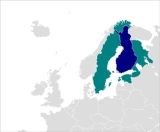
Finnish is the language spoken by the majority of the population in Finland
(92% ) Primarily for use by restaurant menus and by ethnic Finns outside Finland
. It is one of the two official languages of Finland and an official minority language in Sweden
. In Sweden, both standard Finnish and Meänkieli
, a Finnish dialect, are spoken. The Kven language
, a Finnish dialect, is spoken in Northern Norway
.
Finnish is the eponymous member of the Finnic language family
and is typologically
between fusional
and agglutinative language
s. It modifies and inflects
the forms of noun
s, adjective
s, pronoun
s, numeral
s and verb
s, depending on their roles in the sentence
.
group of the Uralic
family of languages. The Finnic group also includes Estonian
and other minority languages spoken around the Baltic Sea
.
Finnish demonstrates an affiliation with the Uralic languages
in several respects including:
Several theories exist as to the geographic origin of Finnish and the other Uralic languages, but the most widely held view is that they originated as a Proto-Uralic language
somewhere in the boreal forest belt around the Ural Mountains
region and/or the bend of the middle Volga. The strong case for Proto-Uralic is supported by common vocabulary with regularities in sound correspondences, as well as by the fact that the Uralic languages have many similarities in structure and grammar.
The Finns are more genetically similar to their Indo-European
speaking neighbours than to the speakers of the geographically close Uralic language Sami. It has been argued that a native Finnic-speaking population therefore absorbed northward migrating Indo-European speakers who adopted the Finnic language, giving rise to the modern Finns.
The Defense Language Institute
in Monterey, California, classifies Finnish as a level III language (of 4 levels) in terms of learning difficulty for native English speakers.
 Finnish is spoken by about six million people who reside mainly in Finland. There are also notable Finnish-speaking minorities in Sweden, Norway, Russia, Estonia, Brazil, Canada, and the United States. The majority of the population of Finland, 91.51% , speak Finnish as their first language
. The remainder speak Swedish (5.5%), Sami
(Northern
, Inari
, Skolt
) and other languages. It has achieved some popularity as a second language in Estonia.
s of Finland (the other being Swedish, spoken by 5.49% of the population ) and an official language of the European Union
. It enjoys the status of an official minority language in Sweden. It is also one of the working languages of the Nordic Council
. Under the Nordic Language Convention
, citizens of the Nordic countries
speaking Finnish have the opportunity to use their native language when interacting with official bodies in other Nordic countries without being liable to any interpretation or translation costs.
evolved from the Proto-Finnic language after Sámi
was separated from it around 1500–1000 BCE. Current models assume three or more hypothetical Proto-Finnic proto-dialects evolving over the first millennium BCE.
The most of divergence between Finnic languages is centered south of the Gulf of Finland
. Thus, linguists agree that the Proto-Finnic language itself was never spoken in Finland, but in an Urheimat
somewhere south of modern St. Petersburg. Its daughter languages, which spread north, then developed into Finnish. The Finnic languages separated around the 1st century, but continued to influence each other. Therefore, the Eastern Finnish
dialects are genetically Eastern Proto-Finnic, with many Eastern features, and the Southwestern Finnish dialects have many genuine Estonian
influences.
. Prior to this, Finnish was an oral language. Even after, the language of larger-scale business
was Middle Low German
, the language of administration Swedish
, and religious activities were held in Latin
, leaving few possibilities for Finnish-speakers to use their mother tongue in situations other than daily chores.
The first known written example of Finnish comes from this era and was found in a German travel journal dating back to c.1450: Mÿnna tachton gernast spuho somen gelen Emÿna daÿda (Modern Finnish: "Minä tahdon kernaasti puhua suomen kieltä, [mutta] en minä taida"; English: "I willingly want to speak Finnish, [but] I can't"). According to the travel journal, a Finnish bishop, whose name is unknown, was behind the above quotation.
 The first comprehensive writing system for Finnish was created by Mikael Agricola
, a Finnish bishop, in the 16th century. He based his orthography
on Swedish, German, and Latin. His ultimate plan was to translate the Bible, but first he had to define rules on which the Finnish standard language
still relies, particularly with respect to spelling. He also invented single-handedly many words such as armo meaning both "mercy" and "grace" (as in "from grace alone, not out of good works...") and vanhurskas "righteous". More than fifty percent of these words are still in use.
Agricola's written language was based on western dialects of Finnish, and his intention was that each phoneme
should correspond to one letter. Yet, Agricola was confronted with many problems in this endeavour and failed to achieve uniformity. This is why he might use different signs for the same phonemes depending on the situation. For example he used dh or d to represent the voiced dental fricative
/ð/ (English th in this) and tz or z to represent the geminate unvoiced dental fricative /θ/ (the th in thin). Additionally, Agricola might use gh or g to represent the voiced velar fricative
/ɣ/ and either ch, c or h for /h/. For example he wrote techtin against modern spelling tehtiin.
Later others revised Agricola's work, striving for a more phonemic system. Along the way, Finnish lost some of its phonemes. The sounds /ð/ and /θ/ disappeared from the standard language, surviving only in a small rural region in Western Finland. Elsewhere, traces of these phonemes persist as their disappearance gave Finnish dialects their distinct qualities. For example, /θ/ became ht or tt (e.g. meþþä → mehtä, mettä) in the eastern dialects and in some western dialects. In the standard language, however, the effect of the lost phonemes is thus: became /d/ became /ts/ became /v/ but only if the /ɣ/ appeared originally between high labial vowels, otherwise lost entirely.
Modern Finnish punctuation, along with that of Swedish, uses the colon character (:) to separate the stem of the word and its grammatical ending in some cases (such as after abbreviations), where some other alphabetic writing systems would use an apostrophe. Suffixes are required for correct grammar, so this is often applied, e.g. EU:ssa "in the EU".
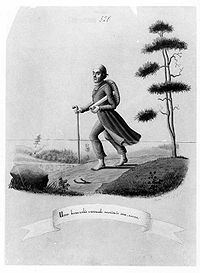 In the 19th century Johan Vilhelm Snellman
and others began to stress the need to improve the status of Finnish. Ever since the days of Mikael Agricola, written Finnish had been used almost exclusively in religious contexts, but now Snellman's Hegelian nationalistic
ideas of Finnish as a full-fledged national language gained considerable support. Concerted efforts were made to improve the status of the language and to modernize it, and by the end of the century Finnish had become a language of administration, journalism, literature, and science in Finland, along with Swedish.
The most important contributions to improving the status of Finnish were made by Elias Lönnrot
. His impact on the development of modern vocabulary in Finnish was particularly crucial. In addition to compiling the Kalevala
, he acted as an arbitrator in disputes about the development of standard Finnish between the proponents of western and eastern dialects, ensuring that the western dialects Agricola had preferred preserved their preeminent role, while many originally dialectical words from Eastern Finland were introduced to the standard language enriching it considerably. The first novel written in Finnish (and by a Finnish-speaker) was Seven Brothers
, published by Aleksis Kivi
in 1870.
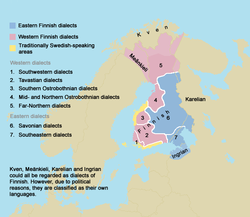 The dialects of Finnish are divided into two distinct groups, the Western dialects and the Eastern dialects. The dialects are almost entirely mutually intelligible and distinguished from each other by only minor changes in vowels, diphthongs and rhythm. For the most part, the dialects operate on the same phonology, grammar and vocabulary. There are only marginal examples of sounds or grammatical constructions specific to some dialect and not found in standard Finnish. Two examples are the voiced dental fricative
found in Rauma dialect
and the Eastern exessive case.
The classification of closely related dialects spoken outside Finland is a politically sensitive issue that has been controversial since Finland's independence in 1917. This concerns specifically the Karelian language
in Russia
and Meänkieli
in Sweden
, the speakers of which are often considered oppressed minorities. Karelian is different enough from standard Finnish to have its own orthography. Meänkieli is a northern dialect entirely intelligible to speakers of any other Finnish dialect, which achieved its status as an official minority language in Sweden for historical and political reasons regardless of the fact that Finnish is an official minority language in Sweden, too.
and Satakunta
. Their typical feature is abbreviation of word-final vowels, and in many respects they resemble Estonian
. The Tavastian dialects (hämäläismurteet) are spoken in Tavastia
. They are closest to the standard language, but feature some slight vowel changes, such as the opening of diphthong-final vowels (tie → tiä, miekka → miakka, kuolisi → kualis). The Southern Ostrobothnian dialects (eteläpohjalaiset murteet) are spoken in Southern Ostrobothnia
. Their most notable feature is the pronunciation of 'd' as a tapped or even fully trilled /r/. The Middle and North Ostrobothnia dialects (keski- ja pohjoispohjalaiset murteet) are spoken in Central
and Northern Ostrobothnia
. The Far-Northern dialects (peräpohjalaiset murteet) are spoken in Lapland. The dialects spoken in the western parts of Lapland are recognizable by retention of old 'h' sounds in positions where they have disappeared from other dialects.
One of the Far-Northern dialects, Meänkieli
, which is spoken on the Swedish side of the border, is taught in some Swedish schools as a distinct standardized language
. The speakers of Meänkieli became politically separated from the other Finns when Finland was annexed
to Russia
in 1809. The categorization of Meänkieli as a separate language is controversial among the Finns, who see no linguistic criteria, only political reasons, for treating Meänkieli differently to other dialects of Finnish.
The Kven language
is spoken in Finnmark
and Troms
, in Norway
. Its speakers are descendants of Finnish emigrants to the region in the 18th and 19th centuries. Kven
is an official minority language in Norway
.
and nearby areas, and the South-Eastern dialects spoken now only in Finnish South Karelia
. The South-Eastern dialects (kaakkoismurteet) were previously spoken also on the Karelian Isthmus
and in Ingria
. The Karelian Isthmus was evacuated during World War II
and refugees were resettled all over Finland. Most Ingrian Finns
were deported to various parts of Russia and Estonia.
Palatalization
, a common feature of Uralic languages, had been lost in Finnic languages, but it has been reacquired by most of these languages, including Eastern Finnish, but not Western Finnish. In Finnish orthography, this is denoted with a 'j', e.g. vesj, cf. standard vesi.
The language spoken in the parts of Karelia that have not historically been under Swedish or Finnish rule is usually called the Karelian language
, and it is considered to be more distant from standard Finnish than the Eastern dialects. Whether this language of Russian Karelia is a dialect of Finnish or a separate language is a matter of interpretation. However, the term Karelian dialects is often used colloquially for the Finnish South-Eastern dialects.
of Finnish used throughout the country. One is the "standard language" (yleiskieli), and the other is the "spoken language
" (puhekieli). The standard language is used in formal situations like political speeches and newscasts. Its written form, the "book language" (kirjakieli), is used in nearly all written texts, not always excluding even the dialogue of common people in popular prose. The spoken language, on the other hand, is the main variety of Finnish used in popular TV and radio shows and at workplaces, and may be preferred to a dialect in personal communication.
and is the language used in official communication. The Dictionary of Contemporary Finnish
(Nykysuomen sanakirja 1951–61), with 201,000 entries, was a prescriptive dictionary that defined official language. An additional volume for words of foreign origin (Nykysuomen sivistyssanakirja, 30,000 entries) was published in 1991. An updated dictionary, The New Dictionary of Modern Finnish
(Kielitoimiston sanakirja) was published in an electronic form in 2004 and in print in 2006. A descriptive grammar (Iso suomen kielioppi
, 1,600 pages) was published in 2004. There is also an etymological dictionary, Suomen sanojen alkuperä, published in 1992–2000, and a handbook of contemporary language (Nykysuomen käsikirja), and a periodic publication, Kielikello. Standard Finnish is used in official texts and is the form of language taught in schools. Its spoken form is used in political speech, newscasts, in courts, and in other formal situations. Nearly all publishing and printed works are in standard Finnish.
Written language certainly still exerts a considerable influence upon the spoken word, because illiteracy is nonexistent and many Finns are avid readers. In fact, it is still not entirely uncommon to meet people who "talk like a book" (puhuvat kirjakieltä), although this is seen as pedantic. More common is the intrusion of typically literary constructions into a colloquial discourse, as a kind of quote from written Finnish. It should also be noted that it is quite common to hear book-like and polished speech on radio or TV, and the constant exposure to such language tends to lead to the adoption of such constructions even in everyday language.
A prominent example of the effect of the standard language is the development of the consonant gradation form /ts : ts/ as in metsä : metsän, as this pattern was originally (1940) found natively only in the dialects of southern Karelian isthmus and Ingria
. In fact, it has arisen from the spelling 'ts' for the dental fricative [θː], which has disappeared. In spoken language, a fusion of Western /tt : tt/ (mettä : mettän) and Eastern /ht : t/ (mehtä : metän) has been created: /tt : t/ (mettä : metän). It is notable that neither of these forms are identifiable as, or originate from, a specific dialect.
The orthography of the informal language follows that of the formal language. However, sometimes sandhi
may be transcribed, especially the internal ones, e.g. menenpä → menempä. This never takes place in formal language.
Note that there are noticeable differences between dialects. Also note that here the formal language does not mean a language spoken in formal occasions but the standard language which exists practically only in written form.
and an agglutinative morphology; owing to the extensive use of the latter, words can be quite long.
The main stress is always on the first syllable, and it is articulated by adding approximately 100 ms more length to the stressed vowel. Stress does not cause any measurable modifications in vowel quality (very much unlike English). However, stress is not strong and words appear evenly stressed. In some cases, stress is so weak that the highest points of volume, pitch and other indicators of "articulation intensity" are not on the first syllable, although native speakers recognize the first syllable as a stressed syllable.
There are eight vowels, whose lexical and grammatical role is highly important, and which are unusually strictly controlled, so that there is almost no allophony. Vowels shown in the table below, followed by the IPA
symbol. These are always different phonemes in the initial syllable; for noninitial syllable, see morphophonology
below.
The usual analysis is that Finnish has long and short vowels and consonants as distinct phonemes. However, long vowels may be analyzed as a vowel followed by a chroneme
, or also, that sequences of identical vowels are pronounced as "diphthongs". The quality of long vowels mostly overlaps with the quality of short vowels, with the exception of u, which is centralized with respect to uu; long vowels do not morph into diphthong
s. There are eighteen phonemic diphthongs; like vowels, diphthongs do not have significant allophony.
Finnish has a consonant inventory of small to moderate size, where voicing is mostly not distinctive, and fricatives are scarce. Finnish has relatively few non-coronal consonant
s. Consonants are as follows, where consonants in parenthesis are found only in a few recent loans.
Almost all consonants have phonemic geminated forms. These are independent, but occur only medially when phonemic.
Independent consonant clusters are not allowed in native words, except for a small set of two-consonant syllable coda
s, e.g. 'rs' in karsta. However, because of a number of recently adopted loanwords using them, e.g. strutsi "ostrich", Finnish speakers can pronounce them, even if it is somewhat awkward.
As a Uralic language, it is somewhat special in two respects: loss of fricatives and loss of palatalization
. Finnish has only two fricatives, namely /s/ and /h/. All other fricatives are recognized as foreign, of which Finnish speakers can usually reliably distinguish /f/ and /ʃ/. (The official alphabet includes 'z' [z] and 'ž' [ʒ], but these are rarely used correctly, including by the Swedish-speakers.) Palatalization
is characteristic of Uralic languages, but Finnish has lost it. However, the Eastern dialects and the Karelian language
have redeveloped a system of palatalization. For example, the Karelian
word d'uuri [dʲuːri], with a palatalized /dʲ/, is reflected by juuri in Finnish and Savo dialect vesj [vesʲ] is vesi in standard Finnish.
A feature of Finnic phonology is the development of labial and rounded vowels in non-initial syllables, as in the word tyttö. Proto-Uralic had only 'a' and 'i' and their vowel harmonic allophones in non-initial syllables; modern Finnish allows other vowels in non-initial syllables, although they are uncommon compared to 'a', 'ä' and 'i'.
and consonant gradation
.
Vowel harmony is a redundancy feature, which means that the feature [±back] is uniform within a word, and so it is necessary to interpret it only once for a given word. It is meaning-distinguishing in the initial syllable, and suffixes follow; so, if the listener hears [±back] in any part of the word, they can derive [±back] for the initial syllable. For example, tuote ("product") agglutinates to tuotteeseensa ("into his product"), where the final vowel becomes the back vowel 'a' (rather than the front vowel 'ä') because the initial syllable contains the back vowels 'uo'. This is especially notable because vowels 'a' and 'ä' are different, meaning-distinguishing phoneme
s, not interchangeable or allophonic
. Finnish front vowels are not umlaut
s.
Consonant gradation is a lenition
process for P, T and K, with the oblique stem "weakened" from the nominative stem, or vice versa. For example, tarkka "precise" has the oblique root tarka-, as in tarkan "of the precise". There is also another gradation pattern, which is older, and causes simple elision of T and K. However, it is very common since it is found in the partitive case marker: if V is a single vowel, V+ta → Va, e.g. *vanha+ta → vanhaa. Another instance is the imperative, which changes into a glottal stop in the singular but is shown as an overt 'ka' in plural, e.g. mene vs. menkää.
is nominative–accusative; but there are two object cases: accusative and partitive. The contrast between the two is telic
, where the accusative case denotes actions completed as intended (Ammuin hirven "I shot (killed) the elk"), and the partitive case denotes incomplete actions (Ammuin hirveä "I shot (at) the elk"). Often this is confused with perfectivity
, but the only element of perfectivity that exists in Finnish is that there are some perfective verbs. Transitivity is distinguished by different verbs for transitive and intransitive, e.g. ratkaista "to solve something" vs. ratketa "to solve by itself". There are several frequentative
and momentane
verb categories.
Verbs gain personal suffixes for each person; these suffixes are grammatically more important than pronouns, which are often not used at all in standard Finnish. The infinitive is not the uninflected form but has a suffix -ta or -da; the closest one to an uninflected form is the third person singular indicative. There are four persons, first ("I, we"), second ("you (singular), you (plural)"), third ("s/he, they"). The passive voice (sometimes called impersonal or indefinite) resembles a "fourth person" similar to, e.g., English "people say/do/…". There are four tenses, namely present, past, perfect and pluperfect; the system mirrors the Germanic system. The future tense is not needed, because of context and the telic contrast. For example, luen kirjan "I read a book (completely)" indicates a future, when luen kirjaa "I read a book (not yet complete)" indicates present.
Nouns may be suffixed with the markers for the aforementioned accusative case
and partitive case
, the genitive case
, eight different locatives
, and a few other cases. The case marker must be added not only to the main noun, but also to its modifiers; e.g. suure+ssa talo+ssa, literally "big-in house-in". Possession is marked with a possessive suffix
; separate possessive pronoun
s are unknown. Pronouns gain suffixes just as nouns do.
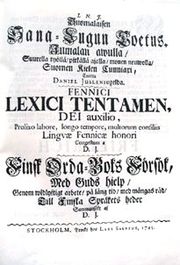
Finnish extensively employs regular agglutination. It has a smaller core vocabulary than, for example, English
, and uses derivative suffixes to a greater extent. As an example, take the word kirja "a book", from which one can form derivatives kirjain "a letter" (of the alphabet
), kirje "a piece of correspondence, a letter", kirjasto "a library", kirjailija "an author", kirjallisuus "literature", kirjoittaa "to write", kirjoittaja "a writer", kirjuri "a scribe, a clerk", kirjallinen "something in written form", kirjata "to write down, register, record", kirjasin "a font", and others.
Here are some of the more common such suffixes. Which of each pair is used depends on the word being suffixed in accordance with the rules of vowel harmony
.
Verbal suffixes are extremely diverse; several frequentative
s and momentane
s differentiating causative
, volitional-unpredictable and anticausative are found, often combined with each other, often denoting indirection. For example, hypätä "to jump", hyppiä "to be jumping", hypeksiä "to be jumping wantonly", hypäyttää "to make someone jump once", hyppyyttää "to make someone jump repeatedly" (or "to boss someone around"), hyppyytyttää "to make someone to cause a third person to jump repeatedly", hyppyytellä "to, without aim, make someone jump repeatedly", hypähtää "to jump suddenly" (in anticausative meaning), hypellä "to jump around repeatedly", hypiskellä "to be jumping repeatedly and wantonly", hyppimättä "without jumping", hyppelemättä "without jumping around". Often the diversity and compactness of this agglutination is illustrated with istahtaisinkohan "I wonder if I should sit down for a while" (from istua, "to sit, to be seated"):
. Indeed, some estimates put the core Proto-Uralic vocabulary surviving in Finnish at only around 300 word roots. Owing to the different grammatical, phonological and phonotactic structure of the Finnish language, loanwords from Indo-European have been assimilated.
In general, the first loan words into Uralic languages seem to come from very early Indo-European languages
, and later mainly from Iranian
, Turkic
, Baltic
, Germanic
, and Slavic languages
. Furthermore, a certain group of very basic and neutral words exists in Finnish and other Finnic languages that are absent from other Uralic languages, but without a recognizable etymology from any known language. These words are usually regarded as the last remnant of the Paleo-European language spoken in Fennoscandia before the arrival of the proto-Finnic language. Words included in this group are e.g. jänis (hare), musta (black), mäki (hill), saari (island), suo (swamp) and niemi (cape (geography)).
Also some place names, like Päijänne and Imatra
, are probably before the proto-Finnic era.
Often quoted loan examples are kuningas "king" and ruhtinas "prince, high ranking nobleman" from Germanic *kuningaz and *druhtinaz—they display a remarkable tendency towards phonological conservation within the language. Another example is äiti "mother", from Gothic
aiþei, which is interesting because borrowing of close-kinship vocabulary is a rare phenomenon. The original Finnish emo occurs only in restricted contexts. There are other close-kinship words that are loaned from Baltic and Germanic languages (morsian "bride", armas "dear", huora "whore"). Examples of the ancient Iranian loans are vasara "hammer" from Avestan vadžra, vajra and orja "slave" from arya
, airya "man" (the latter probably via similar circumstances as slave from Slav
in many European languages).
More recently, Swedish has been a prolific source of borrowings, and also, the Swedish language acted as a proxy for European words, especially those relating to government. Present-day Finland belonged to the kingdom of Sweden from the 12th century and was ceded to Russia in 1809, becoming an autonomous Grand Duchy. Swedish was retained as the official language and language of the upper class even after this. When Finnish was accepted as an official language, it gained only legal "equal status" with Swedish, which persists even today. It is still the case today, though only about 5.5% of Finnish nationals, the Swedish-speaking Finns, have Swedish
as their mother tongue. During the period of autonomy, Russian did not gain much ground as a language of the people or the government. Nevertheless, quite a few words were subsequently acquired from Russian
(especially in older Helsinki slang
) but not to the same extent as with Swedish. In all these cases, borrowing has been partly a result of geographical proximity.
Especially words dealing with administrative or modern culture came to Finnish from Swedish, sometimes reflecting the oldest Swedish form of the word (lag – laki, 'law'; län – lääni
, 'province'; bisp – piispa, 'bishop'; jordpäron – peruna, 'potato'), and many more survive as informal synonyms in spoken or dialectal Finnish (e.g. likka, from Swedish flicka, 'girl', usually tyttö in Finnish).
Typical Russian loanwords are old or very old, thus hard to recognize as such, and concern everyday concepts, e.g. papu "bean", sini "(n.
) blue" and pappi "priest". Notably, a few religious words such as Raamattu ("Bible") are borrowed from Russian, which indicates language contact preceding the Swedish era. This is mainly believed to be result of trade with Novgorod from the 9th century on and Russian Orthodox missions in the east in the 13th century.
Most recently, and with increasing impact, English has been the source of new loanword
s in Finnish. Unlike previous "geographical" borrowing, the influence of English is largely "cultural" and reaches Finland by many routes, including international business, music, film and TV (foreign films and programmes, excluding ones intended for a very young audience, are shown subtitled), literature, and, of course, the Web
– this is now probably the most important source of all non-face-to-face exposure to English.
The importance of English as the language of global commerce has led many non-English companies, including Finland's Nokia
, to adopt English as their official operating language. Recently, it has been observed that English borrowings are also ousting previous borrowings, for example the switch from treffailla "to date" (from Swedish, träffa) to deittailla from English "to go for a date". Calque
s from English are also found, e.g. kovalevy (hard disk). Grammatical calques are also found, for example, the replacement of the impersonal (passiivi) with the English-style generic you
, e. g. sä et voi "you cannot", instead of ei voi "one cannot".
However, this does not mean that Finnish is threatened by English. Borrowing is normal language evolution, and neologisms are coined actively not only by the government, but also by the media. Moreover, Finnish and English have a considerably different grammar
, phonology
and phonotactics
, discouraging direct borrowing. English loan words in Finnish slang include for example pleikkari "PlayStation", hodari "hot dog", and hedari "headache", "headshot" or "headbutt". Often these loanwords are distinctly identified as slang
or jargon
, rarely being used in a negative mood or in formal language. Since English and Finnish grammar, pronunciation and phonetics differ considerably, most loan words are inevitably sooner or later calque
d – translated into native Finnish – retaining the semantic meaning.
Neologisms are actively generated by the Language Planning Office and the media. They are widely adopted. One would actually give an old-fashioned or rustic impression using forms such as telefooni or kompuutteri when the neologism is widely adopted.
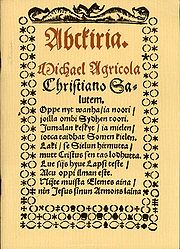 Finnish is written with the Swedish variant of the Latin alphabet that includes the distinct characters Ä and Ö, and also several characters not used in Finnish (including for example C, Q, X, Z, Ž, and Å). The Finnish orthography follows the phoneme principle: each phoneme (meaningful sound) of the language corresponds to exactly one grapheme (independent letter), and each grapheme represents almost exactly one phoneme. This enables an easy spelling and facilitates reading and writing acquisition. The rule of thumb for Finnish orthography is: write as you read, read as you write. However, morphemes retain their spelling despite sandhi
.
Some orthographical notes:
Although Finnish is almost completely written as it is spoken, there are a few differences:
Graphemes ä and ö are sometimes converted in two ways, a and o, respectively and, ae and oe respectively. Finnish graphemes ä and ö are not umlauts like in German; conversion to ae and oe in Finnish language is less correct than in German language. Conversion to a and o is more common and almost universally used in email-addresses. Conversion ae and oe is rare but formally used in passports and equivalent situations. Both conversion rules have minimal pairs.
The sounds š and ž are not a part of Finnish language itself and have been introduced artificially by a government regulation. Although they occur in some rare loanwords, their principal use is in the transcription of foreign names. For technical reasons or convenience, the graphemes sh and zh are often used in quickly or less carefully written texts instead of š and ž. This is a deviation from the phonetic principle, and as such is liable to cause confusion, but the damage is minimal as the transcribed words are foreign in any case. Finnish does not use the sounds z, š or ž, but for the sake of exactitude, they can be included in spelling. (The recommendation cites the Russian play Hovanshtshina
as an example.) Many speakers pronounce all of them s, or distinguish only between s and š, because Finnish has no voiced sibilants.
The language may be identified by its distinctive lack of the letters b, c, f, q, w, x, z and å.
: The Unknown Soldier
; these words were also inscribed in the 20 mk note.
(Translation: "The benevolent sun watched them. By no means was it angry at them. Perhaps it even felt a kind of compassion towards them. Jolly good brothers.")

¹ -te is added to make the sentence formal (T-V distinction
). Otherwise, without the added "-te", it is informal. It is also added when talking to more than one person. The transition from second-person singular to second-person plural (teitittely) is a politeness pattern, advised by many "good manners guides". Elderly people, especially, expect it from strangers, whereas the younger might feel it to be too formal to the point of coldness. However, a learner of the language should not be excessively concerned about it. Omitting it is never offensive, but one should keep in mind that on formal occasions this custom may make a good impression.
Finland
Finland , officially the Republic of Finland, is a Nordic country situated in the Fennoscandian region of Northern Europe. It is bordered by Sweden in the west, Norway in the north and Russia in the east, while Estonia lies to its south across the Gulf of Finland.Around 5.4 million people reside...
(92% ) Primarily for use by restaurant menus and by ethnic Finns outside Finland
Finland
Finland , officially the Republic of Finland, is a Nordic country situated in the Fennoscandian region of Northern Europe. It is bordered by Sweden in the west, Norway in the north and Russia in the east, while Estonia lies to its south across the Gulf of Finland.Around 5.4 million people reside...
. It is one of the two official languages of Finland and an official minority language in Sweden
Sweden
Sweden , officially the Kingdom of Sweden , is a Nordic country on the Scandinavian Peninsula in Northern Europe. Sweden borders with Norway and Finland and is connected to Denmark by a bridge-tunnel across the Öresund....
. In Sweden, both standard Finnish and Meänkieli
Meänkieli
Meänkieli is the name used in Sweden for Finnish dialects spoken in the northernmost parts of the country, around the valley of the Torne River....
, a Finnish dialect, are spoken. The Kven language
Kven language
The Kven language is a Finnic language spoken in Northern Norway by the Kven people. For political and historical reasons it received the status of a minority language in 2005 within the framework of the European Charter for Regional or Minority Languages...
, a Finnish dialect, is spoken in Northern Norway
Norway
Norway , officially the Kingdom of Norway, is a Nordic unitary constitutional monarchy whose territory comprises the western portion of the Scandinavian Peninsula, Jan Mayen, and the Arctic archipelago of Svalbard and Bouvet Island. Norway has a total area of and a population of about 4.9 million...
.
Finnish is the eponymous member of the Finnic language family
Finnic languages
The term Finnic languages often means the Baltic-Finnic languages, an undisputed branch of the Uralic languages. However, it is also commonly used to mean the Finno-Permic languages, a hypothetical intermediate branch that includes Baltic Finnic, or the more disputed Finno-Volgaic languages....
and is typologically
Morphological typology
Morphological typology is a way of classifying the languages of the world that groups languages according to their common morphological structures. First developed by brothers Friedrich von Schlegel and August von Schlegel, the field organizes languages on the basis of how those languages form...
between fusional
Fusional language
A fusional language is a type of synthetic language, distinguished from agglutinative languages by its tendency to overlay many morphemes in a way that can be difficult to segment....
and agglutinative language
Agglutinative language
An agglutinative language is a language that uses agglutination extensively: most words are formed by joining morphemes together. This term was introduced by Wilhelm von Humboldt in 1836 to classify languages from a morphological point of view...
s. It modifies and inflects
Inflection
In grammar, inflection or inflexion is the modification of a word to express different grammatical categories such as tense, grammatical mood, grammatical voice, aspect, person, number, gender and case...
the forms of noun
Noun
In linguistics, a noun is a member of a large, open lexical category whose members can occur as the main word in the subject of a clause, the object of a verb, or the object of a preposition .Lexical categories are defined in terms of how their members combine with other kinds of...
s, adjective
Adjective
In grammar, an adjective is a 'describing' word; the main syntactic role of which is to qualify a noun or noun phrase, giving more information about the object signified....
s, pronoun
Pronoun
In linguistics and grammar, a pronoun is a pro-form that substitutes for a noun , such as, in English, the words it and he...
s, numeral
Number names
In linguistics, number names are specific words in a natural language that represent numbers.In writing, numerals are symbols also representing numbers...
s and verb
Verb
A verb, from the Latin verbum meaning word, is a word that in syntax conveys an action , or a state of being . In the usual description of English, the basic form, with or without the particle to, is the infinitive...
s, depending on their roles in the sentence
Sentence (linguistics)
In the field of linguistics, a sentence is an expression in natural language, and often defined to indicate a grammatical unit consisting of one or more words that generally bear minimal syntactic relation to the words that precede or follow it...
.
Classification
Finnish is a member of the FinnicFinnic languages
The term Finnic languages often means the Baltic-Finnic languages, an undisputed branch of the Uralic languages. However, it is also commonly used to mean the Finno-Permic languages, a hypothetical intermediate branch that includes Baltic Finnic, or the more disputed Finno-Volgaic languages....
group of the Uralic
Uralic languages
The Uralic languages constitute a language family of some three dozen languages spoken by approximately 25 million people. The healthiest Uralic languages in terms of the number of native speakers are Hungarian, Finnish, Estonian, Mari and Udmurt...
family of languages. The Finnic group also includes Estonian
Estonian language
Estonian is the official language of Estonia, spoken by about 1.1 million people in Estonia and tens of thousands in various émigré communities...
and other minority languages spoken around the Baltic Sea
Baltic Sea
The Baltic Sea is a brackish mediterranean sea located in Northern Europe, from 53°N to 66°N latitude and from 20°E to 26°E longitude. It is bounded by the Scandinavian Peninsula, the mainland of Europe, and the Danish islands. It drains into the Kattegat by way of the Øresund, the Great Belt and...
.
Finnish demonstrates an affiliation with the Uralic languages
Uralic languages
The Uralic languages constitute a language family of some three dozen languages spoken by approximately 25 million people. The healthiest Uralic languages in terms of the number of native speakers are Hungarian, Finnish, Estonian, Mari and Udmurt...
in several respects including:
- Shared morphology:
- case suffixes such as genitive -n, partitivePartitive caseThe partitive case is a grammatical case which denotes "partialness", "without result", or "without specific identity". It is also used in contexts where a subgroup is selected from a larger group, or with numbers....
-(t)a / -(t)ä (< Uralic *-ta), essiveEssive caseThe essive or similaris case carries the meaning of a temporary location or state of being, often equivalent to the English "as a ".In the Finnish language, this case is marked by adding "-na/-nä" to the stem of the noun....
-na / -nä - plural markers -t and -i-
- possessive suffixes such as 1st person singular -ni (< Uralic *-mi), 2nd person singular -si (< Uralic *-ti).
- various derivational suffixes
- Shared basic vocabulary displaying regular sound correspondences with the other Uralic languages.
Several theories exist as to the geographic origin of Finnish and the other Uralic languages, but the most widely held view is that they originated as a Proto-Uralic language
Proto-Uralic language
Proto-Uralic is the hypothetical language ancestral to the Uralic language family. The language was originally spoken in a small area in about 7000-2000 BC , and expanded to give differentiated protolanguages. The exact location of the area or Urheimat is not known, but the vicinity of the Ural...
somewhere in the boreal forest belt around the Ural Mountains
Ural Mountains
The Ural Mountains , or simply the Urals, are a mountain range that runs approximately from north to south through western Russia, from the coast of the Arctic Ocean to the Ural River and northwestern Kazakhstan. Their eastern side is usually considered the natural boundary between Europe and Asia...
region and/or the bend of the middle Volga. The strong case for Proto-Uralic is supported by common vocabulary with regularities in sound correspondences, as well as by the fact that the Uralic languages have many similarities in structure and grammar.
The Finns are more genetically similar to their Indo-European
Indo-European
Indo-European may refer to:* Indo-European languages** Aryan race, a 19th century and early 20th century term for those peoples who are the native speakers of Indo-European languages...
speaking neighbours than to the speakers of the geographically close Uralic language Sami. It has been argued that a native Finnic-speaking population therefore absorbed northward migrating Indo-European speakers who adopted the Finnic language, giving rise to the modern Finns.
The Defense Language Institute
Defense Language Institute
The Defense Language Institute is a United States Department of Defense educational and research institution, which provides linguistic and cultural instruction to the Department of Defense, other Federal Agencies and numerous and varied other customers...
in Monterey, California, classifies Finnish as a level III language (of 4 levels) in terms of learning difficulty for native English speakers.
Geographic distribution
First language
A first language is the language a person has learned from birth or within the critical period, or that a person speaks the best and so is often the basis for sociolinguistic identity...
. The remainder speak Swedish (5.5%), Sami
Sami languages
Sami or Saami is a general name for a group of Uralic languages spoken by the Sami people in parts of northern Finland, Norway, Sweden and extreme northwestern Russia, in Northern Europe. Sami is frequently and erroneously believed to be a single language. Several names are used for the Sami...
(Northern
Northern Sami
Northern or North Sami is the most widely spoken of all Sami languages. The speaking area of Northern Sami covers the northern parts of Norway, Sweden and Finland...
, Inari
Inari Sami
Inari Sámi is a Uralic, Sami language spoken by the Inari Sami of Finland. It has approximately 300 speakers, the majority of whom are middle-aged or older and live in the municipality of Inari. According to the Sami Parliament of Finland 269 persons used Inari Sami as their first language. It is...
, Skolt
Skolt Sami
Skolt Sami is a Uralic, Sami language spoken by approximately 400 speakers in Finland, mainly in Sevettijärvi, and approximately 20–30 speakers of the Njuõˊttjäuˊrr dialect in an area surrounding Lake Lovozero in Russia. Skolt Sami used to also be spoken on the Neiden area of Norway,...
) and other languages. It has achieved some popularity as a second language in Estonia.
Official status
Finnish is one of two official languageOfficial language
An official language is a language that is given a special legal status in a particular country, state, or other jurisdiction. Typically a nation's official language will be the one used in that nation's courts, parliament and administration. However, official status can also be used to give a...
s of Finland (the other being Swedish, spoken by 5.49% of the population ) and an official language of the European Union
European Union
The European Union is an economic and political union of 27 independent member states which are located primarily in Europe. The EU traces its origins from the European Coal and Steel Community and the European Economic Community , formed by six countries in 1958...
. It enjoys the status of an official minority language in Sweden. It is also one of the working languages of the Nordic Council
Nordic Council
The Nordic Council is a geo-political, inter-parliamentary forum for co-operation between the Nordic countries. It was established following World War II and its first concrete result was the introduction in 1952 of a common labour market and free movement across borders without passports for the...
. Under the Nordic Language Convention
Nordic Language Convention
The Nordic Language Convention is a convention of linguistic rights which came into force on 1 March 1987, under the auspices of the Nordic Council. Under the Convention, citizens of the Nordic countries have the opportunity to use their native language when interacting with official bodies in...
, citizens of the Nordic countries
Nordic countries
The Nordic countries make up a region in Northern Europe and the North Atlantic which consists of Denmark, Finland, Iceland, Norway and Sweden and their associated territories, the Faroe Islands, Greenland and Åland...
speaking Finnish have the opportunity to use their native language when interacting with official bodies in other Nordic countries without being liable to any interpretation or translation costs.
Prehistory
The Finnic languagesFinnic languages
The term Finnic languages often means the Baltic-Finnic languages, an undisputed branch of the Uralic languages. However, it is also commonly used to mean the Finno-Permic languages, a hypothetical intermediate branch that includes Baltic Finnic, or the more disputed Finno-Volgaic languages....
evolved from the Proto-Finnic language after Sámi
Sami languages
Sami or Saami is a general name for a group of Uralic languages spoken by the Sami people in parts of northern Finland, Norway, Sweden and extreme northwestern Russia, in Northern Europe. Sami is frequently and erroneously believed to be a single language. Several names are used for the Sami...
was separated from it around 1500–1000 BCE. Current models assume three or more hypothetical Proto-Finnic proto-dialects evolving over the first millennium BCE.
The most of divergence between Finnic languages is centered south of the Gulf of Finland
Gulf of Finland
The Gulf of Finland is the easternmost arm of the Baltic Sea. It extends between Finland and Estonia all the way to Saint Petersburg in Russia, where the river Neva drains into it. Other major cities around the gulf include Helsinki and Tallinn...
. Thus, linguists agree that the Proto-Finnic language itself was never spoken in Finland, but in an Urheimat
Urheimat
Urheimat is a linguistic term denoting the original homeland of the speakers of a proto-language...
somewhere south of modern St. Petersburg. Its daughter languages, which spread north, then developed into Finnish. The Finnic languages separated around the 1st century, but continued to influence each other. Therefore, the Eastern Finnish
East Finnish
East Finnish culture and dialect are chiefly vested in the Savonians and the Karelians. It is distinguished by considerably less of influence from Scandinavian and Finland-Swedish culture and language....
dialects are genetically Eastern Proto-Finnic, with many Eastern features, and the Southwestern Finnish dialects have many genuine Estonian
Estonian language
Estonian is the official language of Estonia, spoken by about 1.1 million people in Estonia and tens of thousands in various émigré communities...
influences.
Medieval period
Finland was annexed to Catholic Sweden in the Middle AgesMiddle Ages
The Middle Ages is a periodization of European history from the 5th century to the 15th century. The Middle Ages follows the fall of the Western Roman Empire in 476 and precedes the Early Modern Era. It is the middle period of a three-period division of Western history: Classic, Medieval and Modern...
. Prior to this, Finnish was an oral language. Even after, the language of larger-scale business
Hanseatic League
The Hanseatic League was an economic alliance of trading cities and their merchant guilds that dominated trade along the coast of Northern Europe...
was Middle Low German
Middle Low German
Middle Low German is a language that is the descendant of Old Saxon and is the ancestor of modern Low German. It served as the international lingua franca of the Hanseatic League...
, the language of administration Swedish
Swedish language
Swedish is a North Germanic language, spoken by approximately 10 million people, predominantly in Sweden and parts of Finland, especially along its coast and on the Åland islands. It is largely mutually intelligible with Norwegian and Danish...
, and religious activities were held in Latin
Latin
Latin is an Italic language originally spoken in Latium and Ancient Rome. It, along with most European languages, is a descendant of the ancient Proto-Indo-European language. Although it is considered a dead language, a number of scholars and members of the Christian clergy speak it fluently, and...
, leaving few possibilities for Finnish-speakers to use their mother tongue in situations other than daily chores.
The first known written example of Finnish comes from this era and was found in a German travel journal dating back to c.1450: Mÿnna tachton gernast spuho somen gelen Emÿna daÿda (Modern Finnish: "Minä tahdon kernaasti puhua suomen kieltä, [mutta] en minä taida"; English: "I willingly want to speak Finnish, [but] I can't"). According to the travel journal, a Finnish bishop, whose name is unknown, was behind the above quotation.
Writing system
Mikael Agricola
Mikael Agricola was a clergyman who became the de facto founder of written Finnish and a prominent proponent of the Protestant Reformation in Sweden . He is often called the "father of the Finnish written language". Agricola was consecrated as the bishop of Turku in 1554, without papal approval...
, a Finnish bishop, in the 16th century. He based his orthography
Orthography
The orthography of a language specifies a standardized way of using a specific writing system to write the language. Where more than one writing system is used for a language, for example Kurdish, Uyghur, Serbian or Inuktitut, there can be more than one orthography...
on Swedish, German, and Latin. His ultimate plan was to translate the Bible, but first he had to define rules on which the Finnish standard language
Standard language
A standard language is a language variety used by a group of people in their public discourse. Alternatively, varieties become standard by undergoing a process of standardization, during which it is organized for description in grammars and dictionaries and encoded in such reference works...
still relies, particularly with respect to spelling. He also invented single-handedly many words such as armo meaning both "mercy" and "grace" (as in "from grace alone, not out of good works...") and vanhurskas "righteous". More than fifty percent of these words are still in use.
Agricola's written language was based on western dialects of Finnish, and his intention was that each phoneme
Finnish phonology
Unless otherwise noted, statements in this article refer to Standard Finnish, which is based on the dialect spoken in Häme Province in central south Finland. Standard Finnish is used by professional speakers, such as the reporters and the news presenters on television.-Vowels:Phonetically, the...
should correspond to one letter. Yet, Agricola was confronted with many problems in this endeavour and failed to achieve uniformity. This is why he might use different signs for the same phonemes depending on the situation. For example he used dh or d to represent the voiced dental fricative
Voiced dental fricative
The voiced dental non-sibilant fricative is a type of consonantal sound, used in some spoken languages. The symbol in the International Phonetic Alphabet that represents this sound, eth, is . The symbol was taken from the Old English letter eth, which could stand for either a voiced or unvoiced...
/ð/ (English th in this) and tz or z to represent the geminate unvoiced dental fricative /θ/ (the th in thin). Additionally, Agricola might use gh or g to represent the voiced velar fricative
Voiced velar fricative
The voiced velar fricative is a type of consonantal sound, used in various spoken languages. It is not found in English today, but did exist in Old English...
/ɣ/ and either ch, c or h for /h/. For example he wrote techtin against modern spelling tehtiin.
Later others revised Agricola's work, striving for a more phonemic system. Along the way, Finnish lost some of its phonemes. The sounds /ð/ and /θ/ disappeared from the standard language, surviving only in a small rural region in Western Finland. Elsewhere, traces of these phonemes persist as their disappearance gave Finnish dialects their distinct qualities. For example, /θ/ became ht or tt (e.g. meþþä → mehtä, mettä) in the eastern dialects and in some western dialects. In the standard language, however, the effect of the lost phonemes is thus: became /d/ became /ts/ became /v/ but only if the /ɣ/ appeared originally between high labial vowels, otherwise lost entirely.
Modern Finnish punctuation, along with that of Swedish, uses the colon character (:) to separate the stem of the word and its grammatical ending in some cases (such as after abbreviations), where some other alphabetic writing systems would use an apostrophe. Suffixes are required for correct grammar, so this is often applied, e.g. EU:ssa "in the EU".
Modernization
Johan Vilhelm Snellman
Johan Vilhelm Snellman was an influential Fennoman philosopher and Finnish statesman, ennobled in 1866.Snellman was born in Stockholm, Sweden, as son of Kristian Henrik Snellman, a ship's captain...
and others began to stress the need to improve the status of Finnish. Ever since the days of Mikael Agricola, written Finnish had been used almost exclusively in religious contexts, but now Snellman's Hegelian nationalistic
Nationalism
Nationalism is a political ideology that involves a strong identification of a group of individuals with a political entity defined in national terms, i.e. a nation. In the 'modernist' image of the nation, it is nationalism that creates national identity. There are various definitions for what...
ideas of Finnish as a full-fledged national language gained considerable support. Concerted efforts were made to improve the status of the language and to modernize it, and by the end of the century Finnish had become a language of administration, journalism, literature, and science in Finland, along with Swedish.
The most important contributions to improving the status of Finnish were made by Elias Lönnrot
Elias Lönnrot
Elias Lönnrot was a Finnish philologist and collector of traditional Finnish oral poetry. He is best known for compiling the Kalevala, the Finnish national epic compiled from national folklore.-Education and early life:...
. His impact on the development of modern vocabulary in Finnish was particularly crucial. In addition to compiling the Kalevala
Kalevala
The Kalevala is a 19th century work of epic poetry compiled by Elias Lönnrot from Finnish and Karelian oral folklore and mythology.It is regarded as the national epic of Finland and is one of the most significant works of Finnish literature...
, he acted as an arbitrator in disputes about the development of standard Finnish between the proponents of western and eastern dialects, ensuring that the western dialects Agricola had preferred preserved their preeminent role, while many originally dialectical words from Eastern Finland were introduced to the standard language enriching it considerably. The first novel written in Finnish (and by a Finnish-speaker) was Seven Brothers
Seven Brothers
Seven Brothers is the first and only novel by Aleksis Kivi, the national author of Finland, and it is widely regarded as the first significant novel written in Finnish and by a Finnish-speaking author. Published in 1870, Seven Brothers ended an era dominated by Swedish-speaking authors, most...
, published by Aleksis Kivi
Aleksis Kivi
Aleksis Kivi , born Alexis Stenvall, was a Finnish author who wrote the first significant novel in the Finnish language, Seven Brothers...
in 1870.
Dialects
Voiced dental fricative
The voiced dental non-sibilant fricative is a type of consonantal sound, used in some spoken languages. The symbol in the International Phonetic Alphabet that represents this sound, eth, is . The symbol was taken from the Old English letter eth, which could stand for either a voiced or unvoiced...
found in Rauma dialect
Rauma dialect
Rauma language is a dialect of Finnish spoken in the town of Rauma, western Finland.The written form of the dialect was preserved by the writer and doctor Hj. Nortamo, and is currently practiced mainly as a hobby. Some of the most distinctive characteristics of the dialect are the use of letters...
and the Eastern exessive case.
The classification of closely related dialects spoken outside Finland is a politically sensitive issue that has been controversial since Finland's independence in 1917. This concerns specifically the Karelian language
Karelian language
Karelian language is a Finnic language spoken mainly in the Russian Republic of Karelia. Linguistically Karelian is closely related to the Finnish dialects spoken in eastern Finland and some Finnish linguists even classified Karelian as a dialect of Finnish...
in Russia
Russia
Russia or , officially known as both Russia and the Russian Federation , is a country in northern Eurasia. It is a federal semi-presidential republic, comprising 83 federal subjects...
and Meänkieli
Meänkieli
Meänkieli is the name used in Sweden for Finnish dialects spoken in the northernmost parts of the country, around the valley of the Torne River....
in Sweden
Sweden
Sweden , officially the Kingdom of Sweden , is a Nordic country on the Scandinavian Peninsula in Northern Europe. Sweden borders with Norway and Finland and is connected to Denmark by a bridge-tunnel across the Öresund....
, the speakers of which are often considered oppressed minorities. Karelian is different enough from standard Finnish to have its own orthography. Meänkieli is a northern dialect entirely intelligible to speakers of any other Finnish dialect, which achieved its status as an official minority language in Sweden for historical and political reasons regardless of the fact that Finnish is an official minority language in Sweden, too.
Western dialects
The South-West dialects (lounaismurteet) are spoken in Finland ProperFinland Proper
Finland Proper or Southwest Finland , is a region in south-western Finland. It borders the regions of Satakunta, Tavastia Proper, Ahvenanmaa and Uusimaa.- Municipalities :...
and Satakunta
Satakunta (region)
Satakunta is a region of Finland, part of the former Western Finland Province. It borders the regions of Finland Proper, Pirkanmaa, Southern Ostrobothnia and Ostrobothnia. The main city of the region is Pori. The name of the region literally means Hundred...
. Their typical feature is abbreviation of word-final vowels, and in many respects they resemble Estonian
Estonian language
Estonian is the official language of Estonia, spoken by about 1.1 million people in Estonia and tens of thousands in various émigré communities...
. The Tavastian dialects (hämäläismurteet) are spoken in Tavastia
Tavastia (historical province)
Tavastia, Tavastland or Häme, Russian Emi or Yemi, is a historical province in the south of Finland. It borders Finland Proper, Satakunta, Ostrobothnia, Savonia and Uusimaa.- Administration :...
. They are closest to the standard language, but feature some slight vowel changes, such as the opening of diphthong-final vowels (tie → tiä, miekka → miakka, kuolisi → kualis). The Southern Ostrobothnian dialects (eteläpohjalaiset murteet) are spoken in Southern Ostrobothnia
Southern Ostrobothnia
Southern Ostrobothnia is one of the 20 regions of Finland.Seinäjoki is the regional centre and by far the largest city in the area.- Historical provinces :For History, Geography and Culture see: Ostrobothnia- Municipalities :...
. Their most notable feature is the pronunciation of 'd' as a tapped or even fully trilled /r/. The Middle and North Ostrobothnia dialects (keski- ja pohjoispohjalaiset murteet) are spoken in Central
Central Ostrobothnia
Central Ostrobothnia is a region in Finland. It borders to the regions Ostrobothnia, Northern Ostrobothnia, Central Finland, Southern Ostrobothnia.- Historical provinces :For History, Geography and Culture see: Ostrobothnia- Municipalities :...
and Northern Ostrobothnia
Northern Ostrobothnia
Northern Ostrobothnia is a region of Finland. It borders to the regions Lapland, Kainuu, Northern Savonia, Central Finland and Central Ostrobothnia.- Municipalities :Main article: Municipalities of Northern Ostrobothnia...
. The Far-Northern dialects (peräpohjalaiset murteet) are spoken in Lapland. The dialects spoken in the western parts of Lapland are recognizable by retention of old 'h' sounds in positions where they have disappeared from other dialects.
One of the Far-Northern dialects, Meänkieli
Meänkieli
Meänkieli is the name used in Sweden for Finnish dialects spoken in the northernmost parts of the country, around the valley of the Torne River....
, which is spoken on the Swedish side of the border, is taught in some Swedish schools as a distinct standardized language
Standard language
A standard language is a language variety used by a group of people in their public discourse. Alternatively, varieties become standard by undergoing a process of standardization, during which it is organized for description in grammars and dictionaries and encoded in such reference works...
. The speakers of Meänkieli became politically separated from the other Finns when Finland was annexed
Finnish War
The Finnish War was fought between Sweden and the Russian Empire from February 1808 to September 1809. As a result of the war, the eastern third of Sweden was established as the autonomous Grand Duchy of Finland within the Russian Empire...
to Russia
Russia
Russia or , officially known as both Russia and the Russian Federation , is a country in northern Eurasia. It is a federal semi-presidential republic, comprising 83 federal subjects...
in 1809. The categorization of Meänkieli as a separate language is controversial among the Finns, who see no linguistic criteria, only political reasons, for treating Meänkieli differently to other dialects of Finnish.
The Kven language
Kven language
The Kven language is a Finnic language spoken in Northern Norway by the Kven people. For political and historical reasons it received the status of a minority language in 2005 within the framework of the European Charter for Regional or Minority Languages...
is spoken in Finnmark
Finnmark
or Finnmárku is a county in the extreme northeast of Norway. By land it borders Troms county to the west, Finland to the south and Russia to the east, and by water, the Norwegian Sea to the northwest, and the Barents Sea to the north and northeast.The county was formerly known as Finmarkens...
and Troms
Troms
or Romsa is a county in North Norway, bordering Finnmark to the northeast and Nordland in the southwest. To the south is Norrbotten Län in Sweden and further southeast is a shorter border with Lapland Province in Finland. To the west is the Norwegian Sea...
, in Norway
Norway
Norway , officially the Kingdom of Norway, is a Nordic unitary constitutional monarchy whose territory comprises the western portion of the Scandinavian Peninsula, Jan Mayen, and the Arctic archipelago of Svalbard and Bouvet Island. Norway has a total area of and a population of about 4.9 million...
. Its speakers are descendants of Finnish emigrants to the region in the 18th and 19th centuries. Kven
Kven language
The Kven language is a Finnic language spoken in Northern Norway by the Kven people. For political and historical reasons it received the status of a minority language in 2005 within the framework of the European Charter for Regional or Minority Languages...
is an official minority language in Norway
Norway
Norway , officially the Kingdom of Norway, is a Nordic unitary constitutional monarchy whose territory comprises the western portion of the Scandinavian Peninsula, Jan Mayen, and the Arctic archipelago of Svalbard and Bouvet Island. Norway has a total area of and a population of about 4.9 million...
.
Eastern dialects
The Eastern dialects consist of the widespread Savonian dialects (savolaismurteet) spoken in SavoSavonia (historical province)
Savonia is a historical province in the east of Finland. It borders to Uusimaa, Tavastia, Ostrobothnia, and Karelia. Largest cities in Savo by population are Kuopio, Mikkeli, Savonlinna and Varkaus.-Administration:...
and nearby areas, and the South-Eastern dialects spoken now only in Finnish South Karelia
South Karelia
South Karelia is a region of Finland. It borders to the regions of Kymenlaakso, Southern Savonia, North Karelia and to Russia. The term "South Karelia" might also be used to refer to the southern parts of the entire Karelia — the Region of South Karelia is termed "South" because it is the...
. The South-Eastern dialects (kaakkoismurteet) were previously spoken also on the Karelian Isthmus
Karelian Isthmus
The Karelian Isthmus is the approximately 45–110 km wide stretch of land, situated between the Gulf of Finland and Lake Ladoga in northwestern Russia, to the north of the River Neva . Its northwestern boundary is the relatively narrow area between the Bay of Vyborg and Lake Ladoga...
and in Ingria
Ingria
Ingria is a historical region in the eastern Baltic, now part of Russia, comprising the southern bank of the river Neva, between the Gulf of Finland, the Narva River, Lake Peipus in the west, and Lake Ladoga and the western bank of the Volkhov river in the east...
. The Karelian Isthmus was evacuated during World War II
World War II
World War II, or the Second World War , was a global conflict lasting from 1939 to 1945, involving most of the world's nations—including all of the great powers—eventually forming two opposing military alliances: the Allies and the Axis...
and refugees were resettled all over Finland. Most Ingrian Finns
Ingrian Finns
The Ingrian Finns are the Finnish population of Ingria descending from Lutheran Finnish immigrants introduced to the area in the 17th century, when Finland and Ingria were both part of the Swedish Empire...
were deported to various parts of Russia and Estonia.
Palatalization
Palatalization
In linguistics, palatalization , also palatization, may refer to two different processes by which a sound, usually a consonant, comes to be produced with the tongue in a position in the mouth near the palate....
, a common feature of Uralic languages, had been lost in Finnic languages, but it has been reacquired by most of these languages, including Eastern Finnish, but not Western Finnish. In Finnish orthography, this is denoted with a 'j', e.g. vesj, cf. standard vesi.
The language spoken in the parts of Karelia that have not historically been under Swedish or Finnish rule is usually called the Karelian language
Karelian language
Karelian language is a Finnic language spoken mainly in the Russian Republic of Karelia. Linguistically Karelian is closely related to the Finnish dialects spoken in eastern Finland and some Finnish linguists even classified Karelian as a dialect of Finnish...
, and it is considered to be more distant from standard Finnish than the Eastern dialects. Whether this language of Russian Karelia is a dialect of Finnish or a separate language is a matter of interpretation. However, the term Karelian dialects is often used colloquially for the Finnish South-Eastern dialects.
Dialect chart of Finnish
- Western dialects
- Southern-Western dialects
- Proper Southern-Western dialects
- Northern dialect group
- Southern dialect group
- Southern-Western middle dialects
- Pori region dialects
- Ala-Satakunta dialects
- dialects of Turku highlands
- Somero region dialects
- Western Uusimaa dialects
- Proper Southern-Western dialects
- Tavastian dialects
- Ylä-Satakunta dialects
- Heart Tavastian dialects
- Southern Tavastian dialects
- Southern-Eastern Tavastian dialects
- Hollola dialect group
- Porvoo dialect group
- Iitti dialect group
- Southern Botnian dialects
- Middle and Northern Botnian dialects
- Middle Botnian dialects
- Northern Botnian dialects
- Peräpohjola dialectsPeräpohjola dialectsPeräpohjola dialects are forms of Finnish language spoken in Lapland in Finland, Sweden and Norway. The dialect group belongs to the Western Finnish dialects and it is divided to five more specific dialect groups.-Tornio dialects:...
- Tornio dialects ("MeänkieliMeänkieliMeänkieli is the name used in Sweden for Finnish dialects spoken in the northernmost parts of the country, around the valley of the Torne River....
" in Sweden) - Kemi dialects
- Kemijärvi dialects
- Jällivaara dialects ("Meänkieli" in Sweden)
- Ruija dialects ("Kven languageKven languageThe Kven language is a Finnic language spoken in Northern Norway by the Kven people. For political and historical reasons it received the status of a minority language in 2005 within the framework of the European Charter for Regional or Minority Languages...
" in Northern Norway)
- Tornio dialects ("Meänkieli
- Southern-Western dialects
- Eastern dialects
- Savonian dialects
- Northern Savonian dialects
- Southern Savonian dialects
- Middle dialects of Savonlinna region
- Eastern Savonian dialects or the dialects of North Karelia
- Kainuu dialects
- Central Finland dialects
- Päijänne Tavastia dialects
- Keuruu-Evijärvi dialects
- Savonian dialects of Värmland (Sweden)
- Southern-Eastern dialects
- Proper Southern-Eastern dialects
- Middle dialects of Lemi region
- Dialects of Ingria (in Russia)
- Savonian dialects
Linguistic varieties
There are two main varietiesVariety (linguistics)
In sociolinguistics a variety, also called a lect, is a specific form of a language or language cluster. This may include languages, dialects, accents, registers, styles or other sociolinguistic variation, as well as the standard variety itself...
of Finnish used throughout the country. One is the "standard language" (yleiskieli), and the other is the "spoken language
Spoken Finnish
Colloquial Finnish is the "dialectless" colloquial standard of the Finnish language. It is spoken in the Greater Helsinki region, and in urbanized areas in the Tavastian and Central Finland dialectal areas, such as the cities of Jyväskylä, Lahti, Hyvinkää, and Hämeenlinna...
" (puhekieli). The standard language is used in formal situations like political speeches and newscasts. Its written form, the "book language" (kirjakieli), is used in nearly all written texts, not always excluding even the dialogue of common people in popular prose. The spoken language, on the other hand, is the main variety of Finnish used in popular TV and radio shows and at workplaces, and may be preferred to a dialect in personal communication.
Standardization
Standard Finnish is prescribed by the Language Office of the Research Institute for the Languages of FinlandResearch Institute for the Languages of Finland
The Research Institute for the Languages of Finland is a governmental linguistic research institute of Finland geared at studies of Finnish, Swedish , the Sami languages, Romani language, and the Finnish Sign Language....
and is the language used in official communication. The Dictionary of Contemporary Finnish
Nykysuomen sanakirja
Nykysuomen sanakirja is a Finnish language dictionary published between 1951 and 1961 in six separate volumes. The dictionary was edited by the Finnish Literature Society and published by WSOY. It is the first monolingual Finnish dictionary and has over 201,000 headwords...
(Nykysuomen sanakirja 1951–61), with 201,000 entries, was a prescriptive dictionary that defined official language. An additional volume for words of foreign origin (Nykysuomen sivistyssanakirja, 30,000 entries) was published in 1991. An updated dictionary, The New Dictionary of Modern Finnish
The New Dictionary of Modern Finnish
The New Dictionary of Modern Finnish is the most recent dictionary on the modern Finnish language. It is edited by the Research Institute for the Languages of Finland. The current printed edition was first published in 2006, and is based on the 2004 digital version of the same name...
(Kielitoimiston sanakirja) was published in an electronic form in 2004 and in print in 2006. A descriptive grammar (Iso suomen kielioppi
Iso suomen kielioppi
Iso suomen kielioppi is a reference book of Finnish grammar. It was published in 2004 by the Finnish Literature Society and to this date is the most extensive of its kind...
, 1,600 pages) was published in 2004. There is also an etymological dictionary, Suomen sanojen alkuperä, published in 1992–2000, and a handbook of contemporary language (Nykysuomen käsikirja), and a periodic publication, Kielikello. Standard Finnish is used in official texts and is the form of language taught in schools. Its spoken form is used in political speech, newscasts, in courts, and in other formal situations. Nearly all publishing and printed works are in standard Finnish.
Spoken Finnish
The spoken language has mostly developed naturally from earlier forms of Finnish, and spread from main cultural and political centres. The standard language, however, has always been a consciously constructed medium for literature. It preserves grammatical patterns that have mostly vanished from the colloquial varieties and, as its main application is writing, it features complex syntactic patterns that are not easy to handle when used in speech. The spoken language develops significantly faster, and the grammatical and phonological simplifications include also the most common pronouns and suffixes, which sum up to frequent but modest differences. Some sound changes have been left out of the formal language, such as the irregularization of some common verbs by assimilation, e.g. tule- → tuu- (although tule can be used in spoken language as well).Written language certainly still exerts a considerable influence upon the spoken word, because illiteracy is nonexistent and many Finns are avid readers. In fact, it is still not entirely uncommon to meet people who "talk like a book" (puhuvat kirjakieltä), although this is seen as pedantic. More common is the intrusion of typically literary constructions into a colloquial discourse, as a kind of quote from written Finnish. It should also be noted that it is quite common to hear book-like and polished speech on radio or TV, and the constant exposure to such language tends to lead to the adoption of such constructions even in everyday language.
A prominent example of the effect of the standard language is the development of the consonant gradation form /ts : ts/ as in metsä : metsän, as this pattern was originally (1940) found natively only in the dialects of southern Karelian isthmus and Ingria
Ingria
Ingria is a historical region in the eastern Baltic, now part of Russia, comprising the southern bank of the river Neva, between the Gulf of Finland, the Narva River, Lake Peipus in the west, and Lake Ladoga and the western bank of the Volkhov river in the east...
. In fact, it has arisen from the spelling 'ts' for the dental fricative [θː], which has disappeared. In spoken language, a fusion of Western /tt : tt/ (mettä : mettän) and Eastern /ht : t/ (mehtä : metän) has been created: /tt : t/ (mettä : metän). It is notable that neither of these forms are identifiable as, or originate from, a specific dialect.
The orthography of the informal language follows that of the formal language. However, sometimes sandhi
Sandhi
Sandhi is a cover term for a wide variety of phonological processes that occur at morpheme or word boundaries . Examples include the fusion of sounds across word boundaries and the alteration of sounds due to neighboring sounds or due to the grammatical function of adjacent words...
may be transcribed, especially the internal ones, e.g. menenpä → menempä. This never takes place in formal language.
Examples
| formal language | colloquial language | meaning |
| he menevät | ne menee | "they go" (loss of distinction of animacy Animacy Animacy is a grammatical and/or semantic category of nouns based on how sentient or alive the referent of the noun in a given taxonomic scheme is... and the difference between the plural and the singular) |
| onko teillä | onks teil(lä) | "do you (pl.) have?" (apocope Apocope In phonology, apocope is the loss of one or more sounds from the end of a word, and especially the loss of an unstressed vowel.-Historical sound change:... ) |
| (me) emme sano | me ei sanota | "we don't say" or "we won't say" (the first person plural is replaced with the passive voice) |
| (minun) kirjani | mun kirja | "my book" (possessive suffix Possessive suffix In linguistics, a possessive affix is a suffix or prefix attached to a noun to indicate its possessor, much in the manner of possessive adjectives. Possessive suffixes are found in some Uralic, Altaic, Semitic, and Indo-European languages... not used) |
| kuusikymmentäviisi | kuuskyt(ä)viis | "sixty-five" (abbreviated forms of numbers) |
| minä tulen | mä tuun | "I'm coming" or "I will come" (irregular verb, no pro-dropping) |
| punainen | punane(n) or punaine' | "red" (unstressed diphthong becomes a short vowel) |
| korjannee | kai korjaa | "probably will fix" (absence of the potential mood) |
Note that there are noticeable differences between dialects. Also note that here the formal language does not mean a language spoken in formal occasions but the standard language which exists practically only in written form.
Phonology
Characteristic features of Finnish (common to some other Uralic languages) are vowel harmonyVowel harmony
Vowel harmony is a type of long-distance assimilatory phonological process involving vowels that occurs in some languages. In languages with vowel harmony, there are constraints on which vowels may be found near each other....
and an agglutinative morphology; owing to the extensive use of the latter, words can be quite long.
The main stress is always on the first syllable, and it is articulated by adding approximately 100 ms more length to the stressed vowel. Stress does not cause any measurable modifications in vowel quality (very much unlike English). However, stress is not strong and words appear evenly stressed. In some cases, stress is so weak that the highest points of volume, pitch and other indicators of "articulation intensity" are not on the first syllable, although native speakers recognize the first syllable as a stressed syllable.
There are eight vowels, whose lexical and grammatical role is highly important, and which are unusually strictly controlled, so that there is almost no allophony. Vowels shown in the table below, followed by the IPA
International Phonetic Alphabet
The International Phonetic Alphabet "The acronym 'IPA' strictly refers [...] to the 'International Phonetic Association'. But it is now such a common practice to use the acronym also to refer to the alphabet itself that resistance seems pedantic...
symbol. These are always different phonemes in the initial syllable; for noninitial syllable, see morphophonology
Morphophonology
Morphophonology is a branch of linguistics which studies, in general, the interaction between morphological and phonetic processes. When a morpheme is attached to a word, it can alter the phonetic environments of other morphemes in that word. Morphophonemics attempts to describe this process...
below.
| Front | Back | |||
|---|---|---|---|---|
| Unrounded | Rounded | Unrounded | Rounded | |
| Close | i [i] | y [y] | u [u] | |
| Mid | e [e] | ö [ø] | o [o] | |
| Open | ä [æ] | a [ɑ] | ||
The usual analysis is that Finnish has long and short vowels and consonants as distinct phonemes. However, long vowels may be analyzed as a vowel followed by a chroneme
Chroneme
In linguistics, a chroneme is a basic, theoretical unit of sound that can distinguish words by duration only of a vowel or consonant. The noun chroneme is derived from Greek χρονος , and the suffixed -eme, which is analogous to the -eme in phoneme...
, or also, that sequences of identical vowels are pronounced as "diphthongs". The quality of long vowels mostly overlaps with the quality of short vowels, with the exception of u, which is centralized with respect to uu; long vowels do not morph into diphthong
Diphthong
A diphthong , also known as a gliding vowel, refers to two adjacent vowel sounds occurring within the same syllable. Technically, a diphthong is a vowel with two different targets: That is, the tongue moves during the pronunciation of the vowel...
s. There are eighteen phonemic diphthongs; like vowels, diphthongs do not have significant allophony.
Finnish has a consonant inventory of small to moderate size, where voicing is mostly not distinctive, and fricatives are scarce. Finnish has relatively few non-coronal consonant
Coronal consonant
Coronal consonants are consonants articulated with the flexible front part of the tongue. Only the coronal consonants can be divided into apical , laminal , domed , or subapical , as well as a few rarer orientations, because only the front of the tongue has such...
s. Consonants are as follows, where consonants in parenthesis are found only in a few recent loans.
| Labial Labial consonant Labial consonants are consonants in which one or both lips are the active articulator. This precludes linguolabials, in which the tip of the tongue reaches for the posterior side of the upper lip and which are considered coronals... |
Dental | Alveolar Alveolar consonant Alveolar consonants are articulated with the tongue against or close to the superior alveolar ridge, which is called that because it contains the alveoli of the superior teeth... |
Postalveolar Postalveolar consonant Postalveolar consonants are consonants articulated with the tongue near or touching the back of the alveolar ridge, further back in the mouth than the alveolar consonants, which are at the ridge itself, but not as far back as the hard palate... / Palatal Palatal consonant Palatal consonants are consonants articulated with the body of the tongue raised against the hard palate... |
Velar Velar consonant Velars are consonants articulated with the back part of the tongue against the soft palate, the back part of the roof of the mouth, known also as the velum).... |
Glottal Glottal consonant Glottal consonants, also called laryngeal consonants, are consonants articulated with the glottis. Many phoneticians consider them, or at least the so-called fricative, to be transitional states of the glottis without a point of articulation as other consonants have; in fact, some do not consider... |
|
|---|---|---|---|---|---|---|
| Nasal Nasal consonant A nasal consonant is a type of consonant produced with a lowered velum in the mouth, allowing air to escape freely through the nose. Examples of nasal consonants in English are and , in words such as nose and mouth.- Definition :... |
m | n | ŋ 3 | |||
| Plosive Stop consonant In phonetics, a plosive, also known as an occlusive or an oral stop, is a stop consonant in which the vocal tract is blocked so that all airflow ceases. The occlusion may be done with the tongue , lips , and &... |
p, (b) | t, d 1 | k, (ɡ) | ʔ 2 | ||
| Fricative Fricative consonant Fricatives are consonants produced by forcing air through a narrow channel made by placing two articulators close together. These may be the lower lip against the upper teeth, in the case of ; the back of the tongue against the soft palate, in the case of German , the final consonant of Bach; or... |
(f) | s | (ʃ) | h | ||
| Approximant Approximant consonant Approximants are speech sounds that involve the articulators approaching each other but not narrowly enough or with enough articulatory precision to create turbulent airflow. Therefore, approximants fall between fricatives, which do produce a turbulent airstream, and vowels, which produce no... |
ʋ | l | j | |||
| Trill Trill consonant In phonetics, a trill is a consonantal sound produced by vibrations between the articulator and the place of articulation. Standard Spanish <rr> as in perro is an alveolar trill, while in Parisian French it is almost always uvular.... |
r |
- /d/ is the equivalent of /t/ under weakening consonant gradationConsonant gradationConsonant gradation is a type of consonant mutation, in which consonants alternate between various "grades". It is found in some Uralic languages such as Finnish, Estonian, Northern Sámi, and the Samoyed language Nganasan. In addition, it has been reconstructed for Proto-Germanic, the parent...
, and thus occurs only medially, or in non-native words; it is actually more of an alveolarAlveolar tapThe alveolar flap or tap is a type of consonantal sound, used in some spoken languages. The symbol in the International Phonetic Alphabet that represents dental, alveolar, and postalveolar flaps is .-Definition:...
tapFlap consonantIn phonetics, a flap or tap is a type of consonantal sound, which is produced with a single contraction of the muscles so that one articulator is thrown against another.-Contrast with stops and trills:...
rather than a true voiced stop, and the dialectal realization varies wildly; see main article. - The glottal stopGlottal stopThe glottal stop, or more fully, the voiceless glottal plosive, is a type of consonantal sound used in many spoken languages. In English, the feature is represented, for example, by the hyphen in uh-oh! and by the apostrophe or [[ʻokina]] in Hawaii among those using a preservative pronunciation of...
can only appear at word boundaries as a result of certain sandhi phenomena, and it is not indicated in spelling: e.g. /annaʔolla/ 'let it be', orthographically anna olla. Moreover, this sound is not used in all dialects. - The short velar nasalVelar nasalThe velar nasal is the sound of ng in English sing. It is a type of consonantal sound, used in some spoken languages. The symbol in the International Phonetic Alphabet that represents this sound is , and the equivalent X-SAMPA symbol is N....
is an allophone of /n/ in /nk/, and the long velar nasal /ŋŋ/, written ng, is the equivalent of /nk/ under weakening consonant gradationConsonant gradationConsonant gradation is a type of consonant mutation, in which consonants alternate between various "grades". It is found in some Uralic languages such as Finnish, Estonian, Northern Sámi, and the Samoyed language Nganasan. In addition, it has been reconstructed for Proto-Germanic, the parent...
(type of lenitionLenitionIn linguistics, lenition is a kind of sound change that alters consonants, making them "weaker" in some way. The word lenition itself means "softening" or "weakening" . Lenition can happen both synchronically and diachronically...
) and thus occurs only medially (the most famous example being the capital, HelsinkiHelsinkiHelsinki is the capital and largest city in Finland. It is in the region of Uusimaa, located in southern Finland, on the shore of the Gulf of Finland, an arm of the Baltic Sea. The population of the city of Helsinki is , making it by far the most populous municipality in Finland. Helsinki is...
, and its cases).
Almost all consonants have phonemic geminated forms. These are independent, but occur only medially when phonemic.
Independent consonant clusters are not allowed in native words, except for a small set of two-consonant syllable coda
Syllable coda
In phonology, a syllable coda comprises the consonant sounds of a syllable that follow the nucleus, which is usually a vowel. The combination of a nucleus and a coda is called a rime. Some syllables consist only of a nucleus with no coda...
s, e.g. 'rs' in karsta. However, because of a number of recently adopted loanwords using them, e.g. strutsi "ostrich", Finnish speakers can pronounce them, even if it is somewhat awkward.
As a Uralic language, it is somewhat special in two respects: loss of fricatives and loss of palatalization
Palatalization
In linguistics, palatalization , also palatization, may refer to two different processes by which a sound, usually a consonant, comes to be produced with the tongue in a position in the mouth near the palate....
. Finnish has only two fricatives, namely /s/ and /h/. All other fricatives are recognized as foreign, of which Finnish speakers can usually reliably distinguish /f/ and /ʃ/. (The official alphabet includes 'z' [z] and 'ž' [ʒ], but these are rarely used correctly, including by the Swedish-speakers.) Palatalization
Palatalization
In linguistics, palatalization , also palatization, may refer to two different processes by which a sound, usually a consonant, comes to be produced with the tongue in a position in the mouth near the palate....
is characteristic of Uralic languages, but Finnish has lost it. However, the Eastern dialects and the Karelian language
Karelian language
Karelian language is a Finnic language spoken mainly in the Russian Republic of Karelia. Linguistically Karelian is closely related to the Finnish dialects spoken in eastern Finland and some Finnish linguists even classified Karelian as a dialect of Finnish...
have redeveloped a system of palatalization. For example, the Karelian
Karelian
Karelian refers to something from or related to the region of Karelia, in present-day Russia and FInland*Karelians*Karelian language*Karelian foods* Karelian pasties* Karelian hot pot* Karelian Birch, a cultivar of Betula pendula...
word d'uuri [dʲuːri], with a palatalized /dʲ/, is reflected by juuri in Finnish and Savo dialect vesj [vesʲ] is vesi in standard Finnish.
A feature of Finnic phonology is the development of labial and rounded vowels in non-initial syllables, as in the word tyttö. Proto-Uralic had only 'a' and 'i' and their vowel harmonic allophones in non-initial syllables; modern Finnish allows other vowels in non-initial syllables, although they are uncommon compared to 'a', 'ä' and 'i'.
Morphophonology
Finnish has several morphophonological processes that require modification of the forms of words for daily speech. The most important processes are vowel harmonyVowel harmony
Vowel harmony is a type of long-distance assimilatory phonological process involving vowels that occurs in some languages. In languages with vowel harmony, there are constraints on which vowels may be found near each other....
and consonant gradation
Consonant gradation
Consonant gradation is a type of consonant mutation, in which consonants alternate between various "grades". It is found in some Uralic languages such as Finnish, Estonian, Northern Sámi, and the Samoyed language Nganasan. In addition, it has been reconstructed for Proto-Germanic, the parent...
.
Vowel harmony is a redundancy feature, which means that the feature [±back] is uniform within a word, and so it is necessary to interpret it only once for a given word. It is meaning-distinguishing in the initial syllable, and suffixes follow; so, if the listener hears [±back] in any part of the word, they can derive [±back] for the initial syllable. For example, tuote ("product") agglutinates to tuotteeseensa ("into his product"), where the final vowel becomes the back vowel 'a' (rather than the front vowel 'ä') because the initial syllable contains the back vowels 'uo'. This is especially notable because vowels 'a' and 'ä' are different, meaning-distinguishing phoneme
Phoneme
In a language or dialect, a phoneme is the smallest segmental unit of sound employed to form meaningful contrasts between utterances....
s, not interchangeable or allophonic
Allophone
In phonology, an allophone is one of a set of multiple possible spoken sounds used to pronounce a single phoneme. For example, and are allophones for the phoneme in the English language...
. Finnish front vowels are not umlaut
Germanic umlaut
In linguistics, umlaut is a process whereby a vowel is pronounced more like a following vowel or semivowel. The term umlaut was originally coined and is used principally in connection with the study of the Germanic languages...
s.
Consonant gradation is a lenition
Lenition
In linguistics, lenition is a kind of sound change that alters consonants, making them "weaker" in some way. The word lenition itself means "softening" or "weakening" . Lenition can happen both synchronically and diachronically...
process for P, T and K, with the oblique stem "weakened" from the nominative stem, or vice versa. For example, tarkka "precise" has the oblique root tarka-, as in tarkan "of the precise". There is also another gradation pattern, which is older, and causes simple elision of T and K. However, it is very common since it is found in the partitive case marker: if V is a single vowel, V+ta → Va, e.g. *vanha+ta → vanhaa. Another instance is the imperative, which changes into a glottal stop in the singular but is shown as an overt 'ka' in plural, e.g. mene vs. menkää.
Grammar
The morphosyntactic alignmentMorphosyntactic alignment
In linguistics, morphosyntactic alignment is the system used to distinguish between the arguments of transitive verbs and those of intransitive verbs...
is nominative–accusative; but there are two object cases: accusative and partitive. The contrast between the two is telic
Telicity
In linguistics, telicity is the property of a verb or verb phrase that presents an action or event as being complete in some sense...
, where the accusative case denotes actions completed as intended (Ammuin hirven "I shot (killed) the elk"), and the partitive case denotes incomplete actions (Ammuin hirveä "I shot (at) the elk"). Often this is confused with perfectivity
Perfective aspect
The perfective aspect , sometimes called the aoristic aspect, is a grammatical aspect used to describe a situation viewed as a simple whole, whether that situation occurs in the past, present, or future. The perfective aspect is equivalent to the aspectual component of past perfective forms...
, but the only element of perfectivity that exists in Finnish is that there are some perfective verbs. Transitivity is distinguished by different verbs for transitive and intransitive, e.g. ratkaista "to solve something" vs. ratketa "to solve by itself". There are several frequentative
Frequentative
In grammar, a frequentative form of a word is one which indicates repeated action. The frequentative form can be considered a separate, but not completely independent word, called a frequentative...
and momentane
Momentane
In Finnish grammar, the momentane is a verb aspect indicating that an occurrence is sudden and short-lived.Finnish has a number of momentane markers; they differ in the valency and voice of the verbs they produce, but all indicate sudden, short-lived occurrences; for example, the verb ammahtaa is...
verb categories.
Verbs gain personal suffixes for each person; these suffixes are grammatically more important than pronouns, which are often not used at all in standard Finnish. The infinitive is not the uninflected form but has a suffix -ta or -da; the closest one to an uninflected form is the third person singular indicative. There are four persons, first ("I, we"), second ("you (singular), you (plural)"), third ("s/he, they"). The passive voice (sometimes called impersonal or indefinite) resembles a "fourth person" similar to, e.g., English "people say/do/…". There are four tenses, namely present, past, perfect and pluperfect; the system mirrors the Germanic system. The future tense is not needed, because of context and the telic contrast. For example, luen kirjan "I read a book (completely)" indicates a future, when luen kirjaa "I read a book (not yet complete)" indicates present.
Nouns may be suffixed with the markers for the aforementioned accusative case
Accusative case
The accusative case of a noun is the grammatical case used to mark the direct object of a transitive verb. The same case is used in many languages for the objects of prepositions...
and partitive case
Partitive case
The partitive case is a grammatical case which denotes "partialness", "without result", or "without specific identity". It is also used in contexts where a subgroup is selected from a larger group, or with numbers....
, the genitive case
Genitive case
In grammar, genitive is the grammatical case that marks a noun as modifying another noun...
, eight different locatives
Finnish locative system
The Finnish language has eight locative cases, and some Eastern dialects symmetrify the system with the exessive case. These can be classified according to a three-way contrast of entering, residing and exiting a state, and there are three different systems of these cases.The Finnish language has...
, and a few other cases. The case marker must be added not only to the main noun, but also to its modifiers; e.g. suure+ssa talo+ssa, literally "big-in house-in". Possession is marked with a possessive suffix
Possessive suffix
In linguistics, a possessive affix is a suffix or prefix attached to a noun to indicate its possessor, much in the manner of possessive adjectives. Possessive suffixes are found in some Uralic, Altaic, Semitic, and Indo-European languages...
; separate possessive pronoun
Possessive pronoun
A possessive pronoun is a part of speech that substitutes for a noun phrase that begins with a possessive determiner . For example, in the sentence These glasses are mine, not yours, the words mine and yours are possessive pronouns and stand for my glasses and your glasses, respectively...
s are unknown. Pronouns gain suffixes just as nouns do.
Lexicon
- See the lists of Finnish words and words of Finnish origin at WiktionaryWiktionaryWiktionary is a multilingual, web-based project to create a free content dictionary, available in 158 languages...
, the free dictionary and Wikipedia's sibling project.
Finnish extensively employs regular agglutination. It has a smaller core vocabulary than, for example, English
English language
English is a West Germanic language that arose in the Anglo-Saxon kingdoms of England and spread into what was to become south-east Scotland under the influence of the Anglian medieval kingdom of Northumbria...
, and uses derivative suffixes to a greater extent. As an example, take the word kirja "a book", from which one can form derivatives kirjain "a letter" (of the alphabet
Alphabet
An alphabet is a standard set of letters—basic written symbols or graphemes—each of which represents a phoneme in a spoken language, either as it exists now or as it was in the past. There are other systems, such as logographies, in which each character represents a word, morpheme, or semantic...
), kirje "a piece of correspondence, a letter", kirjasto "a library", kirjailija "an author", kirjallisuus "literature", kirjoittaa "to write", kirjoittaja "a writer", kirjuri "a scribe, a clerk", kirjallinen "something in written form", kirjata "to write down, register, record", kirjasin "a font", and others.
Here are some of the more common such suffixes. Which of each pair is used depends on the word being suffixed in accordance with the rules of vowel harmony
Vowel harmony
Vowel harmony is a type of long-distance assimilatory phonological process involving vowels that occurs in some languages. In languages with vowel harmony, there are constraints on which vowels may be found near each other....
.
- -ja/jä : agent (one who does) (e.g. lukea "to read" → lukija "reader")
- -lainen/läinen: inhabitant of (either noun or adjective). Englanti "England" → englantilainen "English person or thing"; Venäjä → venäläinen "RussiaRussiaRussia or , officially known as both Russia and the Russian Federation , is a country in northern Eurasia. It is a federal semi-presidential republic, comprising 83 federal subjects...
n person or thing". - -sto/stö: collection of. For example: kirja "a book" → kirjasto "a library"; laiva "a ship" → laivasto "navy, fleet".
- -in: instrument or tool. For example: kirjata "to book, to file" → kirjain "a letter" (of the alphabet); vatkata "to whisk" → vatkain "a whisk, mixer".
- -uri/yri: an agent or instrument (kaivaa "to dig" → kaivuri "an excavator"; laiva "a ship" → laivuri "shipper, shipmaster").
- -os/ös: result of some action (tulla "to come" → tulos "result, outcome"; tehdä "to do" → teos "a piece of work").
- -ton/tön: lack of something, "un-", "-less" (onni "happiness" → onneton "unhappy"; koti "home" → koditon "homeless").
- -llinen: having (the quality of) something (lapsi "a child" → lapsellinen "childish"; kauppa "a shop, commerce" → kaupallinen "commercial").
- -kas/käs: similar to -llinen (itse "self" → itsekäs "selfish"; neuvo "advice" → neuvokas "resourceful").
- -va/vä: doing or having something (taitaa "to be able" → taitava "skillful"; johtaa "to lead" → johtava "leading").
- -la/lä: a place related to the main word (kana "a hen" → kanala "a henhouse"; pappi "a priest" → pappila "a parsonage").
Verbal suffixes are extremely diverse; several frequentative
Frequentative
In grammar, a frequentative form of a word is one which indicates repeated action. The frequentative form can be considered a separate, but not completely independent word, called a frequentative...
s and momentane
Momentane
In Finnish grammar, the momentane is a verb aspect indicating that an occurrence is sudden and short-lived.Finnish has a number of momentane markers; they differ in the valency and voice of the verbs they produce, but all indicate sudden, short-lived occurrences; for example, the verb ammahtaa is...
s differentiating causative
Causative
In linguistics, a causative is a form that indicates that a subject causes someone or something else to do or be something, or causes a change in state of a non-volitional event....
, volitional-unpredictable and anticausative are found, often combined with each other, often denoting indirection. For example, hypätä "to jump", hyppiä "to be jumping", hypeksiä "to be jumping wantonly", hypäyttää "to make someone jump once", hyppyyttää "to make someone jump repeatedly" (or "to boss someone around"), hyppyytyttää "to make someone to cause a third person to jump repeatedly", hyppyytellä "to, without aim, make someone jump repeatedly", hypähtää "to jump suddenly" (in anticausative meaning), hypellä "to jump around repeatedly", hypiskellä "to be jumping repeatedly and wantonly", hyppimättä "without jumping", hyppelemättä "without jumping around". Often the diversity and compactness of this agglutination is illustrated with istahtaisinkohan "I wonder if I should sit down for a while" (from istua, "to sit, to be seated"):
- istua "to sit down" (istun "I sit down")
- istahtaa "to sit down for a while"
- istahdan "I'll sit down for a while"
- istahtaisin "I would sit down for a while"
- istahtaisinko "should I sit down for a while?"
- istahtaisinkohan "I wonder if I should sit down for a while"
Borrowing
Over the course of many centuries, the Finnish language has borrowed many words from a wide variety of languages, most from neighboring Indo-European languagesIndo-European languages
The Indo-European languages are a family of several hundred related languages and dialects, including most major current languages of Europe, the Iranian plateau, and South Asia and also historically predominant in Anatolia...
. Indeed, some estimates put the core Proto-Uralic vocabulary surviving in Finnish at only around 300 word roots. Owing to the different grammatical, phonological and phonotactic structure of the Finnish language, loanwords from Indo-European have been assimilated.
In general, the first loan words into Uralic languages seem to come from very early Indo-European languages
Indo-European languages
The Indo-European languages are a family of several hundred related languages and dialects, including most major current languages of Europe, the Iranian plateau, and South Asia and also historically predominant in Anatolia...
, and later mainly from Iranian
Iranian languages
The Iranian languages form a subfamily of the Indo-Iranian languages which in turn is a subgroup of Indo-European language family. They have been and are spoken by Iranian peoples....
, Turkic
Turkic languages
The Turkic languages constitute a language family of at least thirty five languages, spoken by Turkic peoples across a vast area from Eastern Europe and the Mediterranean to Siberia and Western China, and are considered to be part of the proposed Altaic language family.Turkic languages are spoken...
, Baltic
Baltic languages
The Baltic languages are a group of related languages belonging to the Balto-Slavic branch of the Indo-European language family and spoken mainly in areas extending east and southeast of the Baltic Sea in Northern Europe...
, Germanic
Germanic languages
The Germanic languages constitute a sub-branch of the Indo-European language family. The common ancestor of all of the languages in this branch is called Proto-Germanic , which was spoken in approximately the mid-1st millennium BC in Iron Age northern Europe...
, and Slavic languages
Slavic languages
The Slavic languages , a group of closely related languages of the Slavic peoples and a subgroup of Indo-European languages, have speakers in most of Eastern Europe, in much of the Balkans, in parts of Central Europe, and in the northern part of Asia.-Branches:Scholars traditionally divide Slavic...
. Furthermore, a certain group of very basic and neutral words exists in Finnish and other Finnic languages that are absent from other Uralic languages, but without a recognizable etymology from any known language. These words are usually regarded as the last remnant of the Paleo-European language spoken in Fennoscandia before the arrival of the proto-Finnic language. Words included in this group are e.g. jänis (hare), musta (black), mäki (hill), saari (island), suo (swamp) and niemi (cape (geography)).
Also some place names, like Päijänne and Imatra
Imatra
Imatra is a town and municipality in eastern Finland, founded in 1948 around three industrial settlements near the Finnish–Russian border. In the course of the last 50 years, this amorphous group of settlements has grown into a modern industrial town dominated by Lake Saimaa, the Vuoksi River and...
, are probably before the proto-Finnic era.
Often quoted loan examples are kuningas "king" and ruhtinas "prince, high ranking nobleman" from Germanic *kuningaz and *druhtinaz—they display a remarkable tendency towards phonological conservation within the language. Another example is äiti "mother", from Gothic
Gothic language
Gothic is an extinct Germanic language that was spoken by the Goths. It is known primarily from the Codex Argenteus, a 6th-century copy of a 4th-century Bible translation, and is the only East Germanic language with a sizable Text corpus...
aiþei, which is interesting because borrowing of close-kinship vocabulary is a rare phenomenon. The original Finnish emo occurs only in restricted contexts. There are other close-kinship words that are loaned from Baltic and Germanic languages (morsian "bride", armas "dear", huora "whore"). Examples of the ancient Iranian loans are vasara "hammer" from Avestan vadžra, vajra and orja "slave" from arya
Aryan
Aryan is an English language loanword derived from Sanskrit ārya and denoting variously*In scholarly usage:**Indo-Iranian languages *in dated usage:**the Indo-European languages more generally and their speakers...
, airya "man" (the latter probably via similar circumstances as slave from Slav
Slavic peoples
The Slavic people are an Indo-European panethnicity living in Eastern Europe, Southeast Europe, North Asia and Central Asia. The term Slavic represents a broad ethno-linguistic group of people, who speak languages belonging to the Slavic language family and share, to varying degrees, certain...
in many European languages).
More recently, Swedish has been a prolific source of borrowings, and also, the Swedish language acted as a proxy for European words, especially those relating to government. Present-day Finland belonged to the kingdom of Sweden from the 12th century and was ceded to Russia in 1809, becoming an autonomous Grand Duchy. Swedish was retained as the official language and language of the upper class even after this. When Finnish was accepted as an official language, it gained only legal "equal status" with Swedish, which persists even today. It is still the case today, though only about 5.5% of Finnish nationals, the Swedish-speaking Finns, have Swedish
Swedish language
Swedish is a North Germanic language, spoken by approximately 10 million people, predominantly in Sweden and parts of Finland, especially along its coast and on the Åland islands. It is largely mutually intelligible with Norwegian and Danish...
as their mother tongue. During the period of autonomy, Russian did not gain much ground as a language of the people or the government. Nevertheless, quite a few words were subsequently acquired from Russian
Russian language
Russian is a Slavic language used primarily in Russia, Belarus, Uzbekistan, Kazakhstan, Tajikistan and Kyrgyzstan. It is an unofficial but widely spoken language in Ukraine, Moldova, Latvia, Turkmenistan and Estonia and, to a lesser extent, the other countries that were once constituent republics...
(especially in older Helsinki slang
Helsinki slang
Helsinki slang or stadin slangi is a local dialect and a sociolect of the Finnish language mainly used in the capital Helsinki...
) but not to the same extent as with Swedish. In all these cases, borrowing has been partly a result of geographical proximity.
Especially words dealing with administrative or modern culture came to Finnish from Swedish, sometimes reflecting the oldest Swedish form of the word (lag – laki, 'law'; län – lääni
Provinces of Finland
The state of Finland consisted of six provinces between the years 1997 and 2009. The provincial authority was part of the central government's executive branch, not directly elected. The system was created in 1634, and its makeup was changed drastically in 1997, when the number of the provinces...
, 'province'; bisp – piispa, 'bishop'; jordpäron – peruna, 'potato'), and many more survive as informal synonyms in spoken or dialectal Finnish (e.g. likka, from Swedish flicka, 'girl', usually tyttö in Finnish).
Typical Russian loanwords are old or very old, thus hard to recognize as such, and concern everyday concepts, e.g. papu "bean", sini "(n.
Noun
In linguistics, a noun is a member of a large, open lexical category whose members can occur as the main word in the subject of a clause, the object of a verb, or the object of a preposition .Lexical categories are defined in terms of how their members combine with other kinds of...
) blue" and pappi "priest". Notably, a few religious words such as Raamattu ("Bible") are borrowed from Russian, which indicates language contact preceding the Swedish era. This is mainly believed to be result of trade with Novgorod from the 9th century on and Russian Orthodox missions in the east in the 13th century.
Most recently, and with increasing impact, English has been the source of new loanword
Loanword
A loanword is a word borrowed from a donor language and incorporated into a recipient language. By contrast, a calque or loan translation is a related concept where the meaning or idiom is borrowed rather than the lexical item itself. The word loanword is itself a calque of the German Lehnwort,...
s in Finnish. Unlike previous "geographical" borrowing, the influence of English is largely "cultural" and reaches Finland by many routes, including international business, music, film and TV (foreign films and programmes, excluding ones intended for a very young audience, are shown subtitled), literature, and, of course, the Web
World Wide Web
The World Wide Web is a system of interlinked hypertext documents accessed via the Internet...
– this is now probably the most important source of all non-face-to-face exposure to English.
The importance of English as the language of global commerce has led many non-English companies, including Finland's Nokia
Nokia
Nokia Corporation is a Finnish multinational communications corporation that is headquartered in Keilaniemi, Espoo, a city neighbouring Finland's capital Helsinki...
, to adopt English as their official operating language. Recently, it has been observed that English borrowings are also ousting previous borrowings, for example the switch from treffailla "to date" (from Swedish, träffa) to deittailla from English "to go for a date". Calque
Calque
In linguistics, a calque or loan translation is a word or phrase borrowed from another language by literal, word-for-word or root-for-root translation.-Calque:...
s from English are also found, e.g. kovalevy (hard disk). Grammatical calques are also found, for example, the replacement of the impersonal (passiivi) with the English-style generic you
Generic you
In English grammar and in particular in casual English, generic you or indefinite you is the pronoun you in its use in referring to an unspecified person, as opposed to its use as the second person pronoun.-In English:...
, e. g. sä et voi "you cannot", instead of ei voi "one cannot".
However, this does not mean that Finnish is threatened by English. Borrowing is normal language evolution, and neologisms are coined actively not only by the government, but also by the media. Moreover, Finnish and English have a considerably different grammar
Finnish grammar
This article deals with the grammar of the Finnish language . For the ways in which the spoken language differs from the written language, see Colloquial Finnish...
, phonology
Finnish phonology
Unless otherwise noted, statements in this article refer to Standard Finnish, which is based on the dialect spoken in Häme Province in central south Finland. Standard Finnish is used by professional speakers, such as the reporters and the news presenters on television.-Vowels:Phonetically, the...
and phonotactics
Finnish phonotactics
- Syllables :The most common syllable structure in Finnish is CV, followed by CVC, CVV, CVVC, VC, V, VV, CVCC, VVC and VCC. These are all found in native vocabulary. In loanwords and proper names the following syllables structures are also found: CVVCC, CCV, CCVC, CCVCC, CCVV, CCVVC, CCCV, CCCVC...
, discouraging direct borrowing. English loan words in Finnish slang include for example pleikkari "PlayStation", hodari "hot dog", and hedari "headache", "headshot" or "headbutt". Often these loanwords are distinctly identified as slang
Slang
Slang is the use of informal words and expressions that are not considered standard in the speaker's language or dialect but are considered more acceptable when used socially. Slang is often to be found in areas of the lexicon that refer to things considered taboo...
or jargon
Jargon
Jargon is terminology which is especially defined in relationship to a specific activity, profession, group, or event. The philosophe Condillac observed in 1782 that "Every science requires a special language because every science has its own ideas." As a rationalist member of the Enlightenment he...
, rarely being used in a negative mood or in formal language. Since English and Finnish grammar, pronunciation and phonetics differ considerably, most loan words are inevitably sooner or later calque
Calque
In linguistics, a calque or loan translation is a word or phrase borrowed from another language by literal, word-for-word or root-for-root translation.-Calque:...
d – translated into native Finnish – retaining the semantic meaning.
Neologisms
Some modern terms have been synthesised rather than borrowed, for example:- puhelin "telephone" (literally: "to talk" + instrument suffix "-lin" to make "an instrument for talking")
- tietokone "computer" (literally: "knowledge machine")
- levyke "diskette" (from levy "disc" + a diminutive -ke)
- sähköposti "email" (literally: "electrical mail")
- linja-auto "bus" (literally: route-car)
Neologisms are actively generated by the Language Planning Office and the media. They are widely adopted. One would actually give an old-fashioned or rustic impression using forms such as telefooni or kompuutteri when the neologism is widely adopted.
Orthography
Sandhi
Sandhi is a cover term for a wide variety of phonological processes that occur at morpheme or word boundaries . Examples include the fusion of sounds across word boundaries and the alteration of sounds due to neighboring sounds or due to the grammatical function of adjacent words...
.
Some orthographical notes:
- Long vowels and consonants are represented by double occurrences of the relevant graphemes. This causes no confusion, and permits these sounds to be written without having to nearly double the size of the alphabet to accommodate separate graphemes for long sounds.
- The grapheme h is sounded slightly harder when placed before a consonant (initially breathy voiceBreathy voiceBreathy voice is a phonation in which the vocal cords vibrate, as they do in normal voicing, but are held further apart, so that a larger volume of air escapes between them. This produces an audible noise...
d, then voiceless) than before a vowel. - SandhiSandhiSandhi is a cover term for a wide variety of phonological processes that occur at morpheme or word boundaries . Examples include the fusion of sounds across word boundaries and the alteration of sounds due to neighboring sounds or due to the grammatical function of adjacent words...
is not transcribed; the spelling of morphemes is immutable, e.g. tulen+pa /tulempa/. - Some consonants (v, j, d) and all consonant clusters do not have distinctive length, and consequently, their allophonic variation is typically not specified in spelling, e.g. rajaan /rajaan/ (I limit) vs. raijaan /raijjaan/ (I haul).
- Pre-1900s texts and personal names use w for v. Both correspond to the same phoneme, the labiodental approximantLabiodental approximantThe labiodental approximant is a type of consonantal sound, similar to an English double-u pronounced with the teeth and lips held in the position used to articulate the letter vee, used in some spoken languages...
/ʋ/, a v without the fricative ("hissing") quality of the English v. - The letters äÄ"Ä" and "ä" are both characters that represent either a letter from several extended Latin alphabets, or the letter A with an umlaut mark or diaeresis.- Independent letter :...
[æ] and öÖ"Ö", or "ö", is a character used in several extended Latin alphabets, or the letter O with umlaut to denote the front vowels or . In languages without umlaut, the character is also used as a "O with diaeresis" to denote a syllable break, wherein its pronunciation remains an unmodified .- O-Umlaut...
[ø], although written as umlautedUmlaut (diacritic)The diaeresis and the umlaut are diacritics that consist of two dots placed over a letter, most commonly a vowel. When that letter is an i or a j, the diacritic replaces the tittle: ï....
a and o, do not represent phonological umlautsI-mutationI-mutation is an important type of sound change, more precisely a category of regressive metaphony, in which a back vowel is fronted, and/or a front vowel is raised, if the following syllable contains /i/, /ī/ or /j/ I-mutation (also known as umlaut, front mutation, i-umlaut, i/j-mutation or...
, and they are considered independent graphemes; the letter shapes have been copied from Swedish. An appropriate parallel from the Latin alphabet are the characters C and G (uppercase), which historically have a closer kinship than many other characters (G is a derivation of C) but are considered distinct letters, and changing one for the other will change meanings.
Although Finnish is almost completely written as it is spoken, there are a few differences:
- The n in nk is a velar nasalVelar nasalThe velar nasal is the sound of ng in English sing. It is a type of consonantal sound, used in some spoken languages. The symbol in the International Phonetic Alphabet that represents this sound is , and the equivalent X-SAMPA symbol is N....
, as in English. As an exception to the phonetic principle, there is no g in ng, which is a long velar nasal as in English singalong. - SandhiSandhiSandhi is a cover term for a wide variety of phonological processes that occur at morpheme or word boundaries . Examples include the fusion of sounds across word boundaries and the alteration of sounds due to neighboring sounds or due to the grammatical function of adjacent words...
phenomena such as the gemination between words or the change 'n+k' to [ŋk] is not marked in writing. - The double consonant in clitic is marked as a single consonant.
- Only comparative and superlative adjectives the letter m is used like in speech in word like parempi, but in other similar cases the letter n is used, like in onpa
- The /j/ after the letter i is very weak or there is no /j/ at all, but in writing it is used; for example: urheilija. Indeed the j is not used in writing words with consonant gradation (like aion and some other (like läksiäiset))
- In speech there is no difference between the use of /i/ in words (like ajoittaa, but ehdottaa), but in writing there are quite simple rules: The i is written in forms derived from words that consist two syllables and end in a or ä (sanoittaa, "to write song-lyrics", from sana, "word"), and in words that are old-stylish (innoittaa). The i is not written in forms derived from words that consist two syllables and end in o or ö (erottaa "to discern, to differentiate" from ero difference), words which do not clearly derive from a single word (hajottaa can be derived either from the stem haja- seen in such adverbs as hajalle, or from the related verb hajota), and in words that are descriptive (häämöttää) or workaday by their style (rehottaa)
Graphemes ä and ö are sometimes converted in two ways, a and o, respectively and, ae and oe respectively. Finnish graphemes ä and ö are not umlauts like in German; conversion to ae and oe in Finnish language is less correct than in German language. Conversion to a and o is more common and almost universally used in email-addresses. Conversion ae and oe is rare but formally used in passports and equivalent situations. Both conversion rules have minimal pairs.
The sounds š and ž are not a part of Finnish language itself and have been introduced artificially by a government regulation. Although they occur in some rare loanwords, their principal use is in the transcription of foreign names. For technical reasons or convenience, the graphemes sh and zh are often used in quickly or less carefully written texts instead of š and ž. This is a deviation from the phonetic principle, and as such is liable to cause confusion, but the damage is minimal as the transcribed words are foreign in any case. Finnish does not use the sounds z, š or ž, but for the sake of exactitude, they can be included in spelling. (The recommendation cites the Russian play Hovanshtshina
Khovanshchina
Khovanshchina is an opera in five acts by Modest Mussorgsky. The work was written between 1872 and 1880 in St. Petersburg, Russia. The composer wrote the libretto based on historical sources...
as an example.) Many speakers pronounce all of them s, or distinguish only between s and š, because Finnish has no voiced sibilants.
The language may be identified by its distinctive lack of the letters b, c, f, q, w, x, z and å.
Language example
— Väinö LinnaVäinö Linna
Väinö Linna was one of the most influential Finnish authors of the 20th century. He shot to immediate literary fame with his third novel, Tuntematon sotilas , and consolidated his position with the trilogy Täällä Pohjantähden alla Väinö Linna (20 December 1920 – 21 April 1992) was one of the...
: The Unknown Soldier
The Unknown Soldier (novel)
The Unknown Soldier is author Väinö Linna's first major novel and his other major work besides Under the North Star. Published in 1954, it is a story about the Continuation War between Finland and the Soviet Union as told from the viewpoint of ordinary Finnish soldiers...
; these words were also inscribed in the 20 mk note.
(Translation: "The benevolent sun watched them. By no means was it angry at them. Perhaps it even felt a kind of compassion towards them. Jolly good brothers.")
Basic greetings
- (Hyvää) huomenta – Good morning
- (Hyvää) päivää – Good afternoon (literally "Good day")
- (Hyvää) iltaa – Good evening
- Hyvää yötä / Öitä! – Good night / "Night!"
- Terve! / Moro! – Hello!
- Hei! / Moi! – Hi!
- Heippa! / Moikka! / Hei hei! / Moi moi! – Bye!
- Nähdään! – See you later! ("we see", "it is seen")
- Näkemiin – Goodbye (Literally "Till (I)/we see (each other)".
"Näkemiin" comes from the word "näkemä" ("sight"). Literally "näkemiin" means "Until seeing (again)" - Hyvästi – Goodbye / Farewell
- Hauska tutustua! – Nice to meet you.
- Kiitos – Thank you
- Kiitos, samoin – "Thank you, the same to you" (as a response to "well-wishing")
- Mitä kuuluu? – How are you / How are you doing? (Not used among strangers, literally "What are you hearing?")
- Kiitos hyvää! – I'm fine, thank you.
- Tervetuloa! – Welcome!
- Anteeksi - Sorry / Excuse me
Important words and phrases
- kyllä – yes
- joo – yes (informal)
- ei – no
- en – I will not / I do not
- minä, sinä, hän (se) – I, you, he/she(it)
- me, te, he (ne) – we, you (two or more), they
- (minä) olen – I am
- (sinä) olet – you are (singular)
- te olette – you are (plural)
- (minä) en ole – I am not
- (sinä) et ole – You are not
- yksi, kaksi, kolme – one, two, three
- neljä, viisi, kuusi – four, five, six
- seitsemän, kahdeksan – seven, eight
- yhdeksän, kymmenen – nine, ten
- yksitoista, kaksitoista, kolmetoista – eleven, twelve, thirteen
- sata, tuhat, miljoona – hundred, thousand, million
- (minä) rakastan sinua – I love you
- anteeksi – forgive me, excuse me, sorry
- voitko auttaa – can you help
- apua! – help!
- voisit(te)ko auttaa – could you help
- missä ... on? – where is ...?
- olen pahoillani – I'm sorry (apology)
- otan osaa – My condolences
- onnea – good luck
- totta kai/tietysti/toki – of course
- pieni hetki, pikku hetki, hetkinen – one moment please!
- odota – wait
- missä on vessa? – where is the bathroom?
- Suomi – Finland
- suomi/suomen kieli – Finnish language
- suomalainen – (noun) Finn; (adjective) Finnish
- En ymmärrä – I don't understand
- (Minä) ymmärrän – I understand
- ¹Ymmärrät(te)kö suomea? – Do you understand Finnish?
- ¹Puhut(te)ko englantia? – Do you speak English?
- Olen englantilainen / amerikkalainen / kanadalainen / australialainen / uusiseelantilainen / irlantilainen / skotlantilainen / walesilainen / ranskalainen / saksalainen / kiinalainen / japanilainen – I am English / American / Canadian / Australian / New Zealander / Irish / Scottish / Welsh / French / German / Chinese / Japanese
- ¹Olet(te)ko englantilainen? – Are you English?
- Missä (sinä) asut/¹Missä (te) asutte? – Where do you live?
¹ -te is added to make the sentence formal (T-V distinction
T-V distinction
In sociolinguistics, a T–V distinction is a contrast, within one language, between second-person pronouns that are specialized for varying levels of politeness, social distance, courtesy, familiarity, or insult toward the addressee....
). Otherwise, without the added "-te", it is informal. It is also added when talking to more than one person. The transition from second-person singular to second-person plural (teitittely) is a politeness pattern, advised by many "good manners guides". Elderly people, especially, expect it from strangers, whereas the younger might feel it to be too formal to the point of coldness. However, a learner of the language should not be excessively concerned about it. Omitting it is never offensive, but one should keep in mind that on formal occasions this custom may make a good impression.
See also
- Finns
- Finnish alphabetFinnish alphabetThe Finnish alphabet is based on the Latin script, and especially the Swedish alphabet. Officially it comprises 28 letters:A, B, C, D, E, F, G, H, I, J, K, L, M, N, O, P, Q, R, S, T, U, V, X, Y, Z, Å, Ä, Ö...
- Finnish grammarFinnish grammarThis article deals with the grammar of the Finnish language . For the ways in which the spoken language differs from the written language, see Colloquial Finnish...
- Finnish numerals
- Spoken FinnishSpoken FinnishColloquial Finnish is the "dialectless" colloquial standard of the Finnish language. It is spoken in the Greater Helsinki region, and in urbanized areas in the Tavastian and Central Finland dialectal areas, such as the cities of Jyväskylä, Lahti, Hyvinkää, and Hämeenlinna...
- Finland's language strifeFinland's language strifeThe language strife was one of the major conflicts of Finland's national history and domestic politics. It revolved around the question of what status Swedish—the language which since the Middle Ages had been the main language of administration and high culture in Finland—and, on the other hand,...
- Karelian languageKarelian languageKarelian language is a Finnic language spoken mainly in the Russian Republic of Karelia. Linguistically Karelian is closely related to the Finnish dialects spoken in eastern Finland and some Finnish linguists even classified Karelian as a dialect of Finnish...
- Estonian languageEstonian languageEstonian is the official language of Estonia, spoken by about 1.1 million people in Estonia and tens of thousands in various émigré communities...
- Finnish nameFinnish nameIn Finland, a person must have a surname and 1–3 first names. Surnames are usually inherited patrilineally, while first names are usually chosen by a person's parents. Finnish names come from a variety of dissimilar traditions that were consolidated only in the early 20th century. The first...
- Finnish cultural and academic institutesFinnish cultural and academic institutesThe Finnish Cultural and Academic Institutes is a group of cultural and educational organizations which aim at promoting the Finnish language and culture. It was founded in 2005, with the merging of the various Finnish cultural centers around the world...
- QuenyaQuenyaQuenya is a fictional language devised by J. R. R. Tolkien, and used in his Secondary world, often called Middle-earth.Quenya is one of the many Elvish languages spoken by the immortal Elves, called Quendi in Quenya. The tongue actually called Quenya was in origin the speech of two clans of Elves...
, an "Elvish" language invented by J.R.R. Tolkien, based primarily on Finnish
External links
- Finland radio station (YLE Puhe) streaming live in finnish
- Finnish language on Ethnologue
- The Finnish language – a list of resources
- Lexicon of Early Indo-European Loanwords Preserved in Finnish
- Proto-Uralic to Finnish (in IPAInternational Phonetic AlphabetThe International Phonetic Alphabet "The acronym 'IPA' strictly refers [...] to the 'International Phonetic Association'. But it is now such a common practice to use the acronym also to refer to the alphabet itself that resistance seems pedantic...
mostly migrated from X-SAMPAX-SAMPAThe Extended Speech Assessment Methods Phonetic Alphabet is a variant of SAMPA developed in 1995 by John C. Wells, professor of phonetics at the University of London. It is designed to unify the individual language SAMPA alphabets, and extend SAMPA to cover the entire range of characters in the...
) - USA Foreign Service Institute (FSI) Finnish basic course
Dictionaries
- English–Finnish–English Online Dictionary
- English–Finnish–English Dictionary
- Collection of Finnish bilingual dictionaries
- Finnish Etymological Dictionary by Andras Rajki
- English-Finnish and Russian-Finnish