
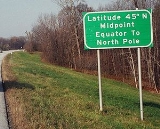
Latitude, usually denoted by the Greek letter
phiPhi , in modern Greek and or sometimes in English, is the 21st letter of the Greek alphabet. In modern Greek, it represents , a voiceless labiodental fricative. In Ancient Greek it represented , an aspirated voiceless bilabial plosive...
(φ) gives the location of a place on
EarthEarth is the third planet from the Sun. It is the fifth largest of the eight planets in the solar system, and the largest of the terrestrial planets in the Solar System in terms of diameter, mass and density...
(or other planetary body) north or south of the
equatorThe equator is the intersection of the Earth's surface with the plane perpendicular to the Earth's axis of rotation and containing the Earth's center of mass. In simpler language, it is an imaginary line on the Earth's surface equidistant from the North Pole and South Pole that divides the Earth...
.
Lines of Latitude are the imaginary horizontal lines shown running east-to-west (or west to east) on maps (particularly so in the
Mercator projectionThe Mercator projection is a cylindrical map projection presented by the Flemish geographer and cartographer Gerardus Mercator, in 1569. It became the standard map projection for nautical purposes because of its ability to represent lines of constant course, known as rhumb lines or loxodromes, as...
) that run either north or south of the equator. Technically, latitude is an
angular measurementIn geometry and trigonometry, an angle is the figure formed by two rays sharing a common endpoint, called the vertex of the angle...
in
degreesA degree , usually denoted by ° , is a measurement of plane angle, representing 1⁄360 of a full rotation; one degree is equivalent to π/180 radians...
(marked with °) ranging from 0° at the equator (low latitude) to 90° at the poles (90° N or +90° for the
North PoleThe North Pole, also known as the Geographic North Pole or Terrestrial North Pole, is, subject to the caveats explained below, defined as the point in the northern hemisphere where the Earth's axis of rotation meets the Earth's surface...
and 90° S or −90° for the
South PoleThe South Pole, also known as the Geographic South Pole or Terrestrial South Pole, is one of the two points where the Earth's axis of rotation intersects the surface. It is the southernmost point on the surface of the Earth and lies on the opposite side of the Earth from the North Pole...
). The latitude is approximately the angle between straight up at the surface (the
zenithIn general terms, the zenith is the direction pointing directly "above" a particular location; that is, it is one of two vertical directions at the location, orthogonal to a horizontal flat surface there...
) and the sun at an
equinoxAn equinox occurs twice a year, when the tilt of the Earth's axis is inclined neither away from nor towards the Sun, the Sun being vertically above a point on the Equator...
. The
complementary angleA pair of angles are complementary if the sum of their measures is 90 degrees.If the two complementary angles are adjacent their non-shared sides form a right angle....
of a latitude is called the
colatitudeIn spherical coordinates, colatitude is the complementary angle of the latitude, i.e. the difference between 90° and the latitude.-Astronomical use:The colatitude is useful in astronomy because it refers to the zenith distance of the celestial poles...
.
Circles of latitude
All locations of a given latitude are collectively referred to as a
circle of latitudeA circle of latitude, on the Earth, is an imaginary east-west circle connecting all locations that share a given latitude. A location's position along a circle of latitude is given by its longitude....
or
line of latitude or
parallel, because they are coplanar, and all such
planeIn mathematics, a plane is a flat surface. Planes can arise as subspaces of some higher dimensional space, as with the walls of a room, or they may enjoy an independent existence in their own right, as in the setting of Euclidean geometry....
s are
parallelParallelism is a term in geometry and in everyday life that refers to a property in Euclidean space of two or more lines or planes, or a combination of these. The existence and properties of parallel lines are the basis of Euclid's parallel postulate. Two lines in a plane that do not intersect or...
to the
equatorThe equator is the intersection of the Earth's surface with the plane perpendicular to the Earth's axis of rotation and containing the Earth's center of mass. In simpler language, it is an imaginary line on the Earth's surface equidistant from the North Pole and South Pole that divides the Earth...
. Lines of latitude other than the Equator are approximately
small circleA small circle of a sphere is the circle constructed by a plane crossing the sphere not in its center. Small circles always have smaller diameters than the sphere itself . Small circles cannot be parallel, because parallelism doesn't exist in spherical geometry...
s on the surface of the Earth; they are not
geodesicIn mathematics, a geodesic is a generalization of the notion of a "straight line" to "curved spaces".In the presence of a metric, geodesics are defined to be the shortest path between points on the space...
s since the shortest route between two points at the same latitude involves a path that bulges toward the nearest pole, first moving farther away from and then back toward the equator (see
great circleA great circle of a sphere is a circle that runs along the surface of that sphere so as to cut it into two equal halves, as distinct from a small circle. The great circle therefore has both the same circumference and the same center as the sphere...
).
A specific latitude may then be combined with a specific
longitudeLongitude , identified by the Greek letter lambda , is the geographic coordinate most commonly used in cartography and global navigation for east-west measurement...
to give a precise position on the Earth's surface (see satellite navigation system).
Important named circles of latitude
Besides the equator, four other lines of latitude are named because of the role they play in the geometrical relationship with the Earth and the Sun:
- Arctic Circle
The Arctic Circle is one of the five major circles of latitude that mark maps of the Earth. In , it is the parallel of latitude that runs approximately 66° 33′ 39″ north of the Equator. The region north of this circle is known as the Arctic, and the zone just to the south is called the Northern...
: 66° 33′ 39″ N
- Tropic of Cancer
The Tropic of Cancer, or the Northern tropic, is one of five major degree measures or major circles of latitude that mark maps of the Earth. It is the northmost latitude at which the sun can appear directly overhead at noon...
: 23° 26′ 21″ N
- Tropic of Capricorn
The Tropic of Capricorn, or Southern tropic, is one of the five major circles of latitude that mark maps of the Earth. It lies 23° 26′ 22″ south of the equator, and marks the most southerly latitude at which the sun can appear directly overhead at noon...
: 23° 26′ 21″ S
- Antarctic Circle
The Antarctic Circle is one of the five major circles of latitude that mark maps of the Earth. As of , it lies at latitude 66° 33′ 39″ south of the equator. The area south of the Antarctic Circle is known as the Antarctic, and the zone immediately to the north is called the Southern Temperate Zone...
: 66° 33′ 39″ S
Only at latitudes between the Tropics is it possible for the
sunThe Sun is the star at the center of the Solar System. The Earth and other matter orbit the Sun, which by itself accounts for about 99.86% of the Solar System's mass....
to be at the
zenithIn general terms, the zenith is the direction pointing directly "above" a particular location; that is, it is one of two vertical directions at the location, orthogonal to a horizontal flat surface there...
. Only north of the
Arctic CircleThe Arctic Circle is one of the five major circles of latitude that mark maps of the Earth. In , it is the parallel of latitude that runs approximately 66° 33′ 39″ north of the Equator. The region north of this circle is known as the Arctic, and the zone just to the south is called the Northern...
or south of the
Antarctic CircleThe Antarctic Circle is one of the five major circles of latitude that mark maps of the Earth. As of , it lies at latitude 66° 33′ 39″ south of the equator. The area south of the Antarctic Circle is known as the Antarctic, and the zone immediately to the north is called the Southern Temperate Zone...
is the
midnight sunThe midnight sun is a natural phenomenon occurring in summer months at latitudes north and nearby to the south of the Arctic Circle, and south and nearby to the north of the Antarctic Circle where the sun remains visible at the local midnight...
possible.
The reason that these lines have the values that they do lies in the
axial tiltIn astronomy, axial tilt is the angle between an object's rotational axis and a line perpendicular to its orbital plane. The angle is measured between the line perpendicular to object's orbital plane and object's rotational axis passing through north pole at which the planet appears to rotate...
of the Earth with respect to the sun, which is
23° 26′ 21.41″A degree , usually denoted by ° , is a measurement of plane angle, representing 1⁄360 of a full rotation; one degree is equivalent to π/180 radians...
.
Note that the Arctic Circle and Tropic of Cancer are colatitudes, since the sum of their angles is 90°—similarly for the Antarctic Circle and Tropic of Capricorn.
Subdivisions
A degree is divided into 60
minutesA minute of arc or arcminute is a unit of angular measurement, equal to one sixtieth of one degree. Since one degree is defined as one three hundred sixtieth of a circle, 1 minute of arc is 1/21,600 of the amount of arc in a closed circle...
. One minute can be further divided into 60 seconds. An example of a latitude specified in this way is 13°19'43″ N (for greater precision, a decimal fraction can be added to the seconds). An alternative representation uses only degrees and minutes, where the seconds are expressed as a decimal fraction of minutes: the above example would be expressed as 13°19.717' N. Degrees can also be expressed singularly, with both the minutes and seconds incorporated as a decimal number and rounded as desired (decimal degree notation): 13.32861° N. Sometimes, the north/south suffix is replaced by a negative sign for south (−90° for the
South PoleThe South Pole, also known as the Geographic South Pole or Terrestrial South Pole, is one of the two points where the Earth's axis of rotation intersects the surface. It is the southernmost point on the surface of the Earth and lies on the opposite side of the Earth from the North Pole...
).
Effect of latitude
A region's latitude has a great effect on its
climateClimate encompasses the statistics of temperature, humidity, atmospheric pressure, wind, rainfall, atmospheric particle count and numerous other meteorological elements in a given region over long periods of time...
and
weatherWeather is a set of all the phenomena occurring in a given atmosphere at a given time. Weather phenomena lie in the troposphere. Weather refers, generally, to day-to-day temperature and precipitation activity, whereas climate is the term for the average atmospheric conditions over longer periods...
(see
Effect of sun angle on climateThe amount of heat energy received at any location on the globe is a direct effect of sun angle of climate, as the angle at which sunlight strikes the Earth varies by location, time of day, and season due to the Earth's orbit around the sun and the Earth's revolution around its tilted axis...
). Latitude more loosely determines tendencies in polar auroras, prevailing winds, and other physical characteristics of geographic locations.
Researchers at Harvard's Center for International Development (CID) found in 2001 that only three tropical economies —
Hong KongHong Kong , officially the Hong Kong Special Administrative Region, is a highly autonomous territory of the People's Republic of China, facing Guangdong to the north and the South China Sea to the east, west and south...
,
SingaporeSingapore , officially the Republic of Singapore, is an island city-state located at the southern tip of the Malay Peninsula, lying north of the equator, south of the Malaysian state of Johor and north of Indonesia's Riau Islands. At , Singapore is a microstate and the smallest nation in Southeast...
, and
TaiwanTaiwan , also known as Formosa , is the largest island of the Republic of China in East Asia. Taiwan is located east of the Taiwan Strait, off the southeastern coast of mainland China...
— were classified as high-income by the
World BankThe World Bank is an international financial institution that provides leveraged loans to poorer countries for capital programs, tied to neoliberal market restructurings...
, while all countries within regions zoned as
temperateIn geography, temperate or tepid latitudes of the globe lie between the tropics and the polar circles. The changes in these regions between summer and winter are generally mild, rather than extreme hot or cold. But in continental areas, such as central North America the variations between summer...
had either middle- or high-income economies. The validity of the Harvard report may be questioned because a different threshold is used for the tropical regions and the World Bank list fails to include Qatar's, United Arab Emirates', and Kuwait's economies. Further, countries such as Brazil have far better incomes than much of the Former Soviet Union and Iron Curtain states.
Elliptic parameters
Because most planets (including Earth) are
ellipsoids of revolution, or spheroids, rather than
sphereA sphere is a perfectly round geometrical object in three-dimensional space, such as the shape of a round ball. Like a circle in two dimensions, a perfect sphere is completely symmetrical around its center, with all points on the surface lying the same distance r from the center point...
s, both the radius and the length of arc varies with latitude. This variation requires the introduction of elliptic parameters based on an ellipse's
angular eccentricityIn the study of ellipses and related geometry, various parameters in the distortion of a circle into an ellipse are identified and employed: Aspect ratio, flattening and eccentricity....
, (which equals , where and are the equatorial radius (6378137.0 m for Earth) and the polar radius (6356752.3142 m for Earth), respectively; is the
first eccentricityIn mathematics, the eccentricity, denoted e or , is a parameter associated with every conic section. It can be thought of as a measure of how much the conic section deviates from being circular.In particular,* The eccentricity of a circle is zero....
squared, ; and or is the
flatteningThe flattening, ellipticity, or oblateness of an oblate spheroid is the "squashing" of the spheroid's pole, towards its equator.-First and second flattening:...
, ). Utilized in creating the integrands for
curvatureIn mathematics, curvature refers to any of a number of loosely related concepts in different areas of geometry. Intuitively, curvature is the amount by which a geometric object deviates from being flat, or straight in the case of a line, but this is defined in different ways depending on the context...
is the inverse of the principal elliptic integrand, :
-
Degree length
On Earth, the length of an
arcdegreeA degree , usually denoted by ° , is a measurement of plane angle, representing 1⁄360 of a full rotation; one degree is equivalent to π/180 radians...
of north–south latitude difference, , is about 60
nautical mileThe nautical mile is a unit of length corresponding approximately to one minute of arc of latitude along any meridian....
s, 111
kilometreThe kilometre , symbol km is a unit of length in the metric system, equal to one thousand metres and is therefore exactly equal to the distance travelled by light in free space in of a second....
s or 69 statute miles at any latitude. The length of an arcdegree of east-west longitude difference, , is about the same at the equator as the north-south, reducing to zero at the poles.
In the case of a spheroid, a
meridianA meridian is an imaginary arc on the Earth's surface from the North Pole to the South Pole that connects all locations running along it with a given longitude. The position of a point on the meridian is given by the latitude. Each meridian is perpendicular to all circles of latitude at the...
and its anti-meridian form an
ellipseIn mathematics, an ellipse is the bounded case of a conic section, the geometric shape that results from cutting a circular conical or cylindrical surface with an oblique plane...
, from which an exact expression for the length of an arcdegree of latitude difference is:
This radius of arc (or "arcradius") is in the plane of a meridian, and is known as the
meridional radius of curvature, .
Similarly, an exact expression for the length of an arcdegree of longitude difference is:
The arcradius contained here is in the plane of the
prime verticalIn astronomy and astrology, the prime vertical is the vertical circle passing east and west through the zenith, and intersecting the horizon in its east and west points....
, the east-west plane perpendicular (or "
normalIn mathematics, two vectors are orthogonal if they are perpendicular, i.e., they form a right angle. The word comes from the Greek , meaning "straight", and , meaning "angle".- Definitions :...
") to both the plane of the meridian and the plane tangent to the surface of the ellipsoid, and is known as the
normal radius of curvature, .
Along the equator (east-west), equals the equatorial radius. The radius of curvature at a
right angleIn geometry and trigonometry, a right angle is an angle of 90 degrees, corresponding to a quarter turn . It can be defined as the angle such that twice that angle amounts to a half turn, or 180°....
to the equator (north-south), , is 43 km shorter, hence the length of an arcdegree of latitude difference at the equator is about 1 km less than the length of an arcdegree of longitude difference at the equator. The radii of curvature are equal at the poles where they are about 64 km greater than the north-south equatorial radius of curvature
because the polar radius is 21 km less than the equatorial radius. The shorter polar radii indicate that the northern and southern hemispheres are flatter, making their radii of curvature longer. This flattening also 'pinches' the north-south equatorial radius of curvature, making it 43 km less than the equatorial radius. Both radii of curvature are perpendicular to the plane tangent to the surface of the ellipsoid at all latitudes, directed toward a point on the polar axis in the opposite hemisphere (except at the equator where both point toward Earth's center). The east-west radius of curvature reaches the axis, whereas the north-south radius of curvature is shorter at all latitudes except the poles.
The WGS84 ellipsoid, used by all
GPSThe Global Positioning System is a U.S. space-based global navigation satellite system. It provides reliable positioning, navigation, and timing services to worldwide users on a continuous basis in all weather, day and night, anywhere on or near the Earth.GPS is made up of three parts: between 24...
devices, uses an equatorial radius of 6378137.0 m and an inverse flattening, (1/f), of 298.257223563, hence its polar radius is 6356752.3142 m and its first eccentricity squared is 0.00669437999014. The more recent but little used
IERSIERS may refer to:* International Earth Rotation and Reference Systems Service* Independent Electricity Retail Solutions Pty Ltd* Information Exchange Requirements - used within MODAF and DODAF as the OV-3 view - called Information Exchange Matrix....
2003 ellipsoid provides equatorial and polar radii of 6378136.6 and 6356751.9 m, respectively, and an inverse flattening of 298.25642. Lengths of degrees on the WGS84 and IERS 2003 ellipsoids are the same when rounded to six significant digits. An appropriate calculator for any latitude is provided by the U.S. government's
National Geospatial-Intelligence AgencyThe National Geospatial-Intelligence Agency is an agency of the United States Government with the primary mission of collection, analysis, and distribution of geospatial intelligence in support of national security. NGA was formerly known as the National Imagery and Mapping Agency and is part of...
(NGA).
| Latitude |
N-S radius of curvature |
Surface distance per 1° change in latitude |
|
E-W radius of curvature
|
Surface distance per 1° change in longitude |
| 0° |
6335.44 km |
110.574 km |
|
6378.14 km |
111.320 km |
| 15° |
6339.70 km |
110.649 km |
|
6379.57 km |
107.551 km |
| 30° |
6351.38 km |
110.852 km |
|
6383.48 km |
96.486 km |
| 45° |
6367.38 km |
111.132 km |
|
6388.84 km |
78.847 km |
| 60° |
6383.45 km |
111.412 km |
|
6394.21 km |
55.800 km |
| 75° |
6395.26 km |
111.618 km |
|
6398.15 km |
28.902 km |
| 90° |
6399.59 km |
111.694 km |
|
6399.59 km |
0.000 km |
Types of latitude
With a spheroid that is slightly flattened by its rotation, cartographers refer to a variety of auxiliary latitudes to precisely adapt spherical projections according to their purpose.
For planets other than Earth, such as
MarsMars is the fourth planet from the Sun in the Solar System. The planet is named after Mars, the Roman god of war. It is also referred to as the "Red Planet" because of its reddish appearance, due to iron oxide prevalent on its surface....
, geographic and geocentric latitude are called "planetographic" and "planetocentric" latitude, respectively. Most maps of Mars since 2002 use planetocentric coordinates.
Common "latitude"
In common usage, "latitude" refers to
geodeticGeodetic systems or geodetic data are used in geodesy, navigation, surveying by cartographers and satellite navigation systems to translate positions indicated on their products to their real position on earth....
or
geographic latitude and is the angle between the
equatorial planeThe equator is the intersection of the Earth's surface with the plane perpendicular to the Earth's axis of rotation and containing the Earth's center of mass. In simpler language, it is an imaginary line on the Earth's surface equidistant from the North Pole and South Pole that divides the Earth...
and a line that is
normalA surface normal, or simply normal, to a flat surface is a vector which is perpendicular to that surface. A normal to a non-flat surface at a point P on the surface is a vector perpendicular to the tangent plane to that surface at P. The word "normal" is also used as an adjective: a line normal to...
to the
reference ellipsoidIn geodesy, a reference ellipsoid is a mathematically-defined surface that approximates the geoid, the truer figure of the Earth, or other planetary body....
, which approximates the shape of Earth to account for flattening of the poles and bulging of the equator. This value usually differs from the geocentric latitude.
The expressions following assume elliptical polar sections and that all sections parallel to the equatorial plane are circular. Geographic latitude (with longitude) then provides a
Gauss mapIn differential geometry, the Gauss map maps a surface in Euclidean space R3 to the unit sphere S2...
. As defined earlier in this article, is the
angular eccentricityIn the study of ellipses and related geometry, various parameters in the distortion of a circle into an ellipse are identified and employed: Aspect ratio, flattening and eccentricity....
of a meridian.
Reduced latitude
- On a spheroid, lines of reduced or parametric latitude, , form circles whose radii are the same as the radii of circles formed by the corresponding lines of latitude on a sphere with radius equal to the equatorial radius of the spheroid.
Authalic latitude
- Authalic latitude, , gives an area-preserving transform to the sphere.
Rectifying latitude
- Rectifying latitude, , is the surface distance from the equator, scaled so the pole is 90°, but involves elliptic integration:
-
-
-
Conformal latitude
- Conformal latitude, , gives an angle-preserving (conformal
* A conformal mapping, in mathematics* A conformal geometry, in mathematics* A conformal map projection, in cartography* A conformal film on a surface* A conformal coating in electronics* A conformal hypergraph, in mathematics...
) transform to the sphere.
Geocentric latitude
- The geocentric latitude, , is the angle between the equatorial plane and a line from the center of Earth.
-
- It is the size of the central angle
A central angle is an angle whose vertex is the center of a circle, and whose sides pass through a pair of points on the circle, thereby subtending an arc between those two points whose angle is equal to the central angle itself...
between the equator and the point of interest, as measured along a meridianA meridian is an imaginary arc on the Earth's surface from the North Pole to the South Pole that connects all locations running along it with a given longitude. The position of a point on the meridian is given by the latitude. Each meridian is perpendicular to all circles of latitude at the...
. This value usually differs from the geographic latitude, as so:
Astronomical latitude
A more obscure measure of latitude is the
astronomical latitude, which is the angle between the equatorial plane and the
normalA surface normal, or simply normal, to a flat surface is a vector which is perpendicular to that surface. A normal to a non-flat surface at a point P on the surface is a vector perpendicular to the tangent plane to that surface at P. The word "normal" is also used as an adjective: a line normal to...
to the
geoidThe geoid is that equipotential surface which would coincide exactly with the mean ocean surface of the Earth, if the oceans were in equilibrium, at rest, and extended through the continents . According to C.F...
(ie a plumb line). It originated as the angle between horizon and pole star. It differs from the geodetic latitude only slightly, due to the slight deviations of the geoid from the reference ellipsoid.
Astronomical latitude is not to be confused with
declinationIn astronomy, declination is one of the two coordinates of the equatorial coordinate system, the other being either right ascension or hour angle. Dec is comparable to latitude, projected onto the celestial sphere, and is measured in degrees north and south of the celestial equator...
, the coordinate
astronomerAn astronomer is a scientist who studies celestial bodies such as planets, stars, and galaxies.Historically, astronomy was more concerned with the classification and description of phenomena in the sky, while astrophysics attempted to explain these phenomena and the differences between them using...
s use to describe the locations of stars north/south of the
celestial equatorThe celestial equator is a great circle on the imaginary celestial sphere, in the same plane as the Earth's equator. In other words, it is a projection of the terrestrial equator out into space...
(see equatorial coordinates), nor with ecliptic latitude, the coordinate that astronomers use to describe the locations of stars north/south of the
eclipticThe ecliptic is the apparent path that the Sun traces out in the sky during the year, appearing to move eastwards on an imaginary spherical surface, the celestial sphere, relative to the fixed stars. More accurately, it is the intersection of the celestial sphere with the ecliptic plane, which is...
(see ecliptic coordinates).
Palaeolatitude
Continents move over time, due to
continental driftContinental drift is the movement of the Earth's continents relative to each other. The hypothesis that continents 'drift' was first put forward by Abraham Ortelius in 1596 and was fully developed by Alfred Wegener in 1912...
, taking whatever fossils and other features of interest they may have with them. Particularly when discussing fossils, it's often more useful to know where the fossil was when it was laid down, than where it is when it was dug up: this is called the
palæolatitude of the fossil. The Palæolatitude can be constrained by palæomagnetic data. If tiny magnetisable grains are present when the rock is being formed, these will align themselves with Earth's magnetic field like compass needles. A
magnetometerA magnetometer is a scientific instrument used to measure the strength and/or direction of the magnetic field in the vicinity of the instrument. Magnetism varies from place to place and differences in Earth's magnetic field can be caused by the differing nature of rocks and the interaction...
can deduce the orientation of these grains by subjecting a sample to a magnetic field, and the
magnetic declinationThe magnetic declination at any point on the Earth is the angle between the local magnetic field—the direction the north end of a compass points—and true north. The declination is positive when the magnetic north is east of true north...
of the grains can be used to infer the latitude of deposition.
Comparison of selected types
The following plot shows the differences between the types of latitude. The data used are found in the table following the plot. Please note that the values in the table are in minutes, not degrees, and the plot reflects this as well. Also observe that the conformal symbols are hidden behind the geocentric due to being very close in value. Finally it is important to mention also that these differences don't mean that the use of one specific latitude will necessarily cause more distortions than the other (the real fact is that each latitude type is optimized for achieving a different goal).
| Approximate difference from geographic latitude ("Lat") |
Lat
|
Reduced
|
Authalic
|
Rectifying
|
Conformal
|
Geocentric
|
| 0° |
0.00′ |
0.00′ |
0.00′ |
0.00′ |
0.00′ |
| 5° |
1.01′ |
1.35′ |
1.52′ |
2.02′ |
2.02′ |
| 10° |
1.99′ |
2.66′ |
2.99′ |
3.98′ |
3.98′ |
| 15° |
2.91′ |
3.89′ |
4.37′ |
5.82′ |
5.82′ |
| 20° |
3.75′ |
5.00′ |
5.62′ |
7.48′ |
7.48′ |
| 25° |
4.47′ |
5.96′ |
6.70′ |
8.92′ |
8.92′ |
| 30° |
5.05′ |
6.73′ |
7.57′ |
10.09′ |
10.09′ |
| 35° |
5.48′ |
7.31′ |
8.22′ |
10.95′ |
10.96′ |
| 40° |
5.75′ |
7.66′ |
8.62′ |
11.48′ |
11.49′ |
| 45° |
5.84′ |
7.78′ |
8.76′ |
11.67′ |
11.67′ |
| 50° |
5.75′ |
7.67′ |
8.63′ |
11.50′ |
11.50′ |
| 55° |
5.49′ |
7.32′ |
8.23′ |
10.97′ |
10.98′ |
| 60° |
5.06′ |
6.75′ |
7.59′ |
10.12′ |
10.13′ |
| 65° |
4.48′ |
5.97′ |
6.72′ |
8.95′ |
8.96′ |
| 70° |
3.76′ |
5.01′ |
5.64′ |
7.52′ |
7.52′ |
| 75° |
2.92′ |
3.90′ |
4.39′ |
5.85′ |
5.85′ |
| 80° |
2.00′ |
2.67′ |
3.00′ |
4.00′ |
4.01′ |
| 85° |
1.02′ |
1.35′ |
1.52′ |
2.03′ |
2.03′ |
| 90° |
0.00′ |
0.00′ |
0.00′ |
0.00′ |
0.00′ |
Corrections for altitude
When converting from geodetic ("common") latitude to other types of latitude, corrections must be made for altitude for systems which do not measure the angle from the
normalA surface normal, or simply normal, to a flat surface is a vector which is perpendicular to that surface. A normal to a non-flat surface at a point P on the surface is a vector perpendicular to the tangent plane to that surface at P. The word "normal" is also used as an adjective: a line normal to...
of the
spheroidA spheroid is a quadric surface obtained by rotating an ellipse about one of its principal axes; in other words, an ellipsoid with two equal semi-diameters....
. For example, in the figure at right, point
H (located on the surface of the spheroid) and point
H' (located at some greater elevation) have different
geocentric latitudes (angles
β and
γ respectively), even though they share the same
geodetic latitude (angle
α). Note that the flatness of the spheroid and elevation of point
H' in the image is significantly greater than what is found on the Earth, exaggerating the errors inherent in such calculations if left uncorrected. Note also that the
reference ellipsoidIn geodesy, a reference ellipsoid is a mathematically-defined surface that approximates the geoid, the truer figure of the Earth, or other planetary body....
used in the geodetic system is itself just an approximation of the true
geoidThe geoid is that equipotential surface which would coincide exactly with the mean ocean surface of the Earth, if the oceans were in equilibrium, at rest, and extended through the continents . According to C.F...
, and therefore introduces its own errors, though the differences are less severe. (See Astronomical latitude, above.)
External links
- Free GeoCoder
- GEONets Names Server, access to the National Geospatial-Intelligence Agency
The National Geospatial-Intelligence Agency is an agency of the United States Government with the primary mission of collection, analysis, and distribution of geospatial intelligence in support of national security. NGA was formerly known as the National Imagery and Mapping Agency and is part of...
's (NGA) database of foreign geographic feature names.
- Look-up Latitude and Longitude
- Resources for determining your latitude and longitude
- Convert decimal degrees into degrees, minutes, seconds - Info about decimal to sexagesimal
Sexagesimal is a numeral system with sixty as the base. It originated with the ancient Sumerians in the 2000s BCE, was transmitted to the Babylonians, and is still used—in modified form—for measuring time, angles, and geographic coordinates....
conversion
- Convert decimal degrees into degrees, minutes, seconds
- Latitude and longitude converter – Convert latitude and longitude from degree, decimal form to degree, minutes, seconds form and vice versa. Also included a farthest point and a distance calculator.
- Worldwide Index - Tageo.com – contains 2,700,000 coordinates of places including US towns
- for each city it gives the satellite map location, country, province, coordinates (dd,dms), variant names and nearby places.
- Distance calculation based on latitude and longitude - JavaScript version
- Average Latitude & Longitude of Countries
- Get the latitude and longitude of any place in the World
- Latitude / Longitude Converter – convert latitude / longitude between DMS and decimal formats.
- Determination of Latitude by Francis Drake on the Coast of California in 1579
- Length Of A Degree Of Latitude and Longitude Calculator - for any latitude, calculates 1 degree in meters, feet, and miles