


Floorball

Encyclopedia
Floorball, a type of floor hockey
, is an indoor team sport
which was developed in the 1970s in Sweden. Floorball is most popular in areas where the sport has developed the longest, such as the Czech Republic
, Denmark
, Estonia
, Finland
, Latvia
, Norway
, Sweden
and Switzerland
. The game is played indoors on a gym floor, making it a year-round sport at the amateur and professional levels. There are professional leagues, such as Finland
's Salibandyliiga
and Sweden
's Svenska Superligan.
While there are 52 members of the International Floorball Federation
(IFF), the Czech Republic
, Finland
, Sweden
and Switzerland
have finished in most of the coveted 1st, 2nd and 3rd places at the Floorball World Championships
.
In addition to those four countries, floorball is gaining popularity in countries such as Latvia
, Australia
, Canada
, Germany
, Japan
, Singapore
, Malaysia and the United States
.
 The game is believed to have originated in Gothenburg
, Sweden
. The sport began as something that was played for fun as a pastime at schools, and pre-season training for bandy
clubs. After a decade or so, floorball began showing up in Scandinavia countries such as Finland, Norway
and Sweden, where the once school pastime was becoming a developed sport. Formal rules soon were developed, and clubs began to form. After some time, several countries developed national associations, and the IFF was founded in 1986.
The game of floorball is also known by many other names, such as salibandy (in Finland), innebandy (in Sweden and Norway), and unihockey (in Switzerland and Germany). The names "salibandy" and "innebandy" are derived from bandy
; both of those names literally translate to "indoor bandy". Unihockey is derived from "universal hockey" since it is meant to be a special and simplified hockey form.
n countries, Japan
, and several parts of Europe
. By 1990, floorball was recognized in 7 countries, and by the time of the first European Floorball Championships in 1994, that number had risen to 14. That number included the United States
, who were the first country outside of Europe and Asia
to recognize floorball. By the time of the first men's world championships
in 1996, 20 nations played floorball, with 12 of them participating at the tournament.
As of 2009, the sport of floorball has been played in almost 80 countries. Of those, 51 have national floorball associations that are recognized by the IFF. With the addition of Sierra Leone
, Africa
's first floorball nation, the IFF has at least one national association on each continent
of the world, with the exception of Antarctica.
, Sweden. In addition to that, the world's two largest floorball leagues, Finland's Salibandyliiga and Sweden's Svenska Superligan were formed, in 1986 and 1995 respectively.
(IOC). The IFF hopes that this provisional recognition will help allow floorball to become a part of the 2020 Summer Olympics
.
In January 2009, the IFF and the sport of floorball received recognition from Special Olympics
. This recognition could make floorball an official Special Olympics sport in just two years. As well, the IFF hopes that floorball will be included as a demonstration sport at the 2013 Special Olympics World Winter Games.
In addition to recognition by the International Olympic Committee and Special Olympics, the IFF is also a member of the General Association of International Sports Federations (GAISF), and co-operates with the International University Sports Federation
(FISU).

The world floorball championships are a semi-annual event where teams from across the world gather to play in a tournament in order to win the world championship. As of 2009, seven men's, as well as six women's, four men's under-19, and three women's under-19 world floorball championships have taken place. The Czech Republic, Finland, Norway Sweden, and Switzerland remain the only five countries to have ever captured a medal at a World Championship event. A floorball world championship is awarded twice a year, and bi-annually in each age group.
From 1996 to 2009, the IFF will use a world floorball championship format where the last team in the A-Division is relegated to the B-Division, while the top team in the B-Division is promoted to the A-Division. This format caused much hardship for countries such as Australia, Canada
, Slovakia, and Spain, who have all been trying to get to the B-Division from the C-Division since 2004. In 2010, the IFF plans to adopt a FIFA
-like continental qualification system, where teams must qualify to play at the world championships. Depending on the number of countries registered per continent
or region, the IFF gives spots for the world championships. For example, Argentina, Brazil, Canada
and the United States would need to play for one spot at the world championships in a continental qualification tournament for the Americas.
A floorball player is also known as a "floorballer".
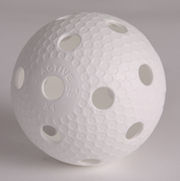 In floorball, the objective is to get a plastic whiffle ball into a net with the aid of the stick past a goaltender. A floor ball weighs 23 grams and its diameter is 72 mm. It has 26 holes in it; each of which are 11 mm in diameter. Many of these balls now are made with aerodynamic technology, where the ball has over a thousand small dimples in it that reduce air resistance. There have been several times where a ball has been recorded to have traveled at a speed of approximately 205 km/h.
. But the coach
can take the goalkeeper for a short amount of time, and switch him with an outplayer. This can make advantages for the attacking side of the team, and disadvantages when it comes to their own defence. The team is also allowed to change players any time ingame, usually they change the whole team. Individual substitution happens sometimes, but it usually happens when a player is exhausted or is hurt.
A floorball game is officially played over three periods lasting 20 minutes each (15 minutes for juniors). The time is stopped in the case of penalties, goals, time-outs and any situation where the ball is not considered to be in play. An intermission of 3–10 minutes takes place between each period, where teams change ends and substitution areas. Each team is allowed a timeout of 30 seconds (which is often used late in matches). There are two referee
s to oversee the game, each with equal authority.
Checking
is disallowed in floorball. Controlled shoulder-to-shoulder contact is allowed, but ice hockey
-like checking is forbidden. Pushing players without the ball or competing for a loose ball is also disallowed, and many of these infractions lead to two minute penalties. The best comparison in terms of legal physical contact is soccer, where checking is used to improve one's positioning in relation to the ball rather than to remove an opposing player from the play. In addition to checking, players cannot lift another opponents stick or perform any stick infractions in order to get to the ball. As well, players may not raise their stick or play the ball above their knee level, and a stick cannot be placed in between a player's legs (to avoid tripping).
When a player commits a foul, or when the ball is deemed unplayable, play is resumed from a face-off or a free hit. A free hit involves a player from one team to start play from the place where the ball was last deemed unplayable. A comparison of this is a free kick in soccer. For many fouls, such as stick infractions, a free hit is the only discipline provided. However, at the referee's discretion, a penalty may be worth either two or five minutes. At that point, the player who committed the foul sits in the penalty area, and his team is short handed for the time of the penalty. If an 'extreme' foul is committed, such as physical contact or unsportsmanlike behavior, a player may receive a 10 minute penalty or even a match misconduct.
The first ever IFF-sanctioned wheelchair floorball matches were played between the men's teams of the Czech Republic and Sweden, during the 2008 Men's World Floorball Championships
in Prague
, Czech Republic.
In addition to this, there is also an electric wheelchair variation.
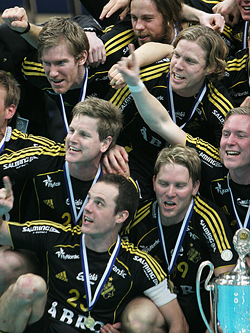 In addition to the world floorball championships
, there are many international floorball club competitions.
together with the cooperation of the Asia Oceania Floorball Confederation
(AOFC). Members of the AOFC get together during this tournament to play for the Asia Pacific Floorball Championship every year. The most recent champions are Japan.
As of 2010, the Asia Pacific Floorball Championship is also the qualifying tournament for the Floorball World Championships
.
is an international club tournament that is held every year in Toronto
, Canada
. It is the largest floorball club tournament outside of Europe, and attracts 55+ clubs from worldwide, every year. The winners of the 2010
tournament were Toronto
's Salming Vikings floorball club.
, USA. It is a part of NAFC series with Canada Cup
and Falls floorball classic.
, Falls floorball classic and USA Cup. Teams must attend at least one tournament in Canada and one in the United States with a roster that is made up of at least 50% of the same players and using the same club name to be eligible.
.
, Sweden (men) and IKSU Innebandy, Sweden (women).
Floor hockey
Floor hockey is a family of indoor hockey games, usually in the style of ice hockey, that are played on flat floor surfaces, such as a basketball court. As in other hockey codes, players on each team attempt to shoot a ball or puck into a goal using sticks, usually with a curved end...
, is an indoor team sport
Sport
A Sport is all forms of physical activity which, through casual or organised participation, aim to use, maintain or improve physical fitness and provide entertainment to participants. Sport may be competitive, where a winner or winners can be identified by objective means, and may require a degree...
which was developed in the 1970s in Sweden. Floorball is most popular in areas where the sport has developed the longest, such as the Czech Republic
Czech Republic
The Czech Republic is a landlocked country in Central Europe. The country is bordered by Poland to the northeast, Slovakia to the east, Austria to the south, and Germany to the west and northwest....
, Denmark
Denmark
Denmark is a Scandinavian country in Northern Europe. The countries of Denmark and Greenland, as well as the Faroe Islands, constitute the Kingdom of Denmark . It is the southernmost of the Nordic countries, southwest of Sweden and south of Norway, and bordered to the south by Germany. Denmark...
, Estonia
Estonia
Estonia , officially the Republic of Estonia , is a state in the Baltic region of Northern Europe. It is bordered to the north by the Gulf of Finland, to the west by the Baltic Sea, to the south by Latvia , and to the east by Lake Peipsi and the Russian Federation . Across the Baltic Sea lies...
, Finland
Finland
Finland , officially the Republic of Finland, is a Nordic country situated in the Fennoscandian region of Northern Europe. It is bordered by Sweden in the west, Norway in the north and Russia in the east, while Estonia lies to its south across the Gulf of Finland.Around 5.4 million people reside...
, Latvia
Latvia
Latvia , officially the Republic of Latvia , is a country in the Baltic region of Northern Europe. It is bordered to the north by Estonia , to the south by Lithuania , to the east by the Russian Federation , to the southeast by Belarus and shares maritime borders to the west with Sweden...
, Norway
Norway
Norway , officially the Kingdom of Norway, is a Nordic unitary constitutional monarchy whose territory comprises the western portion of the Scandinavian Peninsula, Jan Mayen, and the Arctic archipelago of Svalbard and Bouvet Island. Norway has a total area of and a population of about 4.9 million...
, Sweden
Sweden
Sweden , officially the Kingdom of Sweden , is a Nordic country on the Scandinavian Peninsula in Northern Europe. Sweden borders with Norway and Finland and is connected to Denmark by a bridge-tunnel across the Öresund....
and Switzerland
Switzerland
Switzerland name of one of the Swiss cantons. ; ; ; or ), in its full name the Swiss Confederation , is a federal republic consisting of 26 cantons, with Bern as the seat of the federal authorities. The country is situated in Western Europe,Or Central Europe depending on the definition....
. The game is played indoors on a gym floor, making it a year-round sport at the amateur and professional levels. There are professional leagues, such as Finland
Finland
Finland , officially the Republic of Finland, is a Nordic country situated in the Fennoscandian region of Northern Europe. It is bordered by Sweden in the west, Norway in the north and Russia in the east, while Estonia lies to its south across the Gulf of Finland.Around 5.4 million people reside...
's Salibandyliiga
Salibandyliiga
The Salibandyliiga is the top floorball league in the country of Finland. There are men's and women's divisions, and the winner at the end of each season is presented with a national championship. The league was founded in 1986, but has only been referred to as the salibandyliiga since 1994...
and Sweden
Sweden
Sweden , officially the Kingdom of Sweden , is a Nordic country on the Scandinavian Peninsula in Northern Europe. Sweden borders with Norway and Finland and is connected to Denmark by a bridge-tunnel across the Öresund....
's Svenska Superligan.
While there are 52 members of the International Floorball Federation
International Floorball Federation
The International Floorball Federation is the worldwide governing body for the sport of floorball. It was founded in 1986 in Huskvarna, Sweden, by the national floorball associations of Finland, Sweden and Switzerland. As of March 2011, it had 52 member associations, with 3,983 clubs and 277,752...
(IFF), the Czech Republic
Czech Republic
The Czech Republic is a landlocked country in Central Europe. The country is bordered by Poland to the northeast, Slovakia to the east, Austria to the south, and Germany to the west and northwest....
, Finland
Finland
Finland , officially the Republic of Finland, is a Nordic country situated in the Fennoscandian region of Northern Europe. It is bordered by Sweden in the west, Norway in the north and Russia in the east, while Estonia lies to its south across the Gulf of Finland.Around 5.4 million people reside...
, Sweden
Sweden
Sweden , officially the Kingdom of Sweden , is a Nordic country on the Scandinavian Peninsula in Northern Europe. Sweden borders with Norway and Finland and is connected to Denmark by a bridge-tunnel across the Öresund....
and Switzerland
Switzerland
Switzerland name of one of the Swiss cantons. ; ; ; or ), in its full name the Swiss Confederation , is a federal republic consisting of 26 cantons, with Bern as the seat of the federal authorities. The country is situated in Western Europe,Or Central Europe depending on the definition....
have finished in most of the coveted 1st, 2nd and 3rd places at the Floorball World Championships
Floorball World Championships
The Floorball World Championships are a biannual event organized by the International Floorball Federation . They were preceded by the European Championships which were held twice in 1994 and 1995....
.
In addition to those four countries, floorball is gaining popularity in countries such as Latvia
Latvia
Latvia , officially the Republic of Latvia , is a country in the Baltic region of Northern Europe. It is bordered to the north by Estonia , to the south by Lithuania , to the east by the Russian Federation , to the southeast by Belarus and shares maritime borders to the west with Sweden...
, Australia
Australia
Australia , officially the Commonwealth of Australia, is a country in the Southern Hemisphere comprising the mainland of the Australian continent, the island of Tasmania, and numerous smaller islands in the Indian and Pacific Oceans. It is the world's sixth-largest country by total area...
, Canada
Canada
Canada is a North American country consisting of ten provinces and three territories. Located in the northern part of the continent, it extends from the Atlantic Ocean in the east to the Pacific Ocean in the west, and northward into the Arctic Ocean...
, Germany
Germany
Germany , officially the Federal Republic of Germany , is a federal parliamentary republic in Europe. The country consists of 16 states while the capital and largest city is Berlin. Germany covers an area of 357,021 km2 and has a largely temperate seasonal climate...
, Japan
Japan
Japan is an island nation in East Asia. Located in the Pacific Ocean, it lies to the east of the Sea of Japan, China, North Korea, South Korea and Russia, stretching from the Sea of Okhotsk in the north to the East China Sea and Taiwan in the south...
, Singapore
Singapore
Singapore , officially the Republic of Singapore, is a Southeast Asian city-state off the southern tip of the Malay Peninsula, north of the equator. An island country made up of 63 islands, it is separated from Malaysia by the Straits of Johor to its north and from Indonesia's Riau Islands by the...
, Malaysia and the United States
United States
The United States of America is a federal constitutional republic comprising fifty states and a federal district...
.
History
Gothenburg
Gothenburg is the second-largest city in Sweden and the fifth-largest in the Nordic countries. Situated on the west coast of Sweden, the city proper has a population of 519,399, with 549,839 in the urban area and total of 937,015 inhabitants in the metropolitan area...
, Sweden
Sweden
Sweden , officially the Kingdom of Sweden , is a Nordic country on the Scandinavian Peninsula in Northern Europe. Sweden borders with Norway and Finland and is connected to Denmark by a bridge-tunnel across the Öresund....
. The sport began as something that was played for fun as a pastime at schools, and pre-season training for bandy
Bandy
Bandy is a team winter sport played on ice, in which skaters use sticks to direct a ball into the opposing team's goal.The rules of the game have many similarities to those of association football: the game is played on a rectangle of ice the same size as a football field. Each team has 11 players,...
clubs. After a decade or so, floorball began showing up in Scandinavia countries such as Finland, Norway
Norway
Norway , officially the Kingdom of Norway, is a Nordic unitary constitutional monarchy whose territory comprises the western portion of the Scandinavian Peninsula, Jan Mayen, and the Arctic archipelago of Svalbard and Bouvet Island. Norway has a total area of and a population of about 4.9 million...
and Sweden, where the once school pastime was becoming a developed sport. Formal rules soon were developed, and clubs began to form. After some time, several countries developed national associations, and the IFF was founded in 1986.
The game of floorball is also known by many other names, such as salibandy (in Finland), innebandy (in Sweden and Norway), and unihockey (in Switzerland and Germany). The names "salibandy" and "innebandy" are derived from bandy
Bandy
Bandy is a team winter sport played on ice, in which skaters use sticks to direct a ball into the opposing team's goal.The rules of the game have many similarities to those of association football: the game is played on a rectangle of ice the same size as a football field. Each team has 11 players,...
; both of those names literally translate to "indoor bandy". Unihockey is derived from "universal hockey" since it is meant to be a special and simplified hockey form.
Expansion
When the IFF was founded in 1986, the sport was played in mostly ScandinaviaScandinavia
Scandinavia is a cultural, historical and ethno-linguistic region in northern Europe that includes the three kingdoms of Denmark, Norway and Sweden, characterized by their common ethno-cultural heritage and language. Modern Norway and Sweden proper are situated on the Scandinavian Peninsula,...
n countries, Japan
Japan
Japan is an island nation in East Asia. Located in the Pacific Ocean, it lies to the east of the Sea of Japan, China, North Korea, South Korea and Russia, stretching from the Sea of Okhotsk in the north to the East China Sea and Taiwan in the south...
, and several parts of Europe
Europe
Europe is, by convention, one of the world's seven continents. Comprising the westernmost peninsula of Eurasia, Europe is generally 'divided' from Asia to its east by the watershed divides of the Ural and Caucasus Mountains, the Ural River, the Caspian and Black Seas, and the waterways connecting...
. By 1990, floorball was recognized in 7 countries, and by the time of the first European Floorball Championships in 1994, that number had risen to 14. That number included the United States
United States Floorball Association
The United States Floorball Association is the highest governing body for floorball in the United States of America. The USFbA is a self-governed organization, recognized by both state and federal governments. It is based in Fresno, California....
, who were the first country outside of Europe and Asia
Asia
Asia is the world's largest and most populous continent, located primarily in the eastern and northern hemispheres. It covers 8.7% of the Earth's total surface area and with approximately 3.879 billion people, it hosts 60% of the world's current human population...
to recognize floorball. By the time of the first men's world championships
1996 Men's World Floorball Championships
The 1996 Men's Floorball Championships were the first world championships in men's floorball. It was held in May 1996 in Sweden, and was won by the host nation...
in 1996, 20 nations played floorball, with 12 of them participating at the tournament.
As of 2009, the sport of floorball has been played in almost 80 countries. Of those, 51 have national floorball associations that are recognized by the IFF. With the addition of Sierra Leone
Sierra Leone
Sierra Leone , officially the Republic of Sierra Leone, is a country in West Africa. It is bordered by Guinea to the north and east, Liberia to the southeast, and the Atlantic Ocean to the west and southwest. Sierra Leone covers a total area of and has an estimated population between 5.4 and 6.4...
, Africa
Africa
Africa is the world's second largest and second most populous continent, after Asia. At about 30.2 million km² including adjacent islands, it covers 6% of the Earth's total surface area and 20.4% of the total land area...
's first floorball nation, the IFF has at least one national association on each continent
Continent
A continent is one of several very large landmasses on Earth. They are generally identified by convention rather than any strict criteria, with seven regions commonly regarded as continents—they are : Asia, Africa, North America, South America, Antarctica, Europe, and Australia.Plate tectonics is...
of the world, with the exception of Antarctica.
Development
10 years after the IFF was founded, the first world championships were played, with a sold out final of 15,106 people at the Globen in StockholmStockholm
Stockholm is the capital and the largest city of Sweden and constitutes the most populated urban area in Scandinavia. Stockholm is the most populous city in Sweden, with a population of 851,155 in the municipality , 1.37 million in the urban area , and around 2.1 million in the metropolitan area...
, Sweden. In addition to that, the world's two largest floorball leagues, Finland's Salibandyliiga and Sweden's Svenska Superligan were formed, in 1986 and 1995 respectively.
Recognition
In December 2008, the IFF and the sport of floorball received recognition from the International Olympic CommitteeInternational Olympic Committee
The International Olympic Committee is an international corporation based in Lausanne, Switzerland, created by Pierre de Coubertin on 23 June 1894 with Demetrios Vikelas as its first president...
(IOC). The IFF hopes that this provisional recognition will help allow floorball to become a part of the 2020 Summer Olympics
2020 Summer Olympics
The 2020 Summer Olympics, officially known as the Games of the XXXII Olympiad, will be a major international sports and cultural festival, celebrated in the tradition of the Olympic Games....
.
In January 2009, the IFF and the sport of floorball received recognition from Special Olympics
Special Olympics
Special Olympics is the world's largest sports organization for children and adults with intellectual disabilities, providing year-round training and competitions to more than 3.1 million athletes in 175 countries....
. This recognition could make floorball an official Special Olympics sport in just two years. As well, the IFF hopes that floorball will be included as a demonstration sport at the 2013 Special Olympics World Winter Games.
In addition to recognition by the International Olympic Committee and Special Olympics, the IFF is also a member of the General Association of International Sports Federations (GAISF), and co-operates with the International University Sports Federation
International University Sports Federation
The Fédération Internationale du Sport Universitaire , based in Brussels, Belgium is responsible for the organisation and governance of worldwide competitions for student-athletes between the ages of 17 and 28...
(FISU).
World championships
The world floorball championships are a semi-annual event where teams from across the world gather to play in a tournament in order to win the world championship. As of 2009, seven men's, as well as six women's, four men's under-19, and three women's under-19 world floorball championships have taken place. The Czech Republic, Finland, Norway Sweden, and Switzerland remain the only five countries to have ever captured a medal at a World Championship event. A floorball world championship is awarded twice a year, and bi-annually in each age group.
- The Men's World Floorball Championships take place every December (since 2008) in every even year.
- The Women's World Floorball Championships take place every December (since 2009) in every odd year.
- The Men's under-19 World Floorball Championships take place every May (since 2009) in every odd year.
- The Women's under-19 World Floorball Championships take place every May (since 2008) in every even year.
From 1996 to 2009, the IFF will use a world floorball championship format where the last team in the A-Division is relegated to the B-Division, while the top team in the B-Division is promoted to the A-Division. This format caused much hardship for countries such as Australia, Canada
Men's national floorball team of Canada
The Canada men's national floorball team is the men's national floorball team of Canada, and a member of the International Floorball Federation . Canada's men's team is currently ranked 11th in the world at floorball following their result at the 2010 Men's World Floorball Championships...
, Slovakia, and Spain, who have all been trying to get to the B-Division from the C-Division since 2004. In 2010, the IFF plans to adopt a FIFA
FIFA
The Fédération Internationale de Football Association , commonly known by the acronym FIFA , is the international governing body of :association football, futsal and beach football. Its headquarters are located in Zurich, Switzerland, and its president is Sepp Blatter, who is in his fourth...
-like continental qualification system, where teams must qualify to play at the world championships. Depending on the number of countries registered per continent
Continent
A continent is one of several very large landmasses on Earth. They are generally identified by convention rather than any strict criteria, with seven regions commonly regarded as continents—they are : Asia, Africa, North America, South America, Antarctica, Europe, and Australia.Plate tectonics is...
or region, the IFF gives spots for the world championships. For example, Argentina, Brazil, Canada
Men's national floorball team of Canada
The Canada men's national floorball team is the men's national floorball team of Canada, and a member of the International Floorball Federation . Canada's men's team is currently ranked 11th in the world at floorball following their result at the 2010 Men's World Floorball Championships...
and the United States would need to play for one spot at the world championships in a continental qualification tournament for the Americas.
Measurements
Floorball is played indoors on a rink whose size can officially vary from 18–22 meters wide to 36–44 meters long. The rink is surrounded by 50 cm high enclosed boards with rounded corners. The goals are 160 cm wide and 115 cm high. Their depth is 65 cm and they are 2.85 meters from the end of the nearest boards.Field players
Typical equipment for a floorball player consists of a pair of shorts, a shirt, socks and indoor sport shoes. In addition to that, players are allowed to wear shin guards, eye protectors and protective padding for vital areas. Players, except for the goalkeeper, also carry sticks.A floorball player is also known as a "floorballer".
Sticks
A floorball stick is short compared with ice hockey; the maximum size for a stick is 114 cm. As a stick cannot weigh any more than 350 grams, floorball manufacturers produce sticks that are often made of carbon and composite materials.Goalkeepers
Goalkeepers wear protection that is very limited; padded pants, a padded chest protector, and a helmet. The goalkeeper can also wear other protective equipment, but bulky padding is not permitted. Some of this other protective equipment includes knee pads, jocks, and gloves.Ball
Rules
Each team can field six players at a time on the court, one player being a goalkeeperGoalkeeper
In many team sports which involve scoring goals, a goalkeeper is a designated player charged with directly preventing the opposing team from scoring by intercepting shots at goal...
. But the coach
Coach (sport)
In sports, a coach is an individual involved in the direction, instruction and training of the operations of a sports team or of individual sportspeople.-Staff:...
can take the goalkeeper for a short amount of time, and switch him with an outplayer. This can make advantages for the attacking side of the team, and disadvantages when it comes to their own defence. The team is also allowed to change players any time ingame, usually they change the whole team. Individual substitution happens sometimes, but it usually happens when a player is exhausted or is hurt.
A floorball game is officially played over three periods lasting 20 minutes each (15 minutes for juniors). The time is stopped in the case of penalties, goals, time-outs and any situation where the ball is not considered to be in play. An intermission of 3–10 minutes takes place between each period, where teams change ends and substitution areas. Each team is allowed a timeout of 30 seconds (which is often used late in matches). There are two referee
Referee
A referee is the person of authority, in a variety of sports, who is responsible for presiding over the game from a neutral point of view and making on the fly decisions that enforce the rules of the sport...
s to oversee the game, each with equal authority.
Checking
Checking (ice hockey)
Checking in ice hockey is any one of a number of defensive techniques. It is usually not a penalty.- Types :There are various types of checking:...
is disallowed in floorball. Controlled shoulder-to-shoulder contact is allowed, but ice hockey
Ice hockey
Ice hockey, often referred to as hockey, is a team sport played on ice, in which skaters use wooden or composite sticks to shoot a hard rubber puck into their opponent's net. The game is played between two teams of six players each. Five members of each team skate up and down the ice trying to take...
-like checking is forbidden. Pushing players without the ball or competing for a loose ball is also disallowed, and many of these infractions lead to two minute penalties. The best comparison in terms of legal physical contact is soccer, where checking is used to improve one's positioning in relation to the ball rather than to remove an opposing player from the play. In addition to checking, players cannot lift another opponents stick or perform any stick infractions in order to get to the ball. As well, players may not raise their stick or play the ball above their knee level, and a stick cannot be placed in between a player's legs (to avoid tripping).
When a player commits a foul, or when the ball is deemed unplayable, play is resumed from a face-off or a free hit. A free hit involves a player from one team to start play from the place where the ball was last deemed unplayable. A comparison of this is a free kick in soccer. For many fouls, such as stick infractions, a free hit is the only discipline provided. However, at the referee's discretion, a penalty may be worth either two or five minutes. At that point, the player who committed the foul sits in the penalty area, and his team is short handed for the time of the penalty. If an 'extreme' foul is committed, such as physical contact or unsportsmanlike behavior, a player may receive a 10 minute penalty or even a match misconduct.
Freebandy
Freebandy is a sport that developed in the 2000s from floorball fanatics who specialize in a technique called "zorro", which involves lifting the ball onto a stick and allowing air resistance and fast movements to keep the ball "stuck" to the stick. This technique is also referred to as "airhooking" or "skyhooking". In freebandy, the rules are very much the same of those of floorball, with the exception of high nets and no infractions for high sticking. As well, the sticks are slightly tweaked from those of a floorball variety to include a "pocket" where the ball can be placed.Special Olympics
Floorball at the Special Olympics is slightly modified from the "regular" form of floorball. Matches are played 3-on-3 with a goaltender, on a smaller court that measures 20 meters long by 12 meters wide. This form of floorball was developed for the intellectually disabled, and has yet to be played at the Special Olympics. There is a strong possibility that it will be played at the 2013 Special Olympics World Winter Games.Streetbandy
Streetbandy is a form of floorball that is often played outside. It is usually played on a smaller court, and may involve players playing from 1-on-1 to 5-on-5. Goaltenders do not play in this type of floorball, as the nets are very small (household garbage cans are sometimes used).Swiss floorball
Swiss floorball is a revised version of a floorball match. The match is played on a slightly smaller court and often involves only three field players playing on each side, in 3-on-3 floorball. This form of floorball is also slightly shorter, with only two periods of 15 to 20 minutes each played. In Switzerland this form of playing is called "smallcourt" (Kleinfeld), opposed to the usual style of playing on a bigger court, which is called "bigcourt" (Grossfeld).Wheelchair floorball
Originally developed for players with disabilities, wheelchair floorball is played with exactly the same rules as "regular" floorball. Players use the same stick and ball, and goaltenders are also allowed to play.The first ever IFF-sanctioned wheelchair floorball matches were played between the men's teams of the Czech Republic and Sweden, during the 2008 Men's World Floorball Championships
2008 Men's World Floorball Championships
The 2008 Men's World Floorball Championships were the seventh world championships in men's floorball. The tournament was held from December 6th to December 14th, 2008. The tournament took place in the cities of Prague and Ostrava...
in Prague
Prague
Prague is the capital and largest city of the Czech Republic. Situated in the north-west of the country on the Vltava river, the city is home to about 1.3 million people, while its metropolitan area is estimated to have a population of over 2.3 million...
, Czech Republic.
In addition to this, there is also an electric wheelchair variation.
Competitions
Floorball World Championships
The Floorball World Championships are a biannual event organized by the International Floorball Federation . They were preceded by the European Championships which were held twice in 1994 and 1995....
, there are many international floorball club competitions.
Asia Pacific Floorball Championship
The Asia Pacific Floorball Championships are played every single year in Australia, Singapore, or Japan. The event was created by the Singapore Floorball AssociationSingapore Floorball Association
Floorball was introduced to Singapore around 1993 and the Singapore Floorball Association was formed in 1995 due to the overwhelming interest of the game amongst Singaporeans.-Competitions organised:*Singapore Floorball League**Men***Division 1...
together with the cooperation of the Asia Oceania Floorball Confederation
Asia Oceania Floorball Confederation
The Asia Oceania Floorball Confederation is a floorball confederation consisting of 10 nations spanning across 2 continents, Asia and Oceania.The AOFC organizes the men's and women's Asia Pacific Floorball Championships every year.-History:...
(AOFC). Members of the AOFC get together during this tournament to play for the Asia Pacific Floorball Championship every year. The most recent champions are Japan.
As of 2010, the Asia Pacific Floorball Championship is also the qualifying tournament for the Floorball World Championships
Floorball World Championships
The Floorball World Championships are a biannual event organized by the International Floorball Federation . They were preceded by the European Championships which were held twice in 1994 and 1995....
.
Canada Cup
The Canada CupCanada Cup (floorball)
The Canada Cup Floorball Championship, more commonly referred to as The Canada Cup, is an international floorball club open competition held annually during the Victoria Day long weekend in Toronto, Ontario, Canada....
is an international club tournament that is held every year in Toronto
Toronto
Toronto is the provincial capital of Ontario and the largest city in Canada. It is located in Southern Ontario on the northwestern shore of Lake Ontario. A relatively modern city, Toronto's history dates back to the late-18th century, when its land was first purchased by the British monarchy from...
, Canada
Canada
Canada is a North American country consisting of ten provinces and three territories. Located in the northern part of the continent, it extends from the Atlantic Ocean in the east to the Pacific Ocean in the west, and northward into the Arctic Ocean...
. It is the largest floorball club tournament outside of Europe, and attracts 55+ clubs from worldwide, every year. The winners of the 2010
2010 Canada Cup (floorball)
The 2010 Canada Cup Floorball Championship was the seventh such championship contested in the tournament's history. The tournament took place from May 21 to May 23, 2010 at York University in Toronto, Ontario, Canada....
tournament were Toronto
Toronto
Toronto is the provincial capital of Ontario and the largest city in Canada. It is located in Southern Ontario on the northwestern shore of Lake Ontario. A relatively modern city, Toronto's history dates back to the late-18th century, when its land was first purchased by the British monarchy from...
's Salming Vikings floorball club.
USA Cup
The USA Cup is an international club tournament that is held annually in Dallas–Fort Worth metroplexDallas–Fort Worth metroplex
The Dallas–Fort Worth–Arlington Metropolitan Statistical Area, a title designated by the U.S. Census as of 2003, encompasses 12 counties within the U.S. state of Texas. The area is divided into two metropolitan divisions: Dallas–Plano–Irving and Fort Worth–Arlington. Residents of the area...
, USA. It is a part of NAFC series with Canada Cup
Canada Cup (floorball)
The Canada Cup Floorball Championship, more commonly referred to as The Canada Cup, is an international floorball club open competition held annually during the Victoria Day long weekend in Toronto, Ontario, Canada....
and Falls floorball classic.
NAFC - North American Floorball Championship
The NAFC - North American Floorball Championship is an international club tournament series currently including three tournaments: Canada CupCanada Cup (floorball)
The Canada Cup Floorball Championship, more commonly referred to as The Canada Cup, is an international floorball club open competition held annually during the Victoria Day long weekend in Toronto, Ontario, Canada....
, Falls floorball classic and USA Cup. Teams must attend at least one tournament in Canada and one in the United States with a roster that is made up of at least 50% of the same players and using the same club name to be eligible.
Czech Open
The largest club team tournament, the Czech Open is a traditional summer tournament held in Prague, Czech Republic. It is famous not only for its on-court activities, but also for those off-court. The tournament attracts 200+ clubs every year from 20 different countries. The most recent champions of the prestigious Czech Open are Sweden's IBK DalenIBK Dalen
Innebandyklubb Dalen, also known as IBK Dalen, are a floorball club in the Swedish Super League and are based in the city of Umeå. They travel about 300 miles to their nearest away match....
.
EuroFloorball Cup
The EuroFloorball Cup (formerly European Cup) is the only IFF-organized club event. It has taken place every single year since 1993, and in 2000, it changed its format to a 2-year event (i.e. 2000–01). In 2008, the tournament switched back to its one-year format. Teams qualify for the tournament in three different divisions, two of those being East Europe and West Europe, while the other division consists of runners-up to the champions of the top four countries in the previous year's EuroFloorball Cup. The reigning EuroFloorball Cup Champions as of October 2010, are Storvreta IBKStorvreta IBK
The Storvreta Innebandyklubb or Storvreta IBK, is a floorball club based in Storvreta, Sweden. The club plays in Sweden's highest floorball league, the Svenska Superligan. They are the current Superliga champions, having won the 2010 finals against Caperio/Täby FC and the 2011 finals against...
, Sweden (men) and IKSU Innebandy, Sweden (women).
External links
- International Floorball Federation
- Planet Floorball (International floorball resource site)
- Floorball U (International floorball news site)