
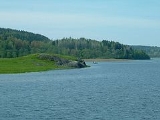
Lake Ladoga is a
freshwaterFresh water is naturally occurring water on the Earth's surface in ice sheets, ice caps, glaciers, bogs, ponds, lakes, rivers and streams, and underground as groundwater in aquifers and underground streams. Fresh water is generally characterized by having low concentrations of dissolved salts and...
lakeA lake is a body of relatively still fresh or salt water of considerable size, localized in a basin, that is surrounded by land. Lakes are inland and not part of the ocean and therefore are distinct from lagoons, and are larger and deeper than ponds. Lakes can be contrasted with rivers or streams,...
located in the
Republic of KareliaThe Republic of Karelia is a federal subject of Russia .-Geography:The republic is located in the northwestern part of Russia, taking intervening position between the basins of White and Baltic seas...
and
Leningrad OblastLeningrad Oblast is a federal subject of Russia . It was established on August 1, 1927, although it was not until 1946 that the oblast's borders had been mostly settled in their present position...
in northwestern
RussiaRussia or , officially known as both Russia and the Russian Federation , is a country in northern Eurasia. It is a federal semi-presidential republic, comprising 83 federal subjects...
, not far from
Saint PetersburgSaint Petersburg is a city and a federal subject of Russia located on the Neva River at the head of the Gulf of Finland on the Baltic Sea...
. It is the largest lake in
EuropeEurope is, by convention, one of the world's seven continents. Comprising the westernmost peninsula of Eurasia, Europe is generally 'divided' from Asia to its east by the watershed divides of the Ural and Caucasus Mountains, the Ural River, the Caspian and Black Seas, and the waterways connecting...
, and the 14th largest lake by area in the world.
Geography
The lake's area is 17,891 km² (excluding the islands). Its length (north to south) is 219 km, average width is 83 km, average depth is 51 m, maximum depth is about 230 m (in the north-western part). Basin area: 276,000 km², volume: 837 km³ (earlier estimated as 908 km³);. There are about 660 islands, with a total area of 435 km². Ladoga's level above the sea is 5 m on average. Most of the islands, including the famous
ValaamValaam, also known historically by the Finnish name Valamo, is an archipelago in the northern portion of Lake Ladoga, lying within the Republic of Karelia, Russian Federation. The total area of its more than 50 islands is 36 km². The largest island is also called Valaam. It is best known as...
archipelago,
KilpolaKilpola is an island 6 x 8 km among the skerries in the northwestern part of the Lake Ladoga, in Lakhdenpokhsky District of Republic of Karelia, connected to the mainland by a bridge. It is composed of granite hills rising up to about 60 m. above sea-level and covered by Scots Pine forest...
and
KonevetsKonevets is an approximately 8.5-km² island famous as the site of the Konevsky Monastery. It is located off the southwestern shore of Lake Ladoga near the village of Vladimirovka. The island is part of the Priozersky District of Leningrad Oblast. The nearest town is Priozersk, which is located...
, are situated in the north-western part.
Separated from the
Baltic SeaThe Baltic Sea is a brackish mediterranean sea located in Northern Europe, from 53°N to 66°N latitude and from 20°E to 26°E longitude. It is bounded by the Scandinavian Peninsula, the mainland of Europe, and the Danish islands. It drains into the Kattegat by way of the Øresund, the Great Belt and...
by the
Karelian IsthmusThe Karelian Isthmus is the approximately 45–110 km wide stretch of land, situated between the Gulf of Finland and Lake Ladoga in northwestern Russia, to the north of the River Neva . Its northwestern boundary is the relatively narrow area between the Bay of Vyborg and Lake Ladoga...
, it drains into the
Gulf of FinlandThe Gulf of Finland is the easternmost arm of the Baltic Sea. It extends between Finland and Estonia all the way to Saint Petersburg in Russia, where the river Neva drains into it. Other major cities around the gulf include Helsinki and Tallinn...
via the
Neva RiverThe Neva is a river in northwestern Russia flowing from Lake Ladoga through the western part of Leningrad Oblast to the Neva Bay of the Gulf of Finland. Despite its modest length , it is the third largest river in Europe in terms of average discharge .The Neva is the only river flowing from Lake...
.
Lake Ladoga is navigable, being a part of the
Volga-Baltic WaterwayThe Volga–Baltic Waterway, formerly known as the Mariinsk Canal System , is a series of canals and rivers in Russia which link the Volga River with the Baltic Sea...
connecting the
Baltic SeaThe Baltic Sea is a brackish mediterranean sea located in Northern Europe, from 53°N to 66°N latitude and from 20°E to 26°E longitude. It is bounded by the Scandinavian Peninsula, the mainland of Europe, and the Danish islands. It drains into the Kattegat by way of the Øresund, the Great Belt and...
with the
Volga RiverThe Volga is the largest river in Europe in terms of length, discharge, and watershed. It flows through central Russia, and is widely viewed as the national river of Russia. Out of the twenty largest cities of Russia, eleven, including the capital Moscow, are situated in the Volga's drainage...
. The
Ladoga CanalLadoga Canal is a historical water transport route, now situated in Leningrad Oblast, linking the Neva and the Svir River so as to bypass the stormy waters of Lake Ladoga which lies immediately to the north...
bypasses the lake in the southern part, connecting the Neva to the Svir.
The basin of Lake Ladoga includes about 50,000 lakes and 3,500 rivers longer than 10 km. About 85% of the water income is due to tributaries, 13% is due to
precipitationIn meteorology, precipitation In meteorology, precipitation In meteorology, precipitation (also known as one of the classes of hydrometeors, which are atmospheric water phenomena is any product of the condensation of atmospheric water vapor that falls under gravity. The main forms of precipitation...
, and 2% is due to underground waters.
Tributaries
- (incomplete list)
- Svir River
Svir is a river in the north-east of Leningrad Oblast, Russia. It flows from Lake Onega west to Lake Ladoga, thus connecting the two largest lakes of Europe. It is the largest river flowing into Lake Ladoga....
from Lake OnegaLake Onega is a lake in the north-west European part of Russia, located on the territory of Republic of Karelia, Leningrad Oblast and Vologda Oblast. It belongs to the basin of Baltic Sea, Atlantic Ocean, and is the second largest lake in Europe after Lake Ladoga...
(south-east, discharge: 790 m³/s);
- Volkhov River
Volkhov is a river in Novgorod Oblast and Leningrad Oblast in northwestern Russia.-Geography:The Volkhov flows out of Lake Ilmen north into Lake Ladoga, the largest lake of Europe. It is the second largest tributary of Lake Ladoga. It is navigable over its whole length. Discharge is highly...
from Lake IlmenIlmen is a historically important lake in the Novgorod Oblast of Russia, formerly a vital part of the Trade route from the Varangians to the Greeks. The city of Novgorod lies six kilometers below the lake's outflow....
(south, discharge: 580 m³/s);
- Vuoksi River
The Vuoksi River runs in the northernmost part of the Karelian Isthmus from Lake Saimaa in southeastern Finland to Lake Ladoga in northwestern Russia. The river enters Lake Ladoga in three branches, an older main northern branch at Priozersk , a smaller branch few km...
(and Burnaya RiverThe Burnaya is a young rapid river in Priozersk District of Leningrad Oblast, Russia, on the Karelian Isthmus, which emerged in 1818. It flows from Lake Sukhodolskoye to Lake Ladoga and is a part of Vuoksi River drainage basin...
) from Lake SaimaaSaimaa is a lake in southeastern Finland. At approximately , it is the largest lake in Finland, and the fourth largest in Europe. It was formed by glacial melting at the end of the Ice Age. Major towns on the lakeshore include Lappeenranta, Imatra, Savonlinna, Mikkeli, Varkaus, and Joensuu. The...
in FinlandFinland , officially the Republic of Finland, is a Nordic country situated in the Fennoscandian region of Northern Europe. It is bordered by Sweden in the west, Norway in the north and Russia in the east, while Estonia lies to its south across the Gulf of Finland.Around 5.4 million people reside...
(west, discharge: 540 m³/s).
- Syas River
Syas River is a river in the Novgorod and Leningrad Oblasts of Russia. The Syas River flows from Valdai Hills north into Lake Ladoga. A town of Syasstroy is located at its mouth. The largest tributary is Tikhvinka River...
(south, discharge: 53 m³/s).
- Olonka River
Olonka is a river in the Republic of Karelia, Russia. It gave the name to the town of Olonets by the river and eventuallty to the surrounding territory ....
from Lake Utozero
Geological history
Deglaciation following the Weichsel glaciation took place in the Lake Ladoga basin between 12,500 and 11,500
radiocarbon years BPBefore Present years is a time scale used in archaeology, geology, and other scientific disciplines to specify when events in the past occurred. Because the "present" time changes, standard practice is to use AD 1950 as the origin of the age scale, reflecting the fact that radiocarbon...
. Lake Ladoga was initially part of the
Baltic Ice LakeThe Baltic ice lake is a name given by geologists to a freshwater lake that gradually formed in the Baltic Sea basin as glaciation retreated from that region at the end of the Pleistocene. The lake, dated to 12,600-10,300 BP, is roughly contemporaneous with the three Pleistocene Blytt-Sernander...
(70–80 m. above present sea-level), a historical
freshwaterFresh water is naturally occurring water on the Earth's surface in ice sheets, ice caps, glaciers, bogs, ponds, lakes, rivers and streams, and underground as groundwater in aquifers and underground streams. Fresh water is generally characterized by having low concentrations of dissolved salts and...
stage of
Baltic SeaThe Baltic Sea is a brackish mediterranean sea located in Northern Europe, from 53°N to 66°N latitude and from 20°E to 26°E longitude. It is bounded by the Scandinavian Peninsula, the mainland of Europe, and the Danish islands. It drains into the Kattegat by way of the Øresund, the Great Belt and...
. It is possible, though not certain, that Ladoga was isolated from it during regression of the subsequent
Yoldia SeaYoldia Sea is a name given by geologists to a variable brackish-water stage in the Baltic Sea basin that prevailed after the Baltic ice lake was drained to sea level during the Weichsel glaciation...
brackish stage (10,200-9,500 BP). The isolation threshold should be at Heinjoki to the east of
VyborgVyborg is a town in Leningrad Oblast, Russia, situated on the Karelian Isthmus near the head of the Bay of Vyborg, to the northwest of St. Petersburg and south from Russia's border with Finland, where the Saimaa Canal enters the Gulf of Finland...
, where the
Baltic SeaThe Baltic Sea is a brackish mediterranean sea located in Northern Europe, from 53°N to 66°N latitude and from 20°E to 26°E longitude. It is bounded by the Scandinavian Peninsula, the mainland of Europe, and the Danish islands. It drains into the Kattegat by way of the Øresund, the Great Belt and...
and Ladoga were connected by a strait or a river outlet at least until the formation of the River Neva, and possibly even much later, until 12th century AD or so.
At 9,500 BP,
Lake OnegaLake Onega is a lake in the north-west European part of Russia, located on the territory of Republic of Karelia, Leningrad Oblast and Vologda Oblast. It belongs to the basin of Baltic Sea, Atlantic Ocean, and is the second largest lake in Europe after Lake Ladoga...
, previously draining into the
White SeaThe White Sea is a southern inlet of the Barents Sea located on the northwest coast of Russia. It is surrounded by Karelia to the west, the Kola Peninsula to the north, and the Kanin Peninsula to the northeast. The whole of the White Sea is under Russian sovereignty and considered to be part of...
, started emptying into Ladoga via the River Svir. Between 9,500 and 9,100 BP, during the transgression of
Ancylus LakeAncylus lake is a name given by geologists to the body of fresh water that replaced the Yoldia Sea after the latter had been severed from its saline intake across central Sweden by the isostatic rise of south Scandinavian landforms. The dates are approximately 9500-8000 BP calibrated, during the...
, the next freshwater stage of the Baltic, Ladoga certainly became part of it, even if they hadn't been connected immediately before. During the Ancylus Lake subsequent regression, around 8,800 BP Ladoga became isolated.
Ladoga slowly
transgressedA marine transgression is a geologic event during which sea level rises relative to the land and the shoreline moves toward higher ground, resulting in flooding. Transgressions can be caused either by the land sinking or the ocean basins filling with water...
in its southern part due to uplift of the
Baltic ShieldThe Baltic Shield is located in Fennoscandia , northwest Russia and under the Baltic Sea. The Baltic Shield is defined as the exposed Precambrian northwest segment of the East European Craton...
in the north. It has been hypothesized, but not proven, that waters of the Litorina Sea, the next brackish-water stage of the Baltic, occasionally invaded Ladoga between 7,000 and 5,000 BP. Around 5,000 BP the waters of the Saimaa Lake penetrated
SalpausselkäSalpausselkä is an extensive ridge system left by the ice age in Southern Finland. It is a large terminal moraine formation that formed in front of the Baltic ice lake during the Younger Dryas period about 12.250 - 10.400 years ago....
and formed a new outlet, River Vuoksi, entering Lake Ladoga in the northwestern corner and raising its level by 1–2 m.
The River Neva originated when the Ladoga waters at last broke through the threshold at Porogi into the lower portions of
Izhora RiverThe Izhora , also known as Inger River, is a left tributary of the Neva River on its run through Ingria in northwestern Russia from Lake Ladoga to Gulf of Finland. A settlement of Ust-Izhora is situated at the confluence of Izhora and Neva, halfway between Saint Petersburg and Schlisselburg. The...
, then a tributary of the
Gulf of FinlandThe Gulf of Finland is the easternmost arm of the Baltic Sea. It extends between Finland and Estonia all the way to Saint Petersburg in Russia, where the river Neva drains into it. Other major cities around the gulf include Helsinki and Tallinn...
, between 4,000 and 2,000 BP. According to some new data, it happened at 3,100
radiocarbon years BPBefore Present years is a time scale used in archaeology, geology, and other scientific disciplines to specify when events in the past occurred. Because the "present" time changes, standard practice is to use AD 1950 as the origin of the age scale, reflecting the fact that radiocarbon...
(3,410-3,250 calendar years BP).
Wildlife
The Ladoga is rich with fish. 48 forms (species and infraspecific taxa) of fish have been encountered in the lake, including
roachRutilus is a genus of fishes in the family Cyprinidae, commonly called roaches. Locally, the name "roach" without any further qualifiers is also used for particular species, particularly the Common Roach Rutilus (Latin for "shining, red, golden, auburn") is a genus of fishes in the family...
,
carp breamThe common bream, freshwater bream, bream, bronze bream or carp bream, Abramis brama, is a European species of freshwater fish in the family Cyprinidae....
,
zanderZander is a species of fish. The scientific name is Sander lucioperca , and it is closely allied to perch. Zander are often called pike-perch as they resemble the pike with their elongated body and head, and the perch with their spiny dorsal fin. Zander are not, as is commonly believed, a pike and...
,
European perchThe European perch, Perca fluviatilis, is a predatory species of perch found in Europe and Asia. In some areas it is known as the redfin perch or English perch, and it is often known simply as perch. The species is a popular quarry for anglers and has been widely introduced beyond its native area,...
,
ruffeThe Eurasian Ruffe or simply Ruffe is a freshwater fish found in temperate regions of Europe and northern Asia. It has been introduced into the Great Lakes of North America, reportedly with unfortunate results...
, endemic variety of smelt, two varieties of
Coregonus albulaThe vendace, Coregonus albula, is a species of freshwater whitefish in the family Salmonidae. It is also known as the European cisco. It is found in lakes in northern Europe, especially Finland, Sweden, Russia and Estonia, and in some lakes of the United Kingdom, northern Germany and Poland...
(vendace), eight varieties of
CoregonusCoregonus is a diverse genus of fish in the salmon family . The type species is the common whitefish . The Coregonus species are known as whitefishes...
lavaretus, a number of other
SalmonidaeSalmonidae is a family of ray-finned fish, the only living family currently placed in the order Salmoniformes. It includes salmon, trout, chars, freshwater whitefishes and graylings...
as well as, albeit rarely, endangered
European sea sturgeonThe Atlantic or the European Sturgeon , also known as the baltic sturgeon or common sturgeon, is a species of sturgeon found on most coasts of Europe. It is currently a critically endangered species....
. Commercial fishing was once a major industry but has been hurt by overfishing. After the war, between 1945–1954, the total annual catch increased and reached a maximum of 4,900 tonnes. However, unbalanced fishery led to the drastic decrease of catch in 1955–1963, sometimes to 1,600 tonnes per year.
TrawlingTrawling is a method of fishing that involves pulling a fishing net through the water behind one or more boats. The net that is used for trawling is called a trawl....
has been forbidden in Lake Ladoga since 1956 and some other restrictions were imposed. The situation gradually recovered, and in 1971-1990 the catch ranged between 4,900 and 6,900 tonnes per year, about the same level as the total catch in 1938. Fish farms and recreational fishing are developing.
http://ladoga.krc.karelia.ru/resources/fish/index.shtml
It has its own
endemicEndemism is the ecological state of being unique to a defined geographic location, such as an island, nation or other defined zone, or habitat type; organisms that are indigenous to a place are not endemic to it if they are also found elsewhere. For example, all species of lemur are endemic to the...
Ringed SealThe ringed seal , also known as the jar seal and as netsik or nattiq by the Inuit, is an earless seal inhabiting the Arctic and sub-Arctic regions...
subspecies known as the
Ladoga SealThe Ladoga ringed seal , is a freshwater subspecies of the ringed seal which are found entirely in Lake Ladoga in northwestern Russia. The subspecies evolved during the last ice age, about 11,000 years ago...
.
Since the beginning of the 1960s Ladoga has become considerably eutrophicated.
Nizhnesvirsky Natural Reserve is situated along the shore of Lake Ladoga immediately to the north of the mouth of the River Svir.
History
In the
Middle AgesThe Middle Ages is a periodization of European history from the 5th century to the 15th century. The Middle Ages follows the fall of the Western Roman Empire in 476 and precedes the Early Modern Era. It is the middle period of a three-period division of Western history: Classic, Medieval and Modern...
, the lake formed a vital part of the
Trade Route from the Varangians to the GreeksThe trade route from the Varangians to the Greeks was a trade route that connected Scandinavia, Kievan Rus' and the Byzantine Empire. The route allowed traders along the route to establish a direct prosperous trade with Byzantium, and prompted some of them to settle in the territories of...
, with the Norse emporium at
Staraya LadogaStaraya Ladoga , or the Aldeigjuborg of Norse sagas, is a village in the Volkhovsky District of Leningrad Oblast, Russia, located on the Volkhov River near Lake Ladoga, 8 km north of the town of Volkhov. The village used to be a prosperous trading outpost in the 8th and 9th centuries...
defending the mouth of the Volkhov since the 8th century. In the course of the
Swedish-Novgorodian WarsSwedish–Novgorodian Wars were a series of conflicts in the 12th and 13th centuries between the Republic of Novgorod and medieval Sweden over control of the Gulf of Finland, an area vital to the Hanseatic League and part of the Varangian-Byzantine trade route...
, the area was disputed between the
Novgorod RepublicThe Novgorod Republic was a large medieval Russian state which stretched from the Baltic Sea to the Ural Mountains between the 12th and 15th centuries, centred on the city of Novgorod...
and
SwedenSweden , officially the Kingdom of Sweden , is a Nordic country on the Scandinavian Peninsula in Northern Europe. Sweden borders with Norway and Finland and is connected to Denmark by a bridge-tunnel across the Öresund....
. In the early 14th century, the fortresses of
KorelaKorela Fortress , at the town of Priozersk, was founded by the Karelians who named the place Käkisalmi.- Origin :...
(Kexholm) and Oreshek (Nöteborg) were established along the banks of the lake.
The ancient
Valaam MonasteryThe Valaam Monastery, or Valamo Monastery is a stauropegic Orthodox monastery in Russian Karelia, located on Valaam, the largest island in Lake Ladoga, the largest lake in Europe.-History:...
was founded on the island of
ValaamValaam, also known historically by the Finnish name Valamo, is an archipelago in the northern portion of Lake Ladoga, lying within the Republic of Karelia, Russian Federation. The total area of its more than 50 islands is 36 km². The largest island is also called Valaam. It is best known as...
, the largest in Lake Ladoga, abandoned between 1611 – 1715, magnificently restored in the 18th century, and evacuated to Finland during the
Winter WarThe Winter War was a military conflict between the Soviet Union and Finland. It began with a Soviet offensive on 30 November 1939 – three months after the start of World War II and the Soviet invasion of Poland – and ended on 13 March 1940 with the Moscow Peace Treaty...
in 1940. In 1989 the monastic activities in the Valaam were resumed. Other historic cloisters in the vicinity are the Konevets Monastery, which sits on the
KonevetsKonevets is an approximately 8.5-km² island famous as the site of the Konevsky Monastery. It is located off the southwestern shore of Lake Ladoga near the village of Vladimirovka. The island is part of the Priozersky District of Leningrad Oblast. The nearest town is Priozersk, which is located...
island, and the
Alexander-Svirsky MonasteryAlexander-Svirsky Monastery is a Russian Orthodox monastery situated deep in the woods of the Leningrad Oblast, just south from its border with the Republic of Karelia...
, which preserves fine samples of medieval Muscovite architecture.
During the
Ingrian WarThe Ingrian War between Sweden and Russia, which lasted between 1610 and 1617 and can be seen as part of Russia's Time of Troubles, is mainly remembered for the attempt to put a Swedish duke on the Russian throne...
, a fraction of the Ladoga coast was occupied by
SwedenSweden , officially the Kingdom of Sweden , is a Nordic country on the Scandinavian Peninsula in Northern Europe. Sweden borders with Norway and Finland and is connected to Denmark by a bridge-tunnel across the Öresund....
. In 1617, by the
Treaty of StolbovoThe Treaty of Stolbovo is a peace treaty of 1617 that ended the Ingrian War, fought between Sweden and Russia.After nearly two months of negotiations, representatives from Sweden and Russia met at the village of Stolbova, south of Lake Ladoga, on 27 February 1617.From the outset, Sweden had gone...
, the northern and western coast was ceded by Russia to Sweden. In 1721, after the
Great Northern WarThe Great Northern War was a conflict in which a coalition led by the Tsardom of Russia successfully contested the supremacy of the Swedish Empire in northern Central Europe and Eastern Europe. The initial leaders of the anti-Swedish alliance were Peter I the Great of Russia, Frederick IV of...
, it was restituted to Russia by the
Treaty of NystadThe Treaty of Nystad was the last peace treaty of the Great Northern War. It was concluded between the Tsardom of Russia and Swedish Empire on 30 August / 10 September 1721 in the then Swedish town of Nystad , after Sweden had settled with the other parties in Stockholm and Frederiksborg.During...
. Later, in 1812 – 1940 the lake was shared between Finland and Russia. According to the conditions of the 1920 Tartu Peace Treaty militarization of the lake was severely restricted. However, both Soviet Russia and Finland had flotillas in Ladoga (see also
Finnish Ladoga Naval DetachmentFinnish Ladoga Naval Detachment was a Finnish naval unit stationed on Lake Ladoga between 1920-1940 and 1941-1944.-Background:The Treaty of Tartu was signed by the Russians and the Finns in 1920. It included terms which limited the size of naval vessels on Ladoga to 100 tons, and the calibre of...
). After the
Winter WarThe Winter War was a military conflict between the Soviet Union and Finland. It began with a Soviet offensive on 30 November 1939 – three months after the start of World War II and the Soviet invasion of Poland – and ended on 13 March 1940 with the Moscow Peace Treaty...
(1939–1940) according to the Moscow Peace Treaty, Ladoga, previously shared with Finland, became an internal basin of the Soviet Union.
During the
Continuation WarThe Continuation War was the second of two wars fought between Finland and the Soviet Union during World War II.At the time of the war, the Finnish side used the name to make clear its perceived relationship to the preceding Winter War...
(1941–1944) not only Finnish and Soviet, but also German and Italian vessels operated there (see also
Naval Detachment KThe Finnish Naval Detachment K was a flotilla that operated on Lake Ladoga during World War II.-Background:The Continuation War began in the summer of 1941. The Finns, who had operated naval units on Lake Ladoga before World War II, began reestablishing a flotilla on the lake as soon as their...
and Regia Marina). Under these circumstances, during much of the
Siege of LeningradThe Siege of Leningrad, also known as the Leningrad Blockade was a prolonged military operation resulting from the failure of the German Army Group North to capture Leningrad, now known as Saint Petersburg, in the Eastern Front theatre of World War II. It started on 8 September 1941, when the last...
(1941 – 1944), Lake Ladoga provided the only access to the besieged city because a section of the eastern shore remained in Soviet hands. Supplies were transported into
LeningradSaint Petersburg is a city and a federal subject of Russia located on the Neva River at the head of the Gulf of Finland on the Baltic Sea...
with trucks on winter roads over the ice, the "
Road of LifeThe Road of Life was the ice road transport route across the frozen Lake Ladoga, which provided the only access to the besieged city of Leningrad in the winter months during 1941–1944 while the perimeter in the siege was maintained by the German Army Group North and the Finnish Defence Forces. ...
", and by boat in the summer. After
World War IIWorld War II, or the Second World War , was a global conflict lasting from 1939 to 1945, involving most of the world's nations—including all of the great powers—eventually forming two opposing military alliances: the Allies and the Axis...
, Finland lost the
KareliaKarelia , the land of the Karelian peoples, is an area in Northern Europe of historical significance for Finland, Russia, and Sweden...
region to the USSR, and all Finnish citizens were
evacuated from the ceded territoryAs a result of the 1940 Moscow Peace Treaty that concluded the Winter War, Finland ceded the area of Finnish Karelia and other territories to the Soviet Union...
. Ladoga became an internal Soviet basin. The northern shore, Ladoga Karelia with the town of
SortavalaSortavala is a town in the Republic of Karelia, Russia, located at the northern tip of Lake Ladoga. Population: It is an important station of the Vyborg-Joensuu railroad.-History:...
, is now part of the
Republic of KareliaThe Republic of Karelia is a federal subject of Russia .-Geography:The republic is located in the northwestern part of Russia, taking intervening position between the basins of White and Baltic seas...
. The western shore,
Karelian IsthmusThe Karelian Isthmus is the approximately 45–110 km wide stretch of land, situated between the Gulf of Finland and Lake Ladoga in northwestern Russia, to the north of the River Neva . Its northwestern boundary is the relatively narrow area between the Bay of Vyborg and Lake Ladoga...
, became part of
Leningrad OblastLeningrad Oblast is a federal subject of Russia . It was established on August 1, 1927, although it was not until 1946 that the oblast's borders had been mostly settled in their present position...
.
Since 1996 the
Lake Ladoga Challenge is an annual competition for
4x4An off-road vehicle is considered to be any type of vehicle which is capable of driving on and off paved or gravel surface. It is generally characterized by having large tires with deep, open treads, a flexible suspension, or even caterpillar tracks...
vehicles and
ATVsAn all-terrain vehicle , also known as a quad, quad bike, three wheeler, or four wheeler, is defined by the American National Standards Institute as a vehicle that travels on low pressure tires, with a seat that is straddled by the operator, along with handlebars for steering control...
that travels through over 1200 kilometers of the mud, swamp and bog that surround Lake Ladoga.
Towns upon the Ladoga

- Shlisselburg
Shlisselburg is a town in Leningrad Oblast, Russia, situated at the head of the Neva River on Lake Ladoga, east of St. Petersburg. From 1944 to 1992, it was known as Petrokrepost...
(at 59°56′N 31°02′E)
- Novaya Ladoga
Novaya Ladoga is a town in Volkhovsky District of Leningrad Oblast, Russia, located at the point where the Volkhov River flows into Lake Ladoga, east of St. Petersburg. Population: The Nikolo-Medvedsky Novaya Ladoga is a town in Volkhovsky District of Leningrad Oblast, Russia, located at...
(at 60°06′N 32°18′E)
- Syasstroy
Syasstroy is a town in Volkhovsky District of Leningrad Oblast, Russia, located near the mouth of the Syas River, at the confluence of the Valdonka and the Syas Rivers, close to Lake Ladoga, east of St. Petersburg. Population:...
(at 60°08′N 32°34′E)
- Pitkyaranta
Pitkyaranta is a town and the administrative center of Pitkyarantsky District in the Republic of Karelia, Russia, located on the northeastern coast of Lake Ladoga. Population: Telephone code is 81433.The town was founded in the 19th century....
(at 61°34′N 31°28′E)
- Sortavala
Sortavala is a town in the Republic of Karelia, Russia, located at the northern tip of Lake Ladoga. Population: It is an important station of the Vyborg-Joensuu railroad.-History:...
(at 61°42′N 30°41′E)
- Lakhdenpokhya
Lakhdenpokhya is a town and the administrative center of Lakhdenpokhsky District of the Republic of Karelia, Russia, located west of Petrozavodsk on the Aurayoki River, and a railway station of the Vyborg-Joensuu railroad. Population:...
(at 61°31′N 30°12′E)
- Priozersk
Priozersk is a town in Leningrad Oblast, Russia, centered on an island at the southwestern shore of Lake Ladoga, at the estuary of the northern armlet of River Vuoksi on the Karelian Isthmus. It is served by a station of the Saint Petersburg-Kuznechnoye railroad with the same name...
(at 61°02′N 30°08′E)
External links