
Encyclopedia
- For more information on Korean history, see Korea
One of the world's oldest civilization [i]s, Korea began with the founding of Gojoseon [i] in 2333 ...
.
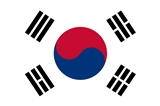
South Korea, officially the
Republic of Korea, is an
East Asian state on the southern half of the
Korean Peninsula. To the north, it is bordered by
North Korea , with which it was a single country called
Korea until 1945. To the west, across the
Yellow Sea, lies
China, and to the southeast, across the
Korea Strait, lies
Japan. Approximately one-half of South Korea's population lives in or near the capital and largest city,
Seoul, the second largest
metropolitan area in the world.
After its founding in 1948, the country has struggled with the aftermath of 35 years of Japanese occupation, the
Korean War, and decades of military rule, seeing five major constitutional changes. Pro-democracy demonstrations during the 1980s led to free elections in 1987. South Korea is now a multi-party
democracy.
The South Korean economy has advanced rapidly since the 1950s and is now the 10th largest economy in the world. South Korea is also one of the world's most technologically advanced and digitally-connected countries. It has the second highest number of broadband
Internet connections per capita in the world and is a global leader in
computer games,
digital displays,
shipbuilding and
mobile phones.
South Korea's entertainment industry has grown explosively since the 1990s, producing Asia-wide successes in music, television, and
film in a phenomenon known as
Hallyu, or the "Korean wave." However, the country still retains centuries-old customs and traditions, such as its unique
cuisine and
ancestor worship.
Etymology
In the
Korean language, South Korea is called
Daehan Minguk , or
Hanguk for short or
Namhan .
Han refers to the ancient Samhan confederacies of southern Korean peninsula.
Hanguk is the most commonly used term by Koreans.
In English, the nation is often referred to simply as "Korea", deriving from the
Goryeo dynasty, which in turn referred to the
Goguryeo kingdom.
Arabic traders' rendering of Goryeo, "Cu'ree", may have made its way to
Italy during the
Middle Ages, and "Corea" became a common European rendering. In the early 20th century, Japanese changed the 'Corea' into 'Korea' because of the fact that the letter 'C' came before 'J'.
History
At the end of
World War II,
American and
Soviet troops had occupied the southern and northern halves of Korea, respectively, dividing the peninsula at the
38th parallel. Despite promises of an independent and unified Korea in the 1943 Cairo Declaration, the United States and Soviet Union helped establish two separate governments in 1948; the communist North and the capitalist South.
On June 25, 1950, the North invaded the South, beginning a civil war that caused the deaths of more than 4 million civilians and soldiers alike, now referred to as the
Korean War. The
United Nations backed South Korea and the
Soviet Union and
China backed North Korea. The war eventually reached a stalemate. The 1953 armistice split the peninsula along the
demilitarised zone at about the original demarcation line. No peace treaty was ever signed, however, and therefore the two countries are technically still at war.
In 1960, a student uprising overthrew the autocratic government of
Syngman Rhee and South Korea saw a brief period of democratic reforms. However, much to the disappointment of the people, the new government was disoriented, and political chaos ensued. Then, a military coup led by General Park Chung-hee, who thought that the communist reunification of the peninsula would be inevitable if the Korean government was kept at this state, toppled the weak government the following year. Park took over as president from 1962 until his assassination in 1979, overseeing rapid export-led economic growth as well as severe political repression.
Park's successor general Chun Doo-hwan launched a
coup d'etat in 1980 to assume the presidency. Chun's seizure of power was greeted by widespread protests culminating in the 1980 Gwangju Massacre. In the aftermath of that incident, the movement for democracy gained strength and was ultimately successful in forcing Chun to allow free elections and a change to civilian democratic rule in 1988. That year, Seoul hosted the
1988 Summer Olympics.
In 1996, South Korea became a member of the
Organization for Economic Co-operation and Development. Despite a severe setback caused by the
Asian financial crisis in 1997, the country soon emerged as a major economic power. In 2004, South Korea joined the "trillion dollar club" of world economies and, today, its standard of living is equal to that of many countries in
Western Europe.
In June 2000, as a part of South Korean president
Kim Dae Jung's
Sunshine Policy of engagement, a historic first North-South summit took place in North Korea's capital
Pyongyang. That year, Kim won the
Nobel Peace Prize for his work for democracy and human rights and efforts at reconciliation between the two Koreas. Since then, trade and investment between the two Koreas have increased dramatically as a result of regular contacts in relations and economic ties. Kim, who is now retired, has made plans to visit Pyongyang again in June 2006.
Government and politics
South Korea is a
democratic republic with powers shared between the
president,
legislature, and judiciary. Since 1948, the constitution has undergone five major revisions, each signifying a new republic. The current Sixth Republic began with the last major constitutional revision in 1988.
The
head of state and head of government is the president, who is elected by direct popular vote for a single five-year term. In addition to being the commander-in-chief of the
armed forces, the president also has considerable executive powers. The president appoints the
prime minister with approval of the National Assembly, as well as appointing and presiding over the State Council of chief ministers.
The South Korean
legislature is the National Assembly, a
unicameral body in which members serve a four-year term of office. This legislature currently has 299 seats, of which 243 are elected by regional vote. The remainder are distributed by proportional representation.
The South Korean judiciary is largely independent of the other two branches. The highest judiciary body is the Supreme Court, whose justices are appointed by the president with the consent of the National Assembly. In addition, the
Constitutional Court oversees questions of constitutionality.
The main political parties in South Korea are the
Uri Party, the
Grand National Party , the Democratic Labor Party , and the Democratic Party . The Uri Party was formed in late 2003 from a liberal faction of the DP . It gained a slim majority in the National Assembly after the April 2004 legislative elections, but lost it in subsequent by-elections. The conservative GNP and centrist DP form the dominant political opposition. The progressive DLP is aligned with
labour unions and farmers' groups, and constitutes the left-wing opposition.
Geography and climate
South Korea occupies the southern portion of the
Korean Peninsula, which extends some 680
miles from the
Asian mainland. This mountainous peninsula is flanked by the
Yellow Sea to the west, and the Sea of Japan to the east. Its southern tip lies on the
Korea Strait and the
East China Sea. The country's total area is 38,462.49 square miles or 99,617.38 square kilometres.
South Korea's land is
mountainous, and most of it is not
arable. Lowlands, located primarily in the west and southeast, constitute only 30% of the total land area. South Korea can be divided into four general regions: an eastern region of high mountain ranges and narrow coastal plains; a western region of broad coastal plains, river basins, and rolling hills; a southwestern region of mountains and valleys and a southeastern region dominated by the broad basin of the
Nakdong River.
About 3,000
islands, mostly small and uninhabited, lie off the western and southern coasts.
Jeju Island is located about 100 kilometres off the southern coast of South Korea. It is the country's largest island, with an area of 1,845 square kilometres . Jeju is also the site of South Korea's highest point:
Halla-san, an extinct
volcano on Jeju, reaches 1,950 metres above sea level.
The local
climate is relatively temperate, with precipitation heavier in summer during a short rainy season called
jangma, and winters that can be bitterly cold. In
Seoul the average January temperature range is -7 °
C to 1 °C , and the average July temperature range is 22 °C to 29 °C . Winter temperatures are higher along the southern coast and considerably lower in the mountainous interior. Rainfall is concentrated in the summer months of June through September. The southern coast is subject to late summer
typhoons that bring strong winds and heavy rains. The average annual precipitation varies from 1,370 millimetres in Seoul to 1,470 millimetres in Busan.
Administrative Divisions
South Korea is divided into 8 provinces, one special autonomous province, six metropolitan cities, and one special city. The names below are given in English, Revised Romanization,
Hangul, and Hanja.
Special City
Metropolitan Cities
Provinces
Special Autonomous Province
- 16. Jeju Special Autonomous Province
Economy
South Korea has the tenth largest economy in the world, and the third largest in Asia, behind only Japan and China. As one of the
East Asian Tigers, it achieved rapid economic growth through exports of manufactured goods. This is in sharp contrast to the stagnation of North Korea's economy, which has turned for the worse since the disintegration of the Soviet Union. South Korea's per capita GDP is now roughly 12 times that of North Korea.
In the 1950s, South Korea was one of the poorest countries in Asia. At the end of World War II, the country inherited a colonial economic system designed solely for Japan's expansion policy. Much of the country's infrastructure was destroyed during the Korean War that followed in 1950-1953. After the war, South Korea became heavily dependent on U.S. aid.
Following the military coup led by general Park Chung-hee in 1962, South Korea embarked on a series of ambitious five-year plans for economic development. Emphasis shifted to foreign trade with the normalization of relations with Japan in 1965 and a subsequent boom in trade and investment. Rapid expansion, first into light and then heavy industries, in the 1960s and 1970s followed. During this period, the South Korean economy grew at an average annual rate of 8.6%.
This phenomenal growth is often called the "Miracle on the Han River", the Han River being the main river that runs through the nation's capital and largest city,
Seoul. In the 1980s and 1990s, growth continued as South Korea transformed itself from an exporter of mostly textiles and shoes into a major global producer of
automobiles,
electronics,
shipbuilding, and
steel and later, high-technology fields such as
digital monitors,
mobile phones, and
semiconductors.
The South Korean model of encouraging the growth of large, internationally competitive companies through easy financing and tax incentives led to the dominance of the family-controlled conglomerates. These companies, known as chaebol, flourished under the support of the Park regime. Some such as
Hyundai,
Samsung,
Daewoo, and
LG became global corporations. Today, through all of this combined, South Korea is in the trillion dollar class, with a GDP of US$1.665 trillion.
Since the
Asian financial crisis of 1997, however, the corporate landscape has changed considerably as a result of massive bankruptcies and government reforms. The crisis exposed longstanding weaknesses in South Korea's economy, including high debt/equity ratios, massive foreign borrowing, and an undisciplined financial sector. This led to two rounds of financial and industrial restructuring, in 1997 and again following the collapse of Daewoo in 1999. Daewoo's collapse has been recorded as one of the world's largest bankruptcies in history. By 2003, just over one-half of the 30 largest chaebol from 1995 remained.
Between 2003 and 2005, economic growth has moderated to about 4% per year. A downturn in consumer spending, attributed to massive personal credit card debt, was offset by rapid export growth especially to China. In 2005, the government proposed labor reform legislation and a corporate pension scheme to help make the labor market more flexible, and new real estate policies to cool property speculation.
Moderate inflation, low unemployment, an export surplus, and fairly equal distribution of income characterize this economy.
Transportation
Transportation in South Korea is provided by extensive networks of railways, highways, bus routes, ferry services, and air routes that criss-cross the country.
The
Korean National Railroad provides frequent service to all major South Korean cities. Two rail lines to
North Korea are now being reconnected. The Korean
high-speed railway system is known as
Korea Train Express .
Major cities have subway systems, including the popular
Seoul Metropolitan Subway. Virtually all towns in South Korea are served by regional bus service.
Highways in South Korea are classified into freeways , national highways, and various classifications below the national level. Korea Highway Corporation operates the toll highways and service amenities en route.
The main international
airport is
Incheon International Airport. South Korea's national air carriers are
Korean Air and
Asiana Airlines.
Demographics
Most South Koreans live in urban areas, due to rapid migration from the countryside during the country's rapid economic expansion in the 1970s, 1980s and 1990s. The capital city of
Seoul is also the country's largest city and chief industrial center. It had 10.3 million inhabitants in 2006, making Seoul one of the most populated single cities in the world. Other major cities include
Busan ,
Incheon ,
Daegu ,
Daejeon ,
Gwangju and
Ulsan .
The population has also been shaped by international migration. Following the
division of the Korean peninsula after
WWII, about 4 million people from North Korea crossed the border to South Korea. This trend of net entry reversed over the next 40 years due to emigration, especially to the
United States and
Canada. However, South Korea's burgeoning economy and improved political climate in the early and mid-1990s slowed the high emigration rates typical of the previous decade. Many of those who left the country chose to return.
Although small, the percentage of non-Koreans in South Korea has risen rapidly in the early 21st century. Officially, as of April 2005, the total number of known foreign labourers in South Korea stood at 378,000, 52% of whom were in the country without authorization. This foreign workforce mainly comes from South Asian and
Southeast Asian nations. There are also many workers from the former
Soviet Union countries and
Nigeria. In addition to these workers, there are about 11,000 expat
English teachers and around 36,000 US military personnel.
As of 2005, approximately 25 million or 46.5% of the South Korean population express no religious preference. Of the remainder, 13.7 million are Christian, 10.7 million are Buddhist, and small numbers belong to various minor religions including Jeungsando and Wonbuddhism. The largest Christian church in the world,
Yoido Full Gospel Church, is located in Seoul and has approximately 780,000 members . Including Yoido Full Gospel, 11 of the world's 12 largest churches are located in Seoul . South Korea is also the second largest missionary sending nation on earth, after the U.S.
Military and foreign relations
In its foreign relations, South Korea is primarily concerned with North Korea and the neighboring countries of China, Japan, and Russia, as well as its main ally, the
United States. The US was the primary driver in the establishment and initial sustenance of the South Korea government in the 1950s; however, since the 1990s the two nations have often been at odds with regard to their policy towards
North Korea.
South Korea and China established formal diplomatic relations on August 24, 1992, despite previous hostility dating back to the Korean War. South Korea's relations with Japan continue to be turbulent, primarily due to a number of Korean-Japanese disputes stemming from Japanese occupation in addition to other
Japanese war atrocities against Korea.
South Korea president rejected in summit talks between South Korea and Japan, the relation between Japan and South Korea was rapidly cooled.
North and South Korea continue to dispute which country should be deemed the "rightful successor" to the previous Korean states. Despite longstanding animosity following the
Korean War in 1950 , the South and North have in recent times sought to establish a more conciliatory relationship. This road has however been punctuated by a number of difficulties, including the North-South presidential summit corruption allegations in June 2000. Nevertheless, events such as the
Olympic Games, where the two Koreas currently enter the opening ceremonies together but still compete as separate teams, show a new and more optimistic side to the North-South relationship. South Korea's relationship with North Korea has been slightly damaged since North Korea's missile testing in late July of 2006.
In addition, South Korea maintains diplomatic relations with approximately 170 countries. The country has also been a member of the
United Nations since 1991, when it joined at the same time as North Korea. It has also developed links with
ASEAN as both a member of "ASEAN Plus three" and the
East Asia Summit .
The South Korean military is composed of the
Republic of Korea Army ,
Republic of Korea Navy ,
Republic of Korea Air Force , and
Republic of Korea Marine Corps , together with reserve forces. Many of these forces are concentrated near the border with North Korea. All South Korean males are constitutionally required to serve in the military, typically for a period of 24 months.
From time to time, South Korea has sent its troops overseas to assist American forces. South Korea dispatched 320,000 troops to fight alongside American soldiers in the
Vietnam War. Most recently, South Korea sent 3,200 troops in the form of the
Zaytun Division to assist with reconstruction efforts in northern
Iraq.
Sports
Taekwondo, a popular
martial art, originated in Korea. Taekwondo means
the way of the foot, the way of the fist, and the way of life, although the emphasis lies on the kicks. It became standard military training in South Korea, and in 1961 the rules were standardized and taekwondo became an official
Olympic sport in 2000. Taekwondo in the military is a integral part in the Korean land forces. During the
Vietnam War, Taekwondo and hand to hand combat enabled a Korean platoon of 13 men to wipe out 400 Viet Cong soldiers of an elite regiment. . Other Korean martial arts include
hapkido and taekkyeon.
Baseball was first introduced in Korea by an American missionary named Phillip Gillette in 1905 and has since become the most popular spectator sport in South Korea. The first South Korean professional sports league was the Korea Baseball Association, established in 1982. During the
2006 World Baseball Classic, South Korea reached the final four before losing to Japan. Prior to that final match, the South Korean team was the only undefeated team, and had beaten Japan twice and the United States once.
Other popular sports in South Korea include
baseball,
basketball,
football,
golf,
tennis, and
ice hockey. Women's golf is especially strong, with over 30 South Koreans playing on the world's leading women's tour, the