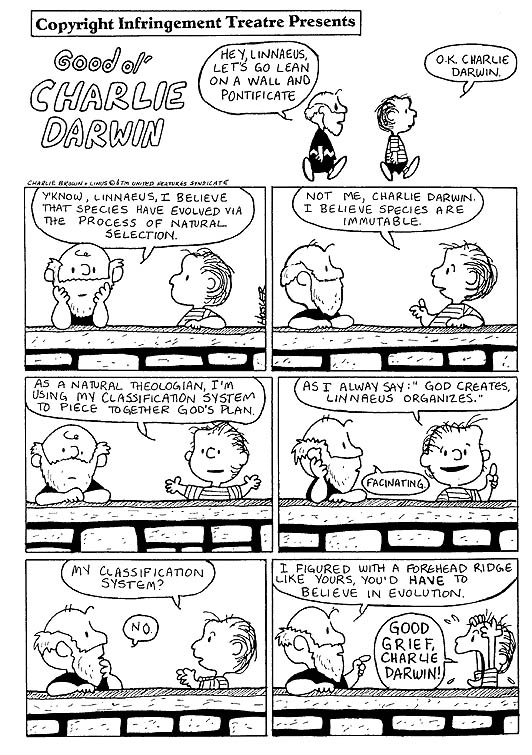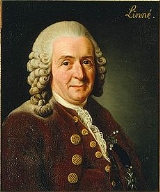
Carolus Linnaeus

Encyclopedia
Carl Linnaeus also known after his ennoblement
as , was a Swedish botanist, physician, and zoologist, who laid the foundations for the modern scheme of binomial nomenclature
. He is known as the father of modern taxonomy
, and is also considered one of the fathers of modern ecology. Many of his writings were in Latin
, and his name is rendered in Latin as (after 1761 Carolus a Linné).
Linnaeus was born in the countryside of Småland
, in southern Sweden. Linnaeus received most of his higher education at Uppsala University
, and began giving lectures in botany
there in 1730. He lived abroad between 1735 and 1738, where he studied and also published a first edition of his in the Netherlands. He then returned to Sweden, where he became professor of botany at Uppsala
. In the 1740s, he was sent on several journeys through Sweden to find and classify plants and animals. In the 1750s and 60s, he continued to collect and classify animals, plants, and minerals, and published several volumes. At the time of his death, he was one of the most acclaimed scientists in Europe.
The Swiss philosopher Jean-Jacques Rousseau
sent him the message: "Tell him I know no greater man on earth." The German writer Johann Wolfgang von Goethe
wrote: "With the exception of Shakespeare
and Spinoza
, I know no one among the no longer living who has influenced me more strongly." Swedish author August Strindberg
wrote: "Linnaeus was in reality a poet who happened to become a naturalist". Among other compliments, Linnaeus has been called (Prince of Botanists), "The Pliny of the North," and "The Second Adam".
In botany, the author abbreviation
used to indicate Linnaeus as the authority for species' names is L. In 1959, Carl Linnaeus was designated as the lectotype
for Homo sapiens
, which means that following the nomenclatural rules
, Homo sapiens was validly defined as the animal species to which Linnaeus belonged.
in Småland
, Sweden on 23 May 1707. He was the first child of Nils Ingemarsson Linnaeus and Christina Brodersonia. His father was the first in his ancestry to adopt a permanent surname. Before that, ancestors had used the patronymic
naming system of Scandinavian countries: his father was named Ingemarsson after his father Ingemar Bengtsson. When Nils was admitted to the University of Lund, he had to take on a family name. He adopted the Latinate name Linnæus after a giant linden tree (or lime tree), in Swedish, that grew on the family homestead. This name was spelled with the æ
ligature. When Carl was born, he was named Carl Linnæus, with his father's family name. The son also always spelled it with the æ ligature, both in handwritten documents and in publications. Carl's patronymic would have been Nilsson, as in Carl Nilsson Linnæus.
One of a long line of peasants and priests, Nils was an amateur botanist, a Lutheran minister, and the curate
of the small village of Stenbrohult in Småland. Christina was the daughter of the rector of Stenbrohult, Samuel Brodersonius. She subsequently gave birth to three daughters and another son, Samuel (who would eventually succeed their father as rector of Stenbrohult and write a manual on beekeeping
). A year after Linnaeus' birth, his grandfather Samuel Brodersonius died, and his father Nils became the rector of Stenbrohult. The family moved into the rectory
from the curate's house.
Even in his early years, Linnaeus seemed to have a liking for plants, flowers in particular. Whenever he was upset, he was given a flower, which immediately calmed him. Nils spent much time in his garden and often showed flowers to Linnaeus and told him their names. Soon Linnaeus was given his own patch of earth where he could grow plants.
. Linnaeus did not like him, writing in his autobiography that Telander "was better calculated to extinguish a child's talents than develop them." Two years after his tutoring had begun, he was sent to the Lower Grammar School
at Växjö
in 1717. Linnaeus rarely studied, often going to the countryside to look for plants. He reached the last year of the Lower School when he was fifteen, which was taught by the headmaster, Daniel Lannerus, who was interested in botany. Lannerus noticed Linnaeus' interest in botany and gave him the run of his garden. He also introduced him to Johan Rothman, the state doctor of Småland and a teacher at Växjö Gymnasium
. Also a botanist, Rothman broadened Linnaeus' interest in botany and helped him develop an interest in medicine.
Linnaeus entered the Växjö Gymnasium in 1724, where he studied mainly Greek
, Hebrew, theology
and mathematics
, a curriculum designed for boys preparing for the priesthood. In the last year at the gymnasium, Linnaeus' father visited to ask the professors how his son's studies were progressing; to his dismay, most said that the boy would never become a scholar. Rothman believed otherwise, suggesting Linnaeus could have a future in medicine. The doctor offered to have Linnaeus live with his family in Växjö and to teach him physiology
and botany. Nils accepted this offer.
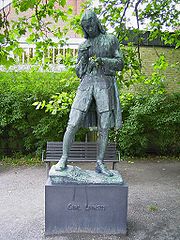 Rothman showed Linnaeus that botany was a serious subject. He taught Linnaeus to classify plants according to Tournefort's
system. Linnaeus was also taught about sexuality of plants, according to Sébastien Vaillant
. In 1727, Linnaeus, age 21, enrolled in Lund University
in Skåne. He was registered as , the Latin form of his full name, which he also used later for his Latin publications.
The local doctor Kilian Stobaeus offered Linnaeus tutoring and lodging, as well as the use of his library, which included many books about botany. He also gave the student free admission to his lectures. In his spare time, Linnaeus explored the flora of Skåne, together with students sharing the same interests.
on the advice of Rothman, who believed it would be a better choice if Linnaeus wanted to study both medicine and botany. Rothman based this recommendation on the two professors who taught at the medical faculty at Uppsala: Olof Rudbeck the Younger
and Lars Roberg
. Although Rudbeck and Roberg had undoubtedly been good professors, by then they were older and not so interested in teaching. Rudbeck no longer gave public lectures, and had others stand in for him. The botany, zoology, pharmacology and anatomy lectures were not in their best state. In Uppsala, Linnaeus met a new benefactor, Olof Celsius
, who was a professor of theology and an amateur botanist. He received Linnaeus into his home and allowed him use of his library, which was one of the richest botanical libraries in Sweden.
In 1729, Linnaeus wrote a thesis, on plant sexuality
. This attracted the attention of Rudbeck; in May 1730, he selected Linnaeus to give lectures at the University although the young man was only a second-year student. His lectures were popular, and Linnaeus often addressed an audience of 300 people. In June, Linnaeus moved from Celsius' house to Rudbeck's to become the tutor of the three youngest of his 24 children. His friendship with Celsius did not wane and they continued their botanical expeditions. Over that winter, Linnaeus began to doubt Tournefort's system of classification and decided to create one of his own. His plan was to divide the plants by the number of stamen
s and pistils. He began writing several books, which would later result in, for example, and . He also produced a book on the plants grown in the Uppsala Botanical Garden
, .
Rudbeck's former assistant, Nils Rosén
, returned to the University in March 1731 with a degree in medicine. Rosén started giving anatomy lectures and tried to take over Linnaeus' botany lectures, but Rudbeck prevented that. Until December, Rosén gave Linnaeus private tutoring in medicine. In December, Linnaeus had a "disagreement" with Rudbeck's wife and had to move out of his mentor's house; his relationship with Rudbeck did not appear to suffer. That Christmas, Linnaeus returned home to Stenbrohult to visit his parents for the first time in about three years. His mother had disapproved of his failing to become a priest, but she was pleased to learn he was teaching at the University.
, reindeer-herding nomads who wandered Scandinavia's vast tundras. In April 1732, Linnaeus was awarded a grant from the Royal Society of Sciences in Uppsala
for his journey.
Linnaeus began his expedition from Uppsala in May; he travelled on foot and horse, bringing with him his journal, botanical and ornithological manuscripts and sheets of paper for pressing plants. Near Gävle
he found great quantities of Campanula serpyllifolia, later known as Linnaea borealis, the twinflower that would become his favourite. He sometimes dismounted on the way to examine a flower or rock and was particularly interested in moss
es and lichen
s, the latter a main part of the diet of the reindeer
, a common animal in Lapland.
Linnaeus travelled clockwise around the coast of the Gulf of Bothnia
, making major inland incursions from Umeå
, Luleå
and Tornio
. He returned from his six-month long, over 2000 kilometres (1,242.7 mi) expedition in October, having gathered and observed many plants, birds and rocks. Although Lapland was a region with limited biodiversity
, Linnaeus described about 100 previously unidentified plants. These became the basis of his book .
In Linnaeus' ideas about nomenclature
and classification
were first used in a practical way, making this the first proto-modern Flora
. The account covered 534 species, used the Linnaean classification system and included, for the described species, geographical distribution and taxonomic notes. It was Augustin Pyramus de Candolle who attributed Linnaeus with as the first example in the botanical genre of Flora writing. Botanical historian E. L. Greene
described as "the most classic and delightful" of Linnaeus's works.
It was also during this expedition that Linnaeus had a flash of insight
regarding the classification of mammals. Upon observing the lower jawbone of a horse at the side of a road he was traveling, Linnaeus remarked: "If I only knew how many teeth and of what kind every animal had, how many teats and where they were placed, I should perhaps be able to work out a perfectly natural system for the arrangement of all quadrupeds."
. Funded by the Governor of Dalarna, the expedition was to catalogue known natural resources and discover new ones, but also to gather intelligence on Norwegian mining activities at Røros
.
with Sohlberg's family. Sohlberg's father was a mining inspector, and let Linnaeus visit the mines near Falun. Sohland's father suggested to Linnaeus he should bring Sohlberg to the Dutch Republic
and continue to tutor him there for an annual salary. At that time, the Dutch Republic was one of the most revered places to study natural history and a common place for Swedes to take their doctoral degree; Linnaeus, who was interested in both of these, accepted.
In April 1735, Linnaeus and Sohlberg set out for the Netherlands
, with Linnaeus to take a doctoral degree in medicine at the University of Harderwijk
. On the way, they stopped in Hamburg
, where they met the mayor, who proudly showed them a wonder of nature which he possessed: the taxidermied
remains of a seven-headed hydra
. Linnaeus quickly discovered it was a fake: jaws and clawed feet from weasels and skins from snakes had been glued together. The provenance of the hydra suggested to Linnaeus it had been manufactured by monks to represent the Beast of Revelation
. As much as this may have upset the mayor, Linnaeus made his observations public and the mayor's dreams of selling the hydra for an enormous sum were ruined. Fearing his wrath, Linnaeus and Sohlberg had to leave Hamburg quickly.
When Linnaeus reached Harderwijk
, he began working toward a degree immediately; at the time, Harderwijk was known for awarding "instant" degrees after as little as a week. First he handed in a thesis on the cause of malaria he had written in Sweden, which he then defended in a public debate. The next step was to take an oral examination and to diagnose a patient. After less than two weeks, he took his degree and became a doctor, at the age of 28. During the summer, Linnaeus met a friend from Uppsala, Peter Artedi
. Before their departure from Uppsala, Artedi and Linnaeus had decided should one of them die, the survivor would finish the other's work. Ten weeks later, Artedi drowned in one of the canals of Amsterdam
, and his unfinished manuscript on the classification of fish was left to Linnaeus to complete.
to whom Linnaeus showed one of the several manuscripts he had brought with him from Sweden. The manuscript described a new system for classifying plants. When Gronovius saw it, he was very impressed, and offered to help pay for the printing. With an additional monetary contribution by the Scottish doctor Isaac Lawson, the manuscript was published as .
Linnaeus became acquainted with one of the most respected physicians and botanists in the Netherlands, Herman Boerhaave
, who tried to convince Linnaeus to make a career there. Boerhaave offered him a journey to South Africa and America, but Linnaeus declined, stating he would not stand the heat. Instead, Boerhaave convinced Linnaeus that he should visit the botanist Johannes Burman
. After his visit, Burman, impressed with his guest's knowledge, decided Linnaeus should stay with him during the winter. During his stay, Linnaeus helped Burman with his . Burman also helped Linnaeus with the books on which he was working: and .
, a director of the Dutch East India Company
and the owner of a rich botanical garden at the estate of Hartekamp
in Heemstede
. Clifford was very impressed with Linnaeus' ability to classify plants, and invited him to become his physician and superintendent of his garden. Linnaeus had already agreed to stay with Burman over the winter, and could thus not accept immediately. However, Clifford offered to compensate Burman by offering him a copy of Sir Hans Sloane's
Natural History of Jamaica, a rare book, if he let Linnaeus stay with him, and Burman accepted. On 24 September 1735, Linnaeus became the botanical curator and house physician at Hartekamp, free to buy any book or plant he wanted.
In July 1736, Linnaeus travelled to England, at Clifford's expense. He went to London to visit Sir Hans Sloane
, a collector of natural history, and to see his cabinet
, as well as to visit the Chelsea Physic Garden
and its keeper, Philip Miller
. He taught Miller about his new system of subdividing plants, as described in . Miller was impressed, and from then on started to arrange the garden according to Linnaeus' system. Linnaeus also traveled to Oxford University to visit the botanist Johann Jacob Dillenius
. He failed, however, to make Dillenius publicly accept his new classification system. He then returned to Hartekamp, bringing with him many specimens of rare plants. The next year, he published , in which he described 935 genera
of plants, and shortly thereafter he supplemented it with , with another sixty (sexaginta) genera.
His work at Hartekamp led to another book, , a catalogue of the botanical holdings in the herbarium and botanical garden of Hartekamp. He wrote it in nine months (completed in July 1737), but it was not published until 1738. It contains the first use of the name Nepenthes
, which Linnaeus used to describe a genus of pitcher plants."If this is not Helen's Nepenthe
s, it certainly will be for all botanists. What botanist would not be filled with admiration if, after a long journey, he should find this wonderful plant. In his astonishment past ills would be forgotten when beholding this admirable work of the Creator!" (translated from Latin by Harry Veitch
)
Linnaeus stayed with Clifford at Hartekamp until 18 October 1737 (new style), when he left the house to return to Sweden. Illness and the kindness of Dutch friends obliged him to stay some months longer in Holland. In May 1738, he set out for Sweden again. On the way home, he stayed in Paris for about a month, visiting botanists such as Antoine de Jussieu
. After his return, Linnaeus never left Sweden again.
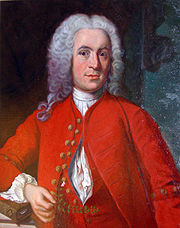 When Linnaeus returned to Sweden on 28 June 1738, he went to Falun
, where he entered into an engagement to Sara Elisabeth Moræa. Three months later, he moved to Stockholm to find employment as a physician, and thus to make it possible to support a family. Once again, Linnaeus found a patron; he became acquainted with Count Carl Gustav Tessin, who helped him get work as a physician at the Admiralty. During this time in Stockholm, Linnaeus helped found the Royal Swedish Academy of Science; he became the first Praeses
in the academy by drawing of lots.
Because his finances had improved and were now sufficient to support a family, he received permission to marry his fiancée, Sara Elisabeth Moræa. Their wedding was held 26 June 1739. Seven months later, Sara gave birth to their first son, Carl. Two years later, a daughter, Elisabeth Christina, was born, and the subsequent year Sara gave birth to Sara Magdalena, who died 15 days old. Sara and Linnaeus would later have four other children: Lovisa, Sara Christina, Johannes and Sophia.
In May 1741, Linnaeus was appointed Professor of Medicine at Uppsala University, first with the responsibility of the medicine-related matters. Soon, he changed place with the other Professor of Medicine, Nils Rosén, and thus was responsible for the Botanical Garden (which he would thoroughly reconstruct and expand), botany and natural history
, instead. In October that same year, his wife and nine-year-old son followed him to live in Uppsala.
and Gotland
with six students from the university, to look for plants useful in medicine. First, they travelled to Öland and stayed there until 21 June, when they sailed to Visby
in Gotland. Linnaeus and the students stayed on Gotland for about a month, and then returned to Uppsala. During this expedition, they found 100 previously unrecorded plants. The observations from the expedition were later published in , written in Swedish. Like , it contained both zoological and botanical observations, as well as observations concerning the culture in Öland and Gotland.
During the summer of 1745, Linnaeus published two more books: and . was a strictly botanical book, while was zoological. Anders Celsius
had created the temperature scale named after him
in 1742. Celsius' scale was inverted compared to today, the boiling point at 0 °C and freezing point at 100 °C. In 1745, Linnaeus inverted the scale to its present standard.
. He set out from Uppsala on 12 June and returned on 11 August. On the expedition his primary companion was Erik Gustaf Lidbeck, a student who had accompanied him on his previous journey. Linnaeus described his findings from the expedition in the book , published the next year. After returning from the journey the Government decided Linnaeus should take on another expedition to the southernmost province Scania
. This journey was postponed, as Linnaeus felt too busy.
In 1747, Linnaeus was given the title archiater
, or chief physician, by the Swedish king Adolf Frederick
—a mark of great respect. The same year he was elected member of the Academy of Sciences in Berlin
.
, again commissioned by the Government. With him he brought his student, Olof Söderberg. On the way to Scania, he made his last visit to his brothers and sisters in Stenbrohult since his father had died the previous year. The expedition was similar to the previous journeys in most aspects, but this time he was also ordered to find the best place to grow walnut
and Swedish whitebeam
trees; these trees were used by the military to make rifles. The journey was successful, and Linnaeus' observations were published the next year in .
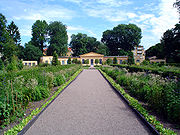 In 1750, Linnaeus became rector of Uppsala University, starting a period where natural sciences were esteemed. Perhaps the most important contribution he made during his time at Uppsala was to teach; many of his students travelled to various places in the world to collect botanical samples. Linnaeus called the best of these students his "apostles". His lectures were normally very popular and were often held in the Botanical Garden. He tried to teach the students to think for themselves and not trust anybody, not even him. Even more popular than the lectures were the botanical excursions made every Saturday during summer, where Linnaeus and his students explored the flora and fauna in the vicinity of Uppsala.
, in 1753. The first volume was issued on 24 May, the second volume followed on 16 August of the same year. The book contained 1,200 pages and was published in two volumes; it described over 7,300 species. The same year the king dubbed him knight of the Order of the Polar Star
, the first civilian in Sweden to become a knight in this order. He was then seldom seen not wearing the order.
Since the initial release of in 1735, the book had been expanded and reprinted several times; the tenth edition
was released in 1758. This edition established itself as the starting point for zoological nomenclature, the equivalent of .
The Swedish king Adolf Frederick granted Linnaeus nobility
in 1757, but he was not ennobled until 1761. With his ennoblement, he took the name Carl von Linné (Latinized as ), 'Linné' being a shortened and gallicised version of 'Linnæus', and the German title 'von
' signifying his ennoblement. The noble family's coat of arms
prominently features a twinflower, one of Linnaeus' favourite plants; it was given the scientific name Linnaea borealis in his honour by Gronovius
. The shield in the coat of arms is divided into thirds: red, black and green for the three kingdoms of nature (animal, mineral and vegetable) in Linnaean classification; in the center is an egg "to denote Nature, which is continued and perpetuated in ovo." At the bottom is a phrase in Latin, borrowed from the Aeneid
, which reads "": we extend our fame by our deeds.
Linnaeus' last years were troubled by illness. He had suffered from a disease called the Uppsala fever in 1764, but survived thanks to the care of Rosén. He developed sciatica
in 1773, and the next year, he had a stroke which partially paralysed him. He suffered a second stroke in 1776, losing the use of his right side and leaving him bereft of his memory; while still able to admire his own writings, he could not recognize himself as their author.
In December 1777, he had another stroke which greatly weakened him, and eventually led to his death on 10 January 1778 in Hammarby. Despite his desire to be buried in Hammarby, he was interred in Uppsala Cathedral
on 22 January.
His library and collections were left to his widow Sara and their children. Joseph Banks
, an English botanist, wanted to buy the collection, but his son Carl refused and moved the collection to Uppsala. However, in 1783 Carl died and Sara inherited the collection, having outlived both her husband and son. She tried to sell it to Banks, but he was no longer interested; instead an acquaintance of his agreed to buy the collection. The acquaintance was a 24-year-old medical student, James Edward Smith
, who bought the whole collection: 14,000 plants, 3,198 insects, 1,564 shells, about 3,000 letters and 1,600 books. Smith founded the Linnean Society of London
five years later.
The von Linné name ended with his son Carl, who never married. His other son, Johannes, had died aged 3. There are over two hundred descendents of Linnaeus through two of his daughters.
notes without Linnaeus' new system, it would not have been possible for the apostles to collect and organise so many new specimens. Many of the apostles died during their expeditions.
ship headed for China. Tärnström never reached his destination, dying of a tropical fever on Côn Sơn Island
the same year. Tärnström's widow blamed Linnaeus for making her children fatherless, causing Linnaeus to prefer sending out younger, unmarried students after Tärnström. Six other apostles later died on their expeditions, including Pehr Forsskål and Pehr Löfling
.
Two years after Tärnström's expedition, Finnish-born Pehr Kalm
set out as the second apostle to North America. There he spent two-and-a-half years studying the flora and fauna of Pennsylvania, New York, New Jersey and Canada. Linnaeus was overjoyed when Kalm returned, bringing back with him many pressed flowers and seeds. At least 90 of the 700 North American species described in Species Plantarum had been brought back by Kalm.
was living in Linnaeus' house during his time as a student in Uppsala. Linnaeus was very fond of him, promising Solander his oldest daughter's hand in marriage. On Linnaeus' recommendation, Solander travelled to England in 1760, where he met the English botanist Joseph Banks
. With Banks, Solander joined James Cook
on his expedition to Oceania on the Endeavour
in 1768–71. Solander was not the only apostle to journey with James Cook; Anders Sparrman
followed on the Resolution in 1772–75 bound for, among other places, Oceania and South America. Sparrman made many other expeditions, one of them to South Africa.
Perhaps the most famous and successful apostle was Carl Peter Thunberg
, who embarked on a nine-year expedition in 1770. He stayed in South Africa for three years, then travelled to Japan. All foreigners in Japan were forced to stay on the island of Dejima
outside Nagasaki
, so it was thus hard for Thunberg to study the flora. He did, however, manage to persuade some of the translators to bring him different plants, and he also found plants in the gardens of Dejima. He returned to Sweden in 1779, one year after Linnaeus' death.
. These binomials could serve as a label to refer to the species. Higher taxa were constructed and arranged in a simple and orderly manner. Although the system, now known as binomial nomenclature
, was partially developed by the Bauhin brothers (see Gaspard Bauhin
and Johann Bauhin
) almost 200 years earlier, Linnaeus was the first to use it consistently throughout the work, including in monospecific genera, and may be said to have popularised it within the scientific community.
as it exists today.
In 1754, Linnaeus divided the plant Kingdom into 25 classes. One, Cryptogamia, included all the plants with concealed reproductive parts (algae, fungi, mosses and liverworts and ferns).
.png)
The establishment of universally accepted conventions for the naming of organisms was Linnaeus' main contribution to taxonomy—his work marks the starting point of consistent use of binomial nomenclature. During the 18th century expansion of natural history knowledge, Linnaeus also developed what became known as the Linnaean taxonomy; the system of scientific classification now widely used in the biological sciences
.
The Linnaean system classified nature within a nested hierarchy, starting with three kingdoms
. Kingdoms were divided into classes and they, in turn, into orders, and thence into genera (singular: genus), which were divided into Species (singular: species). Below the rank of species he sometimes recognized taxa of a lower (unnamed) rank
; these have since acquired standardised names such as variety in botany and subspecies in zoology. Modern taxonomy includes a rank of family
between order and genus that was not present in Linnaeus' original system.
Linnaeus' groupings were based upon shared physical characteristics, and not simply upon differences. Of his higher groupings, only those for animals are still in use, and the groupings themselves have been significantly changed since their conception, as have the principles behind them. Nevertheless, Linnaeus is credited with establishing the idea of a hierarchical structure of classification which is based upon observable characteristics and intended to reflect natural relationships. While the underlying details concerning what are considered to be scientifically valid "observable characteristics" have changed with expanding knowledge (for example, DNA sequencing
, unavailable in Linnaeus' time, has proven to be a tool of considerable utility for classifying living organisms and establishing their evolutionary relationships
), the fundamental principle remains sound.
, the question of man's origin began with Linnaeus. He helped future research in the natural history of man by describing humans just as he described any other plant or animal. He was the first person to place humans in a system of biological classification.
s (as they were later called) beginning with the first edition of . During his time at Hartekamp, he had the opportunity to examine several monkeys and noted similarities between them and man. He pointed out both species basically have the same anatomy; except for speech, he found no other differences.Frängsmyr et al. (1983), p. 167, quotes Linnaeus explaining the real difference would necessarily be absent from his classification system, as it was not a morphological
characteristic: "I well know what a splendidly great difference there is [between] a man and a bestia [literally, "beast"; that is, a non-human animal] when I look at them from a point of view of morality
. Man is the animal which the Creator has seen fit to honor with such a magnificent mind
and has condescended to adopt as his favorite and for which he has prepared a nobler life". See also books.google.com in which Linnaeus cites the significant capacity to reason
as the distinguishing characteristic of humans. Thus he placed man and monkeys under the same category, Anthropomorpha, meaning "manlike." This classification received criticism from other biologists such as Johan Gottschalk Wallerius
, Jacob Theodor Klein
and Johann Georg Gmelin
on the ground that it is illogical to describe a human as 'like a man'. In a letter to Gmelin from 1747, Linnaeus replied:
against me. Perhaps I ought to have by virtue of the law of the discipline.
The theological concerns were twofold: first, putting man at the same level as monkeys or apes would lower the spiritually higher position that man was assumed to have in the great chain of being
, and second, because the Bible says man was created in the image of God (theomorphism
), if monkeys/apes and humans were not distinctly and separately designed, that would mean monkeys and apes were created in the image of God as well. This was something many could not accept. The conflict between worldviews based on science and theology
that was caused by asserting man was a type of animal would simmer for a century until the much greater, and still ongoing, creation–evolution controversy began in earnest with the publication of On the Origin of Species by Charles Darwin
in 1859.
After such criticism, Linnaeus felt he needed to explain himself more clearly. The 10th edition of introduced new terms, including Mammalia and Primates, the latter of which would replace Anthropomorpha as well as giving humans the full binomial Homo sapiens. The new classification received less criticism, but many natural historians still believed he had demoted humans from their former place to rule over nature, not be a part of it. Linnaeus believed that man biologically belongs to the animal kingdom and had to be included in it. In his book , he said, "One should not vent one's wrath on animals, Theology decree that man has a soul
and that the animals are mere 'aoutomata mechanica,' but I believe they would be better advised that animals have a soul and that the difference is of nobility."
from a 1658 publication: Homo troglodytes ("caveman") and published a third in 1771: Homo lar. Swedish historian Gunnar Broberg
states that the new human species Linnaeus described were actually simians or native people clad in skins to frighten colonial settlers, whose appearance had been exaggerated in accounts to Linnaeus.
In early editions of , many well-known legendary creature
s were included such as the phoenix
, dragon
and manticore
as well as cryptid
s like the satyrus
, which Linnaeus collected into the catch-all category Paradoxa
. Broberg thought Linnaeus was trying to offer a natural explanation and demystify the world of superstition. Linnaeus tried to debunk some of these creatures, as he had with the hydra; regarding the purported remains of dragons, Linnaeus wrote that they were either derived from lizards or rays. For Homo troglodytes he asked the Swedish East India Company
to search for one, but they did not find any signs of its existence. Homo lar has since been reclassified as Hylobates lar, the lar gibbon
.
based on continent
and skin colour
: "Europæus albus" (white European), "Americanus rubescens" (red American), "Asiaticus fuscus" (brown Asian) and "Africanus niger" (black African). In the tenth edition of Systema Naturae he further detailed stereotypical characteristics for each variety, based on the concept of the Four Temperaments from classical antiquity
, and changed the description of Asians' skin tone to "luridus" (yellow). Additionally, Linnaeus created a wastebasket taxon "monstrosus" for "wild and monstrous humans, unknown groups, and more or less abnormal people".
s. There are numerous statues of Linnaeus in countries around the world. The Linnean Society of London
has awarded the Linnean Medal
for excellence in botany
or zoology
since 1888. Following approval by the Parliament of Sweden
, Växjö University and Kalmar College merged on 1 January 2010 to become Linnaeus University
. Other things named after Linnaeus include the twinflower genus Linnaea, the crater Linné
on the Earth's moon and the cobalt sulfide mineral Linnaeite
.
Resources
Other
Swedish nobility
The Swedish nobility were historically a legally and/or socially privileged class in Sweden, part of the so-called frälse . Today, the nobility is still very much a part of Swedish society but they do not maintain many of their former privileges...
as , was a Swedish botanist, physician, and zoologist, who laid the foundations for the modern scheme of binomial nomenclature
Binomial nomenclature
Binomial nomenclature is a formal system of naming species of living things by giving each a name composed of two parts, both of which use Latin grammatical forms, although they can be based on words from other languages...
. He is known as the father of modern taxonomy
Alpha taxonomy
Alpha taxonomy is the discipline concerned with finding, describing and naming species of living or fossil organisms. This field is supported by institutions holding collections of these organisms, with relevant data, carefully curated: such institutes include natural history museums, herbaria and...
, and is also considered one of the fathers of modern ecology. Many of his writings were in Latin
Latin
Latin is an Italic language originally spoken in Latium and Ancient Rome. It, along with most European languages, is a descendant of the ancient Proto-Indo-European language. Although it is considered a dead language, a number of scholars and members of the Christian clergy speak it fluently, and...
, and his name is rendered in Latin as (after 1761 Carolus a Linné).
Linnaeus was born in the countryside of Småland
Småland
' is a historical province in southern Sweden.Småland borders Blekinge, Scania or Skåne, Halland, Västergötland, Östergötland and the island Öland in the Baltic Sea. The name Småland literally means Small Lands. . The latinized form Smolandia has been used in other languages...
, in southern Sweden. Linnaeus received most of his higher education at Uppsala University
Uppsala University
Uppsala University is a research university in Uppsala, Sweden, and is the oldest university in Scandinavia, founded in 1477. It consistently ranks among the best universities in Northern Europe in international rankings and is generally considered one of the most prestigious institutions of...
, and began giving lectures in botany
Botany
Botany, plant science, or plant biology is a branch of biology that involves the scientific study of plant life. Traditionally, botany also included the study of fungi, algae and viruses...
there in 1730. He lived abroad between 1735 and 1738, where he studied and also published a first edition of his in the Netherlands. He then returned to Sweden, where he became professor of botany at Uppsala
Uppsala
- Economy :Today Uppsala is well established in medical research and recognized for its leading position in biotechnology.*Abbott Medical Optics *GE Healthcare*Pfizer *Phadia, an offshoot of Pharmacia*Fresenius*Q-Med...
. In the 1740s, he was sent on several journeys through Sweden to find and classify plants and animals. In the 1750s and 60s, he continued to collect and classify animals, plants, and minerals, and published several volumes. At the time of his death, he was one of the most acclaimed scientists in Europe.
The Swiss philosopher Jean-Jacques Rousseau
Jean-Jacques Rousseau
Jean-Jacques Rousseau was a Genevan philosopher, writer, and composer of 18th-century Romanticism. His political philosophy influenced the French Revolution as well as the overall development of modern political, sociological and educational thought.His novel Émile: or, On Education is a treatise...
sent him the message: "Tell him I know no greater man on earth." The German writer Johann Wolfgang von Goethe
Johann Wolfgang von Goethe
Johann Wolfgang von Goethe was a German writer, pictorial artist, biologist, theoretical physicist, and polymath. He is considered the supreme genius of modern German literature. His works span the fields of poetry, drama, prose, philosophy, and science. His Faust has been called the greatest long...
wrote: "With the exception of Shakespeare
William Shakespeare
William Shakespeare was an English poet and playwright, widely regarded as the greatest writer in the English language and the world's pre-eminent dramatist. He is often called England's national poet and the "Bard of Avon"...
and Spinoza
Baruch Spinoza
Baruch de Spinoza and later Benedict de Spinoza was a Dutch Jewish philosopher. Revealing considerable scientific aptitude, the breadth and importance of Spinoza's work was not fully realized until years after his death...
, I know no one among the no longer living who has influenced me more strongly." Swedish author August Strindberg
August Strindberg
Johan August Strindberg was a Swedish playwright, novelist, poet, essayist and painter. A prolific writer who often drew directly on his personal experience, Strindberg's career spanned four decades, during which time he wrote over 60 plays and more than 30 works of fiction, autobiography,...
wrote: "Linnaeus was in reality a poet who happened to become a naturalist". Among other compliments, Linnaeus has been called (Prince of Botanists), "The Pliny of the North," and "The Second Adam".
In botany, the author abbreviation
Author citation (botany)
In botanical nomenclature, author citation refers to citing the person who validly published a botanical name, i.e. who first published the name while fulfilling the formal requirements as specified by the International Code of Botanical Nomenclature...
used to indicate Linnaeus as the authority for species' names is L. In 1959, Carl Linnaeus was designated as the lectotype
Lectotype
In botanical nomenclature and zoological nomenclature, a lectotype is a kind of name-bearing type. When a species was originally described on the basis of a name-bearing type consisting of multiple specimens, one of those may be designated as the lectotype...
for Homo sapiens
Human
Humans are the only living species in the Homo genus...
, which means that following the nomenclatural rules
International Code of Zoological Nomenclature
The International Code of Zoological Nomenclature is a widely accepted convention in zoology that rules the formal scientific naming of organisms treated as animals...
, Homo sapiens was validly defined as the animal species to which Linnaeus belonged.
Childhood
Carl Linnaeus was born in the village of RåshultRåshult
Råshult is a village just north of Älmhult in Kronoberg County, Småland, Sweden. Råshult is the village where the Swedish scientist Carolus Linnaeus was born in 1707....
in Småland
Småland
' is a historical province in southern Sweden.Småland borders Blekinge, Scania or Skåne, Halland, Västergötland, Östergötland and the island Öland in the Baltic Sea. The name Småland literally means Small Lands. . The latinized form Smolandia has been used in other languages...
, Sweden on 23 May 1707. He was the first child of Nils Ingemarsson Linnaeus and Christina Brodersonia. His father was the first in his ancestry to adopt a permanent surname. Before that, ancestors had used the patronymic
Patronymic
A patronym, or patronymic, is a component of a personal name based on the name of one's father, grandfather or an even earlier male ancestor. A component of a name based on the name of one's mother or a female ancestor is a matronymic. Each is a means of conveying lineage.In many areas patronyms...
naming system of Scandinavian countries: his father was named Ingemarsson after his father Ingemar Bengtsson. When Nils was admitted to the University of Lund, he had to take on a family name. He adopted the Latinate name Linnæus after a giant linden tree (or lime tree), in Swedish, that grew on the family homestead. This name was spelled with the æ
Æ
Æ is a grapheme formed from the letters a and e. Originally a ligature representing a Latin diphthong, it has been promoted to the full status of a letter in the alphabets of some languages, including Danish, Faroese, Norwegian and Icelandic...
ligature. When Carl was born, he was named Carl Linnæus, with his father's family name. The son also always spelled it with the æ ligature, both in handwritten documents and in publications. Carl's patronymic would have been Nilsson, as in Carl Nilsson Linnæus.
One of a long line of peasants and priests, Nils was an amateur botanist, a Lutheran minister, and the curate
Curate
A curate is a person who is invested with the care or cure of souls of a parish. In this sense "curate" correctly means a parish priest but in English-speaking countries a curate is an assistant to the parish priest...
of the small village of Stenbrohult in Småland. Christina was the daughter of the rector of Stenbrohult, Samuel Brodersonius. She subsequently gave birth to three daughters and another son, Samuel (who would eventually succeed their father as rector of Stenbrohult and write a manual on beekeeping
Beekeeping
Beekeeping is the maintenance of honey bee colonies, commonly in hives, by humans. A beekeeper keeps bees in order to collect honey and other products of the hive , to pollinate crops, or to produce bees for sale to other beekeepers...
). A year after Linnaeus' birth, his grandfather Samuel Brodersonius died, and his father Nils became the rector of Stenbrohult. The family moved into the rectory
Rectory
A rectory is the residence, or former residence, of a rector, most often a Christian cleric, but in some cases an academic rector or other person with that title...
from the curate's house.
Even in his early years, Linnaeus seemed to have a liking for plants, flowers in particular. Whenever he was upset, he was given a flower, which immediately calmed him. Nils spent much time in his garden and often showed flowers to Linnaeus and told him their names. Soon Linnaeus was given his own patch of earth where he could grow plants.
Early education
His father began teaching Linnaeus Latin, religion, and geography at an early age; one account says that due to family use of Latin for conversation, the boy learned Latin before he learned Swedish. When Linnaeus was seven, Nils decided to hire a tutor for him. The parents picked Johan Telander, a son of a local yeomanYeoman
Yeoman refers chiefly to a free man owning his own farm, especially from the Elizabethan era to the 17th century. Work requiring a great deal of effort or labor, such as would be done by a yeoman farmer, came to be described as "yeoman's work"...
. Linnaeus did not like him, writing in his autobiography that Telander "was better calculated to extinguish a child's talents than develop them." Two years after his tutoring had begun, he was sent to the Lower Grammar School
Grammar school
A grammar school is one of several different types of school in the history of education in the United Kingdom and some other English-speaking countries, originally a school teaching classical languages but more recently an academically-oriented secondary school.The original purpose of mediaeval...
at Växjö
Växjö
Växjö is a city and the seat of Växjö Municipality, Kronoberg County, Sweden with 64 200 inhabitants in 2010. It is the administrative, cultural and industrial centre of Kronoberg County. Furthermore it is the episcopal see of the Diocese of Växjö. It has a population of about 64 200, out of a...
in 1717. Linnaeus rarely studied, often going to the countryside to look for plants. He reached the last year of the Lower School when he was fifteen, which was taught by the headmaster, Daniel Lannerus, who was interested in botany. Lannerus noticed Linnaeus' interest in botany and gave him the run of his garden. He also introduced him to Johan Rothman, the state doctor of Småland and a teacher at Växjö Gymnasium
Gymnasium (school)
A gymnasium is a type of school providing secondary education in some parts of Europe, comparable to English grammar schools or sixth form colleges and U.S. college preparatory high schools. The word γυμνάσιον was used in Ancient Greece, meaning a locality for both physical and intellectual...
. Also a botanist, Rothman broadened Linnaeus' interest in botany and helped him develop an interest in medicine.
Linnaeus entered the Växjö Gymnasium in 1724, where he studied mainly Greek
Greek language
Greek is an independent branch of the Indo-European family of languages. Native to the southern Balkans, it has the longest documented history of any Indo-European language, spanning 34 centuries of written records. Its writing system has been the Greek alphabet for the majority of its history;...
, Hebrew, theology
Theology
Theology is the systematic and rational study of religion and its influences and of the nature of religious truths, or the learned profession acquired by completing specialized training in religious studies, usually at a university or school of divinity or seminary.-Definition:Augustine of Hippo...
and mathematics
Mathematics
Mathematics is the study of quantity, space, structure, and change. Mathematicians seek out patterns and formulate new conjectures. Mathematicians resolve the truth or falsity of conjectures by mathematical proofs, which are arguments sufficient to convince other mathematicians of their validity...
, a curriculum designed for boys preparing for the priesthood. In the last year at the gymnasium, Linnaeus' father visited to ask the professors how his son's studies were progressing; to his dismay, most said that the boy would never become a scholar. Rothman believed otherwise, suggesting Linnaeus could have a future in medicine. The doctor offered to have Linnaeus live with his family in Växjö and to teach him physiology
Physiology
Physiology is the science of the function of living systems. This includes how organisms, organ systems, organs, cells, and bio-molecules carry out the chemical or physical functions that exist in a living system. The highest honor awarded in physiology is the Nobel Prize in Physiology or...
and botany. Nils accepted this offer.
Lund
Joseph Pitton de Tournefort
Joseph Pitton de Tournefort was a French botanist, notable as the first to make a clear definition of the concept of genus for plants.- Biography :...
system. Linnaeus was also taught about sexuality of plants, according to Sébastien Vaillant
Sébastien Vaillant
Sébastien Vaillant was a French botanist.Vaillant was born at Vigny, Val d'Oise. He studied medicine at Pontoise, and then moved to Paris to practice as a surgeon, where he studied botany at the Jardin des Plantes under Joseph Pitton de Tournefort.Vaillant was appointed to the staff of the Jardin...
. In 1727, Linnaeus, age 21, enrolled in Lund University
Lund University
Lund University , located in the city of Lund in the province of Scania, Sweden, is one of northern Europe's most prestigious universities and one of Scandinavia's largest institutions for education and research, frequently ranked among the world's top 100 universities...
in Skåne. He was registered as , the Latin form of his full name, which he also used later for his Latin publications.
The local doctor Kilian Stobaeus offered Linnaeus tutoring and lodging, as well as the use of his library, which included many books about botany. He also gave the student free admission to his lectures. In his spare time, Linnaeus explored the flora of Skåne, together with students sharing the same interests.
Uppsala
In August 1728, Linnaeus decided to attend Uppsala UniversityUppsala University
Uppsala University is a research university in Uppsala, Sweden, and is the oldest university in Scandinavia, founded in 1477. It consistently ranks among the best universities in Northern Europe in international rankings and is generally considered one of the most prestigious institutions of...
on the advice of Rothman, who believed it would be a better choice if Linnaeus wanted to study both medicine and botany. Rothman based this recommendation on the two professors who taught at the medical faculty at Uppsala: Olof Rudbeck the Younger
Olof Rudbeck the Younger
Olaus Rudbeckius, junior or Olof Rudbeck , Swedish explorer and scientist, son of Olaus Rudbeck Sr, Rudbeck Jr. succeeded his father as professor of medicine at Uppsala University. Young Rudbeck was an able botanist and ornithologist who took his doctor's degree in Utrecht in 1690...
and Lars Roberg
Lars Roberg
Lars Roberg was a Swedish physician.Roberg was the son of the royal apothecary Daniel Roberg, matriculated at Uppsala University at a young age in 1675, and left for a long foreign journey in 1680 to Germany, France and England, during which he studied in Wittenberg and Leiden...
. Although Rudbeck and Roberg had undoubtedly been good professors, by then they were older and not so interested in teaching. Rudbeck no longer gave public lectures, and had others stand in for him. The botany, zoology, pharmacology and anatomy lectures were not in their best state. In Uppsala, Linnaeus met a new benefactor, Olof Celsius
Olof Celsius
Olof Celsius was a Swedish botanist, philologist and clergyman, He was a professor at Uppsala University, Sweden. Celsius was a mentor of the botanist and scientist Carolus Linnaeus...
, who was a professor of theology and an amateur botanist. He received Linnaeus into his home and allowed him use of his library, which was one of the richest botanical libraries in Sweden.
In 1729, Linnaeus wrote a thesis, on plant sexuality
Plant sexuality
Plant sexuality covers the wide variety of sexual reproduction systems found across the plant kingdom. This article describes morphological aspects of sexual reproduction of plants....
. This attracted the attention of Rudbeck; in May 1730, he selected Linnaeus to give lectures at the University although the young man was only a second-year student. His lectures were popular, and Linnaeus often addressed an audience of 300 people. In June, Linnaeus moved from Celsius' house to Rudbeck's to become the tutor of the three youngest of his 24 children. His friendship with Celsius did not wane and they continued their botanical expeditions. Over that winter, Linnaeus began to doubt Tournefort's system of classification and decided to create one of his own. His plan was to divide the plants by the number of stamen
Stamen
The stamen is the pollen producing reproductive organ of a flower...
s and pistils. He began writing several books, which would later result in, for example, and . He also produced a book on the plants grown in the Uppsala Botanical Garden
Linnaean Garden
The Linnaean Garden or Linnaeus' Garden is the oldest of the botanical gardens belonging to Uppsala University in Sweden. It has been restored and is kept as an 18th century botanical garden, according to the specifications of Carolus Linnaeus.The garden was originally planned and planted by Olaus...
, .
Rudbeck's former assistant, Nils Rosén
Nils Rosén von Rosenstein
Nils Rosén von Rosenstein was a Swedish physician. He is considered the founder of modern pediatrics, while his work The diseases of children, and their remedies is considered to be "the first modern textbook on the subject".-Career:Nils Rosén was born in Sexdrega, Västra Götaland County in 1706...
, returned to the University in March 1731 with a degree in medicine. Rosén started giving anatomy lectures and tried to take over Linnaeus' botany lectures, but Rudbeck prevented that. Until December, Rosén gave Linnaeus private tutoring in medicine. In December, Linnaeus had a "disagreement" with Rudbeck's wife and had to move out of his mentor's house; his relationship with Rudbeck did not appear to suffer. That Christmas, Linnaeus returned home to Stenbrohult to visit his parents for the first time in about three years. His mother had disapproved of his failing to become a priest, but she was pleased to learn he was teaching at the University.
Expedition to Lapland
During a visit with his parents, Linnaeus told them about his plan to travel to Lapland; Rudbeck had made the journey in 1695, but the detailed results of his exploration were lost in a fire seven years afterwards. Linnaeus' hope was to find new plants, animals and possibly valuable minerals. He was also curious about the customs of the native Sami peopleSami people
The Sami people, also spelled Sámi, or Saami, are the arctic indigenous people inhabiting Sápmi, which today encompasses parts of far northern Sweden, Norway, Finland, the Kola Peninsula of Russia, and the border area between south and middle Sweden and Norway. The Sámi are Europe’s northernmost...
, reindeer-herding nomads who wandered Scandinavia's vast tundras. In April 1732, Linnaeus was awarded a grant from the Royal Society of Sciences in Uppsala
Royal Society of Sciences in Uppsala
The Royal Society of Sciences in Uppsala , is the oldest of the royal academies in Sweden. The society has, by royal decree of 1906, 50 Swedish fellows and 100 foreign....
for his journey.
Linnaeus began his expedition from Uppsala in May; he travelled on foot and horse, bringing with him his journal, botanical and ornithological manuscripts and sheets of paper for pressing plants. Near Gävle
Gävle
Gävle is a city in Sweden, the seat of Gävle Municipality and the capital of Gävleborg County. It had 71,033 inhabitants in 12/31 2010. It is the oldest city in the historical Norrland , having received its charter in 1446 from Christopher of Bavaria.-History:It is believed that the name Gävle...
he found great quantities of Campanula serpyllifolia, later known as Linnaea borealis, the twinflower that would become his favourite. He sometimes dismounted on the way to examine a flower or rock and was particularly interested in moss
Moss
Mosses are small, soft plants that are typically 1–10 cm tall, though some species are much larger. They commonly grow close together in clumps or mats in damp or shady locations. They do not have flowers or seeds, and their simple leaves cover the thin wiry stems...
es and lichen
Lichen
Lichens are composite organisms consisting of a symbiotic organism composed of a fungus with a photosynthetic partner , usually either a green alga or cyanobacterium...
s, the latter a main part of the diet of the reindeer
Reindeer
The reindeer , also known as the caribou in North America, is a deer from the Arctic and Subarctic, including both resident and migratory populations. While overall widespread and numerous, some of its subspecies are rare and one has already gone extinct.Reindeer vary considerably in color and size...
, a common animal in Lapland.
Linnaeus travelled clockwise around the coast of the Gulf of Bothnia
Gulf of Bothnia
The Gulf of Bothnia is the northernmost arm of the Baltic Sea. It is situated between Finland's west coast and Sweden's east coast. In the south of the gulf lie the Åland Islands, between the Sea of Åland and the Archipelago Sea.-Name:...
, making major inland incursions from Umeå
Umeå
- Transport :The road infrastructure in Umeå is well-developed, with two European highways passing through the city. About 4 km from the city centre is the Umeå City Airport...
, Luleå
Luleå
- Transportation :Local buses are run by .A passenger train service is available from Luleå Centralstation on Sweden's national SJ railway service northbound to Narvik on the Norwegian coast, or southbound to Stockholm. See Rail transport in Sweden....
and Tornio
Tornio
Tornio is a town and municipality in Lapland, Finland. The municipality covers an area of of which is water. The population density is , with a total population of . It borders to the Swedish municipality of Haparanda...
. He returned from his six-month long, over 2000 kilometres (1,242.7 mi) expedition in October, having gathered and observed many plants, birds and rocks. Although Lapland was a region with limited biodiversity
Biodiversity
Biodiversity is the degree of variation of life forms within a given ecosystem, biome, or an entire planet. Biodiversity is a measure of the health of ecosystems. Biodiversity is in part a function of climate. In terrestrial habitats, tropical regions are typically rich whereas polar regions...
, Linnaeus described about 100 previously unidentified plants. These became the basis of his book .
In Linnaeus' ideas about nomenclature
Nomenclature
Nomenclature is a term that applies to either a list of names or terms, or to the system of principles, procedures and terms related to naming - which is the assigning of a word or phrase to a particular object or property...
and classification
Classification
Classification may refer to:* Library classification and classification in general* Taxonomic classification * Biological classification of organisms* Medical classification* Scientific classification...
were first used in a practical way, making this the first proto-modern Flora
Flora
Flora is the plant life occurring in a particular region or time, generally the naturally occurring or indigenous—native plant life. The corresponding term for animals is fauna.-Etymology:...
. The account covered 534 species, used the Linnaean classification system and included, for the described species, geographical distribution and taxonomic notes. It was Augustin Pyramus de Candolle who attributed Linnaeus with as the first example in the botanical genre of Flora writing. Botanical historian E. L. Greene
Edward Lee Greene
Edward Lee Greene, Ph.D., was an American botanist known for his numerous publications including the two-part Landmarks of Botanical History and the naming or redescribing of over 4,400 species of plants in the American West.- Early Life :Edward Lee Greene was born on August 20, 1843 in...
described as "the most classic and delightful" of Linnaeus's works.
It was also during this expedition that Linnaeus had a flash of insight
Eureka effect
The eureka effect is any sudden unexpected discovery, or the sudden realization of the solution to a problem, resulting in a eureka moment , also dubbed as "breakthrough thinking"...
regarding the classification of mammals. Upon observing the lower jawbone of a horse at the side of a road he was traveling, Linnaeus remarked: "If I only knew how many teeth and of what kind every animal had, how many teats and where they were placed, I should perhaps be able to work out a perfectly natural system for the arrangement of all quadrupeds."
Dalarna
In 1734, Linnaeus led a small group of students to DalarnaDalarna
', English exonym: Dalecarlia, is a historical province or landskap in central Sweden. Another English language form established in literature is the Dales. Places involving the element Dalecarlia exist in the United States....
. Funded by the Governor of Dalarna, the expedition was to catalogue known natural resources and discover new ones, but also to gather intelligence on Norwegian mining activities at Røros
Røros
is a town and municipality in Sør-Trøndelag county, Norway. It is part of the Gauldalen region. The administrative centre of the municipality is the town of Røros. Other villages include Brekken, Glåmos, Feragen, Galåa, and Hitterdalen....
.
European excursions
Doctorate
Back in Uppsala, Linnaeus' relations with Nils Rosén worsened, and thus he gladly accepted an invitation from the student Claes Sohlberg to spend the Christmas holiday in FalunFalun
Falun is a city and the seat of Falun Municipality in Dalarna County, Sweden, with 36,447 inhabitants in 2005. It is also the capital of Dalarna County...
with Sohlberg's family. Sohlberg's father was a mining inspector, and let Linnaeus visit the mines near Falun. Sohland's father suggested to Linnaeus he should bring Sohlberg to the Dutch Republic
Dutch Republic
The Dutch Republic — officially known as the Republic of the Seven United Netherlands , the Republic of the United Netherlands, or the Republic of the Seven United Provinces — was a republic in Europe existing from 1581 to 1795, preceding the Batavian Republic and ultimately...
and continue to tutor him there for an annual salary. At that time, the Dutch Republic was one of the most revered places to study natural history and a common place for Swedes to take their doctoral degree; Linnaeus, who was interested in both of these, accepted.
In April 1735, Linnaeus and Sohlberg set out for the Netherlands
Netherlands
The Netherlands is a constituent country of the Kingdom of the Netherlands, located mainly in North-West Europe and with several islands in the Caribbean. Mainland Netherlands borders the North Sea to the north and west, Belgium to the south, and Germany to the east, and shares maritime borders...
, with Linnaeus to take a doctoral degree in medicine at the University of Harderwijk
University of Harderwijk
The University of Harderwijk , also named the Guelders Academy , was located in the town of Harderwijk, in the Republic of the United Provinces...
. On the way, they stopped in Hamburg
Hamburg
-History:The first historic name for the city was, according to Claudius Ptolemy's reports, Treva.But the city takes its modern name, Hamburg, from the first permanent building on the site, a castle whose construction was ordered by the Emperor Charlemagne in AD 808...
, where they met the mayor, who proudly showed them a wonder of nature which he possessed: the taxidermied
Taxidermy
Taxidermy is the act of mounting or reproducing dead animals for display or for other sources of study. Taxidermy can be done on all vertebrate species of animals, including mammals, birds, fish, reptiles, and amphibians...
remains of a seven-headed hydra
Lernaean Hydra
In Greek mythology, the Lernaean Hydra was an ancient nameless serpent-like chthonic water beast, with reptilian traits, that possessed many heads — the poets mention more heads than the vase-painters could paint, and for each head cut off it grew two more — and poisonous breath so virulent even...
. Linnaeus quickly discovered it was a fake: jaws and clawed feet from weasels and skins from snakes had been glued together. The provenance of the hydra suggested to Linnaeus it had been manufactured by monks to represent the Beast of Revelation
The Beast (Bible)
The Beast of Revelation, may refer to two beasts in the apocalyptic visions by John of Patmos, as written in the Book of Revelation. The first beast comes from "out of the sea". The second beast comes from "out of the earth" and directs all peoples of the earth to worship the first. This first...
. As much as this may have upset the mayor, Linnaeus made his observations public and the mayor's dreams of selling the hydra for an enormous sum were ruined. Fearing his wrath, Linnaeus and Sohlberg had to leave Hamburg quickly.
When Linnaeus reached Harderwijk
Harderwijk
' is a municipality and a small city in the eastern Netherlands.- The history of Harderwijk :Harderwijk received city rights from Count Otto II of Guelders in 1231. A defensive wall surrounding the city was completed by the end of that century. The oldest part of the city is near where the...
, he began working toward a degree immediately; at the time, Harderwijk was known for awarding "instant" degrees after as little as a week. First he handed in a thesis on the cause of malaria he had written in Sweden, which he then defended in a public debate. The next step was to take an oral examination and to diagnose a patient. After less than two weeks, he took his degree and became a doctor, at the age of 28. During the summer, Linnaeus met a friend from Uppsala, Peter Artedi
Peter Artedi
Peter Artedi or Petrus Arctaedius was a Swedish naturalist and is known as the "father of Ichthyology."...
. Before their departure from Uppsala, Artedi and Linnaeus had decided should one of them die, the survivor would finish the other's work. Ten weeks later, Artedi drowned in one of the canals of Amsterdam
Canals of Amsterdam
Amsterdam, capital of the Netherlands, has been called the "Venice of the North" for its more than one hundred kilometres of canals, about 90 islands and 1,500 bridges. The three main canals, Herengracht, Prinsengracht, and Keizersgracht, dug in the 17th century during the Dutch Golden Age, form...
, and his unfinished manuscript on the classification of fish was left to Linnaeus to complete.
Publishing of
One of the first scientists Linnaeus met in the Netherlands was Johan Frederik GronoviusJan Frederik Gronovius
Jan Frederik Gronovius was a Dutch botanist notable as a patron of Linnaeus....
to whom Linnaeus showed one of the several manuscripts he had brought with him from Sweden. The manuscript described a new system for classifying plants. When Gronovius saw it, he was very impressed, and offered to help pay for the printing. With an additional monetary contribution by the Scottish doctor Isaac Lawson, the manuscript was published as .
Linnaeus became acquainted with one of the most respected physicians and botanists in the Netherlands, Herman Boerhaave
Herman Boerhaave
Herman Boerhaave was a Dutch botanist, humanist and physician of European fame. He is regarded as the founder of clinical teaching and of the modern academic hospital. His main achievement was to demonstrate the relation of symptoms to lesions...
, who tried to convince Linnaeus to make a career there. Boerhaave offered him a journey to South Africa and America, but Linnaeus declined, stating he would not stand the heat. Instead, Boerhaave convinced Linnaeus that he should visit the botanist Johannes Burman
Johannes Burman
Johannes Burman , was a Dutch botanist and physician. Burman specialized in plants from Ceylon, Amboina and Cape Colony. The name Pelargonium was introduced by Johannes Burman....
. After his visit, Burman, impressed with his guest's knowledge, decided Linnaeus should stay with him during the winter. During his stay, Linnaeus helped Burman with his . Burman also helped Linnaeus with the books on which he was working: and .
George Clifford
In August, during Linnaeus' stay with Burman, he met George Clifford IIIGeorge Clifford III
George Clifford III was a wealthy Dutch banker and one of the directors of the Dutch East India Company. He is known for his keen interest in plants and gardens...
, a director of the Dutch East India Company
Dutch East India Company
The Dutch East India Company was a chartered company established in 1602, when the States-General of the Netherlands granted it a 21-year monopoly to carry out colonial activities in Asia...
and the owner of a rich botanical garden at the estate of Hartekamp
Hartekamp
Hartekamp, or Hartecamp, is the name of a villa in Heemstede, the Netherlands, on the Bennebroek border. It was once the summer home of George Clifford, who employed Linnaeus in 1737 to write his Hortus Cliffortianus, a detailed description of the gardens of Hartecamp.-History:The house was built...
in Heemstede
Heemstede
Heemstede is a municipality and a town in the Netherlands, in the province of North Holland.-History :Heemstede formed around the Castle Heemstede that was built on the Spaarne River around 1286. Before 1296, Floris V, Count of Holland, granted Heemstede as a fiefdom to Reinier of Holy...
. Clifford was very impressed with Linnaeus' ability to classify plants, and invited him to become his physician and superintendent of his garden. Linnaeus had already agreed to stay with Burman over the winter, and could thus not accept immediately. However, Clifford offered to compensate Burman by offering him a copy of Sir Hans Sloane's
Hans Sloane
Sir Hans Sloane, 1st Baronet, PRS was an Ulster-Scot physician and collector, notable for bequeathing his collection to the British nation which became the foundation of the British Museum...
Natural History of Jamaica, a rare book, if he let Linnaeus stay with him, and Burman accepted. On 24 September 1735, Linnaeus became the botanical curator and house physician at Hartekamp, free to buy any book or plant he wanted.
In July 1736, Linnaeus travelled to England, at Clifford's expense. He went to London to visit Sir Hans Sloane
Hans Sloane
Sir Hans Sloane, 1st Baronet, PRS was an Ulster-Scot physician and collector, notable for bequeathing his collection to the British nation which became the foundation of the British Museum...
, a collector of natural history, and to see his cabinet
Cabinet of curiosities
A cabinet of curiosities was an encyclopedic collection in Renaissance Europe of types of objects whose categorical boundaries were yet to be defined. They were also known by various names such as Cabinet of Wonder, and in German Kunstkammer or Wunderkammer...
, as well as to visit the Chelsea Physic Garden
Chelsea Physic Garden
The Chelsea Physic Garden was established as the Apothecaries’ Garden in London, England in 1673. It is the second oldest botanical garden in Britain, after the University of Oxford Botanic Garden, which was founded in 1621.Its rock garden is the oldest English garden devoted to alpine plants...
and its keeper, Philip Miller
Philip Miller
Philip Miller FRS was a Scottish botanist.Miller was chief gardener at the Chelsea Physic Garden from 1722 until he was pressured to retire shortly before his death...
. He taught Miller about his new system of subdividing plants, as described in . Miller was impressed, and from then on started to arrange the garden according to Linnaeus' system. Linnaeus also traveled to Oxford University to visit the botanist Johann Jacob Dillenius
Johann Jacob Dillenius
Johann Jacob Dillen Dillenius was a German botanist.Dillen was born at Darmstadt and was educated at the University of Giessen, where he wrote several botanical papers for the Ephemerides naturae curiosorum, and printed, in 1719, his Catalogus plantarum sponte circa Gissam nascentium, illustrated...
. He failed, however, to make Dillenius publicly accept his new classification system. He then returned to Hartekamp, bringing with him many specimens of rare plants. The next year, he published , in which he described 935 genera
Genera
Genera is a commercial operating system and development environment for Lisp machines developed by Symbolics. It is essentially a fork of an earlier operating system originating on the MIT AI Lab's Lisp machines which Symbolics had used in common with LMI and Texas Instruments...
of plants, and shortly thereafter he supplemented it with , with another sixty (sexaginta) genera.
His work at Hartekamp led to another book, , a catalogue of the botanical holdings in the herbarium and botanical garden of Hartekamp. He wrote it in nine months (completed in July 1737), but it was not published until 1738. It contains the first use of the name Nepenthes
Nepenthes
The Nepenthes , popularly known as tropical pitcher plants or monkey cups, are a genus of carnivorous plants in the monotypic family Nepenthaceae. The genus comprises roughly 130 species, numerous natural and many cultivated hybrids...
, which Linnaeus used to describe a genus of pitcher plants."If this is not Helen's Nepenthe
Nepenthe
Nepenthe is a medicine for sorrow, literally an anti-depressant – a "drug of forgetfulness" mentioned in ancient Greek literature and Greek mythology, depicted as originating in Egypt....
s, it certainly will be for all botanists. What botanist would not be filled with admiration if, after a long journey, he should find this wonderful plant. In his astonishment past ills would be forgotten when beholding this admirable work of the Creator!" (translated from Latin by Harry Veitch
Harry Veitch
Sir Harry James Veitch was an eminent English horticulturist in the nineteenth century, who was the head of the family nursery business, James Veitch & Sons, based in Chelsea, London...
)
Linnaeus stayed with Clifford at Hartekamp until 18 October 1737 (new style), when he left the house to return to Sweden. Illness and the kindness of Dutch friends obliged him to stay some months longer in Holland. In May 1738, he set out for Sweden again. On the way home, he stayed in Paris for about a month, visiting botanists such as Antoine de Jussieu
Antoine de Jussieu
Antoine de Jussieu was a French naturalist.Jussieu was born in Lyon, the son of Christophe de Jussieu , an apothecary of some repute, who published a Nouveau traité de la theriaque . Antoine studied at the university of Montpellier, and travelled with his brother Bernard through Spain, Portugal...
. After his return, Linnaeus never left Sweden again.
Return to Sweden
Falun
Falun is a city and the seat of Falun Municipality in Dalarna County, Sweden, with 36,447 inhabitants in 2005. It is also the capital of Dalarna County...
, where he entered into an engagement to Sara Elisabeth Moræa. Three months later, he moved to Stockholm to find employment as a physician, and thus to make it possible to support a family. Once again, Linnaeus found a patron; he became acquainted with Count Carl Gustav Tessin, who helped him get work as a physician at the Admiralty. During this time in Stockholm, Linnaeus helped found the Royal Swedish Academy of Science; he became the first Praeses
Praeses
Praeses , is a Latin word meaning "Seated in front of, i.e. at the head ", has both ancient and modern uses.-Roman imperial use:...
in the academy by drawing of lots.
Because his finances had improved and were now sufficient to support a family, he received permission to marry his fiancée, Sara Elisabeth Moræa. Their wedding was held 26 June 1739. Seven months later, Sara gave birth to their first son, Carl. Two years later, a daughter, Elisabeth Christina, was born, and the subsequent year Sara gave birth to Sara Magdalena, who died 15 days old. Sara and Linnaeus would later have four other children: Lovisa, Sara Christina, Johannes and Sophia.
In May 1741, Linnaeus was appointed Professor of Medicine at Uppsala University, first with the responsibility of the medicine-related matters. Soon, he changed place with the other Professor of Medicine, Nils Rosén, and thus was responsible for the Botanical Garden (which he would thoroughly reconstruct and expand), botany and natural history
Natural history
Natural history is the scientific research of plants or animals, leaning more towards observational rather than experimental methods of study, and encompasses more research published in magazines than in academic journals. Grouped among the natural sciences, natural history is the systematic study...
, instead. In October that same year, his wife and nine-year-old son followed him to live in Uppsala.
Öland and Gotland
Ten days after he was appointed Professor, he undertook an expedition to the island provinces of ÖlandÖland
' is the second largest Swedish island and the smallest of the traditional provinces of Sweden. Öland has an area of 1,342 km² and is located in the Baltic Sea just off the coast of Småland. The island has 25,000 inhabitants, but during Swedish Midsummer it is visited by up to 500,000 people...
and Gotland
Gotland
Gotland is a county, province, municipality and diocese of Sweden; it is Sweden's largest island and the largest island in the Baltic Sea. At 3,140 square kilometers in area, the region makes up less than one percent of Sweden's total land area...
with six students from the university, to look for plants useful in medicine. First, they travelled to Öland and stayed there until 21 June, when they sailed to Visby
Visby
-See also:* Battle of Visby* Gotland University College* List of governors of Gotland County-External links:* - Visby*...
in Gotland. Linnaeus and the students stayed on Gotland for about a month, and then returned to Uppsala. During this expedition, they found 100 previously unrecorded plants. The observations from the expedition were later published in , written in Swedish. Like , it contained both zoological and botanical observations, as well as observations concerning the culture in Öland and Gotland.
During the summer of 1745, Linnaeus published two more books: and . was a strictly botanical book, while was zoological. Anders Celsius
Anders Celsius
Anders Celsius was a Swedish astronomer. He was professor of astronomy at Uppsala University from 1730 to 1744, but traveled from 1732 to 1735 visiting notable observatories in Germany, Italy and France. He founded the Uppsala Astronomical Observatory in 1741, and in 1742 he proposed the Celsius...
had created the temperature scale named after him
Celsius
Celsius is a scale and unit of measurement for temperature. It is named after the Swedish astronomer Anders Celsius , who developed a similar temperature scale two years before his death...
in 1742. Celsius' scale was inverted compared to today, the boiling point at 0 °C and freezing point at 100 °C. In 1745, Linnaeus inverted the scale to its present standard.
Västergötland
In the summer of 1746, Linnaeus was once again commissioned by the Government to carry out an expedition, this time to the Swedish province of VästergötlandVästergötland
', English exonym: West Gothland, is one of the 25 traditional non-administrative provinces of Sweden , situated in the southwest of Sweden. In older English literature one may also encounter the Latinized version Westrogothia....
. He set out from Uppsala on 12 June and returned on 11 August. On the expedition his primary companion was Erik Gustaf Lidbeck, a student who had accompanied him on his previous journey. Linnaeus described his findings from the expedition in the book , published the next year. After returning from the journey the Government decided Linnaeus should take on another expedition to the southernmost province Scania
Scania
Scania is the southernmost of the 25 traditional non-administrative provinces of Sweden, constituting a peninsula on the southern tip of the Scandinavian peninsula, and some adjacent islands. The modern administrative subdivision Skåne County is almost, but not totally, congruent with the...
. This journey was postponed, as Linnaeus felt too busy.
In 1747, Linnaeus was given the title archiater
Archiater
An archiater was a chief physician of a monarch, who typically retained several. At the Roman imperial court, their chief held the high rank and specific title of Comes archiatrorum.The term has also been used of chief physicians in communities...
, or chief physician, by the Swedish king Adolf Frederick
Adolf Frederick of Sweden
Adolf Frederick or Adolph Frederick was King of Sweden from 1751 until his death. He was the son of Christian August of Holstein-Gottorp, Prince of Eutin and Albertina Frederica of Baden-Durlach....
—a mark of great respect. The same year he was elected member of the Academy of Sciences in Berlin
Prussian Academy of Sciences
The Prussian Academy of Sciences was an academy established in Berlin on 11 July 1700, four years after the Akademie der Künste or "Arts Academy", to which "Berlin Academy" may also refer.-Origins:...
.
Scania
In the spring of 1749, Linnaeus could finally journey to ScaniaScania
Scania is the southernmost of the 25 traditional non-administrative provinces of Sweden, constituting a peninsula on the southern tip of the Scandinavian peninsula, and some adjacent islands. The modern administrative subdivision Skåne County is almost, but not totally, congruent with the...
, again commissioned by the Government. With him he brought his student, Olof Söderberg. On the way to Scania, he made his last visit to his brothers and sisters in Stenbrohult since his father had died the previous year. The expedition was similar to the previous journeys in most aspects, but this time he was also ordered to find the best place to grow walnut
Walnut
Juglans is a plant genus of the family Juglandaceae, the seeds of which are known as walnuts. They are deciduous trees, 10–40 meters tall , with pinnate leaves 200–900 millimetres long , with 5–25 leaflets; the shoots have chambered pith, a character shared with the wingnuts , but not the hickories...
and Swedish whitebeam
Sorbus intermedia
Sorbus intermedia is a species of whitebeam in southern Sweden, with scattered occurrences in easternmost Denmark , the far southwest of Finland), the Baltic States, and northern Poland....
trees; these trees were used by the military to make rifles. The journey was successful, and Linnaeus' observations were published the next year in .
Rector of Uppsala University
Publishing of
Linnaeus published in 1751. The book contained a complete survey of the taxonomy system he had been using in his earlier works. It also contained information of how to keep a journal on travels and how to maintain a botanical garden.Publishing of
Linnaeus published , the work which is now internationally accepted as the starting point of modern botanical nomenclatureBotanical nomenclature
Botanical nomenclature is the formal, scientific naming of plants. It is related to, but distinct from taxonomy. Plant taxonomy is concerned with grouping and classifying plants; botanical nomenclature then provides names for the results of this process. The starting point for modern botanical...
, in 1753. The first volume was issued on 24 May, the second volume followed on 16 August of the same year. The book contained 1,200 pages and was published in two volumes; it described over 7,300 species. The same year the king dubbed him knight of the Order of the Polar Star
Order of the Polar Star
The Order of the Polar Star is a Swedish order of chivalry created by King Frederick I of Sweden on 23 February 1748, together with the Order of the Sword and the Order of the Seraphim....
, the first civilian in Sweden to become a knight in this order. He was then seldom seen not wearing the order.
Ennoblement
Linnaeus felt Uppsala was too noisy and unhealthy, so he bought two farms in 1758: Hammarby and Sävja. The next year, he bought a neighbouring farm, Edeby. He spent the summers with his family at Hammarby; initially it only had a small one-storey house, but in 1762 a new, larger main building was added. In Hammarby, Linnaeus made a garden where he could grow plants that could not be grown in the Botanical Garden in Uppsala. He began constructing a museum on a hill behind Hammarby in 1766, where he moved his library and collection of plants. A fire that destroyed about one third of Uppsala and had threatened his residence there necessitated the move.Since the initial release of in 1735, the book had been expanded and reprinted several times; the tenth edition
10th edition of Systema Naturae
The 10th edition of Systema Naturae was a book written by Carl Linnaeus and published in two volumes in 1758 and 1759, which marks the starting point of zoological nomenclature...
was released in 1758. This edition established itself as the starting point for zoological nomenclature, the equivalent of .
The Swedish king Adolf Frederick granted Linnaeus nobility
Nobility
Nobility is a social class which possesses more acknowledged privileges or eminence than members of most other classes in a society, membership therein typically being hereditary. The privileges associated with nobility may constitute substantial advantages over or relative to non-nobles, or may be...
in 1757, but he was not ennobled until 1761. With his ennoblement, he took the name Carl von Linné (Latinized as ), 'Linné' being a shortened and gallicised version of 'Linnæus', and the German title 'von
Von
In German, von is a preposition which approximately means of or from.When it is used as a part of a German family name, it is usually a nobiliary particle, like the French, Spanish and Portuguese "de". At certain times and places, it has been illegal for anyone who was not a member of the nobility...
' signifying his ennoblement. The noble family's coat of arms
Coat of arms
A coat of arms is a unique heraldic design on a shield or escutcheon or on a surcoat or tabard used to cover and protect armour and to identify the wearer. Thus the term is often stated as "coat-armour", because it was anciently displayed on the front of a coat of cloth...
prominently features a twinflower, one of Linnaeus' favourite plants; it was given the scientific name Linnaea borealis in his honour by Gronovius
Jan Frederik Gronovius
Jan Frederik Gronovius was a Dutch botanist notable as a patron of Linnaeus....
. The shield in the coat of arms is divided into thirds: red, black and green for the three kingdoms of nature (animal, mineral and vegetable) in Linnaean classification; in the center is an egg "to denote Nature, which is continued and perpetuated in ovo." At the bottom is a phrase in Latin, borrowed from the Aeneid
Aeneid
The Aeneid is a Latin epic poem, written by Virgil between 29 and 19 BC, that tells the legendary story of Aeneas, a Trojan who travelled to Italy, where he became the ancestor of the Romans. It is composed of roughly 10,000 lines in dactylic hexameter...
, which reads "": we extend our fame by our deeds.
Last years
Linnaeus was relieved of his duties in the Royal Swedish Academy of Science in 1763, but continued his work there as usual for more than ten years after. He stepped down as rector at Uppsala University in December 1772, mostly due to his declining health.Linnaeus' last years were troubled by illness. He had suffered from a disease called the Uppsala fever in 1764, but survived thanks to the care of Rosén. He developed sciatica
Sciatica
Sciatica is a set of symptoms including pain that may be caused by general compression or irritation of one of five spinal nerve roots that give rise to each sciatic nerve, or by compression or irritation of the left or right or both sciatic nerves. The pain is felt in the lower back, buttock, or...
in 1773, and the next year, he had a stroke which partially paralysed him. He suffered a second stroke in 1776, losing the use of his right side and leaving him bereft of his memory; while still able to admire his own writings, he could not recognize himself as their author.
In December 1777, he had another stroke which greatly weakened him, and eventually led to his death on 10 January 1778 in Hammarby. Despite his desire to be buried in Hammarby, he was interred in Uppsala Cathedral
Uppsala Cathedral
Uppsala Cathedral is a cathedral located centrally in the city of Uppsala, Sweden. It dates back to the late 13th century and at a height of 118.7 m is the tallest church building in Scandinavia. Originally built under Roman Catholicism and used for coronations of the Swedish monarch, since the...
on 22 January.
His library and collections were left to his widow Sara and their children. Joseph Banks
Joseph Banks
Sir Joseph Banks, 1st Baronet, GCB, PRS was an English naturalist, botanist and patron of the natural sciences. He took part in Captain James Cook's first great voyage . Banks is credited with the introduction to the Western world of eucalyptus, acacia, mimosa and the genus named after him,...
, an English botanist, wanted to buy the collection, but his son Carl refused and moved the collection to Uppsala. However, in 1783 Carl died and Sara inherited the collection, having outlived both her husband and son. She tried to sell it to Banks, but he was no longer interested; instead an acquaintance of his agreed to buy the collection. The acquaintance was a 24-year-old medical student, James Edward Smith
James Edward Smith
Sir James Edward Smith was an English botanist and founder of the Linnean Society.Smith was born in Norwich in 1759, the son of a wealthy wool merchant. He displayed a precocious interest in the natural world...
, who bought the whole collection: 14,000 plants, 3,198 insects, 1,564 shells, about 3,000 letters and 1,600 books. Smith founded the Linnean Society of London
Linnean Society of London
The Linnean Society of London is the world's premier society for the study and dissemination of taxonomy and natural history. It publishes a zoological journal, as well as botanical and biological journals...
five years later.
The von Linné name ended with his son Carl, who never married. His other son, Johannes, had died aged 3. There are over two hundred descendents of Linnaeus through two of his daughters.
Apostles
During Linnaeus' time as Professor and Rector of Uppsala University, he taught many devoted students, 17 of whom he called "apostles". They were the most promising, most committed students, and all of them made botanical expeditions to various places in the world, often with his help. The amount of this help varied; sometimes he used his influence as Rector to grant his apostles a scholarship or a place on an expedition. To most of the apostles he gave instructions of what to look for on their journeys. Abroad, the apostles collected and organised new plants, animals and minerals according to Linnaeus' system. Most of them also gave some of their collection to Linnaeus when their journey was finished. Thanks to these students, the Linnaean system of taxonomy spread through the world without Linnaeus ever having to travel outside Sweden after his return from Holland. The British botanist William T. StearnWilliam T. Stearn
William Thomas Stearn CBE was a British botanist known for his expertise on the history of botany and in the classical languages. His work is widely read, with his etymological dictionary of Latin names of garden plants likely the best-known of the works appearing under his own name...
notes without Linnaeus' new system, it would not have been possible for the apostles to collect and organise so many new specimens. Many of the apostles died during their expeditions.
Early expeditions
Christopher Tärnström, the first apostle and a 43-year-old pastor with a wife and children, made his journey in 1746. He boarded a Swedish East India CompanySwedish East India Company
The Swedish East India Company was founded in Gothenburg, Sweden, in 1731 for the purpose of conducting trade with the Far East...
ship headed for China. Tärnström never reached his destination, dying of a tropical fever on Côn Sơn Island
Con Son Island
Côn Sơn Island is the largest island of the Côn Đảo archipelago, off the coast of southern Vietnam. The island is also known after its Malay name as Pulo Condore , while its French variant Poulo Condor was well-known during the times of French Indochina.-Early modern era:In 1702, the British...
the same year. Tärnström's widow blamed Linnaeus for making her children fatherless, causing Linnaeus to prefer sending out younger, unmarried students after Tärnström. Six other apostles later died on their expeditions, including Pehr Forsskål and Pehr Löfling
Pehr Löfling
Pehr Löfling was a Swedish botanist and an apostle of Carl Linnaeus.-Biography:Löfling was born in Tolvfors Bruk, Gävle , Sweden. He studied at the University of Uppsala where he attended courses taught by Carolus Linnaeus...
.
Two years after Tärnström's expedition, Finnish-born Pehr Kalm
Pehr Kalm
Pehr Kalm was a Swedish-Finnish explorer, botanist, naturalist, and agricultural economist. He was one of most important apostles of Carl Linnaeus...
set out as the second apostle to North America. There he spent two-and-a-half years studying the flora and fauna of Pennsylvania, New York, New Jersey and Canada. Linnaeus was overjoyed when Kalm returned, bringing back with him many pressed flowers and seeds. At least 90 of the 700 North American species described in Species Plantarum had been brought back by Kalm.
Cook expeditions and Japan
Daniel SolanderDaniel Solander
Daniel Carlsson Solander or Daniel Charles Solander was a Swedish naturalist and an apostle of Carl Linnaeus. Solander was the first university educated scientist to set foot on Australian soil.-Biography:...
was living in Linnaeus' house during his time as a student in Uppsala. Linnaeus was very fond of him, promising Solander his oldest daughter's hand in marriage. On Linnaeus' recommendation, Solander travelled to England in 1760, where he met the English botanist Joseph Banks
Joseph Banks
Sir Joseph Banks, 1st Baronet, GCB, PRS was an English naturalist, botanist and patron of the natural sciences. He took part in Captain James Cook's first great voyage . Banks is credited with the introduction to the Western world of eucalyptus, acacia, mimosa and the genus named after him,...
. With Banks, Solander joined James Cook
James Cook
Captain James Cook, FRS, RN was a British explorer, navigator and cartographer who ultimately rose to the rank of captain in the Royal Navy...
on his expedition to Oceania on the Endeavour
HM Bark Endeavour
HMS Endeavour, also known as HM Bark Endeavour, was a British Royal Navy research vessel commanded by Lieutenant James Cook on his first voyage of discovery, to Australia and New Zealand from 1769 to 1771....
in 1768–71. Solander was not the only apostle to journey with James Cook; Anders Sparrman
Anders Sparrman
Anders Erikson Sparrman was a Swedish naturalist, abolitionist and an apostle of Carl Linnaeus....
followed on the Resolution in 1772–75 bound for, among other places, Oceania and South America. Sparrman made many other expeditions, one of them to South Africa.
Perhaps the most famous and successful apostle was Carl Peter Thunberg
Carl Peter Thunberg
Carl Peter Thunberg aka Carl Pehr Thunberg aka Carl Per Thunberg was a Swedish naturalist and an apostle of Carl Linnaeus. He has been called "the father of South African botany" and the "Japanese Linnaeus"....
, who embarked on a nine-year expedition in 1770. He stayed in South Africa for three years, then travelled to Japan. All foreigners in Japan were forced to stay on the island of Dejima
Dejima
was a small fan-shaped artificial island built in the bay of Nagasaki in 1634. This island, which was formed by digging a canal through a small peninsula, remained as the single place of direct trade and exchange between Japan and the outside world during the Edo period. Dejima was built to...
outside Nagasaki
Nagasaki
is the capital and the largest city of Nagasaki Prefecture on the island of Kyushu in Japan. Nagasaki was founded by the Portuguese in the second half of the 16th century on the site of a small fishing village, formerly part of Nishisonogi District...
, so it was thus hard for Thunberg to study the flora. He did, however, manage to persuade some of the translators to bring him different plants, and he also found plants in the gardens of Dejima. He returned to Sweden in 1779, one year after Linnaeus' death.
Systema Naturae
The first edition of was printed in the Netherlands in 1735. It was a twelve-page work. By the time it reached its 10th edition in 1758, it classified 4,400 species of animals and 7,700 species of plants. In it, the unwieldy names mostly used at the time, such as "", were supplemented with concise and now familiar "binomials", composed of the generic name, followed by a specific epithet – in the case given, Physalis angulataPhysalis angulata
Physalis angulata is a widely-distributed herbaceous annual plant with common name of Fisalia, belonging to the nightshade family Solanaceae. It is known by several names, including Cutleaf groundcherry, Wild tomato, Camapu and Winter cherry...
. These binomials could serve as a label to refer to the species. Higher taxa were constructed and arranged in a simple and orderly manner. Although the system, now known as binomial nomenclature
Binomial nomenclature
Binomial nomenclature is a formal system of naming species of living things by giving each a name composed of two parts, both of which use Latin grammatical forms, although they can be based on words from other languages...
, was partially developed by the Bauhin brothers (see Gaspard Bauhin
Gaspard Bauhin
Gaspard Bauhin, or Caspar Bauhin , was a Swiss botanist who wrote Pinax theatri botanici , which described thousands of plants and classified them in a manner that draws comparisons to the later binomial nomenclature of Linnaeus...
and Johann Bauhin
Johann Bauhin
Johann Bauhin was a Swiss botanist.He studied botany at Tübingen under Leonhart Fuchs . He then travelled with Conrad Gessner, after which he started a practise of medicine at Basel, where he was elected Professor of Rhetoric in 1566...
) almost 200 years earlier, Linnaeus was the first to use it consistently throughout the work, including in monospecific genera, and may be said to have popularised it within the scientific community.
(or, more fully, ) was first published in 1753, as a two-volume work. Its prime importance is perhaps that it is the primary starting point of plant nomenclature
Botanical nomenclature
Botanical nomenclature is the formal, scientific naming of plants. It is related to, but distinct from taxonomy. Plant taxonomy is concerned with grouping and classifying plants; botanical nomenclature then provides names for the results of this process. The starting point for modern botanical...
as it exists today.
In 1754, Linnaeus divided the plant Kingdom into 25 classes. One, Cryptogamia, included all the plants with concealed reproductive parts (algae, fungi, mosses and liverworts and ferns).
was first published in 1737, delineating plant genera. Around 10 editions were published, not all of them by Linnaeus himself; the most important is the 1754 fifth edition.
(1751) was a summary of Linnaeus' thinking on plant classification and nomenclature, and an elaboration of the work he had previously published in (1736) and (1737). Other publications forming part of his plan to reform the foundations of botany include his and : all were printed in Holland (as well as (1737) and (1735)), the Philosophia being simultaneously released in Stockholm.
Linnaean taxonomy
The establishment of universally accepted conventions for the naming of organisms was Linnaeus' main contribution to taxonomy—his work marks the starting point of consistent use of binomial nomenclature. During the 18th century expansion of natural history knowledge, Linnaeus also developed what became known as the Linnaean taxonomy; the system of scientific classification now widely used in the biological sciences
Biology
Biology is a natural science concerned with the study of life and living organisms, including their structure, function, growth, origin, evolution, distribution, and taxonomy. Biology is a vast subject containing many subdivisions, topics, and disciplines...
.
The Linnaean system classified nature within a nested hierarchy, starting with three kingdoms
Kingdom (biology)
In biology, kingdom is a taxonomic rank, which is either the highest rank or in the more recent three-domain system, the rank below domain. Kingdoms are divided into smaller groups called phyla or divisions in botany...
. Kingdoms were divided into classes and they, in turn, into orders, and thence into genera (singular: genus), which were divided into Species (singular: species). Below the rank of species he sometimes recognized taxa of a lower (unnamed) rank
Taxonomic rank
In biological classification, rank is the level in a taxonomic hierarchy. Examples of taxonomic ranks are species, genus, family, and class. Each rank subsumes under it a number of less general categories...
; these have since acquired standardised names such as variety in botany and subspecies in zoology. Modern taxonomy includes a rank of family
Family (biology)
In biological classification, family is* a taxonomic rank. Other well-known ranks are life, domain, kingdom, phylum, class, order, genus, and species, with family fitting between order and genus. As for the other well-known ranks, there is the option of an immediately lower rank, indicated by the...
between order and genus that was not present in Linnaeus' original system.
Linnaeus' groupings were based upon shared physical characteristics, and not simply upon differences. Of his higher groupings, only those for animals are still in use, and the groupings themselves have been significantly changed since their conception, as have the principles behind them. Nevertheless, Linnaeus is credited with establishing the idea of a hierarchical structure of classification which is based upon observable characteristics and intended to reflect natural relationships. While the underlying details concerning what are considered to be scientifically valid "observable characteristics" have changed with expanding knowledge (for example, DNA sequencing
DNA sequencing
DNA sequencing includes several methods and technologies that are used for determining the order of the nucleotide bases—adenine, guanine, cytosine, and thymine—in a molecule of DNA....
, unavailable in Linnaeus' time, has proven to be a tool of considerable utility for classifying living organisms and establishing their evolutionary relationships
Phylogenetics
In biology, phylogenetics is the study of evolutionary relatedness among groups of organisms , which is discovered through molecular sequencing data and morphological data matrices...
), the fundamental principle remains sound.
Views on mankind
According to German biologist Ernst HaeckelErnst Haeckel
The "European War" became known as "The Great War", and it was not until 1920, in the book "The First World War 1914-1918" by Charles à Court Repington, that the term "First World War" was used as the official name for the conflict.-Research:...
, the question of man's origin began with Linnaeus. He helped future research in the natural history of man by describing humans just as he described any other plant or animal. He was the first person to place humans in a system of biological classification.
Anthropomorpha
Linnaeus classified humans among the primatePrimate
A primate is a mammal of the order Primates , which contains prosimians and simians. Primates arose from ancestors that lived in the trees of tropical forests; many primate characteristics represent adaptations to life in this challenging three-dimensional environment...
s (as they were later called) beginning with the first edition of . During his time at Hartekamp, he had the opportunity to examine several monkeys and noted similarities between them and man. He pointed out both species basically have the same anatomy; except for speech, he found no other differences.Frängsmyr et al. (1983), p. 167, quotes Linnaeus explaining the real difference would necessarily be absent from his classification system, as it was not a morphological
Morphology (biology)
In biology, morphology is a branch of bioscience dealing with the study of the form and structure of organisms and their specific structural features....
characteristic: "I well know what a splendidly great difference there is [between] a man and a bestia [literally, "beast"; that is, a non-human animal] when I look at them from a point of view of morality
Morality
Morality is the differentiation among intentions, decisions, and actions between those that are good and bad . A moral code is a system of morality and a moral is any one practice or teaching within a moral code...
. Man is the animal which the Creator has seen fit to honor with such a magnificent mind
Mind
The concept of mind is understood in many different ways by many different traditions, ranging from panpsychism and animism to traditional and organized religious views, as well as secular and materialist philosophies. Most agree that minds are constituted by conscious experience and intelligent...
and has condescended to adopt as his favorite and for which he has prepared a nobler life". See also books.google.com in which Linnaeus cites the significant capacity to reason
Reason
Reason is a term that refers to the capacity human beings have to make sense of things, to establish and verify facts, and to change or justify practices, institutions, and beliefs. It is closely associated with such characteristically human activities as philosophy, science, language, ...
as the distinguishing characteristic of humans. Thus he placed man and monkeys under the same category, Anthropomorpha, meaning "manlike." This classification received criticism from other biologists such as Johan Gottschalk Wallerius
Johan Gottschalk Wallerius
Johan Gottschalk Wallerius was a Swedish chemist and mineralogist.Wallerius was born in Stora Mellösa in Närke, entered Uppsala University in 1725, and graduated as magister in 1731 after studies of mathematics, physics and medicine. He continued his studies at Lund University, where he received...
, Jacob Theodor Klein
Jacob Theodor Klein
Jacob Theodor Klein nickname Plinius Gedanensium was a Royal Prussian jurist, historian, botanist, mathematician and diplomat in service of Polish King August II the Strong.-Life:...
and Johann Georg Gmelin
Johann Georg Gmelin
Johann Georg Gmelin was a German naturalist, botanist and geographer.- Early life and education :Gmelin was born in Tübingen, the son of an professor at the University of Tübingen. He was a gifted child and begun attending university lectures at the age of 14. In 1727, he graduated with a medical...
on the ground that it is illogical to describe a human as 'like a man'. In a letter to Gmelin from 1747, Linnaeus replied:
I absolutely know of none. If only someone might tell me a single one! If I would have called man a simian or vice versa, I would have brought together all the theologians
It does not please [you] that I've placed Man among the AnthropomorphaAnthropomorphaAnthropomorpha is a defunct taxon which contained the manlike, or anthropoid, apes.The order was established by Carl Linnaeus in the first edition of his book Systema Naturae for genera Homo , Simia and Bradypus...
, perhaps because of the term 'with human form',"antropomorphon" but man learns to know himselfKnow thyselfThe Ancient Greek aphorism "Know thyself", Greek: ', English phonetics pronunciation: , was inscribed in the pronaos of the Temple of Apollo at Delphi according to the Greek periegetic writer Pausanias .The maxim, or aphorism, "Know Thyself" has had a variety of meanings attributed to it in...
. Let's not quibble over words. It will be the same to me whatever name we apply. But I seek from you and from the whole world a genericGenusIn biology, a genus is a low-level taxonomic rank used in the biological classification of living and fossil organisms, which is an example of definition by genus and differentia...
difference between man and simiaSimiaIn his Systema Naturae of 1758, Carolus Linnaeus divided the Order Primates into four genera: Homo, Simia, Lemur, and Vespertilio. His Vespertilio included all bats, and has since been moved from Primates to Chiroptera...
n that [follows] from the principles of Natural HistoryNatural historyNatural history is the scientific research of plants or animals, leaning more towards observational rather than experimental methods of study, and encompasses more research published in magazines than in academic journals. Grouped among the natural sciences, natural history is the systematic study...
.Others who followed were more inclined to give humans a special place in classification; Johann Friedrich BlumenbachJohann Friedrich BlumenbachJohann Friedrich Blumenbach was a German physician, physiologist and anthropologist, one of the first to explore the study of mankind as an aspect of natural history, whose teachings in comparative anatomy were applied to classification of what he called human races, of which he determined...
in the first edition of his Manual of Natural History (1779), proposed that the primates be divided into the QuadrumanaQuadrumanaQuadrumana and Bimana form an obsolete division of the primates: the Quadrumana are primates with four hands , and the Bimana being those with two hands and two feet...
(four-handed, i.e. apes and monkeys) and Bimana (two-handed, i.e. humans). This distinction was taken up by other naturalists, most notably Georges CuvierGeorges CuvierGeorges Chrétien Léopold Dagobert Cuvier or Jean Léopold Nicolas Frédéric Cuvier , known as Georges Cuvier, was a French naturalist and zoologist...
. Some elevated the distinction to the level of orderOrder (biology)In scientific classification used in biology, the order is# a taxonomic rank used in the classification of organisms. Other well-known ranks are life, domain, kingdom, phylum, class, family, genus, and species, with order fitting in between class and family...
. However, the many affinities between humans and other primates – and especially the great apes – made it clear that the distinction made no scientific sense. Charles DarwinCharles DarwinCharles Robert Darwin FRS was an English naturalist. He established that all species of life have descended over time from common ancestry, and proposed the scientific theory that this branching pattern of evolution resulted from a process that he called natural selection.He published his theory...
wrote, in The Descent of ManThe Descent of Man, and Selection in Relation to SexThe Descent of Man, and Selection in Relation to Sex is a book on evolutionary theory by English naturalist Charles Darwin, first published in 1871. It was Darwin's second great book on evolutionary theory, following his 1859 work, On The Origin of Species. In The Descent of Man, Darwin applies...
in 1871:
The greater number of naturalists who have taken into consideration the whole structure of man, including his mental faculties, have followed BlumenbachJohann Friedrich BlumenbachJohann Friedrich Blumenbach was a German physician, physiologist and anthropologist, one of the first to explore the study of mankind as an aspect of natural history, whose teachings in comparative anatomy were applied to classification of what he called human races, of which he determined...
and CuvierGeorges CuvierGeorges Chrétien Léopold Dagobert Cuvier or Jean Léopold Nicolas Frédéric Cuvier , known as Georges Cuvier, was a French naturalist and zoologist...
, and have placed man in a separate Order, under the title of the Bimana, and therefore on an equality with the orders of the Quadrumana, Carnivora, etc. Recently many of our best naturalists have recurred to the view first propounded by Linnaeus, so remarkable for his sagacity, and have placed man in the same Order with the Quadrumana, under the title of the Primates. The justice of this conclusion will be admitted: for in the first place, we must bear in mind the comparative insignificance for classification of the great development of the brain in man, and that the strongly marked differences between the skulls of man and the Quadrumana (lately insisted upon by Bischoff, Aeby, and others) apparently follow from their differently developed brains. In the second place, we must remember that nearly all the other and more important differences between man and the Quadrumana are manifestly adaptive in their nature, and relate chiefly to the erect position of man; such as the structure of his hand, foot, and pelvis, the curvature of his spine, and the position of his head.
Theology
Theology is the systematic and rational study of religion and its influences and of the nature of religious truths, or the learned profession acquired by completing specialized training in religious studies, usually at a university or school of divinity or seminary.-Definition:Augustine of Hippo...
against me. Perhaps I ought to have by virtue of the law of the discipline.
The theological concerns were twofold: first, putting man at the same level as monkeys or apes would lower the spiritually higher position that man was assumed to have in the great chain of being
Great chain of being
The great chain of being , is a Christian concept detailing a strict, religious hierarchical structure of all matter and life, believed to have been decreed by the Christian God.-Divisions:...
, and second, because the Bible says man was created in the image of God (theomorphism
Theomorphism
Theomorphism, from Greek θεος, theos and μορφη, morphē , refers to the bestowal of divine attributes on humanity. The term literally means "God-shaped", corresponding to the Hebrew name Michael. Islam, Christianity and Judaism teach that "God created man in his own image"...
), if monkeys/apes and humans were not distinctly and separately designed, that would mean monkeys and apes were created in the image of God as well. This was something many could not accept. The conflict between worldviews based on science and theology
Theology
Theology is the systematic and rational study of religion and its influences and of the nature of religious truths, or the learned profession acquired by completing specialized training in religious studies, usually at a university or school of divinity or seminary.-Definition:Augustine of Hippo...
that was caused by asserting man was a type of animal would simmer for a century until the much greater, and still ongoing, creation–evolution controversy began in earnest with the publication of On the Origin of Species by Charles Darwin
Charles Darwin
Charles Robert Darwin FRS was an English naturalist. He established that all species of life have descended over time from common ancestry, and proposed the scientific theory that this branching pattern of evolution resulted from a process that he called natural selection.He published his theory...
in 1859.
After such criticism, Linnaeus felt he needed to explain himself more clearly. The 10th edition of introduced new terms, including Mammalia and Primates, the latter of which would replace Anthropomorpha as well as giving humans the full binomial Homo sapiens. The new classification received less criticism, but many natural historians still believed he had demoted humans from their former place to rule over nature, not be a part of it. Linnaeus believed that man biologically belongs to the animal kingdom and had to be included in it. In his book , he said, "One should not vent one's wrath on animals, Theology decree that man has a soul
Soul
A soul in certain spiritual, philosophical, and psychological traditions is the incorporeal essence of a person or living thing or object. Many philosophical and spiritual systems teach that humans have souls, and others teach that all living things and even inanimate objects have souls. The...
and that the animals are mere 'aoutomata mechanica,' but I believe they would be better advised that animals have a soul and that the difference is of nobility."
Strange people in distant lands
Linnaeus added a second species to the genus Homo in based on a figure and description by Jacobus BontiusJacobus Bontius
Jacobus Bontius was a Dutch physician, a pioneer of tropical medicine. He is known for the four-volume work De medicina Indorum.-Life:...
from a 1658 publication: Homo troglodytes ("caveman") and published a third in 1771: Homo lar. Swedish historian Gunnar Broberg
Gunnar Broberg
Gunnar Broberg is since 1990 Professor in History of Science and Ideas at Lund University, Sweden. Among other writings, Prof. Broberg has written about the compulsory sterilization activities in Sweden and about the scientist Carl Linnaeus. In 2005 he was elected Chair of the Royal Humanistic...
states that the new human species Linnaeus described were actually simians or native people clad in skins to frighten colonial settlers, whose appearance had been exaggerated in accounts to Linnaeus.
In early editions of , many well-known legendary creature
Legendary creature
A legendary creature is a mythological or folkloric creature.-Origin:Some mythical creatures have their origin in traditional mythology and have been believed to be real creatures, for example the dragon, the unicorn, and griffin...
s were included such as the phoenix
Phoenix (mythology)
The phoenix or phenix is a mythical sacred firebird that can be found in the mythologies of the Arabian, Persians, Greeks, Romans, Egyptians, Chinese, Indian and Phoenicians....
, dragon
Dragon
A dragon is a legendary creature, typically with serpentine or reptilian traits, that feature in the myths of many cultures. There are two distinct cultural traditions of dragons: the European dragon, derived from European folk traditions and ultimately related to Greek and Middle Eastern...
and manticore
Manticore
The manticore is a legendary creature similar to the Egyptian sphinx. It has the body of a red lion, a human head with three rows of sharp teeth , and a trumpet-like voice. Other aspects of the creature vary from story to story. It may be horned, winged, or both...
as well as cryptid
Cryptid
In cryptozoology and sometimes in cryptobotany, a cryptid is a creature or plant whose existence has been suggested but is unrecognized by scientific consensus and often regarded as highly unlikely. Famous examples include the Yeti in the Himalayas and the Loch Ness Monster in...
s like the satyrus
Satyrus (ape)
Satyrus is a species of ape described in some medieval bestiaries. It is said to always give birth to twins. Of these twins, it hates one, but loves the other, just as the callitrix, cericopithicus and cynocephalus apes of medieval bestiaries. The ape is also described as lively and has a pleasant...
, which Linnaeus collected into the catch-all category Paradoxa
Animalia Paradoxa
are the mythical, magical or otherwise suspect animals included in early editions of Carl Linnaeus' seminal work under the cryptid wastebasket taxon of "Paradoxa". It includes fantastic creatures found in medieval bestiaries as well as those reported by explorers from abroad...
. Broberg thought Linnaeus was trying to offer a natural explanation and demystify the world of superstition. Linnaeus tried to debunk some of these creatures, as he had with the hydra; regarding the purported remains of dragons, Linnaeus wrote that they were either derived from lizards or rays. For Homo troglodytes he asked the Swedish East India Company
Swedish East India Company
The Swedish East India Company was founded in Gothenburg, Sweden, in 1731 for the purpose of conducting trade with the Far East...
to search for one, but they did not find any signs of its existence. Homo lar has since been reclassified as Hylobates lar, the lar gibbon
Lar Gibbon
The lar gibbon , also known as the white-handed gibbon, is a primate in the Hylobatidae or gibbon family. It is one of the better-known gibbons and is often seen in zoos.-Range:...
.
Four races
In the first edition of , Linnaeus subdivided the human species into four varietiesRace (biology)
In biology, races are distinct genetically divergent populations within the same species with relatively small morphological and genetic differences. The populations can be described as ecological races if they arise from adaptation to different local habitats or geographic races when they are...
based on continent
Continent
A continent is one of several very large landmasses on Earth. They are generally identified by convention rather than any strict criteria, with seven regions commonly regarded as continents—they are : Asia, Africa, North America, South America, Antarctica, Europe, and Australia.Plate tectonics is...
and skin colour
Human skin color
Human skin color is primarily due to the presence of melanin in the skin. Skin color ranges from almost black to white with a pinkish tinge due to blood vessels underneath. Variation in natural skin color is mainly due to genetics, although the evolutionary causes are not completely certain...
: "Europæus albus" (white European), "Americanus rubescens" (red American), "Asiaticus fuscus" (brown Asian) and "Africanus niger" (black African). In the tenth edition of Systema Naturae he further detailed stereotypical characteristics for each variety, based on the concept of the Four Temperaments from classical antiquity
Classical antiquity
Classical antiquity is a broad term for a long period of cultural history centered on the Mediterranean Sea, comprising the interlocking civilizations of ancient Greece and ancient Rome, collectively known as the Greco-Roman world...
, and changed the description of Asians' skin tone to "luridus" (yellow). Additionally, Linnaeus created a wastebasket taxon "monstrosus" for "wild and monstrous humans, unknown groups, and more or less abnormal people".
Commemoration
Anniversaries of Linnaeus' birth, especially in centennial years, have been marked by major celebrations. Linnaeus has appeared on numerous Swedish postage stamps and banknoteBanknote
A banknote is a kind of negotiable instrument, a promissory note made by a bank payable to the bearer on demand, used as money, and in many jurisdictions is legal tender. In addition to coins, banknotes make up the cash or bearer forms of all modern fiat money...
s. There are numerous statues of Linnaeus in countries around the world. The Linnean Society of London
Linnean Society of London
The Linnean Society of London is the world's premier society for the study and dissemination of taxonomy and natural history. It publishes a zoological journal, as well as botanical and biological journals...
has awarded the Linnean Medal
Linnean Medal
The Linnean Medal of the Linnean Society of London was established in 1888, and is awarded annually to alternately a botanist or a zoologist or to one of each in the same year...
for excellence in botany
Botany
Botany, plant science, or plant biology is a branch of biology that involves the scientific study of plant life. Traditionally, botany also included the study of fungi, algae and viruses...
or zoology
Zoology
Zoology |zoölogy]]), is the branch of biology that relates to the animal kingdom, including the structure, embryology, evolution, classification, habits, and distribution of all animals, both living and extinct...
since 1888. Following approval by the Parliament of Sweden
Parliament of Sweden
The Riksdag is the national legislative assembly of Sweden. The riksdag is a unicameral assembly with 349 members , who are elected on a proportional basis to serve fixed terms of four years...
, Växjö University and Kalmar College merged on 1 January 2010 to become Linnaeus University
Linnaeus University
Linnaeus University is a public university in the Småland region of Sweden. It has two campuses, one in Växjö and one in Kalmar. Linnaeus University was established in 2010 by a merger of former Växjö University and Kalmar University College , and has been named in honour of Carl Linnaeus.-...
. Other things named after Linnaeus include the twinflower genus Linnaea, the crater Linné
Linné (crater)
Linné is a small lunar impact crater located in the western Mare Serenitatis. The mare around this feature is virtually devoid of other features of interest. The nearest named crater is Banting to the east-southeast....
on the Earth's moon and the cobalt sulfide mineral Linnaeite
Linnaeite
Linnaeite is a cobalt sulfide mineral with the composition Co+2Co+32S4 . It was discovered in 1845 in Västmanland, Sweden, and was named to honor Carl Linnaeus ....
.
See also
- Centuria InsectorumCenturia Insectorumis a 1763 taxonomic work by Carl Linnaeus, and defended as a thesis by Boas Johansson; which of the two men should be credited with its authorship has been the subject of some controversy. It includes descriptions of 102 new insect and crustacean species that had been sent to Linnaeus from...
- History of botanyHistory of botanyThe history of botany examines the human effort to understand life on Earth by tracing the historical development of the discipline of botany—that part of natural science dealing with organisms traditionally treated as plants....
- History of phycologyHistory of phycologyThe History of phycology is the history of the scientific study of algae. Human interest in plants as food goes back into the origins of the species and knowledge of algae can be traced back more than two thousand years...
- Index cardIndex cardAn index card consists of heavy paper stock cut to a standard size, used for recording and storing small amounts of discrete data. It was invented by Carl Linnaeus, around 1760....
s, which were invented by Linnaeus - Linnaeus' flower clockLinnaeus' flower clockSee Also: Floral clockLinnaeus' flower clock was a garden plan hypothesized by Carolus Linnaeus that would take advantage of several plants that open or close their flowers at particular times of the day to accurately predict the time. He called it specifically the Horologium Florae See Also:...
- Scientific revolutionScientific revolutionThe Scientific Revolution is an era associated primarily with the 16th and 17th centuries during which new ideas and knowledge in physics, astronomy, biology, medicine and chemistry transformed medieval and ancient views of nature and laid the foundations for modern science...
External links
Biographies- Biography at the Department of Systematic Botany, University of UppsalaUppsala UniversityUppsala University is a research university in Uppsala, Sweden, and is the oldest university in Scandinavia, founded in 1477. It consistently ranks among the best universities in Northern Europe in international rankings and is generally considered one of the most prestigious institutions of...
- Biography at The Linnean Society of London
- Biography from the University of California Museum of PaleontologyUniversity of California Museum of PaleontologyThe University of California Museum of Paleontology is a paleontology museum located on the campus of the University of California, Berkeley....
- A four minute biographical video from the London Natural History MuseumNatural History MuseumThe Natural History Museum is one of three large museums on Exhibition Road, South Kensington, London, England . Its main frontage is on Cromwell Road...
on YouTube
Resources
- The Linnaeus Apostles
- The Linnean Collections
- The Linnean Correspondence
- Linnaeus' Disciples and Apostles
- The Linnaean Dissertations
- Linnean Herbarium
- The Linnæus Tercentenary
Other
- Linnaeus was depicted by Jay HoslerJay HoslerJay Hosler is the author and illustrator of science-oriented comics. He is best known for his graphic novels Clan Apis, The Sandwalk Adventures, and Optical Allusions. Clan Apis follows the life of a honey bee named Nyuki; the story conveys factual information about honey bees in a humorous fashion...
in a parody of Peanuts titled "Good ol' Charlie Darwin". - The 15 March 2007 issue of NatureNature (journal)Nature, first published on 4 November 1869, is ranked the world's most cited interdisciplinary scientific journal by the Science Edition of the 2010 Journal Citation Reports...
featured a picture of Linnaeus on the cover with the heading "Linnaeus's Legacy" and devoted a substantial portion to items related to Linnaeus and Linnaean taxonomy. - A tattooTattooA tattoo is made by inserting indelible ink into the dermis layer of the skin to change the pigment. Tattoos on humans are a type of body modification, and tattoos on other animals are most commonly used for identification purposes...
of Linnaeus' definition of the order Primates mentioned by Carl ZimmerCarl ZimmerCarl Zimmer is a popular science writer and blogger, especially regarding the study of evolution and parasites. He has written several books and contributes science essays to publications such as The New York Times and Discover... - Ginkgo biloba tree at the University of Harderwijk, said to have been planted by Linnaeus in 1735